INTRODUCTION
Several studies of plant–insect interactions have evaluated the potential effects of plant chemical defences on herbivore performance and host-selection behaviour (Kolehmainen et al. Reference KOLEHMAINEN, ROININEN, JULKUNEN-TIITTO and TAHVANAINEN1994, Roininen et al. Reference ROININEN, PRICE, JULKUNEN-TIITTO, TAHVANAINEN and IKONEN1999). Studies of plant-mediated interactions between different types of insect feeding guilds are relatively rare, particularly in the tropics (Fisher et al. Reference FISHER, HARTLEY and YOUNG2000, Taper & Case Reference TAPER and CASE1987). The best-documented case is the induction of plant defences (Tallamy & Raupp Reference TALLAMY and RAUPP1991). Plant secondary compounds may be induced by herbivore attack and these may vary with the herbivore species and the amount of leaf area removed in each plant species (Dicke Reference DICKE2000, Karban & Baldwin Reference KARBAN and BALDWIN1997). In some cases, changes induced by herbivory lead to the induction of plant resistance, but in others, specialist herbivores are capable of inducing and sequestering the secondary compounds produced by the host plant (Dicke Reference DICKE2000).
Galling insects induce tumours on their host plants in response to chemical stimulus. This induction is either made by saliva injection or other fluid secretions produced by the adult insects while laying eggs; or by larvae inside of the plant tissue (Ananthakrishnan Reference ANANTHAKRISHNAN and Ananthakrishan1984, Dreger-Jauffret & Shorthouse Reference DREGER-JAUFFRET, SHORTHOUSE, Shorthouse and Rohfritsch1992, Price et al. Reference PRICE, ROININEN and TAHVANAINEN1987). Each galling insect species has the ability to manipulate the growth and development of plant tissue (Cuevas-Reyes et al. Reference CUEVAS-REYES, SIEBE, MARTÍNEZ-RAMOS and OYAMA2003, Reference CUEVAS-REYES, QUESADA, HANSON, DIRZO and OYAMA2004a; Weis et al. Reference WEIS, WALTON and CREGO1988) and may also be capable of modifying host nutritional quality and plant secondary metabolites for protection against natural enemies (Cornell Reference CORNELL1983, Fernandes & Price Reference FERNANDES and PRICE1992, Hartley & Lawton Reference HARTLEY and LAWTON1992, Langenheim & Stubblebine Reference LANGENHEIM and STUBBLEBINE1983, Waring & Price Reference WARING and PRICE1990).
The nutritional hypothesis states that galled plant tissues contain greater amounts of nutrients and lower concentrations of defensive compounds than other plant tissues not used by galls (Hartley Reference HARTLEY1998, Stone & Schönrogge Reference STONE and SCHÖNROGGE2003). However, the results in the literature are not consistent. In some cases, defensive chemical compounds are less abundant in galls than in normal tissues developed in the same plant (Nyman & Julkunen-Titto Reference NYMAN and JULKUNEN-TITTO2000), while other studies indicate that galls contain higher concentrations of chemical defences, such as host phenolic concentration (Hartley Reference HARTLEY1998), that in many plants constitute an important factor in the defence against herbivore attack (Bennet & Walls-Grove Reference BENNET and WALLS-GROVE1994, Harborne & Grayer Reference HARBORNE, GRAYER and Harborne1993). Galling insect species can protect themselves with defence compounds of their host plants by sequestering secondary metabolites during the formation of gall tissues (Hartley Reference HARTLEY1998, Hartley & Lawton Reference HARTLEY and LAWTON1992); during this process, the host plant may induce defence compounds in leaves with galling insects that in turn may confer resistance against other herbivores that use the same leaf tissue.
In this paper, the effect of leaf-gall induction was examined on host phenolic concentration and its subsequent effects on herbivory caused by folivorous insects in several plant species that occur in both deciduous hillside and riparian sites at Chamela-Cuixmala tropical dry forest. This is the first observational study (but see Foss & Rieske Reference FOSS and RIESKE2004) that documents the interaction between galling insect species and folivorous insects and its relationship to host plant chemical defences. In particular, we addressed the following hypotheses: (1) In accordance with the nutritional hypothesis that proposed that galling insects are capable of controlling host nutritional quality and plant secondary metabolites (Hartley Reference HARTLEY1998, Hartley & Lawton Reference HARTLEY and LAWTON1992), we expected greater induction of phenolic compounds in leaves attacked by galls than in leaves free of herbivory in tropical plant species, (2) as a consequence of this, we expected that gall induction will decrease the frequency and leaf area damaged by folivores, and (3) because massive leaf-flushing occurs at the beginning of the wet season in deciduous forest and the vegetation of riparian sites remain evergreen throughout the year (Bullock & Solis-Magallanes Reference BULLOCK and SOLÍS-MAGALLANES1990, Frankie et al. Reference FRANKIE, BAKER and OPLER1974, Opler et al. Reference OPLER, FRANKIE and BAKER1980, van Schaik et al. Reference VAN SCHAIK, TERBORGH and WRIGHT1993), we expect greater levels of damage by galling insects in plants on hillsides than riparian sites.
MATERIALS AND METHODS
Study site
This study was conducted at the Chamela-Cuixmala Biosphere Reserve on the Pacific coast of Jalisco, Mexico that covers 13 200 ha. The elevation ranges between 0–500 m asl, with an average annual precipitation of 748 mm and the rainy season ranges from June to October (Bullock Reference BULLOCK1985). Vegetation is dominated by tropical deciduous forest, with patches of tropical riparian forest along the streams (Lott et al. Reference LOTT, BULLOCK and SOLIS-MAGALLANES1987, Rzedowski Reference RZEDOWSKI1978).
Sample collection
Surveys were conducted from July to October in 2004 during the rainy season. We chose two independent deciduous hillside and riparian sites at the Chamela-Cuixmala Biosphere Reserve. We sampled 30 transects of 50 × 5 m in each of two independent deciduous hillside and riparian sites at Chamela and Cuixmala (i.e. 120 transects in total, 60 deciduous hillside and 60 riparian sites). Transects were randomly selected from points obtained from a grid system developed within each site using random numbers to assure sampling independence. Individual transects were distributed in space within each site sampling across several uplands in deciduous forest, while in riparian forest transects were across different streams. Galling insect species were identified and counted on the basis of plant species and gall morphology. Because the induction by all galling insect species studied only affected leaves, we restrict our study to foliar galls.
After a preliminary analysis of presence of galling insect species and their host plants in deciduous hillside and riparian site at Chamela-Cuixmala Biosphere reserve, we found 39 galling insect species represented in several orders. Diptera (family Cecidomyiidae) induced the majority of galls in both sites with 27 species (69.2%), while Homoptera (Psyllidae (5.2%) and Kermidae (7.7%)), Hymenoptera (Tanaostigmatidae (2.6%)) and Thysanoptera (2.6%) were rare; five morphospecies (12.7%) were unidentified (Cuevas-Reyes et al. Reference CUEVAS-REYES, QUESADA, HANSON, DIRZO and OYAMA2004a). Five out of a possible 39 species of galling insect were selected for study because these were the only species which were always present in both sites (Table 1).
Galling insect species that occur in both deciduous hillside and riparian sites in the Chamela Cuixmala Biosphere Reserve in Jalisco, Mexico.

We sampled 20 individuals of each of the study species to test if leaf-gall induction affected host phenolic concentration, frequency and amount of folivore damage in relation to the presence of galls on the same plant species that occur in different site conditions. We sampled the following plant species associated with galling-insect species: Achatocarpus gracilis, Cordia alliodora, Guapira macrocarpa, Guettarda elliptica and Ruprechtia fusca in all transects of each site. In all cases, the sampling extended from the canopy to the lower branches of each individual. In trees and shrubs associated with galls, we collected three galled branches and three ungalled branches at the top, intermediate and bottom of each stratum and collected in total 50 leaves in the same position along shoots, to ensure that phenological (i.e. leaf age) factors are controlled. All the leaves sampled from galled branches contained galls. The estimation of total phenol concentrations was made on a sample of leaf tissue obtained from galled and ungalled leaves, and for each leaf, determined the frequency of leaves with folivory and the leaf area removed by folivores. To estimate the leaf area removed by folivores we first obtained a digital image of each leaf and then estimated the total area of the leaf and the area removed using Sigma Scan Pro software. To control for plant size, the stem diameter at breast height (dbh) was measured for each tree and shrub sampled (Cuevas-Reyes et al. Reference CUEVAS-REYES, SIEBE and OYAMA2004b). We defined two categories of plant size: (1) short plants with dbh ≤1 cm and (2) tall plants with ≥2.5 (Gentry Reference GENTRY1982, Reference GENTRY1988).
Chemical analysis
In each individual of the five plant species of both sites, we sampled 25 leaves galled and 25 ungalled leaves without petioles. These are a subsample of the 50 leaves collected in the previous section. We only sampled surrounding leaf tissue from galled leaves and excluded the gall chamber. Fresh tissue samples of 125 mg were flash-frozen in liquid nitrogen. For each sample, 10 ml of ethanol (80%) was added and centrifuged (10 min, 3000 g). The supernatant samples (1 ml) were combined with deionized water (7 ml) and mixed with Folin-Ciocalteu reagent (0.5 ml, 2N). After 1 min, we added 1 ml of sodium carbonate to 20%. The tissue samples were analysed in the spectrophotometer (Cam spec M230) and the blank (deionized water: 7 ml; methanol: 1 ml; Folin–Ciocalteu reagent: 0.5 ml and sodium carbonate: 20%) was used to calibrate the spectrophotometer (Harborne Reference HARBORNE1988, Waterman & Mole Reference WATERMAN and MOLE1994). We measured the absorbance at 760 nm for each leaf tissue sampled (i.e. four samples for each leaf) using tannic acid as standard.
Statistical analysis
To determine the effect of galling insects on leaf phenolic concentration, we used two-way ANOVA analysis (Littell et al. Reference LITTELL, FREUD and SPECTOR1991). The model used site (riparian vs. deciduous), presence of galling insects (leaves with galls vs. leaves without galls) as the independent variables and the concentration of leaf phenols as the response variable. To control the variation associated with plant size, we used dbh as a covariate in the model. To compare phenolic concentrations for leaves with and without galls we used LSMeans (Littell et al. Reference LITTELL, FREUD and SPECTOR1991). This is an adjusted mean generated from least square estimate of the general linear model statistics (Littell et al. Reference LITTELL, FREUD and SPECTOR1991).
We also compared the frequency of leaves with folivores and the area removed by folivory in leaves with and without galls for each of the five plant species. In the first case, we used a generalized linear model applying the GENMOD procedure (Stokes et al. Reference STOKES, DAVIS and KOCH2000) to compare the frequency of leaves with folivores in leaves with and without galls for each of the five plant species that occurred in riparian and deciduous sites. The model used site (riparian vs. deciduous), presence of galling insects (leaves with galls vs. leaves without galls) and individual plant as the independent variables. The number of leaves with damage divided by the total number of leaves was used as the dependent variable. Because the scale and distribution of these variables did not follow a normal distribution, a binomial distribution and a logit link function were used in this analysis.
A similar analysis (i.e. generalized linear model applying the GENMOD procedure, Stokes et al. Reference STOKES, DAVIS and KOCH2000) was used to compare the area removed by folivores in leaves with and without galls for each of the five plant species that occurred in riparian and deciduous sites. The model used site (riparian vs. deciduous), presence of galling insects (leaves with galls vs. leaves without galls) and individual plant as the independent variables. The area of leaf with folivore damage divided by the total leaf area (proportion of leaf area removed) was used as the dependent variable.
We also compared the frequency of leaves with folivores in each plant and the area removed by folivores in each leaf with and without galls between plants from riparian and deciduous sites. A generalized linear model applying the GENMOD procedure (Stokes et al. Reference STOKES, DAVIS and KOCH2000) was used to analyse the frequency of folivores and leaf damage. The model used site (riparian vs. deciduous), presence of galling insects (leaves with galls vs. leaves without galls), plant species as the independent variables and all the two-way interactions. In the first analysis, the number of leaves with damage divided by the total number of leaves was used as the dependent variable and in the second analysis the area of leaf with damage divided by the total leaf area was used as the dependent variable. A binomial distribution and a logit link function were used in both analyses. To control the variation associated with plant size, we used dbh as a covariate in the model.
RESULTS
Galling insects and host total phenol concentration
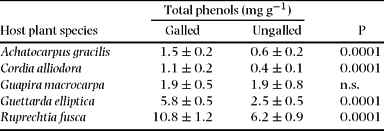
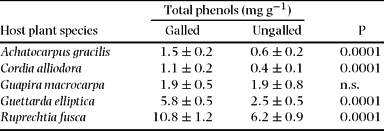
In Chamela-Cuixmala Biosphere Reserve, we found only five galling insect species on their specific host plant species that occurred in both deciduous and riparian sites (Table 1). No significant differences in the plant total phenolic concentrations were found between host plants of deciduous and riparian sites (F = 2.0, df = 1, P > 0.05). However, the results of the t-test for each plant species indicate that four plant species had greater total phenolic concentrations in leaves with galls than in leaves without galls (Table 2).
Mean (± SE) total phenol concentration in galled and ungalled leaves of five host plant species that occur in both deciduous hillside and riparian sites.
In host tree species associated with galls, we found that host total phenolic concentration was significantly greater in smaller than larger plants (Achatocarpus gracilis: χ2 = 4.1, df = 1, P < 0.04; Guettarda elliptica: χ2 = 13.0, df = 1, P < 0.0004; Ruprechtia fusca: χ2 = 25.9, df = 1, P < 0.0001).
Frequency of folivorous insects
In four plant species associated with galls, the frequency of leaves with folivore damage was greater in leaves without galls than in leaves with galls (Table 3). The frequency of folivores was affected by site type. The frequency of leaves with folivore damage was significantly greater in deciduous than in riparian sites (χ2 = 24.4, df = 1, P < 0.0001). The frequency of leaves with folivore damage was greater in leaves without galls than in leaves with galls (χ2 = 92.5, df = 1, P < 0.0001) (Table 4). We found significant differences between plant species in the frequency of folivory (χ2 = 25.7, df = 4, P < 0.0001), the interaction between plant species and site: (χ2 = 24.6, df = 4, P < 0.0001and the interaction between plant species and presence of galling insects: (χ2 = 24.9, df = 4, P < 0.0001), but not for the interaction of site by presence of galling insects (χ2 = 0.74, df = 1, P > 0.05). In addition, we did not find significant differences in the frequency of leaves with folivore damage between shorter and taller plants (χ2 = 0.57, df = 1, P > 0.05).
Mean (± SE) frequency of leaves with damage by folivores and proportion of leaf area removed by folivores on leaves with and without galls in host plant species that occur in deciduous hillside and riparian sites.

Comparison of the frequency of leaves with damage by folivores and proportion of leaf area removed by folivores on leaves with and without galls between deciduous hillside and riparian sites.

Leaf area removed by folivores
Similarly, the proportion of leaf area removed by folivores was significantly greater in leaves without galls than in leaves with galls in four host-plant species (Table 3). The amount of folivore damage was affected by site type. The leaf area removed by folivore insects was greater in deciduous than in riparian sites and different between plant species (χ2 = 164, df = 4, P < 0.0001). The leaf area damaged by folivores was greater in leaves without galls than in leaves with galls (Table 4). There was a significant two-way interaction between plant species and presence of galling insects (χ2 = 218, df = 4, P < 0.0001) but not between plant species and site (χ2 = 2.5, df = 4, P > 0.05) nor between site and presence of galling insects (χ2 = 0.28, df = 1, P > 0.05). The leaf area removed by folivores was not significantly different between smaller and larger plants (χ2 = 0.24, df = 1, P > 0.05).
DISCUSSION
Galling insects and induction of phenolic compounds
Several studies have evaluated the mechanisms of manipulation and alteration of plant development involved in gall formation (Ananthakrishnan Reference ANANTHAKRISHNAN and Ananthakrishan1984, Birch et al. Reference BIRCH, BREWER, ROHFRITSCH, Shorthouse and Rohfritsch1992, Dreger-Jauffret & Shorthouse Reference DREGER-JAUFFRET, SHORTHOUSE, Shorthouse and Rohfritsch1992, Larson & Whitham Reference LARSON and WHITHAM1991, Shorthouse Reference SHORTHOUSE1986). However, little attention has been paid to the manipulation of galling insects on defensive secondary compounds of their host plants (Hartley Reference HARTLEY1998). Controversial results of this chemical manipulation have been reported. In some cases, chemical compounds such as host phenolics are less abundant in the galls than in normal plant tissues (Abrahamson & Weis Reference ABRAHAMSON, WEIS, Slansky and Rodriguez1986, Nyman & Julkunen-Titto Reference NYMAN and JULKUNEN-TITTO2000), while in other cases, galls contain higher concentrations of defence chemicals than in normal tissues (Hartley Reference HARTLEY1998, Hartley & Lawton Reference HARTLEY and LAWTON1992, Vereecke et al. Reference VEREECKE, MESSENS, KLARSKOV, DE BRUYN, VAN MONTAGU and GOETHALS1997). It was originally suggested that phenolics were produced by plants as a defence mechanism against galling insects (Tjia & Houston Reference TJIA and HOUSTON1975, Westphal et al. Reference WESTPHAL, BRONNER and LE RET1981, Zucker Reference ZUCKER1982). However, more recent studies show that host phenolic concentrations are not associated with plant resistance against galling insects (Abrahamson et al. Reference ABRAHAMSON, MCCREA, WHITWELL and VERNIER1991, Hartley Reference HARTLEY1999). In our study, we found that the concentration of phenols was greater in galled than ungalled leaves in four plant species that occur in both deciduous hillside and riparian sites at Chamela-Cuixmala Biosphere Reserve. These results support the nutritional hypothesis that galling insect species have the capacity to stimulate the production of host secondary compounds increasing phenolic concentrations in the surrounding leaf tissue of galled leaves. It has been proposed that gall-induction derives some benefits to their hosts because galling insects stimulate the induction of defence compounds in leaves that confer resistance against other herbivores (Abrahamson et al. Reference ABRAHAMSON, MCCREA, WHITWELL and VERNIER1991, Askew Reference ASKEW and Ananthakrishan1984, Hartley Reference HARTLEY1998, Hartley & Lawton Reference HARTLEY and LAWTON1992).
Galling insects, plant size and host phenolic concentration
Another result of our study shows that cecidomyiids induced the majority of galls in both deciduous hillside and riparian sites of the Chamela tropical dry forest. We found in three plant species associated with galling-insects greater concentration of leaf phenolic compounds in smaller than in larger plants in both sites. This pattern may be explained by two different reasons: (1) because the production of leaf phenolic compounds is a response against galling insect attack (Hartley Reference HARTLEY1998) and (2) because shorter plants represent sites with higher nutritional tissue and undifferentiated meristems that favour the gall induction in the majority of galling insect species because the physiology of gall morphogenesis requires the stimulation by insects to undifferentiated plant tissues (Cuevas-Reyes et al. Reference CUEVAS-REYES, SIEBE and OYAMA2004b, Shorthouse Reference SHORTHOUSE1986, Weis et al. Reference WEIS, WALTON and CREGO1988). In addition, theories of plant allocation to defence would predict that smaller plants which have grown less quickly would have higher levels of phenolics (Hartley & Jones Reference HARTLEY, JONES and Crawley1997). Similarly a previous study showed that shorter plants had greater abundance of galls than larger plants (Cuevas-Reyes et al. Reference CUEVAS-REYES, QUESADA, HANSON, DIRZO and OYAMA2004a, Reference CUEVAS-REYES, SIEBE and OYAMAb, Reference CUEVAS-REYES, QUESADA and OYAMA2006).
Frequency and amount of leaf damage by folivorous insects
We also found that the frequency and amount of folivore damage on ungalled leaves were significantly greater in deciduous than in riparian sites. These results may be explained because in deciduous sites the presence of herbivore insects are synchronized with leaf flushing at the beginning of the wet season (Bullock & Solís-Magallanes Reference BULLOCK and SOLÍS-MAGALLANES1990, Lieberman Reference LIEBERMAN1982, Opler et al. Reference OPLER, FRANKIE and BAKER1980, Reich & Borchert Reference REICH and BORCHERT1984) and some insect herbivores have adjusted their life history to synchronize their youngest larval stages to the appearance of host organs such as shoots and leaves (Taylor Reference TAYLOR1986, Weis et al. Reference WEIS, WALTON and CREGO1988, Yukawa Reference YUKAWA2000), whereas in riparian sites, plants are evergreen and produce new leaves through a more extended period during the wet season (Bullock & Solís-Magallanes Reference BULLOCK and SOLÍS-MAGALLANES1990, Frankie et al. Reference FRANKIE, BAKER and OPLER1974, Opler et al. Reference OPLER, FRANKIE and BAKER1980, van Schaik et al. Reference VAN SCHAIK, TERBORGH and WRIGHT1993). There are differences in soil water content between riparian and hillside sites where trees in the former are mainly evergreen and deciduous in the latter. A few tree species occur in both sites and their intraspecific phenological response is also different between sites. In this case, trees of a given species that occur in riparian sites will be evergreen whereas trees on hillsides of the same species will be deciduous (Bullock & Solís-Magallanes Reference BULLOCK and SOLÍS-MAGALLANES1990, Frankie et al. Reference FRANKIE, BAKER and OPLER1974). Therefore, more availability of younger leaves, during a short period of time, occurs in the deciduous forest than in the riparian evergreen forest in the wet season.
Interactions between galling insects and folivorous insects
Few studies have evaluated the effects of gall induction on host defensive chemical compounds and the subsequent effects of these changes on the incidence of folivorous insects (Foss & Rieske Reference FOSS and RIESKE2004). Simultaneous herbivory by different insect guilds may result in higher selection pressures on host plants that may favour chemical induction (Mooper & Simberloff Reference MOOPER and SIMBERLOFF1995). In our study, we found that gall induction affects the chemical composition of their host plants by increasing phenolic concentration in the surrounding leaf tissue of galled leaves and affecting the subsequent incidence and herbivory levels of defoliators. The reduction of incidence and the leaf area removed in galled plant tissues by folivorous insects in four plant species of both deciduous and riparian sites is consistent with findings obtained in similar studies (Foss & Rieske Reference FOSS and RIESKE2004, Schultz Reference SCHULTZ1992). Two possible ecological interactions may explain the incidence of galling insects and folivores on the same host leaves of the tropical dry deciduous forest. First, massive leaf flushing, at the beginning of the wet season, is a general phenological pattern of the tropical deciduous forests (Bullock & Solís-Magallanes Reference BULLOCK and SOLÍS-MAGALLANES1990, Frankie et al. Reference FRANKIE, BAKER and OPLER1974, Opler et al. Reference OPLER, FRANKIE and BAKER1980) and synchronization of folivores and galling insects to their host phenology is particularly important in the first flush of new leaves of this deciduous forest (Filip et al. Reference FILIP, DIRZO, MAASS and SARUKHÁN1995, Weis et al. Reference WEIS, WALTON and CREGO1988, Yukawa Reference YUKAWA2000). Therefore, it is likely that both folivores and galling insects may directly compete for the same leaf resources but galling insects are better competitors and successfully colonize and displace folivores that would otherwise consume the same leaves. As a result galling insects will competitively exclude folivores. A second explanation is related to the sequestration and induction of host chemical compounds as a result of gall formation assigned to the surrounding host leaf tissue and the gall chamber (Hartley Reference HARTLEY1998, Hartley & Lawton Reference HARTLEY and LAWTON1992). This occurs when galling insects colonize new developing leaves and will indirectly deter folivores through an increase in secondary compounds mediated by galling insect–plant interactions more than the interaction of plants and folivores or folivores and galling insects.
Our results indicate that galling insects may directly affect host plant chemical traits, changing the concentration of foliar phenolics, and indirectly may affect the incidence and leaf-consumption of potential predators such as folivore insects. Schultz (Reference SCHULTZ1992) found that gall induction by several aphids reduce and deter the herbivory of some folivore insects. In this case, galling insects decrease the incidence of folivores. This may have important consequences on the preference of folivorous insects that interact with galling insects in these tropical plant species.
ACKNOWLEDGEMENTS
The authors thank Alfredo Pérez for plant species identification and Nidia Pérez and Gumersindo Sánchez Montoya for technical support and the authorities of Chamela and Cuixmala Biosphere reserve for their permission to conduct this study. This study was partially supported by a scholarship granted by CONACYT and UNAM. Cuevas-Reyes P thanks Programa de Mejoramiento del Profesorado (PROMEP) for their generous support.