Introduction
Studies of the long-term course and outcome of psychosis have tended to focus on those with a diagnosis of schizophrenia (or non-affective psychosis) and to follow cohorts of prevalent cases (Hegarty et al. Reference Hegarty, Baldessarini, Tohen, Waternaux and Oepen1994). Such designs bias samples towards those with poor outcomes (Cohen & Cohen, Reference Cohen and Cohen1984; van Os et al. Reference van Os, Wright and Murray1997) and distort our understanding of long-term prognosis.
Studies of unselected samples of incident cases of all psychoses provide the optimum basis for investigating the variability and determinants of course and outcome over the long term. With the introduction of specialist services for those with a first episode of psychosis in many countries, a new wave of cohorts has been established. Many of these have already reported on short- (1–2 years) to medium- (5 years) term outcomes (e.g. Craig et al. Reference Craig, Garety, Power, Rahaman, Colbert, Fornells-Ambrojo and Dunn2004; Larsen et al. Reference Larsen, Melle, Auestad, Friis, Haahr, Johannessen, Opjordsmoen, Rund, Simonsen, Vaglum and McGlashan2006, Reference Larsen, Melle, Auestad, Haahr, Joa, Johannessen, Opjordsmoen, Rund, Rossberg, Simonsen, Vaglum, Friis and McGlashan2011; Malla et al. Reference Malla, Norman, Bechard-Evans, Schmitz, Manchanda and Cassidy2008; Gafoor et al. Reference Gafoor, Nitsch, McCrone, Craig, Garety, Power and McGuire2010; Nordentoft et al. Reference Nordentoft, Ohlenschlaeger, Thorup, Petersen, Jeppesen and Bertelsen2010; Norman et al. Reference Norman, Manchanda, Windell, Harricharan, Northcott and Hassall2012). However, only a few have reported longer-term outcomes (e.g. Hegelstad et al. Reference Hegelstad, Larsen, Auestad, Evensen, Haahr, Joa, Johannesen, Langeveld, Melle, Opjordsmoen, Rossberg, Rund, Simonsen, Sundet, Vaglum, Friis and McGlashan2012). There are, moreover, still limitations to these cohorts and their capacity to provide generalizable information about the long-term trajectories of psychosis. Some comprise individuals recruited into clinical trials; the extent to which those who take part are representative of those with a first episode is unclear. In addition, many restrict inclusion to those with non-affective psychoses or to narrow age groups (e.g. 16 to 35 years). Studies of unselected samples of incident cases with all psychotic disorders remain rare.
Long-term follow-up studies of first-episode psychosis
To gain some traction on existing findings from long-term (defined here pragmatically as 8 years or more to enhance comparability with our data) follow-up studies of first-episode psychosis, we conducted a review of studies since 1980 drawing, in from prior systematic reviews (Hegarty et al. Reference Hegarty, Baldessarini, Tohen, Waternaux and Oepen1994; van Os et al. Reference van Os, Wright and Murray1997; Menezes et al. Reference Menezes, Arenovich and Zipursky2006; Jaaskelainen et al. Reference Jaaskelainen, Miettunen, Veijola, McGrath, Murray, Jones and Isohanni2008).
Supplementary Table S1 summarizes the methods and main findings on course and outcome from the 13 studies (16 papers) that we identified. There was considerable heterogeneity in reported outcomes. For example, estimates of proportions in remission or recovered (variously defined) at follow-up ranged from 20% (Ciompi, Reference Ciompi1980) to 78% (Thara et al. Reference Thara, Henrietta, Joseph, Rajkumar and Eaton1994). This variability extended to social outcomes. The proportions in paid work at follow-up, for instance, ranged from 19% (White et al. Reference White, Stirling, Hopkins, Morris, Montague, Tantam and Lewis2009) to around 40% (Harrison et al. Reference Harrison, Hopper, Craig, Laska, Siegel, Wanderling, Dube, Ganev, Giel, an der Heiden, Holmberg, Janca, Lee, Leon, Malhotra, Marsella, Nakane, Sartorius, Shen, Skoda, Thara, Tsirkin, Varma, Walsh and Wiersma2001; Harrison & Mason, Reference Harrison, Mason, Hopper, Harrison, Janca and Sartorius2007). What is perhaps most striking is how methodologically diverse these studies are, with little consistency in inclusion criteria, in length of follow-up, and in definitions and measures of course and outcome. For example, there was notable variation in how remission and recovery were operationalized. In some studies remission was defined as total absence of symptoms (e.g. Thara et al. Reference Thara, Henrietta, Joseph, Rajkumar and Eaton1994) and in others as symptoms below a certain threshold (e.g. Crumlish et al. Reference Crumlish, Whitty, Clarke, Browne, Kamali, Gervin, McTigue, Kinsella, Waddington, Larkin and O'Callaghan2009); the time period for achieving remission also varied from 1 month (e.g. Crumlish et al. Reference Crumlish, Whitty, Clarke, Browne, Kamali, Gervin, McTigue, Kinsella, Waddington, Larkin and O'Callaghan2009) to 6 months (e.g. Kurihara et al. Reference Kurihara, Kato, Reverger and Tirta2011). There were similar inconsistencies in how recovery, a concept implying more sustained improvement over time, was defined and operationalized. Furthermore, only three studies were of first-episode cases of all psychoses (Harrison et al. Reference Harrison, Hopper, Craig, Laska, Siegel, Wanderling, Dube, Ganev, Giel, an der Heiden, Holmberg, Janca, Lee, Leon, Malhotra, Marsella, Nakane, Sartorius, Shen, Skoda, Thara, Tsirkin, Varma, Walsh and Wiersma2001; Harris et al. Reference Harris, Henry, Harrigan, Purcell, Schwartz, Farrelly, Prosser, Jackson and McGorry2005; Harrison & Mason, Reference Harrison, Mason, Hopper, Harrison, Janca and Sartorius2007; Hill et al. Reference Hill, Crumlish, Clarke, Whitty, Owens, Renwick, Browne, Macklin, Kinsella, Larkin, Waddington and O'Callaghan2012). In sum, our knowledge of the long-term course and outcome of psychosis is limited both by the methodological heterogeneity of existing studies and by a paucity of epidemiologically robust studies of first-episode cohorts.
AESOP-10
In this context, the AESOP-10 study, a 10-year follow-up of a large epidemiologically characterized sample of first-episode cases of all psychoses, has the potential to provide novel insights into the nature and determinants of long-term trajectories and outcomes. In this lead paper from the study, we provide a detailed account of the procedures and methods used in AESOP-10, and report primary findings on course and outcome across three domains: clinical, social and service use (hospital admissions).
Method
AESOP-10 is a follow-up at approximately 10 years of a cohort of 557 individuals with a first episode of psychosis initially identified in the South East London and Nottingham centres of the Aetiology and Ethnicity in Schizophrenia and Other Psychoses (AESOP) study (Kirkbride et al. Reference Kirkbride, Fearon, Morgan, Dazzan, Morgan, Tarrant, Lloyd, Holloway, Hutchinson, Leff, Mallett, Harrison, Murray and Jones2006). At baseline, a team of researchers screened all in-patient (daily) and out-patient (weekly) mental health services in the catchment areas to identify eligible cases. The sample of 557 comprises all incident cases identified (532) and additional cases identified on a more ad-hoc basis to supplement the brain imaging component of the baseline study (25). In this paper we focus on the 532 incident cases.
Ethics
Full ethical approval for all aspects of the follow-up was provided by the local research ethics committees in South East London and Nottingham. All researchers had substantive or honorary contracts with either the South London and Maudsley National Health Service (NHS) Foundation Trust or the Nottingham Healthcare NHS Trust, the primary participating service providers.
Tracing and recontact procedures
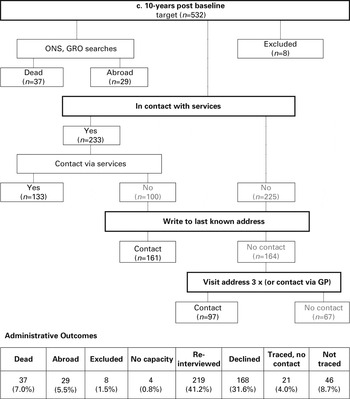
Our procedures for tracing cases were in line with those used in previous long-term follow-up studies (e.g. Harrison et al. Reference Harrison, Hopper, Craig, Laska, Siegel, Wanderling, Dube, Ganev, Giel, an der Heiden, Holmberg, Janca, Lee, Leon, Malhotra, Marsella, Nakane, Sartorius, Shen, Skoda, Thara, Tsirkin, Varma, Walsh and Wiersma2001). At approximately 10 years after inclusion in the baseline study, we sought to trace, recontact and reinterview all cases. When identified and recruited originally, detailed recontact information was collected for all cases. We began by establishing whether cases were currently in contact with mental health services. For those who were, we sought to make contact and invite them to participate through their clinical teams. For those who were not, we sent letters to their last known address inviting them to participate. Non-responders were sent a further letter 2 weeks later and, if necessary, researchers made a maximum of three visits to the address (morning, afternoon and evening) to make initial contact. For those who had moved address, and for whom we had general practitioner (GP) contact details, we sought to make contact and invite them to participate through their GP (see Fig. 1). All deaths and emigrations up to and including those that occurred on 12 December 2012 were identified by a case-tracing procedure with the Office for National Statistics (ONS) for England and Wales and the General Register Office (GRO) for Scotland using name, sex, date of birth and last known address.
Flow chart documenting how cases were traced and administrative outcomes. ONS, Office for National Statistics, for England and Wales; GRO, General Register Office for Scotland.

Data at baseline
At baseline, information was collated on clinical presentation and basic sociodemographic characteristics, and assessments were completed with cases on a range of putative biological, psychological and social risk factors (Morgan et al. Reference Morgan, Dazzan, Morgan, Jones, Harrison, Leff, Murray and Fearon2006). Baseline ICD-10 and DSM-IV diagnoses were determined, using data collected with the Schedules for Clinical Assessment in Neuropsychiatry (SCAN; WHO, 1992), on the basis of consensus meetings involving one of the principal investigators and other members of the research team.
Data at follow-up
Clinical course and outcome
At follow-up, extensive information was collated across three course and outcome domains (clinical, social and service use) from clinical records and, where possible, from follow-up interviews with cases and treating clinicians using an extended version of the World Health Organization (WHO) Life Chart (Sartorius et al. Reference Sartorius, Gulbinat, Harrison, Laska and Siegel1996; see also Burns et al. Reference Burns, Creed, Fahy, Thompson, Tyrer and White1999; Harrison et al. Reference Harrison, Hopper, Craig, Laska, Siegel, Wanderling, Dube, Ganev, Giel, an der Heiden, Holmberg, Janca, Lee, Leon, Malhotra, Marsella, Nakane, Sartorius, Shen, Skoda, Thara, Tsirkin, Varma, Walsh and Wiersma2001). The extended version adapted the original Life Chart to include more items on substance use, medication and service contacts and to include a timeline (following Wiersma et al. Reference Wiersma, Nienhuis, Slooff and Giel1998) to document, month by month where possible, presence of psychotic symptoms and contacts with mental health services. In interviews with cases, we used significant anchor dates to orientate subjects and assist recall and, as appropriate, interviews were structured around key events, such as hospital admissions. Using all available information, researchers painstakingly reconstructed case histories over the follow-up period. The primary course and outcome parameters and variables derived from the Life Chart are detailed in Supplementary Table S2.
In addition, information on current symptoms at follow-up (i.e. the preceding month) was collected using the SCAN (WHO, 1992).
Remission
In line with Andreasen et al. (Reference Andreasen, Carpenter, Kane, Lasser, Marder and Weinberger2005), we defined remission as absence of overt psychotic symptoms (operationalized as a score of 2 or 3 on Rating Scale 2 in the SCAN; 0 = absence, 1 = symptom occurred, but fleeting, 2 = symptom definitely present, 3 = symptom present more or less continuously) for a period of at least 6 months. We defined symptom recovery as sustained remission for at least 2 years.
Consensus ratings and diagnosis
We adopted a consensus approach to Life Chart clinical ratings and lifetime diagnoses. At weekly meetings involving principal investigators, researchers presented detailed summaries of the clinical symptomatology and course and outcome for each case based on information collated from clinical records and interviews with cases and other informants. These formed the bases for consensus ratings of: (a) variables in the Life Chart relating to the occurrence and nature of psychotic episodes and substance use during the follow-up period; and (b) lifetime ICD-10 and DSM-IV diagnoses. A conservative approach was adopted such that positive ratings of, for example, presence or absence of psychotic symptoms were only made if there was definite evidence.
Social
Information on sociodemographic markers of social function and integration across several domains (i.e. housing, employment, relationships, education and social networks) during and at follow-up was collected using the Life Chart. In this paper we present illustrative data on employment and relationship status.
Mental health service use
Information on the nature and types of contacts with specialist mental health services and prescription of and compliance with antipsychotic medication throughout the follow-up was collated using the Life Chart, which was expanded to include a timeline to document, month by month, contacts with services and more detail on each hospital admission and community contact (i.e. dates of admission or contact, mode of contact, source of referral, etc.).
Analysis
We described primary outcomes using frequencies and percentages and means or medians and standard deviations or interquartile ranges (IQRs). Comparisons by sex, baseline diagnosis (non-affective versus affective) and study centre were made using χ2 tests, t tests, ANOVAs and rank sum tests and, for time to first remission, Kaplan–Meier survival curves and log rank tests and, for number of admissions, Poisson regression. Analyses were conducted using Stata version 11 (Stata Corporation, USA).
Results
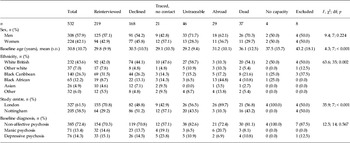
At follow-up, of the 532 incident cases initially identified, 37 (7.0%) had died: a mortality rate of 739/100 000 person-years; standardized mortality ratio (SMR) 3.59 (95% CI 2.60–4.96). Twenty-nine (5.5%) had emigrated and eight (1.5%) were excluded on the basis of information not available at baseline. Of the 458 remaining, 412 (90.0%) were traced successfully. Of these, 219 (53.2%) were reinterviewed, four (1.0%) lacked capacity (due to dementia or head trauma) and 189 (45.8%) could not be contacted or declined reinterview (Fig. 1). Those who had died tended to be older and were more likely to be men; those who had emigrated were more likely to be of black African ethnicity and from London; those who were not traceable were more likely to be men and have a diagnosis of a non-affective psychosis (Table 1).
Baseline demographic characteristics and diagnosis by administrative outcome

s.d., Standard deviation; df, degrees of freedom.
Core analytic sample
After removing those who had died, emigrated or been excluded, useable information on clinical course and outcome across one or more of our three domains was available on 387 (84.5% of 458) cases for at least 8 years of follow-up (our core analytic sample), a combined total of 4141 years of follow-up (mean length of follow-up = 10.7 years, s.d. = 1.2, range 8.1–13.7).
When we compared cases with some information for at least 8 years with those without, there was no evidence of systematic differences by age, sex, ethnicity, duration of untreated psychosis, baseline employment, baseline diagnosis, mode of initial contact with mental health services or study centre (Supplementary Table S3). There was some evidence that those for whom we did not get some information were more likely to have had an acute onset. When we considered source of information (case reinterview versus no case reinterview) among those with data for at least 8 years, the only differences were in relation to length of follow-up (slightly shorter for reinterview group) and study centre (cases in London were more likely to have been reinterviewed) (Supplementary Table S4).
Long-term course and outcome
Clinical
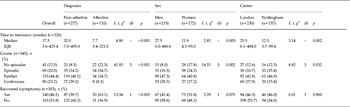
In our core sample, there was marked variability in clinical course (Table 2). Eighty cases (23% of 345, missing 42) did not experience a remission of psychotic symptoms of 6 months or more at any point during the follow-up (i.e. continuous). Of these, symptoms were rated as severe in 23 (29% of 80; 7% of 345) and negative symptoms were a marked feature of the clinical picture in 37 (46% of 80; 11% of 345). At the other end of the spectrum, 43 (13% of 345) had a remission of symptoms within 6 months of first contact and remained symptom free for the duration of the follow-up; a further 69 (20% of 345) did have further episodes after initial remission, but none lasting more than 6 months (i.e. episodic). The remaining cases (153, 44% of 345) formed an intermediate group that had had at least one remission of 6 months or longer and at least one episode of 6 months or longer (i.e. neither continuous nor episodic). In total, 265 (77%) had at least one remission during the follow-up period, with a median time to first remission of 18 weeks (IQR 6–425). At follow-up, 213 (65% of 326, missing 61) were not experiencing psychotic symptoms and 140 (46% of 303 for whom complete data were available, missing 84) had been free of psychotic symptoms for the preceding 2 years or more (i.e. met criteria for symptom recovery). It is notable that, among the 228 cases for whom we had reliable information (75% of 303 with data on recovery), 56% of those who were recovered (57 of 101) had been prescribed antipsychotic medication in the 2 years prior to follow-up, compared with 86% (109 of 127) of those not recovered (χ2 = 24.6, df = 1, p < 0.001). (Note that all cases were, at some point, prescribed antipsychotic medication.) Across all indicators, those with an initial diagnosis of a non-affective psychosis, men and London cases were more likely to experience a worse clinical course and outcome (Table 2 and Supplementary Fig. S1).
Clinical course and outcome

IQR, Interquartile range; df, degrees of freedom.
Clinical course types
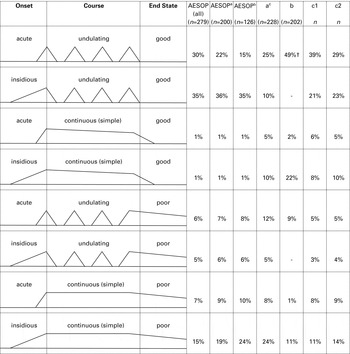
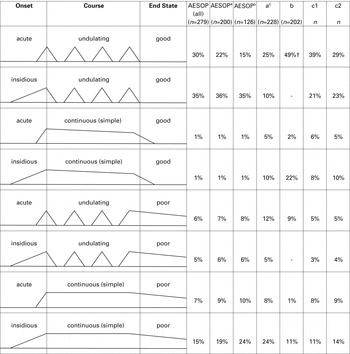
Combining data on overall course type and clinical status at follow-up (i.e. in episode or not) with information on mode of onset, we were able to categorize cases according to the course types originally specified by Bleuler (Reference Bleuler1978). Figure 2 illustrates these and presents the frequencies and percentages for our sample (by diagnosis) alongside those reported by Bleuler (Reference Bleuler1978), Ciompi (Reference Ciompi1980) and Harrison et al. (Reference Harrison, Hopper, Craig, Laska, Siegel, Wanderling, Dube, Ganev, Giel, an der Heiden, Holmberg, Janca, Lee, Leon, Malhotra, Marsella, Nakane, Sartorius, Shen, Skoda, Thara, Tsirkin, Varma, Walsh and Wiersma2001). In all studies, an undulating course (i.e. episodic and neither continuous nor episodic) with good outcome was the most common (percentages in each study range from 35% to 65%); a chronic course with poor outcome was much less common (percentages in each study range from 12% to 32%).
Frequency (%) of course types, schematized following (a) Bleuler (Reference Bleuler1978) (schizophrenia), (b) Ciompi (Reference Ciompi1980) (schizophrenia) and (c) Harrison et al. (Reference Harrison, Hopper, Craig, Laska, Siegel, Wanderling, Dube, Ganev, Giel, an der Heiden, Holmberg, Janca, Lee, Leon, Malhotra, Marsella, Nakane, Sartorius, Shen, Skoda, Thara, Tsirkin, Varma, Walsh and Wiersma2001) (c1 all psychoses; c2 schizophrenia). a Non-affective psychoses only. b Schizophrenia only. c Modestin et al. (Reference Modestin, Huber, Satirli, Malti and Hell2003) re-evaluated cases in Bleuler's study, using operationalized criteria based on current standards and DSM-IV and ICD-10 criteria, and found that the proportions of cases with undulating and continuous courses did not vary much from those reported by Bleuler (e.g. 58% with undulating course in original study versus 48–49% in re-evaluation).
Social
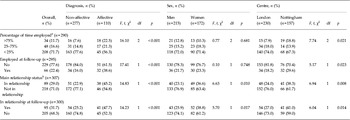
Using employment and relationship status as illustrative indicators of social outcomes, there was strong evidence that the marked social exclusion present among cases at baseline (e.g. 28% of cases employed versus 55% of controls; 71% of cases not in a relationship versus 39% of controls; Morgan et al. Reference Morgan, Kirkbride, Hutchinson, Craig, Morgan, Dazzan, Boydell, Doody, Jones, Murray, Leff and Fearon2008) persisted through the follow-up period. For example, only a small minority of cases in our core sample had been in paid work for over 75% of the follow-up period (34 of 290; 12%). A slightly larger proportion had been employed for between 25% and 75% of the follow-up (48; 17%). The overwhelming majority, however, had been employed for less than 25% of the time (208, 72%). These low levels of employment were evident at follow-up, with only 66 (22%) being in paid work 10 years after initial presentation to mental health services. The proportions of the general populations in paid employment around the time of follow-up in each of the areas from which cases were recruited were: 67% in Lambeth, South East London; 62% in Southwark, South East London; and 49% in Nottingham (www.nomisweb.co.uk/census/2011/key_statistics). With regard to relationship status, a majority of cases were single for most of the follow-up (218, 71%) and at follow-up (205, 68%). Unfortunately, comparable data for general populations on relationship status are not available. Those with a baseline diagnosis of non-affective psychosis and London cases were more likely to experience poor outcomes in these domains (Table 3). Furthermore, these findings suggest that social exclusion emerges before or early after onset and persists over the long term. Of those cases in our core follow-up sample who were not employed at baseline, only 15% (34 of 223) were in employment at follow-up. Similarly, of those not in a relationship at baseline, only 16% (33 of 210) were in a relationship at follow-up.
Markers of social course and outcome

df, Degrees of freedom.
a Of the 97 for whom it was not possible to estimate percentage of total follow-up employed, 65 (67%) had no information on employment during the follow-up, 19 (20%) had at least one period of not being employed, 12 (12%) had at least one period of being employed, and one (1%) had at least one period of not being employed and one period of being employed.
b Of the 80 for whom it was not possible to determine main relationship status during the follow-up, 63 (79%) had no information on relationship status during the follow-up, seven (9%) had been in a relationship at some point, and 10 (13%) had been single at some point.
Service use: hospital admissions
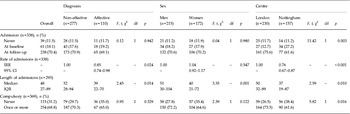
Only 39 cases (12% of 338 on whom information was available) were never admitted to hospital at any point, 61 (18%) were admitted at initial presentation only and 238 (70%) were admitted at least once during the follow-up. Including first presentation, the median number of admissions was 2 (IQR 1–4, maximum number of admissions 20), with a small number of cases having 10 or more admissions (21, 6%). Considered differently, the admission rate was 0.31 [95% confidence interval (CI) 0.29–0.33] per year of follow-up or approximately one admission every 3 years. The median length of admission was 48 days (IQR 27–89) (number in analysis 293), and the median proportion of the follow-up spent in hospital was 2.5% (IQR 0.7–8.0) or around 14 weeks over an average of 520 weeks (10 years) of follow-up (number in analysis 327). The rate and length of admission tended to be less for those with an affective disorder and for those in Nottingham; the length, but not rate, of admission tended to be less for women (Table 4). Furthermore, 254 (69%) were compulsorily admitted to hospital either at first presentation or at some point during the follow-up (number in analysis 369), with compulsory admissions being more common in London (Table 4).
Hospital admissions

IRR, Incidence rate ratio; CI, confidence interval; df, degrees of freedom.
Discussion
Our follow-up provides novel data on the long-term course and outcome of all psychoses in a large unselected sample of incident cases. We found notable heterogeneity in clinical course and outcome. Only a minority of cases experienced continuous symptoms, with no periods of sustained remission, and less than half of these were rated as experiencing severe or negative symptoms. By contrast, almost half had been free of clinically significant psychotic symptoms for the 2 years prior to follow-up. This mirrors the findings for hospital admissions: high rates and long periods of admissions for a minority and low rates and relatively short admissions for a majority. For social outcomes, the picture was reversed: poor outcomes for a majority and good (or better) outcomes for a minority. Interpretation of the proportions with good outcomes, however, should be considered alongside the high mortality rate we found in this sample (see also Saha et al. Reference Saha, Chant and McGrath2007).
Methodological issues
In general, long-term follow-up studies face the twin problems of selection and information bias arising from loss to follow-up and missing or inaccurate data respectively.
In an attempt to minimize attrition, we were exhaustive in our efforts to trace cases and to establish deaths and emigrations. We were able to determine the whereabouts or status of over 90% of the cohort. When we compared those with some information available on course and outcome for 8 years or more with those without, there was (with the exception of mode of onset) no strong evidence of systematic bias. This does not rule out selection bias, but it does suggest attrition is unlikely to have seriously affected our findings.
Perhaps more problematic is the potential for information bias. We made use of all possible sources of information to complete the Life Chart, and clinical ratings were made by consensus after careful consideration of all available information. The extent and quality of information we had for each case, however, inevitably varied. The impact of this is difficult to assess. When we compared course and outcome variables by source of information, there was evidence that those for whom we did not have reinterview data experienced a shorter time to first remission and were less likely to have a continuous course of disorder (Supplementary Table S5). We were very careful to only make ratings of presence or absence of symptoms on the basis of clear and definite information and it may indeed be that those who we did not reinterview did have better clinical outcomes. However, it is also possible that this apparent difference stems from uneven availability of information. Patients do not always disclose symptoms to clinicians and clinicians do not always accurately record what patients say. Consequently, it is possible that periods of remission were overestimated for those who we were not able to reinterview. Furthermore, completeness of information was inevitably less for those we did not reinterview. This urges caution in interpreting our results. For example, we found that clinical course and outcome were better in the Nottingham sample; at the same time, cases in Nottingham were less likely to be reinterviewed. In addition, across all cases in our core analytic sample, completeness of data was patchy because of incomplete case records and limited recall over what was, on average, a 10-year period.
Long-term course and outcome of psychoses
As indicated from our review, there is a dearth of long-term follow-up studies of incident cases of all psychoses, and differences in both study methods and location mean comparisons must be tentative.
This noted, within the context of marked heterogeneity in clinical course and outcome, our estimate that around 23% of all cases (rising to around 30% for non-affective psychoses) experienced a continuous course is notably lower than that found in the WHO International Study of Schizophrenia (ISoS) (i.e. 33% for all psychoses at 15 years), the only other follow-up of an incidence cohort of all psychoses that reports on overall course that we are aware of (Harrison et al. Reference Harrison, Hopper, Craig, Laska, Siegel, Wanderling, Dube, Ganev, Giel, an der Heiden, Holmberg, Janca, Lee, Leon, Malhotra, Marsella, Nakane, Sartorius, Shen, Skoda, Thara, Tsirkin, Varma, Walsh and Wiersma2001). In a more direct comparison, our estimate of the proportion with a continuous course for Nottingham (15%) is also lower than for the Nottingham centre in the ISoS (24%) (Harrison & Mason, Reference Harrison, Mason, Hopper, Harrison, Janca and Sartorius2007). As noted, the lower rate of reinterview in Nottingham may bias estimates towards a good outcome in our Nottingham sample, but this has to be set against the overall tendency for those with an acute onset (and therefore possibly better outcomes) to be lost to follow-up. We will further examine site differences in future publications.
Considered the other way around, 12% (9% for non-affective) of our sample recovered within 6 months of contact with services and did not have a further episode, 20% (14% for non-affective) never had an episode lasting more than 6 months, and around 50% (40% for non-affective) had not experienced symptoms in the 2 years prior to follow-up. Because of differences in the assessment of course and recovery in previous studies, direct comparisons are difficult. For example, only two first-episode studies from Europe have reported on the proportion who, following remission of the first episode, remained symptom free; the reported proportions were in line with ours (12% in Wiersma et al. Reference Wiersma, Nienhuis, Slooff and Giel1998; 7% in Möller et al. Reference Möller, Jager, Riedel, Obermeier, Strauss and Bottlender2010). In the studies we reviewed, estimates of proportions recovered, variously defined, ranged from 20% (Ciompi, Reference Ciompi1980) to 61% (Harrison & Mason, Reference Harrison, Mason, Hopper, Harrison, Janca and Sartorius2007), the higher estimates being from studies of incident cases of all psychoses (e.g. Harrison et al. Reference Harrison, Hopper, Craig, Laska, Siegel, Wanderling, Dube, Ganev, Giel, an der Heiden, Holmberg, Janca, Lee, Leon, Malhotra, Marsella, Nakane, Sartorius, Shen, Skoda, Thara, Tsirkin, Varma, Walsh and Wiersma2001) and from studies that defined recovery cross-sectionally (i.e. did not require absence of symptoms for 2 or more years) (Thara et al. Reference Thara, Henrietta, Joseph, Rajkumar and Eaton1994). This noted, our finding that around 40% of those with a non-affective disorder were symptomatically recovered is very similar to what Robinson et al. (Reference Robinson, Woerner, McMeniman, Mendelowitz and Bilder2004) found over a 5-year follow-up period in their study of 118 first-episode schizophrenia cases (47%) initially recruited to a study of the application of a medication algorithm in clinical practice. This is striking and, together with our findings, suggests that roughly half of those who develop a psychosis will eventually recover symptomatically, suggesting much previous outcome research in schizophrenia and psychosis has provided overly pessimistic views of clinical course and outcome. Insofar as diagnosis should provide information about prognosis, non-affective disorders do generally follow less favourable trajectories than affective disorders (Harrow et al. Reference Harrow, Grossman, Jobe and Herbener2005), but there is still considerable variability within these diagnostic groups.
Perhaps unsurprisingly, our findings on hospital admissions mirror those on clinical course and outcome, that is a high number of admissions and long in-patient stays for a minority and infrequent and relatively short admissions for most. There are very few comparable data in previous studies. White et al. (Reference White, Stirling, Hopkins, Morris, Montague, Tantam and Lewis2009) did find a similar polarization of service use, with most of their sample over a 10-year period having a small number of admissions and a minority (18%) having more than 10. We found that only 6% of our sample had more than 10 admissions.
By contrast, using employment and relationship status as markers, social outcomes were poor for a majority of cases. At follow-up, only 22% were employed (compared with between 49% and 67% in the areas from which cases were originally recruited). This is broadly in line with previous studies. White et al. (Reference White, Stirling, Hopkins, Morris, Montague, Tantam and Lewis2009), for example, found that 48% of their sample of 109 first admission cases followed at 10 years had never worked and only 19% were employed at follow-up. In their 10-year follow-up of participants in the Treatment and Intervention in Psychosis (TIPS) trial of early detection, Hegelstad et al. (Reference Hegelstad, Larsen, Auestad, Evensen, Haahr, Joa, Johannesen, Langeveld, Melle, Opjordsmoen, Rossberg, Rund, Simonsen, Sundet, Vaglum, Friis and McGlashan2012) found that only 11% of the detection as usual group and 28% of the early detection group were in full-time employment. Comparing across contexts is of course problematic because employment levels are affected by local socio-economic factors. Nonetheless, other studies that have used different measures and markers similarly suggest generally poor social outcomes (Supplementary Table S1). Perhaps most notably, our findings suggest that poor social outcomes reflect a persistence of social exclusion evident at first presentation, with only small proportions of those out of work (or single) moving into employment (or a relationship) by the 10-year end-point (around 15%).
Conclusions
In the analyses presented here, we purposefully considered clinical and social markers of course and outcome separately. In doing so, a discrepancy was evident: symptom remission and recovery is more common than social (re)integration following a first episode of psychosis. This points to a significant challenge for mental health services: improving social outcomes. It does so, however, without obscuring the finding that sustained symptom remission is possible for many with a psychotic disorder, a positive finding that goes against the still common view that non-affective psychotic disorders, especially schizophrenia, are chronic and deteriorating. This finding has important clinical implications; several recent reports have pointed out that psychiatrists who hold an overly pessimistic view of the outcome of psychosis can transmit this view to their patients, thereby rendering it a self-fulfilling prophecy (UK Schizophrenia Commission; www.schizophreniacommission.org.uk; Zipursky et al. Reference Zipursky, Reilly and Murrat2013). The focus of forthcoming analyses of AESOP-10 data will be to identify tractable predictors of both clinical and social outcomes that can be targeted to improve long-term trajectories of psychoses.
Supplementary material
For supplementary material accompanying this paper visit http://dx.doi.org/10.1017/S0033291714000282.
Acknowledgements
This work was supported by the UK Medical Research Council (Ref. G0500817) and the Department of Health through the National Institute for Health Research (NIHR) Specialist Biomedical Research Centre for Mental Health award to the South London and Maudsley NHS Foundation Trust (SLaM) and the Institute of Psychiatry at King's College London.
Declaration of Interest
R. Murray has received honoraria from Janssen, Astra-Zeneca, Lilly, BMS and Roche, and is an editor of Psychological Medicine.