




No CrossRef data available.
Article contents
Language for emotions in adolescents with externalizing and internalizing disorders
Published online by Cambridge University Press: 12 May 2005
Abstract
This study compared the structure and quality of emotion language in adolescents with externalizing disorders (N = 21), internalizing disorders (N = 18), and without a behavioral or emotional disorder (N = 16). Emotion language was elicited in response to vignette material prototypical for anger/sadness and fear, to autobiographical experiences, and to an actual emotional challenge. The findings reveal different emphases in the emotion language of internalizing and externalizing youth rather than a relative weakness for externalizing adolescents. Overall, clinical adolescents used fewer emotion terms that were semantically specific for anger, sad, or fear than typical adolescents. The results also show that emotion language is affected differentially for externalizing and internalizing adolescents depending on the emotion domain. Internalizing youth's emotion language to anger/sad events used inner-directed terms, situational references, and reduced intensity while their representation of emotions in response to salient threatening material was dominated by terms with a cognitive focus. Externalizing adolescents' emotion language responses to anger/sad events were more outer directed and intense, and their emotion language in a salient threat situation more orientated to direct affective terms. The results suggest that examining emotion language for specific emotion domains in adolescents with specific disorders will better clarify the role of emotion language in the regulation of emotions than approaches that globalize emotion language competencies or deficits.
Information
- Type
- Research Article
- Information
- Copyright
- © 2005 Cambridge University Press
Evidence is accumulating of a strong connection between children's talk about emotions with their families and peers and subsequent social abilities such as their sensitivity to other's feelings, their prosocial behaviors, and their understanding of emotions (Denham & Grout, 1993; Dunn, Brown, & Beardsall, 1991; Dunn, Brown, Slomkowski, Tesla, & Youngblade, 1991; Eisenberg & Fabes, 1998; Hughes & Dunn, 1998). This association, taken together with the consistent finding that talk about emotions and their causes is more frequent and varied for negative emotions than for positive emotions (Burger & Miller, 1999; Dunn, Brown, & Beardsall, 1991), supports the contention that emotion language is a crucial mechanism for the socialization of emotions and for the development of emotion regulatory abilities (Clancy, 1999; Kopp, 1989; Miller & Sperry, 1987). Emotion talk in the family and with peers also provides the foundation for children's linguistic representation of their own and of others' emotions, so the findings of an association between variability in the quantity and quality of this talk and social and emotional competencies point to an important role for emotion language in the development and maintenance of problems in emotional regulation characteristic of psychological disorders.
There are two sets of research that illuminate this role with varying clarity. The clearest and most interesting data come from studies of emotion language in children with a history of maltreatment, neglect, or abuse. The affective climate of families in which maltreatment occurs is often highly negatively charged with adults who have their own difficulties expressing, recognizing, and regulating negative emotions. It is not surprising, therefore, that evidence from observational studies shows that children subjected to such environments use fewer internal state words (Coster, Gersten, Beeghly, & Cicchetti, 1989; McFadyen & Kitson, 1996), produce proportionately fewer internal state words describing negative affect (Beeghly & Cicchetti, 1994), have greater difficulty in identifying and labeling negative emotional experiences, particularly sadness and anger, and in inferring appropriate negative emotions in social situations (Rogosch, Cicchetti, & Aber, 1995). Overall, these children display a lexicon for internal states that is restricted in range and quantity (Cicchetti, Beeghly, Carlson, & Toth, 1990) compared to nonmaltreated children. Some of this evidence suggests that abilities in recognizing, articulating, and inferring negative emotions mediate the link between maltreatment and behavioral dysregulation (i.e., externalizing problems), but not the association between maltreatment and deficits in social effectiveness (i.e., internalizing problems; Rogosch et al., 1995).
This later finding is consistent with the general conclusion from studies directly comparing children and adolescents with psychological disorders with nondisordered children on specific emotional competencies (Casey, 1996; Casey & Schlosser, 1994; Cook, Greenberg, & Kuche, 1994; Ivins, 1998; Jenkins & Greenbaum, 1999; Merrum Terwogt, 1989; Merrum Terwogt, Schene, & Koops, 1990; Muchmore, 1998; Southam–Gerow & Kendall, 2000; Taylor & Harris, 1986). These studies show that hypothesized differences between children with behavioral and emotional problems and nonproblem children in the ability to represent emotions and describe the causes of emotions is most strongly supported for children with externalizing problems. Children and adolescents with externalizing problems produce fewer words and verbal expressions for emotions (Cook et al., 1994; Muchmore, 1998), display an emotion lexicon which is less semantically specific (Casey, 1996; Cook et al., 1994) and of reduced range (Cook et al., 1994; Muchmore, 1998), and show a paucity of words that focus on cognitive states (Muchmore, 1998). The evidence in regard to explaining the causes of emotions is less clear with evidence of no difference between externalizing children and youth and their nonproblem peers (Merrum Terwogt et al., 1990), as well as evidence of a higher reliance on situational explanations by externalizing children and youth at the expense of more mentalistic accounts (Casey, 1996; Cook et al., 1994; Ivins, 1998). In contrast, studies examining internalizing children and youth suggest that they show deficiencies in their self-reported knowledge of emotions regulation strategies rather than in their ability to represent emotions in language and articulate the causes of emotions (Casey, 1996; Southam–Gerow & Kendall, 2000). However, a recent longitudinal study (Fine, Izard, Mostow, Trentacosta, & Ackerman, 2003) found that the ability to accurately recognize and label emotions in 7-year-old children from economically disadvantaged families predicted self-reported internalizing problems at age 11.
Although such findings may have theoretical and clinical implications with regard to enhancing emotion regulation in disordered children and youth (Southam–Gerow & Kendall, 2002), a number of important conceptual and methodically considerations caution against too readily accepting the conclusions that the differences noted for children and adolescents with externalizing problems represent a general “weakness” (Casey, 1996) or developmental delay (Cook et al., 1994). Equally, such considerations suggest that the conclusion that children and adolescents with internalizing problems do not have significant difficulties in emotion language and basic emotion understanding abilities (Casey, 1996; Southam–Gerow & Kendall, 2000) may be premature.
The most important of these are limitations to internal validity stemming from poor sensitivity of the measures of emotion language and emotional understanding competencies used. For example, Casey's studies (Casey, 1996; Casey & Schlosser, 1994) assessed children's verbal description of emotion in terms of their success or failure in accurately reporting their emotions and evaluated these reports in terms of a 3-point ordinal scale representing “increasing sophistication.” Several other studies (Cook et al., 1994; Southam–Gerow & Kendall, 2000) report comparative analysis using the development stage summary or global score from instruments like the Kusche Affective Interview—Revised (Beilke, Kusche, & Greenberg, 1988) or the Emotional Understanding Interview (Cassidy, Parke, Butkovsky, & Braungart, 1992), which are derived from adult raters' judgments of the children and adolescents' reasoning based on verbal accounts. However, these studies either failed to specify the language dimensions that index the “sophistication” of emotion reports or provide dimensions for developmental stage rankings that are impressionistic. Using only composite measures across various kinds of emotions (positive and negative, simple and complex, other directed and self-focused) for participants who often vary widely in age reduces the likelihood of uncovering important between-group differences for particular emotions or emotion types. The evidence coming from developmental research portrays a more complex picture with what is age-appropriate emotion language depending on the type of emotion (Burger & Miller, 1999; O'Kearney & Dadds, 2004; Wellman, 1995) and its complexity (Ferguson & Stegge, 1995). In addition, some of the observational studies sample emotion understanding in nonaffective or “positive” situations. These types of contexts are not predominant in producing talk about emotions and their causes (Beeghly & Cicchetti, 1994; Dunn & Brown, 1993), and are unlikely to be the most relevant for describing emotional language difficulties in disordered groups with putative difficulties regulating negative emotions.
These considerations formed the basis for our decision to examine emotion language in groups of adolescents with emotional and behavioral disorders using a comprehensive and sensitive classification framework of emotion language. The emotion language samples are elicited in a controlled setting and focus on negative emotion contexts. We choose to study 13- to 17-year-olds because of evidence that typical adolescents have a good appreciation of the complexity of emotional experience (Donaldson & Westerman, 1986; Reimer, 1996), show differentiation in the range and complexity of their emotion referents and explanations, are able to deal with and articulate mixed emotions and have access to the diversity of emotion language that characterizes advanced language users (O'Kearney & Dadds, 2004). We know little, however, about the quality of this language in adolescents with clinically significant emotional or behavioral difficulties.
The current study also addresses the lack of research using equivalent methods to compare the emotion language of adolescents with different types of psychological disorders. There are good reasons to believe that comparison between adolescents with externalizing problems and those with internalizing problems may be informative as this division is based, in part, on theoretical considerations about different mechanisms for the socialization of emotions. In particular, the internalizing/externalizing interpretation of the original factor analytic symptom clustering (Achenbach, 1966) reflected a number of dichotomies such as differing modes of social learning (antisocial vs. over socialized learning), different directions in the management of anger and hostility (extropunitive vs. intropunitive), and different ways of handling conflict between self and societal needs (undercontrol vs. overcontrol). The question that this study takes up is whether such differences are reflected in the nature of language used to represent and explain negative emotions.
The work we report here classifies emotion language using a comprehensive model that integrates theories of emotion language (O'Kearney & Dadds, 2004). The model makes several distinctions. The first distinction is semantic (Shaver, Schwartz, Kirson, & O'Connor, 1987; Storm & Storm, 1987) and differentiates emotion referents among basic negative emotion classes (anger, sad, fear), negative referents not within these semantic classes and self-focused negative emotion terms. This category also includes classes for positive, and positive self-focused emotion terms. The second distinction relates to the referential domains initially proposed by Ortony and colleagues' work (Ortony, Clore, & Collins, 1988; Ortony, Clore, & Foss, 1987) and differentiates between terms used to describe emotions that refer to external or situational conditions (situational domain), those that describe internal physical, expressive, or action states or dispositions (expressive/behavioral domain), those that refer specifically to pure emotional states (affective domain), and those that focus on cognition (cognitive domain). The affective and cognitive domains together make up a subjective/experiential domain.
Our classification model also examines the quality of the emotion referent according to how basic the term is (Shaver et al., 1987; Storm, Jones, & Storm, 1996), its intensity (e.g., furious vs. annoyed) and involvement. Involvement refers to one aspect of the motivational dimension of emotional language (Osgood, Suci, & Tannenbaum, 1957; Wundt, 1916), and is identified by a range of language devices such as modal verbs and adverbs, epistemic verbs, and linking verbs (Caffi & Janney, 1994). Speakers use these types of devices to express their involvement with emotions in terms of linguistic behavior either by “‘living’ one's involvement or … suppressing it” (Hubler, 1987, p. 373). The use of involvement and noninvolvement devices and intensity markers can be seen as manifestations of avoidant or approach strategies (Wiener & Mehrabian, 1968).
Our classification model also draws a distinction between external/situational causes and internal causes in youth's explanations of the causes of emotions (Harris, 1994). Internal causes refer either to the desire of the person in relationship to the emotion eliciting event or to his or her beliefs about that event. In addition, as many emotions have intentional objects to which they refer (e.g., anger at, sad about), the object is included as a fourth aspect. In addition to these categorical divisions, the classification model includes an assessment of the complexity of the causal accounts.
This study investigates differences in the emotion language between clinical groups and their nonproblem peers and between adolescents diagnosed with externalizing disorders and those with internalizing disorders. Based on existing findings, we predict that clinical adolescents' emotion language will show fewer and a more limited semantic range of emotion referents than nonproblem adolescents' emotion language as well as greater use of emotion terms that are not semantically specific. The quality of clinical youth's emotion language will be more basic, intense, and involved than that of nonproblem youths. In addition, clinical youth will use fewer subjective/experiential and more situational emotion referents than nonproblem youth. In regard to causal explanations of emotions, we predict that clinical youths will provide less complex accounts and focus less on internal causes. Our study is the first to directly compare the emotion language of adolescents with different types of psychological disorders. We hypothesize that the predicted difference between clinical and nonproblem youth will be more pronounced for externalizing than internalizing youth. In addition, we anticipate specific differences between the clinical groups in emotion language shown by externalizing youth's preferential use of outer- versus inner-directed emotion terms, situational, and expressive/behavioral versus subjectivist references (affective and cognitive domains) and external versus internal causes.
Method
Participants
The clinical sample was recruited from referrals to the Psychology Clinic at the University of New South Wales for a group program to enhance coping skills and resilience in 13- to 17-year-olds. Referrals came from adolescent mental health services, private practitioners, school counselors, and schools with special services for adolescents with emotional and behavioral problems. Nonclinical participants were recruited from local schools via study information sheets and consent forms distributed to students and their parents. Adolescents were excluded from the study if their referring school or health professional identified them as having significant language delay, intellectual impairment or a pervasive developmental disorder, or childhood onset schizophrenia. For referred adolescents the Diagnostic Interview Schedule for Children and Adolescents and Parents (DISCAP; Holland & Dadds, 1995) based on the adolescent as informant was administered by a clinical psychologist at an initial meeting, and those who meet the diagnostic criteria for a primary internalizing or externalizing disorder and their parents or guardians were informed about the study. Written consent from the adolescents and their parent or guardian was obtained. The DISCAP was administered to all nonreferred participants prior to them taking part in the study. Participation was voluntary and no remuneration or incentives were offered.
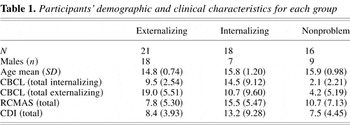
Fifty-five adolescents (age range = 14.00–17.11 years, M = 15.48 years, SD = 1.15 years; 34 males) took part in the study. Table 1 presents demographic and clinical characteristics for each group. The internalizing group consisted of 18 adolescents (10 with a primary diagnosis of major depressive disorder or episode, 5 with generalized anxiety disorder, 2 with social phobia, and 1 with panic disorder with agoraphobia). The externalizing group consisted of 18 adolescents with oppositional defiant disorder and 3 with conduct disorder. There was comorbidity for attention-deficit/hyperactivity disorder in both groups with nine participants receiving this diagnosis in the externalizing group and three in the internalizing group. Nonprimary diagnoses in the internalizing group indicated all comorbidity among this group was for an anxiety disorder (two with obsessive–compulsive disorder; two with panic disorder, and one with specific phobia). Nonprimary diagnosis in the externalizing group consisted of one participant also receiving a diagnosis of panic disorder. None of the nonproblem adolescents warranted a diagnosis. All participants were currently living with their parent(s) or guardian.
Participants' demographic and clinical characteristics for each group

Measures
The DISCAP (Holland & Dadds, 1995) has excellent interrater reliability for identifying the presence of a primary externalizing disorder or internalizing disorder (κ = .93, N = 120) based on the adolescent's report, and has good concurrent validity with scores on the externalizing and internalizing dimensions of the Child Behavior Checklist (CBCL; Johnson, Barrett, Dadds, Fox, & Short, 1999). After the diagnostic interview participants completed the Children's Depression Inventory (CDI; Kovacs, 1992) and the Revised Children's Manifest Anxiety Scale (RCMAS; Reynolds & Richmond, 1985). The CBCL (Achenbach, 1991) was completed by each participant's mother or father.
Materials
The emotion-relevant material included two vignettes, two autobiographical emotional tasks, and an actual emotional challenge. The two vignettes contained the theoretical conditions of events that elicit either anger/sadness (Vignette 1) or fear (Vignette 2) based on Shaver et al.'s (1987) empirical work and Stein and colleagues' goal-directed approach to the organization of emotional experience (Stein & Levine, 1990; Stein, Trabasso, & Liwag, 1993). Both vignettes emphasized the interpersonal aspects of the event and the quality of important relationships (Whitesell, Robinson, & Harter, 1993) and also included achievement themes (Strayer, 1986). Hence, although the vignettes contained the requisite condition for anger/sadness and fear, respectively, their complexity ensured that a range of emotion terms would be elicited. Vignette 1 described an interpersonal conflict between close friends where the protagonist's friend reveals to others in their peer group potentially hurtful information about the protagonist that was told to the friend in confidence. Vignette 2 developed an expectation of achievement by the protagonist in an important classroom situation that is suddenly threatened and replaced by possible failure in front of a peer group and teacher. The vignettes have been shown to be age relevant and valid for eliciting diverse and extensive emotion language (O'Kearney & Dadds, 2004). After the presentation of each vignette, participants were asked to recall an event that happen to them in which they experienced “the same kind of feelings” to those elicited by the vignette. They were asked to think about that experience and describe it to themselves in their mind as vividly as they could. For the actual emotional challenge participants were told that after the study they would be asked to give a brief talk to a group of children on a given topic and that the other children would rate their talk and give them feedback. The actual challenge involved the threat of potential criticism or failure and a disruption to expected plans. The actual challenge was included to increase the range of emotion eliciting events, to maximize the salience of the emotion-relevant material, and to assess emotion language in a context with a relatively high and immediate affective charge.
Two sets of experimental instructions and vignettes were recorded matching participant's gender to the content of the vignettes. The order of recording of the material was Vignette 1, autobiographical event for relevant emotions, Vignette 2, autobiographical event for relevant emotions, and actual emotion challenge. Each relevant emotion went for 90 s and then there was a 90-s pause between the end of one set of material and the commencement of the next.
Procedure
Experimental sessions were conducted individually with each participant and consisted of two activities. Each participant viewed and listened to the videocassette instructions rating out loud the intensity of his or her feeling state on a 0 (no feeling) to 10 (extreme feeling) scale at the beginning, middle, and end of the presentation of the emotion-relevant material. These ratings were prompted by a low volume beep on the videocassette instructions. The experimenter recorded the rating. The participant was videorecorded during the presentation of the emotion-relevant materials. On completion of the presentation of the emotion-relevant materials, the participant was debriefed regarding the actual challenge that was not carried out and then watched the video of him or herself during the first phase. Beginning with the start of the presentation of Vignette 1 the participant watched 30 s of the recorded videotape and then was asked by the experimenter the following three questions: Describe how you felt. What was making you feel that way? What were you feelings about? When it was clear that the participant had exhausted their response to the questions the experimenter then presented 30 s of the tape beginning at the commencement of the next emotion-relevant material (i.e., autobiographical 1). This process was repeated for the five emotion-relevant events. The experimenter prompted or directed the participant if he or she was clearly answering in respect to the wrong emotion-relevant material. The intensity rating could be used as a prompt, for example, You rated your feeling at this point as eight. What type of feeling was it? The experimenter could alter the wording of the questions in minor ways to help comprehension provided there no specific emotion terms, or causes or reasons for emotions were provided to the participant. For example, the experimenter could request more specific answers by questions such as What sort of feelings were they? or What caused that feeling? The participant's response to the video mediated interview procedure was audiorecorded for later transcription.
Coding categories and procedures
Transcripts were segmented into minimal terminal units (T-units) defined as language units grammatically carrying meaning or communicating an idea (Hunt, 1965; McFadyen & Kitson, 1996). The text of the three standard questions was considered in judging a segment as a T-unit. The first step in the coding procedure was to identify all words, phrases, or word groupings in each participant's transcript that constituted a T-unit. Measures of T-unit frequency, average number of words per T-unit (mean length of T-unit) and total number of words were calculated as indices of overall verbal and syntactic competence (Beeghly & Cicchetti, 1994; McFadyen & Kitson, 1996). Words in the standard question were not included as part of the T-unit measures.
All T-units containing a reference either to the participant's emotion or to the vignette protagonist's emotion were coded. Emotion referents were identified on the basis of (a) lexical meaning, which included all clear instances of emotion words (e.g., angry, sad, bad); (b) usage in context such as words marked by I felt, I was, She felt, and so forth; (c) the direct response to the first question Describe how you were feeling?; and (d) the judges' intuition of the T-unit as a reference to an emotion. Judges used and could refer to the transcript context of the identified token for purposes of judgment or classification. Words, phrases, or word groupings that referred to emotions of people other than the participant or the vignette protagonist were not coded. Each emotion referent was then coded within two broad categories, (a) an Evaluative category and (b) a Referential category, and rated along three dimensions (Differentiation, Involvement, and Intensity).
Evaluative category
The Evaluative category consisted of eight mutually exclusive classes: (a) Referents whose hedonic tone is clearly negative were classified in one of three semantic classes (Anger; Sad; Fear, e.g., mad, like hitting him, sad, scared) or as other negative (Other Negative, e.g., bad, cheated, confused); (b) Self-focused referents (Self-focused Negative) were those with a clear negative hedonic tone that focus on judgments of the participant's self (Lewis, 1993; e.g., embarrassed, guilty, humiliated); (c) Positive referents (Positive) included those whose hedonic tone is clearly positive (e.g., pleased, happy); (d) Self-focused referents (Self-focused Positive) were those with a clear positive hedonic tone that focus on judgments of the participant's self (e.g., proud); and (e) Unclear referents (Unclear) were those that the raters were unable to judge as negative or positive (e.g., didn't care, felt nothing).
Referential category
The Referential classification divided all language used to describe emotional experience into four mutually exclusive domains (Ortony et al., 1987, 1988). The external conditions or situational domain (Situational) included terms that while not referring directly to an internal state have a high affective quality. These terms either described aspects of the person in relation to the world (e.g., feel abandoned, alone, let down, violated) or evaluations of the person that may be elicited in others (e.g., feel helpless, foolish). Internal state emotion terms were divided into an expressive/behavioral domain (Expressive/Behavioral) including references to bodily states and activities such as hurt, tense, small, exhausted, as well as referents with a predominantly behavioral focus (e.g., like smashing her), and two subjective/experiential domains according to whether the referent focuses predominantly on affect (e.g., sad, mad, angry, annoyed; Affective Domain), or on cognition (e.g., confused, distrusting, regret; Cognitive Domain; Ortony et al., 1987).
Dimensions
The Differentiation dimension referred to the degree to which the emotion referent was prototypical of the emotion (Shaver et al., 1987). The least differentiated referents were the most prototypical and referred to “basic” emotion terms (e.g., sad, mad, scared), while the more differentiated referents were more complex (e.g., disappointed, furious, guilty). The Involvement dimension related to the degree of commitment to the emotion referent and was identified by linguistic modifiers reflecting degree of confidence with respect to the referent such as modal auxiliary verbs (may/might feel; would/could feel) and adverbs (obviously/possibly), epistemic verbs (know I feel/think I feel), and linking verbs (is/seems; Caffi & Janney, 1994). The final dimension, Intensity, related to the strength of the emotion referent identified either by lexical contrast (e.g., annoyed, angry, furious), or by adjectives or adverbs of degree (e.g., very, a little). Each of the three dimensions was rated on a 3-point Likert scale. For the Differentiation dimension, 1 = least differentiated and 3 = most differentiated. For the Involvement and Intensity dimensions, unmarked emotion referents = 2, those marked by modifiers to lessen involvement or intensity = 1, and those modified to increase involvement or intensity = 3.
Causal structure
The transcript for each vignette was searched for references to the cause of an emotion. Causal referents were identified by (a) the presence of a causal connector (e.g., because), (b) a lexical causative (e.g., made me feel), (c) prepositional connector denoting a causal relationship (e.g., felt at, over, from, about, of, etc.; Dirven, 1997), (d) direct elicitation in response to the questions or prompts about cause (e.g., What made you feel that way?), or (e) any other reference judged to be linked causally to the emotion referent. As with emotion references, judges could refer to the broader transcript to judge a word or phrase as a causal referent and for categorizing and rating.
Each causal referent was coded for reference to one of four types of causes. These were (a) Situational conditions (Situation) where the causal referent referred to an external situation, that is, the context, or action of another or self (e.g., because he told the secret); (b) an internal state (Desire) reflecting a desire identified by use of specific desire state word (e.g., I wanted to do well, I wished she'd kept the secret); (c) an internal state (Belief) reflecting a belief identified by use of specific knowledge state words (e.g., I thought friends could be trusted, I believe he wanted to get me in trouble), and (d) a causal referent (Object) identifying references to the target or object of the emotion (e.g., I was angry at him, at myself). In addition, the causal referent was rated on a 3-point Likert scale in terms of complexity (Complexity) from simple single-dimensional cause to more complex multidimensional cause.
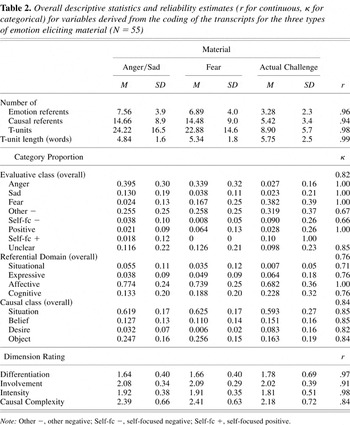
Two masters level clinical psychologists blind to the clinical group of the participants acted as coders. Interrater reliability estimates (Pearson correlation [r] and intraclass kappa [κ]) are included in Table 2. The judges showed strong agreement in their identification of overall production of words and of T-units and for the identification of referents as emotion and causal references. There was good agreement on the ratings of the Differentiation, Involvement, Intensity, and Causal Complexity dimensions. The range of intraclass kappas for Evaluative classes, the Referential domains, and the Causal classes indicated moderate to good reliability for these classifications.
Overall descriptive statistics and reliability estimates (r for continuous, κ for categorical) for variables derived from the coding of the transcripts for the three types of emotion eliciting material (N = 55)

Results
Preliminary analyses
To confirm the integrity of the groupings, DISCAP classifications were compared with the potential classifications based on CBCL clinical cutoffs (Achenbach, 1991) and the groups were compared on measures of specific psychopathology. There was good agreement between the classification based on DISCAP and the CBCL clinical cutoffs (κ = .76). The differences between the two clinical groups on the CBCL internalizing and externalizing scores were significant in the expected directions, t (34) = 2.68, p < .01, and t (34) = 3.46, p < .01, respectively. In addition, the two clinical groups each scored significantly higher than the nonproblem group on the internalizing scale, t (29) = 5.69, p < .001, and t (35) = 3.68, p < .001, for the internalizing and externalizing groups, respectively, and on the externalizing scale, t (29) = 2.33, p < .02, and t (35) = 5.73, p < .001, for the internalizing and externalizing groups, respectively. The internalizing group reported significantly higher RCMAS total anxiety, t (38) = 3.86, p < .01, and t (33) = 2.46, p < .02, and CDI total depression, t (38) = 4.24, p < .01, and t (33) = 2.27, p < .03, than the externalizing group and the nonproblem group, respectively. The externalizing and nonproblem groups were not different on these measures, t (36) = 1.13, p > .13, and t (36) = .43, p > .33, for RCMAS and CDI scores, respectively. There was a significant difference between the groups on mean age, F (2, 50) = 8.35, p < .01, with the externalizing group significantly younger than the internalizing group and nonproblem group. The groups also differed in the proportion of the two genders, with the externalizing group having a higher proportion of males, χ2 (2, N = 55) = 9.24, p < .01.
Table 2 presents the overall descriptive statistics and reliability estimates for the variables coded from the transcripts. The data for the story and autobiographical tasks were combined because there were no significant effects of Material (vignette vs. autobiographical) or Group × Material interaction for either the anger/sad material, F (2, 51) = 1.08, p > .30, and F (2, 51) = 1.07, p > .35, or fear material, F (2, 51) = .49, p > .48, and F (2, 51) = 1.94, p > .15, and because the production of emotion referents in each Evaluative class for the story and for the autobiographical task were significantly correlated (average r = .48 and .45 for the anger and fear material, respectively).
Comparative analysis
The probability of occurrence of each class or domain, PropCat (i), for each participant was calculated as a proportion of each participant's total number of emotion referents for the Evaluative classes or Referential domains and as a proportion of each participant's total number of causal referents for Causal classes:

where η is the production frequency for a particular category class/domain (i) and n is the total number of classes/domains. This calculation controlled for differences between participants in the total number of emotion and causal referents allowing meaningful comparisons using parametric statistical techniques. Examination of the frequency histograms of the proportion variables with the normal distribution as an overlay indicated some degree of divergence from normality for a number of them particularly those with high nonoccurrence rates. Although there was a moderate improvement in normality with square root transformation, the improvement was not consistent across the variables; consequently, the analysis used the more interpretable untransformed proportions.
To test predictions about the semantic range of emotion referents we undertook separate multivariate analyses of covariance for the Evaluative category for the three types of emotion-relevant materials treating PropCat(i) as a repeated-measures variable with the number of levels equal to the number of classes and entering group (Clinical, Nonproblem) as an independent variable controlling for age and verbal ability (number of T-units, mean T-unit length) by entering them as covariates. This analysis tested for the equivalence of the clinical and nonproblem groups across their profile of referents for the evaluative classes. Because of nonequivalence of the variance–covariance structure on the PropCat(i) variables and considering the unequal sample sizes, conservative Pillai's criteria was used to evaluate multivariate significance (Tabachnick & Fidell, 1989). Specific predictions about differences between the clinical and nonproblem group and between the externalizing and internalizing groups were tested with analysis of variance using two orthogonal planned contrasts with age and number of T-units and mean T-unit length entered as covariates. For each type of material, we tested predictions about the specificity of emotion terms by comparing the groups on the proportion of emotion referents classified into the primary semantic class and on the proportion classified as Other Negative. Other comparisons tested predicted differences in production frequency of emotion and causal referents, in the proportion of emotion terms in the subjective/experiential, expressive/behavioral and situational referential domains, for internal referents and causes, and for the average ratings on the Differentiation, Intensity, Involvement, and Complexity dimensions. The specification of two planned and orthogonal contrast protects against inflated type 1 error involved in using multiple comparisons (Tabachnick & Fidell, 1989). Additional exploratory analyses comparing the nonproblem group with the internalizing and externalizing groups separately were undertaken only when the omnibus test for that measure was significant. It was decided to set type 1 error levels at α = .05 for the planned contrasts and use a more conservative level (α = .01) for any post hoc contrasts. One-tailed tests are used to evaluate the significance of the comparisons for the directional hypotheses.
Number of emotion and causal referents
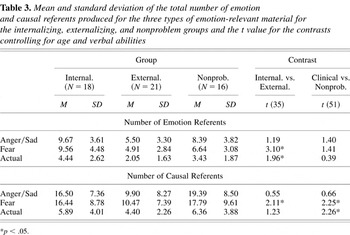
Table 3 presents the mean and standard deviation for the total number of emotion referents and total number of causal referents for the three sets of emotion-relevant materials (Anger/Sad, Fear, Actual Challenge) broken down by group. When age and verbal abilities were taken into account the expected superiority in production of emotion referents for nonproblem adolescents was not significant for any type of material. However, this equivalence was due to the inclusion of the internalizing clinical group with the externalizing group producing significantly fewer emotion referents than the internalizing group for the fear material and actual challenge. With regard to explanations of emotions, clinical participants produced significantly fewer causal referents than nonproblem adolescents for fear relevant material and externalizing youth significantly fewer causal referents than their internalizing peers.
Mean and standard deviation of the total number of emotion and causal referents produced for the three types of emotion-relevant material for the internalizing, externalizing, and nonproblem groups and the t value for the contrasts controlling for age and verbal abilities

Evaluative category
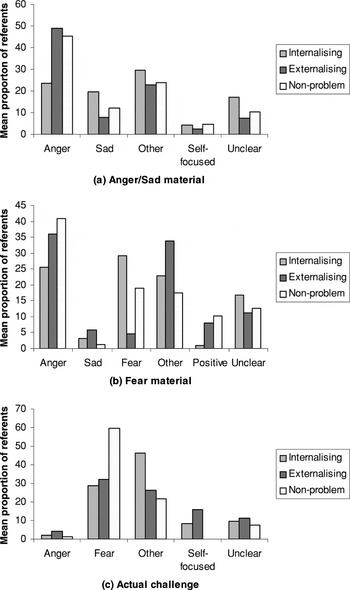
The profiles for the three groups across the Evaluative classes for the anger/sad material, fear material, and actual challenge are presented in Figure 1. Fear, Positive, and Self-focused Positive classes for the anger/sad material, Self-focused Negative and Self-focused Positive classes for the fear material, and Sad, Positive, and Self-focused Positive classes for the actual challenge were eliminated from further analysis because of very low production frequency.

The mean proportion of emotion referents in each Evaluative class for each group for the (a) Anger/Sad material, (b) Fear material, and (c) Actual challenge.
With regard to the anger/sad material, there was no evidence of the clinical group producing a narrower range of referents (Pillai trace = .047), F (4, 45) = .56, p > .69, nor were their referents less well specified, t (51) = .83, p > .4, and t (51) = .52, p > .3, for Anger and Other Negative, respectively. The internalizing and externalizing groups' emotion referents were also no different in their degree of specification, t (35) = .29, p > .7, Other Negative, but the clinical groups differed in their use of inner-directed versus outer-directed referents with the internalizing group producing a significantly greater proportion of referents classified as Sad, t (35) = 2.23, p < .03, and smaller proportion classified as Anger, t (35) = 2.37, p < .02. Separate post hoc comparisons of the two clinical groups with the nonproblem group indicated no significant differences for sad or anger referents.
In response to the fear material, the clinical group and the nonproblem group did not differ in their profile of referents across the Evaluative classes (Pillai trace = .095), F (5, 47) = .99, p > .43, and the difference for nonspecified referents favoring the clinical group failed to reach significance, t (51) = 1.57, p = .06, Other Negative. However, there was evidence that externalizing adolescents produce fewer semantically specific emotion referents than internalizing adolescents, t (35) = 2.62, p < .01, Fear referents, and there was a trend for externalizing adolescents to produce a higher proportion of Other Negative referents, t (35) = 1.49, p = .07. For specific Fear referents, the two clinical groups did not differ individually from the nonproblem group, t (30) = 1.17, p > .2, and t (33) = 1.40, p > .1, for the internalizing and externalizing groups, respectively.
The actual challenge also produced overall equivalent ranges of referents for clinical and nonproblem adolescents (Pillai trace = .164), F (4, 46) = 2.53, p > .07. The clinical group produced a significantly smaller proportion of specific Fear referents, t (51) = 2.67, p < .01, than the nonproblem group but the difference in production of Other Negative referents was not significant, t (51) = 1.36, p > .1. There were no differences between the internalizing and externalizing groups in their degree of specification of emotion referents in response to the actual challenge, t (35) = .28, p > .7, and t (35) = 1.17, p > .2, for Fear and Other Negative, respectively, and the lesser production of specific Fear referents by the clinical groups compared to the nonproblem group did not reach significance, t (30) = 2.34, p < .02, and t (33) = 2.32, p < .02, internalizing and externalizing groups, respectively.
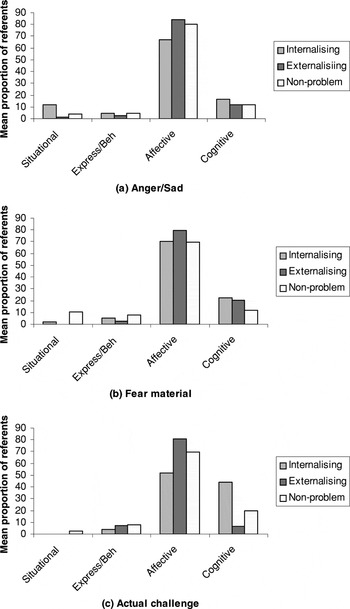
Referential category
The profiles for the three groups across the Referential domains for the anger/sad material, fear material, and actual challenge are presented in Figure 2. The comparison of PropCat(i) across the referential domains allows assessment of the mix of Situational, Expressive/Behavioral, and Subjective/Experiential (Affective, Cognitive) emotion references for the three groups. Specifically, it tests the prediction of less subjective/experiential emotion language for clinical adolescents particularly those with externalizing problems.

The mean proportion of emotion referents in each Referential domain for each group for the (a) Anger/Sad material, (b) Fear material, and (c) Actual challenge.
For the anger/sad material the combined clinical groups did not differ from the nonproblem group on any of the Referential domains for the Situational, t (51) = 1.12, p > .2; Expressive/Behavioral, t (51) = .17, p > .8; Affective, t (51) = .84, p > .4; and Cognitive domains t (51) = .50, p > .6. Against expectation, the internalizing group produced a significantly higher proportion of Situational referents than the externalizing group, t (35) = 2.34, p < .02. There were no significant differences between the two clinical groups on the proportion of referents in any other of the Referential domains for the Expressive/Behavioral, t (35) = .05, p > .9; Affective, t (35) = 1.85, p > .07; and Cognitive domains, t (35) = .99, p > .3. The preferential use of Situational referents by the internalizing group compared to the nonproblem group failed to reach significance, t (30) = 2.11, p < .04.
For the fear material, the combined clinical groups differed significantly from the nonproblem group in producing a smaller proportion of referents in the Situational domain, t (51) = 2.19, p < .03, but was equivalent to the nonproblem group for the other domains, t (51) = 1.43, p > .1; t (51) = .23, p > .8; and t (51) = 1.58, p > .1, for the Expressive/Behavioral; Affective; and Cognitive domains, respectively. The internalizing and externalizing groups were not significantly different in the proportion of referents produced in any of the Referential domains, t (35) = .53, p > .5; t (35) = .55, p > .5; t (35) = .65, p > .5; and t (38) = .01, p > .9, for the Situational; Expressive/Behavioral; Affective; and Cognitive domains, respectively.
In response to the actual challenge, the combined clinical groups did not differ from the nonproblem group in the proportion of referents in any of the Referential domains, t (51) = 1.67 p > .1; t (51) = .17, p > .8; t (51) = .44, p > .6; and t (51) = .71, p > .4, for the Situational; Expressive/Behavioral; Affective; and Cognitive domains, respectively. Compared to the externalizing group the internalizing group produced a significantly smaller proportion of referents that were classified in the Affective domain, t (35) = 2.07, p < .04, and a significantly larger proportion in the Cognitive domain, t (35) = 3.55, p < .001. The two clinical groups did not differ on the other domains for Situational, t (35) = .06, p > .9, and Expressive/Behavioral domains, t (35) = .79, p > .4. Although the internalizing group produced a larger proportion of Cognitive domain referents than the nonproblem group, this difference failed to reach significance, t (30) = 2.22, p < .03.
Differentiation, Involvement, and Intensity
There were no significant differences between the combined clinical group and the nonproblem group on Differentiation, Intensity, and Involvement for any type of material and no difference between the clinical groups for the fear material. In response to the anger/sad material, the internalizing group produced referents that were rated as more differentiated than those produced by the externalizing group, t (35) = 1.99, p < .05, but their referents were less intense, t (35) = 2.08, p < .04, and less involved, t (35) = 2.10, p < .04. In response to the actual challenge, the internalizing group produced referents rated as more differentiated, t (35) = 2.45, p < .02, and more intense, t (35) = 2.45, p < .02, than the externalizing group but as equally involved, t (35) = .43, p > .6.
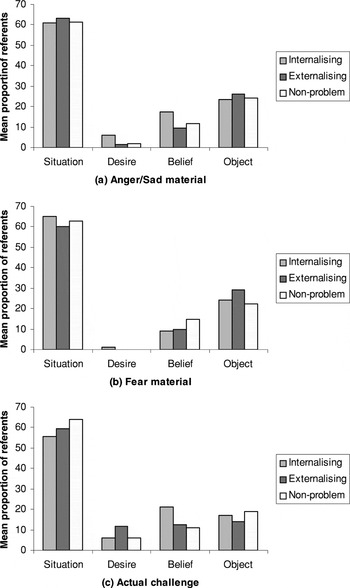
Causal classes and complexity
The mean proportion of referents in each of the Causal classes for the groups are presented in Figure 3 for the anger/sad material, fear material, and actual challenge. There were no significant differences between the groups on the mean proportion in each causal class. However, there was a trend for the internalizing group to produce a higher proportion of Belief referents than externalizing group in response to the Actual challenge, t (35) = 1.97, p < .06.

The mean proportion of emotion referents in each Causal class for each group for the (a) Anger/Sad material, (b) Fear material, and (c) Actual challenge.
The combined clinical groups mean complexity rating for causal referents produced to the fear material was significantly smaller than that of the nonproblem group, t (51) = 2.01, p < .05, but not different for the anger/sad material, t (51) = .81, p > .4, or for the actual challenge, t (51) = 1.72, p > .09. The externalizing group's causal referents were rated as significantly less complex than the internalizing group's for the anger/sad material, t (35) = 2.02, p < .04, and fear material, t (35) = 2.45, p < .01. The difference for the actual challenge failed to reach significance, t (35) = 1.67, p < .10. The internalizing group and the nonproblem group were equivalent in the mean complexity rating of their causal referents to fear material, t (30) = .30, p > .7, while the externalizing group's causal referents were rated as less complex than those of the nonproblem group for the fear material, t (33) = 2.84, p < .01.
Male only data
The very small number of females in the externalizing group prevented inclusion of gender as a covariate in the main multivariate analyses and planned contrasts. A post hoc analysis using data for the male only subgroups of our internalizing, externalizing, and nonproblem youth (N = 7, 16, 8) indicate that the important differences between internalizing and externalizing youth remain significant. The externalizing males produced significantly fewer emotion referents than internalizing males for the fear material, t (21) = 3.44, p < .002, and actual challenge, t (21) = 3.57, p < .002. In response to the anger/sad material internalizing males produced a significantly greater proportion of Sad, t (20) = 2.02, p < .05, and smaller proportion of Anger, t (20) = 2.10, p < .04, emotion referents than externalizing males. For fear material externalizing boys produced fewer semantically specific Fear referents than internalizing boys, t (21) = 2.29, p < .03. In response to the actual challenge internalizing males produce significantly more emotion referents classified in the Cognitive domain, t (21) = 2.02, p < .05. Difference between the combined clinical male group and nonproblem males for the actual challenge in terms of specific Fear referents was not significant, t (28) = 1.36, p > .18.
Discussion
The results of this study clarify the documented deficits in the emotion language of adolescents with or at risk for developing externalizing problems (Beeghly & Cicchetti, 1994; Casey, 1996; Casey & Schlosser, 1994; Cook et al., 1994; Coster et al., 1989; Merrum Terwogt, 1989). Controlling for verbal abilities externalizing adolescents' emotion language is less frequent, less complex, and makes less use of semantically specific emotion terms than that of nonproblem adolescents. However, the findings that clinical adolescents' emotion language overall shows the same semantic range of emotion terms as their nonproblem peers, and that both type of clinical adolescents use less specific emotion terms and show a deficiency for explanations of emotions, particularly in response to salient threatening events, argue against a general weakness in emotion language particular to externalizing youth (Casey, 1996; Cook et al., 1994; Southam–Gerow & Kendall, 2000). As well, both types of clinical adolescents provide profiles of emotion referents across the behavioral/expressive, situational, and subjectivist/experiential domains and use a mix of situational and internalist causal accounts that are broadly similar to that of the nonproblem adolescents. Such findings are not consistent with the depiction of externalizing youth as having developmentally less advanced construals of emotions than other adolescents (Casey, 1996; Cook et al., 1994).
Unlike in previous work the depressed and anxious adolescents in the current study also show emotion language deficits or relative differences indicating that difficulties in basic emotional competencies exist alongside the previously noted problems in their knowledge of emotions regulation strategies (Cook et al., 1994; Southam–Gerow & Kendall, 2000). They display poor emotion language specificity to a threatening challenge and impoverished production of explanations for emotions to such material. Internalizing adolescents are also less likely to use anger terms and more likely to use sad terms in response to anger/sad material than both externalizing and nonproblem adolescents. They produce more externalized, situational references than externalizing youth in response to anger/sad material. This preference for inner-directed emotion referents (sad) in the semantic structure of emotion language and for situational terms in the referential structure is puzzling. It suggests on one hand that internalizing youth are more likely to represent emotion in response to material or events where the features eliciting anger and sadness overlap (Stein et al., 1993) as inner-directed sadness rather than anger while at the same time preferring an external representation of this emotion. One explanation for this apparent discrepancy may be that although emotion referents within the semantic set of sadness are more predominant for adolescents with depression or anxiety, their references within this domain are shaped by their enhanced “success” in using situational avoidance in regulating their negative emotions resulting in a preference for representing negative emotions in situational terms.
Internalizing adolescents are also significantly more cognitively focused in their linguistic representation of emotions and less focused specifically on affect than both their nonproblem and externalizing peers. They also tend to produce a larger proportion of internalist/belief accounts in their explanation of the causes of emotions in the actual challenge situation than externalizing youth. These data suggest differing emphases in respect to making sense of emotions in salient threat-related contexts. In particular, internalizing adolescents can be described as hypercognizant about such events with a dominant emotion representation in cognitive terms while externalizing and nonproblem adolescents focus more closely on their immediate affective response. Whether this cognitively dominant linguistic focus is typical of both types of internalizing youth (depressed and anxious) requires further work comparing emotion language between the narrow-band syndromes. In addition, given that this pattern of responses was observed only to the actual challenge in a relatively small sample, this important finding requires further evaluation.
The data from this study in respect to putative indices of approach/avoidance (Involvement, Intensity) in emotion language are equivocal. Although involvement markers did not differentiate the three groups of adolescents in their talk about fear events, there were significant differences for the intensity markers with externalizing youth's emotion language in response to the salient threat event less intense than that of the depressed and anxious adolescents. A reciprocal difference in use of intensity modifiers was noted for the anger/sad material. The depressed and anxious adolescent's emotion language in response to the anger/sad vignette was rated as less involved than the externalizing adolescents' language. It is hard to integrate these data, and overall they may reflect limitations in the measures of the intensity and involvement dimensions. Although clearly specified and reliable, the ordinal scale used may not have provided enough discrimination along these dimensions to detect important between-group differences. In addition, while the measures are conceptually related to approach and avoidance in language (Caffi & Janney, 1994), the particular features of these functional aspects of intensity and involvement markers are not well understood.
There are a number of limitations to the current study. The very small number of females in the externalizing group complicate inferences about between-group differences even though the groups had gender distributions that are representative of their respective populations. Although inspection of the male only data support the general thrust of the current findings, the reduced power because of small sample size, the post hoc nature of these analysis, and their reduced external validity are clearly not completely satisfactory ways of dealing with this issue. Rather than investigating unrepresentative samples, future work could overcome this problem by examining and contrasting the emotion language of adolescents within and between narrow-band diagnoses for specific emotion domains and consider or eliminate gender as a factor as appropriate. Such a focus is also in keeping with the present results in regard to the importance of the differing types of emotion-eliciting events or emotion domains for internalizing and externalizing youth. There are restrictions to inferences that arise out of the discourse context in which the emotion language samples were elicited that apply here because of the nature of the discourse task, interview responses about emotion prompted by an adult's questions. There are also limitations to external validity due to the range and nature of the emotion-relevant materials. Until there is some comparable data, it is not known to what degree the conclusions from the study apply to emotion language produced in real life contexts such as family or peer discourse about emotions, situation of high disclosure about emotions, for example, in assessment of psychological problems or in psychotherapy, or in observational studies using other types of materials. There are limitations due to procedural constraints such as the single order of presentation of the materials that may impact on material-related differences. The consistent low frequency of the occurrences for some of the domains in the referential category is problematic. The issue of low counts for some measures is an enduring one in research using language measures, and one that can only be resolved through the accumulation of data from a variety of discourse contexts. In general, emotion language produced in experimental or quasiexperimental situations must always be seen to represent only a sample corpus of the total corpus of emotion words, expressions, and their syntactic and grammatical patternings available.
Despite these limitations, the results support the utility and sensitivity of the classification model as a theoretically justified approach to examining the structure and quality of emotion language. Importantly, the findings suggest that emotion language may be affected differentially for externalizing and internalizing adolescents depending on the nature of the emotion-eliciting event. In particular, they show that internalizing youth's emotion language responses to anger/sad events are characterized by innerdirected semantic terms, situational references such as feel alone, let down, and emotion referents of reduced intensity and involvement while their representation of salient threatening material is dominated by cognitive terms, for example, feel full of doubt, apprehensive. Externalizing adolescents' language responses to anger/sad events are more outerdirected and intense, and their emotion language in a salient threat situation less cognitive and more affect orientated, for example, peeved off, scared. The results of this study, therefore, support a move away from conceptualizations that globalize emotion language competencies or deficits toward considerations of emotion language structure and function within specific emotion domains. Similarly, the present results highlighting disorder specific aspects of the linguistic representation of emotions challenge a generic approach to psychoeducation about emotions. The results argue for the development of tailored psychoeducation approaches to emotions in which the clinician both listens to and appreciates the emotion language “dialect” for specific emotions of the particular group while attempting to expand emotion language to highlight problematic semantic and referential aspects. For example, for depressed and anxious youth this would include introducing a more purely affective or experiential language while for externalizing youth the focus would be on developing the semantic specificity of their emotion language and the extent of “explanatory” emotion terms. The degree to which such tailoring can be achieved will depend in part on the results of future studies examining emotion language, its variability, and relationship to emotion regulation in children and adolescents with or at risk of developing psychological disorders.
References
REFERENCES
Achenbach, T. M.
(1966).
The classification of children's psychiatric symptoms: A
factor-analytic study.
Psychological Monographs
80(615).Google Scholar
Achenbach, T. M.
(1991).
Manual for the Child Behavior Checklist/4–18 and 1991
Profile.
Burlington, VT:
University of Vermont, Department of Psychiatry.
Beeghly, M., &
Cicchetti, D.
(1994).
Child maltreatment, attachment, and the self system: Emergence of an
internal state lexicon in toddlers at high social risk.
Development and Psychopathology
6,
5–30.Google Scholar
Beilke, R. L.,
Kusche, C.A., &
Greenberg, M T.
(1988).
Coding manual for the Kusche Affective—Revised.
Unpublished manuscript,
University of Washington, Seattle.
Burger, L. K., &
Miller, P. J.
(1999).
Early talk about the past revisited: Affect in working-class and
middle-class children's co-narrations.
Journal of Child Language
26,
133–162.Google Scholar
Caffi, C., &
Janney, R.W.
(1994).
Towards a pragmatics of emotive communication.
Journal of Pragmatics
22,
325–373.Google Scholar
Casey, R.
(1996).
Emotional competence in children with externalizing and
internalizing disorders. In
M. Lewis &
M. W. Sullivan (Eds.),
Emotional development in atypical children (pp.
161–183).
Mahwah, NJ:
Erlbaum.
Casey, R., &
Schlosser, S.
(1994).
Emotional responses to peer praise in children with and without a
diagnosed externalizing disorder.
Merrill–Palmer Quarterly
40,
60–81.Google Scholar
Cassidy, J.,
Parke, R. D.,
Butkovsky, L., &
Braungart, J. M.
(1992).
Family–peer connections: The roles of emotional expressiveness
within the family and children's understanding of emotions.
Child Development
63,
603–618.Google Scholar
Cicchetti, D.,
Beeghly, M.,
Carlson, V., &
Toth, S. L.
(1990).
The emergence of self in atypical populations. In
D. Cicchetti &
M. Beeghly, (Eds.),
The self in transition: Infancy to childhood (pp.
309–344).
The John D. and Catherine T. MacArthur Foundation series on mental
health and development.
Chicago:
University of Chicago Press.
Clancy, P. A.
(1999).
The socialization of affect in Japanese mother–child
conversation.
Journal of Pragmatics
31,
1397–1421.Google Scholar
Cook, E.,
Greenberg, M., &
Kuche, C.
(1994).
The relations between emotional understanding, intellectual
functioning, and disruptive behavior problems in elementary school
children.
Journal of Abnormal Child Psychology
22,
205–219.Google Scholar
Coster, W.,
Gersten, M. S.,
Beeghly, M., &
Cicchetti, D.
(1989).
Communicative functioning in maltreated toddlers.
Developmental Psychology
25,
1020–1029.Google Scholar
Denham, S. A., &
Grout, L.
(1993).
Socialization of emotion: Pathway to preschoolers' emotional
and social competence.
Journal of Nonverbal Behavior
17,
205–227.Google Scholar
Dirven, R.
(1997).
Emotions as cause and the causes of emotions. In
S. Niemeier &
R. Dirven (Eds.),
The language of emotions: Conceptualization, expression, and
theoretical foundation (pp.
55–86).
Amsterdam:
John Benjamins.
Donaldson, S. K., &
Westerman, M. A.
(1986).
Development of children's understanding of ambivalence and
causal theories of emotions.
Developmental Psychology
22,
655–662.Google Scholar
Dunn, J., &
Brown, J.
(1993).
Early conversations about causality: Content, pragmatics, and
developmental change.
British Journal of Developmental Psychology
11,
107–123.Google Scholar
Dunn, J.,
Brown, J., &
Beardsall, L.
(1991).
Family talk about feeling states and children's later
understanding of others' emotions.
Developmental Psychology
27,
448–455.Google Scholar
Dunn, J.,
Brown, J.,
Slomkowski, C.,
Tesla, C., &
Youngblade, L.
(1991).
Young children's understanding of other people's feelings
and beliefs: Individual differences and their antecedents.
Child Development
62,
1352–1366.Google Scholar
Eisenberg, N., &
Fabes, R.
(1998).
The development of prosocial behaviours. In
N. Eisenberg (Ed.),
Handbook of child psychology: Vol 3. Social, emotional and
personality development.
New York:
Wiley.
Ferguson, T. J., &
Stegge, H.
(1995).
Emotional states and traits in children: The case of guilt and
shame. In
J. Tangney &
K. Fischer (Eds.),
Self-conscious emotions: The psychology of shame, guilt,
embarrassment, and pride (pp.
174–197).
New York:
Guilford Press.
Fine, S. E.,
Izard, C. E.,
Mostow, A. J.,
Trentacosta, C. J., &
Ackerman, B. P.
(2003).
First grade emotional knowledge as a predictor of fifth grade
self-reported internalizing behaviors in children from economically
disadvantaged families.
Development and Psychopathology
15,
331–342.Google Scholar
Harris, P. L.
(1994).
The child's understanding of emotion: Developmental change and
the family environment.
Journal of Child Psychology and Psychiatry
35,
3–28.Google Scholar
Hubler, A.
(1987).
Communication and expressivity. In
R. Driven &
V. Fried (Eds.),
Functionalism in linguistics (pp.
357–380).
Amsterdam:
John Benjamins.
Holland, D., &
Dadds, M.
(1995).
The diagnostic schedule for children, adolescents and
parents.
Brisbane:
Griffith University Press.
Hughes, C., &
Dunn, J.
(1998).
Understanding mind and emotion: Longitudinal associations with
mental-state talk between young friends.
Developmental Psychology
34,
1026–1037.Google Scholar
Hunt, K. W.
(1965).
Grammatical structure at 3 grade levels.
Chicago:
National Council of Teachers of English.
Ivins, K. A.
(1998).
Communicative competence and socioemotional development in
adolescent male offenders. (Doctoral Dissertation, Harvard University,
1998).
Dissertation Abstracts International: Section B: The Physical
Sciences and Engineering,
58,
6845.Google Scholar
Jenkins, J., &
Greenbaum, R.
(1999).
Intention and emotion in child psychopathology: Building
cooperative plans. In
P. Zelazo &
J. Astington (Eds.),
Developing theories of intention: Social understanding and
self-control (pp.
269–291).
Mahwah, NJ:
Erlbaum.
Johnson, S.,
Barrett, P. M.,
Dadds, M. R.,
Fox, T., &
Short, A.
(1999).
The diagnostic interview schedule for children, adolescents, and
parents: Initial reliability and validity data.
Behaviour Change
16,
155–164.Google Scholar
Kopp, C. B.
(1989).
Regulation of distress and negative emotions: A developmental
view.
Developmental Psychology
25,
343–354.Google Scholar
Kovacs, M.
(1992).
Children's Depression Inventory.
North Tonawanda, NY:
Multi-Health Systems, Inc.
Lewis, M.
(1993).
Self-conscious emotions: Embarrassment, pride, shame, and
guilt. In
M. Lewis and
J. M. Haviland (Eds.),
Handbook of emotions (pp.
563–574).
New York:
Guilford Press.
McFadyen, R., &
Kitson, W.
(1996).
Language comprehension and expression among adolescents who have
experienced childhood physical abuse.
Journal of Child Psychology and Psychiatry
37,
561–562.Google Scholar
Merrum Terwogt, M.
(1989).
Do emotionally disturbed children acknowledge their own
feelings?
Kind en Adolescent
10,
88–92.Google Scholar
Merrum Terwogt, M.,
Schene, J., &
Koops, W.
(1990).
Concepts of emotion in institutionalized children.
Journal of Child Psychology and Psychiatry and Allied
Disciplines
31,
1131–1143.Google Scholar
Miller, P. J., &
Sperry, L. L.
(1987).
The socialization of anger and aggression.
Merrill–Palmer Quarterly
33,
1–31.Google Scholar
Muchmore, M. A.
(1998).
Internal state language, attachment and externalizing
psychopathology in preschool boys (Doctoral dissertation, University of
Washington, 1997).
Dissertation Abstracts International: Section B: The Physical
Sciences and Engineering,
58,
6847.Google Scholar
O'Kearney, R., &
Dadds, M.
(2004).
Developmental and gender differences in the language for emotions
across the early adolescent years.
Cognition and Emotion
8,
913–938.Google Scholar
Osgood, C. E.,
Suci, G. J., &
Tannenbaum, P. H.
(1957).
The measurement of meaning.
Urbana, IL:
University of Illinois Press.
Ortony, A.,
Clore, G., &
Collins, A.
(1988).
The cognitive structure of emotions.
Cambridge:
Cambridge University Press.
Ortony, A.,
Clore, G. L., &
Foss, M. A.
(1987).
The referential structure of the affective lexicon.
Cognitive Science
11,
341–364.Google Scholar
Reimer, M. S.
(1996).
“Sinking into the ground”: The development and
consequences of shame in adolescence.
Developmental Review
16,
321–363.Google Scholar
Reynolds, C. R., &
Richmond, B. O.
(1985).
Revised Children's Manifest Anxiety Scale.
Los Angeles:
Western Psychological Services.
Rogosch, F. A.,
Cicchetti, D., &
Aber, J. L.
(1995).
The role of child maltreatment in early deviations in cognitive and
affective processing abilities and later peer relationship
problems.
Development and Psychopathology
7,
591–609.Google Scholar
Shaver, P.,
Schwartz, J.,
Kirson, D., &
O'Connor, C.
(1987).
Emotion knowledge: Further exploration of a prototype
approach.
Journal of Personality and Social Psychology
52,
1061–1086.Google Scholar
Southam–Gerow, M. A., &
Kendall, P. C.
(2000).
A preliminary study of the emotion understanding of youths referred
for treatment of anxiety disorders.
Journal of Clinical Child Psychology
29,
319–327.Google Scholar
Southam–Gerow, M. A., &
Kendall, P. C.
(2002).
Emotion regulation and understanding: Implications for child
psychopathology and therapy.
Clinical Psychology Review
22,
189–222.Google Scholar
Stein, N. L., &
Levine, L. J.
(1990).
Making sense out of emotions: The representation and use of
goal–structure knowledge. In
N. L. Stein,
B. Leventhal, &
T. Trabasso (Eds.),
Psychological and biological approaches to emotions (pp.
45–73).
Hillsdale, NJ:
Erlbaum.
Stein, N. L.,
Trabasso, T., &
Liwag, M.
(1993).
The representation and organization of emotional experience:
Unfolding the emotion episode. In
M. Lewis &
J. M. Haviland (Eds.),
Handbook of emotions (pp.
279–300).
New York:
Guilford Press.
Storm, C.,
Jones, C., &
Storm, T.
(1996).
Aspects of meaning in words related to happiness.
Cognition and Emotion
10,
279–302.Google Scholar
Storm, C., &
Storm, T.
(1987).
A taxonomic study of the vocabulary of emotions.
Journal of Personality and Social Psychology
53,
805–816.Google Scholar
Strayer, J.
(1986).
Children's attributions regarding the situational determinants
of emotion in self and others.
Developmental Psychology
22,
649–654.Google Scholar
Taylor, D. A., &
Harris, P. L.
(1986).
Knowledge of strategies for the expression of emotion among normal
and maladjusted boys: A research note.
Journal of Child Psychology and Psychiatry and Allied
Disciplines
25,
141–145.Google Scholar
Tabachnick, B. G., &
Fidell, L. S.
(1989).
Using multivariate statistics
(2nd ed.).
Cambridge, MA:
Harper & Row.
Wellman, H. M.
(1995).
Young children's conception of mind and emotion: Evidence from
English Speakers. In
J. A. Russell &
J.-M. Fernandez–Dols (Eds.),
Everyday conceptions of emotion (pp.
289–313).
Amsterdam:
Kluwer Academic.
Whitesell, N. R.,
Robinson, N., &
Harter, S.
(1993).
Coping with anger-provoking situations: Young adolescents'
theories of strategy use and effectiveness.
Journal of Applied Developmental Psychology
14,
521–545.Google Scholar
Wiener, M., &
Mehrabian, A.
(1968).
Language within language: Immediacy, a channel in verbal
communication.
New York:
Appleton–Century–Crofts.
Wundt, W. M.
(1916).
Elements of folk psychology: Outlines of a psychological history of
the development of mankind.
London:
Allen & Unwin.
Participants' demographic and clinical characteristics for each group
Overall descriptive statistics and reliability estimates (r for continuous, κ for categorical) for variables derived from the coding of the transcripts for the three types of emotion eliciting material (N = 55)
Mean and standard deviation of the total number of emotion and causal referents produced for the three types of emotion-relevant material for the internalizing, externalizing, and nonproblem groups and the t value for the contrasts controlling for age and verbal abilities
The mean proportion of emotion referents in each Evaluative class for each group for the (a) Anger/Sad material, (b) Fear material, and (c) Actual challenge.
The mean proportion of emotion referents in each Referential domain for each group for the (a) Anger/Sad material, (b) Fear material, and (c) Actual challenge.
The mean proportion of emotion referents in each Causal class for each group for the (a) Anger/Sad material, (b) Fear material, and (c) Actual challenge.
 You have
Access
- 16
- Cited by