I. INTRODUCTION
Superplasticity is known as the high tensile elongation (higher than 400%) achieved in some polycrystalline materials prior to failure.Reference Langdon1 Although superplasticity is generally observed at high temperatures (>0.5T m, where T m is the absolute melting point of the material) and low strain rates (between 10−5 and 10−3 s−1), recent studies showed that it is possible to achieve superplasticity for some alloys at high strain rate (HSR) and low temperature [even at room temperature (RT)] by formation of ultrafine-grained (UFG) microstructures.Reference Valiev, Salimonenko, Tsenev, Berbon and Langdon2–Reference Demirtas, Purcek, Yanar, Zhang and Zhang11 However, such superplastic behavior can be observed in limited alloy systems such as Sn–Bi,Reference Alden12 Pb–Tl,Reference Gifkins13 Pb–Sn,Reference Ahmed and Langdon14 and Zn–AlReference Xia, Wang, Wang and Liu6–Reference Demirtas, Purcek, Yanar, Zhang and Zhang11 due to the their low melting points and suitable microstructures for superplasticity. Among them, binary Zn–Al alloy system is the most commonly studied one, and it was shown that RT superplasticity could be observed in a wide range of phase composition of this system. Eutectoid Zn–22Al with duplex phase structure is well known for exhibiting excellent superplastic ductility in Zn–Al alloys and many studies have been performed on RT superplasticity of this alloy.Reference Xia, Wang, Wang and Liu6–Reference Yang, Pan and Chuang8 RT superplasticity was also achieved in eutectic Zn–5Al alloys and quasi-single phase Zn–Al alloys having Al content up to 1.1% in weight. However, limited studies are available in the open literature on the RT superplastic behavior of those alloys.Reference Demirtas, Purcek, Yanar, Zhang and Zhang9,Reference Demirtas, Purcek, Yanar, Zhang and Zhang11
Besides having RT superplastic behavior, Zn–Al alloys have also high plastic deformation- and elastic deformation-induced damping capacity. Limited studies have been performed on the plastic deformation-induced damping capacity of Zn–Al alloys. For example, Tanaka et al.Reference Tanaka, Makii, Ueda, Kushibe, Kohzu and Higashi15–Reference Tanaka, Chung, Chaing, Makii, Kushibe and Kohzu17 showed that UFG superplastic Zn–22Al could be used as a seismic damper material to reduce the vibration of engineering structures by absorbing earthquake energy via undergoing plastic deformation. More studies, on the other hand, have been conducted on the elastic deformation-induced damping capacity of some Zn–Al alloy compositionsReference Otani, Hoshino and Kurosawa18–Reference Girish, Prakash, Satish, Jain and Prabhakar28 till now, and main microstructural reasons raising high damping behavior have been investigated. In those studies, different mechanisms have been proposed to explain the damping behavior of superplastic Zn–Al alloys,Reference Kawabe and Kuwahara19–Reference Wei, Wang, Xie, Luo and Han23 and phase/grain boundary sliding has generally been accepted as the main damping mechanism in these alloys.Reference Kawabe and Kuwahara19,Reference Kurosawa, Otani and Hoshino21,Reference Wei, Wang, Xie, Luo and Han23 Thus grain size seems to be the main parameter controlling the elastic deformation-induced damping capacity of superplastic Zn–Al alloys,Reference Kawabe and Kuwahara19,Reference Kurosawa, Otani and Hoshino21 since grain boundary sliding (GBS) is directly related to the grain size. It can also be speculated that alloy composition may affect the damping capacity of Zn–Al alloys. Since η/η, η/α, and α/α phase boundaries (α and η are Al- and Zn-rich phases, respectively) of these alloys have different sliding characteristics,Reference Shariat, Vastava and Langdon29–Reference Novikov, Portnoy and Terentieva32 the alloy composition affects the area fraction of the boundaries in the microstructure. Therefore, grain size and alloy composition can be considered as the main two parameters affecting the elastic deformation-induced damping capacity of Zn–Al alloys at a given frequency and strain amplitude besides the testing temperature. According to the available literature, no study has been undertaken for analyzing the direct effects of these two parameters on the damping capacity arising from elastic deformation of Zn–Al alloys.
It is well known that metallic materials exhibit two types of elastic deformation-induced damping behavior, i.e., dynamic and static hysteresis damping behaviors.Reference Murphy33 In metals, which fall into the former group, damping capacity changes with frequency and temperature but remains constant with strain amplitude. On the other hand, in the latter, damping capacity changes with strain amplitude but remains constant with frequency. It has been suggested in an early study that Zn–Al alloys show dynamic hysteresis behavior.Reference Murphy33 However, Demirtas et al.Reference Demirtas, Atli, Yanar and Purcek34 showed that damping behavior of superplastic dilute Zn–0.3Al alloys was either dynamic or combined aspects of dynamic and static hysteresis. Thus, it will be beneficial to determine whether such mechanisms are still operative in dual-phase superplastic Zn–Al alloys or their damping mechanism is only the dynamic hysteresis as suggested for some Zn–Al alloys.Reference Murphy33 It is believed that knowing the characteristics of damping behavior of Zn–Al alloys at different working strains and frequencies will help the designers and engineers in the material selection step of the designing process of the parts and systems in which high damping capacity materials are needed to be used.
In view of the above, the first purpose of this study is to analyze the effects of grain size and phase composition on RT superplastic behavior and elastic deformation-induced damping capacity of Zn–Al alloys (in the rest of the paper, damping capacity term refers to the elastic deformation-induced damping capacity). Two superplastic alloys, namely Zn–5Al in the eutectic composition and Zn–22Al in the eutectoid composition, with dual-phase structures were chosen for this purpose. The superplasticity and damping capacities of the alloys were analyzed before and after grain refinement by severe plastic deformation (SPD) via equal-channel angular pressing (ECAP) technique. The second purpose is to characterize the damping capacity of these alloys as a function of strain amplitude and vibration frequency. It is believed that the results of the present study will provide valuable information especially about the damping capacity and damping mechanisms of Zn–Al alloys for scientists and engineers who are interested in development of high damping capacity alloys and components for vibration isolation applications. In addition to these two main purposes of the present study, the relation between superplasticity and damping capacity of Zn–Al alloys was also investigated for the first time.
II. EXPERIMENTAL PROCEDURE
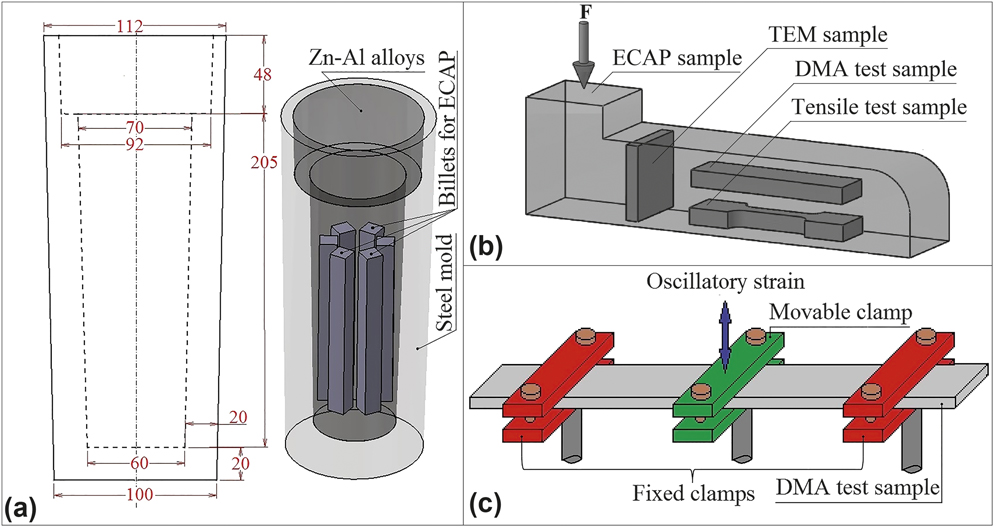
Eutectic Zn–5Al and eutectoid Zn–22Al alloys having nominally 5 wt% Al and 22 wt% Al, respectively, were produced by the gravity casting method where high purity (99.9 wt%) Zn and Al metals were melted in a graphite crucible and casted into a conical-shaped steel mold kept at RT [Fig. 1(a)]. The as-cast Zn–Al ingots were subjected to the first step homogenization process at 320 °C for Zn–5Al and at 375 °C for Zn–22Al, and cooled in the furnace. The first step homogenization durations for Zn–5Al and Zn–22Al alloys were chosen to be 12 h and 24 h, respectively. Then the billets with dimensions of 13 mm × 13 mm × 130 mm were machined from the outer sides of the ingots to avoid the excessive microporosity which occurs mostly at the center of the ingots during the casting process [Fig. 1(a)]. The billets were then subjected to a second homogenization step at the same temperatures given above for each alloy and then quenched into water at RT. The second step was kept longer: 24 h for Zn–5Al and 48 h for Zn–22Al. To achieve more refined microstructures, ECAP was used as the grain refinement process of SPD. ECAP was applied to Zn–22Al as a two-step process. In the first step, four passes ECAP were performed at 350 °C, (at one single region above the eutectoid temperature of the alloy), followed by four more passes at RT. Two-step ECAP was especially applied to the alloy to increase the grain refinement effect of ECAP and achieve UFG microstructure.Reference Demirtas, Purcek, Yanar, Zhang and Zhang7 During the first step, it was aimed to eliminate the as-cast microstructure and provide homogeneous phase composition throughout the ECAP billet. The second step, on the other hand, was performed at RT knowing that decreasing ECAP temperature causes more refined microstructure.Reference Kumar, Xu and Langdon35 Since the Zn–5Al alloy has a eutectic composition and has no single phase region, eight passes ECAP was applied to this alloy at RT as a one-step process. For both alloys, ECAP was conducted at a pressing speed of 1 mm/s using an ECAP die having a channel cross-section angle (Φ) of 90° and an outer curvature angle (Ψ) of 0° imparting an equal plastic strain of ∼1 during each pass. Route Bc was followed during all ECAP processes where the billets were rotated by 90° in the same direction around their longitudinal axes in-between subsequent passes. This processing route was especially chosen since it is known as the most appropriate ECAP route for creating an UFG microstructure having mostly equiaxed grain morphology.Reference Valiev and Langdon36
(a) Technical drawing of steel mold used in the gravity casting process (all dimensions are in mm) and a schematic presentation showing the orientations of the processed billets into Zn–Al ingots. (b) Schematic illustration showing the position and orientation of the test samples in ECAP billets. (c) Schematic representation of the DMA test system used.

The microstructure of the as-quenched alloys before ECAP was examined using either optical microscope or scanning electron microscope (SEM). The samples of both alloys were ground, polished, and then etched into a solution containing 5 g CrO3, 0.25 g Na2SO4, and 100 mL H2O before examinations. The refined microstructure of the alloys processed by ECAP was analyzed on the transverse plane (perpendicular to the extrusion direction) of the samples [Fig. 1(b)] using SEM and/or a FEI Tecnai F20 (FEI Company, Hillsboro, Oregon) transmission electron microscope (TEM) operating at a nominal voltage of 200 kV. Samples for TEM investigations were cut from the processed alloys using Charmilles Robofil 190 (EDMSwiss Sarl, Meyrin, Switzerland) wire electrical discharge machining (wire-EDM). Then the samples with 500 mm in thickness were put into a solution having 25% H3PO4, 25% C2H5OH, and 50% H2O, and electrochemically thinned to form a foil by applying 20–22 V potential difference.
Superplastic behavior of the alloys before and after ECAP were examined with uniaxial tests performed at RT. For this purpose, dog-bone shaped test samples having 2 × 3 × 5 mm gauge section dimensions were cut from the ECAPed samples using wire-EDM with their longitudinal axis aligned with the extrusion direction [Fig. 1(b)]. Prior to the tests, all samples were polished using 2000 grit SiC papers to minimize the adverse effects of any oxidation and microcracks possibly occur on the sample surfaces during the cutting process. Tensile tests were conducted using an Instron-3382 (Instron, Norwood, Massachusetts) electromechanical load frame having a video-type extensometer over a wide range of initial strain rates from 1 × 10⁻⁴ s−1 to 1 × 100 s−1. At least three experiments were performed at each strain rate of all processed samples to check the repeatability of the results.
DMA Q800 (TA Instruments, New Castle, Delaware) Dynamic Mechanical Analyzer (DMA) was used for the damping tests of Zn–Al alloys in all states. Samples with the dimension of 35 × 3 × 0.7 mm were cut from the alloys using wire-EDM. DMA tests were carried out at various strain amplitudes and frequencies ranging between 1 × 10⁻⁵ to 2 × 10⁻³ and 1 Hz–5 Hz, respectively, in the strain-controlled dual cantilever mode. In this mode, two ends of the sample were fixed to the test machine and the sample was subjected to oscillatory strain from its midpoint by a movable clamp as schematically shown in Fig. 1(c). The damping capacity of the alloys were determined in terms of tan δ, where δ is the phase lag (also known as the loss angle) in radians between the applied stress and its resulting strain.
It is known that there is a natural aging effect on severely deformed Zn–22Al alloy due to its low melting point of 753 K, and some limited grain growth may occur in this alloy by means of self-annealing at RT.Reference Zhang, Kawasaki, Huang and Langdon37,Reference Demirtas, Purcek, Yanar, Zhang and Zhang38 Therefore, tensile tests, DMA tests, and microstructural examinations were performed on both alloys as soon as possible just after the ECAP processes to minimize the effect of self-annealing since the Zn–5Al alloy also has low melting temperature. Furthermore, while a test was being performed on one sample, the other samples were kept in a deep freezer at −18 °C.
III. RESULTS
A. Microstructures
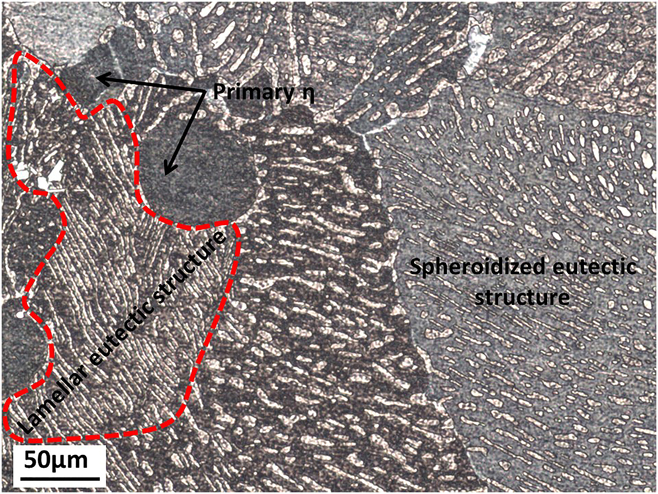
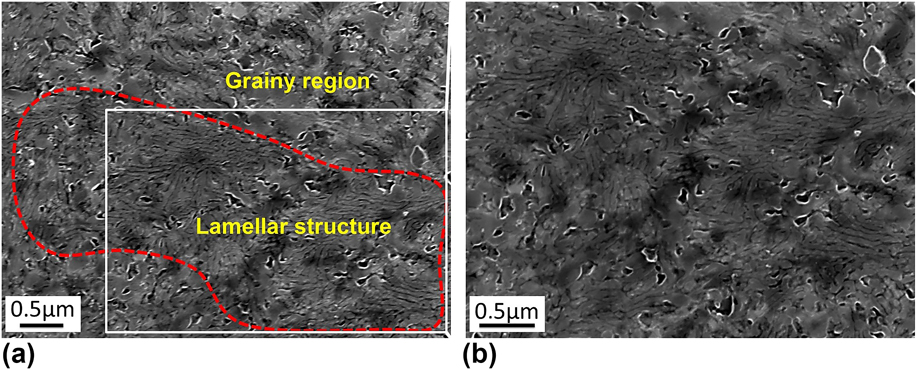
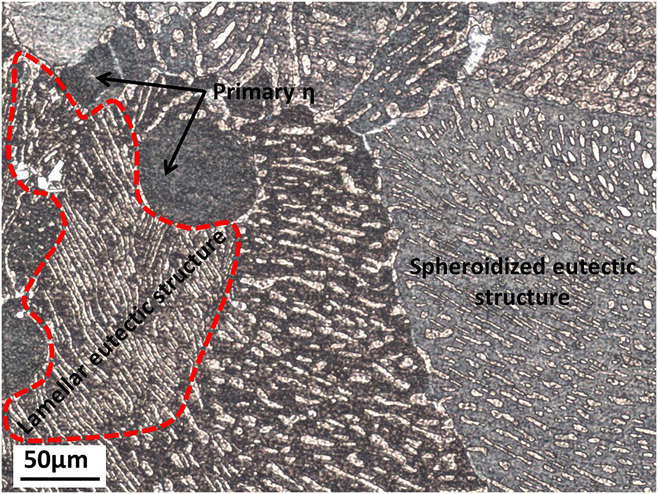
Optical and SEM micrographs of the as-quenched Zn–5Al and Zn–22Al alloys are shown in Figs. 2 and 3, respectively. The microstructure of Zn–5Al before ECAP consists mainly of spherical primary Zn-rich η-phase surrounded by the eutectic structure having both lamellar and spherical microconstituents (Fig. 2). Presence of the regions with lamellar structure shows that alteration from lamellar to spherical morphology was not completed due to the insufficient homogenization duration.Reference Shi, Liu and Li39 Homogenization and subsequent quenching processes resulted in a spheroidized grainy microstructure along with lamellar structure coming from the casting process in the Zn–22Al alloy (Fig. 3).
Optical micrograph showing the initial microstructure of as-quenched of Zn–5Al.
SEM micrographs showing the microstructure of the as-quenched Zn–22Al alloy: (a) A general view and (b) the region having mainly lamellar structure.

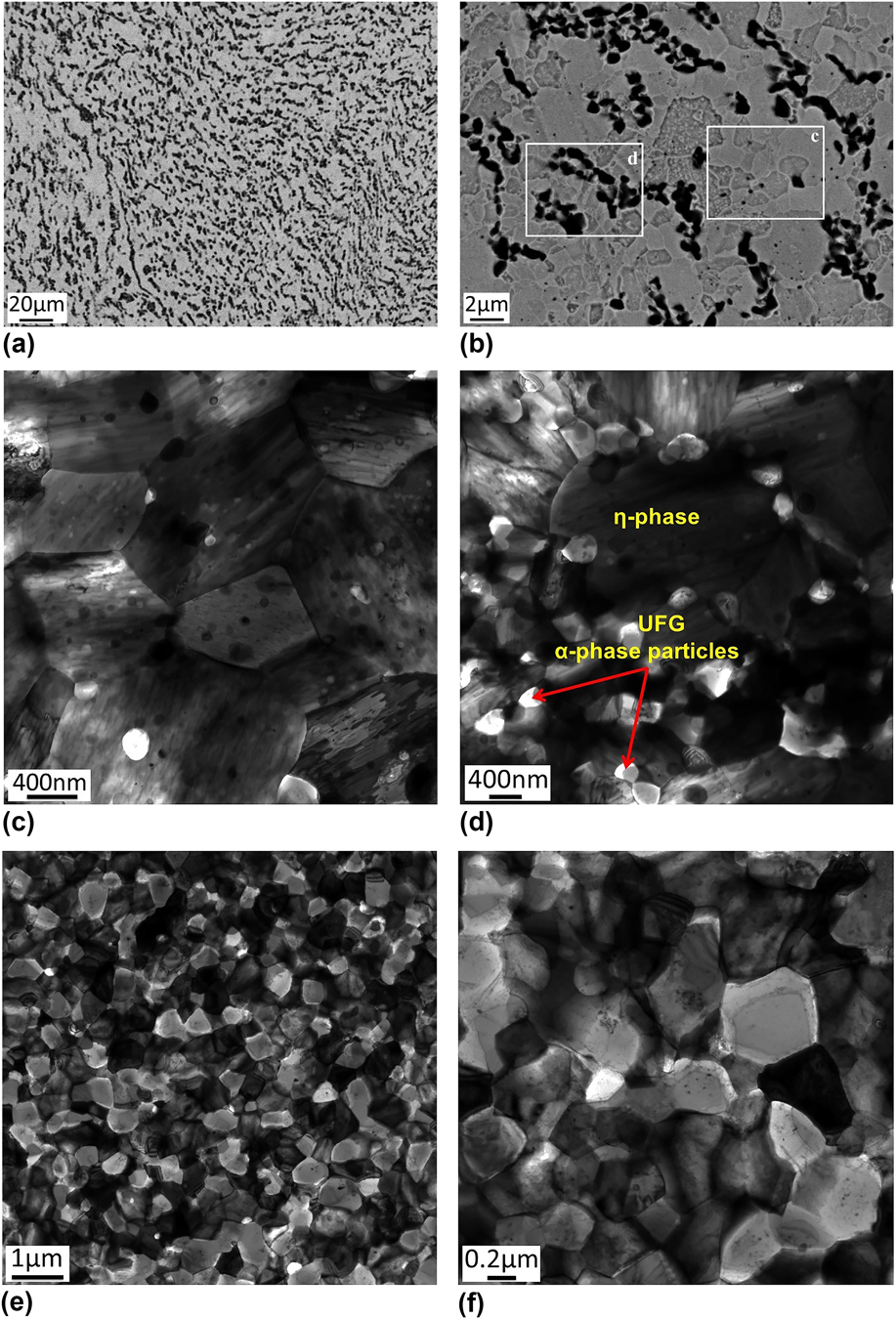
SEM micrographs representing the microstructures of the ECAPed Zn–5Al alloy are shown in Figs. 4(a) and 4(b). In these micrographs, bright and dark contrasts correspond to Zn-rich η- and Al-rich α-phases, respectively, while the case is reverse in TEM micrographs. It is clearly seen that eight passes ECAP completely eliminates the initial microstructure of the Zn–5Al alloy, and the coarse primary η-phase grains broke up into ultrafine grains. Furthermore, in general, the distribution of both phase grains is quite homogeneous throughout the microstructure concerning the global micrographs of the microstructure [Fig. 4(a)], and α-phase grains mainly accumulated along the boundaries of the η-phases [Fig. 4(b)]. TEM investigations were also performed on two different regions of the microstructure (the region of the η-phase grains and the grain boundaries of η-phases, where α-phase grains also exist as shown in the SEM micrograph [Fig. 4(b)]) to analyze the grains of both phases in detail. It is clear that ECAP brings about a bimodal structure within the UFG regime consisting of spherical α-phase grains and hexagonal-shaped η-phase grains [Figs. 4(c) and 4(d)]. Average sizes of α- and η-phase grains were measured to be 110 nm and 540 nm, respectively. This unique microstructural formation can be attributed to the different recrystallization temperatures of both phases of the Zn–5Al alloy. It is well known that the Zn-rich η-phase has a low recrystallization temperature of −12 °C,Reference Yang, Pan and Lee40 and thus dynamic recrystallization and/or grain growth may occur easily during ECAP performed even at RT,Reference Xia, Wang, Wang and Liu6 which brings about relatively coarser η-phase grains. On the other hand, the Al-rich α-phase has relatively high recrystallization temperature (337 °C) than η-phase.Reference Yang, Pan and Lee40 Therefore, grain growth cannot take place in that phase during ECAP, and more refined α-phase grains form in the microstructure. Accordingly, the alloy consists of a unique bimodal microstructure in the UFG regime after ECAP process.
(a and b) Low magnification SEM and (c and d) high magnification TEM micrographs showing the microstructural details of the UFG dual-phase Zn–5Al alloy in different regions of the alloy. (e) Low and (f) high magnification TEM micrographs showing the microstructure of the UFG Zn–22Al alloy.

TEM micrographs showing the microstructure of the ECAPed Zn–22Al alloy are given in Figs. 4(e) and 4(f). The two-step ECAP process also eliminates the lamellar structure and forms an equiaxed UFG microstructure in the Zn–22Al alloy with an average grain size of about 200 nm. Similar to the Zn–5Al alloy, well-defined α- and η-phases are distributed quite homogeneously throughout the microstructure without any agglomeration. In addition, most of the grain boundaries are in the form of η/α and η/η intercrystalline boundaries [Figs. 4(e) and 4(f)], as pointed out in an earlier study,Reference Demirtas, Purcek, Yanar, Zhang and Zhang7 as a result of the homogeneous distribution of phases in the microstructure. The homogeneous distribution of phases in both Zn–5Al and Zn–22Al alloys is because of the fact that the route Bc was used in ECAP, and this route results a homogeneous microstructure over the cross-section of the billet after pressing through four passes.Reference Valiev and Langdon36 Furthermore, high imposed strain during the ECAP process also supports the formation of homogeneous phase distribution. A similar observation was also achieved in the Zn–22Al alloy processed by high pressure torsion (HPT).Reference Kawasaki and Langdon41 It was reported that increasing number of HPT turns also increases the homogeneity of the distribution of α- and η-phases in the microstructure.Reference Kawasaki and Langdon41 Similarly, 8 passes ECAP brought about a UFG microstructure with homogeneously distributed α- and η-phases due to the high imposed strain of ∼8.Reference Valiev and Langdon36,Reference Kawasaki and Langdon41 It is worth to point out that microstructures of both Zn–5Al and Zn–22Al alloys are free of dislocations even after intense plastic deformation due to the dynamic recrystallization occurring during the ECAP processesReference Yang, Pan and Chuang8 [Figs. 4(c)–4(f)].
B. Superplastic behavior
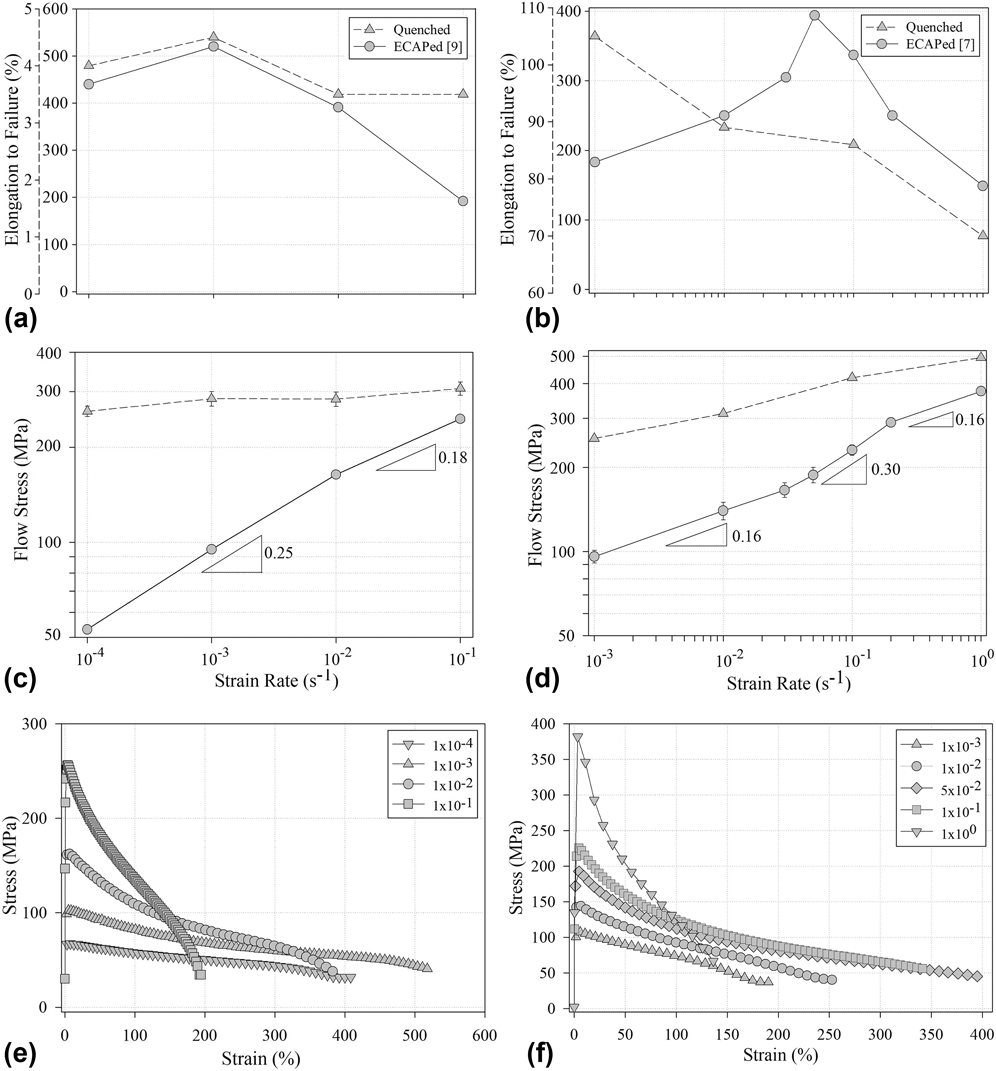
Changes in elongation to failure values of Zn–5Al and Zn–22Al alloys with the initial strain rates are given in Figs. 5(a) and 5(b), respectively, for all states. It is clearly seen that the as-quenched Zn–5Al alloy showed brittle behavior with the limited elongation to failure of ∼5% at all strain rates. In addition, there is no any strain rate dependence of the elongation to failure for the quenched alloy. Application of ECAP increased its elongation to failure significantly, and the maximum elongation to failure was achieved to be 520% at a strain rate of 1 × 10⁻³ s−1. Still high elongation of about 400% was obtained in that alloy at a HSR of 1 × 10⁻² s−1 [Fig. 5(a)]. The Zn–22Al alloy showed higher elongation in the as-quenched condition as compared to that achieved in the as-quenched Zn–5Al. The maximum elongation was about 100% at 1 × 10⁻³ s−1 above which increasing strain rate decreased elongation to failure. Formation of the UFG microstructure via ECAP also increased the elongation of the Zn–22Al alloy, and it brought about a maximum elongation to failure of 400% at a HSR of 5 × 10⁻² s−1. Below and above that strain rate, the elongation values decreased [Fig. 5(b)]. Such a dependence of elongation to failure on the strain rate is a characteristic behavior of superplastic materials, and it arises from the various deformation mechanisms at different regions of the elongation to failure-strain rate curve.Reference Langdon1 Considering these results, it is seen that both Zn–5Al and Zn–22Al alloys show superplastic behavior even at RT and HSRs after UFG formation via ECAP. The significant increases in the elongation to failure values of Zn–Al alloys by means of ECAP can be attributed to the radical microstructural alterations during that process. It was shown in our previously published papers that dominant deformation mechanism of ECAPed Zn–5Al and Zn–22Al alloys in the region where the highest superplastic elongation is achieved is grain boundary sliding.Reference Demirtas, Purcek, Yanar, Zhang and Zhang7,Reference Demirtas, Purcek, Yanar, Zhang and Zhang9 Formation of agglomerate-free UFG microstructures with equiaxed grain morphology in Zn–22Al alloys promotes the grain boundary sliding as the main superplastic deformation mechanism and brought about high superplastic elongations.Reference Demirtas, Purcek, Yanar, Zhang and Zhang7,Reference Demirtas, Purcek, Yanar, Zhang and Zhang9 It is known that the melting point of the Zn-rich η-phase is very low (∼420 °C) and rapid grain growth may occur in that phase during RT deformation. However, UFG α-phase grains along the grain boundaries of η-phases may impede the excessive grain growth of Zn-rich phase grains in the Zn–5Al alloyReference Nieh, Wadsworth and Sherby42 and promotes GBS. Therefore, besides the UFG microstructure, the unique bimodal microstructural features gained by 8 passes ECAP result in a very large RT superplastic elongation in the Zn–5Al alloy.
(a and b) Changes in elongation to failure values of (a) Zn–5Al and (b) Zn–22Al alloys with the initial strain rates. (c and d) Strain rate dependence of flow stress values of (c) Zn–5Al and (d) Zn–22Al alloys. (e and f) Stress–strain diagrams of ECAPed (e) Zn–5Al and (f) Zn–22Al alloys.Reference Demirtas, Purcek, Yanar, Zhang and Zhang7

It is well known that grain boundary sliding occurs more easily at η/η and η/α phase boundaries comparing to the monotonic α/α boundaries.Reference Shariat, Vastava and Langdon29–Reference Novikov, Portnoy and Terentieva32 Furthermore, it was reported that GBS is less active in a Zn–22Al alloy even though it has a lower grain size than another one having mostly η/η interfaces.Reference Choi, Kim, Ahn, Kawasaki, Langdon and Jang43 Thus, it can be speculated that phase composition of phase/grain boundaries is another important parameter affecting achieved elongation. In the present study, high superplastic elongation was achieved after the ECAP process since most of the grain boundaries are in the form of η/η and η/α intercrystalline boundaries in both ECAPed Zn–5Al and Zn–22Al alloys. More detailed analysis on the superplastic behavior of UFG Zn–5Al and Zn–22Al alloys can be found in previously published papers.Reference Demirtas, Purcek, Yanar, Zhang and Zhang7,Reference Demirtas, Purcek, Yanar, Zhang and Zhang9
Figures 5(c) and 5(d) show the changes in the flow stress values of the Zn–Al alloys with the initial strain rates for all states. Although there are very small changes in the yield strength of the as-quenched Zn–5Al alloy by increasing the strain rate, it is possible to say that the flow stress of the alloy is independent of the strain rate in this condition when the scatterings are taken into account [Fig. 5(c)]. On the other hand, the flow stress of the as-quenched Zn–22Al alloy is relatively sensitive to the strain rate [Fig. 5(d)]. Application of ECAP process to the as-quenched alloys decreased the flow stress of both alloys significantly and made the flow stresses very sensitive to the strain rate [Figs. 5(c) and 5(d)]. Such a decrease in flow stress was also reported in an Al–30 mol% Zn alloy previously.Reference Alhamidi, Edalati, Horita, Hirosawa, Matsuda and Terada44 It was stated that flow stress of the alloy decreased after the lamellar structure resulting from the spinodal decomposition was destroyed by HPT processing. Similarly, elimination of the as-quenched lamellar structure and formation of the UFG microstructure by ECAP decreased the flow stresses of both alloys in the present study. Decrease in flow stress of the alloys with grain refinement can be explained by the operation of two different deformation mechanisms in the as-quenched and ECAPed conditions. As stated above, grain boundary sliding is the main deformation mechanism in the ECAPed Zn–5Al and Zn–22Al alloys in the optimum superplastic regionReference Demirtas, Purcek, Yanar, Zhang and Zhang7,Reference Demirtas, Purcek, Yanar, Zhang and Zhang9 Therefore ECAP process decreased flow stress of both alloys significantly due to the transition from nonsuperplastic deformation to superplastic deformation, and thus easier grain boundary sliding at more grain boundary areas in the UFG alloys.Reference Naziri and Pearce45 The decrease in flow stress at low strain rates is more significant compared to that of achieved at HSRs [Figs. 5(c) and 5(d)]. This is due to the fact that deformation mechanism of ECAPed Zn–Al alloys at HSRs is power-law creep,Reference Kawasaki and Langdon46 as in the case of as-quenched alloys, and grain boundary sliding is less active at that region.Reference Langdon1 Therefore, flow stress of the ECAPed alloys at that region is close to the flow stress of the as-quenched samples.
Strain rate sensitivity parameters (m-values) of the ECAPed Zn–5Al and Zn–22Al alloys were calculated using stress–strain rate curves given in Figs. 5(c) and 5(d). It is clear that stress–strain rate curve of UFG Zn–5Al can be divided into two regions while three distinct regions were achieved in Zn–22Al considering the calculated m-values. In region-II (where the highest elongation values were obtained), m-values of ECAPed Zn–5Al and Zn–22Al alloys were determined to be 0.25 and 0.30, respectively. Stress–strain rate curves of superplastic materials show sigmoidal behavior (the curves contain three regions), as in the case of UFG Zn–22Al alloy of the present study,Reference Kawasaki and Langdon46 and strain rate interval of the optimum superplastic region (region-II) generally ranges between 10−4 and 10−2 s−1.Reference Kaibyshev47 However, it is now well established that region-II can be shifted to higher strain rates by decreasing grain size further.Reference Kawasaki and Langdon46 In the present study, the stress–strain rate curve of the UFG Zn–22Al alloy includes three regions although the tensile tests were performed at a narrow strain rate interval ranging between 10−3 and 100 s−1. Because Zn–22Al has a very small grain size of 200 nm which resulted to shift region-II to very HSRs, and thus a low strain rate region (region-I) was also achieved in that alloy between 10−3 and 3 × 10⁻² s−1. On the other hand, the Zn–5Al alloy does not include region-I since region-II occurred between 10−4 and 10−2 s−1 due to the relatively larger grain size comparing to the Zn–22Al alloy.
Stress–strain diagrams of ECAPed UFG Zn–Al alloys are shown in Figs. 5(e) and 5(f). Both alloys show completely similar behavior: i.e., after the stress reaches the maximum value, it starts to decrease at all strain rates. Thus, ECAPed alloys show significant strain softening behavior. In addition, stress–strain curves obtained at the strain rates at which maximum elongations were achieved (1 × 10⁻³ s−1 of Zn–5Al and 5 × 10⁻² s−1 of Zn–22Al) have quite steady-state characteristics [Figs. 5(e) and 5(f)]. Actually, such stress–strain curves are the characteristic curves obtained in superplastic materials, and it is known that they are raised as a result of high-strain rate sensitivity values of superplastic materials.Reference Langdon48,Reference Cetlin, Aguilar, Figueiredo and Langdon49 When the necking initiates in any region of the sample, the deformation is concentrated in this region and the strain rate of this section becomes higher than the rest of the sample. The high m-value causes an increase in the strength of the neck region due to the higher strain rate, and therefore the deformation stops at that region and continue in another section of the sample. Thus, the necking is delayed and a stable stress–strain curve is obtained which brings about high superplastic elongation.Reference Kaibyshev47 As stated above, high m-values were obtained in the optimum superplasticity regions of ECAPed alloys in the present study. Therefore, besides the above-mentioned microstructural properties, the high-strain rate sensitivity of the ECAPed alloys is another reason of the high achieved superplastic elongations.
C. Damping behavior
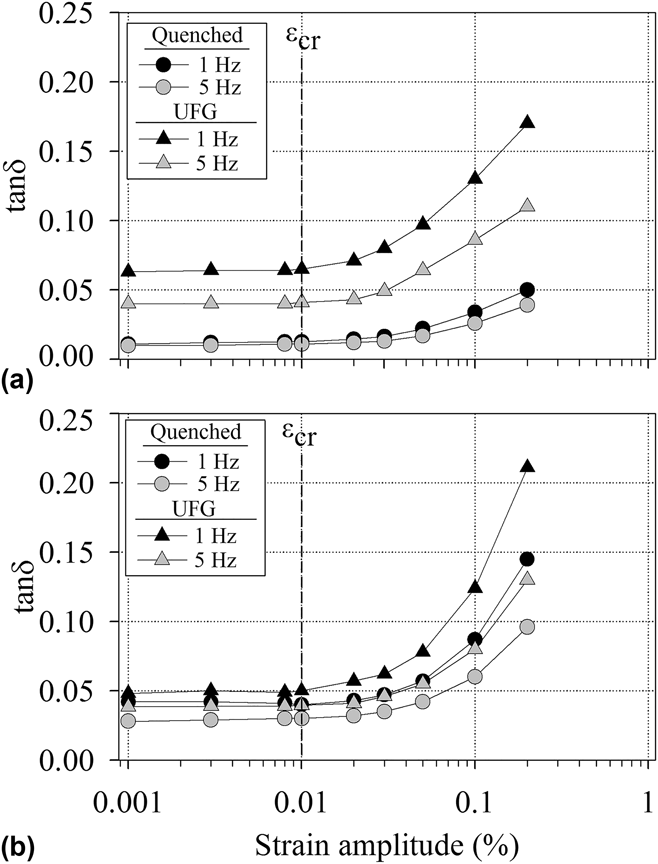
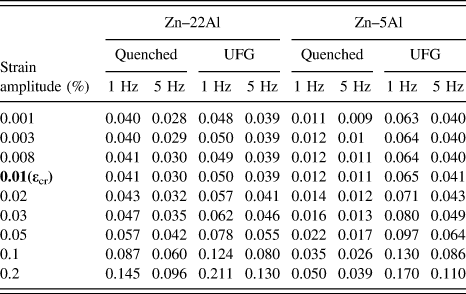
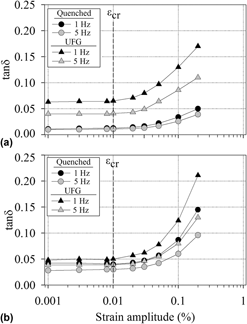
The damping capacities (as measured by tan δ) of Zn–5Al and Zn–22Al alloys were characterized as a function of strain amplitude and frequency (Fig. 6) using DMA. For convenience, tan δ values taken from Fig. 6 are also listed in Table I. In general, for both alloys, tan δ values are frequency-dependent for as-quenched and UFG conditions, i.e., tan δ values decrease with increasing frequency from 1 to 5 Hz. Another implication from Fig. 6 is that there is a critical strain (εcr) value for both alloys, independent of the condition, which separates the tan δ trend into two distinct regions. The tan δ values are almost constant below the εcr value, while increasing significantly above that value. A strain amplitude of 1 × 10⁻⁴ was taken as the transition strain for both alloys since increase in damping capacity is relatively more distinct above that strain value.
Changes in damping capacity (tan δ) of the alloys as a function of strain amplitude and frequency: (a) Zn–5Al alloy and (b) Zn–22Al alloy.

Damping capacity (tan δ) values of dual-phase Zn–5Al and Zn–22Al alloys at different frequencies and strain amplitudes.

Considering the DMA test results achieved at 1 Hz frequency, below the εcr value, the as-quenched Zn–5Al alloy shows a very limited damping capacity with a tan δ value of 0.012, while the as-quenched Zn–22Al alloy has a relatively high damping capacity of 0.041. Above the εcr, tan δ values of as-quenched Zn–5Al and Zn–22Al alloys increase significantly with increasing strain and reach to about 0.050 and 0.145, respectively, at a strain amplitude of 2 × 10⁻³. Grain refinement (or UFG formation) for both Zn–5Al and Zn–22Al alloys by ECAP results in an increase in the tan δ values at all strain amplitudes. The increase in damping capacity is especially pronounced in eutectic Zn–5Al. After grain refinement via the ECAP process, the tan δ value of Zn–5Al increases up to 0.065 at the εcr, above which it continues to increase with increasing strain, reaching to 0.170 at the highest applied strain of 2 × 10⁻³ [Fig. 6(a) and Table I]. To the best of the authors’ knowledge, such a high damping capacity for the Zn–5Al alloy is achieved for the first time. The tan δ value of UFG Zn–22Al alloy is 0.050 at the εcr of 1 × 10⁻⁴, reaching 0.211 at 2 × 10⁻³ strain amplitude [Fig. 6(b) and Table I]. It is also interesting to point out that the tan δ value of Zn–22Al at 2 × 10⁻³ strain is the highest one achieved for this alloy so far.Reference Luo, Bai and Xie27,Reference Lu and Van Aken50 Hence, it can be inferred that the damping capacity of the Zn–22Al alloy was further improved in the present study by UFG formation.
IV. DISCUSSION
A. Damping mechanism below the εcr
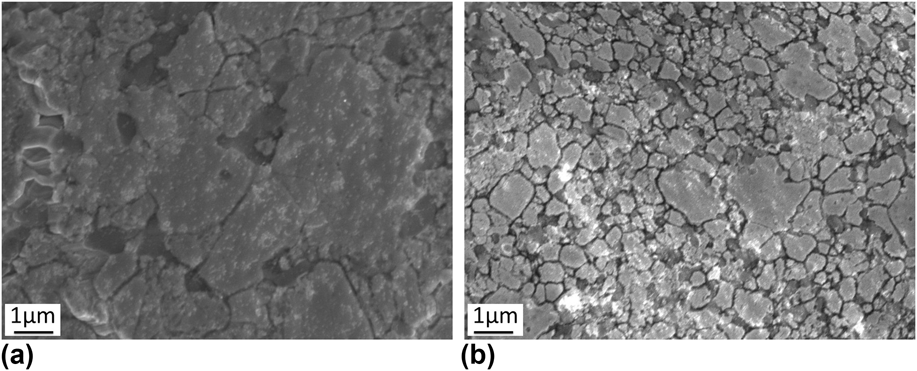
Based on the above results, the dependency of tan δ values of Zn–5Al and Zn–22Al alloys on strain is in a perfect agreement with the results achieved in our previous study on the damping behavior of a dilute Zn–0.3Al alloy,Reference Demirtas, Atli, Yanar and Purcek34 i.e., below the εcr, the tan δ of both alloys is strain-independent, while it increases with increasing strain above the εcr. Thus, Zn–5Al and Zn–22Al alloys show dynamic hysteresis behavior below the εcr value while their damping behavior reflects the combined aspects of both dynamic and static hysteresis damping above the εcr as in the case of Zn–0.3Al alloy.Reference Demirtas, Atli, Yanar and Purcek34 To determine the damping mechanism in the dynamic hysteresis region, it will be beneficial to analyze the previous studies on the damping capacity of Zn–Al alloys. Previous studies showed that dynamic hysteresis damping of Zn–Al alloys arises from two types of damping mechanisms: thermoelastic dampingReference Ritchie, Pan and Goodwin20,Reference Liu, Yang, Lu and Yang22 and damping due to viscous sliding of phase/grain boundaries.Reference Kawabe and Kuwahara19,Reference Kurosawa, Otani and Hoshino21,Reference Wei, Wang, Xie, Luo and Han23 Thermoelastic damping capacity was found to be increased with increasing frequency below the Zener relaxation frequency of 160 Hz.Reference Zhang, Ma, Le, Li and Wang51 In the present case, increasing frequency from 1 to 5 Hz resulted in a decrease in the tan δ for both Zn–5Al and Zn–22Al alloys. Thus, thermoelastic damping cannot be considered as a damping mechanism for the alloys of the current study in the dynamic hysteresis region. An intriguing finding is that grain shape and size affect the damping capacities of both alloys significantly in the strain-independent region as can be clearly seen from Figs. 6(a) and 6(b). This indicates that elimination of the lamellar structure and formation of new UFG structure with equiaxed morphology by ECAP resulted in a considerable improvement in the damping capacity of the Zn–5Al alloy. Similarly, the formation of the dual-phase microstructure with homogeneously distributed lamellae-free equiaxed grains of both α- and η-phases in the Zn–22Al alloy by ECAP brought about a significant improvement in its damping capacity compared to its as-quenched state with lamellar structure surrounded by equiaxed grains. Such a behavior was also achieved in certain Zn–Al alloys previously, which had viscous sliding of phase/grain boundaries as the main damping mechanism, and it was attributed to the dependency of sliding at phase/grain boundaries on the grain shape and size.Reference Kawabe and Kuwahara19,Reference Kurosawa, Otani and Hoshino21 It is well known that grains with equiaxed morphology are more suitable for easier sliding of phase/grain boundaries compared to the lamellar-type microstructure.Reference Demirtas, Purcek, Yanar, Zhang and Zhang10,Reference Nieh, Wadsworth and Sherby42 Furthermore, smaller grain size means increased grain boundary area at which sliding occurs more easily and effectively.Reference Kurosawa, Otani and Hoshino21 Regarding these conclusions and the considerable dependency of damping capacity on grain size and shape, it can be concluded that damping mechanism of Zn–5Al and Zn–22Al alloys is viscous sliding of phase/grain boundaries below the εcr value (in the dynamic hysteresis region). Surface appearance of the ECAPed Zn–5Al alloy after the DMA test performed at 1 Hz frequency and 3 × 10⁻⁵ strain (below the εcr) also confirms that damping arises from the viscous sliding of phase grain boundaries of Zn–Al alloys [Fig. 7(a)]. Grain boundaries at the sample surface are quite evident after the DMA test [Fig. 7(a)]. This suggests that some motion occurred at the grain boundaries (but not at all boundaries) during the DMA test, and grain boundaries became distinct. Thus, as stated above, grain boundary sliding is the main damping mechanism in Zn–Al alloys below the εcr. Therefore, elimination of the difficult-to-slide lamellar structure and formation of the UFG microstructure in Zn–5Al, and decreasing grain size down to 200 nm in the Zn–22Al alloy by ECAP increased the damping capacities of these alloys in the dynamic hysteresis region due to the easier viscous sliding at phase/grain boundaries.
Surface appearance of the ECAPed Zn–5Al alloy after the DMA tests performed at 1 Hz frequency and strain amplitude of (a) 3 × 10⁻⁵ and (b) 1 × 10⁻³.

Dynamic hysteresis damping (frequency-dependent behavior) characteristics of the alloys below the εcr also confirms the presence of grain boundary sliding (viscous sliding at phase/grain boundaries) as the main damping mechanism in that region. It is well known that grain boundary sliding is a diffusion-controlled process.Reference Kawasaki and Langdon46 Higher vibration frequency means less time for the diffusion process controlling the phase/grain boundary motion in each cycle.Reference Bajalan52 Therefore, lower tan δ values were achieved in both alloys at 5-Hz frequency comparing to 1 Hz due to the less accommodation time for the viscous motion of phase/grain boundaries by diffusion process.
B. Damping mechanism above the εcr
Above the εcr value, damping capacity of the alloys increases with increasing applied strain. A similar result was obtained in a previous study for the dilute Zn–0.3Al alloyReference Luo, Bai and Xie27 where the damping capacity remained constant below a specific εcr value and increased with strain above this value. The increase in damping capacity above the εcr was attributed to the dynamic recrystallization which was accounted as the damping mechanism.Reference Demirtas, Atli, Yanar and Purcek34 In another study, a damping peak was observed during heating of a particle-reinforced superplastic Zn–Al composite, which was attributed to the recrystallization of the as-quenched microstructure.Reference Lu and Van Aken50 It was suggested that damping peak originated from stress-induced oscillatory motion of grain boundaries during the growth of the newly formed grains.Reference Lu and Van Aken50 In the present study, DMA tests were performed at RT, which is equivalent to ∼0.45 T m and ∼0.42 T m for Zn–5Al and Zn–22Al alloys, respectively, due to their low melting temperature. Thus, microplasticity-induced dynamic recrystallization may occur in these alloys during the cyclic straining in DMA tests. To provide evidence to that, surface appearance of the ECAPed Zn–5Al alloy after the DMA test performed at 1 Hz frequency and at a strain amplitude of 1 × 10⁻³ (above the εcr) are given in Fig. 7(b). It is seen that the surface of the sample includes ultrafine grains having ∼100 nm grain size and relatively coarse grains (2 µm grain size) together. Furthermore, most of the grains have a grain size smaller than 400 nm. This suggests that cyclic strain on the surfaces of the sample caused some microplasticity and subsequent dynamic recrystallization. Based on these facts and findings, it can be said that dynamic recrystallization is the damping mechanism above the εcr value. Consequently, above the critical strain value, high damping capacities in both alloys resulted from the extensive transfer of atoms between grain/phase boundaries during the formation of new grains and reshaping of pre-existing ones, as well as the stress-induced oscillatory motion of the boundaries of newly formed grains during dynamic recrystallization.Reference Demirtas, Atli, Yanar and Purcek34,Reference Lu and Van Aken50
An increase in the strain from the critical value to 2 × 10⁻³ resulted in a higher increase in the damping capacity of Zn–22Al compared to that of achieved in Zn–5Al in all states [Figs. 6(a) and 6(b)]. This may be considered as an evidence of dynamic recrystallization as the damping mechanism above the εcr. It is known that grain boundaries are the nucleation sites of new grains during dynamic recrystallization due to the their high energy level.Reference Humphreys and Hatherly53 Since the Zn–22Al alloy has smaller grain size compared to Zn–5Al, it has more grain boundaries serving as nucleation sites during dynamic recrystallization. Therefore, the damping capacity of the Zn–22Al alloy is higher at all strains above the εcr values compared to Zn–5Al due to the dynamic recrystallization that occurs easily and effectively at more grain boundaries.
It is known for beams under bending that the equivalent stress takes its maximum value at the surface, decreases moving away from the surface, and becomes zero at the neutral axis.Reference Hibbeler54 Thus, dynamic recrystallization is expected to occur as the damping mechanism only in a thin layer of the Zn–22Al and Zn–5Al sample surfaces due to the microplasticity beyond the εcr as validated in our previous study.Reference Demirtas, Atli, Yanar and Purcek34 Thus, dynamic recrystallization cannot be considered as the only damping mechanism above the εcr. At the subsurface of the samples, viscous sliding at phase/grain boundaries controlled by the thermally activated atomic diffusion across the interfaces is still the main damping mechanism despite the low stress level.Reference Zhu25,Reference Demirtas, Atli, Yanar and Purcek34 Therefore, it can be concluded that two damping mechanisms, i.e., dynamic recrystallization on the sample surfaces and thermally activated viscous motion of grain/phase boundaries at the subsurface of the samples of both Zn–5Al and Zn–22Al alloys occur simultaneously in the strain-dependent region leading to an improvement in the damping capacity of the alloys.
C. Effect of phase composition on the damping capacity
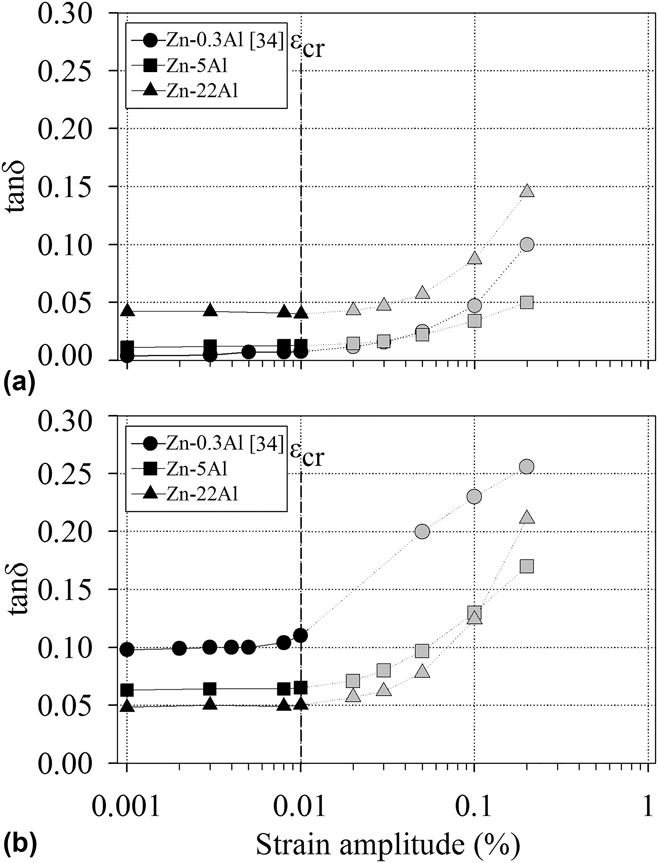
To investigate the effect of phase compositions on the damping capacity of Zn–Al alloys, the alloys of the present study (eutectic Zn–5Al and eutectoid Zn–22Al) and a previously studied quasi-single phase (dilute) Zn–0.3Al alloy were analyzed. The Zn–0.3Al alloy had coarse equiaxed grains of the Zn-rich η-phase with the sizes in the range of 150–200 µm for the as-quenched and fine grains having approx. 2-µm size for the ECAPed conditions.Reference Demirtas, Purcek, Yanar, Zhang and Zhang11 Similar to Zn–5Al, limited elongation was achieved in the as-quenched Zn–0.3Al alloy, while ECAP increased the elongation up to 1000% at RT.Reference Demirtas, Purcek, Yanar, Zhang and Zhang11 In the present study, all three superplastic Zn–Al alloys in different phase compositions and structures were scanned at RT under various strain levels, and the respective tan δ values at 1 Hz frequency are shown in Figs. 8(a) and 8(b). It is believed that the effect of phase composition on the damping capacity of Zn–Al alloys can be analyzed more accurately at the dynamic hysteresis region (below the critical strain value) compared to the region above the critical strain value where the alloys showed combined aspects of both dynamic and static hysteresis damping mechanisms. This is due to the fact that damping mechanisms are more complex above the εcr (dynamic recrystallization on the sample surfaces and thermally activated viscous motion of grain/phase boundaries at the subsurface of the samples) while viscous sliding of phase/grain boundaries is the only main damping mechanism in the dynamic hysteresis region. Therefore, a comparative study was made considering the results obtained below the εcr, and the results achieved above the εcr value were made in gray tone in Fig. 8. It is evident from Fig. 8 that both grain size and phase composition have considerable effects on the damping capacities of Zn–Al alloys. Considering the as-quenched samples of all alloys, the highest tan δ value was achieved with Zn–22Al having the lowest grain size as expected due to the easier and effective phase/grain boundary sliding. While the as-quenched sample of Zn–0.3Al has coarse-grained (CG) microstructure with an average grain size of 150–200 µm,Reference Demirtas, Purcek, Yanar, Zhang and Zhang11 the Zn–5Al alloy has mainly a lamellar microstructure in the as-quenched state.Reference Perevezentsev, Shcherban, Murashkin and Valiev5 It can be concluded that these two types of microstructures are not suitable for effective viscous sliding at phase/grain boundariesReference Demirtas, Purcek, Yanar, Zhang and Zhang10,Reference Nieh, Wadsworth and Sherby42 since stress concentrations at triple junctions of lamellae structure make the accommodation process of sliding by intragranular dislocation motion more difficult while the CG microstructure contains less grain boundary area at which viscous sliding may occur.Reference Demirtas, Purcek, Yanar, Zhang and Zhang10,Reference Nieh, Wadsworth and Sherby42 Thus, limited viscous sliding at phase/grain boundaries occurs in these two alloys in the as-quenched condition, and they show relatively lower tan δ values compared to the eutectoid Zn–22Al alloy.
Effect of grain size and phase composition of Zn–Al alloys in the as-quenched and UFG states on their damping capacities at 1 Hz frequency: (a) quenched alloys and (b) UFG ECAPed alloys.

Considering the ECAPed samples, it is interesting to point out that the Zn–22Al alloy sample showed the lowest tan δ value although it has the lowest grain size among all three Zn–Al alloys. In this state, the highest tan δ was achieved in the Zn–0.3Al alloy with the highest grain size, and the Zn–5Al alloy exhibited a moderate damping capacity with tan δ values in between those of Zn–22Al and Zn–0.3Al alloys. These results clearly show that phase composition has also a considerable effect on the damping capacity of Zn–Al alloys besides the grain size, and its effect on damping capacity is more pronounced in the UFG microstructure after ECAP (Fig. 8). As stated above,Reference Shariat, Vastava and Langdon29–Reference Novikov, Portnoy and Terentieva32 maximum sliding occurs predominantly at Zn–rich η/η and Zn- and Al-rich η/α phase boundaries, and a limited sliding was observed at Al-rich α/α phase boundaries of Zn–Al alloys. It is also known that decreasing Al content decreases the area fractions of α/α phase boundaries, and nearly all of the phase boundaries of the Zn–0.3Al alloy are in the form of η/η boundaries. Therefore, although the grain size of the ECAPed Zn–0.3Al alloy is larger than those of other two alloys, it shows higher damping capacity due to the effective viscous sliding at η/η boundaries. Thus, during the design process of components that will be produced from high damping Zn–Al alloys, phase compositions of the alloys should also be considered as an important parameter controlling the damping capacity besides the size and shape of the grain in the microstructure.
D. Superplasticity–damping capacity relation
It is worth to point out that changes in the damping capacity of Zn–Al alloys by ECAP in the present study with the grain size and phase composition below the critical strain value have a completely similar behavior with the achieved superplastic elongations of these alloys in the ECAPed conditions. The highest superplastic elongation was achieved in the Zn–0.3Al alloy having the highest grain size, and the Zn–22Al alloy with the smallest grain size showed the lowest superplastic elongation as in the case of damping capacities. In our previous studies, it was shown that grain boundary sliding occurs as the main deformation mechanism in Zn–Al alloys during the superplastic deformation at RT.Reference Demirtas, Purcek, Yanar, Zhang and Zhang7,Reference Demirtas, Purcek, Yanar, Zhang and Zhang9,Reference Demirtas, Purcek, Yanar, Zhang and Zhang11 Grain boundary sliding was also suggested as the main damping mechanism below the critical strain value in some previous studiesReference Kawabe and Kuwahara19,Reference Kurosawa, Otani and Hoshino21,Reference Wei, Wang, Xie, Luo and Han23 and in the present study. Thus, it is clear that superplastic elongations and damping capacities of the ECAPed Zn–Al alloys below the εcr show completely similar behavior, since both phenomena arise from the same mechanism of grain boundary sliding. Chuvil’deev et al.Reference Chuvil’deev, Nieh, Gryaznov, Sysoev and Kopylov55 showed that the internal friction peak during the heating and maximum superplastic elongations occurs at the same temperature in the superplastic Mg alloy. Taking into account these results, they suggested that the damping capacity of superplastic materials can be used to determine the temperature at which optimum superplasticity is achieved. Regarding the coincidence between superplastic elongations and damping capacities of Zn–Al alloys in the present study, it can also be speculated that DMA tests performed at low strain amplitudes can be used to estimate the most favorable phase composition and microstructures in the superplastic materials for achieving higher superplastic elongations. It is believed that using DMA method for this purpose will provide some advantages. Superplasticity is a strain-rate–dependent phenomenon, and thus it is necessary to perform tensile tests at different strain rates to determine the maximum superplastic elongation. Considering that low strain rate, tensile tests take long time (up to 16 h in case of high elongations at low strain rates like 1 × 10⁻⁴ s−1), much effort is required to determine the optimum phase composition and microstructure for higher superplastic elongations. On the other hand, the DMA test at one strain amplitude takes ∼3 min which is much less than that of required for the tensile test at one strain rate. Furthermore, one DMA test sample can be used to determine the damping capacity of a material at more than one strain amplitude since deformation occurs at the elastic region of the material below the εcr. Therefore, DMA requires less sample comparing to that of used in tensile tests. Taking into account all these facts, it is clear that DMA is an easier and quicker method to determine the most favorable phase composition and microstructures in the superplastic materials for achieving higher superplastic elongations.
V. CONCLUSIONS
Effects of grain refinement and phase composition on the superplasticity and damping capacity of dual-phase Zn–5Al and Zn–22Al alloys were investigated at different vibrational frequencies and strain amplitudes. The main findings and conclusions of this study can be summarized as follows:
(1) ECAP completely eliminates the initial microstructure of eutectic Zn–5Al and eutectoid Zn–22Al alloys and brings about an UFG structure in both alloys.
(2) Both Zn–5Al and Zn–22Al alloys show superplastic behavior at RT and HSRs after UFG formation via ECAP. The maximum superplastic elongations are achieved to be 520% and 400% in Zn–5Al and Zn–22Al alloys, respectively.
(3) Zn–5Al and Zn–22Al alloys show dynamic hysteresis behavior below a critical strain value (εcr) in all states. In that region, damping capacity of the alloys arises from the viscous sliding of phase/grain boundaries.
(4) Above the εcr, the alloys show combined aspects of both dynamic and static hysteresis damping behaviors in the quenched and ECAPed UFG conditions. In that region, dynamic recrystallization due to microplasticity at the surface of the samples during cyclic straining and thermally activated viscous motion of grain/phase boundaries at the subsurface are proposed as the dominant damping mechanisms for both Zn–5Al and Zn–22Al alloys.
(5) The highest damping capacity values (tan δ) of UFG Zn–5Al and Zn–22Al alloys are 0.211 and 0.170, respectively, at 1 Hz vibration frequency and 2 × 10⁻³ strain amplitude. Such a high value of damping capacity is achieved for the first time in the Zn–5Al alloy in the present study. In addition, the tan δ value of Zn–22Al at 2 × 10⁻³ strain is the highest one achieved in this alloy up to date.
(6) Besides the shape and size of the grains, phase composition has a remarkable influence on the damping behavior of Zn–Al alloys. Although Zn–0.3Al has the highest grain size after ECAP, it shows the highest damping capacity among Zn–0.3Al, Zn–5Al, and Zn–22Al in the dynamic hysteresis region due to its high amount of Zn-rich η/η phase boundaries where sliding may occur easily, being the main source of damping. The UFG Zn–22Al alloy with the lowest grain size shows the lowest damping capacity since it contains the highest amount of Al-rich α/α phase boundaries that have the lowest sliding characteristic compared to η/η and α/η phase boundaries.
(7) It is shown that superplastic elongations and damping capacities of ECAPed Zn–Al alloys below the εcr value show completely similar behavior since both phenomena arise from the same mechanism of grain boundary sliding. Regarding this result, it is suggested that DMA method can be used to estimate the most favorable phase composition and microstructures in superplastic materials for achieving higher superplastic elongations.
ACKNOWLEDGMENTS
This research was partially supported by Scientific Research Projects of Karadeniz Technical University, Turkey, under Grant no: 10501. Dr. G. Purcek was also supported by The World Academy of Sciences (TWAS) under the Visiting Researchers Program of the TWAS-UNESCO Associateship Scheme (Ref. 3240290077).