In relation to other European economies, Sweden experienced both an early and a widespread circulation of officially sanctioned paper monies of various origins. In 1661, the short-lived Stockholm Banco started to issue copper notes which came to circulate above par value. A few years later, the Parliament opened its own bank, Rikets Ständers Bank, literally meaning the Parliament's Bank, now known as the Riksbank. It started to issue something similar to certified cheques in 1701, which circulated as paper money side by side with specie money. In 1745 most specie was drawn out of circulation and Sweden went on a paper standard. This time the Riksbank started to issue notes with printed denominations. Since then, the Swedish money supply has mainly consisted of paper money.
In 1789, the National Debt Office (Riksgäldskontoret) started to issue large quantities of small-denomination interest-bearing promissory notes, which circulated simultaneously with the Riksbank notes for forty years. In 1831, Enskilda (private) banks began to issue notes that circulated side by side with the Riksbank notes for another seventy years. Besides these more officially sanctioned notes, the Swedish money supply also consisted of a mixture of notes issued by a variety of organisations and individuals. It is clear that during most of the period from 1789 to 1903, multiple paper monies circulated in Sweden.
Cases like the Swedish have not attracted much research with theoretical ambitions. Most monetary theorists assume the normality of homogenous monetary systems and the neutrality of money. There seems to be much in favour of one type of (national) money. In a multiple currency system, the main difficulty has been to achieve and maintain stable value relations between different monies in use.Footnote 1 Both instability as such and the attempts to stabilise relative values have increased monetary transaction costs.Footnote 2
The Swedish monetary authorities attempted to handle the situation with unstable monetary value and supply in the same way as other monetary authorities in Europe at the time. The belief that specie was the only form of ‘real’ money remained unchallenged. With a limited amount of specie available, paper money was issued only to represent ‘real’ money at a fixed rate. Coins were what contemporary commentators, at least until the end of the nineteenth century, tended to see as ‘real’ money.Footnote 3 Nevertheless, the monetary authorities repeatedly failed to maintain this fixed rate and it had therefore repeatedly to re-establish the relationship between paper money and specie. Despite attempts to create a homogenous national money supply, multiple monies continued to exist in Sweden throughout the eighteenth and nineteenth centuries.
Apparently, systems with multiple monies are so persistent that they must have been of importance to contemporary actors. They are also prevalent in history. The Swedish case is only one of many historical situations in which monies of various descriptions and origins have circulated side by side. Still, in those rare cases when multiple monies are discussed by scholars, they are perceived either as anomalies, which eventually were to disappear by an evolutionary process, or as competing substitutes issued in a more or less free market for monies. However, since most historical cases of multiple monies are far from fulfilling the conditions of a free market, we are obliged to continue to look for some other logic behind the persistence and prevalence of multiple monies. Limited research has been undertaken to understand the reasons for or impact of the coexistence of different monies. Differences between monies are neglected and lost when all monies in circulation are reduced to substitutes for what is regarded as ‘real’ money.
Our aim is to discuss whether these cases of multiple monies are not better understood as cases of complementarity. Complementary monies would basically mean that an increase in the demand for one kind of money increases the demand for the other and that they together fulfil the demand of the users better than they would without the existence of the other. In short, by using the concept of complementarity we try to understand why there were multiple monies in circulation instead of only one kind of money.
In contrast to most other studies on complementary monies, we are concerned with complementarity between paper monies. Paper monies are of course in some respects different from specie money since paper monies have no intrinsic value and therefore often are seen as only representing ‘real’ money. However, in most cases in history, specie coins were valued far above the metal value which indicates that the value of money, at least to some extent, is determined by the demand for money or for its functions. In that case, the evaluation of paper money is made in the same way as of specie money.
We study two episodes with multiple paper monies in circulation in Sweden. During the first period, between 1789 and 1830, the National Debt Office issued notes in addition to the Riksbank notes. In this first case, there was a shift in the relative proportions of notes with a diminishing circulation of notes of higher quality and discounts in the value of them. During the second period, between 1831 and 1903, private note-issuing banks complemented the Riksbank in providing liquidity. In the latter case, multiple monies circulated side by side at stable relative values indicating that they served to adjust to the demands for liquidity without leading to changing internal value, but without being substitutes.
In our empirical analysis, we address four questions: first, we analyse what was used as money both at the aggregate level, by looking at the money supply in absolute and relative terms, and at the micro-level, by looking at the content of monetary remittances. Second, we study the relative value of different monies in parallel circulation. Our aim is to understand why some cases of multiple monies were successful in maintaining a fixed relative value whereas others were not. Third, we believe that the value of money is determined by the demand for money and since demand fluctuates in relation to economic activities, we try to establish seasonal variations in both use and value. Fourth, Kuroda has in his previous research identified complementarity between monies floating in different monetary circuits. We will therefore try to see whether money of different origins circulated in different ways.
We find that, in the Swedish case, one kind of money could not fulfil the basic monetary function of providing sufficient liquidity and at the same time keep a relatively stable monetary value in relation to foreign currencies. In the Swedish experience ‘real’ money was not only scarce; it was also unevenly dispersed between different parts of the country and unevenly demanded over the seasons in line with the needs of the agricultural economy. A system of complementarity served to solve the dilemma of sufficient liquidity domestically and a stable currency value both internally and externally.
I
A reason for the lack of theoretical interest in multiple monies might be that historical sources seldom disclose exactly what kind of means of payment were used in practice. Account books and letters between traders state the value of the payments expressed in a certain unit of account while, in a situation with multiple monies, we do not know what monies were used to remit that stated value.
In the case of Sweden, there is a source that makes it possible to go beyond the unit of account and to do a rather unique study of what money people actually used when making payments, namely open registered-letter receipts. These receipts were the result of the widespread practice of using the postal service for making long-distance payments and the fact that between 1794 and 1872 it was by ordinance prescribed that the remitter should make a list specifying the content of the money sent by open registered-letter post.Footnote 4
From 1794, the general procedure for sending money by post was as follows: the sender brought an unsealed envelope to the local postmaster, a list specifying the notes to be included and the money. The postmaster counted the money and acknowledged the list provided by the sender by signing it. The letter was then sealed either by the sender or the postmaster. Finally, the sender was given a receipt stating the name and place of the addressee, the total amount enclosed and, from 1850, the fees paid. This receipt was attached to the note list.
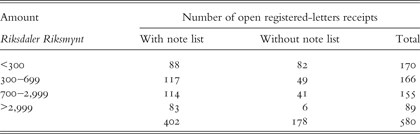
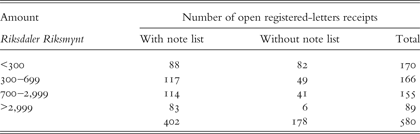
In this article we make use of the collection of open registered-letter receipts held by the Postmuseum (Postal Museum) in Stockholm.Footnote 5 The collection has not previously been used systematically although it is the largest known collection. It contains more than one thousand documents, of which 580 are receipts from remittance between individuals or individual firm representatives from the period before 1872 (Table 1). In slightly more than two-thirds of these cases, the list specifying the notes the letter contained also remains. In total, almost 30,000 notes have been identified with a value of 780,000 Riksdaler Riksmynt.Footnote 6 The median value remitted by letters with the content listed is 646 Riksdaler Riksmynt and the median value remitted by those without a list is 300 Riksdalar Riksmynt, while the average is 1,966 Riksdaler Riksmynt and 613 Riksdaler Riksmynt respectively. Unfortunately, only 19 receipts remain from 1789 to 1830, of which 9 have the notes listed. This collection can therefore be used for an overview from the late eighteenth century until 1872 and a detailed analysis from the late 1840s to 1872.
Overview of the collection of open registered-letter receipts at the Postmuseum
Source: Postmuseum, Archives, Stockholm: Öppen assurans, ii.260.b, 1789–1872.
The macro-data are in general taken from the statistical part of the history of the Riksbank.Footnote 7 Regarding the money supply and in particular the note issuance of the Enskilda banks in the nineteenth century, data recently revised by Ögren have been used.Footnote 8
II
The National Debt Office originated from the Parliament's Office (Riksens Ständers Kontor) founded in 1719. Initially, this authority had the task of managing and repaying the substantial debts accrued from the wars of Karl XII. When the National Debt Office was reformed in 1789, the debt of the Swedish State to foreign lenders was substantial.Footnote 9 At this time, notes issued by the Riksbank were redeemable into a fixed amount of specie. But this had only been the case since the adoption of the silver standard in 1776. The experience of this adoption was that the deflationary effects had been costly for the Swedish economy.
In 1788 the strong regent of Sweden, King Gustav III, requested funds to finance the war on Russia from the bank of the Parliament, the Riksbank. But the board of the Riksbank turned him down and argued that the newly established silver standard had to be protected. The king questioned the Riksbank's refusal and took a loan contrary to the will of Parliament.Footnote 10 This measure further consolidated the government's independence from parliamentary control.
As a compromise with the Parliament, the National Debt Office was given the task of raising further capital. Unlike the Riksbank, the board of this Office was influenced by the government, as the king's representative was appointed chairman. The National Debt Office was given the right to issue interest-bearing promissory notes. The Office could issue notes to a maximum amount of 600,000 Riksdaler Specie, in comparison to which the Riksbank circulated approximately 5.5 million Riksdaler Specie in 1789. The National Debt Office had exceeded this ‘maximum’ amount within one month.Footnote 11
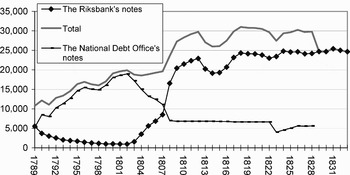
As seen in Figure 1, the massive issuance of notes conducted by the National Debt relative to the Riksbank meant that the main part of the money supply consisted of National Debt Office notes. Riksbank notes were officially legal tender, while National Debt Office notes were in practice legal tender since they were accepted for all payments, including taxes, with the notable exception that they were not accepted for payments to and deposits in the Riksbank. The Riksbank consistently refused to accept any connection with the notes issued by the Office, referring to its responsibility for the fixed exchange rate. No such responsibility limited the issuing capacities of the National Debt Office.Footnote 12
Note circulation 1789–1833 (000s Riksdaler Banco)
Source: Ahlström, Politik och prisutveckling, p. 24, ‘Statistiska tabeller 1668–1924’.

Throughout the period, the Riksbank maintained the specie standard. The first credit notes issued by the National Debt Office were interest bearing. Since the Office issued such a large amount of notes and they were accepted as means of payment by the public, the interest-bearing feature of these notes was dropped in 1791. Until the settlement between the Riksbank and the National Debt Office in 1803, the notes issued by the two monetary authorities were indirectly valued at par since they were both denominated in Riksdaler.
To pay off earlier loans, the Office continued to issue notes independently until the agreement with the Riksbank in 1803. It was then decided that the Riksbank should take over the responsibility for the notes in circulation that had been issued by the National Debt Office. In 1803 National Debt Office notes at a nominal value of no less than 19 million Riksdaler Banco were in circulation.Footnote 13
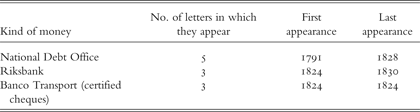
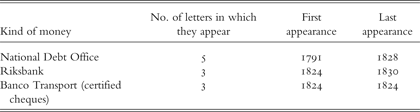
Despite the limited number of note lists remaining (Table 2), it is possible to make some reflections based on the postal remittances. In 1790, the unit of account is only Riksdaler. The previous reference to ‘Specie’ had disappeared. The first receipt with a proper note list is from August 1791. The letter remits 50 Riksdaler in three National Debt Office notes, one 30 Riksdaler note, one 15 Riksdaler and one 5 Riksdaler.Footnote 14 The other two remaining letters from the early 1790s, sent from the same household to the same receiver, include also only National Debt Office notes. Whatever notes had previously been used were replaced by the National Debt Office notes in the early 1790s.
Prevalence of types of money in open registered-letter post 1789–1830
Source: Postmuseum: ii.260.b; 1789–1830.
While these receipts confirm the dominance of National Debt Office notes in circulation, one might question one explanation for the popularity of these notes among the public, namely that the small denominations of the National Debt Office notes were preferred to the larger Riksbank notes.Footnote 15 For postal remittances, large denominations were preferred since that reduced the postage, and in these few cases the notes were not particularly small.
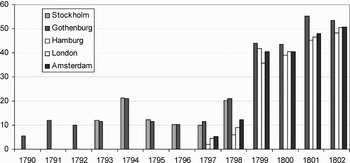
Whatever the reason was for the practical diminishing of Riksbank notes in circulation, this development resulted in several important changes in the monetary situation in Sweden. A market where these notes could be exchanged was quickly established. This market grew in importance and made its mark also on capital markets outside Sweden. It is clear that the market did not value the Riksbank and National Debt Office notes at par (Figure 2); on the contrary, there was almost immediately a divergence in value in the market between Riksbank and National Debt Office notes. It seems as though Riksbank notes obeyed the monetary adverse selection mechanism labelled Gresham's law, although this law originally concerned only metallic coins. As the relative value changed in favour of the Riksbank notes, the public would hold on to these notes and not circulate them.
Ratio between the Riksdaler Banco and the Riksdaler Riksgälds on different markets, 1790–1802 (per cent)
Source: S. Mårtenson, Agiot under kreditsedelsepoken 1789–1802 (Göteborg, 1958), ‘Statistiska tabeller 1668–1924’.

As the value diverged, two ‘new’ currencies emerged. The former Riksdaler Specie was divided into Riksdaler Banco issued by the Riksbank and the Riksdaler Riksgälds issued by the National Debt Office. Both these currencies were in practice issued by the state and circulated simultaneously. As there were more of the latter, prices quickly became quoted in the currency of the National Debt Office.Footnote 16 Consequently, within a short period of time, the new currency Riksdaler Riksgälds became the unit of account as a response to the higher supply of this currency and the changing relative value of the two currencies in the market.
At present, we do not know much more about the seasonal aspects than that the issuance of the National Debt Office notes was made in lumps and that the premium on Riksbank notes was not stable throughout the year.Footnote 17 This latter fluctuation might be explained by drastic shifts in the supply of National Debt Office notes or by fluctuating demand for notes narrowing the gap between the two.
When it comes to the circuits of Riksbank and National Debt Office notes, we know even less. The National Debt Office issued its notes in Stockholm and they were then dispersed throughout the country. The National Debt Office did not redeem its notes, but they were accepted for tax payment, which was done at county level. This might give an explanation for the variation in the premium on Riksbank notes. In the spring, when taxes were to be paid, there might not have been any reason to accept a below par value for the National Debt Office notes.
This episode serves to give some insights into how a system of parallel currencies may work through a market mechanism. But it also shows how institutions based on a rigid idea of what constitutes money may work in contradiction with such a system. The situation with two independent national currencies was not accepted and as a consequence a restored monetary unity was at the top of the political agenda, at least from 1796. However, voices from groups whose income was not dependent on taxes or rents promoted the idea of maintaining the paper standard. In 1800 a detailed plan was agreed upon in the Parliament. But external forces delayed the Riksbank's ability to take over the liabilities of the National Debt Office, and thus these grew from 15 million to 19 million Riksdaler Banco.Footnote 18 When the Riksbank took over responsibility for the National Debt Office notes in circulation in 1803, the exchange rate was fixed at 1:1.5 in favour of the Riksbank. The division between these two currencies was visible until the monetary reform of 1855. Notes issued by the Riksbank, as well as the private banks, were denominated in both currencies, but the denomination was regularly ‘even’ in Riksdaler Riksgälds.Footnote 19
What the experience showed is that, while on the silver standard, Riksbank notes alone were insufficient to meet the economy's demand for domestic liquidity. The National Debt Office notes became a complement to the Riksbank notes. An exchange rate market quickly emerged to deal with the fact that the National Debt Office notes were issued at par value with the Riksbank notes without any binding connection to those. Consequently, the two currencies circulated side by side while their relative value fluctuated.
But the rigidity of the two authorities led to a competitive situation that turned the complementarity of the paper monies into a process of substitution. The Riksbank was rigid in the way it preserved the specie standard and its refusal to have anything to do with the National Debt Office notes. The National Debt Office was rigid in its refusal to accept the Riksbank notes as of higher quality and in disregarding the effects of its massive note issuance. Due to these rigid views, monetary order could only be restored by the abolition of the independence of the National Debt Office notes.
III
In 1824 the Parliament decided that it should be possible to establish banks. These banks should, as all business, run under the principle of solidarity and, in order to fund the business, the banks were given the right to issue credit notes. After the principal decision to readopt the silver standard had been taken in 1830, the first bank applied for a charter in 1831. Owing to institutional constraints on banking establishment the number of banks first grew very slowly. In 1846 the first law that standardised the Enskilda bank charters was passed.Footnote 20 The number of Enskilda banks continued to increase slowly to eight in 1848 and to twelve in 1856.
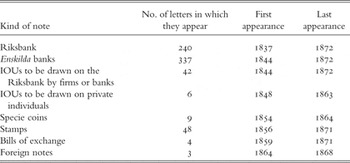
Table 3 shows that there existed paper money of different origin circulating at the same time in Sweden. There are in some cases notes issued by private firms and private individuals, domestic bills of exchange, coins, stamps, and Danish and Norwegian notes (before the formation of the Scandinavian currency union). However, in the letters we predominantly find official Riksbank notes and notes issued by private Enskilda banks. This is fully in accordance with expectations.
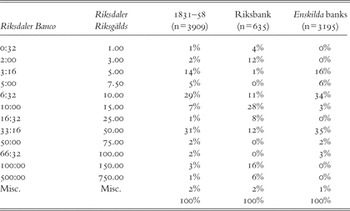
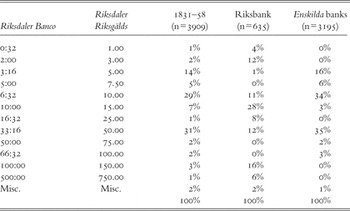
The Riksbank notes and Enskilda bank notes were definitely not perfect substitutes. Riksbank notes could, in contrast to Enskilda bank notes, be held as reserves by the Enskilda banks, be transferred abroad and used for tax payments. However, the Enskilda banks started to pay tax collectors for exchanging the Enskilda bank notes into legal tender when tax payments were made.Footnote 21 Furthermore, the Riksbank had the right to issue notes in smaller denominations than the Enskilda banks throughout the period. In 1834, about 55 per cent of the Riksbank notes in circulation were in small denominations (below 5 Riksdaler Riksmynt). From then on, the share of large notes increased, the share of middle range notes remained low and that of small notes decreased.Footnote 22 At the same time the amount of notes in the smallest denomination available for the Enskilda banks, 5 Riksdaler Riksmynt, was quite substantial.
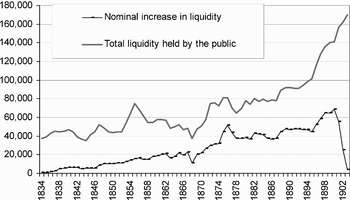
Throughout the period the Enskilda banks operated with reserves consisting of Riksbank notes, thus withdrawing Riksbank notes from circulation. We have defined liquidity as the amount of Riksbank notes not held as reserves in the banking system plus the amount of Enskilda bank notes. The increase in liquidity by the Enskilda banks has been calculated as Enskilda bank notes in circulation minus Riksbank notes held as banking reserves (Figure 3). The Enskilda banks may have been few in number but their notes quickly helped release the constraint on liquidity that the silver standard meant.
Nominal increase in liquidity and total liquidity, 1834–1903 (000s Riksdaler Riksmynt)
Source: Ögren, Money, Credit and Banking.
Note: Liquidity is defined as Riksbank and Enskilda bank notes being held by the public. Nominal increase in liquidity is the net contribution made by the Enskilda banks.

The Enskilda bank notes not only increased liquidity, they replaced less trustworthy money in circulation such as IOUs, promissory notes and/or authorised assignments. They also decreased the number of varieties of money in circulation since the laws, over time, came to standardise the note issuance as well as the basis of operations of the Enskilda banks. The practice of using private IOUs in circulation might have come more or less to an end in the late 1840s when the public suffered an economic loss following a trade crisis, when several merchants known to have issued private notes went bankrupt. Since the Enskilda bank notes came to replace these other forms of money that are more difficult to find data on we can not know exactly the extent to which Enskilda bank notes served to increase liquidity.
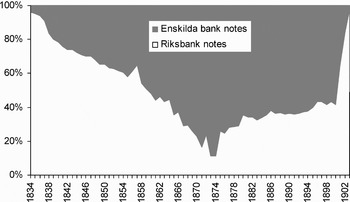
The composition of the money in circulation was altered radically (Figure 4). Already by the late 1850s more Enskilda bank notes were circulating than Riksbank notes. At first this was due to the Enskilda banks' use of Riksbank notes as reserves, which kept them from circulating. This was particularly true during the early and middle 1870s, when most of the notes issued by the Riksbank were held by the Enskilda banks.
Percentage share of Enskilda and Riksbank notes in circulation, 1834–1903
Source: Ögren, Money, Credit and Banking.

Prevalence of types of money in open registered-letter post 1831–72

Source: Postmuseum: ii.260.b; 1831–72.
We can compare this aggregated stock of Riksbank and Enskilda bank notes with the proportion between Riksbank notes and Enskilda bank notes changed between 1850 and 1875 in the postal remittances. Table 4 shows that the proportion of Riksbank notes used in circulation in our sample is below the share of Riksbank notes in total money supply. This indicates that there was a tendency to hold Riksbank notes if possible. On the other hand, since a not insignificant share of the Riksbank notes were in small denominations and these were not used frequently for postal remittances (Table 5), the use of Riksbank notes was perhaps proportional after all.
Proportion of Riksbank notes and Enskilda bank notes in open registered-letter post, 1848–72

Source: Postmuseum: ii.260.b; 1848–72.
Frequency in the use of notes of different denominations (per cent of notes), 1831–58

Source: Postmuseum: ii.260.b; 1831–58.
Annual bank data indicate that Riksbank notes were actually drawn out of circulation. But we know that this to a large extent was to fill reserves of the Enskilda banks. More importantly, the analysis of the remittances indicates that the Riksbank notes were used in circulation to a higher degree than expected. That would indicate that there was no attempt by the business people to withhold Riksbank notes from circulation despite their larger range of possible transactions (including abroad and for taxes). Whether this was forced on the merchants by a shortage of notes in general or if it was because they did not care what note they used is hard to tell. It is probably the former but if not, that does not affect the general argument in this article.
The content of a remittance represented an amount that was stated on the official form that was assured by the postal service and it was this amount that was later acknowledged in the business correspondence. Still, the amount was the sum of the valuation of the various notes the letter contained.
It is thus important to make the distinction between the expressed amount and what kinds of money were used in the remittance as payments. It is also important to compare the official amount stated in the remittance with the nominal amount of the different kinds of money enclosed in the remittance. This provides information on whether certain kinds of notes were valued with a premium or a discount in relation to their nominal value (and thus other kinds of money).
As far as it is possible to determine, each note contributed to the total amount of the remittance with its nominal value. There are many examples of letters with a wide variety of notes with their face value aggregated to a total sum. Actually, there is no indication of any discriminatory treatment of any kind of notes in any of the letters compiled. For instance, in 1863 Halén sent 1,301 Riksdaler Riksmynt 48 öre from Härnösand to Bergström in Umeå. The letter contained in total 108 notes and some stamps, all denominated in Riksdaler Riksmynt. There were two Riksbank notes, one of 100 Riksdaler and one of 1 Riksdaler, one Filialbank assignation of 100 Riksdaler, eight Stockholm Enskilda Bank notes of 10 Riksdaler each and then a mixture of 5, 10, 50 and 100 Riksdaler notes issued by Mälareprovincernas Enskild Bank, which had a branch office in Härnösand at the time. This is only one example that clearly shows that the exact amount was important, not least since the stamps were added to achieve the exact amount.Footnote 23
This example proves that Riksbank notes and Enskilda bank notes circulated side by side in payments fixed at par value. It also shows that assignations issued by the Filialbanks and drawn on the Riksbank were valued at par with other forms of notes. The Filialbanks were private banks without the right to issue notes that operated between 1854 and 1872 and funded their business with equity capital and credit from the Riksbank.Footnote 24 In addition, stamps would be used as a kind of token coin to cover for the smallest denominations. In one case, we have found an instruction to the postmaster to exchange small silver coins for stamps to be included in the letter.
One Enskilda bank failed in 1878 due to embezzlement with the note issuance. Not even this episode led to discounts of the bank's notes. Instead the notes were refused as means of payment until another bank guaranteed the liabilities of this bank. Immediately after the news of its inappropriate business was out, other actors, not least the Riksbank, refused the notes of the bank. We do not know, however, how soon the news reached merchants and other holders of the bank's notes.Footnote 25
The notes issued by the Enskilda banks also followed a seasonal pattern. This pattern rhymed well with the seasonal demand for liquidity of the agricultural cycle in Sweden.Footnote 26 A large form of lending, which was how the Enskilda bank would issue their notes, was in the form of credit granted or overdrafts. This means that the borrower could utilise the funds (or the credit) of the bank when necessary. Such an arrangement served well to smooth the changing demand for liquidity by merchants, large-scale farmers and manufacturers. Moreover, the Enskilda banks normally did not utilise their legal right to issue notes to the fullest extent so they had room for flexible note issuance.Footnote 27
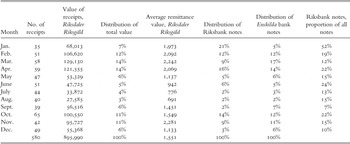
There is nothing in the registered letter that discloses the reason for sending money. But we know from previous studies on the business correspondence of some Swedish iron-masters and grain traders in the nineteenth century that remittances seldom were directly related to specific transactions of goods or services. They either forwarded money to agents purchasing grain directly from farmers or remitted money more or less regularly to settle accounts with trading partners. It is also clear that businessmen tried to avoid making payments in the busy part of the seasons and waited for numerous transactions to level out the claims before the balance was eventually settled by a remittance.Footnote 28 We might therefore expect that the money sent by registered-letter post was for settling accumulated debts and not directly for making payments.
The seasonal distribution of the remittances analysed fits with the expected pattern. There are two peaks a year, in February to April and in October and November (Table 6). Therefore, we assume that the data are somewhat representative and that it is possible to make a few observations with theoretical implications. The difference between the peak and the trough is about 4.5 times. Since the number of remittances only increased by 50 per cent, the size of the remittances increased 3 times in the peak months. This indicates the flexibility that the demand for money required.
Monthly variation in the use of banknotes in postal remittances, 1830–72

Source: Postmuseum: ii.260.b; 1830–72.
In Table 6, it is shown that the proportions of Riksbank notes and Enskilda bank notes were rather stable across the months with a few exceptions. The large share of Riksbank notes in January is explained by one outlier, while the low share in March might be explained by the fact that Riksbank notes were used for tax payments then.
It is difficult to find any regional patterns in the material but a few things are clear. Remittances sent from Stockholm contained mainly Riksbank notes and only a very limited number of Enskilda bank notes. This might further contribute to the interpretation of Table 4, that the sample shows a high proportion of Enskilda bank notes, since the remaining registered-letter receipts show a clear bias in favour of middle-sized trading centres.
This fits with another general observation. It seems as though the kind of private notes sent from one location depends on which banks had a branch in that location. In a few cases, where the sender has listed the serial numbers of the notes, it can be shown that the letter contains up to seven consecutive notes from the local bank.Footnote 29 This indicates that the local branch supplied the remitter with cash in order to allow him to send money to another location. Almost all major note-issuing banks were located in regional trading centres outside Stockholm and Gothenburg. In these two main cities in Sweden there was an ample supply of Riksbank notes.
There does not seem to be any tendency as to where the money was sent. All kinds of private notes were sent all over the country, which is shown by two receipts from local branches of the Kalmar Enskilda Bank. The branches sent money to the limited liability commercial bank Skandinaviska Kredit Aktiebolaget in Stockholm which had became the centre for a national clearing system for Enskilda bank notes. The letters contain about 350 and 150 notes respectively from 20 and 13 different banks from Westerbotten and Sundsvall in the north to Skånes Enskilda Bank in the south.Footnote 30
IV
This section initiates a discussion on the theoretical implications of the Swedish case for our understanding of complementary relationships among multiple monies. Sweden re-adopted the silver standard in both 1776 and 1834. Despite this measure, the means of payment in circulation did not become homogeneous with respect to origin. On the contrary, the number of co-circulating notes expanded shortly after the re-adoption in both cases. However, the experiences in these two cases differ.
The Swedish monetary system had different kinds of means of payments with different qualities. We would, in accordance with Mundell's version of Gresham's law, expect either that these were treated at different rates, probably with fluctuating values, or, if they were traded at par, we would expect that the notes of high quality, the Riksbank notes, would be drawn out of circulation. While the findings of the late eighteenth century partly support this prediction, the findings of the late nineteenth century do not.
In the late eighteenth century, only a fraction of the notes redeemable in silver remained in circulation and there existed a premium on these notes in the market, although for several years this was smaller than expected. In the mid nineteenth century, although some notes redeemable in silver were withdrawn from circulation by the private banks, a substantial amount of notes remained in circulation, and there is no evidence of a premium on these notes. The key to maintaining the stability in monetary value and the balance between different monies during these two periods was whether a complementary relationship between varieties of paper money in circulation was achieved.
When we try to understand why no single homogenous national currency appeared in either of these two instances, the evidence suggests that the attempt to stabilise the currency by fixing the foreign exchange rate of official money through the silver standard limited the supply of money for the domestic market at a level below demand. It appears that there was a shortage of means for clearing debts. The Swedish economy was to a large extent based on bilateral credit relations maintained by bookkeeping, while all kinds of cash payments were kept to a minimum. The problem was how to clear debts with a limited amount of official money supply and without a national banking system allowing a more efficient clearing.
We suggest that the cause for the coexistence of multiple monies is that, without the multiple means of settlement in circulation, the money supply would have been too restrictive on economic activity. This was especially obvious in the busy months of the year. In the Swedish case, the demand for money would peak in February and March when winter conditions allowed for the transportation of goods, especially last autumn's crops, and in September when most annual accounts were cleared before the end of the financial year. No single agent in the Swedish economy, not even the state, had the capacity on its own to create flexible liquidity to the required amount necessary to facilitate trade and production decisions.
The main support for our hypothesis is the fact that the introduction of new money with a doubtful legal position, limited official acceptance for instance for tax payments and with inferior backing, was accepted at par value with legal tender, i.e. Riksbank notes. As the case of Wadstena Enskilda Bank shows, if one form of money came to be regarded as of larger risk it would not lead to discounts in the domestic market but that kind of money would simply disappear since it would no longer be accepted for transactions.
It is clear that the quality of the note-issuer did not determine the value of notes. As long as the aggregated supply of various origins was below total demand, relative prices between these various monies tended to be stable. That can be explained by the argument that the utility of accepting or treating different monies as equal was higher than the risk of a relative fall in value of the monies held. One factor which affected the relative risk of a fall in value is of course the length of time for which individuals kept their money. If shortage was a reality, those periods would be short since incoming money was used for immediate clearing of other debts. This seems to have been the case in eighteenth- and nineteenth-century Sweden.
Since demand was fluctuating, this required that the supply was made flexible as well. The monetary sector of the economy must have been flexible enough to respond to the varying demand for money without causing instability by over-issuing of money. The solution to this shortage of money (especially when a war is on the way) is not trivial, which the episode with the National Debt Office notes and Riksbank notes shows.
Although the increase in the money supply in the late eighteenth century was at first welcome, it tended in the long run to be too high and the stability between the relative values of different monies was not maintained. This has previously been understood as having been caused by the over-issuance of parallel money. We suggest, however, that it was caused by the lack of flexibility in the money supply, especially in the lack of a mechanism for redeeming money during seasonal periods of slack demand. It is possible that the system of complementary monies could have been sustained, given the existence of a market to price these two currencies and the fact that both currencies could be used for tax payments. These two features might together have been an effective mechanism for restraining over-issuance of a currency in the long run. This we will never know since politicians decided to fix the relative value of the two monies and thereby effectively put a stop to the evaluation by the market.
While the authorities had to abandon the silver standard in order to fix the relationship between the National Debt Office notes and the Riksbank notes in the early nineteenth century, both external and internal stability in the currency value were preserved after the readoption of the silver standard in 1834. There were many conditions that did not favour the successful adoption of a metal standard at this time: the Swedish monetary authorities did not hold much metal as reserves; the economy experienced a substantial balance of payment deficit over more than 60 years; the seasonal fluctuations in the economy remained significant; and the economy went through a thorough transformation from a basically agrarian and proto-industrial economy to one with an industrial sector contributing substantially to the national income. Hence, there are no reasons to believe that structural changes caused the sudden monetary stability; instead, it was due to innovations within the monetary system.
We suggest that the explanation lies in the expansion of the multiple monetary system that emerged in the nineteenth century. Due to this system, demand could really steer supply since banks would have to redeem notes that they over-issued. The banks also had the ability to alter their portfolios to follow demand. When the early private banks started their activities in the 1830s and 1840s, they organised a clearing system as a remedy for one of the causes of illiquidity. With a debt-creating system the number of accounts increased and the transfer of ‘funds’ between these accounts was facilitated. Initially, these credit accounts were mainly a reorganisation of the clearing mechanism by a concentration of accounts in one place. This concentration allowed for multiple clearing between large numbers of traders. The banks' accounts thereby helped to synchronise the flows of incomes and the need for clearing debts. Furthermore, it put the clearing of accounts in the hands of a third party, at least nominally.
Still, the clearing system was not sufficiently integrated to ensure that money was allocated to the right place. Individuals could not access money other than that created either by themselves or, after 1850, by the bank in their locality. The endogenous process of money creation and the clearing mechanism for money destruction are two significant parts of the Swedish monetary system. Hence endogenous credit allowed for a more flexible money supply by the creation of liquid credit both at the right place and the right time.
The conclusion is that we find the complementary relationship among monies in the multiple sources of endogenous money that supplied the economy with the means of settlements needed to balance all the various transaction systems in which the economy was involved. Complementary monies are a response to the market's need for flexibility of liquidity in time and in space. The supply of paper monies is always there – the supply will increase if demand increases – but is stopped if the increase leads to devaluation. The key is how the supply is organised to adjust better to a volatile demand for money, a demand that varies with the demand for money for seasonal, regional, domestic and international transactions.