Children in foster care have typically been exposed to a host of early adverse experiences (e.g., prenatal alcohol and substance exposure; physical, sexual, and emotional abuse; physical and supervisory neglect; and repeated caregiver transitions), which have been shown to have negative consequences on important physical, cognitive, and socioemotional outcomes (Bolger & Patterson, Reference Bolger and Patterson2001; Kessler et al., Reference Kessler, Pecora, Williams, Hiripi, O'Brien, English and Sampson2008; Leslie, Gordon, Ganger, & Gist, Reference Leslie, Gordon, Ganger and Gist2002; Pears & Fisher, Reference Pears and Fisher2005). Academic difficulties, including elevated rates of academic skill deficits, special education placement, suspensions and expulsions, and school dropout, also have been well documented in children in foster care (Pears, Fisher, Bruce, Kim, & Yoerger, Reference Pears, Fisher, Bruce, Kim and Yoerger2010; Smithgall, Gladden, Howard, Goerge, & Courtney, Reference Smithgall, Gladden, Howard, Goerge and Courtney2004; Stein, Reference Stein1997; Zima et al., Reference Zima, Bussing, Freeman, Yang, Belin and Forness2000). There has been a growing awareness that the negative outcomes observed among populations who have been exposed to early adverse experiences may, at least partially, result from experience-induced alterations in specific cognitive abilities and the underlying neural regions (De Bellis, Reference De Bellis2001; Fishbein, Reference Fishbein2000; Gunnar, Fisher, & Early Experience Stress and Prevention Network, Reference Gunnar and Fisher2006). Furthermore, it has been suggested that efforts to prevent or ameliorate these negative outcomes may be enhanced by targeting these affected cognitive abilities. For example, response monitoring (the ability to use internal and external cues to monitor one's behavioral performance) may be critical to children's academic success, particularly during the transition into formal schooling when children are required to learn new classroom rules and academic skills quickly. Thus, response monitoring may be a critical target for preventive interventions designed to prepare children who have been exposed to early adverse experiences for formal schooling. In the current study, the effects of a school readiness intervention on electrophysiological indices of external response monitoring were examined in children in foster care prior to entering kindergarten.
Response Monitoring and the Underlying Neural Activity
Response monitoring is a higher order cognitive ability that involves assessing the quality of information processing by comparing actual responses or outcomes to intended responses or outcomes (Holroyd, Nieuwenhuis, Mars, & Coles, Reference Holroyd, Nieuwenhuis, Mars, Coles and Posner2004; van Veen & Carter, Reference van Veen and Carter2002). When a discrepancy is detected, an error signal is generated and additional cognitive resources are recruited to correct the response and achieve the desired outcome. Although even young children are able to recognize their own errors under certain circumstances, previous research suggests that internal response monitoring continues to develop into adolescence. For example, a series of studies using a visual discrimination task revealed that 5-year-olds overestimated their performance and were less likely to rate their performance as worse on more difficult trials than easier trials compared to adults (O'Leary & Sloutsky, Reference O'Leary and Sloutsky2017, Reference O'Leary and Sloutsky2019). Similarly, post-error slowing and post-error improvement in accuracy, which reflect behavioral adjustment following error detection, increased with age during a flanker task among 8- to 19-year-olds (Overbye et al., Reference Overbye, Walhovd, Paus, Fjell, Huster and Tamnes2019). Finally, a study with 7- to 25-year-olds reported that age was positively related to amplitude of an electrophysiological index of internal response monitoring, the error-related negativity (ERN), during a flanker task (Davies, Segalowitz, & Gavin, Reference Davies, Segalowitz and Gavin2004). Recent analyses of these data indicated that there was still a significant developmental increase in amplitude of the ERN even after removing the effect of trial-to-trial latency variability, which has been shown to decrease with age and attenuate the amplitude of electrophysiological indices (Gavin, Lin, & Davies, Reference Gavin, Lin and Davies2019). Taken together, these findings suggest that internal response monitoring is not fully matured in early childhood and that response monitoring following external performance feedback, or external response monitoring, may be particularly important for young children. In fact, previous research suggests that school-aged children are more sensitive to and reliant on external performance feedback than adults (Crone, Jennings, & van der Molen, Reference Crone, Jennings and van der Molen2004; Eppinger, Mock, & Kray, Reference Eppinger, Mock and Kray2009).
To date, much of the research examining external response monitoring has relied upon event-related potential (ERP) data. (In contrast to behavioral data that reflect the final output from the confluence of multiple cognitive abilities, ERP data have excellent temporal resolution [in ms] and provide information about the temporal sequence of specific cognitive abilities.) In particular, the feedback-related negativity (FRN) has been the focus of most of this research. The FRN is a large frontocentral negative deflection that typically peaks approximately 300–400 ms after negative performance feedback or worse-than-expected outcome feedback among adults and children (Luu, Tucker, Derryberry, Reed, & Poulsen, Reference Luu, Tucker, Derryberry, Reed and Poulsen2003; van Meel, Oosterlaan, Heslenfeld, & Sergeant, Reference van Meel, Oosterlaan, Heslenfeld and Sergeant2005). The results from source localization and neuroimaging studies suggest that the FRN is most likely generated in the anterior cingulate cortex; however, the specific region of the anterior cingulate cortex is still debated (Gehring & Willoughby, Reference Gehring and Willoughby2002; Hauser et al., Reference Hauser, Iannaccone, Stämpfli, Drechsler, Brandeis, Walitza and Brem2014; Luu et al., Reference Luu, Tucker, Derryberry, Reed and Poulsen2003; Nieuwenhuis, Slagter, von Geusau, Heslenfeld, & Holroyd, Reference Nieuwenhuis, Slagter, von Geusau, Heslenfeld and Holroyd2005).
External response monitoring, as indexed by the FRN, is believed to be critical to making adaptive behavioral adjustments after committing an error and to learning new skills. Consistent with this hypothesis, a more pronounced amplitude of the FRN in response to unexpected performance feedback was associated with a larger behavioral adjustment during a time estimation task among young adults (Holroyd & Krigolson, Reference Holroyd and Krigolson2007). Furthermore, a more negative amplitude of the FRN following negative performance feedback among young adults predicted not selecting the same erroneous response when the item was presented again during a sequence learning task (van der Helden, Boksem, & Blom, Reference van der Helden, Boksem and Blom2010). The authors concluded that the FRN may reflect a recognition of the contingencies between cues and their associated responses and between responses and their associated outcomes, which facilitates the acquisition of new skills. However, it is important to note that most of the research on the FRN has been conducted with adults. Thus, it is not known whether a more pronounced amplitude of the FRN in response to negative performance feedback also would be associated with adaptive behavioral adjustments in young children. As discussed in more detail below, preschool-aged children who received a preventive intervention displayed greater differentiation between amplitude of the FRN following positive performance feedback and negative performance feedback, but not improved behavioral performance, during a flanker task than children who received services as usual (Bruce, McDermott, Fisher, & Fox, Reference Bruce, McDermott, Fisher and Fox2009).
Impact of Early Adverse Experiences and Preventive Interventions on Response Monitoring
Because the neural regions supporting response monitoring have a protracted developmental course that continues into adolescence (Davies et al., Reference Davies, Segalowitz and Gavin2004; Santesso & Segalowitz, Reference Santesso and Segalowitz2008), it has been argued that response monitoring and the underlying neural regions may be vulnerable to the effects of early adverse experiences such as neglectful and abusive care (Lupien, McEwen, Gunnar, & Heim, Reference Lupien, McEwen, Gunnar and Heim2009; Teicher et al., Reference Teicher, Andersen, Polcari, Anderson, Navalta and Kim2003). Women with histories of childhood sexual abuse and depression demonstrated less differentiation between their electrophysiological activity following correct responses and incorrect responses during a reinforcement learning task than women without such histories (Pechtel & Pizzagalli, Reference Pechtel and Pizzagalli2013). School-aged children who experienced institutional care displayed blunted amplitudes of the ERN and error-related positivity (Pe), another electrophysiological index of internal response monitoring, during a flanker task compared to children who had never experienced institutional care (Loman et al., Reference Loman, Johnson, Westerlund, Pollak, Nelson and Gunnar2013; McDermott et al., Reference McDermott, Troller-Renfree, Vanderwert, Nelson, Zeanah and Fox2013). Furthermore, children (aged 4–14 years) with maltreatment-related posttraumatic stress disorder had significantly lower N-acetylaspartate to creatine ratios, a marker of neuronal integrity, in the anterior cingulate cortex than nonmaltreated children (De Bellis, Keshavan, Spencer, & Hall, Reference De Bellis, Keshavan, Spencer and Hall2000). Similarly, the results of neuroimaging studies revealed reduced gray matter volumes and cortical thickness in the anterior cingulate cortex in adults and school-aged children exposed to early adverse experiences, including harsh corporal punishment and domestic violence (Cohen et al., Reference Cohen, Grieve, Hoth, Paul, Sweet, Tate and Williams2006; Dannlowski et al., Reference Dannlowski, Stuhrmann, Beutelmann, Zwanzger, Lenzen, Grotegerd and Kugel2012; Kelly et al., Reference Kelly, Viding, Wallace, Schaer, De Brito, Robustelli and McCrory2013; Tomoda et al., Reference Tomoda, Suzuki, Rabi, Sheu, Polcari and Teicher2009).
Research documenting the impact of early adverse experiences on response monitoring and the anterior cingulate cortex, in combination with the proposed role of response monitoring in making adaptive behavioral adjustments and learning new skills, underscores response monitoring as a potential target for preventive interventions for children in foster care entering kindergarten. Although limited, there is some electrophysiological evidence to suggest that preventive interventions may be able to ameliorate the effects of early adverse experiences on the functioning of the anterior cingulate cortex. First, a brief computerized attention training for typically developing, preschool-aged children affected the timing and topography of an ERP component that is believed to be generated by the anterior cingulate cortex (Rueda, Checa, & Cómbita, Reference Rueda, Checa and Cómbita2012). According to the authors, these results indicated that the children who received the training activated the underlying neural regions more quickly and efficiently. Second, the Bucharest Early Intervention Project, a randomized controlled trial of high-quality foster care as an intervention for infants and toddlers who experienced institutional care, revealed positive intervention effects on a range of outcomes, including physical growth, intelligence, psychiatric symptoms, and stress response system activity (Nelson, Fox, & Zeanah, Reference Nelson, Fox and Zeanah2014). In addition, at 8 years of age, children who experienced institutional care but were subsequently placed in foster care and children who had never experienced institutional care showed the expected pattern of electrophysiological activity during a go/no-go task with more pronounced amplitudes of the ERN following incorrect responses than following correct responses (McDermott, Westerlund, Zeanah, Nelson, & Fox, Reference McDermott, Westerlund, Zeanah, Nelson and Fox2012). In contrast, children who remained in institutional care displayed significantly smaller amplitude differences between correct responses and incorrect responses. Third, and most germane to the current study, the results of a randomized controlled trial revealed that Multidimensional Treatment Foster Care for Preschoolers, a preventive intervention of enhanced foster care designed to reduce child behavioral problems by training foster parents to use positive reinforcement and consistent, nonpunitive limit setting, has a positive effect on important outcomes, such as placement stability, attachment-related behaviors, and stress response system activity (Gilliam & Fisher, Reference Gilliam, Fisher, Timmer and Urquiza2014). Furthermore, external response monitoring was examined during a flanker task in a subsample of the children who previously participated in the randomized controlled trial. Although the children, as a whole, demonstrated the expected pattern of behavioral results (e.g., flanker interference effect on accuracy and reaction time and post-error slowing), there were not significant group differences between the children in foster care who received the intervention, the children in foster care who received services as usual, and the nonmaltreated children on the behavioral data (Bruce et al., Reference Bruce, McDermott, Fisher and Fox2009). However, the groups displayed different patterns of results for the feedback-locked ERP components (i.e., the N1, P2, and FRN). (The early feedback-locked components, the N1 and P2, have not been as well studied as the FRN; however, these components are believed to reflect early attention and categorization processes [van Meel et al., Reference van Meel, Oosterlaan, Heslenfeld and Sergeant2005]). Specifically, the children in foster care who received services as usual did not demonstrate differential patterns of electrophysiological activity in response to positive performance feedback and negative performance feedback. In contrast, children in foster care who received the intervention and nonmaltreated children displayed similar patterns of electrophysiological activity with significant differences between the amplitudes of all of the feedback-locked ERP components following positive performance feedback and negative performance feedback. Taken together, the results of these studies indicate that preventive interventions may mitigate the impact of early adverse experiences on the neural activity underlying response monitoring.
Objectives and Hypotheses of the Current Study
The current study was designed to investigate the effects of a school readiness intervention, the Kids In Transition to School (KITS) Program (Pears, Carpenter, Kim, Peterson, & Fisher, Reference Pears, Carpenter, Kim, Peterson, Fisher, Mashburn, LoCasale-Crouch and Pears2018), on electrophysiological indices of external response monitoring in children in foster care. The KITS Program is designed to increase children's academic and social–emotional readiness for kindergarten. In the KITS school readiness groups, the teachers preteach the behavioral expectations to the children and then provide a structured, consistent environment and schedule to help the children meet those expectations. The teachers also use a high rate of proactive strategies designed to promote desired behaviors, such as explicit feedback about the children's behavior (e.g., clearly labeling and praising appropriate behaviors). The results of a randomized efficacy trial of the KITS Program with children in foster care demonstrated positive intervention effects on outcomes, including literacy skills, self-regulation skills, and stress response system activity (Pears et al., Reference Pears, Carpenter, Kim, Peterson, Fisher, Mashburn, LoCasale-Crouch and Pears2018).
The use of frequent, explicit, contingent performance feedback within the context of a structured, consistent environment was expected to positively affect the children's external response monitoring. To test this hypothesis, behavioral data and ERP data collected during a flanker task were compared at the beginning of the summer before the intervention and at the end of the summer after the school readiness phase of the intervention for children who received the KITS Program and children who received services as usual. The current study expands upon the previous study that examined intervention effects on external response monitoring in children in foster care (Bruce et al., Reference Bruce, McDermott, Fisher and Fox2009) by assessing a larger sample of children before and after the intervention, ensuring that any observed group differences were not the result of differences before the intervention. Although there were no significant group differences on the behavioral data in the previous study, it was predicted that the children who received the KITS Program would commit fewer errors of commission and display faster reaction times on the flanker task after the intervention than before the intervention. The FRN was the primary feedback-locked ERP component of interest in the current study. However, given the observed group differences on the N1 and P2 in the previous study with children in foster care, the current study also examined these feedback-locked ERP components. It was hypothesized that the children who received the KITS Program would display greater amplitude differences between positive performance feedback trials and negative performance feedback trials for the N1, P2, and FRN after the intervention than before the intervention, suggesting an increased responsivity to corrective performance feedback. In contrast, it was predicted that the children who received services as usual would not demonstrate significant differences on their behavioral data or ERP data over time.
Method
Participants
The sample for the current study was recruited from a larger randomized efficacy trial of the KITS Program with maltreated children in foster care (n = 192). To be eligible for the efficacy trial, children had to be living in kinship or nonkinship foster care in one of two counties in the Pacific Northwest, entering kindergarten in the fall, monolingual or bilingual English speakers, and not involved in another intervention closely associated with the KITS Program. Eligible children and their caregivers were randomly assigned to the KITS group or foster care comparison (FCC) group. Due to distance from the electrophysiology laboratory, only families living in one of the two counties were invited to participate in an additional assessment to collect electroencephalogram (EEG) data during a flanker task at the beginning of the summer before the intervention (Time 1; T1) and the end of the summer prior to kindergarten entry but after the school readiness phase of the intervention (Time 2; T2). A total of 69 children (38 KITS, 31 FCC) completed this assessment at T1 and T2. Of these children, 20 (2 KITS at T1 and 9 KITS at T2, 8 FCC at T1, and 4 FCC at T2) were excluded because of an inadequate number of artifact-free ERP trials at one or both time points. An additional 4 children (2 KITS at T1, 2 FCC at T1 and 1 FCC at T2) were excluded because of extremely poor behavioral performance during the flanker task (i.e., failing to respond to trials, as indicated by more than 50% errors of omission, or pressing the same button for every trial, as indicated by less than 10% correct on trials of one color) at one or both time points. The resulting analytic sample for the current study was 45 children (26 KITS, 19 FCC).
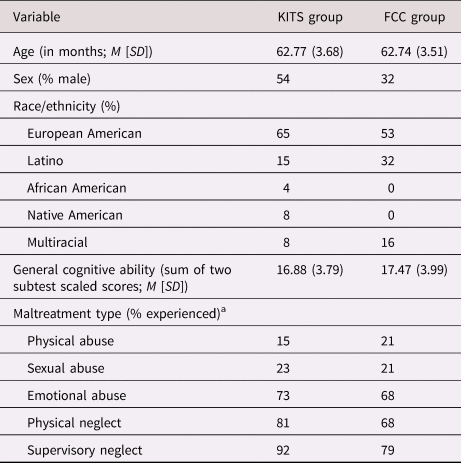
Descriptive information for these children is presented by group in Table 1. The children in the current study did not significantly differ from the children in the larger efficacy trial in terms of child sex or age at T1, Pearson χ2 (1, N = 192) = 0.48, ns, and F (1, 188) = 1.09, ns, respectively. As part of the larger efficacy trial, the children completed the block design and vocabulary subtests of the Wechsler Preschool and Primary Scales of Intelligence–Third Edition (Wechsler, Reference Wechsler2002). In the standardization sample, each subtest scaled score had a mean of 10 and standard deviation of 3. The sum of the scaled scores for these subtests was used to provide an estimate of the children's general cognitive ability. The children in the current study and children in the larger efficacy trial did not differ on their general cognitive ability, F (1, 185) = 0.34, ns. Similarly, the KITS group and the FCC group in the current study did not significantly differ by child sex, age, or general cognitive ability, Pearson χ2 (1, N = 45) = 2.20, ns, F (1, 43) = 0.00, ns, and F (1, 43) = 0.25, ns, respectively. Information about the children's maltreatment experiences were coded from their child welfare records using the Maltreatment Classification System (Barnett, Manly, & Cicchetti, Reference Barnett, Manly, Cicchetti, Cicchetti and Toth1993). The percentage of children who experienced each type of maltreatment also is shown in Table 1.
Descriptive statistics for child characteristics at T1 by group

Note: T1, assessment before the intervention. KITS, Kids In Transition to School Program. FCC, foster care comparison. aThe percentages do not sum to 100 because children may have experienced more than one type of maltreatment.
Procedures
Prior to participation in the larger efficacy trial, the children's child welfare services caseworkers (as representatives of the state, which serves as the legal guardian of children in foster care) provided informed permission for the children's participation, and the children's caregivers provided informed consent for their own participation. As noted above, the children completed the EEG assessment at the beginning of the summer (T1) and at the end of the summer (T2). The assessment at T2 was timed so that the children's readiness skills could be measured before any formal kindergarten instruction began and before any differences between the children's kindergarten schools and classes could affect their academic and social–emotional skills. The staff members involved in data collection were blind to the group assignment of the children and their caregivers.
KITS Program protocol
The KITS Program occurs during the 2 months prior to entering kindergarten (school readiness phase) and the first 2 months of kindergarten (transition/maintenance phase). As stated above, the current study examined the effects of the school readiness phase of the intervention.
The intervention consists of two primary components: a 24-session school readiness group for the children (16 2-hr sessions, twice weekly in the school readiness phase; 8 2-hr sessions, once weekly in the transition/maintenance phase) that focuses on promoting early academic and social–emotional skills and an 8-session caregiver group (4 2-hr sessions, every 2 weeks in both phases) that focuses on promoting caregiver involvement in early academic skills and school. The school readiness groups for the children are designed to be similar to a kindergarten classroom with a highly structured, consistent routine and many transitions between activities. The manualized curriculum covers three skills areas: early academic skills (e.g., letter names, phonological awareness, number recognition, and counting), essential social skills (e.g., reciprocal social interaction, social problem solving, and emotion recognition), and self-regulatory skills (e.g., handling frustration and disappointment, controlling impulses, following multistep directions, listening, and making appropriate transitions). The curricular objectives and activities to promote these objectives are clearly specified for each session by skill area. Multiple opportunities for practicing newly acquired skills are embedded across activities. A graduate-level lead teacher and two assistant teachers conduct the school readiness groups with 12–15 children. The high staff-to-child ratio allows the children to receive immediate and consistent support and feedback while practicing new skills. The manualized curriculum for the caregiver groups includes foci on skills relevant to the kindergarten transition (e.g., developing routines around school activities and using behavior management skills that parallel those used in the school readiness groups). Each group is led by a facilitator and an assistant. The facilitator presents information, leads structured group discussions of the materials, and addresses questions and concerns. Skill acquisition is reinforced via role-plays and discussion.
FCC protocol
Children in the FCC group received services as usual through the child welfare system. These services often include individual child psychotherapy, early childhood education programs such as Head Start, and services such as speech therapy. No attempt was made to influence the type or amount of services given to the children or their caregivers.
Measures
Flanker task
Behavioral data and ERP data were recorded during a computer-administered flanker task that was adapted for young children (McDermott, Perez-Edgar, & Fox, Reference McDermott, Perez-Edgar and Fox2007) and presented using the STIM Stimulus Presentation System (James Long Company, Caroga Lake, NY). Throughout the task, a small circular fixation point was displayed in the center of the computer screen. Each trial began with a 300-ms warning cue indicated by a small asterisk. Following a 500-ms delay, a horizontal row of five 1-in. circles, with the central circle directly above the fixation point, was then shown for 700 ms. The task comprised congruent trials, which consisted of five red circles or five green circles, and incongruent trials, which consisted of a central red circle flanked by green circles or a central green circle flanked by red circles. Congruent trials and incongruent trials were presented in a pseudorandom order using a 30:70 ratio (congruent trials:incongruent trials). The children held a button box with a red pushbutton and a green pushbutton and were instructed to press the button that corresponded with the color of the central circle, regardless of the color of the flanking circles, as quickly and accurately as possible. The children were given up to 1300 ms to respond. Accuracy and reaction time in ms for each trial were recorded using the STIM Stimulus Presentation System. Following a 450-ms delay after the response, performance feedback was presented for 800 ms. A 1-in. yellow smiling face indicated a correct response and a 1-in. yellow frowning face indicated an incorrect response or no response. The intertrial interval varied in length from 0 to 500 ms. The 20-min task consists of three blocks of 60 trials each. Prior to beginning the task, the children's color vision, color familiarity, and comprehension of task terminology were assessed and the children completed 8 practice trials to ensure task comprehension.
EEG data acquisition and processing
Prior to collecting the EEG data, a calibration file was collected by running a 50 μV, 10-Hz calibration signal through all channels. The EEG data were recorded using a Lycra cap fitted with tin electrodes in accordance with the International 10–20 System (Jasper, Reference Jasper1958). Data were collected from 26 scalp electrodes and 2 mastoid electrodes with Cz serving as the reference electrode and AFz serving as the ground electrode. Two channels of electrooculogram (EOG) data were recorded with an electrode placed above and below the left eye for vertical EOG and an electrode placed at the outer canthus of each eye for horizontal EOG. Impedances were tested before and after EEG data collection to ensure that each electrode site had an impedance of 10 KΩ or less. The EEG data were amplified by a custom 32-channel isolated bioelectric amplifier (SA Instrumentation Company, San Diego, CA) using filter settings of 0.1 Hz and 100 Hz. The data were digitized using a sampling rate of 512 Hz with a 16-bit A/D converter (DATAQ Instruments, Inc., Akron, OH).
The EEG Analysis System (James Long Company, Caroga Lake, NY) was used to calibrate, artifact score, and rereference the data. Epochs containing signals +/−200 μV were excluded from analyses, and artifact due to vertical eye movement was regressed. Trials with reaction times of less than 300 ms or errors of omission were excluded from analyses. The EEG data were rereferenced offline using an average mastoid configuration and were digitally refiltered with a 15-Hz low-pass filter. The EEG data at Fz, FCz, and Cz were then time locked to the presentation of the performance feedback, corrected using a baseline window of −150 to −50 ms relative to the presentation of the performance feedback, and quantified separately for positive performance feedback trials and negative performance feedback trials. The children were required to have at least 10 artifact-free ERP trials for both trial types to be included in analyses. At T1, the mean number of artifact-free ERP trials for each group was as follows: 91.92 (SD = 29.55) for the KITS group and 80.63 (SD = 34.64) for the FCC group for positive performance feedback trials and 34.62 (SD = 12.46) for the KITS group and 33.47 (SD = 12.25) for the FCC group for negative performance feedback trials. At T2, the mean number of artifact-free ERP trials for each group was as follows: 88.50 (SD = 36.44) for the KITS group and 77.53 (SD = 41.72) for the FCC group for positive performance feedback trials and 25.38 (SD = 12.96) for the KITS group and 27.37 (SD = 15.33) for the FCC group for negative performance feedback trials. The KITS group and the FCC group did not significantly differ in the number of artifact-free ERP trials for positive performance feedback trials or negative performance feedback trials at T1 or T2, F (1, 43) = 1.39–0.09, ns.
The N1 was identified as the maximum negative peak between 50 and 150 ms, the P2 was identified as the maximum positive peak between 160 and 260 ms, and the FRN was identified as the maximum negative peak between 300 and 600 ms relative to the presentation of the performance feedback. (The selection of the electrode sites and time window for each component was informed by a previous study that used this task with a similar sample [Bruce et al., Reference Bruce, McDermott, Fisher and Fox2009] and refined by visual inspection of the ERP waveforms for each child at T1 and T2.) It has been argued that the FRN is, by definition, the difference between the electrophysiological activity in response to positive performance feedback and negative performance feedback (Krigolson, Reference Krigolson2018). Thus, a difference score was calculated for the N1, P2, and FRN by subtracting the amplitude of the ERP component for negative performance feedback trials from the amplitude of the ERP component for positive performance feedback trials. For example, the difference score for the FRN (FRNd) was equal to the amplitude of the FRN for negative performance feedback trials subtracted from the amplitude of the FRN for positive performance feedback trials. As such, a greater, positive FRNd indicated a greater difference between the amplitude of the FRN for positive performance feedback trials and negative performance feedback trials, with a more pronounced (i.e., more negative) amplitude for negative performance feedback trials. One-sample t tests were conducted to test whether the mean of the N1d, P2d, and FRNd at each electrode site was significantly different from zero at T1 and T2. The results of these tests revealed that the amplitude of the FRNd was significantly greater than zero at Fz, FCz, and Cz at T1 and T2, indicating that the amplitude of the FRN was consistently more pronounced for negative performance feedback trials than for positive performance feedback trials, t (44) = 3.16–5.67, p = .00. In contrast, with the exception of the amplitude of the N1d at Cz, t (44) = 2.57, p = .01, the amplitude of the N1d and P2d did not significantly differ from zero at T1, t (44) = –0.41–1.61, ns. The amplitude of the N1d and P2d was greater than zero at Fz, FCz, and Cz at T2, t (44) = 1.82–4.00, p = .00–.08. These results suggest that the amplitude for the N1 and P2 primarily differed for positive performance feedback trials and negative performance feedback trials at T2.
Data analysis
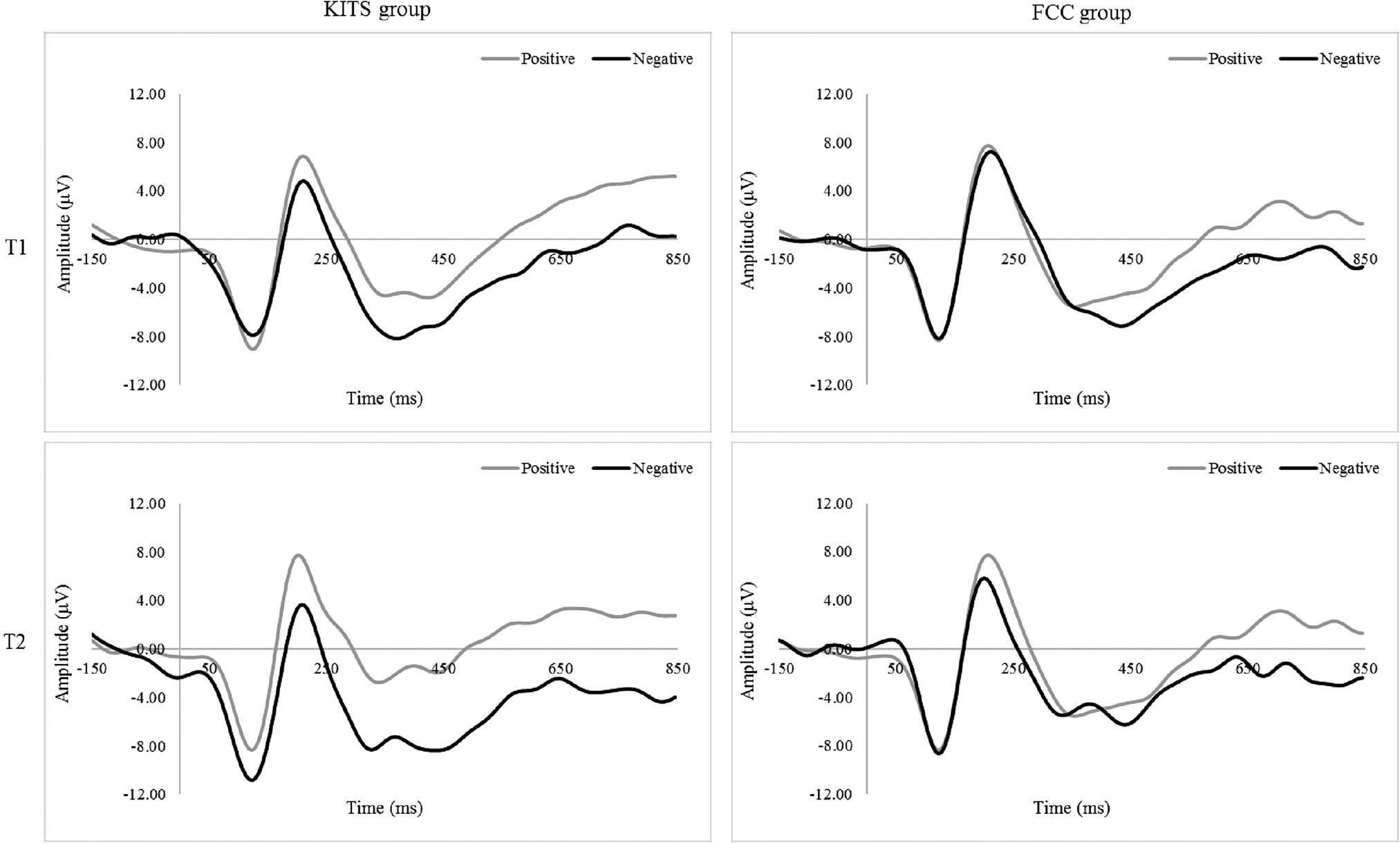
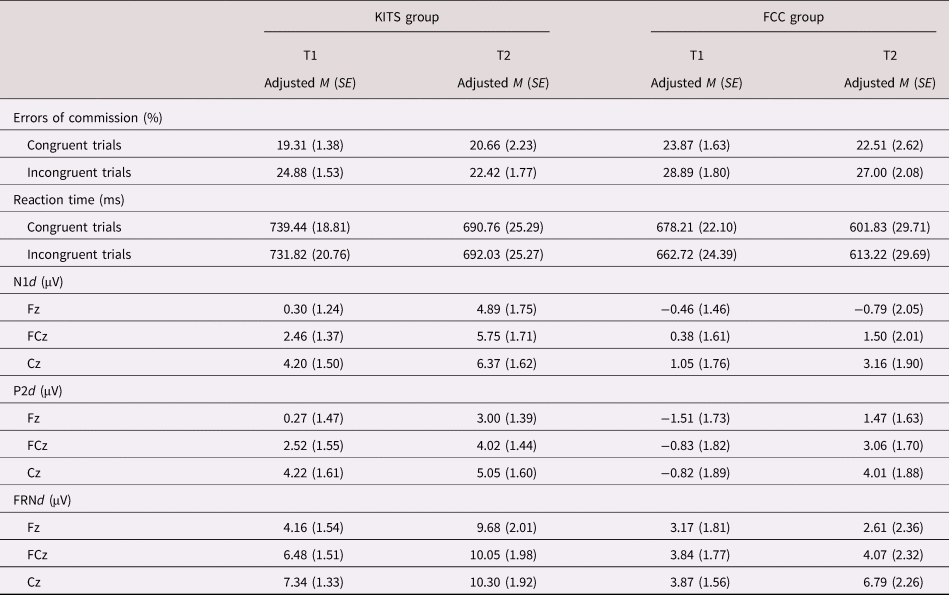
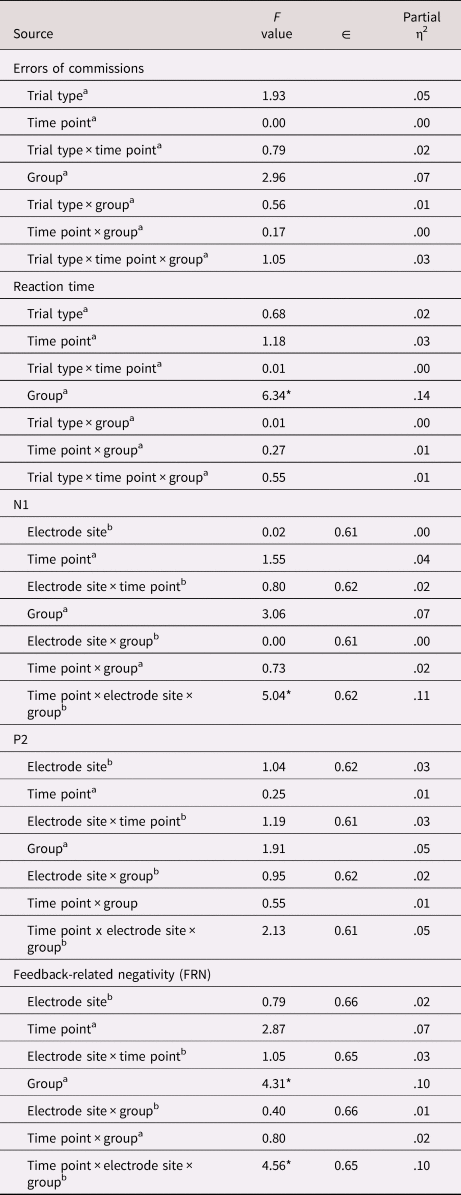
Descriptive data for the behavioral data and ERP data collected during the flanker task at T1 and T2 are presented for the KITS group and the FCC group separately in Table 2, and the grand average waveforms for positive performance feedback trials and negative performance feedback trials at Fz are presented by time point and group in Figure 1. Repeated measures analyses of covariance (ANCOVAs), controlling for child sex, age, and general cognitive ability, were conducted to examine the behavioral data (i.e., percentage of errors of commission and average reaction time) and ERP data (i.e., amplitude of the N1d, P2d, and FRNd). Greenhouse–Geisser corrections were applied when necessary to control for violations of sphericity. The reported degrees of freedom are not corrected; instead, epsilons (∈) are reported when less than 1.0. The degrees of freedom, F values, epsilons for the Greenhouse–Geisser corrections, p values, and effect sizes (partial η2) for all of the repeated measures ANCOVAs examining the behavioral data and ERP data are shown in Table 3. (The effects of the covariates are not reported in Table 3 in an effort to simplify the table; however, all significant interactions with the covariates are reported in the text.) Post hoc paired comparisons using Bonferroni corrections for multiple comparisons were conducted for significant main effects and interactions.
Grand average waveforms for the feedback-locked ERP components by time point and group at Fz for positive performance feedback trials (gray line) and negative performance feedback trials (black line). T1, assessment before the intervention. T2, assessment prior to kindergarten entry but after the school readiness phase of the intervention. KITS, Kids In Transition to School Program. FCC, foster care comparison.

Descriptive statistics for behavioral and ERP data by time point and group

Note: T1, assessment before the intervention. T2, assessment prior to kindergarten entry but after the school readiness phase of the intervention. KITS, Kids In Transition to School Program. FCC, foster care comparison. FRN, feedback-related negativity.
Results of repeated measures analyses of covariance for behavioral and ERP data

Note: Epsilons (∈) are only reported when less than 1.0. adf = 1, 40. bdf = 2, 80. *p < .05.
Results
Behavioral data
Errors of commission
A repeated measures ANCOVA, controlling for child sex, age, and general cognitive ability, was conducted to examine percentage of errors of commission on the flanker task with trial type (congruent and incongruent) and time point (T1 and T2) as the within-subjects factors and group (KITS and FCC) as the between-subjects factor. Although the main effect of trial type was not significant, there was a significant interaction between trial type and child age, F (1, 40) = 4.42, p = .04, partial η2 = .10. To clarify the nature of this significant interaction, post hoc paired comparisons using a median split on child age were conducted. Results of these paired comparisons indicated that the younger children and the older children committed significantly fewer errors of commission on congruent trials than incongruent trials, F (1, 19) = 7.03, p = .02, partial η2 = .27, and F (1, 18) = 35.31, p = .00, partial η2 = .66, respectively. However, this difference was more pronounced for the older children (congruent adjusted M = 20%; incongruent adjusted M = 26%) than the younger children (congruent adjusted M = 23%; incongruent adjusted M = 26%). Overall, these results provide evidence of a significant flanker interference effect. The main effects of time point and group were not significant. In addition, none of the interactions with time point or group were significant.
Reaction time
A repeated measures ANCOVA, controlling for child sex, age, and general cognitive ability, also was conducted to examine average reaction time on the flanker task with trial type (congruent and incongruent) and time point (T1 and T2) as the within-subjects factors and group (KITS and FCC) as the between-subjects factor. (Trials with an error of omission were not included in this analysis.) There was a main effect of group, with slower average reaction times for the KITS group (adjusted M = 713.51 ms) than the FCC group (adjusted M = 638.99 ms). The main effects of trial type and time point and all of the interactions with trial type, time point, or group were not significant.
ERP data
N1
A repeated measures ANCOVA, controlling for child sex, age, and general cognitive ability, was conducted to examine the amplitude of the N1d with electrode site (Fz, FCz, and Cz) and time point (T1 and T2) as the within-subjects factors and group (KITS and FCC) as the between-subjects factor. The main effect of time point was not significant; however, there was a significant interaction between time point and child general cognitive ability, F (1, 40) = 4.12, p = .05, partial η2 = .09. To further examine this significant interaction, post hoc paired comparisons using a median split on child general cognitive ability were conducted. Results of these comparisons indicated that the amplitude of the N1d for the children with higher general cognitive ability was significantly greater at T2 (adjusted M = 7.73 μV) than at T1 (adjusted M = 0.56 μV), F (1, 13) = 15.95, p = .00, partial η2 = .55. In contrast, the amplitude of the N1d for the children with lower general cognitive ability did not significantly differ for T1 (adjusted M = 1.72 μV) and T2 (adjusted M = 0.81 μV), F (1, 24) = 0.25, ns, partial η2 = .01. The main effects of electrode site and group were not significant; however, there was a significant interaction between electrode site, time point, and group. To clarify the nature of this interaction, the simple main effects of time point and group were examined. As predicted, post hoc paired comparisons examining the simple main effect of time point revealed that the amplitude of the N1d for the FCC group did not significantly differ at T1 and T2 at any of the electrode sites, F (1, 40) = 0.02–0.95, ns, partial η2 = .00–.02. In contrast, the amplitude of the N1d for the KITS group was significantly greater at T2 (adjusted M = 4.89 μV) than at T1 (adjusted M = 0.30 μV) at Fz and marginally greater at T2 (adjusted M = 5.75 μV) than at T1 (adjusted M = 2.46 μV) at FCz, F (1, 40) = 6.12, p = .02, partial η2 = .13, and F (1, 40) = 2.98, p = .09, partial η2 = .07, respectively. Furthermore, post hoc paired comparisons examining the simple main effect of group indicated that the amplitude of the N1d did not significantly differ for the KITS group and the FCC group at any of the electrode sites at T1, F (1, 40) = 0.15–1.81, ns, partial η2 = .00–.04. However, the amplitude of the N1d was significantly greater for the KITS group (adjusted M = 4.89 μV) than for the FCC group (adjusted M = -0.79 μV) at Fz at T2, F (1, 40) = 4.33, p = .04, partial η2 = .10. None of the other interactions with electrode site, time point, or group were significant.
P2
A repeated measures ANCOVA, controlling for child sex, age, and general cognitive ability, was conducted to examine the amplitude of the P2d with electrode site (Fz, FCz, and Cz) and time point (T1 and T2) as the within-subjects factors and group (KITS and FCC) as the between-subjects factor. The main effects of electrode site, time point, and group were not significant. In addition, none of the interactions with electrode site, time point, or group were significant.
FRN
A repeated measures ANCOVA, controlling for child sex, age, and general cognitive ability, was conducted to examine the amplitude of the FRNd with electrode site (Fz, FCz, and Cz) and time point (T1 and T2) as the within-subjects factors and group (KITS and FCC) as the between-subjects factor. Although the main effect of time point was not significant, there was a significant interaction between time point and child sex, F (1, 40) = 5.05, p = .03, partial η2 = .11. To further examine this significant interaction, post hoc paired comparisons were conducted for boys and girls separately. Results of these comparisons indicated that the amplitude of the FRNd for the girls was significantly greater at T2 (adjusted M = 8.66 μV) than at T1 (adjusted M = 2.57 μV), F (1, 21) = 8.98, p = .01, partial η2 = .30. Conversely, the amplitude of the FRNd for the boys did not significantly differ for T1 (adjusted M = 6.79 μV) and for T2 (adjusted M = 6.30 μV), F (1, 16) = 0.03, ns, partial η2 = .00. The main effect of electrode site was not significant. However, there was a significant main effect of group and a significant interaction between electrode site, time point, and group. To clarify the nature of this interaction, the simple main effects of time point and group were examined. As hypothesized, post hoc paired comparisons examining the simple main effect of time point indicated that the amplitude of the FRNd for the FCC group did not significantly differ at T1 and T2 at any of the electrode sites, F (1, 40) = 0.26–0.93, ns, partial η2 = .00–.03. In contrast, the amplitude of the FRNd for the KITS group was significantly greater at T2 (adjusted M = 9.68 μV) than at T1 (adjusted M = 4.16 μV) at Fz, F (1, 40) = 4.65, p = .04, partial η2 = .10. In addition, post hoc paired comparisons examining the simple main effect of group revealed that the amplitude of the FRNd did not significantly differ for the KITS group and the FCC group at any of the electrode sites at T1, F (1, 40) = 0.17–2.80, ns, partial η2 = .00–.07. However, at T2, the amplitude of the FRNd was significantly greater for the KITS group (adjusted M = 9.68 μV) than the FCC group (adjusted M = 2.61 μV) at Fz and marginally greater for the KITS group (adjusted M = 10.05 μV) than the FCC group (adjusted M = 4.07 μV) at FCz, F (1, 40) = 5.06, p = .03, partial η2 = .11, and F (1, 40) = 3.73, p = .06, partial η2 = .09, respectively. None of the other interactions with electrode site, time point, or group were significant.
Discussion
There is extensive research showing that maltreated children in foster care are at increased risk for negative outcomes across multiple domains of functioning, including academic functioning (Bolger & Patterson, Reference Bolger and Patterson2001; Kessler et al., Reference Kessler, Pecora, Williams, Hiripi, O'Brien, English and Sampson2008; Leslie et al., Reference Leslie, Gordon, Ganger and Gist2002; Pears & Fisher, Reference Pears and Fisher2005; Pears et al., Reference Pears, Fisher, Bruce, Kim and Yoerger2010; Smithgall et al., Reference Smithgall, Gladden, Howard, Goerge and Courtney2004; Stein, Reference Stein1997; Zima et al., Reference Zima, Bussing, Freeman, Yang, Belin and Forness2000). It has been speculated that the difficulties observed among children in foster care may, at least partially, result from experience-induced alterations in specific cognitive abilities and the underlying neural regions and that targeting these cognitive abilities may enhance the effectiveness of preventive interventions designed to address these difficulties (De Bellis, Reference De Bellis2001; Fishbein, Reference Fishbein2000; Gunnar et al., Reference Gunnar and Fisher2006). Thus, the current study examined the effects of a school readiness intervention, the KITS Program, on one such cognitive ability, external response monitoring, in children in foster care prior to entering kindergarten. Taken as a whole, the results of the current study suggest that the KITS Program had an impact on the children's electrophysiological indices of external response monitoring.
Consistent with previous results on the FRN (Luu et al., Reference Luu, Tucker, Derryberry, Reed and Poulsen2003; van Meel et al., Reference van Meel, Oosterlaan, Heslenfeld and Sergeant2005), the amplitude of the FRN was more pronounced following negative performance feedback than following positive performance feedback at all electrode sites before and after the intervention. The amplitude differences between positive performance feedback and negative performance feedback for the N1 and the P2 also significantly differed at all electrode sites after the intervention. These results indicate that the children in the current study demonstrated the expected pattern of electrophysiological activity during the flanker task. More important, the results of the current study provide evidence that the KITS Program affected the children's electrophysiological activity during the task. As hypothesized, the children who received the KITS Program displayed greater amplitude differences between positive performance feedback and negative performance feedback after the intervention than before the intervention for the N1, which is believed to reflect early attention (i.e., orienting) processes, and the FRN, which is believed to reflect evaluation of the external performance feedback. In contrast, the children who received services as usual did not demonstrate a significant difference in their electrophysiological activity over time. In addition, although the amplitude differences for the N1 and the FRN did not significantly differ for the two groups of children before the intervention, the children who received the KITS Program displayed greater amplitude differences for the N1 and the FRN than the children who received services as usual after the intervention. Consistent with the results of the current study, the KITS Program has been shown to affect external response monitoring among children with developmental disabilities and delays (McDermott et al., Reference McDermott, Pears, Bruce, Kim, Roos, Yoerger and Fisher2018), another population at increased risk for early adverse experiences (Berg et al., Reference Berg, Shiu, Feinstein, Acharya, MeDrano and Msall2019).
The observed effects of the KITS Program on these electrophysiological indices of external response monitoring may be particularly beneficial as the children transition into formal schooling. That is, the greater amplitude differences between positive performance feedback and negative performance feedback suggest that the children who received the KITS Program were more responsive to external performance feedback after the intervention. Based on prior research with adults, effectively processing external cues about behavioral performance, particularly after committing an error, is critical to making the adjustments needed to improve behavioral performance (Holroyd & Krigolson, Reference Holroyd and Krigolson2007; van der Helden et al., Reference van der Helden, Boksem and Blom2010). Furthermore, recognizing the association between behaviors and the outcomes resulting from these behaviors is necessary to acquire new skills. The transition to formal schooling typically requires children to learn a new set of rules and skills quickly, and teachers and peers frequently give children feedback about their academic and social–emotional behavior. The results of the current study suggest that the children who received the KITS Program may be better prepared to use this feedback to adjust their behavior to meet the demands of the situation. External response monitoring may be one foundational skill that allows the children who received the KITS Program to avoid some of the academic difficulties that have been observed among children in foster care (Pears et al., Reference Pears, Fisher, Bruce, Kim and Yoerger2010; Smithgall et al., Reference Smithgall, Gladden, Howard, Goerge and Courtney2004; Stein, Reference Stein1997; Zima et al., Reference Zima, Bussing, Freeman, Yang, Belin and Forness2000). However, as noted above, much of the research on the FRN has been conducted with adults. In addition, as discussed below, the children who received the KITS Program did not demonstrate improved behavioral performance during the flanker task after the intervention despite the observed differences in the electrophysiological indices of external response monitoring. Therefore, additional research with younger children is critical to fully understanding the implications of the effects of the KITS Program on the electrophysiological indices of external response monitoring.
The results of the current study contribute to the growing literature suggesting that appropriate preventive interventions may affect children's electrophysiological indices of response monitoring (Bruce et al., Reference Bruce, McDermott, Fisher and Fox2009; McDermott et al., Reference McDermott, Westerlund, Zeanah, Nelson and Fox2012, Reference McDermott, Pears, Bruce, Kim, Roos, Yoerger and Fisher2018). Although none of these studies directly investigated the critical elements of change, an element common to the studied preventive interventions is the provision of frequent, explicit, contingent performance feedback to the child within the context of a consistent caregiving environment. For example, the previous study with children in foster care examined a preventive intervention that trained foster parents to provide their foster children with high rates of reinforcement for positive behaviors and effective consequences for negative behaviors (Bruce et al., Reference Bruce, McDermott, Fisher and Fox2009). Similarly, the KITS school readiness groups have high staff-to-child ratios, allowing the teachers to provide immediate and contingent feedback while the children are practicing new skills, and the KITS caregiver groups teach the parents to employ the behavior management skills used in the school readiness groups. Taken together, the results of these studies indicate that providing contingent performance feedback may enhance children's ability to use internal and external cues to monitor their behavioral performance.
Consistent with the results from previous research using a flanker task with children (McDermott et al., Reference McDermott, Perez-Edgar and Fox2007; Ridderinkhof, van der Molan, Band, & Bashore, Reference Ridderinkhof, van der Molan, Band and Bashore1997), the children committed significantly fewer errors of commission on the congruent trials than the incongruent trials. This pattern of behavior, which has been referred to as the flanker interference effect, was more pronounced among the older children in the current sample. Although the expected general pattern of behavioral performance during the flanker task was observed, the children who received the KITS Program did not commit fewer errors over time as hypothesized. In addition, there was not a significant difference between the children who received the KITS Program and the children who received services as usual in terms of behavioral performance after the intervention. The absence of significant group differences on behavioral measures, despite significant group differences on neural measures, has been observed in previous research with different populations of children, including children in foster care and children with attention-deficit/hyperactivity disorder (Bruce et al., Reference Bruce, McDermott, Fisher and Fox2009; Durston, Mulder, Casey, Ziermans, & van Engeland, Reference Durston, Mulder, Casey, Ziermans and van Engeland2006; Jankowski et al., Reference Jankowski, Bruce, Beauchamp, Roos, Moore and Fisher2017; Karayanidis et al., Reference Karayanidis, Robaey, Bourassa, De Koning, Geoffroy and Pelletier2000). One possible explanation for this divergent pattern of results is that behavioral measures may not be sensitive enough to detect subtle differences in cognitive processing that do not result in differences in behavioral performance during laboratory tasks, particularly with small sample sizes, but affect functioning in more complex settings such as a kindergarten classroom or playground. The larger randomized efficacy trial of the KITS Program revealed a positive intervention effect on a broader measure of self-regulatory skills after the school readiness phase of the intervention (Pears et al., Reference Pears, Fisher, Kim, Bruce, Healey and Yoerger2013). Another possible explanation for the divergent pattern of results observed in the current study is that being aware of committing an error may be necessary, but not sufficient, for improving behavioral performance. That is, it is possible that the children who received the KITS Program were able to more effectively process external performance feedback after the intervention but did not yet have the ability to adjust their behavior and commit fewer errors.
There were several limitations of the current study. Although the sample size was larger than the previous study with children in foster care (Bruce et al., Reference Bruce, McDermott, Fisher and Fox2009), it was still somewhat small. Studies involving neural measures tend to have smaller sample sizes, and it is particularly challenging to obtain electrophysiological measures with young, at-risk populations such as children in foster care. This limitation was mitigated by the replication of previous research findings. However, the sample size prohibited investigating the impact of different maltreatment experiences (e.g., type, severity, and chronicity of maltreatment) and foster care experiences (e.g., age at first placement in foster care and number of different foster care placements) on the children's electrophysiological indices of external response monitoring. In addition, it will be important for future research to examine the persistence of the intervention effects on the children's electrophysiological indices of external response monitoring as well as the association between these indices of external response monitoring and subsequent academic and social–emotional functioning. The results of such research also may contribute to discussions about the potential fadeout of preventive interventions that are delivered early in life. Whereas there might be concern that the effects of such interventions will diminish over time, it is possible that preventive interventions that demonstrate an impact on the activity of critical neural regions will have more sustained effects. Of note, the KITS Program has been shown to have positive effects on behavior (e.g., self-competence and attitudes toward alcohol use and antisocial behavior) through third grade in the larger randomized efficacy trial (Pears, Kim, & Fisher, Reference Pears, Kim and Fisher2016). This issue of fadeout will continue to be an important topic for future research as the participants in this and other early preventive interventions are followed over time.
Despite these limitations, the current study expands upon previous research indicating that appropriate preventive interventions may have an impact on electrophysiological indices of response monitoring in children who have been exposed to early adverse experiences. Specifically, the results of the current study demonstrated that children who received the KITS Program showed more pronounced electrophysiological activity following negative performance feedback than following positive performance feedback after the intervention compared to their own activity before the intervention and the activity of children who received services as usual. Given the purported role of external response monitoring in making adaptive behavioral adjustments and learning new skills, this change in electrophysiological activity could positively affect children's functioning as they transition into formal schooling and beyond. Although promising, the current study highlights the need for future research with this at-risk population of children.
Acknowledgments
Support for this research was provided by the following grants: DA021424, from the National Institute on Drug Abuse and the US Public Health Service, and AA021973, from the National Institute on Alcohol Abuse and Alcoholism and the US Public Health Service. The content of this article is solely the responsibility of the authors and does not necessarily represent the official views of the funding organizations. The authors thank Deena Scheidt for project management, Sally Schwader for editorial assistance, and the staff and families of the Kids In Transition to School (KITS) Program for their ongoing dedication and participation.