Introduction
Political institutions such as federalism, which define the balance of power between national, regional, and local governments, can influence the spatial development of nations. In many countries, especially in Latin America, where political centralization at the federal level has historically emasculated the political and fiscal powers of local governments (Nickson Reference Nickson1995; Sokoloff and Zolt Reference Sokoloff, Zolt, Edwards, Esquavel and Marquez2007), spatial development has been characterized by a condition known as urban primacy in which population is heavily concentrated in a few cities that are politically and economically dominant. By contrast, in countries like the United States where political and fiscal powers are more decentralized, urban development has been more spatially balanced.Footnote 1
Because Canada and the United States are two former British colonies that adopted federalist constitutional forms of government, albeit under different times and circumstances, scholars have often focused on the similarities in their patterns of development. Factors that determine institutions such as colonial origins, culture, language, climate, and factor endowments are quite similar in both countries, with the well-known exceptions of Quebec and the southern United States.Footnote 2 These factors, in turn, are believed to have contributed to high rates of literacy, land ownership, enfranchisement, and the rise of democratic political institutions conducive to modern economic growth (Acemoglu et al. Reference Acemoglu, Johnson and Robinson2001; Engerman and Sokoloff Reference Engerman, Sokoloff and Haber1997, Reference Engerman and Sokoloff2002; North Reference North1990; Zolt Reference Zolt2009). Compared with the rest of the Americas, the similarities in the patterns of development between Canada and the United States are undeniable and were reinforced by the migration of US citizens to Canada during the eighteenth and nineteenth centuries, many of whom brought their institutions and customs with them. The slowing down of migration did not stop the flow of ideas, however, as Canadian leaders studied US institutions closely before designing their own (Buckley Reference Buckley2014; Moore Reference Moore1997).
Yet, despite notable similarities in American and Canadian institutional developments, scholars also believe that Canadian and US political institutions diverged in important ways (Gibbins Reference Gibbins1982; Goldberg and Mercer Reference Goldberg and Mercer1986; Riker Reference Riker1964). For example, in Canada, under the “peace, order, and good government” clause of the 1867 British North America (BNA) Act—Canada's original constitutional document—residual powers were granted to the federal government; in contrast, the US Constitution vests residual powers in the states. However, in spite of attempts by the founding fathers of the Canadian confederation to create a highly centralized national government, the provincial rights movement led by Oliver Mowat of Ontario gradually led to politically and fiscally autonomous provincial governments.Footnote 3 In the United States, however, the Jeffersonian-Jacksonian model of federalism based on decentralized states’ rights was transformed into a more nationally centralized federalism from the late nineteenth century onward.
It is not so widely recognized, but no less significant, that the decentralization of political power in Canada away from the national government and toward provincial governments was accompanied by a significant centralization of provincial government power over local governments, whereas in America the states’ rights movement was characterized by a continued emphasis on the importance of decentralized local governments. Thus, although cities and local governments in Canada and the United States are “creatures” of their respective provincial or state governments, the ascendancy of Canadian provincial governments was accompanied by a corresponding reduction in the autonomy of local governments.Footnote 4 In contrast, even when state and federal governments in the United States became more centralized during the Progressive Era, local governments continued to enjoy significant political autonomy through decentralized political representation and the rise of the home rule movement (Burns and Gamm Reference Burns and Gamm1997; Campbell Reference Campbell1980; McGoldrick Reference McGoldrick1967). These diverging trends in political centralization had consequences for the size distribution of cities, as well as the form, number, and density of city governments in US states and Canadian provinces (Goldberg and Mercer Reference Goldberg and Mercer1986; Kim and Law Reference Kim and Law2012).
In this paper, we argue that the diverging trends in political centralization in the United States and Canada were driven by institutional differences that gave the various levels of government in the two countries differential access to revenue sources. We then show how differences in national and subnational (i.e., state or provincial) political centralization in United States and Canada affected another dimension of urban development, namely the population of capital cities. Our empirical analysis is motivated using a simple model of political centralization developed in Galiani and Kim (Reference Galiani, Kim, Costa and Lamoreaux2011), which predicts that if a country is federally or subnationally centralized, then the national or subnational capital city effect on population is more significant than if it is decentralized, controlling for other factors such as climate and geography. While we caution against drawing strong causal inferences from our estimates, because the location of capital cities may be correlated with unobservable factors that influence urban development, we believe they are highly suggestive of a causal relationship because the national and subnational capitals in Canada and the United States were generally chosen for political reasons prior to the onset of industrialization.
Most political capitals in Canada and the United States were originally small and their locations were chosen in an era when economies were agricultural, extractive, or mercantile rather than industrial. As far as we are aware, the locations of the national capitals were not chosen with an eye for future industrial development. Washington, D.C., and Ottawa, once remote and undeveloped places, were selected as a consequence of sectional compromise even though the seats of national governments during the colonial period in both nations were in major cities such as Philadelphia, New York City, Montreal, and Toronto. In the United States, after many years of contentious debate, the Compromise of 1790 between Alexander Hamilton and James Madison settled the location of the capital in the undeveloped South along the Potomac in exchange for southern votes in favor of the assumption of state debts by the national government (ibid.). In Canada, Queen Victoria chose Ottawa as a compromise between Ontario and Quebec because it was midway between Toronto and Quebec City. Its distance from the United States for military defense was also a consideration (Nader Reference Nader1976). However, while Washington, D.C., is its own district, Ottawa is part of Ontario and this difference, according to Gibbins (Reference Gibbins1982), has contributed to greater federal-provincial conflict in Canada.Footnote 5
From the subnational perspective, US state capitals were often located in remote places near a state's geographic center to promote political decentralization (Galiani and Kim Reference Galiani, Kim, Costa and Lamoreaux2011). In Canada, the location of capitals in three of the original four provinces (Ontario, Quebec, and Nova Scotia) coincided with the more established cities (Toronto, Quebec City, and Halifax, respectively). As in Latin America, the decision to make these larger cities provincial capitals may have been done with the intent to centralize political power in capitals. However, for many of the other provinces, the capitals were originally small and undistinguished places. For instance, Winnipeg and Edmonton, the capitals of Manitoba and Alberta, were mere trading posts at the time these provinces joined confederation. Regina, the capital of Saskatchewan, did not exist when the province was created (Nader Reference Nader1976).
For our empirical analysis, we use data on cities with populations greater than 25,000 from 1900 to 2000 and metropolitan areas from 1950 to 1990. Based on the regression estimates using city-level data, we find that the national capital city effect on population rose significantly over the twentieth century for both countries, reflecting the increasing centralization of political authority and revenue sources in their respective federal governments. After controlling for other factors, Washington, D.C.'s status as the nation's capital increased its population by 35 percent compared to noncapital cities in 1900, but that figure rose more than tenfold to 380 percent by 2000. In Canada, Ottawa's capital city status raised its population by 305 percent relative to noncapital cities in 1920, an effect that increased to 685 percent in 2000.
The data also show that the impact of subnational capital status on city population diverged between Canada and the United States over the second half of the twentieth century. While Canadian provincial capital city status increased city population from 39 percent in 1920 to more than 164 percent in 2000 over noncapital cities, the impact of US state capital city status on city population stayed more or less the same, at roughly 40 percent, throughout the century. This divergence between Canada and the United States can be seen even more clearly when we pool the data, especially for samples of contiguous and other near-border states and provinces. By the second half of the twentieth century, the pooled data suggest that the national capital city effect was actually much greater for the United States compared to Canada while the reverse pattern continues to hold for the subnational capital city effect. Thus, to the extent that a capital city's ability to attract a disproportionately large population is correlated with levels of political centralization, the data suggest how the divergence in Canadian and US federalisms affected spatial development in the two nations.
The remainder of this paper is structured as follows. We begin by providing evidence of the diverging patterns of US and Canadian fiscal federalism, especially over the second half of the twentieth century. This is followed by an investigation of the historical causes of this divergence. We then provide estimates of the national and subnational capital city effects on city and metropolitan populations in Canada and the United States to illustrate how the divergence in the two nations, federal systems influenced urban development.
The Divergence of US and Canadian Fiscal Federalisms
In this section, we examine the diverging patterns of fiscal federalism between Canada and the United States. Bird and Tassonyi (Reference Bird and Tassonyi2001) argue that Canadian provincial governments face few hierarchical fiscal constraints from the federal government, but imposed tight controls on their local governments. While US states also imposed controls on local taxing and spending power, usually in the form of uniformity provisions or property tax rate limitations, the scale and scope of state involvement in local matters differed greatly from their northern neighbors (Aronson and Hilley Reference Aronson and Hilley1986; Fisher Reference Fisher1996).
Fiscal Federalism
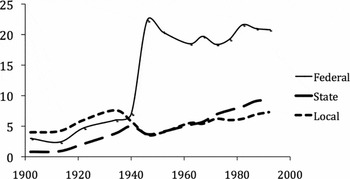
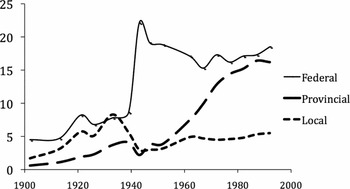
The data on revenues and expenditures across the three levels of government are consistent with the hypothesis that US and Canadian fiscal federalisms diverged significantly in the second half of the twentieth century. Figure 1 shows own source revenues of US federal, state, and local governments as a percentage of gross national product (GNP). At the beginning of the century, local government revenues as a share of GNP were slightly higher than the federal government's but nearly four times more important than state governments’. By the mid-twentieth century, the position of state governments caught up to that of local governments whereas the federal governments' share of revenues as a percent of GNP surpassed the other two levels of government by several-folds. As shown in figure 2, the Canadian pattern was relatively similar to that of the United States from the early 1900s until the middle of the century, except that the federal government's revenues exceeded provincial and local governments’ revenues for most of the early decades of the century. However, the Canadian pattern diverged significantly from the US pattern after the 1950s as provincial governments’ revenues, unlike those of US states, rose sharply and converged with the federal government’s.Footnote 6
Own source revenues as a percentage of GNP by level of government, United States. Source: Wallis (Reference Wallis2000).

Own source revenues as a percentage of GNP by level of government, Canada. Sources: Perry (Reference Perry1955), Urquart (Reference Urquhart1993) and Tremblay (Reference Tremblay2007).

The United States and Canada also differ fundamentally with respect to their intergovernmental transfer policies. While intergovernmental transfers exist in both countries, the nature and size of these transfers differ significantly. The United States, unlike Canada and other federal countries, does not have an explicit policy of equalizing the fiscal resources of state governments through intergovernmental grants or transfers (Stark Reference Stark2010). In contrast, Canada's long-standing policy of equalizing the fiscal capacity of provinces using a system of “equalization payments” from the federal to provincial governments has been enshrined in its constitution since 1982 (Buck Reference Buck1949; Courchene Reference Courchene2007; Perry Reference Perry1955). In addition to general equalizing grants, the Canadian federal government gives money to provinces for health, education, and social assistance, but these grants are largely unconditional and have few strings attached. Provincial government transfers to local governments are also significant but most of these transfers are conditional on municipal expenditures by specific categories such as education and roads (Sancton and Young Reference Sancton and Young2009; Tremblay Reference Tremblay2007).
Indirect Taxes and Political Centralization
Because centralized governments require an administrative bureaucracy to govern their constituent parts, they typically require greater revenue than decentralized states. In Canada, political centralization at the provincial level was facilitated by provincial governments’ ability to raise significant sources of non-property-tax revenue. These activities led to the rise of a sizeable provincial bureaucracy, often centered in its capital city. American states, meanwhile, generally restricted the scope of taxes to property and deferred the collection duties to local county officials (Fisher Reference Fisher1996; Higgens-Evenson Reference Higgens-Evenson2003). Few permanent bureaucrats resided in US state capitals. State capitals were small and remote; legislators stayed in temporary residences for the duration of legislative sessions. To further limit legislative activity and spending, many state legislatures only met biennially (Campbell Reference Campbell1980).
While the differences in the sources of government revenues have narrowed in recent years, Canadian federal and provincial governments have relied more extensively on revenues raised from indirect taxation and other means. While national governments in both countries raised revenues through indirect taxes such as tariffs and internal excises, the scale and scope was much greater in Canada. The most significant difference, however, emerged between Canadian provinces and US states. In the United States, after a period of tax-less finance and borrowing between 1820 and 1840 that culminated in major state government defaults, most states restricted their revenue sources to the property tax (Fisher Reference Fisher1996; Wallis Reference Wallis2005). Thus, even as late as 1902, the property tax generated 57 percent of state government revenues (Wallis Reference Wallis2000: 67). In Canada, by contrast, the province of Ontario's main sources of revenue in the early twentieth century were timber leases and fees, taxes on corporations, succession duties, and other indirect taxes. In 1902, natural resource revenues accounted for more than 70 percent of Ontario's own-source revenues. Over time, Ontario's indirect sources of revenue expanded to include mining profits, liquor control, corporations, and gasoline taxes. A small property tax was imposed in the 1920s. Personal income taxes were also introduced (Perry Reference Perry1955: 648–51).Footnote 7
Financing Local Governments
In both the United States and Canada, local governments began their histories as relatively autonomous municipal corporations, an institutional legacy from Great Britain (Bellan Reference Bellan2003; Crawford Reference Crawford1954; Teaford Reference Teaford1975). Over the nineteenth century, however, the gradual centralization of political power at the state level within the United States necessitated the exercise of authority over local governments. Cities like New York were no longer viewed as private corporations but as public property (Hartog Reference Hartog1983). As state legislatures asserted their power over local governments, their authority was recognized in Dillon's Rule, an 1868 Iowa court ruling that narrowly defined the powers of local government (McGoldrick Reference McGoldrick1967). In Canada, the diminutive status of local governments as “creatures” of provincial governments was written into the national constitution.
When governments centralize political power, they usually assume greater control over their geographic constituent parts. In Canada, provincial governments’ authority to generate significant revenues from nonproperty taxes—a policy popular with their voters—enabled them to centralize authority over local governments as cities, willingly or otherwise, traded political and fiscal autonomy for provincial transfers. During the nineteenth and early twentieth centuries, cities raised revenues through a variety of means, but by the mid-twentieth century their tax base was essentially confined to real property taxes. Indeed, municipal access to income taxes was precluded by tax-sharing agreements concluded between Ottawa and the provinces as a consequence of the Great Depression and World War II. These developments have raised concerns among Canadian scholars about whether Canadian cities can effectively compete (Bird and Tassonyi Reference Bird and Tassonyi2001, Reference Bird, Tassonyi, Rodden, Eskeland and Litvack2003; Coté and Fenn Reference Coté and Fenn2014; Slack and Bird Reference Slack and Bird2007).
While the relative autonomy of Canadian cities over their fiscal resources has diminished over time a different trend is observed for US cities. In the United States, the municipal tax base in many states expanded to include sales and income taxes. Additionally, there is a large US municipal debt market. Cities in many states issue bonds to finance a wide variety of municipal expenditures (Aronson and Hilley Reference Aronson and Hilley1986). Strikingly, local governments in Canada cannot borrow except for allowed capital expenditures, and the sums borrowed continue to remain relatively unimportant. Footnote 8
Why Did Canadian and American Federalisms Diverge?
While identifying the causes of institutional divergence is a challenging task, we believe that the seeds of divergence were sewn early in the history of both nations.Footnote 9 In this section, we highlight two key factors for why Canadian and US federalism diverged.
First, Canadian provinces, unlike US states, possessed centralizing institutional powers such as parliamentary authority largely unchecked by a written constitution and courts (Banks Reference Banks1991). Provincial parliaments were thus able to establish public ownership of land and corporations using the institutions of Crown Land and Crown Corporation (Hanson Reference Hanson1961; Hodgetts Reference Hodgetts and Friedmann1954; La Forest Reference La Forest1969). In contrast, US state legislatures faced greater checks and balances between the branches of government. Their powers were limited by written constitutions, and enforcement was left to local authorities and the courts (Higgens-Evenson Reference Higgens-Evenson2003). Except by the terms imposed by the BNA Act of 1867, which divided powers between the federal and provincial governments, for most of Canadian history the authority of federal and provincial legislatures to make law has been largely unconstrained.
Second, centralized governments need money. The power of government to extract revenue necessarily involves fundamental questions regarding the nature of political authority and property rights. In Canada, in contrast to the United States, access to significant nonproperty revenues allowed provinces like Ontario to decentralize authority away from the national government and to centralize authority over local governments (Drummond Reference Drummond1987). In our analysis, we focus attention on developments of Ontario because it played a critical role in the development of Canadian federalism, with the other provinces emulating its public policies toward land and public corporations. Indeed, as shown by Perry (Reference Perry1955), the other provinces followed Ontario's heavy reliance on revenues from public lands (i.e., natural resource rents) and public corporations (notably, liquor control boards).Footnote 10
Public Land
Oliver Mowat, often referred to as the Thomas Jefferson of Ontario, is identified with the provincial rights movement in Canada (Evans Reference Evans1992). Mowat, who was premier of Ontario from 1872 until 1896, presided over the province during the formative years of the Canadian confederation. Under Mowat's stewardship, Ontario fought several key battles against Sir John A. Macdonald, Canada's Alexander Hamilton and the first prime minister of Canada, who desired a strong centralized federal government (Armstrong Reference Armstrong1981; Moore Reference Moore1997). One key battle involved public lands. To reduce Ontario's potential wealth and influence, Macdonald attempted to hand over a huge forest area to the new province of Manitoba. Both Mowat and Macdonald recognized that forest and mineral resources were potentially a major source of financial independence for Ontario. Mowat, also the attorney general, delivered the victory for Ontario as the right of ownership was decided before the Judicial Committee of the Privy Council (JCPC) (Armstrong Reference Armstrong and Swainson1972; Saywell Reference Saywell2002). Unlike the US Supreme Court under Marshall, which favored federal over states’ rights, the JCPC sided with the provinces.
Apart from his advocacy of strong provincial government powers, however, Mowat was hardly a Jeffersonian. During his 20 years as the premier of Ontario, as he maneuvered to tilt the federal constitution toward provincial rights, he also built a centralized provincial bureaucracy, created a provincial political machine based on patronage, and asserted greater control over local affairs. His strategy was based on generating significant government revenues from nonproperty sources, which, for a majority of voters, amounted to a policy of sharing in the “bounty of nature.” Thus, despite the Clear Grits, a reformist party in Ontario that favored American-style local decentralization, and, notwithstanding arguments by individuals such as Alexander Galt to adopt the American system of outright sale of land, Mowat and other political leaders in Ontario deliberately chose a different path (Hodgins Reference Hodgins and Swainson1972; Nelles Reference Nelles1974; O'Brien Reference O’Brien and McDonald1975).
On one side, the representatives of the railroads, land companies, and American timber interests lobbied for the adoption of the American system of selling clear title to land and minerals; on the other, Canadian lumbermen and timber administrators favored government ownership as a sales system was seen to favor American speculators and the wealthy few who could potentially buy up the best lands (Nelles Reference Nelles1974).
Eschewing the American system, Ontario enacted the Crown Timber Act of 1849 whereby it established natural resources as “public” rather than “private” property. The revenues from the forest were to be shared with all the residents of Ontario, presumably through a reduction of property taxes. Whereas large private firms in the United States like Weyerhaeuser acquired vast forest territories for private gain at relatively low prices, Ontario generated a substantial portion of its revenues in its early years from timber dues and licenses (Hidy et al. Reference Hidy, Hill and Nevins1963; Hurst Reference Hurst1964; Perry Reference Perry1955). Importantly, rather than relying on local officials to collect taxes, Ontario developed a centralized administrative bureaucracy that used its coercive powers to gather detailed information for revenue collection purposes (Nelles Reference Nelles1974).
American state governments also saw the revenue potential from taxing forest resources; nevertheless, forestland was treated more or less like agricultural land. Hurst (Reference Hurst1964: 505) writes that Wisconsin's tax policy “was to apply the general property tax to timberland and forest products, almost entirely under local administration with no effective central supervision.” Because assessing and collecting taxes on timberland presented special challenges, state legislatures struggled to formulate an effective policy but most efforts were based on ad hoc commissions. Small property owners alleged that local assessors were in the pockets of big lumber firms who received favorable treatment. Even new county boundaries were carved with the backing of large landowners so that new local officials could be persuaded to lower taxes (ibid.).
Ontario's policy toward minerals was more complex and varied, but it was also designed to claim the “People's Share” of resource rents (Nelles Reference Nelles1974). Due to perceived difficulties of attracting American expertise and capital, Ontario initially granted mineral lands in fee simple. However, as the enormous value of this resource became apparent, Ontario freely altered property rights over minerals. Public ownership never took hold over mineral lands, but Ontario claimed its share through royalties and profit taxes.Footnote 11 Every mine operator was required to submit detailed operating statements to the provincial government, and provincial mine assessors were vested with wide powers to investigate both the mines and the mining companies’ books (Skelton Reference Skelton1908). In US states, however, mineral land, like forestland, was treated similarly to nearby agricultural land (Roberts Reference Roberts1944). While policies varied across states, mineral taxes were assessed and collected by local officials with little access to expertise and information (Hellerstein Reference Hellerstein, McLure and Mieszkowski1983).
According to Nelles (Reference Nelles1974), Ontario's principle of reservation, crown ownership, and leasehold tenure and the American principle of private ownership involved two fundamentally different notions of property rights. In Canada, provincial authority was final and unrestrained. Provincial governments could alter existing property rights, as Ontario did with mineral lands. Footnote 12 Property rights to waterpower furnish another example. For most of the nineteenth century, as in the United States, a freehold landowner in Canada possessed extensive riparian rights to waterpower found on his or her property. However, the Ontario Waterpower Reservation Act, enacted in 1898, declared that all major waterpower would remain vested in the Crown and that the right of usufruct would not be attached to riparian ownership. Waterpower thus became a public resource and another source of provincial government revenue.
Public Corporations
The divergence in property rights associated with corporations in the United States and Canada was likely tied to divergent views of the state. With independence, the power to incorporate, previously a prerogative of the Crown, was acquired by state and provincial legislatures. In the United States, all corporations, which included businesses, municipalities, and religious societies, were initially incorporated to serve the public. But with Dartmouth v. Woodward (1819), businesses became private whereas municipalities remained public, increasingly under the direct authority of the state. In Maier's (1993) view, the growth of private corporations in the United States was consistent with American-style federalism of decentralization and localism: “For contemporaries, the proliferation of corporations could signal, in effect, an extension of American federalism down into day-to-day, local associational relationships” (ibid.: 82). In Canada, by contrast, provincial legislatures adopted the idea of the Crown Corporation to establish public enterprises in a variety of activities as a means of raising revenue for the government. In comparative analyses of public corporations around the world, Canada emerged by the 1950s as one of the most intensive users of the form whereas the United States was (and remains) an opposite outlier (Abel Reference Abel and Friedmann1954; Hodgetts Reference Hodgetts and Friedmann1954).
One interesting example of the divergent use of public and private enterprises that has implications for Canadian provincial centralization and US state decentralization involves the alcohol industry. Because of similarities in culture, demographics, and religion, the temperance movement became a major political force in both countries. Yet, the two countries diverged significantly in how federal, state or provincial, and local governments controlled the sale of alcohol. In Canada, the distribution and sale of alcohol fell to provincial-level, executive-based administrative Liquor Control Boards whereas in the United States control was exercised through legislative statutes and constitutional amendments combined with local enforcement.Footnote 13 In the United States, the tax on alcohol, particularly spirits, was a major source of revenue for the federal government and some localities but was rarely a major source of revenue for state governments (Hamm Reference Hamm1995).Footnote 14 However, in Canada, the Liquor Control Boards not only became a significant source of provincial revenue—in Ontario, it generated almost 20 percent of provincial government revenue in 1950 (Perry Reference Perry1955: 648–51)—but they also created a provincial bureaucracy and positions of patronage (Hodgetts and Dwivedi Reference Hodgetts and Dwivedi1974).Footnote 15
Consequences for Political Centralization
Political centralization of provincial government authority over local governments seems to have arisen as local governments sacrificed political and fiscal autonomy for provincial transfers. According to Noel (Reference Noel1990), the roots of the centralization of power in Ontario began with the Municipal Loan Fund Indebtedness Act of 1873. During the railroad boom of the 1850s, while still under British rule, many municipalities borrowed heavily to fund railroad ventures, especially as they were allowed to borrow at lower than market rates from the provincial government. By 1872, however, some 44 municipalities in Ontario were in debt to the provincial government by an amount of about $12 million. Under the direction of Mowat the provincial government initiated a program of provincial transfers to local governments as it used its fiscal surplus to forgive municipal debt. Those municipalities that were not in debt also received transfers with the provision that they were to be used for local development but only under provincial supervision. In Noel's (ibid.: 282) opinion, Mowat's approach was not to attack local autonomy directly but to serve as a “benefactor to enact centralizing acts and regulations such as health, education, liquor licensing, and agriculture which cumulatively amounted to a new definition of the role of the province.”
This process continued during the first half of the twentieth century. Under the BNA Act, responsibility for education and social services, such as welfare, hospitals, and unemployment relief, fell to the provinces and it was up to the provinces to decide how to finance and run these programs. Prior the Great Depression, however, provinces left much of the finance and administration of these services (except education) to municipalities. As the demand for unemployment relief, welfare, and other social services skyrocketed during the Great Depression, property-tax revenues fell and municipal debts grew out of control. Several municipalities defaulted on their bonds. In response, provinces reorganized municipal finance more or less unilaterally. Provincial Municipal Finance Authorities were set up to audit and control municipal spending. Additionally, the provinces imposed restrictions on municipal public finances. Municipalities were forbidden to run deficits; bonds could only be issued for capital projects; and municipal tax bases were restricted to real property taxes (Bird and Tassonyi Reference Bird, Tassonyi, Rodden, Eskeland and Litvack2003; Coté and Fenn Reference Coté and Fenn2014; Tassonyi Reference Tassonyi2011). In turn, provincial governments assumed the responsibilities for financing and administering social services like welfare and hospitals. Over time, the growing political and economic importance of these social services gave provinces enormous bargaining power with respect to not only local governments, but also the federal government, culminating in federal-provincial tax-sharing agreements that gave provinces access to tax bases that were previously dominated by the federal government. The long-run consequence of these developments is that Canadian provinces became “responsible for most major social expenditures and have a virtually free hand in levying taxes. They face essentially no constitutional restraints on tax bases, or collection systems and no requirements to harmonize either with each other or with the federal government” (Bird and Tassonyi Reference Bird and Tassonyi2001: 85–86).
Federalism, Political Capitals, and Urban Development
The empirical specification used in this paper is motivated by a simple model of political centralization and geographic development presented in Galiani and Kim (Reference Galiani, Kim, Costa and Lamoreaux2011). Although the model contains only two locations or potential levels of government—a capital city and a hinterland—the model captures why differences in political centralization or federalism may impact urban development. When governments are centralized, the model assumes that the capital city government sets the level of tax and public goods provision of both locations; when decentralized, capital city and hinterland governments are both free to choose their respective levels of taxes and public goods. Because workers are assumed to be mobile, exogenous local productivity and levels of public goods provision in each location determine the population distribution between the capital and hinterland locations.
In this model, political centralization determines the geographic distribution of population through its ability to set taxes and local public goods. In the decentralized scenario, as both locations are allowed to independently set taxes and local public goods, the geographic distribution of population between the capital city and hinterland will be determined by differences in economic productivity. In the politically centralized scenario, however, the population distribution between capital city and hinterland depends on the relative weight the central government places on the welfare of capital city versus hinterland residents. If the central government places greater weight on the welfare of capital city residents as compared to those in the hinterland, capital city residents will enjoy higher levels of public goods and will attract a greater concentration of population.
There are many other reasons to believe that capital cities will benefit politically when governments are more politically centralized. First, because most government officials reside in capital cities, government elites have an incentive to increase the allocation of public goods such as roads, infrastructure, and universities to the capital city. Second, because politics and rent-seeking activities are facilitated by frequent face-to-face interactions, lobbying is likely to be concentrated in capital cities. Third, government agencies and workers who administer government programs and policies are also likely to reside in capital cities.
Following Galiani and Kim (Reference Galiani, Kim, Costa and Lamoreaux2011), we estimate the following regression equation:
 $$\begin{equation*}
\log \;(pop)_i \; = \;\beta _0 \; + \;{\beta}_1 NCAP_i \; + \;{\beta}_2 PCAP_i \; + \;{\beta}_3 \;In(LAND_i )\; + \;{\beta}_4 X_i \; + \;\varepsilon _i
\end{equation*}$$
In this regression, log(pop)i is the natural logarithm of the population of city i; NCAPi is a dummy variable that equals 1 if city i is a national capital and 0 otherwise; PCAPi is another indicator that equals 1 if city i is a state or provincial capital and 0 otherwise; LANDi is the area of city i; and Xi are exogenous controls that consist of the geographic variables—latitude, longitude, and dummy variables for whether a city is a major port or located along a major river—and climate variables, specifically annual average daytime temperature and annual precipitation. Our data consist of cities (i.e., municipalities) with populations greater than 25,000 from 1900 and 2000.Footnote 16 City size is determined by municipal boundaries.
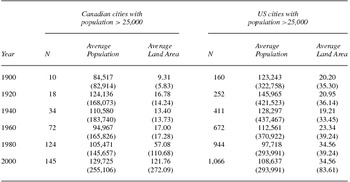
Table 1 displays data on population and land area (in square miles) for Canadian and US cities with population greater than 25,000 from 1900 to 2000. For both countries, the average population of cities with more than 25,000 persons increased gradually from the turn of the twentieth century, reaching a peak in 1920. After 1920, the average population declined until around 1980 when it increased again. Over the course of the century, the land area of cities increased in both countries, thus reflecting municipal consolidation and urban growth. US cities were larger in land area than Canadian cities until 1960, after which Canadian cities became substantially larger. This dramatic increase in city size reflects massive municipal consolidations in Canada that began in during the 1970s and accelerated during the 1990s (Tindal and Tindal Reference Tindal and Tindal2000).
Descriptive statistics on US and Canadian cities, 1900–2000

Sources: Statistics Canada (various years); US Bureau of the Census (various years).
Note: Standard deviations are in parentheses.
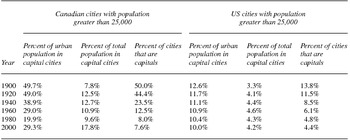
Table 2 displays the percentage of the urban and total population residing in national and subnational capitals for Canada and the United States. These figures allow us to compare the extent to which the population has been concentrated in capital cities in the two countries. In the United States, the share of cities larger than 25,000 that were capitals declined steadily from 13.8 percent in 1900 to 4.4 percent in 2000 while the share of the urban population living in capitals declined from 12.6 percent to 10 percent. For Canada the share of cities that were capitals declined even more rapidly over the same period, from 50 percent to 7.6 percent. The share of the urban population living in capitals also declined from almost 50 percent in 1900 to 20 percent in 1980 after which it increased to 30 percent by 2000. This increase during the last 20 years of the century reflects municipal consolidation of capital cities (most notably, the amalgamation of the metropolitan Toronto region into a single municipality). A somewhat different picture emerges, however, when we examine the share of the total population living in capital cities. In both Canada and the United States the share of the total population living in capital cities has risen over time; however, population concentration in capitals has been significantly greater in Canada than in the United States. For Canada, the percentage of the total population living in capital cities rose from 7.8 percent in 1900 to 17.8 percent in 2000 while for the United States the corresponding figures are 3.3 percent in 1900 and 4.2 percent for 2000.
Percentage of urban and total population residing in national and subnational (provincial or state) capitals for Canada and the United States.

Source: See Table 1.
Estimates Using National Samples of Municipalities
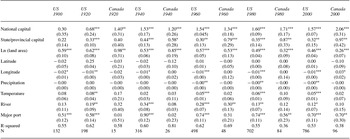
Table 3 presents the coefficients from ordinary least squares estimation of the regression model using data on municipalities with population greater than 25,000. Each column represents a separate regression. We estimate the regression separately for each year for Canada and also for the United States.Footnote 17 Because Canada had very few cities with population greater than 25,000 before 1920, we estimate the regression for 1920 onward for Canada. We omit cities in the US south (except Washington, D.C.) and Quebec because of long-standing institutional and cultural differences in these two regions (qualitatively similar results were found, however, when we included the south and Quebec). The estimates show that political capital status had a positive and statistically significant effect on population after controlling for a variety of factors that are likely to be correlated with economic activity. This suggests that capital cities receive undue political benefits relative to noncapital cities. To the extent that the capital city effect is positively correlated with political centralization, the estimates also demonstrate how differing trends in political centralization affected the urban landscapes in the two countries. While the national capital city effect between the nations was relatively similar, the subnational capital city effect was larger for Canada than for the United States, suggesting the disproportionate political centralization within Canadian provinces. Additionally, the capital city effect grew over the twentieth century as the importance of regional and national governments—shown earlier by their rising shares of government revenues as percentage of GNP (see figures 1 and 2)—has grown significantly.
Log of population on capital city status for US and Canadian cities with population greater than 25,000, 1900–2000

Source: See Table 1.
Notes: Each column is a separate regression. Robust standard errors are displayed in parentheses.
*p < 0.10. **p < 0.05. ***p < 0.01.
For the national capitals, our estimates suggest that Washington, D.C., attracted 35 percent more in population due to its status as the nation's capital in 1900 but its impact grew more than tenfold to 305 percent by 2000.Footnote 18 For Ottawa, its capital city effect on population agglomeration was around 380 percent in 1920 and rose to 685 percent in 2000. For subnational capitals, American state capitals attracted approximately 40 percent more population throughout the century. However, the Canadian provincial capital effect on population agglomeration grew from around 49 to 79 percent in 1920–40 to between 120 to 164 percent in 1960–2000.Footnote 19 It is noteworthy that the timing of this shift in the magnitude of the provincial capital effect occurs in the middle decades of the century, around the time that the own source revenues of provincial governments increased dramatically relative to the own source revenues of local governments (see figure 2). This is consistent with our view that access to revenue sources was a driving factor behind the political centralization of Canadian provinces.
The geographic controls are generally significant and have the predicted signs. In the United States, cities that were located on rivers and major ports possessed significant advantages over other cities in terms of attracting population. Access to rivers increased population from 20 to 40 percent between 1920 and 1960, but fell back to around 13 percent in 2000. By contrast, access to major ports increased population by 79 percent to 146 percent between 1920 and 1940 and fell to 101 percent in 2000. In Canada, cities on river locations did not possess significant advantages whereas access to major ports became important from 1980 onward. Canadian cities located near major ports were larger by 75 percent in 1980 and 101 percent in 2000.
How does capital city status compare to access to major ports and rivers in determining city population? For the United States, a city's access to a major port was more advantageous than if it was home to a state capital in attracting population; however, over time, being a national capital became far more important than having access to a major port. Until recent years when its impact declined, the effect on population of having access to a major river was comparable to being a state capital. In Canada, the impact of being a national or provincial capital was always greater than having access to a major port.
The climate variables were also generally significant with the predicted signs. Precipitation was negatively correlated with population whereas temperature was positively correlated. The positional variables, latitude and longitude, which are likely to control for other unmeasured geographic factors were also jointly significant. These variables are also likely to control for historical factors that contributed to initial population concentration in northeastern locations as colonial settlement began there and moved westward over time.
Estimates Using Pooled Samples
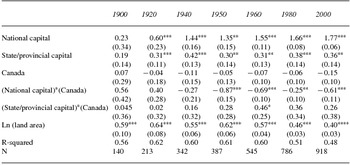
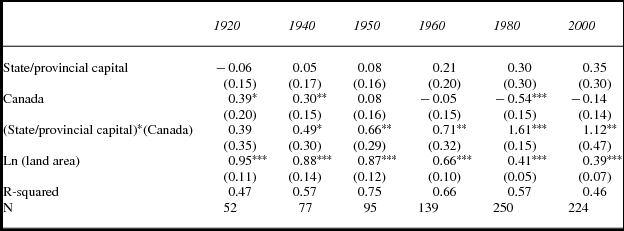
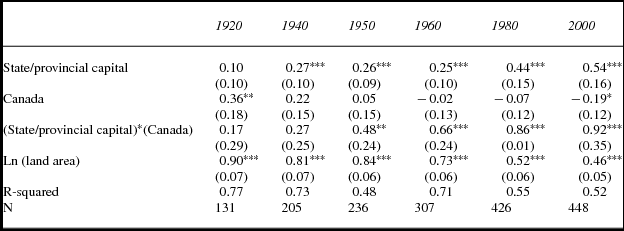
Because the urban data for the United States and Canada are fairly comparable, we pool the two data sets to more effectively identify the differences in US-Canadian capital city effects. We provide three different pooled sample results. First, in table 4, we report results for the entire Canada-US pooled sample.Footnote 20 Second, in table 5, we report results using a thin-border sample that consists of Canadian provinces and US states that share borders.Footnote 21 Because our goal is to identify how differences in the degree of political centralization influence city population, we believe that this thin-border sample is likely to be the most informative as these border economies are likely to be similar in most other respects such as in geography, climate, era of settlement, and natural resources. Finally, in table 6, we also report results for a thick-border sample where the US state sample is extended to include another interior layer of states.Footnote 22 The regression equation we estimated using the entire pooled sample of cities is the same as before, except that we include three additional variables: an indicator equal to 1 if the city is located in Canada, a national capital–Canada interaction term, and a subnational capital–Canada interaction term. The inclusion of these additional variables allows us to determine whether the magnitude of the national and subnational capital city effects differs across the two countries. For the thin- and thick-border samples, the regression omits the national capital effect and its interaction with the Canada indicator because Washington, D.C., is not included in either of these subsamples.
Log of population on capital city status for pooled sample of Canadian and US cities with population greater than 25,000

Source: See Table 1.
Notes: Each column is a separate regression. Other controls not reported include latitude, longitude, precipitation, temperature, and major river and major port indicators. Robust standard errors are displayed in parentheses.
*p < 0.10. **p < 0.05. ***p < 0.01.
Log of population on subnational capital city status for cities with population greater than 25,000 in border states and provinces (thin-border sample)

Source: See Table 1.
Notes: Each column is a separate regression. Other controls not reported include latitude, longitude, precipitation, temperature, and major river and major port indicators. Robust standard errors are displayed in parentheses.
*p < 0.10. **p < 0.05. ***p < 0.01.
Log of population on subnational capital city status for cities with population greater than 25,000 in border states and provinces (thick-border sample)

Source: See Table 1.
Notes: Each column is a separate regression. Other controls not reported include latitude, longitude, precipitation, temperature, and major river and major port indicators. Robust standard errors are displayed in parentheses.
*p < 0.10. **p < 0.05. ***p < 0.01.
The estimates based on the pooled data for the entire sample suggest the following. First, from 1940 to 2000, the national capital effect for Canada is consistently smaller than that of the United States. Second, the subnational capital city effect for Canada is greater than that of the United States but the effect is only significantly different for 1960. When we use the thin-border sample that only includes the contiguous border states and provinces, however, the Canadian provincial capital city effect is substantially larger than the US state capital effect (see table 5). In addition, the Canadian provincial capital city effect relative to the US state capital effect rose markedly over the second half of the twentieth century before falling slightly in 2000. Even when the sample is extended to include the next layer US states near the border, the Canadian provincial capital on population effect remains significantly higher than the US state capital effects (see table 6). Strikingly, the statistical and economic significance of the interaction term begins in 1950 and becomes larger in subsequent decades. Accordingly, the timing of this shift coincides with the growth of own source provincial government revenues.
Robustness Test: Estimates Using Metropolitan Areas
Due to suburbanization and the expansion of urban populations away from city centers to outlying areas, regression estimates based on municipalities may not capture the full impact of capital city status on population agglomeration. Accordingly, as a robustness check, we reestimated the national regressions and pooled regressions using data on metropolitan areas for the period between 1950 and 1990 for the United States and for 1970 to 1990 for Canada. The years included in the metropolitan regressions are different for the two countries because Canada began collecting metropolitan data later than the United States. Additionally, we did not use data on metropolitan areas for 2000 because how metropolitan areas were defined in the United States changed too dramatically between 1990 and 2000. For the United States, metropolitan areas correspond with the Census Bureau's Metropolitan Statistical Areas while for Canada they include Statistics Canada's Census Metropolitan Areas and Census Agglomerations.
The results from estimating our regression model using metropolitan data (not displayed but available upon request) are as follows. When we estimate the model separately for each country, we find that while national and subnational capital city effects grew in each country, the provincial capital effect grew faster than the state capital effect. Additionally, the magnitudes of the national capital city effects using metro areas are larger than the magnitudes using municipalities. Washington's status as a capital increased its metropolitan population by 344 percent in 1950 and 654 percent in 1900. Ottawa's status as a national capital increased its metropolitan population by 278 percent in 1970 and 759 percent in 1990. For the United States, the state capital effect increased metropolitan population by 42 percent in 1950 and 68 percent in 1990, while for Canada, the provincial capital effect increased population by 92 percent in 1970 and 156 percent in 1990.
When we pool the US and Canadian metropolitan data, our findings continue to be robust. Specifically, the national capital effect for Canada is smaller than the United States, the subnational capital effect is no longer significant, and the sign of the Canada indicator is negative. When we use thick- and thin-border samples of metropolitan areas, however, the Canadian provincial capital city effect is greater than the US state capital effect.
Conclusion
In this paper, we examine how different patterns of federalism in Canada and the United States affected the population of capital cities. In the United States, the tradition of states’ right and localism was gradually transformed into a national centralized form of federalism during the Progressive Era, but states and localities continued to retain significant autonomy. In contrast, in Canada, federalism came to favor provincial rights but not localism. Using data on municipalities, the estimates show that the national capital city effect on population rose over the twentieth century in both countries reflecting increasing political centralization at the federal level. For subnational capitals, however, the provincial capital city effect in Canada rose sharply in the second half of the twentieth century whereas the US state capital effect remained relatively moderate. Although our empirical strategy does not allow us to make definitive causal claims, our findings are consistent with the hypothesis that diverging patterns of political centralization in the United States and Canada affected population agglomeration in capital cities in different ways.
While it is difficult to determine the causes of the divergence of US and Canadian federalism, we believe that they are likely related to the different ways in which governments raised revenues. Rule and revenue are intimately intertwined (Levi Reference Levi1988). The ability of national governments in both countries to raise revenues increased dramatically in both countries, facilitating political centralization at the federal level. However, in Canada, the power to generate revenue from nonproperty taxes facilitated political centralization at the provincial level whereas in the United States, the early focus on property taxes by state and local governments fostered decentralization. When US governments became more centralized during the twentieth century, they eventually did so using the Canadian strategy of raising taxes from non-property-tax sources.
The divergence in American and Canadian federalism was also influenced by the size and number of subnational jurisdictions (Gibbins Reference Gibbins1982). In the United States, Thomas Jefferson, the champion of states’ rights and localism, argued for the division of the western territories into numerous small states because he believed that political competition would encourage localism (Berkhofer Reference Berkhofer1972).Footnote 23 Indeed, until the Civil War, competition between states seems to have fostered decentralization. Yet, ironically, as the scale and scope of government regulation increased during the late nineteenth and early twentieth centuries, the United States moved toward a more federally centralized system, consistent with Alexander Hamilton's vision.Footnote 24 The founders of the Canadian federation, however, believing that excessive states’ rights in the United States contributed to its Civil War, determined to establish a more centralized federal government. Yet, Ontario's size and dominance led to greater provincial autonomy, as advocated by Jefferson, but also greater centralization over local governments, as desired by Hamilton.