In this essay I argue that a search for the origin of the antiliberal ideology that characterizes the New Cold War leads us back into the communist era—but not to anything remotely resembling Marxism or Leninism.Footnote 1 It might seem odd to suggest that the antiliberal politicians of our time (Vladimir Putin, Donald Trump, Viktor Orbán, Jarosław Kaczyński, Robert Fico, Recep Erdoğan, Marine Le Pen, Norbert Hofer, and the like) have much in common with the communists who were ousted almost thirty years ago. Only in Putin's case are there clear connections. Although he is instrumental and inconsistent in his rhetoric, his ties to the old Communist Party of the USSR are direct, and he has never hesitated to draw upon nostalgia for the Soviet era.Footnote 2 When selecting groups to support abroad, however, he has tended to pick those with strong anticommunist bona fides: Fidesz and Jobbik in Hungary, the Front National in France, the Republican Party in the US, and so on. One could interpret this as cynical opportunism, but I believe that we are witnessing something deeper and more dangerous than the geopolitical machinations of Russian spies and hackers. We can see this most clearly in Poland, where Putin's involvement has been minimal even as the broader cause he represents has triumphed. Here we can see most clearly the contours of an ideological tendency that transcends the personality of Putin or the foreign policy of Russia.
In 2015, Prawo i Sprawiedliwość (Law and Justice, or PiS) rose to power in Poland and immediately set about transforming the country's constitutional norms. Over the past year they have turned the public radio and TV networks into openly partisan mouthpieces, purged the civil service of those deemed insufficiently loyal, and refused to honor rulings of the constitutional court until they were able to stack it with their supporters. The formal offices of the state have been stripped of real authority, so that the country's president and prime minister are subordinate to the PiS party leader, Jarosław Kaczyński (who holds no official position other than an ordinary member of parliament). The European Union has condemned the Polish government for these actions, but international criticism only strengthens the resolve of PiS loyalists.Footnote 3
Kaczyński would seem to constitute an exception to the patterns of the New Cold War: he has always been vehemently hostile to Russia, and he would never admit that his political vision has anything in common with Putin's. This contrasts with Hungary's Viktor Orbán, who broke with decades of nationalist rhetoric by openly praising Putin and calling Russia a model for a new type of “illiberal democracy.”Footnote 4 Today Orbán stands alongside people like Marine Le Pen in France, Robert Fico in Slovakia, and Miloš Zeman in the Czech Republic, fighting EU sanctions against Russia and echoing Moscow's foreign policy line.Footnote 5 It is hard to imagine Kaczyński doing anything like that. Quite the contrary: he continues to say that increased US troops are needed in Poland to counteract a looming Russian menace. His defense minister, Antoni Macierewicz, has been devoting significant resources to the development of a “Territorial Defense Army” consisting of part-time soldiers outside the regular military command structure, designed explicitly to resist irregular Russian troops should Putin try to repeat in Poland what he did in eastern Ukraine.Footnote 6 Kaczyński, Macierewicz, and their colleagues believe—against all evidence to the contrary—that Putin and former Polish Prime Minister Donald Tusk (and perhaps German Chancellor Angela Merkel as well) plotted to assassinate Lech Kaczyński (Jarosław's twin brother), who died in a plane crash in 2010. PiS propaganda depicts that (imaginary) assassination plot as the tip of the iceberg of Polish corruption and treasonous subservience to foreign interests.Footnote 7 For his part, Putin treats Poland in general and Kaczyński in particular as enemies, and the Russian propaganda apparatus has alternatively mocked and attacked the PiS government.Footnote 8
But despite all this implacable hostility towards Russia (and vice-versa), Kaczyński remains extremely close with Orbán, and speaks approvingly about Le Pen, Trump, and other pro-Russian politicians. Like them (and like Putin), he longs for a less cohesive and centralized European Union, one transformed into an alliance of fully independent nation-states, with each member retaining autonomy on all significant matters. PiS opposes reforms to strengthen the directly elected European parliament, preferring instead the principle of one-nation-one-vote (or better, one-nation-one-veto) within a loose economic alliance.Footnote 9
Looking eastward, Kaczyński himself has upheld the continuation of Polish support for pro-European and pro-democracy advocates in the former Soviet republics, but this commitment is wavering in the face of opposition within PiS.Footnote 10 The Polish government had long provided aid to the opponents of Belarus's authoritarian leader, Aliaksandar Lukashenka, but recently these relations have taken a 180 degree turn. For example, in December 2016 it was announced that the Polish-sponsored TV station Bielsat, which had offered programing in Belarusian that was free from the regime's censors, would be defunded in favor of a Polish-language station aimed at the small Polish minority within Belarus. When the foreign minister was asked what Belarusians could do now to find independent news, he said “they'll learn Polish.”Footnote 11
So far, Poland has continued to support Ukraine, and this remains an important exception in the convergence of Polish foreign policy with that of Orbán, Le Pen, and the like.Footnote 12 But here, too, the old norms are changing. Central to the PiS movement is what Kaczyński calls polityka historyczna, a term which encompasses both “historical politics” and “historical policy.” He sees history as inherently political, and he believes that the state should promote a vision of the nation's past aimed at instilling patriotism, a willingness to sacrifice, and (above all) a keen awareness of national martyrology and grievances.Footnote 13 One aspect of this has been a renewed focus on the story of the Volyhnia Massacre, when Ukrainian nationalists killed tens of thousands of Poles during WWII. In the summer of 2016, PiS commemorated this tragic event with a parliamentary resolution labeling it an act of “genocide.”Footnote 14 In trying to balance the government's ongoing foreign policy objectives with the domestic political demands of the PiS base, the government has left everyone dissatisfied.Footnote 15 Not surprisingly, this has led to a decline in Poland's popularity and influence in Ukraine.Footnote 16
Putting all this together, we get a picture of a government that is behaving almost exactly as Putin would wish, with the wavering exception of Kaczyński's Ukrainian policy. As recently as 2014, Poland had been the prime example of the effectiveness and wisdom of the 2004 EU expansion; now the country is being cited as evidence that it would have been better to leave the former Soviet bloc countries on their own.Footnote 17 Beyond any doubt, Kaczyński is sincerely hostile to Russia, but it is equally undeniable that PiS rule has helped Putin's broader agenda in Europe, and that domestic politics in Poland and Russia are more closely aligned today than at any time since 1989. On most issues, there is very little space between Kaczyński, Fico, Zeman, Orbán, and Le Pen.
I think we can set aside one possible explanation for this convergence: that Putin is engineering it all. To be sure, there are some reasons to suspect Russian machinations in Poland in recent years, but we must be extremely cautious because the evidence remains thin and circumstantial. There were many reasons why PiS got 38% of the vote during the elections in 2015 (which was enough to gain a parliamentary majority, thanks to the number of parties that failed to reach the 5% minimum). And there were even more reasons why people voted against the previous Platforma Obywatelska (Civic Platform, or PO) government, which held power for eight years. Among the events leading to the erosion of PO's authority was a scandal that broke out in 2014 with the publication of secret recordings of private conversations among leading government figures. The revelations emerged under very suspicious circumstances, and while Polish counterintelligence suspected Russian involvement, this was never proven.Footnote 18 Journalists have uncovered hints of ongoing covert Russian operations in Poland, particularly inside the Defense Ministry—though again, the public evidence is inconclusive.Footnote 19
Whether there is truth to any of those suspicions is beside the point. We should resist the temptation to overstate Russia's role or Putin's power. Even in the most unambiguous examples of Russian interventions, they have only managed to turn up the heat slightly under a social, cultural, and political stew that was already at a full boil. Even if Russia was entirely out of the picture, these various antiliberal movements would still constitute a major challenge. More important than specific Russian intelligence operations, I would argue, is the underlying ideological convergence that makes the antiliberal international imaginable in the first place. This coalition is not (at least, not only) a “conservative” or “right wing” phenomenon in the way those terms are understood in the United States. It has in part emerged from the conceptual framework of the old communist parties of eastern Europe, but is now resonating far beyond the region, appealing to a demographic base that challenges our ideological expectations.
To understand the deep historical context of our current political moment, we need to start with the recent scholarship on the immediate post-WWII years in east-central Europe. There is a growing consensus among historians that it is too simplistic to depict the events of the late 1940s solely in terms of Soviet conquest and occupation. Instead, a number of scholars have urged us to think of those years as a time of actual revolution, with autonomous local causes and with a significant local constituency.Footnote 20 The wartime destruction and postwar confiscations of nearly all the private capital in Poland, the murder of over 90% of Poland's Jewish citizens in the Holocaust, the removal of nearly everyone claiming German or Ukrainian ethnicity in the postwar ethnic cleansing, and the discrediting of the prewar political elite because of the country's catastrophic 1939 defeat: all this facilitated a reconstruction of economic, political, cultural, and social life beyond the wildest dreams of prewar revolutionaries. The Soviets only needed to step in and sculpt the revolution to their own specifications, and they did so with ruthless determination. But it is important to distinguish the domestic revolutionary dynamics from the political impositions of the Soviets. That foundation wasn't socialist, but something more elemental: it was a revolution of what I call exclusionary egalitarianism.Footnote 21
This wasn't the egalitarianism described in the prophecies of Marx or Lenin, and it certainly wasn't the “equality of opportunity” framework advanced by the theorists of liberal capitalism. Nor was it the “egalitarian individualism” that scholars have described for places as diverse as the US and Scandinavia—an ethos that combines a desire for rough equality with a strong sense of individual autonomy.Footnote 22 Instead, it was grounded in the moral framework that strives to prevent people from straying too far from communal norms, either by falling into destitution or by rising too far above their neighbors. It was not the egalitarianism of fairness, but of community, and it provided a mandate for the social compression needed to maintain strong bonds within a tight social group. Such mandates for rough equality are common enough, but distinguishing the post-WWII ethos (particularly in east-central Europe) was a second component: a politics of exclusionary identity emerging out of the brutality of the war, a heightened sense that the world was divided between “us” and “them.” Across all the combatants of WWII, but with particular intensity in the parts of Europe where the occupation was most violent and the conflict most bitter, it became a basic survival mechanism to identify one's enemies and one's friends, and this Manichean worldview survived long after the fighting stopped. The perception of a dualist world of allies and foes was much more important than the debates over whether those categories were defined according to “class” or “nation.” In fact, we are as likely to find examples of this thinking among communists as among nationalists. Intellectuals would argue about the specific content of postwar identity politics, but what really mattered was the centrality of identity itself. In this context, the words “liberty,” “freedom,” or “emancipation” did not refer to the individual liberty of liberalism, but the sort of collective freedom that implies walls against “outsiders” and the enforcement of homogeneity “inside.”Footnote 23
The role of the USSR, then, was not to force a revolution upon Poland, but to seize the existing social forces and redirect them in a Marxist/Leninist/Stalinist model. This project failed very quickly, mainly because a key component of the model was the transformation of human subjectivity into a cosmopolitan homo sovieticus. Although Stalin had “nationalized” communism in many ways, the establishment of the Soviet Bloc involved a great deal of pressure to perceive “brotherly” Russo-Polish bonds, as part of a broader socialist identity.Footnote 24 Against this backdrop, 1956 appears as the Thermidor to Poland's Revolution, and like the French original, it both brought the worst violence to an end and rolled back some of the radical social transformations of previous years. The rise of Władysław Gomułka as leader of the PZPR (Polska Zjednoczona Partia Robotnicza, or Polish United Workers Party) was not really a “liberalizing” thaw. Instead, his reforms marked a withdrawal by the communists from any serious ambition to fundamentally transform Polish culture and society.Footnote 25 Even in the late 1940s, as the communists were seizing power in Poland, Gomułka represented a very distinct kind of communism. His slogan then (and later) was the “Polska Droga” (Polish Road, or Polish Way), which is often understood to imply that the communists of each particular country should adopt the path to socialism most suited to their context. Actually, his arguments went deeper than mere tactics; he also questioned the assumption that the end-point of socialist development would look the same in each country. His road wasn't called Polish because it ran through Poland, but because it led to Poland.
So what really distinguished Gomułka's Poland was an embrace of the exclusionary identity politics of the time, and an abandonment of any lingering remains of the old communist ambitions to create a truly new form of human subjectivity. Without explicitly admitting it, he and his successors didn't really try to create homo sovieticus. The Stalinist revolution was supposed to strike deep into the realm of social norms, down to the level of the family and interpersonal relations. That's what Gomułka surrendered, accepting consumerism on the one hand, and nationalism on the other. In the countryside, the abandonment of agricultural collectivization re-enshrined the family, organized within traditional peasant villages, as the basic unit of production. Perhaps most important, the state retreated from its efforts to change family or gender norms.Footnote 26 The legendary female tractor drivers disappeared, to be replaced by new laws blocking women from jobs deemed too “masculine” or too dangerous for women's health. Funding patterns for childcare relied upon a presumed return to traditional nurturing roles for women (usually grandmothers, who were legally encouraged to retire early). Above all, Gomułka abandoned the idea of creating an internationalist, cosmopolitan, socialist subject. Instead, the PRL became emphatically national, even nationalistic (particularly after the rise of Mieczysław Moczar's “patriotic” faction in the late 1960s).Footnote 27 After 1956, the red-and-white Polish flag became much more prominent than the red communist flag, and state propaganda intensified the use of the adjective “Polish” before all the old communist slogan words (the Polish proletariat, the Polish people, and Polish communism). The official ideology of the state glorified ethno-national homogeneity, resurrecting old stories about national martyrdom in the struggle for independence. Above all, the party kindled hatred towards foreigners (particularly Germans and Jews).
It is therefore no surprise that some former members of the National Democratic movement (the Endecja) participated in the building of the Polish People's Republic in a variety of functions.Footnote 28 But most of those on the far right either left the country or withdrew from political life, and the primary reason is crucial: the PZPR's legitimacy was never recognized by the Catholic Church. Gomułka and his successors downplayed many of socialism's goals, but they could never entirely abandon the foundational anticlericalism and scientism of the Marxist project. For their part, the Church hierarchy had been demonizing (literally!) socialism for so long that a reversal was inconceivable. Given the importance of Catholicism to 20th century Polish nationalism, Gomułka's National Communism was doomed. This wasn't because Polish nationalism was essentially tied to Catholicism, since that had not always been the case.Footnote 29 Rather, the problem was more generic: with a hostile Catholic Church, an important ideological transmission belt and an important form of quotidian sociability in Poland remained firmly anti-communist. If Gomułka was embracing the politics of identity, he was doing so with one hand tied behind his back. Far too many of the rituals of identity and the ceremonial markers of life's passage could never be assimilated into his system. Or to be more specific, the only way to have done so would have been to more fully embrace the Stalinist approach to the reconstruction of individual subjectivity, which Gomułka had otherwise abandoned.
As inexorable as that failure may have been, it does raise a question that rarely gets posed: if the post-WWII Church leadership did not accept communism, just what sort of social, economic, and political system did they want to see in Poland? One thing was very clear: they did not want Poland to become a liberal capitalist democracy. Although Pius XII seemed to ally the Church with the United States after WWII (particularly with his 1949 excommunication of all those who cooperated with communists), he saw this as an uncomfortable alliance against a common foe.Footnote 30 The problem with communism, for most of the Catholic hierarchy, was not that it challenged capitalism and democracy. Quite the contrary: they saw it as the culmination of all the evils unleased by capitalism and democracy. Communism, for them, stood at the very bottom of the slippery slope down which humanity had been descending since the Enlightenment. Only at the Second Vatican Council (1963–1965) did the Church soften its stance on modernity and democracy—but even then, Catholic hostility towards individualism and capitalism remained, particular for traditionalists like Polish Primate Stefan Wyszyński and his successor Józef Glemp. From their perspective, both the communists and the left-liberal or social democratic dissidents were problematic, albeit in different ways.Footnote 31 Karol Wojtyła represented a more open stance towards modernity, but after his election to the papacy as John Paul II, his direct influence over the Polish Church was attenuated (even as his symbolic influence expanded to unimaginable heights).
In the 1970s and 1980s, most observers thought that the Catholics and the secular left had reached a rapprochement, maybe even a genuine alliance in the struggle against communism.Footnote 32 In hindsight, we can see how fragile and superficial that brief confluence of interests was. When the PZPR was finally overthrown in 1989, the disillusionment among conservative Catholics was immediate and bitter.Footnote 33 Instead of the systemic counterrevolution that most priests and bishops had desired, they saw Poland change from one unacceptable regime (communism) to another (liberal capitalist democracy). People outside Poland express bewilderment when PiS supporters insist that nothing significant changed in 1989, that it was all a big conspiracy to allow PZPR functionaries to retain positions of power, or that Lech Wałęsa was a communist agent.Footnote 34 From the perspective of those who saw the protagonists in the Cold War as authoritarian communism and liberal democratic capitalism, it is absurd to suggest that 1989 was anything less than an epic triumph. But from the perspective of those who saw communism as the logical consequence of the Enlightenment and the French Revolution, all the Poles did was crawl a little bit backwards on that slippery slope to perdition.
1989 was therefore experienced as a failure for two large ideological clusters: the national communists and the Catholic conservatives. The former lost all credibility, and their rhetorical vocabulary was discredited. But large swaths of the PZPR's worldview remained popular: hostility towards foreigners, a commitment to redistributive economic policies, and a longing for social discipline and unity. In other words, exclusionary egalitarianism. All of those issues were central to the disillusioned Catholics as well, who were able to slide right into the spot that had been occupied by the national communists. The only significant difference was that they could add to the PZPR's mix the one key element that the communists never had: the imprimatur of the Church.
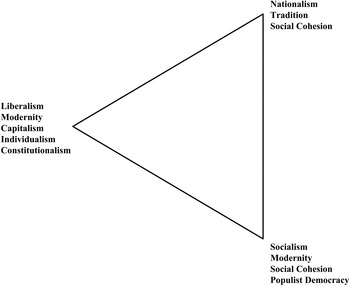
It is tempting to describe this as a manifestation of the old bromide about the far left and the far right circling back to each other, under the flexible label of “populism.” That word can certainly be useful, particularly when we want to emphasize a general hostility towards “elites.” It helps us explain, for example, why Bernie Sanders and Donald Trump rose to popularity at the same time, or why both Geert Wilders and GroenLinks could achieve such strong results in this year's Dutch elections. Grouping together such diverse movements inside the “populist” tent draws our attention to the ways in which growing inequality, the erosion of the welfare state, and the collapse of mid-20th century forms of industrial stability have all coalesced to spark our current crisis. But the concept of “populism” has its limitations, too. The biggest problem is that it risks replacing one binary (left vs. right) with another (liberal vs. populist). That, in turn, could encourage the view that the political struggle of the moment is between the besieged elites and the enraged masses, or between individual liberty and a collectivist mob. I think we need a framework that allows us to approach this problem with a scalpel rather than a scythe, and “populism” strikes me as too capacious for that purpose. The label “exclusionary egalitarianism” is admittedly clunky (three syllables is definitely better than thirteen), but it has the advantage of taking us away from the two-dimensional “ideological spectrum.” Instead, I propose a different geometric metaphor: a triangle, with liberal democracy on one vertex, nationalist conservatism on another, and socialism on the third (see figure 1). This alternative shape is helpful because it allows us to envision the shifts that different political movements must make in order to establish alliances or to create new blended ideologies.
The Ideological Triangle.

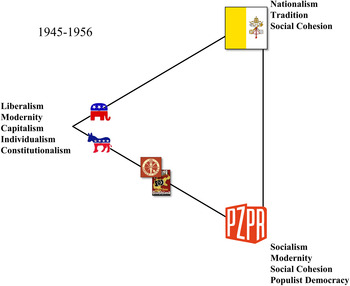
In this scheme, the immediate postwar years saw the two major US political parties competing over a tiny bit of space at the liberal tip of the triangle, while the center of gravity in west European politics was somewhere along the line between liberalism and socialism. The upper-right vertex was largely discredited by the horrors of fascism, and while the Vatican still occupied that spot, even Catholicism was changing rapidly. Communism, meanwhile, was firmly lodged on the bottom-right vertex (see figure 2).
The Ideological Triangle, 1945–1956.

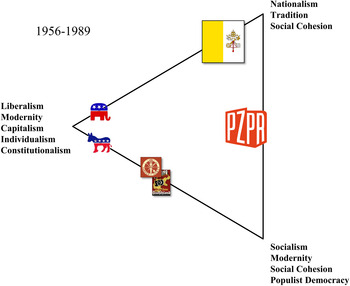
The rise of Gomułka's national communism after 1956 did not push the PZPR towards liberalism, but upwards along the right-hand edge of the triangle. Meanwhile, the Second Vatican Council dislodged the Church from the very furthest vertex, though that change was harder to see in Poland (see figure 3).
The Ideological Triangle, 1957–1989.

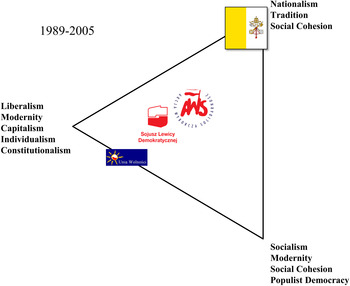
After 1989 the PZPR was gone, leaving a gaping hole in Poland's political landscape. The large majority of the intelligentsia had hoped to create something like an American or west European array of center-left (Unia Wolności [Freedom Union] and perhaps the post-communist Sojusz Lewicy Demokratycznej [Alliance of the Democratic Left]) and center-right parties (Akcja Wyborcza Solidarność [Solidarity Electoral Action]), but as David Ost has argued, these efforts left very little space for the indispensable politics of anger and frustration. Footnote 35 The most emotional political debates throughout the 1990s circled around cultural issues, with liberals pushing for a more secular state and conservatives hoping to retain a significant place for Catholicism. There was an obvious problem with the resulting picture (see figure 4).
The Ideological Triangle, 1989–2005.

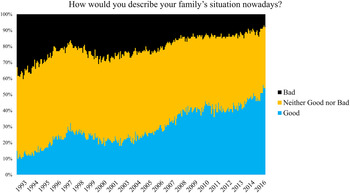
The way in which that gaping hole was filled was by no means preordained. Several political parties on the left tried to establish a foothold near the empty vertex of this triangle, but none have succeeded in establishing a significant and enduring presence. Meanwhile, many believed that increasing prosperity and secularization would cause the upper-right segment of the triangle to gradually lose its significance. The unprecedented growth in the Polish economy, and the fact that more and more Poles were reporting that they were happy with their lives and optimistic about the future, made it seem possible that the future belonged entirely to the liberal side of the triangleFootnote 36 (see figure 5).
Survey of Well-Being, 1993–2016.

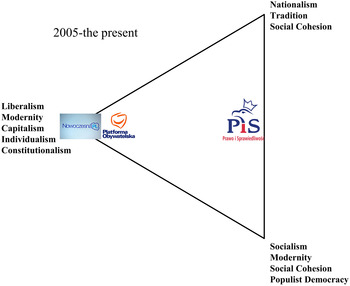
What so many of us did not realize was that while traditional Catholic conservatism was in fact in decline, the exclusionary egalitarianism at the foundation for Gomułka's national communism had never gone away. That worldview didn't represent a majority of the population, but with the right concatenation of political forces even a party with support of around a third of the electorate can come to power (as we learned after the 2015 elections). Thus we ended up with today's political landscapeFootnote 37 (see figure 6).
The Ideological Triangle, 2005 to the present.

Although I have located PiS in precisely the spot that the PZPR had occupied, I am not arguing that Kaczyński is a communist. Instead, I'm suggesting that by the 1970s and 1980s, the PZPR itself had moved away from earlier forms of Leninism and even Stalinism, towards national communism. That was the ideology overthrown in 1989. For anyone who embraced the broad framework of liberal democracy (everyone from social democrats through libertarians to Christian democrats), this was an unambiguous victory. But many in Poland did not want that sort of revolution back in the 1980s. Instead, they longed for a state that would repudiate the whole left vertex of my ideological triangle. They wanted a state that would preserve the PZPR's commitment to social cohesion, cultural homogeneity, and nationalism, but imbue it with a Catholic rather than a leftist vocabulary.
So what we see today is the ideology of exclusionary egalitarianism fortified with the antiliberal rhetoric of Catholicism. The latter component, I would argue, is less important, because when we view this phenomenon comparatively, we see Orthodoxy (in Putin's Russia), evangelical Protestantism (in Trump's USA), and Islam (in Erdogan's Turkey) serving just as well. In the French, Czech, and Scandinavian cases, we can even see these dynamics playing out in highly secularized societies. This is the core of the worldview that links Putin, Kaczyński, Orbán, Zeman, and Fico. Understood broadly as exclusionary egalitarianism (without the direct communist affiliation), this is what we see in Le Pen, Hofer, Wilders, and their ilk in western Europe.Footnote 38 It was the core ideology that supported the Soviet Bloc states, far more so than Marxism ever did. It seemed to have been defeated in 1989 by constitutional, rule-of-law, liberal politics and multiculturalism on the one hand, and free-market “neoliberal” economics on the other. That defeat was an illusion.
Plotting exclusionary egalitarianism on a triangle rather than positioning it along a political spectrum helps us see the history of this ideology more clearly, and understand why the former Soviet Bloc countries are playing a crucial role in its resurgence. But if the history of this worldview is tied to eastern Europe, its present incarnation has no geographical locus. Putin's Russia might have become a symbolic focal point, but it would be a grave error to draw too many parallels between his machinations today, and the position of the USSR in the international communist movement a half century ago. The association of exclusionary egalitarianism with communism during the 20th century's Cold War established a useful quarantine around it in western Europe and North America, but with that gone, we now see all too clearly that the sentiments behind it are (and probably always were) equally potent across the globe.