Introduction
Background
Schizophrenia is associated with poorer than average cognitive functioning (Green et al., Reference Green, Kern, Braff and Mintz2000). Given the impact these cognitive impairments have on day-to-day functioning, researchers are exploring methods to remediate them in patients. Previous studies have examined the effects of cognitive training on cognition and functioning in schizophrenia patients (McGurk et al., Reference McGurk, Twamley, Sitzer, McHugo and Mueser2007; Wykes et al., Reference Wykes, Huddy, Cellard, McGurk and Czobor2011). However, the majority of these studies have examined the effects of broad-based cognitive interventions, leaving many unanswered questions about how to most effectively and efficiently improve cognition and functioning through training. In other words, which domains of cognition should be targeted to produce the most widespread benefits in cognition and functioning in schizophrenia patients?
Training low-level (e.g. pre-attentive perceptual processing) and mid-level (e.g. working memory [WM]) cognitive processes may be necessary for improving high-level cognitive processes (e.g. recognizing facial emotions; Vinogradov et al., Reference Vinogradov, Fisher and De Villers-Sidani2012). Logically, targeting specific lower-level cognitive processes may also be a more efficient means of obtaining treatment gains. Targeting cognitive processes with broad associations to other aspects of cognition and functioning may be the best strategy for treatment with schizophrenia patients. This approach would plausibly lead to enhancements in multiple domains of cognition by efficiently targeting one broad-reaching domain (Lawlor-Savage and Goghari, Reference Lawlor-Savage and Goghari2014). As such, there is a need for more research examining both the near-transfer (i.e. transfer of learning to related contexts) and far-transfer (i.e. transfer of learning to new contexts) gains associated with cognitive training of specific domains of cognition in schizophrenia patients.
For the purposes of the current study, WM and processing speed (PS) deficits in schizophrenia were examined and specifically targeted. Both WM (Silver et al., Reference Silver, Feldman, Bilker and Gur2003) and PS (Dickinson et al., Reference Dickinson, Ramsey and Gold2007) have been described as core cognitive deficits in schizophrenia. Moreover, both have been hypothesized to mediate impairments in higher-order cognition, social cognition, symptoms, and functioning in patients (Menon et al., Reference Menon, Anagnoson, Mathalon, Glover and Pfefferbaum2001; Silver et al., Reference Silver, Feldman, Bilker and Gur2003; Rodríguez-Sánchez et al., Reference Rodríguez-Sánchez, Crespo-Facorro, González-Blanch, Pérez-Iglesias and Vázquez-Barquero2007). Given these findings, recent literature has underscored the need for further examination of both WM and PS training specifically in schizophrenia patients to improve broader cognitive domains, as well as functioning and symptoms (Brébion et al., Reference Brébion, David, Jones and Pilowsky2009). Prior research has shown that WM and PS skills can be improved following broad-based cognitive interventions in schizophrenia (effect sizes approximately d = 0.40–0.50) (McGurk et al., Reference McGurk, Twamley, Sitzer, McHugo and Mueser2007; Wykes et al., Reference Wykes, Huddy, Cellard, McGurk and Czobor2011), though few studies have examined targeted WM training and no previous studies have investigated targeted PS training in patients. Furthermore, we focused on functioning and symptoms as outcome measures given their relationship to cognition, but also as these measures are the main indices for assessing wellness in schizophrenia patients. Thus, the goal of the current study was to examine both the near-transfer and far-transfer effects of WM and PS training in schizophrenia patients.
Objectives and hypotheses
This study investigated: (1) near-transfer gains associated with WM and PS training in schizophrenia patients (i.e. gains in the WM or PS domains respectively); (2) far-transfer gains associated with WM and PS training in schizophrenia patients (i.e. gains in other neurocognitive domains, primarily fluid intelligence, and gains in social cognition); and (3) real-world gains associated with WM and PS training in schizophrenia patients (i.e. gains in symptoms and daily functioning). Exploratory analyses examined the effect of individual difference variables (e.g. sleep quality, intrinsic motivation during training, beliefs about the malleability of intelligence) on training-related cognitive or functioning gains.
The corresponding hypotheses were as follows: (1) post-training performance in WM and PS would improve in the WM training group and PS training group, respectively, relative to the no-training control group; (2) both WM and PS training would lead to more generalized improvements in other neurocognitive domains, particularly fluid intelligence, as well as enhancements in social cognition relative to the no-training control group; and (3) both WM and PS training would lead to more improvements in symptoms and daily functioning compared to the no-training control group.
Methods
Study design and population
The full rationale and methodology of the present study was previously published (Cassetta and Goghari, Reference Cassetta and Goghari2016) and registered online at ClinicalTrials.gov (registration number: NCT02478827). The current study was a randomized controlled trial (RCT) that employed a parallel design with a 1:1:1 allocation ratio. Participants were randomly assigned to one of three conditions: (1) WM training, (2) PS training, or (3) a no-training control. Participants in the two training conditions were blind to the fact that there were multiple training groups and to which cognitive domain they were assigned. A trained graduate student completed all cognitive assessments and was blind to group allocation until the completion of the study.
Patients were recruited through outpatient clinics and community support programs in Calgary and Edmonton, Alberta. Inclusion criteria for participants included: (1) a diagnosis of schizophrenia or schizoaffective disorder, assessed with the Structured Clinical Interview for Diagnostic and Statistical Manual of Mental Disorders (DSM)-5 (SCID-5) (American Psychiatric Association, 2013); (2) age 18–65; (3) no uncorrected visual impairment; (4) no uncorrected hearing impairment; and (5) able to provide informed consent. Exclusion criteria included: (1) meeting DSM-5 criteria for a current major depressive, manic, or hypomanic episode; (2) use of electroconvulsive therapy or transcranial magnetic stimulation within the past month; (3) past 3-month history of substance use disorder (excluding nicotine, cannabis, or caffeine); (4) diagnosed with a medical condition known to affect cognition (e.g. endocrine disease, uncontrolled diabetes); and (5) score <70 on the Wechsler Abbreviated Scale of Intelligence-2nd Edition (WASI-II).
Ethical standards
All participants provided written informed consent. This study was approved by the Conjoint Health Research Ethics Board (CHREB) at the University of Calgary (study ID number: REB15-0526).
Cognitive training program
PS and WM training programs were provided by BrainGymmer (Dezzel Media, 2010) and accessed online. All participants were instructed to train for 30 min/day, 5 days/week, for 10 weeks. Each training program consisted of three exercises and participants were instructed to distribute their time approximately equally across the exercises. All participants were provided with training instructions during the baseline session and the opportunity to practice in person with a research assistant present.
Screenshots and detailed descriptions of the training exercises are provided in online Supplementary Materials. WM training consisted of three games which incorporated both maintenance and manipulation aspects of WM. PS training consisted of three games which required timely information processing and had a minimal memory component. All exercises were continuously adapted to individual performance by the training program to prevent boredom and push participants’ cognitive boundaries. Training compliance was monitored through weekly electronic data upload, and participants in all groups received phone call follow-up at weeks 2, 5, and 8 to remind training participants of the weekly training goals or for no training control participants of how long until follow-up. The training program provided built-in feedback (i.e. scores). No feedback was provided by the researchers.
Outcome measures
As previously described (Cassetta and Goghari, Reference Cassetta and Goghari2016), all participants were administered the following measures at pre- and post-assessment: three measures of WM (N-Back, maintenance and manipulation task, and digit span), two measures of PS (symbol search and color naming from the Delis–Kaplan Executive Function System [DKEFS]), two measures of fluid intelligence (Raven's Standard Progressive Matrices [RSPM] and Cattell's Culture Fair Test [CCFT]), three measures of executive functioning (EF; DKEFS Color-Word Interference Test [CWIT]-Inhibition Scale, DKEFS CWIT-Switching Scale, DKEFS Trail Making Test [TMT]-Switching Subtest), two measures of social cognition (The Hinting Task and the Geneva Emotion Recognition Test [GERT]), four measures of daily functioning/symptomatology (the Cognitive Failures Questionnaire [CFQ], UCSD Performance-Based Skills Assessment Brief [UPSA Brief], Social and Occupational Functioning Assessment Scale [SOFAS], and the Positive and Negative Syndrome Scale [PANSS]), and two measures of beliefs regarding cognition (Need for Cognition Scale and Theories of Intelligence Scale). The primary outcome measures (i.e. WM, PS, and fluid intelligence) were always administered in the first half of the session in a counter-balanced fashion, while all other (secondary) measures were administered in a counter-balanced fashion during the second-half of the session.
In addition, a brief self-report motivation questionnaire (McAuley et al., Reference McAuley, Duncan and Tammen1989) was provided to patients prior to training, half-way through training, and immediately post-training to measure motivation and engagement with the training program. Mid-point motivation was used in exploratory regression analyses to represent motivation across the training period. Participants were paid $20 for each assessment session ($60 total).
Statistical analysis
Complete case analyses were conducted and reported below, using data from all participants who completed both assessments, regardless of how much training they completed. Notably, the results do not change with intent-to-treat analyses using the expectation algorithm to handle missing data (see online Supplementary Materials). Between-groups analyses of variance (ANOVAs) and χ2 analyses were used to examine any baseline differences between groups. Paired t tests were used to identify changes in scores and level achieved on each cognitive training game from day 1 to the last day of training. A 2 × 3 group by time repeated measure ANOVA was conducted to test for significant group differences in motivation over time throughout training, across the two training groups.
The 2 × 2 time by group repeated measure ANOVAs were conducted to examine differences in training-related gains between each training group and the no-training control group and between the training groups. Bonferroni-corrected α levels were used to control for multiple tests within each cognitive domain. Exploratory multiple regression analyses were conducted to examine potential predictors of training-related change among participants collapsed across both training group.
Results
Participant flow and baseline characteristics
Enrolment, allocation, and completion rates are shown in Fig. 1. The average number of days between pre- and post-assessments was similar for the WM group (M = 81.17, s.d. = 11.21), the PS group (M = 77.50, s.d. = 13.70), and the no-training control group (M = 75.75, s.d. = 12.93) [F(2,70) = 1.15, p = 0.32].
Flow chart of study design and number of participants.

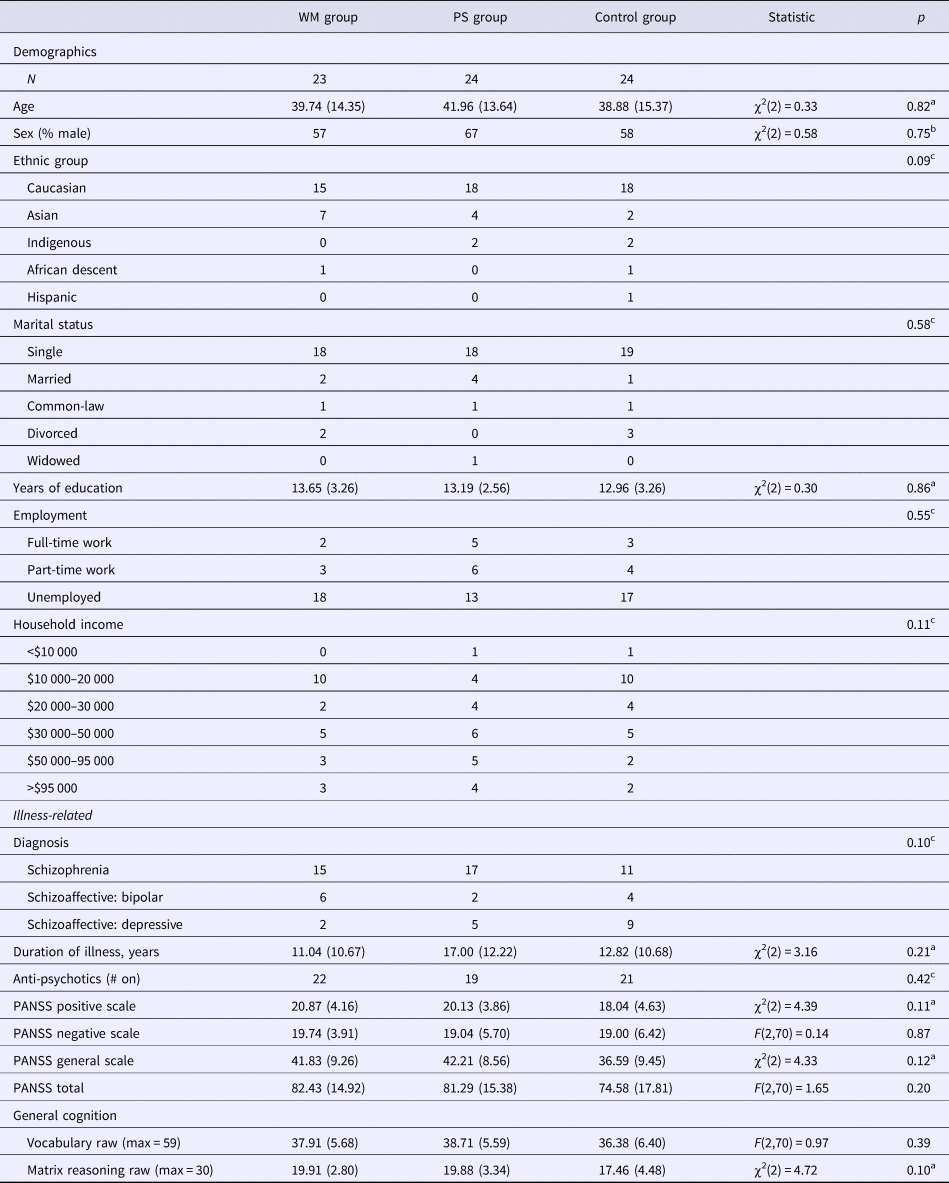
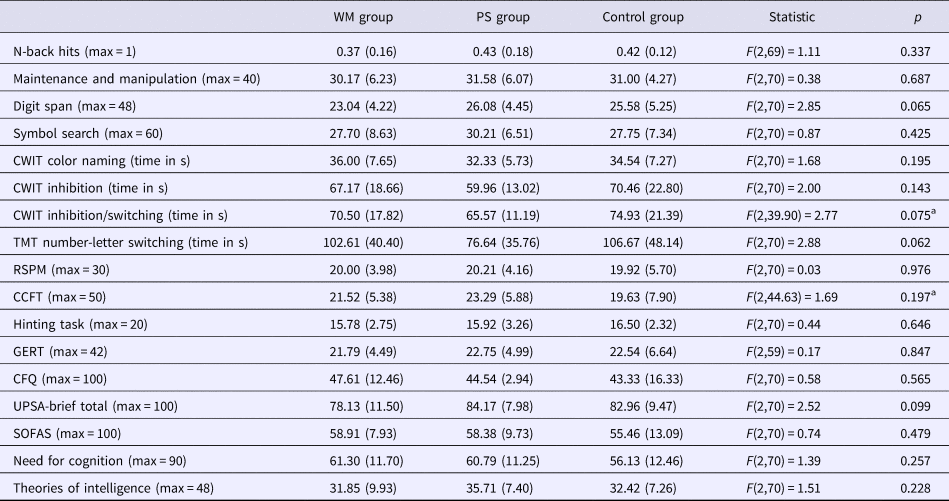
Participant characteristics at baseline are shown in Tables 1 and 2. There were no baseline differences between groups on any demographic, cognitive or illness-related variables. There were no significant differences at baseline between participants who completed follow-up and those who did not.
Participant characteristics at baseline

WM, working memory; PS, processing speed; PANSS, Positive and Negative Syndrome Scale.
a Kruskal–Wallis test used.
b χ2 test used.
c Fisher's exact test used.
Means and standard deviations on cognitive and functioning tasks at baseline

WM, working memory; PS, processing speed; CWIT, Color-Word Interference Test; TMT, Trail Making Test; RSPM, Raven's Standard Progressive Matrices; GERT, Geneva Emotion Recognition Test; CFQ, Cognitive Failures Questionnaire; UPSA, UCSD Performance-Based Skills Assessment.
a Welch's F-test used.
Cognitive training time and performance
Both the WM (M = 497.19, s.d. = 638.68) and PS (M = 411.70, s.d. = 409.22) training groups spent a similar number of minutes training [t(52) = 0.58, p = 0.56]. Training progress was measured by comparing the scores and the level of difficulty achieved from each participant's first day of training to the last day of training on each training game. Participants within both training groups achieved significantly higher scores and higher levels of difficulty (p’s<0.05) on each game by the end of their training.
Self-reported motivation throughout training
An examination of self-reported intrinsic motivation before training, mid-training, and after training did not reveal a significant time × group effect [F(1.61,56.20) = 0.89, p = 0.395] or main effect of group [F(1,35) = 2.43, p = 0.128]. However, there was a significant main effect of time, with motivation scores significantly decreasing across both training groups over time [F(1.61,56.20) = 11.85, p < 0.001].
Change in outcome measures
WM
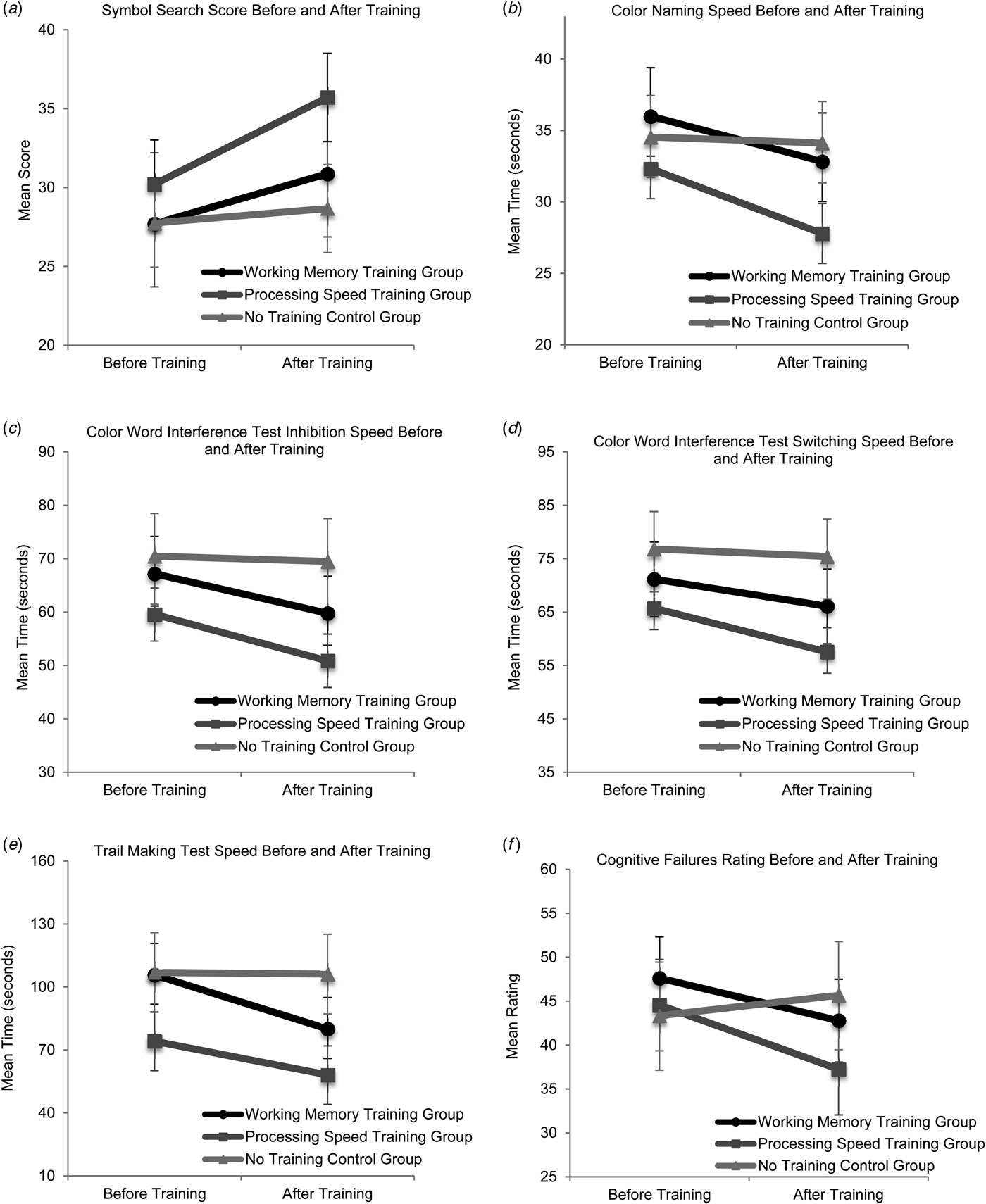
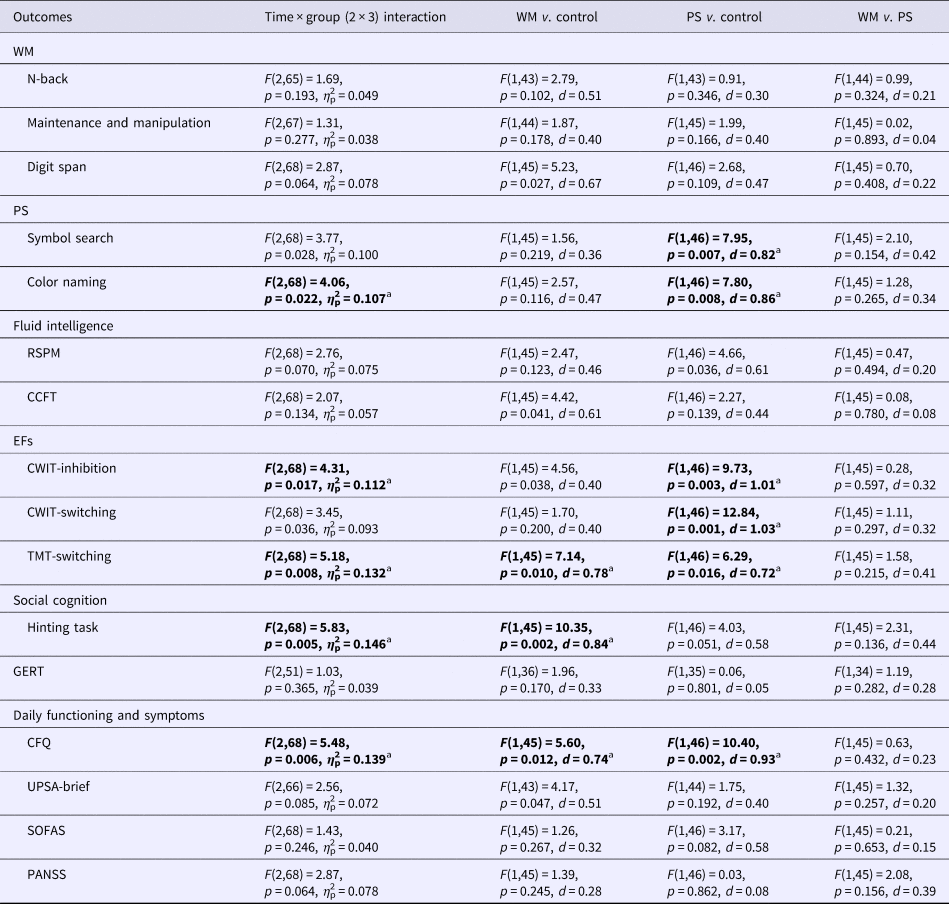
Statistics for all planned analyses are provided in Table 3. Graphs depicting significant group differences over time are shown in Fig. 2. There were no group differences over time between any groups on any of the WM tasks.
Raw scores on each cognitive task by group, before and after training. Symbol search task (a); color naming task from the Delis–Kaplan Executive Function System (DKEFS) (b); inhibition subtest of the DKEFS Color Word Interference Test (c); switching subtest of the DKEFS Color Word Interference Test (d); number-letter switching subtest of the DKEFS Trail Making Test (e); and Cognitive Failures Questionnaire (f). Error bars represent 95% confidence intervals.

Planned 2 × 2 repeated measure ANOVAs on cognitive and functioning tasks over time

WM, working memory; PS, processing speed; RSPM, Raven's Standard Progressive Matrices; CCFT, Cattell's Culture Fair Test; CWIT, Color-Word Interference Test; TMT, Trail Making Test; GERT, Geneva Emotion Recognition Test; CFQ, Cognitive Failures Questionnaire; UPSA, UCSD Performance-Based Skills Assessment; SOFAS, Social and Occupational Functioning Assessment Scale; PANSS, Positive and Negative Syndrome Scale; η p2, partial eta squared effect size; d, Cohen's d effect size.
a Denotes significance after Bonferroni correction.
PS
On both the symbol search and color naming tasks, the PS group improved significantly more than the no-training control group over time. However, no differences were observed between the WM and no-training control groups or the WM and PS groups.
Fluid intelligence
There were no significant group differences over time between any groups on the RSPM or CCFT tasks.
Executive functioning
On the CWIT-inhibition and CWIT-switching tasks, the PS group improved significantly more than the no-training control group over time. However, no differences were observed between the WM and no-training control groups or the WM and PS groups. On the TMT, both the WM and PS groups improved significantly more than the no-training control group over time. However, no differences were observed between the WM and PS groups.
Social cognition
On the hinting Task, the WM group improved significantly more than the no-training control group over time. However, no significant differences were observed between the PS and no-training control groups or the WM and PS groups. There were no significant group differences over time on the GERT.
Daily functioning and symptoms
On the CFQ, the WM and PS groups reported significantly fewer cognitive failures than the no-training control group over time. However, no differences emerged between the WM and PS groups. There were no significant group differences over time on the UPSA-Brief, SOFAS, or PANSS.
Correlations with training time
Across both training groups, only improvement in the UPSA-Brief was significantly correlated with training time (r = 0.463, p = 0.001), after Bonferroni correction (α = 0.003).
Exploratory regression analyses for predictors of cognitive and functioning change
Exploratory multiple regression models examined whether antipsychotic usage, illness duration, average sleep duration, and mid-training intrinsic motivation predicted change scores on any individual task. After applying a conservative correction (α = 0.005), the analyses revealed that shorter illness duration significantly predicted greater improvement in the RSPM at post-assessment (β = −0.50, t = 3.36, p = 0.002). No other individual-difference factors predicted change on any cognitive or functioning measures.
Finally, after applying a conservative correction (α = 0.005) multiple regression models with baseline need for cognition and theories of intelligence as the independent variables revealed that theories of intelligence significantly predicted greater improvement in symbol search (β = 0.42, t = 3.04, p = 0.004) and color naming (β = −0.46, t = 3.46, p = 0.001). Need for cognition did not predict improvement in any tasks.
Discussion
Evaluating the current results on PS training
In the current trial, PS training, but not WM training, led to greater improvements in untrained PS tasks compared to the no-training control group. The closest studies to examine PS training in prior schizophrenia research have utilized the Brain Fitness Program, which is an adaptive program designed to improve speed and accuracy of auditory information processing. Among these studies, the main objectives were to examine whether training leads to improvements in global cognition and/or functioning, with some studies finding positive results (Fisher et al., Reference Fisher, Holland, Merzenich and Vinogradov2009, Reference Fisher, Loewy, Carter, Lee, Ragland, Niendam, Schlosser, Pham, Miskovich and Vinogradov2015) and others finding no transfer effects of training to global cognition or functioning (Murthy et al., Reference Murthy, Mahncke, Wexler, Maruff, Inamdar, Zucchetto, Lund, Shabbir, Shergill, Keshavan, Kapur, Laruelle and Alexander2012; Rass et al., Reference Rass, Forsyth, Bolbecker, Hetrick, Breier, Lysaker and O'Donnell2012). Interestingly, these studies did not find a significant near-transfer effect to untrained PS tasks. Notable differences between those studies and the current study are that the majority of prior studies used a single outcome measure of PS, while the current study used two measures. The Brain Fitness training program also targets WM skills in addition to PS. Finally, the prior studies used an auditory PS training paradigm and often used visual PS outcome measures. In contrast, the current study used a visual PS training program and heavily visual PS outcome measures. This difference could be important because prior research has shown that there may not be a cross-modal effect of cognitive training (Surti et al., Reference Surti, Corbera, Bell and Wexler2011).
While studies have not previously examined targeted PS training without incorporating some aspect of WM training in schizophrenia samples, the current results are similar to studies that have found near-transfer effects of PS training in older adults (Edwards et al., Reference Edwards, Wadley, Myers, Roenker, Cissell and Ball2002; Ball et al., Reference Ball, Edwards and Ross2007). Older adults may be a relevant comparison population to schizophrenia given that both groups are associated with having slower baseline PS and given that slower initial speed has been associated with greater training-related gains (Ball et al., Reference Ball, Edwards and Ross2007). Thus, it appears that PS training can transfer to other tasks requiring speed, at least for individuals who come in with reduced speed initially. Given that PS has been cited as one of the core deficits of schizophrenia (Henry and Crawford, Reference Henry and Crawford2005; Dickinson et al., Reference Dickinson, Ramsey and Gold2007), PS training may be particularly beneficial for this population.
With regards to far-transfer, the PS training group improved significantly more than the no-training control group on all three measures of EF. Notably, all three of these tasks were timed tasks and, thus, had an element of speed associated with them. In contrast, the PS training group did not improve significantly more than the no-training control group on untimed tasks (e.g. RSPM, hinting task, GERT, UPSA-Brief). Thus, the improvements in EF measures may simply be related to gains in speed. Alternatively, it may that PS training leads to improvements in EF even on untimed tasks. Future studies should incorporate untimed EF tasks to identify whether far-transfer effects of PS training to EF remain. Future studies should also incorporate timed measures of social cognition and daily functioning (e.g. conversations, driving) as these time-sensitive activities may be more amenable to training-related effects.
Evaluating the current results on WM training
Despite improving on the trained WM tasks over time, WM training did not lead to improvements in near-transfer WM tasks compared to the other two groups. The lack of effects following WM training does not fit with some previous studies that have found improvements in WM among schizophrenia patients following cognitive training; however, the majority of prior studies used broad-based cognitive programs rather than specific WM training (McGurk et al., Reference McGurk, Twamley, Sitzer, McHugo and Mueser2007; Grynszpan et al., Reference Grynszpan, Perbal, Pelissolo, Fossati, Jouvent, Dubal and Perez-Diaz2011; Wykes et al., Reference Wykes, Huddy, Cellard, McGurk and Czobor2011). Research using broad-based cognitive programs in schizophrenia populations has often found small to moderate gains in WM following training (Wykes et al., Reference Wykes, Huddy, Cellard, McGurk and Czobor2011). Among the handful of studies that have specifically targeted memory and WM skills in schizophrenia patients, there have been mixed findings and that divide can be seen more strongly between older and newer studies. For example, one study found improvements in the trained task, but no near- or far-transfer effects following memory training (Medalia et al., Reference Medalia, Revheim and Casey2000). In contrast, another study found improvements in WM and short-term memory following four weeks of WM training (Hubacher et al., Reference Hubacher, Weiland, Calabrese, Stoppe, Stöcklin, Fischer-Barnicol, Opwis and Penner2013). In another study, a computerized training program aimed at improving lower-level auditory processing and auditory-verbal WM found that training led to significant gains in verbal WM, verbal learning and memory, and global cognition (Fisher et al., Reference Fisher, Holland, Merzenich and Vinogradov2009).
In more recent studies, few transfer effects have been found following WM training in schizophrenia. One study that used a computer-based verbal and visual WM training program found no transfer to an untrained WM task or far-transfer to fluid intelligence (Hargreaves et al., Reference Hargreaves, Dillon, Anderson-Schmidt, Corvin, Fitzmaurice, Castorina, Robertson and Donohoe2015). Similarly, another randomized, active placebo-controlled trial comparing WM training to computer skills training found no generalization of WM training to untrained tasks (Nienow and MacDonald, Reference Nienow and MacDonald2017). Taken together, there are mixed findings on transfer effects following WM training in schizophrenia, though studies that have used multiple outcome measures and active control groups have generally not found evidence of transfer.
Overall, the current results suggest that WM training, at least in the visual modality, may not lead to improvements in untrained WM tasks for schizophrenia patients. These results are in line with an abundance of research on healthy populations which has suggested that the effects of WM training are task-specific and do not appear to transfer to untrained tasks (Melby-Lervåg and Hulme, Reference Melby-Lervåg and Hulme2013, Reference Melby-Lervåg and Hulme2016; Melby-Lervåg et al., Reference Melby-Lervåg, Redick and Hulme2016). With regards to schizophrenia, the lack of near-transfer effect may be related to recent research which has suggested that, unlike PS training, WM training may be more beneficial for individuals with longer baseline WM spans (Swanson et al., Reference Swanson, Orosco and Lussier2014; Foster et al., Reference Foster, Harrison, Hicks, Draheim, Redick and Engle2017). Specifically, WM training may not necessarily lead to gains in WM capacity, but rather lead to improvements in stimuli-specific strategies that are relevant to performance on training tasks and very similar near-transfer tasks (Foster et al., Reference Foster, Harrison, Hicks, Draheim, Redick and Engle2017).
Far-transfer is not occurring following WM training in this study, given the lack of positive findings and the inconsistency in far-transfer effects across tasks. However, non-specific effects may be leading to improvements in some outcome measures. For example, the general pattern of effect sizes suggests that both the WM and PS groups improved similarly across most tasks, which may suggest that targeted cognitive training has general effects such as those associated with behavioral activation, changes in motivation, expectancy or placebo effects, or a general impact on executive attention rather than through specific near- or far-transfer. These factors should be addressed in future research. Last, both training groups experienced improvements in PANSS symptoms over time, though these improvements were not significantly greater than the no-training control group. This is in line with previous research, which has found small, non-lasting effects of cognitive training on symptoms (Wykes et al., Reference Wykes, Huddy, Cellard, McGurk and Czobor2011).
Taken together, there does not appear to be sufficient evidence to support the use of WM training alone in schizophrenia currently. Future research is needed to disentangle the general v. specific effects of domain-targeted cognitive training.
Subjective effects of cognitive remediation
With regards to subjective effects, the current study found that both the WM and PS training groups reported significant improvements in subjective cognition compared to the no-training control group. Similarly, other studies have found improvements in self-report cognitive complaints following training (Franck et al., Reference Franck, Duboc, Sundby, Amado, Wykes, Demily, Launay, Le Roy, Bloch, Willard, Todd, Petitjean, Foullu, Briant, Grillon, Deppen, Verdoux, Bralet, Januel, Riche, Roy and Vianin2013; Cellard et al., Reference Cellard, Reeder, Paradis-Giroux, Roy, Gilbert, Ivers, Bouchard, Maziade and Wykes2015). Notably, in a study comparing neurocognitive training to autobiographical memory training and mindfulness-based cognitive therapy, the neurocognitive training group showed significant improvements in subjective cognition compared to the other groups (Lalova et al., Reference Lalova, Baylé, Grillon, Houet, Moreau, Rouam, Cacot and Piolino2013).
Thus, schizophrenia patients appear to perceive improvements in their cognitive skills following training, regardless of whether their cognitive skills have improved objectively. This finding is interesting in and of itself, given that higher perceived cognitive skills have been associated with lower levels of dysphoria and positive symptoms in schizophrenia (Sellwood et al., Reference Sellwood, Morrison, Beck, Heffernan, Law and Bentall2013). Improvements in subjective cognition may also lead to objective improvements in functioning through increased self-efficacy (Chang et al., Reference Chang, Kwong, Hui, Chan, Lee and Chen2017).
Moderating factors of cognitive remediation
Previous cognitive remediation research has been criticized for not considering individual factors that could moderate the effects of training (Chein and Morrison, Reference Chein and Morrison2010; Urbanek and Vladimir, Reference Urbanek and Vladimir2016). To better address these concerns, some intra-individual factors were assessed and analyzed in the current trial, including motivation, sleep, illness duration, and antipsychotic usage. Among these individual factors, shorter illness duration predicted greater change in one task (RSPM). Given that only one significant association was found, it should be interpreted with caution and these individual factors will require further study.
Meta-analyses suggest that other factors may impact the efficacy of cognitive training, such as personality characteristics (Urbanek and Vladimir, Reference Urbanek and Vladimir2016), type of intervention (e.g. drill and practice v. drill and strategy training), and duration of intervention (McGurk et al., Reference McGurk, Twamley, Sitzer, McHugo and Mueser2007). The current study employed a drill and practice paradigm, though a review of the literature finds mixed results on whether drill and practice is superior to drill and strategy training (McGurk et al., Reference McGurk, Twamley, Sitzer, McHugo and Mueser2007; Wykes et al., Reference Wykes, Huddy, Cellard, McGurk and Czobor2011). With regards to training time, the current study found a relationship between training time and only one outcome measures (the UPSA-Brief). This general lack of association with training time is similar to recent meta-analyses which found no relationship between training time and cognitive gains in schizophrenia (Grynszpan et al., Reference Grynszpan, Perbal, Pelissolo, Fossati, Jouvent, Dubal and Perez-Diaz2011; Wykes et al., Reference Wykes, Huddy, Cellard, McGurk and Czobor2011).
Furthermore, we examined the relationship between cognitive improvement and beliefs about cognition. Greater belief in the malleability of intelligence was predictive of greater improvement in two PS tasks. A previous study with healthy adults found similar results, and suggested that this relationship may be a result of individuals with fixed beliefs about intelligence being more likely to disengage from challenging tasks, or that those with beliefs about the malleability of intelligence are more susceptible to placebo effects (Jaeggi et al., Reference Jaeggi, Buschkuehl, Shah and Jonides2014). Either way, individuals who believe that intelligence can be modified by experience may receive a greater benefit from training. Future research should continue to investigate individual and intervention-specific factors that can be utilized to enhance the effects of cognitive training in schizophrenia.
Strengths, limitations, and future directions
There are a number of strengths evident in the current study, including the use of complete randomization and a double-blind procedure. Multiple measures were used to assess each cognitive domain, and none of the outcome measures were observed to decline in the no-training control group, which has been a source of criticism in previous studies (Redick, Reference Redick2015). Finally, the current study measured several intra-individual factors that have been suggested to moderate the effects of cognitive training.
Despite these important methodological strengths, this study does have its limitations. There was no active control group, making it difficult to attribute the cognitive changes that were found in each training group to the effects of training v. more general factors that might come with engaging in a treatment program or any regular activity. That being said, the two cognitive training groups can act, somewhat, as a control for the other by considering the transfer effects that would be theoretically expected following a program that targets WM v. PS (e.g. near transfer within each domain). However, future studies would benefit from employing other active control groups, such as those that engage in non-adaptive cognitive exercises or other regularly scheduled activities (e.g. a fitness class).
In addition, attrition must be considered in the present trial, as 14% of participants were lost at follow-up. This number is similar to what has been reported in previous cognitive remediation trials for schizophrenia (Saperstein and Kurtz, Reference Saperstein and Kurtz2013). Most participants were lost due to loss of interest in the training program or no longer being reachable. Moreover, many participants did not engage in the treatment program for the length of time that was suggested, despite receiving regular telephone reminders. This may speak to unique difficulties of using at-home treatment programs with a population that tends to experience relatively high levels of apathy and amotivation. Future research should investigate factors that promote adherence v. attrition in cognitive training for schizophrenia patients.
Last, despite surpassing the minimum sample size requirements that have been suggested for psychology trials (Simmons et al., Reference Simmons, Nelson and Simonsohn2011), the current study is under-powered to detect small-to-moderate effect sizes. Future studies with larger sample sizes should be conducted to ensure adequate power to detect group differences.
Concluding remarks
Overall, while domain-specific cognitive training may not have the far-transfer cognitive benefits that it was designed to achieve, engaging in such programs does still appear to be somewhat beneficial for this population. In particular, for individuals who are struggling with mental PS, PS training does appear to be an efficacious treatment and these benefits seem to transfer to other PS tasks. In contrast, WM capacity may not be as amenable to training effects. There may be more general benefits of engaging in an intervention, such as improvements in motivation or mood, which may be a result of behavioral activation. Future studies should address these factors. Additionally, cognitive training appears to lead to improvements in subjective cognition, which may lead to increased self-efficacy. Thus, future research would benefit from comparing cognitive training with other psychosocial interventions to better disentangle specific v. non-specific effects. Nevertheless, certain cognitive training programs, and especially those that are supplemented with other psychosocial interventions such as social skills or vocational training, might be more beneficial for schizophrenia patients who have cognitive complaints.
Supplementary material
The supplementary material for this article can be found at https://doi.org/10.1017/S0033291718002775
Acknowledgements
The authors would like to thank Dr Christopher Sears, Dr Jean Addington, Dr Carol Ewashen, and Dr Joel Goldberg for serving on the primary author's dissertation committee and providing valuable feedback on this work. We would also like to thank Megan Hanrahan, Danielle Lefebvre, and Cienna Lavery for their help with data collection and entry. Finally, we are very grateful for the help and support of the Schizophrenia Society of Alberta in Calgary and Edmonton.
Conflict of interest
None.
Ethical standards
The authors assert that all procedures contributing to this work comply with the ethical standards of the relevant national and institutional committees on human experimentation and with the Helsinki Declaration of 1975, as revised in 2008.
Financial support
This work was supported by an Alberta Gambling Research Institute grant (#S40). Briana Cassetta was supported by scholarships from the Social Sciences and Humanities Research Council of Canada, Alberta Innovates Health Solutions, the Killam Trusts, and the Alberta Gambling Research Institute. Lianne Tomfohr-Madsen was supported by a Canadian Child Health Clinician Scientist Program Award. Vina Goghari was supported by a Canadian Institute of Health Research New Investigator Award.