


1. Introduction
I take naturalism to be, in part, a methodological prescription about how philosophical theories should relate to scientific theories. Naturalists think that human knowledge is the product of fallible animals whose biology does not equip them to reliably track the structure of reality. They regard earlier attempts to carve out foundational truth claims secure from revision by the findings of science, history and observation as conspicuous failures, for they misinterpret anthropological facts about how we are disposed to think as necessary truths.Footnote 1 As James Ladyman and Don Ross remark, ‘Naturalism is, among other things, the metaphysical hypothesis that the objective world is not constrained by any reasons or standards of reasonableness’.Footnote 2
If the world is not constrained by ingrained presumptions about how it ought to be, philosophical claims about its structure should not be insulated from the consequences of scientifically motivated conceptual change. However, the influence can run from philosophy to science. Theories in naturalistic philosophy of mind, for example, are informed by developments in psychology, neuroscience and AI but also frequently inform research in those areas. In a naturalized philosophical discipline the arrows of inference and constraint are reciprocal. Thus methodological naturalists urge that philosophical claims should a) be informed and constrained by the best scientific and empirical knowledge and b) should eschew claims about sources of information not thus informed or constrained.Footnote 3
The claim that phenomenology is apt for ‘naturalization’ is contentious because many philosophers regard it as epistemically closed to findings of disciplines with different doctrines of evidence.Footnote 4 For example, speculations about the physical basis of conscious experience are frequently held to be irrelevant to describing ‘how it feels’. The closure assumption implies that a neural network model explaining how our experience of time is generated could throw no light on what that experience is like. Given closure we cannot need a theory to tell us what it is like.
The closure assumption receives its clearest expression in transcendental phenomenology, which takes the epoché or ‘bracketing’ of naturalistic assumptions as a methodological axiom. For transcendental phenomenologists following in the wake of Husserl's work, the meaning of claims about physical entities of the kind posited in some naturalistic ontologies can be adequately explicated only in terms of our possible modes of awareness of them. These can be phenomenologically described by suspending ordinary assumptions about the mind-independent existence of objects and directing attention to how we are aware of objects as mind independent. The ‘world’ of modern natural science, thus understood, is just one way of interpreting the culturally molded ‘life world’ of perceptual objects, qualities and values.Footnote 5
If the epoché is possible, the arrows of epistemic pressure at most run from phenomenology to science. The phenomenologist can advise the cognitive scientist about what it means to say that the brain ‘is a thing’ but no reciprocal wisdom can be forthcoming from cognitive science.
Like the naturalization claim, the normative claim for closure requires a justifying doctrine of evidence. One form of this is that phenomenological claims don't have to be scientifically or theoretically-informed as long as the things they describe are pre-theoretically or ‘intuitively’ given to the conscious subject.
This putative theory-independence seems to explain transcendental phenomenology's claim to methodological priority over purely conceptual or speculative philosophy. A theory can always be glossed with discrepant interpretations or ontologies. If there is no non-theoretical access to ‘the things themselves’ one may reason, as Quine did, that ontology is relative to the translation manual we adopt under radical interpretation: a relativity applying recursively and without end since the ontology applied by the translator will itself be expressible as a theory with multiple models.Footnote 6
The discipline of phenomenology suggests a way out of Quine's labyrinth. If intuition obviates regress to a background theory, perhaps it will help us recover the ‘authentic’ meaning of philosophical or scientific claims – including that of naturalism itself!Footnote 7
Of course, the claim that anything can be ‘given’ or intuited this way is contestable and has been extensively contested.Footnote 8 It follows that any substantive interpretation of the notions of ‘givenness’ or ‘intuition’ may cede ground to the anti-naturalist unnecessarily. Fortunately, we do not need a positive conception of intuition to understand its role in the debate between phenomenological naturalists and phenomenological anti-naturalists. ‘Intuition’ can be a placeholder for whatever (real or imagined) epistemic organ allows the phenomenological domain to provide a yardstick for its own description.
An anti-naturalistic phenomenology would be well founded, then, if its justifications were closed under appeal to intuition. The only legitimate challenge to a phenomenological description would be to make a better job of intuiting.Footnote 9
Phenomenology would be closed in this way only if its domain were completely intuitable. However, it is at least conceivable that the domain is not wholly intuitable. A feature of conscious experience is intuition-transcendent or ‘dark’ if it confers no explicit or implicit understanding of its nature on the experiencer. Intuitable phenomenology confers an implicit understanding of its nature on the experiencer, even if this must be subsequently clarified in phenomenological reflection. For example, Husserlian phenomenologists claim that ‘concepts’ under which we grasp objects have implicit entailment structures that can be promoted to objects of awareness in reflection.Footnote 10 Dark phenomenology would be epistemically resistant to such a process. Having experiences in which it figures would not constitute or produce an understanding of its nature that could be explicated at a later date.
This is not to say that dark phenomenology would be ipso facto inaccessible. A dark phenomenon could influence the dispositions, feelings or actions of the experiencer without improving her capacity to describe them. Theories of dark phenomenology could be adduced to explain these effects. Our access to the dark side would thus be as theoretically and technically mediated as our access to the humanly unobservable universe. The criteria for evaluating theories of dark phenomenology would presumably be those applying in other areas of empirical enquiry (instrumental efficacy, simplicity, explanatory unity within wider science).
At this point some phenomenologists might object that the dark side is just another posit of the natural attitude and does not lie within the domain of phenomenology as first philosophy. Since it falls short of the ideal of intuitability, the hypothesis of dark phenomenology could be bracketed for purposes of phenomenological description. However, the bracketing objection assumes that the dark domain is disjoint from the intuitable domain and does not impinge on it in some way. I will call this the disjointness assumption.Footnote 11
If disjointness fails, there may be phenomenological structures that are only partially intuitable because their phenomenologically accessible relations or entities are conjoined with dark relations or entities. For example, the conjoining of dark with light could involve relations between phenomenological parts to wholes. Suppose there are phenomenological structures like colour or pitch continua that are intuitively accessible at a coarse grain level but not at a fine grain. Any inference from the former to the latter might be prone to the fallacy of division and unrectifiable as long as closure under appeal to intuition is enforced.
On the other hand, specialists in empirical disciplines such as cognitive science might have access to observational techniques that obviate limits on intuition. If their claims could be supported, phenomenology would be subject to revisionary pressure from those disciplines and the methodological prescription ‘to naturalize’ could be factually supported.
How should we understand this possibility? One way to do this is by drawing on an analogy from the history of science. We could compare phenomenological claims based on intuition to studies in electromagnetism, thermodynamics or genetics whose interpretation is largely descriptive or instrumental rather than abstract or quantitative. When faced with abstract theoretical explanations of the phenomena that are more consilient with other areas of science there is typically a dialectical relationship whereby questions can be raised about the metaphysical and explanatory heft of either theory. For example, some philosophers claim that Mendel's classical genetics is better understood as a theoretical refinement of instrumental claims about how to obtain phenotypes through breeding than as an ontologically revealing account of the actual mechanisms of heredity.Footnote 12 Clearly, there are other ways of allocating ontological significance here. Some might argue that classical genetics is ‘eliminated’ or reduced by molecular genetics while those who favour the instrumental interpretation might claim molecular and classical genetics are too different in their aims for the former to be eliminable by the latter.Footnote 13
If this analogy holds, then prima facie evidence for dark phenomenology would open up transcendental phenomenology to a dialectic similar in at least some respects to those in other areas of science. According to the epistemic model introduced earlier, this would constitute a de facto naturalization since the claims of intuition would already be susceptible to epistemic pressure from natural science.
But are there any grounds for belief in non-disjoint (i.e. conjoint), dark phenomenology? I will consider some prima facie candidates. The first belong to the area of perceptual phenomenology: pitch, colour and timbre perception. The second (and arguably most conjoint of all) is the phenomenology of time.
2. Perceptual Phenomenology
If intuiting supports the evaluation of phenomenological descriptions intuition must supply conceptual content. So intuition plausibly includes a recognitional component: if we cannot recognize tokens of some type, we are in no position to evaluate descriptions of it. It follows that any phenomenology that transcended our subjective recognitional powers would be ‘dark’.
There is some evidence for phenomenological darkness of this kind. Psychophysical work suggests that the human capacity to discriminate musical pitch differences is more fine-grained than the human ability to identify pitch intervals.Footnote 14 Claims for this disparity are typically supported by tests where subjects prove able to discriminate very fine differences between tones or hues when the stimuli are presented simultaneously, but are unable to reliably categorize them when they are presented successively. For example, listeners can discriminate, on average, over a thousand frequency differences within the auditory spectrum.Footnote 15 However, the number of musical intervals that even trained musicians can identify by linguistically labelling intervals (as a ‘fourth’ or ‘tritone’, etc.) or by estimating degrees of similarity between intervals is much smaller. When identifying musical intervals, trained musicians often overlook discrepancies in tuning similar in magnitude to the average just-noticeable-frequency-differences for pitch discrimination.Footnote 16 In the case of colour perception the apparent gulf between discrimination and type identification is vast, with discriminable colour differences numbering around ten million as compared with a colour lexicon of around thirty.Footnote 17
Diana Raffman uses the evidence for dark phenomenology to rebut a standard physicalist objection to the phenomenologically inflationary claim that conscious states are irreducibly subjective, introspectable properties of experience (qualia). The objection goes something like this: ‘[There] are no irreducibly subjective facts; rather, there are simply different ways of knowing ordinary physical or functional facts about the mind-brain’.Footnote 18
One detailed proposal for explaining this difference is that phenomenal states only seem to have irreducibly subjective properties because they are introspected under direct recognitional concepts which track them via some reliable internal scanning mechanism.Footnote 19 The scanning mechanism allows us to recognize phenomenal states as being of a certain kind without exploiting a description or theory of what these states are like. Footnote 20 A complete physical description of these scanning mechanisms would not allow one to infer a subjective description that conveys how red-31 feels simply because no such descriptions are to be had: phenomenal concepts designate phenomenal properties without describing them. The ‘irreducible subjectivity’ of phenomenal states is thus a cognitive illusion generated by their idiosyncratic mode of presentation.
For Raffman, the moral of the psychophysical data on the gulf between discrimination and identification is that any account of phenomenal recognitional concepts is liable to hit a bottleneck on our capacity to remember concepts of phenomenal states that allow tokens of the same phenomenal types to be subsequently recognized. For the psychophysical data indicates that our recognitional schema simplify the memory task by omitting fine-grained differences in perception. We are not capable of recognizing the refined qualitative states that we nonetheless introspect. Suppose the production of phenomenal concepts reflects this coarse-coding strategy.Footnote 21 If a phenomenal state of seeing Red-31 is more determinate than any available phenomenal recognitional concept there can be no type-identifying mentalese predicate ‘Red-31 Experience’ available to track the corresponding brain states through the memory bottleneck.Footnote 22 However, we are introspectively aware of refined qualitative perceptual states. Thus the disparity between identifying concepts and refined sensory discriminations implies that the introspected character of phenomenal experience is not explicable by way of special-purpose phenomenal concepts.
If the grain of the ‘memory schemas’ that track phenomenal types are coarser than the underlying phenomenology some of this phenomenology will go unrecognized and unremembered.Footnote 23 If that is indeed the case then, as Ned Block has argued, phenomenology cannot supervene on its accessibility to working memory.Footnote 24 Corroborating evidence for this is provided by well replicated experiments like those of George Sperling who found that subjects reported seeing all or almost all elements of an alphanumeric array of twelve characters presented for 50 milliseconds, though they were only able to identify around four elements of the array following the presentation.Footnote 25 Block uses these findings to argue that phenomenology overflows attentional availability. The supervenience base of consciousness experience thus does not include informational links between sensory modules and the working memory circuits in the front of the head.Footnote 26
This experimental data is thus an apparent foil for first-person verificationist accounts of the type elaborated by Daniel Dennett in Consciousness Explained. First person verificationism states that there can be no facts about consciousness transcending our subjective knowledge of them.Footnote 27 A state can only be conscious, according to this account, if it is poised to contribute to the activities of a knowing, rational, speaking subject: hence available in working memory. For deflationists, the evidence purportedly demonstrating the existence of unattended phenomenal richness testifies rather to the existence of information – stored in the recurrent activity of perceptual modules in the back of the head – that has lost the fight to become available to the prefrontal centres associated with working memory, and thus promotion to ‘full’ consciousness.Footnote 28
However, as Robert Van Gulick points out in a response to Block's target article in Behavioural and Brain Sciences there are other possibilities here. The unattended form of consciousness may be a functionally distinct – and in certain respects – deficient phenomenology characterized by cognitively deficient access. The subjects in Sperling's experiment were, after all, able to access the fact that they had seen an array of twelve alphanumeric characters.Footnote 29 Moreover, evidence of change-blindness phenomena in Sperling-type situations and elsewhere suggests that subjects can impute richness to the reported phenomenology that is not informationally present.Footnote 30 The fact that subjects in Sperling-type experiments report seeing more alphanumeric figures than they can describe does not, then, imply that the letters were all determinately and ineffably present in a kind of internal ‘movie screen of the mind’.
Thus the hypothesis that some phenomenology confers no tacit or explicit understanding of its nature does not have to attribute either a determinacy that is recalcitrant to third-person description; or an intrinsic nature that is recalcitrant to functional analysis. As the change-blindness data suggests, certain dark phenomena may be relatively indeterminate – more informationally coarse than the phenomenological reports suggest. Semantic over-determinacy may be a sufficient condition for phenomenological darkness without being a necessary one.
Dark phenomena may be functionally distinguished from non-conscious mental states by access relations that – while epistemically deficient – exhibit variable coarseness with respect to the content accessed.Footnote 31 Thus proponents of the dark side can be realists (rather than first-person verificationists) about the domain of phenomenology while retaining the deflationary claim that consciousness is a functional property of a mental state associated with its accessibility for other sub-personal agencies in the mind/brain. Footnote 32
The deflationary potential of the dark phenomenology hypothesis is nicely illustrated in Thomas Metzinger's appropriation of Raffman's argument in his book Being-No-One.Footnote 33 Rather than using dark phenomenology to motivate belief in irreducibly subjective phenomenal properties, he co-opts her argument from informational constraints on working memory to motivate an epistemological argument against classic qualia. The classic quale is a simple, intrinsically subjective, intuitable property of experience. However, ‘Raffman qualia’ – his term for the simplest perceptual discriminations – cannot be intuited because they lack subjective identification conditions. It does not follow that they are wholly inaccessible or unrepresentable from a third-person point of view, however. It is possible to attend to them non-conceptually – as in experiments involving just noticeable differences between pitch or colour samples. They can also be identified functionally by their distal inputs and contributions to behaviour. Raffman qualia, according to Metzinger, are functionally individuated content fixations whose recognition requires organs other than intuition. The classic quale must, accordingly, be a purely theoretical entity because the simplest forms of perceptual content fixation are necessarily intuition-transcendent and (thus dark). If quales must be introspected nonconceptually knowledge of them cannot, as he puts it, ‘be transported out of the specious present’.Footnote 34 Thus the nature of Raffman qualia is epistemically closed to the subject who experiences them. For such states, Metzinger famously quips, ‘Neurophenomenology is possible; phenomenology is impossible’.Footnote 35
This particular deflationary gambit is resisted by phenomenal conceptualists, who claim that perceptual concepts are, after all, no less grainy than perceptual contents. For example, Alva Noë employs an enactivist account of perceptual content similar to some phenomenological accounts of perceptual intentionality to motivate the claim that our phenomenology is tacitly conceptualized.Footnote 36 Since this seems to be what the closure assumption requires it is worth considering whether his argument bolsters it.
Enactivist philosophers of mind claim that perception is an organism's grasp of its potentialities for action: ‘To feel a surface as flat is precisely to perceive it as impeding or shaping one's possibilities of movement.’Footnote 37 To see an object's shape or colour is to activate a ‘sensorimotor profile’ which, much as a Husserlian noema, anticipates how it could look from different orientations:Footnote 38
[In] looking at the tomato, you implicitly take it that were you to move your eyes a bit to the left or right, or up or down, you would bring previously hidden or obscured parts of the tomato into view. Your perceptual experience of the tomato as voluminous depends on your tacit understanding of the way its appearance (how it looks) depends on movement.Footnote 39
Importantly, Noë claims that this enacted content does not anticipate variations of occurrent perceptual qualities (occurrent shapes, colours, etc.). Rather, experience is ‘virtual’ all the way down: ‘Qualities’, he writes ‘are available in experience as possibilities, as potentialities, but not as givens’.Footnote 40
Noë thinks that treating sensory qualities as virtual saves the idea that experience is conceptually articulated, thus phenomenologically recoverable, from fineness of grain arguments of the kind adduced by Raffman and Metzinger. To perceive a perceptual quality is a quasi-conceptual act because each sensorimotor profile provides a formula to demonstratively refer to any position in its quality space with descriptions like ‘all blues lighter than the blue I currently see’.Footnote 41 Thus, pace the dark phenomenology hypothesis, enactivism suggests that a tacit conceptual grasp of the character of our phenomenology illuminates the phenomenology of the most refined perceptual awareness.
However, this model is open to some objections. Firstly, if the phenomenological domain includes Raffman qualia at some level then what entitles us to assume these are related in the same way as subjectively identifiable shades? Even if Raffman qualia were mereological parts of coarser-grained shades – surely a questionable assumption – this inference would commit the fallacy of division. Since the part-whole relationship is supposedly non-intuitable, we cannot assume the uniformity of relation on the basis of phenomenology alone. Note that this objection applies even if qualities are virtual all the way down. A virtuality or tendency can be as phenomenologically inaccessible as any occurrent state. Secondly, debates over conceptualism and granularity often suggest that our perception consists only of shades in continua structured by formal relations like pitch or brightness intervals.
But most perceptual contents are arguably of a more complex nature. For example, auditory timbre is a multi-dimensional quality that lacks the formulaic orderings usually attributed to colour or pitch continua.Footnote 42 Timbres can be typed and analysed differently but these include some specification of the overall shape or ‘envelope’ of a sound. The envelope is how a sound's intensity changes over time. In music technology implementations derived from Vladimir Ussachevsky's work in the 1960sFootnote 43 the envelope is represented as the gradient of a sound's attack, decay and sustain: the speed at which it hits peak amplitude, decays from that peak and sustains the resultant of the decay segment.
While the classic Attack Decay Sustain Release (ADSR) envelope reflects the behaviour of natural resonators like percussed wood or metal many natural and synthetic timbres can have highly involuted shapes. Some sonic events are too involved to give the formulaic orderings Noë relies on. Thus it must be possible for quality samples to underdetermine their qualitative extension leaving whole regions of their quality space inaccessible to demonstrative reference. For example, while currently perceiving a complex sound we may anticipate that successive sounds will be of a general type without adumbrating those possibilities in any detail.
Most listeners, I suspect, will distinguish an eight second sequence from Xenakis' pioneering ‘granular’ composition Concret Ph.

and a loop that repeats the first one-second slice of it for eight seconds.
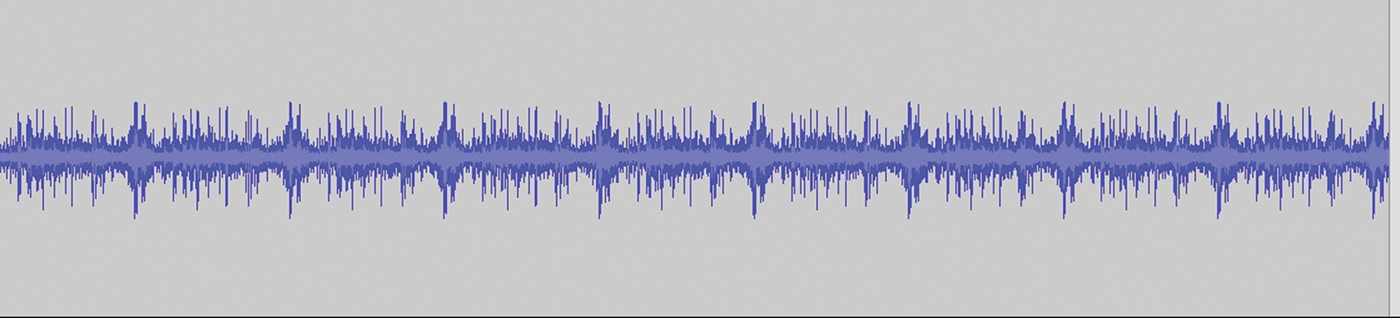
This is discernible because of the obvious repetition in pitch and dynamics.
Telling the looped sequence from the non-looped sequence is not the same as acquiring subjective identity conditions that would allow us to recognise the extra structure distinguishing the non-looped from the looped sequence in a different context (e.g. within the entirety of Concret Ph). What is intuited here is arguably a fact about the shortfall between type-identifiable phenomenology and non type-identifiable phenomenology. It does not provide any obvious insight into the structure or nature of the latter and thus does not constitute an exception to Metzinger's claim.
As an illustration of this, the mere awareness that there is missing structure in the loop does not help settle the issue between virtualist and occurentist construals of that structure. It is plausible to suppose that the perceptual awareness of the missing structure in the Xenakis loop consists of virtual contents – a representation of tendencies in the developing sound rather than something like a constantly updated encoding of occurrent sonic eventsFootnote 44. Indeed the virtual model would be consistent with the widely held assumption that our representation of temporal structure is accomplished via recurrent neural architecture that modulates each current input by feeding back earlier input.Footnote 45 But whether the contents of representations of temporal structure are virtual or occurrent in nature has no direct bearing on their conceptual or intuitive accessibility.
So the virtual/occurrent distinction is orthogonal to the methodological issue of closure. Raffman qualia might be temporally discrete content-fixations; or they might be dynamic entities such as trajectories or attractors in the state spaces of recurrent nets.Footnote 46 Whichever model turns out right, evidence for non type-identifiable content fixations suggests that some perceptual ‘matter’ falls outside the reach of conceptual sensorimotor profiles (if such there be) or memory schema (if such there be) or phenomenal concepts (if such there be).
Thus a case can be made for ‘dark’ perceptual grains and involutes ‘nested’ in the more type-identifiable and intuitable uplands of our phenomenology. If so, then a portion of its structure is not intuitively accessible and a solely ‘phenomenological’ account of this sub-domain will be liable to mischaracterize it.
3. The Phenomenology of Time
A case can also be made for claiming that the phenomenology of time is part of the dark sub-domain. If this is right, then the implications for phenomenology's transcendental pretensions are devastating.
Temporality is a central ingredient in most phenomenological accounts of reality or transcendence. Husserl understands the objectivity of the empirical or physical thing as an excess over any of its temporally structured aspects. ‘‘The’ thing itself is always in motion, always, and for everyone, a unity for consciousness of the openly endless multiplicity of changing experiences and experienced things, one's own and those of others'.Footnote 47
As with the case of Raffman qualia, committing this structure to the dark side would not entail its inaccessibility to other epistemic organs. However, if dark temporality were conjoint with the intuitable or subjectively accessible temporalities it would be a transcendent thing not a transcendental condition of thinging. There would be no reason to accord it a different epistemological or ontological status to rocks or cats. The phenomenological distinction between the transcendental form of experience and the particular experienced entities whose contents it articulates would be irreparably undermined.
Is there any reason to believe that temporality is dark? If one is a representationalist philosopher of mind there are reasons to be skeptical about its transcendental role. A theory of transcendental subjectivity allows that particular objects are existentially independent of the existence of particular subjects. However, it cannot allow that the existence of the object is conceptually independent of modes of presentation in possible experiences:
[The] intentional object is only constituted as an object – as act-transcendent – the moment we experience it as an identity in a manifold, that is, the moment we establish its identity across different acts and appearances. But this experience of the identity of the object across a change in acts (and appearances) is an experience that once again draws on the contribution of our time-consciousness […] Ultimately, Husserl argues, temporality must be regarded as the formal condition of possibility for the constitution of any objects […]Footnote 48
The very existence of the object is thus understood in terms of its transcendence of temporally informed modes of presentation. Temporally informed modes of presentation are thus conceptually prior in the order of philosophical explanations to what they present. But representationalists claim that all cognitive processes – including thinking and perceptual experience – are transformations on physical vehicles with a representational content.
If content is a semantic relation between vehicles and properties or possible states of affairs in the world then the mind-independent existence of these types is conceptually prior to any specification of the semantic relation.Footnote 49 However, much the same applies if mental content is a structural property of mental representations alone – e.g. their functional role or their geometric relations to other states within a neural ‘activation space’.Footnote 50
Mental representations, so conceived, are just another kind of thing and content is just one (among many other) abstract relations that things subtend. True, the vehicle-to-vehicle state transitions specified in representationalist accounts are plausibly identical to or instantiated in state-transitions between representational states. However, failing panpsychism, there can be nothing intrinsically subjective about such transitions since they are identical to, instantiated by or supervenient upon physical processes. In Husserlian terms, they belong to the constituted time of the world, rather than to he transcendentally constitutive features of subjectivity. Thus a representationalist account of experience cannot be conceptually prior to an account of the temporally ordered processes described in physics, chemistry, biology or any other ‘regional’ scientific discipline. Phenomenological time is just a time among many, with no special epistemological heft.
Representationalism also implies a methodological impediment to phenomenology. If temporality is a property of the content of mental representations, then there can obviously be a phenomenology of temporal relations and relata such as the melody famously described by Husserl in section 16 of the Phenomenology of Internal Time Consciousness. However, given representationalism, there can be a phenomenology of our ‘experience’ of time only if it is represented somehow, somewhere in another representation.
What aspect of the temporality of experience could be captured by such higher order representations? This depends on what the phenomenologically and cognitively salient properties of our representations of temporality are. Whatever these turn out to be, there is no reason to think that that the higher order representations that generate phenomenology (if such there be) capture all the features salient to the representation of temporal experience. Thus representationalism implies that phenomenology could not possibly be well founded – i.e. closed under appeal to intuition – because it would always be the case that representations of content-relevant properties of mental states could be epistemically deficient.
Of course any good naturalist should concede that representationalism could turn out to be a false or otherwise ‘bad’ theory of content, while good phenomenologists of Husserlian or Heideggerian persuasion reject it anyway. So the argument from representationalism suggests at most that first person insight into temporality might not be well founded. It is hardly a conclusive argument.
However, there may be reasons internal to phenomenology for considering theories of temporality to be in need of clarification from wider science. They concern the relationship between phenomenological ontology and the doctrine of evidence that motivates its closure. For where a phenomenological ontology transcends the plausible limits of intuition its interpretation would have to be arbitrated according to its instrumental efficacy, simplicity, and explanatory potential as well as its descriptive content.
We can get a schematic idea of how what we might call the ‘Argument from Intuitive Overreach’ works for specific phenomenological ontologies by considering the ontological commitments of Husserl's theory of temporality. Husserl's theory of temporality builds on the assumption that the content of our experience of objective succession depends upon the organization of subjective time. He thinks this organization must be continuous and non-atomistic. Were each phase of my experience of a melody a temporal atom, how could I experience the melody as a persistent temporal object?
Husserl explains this by describing the experiential ‘now’ in terms of three indissociable aspects of its intentional content: 1) an intending of the current phase of the object – for example the falling of the fourth to the third of the scale; 2) a ‘retention’ or primary remembrance of the previous experience; 3) a ‘protension’ which, as in Noë's account, anticipates the content to come:
The ‘source-point’ with which the ‘generation’ of the enduring Object begins is a primal impression. This consciousness is engaged in continuous alteration. The actual […] tonal now is constantly changed into something that has been; constantly, an ever fresh tonal now, which passes over into modification, peels off. However, when the tonal now, the primal impression, passes over into retention, this retention is itself again a now, an actual existent. While it itself is actual (but not an actual sound), it is the retention of a sound that has been.Footnote 51
Now, why might we consider this triple structure to be a speculative description of an intuition-transcendent object? Because, like the physical thing, the entity that Husserl describes has a structure that must exceed intuitability if it is to do the job that his theory allocates to it. The now or temporal source point, as Husserl claims, must be continuously modified into retention. Lacking continuity the operation would have gaps, as on the atomistic model.Footnote 52 If temporal experience could possess gaps then phenomenology would be committed to a dark phenomenology in any case; thus ceding to naturalistic modes of inquiry for the reasons we have already discussed.
However, suppose every segment of a continuum is divisible into a further segment with the same non-discrete characteristics. Unless intuition can handle infinite complexity – implausible, if even Xenakis' rudimentary grain cloud is intractable for structural listening! – apprehending the structure of temporality appears as much as an endless task as the apprehension of a physical thing.
We might try to rescue Husserl by using a variant of the argument Noë employs to rescue conceptualism. Perhaps I am making an elementary error in treating the temporal continuum as a complex object with a real infinity of occurrent parts. Perhaps phenomenological continuity is not like that. Perhaps intuiting the continuum is more like intuiting a formulaic function by which a virtual present is transformed into a virtual past. It is probably correct to say that Husserl did not think that the temporal continuum was composed of independently subsisting phases, describing the content of temporal experience rather as a ‘single continuum that is constantly modified’.Footnote 53
However, his reason for denying that phenomenological temporality is particulate is that it replicates the triple dependence structure at every grain. The question still arises: over what regions and at what phenomenological scales does this dependence relation apply? The claim that this operation can be applied at any scale of the temporal flow entails that it has no gaps and that the triplicate structure is replicated ad infinitum at every scale. Yet, no finite phenomenological subject could ever carry out a complete investigation of this nested structure. It is, as David Wood has argued, a pure metaphysical posit made on epistemological rather than phenomenological grounds.Footnote 54
So Husserl's theory conflicts with its own doctrine of evidence. If the structure of time is too fine to be grasped with the organ of intuition then Husserl's theory is at best a useful approximation that helpfully limns the ontology of subjective time while implying that there must be something more to the temporality of subjectivity than we can intuit. However, phenomenological time must have a continuous structure if phenomenology is to provide a transcendental theory of objectivity and to rebut naturalism. Thus if temporality is dark, it cannot do what it has to do. But in order to do this, it must be dark. Therefore it cannot do what it has to do.
Thus temporality is dark on both representationalist accounts and on a rival Husserlian account that rejects representationalism as a theory of mental content. There may be versions of phenomenological theory for which there is no more to the temporal structure of experience than can be intuitively grasped, reported on and described by a reflective subject. However, this seems to imply first person verificationism with regard to temporal flow. It is hard to see how such a position could generate problems for the philosophical naturalist. To be sure, it would restrict the evidence base of theories of temporal experience to the contents of subjective reports, but it is difficult to see how such an etiolated temporal structure could inform an account of objectivity of the kind sought by transcendentalists. Thus if phenomenology has anything interesting to say about temporality, it concerns a crepuscular structure with both light and dark aspects. It must, therefore, provide an incomplete account that requires supplementation through other modes of enquiry.
If phenomenology is incompletely characterized by the discipline of phenomenology, though, it seems proper that methods of enquiry such as those employed by cognitive scientists, neuroscientists and cognitive modelers should take up the interpretative slack. If phenomenologists want to understand what they are talking about, they should apply the natural attitude to their own discipline.


