Worldwide, the extraction of fossil and mineral resources has increased by factors of twelve and twenty-seven respectively over the last century, in order to meet the demands of global population growth, Western-style development, and accelerated industrialisation.Footnote 1 While this trend is to some extent inevitable, extractive activities expose more than other industries the clash between communal values and the profit motive. One obvious reason for this is that geological resources are geographically bound, and their exploitation inevitably impacts on neighbouring communities. For example, extractive industries often expand through remote territories, regardless of the land rights of the resident populations, the unique biodiversity of some areas,Footnote 2 or the presence of historical assets.Footnote 3 The environmental, social, and health costs of fossil fuel extraction and industrial mining are therefore considerable and lead to frequent conflicts between local communities and extractive companies.Footnote 4
Considering the developing world in particular, three aspects of extractive activities should be emphasised. Firstly, patterns of extraction vary in scale and intensity. They can include, for example, sporadic and purely artisanal activities,Footnote 5 larger mining communities controlled by local or regional interests,Footnote 6 or the industrial exploitation of large deposits by national or transnational companies. Secondly, a large portion of the resources extracted in developing countries is not locally processed and does not fulfil local development needs. Instead, these resources find their way through a complex network of export pathways feeding a profitable and largely unregulated market of globally traded commodities.Footnote 7 Conceptually, it is thus rather misleading to distinguish artisanal mining from the activities of transnational corporations. Thirdly, in spite of a common developmental rhetoric that promises poverty alleviation, the rapid exploitation of natural resources is more likely to produce a ‘resource curse’, a situation typically seen in Sub-Saharan Africa.Footnote 8 The resource curse was originally defined by a slowdown of economic growth resulting from the extraction of natural resources, and typically explained by poor governance, corruption, lack of democratic process, and violence.Footnote 9 The econometric foundations of resource curse theories and their causal inferences have recently been challenged.Footnote 10 More importantly, mainstream resource curse theories ignore community perspectives and conceal profound flaws in common development ideologies. For example, regardless of their economic effects, extractive activities often result in land seizures, destitution, imposed industrialisation and urbanisation, population displacements, gender disparities,Footnote 11 child labour,Footnote 12 and the unequal distribution of profits from geological wealth. This is to say that any kind of collaboration with the expansion of extractive industries, even for the sake of local needs, is an implicit endorsement of a dominant development paradigm based on rapid economic growth and market productivity. From such a global perspective, this paper looks specifically into the relationships between extractive industries and humanitarian organisations, examining the position of Médecins sans Frontières (Doctors without Borders, MSF) as a case in point. MSF as a movement has taken a clear stance, refusing funds linked to extractive industries. The reasons for this positioning will be further analysed in this paper, to demonstrate that similar reservations apply beyond the case of philanthropy.
NGOs and extractive companies: a complex range of relationships
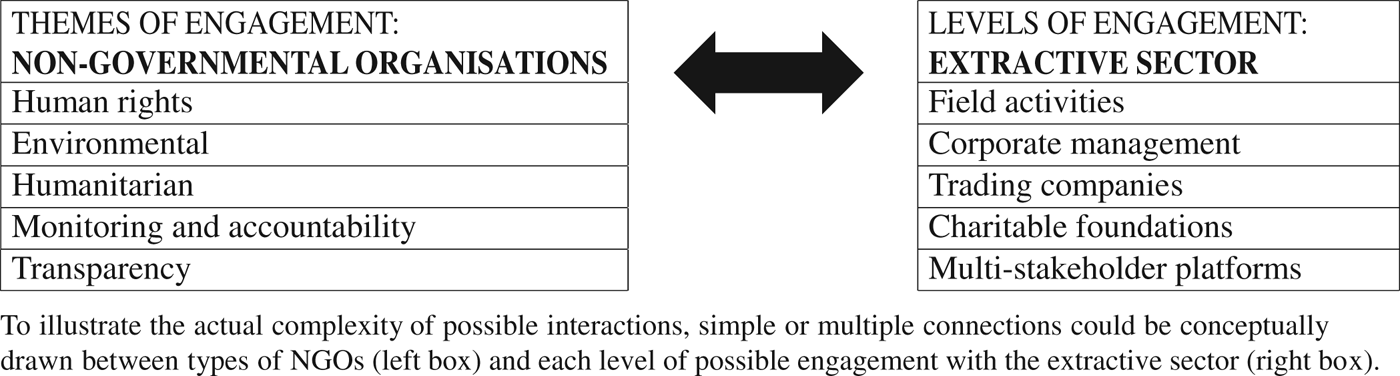
In order to understand MSF's specific position, it is apt to first examine the perspective of other NGOs in general, and of other humanitarian NGOs in particular. There is a wide spectrum of relationships between NGOs on the one hand and extractive industries or their allied trading companies dealing with primary commodities on the other (Figure 1). NGOs are diverse in terms of definition, aims, and outreach. Furthermore, they can interact with extractive industries at different levels: locally in the proximity of extraction sites; at the level of corporate management; through charitable foundations derived from extractive or trading companies; or through thematic platforms hosted by governments, academia, or NGO coalitions. Examples of relationships include philanthropic sponsoring, operational partnerships, conflict prevention, accountability and advocacy, and principled non-engagement (Figure 2).
Relationships between NGOs and extractive industries.
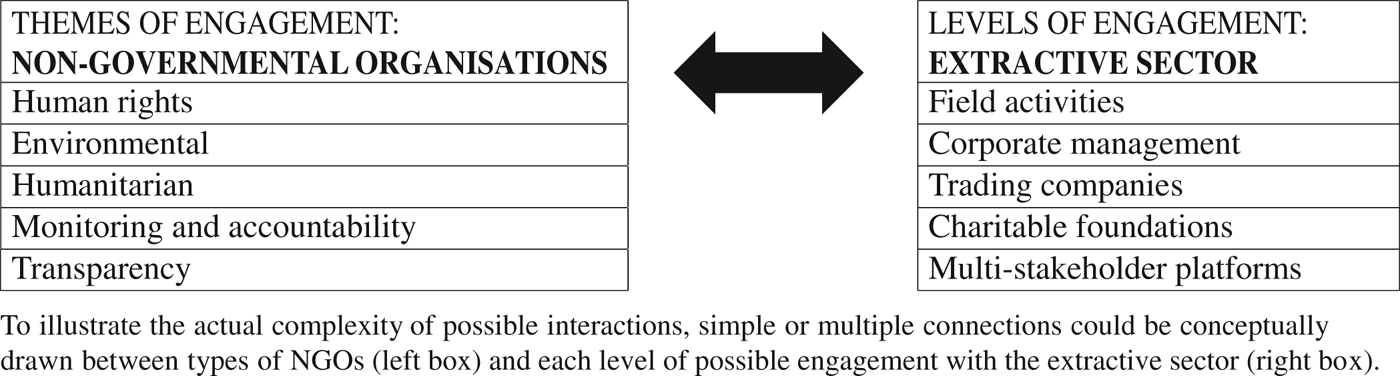
Examples of relationships between NGOs and extractive industries.

Historically, some international human rights NGOs have triggered controversies by exposing the complicity of some international oil companies in human rights abuses perpetrated by governmental and local armed forces.Footnote 13 Other NGOs have been active in promoting transparency initiatives to improve the accountability of mining companies and governments in their commercial transactions with regard to natural resources.Footnote 14 Adding to this complexity, there is a frequent confusion between philanthropy, humanitarian action, and corporate social responsibility (CSR). Transnational companies account for only part of all extractive activities carried out around the world, and they tend to become increasingly mindful of their adverse environmental and social effects, often under the pressure of environmental or human rights NGOs. In their attempts to exercise CSR, they seek at the same time to externalise remediation and mitigation measures, and naturally turn to humanitarian or developmental NGOs for expertise and operational partnerships. For example, transnational extractive companies are keen to display their corporate philanthropy by awarding local or international NGOs financial support for development programmes that benefit impacted populations. The engagement of the civil society into tri-sector partnerships with the corporate sector and development agencies is being encouraged by some governmentsFootnote 15 and by global finance organisations, but such initiatives are clearly controversial.Footnote 16 Indeed, by being seen as the CSR agents of companies seeking a ‘social licence to operate’, humanitarian NGOs could run the risk of compromising their independence and their credibility toward impacted communities. Interpretations of such a risk vary among humanitarian organisations themselves, as illustrated by their differing stances toward corporate extractive industries.
Humanitarian organisations and the Dunantist tradition
While others have opted for active engagement with the extractive sector, some among prominent international humanitarian NGOs like MSFFootnote 17 and Médecins du Monde (Doctors of the World) have endorsed corporate fundraising policies that exclude financial partnerships with extractive industries.Footnote 18 This could be put in the perspective of both MSF and Médecins du Monde being the champions of a strong ‘Dunantist’ or principled tradition of humanitarianism. In the following sections, I will refer mostly to the position of MSF, whose reservations toward extractive industries are broader than financial, and appear to be grounded in at least three types of considerations: (1) conflicts of interest and independence, (2) neutrality and perception, and (3) operational capacity and security.
Conflicts of interest and independence
An international Corporate Fundraising Statement issued by MSF in October 2010 excludes donations and collaborations ‘with companies with prime business activities in the following sectors: arms manufacturing and selling, tobacco manufacturing and selling, pharmaceutical industry, and extraction industry’. Leaving the pharmaceutical industry aside, the conflation of arms, tobacco, and extractive industries in the same exclusion category reflects a logic of preventing conflicts of interest. In other words, any money generated by activities that are harmful to health is incompatible with the medical and humanitarian endeavours of the organisation.
Extractive industries are a rather new topic of reflection for MSF.Footnote 19 Environmental disasters, regardless of their origins, are being considered as a new field of intervention for the organisation, after its recent involvement in response to the major outbreak of lead poisoning in Zamfara State, Nigeria. Apart from environmental disasters, MSF as an international humanitarian organisation with a medical focus cannot ignore the many health hazards brought about by mining and oil extraction. For example, oil spills and gas flaring contribute to environmental illnesses, as seen in the Niger Delta.Footnote 20 The industrial mining of metal ores depletes and pollutes water resources, compromises agricultural livelihoods, and affects food security.Footnote 21 In some contexts, mining and the resource curse contribute to the spread of sexually transmitted infections, HIV/AIDS,Footnote 22 and tuberculosis.Footnote 23 Extractive explorations and exploitations are reaching areas of exceptional biodiversity and can potentially enhance the risk of emerging infections.Footnote 24 Endemic violence frequently features as a component of the resource curse, with humanitarian consequences including population displacements, malnutrition, and an increased prevalence of mental health disorders. Transnational extractive companies and their trading partners are obviously not the only actors to blame for such dire health consequences, but their corporate philanthropy cannot be dissociated from the consequences of their mainstream activities and from business practices that may increase adverse social and health impacts. For example, the ongoing support of oil companies to some authoritarian governments in exchange for access to oil fields perpetuates poor governance and public health neglect. In a well-documented case, the funding of limited malaria control projects by ExxonMobil in Equatorial Guinea has been criticised as representing a conflict of interest with regard to the privileged connections between the company and the Guinean dictatorship.Footnote 25 Thus, both the direct and indirect health effects of extractive industries are a first justification for MSF to exclude extractive industries and their derived foundations as sources of funding. Corporate funding by the extractive sector would also affect the credibility of MSF as an independent organisation, particularly when MSF projects address the medical needs of populations affected by the activities of oil and mineral industries.
Neutrality and perception
Neutrality is a versatile concept, encompassing at least two meanings: (1) ideological neutrality and (2) not taking sides in a conflict, directly or indirectly.Footnote 26 The first meaning – ideological neutrality – matters to the extent that extractive industries are instruments of a dominant concept of development, akin to a religionFootnote 27 which is not necessarily accepted by communities offered humanitarian relief. To illustrate the latter point, not a single week passes without news of extractive projects being opposed by local communities.Footnote 28
The second meaning of neutrality is even relevant for MSF, as extractive industries can arguably be indirect participants in a variety of conflicts. Violence is a hallmark of extractive activities,Footnote 29 particularly in the developing world. The range of conflict situations reflects different geopolitical contexts as well as variable balances of power between the extractive sector and local populations. Some of the most recent inter-state conflicts are obviously rooted in power struggles for access to natural resources. In parallel, armed conflicts and civil wars remain endemic in some of the most coveted or exploited areas of extractive resources. For oil extraction, for example, emblematic cases include the Niger Delta in NigeriaFootnote 30 and South Sudan.Footnote 31 In the Kivu provinces, unprecedented levels of sexual violence are concentrated in areas that overlap with mining activities.Footnote 32 Plausibly, this is a geographical illustration of the demonstrated link between mineral exploitation, a self-financing war economy, and human rights abuses in the region. In addition to protracted conflicts, more sporadic violence and human rights exactions can be committed by governmental forces or militias, sometimes with the logistical assistance of extractive companies.Footnote 33 A milder but even more common form of violence is the repression of protests against the environmental destruction brought about by mining and oil exploitation. These environmental conflicts often result in land seizures and the displacement of those whose lifestyles and agricultural livelihoods are compromised by extractive industries. When this happens on indigenous territories, the protection of ancestral land rights is weak and underground assets are typically seized as state property that can be sold or leased to private companies.Footnote 34 The International Labour Organization (ILO) Convention No. 169 is the most comprehensive legal instrument for protecting the rights of indigenous populations, but it has unfortunately been ratified by only twenty states.Footnote 35 Article 15 of Convention No. 169 deals with natural resources and guarantees to tribal peoples a due process of consultation, but it does not necessarily acknowledge their ownership over mineral or sub-surface assets. When facing land seizures for the sake of resource extraction, their ultimate legal rights are thus considerably limited.
These considerations illustrate the key feature of most of the conflicts rooted in resource extraction: they are typically asymmetrical conflicts, where corporate interests prevail over local grievances. What counts for humanitarian organisations is the magnitude of local needs. In a distinctly asymmetrical conflict, there is thus no breach of neutrality in the fact of providing humanitarian relief to seditious communities while at the same time refusing to engage in partnerships with the corporate sector. In some instances of organised rebellion, it could be argued that environmental issues can be at the root of non-international armed conflicts as defined by international humanitarian law,Footnote 36 and that the conflict ceases to be asymmetrical. The Niger Delta would be a case in point – in the highly hypothetical case of a wealthy supporter of the rebellion offering philanthropic donations to MSF, there would indeed be a breach of neutrality akin to receiving donations from extractive companies. In any case, the application of the humanitarian principle of neutrality is not conditional upon any specification of the type of armed conflict taking place.Footnote 37 With extractive industries, the neutrality of MSF and similar organisations practically pertains to relationships with those companies having corporate interests or indirect participation in conflicts over natural resources. This encompassing interpretation of neutrality is reflected in the MSF Corporate Fundraising Statement when it says that all MSF sections will refuse funds and/or collaborations with extractive industries ‘to ensure that [MSF] is not perceived to contribute to conflicts and/or disasters that affect populations in danger or cause humanitarian suffering’.
Operational capacity and security
The next argument spelled out in the MSF Corporate Fundraising Statement is more pragmatic, but derives from the former considerations about independence and neutrality. The ultimate goal is to ‘never compromise MSF operational work and/or the security of volunteers and beneficiaries in the field’. Thus, beyond principles and values, strict adherence to neutrality and independence is also instrumental to guaranteeing operational space and security for humanitarian NGOs. In this sense, it would be pragmatically unwise for MSF to side in any manner with extractive industries when they generate local grievances and armed conflicts. Finally, the Corporate Fundraising Statement indicates that ‘Exceptions could be made with companies which are not active in areas of MSF operations.’ Such territorial exceptions would perhaps be compatible with the second understanding of neutrality (not taking side in hostilities, directly or indirectly), but not with the arguments over independence and conflicts of interest.
Beyond philanthropy
MSF thus sees in the receipt of financial sponsoring from extractive industries a breach of its independence and neutrality, and a risk of conflicts of interest and misperceptions. But would other types of interactions be more aligned with the values and principles of the organisation – for example, participation in CSR activities, conflict prevention, or disaster response? The exercise of CSR is instrumental to corporate achievements, and therefore foreign to the realm of humanitarian actions, even if those actions are devolved to humanitarian actors. Yet one could argue that a number of extractive companies are taking measures to prevent conflicts and health hazards (if only out of their own self-interest), and that humanitarian organisations can pragmatically help exposed communities by joining this endeavour. In fact, partnerships that could be interpreted as advisory would be no less damaging to independence and neutrality than sponsoring, particularly if there is a risk of NGOs being co-optedFootnote 38 or becoming a source of geopolitical intelligence. From the perspective of some industries, conflict prevention relies less on respecting the voice of dissenting communities than on gaining strategic information over their beliefs, social structure, and acceptance of environmental changes. Humanitarian organisations that would be in a position to receive such information should exercise restraint in sharing their analysis, even within thematic platforms bound by the ‘Chatham House Rule’.
Finally, it remains to be debated within MSF whether pragmatic dialogue with the corporate sector of the extractive industries could take place on an ad hoc basis, on the occasion of environmental disasters and environmental conflicts. In the former case, independent advocacy should make it clear that humanitarian NGOs are not mere providers of environmental public health or palliative measures. In the latter case, engagement should follow the same rules as those exercised with armed forces or their political allies. These rules are meant exclusively to secure access to victims and to optimise their relief.
Ironically, MSF was created in the aftermath of the Nigerian Civil War, a conflict whose escalation was rooted in a struggle for access to oil in the Niger Delta.Footnote 39 After forty years, the organisation is committed to a renewed reflection on the broad humanitarian consequences of extractive industries.