IN November 1982, just before the first democratic elections were to be held in Brazil’s São Paulo State after two decades of dictatorship, then-Governor José Maria Marin denounced rampant killings by the state’s Military Police and promised imminent reform: “Even if I am forced to take drastic measures … I will go to the final consequences to contain police violence.”Footnote 1 Today, though police killings far outnumber those that alarmed Marin in 1982, reform to curb police violence remains elusive. After Argentina’s democratic transition, profound institutional deficiencies within the Policía Bonaerense, the police in Buenos Aires Province, persisted unabated for years. Nicknamed the maldita policía (damned police), the Bonaerense systematically engaged in corruption, extrajudicial violence, and criminal activity.Footnote 2 They eventually underwent comprehensive reform, while the police in São Paulo State have not. What explains these divergent outcomes?
Coercion is central to definitions of the state and state capacity, and is defined as a state’s ability to control and enforce laws throughout its territory.Footnote 3 But the state capacity literature rarely considers the entity exercising the state’s coercive authority. This oversight is particularly puzzling for Latin America, the world’s most violent region,Footnote 4 where security is among citizens’ most pressing demands.Footnote 5 Despite the imperative to build state capacity in security provision, Latin America’s coercive institutions exhibit profound weakness, characterized by poor training, low specialization, ineffectiveness, extralegal violence, and widespread corruption.Footnote 6 Per definitions of state capacity as the state’s ability to implement its own policies, institutional weakness describes the low capacity of police bureaucracies and the civilian entities overseeing them to coordinate members to do what they’re supposed to do or to restrain them from doing what they’re not supposed to do (defecting).
Despite profound deficiencies, the region’s police have successfully blocked structural reform altogether, as in São Paulo, or thwarted reform for years, as in Buenos Aires. To explain these patterns of institutional continuity and change, I apply the concept of structural powerFootnote 7 and demonstrate how police leverage control of coercion to constrain available policy options. Within this constrained policy space, politicians choosing between continuity and reform assess societal preferences and political competition. When preferences regarding reform are fragmented, police reform may be electorally disadvantageous. Reform becomes more likely when preferences converge and politicians face robust political opposition, constituting an electoral counterweight to the structural power of police. I test this argument through comparative analysis of periods of continuity and reform in Argentina, Brazil, and Colombia.
This article builds on theories of institutional persistence and change, elucidating an institution that remains opaque in political science. It theorizes about the agency and structural power of a bureaucracy that leverages its control of coercion to act as a veto player, setting the bounds of policy options that are available to politicians choosing between continuity and reform. It also contributes to scholarship on state-society interactions and policy change by disaggregating state and societal actors. It adds nuance to theories of how societal pressures and political competition drive policy change by identifying conditions under which these factors can instead favor the persistence of institutional weakness.
Structural Power and the Problem of Police Reform
Latin American police institutions face a legacy of stalled reform, where reform is defined as the enactment of a written policy intended to permanently change internal structures, rules, or practices within an entire organization. In Venezuela, police avoided reform for “almost 100 years,”Footnote 8 despite grave institutional deficiencies.Footnote 9 Buenos Aires’s 1998 police reform was only the second reform in a century,Footnote 10 and police reform in São Paulo continues to remain unlikely. Crucial military reform following democratic transitions in Argentina and BrazilFootnote 11 conspicuously excluded police.Footnote 12 In Colombia, meanwhile, an ambitious agenda in the early 1990s to transform nearly all areas of the state did not include police reform.
This remarkable persistence is consistent with the institutions literature, which predicts continuity due to self-reinforcing mechanismsFootnote 13 and historical sequences that “set into motion institutional patterns that have deterministic processes.”Footnote 14 Although path dependence suggests stability, certain institutional features “permit or invite specific kinds of change strategies and change agents”Footnote 15 that yield gradual, endogenous change.Footnote 16 Indeed, such theories predict police forces that endure fifty years without considerable reform and that are instead subject to gradual change.
But Kurt Weyland observes that institutional change is often dramatic and discontinuous,Footnote 17 which accurately describes the remarkable persistence and rare reform among Latin America’s police. Citing prospect theory, Weyland predicts “reform deficit,” or policy inaction despite deteriorating conditions, as risk aversion in the domain of gains or mixed domains, and predicts drastic policy change as risk seeking in the domain of losses, or crisis.Footnote 18 Scholars of policing also cite crisis to explain reforms in Latin America, England, and the United States.Footnote 19 But as the case studies I present show, crisis is often poorly defined conceptually, difficult to identify empirically, and likely to overpredict reform.
Since institutional change theories often don’t explain persistence and pathways to reform of police institutions, we must consider how this scholarship may be complemented by the policing literature, which examines police along key political variables that are central to the broader political science literature. Policing scholars highlight electoral pressures as drivers of reform following widespread public concern over insecurityFootnote 20 and civil society mobilization.Footnote 21 But they also cite institutional features, including federalismFootnote 22 and political competition,Footnote 23 to explain the demise of reforms. This presents a discrepancy with institutional change theories that argue that political competition drives bureaucratic reformsFootnote 24 and that federalism favors reform by promoting local innovation.Footnote 25
In practice, we observe less police reform than both literatures predict, which underscores why police constitute a hard case for reform, both empirically and conceptually. The case studies presented below document empirical regularities that are indicative of politicians’ reluctance to pursue police reform. When facing a salient issue regarding a profoundly deficient bureaucracy, politicians avoided police with surgical precision. Instead they enacted new security plans, reformed courts, or banned torture.Footnote 26 Moreover, police opposition derailed initial reform proposals while leaders successfully enacted other complex and politically costly institutional reforms. Analyzing police reform can thus inform institutional change theories by considering police bureaucracies’ ability to block reforms and by elucidating other policy areas where reform is particularly challenging.
Underlying the difficulty of instituting police reform is the police’s structural power. I argue that police leverage control of coercion to constrain available policy options and in so doing raise the threshold for reform. This constrained policy space is essential for understanding reform deficit and rare, dramatic reform of police forces, and why scholars of institutional change and police reform often offer conflicting predictions.
Charles Tilly famously argues that European state formation was a function of capital and coercion.Footnote 27 Foreshadowing Tilly, Charles E. Lindblom argues that business, which controls capital, occupies a “privileged position” as “functionaries performing functions that government officials regard as indispensable.”Footnote 28 Accordingly, Lindblom warns that “Depression, inflation, or other economic distress can bring down a government.”Footnote 29 The same holds for police, which control coercion. Police action or inaction is consequential for state building and governance. Police serve leaders’ ability to consolidate powerFootnote 30 and to pursue political interests by selectively providing protection or waiving unfavorable enforcement for constituents,Footnote 31 punishing opponents,Footnote 32 and generating revenue.Footnote 33 But police also threaten leaders by withdrawing the provision of order and security, which they have done in New York,Footnote 34 Baltimore,Footnote 35 São Paulo,Footnote 36 and Buenos Aires Province, for example.Footnote 37 Echoing Lindblom, a former Buenos Aires security secretary outlined the risk: “Any governor or president knows that insecurity events can corrode [their] administration.”Footnote 38
Constituting both an asset and a formidable threat, police induce politicians to engage in accommodation—a mutually beneficial relationship wherein politicians grant police autonomy in exchange for cooperation in pursuing political interests. Although all bureaucracies pursue autonomy,Footnote 39 police can credibly threaten to withdraw cooperation due to hierarchical, often-militarized structures that facilitate coordination. Indeed, scholars note that police routinely resist interference by hesitating to adopt new tasks,Footnote 40 rejecting external accountability mechanisms,Footnote 41 and weakening reforms once enacted.Footnote 42
To understand the agency of police and the nature of accommodation, consider Brian Taylor’s distinction between tasks that are routine (formal/legal) and exceptional (informal, possibly extralegal).Footnote 43 These may operate as separate dimensions, wherein police possess institutional weakness in routine tasks but capacity in exceptional tasks, as Taylor’s analysis shows. Police may also exchange cooperation in one dimension for autonomy in another. For example, Buenos Aires police cultivated autonomy in routine security provision in exchange for cooperation in an illicit political financing network. Colombia’s police evaded political intervention, despite widespread malfeasance, in exchange for cooperation in the government’s war against drug cartels. Police act as political instruments functional to politicians in some dimensions, and as political actors pursuing their own prerogatives in others.
As with the business sector, structural power is granted by the “privileged position” of police, which creates “reciprocal dependence”Footnote 44 and raises the threshold for reform. As the case studies demonstrate, police have three faces through which they exercise powerFootnote 45 as conceptualized by Steven Lukes, to constrain policy options available to executives. First, police forces get their policy priorities implemented (decision-making); second, they keep reform proposals off the agenda (nondecision-making), and, third, they shape how politicians and citizens understand security issues (ideology shaping). To explain how politicians choose between continuity and reform within this constrained policy space, it’s important to understand how politicians assess the electoral costs of both policy options.
Societal Preferences as Drivers of Continuity and Reform
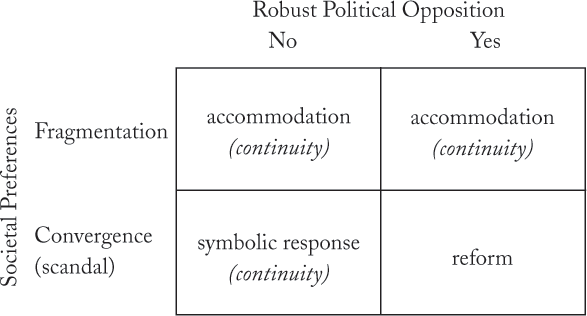
When politicians face bureaucracies they formally control but which can withdraw cooperation, they navigate a constrained policy space. Because the structural power of police raises the threshold for reform, executives choose between the status quo and reform by determining whether policing poses an electoral threat: a coherent societal demand for police reform alongside robust political opposition (see Figure 1). When societal preferences over police reform are fragmented, irrespective of political competition, reform brings little electoral gain and risks alienating a powerful bureaucracy. Fragmentation leads executives to choose continuity, favoring the persistence of institutional weakness. Conversely, preference convergence and robust political opposition provide an electoral counterweight to the police’s structural power, making reform likely.
Determinants of Politicians’ Choices between Police Continuity and Reform

This theory follows extensive scholarship on state-society relations and policy change. From Jonathan Fox’s “sandwich strategies” in agricultural policy in MexicoFootnote 46 to health policy in BrazilFootnote 47 and labor policy in Argentina,Footnote 48 scholars demonstrate convincingly that state-society interactions can promote policy change. Candelaria Garay also shows how informal sector workers’ mobilization and partisan competition for their votes promote social policy expansion.Footnote 49 Beyond constituting isolated instances of “societal accountability,”Footnote 50 state-society interactions—from informal state-social movement partnerships to formal incorporation into bureaucraciesFootnote 51—produce lasting institutional change.
My theory expands upon this literature, disaggregating state and societal actors. It elucidates how executives and a powerful bureaucracy reconcile divergent interests through accommodation, constraining the policy options available to politicians to address citizen demands. It also highlights societal preference fragmentation, showing that societal pressure doesn’t always move toward policy change that bolsters state capacity, as in the aforementioned studies. Societal mobilization sometimes works in the opposite direction, reinforcing institutional weakness among police.
How Fragmentation Promotes Institutional Persistence
Scholars have characterized Latin Americans’ conflicting demands over policing as “schizophrenic”Footnote 52 or “paradox[ical].”Footnote 53 But such conflicting demands constitute fragmentation, wherein attitudes and preferences regarding police and security are divided among considerable segments of society, typically along existing cleavages, with no clear majority position. For instance, when a 2013 poll asked Venezuelans about recent police reforms, 45 percent viewed them positively and 43 percent negatively, a division that reflected support for or opposition to Chavismo, the governing ideology of former President Hugo Chávez.Footnote 54
Far from constituting a public good, policing is subject to distributive contestation and selective provision by politicians for electoral gain. An event I observed in São Paulo illustrates how societal contestation and electoral interests can shape the distribution of protection and repression.Footnote 55 A community leader in a low-income region complained to police that police cars were stationed along a major road rather than within the community or its commercial areas. The police commander responded that the governor had requested this placement after receiving complaints from residents of a neighboring wealthy municipality that they’d been robbed when driving through this community. The distribution of protection by the local police thus favored the wealthy municipality outside their jurisdiction—and where the governor had won some 60 percent of the voteFootnote 56—over the low-income residents in their own jurisdiction, a stronghold of the leftist Workers Party.
Scholarship on policing and criminal justice across the Americas demonstrates that the distribution of protection and repression reproduces societal inequalities. Scholars find disparities along race, class, and geography in police stops,Footnote 57 protest repression,Footnote 58 arrests,Footnote 59 extrajudicial killings,Footnote 60 and the quality of police services.Footnote 61 Scholars of the United States also find that these disparities shape attitudes toward the police.Footnote 62 Like the policy feedback effects scholars identify for other bureaucracies,Footnote 63 citizens’ different experiences likely produce divergent views and preferences of police.
Politicians deciding between continuity and reform assess societal preferences to determine whether there’s a broad demand for police reform. But ordinary citizens don’t generally hold articulable preferences for or against such reform. Still, although they may lack clear preferences on specific security policies, citizens do express identifiable views about policing that offer signals to politicians. When hundreds of residents of a wealthy São Paulo neighborhood call to praise an operation where police kill ten alleged burglars,Footnote 64 and hundreds of homeless citizens protest after police kill a homeless man,Footnote 65 politicians draw inferences about societal preferences over police use of lethal force.
I use several proxies for preferences over police reform that correspond to how ordinary citizens experience policing and the information cues that citizens regularly convey to government officials: trust in police, assessment of police performance, and views about police discretion and authority. These are basic elements of policing that citizens can reasonably be expected to have direct experience of and articulable opinions on, and that serve as proxies for specific policy preferences. Politicians learn about these views from surveys, citizen contacts, media, protests, and other sources.Footnote 66 Citizens also form organizations and networks,Footnote 67 often along class, race, and other cleavages,Footnote 68 that convey specific demands to politicians about policing.
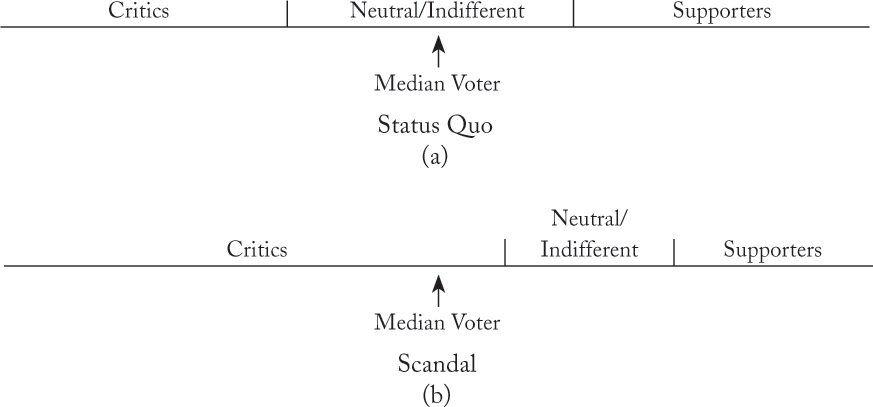
Politicians use this information to assess the degree of preference fragmentation, a key explanatory variable. I operationalize fragmentation as whether there’s a clear majority view on the proxies defined above or whether views are divided among substantial segments of the population and whether such divisions reflect social cleavages (such as race, class, and geography). Under high fragmentation politicians receive information cues (from surveys, media, protests, or meetings with organizations) suggesting that opinions on trust, police performance, and police discretion and authority are divided among considerable segments of the population—typically along relevant social cleavages—such that there is no clear majority opinion (see Figure 2 (a)). Fragmentation entails divergence on any dimension, even if the other dimensions reflect consensus. While it makes intuitive sense that these dimensions should vary together, they’re often contradictory. Thus, scholars interrogate the paradox of broad distrust in police alongside considerable support for greater police authority to kill,Footnote 69 and public officials, such as former Buenos Aires Security Minister León Arslanián, grapple with similar “erratic demands” (see below). These contradictions convey fragmentation and have important policy implications. Meanwhile, under low fragmentation (convergence), politicians observe shared discontent along all dimensions across race, class, and geographic cleavages.
Hypothesized Shift in Societal Preferences under Status Quo (Fragmentation) and Scandal (Convergence)

Facing fragmentation, politicians are unlikely to see police reform as electorally advantageous. Per Juan Pablo Luna’s work on political parties’ “segmented representation,” a unified programmatic policy approach is untenable for winning elections in high-inequality settings, where class preferences likely conflict.Footnote 70 Instead, parties adopt a “segmented” strategy, pursuing programmatic appeals with middle-class constituents and clientelistic linkages in low-income constituencies, with policy “significantly biased” toward the former. Policing creates similar incentives. Executives perceiving fragmented preferences over policing are unlikely to pursue reform if discontent is concentrated in low-income sectors, reproducing a pattern of inequality shown in Daniel Brinks’s work on judicial responses to police killings.Footnote 71
Since police violence and ineffectiveness disproportionately affect the poor and the working class, how might the argument apply to leftist parties? In contrast to Garay’s findings regarding social policy, I argue that leftist politicians representing poor and working-class voters are unlikely to push for police reform under fragmentation. Although left parties with low-income constituencies can afford to enact social policies despite antagonizing business groups, they can seldom afford to alienate the police, which can withdraw service and put order and governance at risk—along with incumbents’ electoral fortunes. Though executives in my case studies span from center-left to center-right (see Appendix 5 in the supplementary material),Footnote 72 other scholars show that leftist executives in Mexico CityFootnote 73 and Bahia, Brazil,Footnote 74 pursued accommodation rather than police reform. Thus, even politicians whose core constituencies suffer the brunt of police violence and malfeasance are susceptible to the constraints posed by the structural power of police and are unlikely to enact police reform under fragmentation. Such leaders may instead satisfy constituents through less divisive measures that entail fewer electoral risks. Irrespective of ideology, fragmentation favors continuity—and thereby the persistence of institutional weakness.
How Preference Convergence Shifts Incentives Toward Reform
Politicians’ electoral calculations change when societal preferences shift from fragmentation toward convergence. While issue preferences may shift gradually, scandals are a useful tool for identifying convergence and assessing its short-term impact on politicians’ strategies. Scandals—high-profile acts of police deviance that generate broad societal outrage—mobilize groups that are typically critical of police and move previously supportive or neutral societal sectors (typically the middle class) into the ranks of critics. Figure 2 summarizes the hypothesized shift in the distribution of preferences from status quo to scandal. A helpful heuristic is to consider where the median voter might lie under the status quo and under a scandal (convergence). Under the status quo condition of fragmentation, the median voter usually lies in the neutral or supporter category, leading politicians to infer that most voters don’t prefer police reform. But under convergence, the median voter is in the critics’ camp, such that leaders infer that a majority now demands police reform.
Convergence needn’t entail agreement across all societal groups, nor does it require that newly critical sectors share the exact views of typical police critics regarding inequality in policing. Instead, scandals act as focal points for groups that were previously neutral or supportive of police to mobilize alongside critics in demanding a government response to police deviance—whether for solidaristic motives or the selfinterested realization that they, too, may become victims.
Scandals focus societal and political attention on points of consensus about policing, incorporating broad sectors alongside typical police critics. Modes of expression that previously conveyed fragmentation—citizen contacts, media statements, surveys, protests, civil society organizations—transmit shared societal discontent to elected leaders. But politicians know that scandals fade and convergence is temporary. Without a political opposition that poses an electoral threat, politicians may prefer to address discontent with a symbolic response like firing a high-ranking official.
Reform becomes likely when preferences converge and incumbents face a robust opposition that “comprise[s] a daunting threat of replacement.”Footnote 75 A broadly shared criticism of police provides leverage for a strong opposition party to threaten the incumbent’s electoral success. The larger the majority is that expresses pro-reform preferences, the greater the likelihood that a strong opposition party can mobilize voters against the incumbent in the next elections. Five indicators measure opposition strength (the ability to pose an electoral threat): party vote shares, holding executive office at other levels of government, opposition to executive’s legislative agenda,Footnote 76 incumbent approval ratings,Footnote 77 and proximity to elections. These characteristics indicate whether an opposition party has the capacity and incentive to marshal institutional resources (hearings, investigations, or legislation) and to strategically mobilize media and public attention around the scandalFootnote 78 against the incumbent.
Thus, although police induce executives to pursue accommodation, convergence and a robust opposition provide an electoral counterweight to the police’s structural power, shifting politicians’ strategy toward reform. An exception to this argument may be found in far-right politicians, such as Rodrigo Duterte of the Philippines, who explicitly favor unrestrained police power; such politicians aren’t likely to deviate from such policy, irrespective of preferences and competition.
Emphasizing that reform becomes likely under the joint occurrence of these factors helps to reconcile the discrepancy between the literatures on policing and institutional change, and the tendency of the former to overpredict reform. Political competition and federalism serve as obstacles to reform, but not when societal preferences converge. Societal pressure and mobilization may drive reform, but may result in continuity without preference convergence or robust opposition.
Explaining Institutional Persistence and Reform in 1Latin America
I test the theory with evidence from police in Buenos Aires Province (Argentina), São Paulo State (Brazil), and Colombia. Selecting two subnational cases within federal countries and one unitary country achieves congruence between the bureaucracy and the governing jurisdiction. Given the research question, the appropriate unit of analysis is the “locus of choice”Footnote 79—the political-administrative level where politicians make decisions about police reform. We can assess the generalizability of the argument under different institutional configurations, testing whether structural differences between unitary and federal systems drive variation in the enactment of reform. Federalism may nevertheless hinder implementation of police reform once enacted.Footnote 80
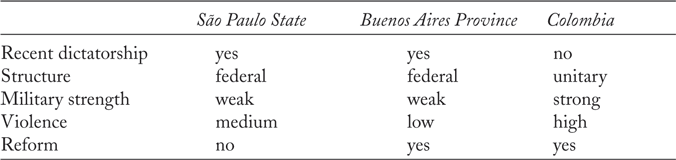
Case selection followed a most-similar and most-different systems design (see Table 1) along structural conditions relevant for reform outcomes. Despite their structural similarities—federalism, authoritarian past, military strength, and low-medium levels of violence—São Paulo State and Buenos Aires Province differ on outcomes.Footnote 81 Though Colombia is a unitary country with a history of formal democracy, a powerful military, and a decades-long armed conflict, its police reform resembles that of Buenos Aires. This case selection helps rule out these conditions as alternative explanations.
Case Selection: Most-Similar and Most-Different Design

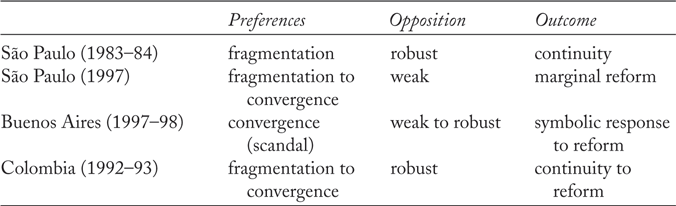
My argument focuses on the dynamic processes that shape politicians’ choices between continuity and reform. To test different components of the argument, the case studies highlight variation in explanatory variables and outcomes (see Table 2). Because São Paulo has lacked structural police reform, the case study shows how fragmentation and weak political opposition favor institutional continuity. Because Buenos Aires and Colombia adopted ambitious reforms, the cases highlight how a shift in opposition strength under preference convergence and a change in preferences from fragmentation to convergence in the context of a relatively robust opposition, respectively, altered politicians’ policy choices. Through process tracing, I show how police leverage structural power to constrain available policy options, and how, within this constrained policy space, politicians’ choices between continuity and reform are a function of preferences and political opposition strength.
Overview of Cases
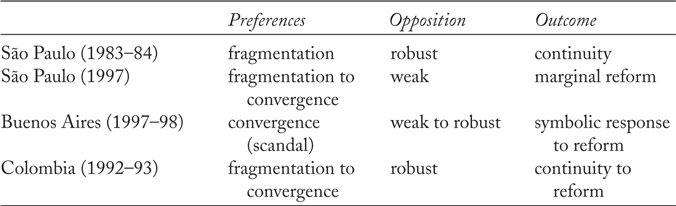
This analysis draws on two years of fieldwork in Argentina, Brazil, and Colombia, including interviews, ethnography, and archival research. It’s based on processes that occurred during the 1980s and 1990s, which poses important limitations on available data, particularly regarding preferences. I triangulate across multiple data sources, including public opinion data, media archives, and interviews with officials and societal activists, to assess societal attitudes and demandmaking and to determine how these shaped politicians’ choices.
The Persistence of the “Police That Kill” in São Paulo State
São Paulo’s police have shown considerable persistence since Brazil’s democratic transition, sustaining rampant lethal violence with little civilian intervention.Footnote 82 From 1983, when police committed 10 percent of the state’s homicides,Footnote 83 to 2015, when this proportion rose to 20 percent (see Appendix 1 in the supplementary material),Footnote 84 police have remained a key source of violence. But the police have successfully constrained policy responses to pervasive police killings. There’s been little electoral counterweight to their structural power, I argue, due to the enduring fragmentation of societal preferences and weak partisan competition.
Overview: Three Decades of Continuity
Democratization in São Paulo coincided with rising crime. Homicides tripled between 1981 and 2000, rising to forty-three per one hundred thousand inhabitants in the stateFootnote 85 and to sixty-seven per one hundred thousand in the capital.Footnote 86 Violence and growing discontent with security provision topped the public agenda.Footnote 87 But police responded to the growing violence by committing widespread extrajudicial killings,Footnote 88 some through police-linked death squads.Footnote 89 These practices remain unchanged since the authoritarian regime,Footnote 90 when the police were central to the military’s repressive apparatus.Footnote 91 Though significant military reforms were adopted after the transition,Footnote 92 the police were left untouched.
Structural reform has been constrained by police-politician accommodation, as São Paulo’s politicians deploy police coercion selectively for political gain. A police captain in a downtown district, for instance, noted that the mayor and governor often call commanders to recommend how forcefully police should treat different protest groups. They urge lax enforcement with sympathetic groups, such as a gay pride rally, because if the police were to act aggressively, “it’s over for São Paulo, it’s over for Brazil because it’s something the whole world would be watching.”Footnote 93 In exchange for cooperation, politicians grant considerable autonomy to the police, as suggested by a former commander of the Military Police. “I had a lot of freedom to command,” he said. “There was no interference from the secretary nor from the governor in my command.” But, he continued, the governor still expected the police to serve his interests. “I always felt pressure, from the beginning. The governor always holds us to account (cobra), ‘See what you can do.’ … He would talk about Morumbi [a wealthy neighborhood] and I’d say, ‘We already made this many arrests,’ or this and that. I always worked to face these pressures head on.”Footnote 94 But São Paulo’s police also engaged in strategic defection to create political problems. For instance, when officers purposely relaxed patrols during a high-profile festival in 2013, a spike in violence occurred.Footnote 95 This ability to confer or withdraw cooperation allows police to thwart interference with internal matters.
Alongside constraints posed by the police’s structural power, the fragmentation of societal preferences means politicians may see little electoral gain in reform. In a highly unequal country where race and class determine relationships with state institutions,Footnote 96 policing is no exception. Interviewees routinely described the population most subject to police repression as “the three Ps”: preto, pobre, e periférico (black, poor, and from the city’s periphery). For decades, studies have shown that black Paulistas from low-income urban peripheries have disproportionately been victims of extrajudicial killings,Footnote 97 with security provision defined by a lack of preventive policing, unresponsiveness to citizens’ calls,Footnote 98 and reliance on repression.Footnote 99 These differentiated experiences with police, in turn, shape attitudes and preferences. As a police ombudsman official told me, most complaints come from “the three Ps; we don’t receive complaints from Jardins” (a wealthy, mostly white area).Footnote 100 This fragmentation impedes reform, as shown by the experience of São Paulo Governor Franco Montoro.
The Failure of Early Reform Attempts (1983–84)
Montoro, São Paulo’s first democratically elected governor after two decades of dictatorship, won the 1982 elections by pledging a “Return to the Rule of Law.” Montoro had a formal police reform proposal,Footnote 101 and he began by expelling corrupt officers, installing pro-human-rights officials in the Secretariat for Public Security, and removing the elite and highly deadly rota (Rondas Ostensivas Tobias de Aguiar) unit from patrols. Montoro’s initial intervention generated police resistance, including inaction during riots in commercial areas.Footnote 102 Even though Montoro had won a majority of votes with his reformist agenda a year earlier, police resistance contributed to fragmentation in citizens’ views of his reformist measures, reflecting the “third face” of power.Footnote 103 Given rising crime and social unrest, Montoro’s attempts at police reform divided public opinion. A 1983 survey asked citizens to evaluate his security policy: 41 percent said it was “average,” while 39 percent called it “bad.”Footnote 104 Business groups mobilized in opposition to Montoro’s policies.Footnote 105 Montoro’s officials described daily visits from citizens demanding the rota return to the streets.Footnote 106 One such official, Montoro’s Secretary of Government Luiz Carlos Bresser-Pereira said, “I remember a meeting where a community leader from a low-income neighborhood…[said] he was worried about the safety of his kids when they came home at night, and the only guarantee he had was the police.”Footnote 107
Less prominent residents of the city’s periphery conveyed different demands. Black activist groups like the Unified Black Movement—founded after police tortured and killed a black man in 1978—denounced the continued violence in the city’s periférias, where rota “killed many black people, [accusing them] of being involved in crime, [but] it was just for being black, for being in a certain place…. The genocidal project that existed under the military dictatorship continued into democracy.”Footnote 108 As black social movements protested racism that was “becoming increasingly explicit in acts of police violence,”Footnote 109 Montoro responded in 1984 by creating a Council for the Participation and Development of the Black Community, but he did not renew prior police reform efforts. Facing fragmentation and conflicting demands, Montoro pursued a segmented strategy.
Montoro also faced political pressures from above and below.Footnote 110 Military rule persisted at the national level, and Montoro feared that signs of disorder in the state would trigger federal intervention.Footnote 111 In the state capital, meanwhile, an opposition-party mayoral candidate actively campaigned against Montoro’s security policy,Footnote 112 and eventually defeated the candidate from Montoro’s party, the pmdb (Party of the Brazilian Democratic Movement).
With conflicting societal demands, police resistance, and threats to his hold on power, Montoro abandoned his reform plan and pursued accommodation. Michel Temer, who became Montoro’s third secretary of security, reversed the approach of his predecessors. Temer described his mandate as managing the police without ruffling feathers: “I was able to really unify the two police forces.Footnote 113 I achieved a good rapport with them…. I preached a lot about democracy, but democracy without radicalism, without any of that which would touch the police.”Footnote 114 A former security official agreed, saying Temer “didn’t mess with anything. For better or for worse, he accommodated [the police], and that’s when the reform started to regress.”Footnote 115
The rest of Montoro’s term brought important policies to promote societal participation in security, which I analyze elsewhere.Footnote 116 But following this early failure to enact police reform, neither Montoro nor his successors would again attempt to enact internal, structural, permanent reform of the state’s police institutions.
Convergence without Competition: A Lost Opportunity for Reform (1997)
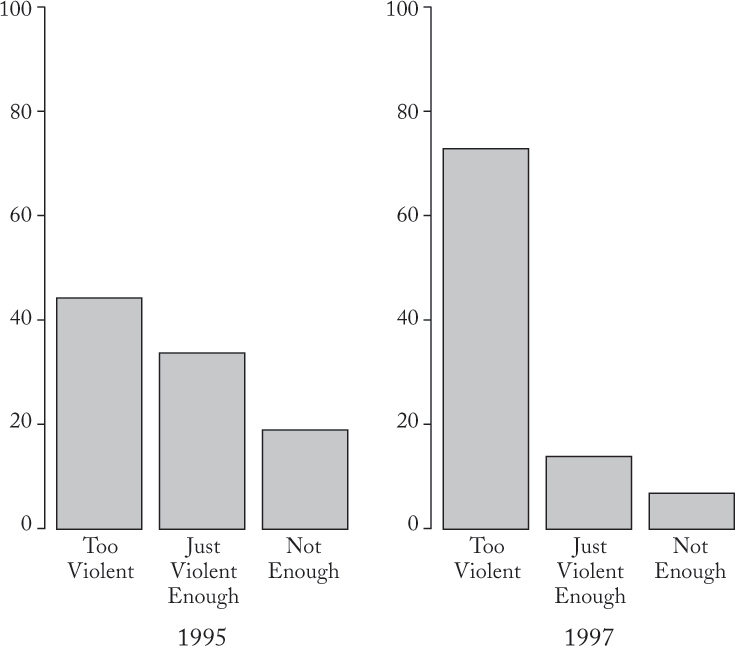
Although Montoro reversed his reformist attempts partly due to preference fragmentation, convergence alone hasn’t been sufficient to produce reform. One remarkable instance of convergence occurred in March 1997, when television viewers saw footage of Military Police officers engaging in extortion, torture, and an execution in Favela Naval, a low-income community in the São Paulo city of Diadema. Police abuses in Favela Naval caused widespread outrage, even though the victims belonged to those typically criminalized populations—the three Ps. The event generated large protests by Favela Naval residentsFootnote 117 and repudiation by the General Community Council of the Military Police, the police commander’s civilian advisory board, which includes business leaders.Footnote 118 Following the broadcast, nearly two-thirds of survey respondents demanded the resignation of the secretary of security and the police commander.Footnote 119 Convergence is best illustrated by Figure 3, which shows the results of a survey question about police violence that was first asked in 1995, and then two years later, days after the revealing broadcast.Footnote 120 In the 1995 survey, 44 percent of respondents said the Military Police were “more violent than they should be,” 35 percent believed police used “appropriate levels of violence,” and 19 percent said the police were “less violent than they should be.” After the Favela Naval footage aired in 1997, the fragmentation indicated in the previous survey gave way to convergence. In the second survey, the proportion of respondents who viewed the police as too violent rose to 73 percent. Many citizens who were previously indifferent to or supportive of police violence joined the critics.
Shifts in Societal Opinion toward Police in São Paulo (1995 and 1997)

Governor Mário Covas responded to the scandal with symbolic actions, apologizing to “the people of São Paulo” and dismissing two high-ranking officials.Footnote 121 Covas also promoted marginal reform—legislation to bolster a police ombudsman’s office (Ouvidoria) that he had created by executive order in 1995. The Ouvidoria, intended to receive citizen complaints about police, left internal police structures intact and lacked formal authority to oversee police or punish malfeasance.Footnote 122 Benedito Mariano, who served as police ombudsman between 1995 and 2000, said he proposed structural reforms after the Favela Naval incident, but “the [Covas] administration didn’t want to move forward with those proposals. The one that had the most resistance from the police was the new disciplinary code [I proposed], because that messed with the internal culture of the Military Police…. The secretary [of security] made the mistake of sending the proposal to the Military Police commander, and of course when you send it to the police for their opinion, they’re going to want to maintain the status quo.”Footnote 123 The police thus kept structural reforms off the agenda.
In contrast to the ambitious reforms in Buenos Aires that began in late 1997 (described below), the response to Favela Naval ultimately “maintained the status quo.” I argue that the divergent policy choices in Buenos Aires Province and São Paulo State in 1997 can be accounted for by looking to the strength of the political opposition faced by the respective governors. While Buenos Aires Governor Eduardo Duhalde faced stronger opposition following legislative elections in 1997, Covas and his party, the psdb (Brazilian Social Democratic Party), faced no such electoral threat (see Appendix 2 in the supplementary material).Footnote 124 Reflecting Brazil’s famously fragmented political party system, more than a dozen parties were represented in the state legislature during the Covas administration, with the largest opposition party—the pmdb—receiving 24 percent of the vote in the 1994 elections. Covas, meanwhile, defeated his opponent by more than 10 percentage points in a runoff election that same year; the challenger’s political party, the pdt (Democratic Workers Party) won only 3 percent of the votes for the state legislature.Footnote 125 The psdb governs São Paulo to this day. While states such as Minas Gerais and Rio de Janeiro have seen a turnover of political parties in the governorship since democratization, São Paulo’s governors have represented a single party since 1995 and, for twelve years before that, the party that it broke from (the pmdb).
These instances elucidate how police leverage their structural power to constrain policy options, and how politicians’ choices between continuity and reform are shaped by societal preferences and political competition. The urgency of the problem of police violence in São Paulo highlighted by Governor Marin in 1982, and the structural conditions resulting from such violence, remain largely unchanged in the three decades since democratization. The political choices of consecutive governors are also unchanged, as noted by Mariano, the first police ombudsman of that state, in an interview: “This is a debate that even the progressive [political] parties have to undertake. In the period since the transition [to democracy], considering all state governors, we haven’t had great advances in terms of structural reforms. Not from any administration. In some ways it continues to be a big taboo.”
Continuity and Change in the “Damned Police” of Buenos Aires
In contrast to São Paulo State, a contemporaneous convergence of preferences in Buenos Aires Province, along with a midterm election that strengthened the opposition, shifted politicians’ strategies in favor of reform. But that reform followed fifteen years of institutional stasis after Argentina’s transition to democracy in 1983, during which many conditions in Buenos Aires Province resembled those in São Paulo. Although Argentina’s military underwent significant reforms after the transition,Footnote 126 police structures remained largely intact. Police were governed by policies enacted under dictatorshipFootnote 127 with few reform attempts, despite constituting a key component of the military regime’s repressive apparatus.Footnote 128 Meanwhile, as crime in the province tripled,Footnote 129 police proved largely incapable of preventing it.
Instead, the Bonaerense were routinely complicit in crimes they were supposed to prevent. Through the practice of recaudación (collection), a remnant of the clandestine repressive practices of the authoritarian period,Footnote 130 police collected fees from both licit and illicit economic activities.Footnote 131 According to one former security official, police commanders ran their jurisdictions as “their own hunting preserve, their own fiefdom” for rent-seeking purposes.Footnote 132 Officers also perpetrated high levels of institutional violence, with approximately one hundred extrajudicial killings per year, and countless cases of torture.Footnote 133 Unsurprisingly, a 1997 survey found that 92 percent of respondents distrusted the police.Footnote 134
Much has been written about cycles of police reform in Buenos Aires Province,Footnote 135 but these works offer few explanations for patterns of continuity and change. To explain both the prolonged reform deficit and the dramatic reform in 1998, it’s important to understand how the police’s structural power constrained policy options and created a set of entrenched interests that blocked reform. We must also grasp how, after fifteen years of continuity, shifts in preferences and political competition changed politicians’ calculations toward reform.
Structural Power, Fragmentation, and Continuity
The Bonaerense case exemplifies the police’s structural power and politicians’ incentives to pursue accommodation. Provincial and local politicians—mostly, though not exclusively, from the dominant Partido Justicialista (pj, Peronist Party)—pursued mutually beneficial relationships with the police. Many scholars and analysts suspect politician complicity in recaudación, presuming politicians use the funds to finance electoral campaigns and offer political protection to police in exchange.Footnote 136 Various secretaries of security during the 1980s and ’90s reported interference by mayors when those secretaries attempted to curtail corruption. As one secretary of security under Governor Eduardo Duhalde, Eduardo De Lázzari, describes:
The mayors create alliances with certain commanders of their respective police districts. If I tried to touch a police officer who was shielded by some mayor, that mayor would come to me in a fury, with the demand that I not remove this chief to put in that other chief…. It is extremely clear that there was a political motive in relation to the police [chief] in their zone. It’s not casual, it’s not free; it’s not because they like [the commander’s] face. It’s because they form a series of relationships between the mayor and the local police for mutual benefit.Footnote 137
Peronist Governor Duhalde also engaged police in a mutually beneficial exchange of autonomy for cooperation. Journalists documented how the Bonaerense spied on Duhalde’s political opponents during the mid-1990s,Footnote 138 including Ramón “Palito” Ortega, Duhalde’s presumptive rival for the Peronist candidacy in the upcoming presidential election. Perhaps because of such cooperation, Duhalde viewed police chief Pedro Klodczyk as a “true guarantee” and prohibited his secretary of security from removing Klodczyk in 1994, despite acknowledging the Bonaerense’s crisis.Footnote 139 Thus, the provincial police leveraged political relationships to thwart external interference.
Given its political value, the police force enjoyed extraordinary autonomy, largely free from interference by civilian officials. Eduardo Pettigiani, Duhalde’s first secretary of security, recalled that in 1992, the undersecretariat of security within the Ministry of Government “had been virtually deactivated, it had been directed de facto by officers from the police force.”Footnote 140 Police autogobierno (self-governance), as one former security official called it, endured throughout Duhalde’s term.Footnote 141
Duhalde pursued a concerted strategy of accommodation with police, favoring institutional continuity. He also faced little electoral pressure for police reform throughout most of his administration, due to societal preference fragmentation. These preferences manifested as divided attitudes and contradictory demands. A 1993 survey, for instance, showed that similar proportions of respondents expressed a positive (35 percent), neutral (29 percent), and negative (33 percent) perception of the provincial police.Footnote 142 But even when public opinion polls showed growing consensus of distrust, considerable fragmentation persisted, reflecting what former Minister of Security Arslanián called “erratic demands” not only for “authority and freedom of action” for police to fight crime, but also for greater oversight of a “corrupt, punitive, and terrible police.”Footnote 143 Indeed, despite the 92 percent distrust reported in the 1997 survey noted above, 45 percent of survey respondents supported increasing the police’s authority to fight crime.Footnote 144
Societal preference fragmentation reflected the divergent experiences of different societal groups with police. A human rights lawyer noted that two-thirds of victims of gatillo fácil (trigger-happy) police killings in her ngo’s database were male, young, and poor.Footnote 145 Similarly, 72 percent of victims were poor or working class and 15 percent lived in a shantytown, compared to 3 percent from the general population of the Buenos Aires metropolitan area. Moreover, 60 percent of victims had completed only primary education and 33 percent were unemployed.Footnote 146 Amid preoccupation with rising crime, societal demands encompassed sustained mobilization in low-income communities protesting police killings and misconductFootnote 147 as well as calls for greater authority, including support for extralegal measures, for police to combat crime.Footnote 148
With conflicting societal demands and discontent concentrated among the poorest sectors, politicians from both the ruling Peronist party and the opposition saw little electoral gain in police reform and little counterweight to the strong incentives to pursue accommodation.
Scandal, Shared Outrage, and Avoiding Reform (January–October 1997)
Conditions changed in 1997 when police officers killed photojournalist José Luis Cabezas and legislative elections strengthened the opposition. A careful analysis of events throughout 1997 illustrates how the joint occurrence of convergence (scandal) and a robust political opposition can drive reform. Regarding the Cabezas murder, on January 26, 1997, the newspaper Clarín’s front page declared, “A crime like this has no precedent since the restoration of democracy.” Protests erupted “with a broad adherence of different groups representative of the society,”Footnote 149 including students, religious leaders, major labor unions, the Federation of Chambers of Commerce, and human rights organizations formed during the dictatorship (such as Abuelas de Plaza de Mayo; Serpaj; Madres de Plaza de Mayo; and the Centro de Estudios Legales y Sociales (cels).Footnote 150 Notably, the Cabezas case was among the first instances in which traditional human rights groups opposing repression of middle-class victims under dictatorship mobilized explicitly against police violence in a democracy alongside correpi (Coordinator Against Police and Institutional Repression), a group that focuses on police violence targeting low-income victims.Footnote 151 Thousands marched demanding “Justice for José Luis.”Footnote 152 The crime produced “a change in societal perception … of police repression,”Footnote 153 with most observers immediately blaming the police.Footnote 154 Activists protested on the twenty-fifth of each month, and flyers bearing Cabezas’s photo and the phrase, “No se olviden de Cabezas” (Don’t forget Cabezas) were ubiquitous among diverse sectors of society.Footnote 155 Cabezas’s murder produced sustained mobilization. Indeed, for years after the murder, journalist Santo Biasatti ended his nightly broadcast with the phrase.”Footnote 156
Duhalde responded to this widespread discontent with short-term measures, including public statements, purges of allegedly corrupt officers, and a vow to support the investigation. Meanwhile, Peronists in the provincial legislature created a bicameral commission to oversee the investigation.Footnote 157
But despite the scandal’s ongoing salience, broader reform remained off the agenda. By October 1997, the eve of legislative elections, nine months had passed since Cabezas’s murder. Yet a range of evidence suggests that during this period, Duhalde had no intention to enact police reform. De Lázzari, then-secretary of security and a reformist, said that although the Cabezas murder “unleashed a storm,” his office continued its strategy of investigating corruption and institutional purges.Footnote 158 Despite his timid response to the Cabezas case, Duhalde removed de Lázzari in May 1997 in response to police pressure,Footnote 159 replacing him with Carlos Brown, a long-time Peronist operative. Meanwhile, the national and provincial Peronist Party denied the existence of broader structural problems within the police. Carlos Corach, national minister of the interior, declared that Cabezas’s murder “was not a security problem … it was an isolated case. It cannot be used to draw conclusions about the system of security.”Footnote 160
By October 1997, the Cabezas case still hadn’t led the governor or his party to address the grave deficiencies of the police, even though Duhalde had announced a year earlier that a “profound reform”Footnote 161 was forthcoming. Cabezas’s murder could have been an opportunity for Duhalde to assuage widespread outrage by enacting this previously announced reform plan, but he did not take it.Footnote 162 One month before the elections, opposition members of the legislative commission investigating the Cabezas case stated in an internal report that they saw “no major changes in the police institution.”Footnote 163
Despite prolonged societal mobilization, the victim’s social status, the availability of a reform proposal Duhalde had previously touted in the media, and the provincial police’s dire institutional deficiencies, Duhalde and his party didn’t pursue police reform in the months following Cabezas’s murder.
A Strengthened Opposition and the Onset of Reform (October–December 1997)
Duhalde’s strategy changed after legislative elections in October 1997 strengthened the opposition. Duhalde likely expected his party to win, since news analyses declared the provincial legislative elections a tossupFootnote 164 and internal polling by the governor’s party predicted a victory.Footnote 165 But at the national level, two smaller opposition parties—ucr (Radical Civic Union) and frepaso (Front for a Solidaristic Country)—formed a progressive coalition, the Alianza, which defeated the Peronists in the 1997 elections in the national congress, in eight provinces, and in the national capital. The Alianza also won a majority of legislative seats in
Buenos Aires Province, handing the pj its first defeat in a decade (see Appendix 3 in the supplementary material).Footnote 166 Journalists declared, “The provincial pj had its worst electoral performance since 1987” and that the outcome “hurt the presidential ambitions of Eduardo Duhalde,” a damaging assessment as the presidential campaign drew nigh.Footnote 167
Facing a newly robust political opposition and eyeing the presidency in 1999, Duhalde moved toward comprehensive police reform a month after the elections. He declared a “state of emergency” within the police,Footnote 168 facilitating a civilian intervention of the police and the early retirement of all police commanders. He solicited reform proposals and worked with legislators to pass comprehensive reform legislation in a matter of months.Footnote 169 The reform enacted in Buenos Aires Province was highly ambitious, targeting the police’s political and economic power structure. It created a Ministry of Security to establish civilian oversight and eliminated the position of the chief of police. The law included measures for demilitarization and professionalization, as well as for administrative and territorial decentralization. It also improved recruitment standards and training, created new systems of internal accountability, and introduced societal oversight through local security forums.
The provincial police had little choice but to cooperate. Although some officers, particularly high-ranking officials forced into retirement, engaged in intimidation and fear tactics, Luis Lugones, the official leading the civilian intervention, recalled that “those officers who remained in activity—insofar as a political decision had been made and … the consensus by which these measures had been taken—felt trapped,” and adhered to the reform. Indeed, during an interview in a noisy café, a retired comisario (commissioner) of the provincial police leaned over and whispered to me what his commander had whispered to him at the start of the reform: “Tenemos que dejar de recaudar” (We have to stop collecting).Footnote 170
Violence, Institutional Crisis, and Reform in Colombia
The Colombian case represents a hard test for my argument, as it exhibits conditions that seemingly preclude police reform. But despite decades-long armed conflict, the world’s highest homicide rates, and weak state capacity, Colombia’s police underwent comprehensive reform in 1993. Police reform went from dead on arrival to unanimous legislative passage following shifts in political opposition strength and a scandal.
During the 1980s and early 1990s, the Colombian National Police underwent dramatic institutional decay, accelerated by a prolonged war against drug cartels. The police endured extraordinary violence, with nearly three thousand officers killed between 1982 and 1992,Footnote 171 and extensive infiltration by cartels. Frequent mass expulsions for corruption and drug trafficking implicated officers across all units, territorial regions, and ranks.Footnote 172 The National Police were also ineffective against rising crime: homicide rates skyrocketed from thirty-six per one hundred thousand inhabitants in 1987 to 127 in 1994.Footnote 173 The force grew from forty-six thousand to seventy-six thousand officers between 1982 and 1992 in response to rising drug violence, but such growth was achieved through lower recruitment standards, reduced training periods,Footnote 174 and diminished internal oversight.Footnote 175
The police also committed extensive extrajudicial violence. Citizens told a presidential commission that officers “ignore the rights of citizens,” “act with unnecessary violence,” and engage in “abuse and systematic trampling [of rights].”Footnote 176 The attorney general’s office told the commission that human rights violations doubled between 1990 and 1991, and that police committed most of the violations reported in 1992. Police committed countless extrajudicial killings of marginalized citizens—including people who were suspected of crimes, engaged in prostitution, or experiencing homelessnessFootnote 177—with an estimated nineteen hundred “social cleansing murders” between 1988 and 1992.Footnote 178 Not surprisingly, a 1992 survey showed that only 23 percent of respondents trusted the police.Footnote 179
The case of the Colombian police underscores the shortcomings of crisis as an explanation for reform. By 1990, the National Police was a decade into a crisis that only deepened in the following years, yet reform remained off the agenda.
The National Police crisis was intertwined with a broader crisis of legitimacy permeating the Colombian state throughout the 1980s, driven by dramatic rates of violence resulting from the decades-long guerrilla war and the war on drug cartels. Former President César Gaviria, elected in 1990, argued that “all that violence delegitimized the political system…. That’s why there was so much desire and will to transform it.”Footnote 180 The crisis of legitimacy facilitated Gaviria’s transformative policy agenda—his revolcón institucional (institutional shakeup)—and a new constitution drafted in 1991. The constitution created new institutions, including the Constitutional Court and the Attorney General’s Office (Fiscalía General), and deepened other institutional changes, including decentralization and congressional reforms. Gaviria’s shakeup included such highly contested measures as central bank independence, which according to Gaviria “was quite costly politically.” He also enacted controversial drug-war policies, including mandating domestic prosecution of high-level drug traffickers rather than extradition to the United States,Footnote 181 and secret court procedures in drug cases.Footnote 182 Gaviria’s transformative agenda was bold in both content and strategy. Per Gaviria, most reforms were pushed through Congress during his first six months in office, a deliberate strategy to “promote all of these reforms at the same time, rather than one by one.”
Fragmentation, Strengthened Opposition, and Thwarted Reform
For all its changes, Gaviria’s institutional overhaul excluded comprehensive reform of the beleaguered National Police. Reforming the police was likely complicated by its structural power and politicians’ incentives to pursue accommodation. Police control of coercion—and the drug war—granted the force a prominent patron, the United States. By 1995, the police had received hundreds of millions of dollars; by 1999, the amount had increased to $2.6 billion under Plan Colombia.Footnote 183 A former presidential security and defense adviser recalled, “The police began to be subsidized by the US. The US distanced itself from the Colombian military, to the point that when I was advisor in the 1990s, the problem of the internal armed conflict did not exist for the embassy … it was only drug trafficking.”Footnote 184 The National Police linked the government to a powerful ally and financial backer.
Police control over a key policy and its relationship to the US gave the force considerable leverage to protect institutional prerogatives. The result was accommodation, wherein the National Police enjoyed considerable autonomy and deference from civilian officials, despite its profound deficiencies.Footnote 185 According to a leading security expert, Gaviria’s administration minimized the problem, claiming it was limited to a few “rotten apples.”Footnote 186 Indeed, although the inefficiency, violence, and corruption of the National Police were widely recognized, Gaviria called the force “a source of pride for the country.”Footnote 187 Despite his commitment to transforming national policy through an institutional shakeup, Gaviria appeared unwilling to acknowledge the institutional deficiencies of the police.
Colombian politicians perhaps saw police reform as electorally disadvantageous due to citizens’ fragmented preferences and conflicting demands. As in Buenos Aires, widespread distrust of police coincided with divergent experiences and preferences regarding policing. National survey data aren’t widely available for the 1980s and early 1990s, but a survey conducted in Medellín in 1992 reveals considerable class divisions in attitudes toward police. Citizens at the lowest socioeconomic strata were far less likely to say that the police inspire protection and respect than were those in the middle- and high-income categories. They were also more likely to express distrust and fear of the police, and to perceive that the police do not act lawfully.Footnote 188 Colombian society, after decades of war with guerrilla groups and drug cartels, held divided attitudes and preferences, despite generalized low trust in the police. María Victoria Llorente, a Ministry of Defense official at the time, described the “different visions” found in society, reflecting the Medellín survey findings: some citizens held “very romantic visions of the corner policeman, the friendly policeman, and [others said] ‘Well, in a society coopted by drug trafficking, I don’t want the friendly policeman.’”Footnote 189 Government officials thus perceived conflicting societal demands, rather than a coherent demand for reform.
Without such coherent pressure, there was little counterweight to the police’s structural power, an important obstacle to reform. The fate of a 1992 reform bill is illustrative. In September of that year, the administration introduced a legislative proposal to reform the National Police’s Organic Law, codifying changes required by the Constitution.Footnote 190 The bill died in committee. Then-Senator Jose Blackburn, who sponsored a successful police reform bill the following year, said in an interview that he had no recollection of this initial bill.Footnote 191
The reform bill’s failure demonstrates how police constrain policy options and shape the agenda. Then-Defense Minister Rafael Pardo Rueda said the reluctance to approve the bill was “due to the Colombian police itself. The [National] Police would say that it was taking corrective measures, and the Congress wouldn’t challenge the opinions of the institutions of the Public Force [National Police and military], so there wasn’t an environment that would justify the bill. So the reform [bill] that was making its way [through Congress] very slowly was a reform [bill] to avoid having to reform” (una reforma para no reformar).Footnote 192 But it also seems that the president and defense minister didn’t put their political weight behind this bill. The failure of the 1992 police reform bill stands in sharp contrast to Gaviria’s institutional shakeup, and the considerable pressure he exerted on legislators to ensure the passage of his initiatives.Footnote 193
The bill also failed despite a strengthened opposition that could have used police deficiencies to attack Gaviria. The size of the Conservative Party in Congress was modest—23 percent of deputies and 25 percent of senators.Footnote 194 But Gaviria also faced new opposition on the left from the M-19 Democratic Alliance, a demobilized former guerrilla group that won 27 percent of votes for the 1991 constitutional assembly (compared to the Liberal Party’s 28 percent), increased its vote share from the preceding presidential elections, and, following the 1991 elections, came to occupy nearly 10 percent of congressional seats for the first time. As Gaviria noted in an interview, the M-19 represented “an opposition that expressed itself but did not impede the legislative process.”
The balance of power between government and opposition shifted further in mid-1992 following various setbacks for the president, including high inflation, electricity rationing, and drug kingpin Pablo Escobar’s escape from jail. Whereas Gaviria enjoyed a 70 percent approval rating in 1990,Footnote 195 a 1992 survey reported his approval rating had dropped to 29 percent.Footnote 196 Gaviria faced little legislative opposition before 1992, but Escobar’s escape led to months of congressional hearings—shown on live television—challenging top administration officials. Meanwhile, “in the halls of Congress, the resignation of the President was openly discussed as a possibility.”Footnote 197 Escobar’s escape thus led the opposition to challenge the president to an extent not seen since before the National Front, the decades-long power-sharing pact between the Liberal and Conservative parties.
By the start of 1993, the opposition was robust along three of the five indicators—decreased presidential approval rating, increased opposition to the incumbent’s legislative agenda, and proximity to the presidential elections the following year—and increasingly robust in vote/seat shares. The Conservative Party, for example, began the 1993 legislative session by demanding that the country’s inspector general’s office investigate Gaviria.Footnote 198 Moreover, for the first time Gaviria’s Liberal Party faced a relatively strong performance by a leftist party, which presented an increasingly formidable opposition to Gaviria’s policies. The M-19, for instance, led an effort in the Congress—with the support of dissident “independent Liberals” who opposed the president’s economic agenda—to declare dozens of Gaviria’s executive orders illegal and to demand censure of his minister of labor.Footnote 199 In addition to this increasing opposition from the left and the right, Gaviria had to contend with a growing split within his own party along ideological lines in response to his neoliberal economic agenda. A sizable social-democratic current within the Liberal Party emerged as such a strong critic of his administration that observers speculated that the upcoming presidential elections could well have “two opposition candidates,” including that of the president’s own Liberal Party.Footnote 200
Gaviria was thus flanked by moderately robust opposition on both sides of the ideological spectrum and by a schism within his own party. But the opposition didn’t use the crisis facing the National Police to challenge him. To Gaviria’s left, the M-19—despite previously engaging in confrontations with police and enduring egregious extrajudicial killingsFootnote 201—joined Liberals and Conservatives in rejecting the police reforms introduced by the leftist Patriotic Union during the constituent assembly.Footnote 202 Meanwhile, Conservatives failed to champion a reform bill introduced by a Conservative senator,Footnote 203 which, per Minister Pardo Rueda, was considered far-reaching and “inconvenient for the stability of the institution.”Footnote 204 It’s telling that two dissident Liberal politicians announced their intention to run for their party’s nomination for president in early 1993, presenting strong critiques of the incumbent—including his policies on security and violence—but no calls for police reform.Footnote 205 Overall, neither the incumbent nor the opposition parties prioritized police reform prior to 1993.
A Shift in Societal Preferences and Long-Overdue Reform
Months later, politicians’ incentives suddenly changed. On February 28, 1993, nine-year-old Sandra Catalina Vásquez Guzmán was raped and killed in a Bogotá police station. “If a person is not safe inside a police station, then where?” asked the child’s mother, Sandra Janeth Guzmán.Footnote 206 Perhaps due to that symbolism, the case is widely considered the catalyst for long-overdue police reform in Colombia.Footnote 207 Even though approximately fifteen hundred children had been murdered the previous year, the murder “infuriated Colombian public opinion … [and] prompted a national debate about the role of the police and the creation of a commission about its reform.”Footnote 208 Reacting to the case, the prominent journalist Enrique Santos Calderón declared, “Sandra Catalina concerns us all…. It will be said that in a country that has beaten all records on the subject of violence and death, nothing surprises or perturbs. But the case of Sandra Catalina Vásquez is the most demoralizing and outrageous thing that could occur in a society that still hopes to conserve basic values.”Footnote 209 Individuals across diverse sectors, including the National Federation of Merchants and the Bogotá Chamber of Commerce, called for police reform. Footnote 210
To discern the effect of the scandal on politicians’ strategies, consider what occurred before and after the case became broadly known. On March 1, the day after Sandra Catalina’s death, legislators and Gaviria’s administration announced a shared legislative agenda for the remainder of the term; it did not include reforming the National Police.Footnote 211 But by late March the president had created two commissions to recommend police reforms. In August, despite an identical composition of the Congress, the bill that had failed in September 1992 was reintroduced, amended, and approved “with near unanimous support.”Footnote 212
The president felt considerable pressure to respond. Legislators called hearings throughout March 1993, questioning the ministers of defense and justice about the investigation and keeping it on the public agenda.Footnote 213 During the hearings, legislators from across the political spectrum shared the view that “society and the legislative branch can no longer tolerate the problems that exist within the police.” One dissident Liberal senator asked why the president’s many executive orders to restructure and modernize state institutions neglected the police, “an entity so essential for the security of the citizenry, [and] the prevention and repression of crime.”Footnote 214 Camilo Granada, then-presidential adviser for national security and defense, said that the case “generated an enormous debate…. It was a scandal. It opened the doors to allow a broad reform process and posed a political obligation on the government.”Footnote 215 The government, in contrast to 1992, worked to ensure the bill’s passage.Footnote 216
Law 62/1993 represented a comprehensive overhaul, including measures to professionalize and decentralize the police, to improve recruitment and training, and to improve officer welfare. It was the first effort in four decades to introduce strong civilian oversight in policing and to diminish the force’s profound militarization—inherited from a brief period of authoritarian rule in the 1950s that has been cited as a driver of police institutional decay and illegitimacy.Footnote 217 In six months, following a shift from fragmentation to convergence, the legislation went from languishing in committee to legislative priority. Notably, the methodology of the reform process, a commission representing diverse sociopolitical sectors, sought to minimize future fragmentation. As the then-director general of the National Police put it, “Our country had never convened all sectors of the community to ask them, well, what is it that you want from the police?”Footnote 218
Conclusion
Long after the third wave of democratization, police institutions throughout Latin America still constitute a blind spot for democracy. Even while national democratic institutions flourished, the region’s democracies failed to reform police structures and practices developed under dictatorship. As my analysis demonstrates, democratic processes sustain this institutional persistence well after military dictatorships ended.
This comparative study has theoretical implications for debates about institutional continuity and change. The article provides a framework for understanding the remarkable persistence of an institution that is central to the state, but which has largely been marginal in the political science literature. By demonstrating how police leverage their structural power to constrain policy agendas, this article elucidates the role of coercion, a factor that has been surprisingly understudied in the institutions literature even though it’s a defining feature of the state. My analysis also adds nuance to broader theories of institutional persistence and change. While much of the literature has focused on the role of societal actors as drivers of policy and institutional change, particularly in Latin America, my analysis demonstrates that in the absence of political competition, societal preferences and mobilization may favor the persistence of institutional weakness, as occurred in São Paulo State. Moreover, in contrast to theories of gradual and endogenous institutional change, I demonstrate that the joint occurrence of societal preference convergence and political competition can lead to ambitious structural reforms in the short term, as occurred in Buenos Aires Province and Colombia.
This analysis paves the way for future research to elucidate why Latin America’s democratic governments have been deficient in performing the state’s defining task. First, although I demonstrate that preference fragmentation is an obstacle to police reform, the underlying mechanism remains underexplored. One of the theory’s underpinnings is that preference fragmentation is rooted in societal inequalities, wherein characteristics like race, class, and geography shape demand formation and political decision-making over the distribution of protection and repression. The result is the continuity of institutional weakness, raising an essential question about democratic responsiveness under high inequality. This question has become increasingly important in political science,Footnote 219 and future research must incorporate the police. Brinks’s study of judicial responses to police killings in Latin America shows how inequality shapes who is subject to state violence and whether state actors are held accountable. Footnote 220 Further research probing the relationship between inequality and policing is thus an important undertaking, as Latin America is the world’s most violent and unequal region.
Second, my analysis underscores the role of police as veto players who successfully block reform, but additional questions remain. Although I treat police as unitary actors, organizations also exhibit fragmentation that shapes their ability to achieve objectives. Future research must open the black box of police to better understand the conditions under which police bolster—or threaten—state capacity, leaders’ hold on power, and basic order. Theoretical insights from the regime transitions literature may be helpful for identifying “hard-liners” and “soft-liners”Footnote 221 within the police, and whether reform is similarly facilitated by cleavages between the two.
My theoretical framework about police also provides insights for other policy areas in which reform has proven elusive. Teachers’ unions, for example, have successfully blocked educational reforms—such unions in France once made reform “almost impossible,”Footnote 222 and those in MexicoFootnote 223 and IndiaFootnote 224 have also thwarted reform—because politicians depend on them for votes. The leverage of teachers’ unions reflects instrumental power that “stems from political resources that make deliberate actions to influence policy more effective,”Footnote 225 rather than from structural power, as with police. But it’s worth investigating how teachers’ unions constrain policy agendas, and whether societal preferences and political competition similarly shape politicians’ choices.
Political scientists must grapple further with the tensions between policing and democracy. Throughout Latin America, we’ve observed the persistence of coercive institutions that fail to satisfy citizens’ demands for greater protection and that exercise their authority in decidedly undemocratic ways—extrajudicial violence, arbitrary enforcement, and rampant corruption. Yet these undemocratic outcomes can emerge from democratic processes of citizen contestation and political competition. Thus, while building state capacity in the provision of security has been an important challenge for democracy, democracy itself may pose an important challenge for reforming coercive institutions.
Supplementary Material
Supplementary material for this article can be found at https://doi.org/10.1017/S004388711800014X.
Acknowledgments
I thank Emily Clough, Archon Fung, Candelaria Garay, Alisha Holland, Wendy Hunter, Kyle Jaros, Ben Lessing, Lauren McCarthy, Brian Palmer-Rubin, Suzanne Scoggins, Nicholas Smith, Vesla Weaver, and four anonymous reviewers for insightful feedback that greatly strengthened this manuscript.
Funding
This research was made possible by a fellowship from the Drugs, Security and Democracy Program, which is a joint initiative of the Social Science Research Council, the Open Society Foundations, and the International Development Research Centre, and by funding from the Bobst Center for Peace and Justice at Princeton University.
Author
Yanilda González is an assistant professor at the School of Social Service Administration at the University of Chicago. Her research probes the consequences of violence and inequality for state capacity, democratic citizenship, and the relationship between citizens and state institutions in the Latin American context. Her current book project explores the persistence of police forces as authoritarian enclaves in democracies and develops a theoretical framework for explaining continuity and reform among coercive institutions. She can be reached at yanilda@uchicago.edu.