Introduction
Mass-casualty incidents (MCIs) present a unique challenge for the medical community as patient volume often outweighs the number of available Emergency Medical Services (EMS) providers. All MCI triage algorithms are purposed to sort patients rapidly based on acuity to allow health care providers to ensure the greatest good is achieved for the most patients in a resource-constrained environment.Reference Lee, McLeod and Peddle 1 Multiple civilian MCI triage algorithms have been developed with little consensus regarding superiority.Reference Pesik, Keim and Iserson 2 The majority of previous triage algorithm research pertains to accuracy and construct validity, the latter being the ability of an algorithm to identify patient acuity correctly. When different triage tools are compared, reported triage accuracy is similar amongst MCI algorithms, but there is no definitive evidence to suggest which triage instrument is superior.Reference Jenkins, McCarthy and Sauer 3 - Reference Cross and Cicero 6 Moreover, although an evidence-based approach has been encouraged, MCI triage systems have been developed mostly through expert opinion.Reference Pesik, Keim and Iserson 2
In an attempt for consensus, the Centers for Disease Control and Prevention (Atlanta, Georgia USA) created the Sort, Assess, Life-saving interventions, Treatment and/or transport (SALT) triage algorithm in 2008.Reference Schultz 7 Although SALT triage remains a relatively new algorithm, evidence continues to accumulate documenting its accuracy in not only paper-based case scenarios, but also during mock disasters.Reference Lerner, Schwartz and Coule 8 - Reference Lerner, Schwartz, Coule and Pirrallo 15 However, broad international adoption has yet to occur, with regional variation in utilization of the SALT triage algorithm remaining the norm.
Currently in North America, most disaster triage systems are initiated by paramedics, leaving fire and police first responders to perform other roles. However, compared to the number of fire and police first responders, there are often fewer paramedics on scene available to triage during a MCI event. If fire and/or police first responders could be trained to perform MCI triage alongside EMS, this may help facilitate the MCI triage process and allow paramedics to focus on providing advanced medical care and patient transport.
The hypothesis of this study was that first-year primary care paramedic (PCP), fire, and police trainees could apply SALT triage and categorize patients with similar accuracy in written MCI scenarios immediately following a brief training session, and again three months later. This study solely focused on the triage categorization aspect of SALT and did not test decision making or simulation of life-saving interventions or transport.
Methods
Study Design
All first-year students enrolled in the PCP, fire, and police foundation programs at two community colleges were invited to participate in this prospective cohort study. None of the PCP, fire, and police trainees had prior exposure to mass-casualty triage tools, including SALT. Admission requirements for each first responder program included secondary school diploma or equivalent, with only PCP requiring specific science prerequisites. In terms of medical background at the time of this study, PCP students were in the first year of a two-year paramedic diploma program. All fire students had completed Level C cardiopulmonary resuscitation certification and were in the midst of receiving training comparable to the Red Cross (Washington, DC USA) First Responder Course. Although not required by their program, approximately one-third (90/260; 36.4%) of police students had first aid training at the time of this study. Participants attended a 30-minute didactic session on the SALT triage algorithm, which included MCI background, stepwise explanation of the algorithm, detailed description of triage categories, and multiple case studies with example triage code assignments, by presenter-guided audience participation. Immediately following this session, a 17-item, paper-based test was administered to assess the students’ ability to understand and accurately apply SALT triage (Appendix 1; available online only). The test was adopted closely with permission from Deluhery et al. who conducted a similar study using SALT triage.Reference Lerner, Schwartz, Coule and Pirrallo 15 Four questions pertained to participant medical education and background, three assessed SALT algorithm comprehension, and participants were then asked to assign triage categories to 10 hypothetical patient scenarios. An expert in Disaster Medicine predetermined the correct triage category to each paper-based case scenario and accuracy was assessed based on this standard. The Disaster Medicine expert was a fellow of the Royal College of Physicians of Canada (Ottawa, Ontario, Canada) in Emergency Medicine, had completed additional training in Emergency Preparedness and MCI Management, and held the position of Medical Director for Emergency Preparedness at a tertiary care trauma center. Three months after administration of the initial test, participants were again invited to complete an identical second test to evaluate retention. No SALT didactic session or refresher course was provided prior to the repeat test.
The initial didactic and testing sessions were completed from October 2012 through January 2013, and repeat testing sessions occurred from January through April 2013. Prior to distribution, all paper-based case scenarios were peer reviewed and pilot tested for clarity and comprehension. Written, informed consent was obtained from each trainee and study participation was completely voluntary. Completion of the initial and follow-up tests was proctored by one of the authors (SM, CL, or MP) to ensure there was no communication between participants. The study protocol was approved by the Health Sciences Research Ethics Board at Western University (London, Ontario, Canada).
Outcome Measures and Data Analysis
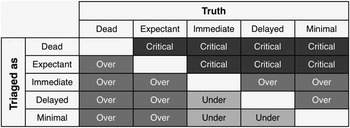
The primary objective of this study was to evaluate the ability of first-year PCP, fire, and police trainees to apply SALT triage accurately in written MCI scenarios immediately following a brief training session and to evaluate knowledge retention three months later. Secondary objectives were to compare total test scores, triage errors, and knowledge retention between groups. Total test scores incorporated the responses to the questions pertaining to SALT algorithm comprehension and also the responses from the hypothetical triage scenarios. Triage error was categorized by the following mutually exclusive classifications: over-triage, under-triage, and critical error. Critical error was defined as erroneous triage resulting in irrevocable detriment to patient morbidity or mortality. Categorical definitions of error can be found in Figure 1.
Error Table.

Data were entered directly into a study-specific Microsoft Excel database (Microsoft Corporation; Redmond, Washington USA). Descriptive statistics were summarized using means and standard deviations or proportional differences with 95% confidence intervals. General linear models with repeated measures were used, where appropriate, and chi square tests were used to compare the proportion of errors made amongst respondents. All analyses were performed using SPSS 21.0 (IBM Corporation; Somers, New York USA).
Results
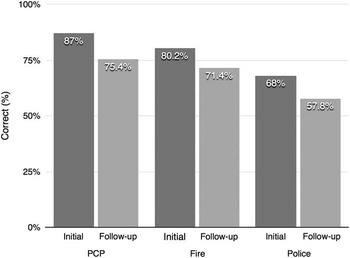
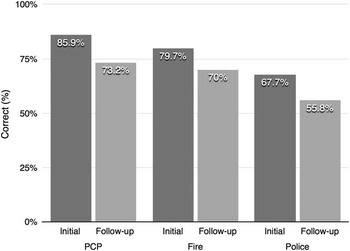
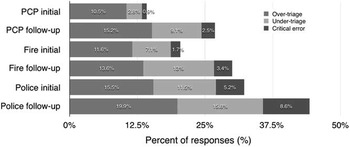
A total of 464 out of a possible 485 trainees (95.7%) completed the initial training session. The compositions of the study participants by PCP, fire, and police students in relation to the total number of available participants per group were 116/116 (100%), 88/109 (80.7%), and 260/260 (100%), respectively. Regarding the initial test, overall scores were higher (P<.05) for PCPs (87.0%) compared to fire (80.2%) and police (68.0%) trainees (Figure 2). Specifically examining triage accuracy using only the 10 paper-based clinical scenarios, PCPs demonstrated better accuracy compared to fire trainees (85.9% vs 79.7%; Δ 6.2%; 95% CI, 2.9%-9.5%). Furthermore, fire trainees achieved superior accuracy compared to their police colleagues (79.7% vs 67.7%; Δ 12.0%; 95% CI, 7.7%-16.2%; Figure 3). Over-triage errors occurred in 13.5% of all responses, compared to under-triage errors in 8.5% of responses (Figure 4). The PCPs over-triaged in 10.5% of cases, while fire and police errors were 11.6% and 15.5%, respectively. The PCPs under-triaged in 2.8% of cases, while fire and police errors occurred in 7.1% and 11.5% of cases, respectively. Critical errors were rare, occurring in 0.9%, 1.7%, and 5.2% of PCP, fire, and police responses, respectively.
Overall Test Scores. Abbreviation: PCP, primary care paramedic.

Triage Accuracy Scores. Abbreviation: PCP, primary care paramedic.

Triage Errors. Abbreviation: PCP, primary care paramedic.

Only 364 (78.4%) of the original participants completed the three month follow-up test. Of these, 87 were PCPs, 70 were fire trainees, and 207 were students in the police foundations program. For all groups, initial test scores were higher compared to the three month follow-up tests (75.0% vs 64.7%; Δ 10.3%; 95% CI, 8.0%-12.6%; Figure 2). Three month test scores for PCPs (75.4%) were similar to fire (71.4%) students (Δ 4.0%; 95% CI, −2.1% to 10.1%). Both PCP and fire trainees significantly outperformed their police colleagues (57.8%). In terms of triage accuracy, PCPs and fire students scored similarly (73.2% vs 70.0%; Δ 3.2%; 95% CI, −1.2% to 7.6%). Both PCPs and fire trainees achieved better accuracy (P<.05) compared to their police (55.8%) colleagues (Figure 3). At three months, over-triage errors occurred in 17.5% of responses, compared to under-triage in 13.6%; both were statistically greater when compared to initial testing. During the three month follow-up tests, PCPs over-triaged in 15.2% of cases, while fire and police over-triage errors were 13.6% and 19.9%, respectively. The PCPs under-triaged in 9.1% of cases on the follow-up test, while fire and police errors were 13.0% and 15.8%, respectively. Critical errors occurred in 2.5%, 3.4%, and 8.6% of PCP, fire, and police responses, respectively (Figure 4).
Discussion
This study evaluated the ability of first-year paramedic, fire, and police trainees to apply SALT triage accurately in written MCI scenarios, both immediately after training and again three months later. No evaluation or simulation of treatment and transport decision making was completed during this study. The PCP trainees were able to apply the SALT triage tool with the most accuracy, followed by fire, then police. None of the participants had prior experience with MCI triage algorithms. The varied proficiency between groups partially may be explained by their previous medical knowledge, with PCP being the most knowledgeable, followed by fire, then police. Other factors that may affect studied triage accuracy in first responders include field and clinical experience, continuing medical education and exposure, and higher simulation fidelity.
Although multiple MCI triage algorithms have been derived, few have been studied extensively. Most studies of triage accuracy have focused on the Simple Triage and Rapid Treatment (START) algorithm. A study by Rasavi et al. reported an accuracy of 75% when emergency medical technicians, prehospital registered nurses, and Basic Life Support workers performed triage using the START instrument for paper-based case scenarios.Reference Jones, White and Tofil 12 Similarly, a study of medical students using START triage for paper scenarios described a triage accuracy of 64.3%.Reference Schenker, Goldstein and Braun 10 The START algorithm has also been studied during live-action, mock-MCI drills.Reference Cone, Serra and Kurland 9 , Reference Deluhery, Lerner, Pirrallo and Schwartz 16 In 2006, Schenker et al. reported triage accuracy of 78% by EMS personnel using the START algorithm during live-action, mock-MCI drills,Reference Cone, Serra and Kurland 9 and a small study reported 81% accuracy by Emergency Medicine residents using START during a real-time, mock disaster.Reference Deluhery, Lerner, Pirrallo and Schwartz 16 Since the introduction of the SALT algorithm in 2008, there have been few studies of triage accuracy using this tool. A paper-based study by Deluhery et al. demonstrated EMS personnel could triage accurately using SALT in 84% of cases.Reference Lerner, Schwartz, Coule and Pirrallo 15 One smaller study employing virtual-reality simulation reported triage accuracy of 70% when SALT was used,Reference Lerner, Schwartz and Coule 8 while two higher fidelity, mock-disaster simulations incorporating patient actors and manikins found EMS responders triaged accurately using SALT in 78.8% and 81.0% of cases.Reference Risavi, Salen, Heller and Arcona 13 , Reference Cone, Serra, Burns, MacMillan, Kurland and Van Gelder 14 The PCP trainees in this present study were able to triage 85.9% of the paper-based clinical scenarios accurately, suggesting EMS trainees with limited experience can utilize SALT accurately. Moreover, these results further support the notion that SALT and START triage accuracies are comparable.
To date, there has been only one published study reporting the triage accuracy of other first responder groups, specifically police.Reference Andreatta, Maslowski and Petty 17 Kilner et al. revealed that UK police officers were able to understand and apply Triage Sieve to triage a paper-based MCI scenario. The officers were able to apply the triage tool accurately in 81.4% of cases. By comparison, fire trainees in this present study accurately triaged 79.7% of the paper-based clinical scenarios, much higher compared to their police colleagues at 67.7%. Although different triage algorithms were used, these results suggest that other non-EMS first responders may be able to assist with MCI field triage.
Only a small proportion of accuracy studies have discussed over- and under-triage error, and the definition of critical error has not been well described. Distinguishing critical error is an important practice as some triage errors may cause irreversible patient morbidity and/or mortality. The EMS and fire trainees committed critical errors in 0.9% and 1.7% of triage encounters immediately following the initial training session, and 2.5% and 3.4% at the three month follow-up, demonstrating the rare nature of these errors. Comparison of over- and under-triage from previous literature is difficult as the definition of over- and under-triage errors across different systems has not been standardized. A study by Kahn et al. retrospectively assessed the construct validity of START triage following a real-life train derailment MCI and found 49% of patients were over-triaged and 2% were under-triaged.Reference Garner, Lee, Harrison and Schultz 4 In contrast, a paper-based study of medical students employing the START triage tool reported 17.8% of patients were over-triaged and 12.6% were under-triaged.Reference Schenker, Goldstein and Braun 10 This variation in triage errors is not limited to the START triage algorithm. Results published by Cone et al. revealed paramedics using SALT over-triaged and under-triaged 13.5% and 3.8% of cases from a live-action, mock MCI, respectively.Reference Risavi, Salen, Heller and Arcona 13 However, a similar, yet larger, SALT triage study involving over 214 patient encounters from 73 triage officers reported an opposing trend, where 8% of cases were over-triaged and 11% were under-triaged.Reference Cone, Serra, Burns, MacMillan, Kurland and Van Gelder 14 More recently, Cone et al. reported triage errors resulting from a small virtual-reality MCI simulation.Reference Lerner, Schwartz and Coule 8 Two different triage algorithms were assessed, SALT and Smart Incident Command System (Smart) from TSG Associates (Halifax, Yorkshire, UK), with over- and under-triage of 6.8% and 23.2% reported when SALT was used, and 1.8% and 5.1% with the Smart triage algorithm. The present over-triage findings of 13.5% and under-triage of 8.5% contrast the majority of the existing triage errors found in the SALT literature, suggesting more research is needed to better explain and define expected rates of over- and under-triage. Research in this area also has focused on ways to reduce triage error. Deluhery et al. found the provision of refresher training maintained high triage accuracy;Reference Lerner, Schwartz, Coule and Pirrallo 15 thus, regular training may be considered an option to limit triage error. Additionally, triage algorithm pocket cards are a simple and viable option to help limit inaccuracies and reduce triage error.
In addition to triage error, knowledge retention has been gaining traction in the MCI literature. Risavi et al. found that Basic Life Support providers who completed START triage training had immediate post-instruction test scores of 74%. When knowledge retention of the triage tool was assessed one month later, there was a modest decline in test scores to 68%. The same authors subsequently investigated knowledge retention in another START triage study comparing scores immediately post-training and those six months later in both written and simulated scenarios.Reference Kilner and Hall 18 In their written scenarios, a statistically significant drop in triage accuracy from 73.3% to 65.0% was found, whereas a significant reduction from 65.0% to 60.0% was reported in simulated scenarios. However, a 2011 study by Deluhery et al. found no significant decline in triage accuracy when comparing post-training test scores and those occurring four months after. Interestingly, only 55% of the original participants completed repeat testing and were also given refresher training throughout the study. In comparison, the 364 (78.4%) participants who completed the three month follow-up testing in this present study did not receive refresher training and the mean test score for all respondents was higher immediately after the initial didactic session compared to the three month follow-up test (75% vs 64.7%; Δ 10.3%; 95% CI, 8.0%-12.6%). These results demonstrate significant knowledge attrition at three months and they support the conclusion posited by Risavi et al. that skill deterioration will be inevitable with a rarely used triage method.
Limitations
This study is not without limitations. A baseline test prior to the didactic session was not conducted to determine the degree of learning affected by the didactic intervention. Accuracy was assessed using a small number of paper-based MCI scenarios as opposed to observation of real-time triage in a true disaster setting. However, previous studies have shown good agreement between inter-rater reliability of paper-based case scenarios and live triage.Reference Risavi, Terrell, Lee and Holsten 19 The voluntary nature of the study introduces bias due to incomplete participation of all eligible trainees. Self-selection bias, or volunteer bias, is error due to systematic differences between the characteristics of participants and non-participants. As such, the external validity of this study may be compromised if there are differences between those who did and did not participate. Lastly, this study was only conducted at two community colleges in a single province and only included first-year students, so these findings may not be generalizable to other settings.
Conclusions
Amongst first responder trainees, PCPs were able to apply the SALT triage tool with the most accuracy, followed by fire, then police. Over-triage was the most frequent error, while critical errors were rare. Three months after the initial training period, all first responder groups showed a decline in triage accuracy. Although a statistical difference was found between PCP, fire, and police trainees in paper-based MCI triage accuracy, the clinical relevance and importance of this varied proficiency has yet to be determined.
Supplementary material
To view supplementary material for this article, please visit http://dx.doi.org/10.1017/S1049023X15004975