INTRODUCTION
The keystone species concept, a fundamental theory in ecology, explains the role of certain species in maintaining community stability through trophic interactions (Bond Reference BOND, Schulze and Mooney1993, Kricher Reference KRICHER2011, Paine Reference PAINE1969, Power et al. Reference POWER, TILMAN, ETES, MENGE, BOND, MILLS, DAILY, CASTILLA, LUBCHENCO and PAINE1996). A keystone species is one that exerts disproportionate influence on the food web relative to its abundance (Kricher Reference KRICHER2011, Power et al. Reference POWER, TILMAN, ETES, MENGE, BOND, MILLS, DAILY, CASTILLA, LUBCHENCO and PAINE1996). The concept can be extended to include certain plant species that provide nutritional resources for animals during the period of food scarcity (Bond Reference BOND, Schulze and Mooney1993, Kricher Reference KRICHER2011, Peres Reference PERES2000, Whitmore Reference WHITMORE1998). Terborgh (Reference TERBORGH, Soule and Wilcox1986a) first framed the concept of keystone plant resources (KPR) in tropical forests, suggesting that the frugivore community of a neotropical forest depends disproportionately on a small group of plants that bear fruit primarily during the transitional period between the wet and dry seasons when fruit availability is lowest. Twelve keystone plant species that support the nutritional requirements of the frugivore community during the season of fruit scarcity were identified at Cocha Cashu Biological Station (CCBS) in Manu National Park in south-eastern Peru. However, the study focused primarily on the availability of the plant resources during the season of food scarcity and less on their reliability and abundance. Furthermore, the availability of plant resources was determined primarily through observations of primate foraging, resulting in an incomplete list of keystone plant resources in relation to the entire community of vertebrate frugivores. Subsequent efforts have identified KPRs in other tropical forest ecosystems (Lambert & Marshall Reference LAMBERT and MARSHALL1991, Leighton & Leighton Reference LEIGHTON, LEIGHTON, Sutton, Whitmore and Chadwick1983, Peres Reference PERES2000), and the KPR concept is now largely accepted. However, given the wide variety in the raw data and test criteria used in previous studies, the KPR concept remains open to further critical consideration and refinement, particularly in the methods and criteria used to identify KPRs.
In this study, we reexamine the keystone plant resources concept in a lowland western Amazonian forest using an 8-y record of year-round fruit production. We use a quantitative approach and a comprehensive set of criteria to identify potential KPRs, and test the following hypotheses: (1) community-wide fruiting phenology reflects a distinct and consistent annual period of fruit scarcity, (2) a very small fraction of species consistently produce all/most of their annual fruit output during this period, and (3) a subset of these species are sufficiently abundant in their fruit output and broadly consumed to serve as potential keystone plant resources (KPRs) for the consumer community.
METHODS
Study site
Cocha Cashu Biological Station (CCBS) is located within Manu National Park (11°54′S, 71°22′W), at the western margin of the Madre de Dios river basin in south-eastern Peru. Less than 10 cm of rain falls during the dry season from June to October, although this may vary annually (Terborgh Reference TERBORGH and Gentry1990). Community-wide fruiting begins at the onset of the rainy season, peaking once in November and again between January and March (Terborgh Reference TERBORGH and Gentry1990). During this period, roughly between September and April, an excess of fruit resources is available for frugivorous vertebrate consumers (Terborgh Reference TERBORGH, Estrada and Fleming1986b). Fruit resources are scarce between May and August, during the transition from the rainy to the early dry season (Terborgh Reference TERBORGH and Gentry1990). During this period, frugivores adjust their behaviour to cope with limited resources (Terborgh Reference TERBORGH1983, Reference TERBORGH, Soule and Wilcox1986a; Van Schaik et al. Reference VAN SCHAIK, TERBORGH and WRIGHT1993).
Data collection
Between 2002 and 2011, year-round quantitative data on fruit and seed fall were collected at CCBS within a 4-ha (200 × 200 m) long-term forest dynamics plot situated in mature floodplain forest habitat. A 17 × 17 array of 289 evenly spaced seed-fall traps was installed within the central 1.44 ha (120 × 120 m) of the plot at the beginning of the study. Seed traps consisted of 0.49 m2 (70 × 70 cm) open bags made of 1-mm nylon mesh sewn to wire frames with 0.5-mm monofilament line. Corners of the traps were attached to nearby trees with 1-mm monofilament line so that the traps were suspended approximately 1 m above the ground. The contents of the traps were collected every 2 wk, and all seeds, fruit and fruit parts (capsules, valves, pods, etc.) were identified to species and recorded. For this study, we used eight complete calendar years of seed trap data from January 2003 to December 2010.
Data analysis
Community-wide fruiting phenology patterns
Before testing if individual species fitted the KPR criteria based on their fruiting phenology, we first determined community-level periods of fruiting highs and lows, which correspond to periods of resource abundance and scarcity for the frugivore community. Only species that produce fruits or seeds consumed by vertebrates (personal obs., Terborgh Reference TERBORGH1983, Terborgh et al. Reference TERBORGH, NUÑEZ-ITURRI, PITMAN, VALVERDE, ALVAREZ, SWAMY, PRINGLE and PAINE2008) were analysed. All ripe fruits and mature seeds (with and without adherent pulp) recorded in the seed-trap collections were used in this analysis since these categories indicate the presence of fruit available for consumption.
First, the total number of propagules recorded in seed traps i.e. total fruit output for each species was tallied for each month of each year. If the total number of propagules recorded for a species included both seeds and fruit, seed counts were converted to fruit counts by dividing the seed count by the average number of seeds per fruit for that species, and then adding that number to the original fruit count to obtain the total fruit output for a given month. For species collected only as seeds, no conversion was needed since the data were subsequently relativized. Data on seeds per fruit were obtained from Alvarez-Buylla & Martínez-Ramos (Reference ALVAREZ-BUYLLA and MARTÍNEZ-RAMOS1992), Cornejo & Janovec (Reference CORNEJO and JANOVEC2010), Gentry (Reference GENTRY1993), Kalko & Condon (Reference KALKO and CONDON1998), Russo (Reference RUSSO2003) and Stevenson et al. (Reference STEVENSON, CASTELLANOS, PIZARRO and GARAVITO2002).
Analysis of whole-community fruiting phenology and comparisons between individual species must account for substantial interspecific differences in fecundity, biomass and nutritional content. Since data on these traits were unavailable for several species, we instead relativized the raw fruit output data for all species. Monthly fruit outputs for each individual species in a given year were converted to proportions of total annual output for that year by dividing each month's output by that year's total output. Then, in order to obtain the monthly proportion of annual fruit output for the whole community, monthly proportions for individual species in each month were summed and divided by the total number of species. Finally, the monthly proportions of annual fruit output for each individual species and the whole community were averaged across all 8 y to obtain the mean monthly relativized outputs, or MMROs.
If monthly fruit output was uniform through the year, each month would be expected to produce an average of 8.33% of the total annual output, and May–August would produce, on average, 33.3% of the annual output, with 66.7% in September–April. However, if, as hypothesized, the May–August dry season is, in fact, a period of fruit scarcity, the observed MMRO for each of these months would be less than 8.33% of the yearly output, and significantly lower than the observed MMRO for the September–April period.
KPR criteria
In a critical discussion of the keystone plant resource concept in the neotropics, Peres (Reference PERES2000) described four criteria to identify species of community-wide importance and evaluate their potential as a KPR: temporal redundancy, resource reliability, consumer specificity and resource abundance. This set of criteria provides a comprehensive framework to evaluate a species and determine its importance at the community level. These criteria were adapted and applied to the 8-y record of seed fall as described below.
Temporal non-redundancy (TNR)
Peres (Reference PERES2000) defined temporal redundancy as ‘the degree to which the availability of a potential KPR synchronizes with that of the combined pool of alternative food resources used by a consumer assemblage’. Therefore, the relative fruit output of a putative KPR should be disproportionately greater during the period of fruit scarcity and correspondingly lower during the rest of the year in order to be considered temporally non-redundant. We considered a species as temporally non-redundant if its proportion of annual fruit output (as inferred from seed trap data) during May–August was significantly greater than the expected percentage of 33.3% if fruit output was uniform through the year. Based on this criterion, a species whose observed percentage of annual fruit output in May–August was >42.5% (χ2 = 3.82, df = 1, P = 0.05) was considered temporally non-redundant for that year.
Resource reliability
Peres (Reference PERES2000) defined resource reliability as ‘the degree to which a potential KPR at a given site will predictably become available every year to sustain vertebrate consumers, and in the case of low-redundancy resources, through annual periods of scarcity’. We interpreted the reliability criterion for a potential KPR in our study as being temporally non-redundant (based on our TNR criterion) in at least half of all years considered, i.e. 4 or more of 8 y.
Resource abundance
This criterion is defined by Peres (Reference PERES2000) as ‘the crude abundance of a potential KPR at a given site, on the basis of the approximate patch density of a given resource, and when available, some indication of patch size’. In this study, abundance of temporally non-redundant and reliable tree species was calculated at a local scale as well as a regional scale. Local abundance was based on density of reproductive-size individuals in two 4-ha forest dynamics plots at CCBS including the seed-fall monitoring site, and regional scale abundance was based on density of reproductive-size individuals in four additional 4-ha plots of mature floodplain forest spread across the Madre de Dios basin (BM: 12°15′S, 70°55′W; TRC: 13°7′S, 69°36′W; RA: 12°32′S, 69°3′W; LA:12°34′S, 70°4′W). Species-specific size thresholds for calculating density of reproductive individuals were based on dbh of the smallest observed reproductive trees within the long-term seed fall monitoring site at CCBS. Because scandent and hemiepiphytic species are not systematically censused in the forest dynamics plots, their abundances were estimated as either ‘abundant’ or ‘present’ from reviewing the available literature for these species locally at CCBS (McManus Reference MCMANUS2003) and regionally within the Amazon Basin (Burnham Reference BURNHAM2002, Nabe-Nielsen Reference NABE-NIELSEN2001). In order to compare abundances between lianas and tree species, trees were considered either ‘abundant’ (≥1 indiv. ha−1) or ‘present’ (<1 indiv. ha−1) both locally and regionally. Another measure of resource abundance was based on the total and average number of fruits recorded in seed traps during the season of fruit scarcity (May–August) for all years that a species showed temporal non-redundancy.
Consumer generalization
Consumer specificity was defined by Peres (Reference PERES2000) as ‘an inverse function of the percentage of frugivorous species in a local vertebrate assemblage … that were reported to exploit a putative KPR’. In this context, the local frugivorous vertebrate assemblage consists of ‘all bird and mammal species occurring at any one site including at least 50% of fruit in their diet’. If an abundant resource regularly provides food resources during the season of fruit scarcity, but is only consumed by a small portion of the frugivore assemblage, it cannot be considered a valuable resource to the entire community (Peres Reference PERES2000). Therefore, an ideal KPR should also be highly generalized, i.e. consumed by species from at least 50% or more of the consumer categories described below.
Frugivorous vertebrate species were assigned to one of 10 consumer categories based on foraging habits and body size. For example, diurnal primates were categorized as large (6–10 kg), medium-sized (1–6 kg) and small (≤ 1 kg). Saki monkeys (Pithecia sp.), marmosets, coatis (Nasua nasua) and marsupials were not included because sufficient diet information was lacking. Based on a comprehensive literature survey compiled for CCBS (Andresen Reference ANDRESEN2008, Bunce Reference BUNCE2009, Castro Reference CASTRO1991, Galetti Reference GALETTI2000, Gibson Reference GIBSON2008, Julliot Reference JULLIOT1996, Kays Reference KAYS1999, Meluk & Rodriguez Reference MELUK and RODRIGUEZ1999, Mitchell Reference MITCHELL1999, Podolsky Reference PODOLSKY1985, Ramirez Reference RAMIREZ1989, Romo Reference ROMO1996, Sherman Reference SHERMAN1991, Symington Reference SYMINGTON1987, Van Roosmalen Reference VAN ROOSMALEN1985, Wehncke et al. Reference WEHNCKE, HUBBELL, FOSTER and DALLING2003, Reference WEHNCKE, VALDEZ and DOMINGUEZ2004; Wright Reference WRIGHT1985) as well as other published literature (Romo et al. Reference ROMO, TUOMISTO and LOISELLE2004, Swamy Reference SWAMY2008, Terborgh Reference TERBORGH, Soule and Wilcox1986a), the number and per cent of frugivore categories for each potential KPR species were tallied.
Overall potential as a KPR
A putative KPR species needs to have first satisfied the temporal non-redundancy criterion because only those species that bear the majority of their fruit during the season of maximum overall fruit scarcity are potentially ‘entirely indispensable’ to the frugivorous community (Peres Reference PERES2000). Next, only species that consistently exhibit temporal non-redundancy i.e. in at least four or more years were considered to have met the reliability criterion. Species that made the shortlist of reliable temporal non-redundancy were then ranked separately for the reliability, consumer generalization and abundance criteria. Ranks for reliability were based on the per cent of study years (out of 8 y total) a species exhibited temporal non-redundancy, as follows: >87.5% (excellent), 75% (good), 62.5% (fair) and 50% (poor). Ranks for consumer generalization were based on the percentage of the frugivore community that foraged upon each species: ≥50% (excellent), 40% (good), 30% (fair) and <30% (poor). Ranks for resource abundance were assigned based on the local density of reproductive-size individuals: ≥1 indiv. ha−1 (excellent), <1 and ≥0.5 indiv. ha−1 (good), <0.5 and >0.125 indiv. ha−1 (fair) and <0.125 indiv. ha−1 (poor). Scandent and hemiepiphytic species were also assigned abundance ranks based on estimates of local abundance from available literature (McManus Reference MCMANUS2003). Ranks for resource abundance were also assigned based on the yearly average of fruit output of each species recorded in the seed traps: >100 (excellent), <100 and ≥10 (good), <10 and ≥5 (fair), <5 (poor). The final ranking of overall potential as a KPR for each species was determined by combining its ranking for each individual criterion, e.g. species ranked as ‘excellent’ for consumer generalization and ‘good’/‘excellent’ for either abundance criterion were considered overall ‘excellent’ potential KPRs, whereas species ranked as ‘fair’/‘poor’ in either abundance criterion and ‘good’/‘excellent’ for generalization received an overall rank of ‘good’. All species were ranked in terms of their overall potential as a KPR as either ‘excellent’, ‘good’, ‘fair’ or ‘poor’.
RESULTS
Community-wide fruiting phenology patterns
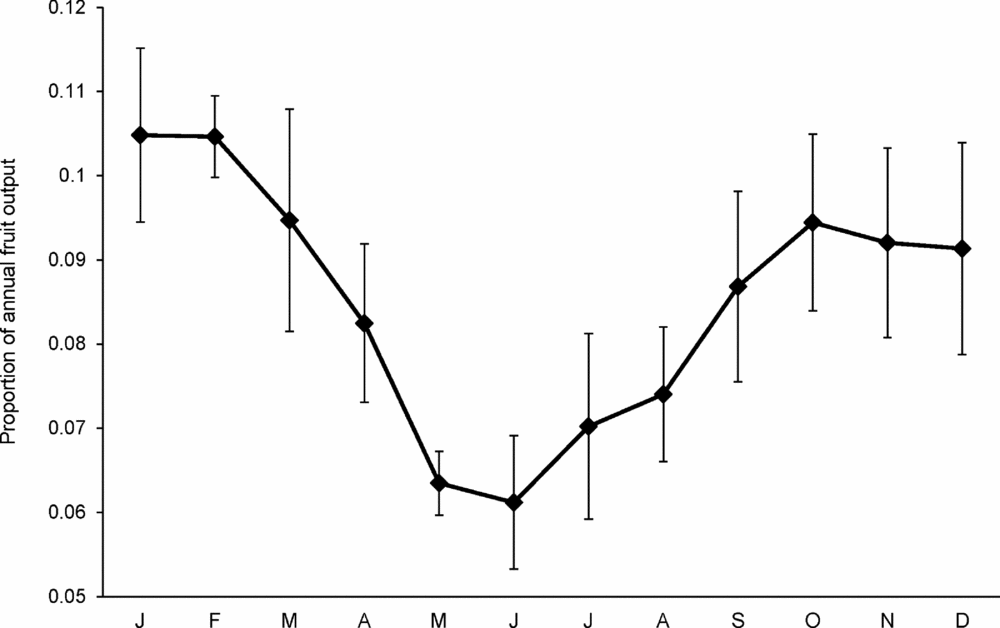
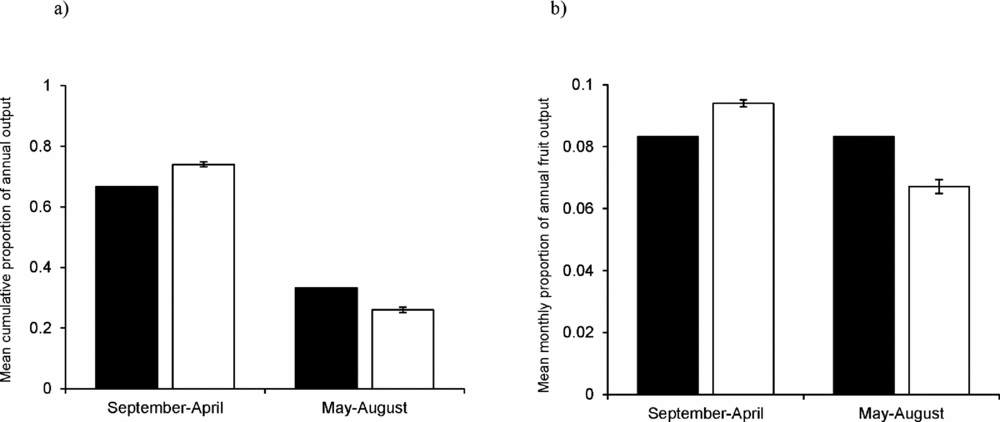
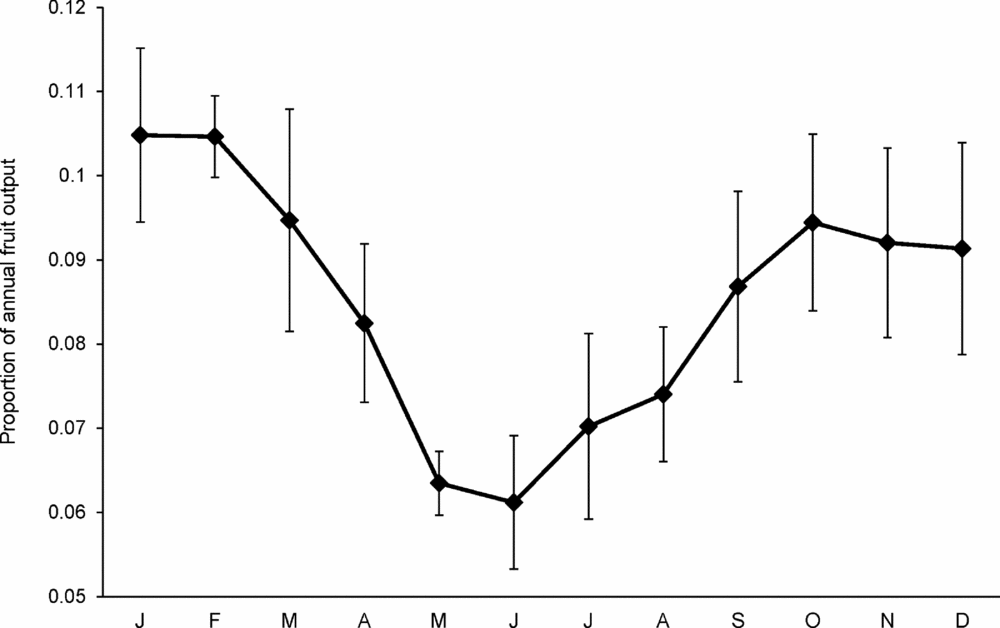
The distribution of whole-community MMROs (Figure 1) indicates a pronounced seasonal variation in fruit availability, with an annual peak during January and February and a trough from May–August. Only 26.0% of annual fruit output is produced from May–August and the remaining 74.0% is produced between September and April, versus the expected ratio of 33.3% and 66.7% (Figure 2a). The mean monthly proportion of annual fruit output (Figure 2b) between May–August (6.7% mo−1), is significantly lower than between September–April (9.4% mo−1, t = −4.68, P <0.001).
Whole-community mean monthly relativized fruit output (MMRO) at Cocha Cashu Biological Station (CCBS), Madre de Dios, Peru, based on year-round fruit fall data recorded within a long-term forest dynamics plot over an 8-y study period from 2003–2010. Error bars are ± 1 SE.
Observed (white bars) vs. expected (black bars) proportions of whole-community annual fruit output at Cocha Cashu Biological Station (CCBS), Madre de Dios, Peru, based on year-round fruit-fall data recorded within a long-term forest dynamics plot over an 8-y study period from 2003–2010. Mean cumulative proportion of annual output over the months of September–April and May–August compared with the expectation of uniform fruit output year-round (a). Mean monthly proportion of annual fruit output for September–April vs. May–August compared with the expectation of uniform fruit output in any given month (b). Error bars are ± 1 SE calculated for sample sizes of 16 (a) and 94 (b).

Temporal non-redundancy and resource reliability
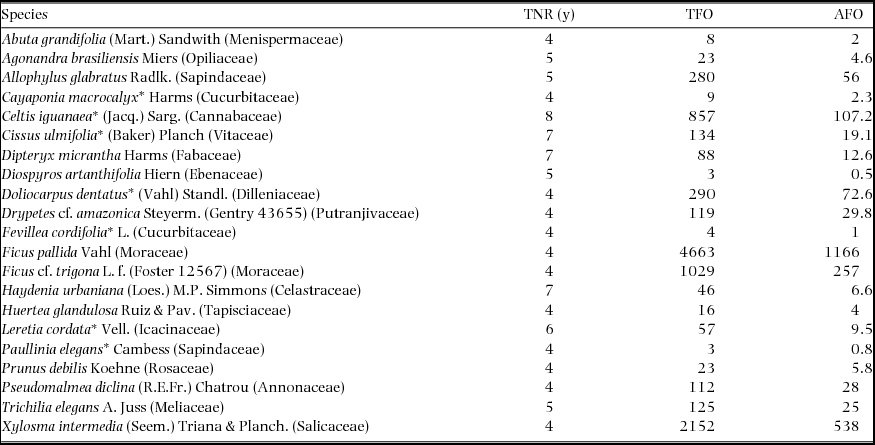
Out of a total of 453 species analysed, 222 species had temporally non-redundant fruiting patterns for at least 1 y. However, only 21 species (<5% of all species analysed), were temporally non-redundant for 50% or more of the 8 y, representing a yearly average of 13.9 species or ~3% of all species (Table 1). Of these 21 temporally non-redundant and reliable species, 12 species showed temporal non-redundancy in 4 y (50%); four species showed temporal non-redundancy in 5 y (62.5%); one species was temporally non-redundant in 6 y (75%); three species were temporally non-redundant in 7 of 8 y (87.5%) and one species – Celtis iguanaea (Cannabaceae) – was temporally non-redundant in all 8 y (Table 1).
Species with temporally non-redundant (TNR) fruiting patterns in ≥4 y over an 8-y period (2003–2010) of year-round fruit-fall data collection within a long-term forest dynamics plot at Cocha Cashu Biological Station (CCBS), Madre de Dios, Peru. Total and average fruit output (TFO and AFO) recorded in seed traps during the season of fruit scarcity (May–August) were tallied for TNR years only. *Scandent or hemiepiphytic growth form.
Resource abundance
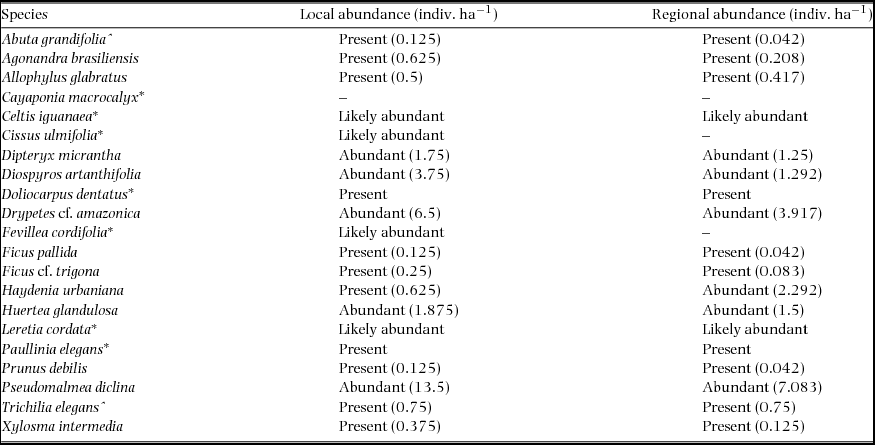
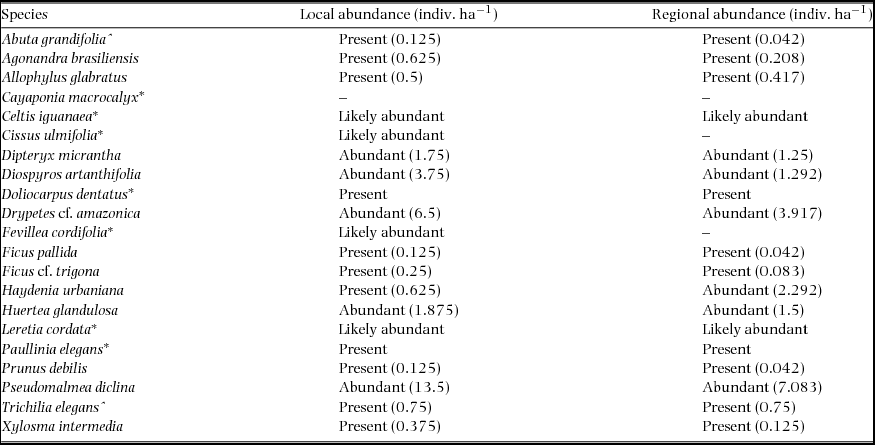
In terms of fruit output recorded in seed traps during the period of fruit scarcity, four out of the 21 reliably temporally non-redundant species averaged >100 fruits per season, eight species averaged between 10–100 fruits per season, three species between 5–10 fruits and six species averaged <5 fruits per season (Table 1). In terms of density of reproductive-size individuals for the 14 tree species, five were ‘abundant’ (≥1 indiv. ha−1) and nine were ‘present’ (<1 indiv. ha−1) on a local scale; six species were ‘abundant’ and eight were ‘present’ on a regional scale (Table 2). Nine of the 21 potential KPR species are lianas. Based on a literature review of the diversity and dominance of liana species locally as well as in the Amazon basin (Ecuador and Peru), four liana species were considered ‘abundant’ and three ‘present’ on a local scale; two species were considered ‘abundant’ and two ‘present’ on a regional scale (Table 2). No information was available on the abundance of Cayaponia macrocalyx, a non-woody climber.
Local and regional abundances of reliably temporally non-redundant species at Cocha Cashu Biological Station (CCBS), Madre de Dios, Peru, based on stem inventory data (six sites and 24 ha total for regional estimates). Species designated as ‘Present’ and ‘Abundant’ have <1 and ≥1 indiv. ha−1, respectively. *Scandent or hemiepiphytic growth form and therefore not included in stem inventory data; abundance estimates are based on published literature. ^ Underestimated abundance.
Consumer generalization
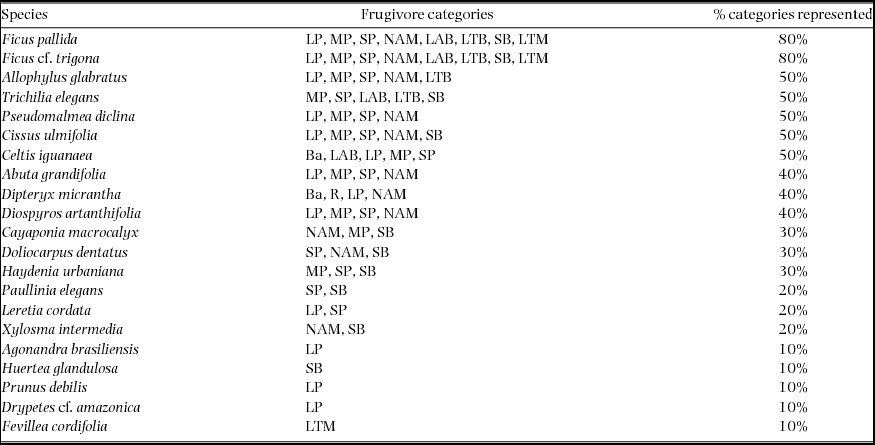
Fruits of nine of 21 temporally non-redundant and reliable species were consumed by 50% or more of all frugivore categories and therefore considered as generalized resources (Table 3).
Categories of frugivores that feed on reliably temporally non-redundant plant species, and the percentage of all frugivore categories they represent at Cocha Cashu Biological Station (CCBS), Madre de Dios, Peru. Frugivore categories: LP – Large-bodied diurnal primates: black spider monkey (Ateles chamek (Humboldt, 1812)), red howler monkey (Alouatta seniculus (Linnaeus, 1766)); MP – Medium-bodied diurnal primates: brown capuchin (Cebus apella (Linnaeus, 1758)), white-fronted capuchin (Cebus albifrons (Humboldt, 1812)); SP – Small diurnal primates: dusky titi monkey (Callicebus moloch (Hoffmannsegg, 1807)), emperor tamarin (Saguinus imperator (Goeldi, 1907)), saddle-back tamarin (Saguinus fuscicollis (Spix, 1823)), squirrel monkey (Saimiri sciureus (Linnaeus, 1758)); NAM – Nocturnal arboreal mammals: kinkajou (Potos flavus (Schreber, 1774)), night monkey (Aotus trivirgatus (Humboldt, 1812)); R – Rodents: agoutis (Dasyprocta spp.), acouchis (Myoprocta spp.); LTM – Large terrestrial mammals: South American tapir (Tapirus terrestris (Linnaeus, 1758)), collared peccary (Pecari tajacu (Linnaeus, 1758)), white-lipped peccary (Tayassu pecari (Link, 1795)); Ba – Bats: fruit bats (Artibeus spp.); LAB – Large arboreal birds: guans (Penelope spp., Aburria spp., Pipile spp.), toucans (Ramphastidae), macaws (Ara spp.), parrots (Amazona spp.); LTB – Large terrestrial birds: pale-winged trumpeter (Psophia leucoptera Spix, 1825), curassows (Crax spp., Mitu spp.); SB – Small birds: tanagers (Thraupidae), manakins (Pipridae).
Overall potential as a KPR
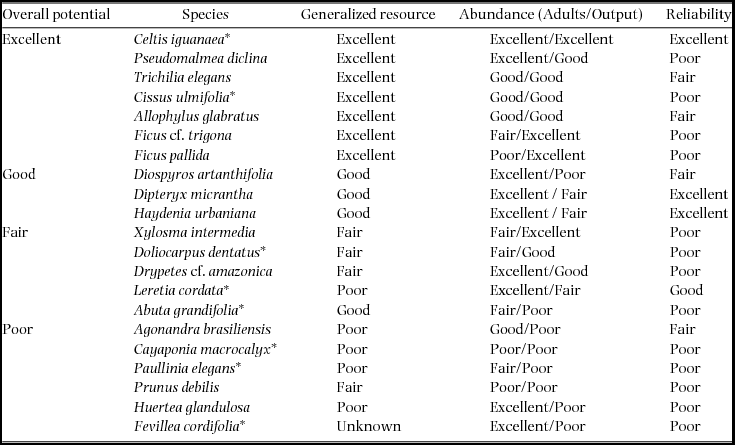
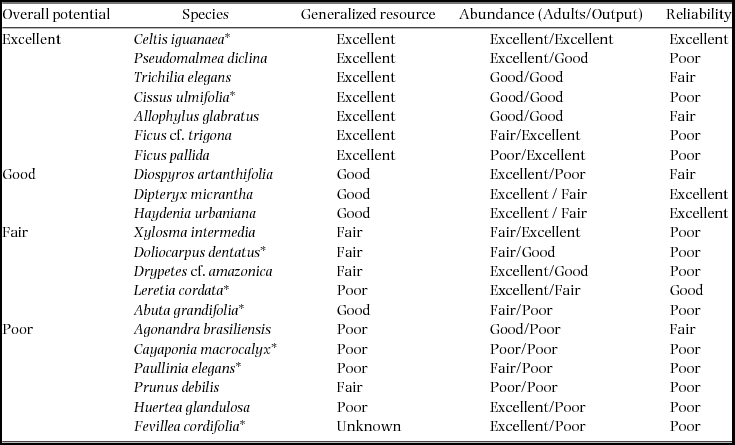
Seven species were considered as ‘excellent’ potential KPRs (Table 4). Two of these belong to the genus Ficus and are consumed by 80% of the frugivore consumer categories. Two liana species (Celtis iguanaea and Cissus ulmifolia) and three tree species (Pseudomalmea diclina, Trichilia elegans and Allophylus glabratus) were also considered ‘excellent’ potential KPRs. Three species were classified as ‘good’ potential KPRs, five species were considered ‘fair’ and six species were considered ‘poor’ (Table 4).
Overall potential of 21 species with temporally non-redundant fruiting patterns at Cocha Cashu Biological Station (CCBS), Madre de Dios, Peru to function as keystone plant resources based on three additional criteria. *Scandent or hemiepiphytic growth form.
DISCUSSION
The observed patterns of fruiting phenology for the whole community confirmed that the months of May–August encompass the season of fruit scarcity while the rest of the year is the season of relative fruit abundance. These results support past studies of fruiting phenology at Cocha Cashu Biological Station (CCBS) that found the annual lows in fruit production to be during the transitional months between the rainy season and the early dry season from May–August, and the season of high fruit production between January–March (Janson & Emmons Reference JANSON, EMMONS and Gentry1990, Terborgh Reference TERBORGH1983, Reference TERBORGH, Soule and Wilcox1986a, Reference TERBORGH, Estrada and Flemingb, Reference TERBORGH and Gentry1990). However, overall fruit output as well as seasonal patterns can change markedly from year to year. For example, in some years, fruit output was lowest in September and/or October whereas in other years, fruit output peaked in these months. Fruiting phenology in tropical forests often varies annually in response to variation in biotic and abiotic factors; rainfall and irradiance are particularly important since they mediate water stress and also affect leafing and flowering (van Schaik et al. Reference VAN SCHAIK, TERBORGH and WRIGHT1993, Wright & van Schaik Reference WRIGHT and VAN SCHAIK1994). Therefore, the observed interannual variation in fruiting patterns at CCBS is likely influenced by variation in the timing, distribution and amount of annual rainfall as well as the amount of monthly irradiance. A detailed analysis of the interaction between fruiting phenology and rainfall patterns is beyond the scope of this study since complete rainfall records for the study region are unavailable for large portions of the study period (2003–2010). Nevertheless, the overall trend over the 8-y study period confirmed that May–August was typically the period of fruit scarcity at CCBS.
Over 450 species were analysed in this study and only 21 of those species exhibited temporal non-redundancy for 50% or more of the study years, emphasizing their importance during the season of fruit scarcity. Several species were considered temporally non-redundant in at least one, but less than four, of the eight study years. It is possible that frugivores opportunistically utilize these species in addition to more reliable potential keystone plant resources (KPRs) to sustain their populations during the season of fruit scarcity when food resources are limited (Leighton & Leighton Reference LEIGHTON, LEIGHTON, Sutton, Whitmore and Chadwick1983, Peres Reference PERES2000, Terborgh Reference TERBORGH, Soule and Wilcox1986a). However, our evaluation of the reliability criterion and interpretation of results are constrained by the relatively small size of the sample area (1.44 ha), which is likely not large enough to capture fruiting events on an annual basis for less abundant species. Given that not all reproductive-size individuals of any species fruit every year, the sample area may not include sufficient fruiting individuals of these species to register annual records of fruiting, even if the fruiting period for these species is consistent from year to year.
Unlike the other criteria, resource abundance does not ‘make or break’ a species’ potential as a KPR but a putative KPR should be sufficiently abundant that its removal would have a significant impact on the consumer community (Peres Reference PERES2000). Although only local abundance was used in ranking the overall potential of putative KPRs, information on regional abundance, when available, enhances the scope of this study by indicating whether potential KPRs identified at this study site are important at a regional scale as well. Therefore, reliably temporally non-redundant species that are abundant both regionally and locally, such as Pseudomalmea diclina, Drypetes cf. amazonica, Diospyros artanthifolia, Huertea glandulosa and Dipteryx micrantha, are excellent candidates for KPRs at a regional scale. Dipteryx micrantha is a common and well-studied species at CCBS as well as in other regions of the neotropics (Cintra Reference CINTRA1997). Species such as Xylosma intermedia, Ficus cf. trigona, Trichilia elegans, Agonandra brasiliensis, Allophylus glabaratus, Prunus debilis and Ficus pallida, were present both locally and regionally but only locally abundant (based on stem density or fruit output), suggesting that their potential as KPRs is restricted to the mature floodplain forest habitat that characterizes CCBS.
Seven species are either scandent or hemiepiphytic and were therefore not accounted for in tree inventories. One liana species Abuta grandifolia that frequently attains a diameter >10 cm is occasionally but not systematically censused in tree inventories, resulting in an underestimation of its local as well as regional abundance. Both Celtis iguanaea and Leretia cordata are dominant liana species contributing to the oligarchy of lianas in Ecuador (Burnham Reference BURNHAM2002), which confirms their regional and likely local importance as well. Paullinia elegans and Doliocarpus dentatus have been documented in Ecuador (Nabe-Nielsen Reference NABE-NIELSEN2001), indicating that they are distributed regionally. Cissus ulmifolia and Fevillea cordifolia are locally abundant at CCBS (McManus Reference MCMANUS2003); information on their regional distribution was unavailable. Total and average fruit outputs recorded in seed traps indicate if a reliably TNR species is fecund enough to serve as a likely KPR. Nine species that recorded <5 fruits per season on average over the 8 y of analysis are therefore poor candidates for KPRs. However, this observation is misleading, given the relatively small sample area, which limits the presence/density of reproductive individuals of less common species and therefore does not provide an accurate estimate of fruit output for these species. Additionally, inherent differences in biomass and nutritional content of fruit were beyond the scope of, and not accounted for, in this study, thus limiting the qualitative comparison of fruit output between species. Furthermore, the passive sampling design (an evenly spaced grid of seed traps) used in this study unavoidably underestimates the true fruit crop size of most species, particularly for species with distinct morphologies and architectures, such as unbranched palms and cauliflorous species. The passive sampling design could also substantially underestimate the fecundity and true fruit crop size of certain highly valued fruit resources (e.g. Diospyros artanthifolia, Dipteryx micrantha) whose output is consumed almost entirely by arboreal frugivores, resulting in scant fruit-fall data consisting primarily/entirely of dispersed seeds.
Determining consumer generalization was hampered by the high floristic diversity of the study site (and of the neotropics in general) and the paucity of available literature, especially for less common species. Some plant species may be more generalized and therefore more important than indicated by this study since the 50% cut-off was based only on available information in the literature. Thus, it is probable that more consumer categories than we report feed on the less common species. In addition, during the period of fruit scarcity, frugivores may consume certain less-palatable species that are available year-round but not consumed during periods of high fruit availability of preferred species (Terborgh Reference TERBORGH1983, Reference TERBORGH, Soule and Wilcox1986a, Reference TERBORGH, Estrada and Flemingb; van Schaik et al. Reference VAN SCHAIK, TERBORGH and WRIGHT1993). Consequently, the number of consumer categories may be underestimated for some species, whereas there is greater certainty in the number of consumer categories for the more common plant species.
Only seven species of more than 450 analysed in this study met the requirements to qualify as ‘excellent’ potential KPRs. Two of these belong to the genus Ficus, confirming the importance of this genus as a KPR in the tropics (Lambert & Marshall Reference LAMBERT and MARSHALL1991, Leighton & Leighton Reference LEIGHTON, LEIGHTON, Sutton, Whitmore and Chadwick1983, Mabberley Reference MABBERLEY1992, Terborgh Reference TERBORGH, Estrada and Fleming1986b, van Schaik et al. Reference VAN SCHAIK, TERBORGH and WRIGHT1993). Terborgh (Reference TERBORGH, Soule and Wilcox1986a) even speculated that the removal of Ficus from the flora at CCBS would result in ecosystem collapse. Celtis iguanaea, an abundant liana species across the Amazon Basin was also previously identified as a potential KPR at CCBS; this was the only species in our study that displayed temporal non-redundancy in all 8 y, which further enhances its potential as a KPR. Allophylus glabratus is a common understorey treelet, whose congener Allophylus scrobiculatus, was previously identified as a potential KPR at CCBS, suggesting that the genus Allophylus may serve as an important KPR during the season of fruit scarcity. Cissus ulmifolia, a newly identified potential KPR at CCBS, is a dominant liana in early successional habitats along the Manu River in Peru (McManus Reference MCMANUS2003). Trichilia elegans, a common midstorey tree, and Pseudomalmea diclina, a common (sub-) canopy species have also not previously been identified as potential KPRs; these species are therefore significant additions to the literature on KPRs.
Certain species classified as having intermediate (‘good’ and ‘fair’) overall potential as KPRs catered to specialized consumers and/or had low output. For example, canopy bats as well as rodents forage heavily on Dipteryx micrantha, a large emergent tree (Cintra Reference CINTRA1997, Romo et al. Reference ROMO, TUOMISTO and LOISELLE2004). These species are vital plant resources for their specific frugivorous consumers but not for the frugivore community as a whole. Other species that ranked poorly overall as potential KPRs were either uncommon or had low fecundity or were eaten only by specialized consumers. In general, species with localized occurrence and/or abundance are likely important KPRs for the communities where they occur but not important on a larger scale. This concurs with past studies suggesting that the relative importance of different KPRs may depend on the spatial scale of the analysis (Peres Reference PERES2000, Terborgh Reference TERBORGH, Estrada and Fleming1986b).
Our findings have significant implications for the conservation and management of neotropical forests. It is important to emphasize that a very small portion, about 5%, of the total fleshy fruit-bearing plant community can be considered as potential KPRs and only about 2% can be considered ‘excellent’ potential KPRs. Because KPRs may set the carrying capacity of a frugivore community (Terborgh Reference TERBORGH1983, Reference TERBORGH, Soule and Wilcox1986a), it is essential to keep this small albeit critically important group of species in mind when selecting areas to protect, monitoring for ecosystem health or attempting habitat restoration. For example, designation of Pseudomalmea diclina as a KPR would raise its conservation profile since this species is commonly harvested for timber in the Madre de Dios basin (Alvarez-Loayza et al. Reference ALVAREZ-LOAYZA, WHITE and GIRALDO2008). Providing protection to KPR species in currently unprotected, fragmented or disturbed forests could boost nutritive resources for frugivores, which often expand their home ranges in search for food during seasons of fruit scarcity (Terborgh Reference TERBORGH1983, van Schaik et al. Reference VAN SCHAIK, TERBORGH and WRIGHT1993). Prior information on the KPRs of a disturbed or degraded forest habitat could also help in reforestation efforts by making the restored forest more hospitable for animal species to recolonize. Finally, because of the mutualistic relationship between plants and their seed dispersers, it is imperative to maintain healthy and abundant populations of frugivores that will inevitably facilitate forest regeneration.
ACKNOWLEDGEMENTS
Financial support for this research was provided by the Andrew Mellon Foundation and the National Science Foundation (DEB 0742830). Z. D-M. was supported by a grant from the Goodwin-Niering Center for the Environment at Connecticut College. V.S. was supported by a 2012–13 Bullard Fellowship in Forest Research from Harvard Forest. Seed fall data collection received assistance from Amador Tapia, Angelica Garcia, Antonio Guerra, Beth Pringle, Cecilia Ramirez, Clara Rojas, Jenifer Alvarez, Juan Kapeshi, Julian Huarancasi, Kyle Dexter, Luis Delgado, Nancy Suarez, Nadir Pallqui, Natalia Quinteros, Nohemi Huanca, Victor Chama and Yuri Huillca. We thank the Instituto Nacional de Recursos Naturales (INRENA) and Servicios Nacionales a Areas Naturales Protejidas (SERNANP), Peru for providing authorization to conduct research in Manu National Park. Comments and suggestions from Mercedes Foster and two anonymous reviewers greatly enhanced the quality of this manuscript.