Introduction
Soybean is one of the most important crops in Korea used in food products, industries and animal feeds. In 2010, the total demand for soybeans was 1,381,000 ton in Korea, of which 70, 24 and 6% were used for animal feeds, industrial processing and food products, respectively. Although a high demand for soybean was expected for animal feed production, soybean breeding researches carried out in Korea have been focused on the improvement of soybean traits for food products, such as soy sauce, tofu, soybean sprouts, and soybean used for cooking with rice. Until now, a total of 135 soybean varieties have been released in Korea and most of them have been developed by conventional breeding techniques (http://www.seed.go.kr).
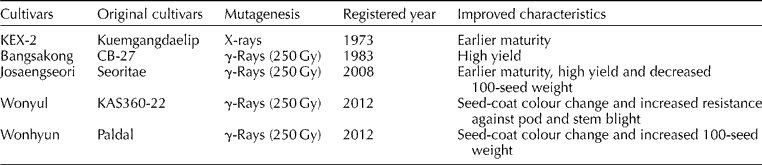
Induced mutagenesis is also used to improve crop varieties or create new genetic variations. According to the Food and Agriculture Organization of the United Nations (FAO) – International Atomic Energy Agency (IAEA) Mutant Variety Database (http://www-mvd.iaea.org), about 3000 plant mutant varieties have been released worldwide. Most of them (60%) have been derived using physical radiations (γ-rays or X-rays). In Korea, mutation breeding in crops was started in the mid-1960s and about 35 plant cultivars have been released (Kang et al., Reference Kang, Kim and Lee2007). By means of physical irradiation or combined with chemical mutagenesis, about 30 new plant cultivars including rice, sesame, hibiscus, soybean, barley and boxtron (Chinese matrimony vine, Lycii fructus) have been developed by the Korea Atomic Energy Research Institute (KAERI) or the Rural Development Administration (RDA). The KAERI has unique radiation facilities for acute and chronic γ-irradiation and has developed five soybean mutant cultivars (Table 1 and Fig. 1). This paper summarizes the main achievements and the current situation of soybean mutation breeding programmes and genetic studies in the KAERI.
Registered soybean mutant cultivars developed through physical irradiation at the Korea Atomic Energy Research Institute (KAERI)

Different agronomic characteristics of soybean mutant cultivars compared with their original cultivars.

Improvement of agronomic characteristics
Maturity and yield
The first early-maturity mutant soybean cultivar ‘KEX-2’ was developed by X-ray irradiation of ‘Kuemgangdaelip’ in 1973 (Table 1). Kuemgangdaelip was the elite cultivar (1.12 ton/ha) in the 1970s, but it had late maturing characteristics (02–08 October). Because ‘KEX-2’ matured 11 d earlier than the original cultivar, 30% increased yield was observed and this was suitable for the barley–soybean cropping system in Korea. Through a joint project between the RDA and the KAERI in 1983, a second soybean mutant cultivar ‘Bangsakong’ was developed from ‘CB-27’, which was introduced from the USA, through γ-irradiation at a dose of 250 Gy (Table 1 and Fig. 1). ‘Bangsakong’ exhibited a 15% increased seed yield (2.58 ton/ha) and a small seed size (100-seed weight: 12 g) compared with the elite soybean sprout cultivar Jangyeopkong (2.24 ton/ha). Therefore, it was broadly cultivated for soybean sprouts in Korea (Kang et al., Reference Kang, Kim and Lee2007).
In 2005, a new improved soybean mutant variety ‘Josaengseori’ was developed from ‘Seoritae’, which was a very famous variety of black soybean for cooking with rice, through γ-irradiation at a dose of 250 Gy (Table 1 and Fig. 1). ‘Seoritae’ had poor agronomic traits, such as late flowering (66 d after seedling) and maturity (164 d after seedling). However, ‘Josaengseori’ had a 10-d earlier flowering period and a 34-d earlier maturation period compared with ‘Seoritae’ (Song et al., Reference Song, Kim, Lee, Kim, Kim, Lee and Kang2010). This early maturation in ‘Josaengseori’ led to 2.4 times higher seed yield (1.79 ton/ha) and 20% lower 100-seed weight (32.8 g) compared with the original cultivar (0.74 ton/ha, 40.1 g).
Seed-coat colour
Two seed-coat colour mutant cultivars were developed through γ-irradiation at a dose of 250 Gy. One mutant cultivar ‘Wonyul’ was derived from a Korean soybean landrace, KAS360-22, in 2010 (Table 1). The seed-coat colour of ‘Wonyul’ changed from yellow (KAS360-22) to brown (Fig. 1). ‘Wonyul’ also exhibited disease resistance to pod and stem blight compared with the original landrace. The seed-coat colour of another mutant cultivar ‘Wonhyun’ derived from cv. Paldal changed from yellow (cv. Paldal) to black (Table 1 and Fig. 1). These types of seed-coat colour mutants were also recorded in different varieties in many other researches (Prakash et al., Reference Prakash, Trivedi, Kerketta, Haque and Prakash1984; Mahamune and Kothekar, Reference Mahamune and Kothekar2011).
Kunitz trypsin inhibitor activity
Kunitz trypsin inhibitor (KTi) has significant antinutritive effects in soybean seeds. A total of 451 soybean mutant lines were screened to select for low KTi activity using a spectrometric method (Kim et al., Reference Kim, Lee, Kim, Kim, Song, Seo, Lee and Kang2010). Among the 451 mutant lines, 144 mutant lines exhibited decreased KTi activity when compared with the original cultivars. Using single-nucleotide-amplified polymorphism marker distinguishing KTi types between Tia and Tib, eight mutant lines having different KTi activities when compared with the original cultivars were identified.
Seed storage protein patterns
Soybean seed storage proteins consist of two major components: glycinin (11S globulin) and β-conglycinin (7S globulin). Glycinin consists of five subunits (A1aB2, A1bB1b, A2B1a, A3B4 and A5A4B3) and β-conglycinin consists of α-, α′- and β-subunits. Through sodium dodecyl sulfate- polyacrylamide gel electrophoresis (SDS-PAGE) analysis using 414 mutant lines (Lee et al., Reference Lee, Kim, Kim, Ha, Lee, Kang and Kim2011), various changes in β-conglycinin subunits were identified. Among these, 113 mutant lines were found to lack the α-subunit and 89 mutant lines the α′-subunit and 38 mutant lines were found to have an altered β-subunit of β-conglycinin. Also, the A3 subunit of glycinin was absent in 149 mutant lines.
Lipoxygenase-lacking soybean
Most of the soybean products have undesirable ‘beany’ flavour caused by the activity of lipoxygenase enzymes. Therefore, the development of lipoxygenase-free soybean is important for improving the taste of many soybean products. In the KAERI, using SDS-PAGE and colorimetric assay, four mutant lines (H6, H22, H23 and H70) exhibiting triple null traits were identified from a soybean mutant population derived through γ-irradiation of cv. Hwanggumkong. These lipoxygenase-null mutants were used for the genetic analysis of lipoxygenase-1, -2 and -3 genes (Lee et al., Reference Lee, Velusamy, Kim, Ha, Kim, Kang, Lee and Kim2013).
Reverse genetics in soybean
Mutation genetic resources are highly important not only for the improvement of crop cultivars but also for functional genomic research purposes in the post-genomic era. TILLING (Targeting Induced Local Lesions in Genomes) is the most common reverse genetic approach. The KAERI has also started developing a TILLING population with a black seed-coat soybean cultivar, Chungja-3 (Velusamy et al., Reference Velusamy, Ha, Kim, Kim, Kang and Kim2013). A total of 3500 M2 lines have been developed from Chungja-3 through γ-irradiation at a dose of 250 Gy. The NEATTILL (Nucleic acid Extraction from Arrayed Tissue for TILLING) method has been applied for pooling samples in eightfold pools (Sreelakshmi et al., Reference Sreelakshmi, Gupta, Bodanapu, Chauhan, Hanjabam, Thomas, Mohan, Sharma, Srinivasan and Sharma2010). Currently, multiple target genes are being used for identifying specific mutant lines. This TILLING population would be useful for soybean functional genetic studies.
Conclusions
Mutation breeding techniques have made an important contribution to soybean improvement in Korea. In the initial stages of mutation breeding technique development, morphological variations, including plant height, maturity, and seed-coat colour, were the major selection and breeding targets. Later, several mutants associated with seed-quality components, such as lipoxygenase enzymes, KTi activity and soybean seed storage proteins, were developed in the KAERI. Currently, the application of mutation breeding techniques is being expanded to gene discovery and reverse genetics with TILLING or next-generation DNA sequence technology. The TILLING population developed using γ-rays in the KAERI will accelerate functional genomic research and development of superior cultivars in soybean.
Acknowledgements
This work was supported by the National Research Foundation of Korea (NRF) grant funded by the Korean Government (NRF-2012M2A2A6010566), a grant from the KAERI, and a grant from the Next-Generation BioGreen 21 Program (no. PJ009091), RDA, Republic of Korea.