Introduction
The International Union for the Conservation of Nature (IUCN) classifies humpback whales (Megaptera novaeangliae) in the category of Least Concern with an increasing population trend (Cooke, Reference Cooke2018). However, it remains important to understand and determine the possible short, medium and long-term effects of anthropogenic pressures and climate change on these whales and their habitats (Chou et al., Reference Chou, Kershaw, Maxwell, Collins, Strindberg and Rosenbaum2020; Santora et al., Reference Santora, Mantua, Schroeder, Field, Hazen, Bograd, Sydeman, Wells, Calambokidis, Saez, Lawson and Forney2020). Examples of these effects are the changes in migratory patterns observed in humpback whale winter aggregation areas (Cartwright et al., Reference Cartwright, Venema, Hernández, Wyels, Cesere and Cesere2019; Avila et al., Reference Avila, Dormann, García, Payán and Zorrilla2020). Studies of the species in the North Pacific have been conducted in different zones although there are unknown winter locations because individuals from feeding areas were not well represented in the known wintering grounds (Hill et al., Reference Hill, Bradford, Steel, Baker, Ligon, Adam, Acebes, Filatova, Hakala, Kobayashi, Yukari, Okabe, Okamoto, Rivers, Sato, Titova, Uyeyama and Oleson2020). Effective conservation of whale stocks requires integral knowledge of their local distribution, abundance and habitat use patterns (Bejder et al., Reference Bejder, Johnston, Smith, Friedlaender and Bejder2016) over a long period of time.
The North Pacific population is estimated to be around 21,000 animals, of these, 8000 breed in the Mexican Economic Exclusive Zone (EEZ) (Barlow et al., Reference Barlow, Calambokidis, Falcone, Baker, Burdin, Clapham, Ford, Gabriele, LeDuc, Mattila, Quinn, Rojas-Bracho, Straley, Taylor, Urbán, Wade, Weller, Witteveen and Yamaguchi2011; Bettridge et al., Reference Bettridge, Barlow, Clapham, Ford, Gouveia, Mattila, Pace, Rosel, Silber and Wade2015). These whales have a wide distribution in this zone; their main winter aggregation areas are in the waters around Los Cabos, the Revillagigedo Archipelago, and the Pacific continental coast of Mexico where Banderas Bay receives the highest concentration of whales from the so-called ‘coastal stock’ (Urbán & Aguayo, Reference Urbán and Aguayo1987; Urbán et al., Reference Urbán, Alvarez, Salinas, Jacobsen, Balcomb, Jaramillo, Ladrón de Guevara and Lobo1999; Medrano & Urbán, Reference Medrano-González and Urbán-Ramírez2002; Calambokidis et al., Reference Calambokidis, Falcone, Quinn, Burdin, Clapham, Ford, Gabriele, LeDuc, Mattila, Rojas-Bracho, Straley, Taylor, Urbán, Weller, Witteveen, Yamaguchi, Bendlin, Camacho, Flynn, Havron, Huggins, Maloney, Barlow and Wade2008; Barlow et al., Reference Barlow, Calambokidis, Falcone, Baker, Burdin, Clapham, Ford, Gabriele, LeDuc, Mattila, Quinn, Rojas-Bracho, Straley, Taylor, Urbán, Wade, Weller, Witteveen and Yamaguchi2011). They have a complex dynamic of their site fidelity within the ‘main wintering ground’ (Medrano-González et al., Reference Medrano-González, Aguayo, Urbán and Baker1995; Urbán et al., Reference Urbán, Alvarez, Salinas, Jacobsen, Balcomb, Jaramillo, Ladrón de Guevara and Lobo1999, Reference Urbán, Jaramillo, Aguayo, Ladrón de Guevara, Salinas, Álvarez, Medrano, Jacobsen, Balcomb, Claridge, Calambokidis, Steiger, Straley, von Ziegesar, Waite, Mizroch, Dahlheim, Darling and Baker2000; Medrano-González & Urbán, Reference Medrano-González and Urbán-Ramírez2002; Calambokidis et al., Reference Calambokidis, Falcone, Quinn, Burdin, Clapham, Ford, Gabriele, LeDuc, Mattila, Rojas-Bracho, Straley, Taylor, Urbán, Weller, Witteveen, Yamaguchi, Bendlin, Camacho, Flynn, Havron, Huggins, Maloney, Barlow and Wade2008; Barlow et al., Reference Barlow, Calambokidis, Falcone, Baker, Burdin, Clapham, Ford, Gabriele, LeDuc, Mattila, Quinn, Rojas-Bracho, Straley, Taylor, Urbán, Wade, Weller, Witteveen and Yamaguchi2011; Baker et al., Reference Baker, Steel, Calambokidis, Falcone, González-Peral, Barlow, Burdin, Clapham, Ford, Gabriele, Mattila, Rojas-Bracho, Straley, Taylor, Urbán, Wade, Weller, Witteveen and Yamaguchi2013), however, we know very little about the biology and ecology of the coastal stock in a large part of its distribution, including Isabel Island National Park localized between Los Cabos and Banderas Bay breeding areas (Alvarez, Reference Alvarez1987; Urbán & Aguayo, Reference Urbán and Aguayo1987; Alvarez et al., Reference Alvarez, Aguayo, Rueda and Urbán1990; Calambokidis et al., Reference Calambokidis, Falcone, Quinn, Burdin, Clapham, Ford, Gabriele, LeDuc, Mattila, Rojas-Bracho, Straley, Taylor, Urbán, Weller, Witteveen, Yamaguchi, Bendlin, Camacho, Flynn, Havron, Huggins, Maloney, Barlow and Wade2008; Sosa Bonequi, Reference Sosa Bonequi2016). Even though Isabel Island is listed as a national park, knowledge of its marine fauna is scarce or even unknown for many biological groups and the National Park does not include a maritime area. Giving its geographic location, the surrounding waters of Isabel Island National Park appear to be an important transit area for humpback whales for their migration during the winter months.
The present study analyses basic aspects of the ecology of these whales including photo-identification, social organization, abundance, habitat characterization and singing activity, which is performed exclusively by males (Darling & Bérubé, Reference Darling and Bérubé2001), for the 2007–2013 period in waters surrounding Isabel Island National Park (30 km), as well as movements of individual humpback whales to Banderas Bay (100 km south-west). Generation of knowledge on the habitat use, transit among these waters by humpback whales and their wintering ground of Banderas Bay may show the importance of this area for species conservation. Moreover, it provides basic ecological information to encourage the legal protection of this marine area.
Materials and methods
Ethical statement
All sightings and activities involving whales were conducted in strict accordance with current Mexican regulations under research permits SGPA/DGVS/00245 to SGPA/DGVS/12329/12 issued by the Wildlife Agency (DGVS) of the Mexican Department of Environment and Natural Resources (SEMARNAT) in coordination with personnel of the Mexican Commission for Protected Areas (CONANP) for the Isabel Island National Park.
Study area
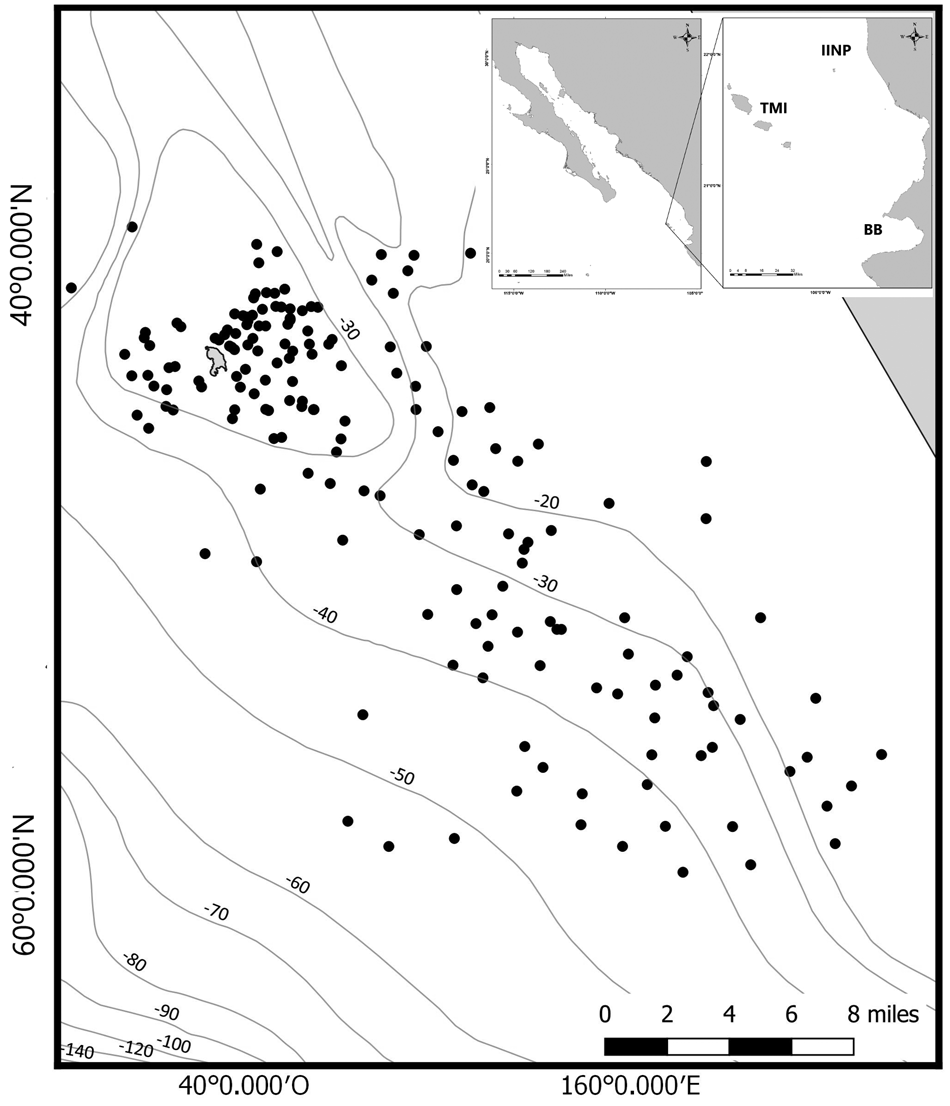
Isabel Island National Park is a small island located between the coast of Nayarit and the Tres Marías Islands in the vicinity of the mouth of the Gulf of California at 21°84′65″N 105°88′32′′W, in the central-western Pacific, Mexico. It has a total area of 821,641 hectares and is located 30 km from the west coast of Nayarit and 61.5 km NE of Marias Islands (Alvarez-Flores, Reference Alvarez1987; CONANP, 2005; Alvarez et al., 2017; Figure 1). This island rises 60–80 m above the platform and extends 20 km in the NW–SE direction and 17 km in a perpendicular direction. It is of volcanic origin with tuff cones, basaltic flows and explosion craters exposed (Alvarez et al., Reference Alvarez, Corbo and Yutsis2017). Isabel Island National Park's surrounding waters are subject to interannual variations produced by seasonal oceanographic conditions and by events such as the El Niño Southern Oscillation (ENSO) (Lavín et al., Reference Lavín, Durazo, Palacios, Argote and Carrillo1997; Escalante et al., Reference Escalante, Valdez-Holguín, Álvarez-Borrego and Lara-Lara2013). The main activities being carried out on this island and in the adjacent marine area, are those associated with artisanal fishing, tourism oriented towards the observation of wildlife through tours of the island, camping, diving, sport fishing and scientific research. Isabel Island is a National Park protected by the Mexican law (CONAP, 2005) but no protection extends to the marine waters around the island.
Location of Isabel Island National Park, Mexico, and distribution of the humpback whale sightings documented during the 2007–2013 breeding seasons. BB, Banderas Bay; TMI, Tres Marias Islands; IINP, Isla Isabel National Park.

Sampling
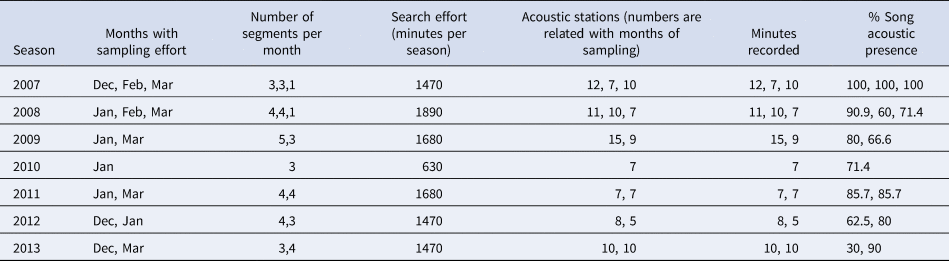
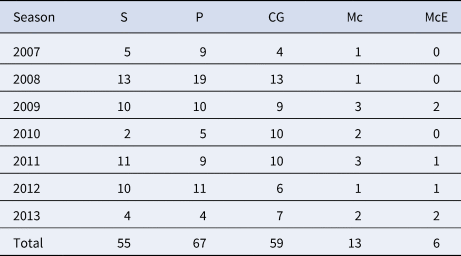
From December to March of 2007–2013 we conducted surveys in the vicinity of Isabel Island National Park onboard a 7 m boat with an outboard engine (Table 1). Each navigation departed from the port of San Blas, Nayarit, trying to perform a zigzagging course towards Isabel Island. Three simultaneous observers were present during every survey (1 in the bow, 1 at port side and 1 at starboard side). Due to the heterogeneity in the effort between the different years and to be able to compare the information between years, searching effort time was divided into ‘segments’ of 3.5 h (equivalent to navigation intervals of 210 min), so the number of segments per survey and per month of each year was variable (Table 1). Every time we sighted a group of whales, navigation was interrupted to approach the group and follow it long enough to confirm the species identity and the composition of the group (number of individuals and presence of calves). Sighting positions were georeferenced using a GPS, and then mapped in a geographic information system. Once near the island, circumnavigations were made around it in search of humpback whales (Figure 1). The classification of the types of whale groups observed included: single individual (S), pair (P), competition group (CG) for sightings with three or more adult whales, Mother-calf pair (Mc) and Mother-calf and escort (McE) (Table 2).
Humpback whale sampling effort at Isabel Island, Jalisco, Mexico

Each segment considered for the abundance analysis was 210 min long. Acoustic sampling consisted of listening for one minute for the presence of any singing activity in each station.
Number of whale sightings per group type per season (2007–2013) in the waters surrounding Isabel Island National Park in western-central Mexico

S, Single individual; P, Pair; CG, Competition group; Mc, Mother with calf; McE, Mother with calf and escort.
Photo-identification
Whenever possible, every whale sighted was photographed from the ventral side of its fluke (Katona et al., Reference Katona, Baxter, Brazier, Kraus, Perkins and Whitehead1979) using a DSLR camera equipped with 300 mm lens. Pictures were later edited for cataloguing purposes using ACDSee pro-6. The best pictures of each individual in each sighting were selected to build a photo-identification catalogue. Photo quality was graded considering the angle of the photo as well as its sharpness. Only photos that included 3/4 or more of the fluke, with a front angle or slightly angled and with good sharpness were included following the same criteria as with Structure of Populations Levels of Abundance and Status of Humpbacks (SPLASH) in 2004–2006 (Calambokidis et al., Reference Calambokidis, Falcone, Quinn, Burdin, Clapham, Ford, Gabriele, LeDuc, Mattila, Rojas-Bracho, Straley, Taylor, Urbán, Weller, Witteveen, Yamaguchi, Bendlin, Camacho, Flynn, Havron, Huggins, Maloney, Barlow and Wade2008). Each identified whale was classified and assigned in one of five possible categories depending on the colour pattern of its fluke (from category 1 for completely white to category 5 for completely black) (Katona et al., Reference Katona, Baxter, Brazier, Kraus, Perkins and Whitehead1979; Katona & Whitehead, Reference Katona and Whitehead1981), in a unique identification code indicating the colour category (1–5). The selected pictures were used to conduct paired comparisons of each picture with all other pictures. Considering comparisons within and between years a record of individuals’ recaptures was created. Comparisons with the Photo-Identification Catalog of Banderas Bay (FIBB), spanning 1996–2016 which includes 2269 uniquely identified whales (https://whalephoto.org/), were also done. The reason for comparison with FIBB, is because the whales from Banderas Bay, Marias Islands and Isabel Island National Park are considered part of the continental stock of Mexico (Urbán et al., Reference Urbán, Jaramillo, Aguayo, Ladrón de Guevara, Salinas, Álvarez, Medrano, Jacobsen, Balcomb, Claridge, Calambokidis, Steiger, Straley, von Ziegesar, Waite, Mizroch, Dahlheim, Darling and Baker2000; Barlow et al., Reference Barlow, Calambokidis, Falcone, Baker, Burdin, Clapham, Ford, Gabriele, LeDuc, Mattila, Quinn, Rojas-Bracho, Straley, Taylor, Urbán, Wade, Weller, Witteveen and Yamaguchi2011).
Habitat
To characterize the habitat of the humpback whales surrounding Isabel Island, we used the coordinates of the sightings to map them out. Sighting locations using ArcMap, and each sighting was associated to the following variables: sea surface temperature (SST) with values obtained in situ with a manual gallium thermometer; depth, using the General Bathymetric Chart of the Ocean (GEBCO), downloading data using the ‘Download data for user-defined areas’ for the adjacent waters of Isabel Island National Park (https://download.gebco.net/); distance to the continental coast, using the script for ‘Euclidean distance’; and slope using the script ‘Surface-Slope’. We chose distance to continental slope due to the small size of the island (only 3 km in length and 1.5 in width), and the large extent of the continental shelf. All sightings were projected into the geographic information system ArcMap, using the geographic coordinates, and for each sighting we used the function ‘Extract by points’ to assign the values of these variables (Ersts & Rosenbaum, Reference Ersts and Rosenbaum2003; Chou et al., Reference Chou, Kershaw, Maxwell, Collins, Strindberg and Rosenbaum2020).
Singing activity
Singing activity, was assessed as the presence/absence of singing sounds (regardless of the number of singers or the intensity of the song) documented every hour of navigation by listening with an omnidirectional SQ26-H1 hydrophone with a frequency range of 0.20–50 kHz and a speaker. A singing activity ‘station’ refers to each time the hydrophone was dipped to listen for 1 min the presence of any singing activity. Singing activity in the waters adjacent to the island, was assumed as a simple metric of the reproductive activity of males in the area (Table 1) (Winn & Winn, Reference Winn and Winn1978; Tyack, Reference Tyack1981; Darling & Bérubé, Reference Darling and Bérubé2001).
Statistical analysis
Due to the small variation in depth around the island, and in the transit to Banderas Bay, we analyse only the temporal variation (not spatial) of the whale abundance, measured as the number of individuals documented per unit of effort, using a non-parametric analysis of variance (ANOVA), based on permutations with a Euclidean distance matrix (Anderson et al., Reference Anderson, Gorley and Clarke2008). This ANOVA was based on a nested One factor model. The fixed factor ‘reproductive season’ had seven levels (2007 to 2013) and the random factor ‘month’ had four levels (December, January, February and March) nested on the reproductive season (Tables 1, 2). The number of individuals for each effort segment was considered as a repetition for the permutations.
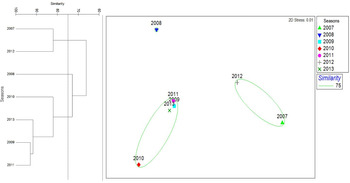
Temporal variation in whale group composition was analysed with a Non-metric Multidimensional Scaling Analysis (NMDS) and a Cluster Analysis (CA) using the group average linking method and a cut-off of 75%. Data were transformed using a square root transformation prior to building a Bray–Curtis similarity matrix (Anderson et al., Reference Anderson, Gorley and Clarke2008). To test if there were significant seasonal differences in SST, depth, distance to the continental coast and slope at whale sightings, non-parametric ANOVAs based on permutations with Euclidean distance matrix (Anderson et al., Reference Anderson, Gorley and Clarke2008) were performed. A One factor model with fixed effect and seven levels (seasons 2007–2013) was taken into account. Every sighting of a whale group was considered a repetition. Prior to the permutation ANOVAs, data were square root transformed (Anderson et al., Reference Anderson, Gorley and Clarke2008), and statistical significance determined with 100,000 permutations using the software PRIMER® v 6.1 (Clarke & Gorley, Reference Clarke and Gorley2006; Anderson et al., Reference Anderson, Gorley and Clarke2008).
Results
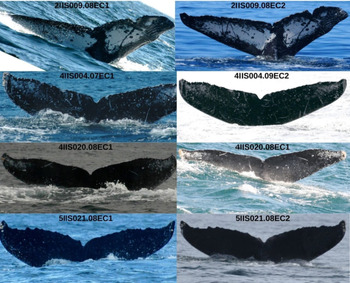
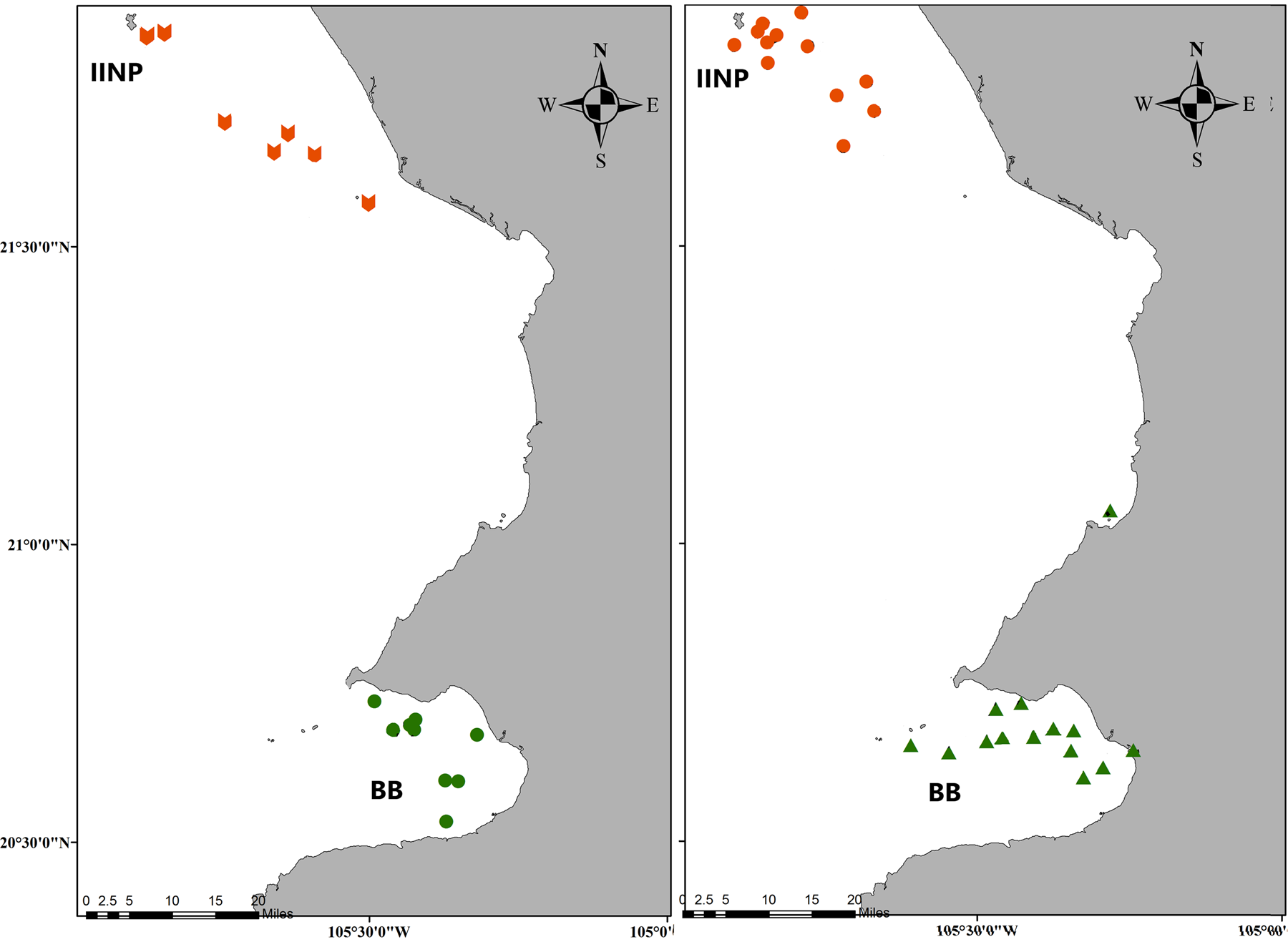
A total of 463 humpback whales were observed in 200 sightings (Table 2) (2.3 whales per sighting), including 222 unique photo-identified individuals. Of these, only four individuals (1.8%) were recaptured across years in the waters adjacent to Isabel Island National Park (Figure 2) and 75 whales (34%) were found in the Banderas Bay FIBB Catalog (1996–2016). Twenty-three (31%) of these 75 recaptures were observed in both sites during the same year, with 56.6% of them observed first in Banderas Bay and later near Isabel Island, whilst 43.4% were sighted first in Isabel Island National Park (Figure 3A and B). During the 2011 winter season, individual #2II019 was first observed in Banderas Bay (20 December 2010), later in Isabel Island National Park (12 January 2011) and then again in Banderas Bay (31 January 2011). From the 75 identified humpback whales near Isabel Island which were also recaptured in Banderas Bay, four whales have been observed during 8–20 different seasons (1997–2015) in Banderas Bay, while 29 other whales have been documented in 3–7 different wintering seasons (1997–2016) in Banderas Bay.
Individual intra-annual recaptures of humpback whales in waters adjacent to Isabel Island.

Distribution of whales observed in both Isabel Island National Park and Banderas Bay, Mexico. (A) Whales observed first in Isabel Island National Park (red arrows) and later in Banderas Bay (green circles); (B) whales observed first in Banderas Bay (green triangles) which then travelled to Isabel Island National Park (red circles).

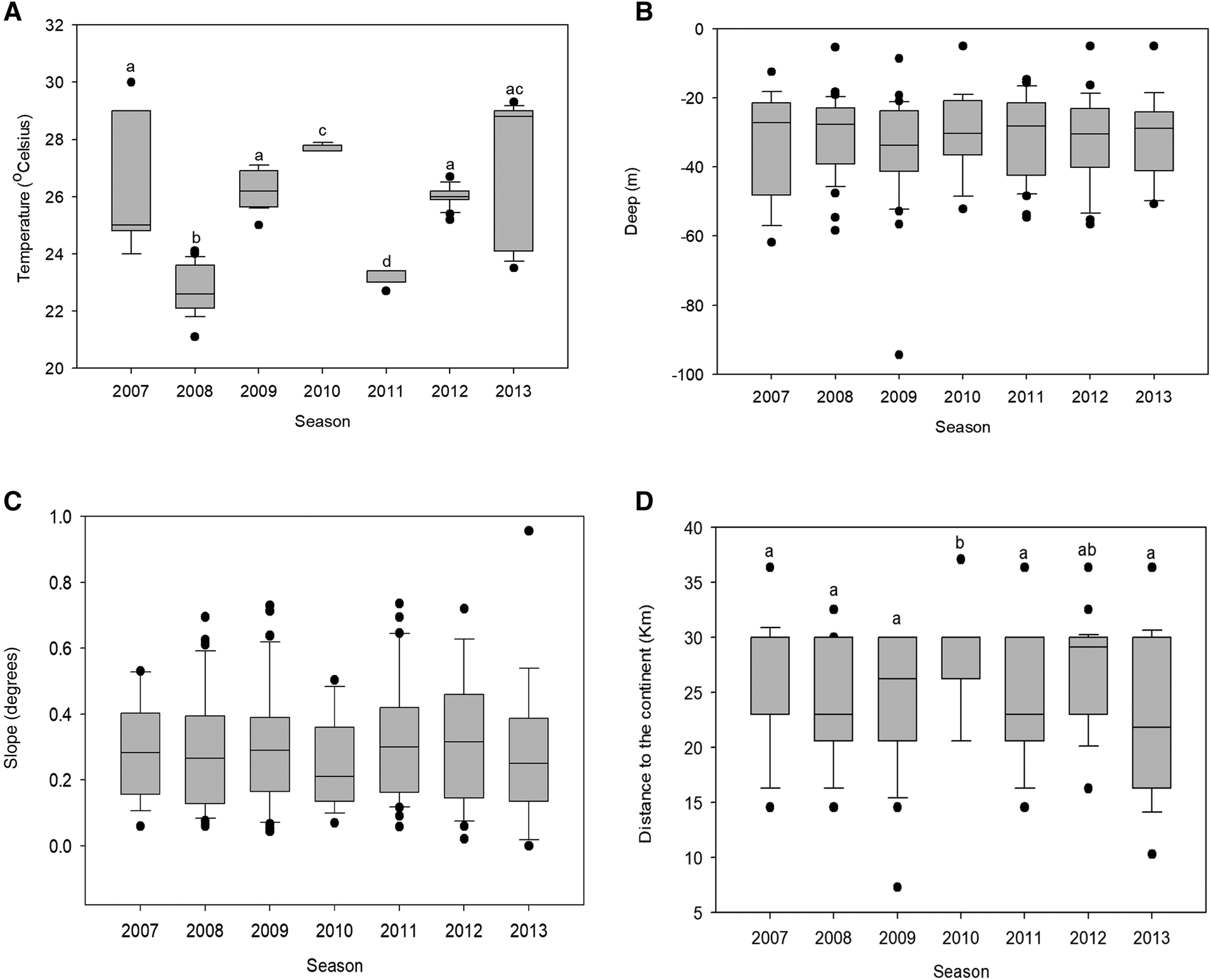
Habitat characteristics, where whales were sighted, showed significant inter-annual variation in sea surface temperature (in all cases P < 0.05) and distance to the continental coast (in all cases P < 0.05) (Figure 4, Table 3). The winter seasons of 2010 and 2013 had the highest average sea surface temperature values while the lowest values were found in 2008 and 2011. Sightings in 2009 occurred closest to the continent whereas in 2010 the whales were the furthest away (Figure 4).
Characteristics of the habitat used by the humpback whales observed throughout the study period (2007–2013). (A) Sea surface temperature (°C); (B) Depth (m); (C) Slope (degrees); (D) Distance to the continent (km). Bars with letters indicate statistical differences.

Results of the permutation ANOVA for the relative abundance of humpback whales between seasons and for habitat variables per seasons and groups in the waters surrounding Isabel Island National Park in western-central Mexico

SST, Sea Surface Temperature; D, Depth; DC, Distance to the continent; S, Slope.
Overall, for all years, humpback whales around Isabel Island were distributed where sea surface temperatures were between 24–26°C, with an interval between 22.5 and 28°C, at depths between 25–30 m, in areas with average slope values of 0.23 degrees and 22–25 km away from the closest continental coast (Figure 4, Table 3). Habitat characteristics by type of group show that groups with calves (Mc and McE) were distributed in slightly shallower waters in comparison with S, P and CG, but no significant difference was found between group types and the habitat variables analysed (Figure 5, Table 3).
Characteristics of the habitat used by different group types of humpback whales observed throughout the study period (2007–2013). (A) Sea surface temperature (°C); (B) Depth (m); (C) Slope (degrees); (D) Distance to the continent (km).

Despite the fact that we were unable to visually locate any singers, humpback whale songs were recorded in all years and in all months, 106/135 (78%) acoustic listening stations, 2007 being the only year in which songs were registered in all the singing stations (Table 1).
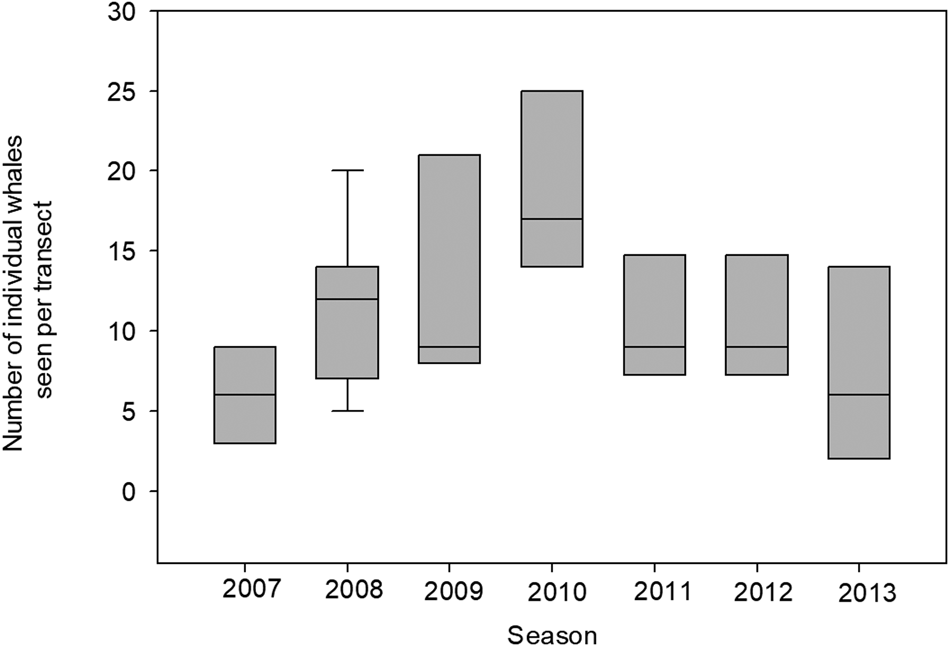
No significant changes in relative abundance (number of individuals counted per unit effort) between years was observed (P > 0.05) (Table 3), however, 2007 was the year with lowest relative abundance while 2010 was the year with highest relative abundance (Figure 6).
Humpback whale individuals observed per segment (effort in hours per month) documented monthly along seven seasons (2007–2013) around Isabel Island, Mexico.

By group type, P with 33.5% of total sightings were the dominant group, followed by CG, 29.5%; while groups with calves (Mc + McE) were uncommon with 9.5% of total sightings (Table 2). Seasonal composition by type of group shows that seasons 2009–2011 and 2013 had a similar composition, while 2008 was a different season with just one group with calves but a higher number of CG, and finally, 2007 and 2012 formed a third aggregation with few groups with calves as well as CG (Figure 7).
Cluster analysis and non-metric multidimensional scaling based on the number of individuals per group type throughout the study period (2007–2013) around Isabel Island.

Discussion
This is the first systematic long-term study conducted in the waters adjacent to Isabel Island National Park, Mexico. We collected data from seven winter seasons with an average of seven effort segments per season, equivalent to 1470 min each season. From 222 photo-identified whales, 1.8% were recaptured across years in waters adjacent to Isabel Island National Park. This value is lower than the 4% reported by Alvarez et al. (Reference Alvarez, Aguayo, Rueda and Urbán1990) for this area. Meanwhile, comparison of Isabel Island National Park with Banderas Bay (130 km south-west) allowed us to document 75 recaptures (34% of the 222 whales photo-identified) between these zones. It had previously been documented that the waters surrounding Isabel Island, altogether with the Tres Marias Islands and Banderas Bay, form a wintering area sub-region with a high concentration of humpback whales (Rice, Reference Rice1974; Urbán & Aguayo, Reference Urbán and Aguayo1987; Sosa Bonequi, Reference Sosa Bonequi2016).
The low intra- and inter-annual recapture rate in the waters adjacent to Isabel Island, the high interchange rate between Isabel Island National Park and Banderas Bay (34%) during the sample period (within years 23 recaptures, and inter-annually 52 recaptures) (similar to that previously documented, Sosa Bonequi, Reference Sosa Bonequi2016), the high rate of singing activity recorded during acoustic monitoring, and the absence of recaptures of mother-calf pairs and the low sighting percentage of groups with calves (9.5% of the 200 recorded sightings) suggest that (1) this area is used like a corridor in which males are involved in a search for mates and in competition activity, and (2) the waters adjacent to Isabel Island National Park are used as a transit zone more than as a calving area. Our findings correspond with the proposal by Ladrón de Guevara (Reference Ladrón de Guevara1995) and Sosa Bonequi (Reference Sosa Bonequi2016) who suggested that the area extending between the southern extreme of the Baja California Peninsula and Banderas Bay, including Isabel Island National Park and Marias Islands, is used as a corridor by the whales during their winter residency in the Central and South Mexican Pacific.
Humpback whale song has been suggested to play a role as an alternative breeding strategy used by males (Clapham, Reference Clapham1996). Similarly, in other areas of the Mexican Pacific it has been documented that singing activity is inversely proportional to male abundance and physical competition (Medrano & Smith, Reference Medrano-González and Smith-Aguilar2014). This coincides with results from this study showing that during 2010, the highest whale abundance documented corresponded to the lowest singing activity, while in 2007, the lowest number of whales observed coincided with a greater number of singing activity records.
Studies in Isabel Island National Park are scarce despite its proximity to Banderas Bay which is considered a core breeding and calving zone for the ‘coastal Mexican stock’ (Urbán & Aguayo, Reference Urbán and Aguayo1987; Calambokidis et al., Reference Calambokidis, Falcone, Quinn, Burdin, Clapham, Ford, Gabriele, LeDuc, Mattila, Rojas-Bracho, Straley, Taylor, Urbán, Weller, Witteveen, Yamaguchi, Bendlin, Camacho, Flynn, Havron, Huggins, Maloney, Barlow and Wade2008; Barlow et al., Reference Barlow, Calambokidis, Falcone, Baker, Burdin, Clapham, Ford, Gabriele, LeDuc, Mattila, Quinn, Rojas-Bracho, Straley, Taylor, Urbán, Wade, Weller, Witteveen and Yamaguchi2011; Baker et al., Reference Baker, Steel, Calambokidis, Falcone, González-Peral, Barlow, Burdin, Clapham, Ford, Gabriele, Mattila, Rojas-Bracho, Straley, Taylor, Urbán, Wade, Weller, Witteveen and Yamaguchi2013). With the exception of the studies by Alvarez (Reference Alvarez1987), Alvarez et al. (Reference Alvarez, Aguayo, Rueda and Urbán1990) and Sosa Bonequi (Reference Sosa Bonequi2016), there were no previous systematic efforts to consistently study the humpback whales that overwinter in adjacent waters of Isabel Island, and even less about the intra- and inter-annual movements of these whales between the neighbouring areas (Calambokidis et al., Reference Calambokidis, Falcone, Quinn, Burdin, Clapham, Ford, Gabriele, LeDuc, Mattila, Rojas-Bracho, Straley, Taylor, Urbán, Weller, Witteveen, Yamaguchi, Bendlin, Camacho, Flynn, Havron, Huggins, Maloney, Barlow and Wade2008; Barlow et al., Reference Barlow, Calambokidis, Falcone, Baker, Burdin, Clapham, Ford, Gabriele, LeDuc, Mattila, Quinn, Rojas-Bracho, Straley, Taylor, Urbán, Wade, Weller, Witteveen and Yamaguchi2011). Whale displacements between the so-called ‘main’ reproductive areas of the Mexican Pacific including Los Cabos, Banderas Bay and Socorro Island at Revillagigedo Archipelago (Barlow et al., Reference Barlow, Calambokidis, Falcone, Baker, Burdin, Clapham, Ford, Gabriele, LeDuc, Mattila, Quinn, Rojas-Bracho, Straley, Taylor, Urbán, Wade, Weller, Witteveen and Yamaguchi2011; Baker et al., Reference Baker, Steel, Calambokidis, Falcone, González-Peral, Barlow, Burdin, Clapham, Ford, Gabriele, Mattila, Rojas-Bracho, Straley, Taylor, Urbán, Wade, Weller, Witteveen and Yamaguchi2013), have been analysed identifying three whale groups with a certain level of fidelity to each of these breeding areas and with little interchange between those areas. Less than 20% of identified individuals in previous studies were observed in both Banderas Bay and Los Cabos, and less than 9% between Banderas Bay and the Revillagigedo Archipelago (Calambokidis et al., Reference Calambokidis, Falcone, Quinn, Burdin, Clapham, Ford, Gabriele, LeDuc, Mattila, Rojas-Bracho, Straley, Taylor, Urbán, Weller, Witteveen, Yamaguchi, Bendlin, Camacho, Flynn, Havron, Huggins, Maloney, Barlow and Wade2008; Barlow et al., Reference Barlow, Calambokidis, Falcone, Baker, Burdin, Clapham, Ford, Gabriele, LeDuc, Mattila, Quinn, Rojas-Bracho, Straley, Taylor, Urbán, Wade, Weller, Witteveen and Yamaguchi2011). In other breeding areas, such as west South Africa, it has been proposed that recapture rates over 15% are indicative of high site fidelity (Barendse et al., Reference Barendse, Best, Thornton, Elwen, Rosenbaum, Carvalho, Pomilla, Collins and Meyer2011), so the 34% recapture rate observed between Isabel Island National Park and Banderas Bay may suggest they should be considered as part of the same core area. At the same time, this highlights the need to generate more information to understand the exchange rates between the different areas used by the coastal stock of Mexico. In particular, the waters adjacent to Isabel Island National Park are not considered under any protection category like other distribution areas of the coastal stock in Mexico. This, together with the high rate of inter- and intra-annual movements found between Isabel Island National Park and Banderas Bay, highlights the need to have information to identify the risks that these whales from the coastal stock face or will face during their winter displacements in the waters of the Mexican Pacific continental coast.
The dispersion of these whales has been related to mate-search by males, in different worldwide winter aggregation areas (Baker et al., Reference Baker, Steel, Calambokidis, Falcone, González-Peral, Barlow, Burdin, Clapham, Ford, Gabriele, Mattila, Rojas-Bracho, Straley, Taylor, Urbán, Wade, Weller, Witteveen and Yamaguchi2013) with documented displacements of over 1000 kilometres between different breeding sites (Wedekin et al., Reference Wedekin, Neves, Marcondes, Baracho, Rossi-Santos, Engel and Simões-Lopes2010; Dulau et al., Reference Dulau, Pinet, Geyer, Fayan, Mongin, Cottarel, Zerbini and S2017). Individual variation in dispersion patterns and movement rates has also been documented in some wintering areas (Wedekin et al., Reference Wedekin, Neves, Marcondes, Baracho, Rossi-Santos, Engel and Simões-Lopes2010). Since there is a high recapture rate (75 individuals of 222) during 3–20 different seasons together with inter- and intra-seasonal movements this suggests that Isabel Island National Park constitutes an important component for the reproductive dynamics of the coastal stock in Mexico, in one of the core areas like Banderas Bay.
We found that in 40% of the months (6 out of 15) no groups with calves (Mc or McE) were observed while the most commonly observed group types were pairs (33.5%), competition groups (CG) (29.5%) and singles (27.5%), suggesting the idea that the area is used for breeding more than calving purposes. This fact contrasts with what has been documented for other wintering areas in Mexico and elsewhere (Ladrón de Guevara, Reference Ladrón de Guevara1995; Mobley et al., Reference Mobley, Bauer and Herman1999, Reference Mobley, Spitz and Grotefendt2001; Rosales-Nanduca, Reference Rosales-Nanduca2004; Franklin et al., Reference Franklin, Franklin, Brooks, Harrison, Clapham and Baverstock2011; Noad et al., Reference Noad, Dunlop, Paton and Cato2011), where competition groups are less common, while other groups like pairs and singles are the dominant group.
The ideal SST interval for humpback whales in their worldwide breeding areas is 21.1–28.3°C with an optimal temperature of 24.6°C (Rasmussen et al., Reference Rasmussen, Palacios, Calambokidis, Saborio, Dalla-Rosa, Secchi, Steiger, Allen and Stone2007). Recent studies have documented fluctuations in the presence and abundance of humpback whales related to climatic anomalies (Cartwright et al., Reference Cartwright, Venema, Hernández, Wyels, Cesere and Cesere2019). In this sense, the highest relative abundance (whales per navigation time) documented in 2010 coincided with the presence of warmer waters along the Mexican coast related to the presence of an ENSO event in the Eastern Tropical Pacific (NESDIS, 2019). Banderas Bay has already shown considerable changes in the abundance of whales related to the presence of ‘El Niño’ and ‘La Niña’ events (Ladrón de Guevara, Reference Ladrón de Guevara1995). Accordingly, the highest (although non-significantly) relative abundance of humpback whales observed in 2010, a year of a strong ‘El Niño’ event, may suggest a displacement to the north of the whales located further south of Isabel Island National Park after not finding suitable conditions for their calving and breeding activities. However, this hypothesis needs to be investigated with more sampling effort. The evidence found here highlights the importance of understanding the connectivity between priority sites for reproductive activities of the whales from the coastal stock in the Mexican Pacific, using an integrated perspective.
It is known that females with calves prefer shallow waters close to the coast with an average surface temperature of 24.6°C (±1.9°C) (Ersts & Rosenbaum, Reference Ersts and Rosenbaum2003; Rasmussen et al., Reference Rasmussen, Palacios, Calambokidis, Saborio, Dalla-Rosa, Secchi, Steiger, Allen and Stone2007). Although the SST range recorded in our study falls within the optimal interval for this species (Rasmussen et al., Reference Rasmussen, Palacios, Calambokidis, Saborio, Dalla-Rosa, Secchi, Steiger, Allen and Stone2007), the absence of bays, the small size of Isabel Island National Park and the distance greater than 30 km from the continental coast, can explain the low presence of mother-calf pairs and the lack of recaptures within seasons, suggesting that females don't find the secure conditions necessary for their calves. Therefore, females might use the area as a transit zone moving towards suitable calving areas further south or during their northbound trip when many of the females begin their trip towards feeding areas. This last fact was documented in this study with a higher occurrence of females with calves in March.
Considering the current context of climate change and the increase in threats including entanglements, boat traffic and tourism, among others (Senigaglia et al., Reference Senigaglia, Christiansen, Bejder, Gendron, Lundquist, Noren, Schaffar, Smith, Williams, Martínez, Stockin and Lusseau2016; Avila et al., Reference Avila, Kaschner and Dormann2018), our results highlight the importance of having continuous monitoring, not only of Isabel Island National Park, but of all the aggregation zones used by humpback whales along the Mexican Pacific. This should be done with the objective of understanding the movement and habitat use patterns of this species. It is important to highlight that, although Isabel Island is listed as a National Park, it does not include any protection measures for its marine areas (CONANP, 2005). The findings reported in this study underline the importance of studying and protecting the waters surrounding Isabel Island National Park as a measure to help define a marine area for the protection of the humpback whales which use these waters.
Acknowledgements
This study was supported by Ecología y Conservación de Ballenas, A. C. We would like to thank the Comisión Nacional de Áreas Naturales Protegidas (CONANP), particularly Jorge Castrejón and the research boat captains Gonzálo Pérez and Cayetano Robles, for their logistic support to conduct the study. To the volunteers which accompanied and supported us during sampling: Karel Beets, Frank Mc Cann, Jorge Morales, Fernando Noriega, Carlos González and Fernando Romo. To all the collaborators for the Banderas Bay Humpback Whale Photo-Identification Catalog: Biocean, Centro Regional de Investigación Pesquera, Cielo Abierto, Discover Pacific, Ecotours de México, Instituto Tecnológico de Bahía de Banderas, Murdoch University, Ocean Friendly, Orca de Sayulita, Vallarta Adventures, Vallarta Natours and Whale Watch Vallarta. We also thank the community of San Blas and the fishermen of Isabel Island National Park for their hospitality. Finally, we want to thank the anonymous reviewers whose comments helped to substantially improve this work.