Narrative production and comprehension skills in bilingual and multilingual children have rarely been studied for each of the child's languages (Pearson, Reference Pearson, Oller and Eilers2002; Schwartz & Shaul, Reference Schwartz and Shaul2013), as usually only one language of the child, typically the majority language, is investigated. There are as yet no systematic studies of the narrative abilities of bilingual Swedish–English children.
It is generally acknowledged that narratives provide rich data in a short language sample about a child's multiple linguistic abilities, including story structure, structural complexity, internal state language, cohesion, morphosyntax, and lexical diversity and productivity. Oral narratives also provide an index of children's cognitive and social abilities. For these reasons, clinicians and researchers consider narrative analysis an ecologically valid way to investigate communicative competence in children. However, research into and assessment of the narrative abilities in multilingual children is hampered by the fact that most existing elicitation and assessment tools are designed and norm referenced for monolinguals, that they are not always cross-culturally robust, and that they are often available for only one of the child's languages.
In an attempt to overcome some of these shortcomings, a new tool, the Multilingual Assessment Instrument for Narratives (MAIN; Gagarina et al., Reference Gagarina, Klop, Kunnari, Tantele, Välimaa and Balčiūnienė2012) was developed and piloted for 17 different languages and language combinations during a recent EU COST Action on child multilingualism (http://www.bi-sli.org). The intent was to design a reliable assessment instrument for bilingual children that probes not only language-specific but also language-general narrative skills at the cognitive–linguistic interface. MAIN contains parallel sets of picture stimuli with different fictional characters and events but with identical macrostructure, that is, identical overall story and episode structure. Protocols for eliciting storytelling, retelling, and answers to story comprehension questions and scoring methods were designed to tap into the narrative abilities of multilingual children age 4–10 in a parallel manner in each of their languages.
The development of MAIN proceeded on the widespread assumption that narrative structure has universal characteristics and properties that hold across languages (notwithstanding culture-specific storytelling conventions). There appears to be a strong cognitive, language-general component to story structure and to the development of story structure in children. The working hypothesis is thus that story structure should be more or less invariant across a bilingual child's two languages at a given age, with similar understanding of story events and causality and similar awareness of the intentions and goal-directed behavior of the protagonists. A bilingual child should readily carry over such language-general narrative abilities from one language to another and profit from them, even in cases where one language is weaker than the other with regard to morphosyntax or vocabulary development, as is often the case in simultaneous and sequential bilinguals (Berman, Reference Berman, Verhoeven and Strömqvist2001; Iluz-Cohen & Walters, Reference Iluz-Cohen and Walters2012; Kupersmitt & Berman, Reference Kupersmitt, Berman, Verhoeven and Strömqvist2001; Paradis, Genesee, & Crago, Reference Paradis, Genesee and Crago2011; Pearson, Reference Pearson, Oller and Eilers2002).
The present paper puts this hypothesis to the test and presents results for 52 Swedish- and English-speaking children, with a view to shedding light on the following questions. Do bilingual children make use of similar macrostructure in both their languages as reflected in their MAIN scores? How does their story production compare with story comprehension? How do macrostructural aspects of narrative ability develop between age 5 and 7?
BACKGROUND
Two distinct but interrelated areas underlie narrative discourse competence: macrostructure and microstructure (Justice et al., Reference Justice, Bowles, Kaderavek, Ukrainetz, Eisenberg and Gillam2006). Macrostructure concerns the higher-order mental organization of narratives, where content connectedness is achieved through a global organization structure following an underlying narrative schema (Heilmann, Miller, & Nockerts, Reference Heilmann, Miller and Nockerts2010; Paradis et al., Reference Paradis, Genesee and Crago2011; Stein & Glenn, Reference Stein, Glenn and Freedle1979). Microstructure concerns the linguistic forms used in the construction of coherent narrative discourse and is thus much more language specific (Berman & Slobin, Reference Berman, Slobin, Berman and Slobin1994; Hickmann, Reference Hickmann, Piérait-Le Bonniec and Dolitsky1991). For instance, languages vary in the linguistic forms they employ for building referential cohesion in a narrative, in the way characters are introduced and in the way reference to them is maintained (e.g., whether the language employs morphological marking of [in]definiteness and/or word order for newness vs. givenness, whether subjects are expressed overtly or can be null). This paper focuses on the macrostructural aspects of narrative production and comprehension in bilingual children.
To capture the macrostructure of narratives, story grammar models have been developed (e.g., Mandler & Johnson, Reference Mandler and Johnson1977; Stein & Glenn, Reference Stein, Glenn and Freedle1979). They describe general mental schemas that guide story processing, so that information is expected, attended to, organized, and encoded in similar patterns (Shapiro & Hudson, Reference Shapiro and Hudson1991; Stein & Glenn, Reference Stein, Glenn and Freedle1979; Trabasso & Nickels, Reference Trabasso and Nickels1992; Trabasso & Rodkin, Reference Trabasso, Rodkin, Berman and Slobin1994). These cognitive foundations guiding the comprehension and production of stories are thought to be language independent. Evidence for the psychological validity of story schemas comes mainly from recall experiments and comprehension studies (Hickmann & Schneider, Reference Hickmann, Schneider, Perkins and Howard2000; Mandler & Johnson, Reference Mandler and Johnson1977; Stein & Glenn, Reference Stein, Glenn and Freedle1979; Stein & Policastro, Reference Stein, Policastro, Mandl, Stein and Trabasso1984). Actual story narrations may be regarded as surface realizations of the underlying mental narrative schema.
Fictional stories, as described by story grammars, are organized around the protagonist's or protagonists’ goals and their path of succeeding or failing to attain these goals (Hughes, McGillivray, & Schmidek, Reference Hughes, McGillvray and Schmidek1997; Stein & Policastro, Reference Stein, Policastro, Mandl, Stein and Trabasso1984; Trabasso & Rodkin, Reference Trabasso, Rodkin, Berman and Slobin1994; Westby, Reference Westby, Kamhi and Catts2012). The units of analysis in story grammar models are specific types of information that serve different functions in the story structure. There are slight variations as to how these components are operationalized in different story grammar models. In all models, stories are assumed to contain a setting and an episode system (Mandler & Johnson, Reference Mandler and Johnson1977; Peterson & McCabe, Reference Peterson and McCabe1983, chaps. 6–7; Shapiro & Hudson, Reference Shapiro and Hudson1991; Stein & Glenn, Reference Stein, Glenn and Freedle1979; Westby, Reference Westby, Kamhi and Catts2012). The setting provides the context for the story, specifies time and place, and introduces the protagonist(s). The episode system may consist of one or more episodes, each of which is made up of an entire behavioral sequence that is causally and temporally related, centering around an animate protagonist: an initiating event or internal state of the protagonist, the protagonist's goal, an attempt or action by the protagonist to reach the goal, an outcome or consequence of the attempt in terms of the goal, and an internal state as a reaction to the outcome. Not every one of these components will always be expressed overtly in actual narration, but it is assumed to be there mentally (Stein & Glenn, Reference Stein, Glenn and Freedle1979; Stein & Policastro, Reference Stein, Policastro, Mandl, Stein and Trabasso1984). These mental schemas of narrative organization are thought to be functioning largely independently of the language a story is told in. Therefore, story grammar approaches have been used for macrostructural analysis of fictional narratives across languages, in story comprehension, recall, and actual story production.
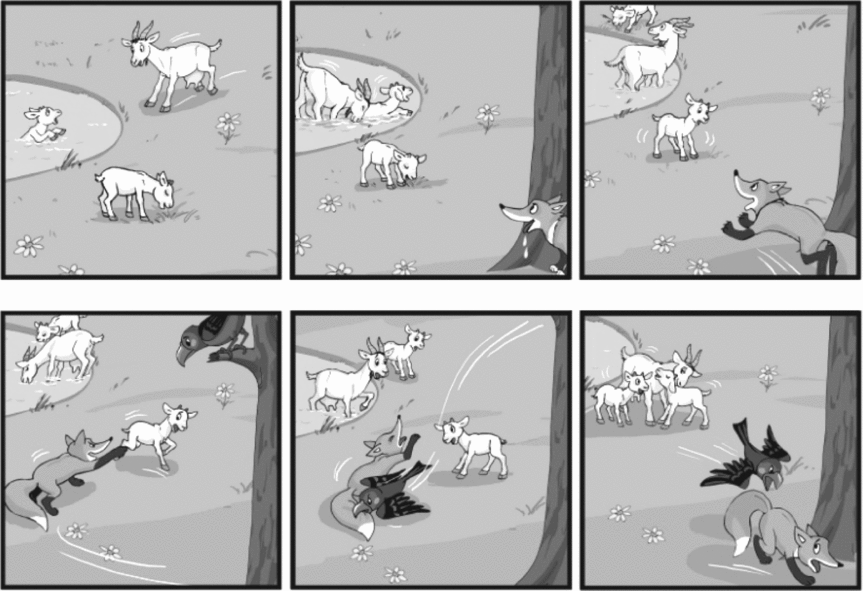
The present study, employing MAIN, uses an adaptation of the story grammar model of Stein and Glenn (Reference Stein, Glenn and Freedle1979). Parallel sets of picture stimuli were designed to depict stories of comparable complexity and plotline, in order to be able to elicit comparable narratives in the two languages of a bilingual child. Each set of picture stimuli depicts a story with different animal protagonists but with identical global story structure and episode structure. In each, a setting statement (e.g., once upon a time there were three goats in a meadow) is followed by three short episodes. Each episode consists of a goal of the protagonist, an attempt by the protagonist to reach the goal, an outcome in terms of the goal, an internal state (e.g., an emotional or cognitive state) that initiates the goal, and an internal state (e.g., an emotional or cognitive state), which is the reaction to the outcome. For instance, in the Baby Goats story (Figure 1), in the first episode, the goal of the big goat is to help the baby goat out of the water; in the second episode, the goal of the fox is to catch or kill the baby goat; and in the third episode, the goal of the bird is to rescue the baby goat from the fox. While the actions of the protagonists are explicitly depicted, the perceptions, thoughts, emotions, motives, and goals of the story characters must be inferred from the pictures to tell a complete story.
The picture stimuli for the Multilingual Assessment Instrument for Narratives Baby Goats story (originals are 9 × 9 cm colored pictures in a folded strip).

An observation in the literature is that the macrostructural narrative skills of children appear to vary with and depend more on age than on the language a story is told in. This is at least the conclusion of Berman and Slobin (Reference Berman, Slobin, Berman and Slobin1994), who, in their seminal study of monolingual English-, German-, Hebrew-, Spanish-, and Turkish-speaking children age 3–9 and adults telling the Frog story from a wordless picture book (Frog, Where Are You?; Mayer, Reference Mayer1969), found strong commonalities within one age group across languages, but striking differences among 3- to- 4-year-olds, 5-year-olds, 9-year-olds, and adults. Berman and Slobin's (Reference Berman, Slobin, Berman and Slobin1994) observations have been upheld by other empirical studies (based on the Frog story and on other stimulus materials).
While children age 3–4 may already be able to respond to picture-elicited fictional storytelling tasks, their narratives are short and include but few story grammar components. The literature characterizes narratives at this age as mere descriptions of some characters, objects, and events (i.e., identification and naming), without any temporal or causal links (“descriptive sequences”; Berman & Slobin, Reference Berman, Slobin, Berman and Slobin1994, pp. 51–58; Nicolopoulou & Richner, Reference Nicolopoulou and Richner2007; Peterson & McCabe, Reference Peterson and McCabe1983, pp. 71–72; Stein & Policastro, Reference Stein, Policastro, Mandl, Stein and Trabasso1984, p. 135; Trabasso & Rodkin, Reference Trabasso, Rodkin, Berman and Slobin1994; Westby, Reference Westby, Kamhi and Catts2012). Alternatively, two or three events may be chained together, for instance, by commonplace connectives such as and or and then (“action sequences”; Berman & Slobin, Reference Berman, Slobin, Berman and Slobin1994, pp. 63–64; Peterson & McCabe, Reference Peterson and McCabe1983, pp. 71–72, 101–102; Stein & Policastro, Reference Stein, Policastro, Mandl, Stein and Trabasso1984, p. 135; Westby, Reference Westby, Kamhi and Catts2012). Relevant scene-setting information (time, place, and motivation) is lacking, and the thoughts and goals of story characters are usually not expressed (Trabasso & Nickels, Reference Trabasso and Nickels1992; Trabasso & Rodkin, Reference Trabasso, Rodkin, Berman and Slobin1994). Fictional narratives told by 3- and 4-year-olds have been reported to be heavily dependent on adult conversational scaffolding and interactive help such as prompting, encouragement, and leading questions from an older and more mature listener (Berman & Slobin, Reference Berman, Slobin, Berman and Slobin1994; Peterson & McCabe, Reference Peterson and McCabe1983). Around age 4, “reactive sequences” (Stein & Albro, Reference Stein, Albro and Bamberg1997, p. 10) begin to appear, with causal relationships between events, but still no mention of goal-based behavior. After age 4, but especially from age 5 onward to age 9, the literature notes an increase, if at first for some children only, in the number of story components produced and in the frequency of individual components. Narratives gradually contain more settings and full goal–attempt–outcome (GAO) sequences (Stein & Albro, Reference Stein, Albro and Bamberg1997; Trabasso & Nickels, Reference Trabasso and Nickels1992; Trabasso & Rodman, 1994; Trabasso & Stein, Reference Trabasso, Stein, Haith, Benson, Roberts and Pennington1994). Thus, with increasing age and cognitive maturity, there is a gradual move away from descriptive and action sequences and a development toward a more complex episodic organization with causal connections, where the thoughts, feelings, motives, and goals of protagonists, as well as their reactions to successful or failed outcomes, are made explicit for the listener. The development of certain narrative components and story complexity is often seen in relationship with the development of theory of mind, that is, the awareness of shared as opposed to unshared knowledge. As such, it forms part of children's cognitive development (Berman & Slobin, Reference Berman, Slobin, Berman and Slobin1994; Nicolopoulou & Richner, Reference Nicolopoulou and Richner2007; Pearson, Reference Pearson, Oller and Eilers2002; Shapiro & Hudson, Reference Shapiro and Hudson1991; Soodla, Reference Soodla2011; Tomasello, Reference Tomasello2003; Westby, Reference Westby, Kamhi and Catts2012). The ability to produce well-formed episodes (including GAO sequences) indicates understanding of underlying narrative schemas, causality, perspective taking, and the need to justify plans and actions (Shapiro & Hudson, Reference Shapiro and Hudson1991; Trabasso & Nickels, Reference Trabasso and Nickels1992; Trabasso & Rodkin, Reference Trabasso, Rodkin, Berman and Slobin1994). This development continues during the primary school years. By age 9–10, children's fictional narratives are said to resemble those of adults concerning macrostructure, with evaluative comments and frequent attributions of emotional states to protagonists (Berman & Slobin, Reference Berman, Slobin, Berman and Slobin1994).
There is however a fair bit of variation concerning the exact age at which monolingual children are reported to be able to produce or regularly express certain narrative components and full GAO episodes. This is because studies have employed a wide variety of elicitation materials and data collection procedures with different task demands and analyzed their data according to slightly different story grammar models.
Fewer studies exist concerning multilingual children, though it is generally said that their macrostructural narrative skills develop similarly to monolinguals (e.g., Akinci, Jisa, & Kern, Reference Akinci, Jisa, Kern, Verhoeven and Strömqvist2001; Fiestas & Peña, Reference Fiestas and Peña2004; Iluz-Cohen & Walters, Reference Iluz-Cohen and Walters2012; Kupersmitt & Berman, Reference Kupersmitt, Berman, Verhoeven and Strömqvist2001; Lanza, Reference Lanza, Verhoeven and Strömqvist2001; Möller, Reference Möller2010; Pearson, Reference Pearson, Oller and Eilers2002; Viberg, Reference Viberg, Verhoeven and Strömqvist2001). It has also been suggested that successive bilinguals catch up more quickly for story structure because it is a cognitive–linguistic interface skill that can be shared with the first language (Paradis et al., Reference Paradis, Genesee and Crago2011; Paradis & Schneider, Reference Paradis and Schneider2008; Pearson, Reference Pearson, Oller and Eilers2002). For instance, Pearson's (Reference Pearson, Oller and Eilers2002) study of 160 successively bilingual Spanish–English and 80 monolingual English-speaking children from mixed socioeconomic backgrounds in Miami found that Spanish–English 7- to 8-year-olds lagged behind monolingual English age peers on most language measures. By age 10–11, however, there were virtually no differences in the story structure of bilinguals and age-matched monolinguals telling the Frog story, although bilinguals still lagged significantly behind monolinguals on measures of morphosyntactic accuracy and vocabulary. Story structure scores in one language correlated with story structure scores in the other at a given age (Pearson, Reference Pearson, Oller and Eilers2002), while language structure scores differed. Pearson also found that her two age groups (7- to 8-year-olds vs. 10- to 11-year-olds) differed significantly in story structure, and she concluded that the global structure of narratives develops as a function of age and not of language (Pearson, Reference Pearson, Oller and Eilers2002). Similarly, Akinci et al. (Reference Akinci, Jisa, Kern, Verhoeven and Strömqvist2001), in a study of 42 successively bilingual Turkish–French children age 5, 7, and 10 telling the Frog story in their first language and their second language, reported narratives of equal story complexity in both languages at a particular age, and so did Fiestas and Peña (Reference Fiestas and Peña2004), in their study of Frog story retellings by 12 successively bilingual Spanish–English children age 4–6. The authors therefore concluded that macrostructural narrative knowledge is more dependent on age than on a specific language.
These studies support the hypothesis that once a narrative schema has been acquired, it can be transferred to and used for narrative production and processing in any language. It should be pointed out though that very little is known about bilinguals’ narrative skills outside the context of the Frog story. In addition, measures and assessment scales of macrostructural skills in the above studies have been relatively coarse. Children are often already credited with full points for story structure when having mentioned the main protagonists, an initiating event, one attempt, and one outcome/consequence (e.g., Akinci et al., Reference Akinci, Jisa, Kern, Verhoeven and Strömqvist2001; Möller, Reference Möller2010; cf. Fiestas & Peña, Reference Fiestas and Peña2004; and Lanza, Reference Lanza, Verhoeven and Strömqvist2001, for a scale of max 7 points). This may be partly due to the special recursive structure of the Frog story with its series of attempts to reach the goal (i.e., to find/retrieve the frog), which all fail except for the final attempt, the goal being repeatedly reinstated (Trabasso & Rodkin, Reference Trabasso, Rodkin, Berman and Slobin1994). With other stimuli materials too, story structure is often investigated on a scale of few points only (Iluz-Cohen & Walters, Reference Iluz-Cohen and Walters2012). Therefore, different stimuli materials and a more detailed assessment will be used in the present study. Finally, note that some language proficiency is required to express macrostructural knowledge linguistically, although the minimum proficiency threshold is not usually specified in the literature (Pearson, Reference Pearson, Oller and Eilers2002; Viberg, Reference Viberg, Verhoeven and Strömqvist2001).
AIMS OF THE STUDY
An overarching aim of this study is to investigate the narrative skills of bilingual Swedish- and English-speaking children age 5–7 in both languages in tandem at the level of global organization (macrostructure). The study explores whether there is empirical support for the assumption that macrostructural knowledge in narrative production and comprehension is invariant across a bilingual child's two languages at a given age, using a more detailed and rigorously designed new assessment tool (MAIN). The study also investigates whether any aspects of macrostructural discourse competence can be said to develop between age 5 and 7 in Swedish–English bilinguals. The study thus aims to contribute to a growing knowledge base on the development of language-general and language-specific narrative skills in children across languages.
METHOD
Participants
Fifty-two children age 5–7 growing up bilingually with Swedish and English participated. This age range was chosen because the late preschool and early school years are a time when children's narrative abilities evolve strongly according to the existing literature.
The criteria for selecting participants were the following: 5 or 6–7 years of age; no history of hearing loss, language impairment, or cognitive disorder; a minimum of 2 years of regular and frequent exposure of the child to each language (i.e., several times a week); regular use of both languages by the child (i.e., several times a week); and good comprehension and fluency in both languages according to parental report.
All 52 children came from families where both languages were spoken at home on a regular basis. Families had high socioeconomic status as measured by educational level. All parents had completed secondary school, and in 60% of the families (31/52) at least one parent held a university degree, as is often the case in bilingual Swedish–English families in Sweden.
Children were recruited from 20 preschools and schools in urban areas in central Sweden. There was a younger group of 19 children (5 years, 4 months [5;4]) in preschool and an older group of 33 children (6;7) who had started their first year of primary school (which in Sweden is called Grade 0 [preparatory year] or Grade 1). About half the children (24/52) attended a (pre)school where both Swedish and English was the medium of instruction; 9 attended an English-medium school; and 19 attended a (pre)school with Swedish as the medium of instruction, with 1 hr of supplemental “home language” English per week.
Most 5-year-olds (17/19) and two-thirds of the 6- to 7-year-olds (22/33) had been simultaneously exposed to Swedish and English from birth. The other children were sequential bilinguals, with one language from birth and the other language coming in after age 1 but before age 5. For most of these sequential bilinguals, the other language had come in before age 3 (two 5-year-olds and six 6- to 7-year-olds), and for the remaining five 6- to 7-year-olds at age 4–5. We purposely included both simultaneous and sequential bilinguals and did not limit ourselves to participants who had been exposed to both languages from birth or before age 3. We did so because a bilingual child can be expected to make use of macrostructural knowledge in both languages, regardless of simultaneous or sequential acquisition, on the widespread assumption that there is a strong cognitive, language-independent component to story structure (Pearson, Reference Pearson, Oller and Eilers2002). Of course, a certain threshold of language-specific knowledge must have been reached in order to be able to verbalize this macrostructural knowledge (Viberg, Reference Viberg, Verhoeven and Strömqvist2001). Here we adopted the arbitrary criterion of a minimum of 2 years of exposure to each language, and then proceeded as follows.
The parents of potential participants completed a background questionnaire (as part of MAIN) on the patterns of language use in their family and the child's perceived comprehension and production skills in everyday situations for both languages. This questionnaire was administered in Swedish or English in paper form or, in some cases, via telephone interview. All parents reported regular book reading and storytelling activities. The majority of parents considered their children to be equally strong in both languages or slightly stronger in Swedish than in English. All children were rated to have good or very good comprehension skills in both Swedish and English and good or very good production skills in at least one language, but not all were rated to have good or very good production skills in both languages by their parents.
Because the aim of this study was to compare the macrostructural skills of bilingual children in both their languages, we did not accept or reject children on the basis of parental ratings. Rather, candidates were included in the study if they could respond to questions and tell a story in both Swedish and English. We thus had 52 participants, 19 5-year-olds (mean age = 64 months [5;4], SD = 3.7 months, age range = 4;11–5;11) and 33 6- to 7-year-olds (mean age = 79 months [6;7], SD = 5.9 months, age range = 6;0–7;9).Footnote 1
Materials and procedure
A standard methodology was used to elicit narratives across the set of studies in the current Special Issue (see also Gagarina, Klop, Tsimpli, & Walters, Reference Gagarina, Klop, Tsimpli and Walters2016 [this issue]).
In the present study, the Swedish and English versions of MAIN were used. MAIN provides stimuli sets of colored picture sequences to elicit four stories with identical overall story and episode structure (consisting of a setting and three short episodes, each made up of a GAO sequence with comparable complexity). In contrast to conventional picture books, the MAIN stimulus materials were carefully constructed with story grammar as a theoretical base to allow clear identification of the story grammar elements generated by the child. By portraying three episodes in each picture sequence, children are provided with more than one opportunity to produce each element targeted for macrostructure analysis. Two of these picture stimuli sets were used in the present study: Baby Birds and Baby Goats (see Figure 1), which were designed for storytelling, with parallel plots and identical story structure. The picture sequences were used to elicit two narratives per child, one in each language (narrative production task).
For each picture stimuli set, MAIN also includes a story comprehension task, which targets understanding of a core component of story grammar, namely, the goal, and internal states. Here, 10 why and how questions probe the children's overall story comprehension, in particular, their inferencing ability concerning the thoughts, feelings, and intentions of the protagonists (e.g., Why does the bird bite the fox's tail? How does the fox feel? Why do you think the fox is feeling . . .?). Thus, the comprehension task does not probe story recall (memory), but the ability to interpret cause and effect in stories and to draw inferences. The comprehension task is particularly informative in case of poor storytelling performance, because children might know more about narrative structure than their narratives can display. The comprehension task was carried out after the narrative production task, one in each language.
In the MAIN protocol, story grammar elements in the child's narrative production are scored with 1 point each. For the setting, time reference (e.g., one day) scores 1 point and place reference (e.g., in a meadow) 1 point. In the episode system, internal state as initiating event (IS as IE), goal (G), attempt (A), outcome (O), internal state as reaction (IS as R) all score 1 point each. For instance, in the first episode of the Baby Goats story (recall Figure 1), the internal state as initiating event that sets the events in motion is the baby goat being scared/in danger/drowning or the big goat seeing/being worried that the baby goat is scared/in danger/drowning/can't swim. Mention of such an emotional, perceptual, or cognitive state would score 1 point for IS as IE for that first episode. Mention of the goal (wanting to help/save/rescue the baby), the attempt (running/going into the water/pushing), and the outcome (the big goat pushed the little one out of the water/saved/rescued the baby or the baby goat was out of the water) would accordingly merit points for G, A, and O. In the first episode, the internal state as reaction is the big goat being happy/relieved or the baby goat being relieved/happy/glad/not scared any more, and mention of such an emotional state would score 1 point for IS as R. As every story contains three episodes, IS as IE, G, A, O, and IS as R are scored three times per story. Together with the points for setting, this adds up to a maximum of 17 points for the production task, which is the composite story structure score. The presence or absence of full GAO episodes is also noted; this is the episodic complexity measure. Finally, answers to the 10 questions in the comprehension task are scored 1 point each, with a maximum of 10 points per story. This is the composite story comprehension score. For further description of MAIN, see Gagarina et al. (Reference Gagarina, Klop, Kunnari, Tantele, Välimaa and Balčiūnienė2012, Reference Gagarina, Klop, Kunnari, Tantele, Välimaa, Balčiūnienė, Armon-Lotem, de Jong and Meir2015).Footnote 2
Children were seen individually in a quiet room at (pre)school on two separate occasions, by two different female research assistants. (In some cases, a second assistant was present to operate the video equipment, and in a few cases, a preschool teacher sat in as a silent observer in a corner.) Each session was conducted entirely in one language, in Swedish or in English. Investigators were native speakers of Swedish and native or near-native speakers of English, respectively.
After an initial period of warming-up conversation or play, the children sat at a table facing the investigator and were presented with three envelopes, each containing an identical copy of one of the picture sequences as a six-picture strip (Baby Birds or Baby Goats). Following standard MAIN procedure, the children were told that there were different pictures in the envelopes and that they were to choose one. After selecting an envelope, the children were asked to take out and unfold the pictures and look at them to familiarize themselves with the story. They were instructed to tell the story keeping the pictures in front of them so that the investigator could not see the pictures. This was done in order to minimize effects of shared knowledge and to discourage the use of pointing. After an initial previewing of all six pictures to minimize task demands, fold-out was used during the actual storytelling, with pictures presented in pairs of two (first two, then four, then all six pictures visible). Care was taken not to start the story for the children but to encourage them to tell the story themselves. The investigator listened without interrupting much, except to provide back-channeling encouragement, to direct or help with the folding out of pictures, or when queried by the child for a word or the name of an animal. In cases when the child hesitated, the investigator used standard MAIN prompts (e.g., Tell me more; Anything else?; Let's see what else happens in the story). After the children had finished telling their story, the investigator asked the comprehension questions, with the entire picture sequence visible on the table. The 5-year-olds were asked all 10 comprehension questions. The 6- to 7-year-olds were asked only the first 9 of the 10 questions (the 10th question was a later addition in the development of the MAIN materials). Finally, the children received stickers, a diploma, or a small thank-you gift.
Half the children did the task first in Swedish and then in English, and half vice versa, in randomized order, with a break in between. For logistic reasons, it proved impossible to adhere to the recommendation of the MAIN guidelines of keeping a 5- to 7-day interval between sessions for all 52 children. For half of the children there was a 3- to 7-day interval; the others were seen twice on the same day. To offset potential training or carryover effects from the first to the second session, we counterbalanced for both language (Swedish first vs. English first) and picture sequence (Baby Birds first vs. Baby Goats first).
The narrative tasks were audio- and videorecorded and transcribed by the investigators into CHAT format according to CHILDES transcription conventions (MacWhinney, Reference MacWhinney2000). Transcripts were checked by the present author. The narratives were analyzed and scored for macrostructure (story structure components, story structure composite score, structural complexity, and internal state terms) according to the MAIN scoring sheets and manual. For interrater reliability, each narrative (n = 104) was jointly scored by the two investigators, independently scored by a third research assistant not involved in data collection, and by the present author. Comparison of these scores showed 91% point to point agreement. Disagreements were resolved through discussion, and final scoring was checked for consistency by the present author. Performance in the comprehension task was independently scored by the two investigators and checked by the present author. Comparison of these scores showed 97% agreement. Such little disagreement there was got resolved through discussion.
The children's Swedish and English scores on MAIN were then compared with each other. Nonparametric tests were used because the data did not show a normal distribution. Moreover, a qualitative analysis of the story structure components in the children's storytelling and their answers to probe questions was carried out. Order effects (first narrative vs. second narrative) and age effects (5-year-olds vs. 6- to 7-year-olds) were also explored.
RESULTS
Narrative production
5-year-olds
The 38 narratives produced by the 5-year-olds had a mean length of 60 words (SD = 24) and contained on average 5 (out of 17) story structure components as assessed by MAIN. No children achieved more than 9 points, which indicates that their narratives were all in the lower range. Broken down by language, the mean for Swedish (M = 5.7, SD = 1.7, range = 3–8 out of 17 points) was slightly higher than for English (M = 4.9, SD = 1.6, range = 2–9 out of 17 points), but this difference was not statistically significant (Wilcoxon signed ranks, z = −1.76, p = .0784). Thus, the 5-year-olds at group level scored similarly for macrostructure in both their languages.
The two testing sessions were counterbalanced for language and picture sequence. To investigate any potential order effects, we compared the mean scores for the first narrative (M1 = 5.6, SD = 1.5) with the second narrative (M2 = 5.1, SD = 1.9). No significant difference was found (Wilcoxon, z = 0.96, p = .3371). This suggests that there was no overall training or carryover effect for storytelling from the first to the second session for the 5-year-olds.Footnote 3
At an individual level, the majority of children (14/19) also scored similarly in their two languages. Only for 5 5-year-olds did the story structure score in one language fall more than 2 points below the score in the other language. In each case, the lower score was for English. The parents of these 5 children reported their child to have a preference for Swedish, a somewhat higher language proficiency in production in Swedish than in English, more exposure to Swedish (~75%) than to English (~25%), and in 4 out of 5 cases, Swedish as the predominant language at preschool. It is thus tempting to explain the lower English scores by lower levels of English language exposure and use. However, for the other 5-year-olds, we could not detect a relationship between a lower (or higher) production score on MAIN and parental report of the child's language preference, age of first exposure, language exposure pattern, or language use at (pre)school. Shyness (despite warming-up activities) and disturbances when other children came barging into the testing room on two occasions may also have been responsible for the lower performance. We cannot rule out a possible training effect from the first to the second session for some individuals; however, as we have just seen, no such order effect obtained at a group level.
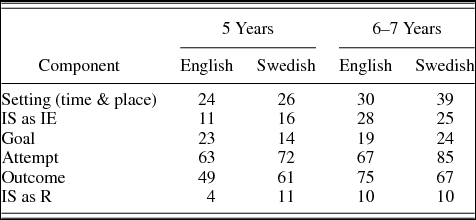
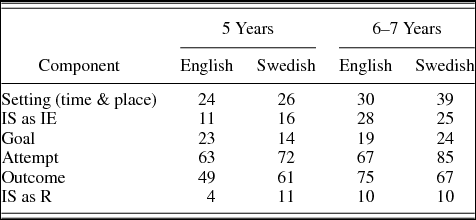
Let us now turn to an analysis of individual story structure components. Children realized the different types of components to strikingly different degrees. (Recall that because of the three-episode structure of each story, there are three opportunities for each story component to be produced.) As shown in Table 1, by far the most common components are attempts, which were produced by the 5-year-olds in 63% (English) and 72% (Swedish) of all contexts, and outcomes, which were produced in 49% (English) and 61% (Swedish) of all contexts. Settings, defined on MAIN as time and place references (e.g., once upon a time, one day, in a meadow, by the lake) and goals of protagonists (e.g., wanted to catch the baby goat) were sometimes made explicit, but not often. Internal states as initiating events (IS as IE; e.g., worried, hungry), and internal states as reactions, (IS as R; e.g., scared, happy), were expressed but rarely. Table 1 shows how similar the distribution of story structure components is across the two languages.
Frequencies of different types of story grammar components provided in the 5-year-olds’ and 6- to 7-year-olds’ narratives, broken down by language
Note: IS as IE, Internal state as initiating event; IS as R, internal state as reaction.
Example (1) illustrates how the 5-year-olds’ narratives are dominated by attempts and outcomes, with little information about the feelings, intentions, and goals of the protagonists involved. Scorable attempts and outcomes are underlined. Quite a few narratives contain passages with purely descriptive sequences, where objects and characters are merely named and identified (cf. the beginning of (1), A goat. A baby goat. A tree där. A wolf was behind. [. . .] That's a wolf.). No narrative however is purely descriptive; all identify events and chain these together (“action sequences”).
(1) A goat. A baby goat. And it was a tree. A tree där. A wolf was behind. And then when the goat looked behind the tree. That's a wolf. And then the wolf ran and took her knee. And then the baby goat … when a black bird took … flied. I mean not flied … from the top of the tree and took the wolf's tail. Then the baby goat run to the baby goat's mummy. And then the black bird was chasing and scaring the wolf. That's all.
(Baby Goats, English, 5-year-old, MAIN story structure score = 3/17)
Example (2) also contains several attempts and outcomes (underlined), but also expresses goals (in boldface) and some internal states of the protagonists (in capitals), such as the fox being hungry, which motivates its going to catch the baby goat, or the goat family being happy, which is a result of the fox being chased away by the intervening bird. While not particularly frequent, such story structure elements are expressed by at least some 5-year-olds. Example (2) is the narrative with the highest score for story structure in the 5-year-olds’ data.
(2) It was a little baby … goat. Falled in the water and the daddy goat comed and it was going to save the little baby goat. And the sister goat was only eating the grass. And the daddy goat was taking up the baby goat from the water. And the sister goat was still eating grass. And then the fox comed and it was HUNGRY. And it was going to eat those goats. And then the fox comed. And then it runned and was going to catch the baby goat. And then it catched the baby goat. And the daddy goat was still drinking grass and didn't save the baby goat. And then a bird comed and bite the fox's tail. And then the fox run away. And they was HAPPY.
(Baby goats, English, 5-year-old, MAIN story structure score = 9/17)
Owing to the low frequency of overtly expressed goals, there are very few full GAO episodes (n = 8) in the 5-year-olds’ data. This corresponds to 7% provision of GAO out of all potential contexts (8/114), evenly distributed over both languages. Put differently, 21% of all narratives contained one GAO (8/38). No child produced more than one GAO.
The 6- to 7-year-olds
The 66 narratives of the 6- to 7-year-olds had a mean length of 74 words (SD = 24) and contained on average 7 (out of 17) MAIN story structure components, which is 2 points higher than the 5-year-olds. None of the 6- to 7-year-olds achieved more than 12 points, which indicates that their narratives were all in the lower or middle range for story grammar elements. When broken down by language, the Swedish mean composite score (M = 7.1, SD = 2.1, range = 3–12) is extremely close to that for English (M = 7.0, SD = 2.6, range = 2–12), with no statistically significant difference (Wilcoxon signed ranks, z = −0.13, p = .8966). Thus, the 6- to 7-year-olds at group level scored virtually identically for macrostructure production in both their languages.
At an individual level, a large majority of 6- to 7-year-olds (24/33) also scored similarly in their two languages. Most children with very low scores had low scores in both Swedish and English; similarly, most children with a high score in one language also had a high score in the other language. Only for 9 children did the story structure score in one language fall more than 2 points below the score in the other language. In each of these nine cases, the low score concerned the first of the two testing sessions and in six of them the low score was for English. For four of these children, parents had previously rated the child's proficiency in English lower than in Swedish. However, for none of the other 6- to 7-year-olds could we detect a relation between a lower score on MAIN and a lower parental language proficiency rating; many children with lower parental proficiency ratings in one language had high scores in that language, and vice versa. Other information from the background questionnaires on the child's language preference, age of first exposure, estimated amount of exposure, and language use at school did not show any relation with the production scores either. We compared the narrative production scores for the first testing session with those for the second (Story 1: M = 6.4, SD = 2.4 vs. Story 2: M = 7.7, SD = 2.2).Footnote 4 Scores for the second story tended to be higher, which suggests a training or carryover effect from the first to the second session for the 6- to 7-year-olds (z = −3.24, p = .0012, Cohen d = 0.57). Most improvement appeared to happen when Story 1 was told in English and Story 2 in Swedish (see Discussion).
When considering the types of story structure components expressed by the 6- to 7-year-olds in their narratives, we find, just as for the 5-year-olds, that by far the most common components are attempts, which were produced in 67% (English) and 85% (Swedish) of all contexts, and outcomes, produced in 75% (English) and 67% (Swedish) of all contexts, see Table 1. Settings (i.e., time and place) are sometimes made explicit (30% for English, 39% for Swedish). Somewhat less commonly expressed are goals (19% for English, 24% for Swedish) and internal states as initiating events (IS as IE; 28% for English, 25% for Swedish). Internal states as reactions (IS as R) are rare (10%), regardless of whether the children told their narratives in Swedish or English.
Example (4) illustrates the 6- to 7-year-olds’ narratives with the highest score (12/17 points) for story structure. Settings are provided (double underline). In addition to many attempts and outcomes (underline), some of the goals of the protagonists are mentioned (in boldface), thus making full GAO episodes. Some protagonists’ internal states as initiating events (in capitals) are also spelled out, such as the little goat drowning, which motivates daddy goat coming to the rescue. Similarly, the fox being hungry motivates his wanting to eat up the other goat. Internal states as reactions are mentioned too (in capitals), like the goat getting scared by the fox, and the goats living happily, as a result of the fox being chased away by the intervening crow.
(4) Once upon a time, there were three goats and one day the little goat, one of the little goats were ABOUT TO DROWN in the water. And then their big daddy goat came and took them up. Then, suddenly, there came a fox that was HUNGRY and it wanted to eat up the other goat that was eating grass. Then the goat, the fox jumped up and the goat got SCARED. And the fox snatched the goat. And then there was a bird, a crow LOOKING. And then the crow swooped down and took the fox's tail and chased him away. The goats were HAPPILY ever after, yeah.
(Baby Goats, English, 6- to 7-year-old, MAIN structure score = 12/17)
Owing to the low frequency of overtly expressed goals, there are few full GAO episodes (n = 23) in the 6- to 7-year-olds’ data. Computed over all potential contexts (23/198), this corresponds to a 12% provision rate for GAO, which is low but nearly twice as high as in the 5-year-olds. An alternative way of looking at episodes is to say that a full GAO occurs in 35% (23/66) of the narratives told by the 6- to 7-year-olds. Not all children who produced full GAOs also reached a high composite story structure score, and not every child with a high composite structure score produced a full GAO, but most of them did. Only 5 children (out of 33) produced more than one full GAO. GAOs were evenly distributed over the two languages.
Narrative production across the two age groups
The 5-year-olds’ narratives contained on average 5 story structure components (M = 5.3, SD = 1.7, range = 2–9 out of 17), vis-à-vis 7 components in the 6- to 7-year-olds’ narratives (M = 7.1, SD = 2.4, range = 2–12 out of 17). The difference between the two age groups is statistically significant (Mann–Whitney two-tailed, z = 3.61, p = .0003, effect size Cohen d = 0.87). This suggests that macrostructural discourse competence in production improves from age 5 to 7. While all story grammar components become more frequent from age 5 to age 6–7, some seem to develop more than others, see Figure 2.
Frequencies of different types of story grammar components provided in the narratives of the 5-year-olds versus the 6- to 7-year-olds, Swedish and English combined.
Settings, which orient the listener with regard to time and/or place of the story, are realized in only 25% of the stories of the 5-year-olds but in the majority (61%) of the stories told by the 6- to 7-year-olds (two-proportion z test, z = 4.294, p < .0002, Cohen d = 0.45). Often, these setting statements are stereotypical fairytale openings or fragments thereof. They indicate, besides macrostructural knowledge, an increasing familiarity with storytelling conventions and formulaic storybook expressions specific to English and Swedish (e.g., Once upon there was three animals, Once upon a time …, One day…, Det var en gång tre bockar som betade på en grön äng [it was a time three billygoats that grazed on a green meadow], En gång var det en fågel som … [one time was there a bird that …]). Such settings are rare in the 5-year-olds, who instead often start their narrative by directly plunging into picture description (e.g., That's a baby goat; Dom ville ha mat [they wanted food]). Yet the difference between the age groups is not categorical; a few 5-year-olds’ stories do include a setting component, and a considerable number of narratives by the 6- to 7-year-olds lack settings (39% mention neither time nor place, 61% mention time or place, and 31% mention both).
Moving on to the episode system, it is striking how infrequently the goals of protagonists are made explicit (18% at 5 years, 22% at 6–7 years). There is no development over age with regard to goals from age 5 to 7; and with so few goal statements, there cannot be many complete episodes (GAO) either. This milestone of narrative development, often described in the literature but with contradictory information concerning age (cf. Background section), does not appear to be mastered by the average 6- to 7-year-old when telling a story elicited by MAIN.
For other story structure components, we see some age differences. While internal states as initiating events are rare at 5 years (13%), they are mentioned twice as often by the 6- to 7-year-olds (27%), for instance, under their nest was a hungry cat; då tänker katten dom dära är smaskiga [then thinks the cat those are yummy]. Such explicit internal state terms are helpful when listeners are trying to follow the child's story and deduce what the (implicit) goal of the protagonist might be (e.g., the cat wanting to kill and eat a bird). Outcomes of events also increase in frequency, though from a much higher level of 55% at age 5 to 71% at age 6–7 and then are explicit nearly as often as attempts (76%). Most episodes end abruptly with an outcome statement (e.g., pushed the little one out of the water; snatched the baby; chased him away), without spelling out the internal reaction or affective response of the story characters to that outcome (e.g., those three was scared; då blev lilla fågelungen rädd [then became the little baby bird scared]; all the goats were really happy; å sen blev mamman glad [and then became the mother glad]). Such internal states as reactions are rarely mentioned regardless of age (5-year-olds: 7%; 6- to 7-year-olds: 10%), and the repertoire of such states is extremely limited (scared, happy).
Narrative comprehension
5-year-olds
Comprehension questions targeting macrostructure were asked immediately after the children had told their story. The 5-year-olds scored on average 6.7 out of a maximum of 10 points. Most performed in the middle to higher range for comprehension of story grammar elements.
Broken down by language, the mean comprehension score for Swedish (M = 7.1, SD = 1.8, range = 2–9) is slightly higher than for English (M = 6.4, SD = 1.5, range = 3–9), but this difference proved not statistically significant (Wilcoxon signed ranks, z = –1.21, p = .2263). Thus, the 5-year-olds at group level scored highly similarly for story comprehension in both their languages. Comprehension scores for the first versus second narrative were very close, with no significant difference between the two (M1 = 6.1, M2 = 6.0, z = 0.3, p = .7642), which suggests that there was no practice effect for story comprehension from the first to the second session.Footnote 5 At an individual level too, the majority of 5-year-olds (12/19) attained similar comprehension scores in both their languages. For the remaining 7 children, comprehension scores in the two languages differed by more than 2 points. The lower score was mostly in English. We could not detect any relationship between low (or high) comprehension scores and individual language background factors as established via parental questionnaires. (Individual results are not reported here for reasons of space.)
A large discrepancy was found between the 5-year-olds’ story production and story comprehension as measured on MAIN. For instance, the very same child who produced the narrative in Example (1) without any goals or initiating events or internal reactions (low score of 3/17), when questioned showed good understanding of these macrostructural components (high comprehension score of 8/10). This is illustrated in Example (3) for Episode 1 in the Baby Goats story; the child understands both the goal (3a) and the internal state as initiating event (3b) of this episode.
(3)

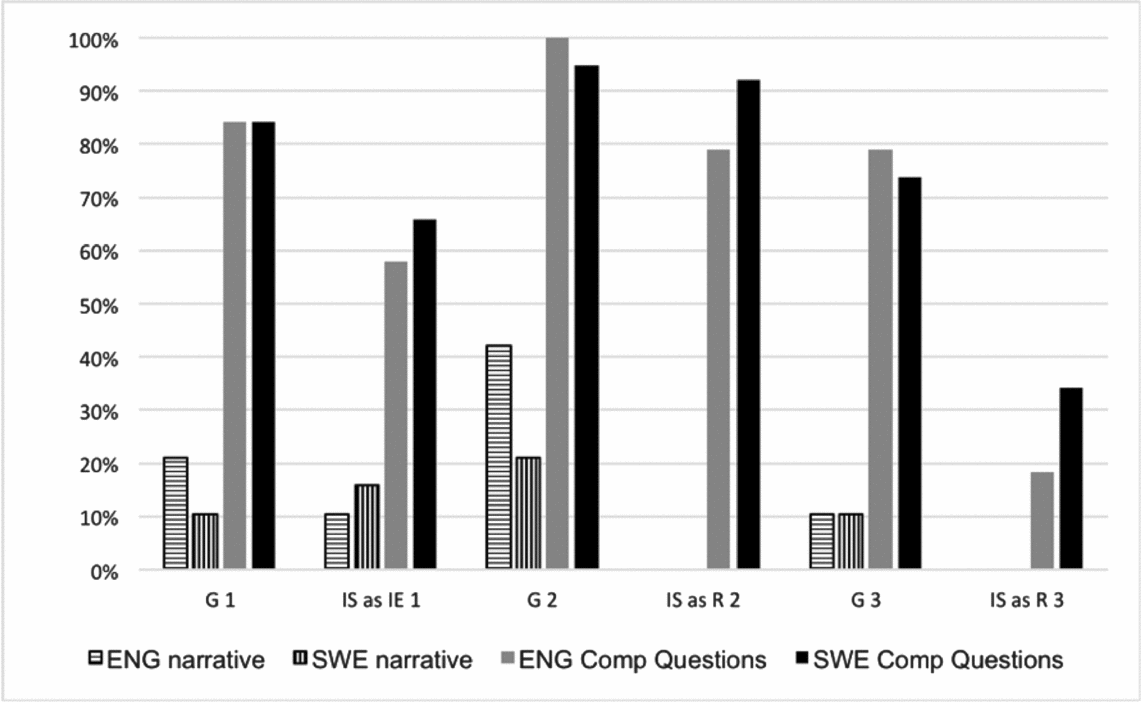
Figure 3 illustrates the gap between story comprehension and narrative production for the components targeted by the comprehension questions (i.e., goals and internal states in the three episodes). Tall solid bars in gray (for English) and black (for Swedish) show the high frequencies at which these individual macrostructural components were understood by the 5-year-olds when probed (mostly 75%–100%). By contrast, short stripy bars show the very low frequencies at which these components were actually expressed in the children's own stories (mostly 0%–20%). This pattern is strikingly similar for both languages. However, the 5-year-olds scored low on one comprehension question (IS as R3, as shown in the rightmost columns in Figure 3), which is investigated below.
Production versus comprehension of goal and internal state components in the three episodes for the 5-year-olds, English and Swedish.
The 6- to 7-year-olds
Concerning the understanding of macrostructure components, the 6- to 7-year-olds scored on average 7 out of a maximum of 9 points. Broken down by language, the mean for Swedish (M = 6.7, SD = 1.7, range = 4–9) was very close to that for English (M = 7.0, SD = 1.8, range = 2–9), with no statistically significant difference (Wilcoxon, z = 1.09, p = .2757). The 6- to 7-year-olds at group level thus scored virtually identically for story comprehension in both their languages.
Comprehension scores for the first story did not differ significantly from those for the second; if anything, they were somewhat lower for the second (M1 = 6.5, SD = 2.0; M2 = 6.2, SD = 2.2; z = 0.63, p = .5287), which indicates that there was no training effect for story comprehension from the first to the second session for the 6- to 7-year-olds.Footnote 6 At an individual level, the majority of children (23/33) attained similar comprehension scores in both their languages, though 10 children had scores of more than 2 points’ difference between the languages. This, however, could not be attributed in any way to a particular language (e.g., lower scores in English) or to the first versus the second testing session. Rather, our impression was that some 6- to 7-year-olds were bored by the comprehension task and not always willing to cooperate, finding the questions repetitive when having already told the story. Low results on the comprehension task, especially when combined with high results on the narrative production task, thus need not indicate flaws in narrative understanding. (Individual results are not presented here for reasons of space.)
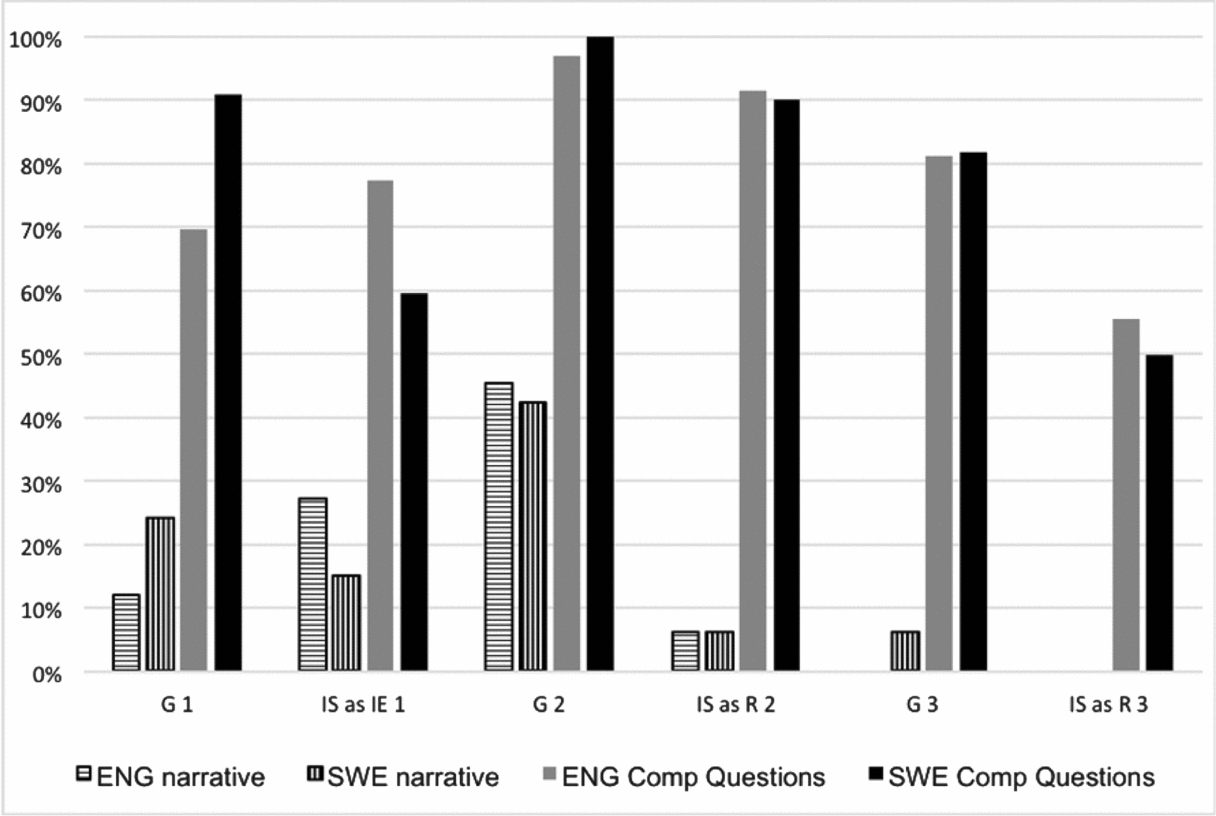
For most 6- to 7-year-olds (and in parallel with the 5-year-olds), we found a great gap between story production and story comprehension as measured on MAIN. Figure 4 illustrates that goal and internal state components were understood to a much greater extent (mostly 70%–100%) than they were spontaneously expressed in the children's actual narrative (0%–45%). This pattern is strikingly similar for both languages. The tall gray (English) and black (Swedish) solid bars in Figure 4 indicate comprehension, and short striped bars indicate components in story production. Just like the 5-year-olds, the 6- to 7-year-olds scored less well on one particular comprehension question (IS as R3, rightmost columns in Figure 4). This is discussed in the next section.
Production versus comprehension of goal and internal state components in the three episodes for the 6- to 7-year-olds, English and Swedish.
Story comprehension across the two age groups
The mean comprehension score of the 5-year-olds (M = 6.1 SD = 1.7, range = 2–9 out of 9) is relatively close to that of the 6- to 7-year-olds (M = 6.8 SD = 1.7, range = 2–9 out of 9).Footnote 7 The difference between the two age groups is statistically significant, but effect size is not very high (Mann–Whitney two-tailed, z = 2.26, p = .0238, Cohen d = 0.41). Understanding of narrative macrostructure is thus generally quite good already at age 5 and does not improve as much as macrostructural production skills develop between age 5 and 6–7.
Figure 5 plots the two age groups against each other, for each story structure component targeted by the comprehension questions (goals and internal states). Comprehension rates are very similar for the two groups, and particularly high for goals (80%–98%).
Comprehension of goal and internal state components in the three episodes for the 5-year-olds versus the 6- to 7-year-olds, Swedish and English combined.
Comprehension of internal states is more variable, but here too the two age groups are very close, except for one element, namely, internal state as reaction in Episode 3 (IS as R3). As graphically shown by the rightmost pair of bars in Figure 5, the 6- to 7-year-olds do much better than the 5-year-olds when being asked the following question (in connection with the sixth and last picture; cf. Figure 1, where the experimenter points to the “goodie” X and the “family” Y): Imagine that the X (bird/dog) sees the Y (goats/baby birds). How does the X (bird/dog) feel? Why do you think that the X (bird/dog) feels …? Comprehension of internal state as reaction in the final episode (i.e., at the end of the story) is arguably more difficult, because the child needs to consider the whole story (plotline) to arrive at the conclusion that the bird/dog must feel good about the result of its intervention. The child must also take the perspective of the bird/dog (theory of mind). Correct answers here are feels good, proud, like a hero, relieved, pleased, satisfied, glad, happy that the goats/baby birds are safe, and so on. Such positive emotional state terms made up only a minority of the answers by the 5-year-olds (26%) and half of the answers by the 6- to 7-year-olds (53%). A qualitative analysis of the answers reveals that 5-year-olds instead mostly answered with negative emotions and said that the bird/dog feels bad because it is hungry (which indicates no understanding of the plot whatsoever), or answered that the bird/dog feels bad because it is sad, mad, or angry at the fox/cat. Forty-seven percent of the answers given by the 6- to 7-year-olds were also negative emotions (feels bad because it is sad/mad/angry at the fox/cat). Such answers suggest that the children verbalize what they see in the last picture (which shows the bird/dog with a fierce and angry expression; Figure 1), but that they do not draw the required inference concerning the entire plot: while the bird/dog may have felt sadness, anger, and fury earlier on, this is unlikely to be its reaction at the end of the story in response to the question Imagine that the bird/dog sees the goats/baby birds. How does the bird/dog feel? As most 5-year-olds and half of the 6- to 7-year-olds fail to demonstrate adequate understanding of the internal state as reaction in Episode 3, we are led to conclude that awareness of others’ states of mind and the ability to draw inferences are still developing at age 7.
Some other answers in the comprehension task point in the same direction. Both age groups scored highly on the following question targeting the internal state of the “baddie” as reaction (IS as R2 in connection with the last picture: How does the fox/cat feel? > Negative reaction: bad, sad, angry, mad, scared, hurt, still hungry, disappointed). Children at age 5 mostly described this internal state in very general terms as “bad” or “not good.” When probed further (Why do you think . . . ?), nearly all 5-year-olds related the fox/cat feeling bad to its being physically hurt; only a few mentioned it being scared. They explained that its tail hurt because it was bitten by the bird/dog. Thus, they gave an exclusively short-range explanation or rationale for the internal state as reaction of their choice. No 5-year-old mentioned that the fox/cat might feel bad, disappointed, or still hungry because its attempt at killing its prey had been thwarted. Children at age 6–7 mostly described the internal state of the fox/cat as “scared,” less commonly as “bad” or “not good.” In contrast to the younger children, few children at age 6–7 attributed the fox/cat's feeling bad to it being physically in pain; rather, they explained that it felt scared because it was being chased or bitten. Despite this shift from a physical state (hurt) to an emotional state (scared), the 6- to 7-year-olds still gave short-range explanations, just as the 5-year-olds had done: they focused on what the bird/dog physically does to the fox/cat and how this makes it feel. Thus, they processed information locally rather than globally. Very few 6- to 7-year-olds (n = 4) gave long-range explanations that relate back to earlier events in the story: two children said that the fox felt disappointed and hungry because it did not get any food, and two stated that the fox felt bad because he was ashamed or full of remorse for having attacked the goat. These were very unusual answers, and their rarity suggests that the average 6- to 7-year-old is far more likely to verbalize internal states of protagonists that are depicted in individual pictures than make explicit internal states that only can be deduced by taking into account the entire plotline.
DISCUSSION
The previous sections reported results for narrative production and comprehension from 19 Swedish- and English-speaking preschoolers age 5 and 33 first-graders age 6–7, with a view to shedding light on the following questions. Do bilingual children with comparable language exposure exhibit similar narrative macrostructure in both their languages? What is the macrostructure of elicited narratives in terms of presence of story grammar components and episodic complexity? How does story production compare with story comprehension? Are there any macrostructural aspects of narrative ability that can be said to develop between the ages of 5 and 7? Quantitative scores on MAIN were compared for language (Swedish vs. English), first versus second narrative, production versus comprehension modality, as well as age (5 vs. 6–7 years). This was complemented by qualitative analyses of the data.
Let us now consider the research questions in turn. First, do bilingual children make use of similar narrative macrostructure in both their languages as reflected in their performance on MAIN? At a group level, the answer is a resounding yes. Keeping age constant, there were no significant differences between Swedish and English on the composite narrative production score. This would suggest that story structure is invariant across a bilingual child's two languages, as has been claimed before but not been previously shown in such detail (e.g., Berman, Reference Berman, Verhoeven and Strömqvist2001; Fiestas & Peña, Reference Fiestas and Peña2004; Iluz-Cohen & Walters, Reference Iluz-Cohen and Walters2012; Paradis et al., Reference Paradis, Genesee and Crago2011; Pearson, Reference Pearson, Oller and Eilers2002). For the 5-year-olds, story structure scores for Swedish (M = 5.7) were slightly higher than for English (M = 4.9), which could be due to Swedish being the ambient majority language for these children growing up in Sweden, and in some cases also the slightly stronger language, as rated by the parents. For the 6- to 7-year-olds, story structure scores in English and Swedish were virtually identical (M = 7.0 and 7.1, respectively).
The younger children scored significantly lower on MAIN (5-year-olds, M = 5.3) than the older ones (6- to 7-year-olds, M = 7.1). This suggests that macrostructural narrative skills measurably improve between the ages of 5 and 6–7 and that these skills vary with and depend on age more than on the language a story is told in (Akinci et al., Reference Akinci, Jisa, Kern, Verhoeven and Strömqvist2001; Berman & Slobin, Reference Berman, Slobin, Berman and Slobin1994; Fiestas & Peña, Reference Fiestas and Peña2004; Kupersmitt & Berman, Reference Kupersmitt, Berman, Verhoeven and Strömqvist2001; Pearson, Reference Pearson, Oller and Eilers2002; Soodla, Reference Soodla2011).
Group means may mask some individual differences. While all 5-year-olds fell into the lower range on MAIN (2–9 out of 17) and the 6- to 7-year-olds into the low to middle range (range = 2–12 out of 17), there was a lot of variability within each age group. Composite scores in the two languages were often close, but for a minority of children, the scores differed substantially. While 38 children scored within 2 points’ difference in their two languages, 14 did not: 5 5-year-olds and 9 6- to 7-year-olds had a substantially lower composite score in one of their narratives, mostly in the first session and mostly in English. This occurred even though all participants had received at least 2 years of regular and frequent exposure to both languages and were using both languages regularly. The children could thus reasonably be expected to have enough language-specific knowledge to express macrostructural knowledge in both languages. Yet not every child did so to the same degree. This suggests that on an individual level, macrostructural narrative skills may not be completely invariant across a bilingual's child two languages or at least not completely invariant as manifested and measured on MAIN.
We could not detect any direct relationship between low (or high) macrostructural scores and the parents’ ratings of language proficiency in the child, reported language preference, age of first exposure, estimated amount of exposure, or language use at school, although this should be investigated further for a larger data set. All participants were exposed to and used both languages several times a week; children with less even language exposure and proficiency than our participants might show less even macrostructural scores.Footnote 8 For some 5-year-olds, unplanned disturbances from children noisily barging into the testing session affected performance negatively. For the 6- to 7-year-olds, however, the lower score was always for the first story they told, never for the second one. Indeed, the mean score for the first session (M = 6.4) for the 6- to 7-year-olds as a group was significantly lower than for the second session (M = 7.7), which may point to a general carryover or training effect for storytelling. No such effect whatsoever was found for the 5-year-olds. Does this indicate that that the 6- to 7-year-olds, but not the 5-year-olds, are cognitively able to learn and improve from the first to the second session or is the second-story effect in the 6- to 7-year-olds less to do with general learning and more to do with language, because improvement from the first to the second session mainly happened when Story 1 was told in English and Story 2 in Swedish? We must leave this question open, but we do see that there are a number of factors, including language and testing session, which may influence MAIN scores for macrostructure.
Second, we asked what the macrostructure of elicited narratives was like in terms of presence of story structure (story grammar) components and episodic complexity. By far the most common components are attempts and outcomes (Table 1). Other components are less common (goals; internal states; scene-setting information [time and place]). This holds for both Swedish and English and for the 5-year-olds and 6- to 7-year-olds alike. Attempt and outcome events are often chained together into action sequences, whereas complete episodes (GAO sequences) with causal connections that express the goals, thoughts, and feelings of the protagonists are infrequent. Internal states as reactions are particularly rare. This holds for Swedish and English and for both age groups. As such, the findings are in line with the existing literature on 5- to 7-year-olds’ narratives elicited in other languages, even though these other studies did not investigate bilingual children in both languages and used other stimulus materials, including the Frog story (cf. Berman & Slobin, Reference Berman, Slobin, Berman and Slobin1994; Shapiro & Hudson, Reference Shapiro and Hudson1991; Soodla, Reference Soodla2011; Stein & Albro, Reference Stein, Albro and Bamberg1997; Stein & Policastro, Reference Stein, Policastro, Mandl, Stein and Trabasso1984; Trabasso & Nickels, Reference Trabasso and Nickels1992; Trabasso & Rodkin, Reference Trabasso, Rodkin, Berman and Slobin1994; Westby, Reference Westby, Kamhi and Catts2012).
Third, we considered the children's comprehension of macrostructural elements. Note that the story comprehension task did not probe story recall but the ability to draw inferences concerning the thoughts, feelings, and goals of story characters. The 5-year-olds scored lower but still relatively close to the 6- to 7-year-olds, with large within-group variation. For neither age group was there any improvement in comprehension from the first to the second session, and no noticeable difference between Swedish versus English.
However, a large gap was found between story production and story comprehension for both 5- and 6- to 7-year-olds. Comprehension was clearly ahead of production. Fictional stories are organized around protagonists’ goals and their path of succeeding or failing to attain these goals. While few children in our study provided evidence of a full-fledged story schema in their narrative productions, they understood most goals (77%–98%) very well and also internal states as initiating event, regardless of language (Figs. 3, 4, and 5). This suggests that they had established and were using an underlying mental schema for narrative comprehension, even though they evidently could not fully apply this schema in production (cf. Shapiro & Hudson, Reference Shapiro and Hudson1991; Stein & Albro, Reference Stein, Albro and Bamberg1997; Trabasso & Rodkin, Reference Trabasso, Rodkin, Berman and Slobin1994; Trabasso & Stein, Reference Trabasso, Stein, Haith, Benson, Roberts and Pennington1994). Although it would be difficult to establish a “typical” composite comprehension score on MAIN for a particular age, owing to large within-group variation, we might say that the average child at age 5–7 should be able to demonstrate understanding of the goals of protagonists in MAIN when questioned. By contrast, we cannot expect all preschoolers or first graders to display full understanding of the internal states of fictional protagonists (thoughts, feelings, and affective responses). Here, the results from the comprehension task (Figure 5) showed that both 5- and 6- to 7-year-olds had difficulties in inferring internal states as reactions beyond the purely physical and clearly depicted.
Fourth, we explored whether there was any evidence for the development of certain macrostructural aspects of narrative ability. The literature mentions that such development occurs during the late preschool to early school years; yet which age “late preschool” and “early school years” precisely correspond to varies from country to country. The present study compared age 5 (preschoolers) to age 6–7 (first-graders) in a Swedish context. Most narrative studies with more than one age group compare ages further apart and, not surprisingly, find differences, for instance, between 5- to 6-year-olds and 9-year-olds (Berman & Slobin, Reference Berman, Slobin, Berman and Slobin1994; Möller, Reference Möller2010; Stein & Albro, Reference Stein, Albro and Bamberg1997; Stein & Glenn, Reference Stein, Glenn and Freedle1979; Trabasso & Stein, Reference Trabasso, Stein, Haith, Benson, Roberts and Pennington1994) or between 7- to 8-year-olds and 10- to 11-year-olds (Pearson, Reference Pearson, Oller and Eilers2002).
It is worth asking whether any development can already be seen from age 5 to 6–7. With regard to story production, the younger group's narratives were generally less complex and contained fewer story structure components than those from the older group; in particular, the category of setting (time and/or place) was rarely expressed at age 5 (25%) but often made explicit by age 6–7 (61%), irrespective of language (cf. Figure 2). The older children thus tended to set the scene and orient the listener (unshared knowledge), while the younger children plunged right into the action. Similarly, internal states as initiating events were rarely mentioned (13%) by the younger children, but twice as often by the 6- to 7-year-olds (27%, though again far from all). Outcomes too were more frequently expressed by the 6- to 7-year-olds. Here we see some developmental trends with age, but no categorical differences.
However, internal states as reactions to successful or failed outcomes were rarely made explicit for the listener by any child, with no development discernible from age 5 to age 6–7. The relative lack of mention of internal states as reactions echoes similar findings from other studies of narratives told by children before age 8–9, using different stimulus materials (e.g., Iluz-Cohen & Walters, Reference Iluz-Cohen and Walters2012; Shapiro & Hudson, Reference Shapiro and Hudson1991; Soodla, Reference Soodla2011).Footnote 9
Similarly, goals of protagonists were infrequently expressed by the children in the present study, irrespective of language, without any notable increase from age 5 to 6–7 (19%; 22%). This milestone of narrative development according to the literature (Trabasso & Nickels, Reference Trabasso and Nickels1992; Trabasso & Stein, Reference Trabasso, Stein, Haith, Benson, Roberts and Pennington1994; Westby, Reference Westby, Kamhi and Catts2012) does not appear to be mastered by the average 6- to 7-year-old when telling a fictional story in MAIN; and with so few goal statements, not many complete episodes (GAO sequences) were produced either. Full episodes remained more the exception than the rule, with at least one GAO in 35% of the narratives told at age 6–7, slightly up from 21% at age 5. The majority of children thus never produced a full GAO sequence, even though the elicitation materials with their three-episode structure provided three opportunities per story to do so.
In the bilingual Swedish–English narrative data, we thus see some development from age 5 to 6–7 toward the realization of more story grammar components and toward a more complex episodic organization, taking place in tandem fashion in both languages. The findings appear to be generally in line with what is reported on in the literature on narrative production in just one language, although concrete comparisons are difficult, because most studies use different stimuli and different age groups (e.g., 5 vs. 9 years; cf. Berman & Slobin, Reference Berman, Slobin, Berman and Slobin1994; Möller, Reference Möller2010; Trabasso & Rodkin, Reference Trabasso, Rodkin, Berman and Slobin1994). Elicitation materials with different global organization (e.g., the frog story) and other methods of story structure analysis are often relatively coarse-grained, so that one may easily be credited with full points for story structure and ceiling is reached relatively quickly (e.g., Akinci et al., Reference Akinci, Jisa, Kern, Verhoeven and Strömqvist2001; Fiestas & Peña, Reference Fiestas and Peña2004; Lanza, Reference Lanza, Verhoeven and Strömqvist2001; Möller, Reference Möller2010). By comparison, the analysis of story structure on MAIN is more detailed and includes both production and comprehension.
The present study has used MAIN to elicit and assess macrostructure in the two languages of bilingual Swedish–English children. The results show that there is development of narrative skills between age 5 and 7, but they also show that such development is far from complete by age 7. The composite production score (max 17 points) increased substantially with age from 5 to 6–7, while the complexity measure (provision of full GAO or not) and the composite story comprehension score (max 10 points) only marginally did so. In time and with a considerably larger data pool involving different language pairings, it may be possible to establish norms for children of different ages, which could then be used for screening and assessment in speech–language pathology and therapy for multilingual (and monolingual) children.
At present, we suggest that the usefulness of MAIN mainly lies in the possibilities it provides for explorative research on narrative skills in bilingual children. Here, the composite scores by themselves do not tell us all. More detailed analyses uncover some telltale qualitative differences between individual children and between age groups concerning story structure components. For instance, a high score in the comprehension task remains silent on whether the child mainly draws “short-range” inferences (e.g., fox feels bad because its tail hurts) or higher level “long-range” inferences involving the entire plotline (e.g., fox feels bad because it wasn't successful). Here, a qualitative analysis of selected items on the comprehension task (or, perhaps, an amendment of the existing scoring system) would be more informative. An analysis of selected comprehension questions would also be more informative for the item targeting internal state as reaction at the end of the story (e.g., crow feels good because the baby goat is safe now), which many children scored zero points on, despite reaching an overall high composite comprehension score. Similarly, the MAIN composite story structure score does not tell us whether the child includes a setting statement (time and place) in his/her production, which orients the listener and thus adds to the quality of the narrative. Again, a qualitative analysis of selected story structure components would be more revealing here than a composite score.
A future amendment that the authors of MAIN might want to consider in connection with settings would be to include not only mentions of time and place (which earn points in MAIN) in the setting component but also appropriate introduction of story characters (which does not earn points). Character introduction is typically included in story grammar analyses as part of the setting (Mandler & Johnson, Reference Mandler and Johnson1977; Schneider & Hayward, Reference Schneider and Hayward2010; Shapiro & Hudson, Reference Shapiro and Hudson1991; Stein & Glenn, Reference Stein, Glenn and Freedle1979; Stein & Policastro, Reference Stein, Policastro, Mandl, Stein and Trabasso1984). It is somewhat surprising that character introduction is not evaluated in the current version of MAIN, even though it provides the listener with vital information. (Consider the following two story openings: They were eating grass. vs. One daythere were some goats eating grass in a meadow.) Character introduction cuts across macrostructure and microstructure, as it is a type of referent introduction that is encoded by different language-specific means. Nevertheless, storytelling in all languages involves mention of protagonists, and their appropriate introduction (or absence thereof) could be informative for assessing narrative skills in a child.
In sum, this study has found MAIN to be a useful tool to elicit and assess narrative macrostructure in tandem in two languages. A large majority of children employed the same level of story complexity and story structure components to similar degrees in both languages, and evidently used a more complete underlying schema for story comprehension, even though they could not fully apply this schema in actual narration. By and large, the results can be interpreted to support the assumption that story structure is invariant across a bilingual child's two languages at a given age, with similar understanding of story events and causality and similar awareness of the intentions and goal-directed behavior of protagonists, regardless of language. This supports the idea that macrostructure is largely language independent, that it may be transferred across languages, and also that it may be a more appropriate measure of narrative ability in bilingual children than more language-dependent microstructural measures.
ACKNOWLEDGMENTS
This work was partially supported by the Swedish Research Council (Grant 2013-1309). I am grateful to two anonymous Applied Psycholinguistics referees and special issue editor Elizabeth Kay Raining-Bird for many useful suggestions. I owe a particular debt of gratitude to Natalia Gagarina, Daleen Klop, Sari Kunnari, Koula Tantele, and Taina Välimaa for fruitful collaboration and to the entire COST Action IS0804 Working Group 2 for welcoming me into their midst. Heartfelt thanks to Sara Arnoldsson, Bente Aronsson, Annika Leback, Josefin Lindgren, Sara Härdelin, Ingrid Naylor, and Lisa Nilsson for assisting me in piloting MAIN in Sweden, for data collection and transcription. Many thanks to all the (pre)schools, parents, and children who were willing to participate; without them there would be no MAIN and no results.