1. INTRODUCTION
In 1405, in the early part of the Ming Dynasty, a grand fleet led by Admiral Zheng He left the port of Changle, which was located on the southeast coast of China, to start a grand expedition to the Western Ocean. Over the next 28 years (1405–1433), the fleet completed seven voyages to the Western Ocean and visited more than 30 countries in Southeast Asia, South Asia, West Asia, and the eastern coast of Africa. The ships forming Zheng He's fleet were wooden sailing vessels powered by winds and currents. The navigators not only knew how to trim their sails to take advantage of different winds, but also knew where and when to wait for the right following winds. To ensure their safety and success, the navigators of Zheng He's fleet had to be very familiar with the patterns of the winds and the currents in their voyages. According to historical records, along the main routes of Zheng He's fleet, special ports had been chosen as the departure point, the wind-waiting points, and the divergent or rendezvous points for the main fleet and the squadrons. In general, to complete their diplomatic missions successfully, the navigators of the fleet had to possess extensive knowledge of the tropical and subtropical monsoons and of the geographical environments along their routes.
2. CHANGING PATTERNS OF ASIAN TROPICAL AND SUBTROPICAL MONSOON
The book Ping Zhou Ke Tan (Table-Talk at Pingzhou), which was compiled in the North Song Dynasty (960–1126), contains a description of the Chinese sea-going ships. They were described to have had the following characteristics:
‘The ships are built squarely like rectangular wooden grain-measures (Mu Hu). If there is no wind, they cannot move anymore. Their masts are firmly stepped on the deck, and the sails are hoisted beside them. One side of the sail is close to the mast, around which it moves like a door on its hinges. … At sea, they can use not only a wind from abaft but also the winds from offshore or onshore. It is only the head wind that cannot be used. This is called using the winds of the three directions.’ (Zhu Yu Reference Zhu1939).
Though this record reveals that ancient Chinese sea-going sailing ships could use the winds from three directions, the most efficient and convenient way for sailing on the deep sea was to move forward in a following wind. Under these circumstances, in ancient times, the monsoon played a significant role in the navigation of wooden ships sailing on the low-middle latitude seas. Thus, the voyages and the sailing schedule had to be carefully planned in advance according to the seasonal changing patterns of the monsoon.
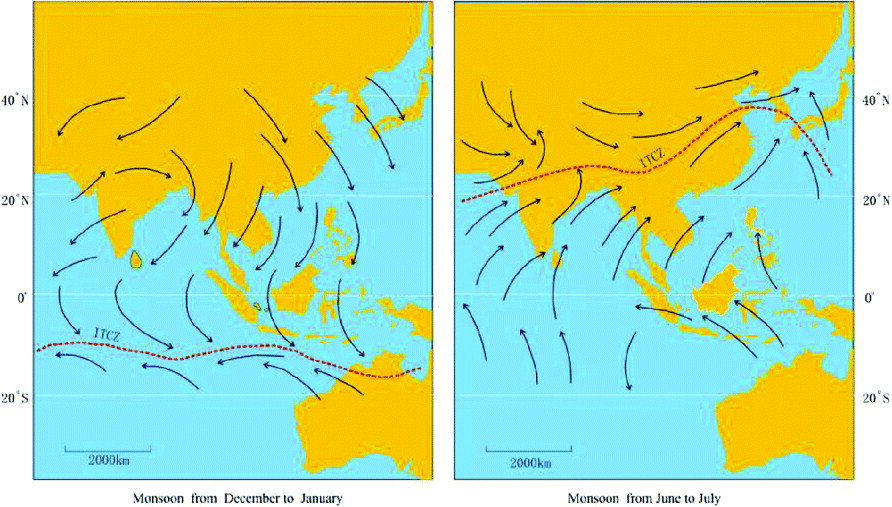
Modern meteorology proves that the Asian monsoonal circulation system develops in response to the differences in seasonal temperature variations between continents and oceans, which is further strengthened by seasonal northward or southward movements of the subtropical high-pressure belts and the Inter-tropical Convergence Zone (ITCZ) (Edwards, Joseph & Riper Reference Edwards and Riper1971). Generally, the subtropical high-pressure belts situate intermittently around 20–30° N and 20–30° S, from where the northeast trades in the Northern Hemisphere and the southeast trades in the Southern Hemisphere blow to the equatorial low pressure area forming the ITCZ. Because the angle of incidence of the sun's radiation changes seasonally, so the ITCZ also changes its position correspondingly. In spring and autumn, the location of the ITCZ is near the Equator. During the summer in the Northern Hemisphere the ITCZ moves away from the Equator to the north, whereas during the summer in the Southern Hemisphere the ITCZ moves to the south of the Equator. Therefore, the persistent winds in the area between the northern and the southern extremes of the ITCZ periodically change direction from NE to SW (Figure 1).
Changing patterns of the Asian monsoon (Edwards, Joseph & Riper Reference Edwards and Riper1971).

In general, over the low-latitude seas of Asia, the NE wind prevails during the winter months, while the SW wind blows in the summer months. The onset of the persistent winds differs slightly from the South China Sea to the Indian Ocean. Over the South China Sea, the NE wind blows from October to March, while over the Indian Ocean, the NE wind blows from December to late February. Relatively the NE wind over the Indian Ocean is weaker than that over the South China Sea. Moreover, the SW wind over the Indian Ocean blows from late April to September, while the SW wind over the South China Sea prevails from May to August and is usually weaker than that over the Indian Ocean.
Comparatively speaking, the NE wind over the South China Sea arrives earlier but leaves later, while the SW wind over the North Indian Ocean starts earlier but ends later. The span of the time between the dates of onset and withdrawal of the NE wind or the SW wind in the two areas was beneficial to ancient shipping. According to historical records, ancient Chinese sailing patterns in the regions of the South China Sea and the Indian Ocean were as follows:
‘The ships left the China port in November and December (in Chinese calendar) in order to take advantage of the north winds, and they came back in May and June following the south winds’ Footnote 3. (Zhu Yu Reference Zhu1939) ‘Every October of the Chinese Calendar, the officials ordered the foreign ships sailing back to the west, which they usually arrived in at the date of the summer solstice’ Footnote 4. (Zhou Qu-fei Reference Zhou1999)
3. DEPARTURE PORT AND THE MAIN ROUTEs OF ZHENG HE'S FLEET
In documents from the Ming Dynasty (1368–1644), three ports were associated with Zheng He's fleet: the Longwan port in Nanking, the Liujiagang port in Taicang, and the Wuhumen port in Changle. Ming Shi (History of the Ming Dynasty) recorded Zheng He's first voyage:
‘In June of the third year of the Yongle Reign (1405), the emperor ordered Zheng He and Wang Jing-hong as the ambassadors to the Western Ocean. They led more than 27,800 sailors and carried plenty of golden coins with them. Sixty-two large ships were built, each of them were 44 zhang Footnote 5in length and 18 zhang in breadth. The fleet set out from the Liujiahe port Footnote 6for Fujian. The fleet, starting the voyage at the Wuhumen port (in Changle), firstly arrived at Campa and then visited other countries in sequence in the Western Ocean. In each country they visited the decree from the Emperor was announced and the gifts from the court were awarded. If the local rulers refused to obey the royal order, the fleet would suppress them with force’. (Zhang Ting-yu Reference Zhang1974)
In another book, Xing Cha Sheng Lan (Triumphant Visions of the Starry Raft), written by Fei Xin in the Ming Dynasty, the ports and the routes passed through in the third voyage of Zheng He's fleet were recorded:
‘In September of the seventh year of the Yongle Reign (1409), the fleet left the Liujiagang port of Taicang. In October it arrived in the Taipinggang port of Changle in Fujian and stayed there until December, and then the fleet left Wuhumen, set up twelve sails, for Campa and arrived there in ten days and nights under following winds’. (Fei Xin Reference Fei1954)
In the two voyages mentioned above, Zheng He's fleet first sailed from Taicang to Changle, from where the fleet started the formal voyage to the Western Ocean. When Zheng He's fleet went on its seventh voyage in the sixth year of the Xuande Reign (1431), instead of sailing out of Taicang, the fleet set out from Longwan, the treasure-shipyard in Nanking, for Changle. Eight months after its arrival in Changle, the fleet began its formal voyage to the Western Ocean.
Therefore, it can be concluded from these records that Changle was the formal departure port for Zheng He's voyages to the Western Ocean. The Changle port was located at 26° N where the sub-tropical monsoon appears strongly in a regular pattern. To prepare for the voyage to the Western Ocean, the ships of Zheng He's fleet, coming from either the ports of Longwan or Liujiahe, had to sail to Changle to wait for the right NE wind. The inscription engraved on the stele, which was erected by Zheng He and his associates in the Temple of South Mountain at Changle, states the following:
‘As the fleet frequently stationed in Changle waiting for favourable winds to set sails upon the ocean, in the tenth year of the Yongle Reign (1412), I asked the permission of the court to build this temple for the crew to pray for good winds and safe voyages’. (Gong Zhen Reference Gong2004a)
Thus, it is evident that Changle is the formal departure port of the fleet, where all the ships taking part in the voyages to the Western Ocean assembled.
During the voyages to the Western Ocean, limited by the direction of the persistent winds, the main fleet, led by Zheng He himself, had to send out the squadrons to different destinations in different directions. Therefore, the main fleet only sailed along the main routes whereas the squadrons sailed out on the branch routes. The stele in South Mountain Temple contains a record of the fleet's main routes.
‘In the third year of the Yongle Reign (1405), I was appointed as the ambassador to the countries in the Western Ocean. Since then, seven voyages have been completed. We have visited more than thirty countries and sailed over one hundred thousand Li. We reached Campa, Java, Srivijaya Footnote 7, Siam, and then sailed to Sirandib Footnote 8, Calicut, and Cochin. Finally, we arrived in Hormuz, Aden, and Muqdisho’ Footnote 9. (Gong Zhen Reference Gong2004b)
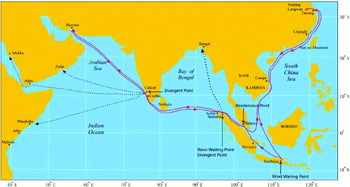
The routes of the main fleet and the squadrons, based on this and other historical records, are drawn on a map (Figure 2). This shows that the fleet departed from the Changle port sailing southwestward to CampaFootnote 10, and then turned to the south sailing to JavaFootnote 11. From Java, the fleet turned to the northwest, passed Srivijaya, sailed through the Strait of Malacca, passed Sirandib, and arrived at Calicut. At Calicut, the squadrons were sent out to AdenFootnote 12, MuqdishoFootnote 13, and Zufar respectively, while the main fleet kept on sailing on the main route until it reached HormuzFootnote 14.
Routes of Zheng He's main fleet (red lines) and the squadrons (dashed lines).

Other available historical documents also verified that the main fleet during other voyages also took the same routes:
(1) Both the stele in the Tianfei Temple at Liujiagang in Jiangsu province and the stele in the Temple of South Mountain at Changle in Fujian province recorded Zheng He's voyage in the third year of the Yongle Reign (1405):
‘In the third year of the Yongle Reign, in the command of Zheng He, the fleet went to Calicut and other countries. At that moment, the pirate Chen Zu-yi and his gang gathered at Srivijaya (Palembang) plundering foreign merchant ships. When they intended to attack our fleet, the heavenly-aided soldiers annihilated them in one beat of the drum. The fleet returned in the fifth year of the Yongle Reign (1407)’Footnote 15. (Gong Zhen Reference Gong2004a)
It is apparent that during the voyage between the third and fifth year of the Yongle Reign, the fleet heading for Calicut had to take the route which passed Campa, Java, Srivijaya, and Malacca. This was the only route through which it could have been possible for the fleet to encounter the pirate gang of Chen Zuyi at Srivijaya near the Strait of Malacca.
(2) The stele of the Temple of South Mountain at Changle in Fujian province recorded the voyage in the fifth year of the Yongle Reign (1407):
‘The fleet visited Java, Calicut, Kochin and Siam, the local rulers of the countries attributed all kinds of treasures to the Emperor with respect.’ Footnote 16 (Gong Zhen Reference Gong2004a)
This provided further evidence that the main fleet had taken the same routes again.
(3) Fei Xin, the writer of Xing Cha Sheng Lan (Triumphant Visions of the Starry Raft), who once joined in Zheng He's fleet sailing to the Western Ocean, also noted the places he visited in order in his book:
‘In the seventh year of the Yongle Reign (1409), following ambassador Zheng He we visited Campa, Java, Malacca, Sumatra, Simhala, Quilon, Kochin, we gave awards to the local rulers and returned in the ninth year of the Yongle Reign (1411)’. (Fei Xin Reference Fei1954).
The route that Fei Xin explored in his voyage was the same as the route mentioned above.
(4) Ma Huan, who took part in the voyage in the 11th year of the Yongle Reign (1413), wrote a poem in the prologue of his book Ying Ya Sheng Lan (Triumphant Visions of the Ocean Shores) to immortalize his experiences. In the poem, Ma also mentioned the places he visited in sequence, which are Campa, Java, Srivijaya, Malacca, Sumatra, Simhala, Cochin, Calicut, Maldives, and Hormuz (Ma Huan Reference Ma1955a). The sequence of the visited places shows that the route Ma Huan explored is identical to the route that the fleet had taken in the preceding voyages.
(5) A record in Qian Wen Ji, which was compiled by Zhu Yun-ming in the Ming Dynasty, shows the places where Zheng He's fleet stayed sequentially during the voyage in the fifth year of the Xuande Reign (1430) (Zhu Yun-ming Reference Zhu1937). They are Changle, Campa, Java, Srivijaya, Sumatra, Simhala, and Calicut. The route indicated by the places completely matched with the record of the stele of the South Mountain Temple.
4. RELATIONS BETWEEN THE SAILING ROUTES AND ASIAN MONSOON
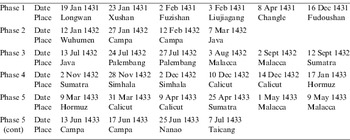
The book of Qian Wen Ji provides a detailed itinerary of the seventh voyage of Zheng He's fleet. Based on this precious document, the sailing schedule could be listed and the routes taken by the fleet, revealed by the places it visited in sequence, could be drawn on the map (Figure 2).
4.1. Sailing Schedule – Seventh Voyage
A careful analysis of this travel schedule shows that the main fleet obviously stayed at some places for a much longer time than in other places, so the voyage of the main fleet could thus be subdivided into five phases (Table 1). In each phase, the fleet had been sailing for a certain amount of time without a long stop. Each of the five phases of the voyage will be discussed to determine which causes affected the time schedule of the fleet.
Sailing schedule of the seventh voyage of Zheng He's fleet.

4.1.1. Phase 1
In the first phase of the voyage, on 19 January 1431, the fleet left the Longwan treasury boatyard at Nanking for Changle in Fujian, and arrived at Changle on 8 April. The fleet stayed in Changle until 12 January 1432. The length of the stay was approximately eight months. Although the long stay was partly due to the preparation for provisions and recruitment of sailors, the main reason for the long stay was that the fleet had to wait for the arrival of the persistent northeast wind to start its formal voyage to the Western Ocean.
4.1.2. Phase 2
During the second phase of the voyage, the fleet set out from Wuhumen in Changle on 12 January 1432 and, after a short stop at Campa, reached Surabaya, Java on 7 March. The fleet stayed there for more than four months until July 13. The reason for such a long stay was that the fleet had to await the arrival of the southeast wind in the Southern Hemisphere to sail to the northwest.
4.1.3. Phase 3
In the third phase of the voyage, on 13 July 1432 the fleet left Surabaya, after a short stop at Srivijaya, and arrived at Sumatra in the northwest of Sumatra Island on 12 September. The fleet stayed there for almost two months until 2 November, where it awaited the arrival of the northeast wind.
4.1.4. Phase 4
In the fourth phase of the voyage, on 2 November 1432 the fleet left Sumatra sailing northwestward under the northeast wind. After short stops at Sri Lanka and Calicut, the fleet finally arrived at Hormuz on 17 January 1433. The fleet stayed there for two months until 9 March 1433.
4.1.5. Phase 5
During the fifth phase of the voyage, on 9 March 1433, before the break of the southwest monsoon over the Indian Ocean, the fleet left Hormuz heading for home. The return fleet sailed continuously to the east, passed by Calicut, Sumatra, Malacca, Campa, and finally returned to Taicang on 7 July 1433.
4.2. Phases Versus Surface Wind Patterns
Studying the seventh voyage of Zheng He's fleet, it can be concluded that Asian monsoon had played a crucial role in the whole journey to the Western Ocean. The first phase of the voyage was the preparation for the overseas voyage. The formal voyage to the Western Ocean started from the second phase.
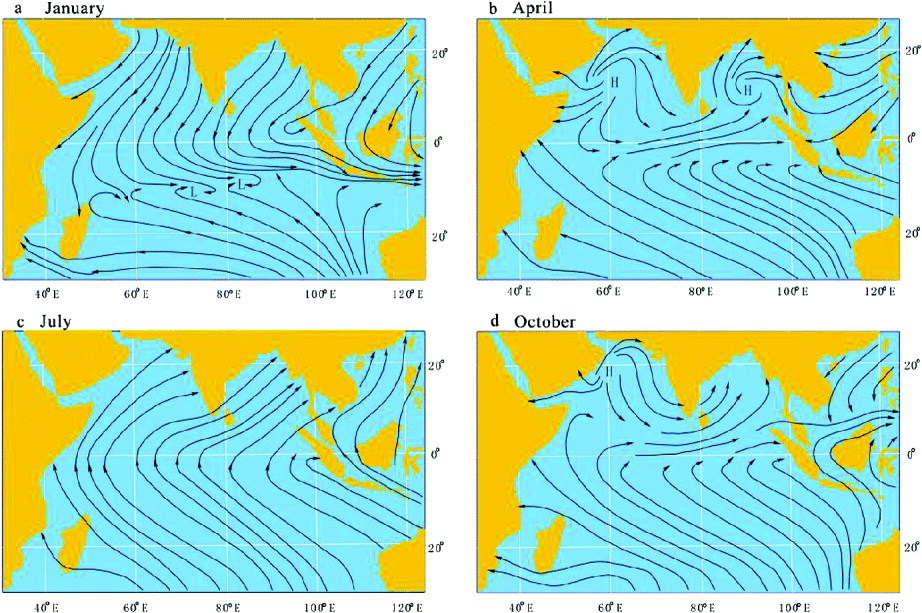
On 12 January 1432, the fleet set off from Changle following the northeast wind and sailed toward Southeast Asia. As soon as the fleet crossed the Equator, the northeast wind in the Northern Hemisphere was deflected to become the northwest wind in the Southern Hemisphere under the influence of the Coriolis force (See Figure 3a). Therefore, the fleet, following the wind's direction, naturally changed its sailing direction from southwest to southeast, and finally arrived at Surabaya.
Surface wind patterns over the Indian Ocean and the South China Sea (Ramage, C. S. Reference Ramage1971).

In the third phase of the voyage, the fleet left Surabaya for Sumatra in northwest. During this phase, the southeast wind in the Southern Hemisphere drove the fleet back across the Equator until it was blocked at Sumatra because the following southeast wind in the Southern Hemisphere transformed into the head southwest wind at 5° N (Figure 3c), and the fleet had to stay there to await the northeast wind of the next winter.
In the fourth phase of the voyage, the fleet took advantage of the northeast wind of the next year and sailed northwestward (Figure 3a). After a short stop at Calicut, which was located on the west coast of India, the fleet finally arrived in Hormuz.
In the fifth phase of the voyage, the fleet left Hormuz sailing for China on 9 March, while the southwest monsoon over the Indian Ocean was yet to arrive. During the journey from Hormuz to Calicut, from 9 March to 31 March, the fleet used the north wind that was prevailing in the eastern part of the anticyclone over the northern Indian Ocean sailing to the south. When the fleet left Sumatra on 25 April, it could use the newly arrived southwest monsoon over the eastern Indian Ocean sailing to the east (Figure 3b). As soon as the fleet passed through the Strait of Malacca in early May, it caught up with the southwest wind over the South China Sea (Figure 3c) and sailed back to Taicang, China.
According to the record of Qian Wen Ji, the outward voyage from Changle to Hurmoz took the fleet 139 days to complete. The days the fleet spent on different stages are listed below:
Wuhumen→16 days→Campa→25 days→Surabaya→11 days→Srivijaya→7 days→Malacca→10 days→Sumatra→26 days→Simhala→9 days→Culicut→35 days→Hormuz.
The homeward voyage from Hormuz to Taicang took the fleet 103 days to accomplish. The days that the fleet spent on the different stages are listed below:
Hormuz→23 days→Culicut→17 days→Sumatra→9 days→Malacca→18 days→ Condore→13 days→Chikan→3 days→Campa→2 days→Wailuoshan→6 days→ Nanao→5 days→Qitouyang→1 day→Wandieyu→5 days→Daxiaochi→1 day→Taicang.
The seventh voyage of Zheng He's fleet began on 12 January 1432 and was completed on 7 July 1433. The entire time of the voyage was one and a half years. For the whole journey, the fleet spent eight months, 242 days, at sea, and the other 10 months in the ports-of-call. The days that the fleet spent in the ports had a close relationship with Asian monsoon. During the entire voyage, the sailing power for the fleet was provided by the different persistent winds in turn that included the northeast wind in the Northern Hemisphere, the northwest and southeast winds in the Southern Hemisphere, and the northeast and southwest winds in the Northern Hemisphere. The completion of the voyage took one and a half years, which was determined by the circulation of all the five persistent winds.
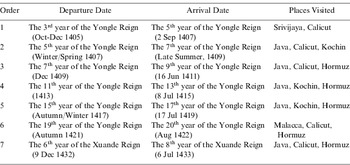
Using the information contained in History of Navigation on the South China Sea (Feng Cheng-jun Reference Feng1962), Atlas of Zheng He's Voyages to the Western Ocean (Research Group of Navy's Hydrographic Surveying et al 1988), the Stele of the Tian Fei Temple at Liujiagang, and the Stele of the South Mountain Temple at Changle, the timetable for the seven voyages can be reconstructed (Table 2). It shows that except for the sixth voyage all the other voyages had taken one and half years to complete. The internal mechanism for controlling the departure and arrival dates of these voyages was the same as that for the seventh voyage.
Timetable of the seven voyages.

5. SPECIAL STOPPING POINTS ON THE MAIN ROUTES OF THE FLEET
Since the winds provided the main driving power for the voyages, Zheng He's fleet was limited to certain routes and had to stop in some ports for a long time to wait for the right winds. It is natural to ask the question: How could the fleet, in one mission, be able to visit all the countries and regions, some of which are not only in different directions but also far away from the main routes? To solve this problem, squadrons had to be dispatched at some places to stand in for the main fleet to visit the countries or regions far away from the main routes. These special places are referred to as the Divergent Points. Consequently, during the return journey, the squadrons were required to reunite with the main fleet at a certain place, referred to as the Rendezvous Point, so that the whole fleet could sail back to China at the same time under the southwest wind (Figure 2).
The first wind-waiting point is Surabaya. When Zheng He's fleet sailed to the Western Ocean, the fleet did not sail directly to the Indian Ocean via the Strait of Malacca. Instead, it first arrived at Campa, and then sailed southward, passing through the Equator, and arrived at Surabaya on the island of Java. In the voyage of the sixth year of the Xuande Reign, Zheng He's fleet stayed in Surabaya for more than four months. In addition to the commercial and diplomatic purpose, the main reason for such a long stay was to wait for the arrival of the tropical southeast wind in the Southern Hemisphere.
Sumatra is the second wind-waiting point and the first divergent point. While the fleet sailing in the following southeast wind arrived to the north of the Equator, it soon encountered the strong west wind and could not continue to move to the northwest. This situation forced the fleet to stay in Sumatra waiting for the next year's northeast wind. Sumatra is also the divergent point from where the squadron was dispatched to BengalFootnote 17. The related historical documents recorded:
‘Sumatra was an important place in the way to the Western Ocean where the commercial ships gathered and diverged, from where the fleet sailed for Simhala, Cochin, and Calicut’ (Ma Huan Reference Ma1955a). ‘The squadron being sent to Bengal from Sumatra passed Weh Island, Nicobar, and continued the voyage to the northwest, the fleet could get to Chittagong in twenty days under tail wind’ (Gong Zhen Reference Gong2004c).
The second divergent point is Calicut which was an important port on the western coast of the Indian subcontinent. From Calicut the ships could use the northeast wind not only to sail to Hormuz in the northwest, but also to the places in the west such as Zufar, Aden, Mecca on the Arabian Peninsular and other countries on the eastern coast of Africa. There are historical documents on the movements of the squadrons which set out from Calicut to different locations.
‘The ships that left Calicut sailing for the northwest would arrive at Zufar after ten days’. (Gong Zhen Reference Gong2004d) ‘The ships that set out from Calicut sailing to the west would arrive at Aden after one month’; ‘The ships that left Calicut taking the following wind sailing to the northwest would arrive at Hormuz after twenty-five days’; ‘The ships that set out from Calicut sailing for the southwest would arrive at Mecca after three months’. (Gong Zhen Reference Gong2004e)
Malacca is the Rendezvous Point in the return journey. There was a station built particularly for logistics purposes and the squadrons' reunion. Ying Ya Sheng Lan recorded:
‘When Chinese vessels arrived in Malacca, on the shore the palisades were erected as the city walls. The city had four gates and the drum tower. At night, the men with hand bells patrolled the enclosure. Inside the palisades walls, a small inner city was built to hold the warehouses for storage of grains and provisions. When the squadrons returned from their destinations, the ships all stopped here for convergence. As long as the favourite south wind arrived in the middle of the fifth month, all ships loaded with the exotic goods sailed to the sea at the same time and returned to China.’ (Ma Huan Reference Ma1955b)
According to Qian Wen Ji, during the seventh voyage of Zheng He, the fleet arrived at Malacca on 1 May and departed on 9 May. The time schedule of the seventh voyage fits well into the travelling pattern mentioned by Ma Huan and is identical to the circulation of the SW monsoon.
6. CONCLUSIONS
The choice of Changle as the formal departure port was due to its location; it is located in the low latitudes where the sub-tropical monsoon prevails. The voyages usually took one and a half years to accomplish, this nearly fixed time schedule of the voyages was determined by the circulation of the monsoon and the routes taken by the main fleet. During the outward journey, the main fleet took the route which passed Campa, Java, Sumatra, Calicut, and Hormuz, taking advantage of the following winds in the order they are listed: the northeast, the northwest, the southeast and the northeast winds. During the homeward journey, the fleet taking the route via the Strait of Malacca depended mainly on the southwest wind. The circulation of these winds in the whole voyage had to take one and a half years to complete.
There were two wind-waiting points during the voyages. One of them was Surabaya, where the fleet stayed to wait for the southeast wind. The other is Sumatra, where the fleet stopped until the northeast wind arrived. Due to the limitation of the persistent winds' directions, it was impossible for the whole fleet to reach every country or region it planned to visit in one mission. Therefore, the fleet had to send squadrons to those countries or regions located far away from the main routes. Through this strategy, the mission of the voyages was successfully accomplished.
There were two divergent points. One was Sumatra and the other was Calicut. For the squadrons that had set out in their different directions, they reunited with the main fleet at the rendezvous point at Malacca on the return journey so as to arrive in China at the same time.
An analysis of the voyages of Zheng He's fleet shows that the impact of Asian tropical and sub-tropical monsoon was very significant. All the facts indicate that in the Ming Dynasty, China had already reached high levels in both sailing skills and organization of large-scale overseas expeditions by making the best use of the Asian Monsoon.
ACKNOWLEDGEMENT
This research project was jointly sponsored by National Natural Science Foundation of China (No. 40871087) and Ministry of Science and Technology of China Supported Project (No. 2006BAK21B02). We are also grateful to Captain Philip J. Rivers and Professor Cole Harris for their helpful comments and suggestions on the early manuscript.