Introduction
Freshwater resources are limited and should not be considered as self-renewable and low-cost (Semiat, Reference Semiat2000). With increasing population, it is obvious that sewage and effluents derived directly or indirectly from anthropogenic sources increase and are not removed fully by conventional water-treatment procedures (Loos et al., Reference Loos, Carvalho, António, Comero, Locoro, Tavazzi, Paracchini, Ghiani, Lettieri, Blaha, Jarosova, Voorspoels, Servaes, Haglund, Fick, Lindberg, Schwesig and Gawlik2013). Dissolved organic pollutants, some being highly toxic, carcinogenic, and with long residence times in the environment (El-Shahawi et al., Reference El-Shahawi, Hamza, Bashammakh and Al-Saggaf2010; Unuabonah & Taubert, Reference Unuabonah and Taubert2014), e.g. personal care products, hormones, and drug residues ('emerging contaminants'), are recorded in natural streams (Grassi et al., Reference Grassi, Kaykioglu, Belgiorno and Lofrano2012), and may accumulate to biologically hazardous levels (Di Credico et al., Reference Di Credico, Bellobono, D'Arienzo, Fumagalli, Redaelli, Scotti, Morazzoni, Di Credico, Bellobono, Arienzo, Fumagalli, Redaelli, Scotti and Morazzoni2015).
Among such pollutants, Endocrine Disruptive Compounds (EDCs) from natural or anthropogenic sources (Lintelmann et al., Reference Lintelmann, Katayama, Kurihara, Shore and Wenzel2003), may cause disruption due to hormone blocking or mimicking, thus interfering with normal hormone activity and leading to health problems in organisms and even to their descendants (Bolong et al., Reference Bolong, Ismail, Salim, Rana, Matsuura and Tabe-Mohammadi2010).
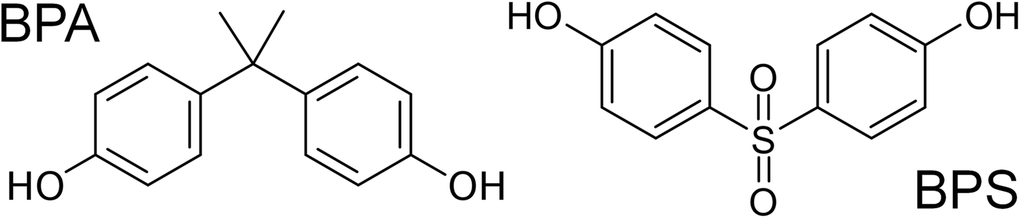
Two EDCs used widely in industry are bisphenol-A (BPA) and bisphenol-S (BPS) (Fig. 1). BPA (4,4'-isopropylide-nediphenol, M.W. 228.3 g mole–1) is a chemical used in industry as raw material for the manufacture of polycarbonate, epoxy resins, polyesters, styrenes, etc. (Staples et al., Reference Staples, Dorn, Klecka, O'Block, Branson and Harris2000), and it is found in all kinds of plastic pipes, bottles, and food containers (Vandenberg et al., Reference Vandenberg, Hauser, Marcus, Olea and Welshons2007). Its manufacture is projected to reach 7.4 million tons globally by the end of 2023, and is increasing at 3% per year (Research & Markets, 2018). Physiologists consider that BPA is detected incorrectly by cells as estrogen, causing endocrine disruption (Le Fol et al., Reference Le Fol, Aït-Aïssa, Sonavane, Porcher, Balaguer, Cravedi, Zalko and Brion2017). Due to the increased awareness of the health hazards posed by BPA, several countries have limited its use since 2011 in food-related accessories, especially in babies’ feeding bottles, and the notation "BPA-free" became widely-used. In most cases, however, it was replaced by similarly hazardous BPA analogs such as bisphenol-S (BPS;4,4'-sulfonylbisphenol, M.W. 242.3 g mole–1) or bisphenol-F (BPF; 4,4’-dihydroxydiphe-nylmethane).
Schematic structure of BPA (left) and BPS (right)

BPS exposure at levels of 60 mg (kg body weight)–1 day–1 was found to disrupt endocrine activity (Grignard et al., Reference Grignard, Lapenna and Bremer2012). Those values are not significantly different from hazardous exposure levels to BPA (50 mg (kg body weight)–1 day–1) (Le Fol et al., Reference Le Fol, Aït-Aïssa, Sonavane, Porcher, Balaguer, Cravedi, Zalko and Brion2017). Furthermore, due to the extensive use of BPS in thermal paper, 88% of human exposure has been found to come from receipts and similar uses (Konkel, Reference Konkel2013; Thayer et al., Reference Thayer, Taylor, Garantziotis, Schurman, Kissling, Hunt, Herbert, Church, Jankowich, Churchwell, Scheri, Birnbaum and Bucher2016).
In summary, although those pollutants are not considered lethal to humans, they have a hazardous influence due to their similarity to 17β-estradiol (a feminine estrogen hormone). This influence causes, for example, developmental malformation in Zebrafish embryo-larvae at levels as low as 5 and 100 mg L–1 BPA and BPS, respectively (Moreman et al., Reference Moreman, Lee, Trznadel, David, Kudoh and Tyler2017; Salahinejad et al., Reference Salahinejad, Naderi, Attaran, Meuthen, Niyogi and Chivers2020). Additional studies performed on rodents during the last 10 years indicate that BPA, at least, may promote breast and prostate tumors (Seachrist et al., Reference Seachrist, Bonk, Ho, Prins, Soto and Keri2016).
Because wastewater treatment plants are only partially effective at removing BPA and BPS (Mohapatra et al., Reference Mohapatra, Brar, Tyagi and Surampalli2011), their concentration in water sources is constantly increasing (Yamazaki et al., Reference Yamazaki, Yamashita, Taniyasu, Lam, Lam, Moon, Jeong, Kannan, Achyuthan, Munuswamy and Kannan2015), and, in some cases, has reached >30 μg L–1(Lintelmann et al., Reference Lintelmann, Katayama, Kurihara, Shore and Wenzel2003). In a mini-review focusing on BPA occurrences, Onundi et al. (Reference Onundi, Drake, Malecky, DeNardo, Mills, Kundu, Ryabov, Beach, Horwitz, Simonich, Truong, Tanguay, Wright, Singhal and Collins2017) concluded that human exposure to them may occur in some cases from drinking water, while other recent studies (Fang et al., Reference Fang, Gao, Wu, Xu, Sarmah, Bolan, Gao, Shaheen, Rinklebe, Ok, Xu and Wang2020) mentioned that BPS concentrations in aqueous environments are increasing constantly, concluding that "removal from water and its degradation behavior require urgent attention."
Methods for the removal of health-hazardous EDCs from water are based on one or more of the following three approaches: biological degradation (Danzl et al., Reference Danzl, Sei, Soda, Ike and Fujita2009; Frankowski et al., Reference Frankowski, Zgoła-Grześkowiak, Smułek and Grześkowiak2020), adsorption (Bhatnagar & Anastopoulos, Reference Bhatnagar and Anastopoulos2017; Wirasnita et al., Reference Wirasnita, Mori and Toyama2018), or advanced oxidation processes (Chen et al., Reference Chen, Linden, Hinton, Kashiwada, Rosenfeldt and Kullman2006; Mehrabani-Zeinabad et al., Reference Mehrabani-Zeinabad, Achari and Langford2015). Biological degradation is relatively effective in wastewater treatments plants, with a half-life of 4–5 days (Staples et al., Reference Staples, Dorn, Klecka, O'Block, Branson and Harris2000); however, in river waters only 20% degradation was observed, even after 50 days (Frankowski et al., Reference Frankowski, Zgoła-Grześkowiak, Smułek and Grześkowiak2020). The latter study also reported that BPS is slightly more biodegradable in river waters but considerably more stable than BPA in wastewaters. Thus, even though bisphenol species are not considered to be 'persistent' from the biodegradation point of view, the amounts of sources and expected hazards are so vast that additional and more effective removal alternatives based on the other two approaches should be considered.
A broad selection of adsorption media – from organic waste and activated carbon to nanocomposites – was tested for bisphenol molecules. However, an extensive review focusing on adsorption matrices for BPA (Bhatnagar & Anastopoulos, Reference Bhatnagar and Anastopoulos2017) mentioned that "due to the lack of column-, pilot-, and full-scale studies, it is difficult to estimate the potential of these adsorbents in real applications of BPA removal under real environmental conditions." Adsorption matrices based on clays, organo-clays, or nanocomposites for the removal of hazardous pollutants have been used widely and increasingly since the middle of the 20th century. The low cost of these materials, their wide availability, and the fact that they are, in most cases, non-toxic make them useful matrices for the adsorption of heavy metals (as raw minerals) as well as organic non-charged or anionic pollutants (upon modifications) (Churchman et al., Reference Churchman, Gates, Theng and Yuan2006). Numerous studies of specific sorbents based on clays were reviewed in the course of the present study. In the case of organic non-charged pollutants as BPA and BPS, special attention has been given to the capabilities of organo-clays (Theng et al., Reference Theng, Churchman, Gates and Yuan2008). While only a few works reported adsorption of BPS on clay-based materials (Fang et al., Reference Fang, Gao, Wu, Xu, Sarmah, Bolan, Gao, Shaheen, Rinklebe, Ok, Xu and Wang2020), several pillared clays and organo-clays based on quarternary ammonium cations were tested for BPA adsorption (Bhatnagar & Anastopoulos, Reference Bhatnagar and Anastopoulos2017). Other studies utilized π-π interactions between BPA and pyridinium surfactant-based organo-clays (Yang et al., Reference Yang, Gao, Luo and Yang2016). In the current study, the efficiency of π–π interactions was tested along with isotherms and breakthrough columns for the adsorption of BPA and BPS on a food-grade organo-clay based on thiamine (B1 vitamin, consists of an aminopyrimidine aromatic ring bound to a thiazolium ring via CH2 group) and montmorillonite. This organo-clay has been found to be very effective for the removal of phenol in aqueous solutions (Ben Moshe & Rytwo, Reference Ben Moshe and Rytwo2018).
In addition to biodegradation and adsorption, a third approach was based on advanced oxidation processes (AOP) that are defined as "water treatment processes performed at pressure and temperature close to environmental conditions, which involve the generation of hydroxyl radicals in sufficient quantity to interact with the organic compounds of the medium" (Cuerda-Correa et al., Reference Cuerda-Correa, Alexandre-Franco and Fernández-González2019). AOP processes can be homogeneous (when all components are in the liquid phase) or heterogeneous (when the catalyst is a solid) (Poyatos et al., Reference Poyatos, Muñio, Almecija, Torres, Hontoria and Osorio2010). Most photodegradation studies on bisphenol compounds were performed with homogeneous catalysis or Fenton-like processes (Fang et al., Reference Fang, Gao, Wu, Xu, Sarmah, Bolan, Gao, Shaheen, Rinklebe, Ok, Xu and Wang2020; Goulart de Araujo et al., Reference Goulart de Araujo, da Silva Santos and Teixeira2017; Mehrabani-Zeinabad et al., Reference Mehrabani-Zeinabad, Achari and Langford2015; Onundi et al., Reference Onundi, Drake, Malecky, DeNardo, Mills, Kundu, Ryabov, Beach, Horwitz, Simonich, Truong, Tanguay, Wright, Singhal and Collins2017). Heterogeneous photocatalysis was also tested, either with the widely used TiO2 or other oxides (Abo et al., Reference Abo, Kummer and Merkel2016; Fang et al., Reference Fang, Gao, Wu, Xu, Sarmah, Bolan, Gao, Shaheen, Rinklebe, Ok, Xu and Wang2020) and even organo-clays (Yang et al., Reference Yang, Gao, Luo and Yang2016).
Several reaction paths are suggested for the heterogeneous catalysis process; all begin with interaction between photons, the solid catalyst, and the pollutant (Herrmann, Reference Herrmann1999; Rytwo, Reference Rytwo2018). The most widely available commercial photocatalyst, P25 type TiO2(Schneider et al., Reference Schneider, Matsuoka, Takeuchi, Zhang, Horiuchi, Anpo and Bahnemann2014), is based on a combination of three phases of TiO2: anatase, rutile, and amorphous (Ohtani et al., Reference Ohtani, Prieto-Mahaney, Li and Abe2010), and is considered to be a 'gold standard photocatalyst.' The search for a cheaper/more effective heterogeneous catalysts is ongoing, and several studies have combined clay minerals (Herney-Ramirez et al., Reference Herney-Ramirez, Vicente and Madeira2010; Iurascu et al., Reference Iurascu, Siminiceanu, Vione, Vicente and Gil2009; Ramirez et al., Reference Ramirez, Costa, Madeira, Mata, Vicente, Rojas-Cervantes, López-Peinado and Martín-Aranda2007), organo-clays, and even TiO2-pillared clays or clays impregnated with TiO2 (Bel Hadjltaief et al., Reference Bel Hadjltaief, Galvez, Ben Zina and Da Costa2019; Chen et al., Reference Chen, Du, Zhu and Zhou2013). In the current study the focus was on comparing the basic properties of a synthetic montmorillonite (Syn-1 "Barasym"), either raw or impregnated with TiO2. Additional experiments with the addition of a small amount of H2O2 (2 mg L–1, 58.8 μM) were performed to test a combined heterogeneous/homogeneous process.
Considering the detrimental health effects of BPA and BPS, and their general and increasing importance, the objectives of the current study (carried out by B.Sc. and M.Sc. students) were to measure the adsorption or photodegradation of BPA and BPS in waters using clays, organo-clays, or modified clays. The results indicate that: (a) B1-montmorillonite organo-clay might be relatively effective for the adsorption of BPA but less successful in the case of BPS; and (b) photocatalytic degradation, combining clays (original or modified) with H2O2, offers a very fast and effective mineralization process even when applied at low catalyst concentrations. The testing of BPA photocatalysis was beyond the scope of this project due to the formation of degradation byproducts that absorb in the UV-Vis range.
Materials and Methods
Materials
SWy-2 montmorillonite and SYn-1 Barasym SSM-100 synthetic mica-montmorillonite were obtained from the Source Clays Repository of The Clay Minerals Society. Thiamine hydrochloride (>99%), BPA, BPS, materials for the preparation of TiO2-barasym clay (TTIP, titanium(IV)-isopropoxide 97%), catalyst-grade industrial TiO2 (Hombikat®), and a 30% (9.79 M) concentrated H2O2 solution were obtained from Merck/Sigma-Aldrich (Merck KGaA, Darmstadt, Germany). Sand for the breakthrough columns was collected from the Mediterranean coast in northern Israel. All materials were used without further treatment, except the sand which was sieved for particles >2 mm, and washed four times with distilled water to remove excess salt. All the experiments were performed at ambient conditions (23 ± 2°C).
B1-SWy-2 Organo-Clay and TiO2-Barasym Preparation
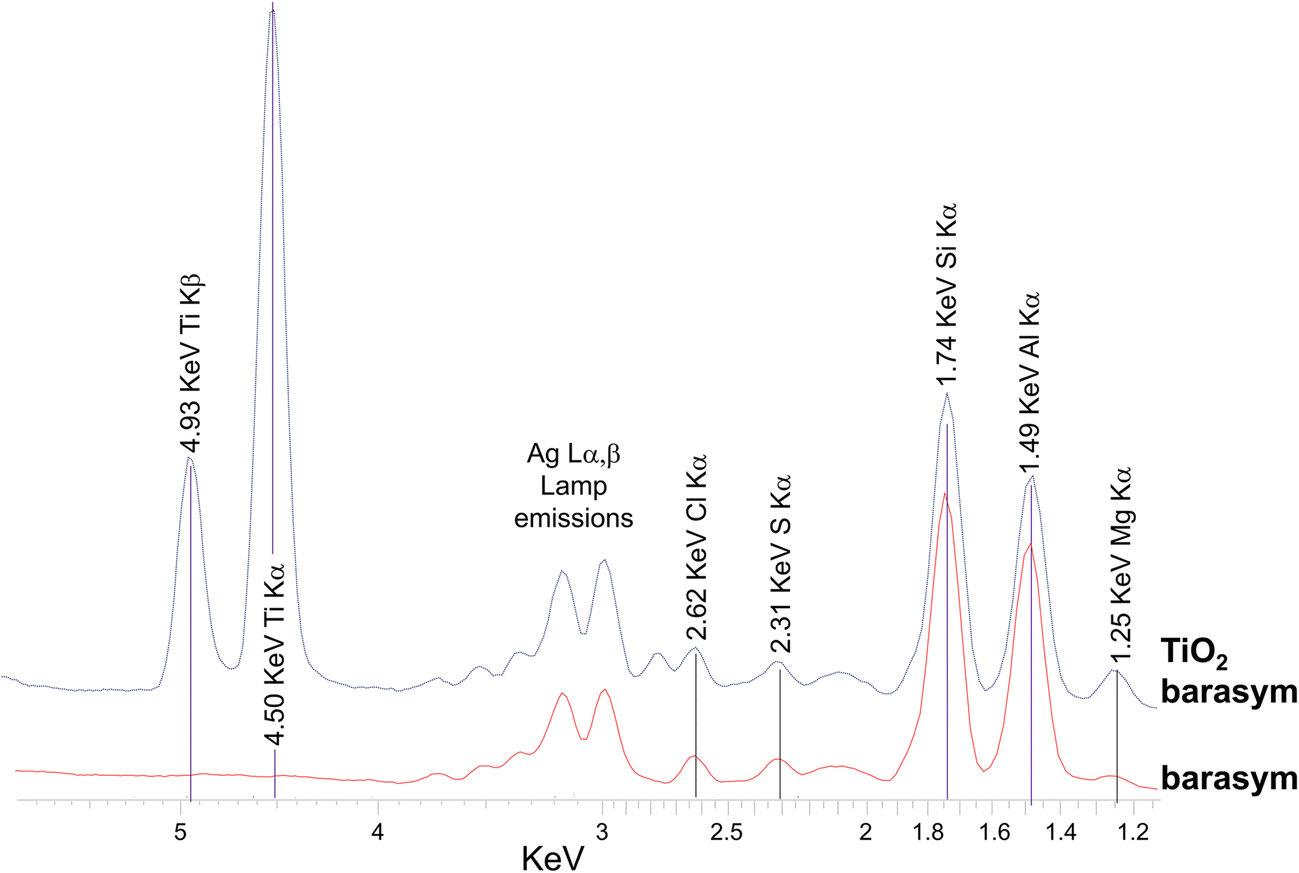
The SWy-2 organo-clay (denoted B1–SWy-2) for the BPA and BPS batch and column adsorption experiments were prepared as described in previous studies (Ben Moshe & Rytwo, Reference Ben Moshe and Rytwo2018): to a homogeneous dispersion of 1 g of SWy-2 with 100 mL distilled water, 175 mg of thiamine powder was added gradually, while stirring. The organo-clay was allowed to reach equilibrium for at least 24 h. The remaining B1 was washed by centrifuging the suspension then replacing 90.0% of the supernatant with distilled water three times, after which no measurable amounts of B1 remained in the supernatant. The final amount of organic cation adsorbed (~0.6 mole kg–1) was evaluated by measuring thiamine concentration in the supernatants and performing mass balance. The TiO2 barasym photocatalyst was prepared by the "impregnation method" (Bel Hadjltaief et al., Reference Bel Hadjltaief, Galvez, Ben Zina and Da Costa2019) by adding, while stirring, 5 g of barasym clay to 20 mL of TTIP solution and heating to 150°C for 5 h. As in the case of B1-SWy2, the remaining reagents were removed by washing, and the TiO2 barasym catalyst was dried at 105°C for 24 h and calcined at 500°C in a N2 purged vessel for 3 h. To confirm successful impregnation of TiO2 on barasym clay, X-ray fluorescence (XRF) measurements (Fig. 2) of the dried powders were made in a He atmosphere at 10, 20, 40, and 50 keV using a S2 Ranger Energy Dispersive XRF (Bruker GmBh, Karlsruhe, Germany). Semiquantitative evaluation of the XRF spectrum, performed using an adapted EQUA-ALL application in Spectra EDX v.2.4.2 software program (Bruker GmBh), indicated that while in the raw barasym clay 27% and 22% of the atoms were Si and Al, respectively, and no Ti was measured; in the TiO2-barasym sample only 8.2% and 7.8% of the atoms were Si and Al, respectively, while 39% were Ti atoms. Those results can be observed clearly in Fig. 2.
XRF spectra of barasym and TiO2-barasym irradiated with a 10 KeV Ag lamp

Adsorption Isotherms and Column Breakthrough Experiments
BPA and BPS isotherms of raw or B1-SWy-2 montmorillonite were measured, as described in a previous study (Ben Moshe & Rytwo, Reference Ben Moshe and Rytwo2018) in 15-mL plastic tubes with screw caps by adding 1 mL of a stirred 10 g L–1 of the relevant clay dispersion, and the relevant amounts of BPA or BPS ranging between 0–0.4 mmole adsorbate g–1 of adsorbent. Distilled water was added to give a final volume of 14 mL. The tubes were agitated on an orbital shaker for 24 h to ensure equilibrium, which was confirmed by measuring again after 48 h. Preliminary studies had shown that the molar absorption coefficient of BPA and BPS at the wavelengths used for determination of the concentration did not change significantly in the range of pH of the experiment (pH ≈ 7.0). From each tube, 1.5 mL was transferred to Eppendorf vials that were then centrifuged at 12,000 rpm (RCF = 9700×g) in a SciLogex D2012 Eppendorf centrifuge (SCILOGEX, Rocky Hill, Connecticut, USA) for 15 min to separate the solids from the supernatant. The concentration of the adsorbate (BPA or BPS) in the supernatant was measured using a diode-array HP 8452A UV-Vis spectrophotometer (Hewlett-Packard Company, Palo Alto, California, USA), and determined by absorbance at 276 nm (OD276) for BPA (ε = 3060 M–1 cm–1) and OD260 for BPS (ε = 18500 M–1 cm–1), respectively. Experiments were performed in three replications, and average values and standard deviations were calculated. The isotherm results were adapted to a dual mode adsorption model, based on a combination of the Langmuir equation (the left term on the right side) and chemical partition between the adsorbent and the solvent (right term on the right side) (Gonen & Rytwo, Reference Gonen and Ryt wo2006).

where q is the amount adsorbed (in mole kg–1), C is the adsorbate equilibrium concentration (M), S max is the amount of adsorption sites per mass of adsorbent (mole kg–1), KL represents the Langmuir adsorption constant (M–1), and Kp is a partitioning coefficient (in L kg–1). The relevant coefficients (KL, Kp, and S max) were evaluated using the 'Solver' algorithm in Excel® software (Office 365, Microsoft Intl.), to minimize the sum of root mean-squared error (RMSE) between measured and calculated values.
Columns for breakthrough experiments were prepared using plastic tubes with a cross section of 5.59 cm2 (diameter = 2.67 cm) and a total volume of 40 cm3. The tubes were filled with mixtures of sand and clay mineral or organo-clay. The sand was added to avoid clogging and ensure relatively fast flow of the effluent. Control columns contained sand and 1% (w/w) crude SWy-2, while the experiment columns contained sand and 1% B1-SWy-2 organo-clay. BPA and BPS effluents were 0.225 and 0.4 mM, respectively, flowing at a volume rate of 3.2 ± 0.02 mL min–1. BPA and BPS concentrations at the outflow were measured as described above and normalized to the initial concentration (C/C 0). The pore volume of columns was measured by the "water-displacement method" (Montes et al., Reference Montes, Valavala and Haselbach2005) based on measuring the volume of water needed to fill the pores in a certain volume of medium. Experiments were performed twice.
Photocatalysis Experiments
In order to evaluate the efficiency of clay or TiO2-clay in photocatalytic degradation of EDCs, several irradiation experiments were performed in a 100-mLUV-C-transparent quartz glass (refractive Index n = 1.5048), 5.3-cm diameter beaker placed in a Rayonet RMR-600 mini photochemical chamber reactor (Southern New England Ultraviolet Company, Branford, Connecticut, USA), as described in previous studies (Rendel & Rytwo, Reference Rendel and Rytwo2020a, Reference Rendel and Rytwo2020b). The photoreactor was equipped with eight RMR 2537A lamps (254 nm wavelength), each lamp emitting an irradiance flux of 19 J m–2 s–1 at 254 nm, as measured in the center of the chamber using a Black Comet SR spectrometer with an F400 UV–VIS–SR-calibrated fiber optic probe equipped with a CR2 cosine light receptor (StellarNet Inc., Tampa, Florida, USA). The same spectrometer was used to measure the spectrum of the solution with a 20 mm pathlength DP400 dip probe cuvette placed inside the beaker. The solution was mixed constantly with an external stirrer (VELP Scientifica, Usmate Velate, Italy) rotating at 100 rpm. Spectra were measured using the SpectraWiz software (StellarNet Inc., Tampa, Florida, USA) every 10–20 s for 30–60 min. Data was transformed to comma separated value (CSV) files, and absorption at the maxima of each chemical (260 or 276) was downloaded after subtracting a baseline value at wavelengths depending on the sample. To allow comparisons between parameters in different reaction mechanisms, the “relative dimensionless concentration at time t” [A](t) was evaluated (Rytwo et al., Reference Rytwo, Klein, Margalit, Mor, Naftaly and Daskal2015) as C t/C 0 = ODt/OD0 (the ratio of actual to initial concentration, or actual to initial light absorbance); thus A 0 = 1. This procedure led to >200 data points for each experiment.
Considering that all parameters in each experiment remained constant, the rate of photodegradation of BPA or BPS can be defined by a simple rate law (Rendel & Rytwo, Reference Rendel and Rytwo2020a, Reference Rendel and Rytwo2020b):

where υ is the reaction rate, k app is the apparent rate coefficient, A is the relative dimensionless concentration, and n app is the apparent or 'pseudo' reaction order. n app can be found empirically and is related to the mechanism by which the process occurs. It should be emphasized that high values for n app indicate higher degradation rates (
 at large concentrations; but, at very low pollutant concentrations, lower orders yield better performance. The term 'pseudo' is used to acknowledge the fact that all other influencing parameters (catalyst/degradation agent, temperature, light, etc.) were kept constant (IUPAC, 2014). Because A is dimensionless, none of the parameters has concentration units. This is convenient because it yields apparent kinetic coefficients that always have dimensions per time, regardless of the order of the process (Rytwo et al., Reference Rytwo, Klein, Margalit, Mor, Naftaly and Daskal2015). Analytical integration of Eq. 2 yields:

From the large amount of data in each experiment, a "bootstrap" (Efron, Reference Efron1979; Mishra et al., Reference Mishra, Dolan and Yang2011) procedure was performed by choosing five sets of 20 random values for each experiment. Values of k app and n app were calculated by evaluating [A](t) using Eq. 3, and finding to each set the best possible parameters using the 'Solver' algorithm in Excel® software, to minimize the RMSE between measured and calculated [A](t)values (Rytwo & Zelkind, Reference Rytwo and Zelkind2022). Half-life times were evaluated by solving mathematically Eq. 3 for the case where [A](t) = 0.5, yielding

The simplification in the right-hand term is, as mentioned above, due to A 0 = 1. For all three parameters in each experiment (k app, n app, and t1/2), averages and confidence values at α = 0.001 of the five sets of randomly chosen values were evaluated.
Preliminary experiments were performed to test the accuracy of UV-Vis measurements in the determination of the concentration of BPA and BPS. For this purpose, BPA and BPS photodegradation was tested with no catalysts or reagents (photolysis) by placing in the photoreactor a 25 mg L–1 concentration of each of the EDCs and comparing measured results from the UV-Visible measurements with an LC-MS/MS analysis performed with a heated electrospray ionization (HESI-II) source connected to a Thermo Scientific™ Q Exactive™ Plus Hybrid Quadrupole-Orbitrap™ Mass Spectrometer (Thermo Fisher Scientific GmbH, Darmstadt, Germany). ESI capillary voltage was set to 3500 V, capillary and gas temperature to 350°C, and gas flow to 35 mL/min. The mass spectra (m/z 50–500) were acquired in negative-ion mode. Peak determination and peak-area integration were performed using Compound Discoverer (Thermo Xcalibur, Version 3.1.0.305). The conclusion of this preliminary experiment (see the Results section) was that, while BPS concentration can be determined reliably by UV-Vis measurements, BPA 'apparent' concentrations measured by UV-Vis spectroscopy, are erroneous, presumably due to aromatic degradation products that absorb light strongly at the wavelength used.
Based on the preliminary results, the following experiments with an initial BPS concentration of 5 mg L–1 (20.6 μM) BPS were performed: (a) photolysis (photodegradation with no catalyst); (b) photocatalysis using the 'gold standard' P-25 TiO2 photocatalyst; (c) photocatalysis using barasym synthetic montmorillonite; (d) photocatalysis using TiO2-barasym prepared as described in the B1-SWy-2 Organo-clay and TiO2-barasym preparation subsection; (e) as (a) with the addition of a low concentration (58.8 μM) of H2O2; (f) as (c) with 58.8 μM H2O2; and (g) as (d) with 58.8 μM H2O2. The last three experiments were performed to test the contribution of an auxiliary component in order to perform a combination of "photo-Fenton process" (Poyatos et al., Reference Poyatos, Muñio, Almecija, Torres, Hontoria and Osorio2010) with heterogeneous catalysis. In all the experiments, catalyst concentration was 20 mg L–1. After analyzing the results, a second set of experiments was performed, identical to (b)–(d), (f), and (g), but the concentrations of catalysts (barasym, TiO2-barasym, and TiO2) were reduced by two orders of magnitude to 0.2 mg L–1.
Results and Discussion
Adsorption Isotherms
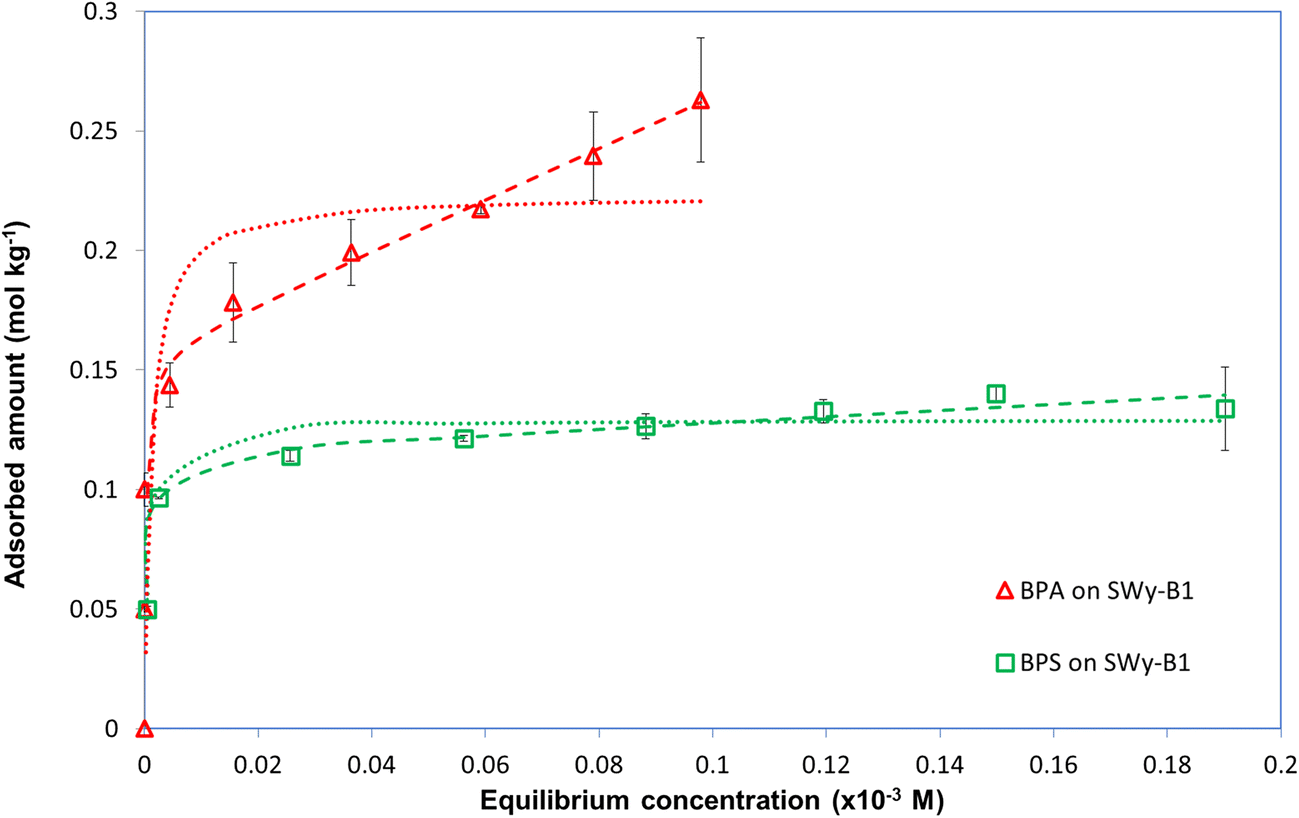
The adsorption isotherms of BPA and BPS to B1-SWy-2organo-clay are shown in Fig. 3. Adsorption to raw SWy-2 is not shown; preliminary experiments indicated that it was null. As reported and reviewed extensively, organophilic matrices adsorb hydrophobic organic compounds efficiently (Churchman et al., Reference Churchman, Gates, Theng and Yuan2006; Nafees & Waseem, Reference Nafees and Waseem2014), and have been used in water treatment. Indeed, the organophilic modification with B1 converted the montmorillonite (that did not adsorb BPA and BPS at all) to a relatively efficient removal matrix.
Adsorption isotherms of BPA (red triangles and lines) and BPS (green squares and lines). Triangles and squares represent measured values with their respective standard deviations. The lines represent calculations according to the Langmuir equation (dotted lines), or to the dual mode model (dashed lines). Coefficients and fitting parameters are reported in Table 1

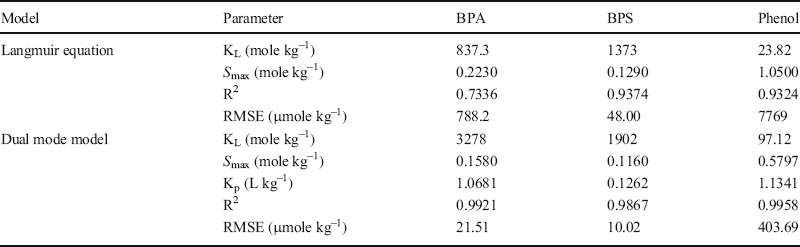
The adsorption results of BPA fit the dual model very well, but do not fit the regular Langmuir equation as well and do not reach a real saturation value in the range tested. On the other hand, adsorption of BPS fits the Langmuir model very well, giving a saturation value of ~0.13 mole Kg–1. The improvement obtained using the dual model for BPS is not very significant, and this is supported by the fact that the partition coefficient is about one order of magnitude lower than for BPA (see Table 1). The noticeable difference in the isotherms is ascribed to the fact that BPS is more hydrophilic than BPA; the solubility of BPS in water is almost four times that of BPA (Samineni, Reference Samineni2017), thus almost no partition effect was observed. For the case of BPA, due to its greater hydrophobicity, very high affinity (H-type) allowing complete removal was observed at low concentrations, whereas partition behavior (C-type) allowed a large capacity for adsorption at larger concentrations, offering it as a relatively effective adsorbent. Phenol-calculated adsorption parameters for the equations based on previous studies (Ben Moshe & Rytwo, Reference Ben Moshe and Rytwo2018) were also added to Table 1 and brought an interesting perspective: partition coefficients for phenol and BPA are similar, whereas S max of phenol in the Langmuir equation is almost five times that of BPA and eight times that of BPS. On the other hand, the KL value of phenol is relatively low, but this does not hinder the vast adsorption of this pollutant due to the large S max according to both models.
Parameters for the calculations of BPA, BPS, and phenol adsorption on B1-SWy-2 organo-clay, according to the Langmuir equation and the dual mode model. Adsorption of phenol was evaluated based on the work of Ben Moshe and Rytwo (Reference Ben Moshe and Rytwo2018).

Breakthrough Column Experiments
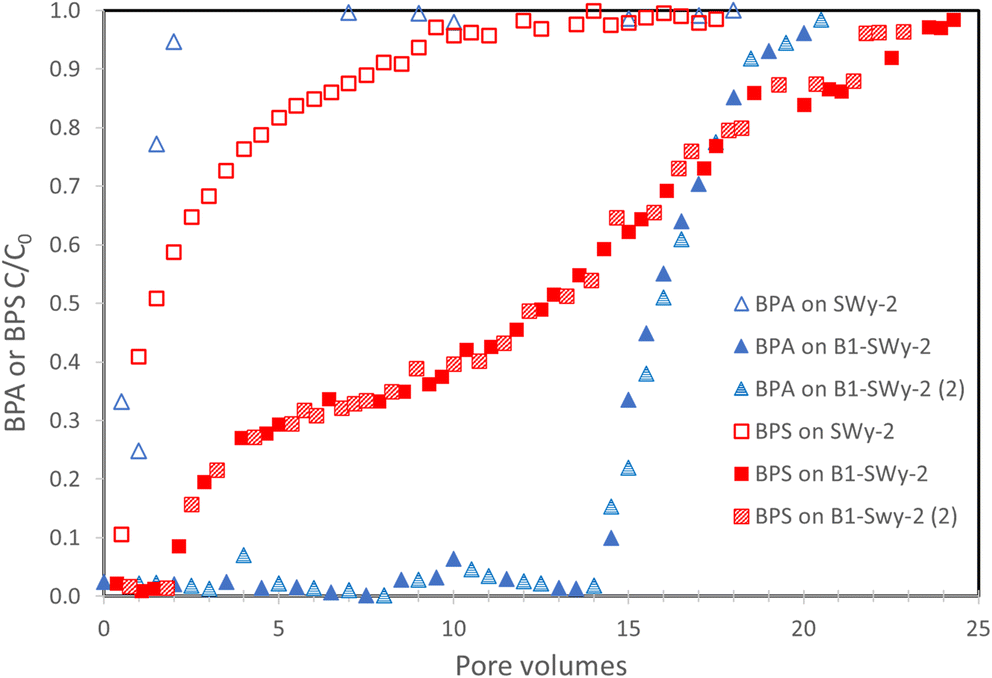
To complete the picture of the efficiency of B1-SWy-2 in the removal of BPA and BPS from water, column breakthrough flowing experiments were performed. Clay-based materials have very low hydraulic conductivity, thus the flow rate through an organo-clay column is very low (Rytwo, Reference Rytwo2018). In 'real' systems, this severe limitation might be solved by using flow-through active slurry filters (Rytwo & Daskal, Reference Rytwo and Daskal2016) or a series of consecutive slurry vessels (Rytwo et al., Reference Rytwo, Kohavi, Botnick and Gonen2007). However, for laboratory purposes, such a handicap is usually bypassed by mixing the active ingredient (the organo-clay) with inactive sand, quartz, or other materials with good hydraulic properties (Radian et al., Reference Radian, Carmeli, Zadaka-Amir, Nir, Wakshal and Mishael2011). The relative concentration of BPA or BPS in the outflow, as a function of the number of pore volumes of polluted solution introduced to the column, is shown in Fig. 4. For adsorption on organoclay columns, both replicates for each EDC are shown.
Breakthrough curve of a BPA (triangles) or a BPS (squares) solution filtered through sand mixed with 1% B1–SWy-2 organoclay (full or partially full symbols) or sand mixed with 1% raw SWy-2 montmorillonite (empty symbols) columns. Full or partial symbols indicate results from two separate experiments

Almost no removal of either pollutant occurred in the raw-clay/sand columns, and after 1 pore volume the relative concentration increased, reaching a maximum concentration after 5 and 9 pore volumes for BPA or BPS, respectively (it should be emphasized that the initial concentration of BPS was almost 80% larger than that of BPA).
As for the organo-clay/sand columns in previous studies using the same matrix of a 2% organo-clay/sand, phenol was removed completely from a 0.45 mM solution with >80 pore volumes (Ben Moshe & Rytwo, Reference Ben Moshe and Rytwo2018), whereas complete removal of BPA required just 14 pore volumes. Comparing these two cases is difficult, however, due to differences in pollutant and organo-clay concentrations, but it is obvious that removal of BPA by B1-SWy-2 is considerably less effective than removal of phenol. Such differences can be ascribed to the data shown in the isotherms and in Table 1; the maximum adsorption of BPA was considerably lower than for phenol.
In the case of BPS removal, the results revealed that removal by the clay/sand column was even less effective than for BPA; pollutant leaks appeared in the outflow after only three pore volumes. Such results might be explained by the combination of low maximum adsorption capacity and no partition effect, as shown in the adsorption isotherms. After breakthrough, however, the behaviors of the two EDCs were completely different. Breakthrough of BPA occurred (as mentioned above) after 14 pore volumes and the increase in outflow concentration was sharp, from no BPA in the outflow, to 0.8 C0 in less than three additional pore volumes, with complete saturation reached after 20 pore volumes. For BPS, the increase after breakthrough was slow and gradual, from 0.1 C0 after ~3 pore volumes to up to 0.8 C0 after 20 pore volumes. Similar behavior was reported in previous studies with humic-acid removal by columns based on ODTMA organo-clays (Beall, Reference Beall2003).
Photocatalytic Degradation
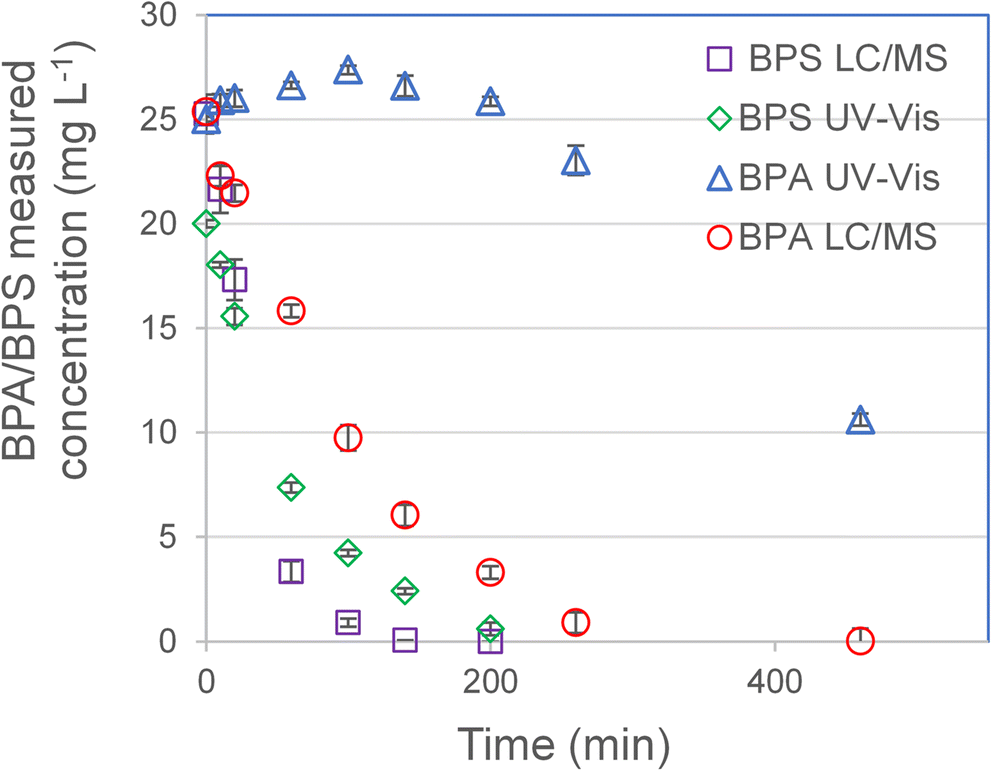
As mentioned in the Photocatalysis Experiments subsection, a preliminary experiment was performed to ensure that UV-Vis measurements gave reliable information about the concentration of BPA and BPS. Photolysis experiments with no catalyst (only UVC light) were performed and concentrations as a function of time were measured by both LCMS/MS and UV-Vis, as described in the Methods section (Fig. 5). While BPS concentrations using both methods were similar, indicating that for BPS UV-Vis may offer a very fast and relatively accurate quantification, the values measured for BPA by the two methods gave completely different results. Detailed LCMS/MS measurements screening the range of molecular weights between 50 and 500 g mole–1 indicated that indeed there are several aromatic photodegradation byproducts that may be wrongly misinterpreted in a simple UV-Vis evaluation as BPA. Because the study focused on collecting large amounts of data for each experiment (which cannot be done in LCMS/MS measurements), only BPS was tested in subsequent experiments.
Comparison of concentrations measured by LCMS and UV-Vis of the photolytic degradation of BPA and BPS as a function time. The initial concentration of both pollutants was 25 mg L–1

The intention of the following experiments was to determine if clay or TiO2-modified clay can act as an effective photocatalyst for BPS. In a review on AOPs for the removal of BPS, a series of studies was reported but in all of them the half-life of BPS was 40–120 min (Fang et al., Reference Fang, Gao, Wu, Xu, Sarmah, Bolan, Gao, Shaheen, Rinklebe, Ok, Xu and Wang2020). Heterogeneous photocatalysis with TiO2 (Abo et al., Reference Abo, Kummer and Merkel2016) or organo-clays (Yang et al., Reference Yang, Gao, Luo and Yang2016) gave similar values. Homogeneous photocatalysis ranged between a few minutes (Goulart de Araujo et al., Reference Goulart de Araujo, Oscar Conte, Violeta Schenone, Alfano and Teixeira2020; Mehrabani-Zeinabad et al., Reference Mehrabani-Zeinabad, Achari and Langford2015) to several tens of minutes (Mehrabani-Zeinabad et al., Reference Mehrabani-Zeinabad, Achari and Langford2015; Onundi et al., Reference Onundi, Drake, Malecky, DeNardo, Mills, Kundu, Ryabov, Beach, Horwitz, Simonich, Truong, Tanguay, Wright, Singhal and Collins2017), but short half-life times were observed only at very high concentrations of H2O2 (>3 mM, 50 times greater than the concentration used in the present study) or combinations of H2O2 with ozone.
The efficiency of barasym clay or TiO2-barasym clay as a photocatalyst was evaluated based on the half-life (t 1/2) of the degradation, as compared with photolysis, or a 'gold standard' well known photocatalyst – commercial type P-25 TiO2 (Rioja et al., Reference Rioja, Zorita and Peñas2016). The catalyst concentration was set at 20 mg L–1 based on previous studies on the photodegradation of carbamazepine (Klein & Rytwo, Reference Klein and Rytwo2014, unpublished results) which showed that the optimal efficiency was observed at <100 mg L–1 TiO2. The determination of t 1/2 was based (as described in the Methods section) on performing more than 200 UV-Vis measurements for each experiment, and analyzing the change of concentration with time, finding suitable specific k app and n app values for each case that fitted the integrated simple rate law (Eq. 2).
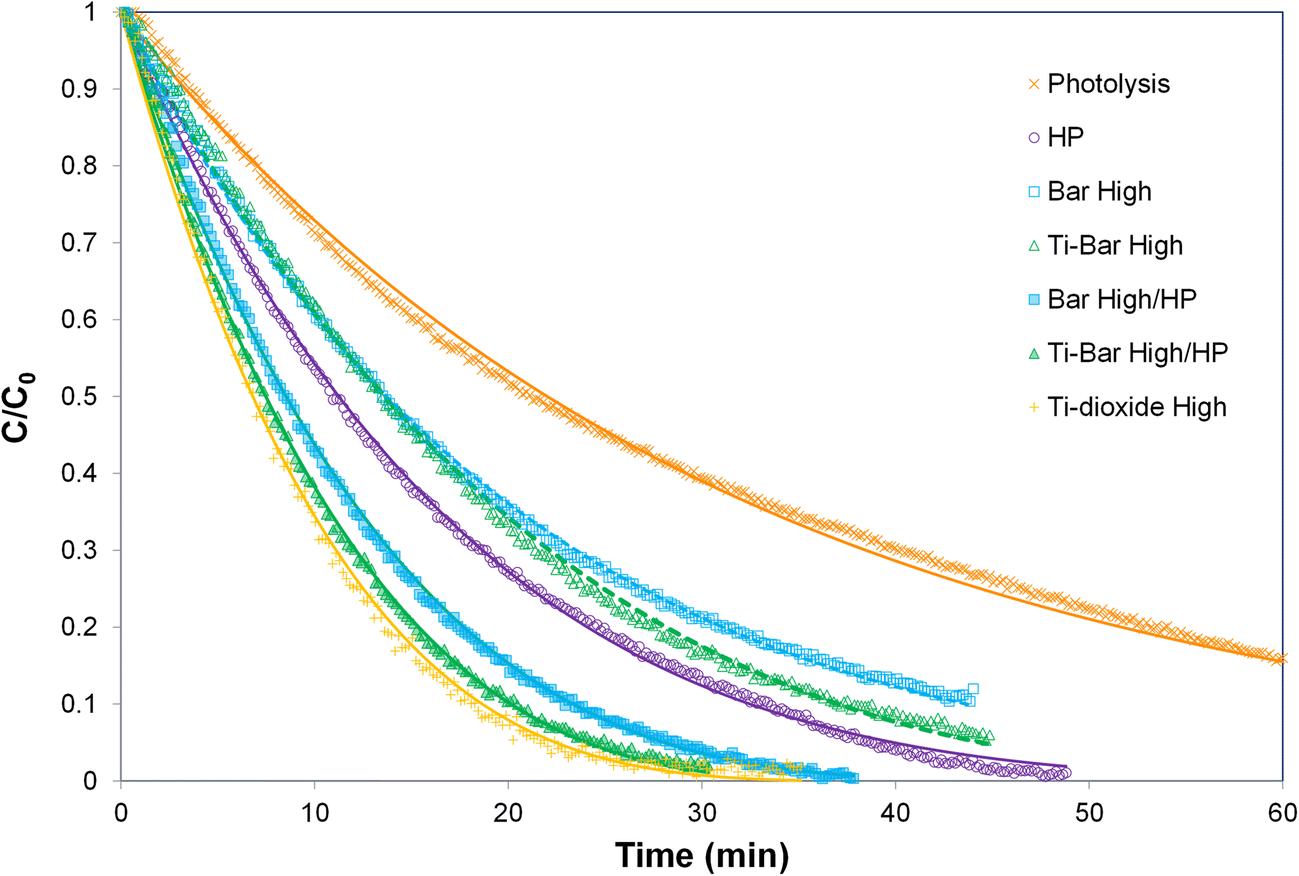
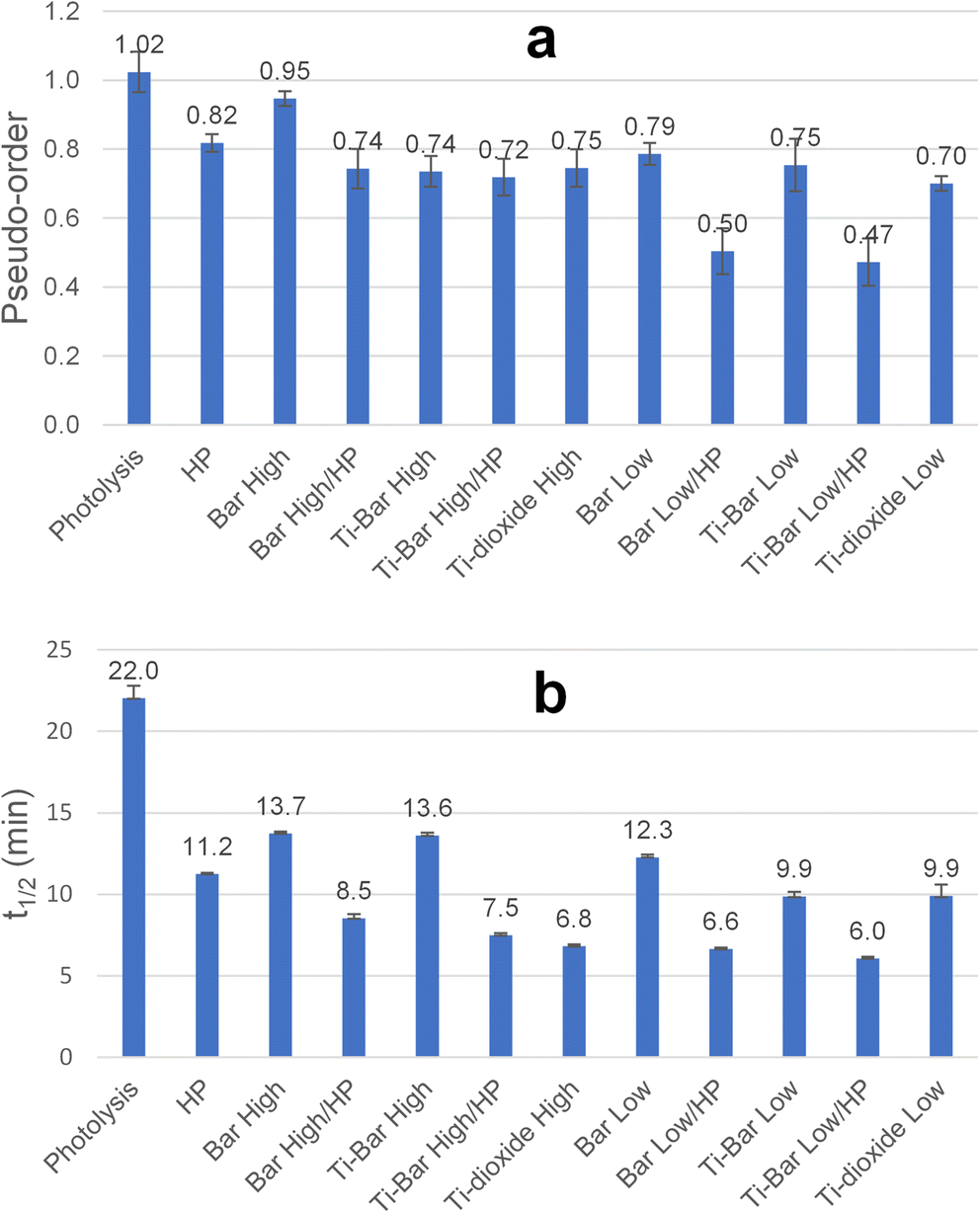
Figure 6 shows the concentration of BPS as a function of time for the various treatments (a–f in the Photocatalysis Experiments subsection), whereas Fig. 7 summarizes t 1/2 and n app (the pseudo order) of all the experiments, according to Eqs 2–4. The photolysis process (without catalysts) followed a close to 1st order process (n app = 1.02 ± 0.06), and t 1/2 = 22.0 ± 0.77 min. Performing homogeneous photocatalysis with hydrogen peroxide (2 mg L–1 = 58.8 μM H2O2) changed the pseudo order of the process to n app = 0.82 ± 0.03, and reduced the half-life time to almost 50% of the value measured by photolysis (t 1/2 = 11.2 ± 0.07 min). The use of clay-based materials as heterogeneous catalysts yielded slightly longer half-life times (t 1/2 = 13.7 ± 0.12 and 13.6 ± 0.18 min for barasym and TiO2-barasym, respectively). However, even though the half-life time for both catalysts was almost the same, the pseudo order was completely different. While for the raw barasym it was almost a pseudo first-order process (n app = 0.95 ± 0.02), for the TiO2-barasym it was n app = 0.74 ± 0.04. The outcome of it is that the behavior was almost identical for both catalysts at the beginning of the process; but after 15–20 min, differences appeared (Fig. 6) and the TiO2-barasym exhibited slightly better degradation performance at very low concentrations, as expected due to the lower pseudo order of the process (see Eq. 1) (Rytwo & Zelkind, Reference Rytwo and Zelkind2022). Thus, the results indicated that clay-based catalysts under current conditions reduce the half-life times to ~55% of photolysis values, reaching results like those obtained by homogeneous catalysis with hydrogen peroxide. An additional observation was that the modification of the clay mineral with TiO2 impregnation indeed changes the process in some way, as can be seen by the different pseudo order.
Relative concentration in a photodegradation experiment of an initial concentration of 5 mg L–1 (20.6 μM) BPS. 'Photolysis' represents the process without catalyst; HP, 2 mg L–1 H2O2; Bar High, barasym 20 mg L–1; Ti-Bar High, TiO2-barasym 20 mg L–1; Ti-dioxide High, commercial TiO2 20 mg L–1; Bar High/HP, barasym 20 mg L–1 + 2 mg L–1 H2O2; Ti-Bar High/HP, TiO2-barasym 20 mg L–1 + 2 mg L–1 H2O2

a Pseudo order and bhalf-life time in photodegradation experiments of an initial concentration of 5 mg L–1 (20.6 μM) BPS. 'Photolysis' represents the process without catalyst, whereas the term 'HP' indicates 2 mg L–1 H2O2. The terms 'Bar', 'Ti-Bar', and 'Ti-dioxide' indicate barasym. TiO2-barasym, and commercial TiO2, respectively. The terms 'High' and 'Low' indicate catalyst concentration of 20 mg L–1 or 0.2 mg L–1, respectively

To compare the efficacy of clay-based catalysts with catalysts used commonly, the same experiment was performed using the same concentration of commercial catalyst P25 type TiO2. As mentioned above, this material is considered the 'gold standard' of heterogeneous catalysts, and, indeed, exhibits the best results for this set. While the pseudo order with P25 type TiO2 was similar to that of TiO2-barasym (n app = 0.75 ± 0.05), the half-life time was only 30% of the photolysis value (t 1/2 = 6.8 ± 0.11 min).
Following these results, a test for a possible synergistic effect by combining a "photo-Fenton process" (addition of H2O2) with heterogeneous catalysis using clay-based materials was performed. Results were indeed improved. In barasym/H2O2, pseudo order changed to n app = 0.74 ± 0.06 and t 1/2 = 8.5 ± 0.26 min (62% of the value without hydrogen peroxide). In TiO2-barasym, the pseudo order remained as before (n app = 0.72 ± 0.05), but the improvement was even more significant (55%, t 1/2 = 7.5 ± 0.13 min), reaching values close to those of the 'gold standard' commercial TiO2.
Previous studies on caffeine photodegradation (Rendel & Rytwo, Reference Rendel and Rytwo2020a, Reference Rendel and Rytwo2020b) demonstrated high efficiency at TiO2 concentrations of 1 mg L–1 and even less. Thus, following the results described above, the photodegradation experiments were performed again, with the same EDC (5 mg L–1 BPS) and homogeneous catalyst (2 mg L–1 H2O2) concentrations, but reducing the heterogeneous catalyst (barasym, TiO2-barasym or commercial TiO2) by two orders of magnitude to 0.2 mg L–1. As mentioned above, Fig. 7 summarizes t 1/2 and n app (the pseudo order) of all the experiments, according to Eqs 2–4. Raw barasym at low catalyst concentration yielded a slightly lower half-life time than at high concentration (t 1/2 = 12.3 ± 0.16 instead of 13.7 ± 0.12 min) but the pseudo-order change from almost pseudo first order to n app = 0.79 ± 0.03. TiO2 barasym at 0.2 mg L–1 appeared to be considerably more effective than at 20 mg L–1 (t 1/2 = 9.9 ± 0.29 instead of 13.6 ± 0.18 min), but with almost identical pseudo order (n app = 0.75 ± 0.08). Decreased efficiency at higher catalyst concentrations was ascribed in previous studies to light dispersion by the colloidal catalysts, and even catalyst aggregation, causing a reduction in the active surface (Chong et al., Reference Chong, Jin, Chow and Saint2010). In commercial TiO2 the effect was completely different; reducing the catalyst concentration lowered the efficiency and increased the half-life time (t 1/2 = 9.9 ± 0.18 instead of 6.8 ± 0.12 min) with slightly lower pseudo order (n app = 0.70 ± 0.09 instead of 0.74 ± 0.04). The outcome was that while at 20 mg L–1 catalysts concentration the commercial TiO2 exhibited better performance than TiO2-barasym, the results were almost identical when the catalyst concentration was 0.2 mg L–1, thus the modified clay met the 'gold standard' of photocatalysis, under the same conditions.
The most impressive effect was obtained, however, by combining small concentrations of clay-based catalyst with H2O2 (Fig. 7, Fig. S1 in Supplemental Information). In barasym, the parameters changed to t 1/2 = 6.6 ± 0.09 min, n app = 0.50 ± 0.07, while in TiO2-barasym results were even better (t 1/2 = 6.0 ± 0.11 min, n app = 0.47 ± 0.07). Thus, both raw clay and TiO2-impregnated clay exhibited very good performance at low concentrations, especially in combination with hydrogen peroxide.
As mentioned above (Rytwo & Zelkind, Reference Rytwo and Zelkind2022), according to Eq. 1, at low pollutant concentrations processes benefit from lower pseudo orders. From Fig. 7a it can be hypothesized that the real orders that depend on the exact and specific set of "consecutive elementary reactions" (Atkins & de Paula, Reference Atkins and de Paula2006) are essentially 1, 0.75, or 0.5. Forcing the pseudo order to such rounded values (the best fit between 1, 0.75, or 0.5) delivered almost the same t 1/2 in all cases, while k app changed slightly accordingly. For example, by fixing the pseudo order of the low concentration of TiO2 to n app = 0.75 instead of the optimized value of 0.70, yielded t 1/2 = 9.7 min instead of 9.9 min. In all other cases, differences were even smaller. The hypothesis is that a relationship exists between the pseudo order and the efficacy of the process: With less effective processes (t 1/2 > 14 min) the observed pseudo orders were close to one. When efficacy improved (7 min < t 1/2 < 13 min), pseudo order was reduced to 0.75. Borderline cases (t 1/2 ≈ 13.5 min) can be either one pseudo order or the other (high concentration of barasym is pseudo order ≈ 1 whereas high TiO2-barasym is ≈ 0.75). Additional improvement in efficiency (t 1/2 < 7 min) was accompanied by reduction of the pseudo order to 0.5.
Summary
As mentioned in the introduction, bisphenol compounds are considered to be very hazardous. In the pursuit of ways to remove such health concerns from water, this study presented test cases of the use of clay-based materials either as adsorbents or as catalysts.
Results show that bisphenol molecules are not adsorbed on raw clays, but the preparation of organophilic organo-clays can offer a possible effective sorbent, especially for BPA which is more hydrophobic. Adsorption columns combining 1% organo-clay as an active ingredient were able to remove BPA completely for ~15 pore volumes. Preparing mixed columns with other active components (such as activated carbon) may improve considerably the efficiency, even though this should be tested in a closer-to-nature environment that includes lower EDC concentrations, and other chemicals that may compete with BPA for adsorption. It is interesting to note that there does not appear to exist a single solution; even though BPA and BPS are considered 'homologue molecules,' the specific matrix used in the present study (B1-SWy-2 organo-clay) exhibited relatively high removal efficiency for BPA but was not very effective at removing BPS, probably due to its relatively high hydrophilicity, leading to the lack of a partition mechanism. More research is required to find specifically adapted adsorbing matrices to optimize the specific interaction with a particular hazardous pollutant case, and a combination of matrices may be required in real cases.
On the other hand, the present study showed that BPS can be removed effectively by photocatalytic processes, using clays or modified clays as catalysts. Based on the results of this test case, another conclusion is that, at low catalyst concentration (0.2 mg L–1), clay-based catalysts may be as effective for the photodegradation of BPS as the 'gold standard' P-25 type TiO2, especially when combined with low concentrations (0.059 mM) of hydrogen peroxide. Modifications of the clay, such as impregnation with TiO2, may yield even better results. Optimization of the process requires additional experimental work because other solution components should also be considered, and their contribution to the photocatalytic process cannot always be predicted. On one hand, BPA homogeneous photocatalysis was severely hindered in wastewater compared with clean water (Goulart de Araujo et al., Reference Goulart de Araujo, Oscar Conte, Violeta Schenone, Alfano and Teixeira2020). On the other hand, while bromide hindered caffeine homogeneous photocatalysis even at very low concentrations, chloride improved the photodegradation when present up to 100 mM but hindered the process at higher concentrations (Rendel & Rytwo, Reference Rendel and Rytwo2020a).
In summary, clay minerals offer solutions for the removal of health-hazardous pollutants from water, based on completely different procedures and mechanisms. The versatility of clay minerals allows us to 'tailor' specifically adapted materials that might improve their efficiency based on specific pollutant-matrix interactions.
Supplementary Information
The online version contains supplementary material available at https://doi.org/10.1007/s42860-021-00166-1.
Abbreviations
- [A](t)
Relative dimensionless concentration at time t
- AOP
Advanced oxidation process
- B1
Thiamine (Vitamin B1)
- B1-SWy-2
B1 organo-montmorillonite
- BPA
Bisphenol-A (4,4'-isopropylidenediphenol)
- BPS
Bisphenol-S (4,4'-sulfonylbisphenol)
- CMS
The Clay Minerals Society
- EDCs
Endocrine Disruptive Compounds
- LC-MS/MS
Liquid chromatography tandem-mass spectrometry
- k app
Apparent rate coefficient
- KL
Langmuir coefficient
- Kp
Partition coefficient in dual model equation
- n app
Apparent or "pseudo" reaction order
- P25
Commercial high quality catalyst grade TiO2
- RMSE
Root mean square error
- S max
Maximum adsorption in Langmuir equation
- SYn-1
"Barasym" SSM100 synthetic montmorillonite from the Source Clays Repository of CMS
- SWy-2
Wyoming montmorillonite from the Source Clays Repository of CMS
- TiO2-barasym
Barasym impregnated with TiO2
- TTIP
Titanium(IV)-isopropoxide
- UVC
Light with wavelength 100-280 nm
- UV-Vis
UV-visible
- XRF
X-ray fluorescence
Acknowledgments
The authors thank Prof. Soliman Khatib and the whole team at the Research Laboratory of Tel Hai College for their support with LC-MS/MS measurements, and all the staff at the Hydrogeochemistry Lab at MIGAL Research Institute (headed by Prof. M. Iggy Litaor) for kindly hosting the authors and their photodegradation device at their premises.
Funding
Funding sources are as stated in the Acknowledgments.
Declarations
Conflict of Interest
The authors declare that they have no conflict of interest.