Introduction
Post-traumatic stress disorder (PTSD) is one of the most prevalent anxiety disorders and had a great impact across all disability and quality-of-life measures (Tansella, Reference Tansella2004; de Girolamo, Alonso & Vilagut, Reference De Girolamo, Alonso and Vilagut2006; Kessler et al. Reference Kessler, Aguilar-Gaxiola, Alonso, Chatterji, Lee, Ormel, Üstün and Wang2009). Various scales exist to measure the severity and frequency of post-traumatic symptoms, but few contain validity scales. Elhai et al. (Reference Elhai, Gray, Kashdan and Franklin2005) found that the most popular self-report instrument in the clinical assessment of post-traumatic symptoms is the trauma symptom inventory (TSI; Briere, Reference Briere1995). The TSI is a 100-item measure, tapping symptoms of PTSD and acute stress disorder, and other common trauma-related emotional problems. The TSI includes three validity scales and 10 clinical scales. The validity scales that are designed to detect conflicting, under reporting and over reporting response sets, respectively, are inconsistent response (INC), response level (RL) and atypical response (ATR) scales (Briere, Reference Briere1995). The clinical scales measure the extent to which the responder endorses four categories of distress. In particular, anxious arousal (AA), depression (D) and anger/irritability (AI) scales represent the dysphoric mood states often encountered by those experiencing significant psychological trauma. Intrusive experiences (IE), defensive avoidance (DA) and dissociation (DIS) scales are designed to measure the re-experiencing and avoidance symptoms of PTSD. Sexual concerns (SC) and dysfunctional sexual behavior (DSB) scales measure attitudes and feelings regarding sex as well as sexual problems, respectively. Impaired self-reference (ISR) and tension reduction behavior (TRB) scales tap into difficulties with self and affect regulation including outward behavior manifestations used to manage negative affect such as self-mutilation (Briere, Reference Briere1995). Five clinical scales (i.e. AA, D, AI, IE and DA) measure Diagnostic and Statistical Manual of Mental Disorders–IV-Text Revised (DSM-IV-TR) PTSD criteria (American Psychiatric Association, 2000) and the other five clinical scales measure common trauma-related mental health symptoms (i.e. DIS, SC, DSB, ISR and TRB). In general, elevations (T scores of 65 or higher) on the first five clinical scales often reflect distress associated with the impact of traumatic events or processes, whereas elevations on the other five clinical scales may indicate that the individual has insufficient self-resources to modulate such distress.
Several researches supported the TSI's psychometrics. The 10 clinical scales have demonstrated adequate internal consistency, with alpha-coefficients ranging from 0.84 to 0.87 across studies on clinical, Navy recruits and university samples (Briere, Reference Briere1995) and ranging from 0.73 to 0.91 in at-risk population for trauma exposure and traumatic stress, such as military veterans (Snyder et al. Reference Snyder, Elhai, North and Heaney2009).
Adequate construct validity had also been demonstrated: elevated TSI scores in the non-clinical sample were associated with several trauma types such as adult and childhood interpersonal violence or disaster (Briere et al. Reference Briere, Elliott, Harris and Cotman1995). A self-reported history of interpersonal trauma, in a clinical sample, was associated with high TSI scores in all clinical scales relative to those not reporting victimization (Briere et al. Reference Briere, Elliott, Harris and Cotman1995). The TSI is also a useful instrument for measuring sensitivity to change of PTSD symptoms after therapy. For example, Wallis (Reference Wallis2002) demonstrated that, after receiving group therapy, traumatized participants in the experimental group scored lower on 7 of the 10 clinical scales on the TSI and on the three composite scales (i.e. self, trauma, dysphoria; see below the three-factor model of the TSI; Briere, Reference Briere1995). The researcher reported no similar reduction in symptoms in the control group. Bradley & Follingstad (Reference Bradley and Follingstad2003) showed a change in PTSD symptoms, among TSI clinical scales, before and after group therapy for incarcerated women with histories of childhood sexual and/or physical abuse.
The TSI has also demonstrated reasonable convergent validity and, excluding the INC validity scale, all 12 other scales significantly correlated with other self-report PTSD measures, including the Impact of Event Scale-Revised, PTSD checklist, Civilian Mississippi PTSD Scale, and Traumatic Stress subscale of the Personality Assessment Inventory (McDevitt-Murphy, Weathers & Adkins, Reference McDevitt-Murphy, Weathers and Adkins2005).
Adequate criterion validity has also been demonstrated: in a study with 449 participants from the general population, discriminant classification analysis revealed that the TSI clinical scales were 92% accurate in predicting true-positive cases and 91% accurate in predicting true-negative cases. This said, the TSI's incorrect prediction was 9% for false-positive cases (Briere, Reference Briere1995), demonstrating a low probability of over-inclusion of the instrument.
In another study, those participants reporting a history of childhood sexual abuse had significant elevations on six clinical scales and those reporting a history of child physical maltreatment had significant elevations on all 10 clinical scales in comparison with those without such trauma history (Runtz & Roche, Reference Runtz and Roche1999). McDevitt-Murphy, Weathers & Adkins (Reference McDevitt-Murphy, Weathers and Adkins2005), using a structured diagnostic PTSD interview, found that, in logistic regression analysis, TSI scales possessed 86% diagnostic utility in detecting PTSD.
Using a non-clinical sample, the TSI has reasonable incremental validity in its ability to predict victimization history of women, as it accounts for variance beyond that demonstrated by other measures including the Impact Event Scale (IES; 12% unique variance added), SCL-90 (8% unique variance) and the brief symptom inventory (BSI) (17% unique variance). For men, the TSI's additional variance beyond that accounted for by other measures was only seen at a significant level relative to the BSI (7%) (Briere, Reference Briere1995).
With regard to the TSI's structural validity, Briere's (Reference Briere, Elliott, Harris and Cotman1995) study revealed that both his two- and three-factor models adequately represented the intercorrelations among the TSI's clinical scales. The two-factor model's factors, derived from exploratory factor analysis, were labeled ‘generalized trauma and distress’ and ‘self-dysfunction,’ with scales AA, D, AI, IE, DA, DIS, ISR and TRB loading on the former factor, and scales DIS, ISR, TRB, SC and DSB loading onto the latter factor.
Briere's (Reference Briere1995) three-factor model, based on a more theoretically driven confirmatory factor analysis, possessed factors labeled ‘trauma,’ ‘self’ and ‘dysphoria’, with scales IE, DA, DIS and ISR loading onto trauma, scales ISR, SC, DSB, TRB and AI loading onto self, and scales AI, D and AA loading onto dysphoria. Snyder et al. (Reference Snyder, Elhai, North and Heaney2009) demonstrated that the two-factor model (merged trauma/dysphoria and self-dysfunction) was the most parsimonious model and it provided the best fit for the data derived from veterans evaluated for military-related PTSD symptoms.
The purpose of the current study was to validate the Italian version of the original TSI in a sample of the general population and to evaluate TSI's reliability and validity from post-traumatic, clinical and non-clinical samples. To date, there are few self-report instruments assessing PTSD that have been validated in the Italian language and in a sample of Italian subjects, including the MMPI-2 PK scale (Keane, Malloy & Fairbank, Reference Keane, Malloy and Fairbank1984), the IES (Pietrantonio et al. Reference Pietrantonio, De Gennaro, Di Paolo and Solano2003) and the Self-Report instrument for Trauma and Loss Spectrum (TALS-SR; Dell'Osso et al. Reference Dell'Osso, Carmassi, Rucci, Conversano, Shear, Calugi, Maser, Endlcott, Fagiolini and Cassano2009). An Italian version of the TSI has several advantages: for example, it permits to compare results from Italian studies with the many international studies that have used the English version of this instrument (e.g. Goldenberg & Matheson, Reference Goldenberg and Matheson2005; Adams & Riggs, Reference Adams and Riggs2008). However, the main strengths are the presence of validity scales, which allow the detection of those who report an unusual number of statistically unlikely or bizarre responses and those who respond to items of similar content in an inconsistent or random manner and the assessment of post-traumatic symptoms beyond those of PTSD or acute stress disorder per se.
Based on previous psychometric research on the TSI (e.g. Briere et al. Reference Briere, Elliott, Harris and Cotman1995; McDevitt-Murphy, Weathers & Adkins, Reference McDevitt-Murphy, Weathers and Adkins2005), we predicted that: (1) The TSI's clinical scales would yield similarly adequate internal consistency results that were achieved in Briere's (Reference Briere1995) study. (2) Scores on related Impact of Event Scale-Revised (IES-R; Weiss & Marmar, Reference Weiss, Marmar, Wilson and Keane1997), MMPI-2 PK Scale, symptom questionnaire (SQ; Fava et al. Reference Fava, Kellner, Perini, Fava, Michelacci, Munari, Evangelisti, Grandi, Bernardi and Mastrogiacomo1983), BSI (Derogatis, Reference Derogatis1993 would converge with TSI clinical scale scores. (3) Scores on related MMPI-2 validity scale (i.e. F, K and L) would converge with TSI validity scale (i.e. ATR, RL and INC) scores and (4) the TSI would yield similar structural validity results to that of Briere's (Reference Briere1995) validation, with the two- and three-factor models both serving as adequate representations of the TSI's latent dimensions.
Methods
Participants
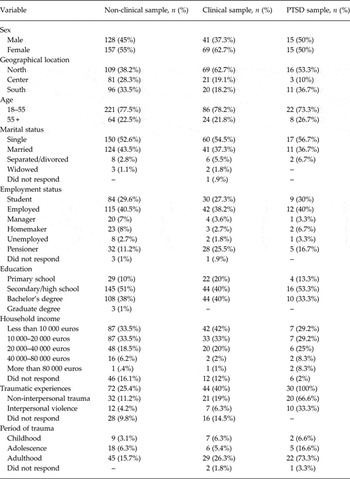
The Italian TSI version was administered, in total, to 425 individuals aged 18–78 years (M = 39.3, s.d. = 15.4) from 2007 to 2010. Three distinct participant groups were recruited (see Table 1 for detailed demographic data). Group one (termed ‘non-clinical sample’ in subsequent text and tables) comprised 285 individuals (aged 18–78 years, M = 39.1 years, s.d. = 15.5, 157 female), recruited, via advertisement or personal contacts through the researchers, in three Italian geographical location (North, Center and South) at the university or at work or in social centers. Traumatic experiences were reported by 28.5% of women and 22% of men (25.4% of the sample), whereas non-interpersonal trauma (i.e. car accidents and natural disasters) during childhood, adolescence and adulthood was reported by 15.4% of women and 20% of men. Experiences of interpersonal violence (i.e. abuse and other forms of assault), during adolescence and adulthood, were reported by 5.2% of women and 7.7% of men.
Demographic data of the three samples (non-clinical, clinical and PTSD)

The second group (termed ‘clinical sample’) comprised 110 individuals (aged 19–75 years, M = 40.4 years, s.d. = 15.3, 69 female), who showed a mental disorder as diagnosed at Centers of Mental Health or at private surgeries. Of these, 43% was in therapy or taking psychoactive medication for anxiety disorders, 47.6% for mood disorders and 8.4% for personality disorders or psychosis. Traumatic experiences were reported by 40% of the clinical sample (45.9% of women and 31.4% of men). In particular, non-interpersonal trauma (i.e. accidents and disasters) during adolescence and adulthood was reported by 21.4% of women and 38.9% of men. Experiences of interpersonal violence (i.e. aggressions, but not sexual abuse), during adolescence and adulthood, were reported by 19.1% of women and 5.6% of men.
The third group (termed ‘PTSD sample’) comprised 30 individuals (aged 20–67 years, M = 39.7 years, s.d. = 15.6, 15 female) who satisfied criterions for DSM-IV-TR PTSD diagnosis, assessed at least 6 months post-trauma by psychiatrics and psychologists (through the Structure Clinical Interview for DSM-IV; SCID-I, First et al. Reference First, Spitzer, Gibbon and Williams1996) at the Centres of Mental Health of Bologna or at the Montecatone Rehabilitation Institute of Imola (a rehabilitation hospital that begins by taking charge of the acute phase through to social reinstatement of the patient in his living environment). These adults had been exposed to adulthood experiences of non-interpersonal trauma (i.e. car accidents, serious illness and disasters; 21.4% of women and 53.3% of men). Experiences of interpersonal violence (i.e. aggressions and physical abuse), during childhood and adolescence, were reported by 42.7% of women and 13.4% of men.
Measures
The TSI evolved from the revision and expansion of the Trauma Symptom Checklist (TSC-33/40) (Briere & Runtz, Reference Briere and Runtz1989). Respondents are asked to rate items on a four-point Likert Scale, with ‘0’ representing no experience of the symptom and ‘3’ representing frequent occurrence in the last 6 months.
The Italian TSI version was a translation of the original questionnaire, with exactly alike item numbering. The goodness of translation was verified by a back-translation from Italian to English, conducted by a native English speaker unfamiliar with the English version of the TSI. The back-translation was forwarded to Publisher, Psychological Assessment Resources for review and approval. The Italian TSI version was adapted and reproduced by special permission of the PAR Inc.
The MMPI-2 PK scale (Keane, Malloy & Fairbank, Reference Keane, Malloy and Fairbank1984) is a 46-item scale designed to specifically evaluate PTSD symptoms. A raw score of 19 or 23 (respectively for male and female) or a T score higher than 65 in the Italian standardization are indicative of PTSD (Pancheri & Sirigatti, Reference Pancheri and Sirigatti1995). The PK scale had a Cronbach's alpha of 0.81 in the clinical and non-clinical samples and 0.82 in the PTSD sample.
The IES-R (Weiss & Marmar, Reference Weiss, Marmar, Wilson and Keane1997) is a 21-item self-report measure, tapping the three most commonly reported specific categories of experiences in response to stressful events: intrusion, avoidance and hyperarousal. In this study, we used the Italian version of the original IES (Pietrantonio et al. Reference Pietrantonio, De Gennaro, Di Paolo and Solano2003) that demonstrated a good internal reliability (alpha ranging from 0.94 to 0.71). Furthermore, we included the six items of hyperarousal scale, using the Italian translation provided by Giannantonio (Reference Giannantonio2003). The IES-R was completed by all the post-traumatic samples and a large sub-samples of participants in non-clinical sample (n = 237, 60.5%) and in clinical sample (n = 95, 76.3%). Internal consistency reliability for the total scale was strong in these samples, respectively Cronbach's alpha was 0.91 in the PTSD sample and 0.89 both in the non-clinical and clinical samples.
The SQ (Fava et al. Reference Fava, Kellner, Perini, Fava, Michelacci, Munari, Evangelisti, Grandi, Bernardi and Mastrogiacomo1983) is a 92-item self-report questionnaire with four scales assessing pathological dimensions: anxiety, depression, somatization and hostility. Each item consists of adjectives or brief statements to which subjects can answer ‘true’ or ‘false’ or ‘yes’ or ‘not’. High scores indicate more severe psychological symptoms. The SQ has been widely administered to psychiatric patients, normal controls and patients with several medical illnesses. It resulted valid and very sensitive to both differences between groups and changes in psychological distress after diagnostic procedures and treatments (Fava et al. Reference Fava, Kellner, Lisansky, Park, Perini and Zielezny1986). The SQ had a good reliability in the present study: Cronbach's alpha was 0.88 in the PTSD sample, 0.89 in the non-clinical sample and 0.82 in the clinical sample.
The BSI (Derogatis, Reference Derogatis1993) is a 53-item self-report inventory designed to reflect the typical symptomatology of people experiencing psychiatric problems. Each item is scored on a 5-point Likert scale ranging from ‘not at all’ to ‘extremely’. BSI includes nine symptom dimensions: somatization, obsession–compulsion, interpersonal sensitivity, depression, anxiety, hostility, phobic anxiety, paranoid ideation and psychoticism; and three global indices of distress: global severity index, positive symptom distress index and positive symptom total. The global indices measure current or past level of symptomatology, intensity of symptoms and number of reported symptoms, respectively. The BSI is the short version of the SCL-R-90 (Derogatis, Reference Derogatis1983), which measures the same dimensions. The scales have been used in previous studies on the Italian general population and medically ill patients (e.g. Grassi et al. Reference Grassi, Buda, Cavana, Annunziata, Torta and Varetto2005), showing acceptable levels of validity and reliability. Cronbach's alpha was 0.86 both in the clinical and non-clinical sample and 0.91 in the PTSD sample.
Procedure
Informed consent was obtained from all participants. Subjects completed the TSI Italian version as part of a battery that included demographic data and the self-report measures of trauma exposure. The MMPI-2 PK scale and IES-R have excellent psychometric properties and are widely accepted criterion measures for PTSD (e.g. Weathers, Keane & Davidson, Reference Weathers, Keane and Davidson2001; Elhai et al. Reference Elhai, Gray, Kashdan and Franklin2005). These self-report measures of PTSD were specifically administered to evaluate the convergent validity of the TSI. Participants completed also two self-report measures of psychological symptoms: the SQ and the BSI. Finally, ATR, RL and INC scales were compared with MMPI-2 F, K and L ones in order to assess convergent validity (see Briere, Reference Briere1995).
Data analysis
Internal consistency of the TSI's 10 clinical scales was conducted, on the data taken from clinical, non-clinical and overall samples, using Cronbach's alpha coefficient. The nature of the study (cross-sectional) did not permit test–retest reliability. Intercorrelations among validity and clinical TSI scales were performed.
Varying numbers of participants completed the PK (n = 425), SQ (n = 425), BSI (n = 425), IES-R (n = 362), MMPI-2 F, K and L scales (n = 130), thus convergent validity analyses were conducted using such sample sizes.
We performed a discriminant function analysis to assess the TSI clinical scales to discriminate between PTSD and non-PTSD groups.
An exploratory factor analysis was conducted on the overall sample in order to check the structure of TSI and compare results with original Briere's work (Reference Briere1995). The extraction method of factors was the Maximum Likelihood with Varimax rotation.
Finally, confirmatory factor analysis in this study was computed for Briere's (Reference Briere, Elliott, Harris and Cotman1995) intercorrelated two- and three-factor models, with ISR loading on Trauma and Self factors, and AI loading on Self- and Dysphoria factors (see also Snyder et al. Reference Snyder, Elhai, North and Heaney2009). Confirmatory factor analyses were performed using maximum likelihood estimation with EQS-6.1 statistical software (Bentler, Reference Bentler1995). Because of significant multivariate non-normality (skewness and kurtosis), model fit was first determined with the Satorra–Bentler-scaled chi-square test (Satorra & Bentler, Reference Satorra and Bentler2001; Muthén & Muthén, Reference Muthén and Muthén2007). To further assess model fit, the comparative fit index (CFI) and standardized root mean square residual (SRMR; Hu & Bentler, Reference Hu and Bentler1998, Reference Hu and Bentler1999) were examined, with an acceptable fit often associated with CFI 0.90 and SRMR 0.10, and excellent fit associated with CFI 0.95 and SRMR 0.08 (Hu & Bentler, Reference Hu and Bentler1999). Models were compared using AIC index (Akaike, Reference Akaike1987), with smaller values indicating better model fit.
Results
Reliability and correlational statistics for scores on the TSI scales
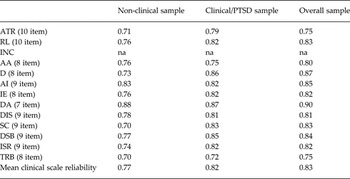
Reliability scores of the TSI scales for the non-clinical (n = 285), clinical and PTSD (n = 140) and overall sample (n = 425) are shown in Table 2. Internal-consistency reliabilities ranged from 0.71 to 0.83 for validity scales and from 0.70 to 0.90 for the clinical scales across the samples.
Cronbach's alpha of the TSI scales on non-clinical, clinical/PTSD and overall samples

na = not applicable because reliability of a scale measuring inconsistency of responses is counterintuitive.
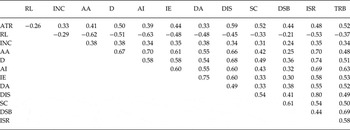
The pattern of correlations among the TSI scales in the overall sample (n = 425) revealed that, consistent with Briere's validation (Reference Briere1995), all the validity and the clinical scales were significantly intercorrelated (see Table 3).
Inter-correlations among the TSI scales on the overall sample

All rs (Pearson correlation coefficients) significant at p < 0.001 level (two-tailed).
Convergent validity
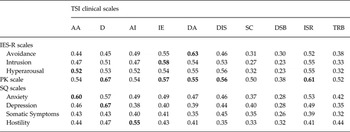
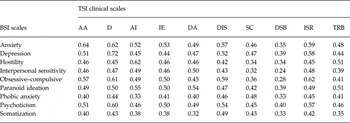
As shown in Table 4, all the TSI scales positively correlated with the MMPI-2 PK scale, with the higher values for TSI's D and ISR scales. IES-R's Avoidance and Intrusion scales largest correlations were with, respectively, DA and IE scales, while Hyperarousal scale correlated with AA scale and DIS scale. As regards SQ, the largest correlations were found for AA, D and AI scales against similar SQ scales. Consistent with Briere's validation (Reference Briere1995), the TSI had reasonable convergent validity for those scales that overlapped in content between the TSI and the BSI. In particular, TSI's AA, D and AI scales were most highly correlated with, respectively, the BSI's anxiety, D, and hostility scales (see Table 5).
Correlations among TSI clinical scales and ISR-R, SQ and PK scales

All rs (Pearson correlation coefficients) significant at p < 0.01 level (two-tailed). The boldface numbers correspond to the largest correlations among the scales.
Correlations among TSI clinical scales and BSI scales

All rs (Pearson correlation coefficients) significant at p < 0.01 level (two-tailed).
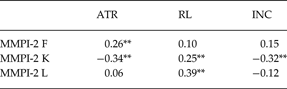
Validity scales convergent analyses are reported in Table 6. Similar to Briere (Reference Briere1995): (1) ATR scale correlated positively with MMPI-2 F scale and negatively with K scale; (2) RL scale positively with K and L scales; (3) INC scale negatively with K scale.
Correlations between TSI and MMPI-2 validity scales (Pearson-r coefficients)
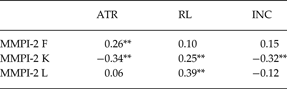
**p < 0.01 level (two-tailed).
Criterion validity
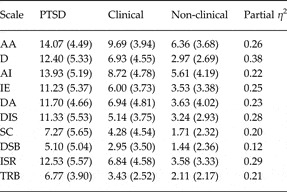
We compared the three groups (non-clinical, clinical and PTSD) as regards TSI clinical scales in order to assess the TSI-specific ability to discriminate PTSD. A MANOVA showed a significant differences on each of the TSI scales (Wilks' Lambda = 16.44, p < 0.001, partial η 2 = 0.28, all Fs > 27.41, all ps < 0.001) across the three groups. Given inequality of variances across the samples, significant differences among each of the scales as regards each group were performed with Games–Howell post-hoc test (e.g. Field, Reference Field2005). Specifically, we found that PTSD group obtained significant higher scores on each of the TSI clinical scales as compared to clinical and non-clinical ones (all ps < 0.02). Means, standard deviations and effect sizes (partial η 2) related to each of the TSI scale as regards the three samples are reported in Table 7. Specifically, effect sizes were generally large (Rosenthal, Rosnow & Rubin, Reference Rosenthal, Rosnow and Rubin2000), ranging from 0.12 to 0.38.
Means (s.d.) and effect sizes (partial η2) related to the TSI clinical scales in the PTSD, clinical and non-clinical samples

Discriminant function analysis using TSI clinical scales to predict PTSD (applied to patients with PTSD by comparison with non-clinical/clinical participants) showed that all TSI scales were associated with PTSD (Rc = 0.558, χ 2(10) = 155.69, p < 0.001). Discriminant classification analysis showed that an optimally weighted combination of TSI scales correctly predicted 27 of 30 PTSD positive cases (90% true positive) and 361 of 395 PTSD negative cases (91.4% true negative). Consequently, the TSI's incorrect prediction was 10% for false-negative and 8.6% for false-positive cases.
Furthermore, we performed a discriminant function analysis between clinical and non-clinical groups on the TSI clinical scales in order to assess if the discrimination of the instrument is specific to PTSD or just to generic clinical symptoms. Results showed that the TSI scales correctly predicted 231 of 285 non-clinical cases (81.1%) and 74 of 110 clinical cases (67.3%; Rc = 0.532, χ 2(10) = 129.36, p < 0.001).
Exploratory and confirmatory factor analyses
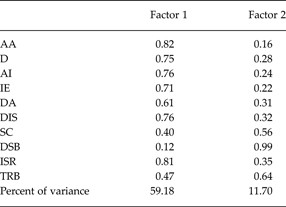
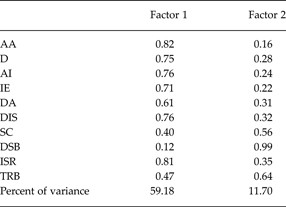
The exploratory factor analysis of TSI scores in our overall sample yielded two independent factors. Rotated factor loadings are reported in Table 8. Similar to Briere's original work (Reference Briere1995), AA, D, AI, IE, DA, DIS and ISR scales loaded on the first factor, while DSB scale loaded onto the second one, with SC and TRB sharing both factors.
Factor structure/pattern matrix of the TSI
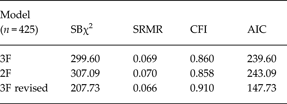
As regards confirmatory factor analysis, we tested the two original TSI theoretical models (see Briere, Reference Briere1995; Snyder et al. Reference Snyder, Elhai, North and Heaney2009): three-factor model (3F, with trauma, self-dysfunction and dysphoria intercorrelated factors) and two-factor model (2F, with trauma/dysphoria and self-dysfunction intercorrelated factors). As can be seen in Table 9, both models yielded an excellent fit as regards SRMR (<0.08) but they were less than adequate on CFI values (<0.90). Nevertheless, AIC scores indicated a better fitting of the 3F model against the 2F one. Given the not complete adequacy showed by confirmatory factor analysis, we analysed the suggestions provided by Wald and Lagrange test and we constructed a revised theoretical model (3F-R) that comprised: (1) Trauma factor (with IE, DA, AA scales); (2) a merged dysphoria and self-dysfunction factor (with ISR, D, AI, DIS, TRB and AA scales); (3) a new factor labeled sex problem (with TRB, DSB and SC scales). Fit indices of such model are reported in Table 9. Differently from the original ones, the 3F-R yielded an adequate CFI score and a better SRMR value, as confirmed by the even smaller AIC index. Overall, only such model provided a full adequate fit to our data.
Confirmatory factor analyses, ML method: good-fit indexes
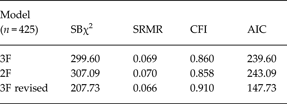
SBχ2, Satorra–Bentler chi-square statistic; SRMR, standardized root mean square residual; CFI, comparative fit index; AIC, Akaike's information criterion.
Discussion
This study provides evidence for reliability and validity of the TSI Italian version. The internal consistency reliabilities of the 10 clinical scales are from adequate to strong (all Cronbach's alpha ranging from 0.75 to 0.90 in the overall sample). Similar results have been obtained in some previous works (e.g. Briere, Reference Briere1995; Runtz & Roche, Reference Runtz and Roche1999; Snyder et al. Reference Snyder, Elhai, North and Heaney2009).
The TSI scales of the Italian version demonstrate a good convergent validity, as shown by expected patterns of relationships with related scales of SQ, BSI, IES-R and MMPI-2 post-traumatic and validity scales. In particular, AA, D and AI scales are strongly correlated with corresponding measures on SQ, BSI and IES-R. Moreover, IE and DA scales are best correlated with, respectively, intrusion and avoidance scales of IES-R. At the same time, TSI clinical scales are all strongly correlated with PK scale. Validity scales are correlated with F, K and L scales of MMPI-2 in the expected direction, with the exception of RL and F ones that are not associated in our study.
With regard to criterion validity, all PTSD-diagnosed participants obtained significant higher scores on all the clinical scales of TSI compared to both clinical and non-clinical samples. Effect size scores confirm the good capacity of TSI to discriminate between PTSD and non-PTSD, and discriminant function analysis indicates a classification accuracy of TSI scales of 90% for true-positive and 91.4% for true-negative PTSD cases. These data reflect the sensitivity of TSI to the effects of a variety of different traumatic events (interpersonal or non-interpersonal trauma), as demonstrated in other works (e.g. Runtz & Roche, Reference Runtz and Roche1999; Briere & Spinazzola, Reference Briere and Spinazzola2005; McDevitt-Murphy, Weathers & Adkins, Reference McDevitt-Murphy, Weathers and Adkins2005). The incorrect predictions of TSI (8.6% false-positive cases and 10% false-negative) are similar to Briere's validation (9% false positive and 7.7% of false negative); this suggests that TSI possesses a high level of sensitivity and specificity for PTSD. Accordingly, the TSI has an high sensitivity as regards non-clinical identification (81.1%), while a quite low specificity for clinical symptoms (67.3%) thus showing that the TSI appears particularly able to discriminate post-traumatic symptoms above clinical conditions.
Finally, the present findings do not completely support the three intercorrelated factor models originally proposed by Briere (Reference Briere1995). Despite the results of some works (Briere et al. Reference Briere, Elliott, Harris and Cotman1995; Snyder et al. Reference Snyder, Elhai, North and Heaney2009), the structural validity of such model does not adequately fit the observed data. Conversely, a revised model, in which self and dysphoria were merged, while modifying trauma factor and introducing sex problem factor, demonstrated an adequate and the best fit for the data. It should be noted that such a model could be theoretically sound. Trauma factor comprises intrusion, avoidance and hyperarousal symptoms, features that mostly characterize a trauma according to DSM-IV-TR definition. Self/dysphoria-merged factor appears to include emotional and self-related disturbances, representing distress and psychopathological dimensions highly correlated with trauma but that do not necessarily overlap it. Finally, sex concerns and dysfunctional sex behaviors can be reasonably considered as important features for specific traumatic experience of sexual abuse, thus remaining as a separate dimension both from trauma and self/dysphoria dimensions. The idea of a unique factor that includes sex-related scales, as in the 3F-R model, is coherent with the TSI-A, a 86-item alternate version of the TSI proposed to assess PTSD for non-sexual traumas, in which items of SC and DSB scales are not present.
It should be noted that, though the TSI accurately discriminates PTSD from non-PTSD cases, this instrument measures the specific components of post-traumatic stress rather than merely rendering an overall determination of PTSD or acute stress disorder (e.g. Snyder et al. Reference Snyder, Elhai, North and Heaney2009). Indeed, the TSI provides information regarding both PTSD-related and other trauma-related mental health symptoms usually experienced by trauma victims, such as: anger and irritability, depression, dissociation, impaired self-functioning, sexual problems and behaviors used to reduce negative affect. According to this, the variety of symptoms assessed by the TSI has resulted in the use of this measure as a broad spectrum measure of complex post-traumatic outcomes (e.g. Resick, Nishith & Griffin, Reference Resick, Nishith and Griffin2003).
To sum up, the TSI appears to be a valid measure of trauma-related symptoms. Nevertheless, there are some limitations that should be considered. For example, while this is a popular instrument in clinical assessments (e.g. Elhai et al. Reference Elhai, Gray, Kashdan and Franklin2005); it does not seem particularly useful for studying trauma on a large scale or in emergency contexts. Indeed, the TSI assesses post-traumatic symptoms but not trauma exposure events. According to this, in a recent review about population exposed to mass conflict and displacement, the TSI was not even cited (Steel et al. Reference Steel, Chey, Silove, Marnane, Bryant and van Ommeren2010). Furthermore, the TSI scales were highly intercorrelated. However, while this could suggest a low discrimination of the symptoms they are expected to measure, such findings were expected considering previous works (e.g. Briere, Reference Briere1995). An explanation is that each TSI scale measures different level of distress, maladjustment and psychopathology all related to post-trauma. As a result, the TSI scales should be considered as a set of indexes to assess various post-traumatic dimensions and their affective correlates. Finally, while a limitation of the TSI could be its length (i.e. 100 items), it requires approximately 20 min to complete for all the most traumatized or clinically impaired individuals and can be scored in 10–15 min.
In conclusion, the present study encompasses the goodness of TSI's psychometric properties, indicating a general reliability and validity of the inventory. The TSI provides broader and additional data regarding commonly associated symptoms with post-traumatic clinical conditions. This is quite relevant given the scarcity of validated, accurate and reliable post-traumatic self-report instruments in Italy. However, as with any self-report measure, it is not sufficient to establish a diagnosis of PTSD, but it would be a useful component of a comprehensive PTSD assessment battery (e.g. McDevitt-Murphy, Weathers & Adkins, Reference McDevitt-Murphy, Weathers and Adkins2005). Results of our study extend the generalization and validity of the TSI while, at the same time, providing some suggestions for eventually revisiting factorial structure of the questionnaire.