1. INTRODUCTION
Theoretical and experimental study of evolution of high power laser beams as they propagate through plasmas is an active area of research due to their potential relevance in plasma based accelerators (Sarkisov et al., Reference Sarkisov, Bychenkov, Novikov, Tikhonchuk, Maksimchuk, Chen, Wagner, Mourou and Umstadter1999), inertial confinement fusion (Tabak et al., Reference Tabak, Hammer, Glinsky, Kruer, Wilks, Woodworth, Campbell, Perry and Mason1994; Regan et al., Reference Regan, Bradley, Chirokikh, Craxton, Meyerhofer, Seka, Short, Simon, Town and Yaakobi1999), ionospheric modification (Perkins & Goldman, Reference Perkins and Goldman1981; Gondarenko et al., Reference Gondarenko, Ossakow and Milikh2005), and new radiation sources (Suckewer & Skinner, Reference Suckewer and Skinner1990, Reference Suckewer and Skinner1995; Foldes et al., Reference Foldes, Bakos, Bakonyi, Nagy and Szatmari1999; Fedotov et al., Reference Fedotov, Naumov, Silin, Uryupin, Zheltikov, Tarasevitch and Von der Linde2000). For success of these applications, a long propagation distance of intense lasers in plasma is desirable. As several effects emerge in such transit of high power laser beam through plasma medium, many instabilities and nonlinear phenomena such as self-phase modulation (SPM), the filamentation instability, group velocity dispersion (GVD), finite pulse effects, relativistic and ponderomotive self-focusing effects, become important. Therefore, it is important to study analytically and numerically some of these effects. This leads to a deep understanding of laser-plasma-interaction physics to keep the nonlinear process at low level.
Ever since the first investigation reported by Askar'yan (Reference Askar'yan1962) and subsequently followed by Chiao et al., (Reference Chiao, Garmire and Townes1964) on self-trapping of optical beams, this nonlinear generic process had been focus of attention for nearly five decades and is still being actively pursued by researchers worldwise because of their relevance to a number of newly discovered process. The self-focusing being a genuinely nonlinear phenomenon arising out of nonlinear response of material medium leading to its modified refractive index. Specifically, in the laser-plasma-interaction, the generic process of self-focusing of the laser beams (Chiao et al., Reference Chiao, Garmire and Townes1964; Kelley, Reference Kelley1965; Sodha et al., Reference Sodha, Ghatak and Tripathi1974, Reference Sodha, Ghatak and Tripathi1976; Milchberg et al., Reference Milchberg, Durfee and Mcllrath1995; Saini & Gill, Reference Saini and Gill2006; Gill & Saini, Reference Gill and Saini2007; Yu et al., Reference Yu, Yu, Xu, Tian, Chen and Wong2007; Gill et al., Reference Gill, Mahajan and Kaur2010a, Reference Gill, Mahajan and Kaur2010b; Kaur et al., Reference Kaur, Gill and Mahajan2010) has been focus of attention as it affects many other nonlinear processes. It plays crucial role in beam propagation and arises due to increase of the on-axis index of refraction relative to edge of the laser beam. For example, for ponderomotive force type nonlinearity, electrons are expelled from the region of high intensity laser field. On the other hand, relativistic self-focusing results from the effect of quiver motion leading to reduced local plasma frequency. The self-focusing is counterbalanced by the tendency of the beam to spread because of diffraction. In the absence of nonlinearities, the beam will spread substantially in a Rayleigh length, R d (~ka 02), where k is the wave-number and a 0 is the spot size of the laser beam.
Theoretical analysis of self-focusing, self-trapping, and filamentation of laser has been reported by Akhmanov et al. (Reference Akhmanov, Sukhorukov and Khokhlov1968) developed by Sodha et al. (Reference Sodha, Ghatak and Tripathi1976), and Kaw et al. (Reference Kaw, Schmidt and Wilcox1973). Sodha et al. (Reference Sodha, Ghatak and Tripathi1974) extended the laser beam self-focusing to variety of media such as dielectrics, semiconductors and plasmas under considering different nonlinear mechanisms. Self-focusing and filamentation are among the most dangerous nonlinear phenomena that destroy the uniformity of overall irradiation required for direct-drive fusion experiment as well as leads to seeding and growth of hydrodynamic instabilities. Relativisticlaser-plasma-interaction physics has also been focus of attention as many nonlinear processes playing key role in the generation of new ion sources as reported recently (Laska et al., Reference Laska, Badziak, Boody, Gammino, Jungwirth, Krasa, Krousky, Parys, Pfeifer, Rohlena, Ryc, Skala, Torrisi, Ullschmied and Wolowski2007; Strangio et al., Reference Strangio, Caruso, Neely, Andreoli, Anzalone, Clarke, Cristofari, DelPrete, Di Giorgio, Murphy, Ricci, Stevens and Tolley2007; Torrisi et al., Reference Torrisi, Margarone, Laska, Krasa, Velyhan, Pfeifer, Ullschmied and Ryc2008). Further, there have been a series of novel experiments to study rich physics issues in nuclear and particle physics, atomic physics (Stöhlker et al., Reference Stöhlker, Backe, Beyer, Bosch, Braeuning-Demian, Hagman, Ionescu, Jungmann, Kluge, Kozhuharov, Kuehl, Lisen, Mann, Mokler and Quint2003), plasma physics (Hoffmann et al., Reference Hoffmann, Blazevic, Ni, Rosmej, Roth, Tahir, Tauschwitz, Udrea, Varentsov, Weyrich and Maron2005; Schaumann et al., Reference Schaumann, Schollmeier, Rodriguez-Prieto, Blazevic, Brambrink, Geissel, Korostiy, Pirzadeh, Roth, Rosmej, Faenov, Pikuz, Tsigutkin, Maron, Tahir and Hoffmann2005), and applied sciences (Kuehl et al., Reference Kuehl, Ursescu, Bagnoud, Javorkova, Rosmej, Cassou, Kazamias, Klisnick, Ros, Nickles, Zielbauer, Dunn, Neumayer and Pert2007; Kasperczuk et al., Reference Kasperczuk, Pisarczyk, Kalal, Martinkova, Ullschmied, Krousky, Masek, Pfeifer, Rohlena, Skala and Pisarczyk2008).
There are several approximate analytical approaches to analyse the effect of self-focusing namely a paraxial ray approximation (PRA) (Akhmanov et al., Reference Akhmanov, Sukhorukov and Khokhlov1968; Sodha et al., Reference Sodha, Ghatak and Tripathi1974, Reference Sodha, Ghatak and Tripathi1976), moment theory approach (Firth, Reference Firth1977; Lam et al., Reference Lam, Lippmann and Tappert1977), variational approach (Firth, Reference Firth1977; Anderson & Bonnedal, Reference Anderson and Bonnedal1979), and source-dependent expansion (SDE) method (Sprangle et al., Reference Sprangle, Hafizi and Penano2000). Each of these theories has limitations in describing completely the experimental/computer simulation results. However, the most used theory based on Wentzel-Krammers-Brillouin (WKB) approximation and PRA is given by Akhmanov et al. (Reference Akhmanov, Sukhorukov and Khokhlov1968) and developed by Sodha et al. (Reference Sodha, Ghatak and Tripathi1976). Due to its mathematical simplicity, it has been extensively used to account for general features of self-focusing as witnessed by the increasing number of publications. Grow et al. (Reference Grow, Ishaaya, Vuong, Gaeta, Gavish and Fibich2006) and Fibich (Reference Fibich, Boyd, Lukishova and Shen2007) have beenrecently reviewed the present status of self-focusing, including the ring formation in Gaussian and super-Gaussian beams. Paraxial ray theory is based on the expansion of the eikonal and nonlinear dielectric constant up to square term r 2, where r is the distance from the axis of beam. The theory qualitatively agree well with experimental observations. Thus, the conventional theories like PRA based on near axis approximation, where eikonal is expanded upto only first power in r 2, cannot account for changing radial profile of the laser beam from initial Gaussian to that of ring. Particularly, if the initial intensity is sufficiently larger than the threshold, then near axis approximation fails after some distance of propagation when intensityhas fallen due to defocusing. This premise has been recently applied by Liu and Tripathi (Reference Liu and Tripathi2000) to investigate the ring formation in tunnel ionization of a gas by a laser beam. Subsequently, Faisal et al. (Reference Faisal, Mishra, Verma and Sodha2007), have developed a self-consistent, steady state paraxial theory of self-focusing in a plasma characterized by significant collisional, or ponderomotive nonlinearity considering the terms up to r 4 in the expansion of eikonal S and irradiance A 02. Thus effects of higher order paraxial theory are expressed as follow:
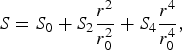

where r 0 is the initial radius of the super-Gaussian beam and S 0, S 2, S 4, a 2, a 4, and the beam width parameter f are functions of distance of propagation z. The parameters S 0, S 2, S 4 are components of the eikonal. Here S 2 indicate the spherical curvature of the wavefront. S 4 corresponds to its departure from the spherical nature. The parameter a 2 and a 4 indicates the departure of the beam from super- Gaussian nature.
In a variety of applications, the fundamental TEM00 mode plays a vital role on account of its specific characteristics with a simple Gaussian intensity profile. Most of the research work on self-focusing of the laser beam has been confined to the cylindrically symmetric Gaussian beams symmetry (Kumar et al., Reference Kumar, Gupta and Sharma2006; Hora, Reference Hora1975; Esarey et al., Reference Esarey, Sprangle, Krall and Ting1997; Sharma et al., Reference Sharma, Verma and Sodha2004; Akhmanov et al., Reference Akhmanov, Sukhorukov and Khokhlov1968). Only a few investigations have been reported on the self-focusing of super-Gaussian beams (Karlsson & Anderson, Reference Karlsson and Anderson1992; Grow et al., Reference Grow, Ishaaya, Vuong, Gaeta, Gavish and Fibich2006; Fibich, Reference Fibich, Boyd, Lukishova and Shen2007), self-trapping of degenerate modes of laser beams (Karlsson, Reference Karlsson1992), self-trapping of Bessel beams (Johannisson et al., Reference Johannisson, Anderson, Lisak and Marklund2003), elliptical Gaussian beam (Cornolti et al., Reference Cornolti, Lucchesi and Zambon1990), and hollow elliptical Gaussian beam (Cai & Lin, Reference Cai and Lin2004), sinusoidal-Gaussian beam in complex systems (Casperson & Hall, Reference Casperson and Hall1997), Hermite-sinusoidal-Gaussian (HSG) laser beams in the turbulent atmosphere (Baykal, Reference Baykal2004), Hermite-Gaussian beams (Takale et al., Reference Takale, Navare, Patil, Fulari and Dongare2009), and Hermite-cosh-Gaussian (HChG) laser beams (Belafhal & Ibnchaikh, Reference Belafhal and Ibnchaikh2000; Patil et al., Reference Patil, Takale, Navare and Dongare2010). In relatively recent studies, the propagation of cosh-Gaussian laser beams in turbulent atmosphere, cubic quintic nonlinear media, parabolic medium, and plasma has been investigated in detail (Eyyuboglu & Baykal, Reference Eyyuboglu and Baykal2005; Konar et al., Reference Konar, Mishra and Jana2007; Patil et al., Reference Patil, Navare, Takale and Dongare2009; Gill et al., Reference Gill, Mahajan and Kaur2011a, Reference Gill, Kaur and Mahajan2011b). A review of literature highlights the fact that the propagation characteristics of super-Gaussian laser beams in plasma with transverse magnetic field have not been studied to a significant extent. Most previous investigations (Gagnon & Pare, Reference Gagnon and Pare1991; Hermann, Reference Hermann1991) based on variational approach have used Gaussian or sech expressions as trial functions for the radial shape of fundamental nonlinear mode. The Gaussian and especially the sech solutions indeed exhibit good agreement with the numerically obtained results for the cases considered. These trial functions do not however, provide any information about how radial shape of the fundamental mode depends on pulse amplitude, pulse width, distance of propagation etc. One way of allowing for a more flexible shape is to choose super-Gaussian trial functions. Super-Gaussian profiles evolve into a ring profile (Fibich, Reference Fibich, Boyd, Lukishova and Shen2007). It is therefore pertinent to use PRA for such type of beams. We have used PRA with higher order corrections as it predictsring formation in case of super-Gaussian beams.
With the availability of superintense laser pulse, the laser-plasma-interactions has undergone a paradigm shift. The electron oscillatory velocity at high laser intensity approaches the velocity of light and we enter a regime when relativistic effects areof paramount importance. The situation is more relevant in the fast ignition schemes of laser driven fusion. In such case, long laser pulse converts the pellet into plasma ball, heats the coronal region and compresses the core to a superdense plasma. Propagation of intense laser in such plasma involves the relativistic mass effect and plasma frequency is lowered falling below the laser frequency, consequently making the plasma transparent. Sharma (Reference Sharma1978) studied the steady self-focusing in plasma immersed in a uniform magnetic field perpendicular to the direction of wave propagation. The extent of self-focusing increases as the magnetic field increases. Gurevich (Reference Gurevich1978) developed an elegant formulism of self-focusing/defocusing of radio waves in the ionosphere in the presence of earth's magnetic field where ohmic nonlinearities and collisional effects play a vital role. Akhmanov et al. (Reference Akhmanov, Sukhorukov and Khokhlov1968) showed that the azimuthal magnetic field has a focusing effect on rays in the plane of laser polarization. In the present investigation, authors have studied evolution of super-Gaussian laser beam in a plasma transverse to magnetic field when relativistic nonlinearity is taken into account using higher order paraxial ray theory. The laser beam propagates in the extraordinary x-mode with super-Gaussian distribution of intensity in one transverse dimension and focuses in a periodic manner on the distance of propagation.
The organization of the paper is as follows: In Section 2, an expression for the nonlinear permittivity tensor is derived. In Section 3, the equation for beam width parameter f using higher order paraxial ray theory is obtained. In Section 4, authors have studied the self-trapped mode, and Section 5 is devoted to discussion. In the last, Section 6, conclusions of present investigation are presented.
2. NONLINEAR PERMITTIVITY TENSOR
Consider a uniform plasma of equilibrium electron density n 00 immersed in a magnetic field  . An intense laser beam propagates through it along the
 -direction,

where  . The response of plasma electrons is governed by the relativistic equation of motion,

where −e and m are the electronic charge and rest mass, c is the velocity of light in vacuum, and γ is the Lorentz factor. For ω frequency response, this equation reduces to
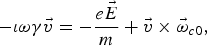
giving
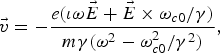
where 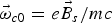 and γ ≅ 1 + ∣ v ∣2 /4c 2
After a straightforward mathematical manipulation, we arrive at:

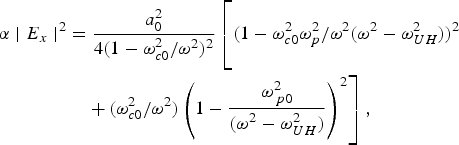
where 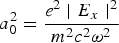 and ωUH2 = ωp02 + ωc02
In the propagation of extra-ordinary mode, we need εeff = ε+ε−/(ε+ + ε−), where ε± = εzz ± ιεzx. We may write:

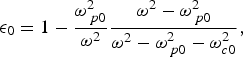
Following Hassoon et al. (Reference Hassoon, Sharma and Khamis2010), we obtain an equation including two terms of the dielectric constant, the linear and the nonlinear term where:

3. BASIC FORMULATION
The wave equation governing the electric field of the laser is:

Consider the solution of the above equation of the form:

where A 0 (r,z) is the complex amplitude of the electric field.
Particularly, we have chosen extra-ordinary mode for the beam propagation as ε0 should be positive for plasma to act as an overdense medium (Misra & Mishra, Reference Misra and Mishra2009).
Substituting Eq. (13) in Eq. (12) and neglecting  (assuming A to be slowly varying function of z), one obtains

The complex amplitude A 0 (r, z) may be expressed as:

where S is called the eikonal. Substituting Eq. (15) in Eq. (14), we obtain the following two equations:
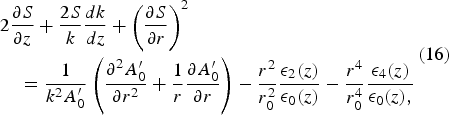
and

Where ε0(z), ε2(z), ε4(z) are the coefficients in the expansion of ε(r, z).

One can consider a solution of Eq. (17) of the form:

where f can be identified as the beam width parameter. The eikonal S(r, z) may also be expanded up to r 4 as:

Substituting A 0′2 and S from Eqs. (19) and (20) in Eq. (17), and equating the coefficients of r 0, r 2, r 4 on both sides of the resulting equation, we obtain

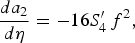
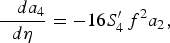
where

Eliminating S 4 from Eqs. (22) and (23) and integrating the resulting equation with the initial conditions a 4 = 0 and a 2 = 0 at η = 0, we obtain

Substituting the value of a 4 from Eq. (25) in Eq. (19), we get:

Substitute the value of A 0′2 and S from Eq. (19) and (20) in Eq. (16) and equating the coefficients of r 2 and r 4 in the resulting equation to zero, we get the following equations, governing the beam width parameter f and S′4:


where  and
 are the dimensionless distance and dimensionless original beam width.
As the effective dielectric constant is given by:

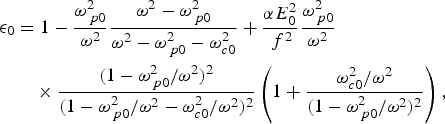
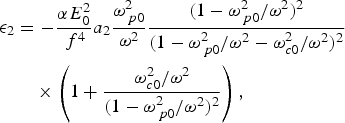
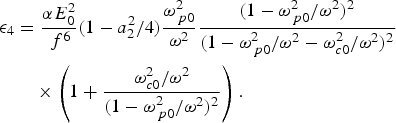
Substituting the value of EE* from Eq. (26) in Eq. (29) and expanding ε as a series in  and retaining terms up to
 , one obtain the dielectric function appearing in the Eq. (18), where
4. SELF-TRAPPED MODE
For an initially plane wave front,  and f = 1 at z = 0, the condition
 leads to the propagation of super-Gaussian beam in the uniform waveguide/self-trapped mode. The conditions under which this occurs are termedas critical conditions and their graphical representation is known as the critical curve.
By putting  in Eq. (27), we obtain a relation between dimensionless initial beam width parameter (ρ0 ) and critical values of power of the beam Π (=α|E 0|2). The expression when simplified is given as follow:

On substitution of the appropriate expression for ε2 for relativistic nonlinearity, one obtains the above equation for ρ02 as a function of Π. The nature of self-focusing is further highlighted through the critical curves. Super-Gaussian beam undergoes self-focusing when the condition  is satisfied whereas for
 , super-Gaussian beam displays either oscillatory or steady state self-focusing.
5. DISCUSSION
Eqs. (22), (27), and (28) are nonlinearly coupled ordinary second order differential equations governing evolution of a 2, normalized beam width parameter, f and S 4 as a function of dimensionless distance of propagation, η. Analytical solutions to these equations are not possible. We therefore, seek numerical computational techniques to study beam dynamics. The solution for self-focusing can be obtained by analysing the equations numerically subjected to the following initial conditions f = 1,  , S 4 = 0 and a 2 = 0, at η = 0. For the paraxial theory of ring formation to be valid, we have followed the approach Misra and Mishra, (Reference Misra and Mishra2009) that demands the following inequality to be satisfied:

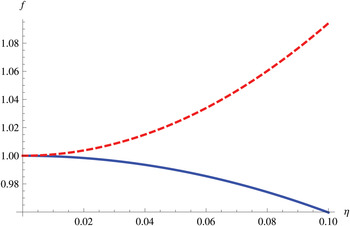
In Figure 1, the plot of normalized beam width parameter, f as a function of η is displayed when relativistic nonlinearity is considered for the following set of parameters

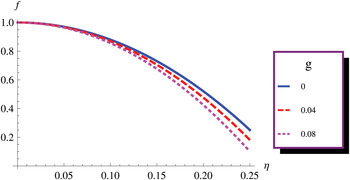
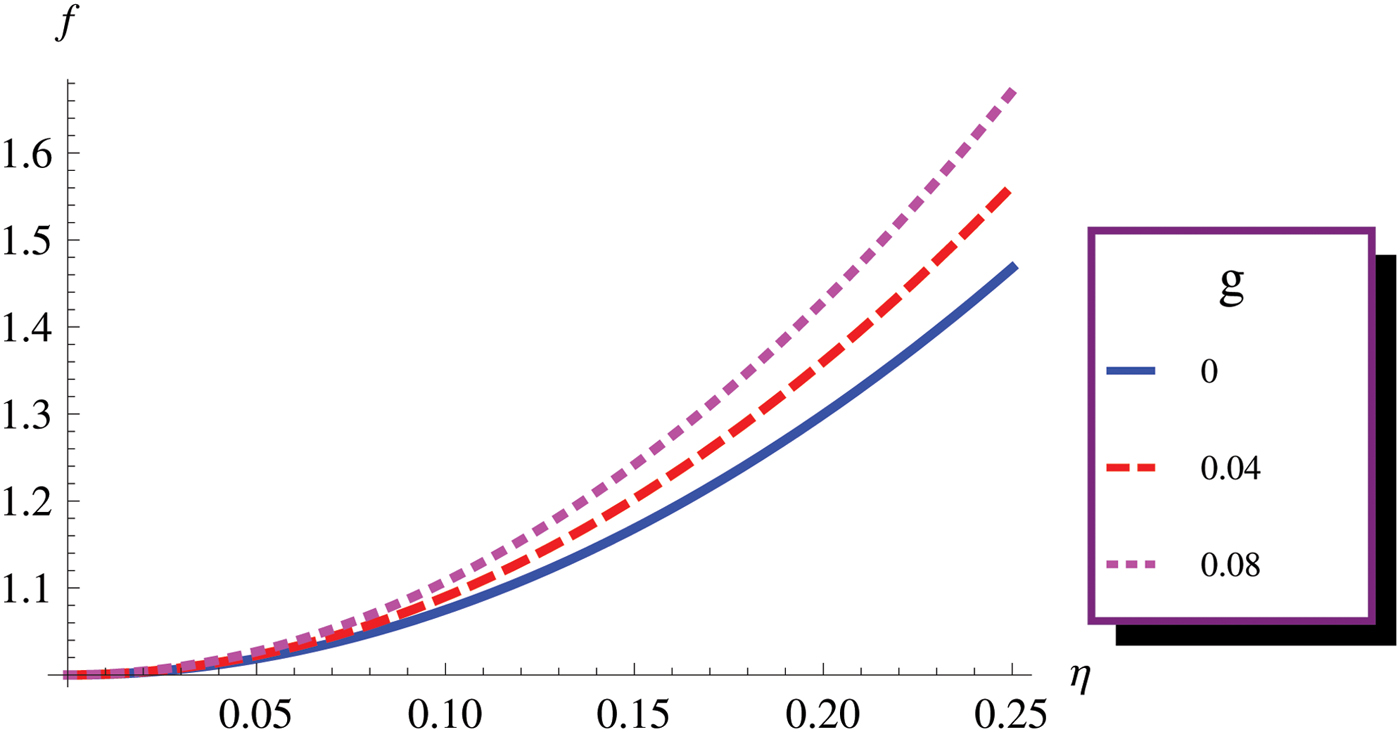
Solid curve is for ordinary paraxial ray theory and dotted curve represents the graph with inclusion of higher order terms. Although self-focusing is observed in both cases, less self-focusing is observed when higher order terms are taken into account. However, there is substantial increase in self-focusing with inclusion of higher order terms. This is the case of the dark ring. Contradicting results are obtained in the case of a bright ring as depicted in Figure 2. Beam focuses at all values of η in the absence of higher order terms (Solid curve) and it undergoes defocusing on account of these terms (Dashed curve). Figures 3 and 4 plot f as a function of η for relativistic nonlinearity at three values of ωc0/ω(=g) in the case of both dark and bright ring formation respectively. Self-focusing is observed at all values of g in Figure 3 and the minimum point is lower for higher values of g (dark ring). However, defocusing of the laser beam is observed at all values of g as displayed in Figure 4 (bright ring). Self-focusing length decrease as the value of magnetic field increases in both dark and bright rings.:
(Color Online) Variation of normalized beam width parameter f as a function of dimensionless distance of propagation η when relativistic nonlinearity is taken into account for the following set of parameters:  ,
 intensity parameter, α |E 0|2(=Π) = 0.6. Solid curve corresponds to α 2 = 0 i.e. simple paraxial ray theory and dashed to higher order PRT i.e. a 2 ≠ 0. This figure corresponds to dark ring.

(Color Online) Variation of normalized beam width parameter f as a function of dimensionless distance of propagation η when relativistic nonlinearity is taken into account at same set of parameters as mentioned in the caption of figure 1 except Π = 0.7. Solid curve corresponds to a 2 = 0, dashed to a 2 ≠ 0. This figure corresponds to bright ring.

(Color Online) Variation of normalized beam width f with dimensionless distance of propagation η for the various values of magnetic field, g keeping other parameters same as in the caption of figure 1. Solid curve corresponds to g = 0, dashed to g = 0.04 and dotted to g = 0.08 (dark ring).

(Color Online) Plot of normalized beam width f with dimensionless distance of propagation η for the various values of magnetic field, g keeping other parameters same as in the caption of figure 1. Solid curve corresponds to g = 0, dashed to g = 0.04 and dotted to g = 0.08 (bright ring).
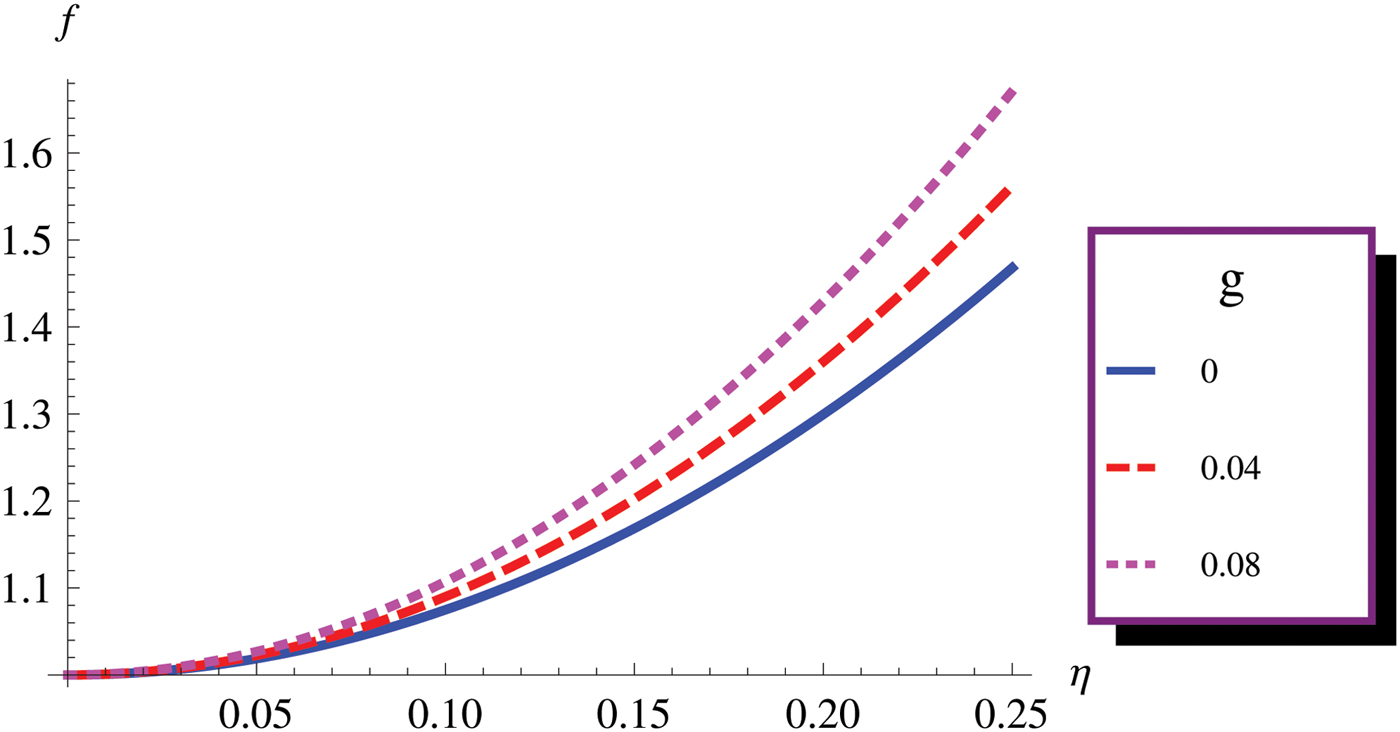
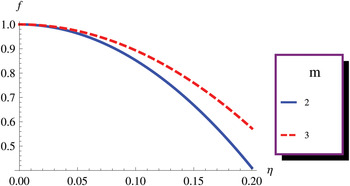
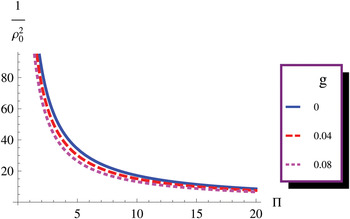
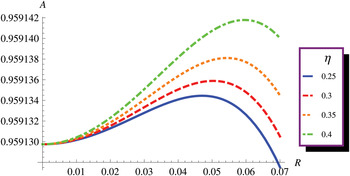
Figure 5 displays f versus η at two values of super-Gaussian coefficient, m (bright ring). Self-focusing is observed at both values of m. Another aspect of this phenomenon observed here is that this behavior becomes slow with increase in the value of m. To further elucidate the results for deleanating the underlying physics for the propagation of super-Gaussian laser beam in a plasma, we numerically analyse the dependence of dimensionless initial beam width parameter (ρ0) as a function of critical values of beam power Π (=α |E 0|2) for various values of g. The results are depicted in the form of graphs. The critical curve for super-Gaussian beam characterizes the self-focusing region in ρ02—Π space.Those points which lie below the critical power curve correspond to the propagation of super-Gaussian beam with self-focusing whereas the points lying above the critical curve result in oscillatory or steady defocusing of super-Gaussian beam. Points on the critical curve lead to the propagation of super-Gaussian beam in self-trapped mode. In Figure 6, we have plotted ρ02 versus Π for three values of g when higher order terms are incorporated in the analysis. Solid curve corresponds to g = 0, dashed to g = 0.04 and dotted to g = 0.08. Curves exhibit faster monotonic decrease in ρ02 (bright ring). However, increase in g leads to weaker dependence on intensity, a feature reported in earlier investigation (Anderson, Reference Anderson1978). Lastly, Figure 7 displays the variation of normalized irradiance (A = A 02f 2/E 02) on the dimensionless distance of propagation η as a function of R(=r/r 0f)2 corresponding to relativistic nonlinearity. It is observed that as the beam propagates, the ring moves away from the axis.
(Color Online) Plot of f versus dimensionless distance of propagation η for the various values of m with the same set of parameters as mentioned in the caption of figure 1. Solid curve corresponds to m = 2 and dashed to m = 3.

(Color Online) Dependence of the dimensionless initial beam width (ρ0 ) as a function of Π with various values of g. Solid curve corresponds to g = 0, dashed to g = 0.04 and dotted to g = 0.08 (bright ring).

(Color Online) Variation of normalized irradiance A(=A 02f 2/E 02) on the dimensionless distance of propagation η as a function of R(=r/r 0f)2 corresponding to relativistic nonlinearity. Solid curve corresponds to η = 0.25, dashed to η = 0.3, dotted to η = 0.35 and dotdashed to η = 0.4.

6. CONCLUSIONS
In the present investigation, authors have studied evolution of super-Gaussian laser beam in a plasma transverse to magnetic field when relativistic nonlinearity is taken into account. The equation for beam width parameter f using higher order paraxial ray theory is obtained. Depending on the value of a 2, we predict two regimes characterized by dark and bright ring formation. It is observed that self-focusing character becomes slow with higher value of m. Lastly, we have studied some distinct features of critical power curves for varying values of g in the case of a bright ring.
ACKNOWLEDGMENT
R. M. and R. K. gratefully acknowledge Guru Nanak Dev University, Amritsar, India for providing financial support.