

Introduction
An abundance of scholarship has established that party leaders in the US Congress have considerable influence over political and policy outcomes (Cox and McCubbins Reference Cox and McCubbins2005; Curry Reference Curry2015; Green Reference Green2010; Sinclair Reference Sinclair1995; Smith Reference Smith2007; Strahan Reference Strahan2007). Party leaders in state legislatures can also be influential, sometimes even more so than their counterparts in Congress. Many possess formal powers that congressional leaders lack, such as the ability to determine all committee assignments, appoint committee chairs, and unilaterally set the legislative agenda (Squire and Hamm Reference Squire and Hamm2005).
Recognizing the centrality of party leadership to legislative governance in American states, scholars have developed various metrics for measuring the power of state house Speakers, or majority party leadership more generally, and have used them to test theories that explain variation in that power. Unfortunately, such metrics are mostly lacking for state senate leadership, even though some senate leaders can exercise major influence over legislative outcomes while others cannot. For instance, the president of the Florida Senate appoints lawmakers to committees and selects the party’s majority leader, and Phil Berger, President Pro Tem of the North Carolina Senate, is often described as one of the most powerful officials in the state in part because of his adroit use of formal powers like the right to make committee assignments.Footnote 1 By contrast, Colorado’s Senate president must share committee appointment power with other members of the majority party.
In this article, I employ a modified version of an index initially developed by Mooney (Reference Mooney2013a) to quantify the power of state Speakers to measure, for the first time, the formal powers of the top chamber-elected leader in state senates. After explaining how I define a senate’s “top chamber-elected leader”—a more complicated task than for state houses, since in many state senates, the president is the lieutenant governor and thus not chosen by senators themselves—I discuss my new data and how they compare with Mooney’s measure of state speaker power. I then use them to test several hypotheses explaining variation in the power of legislative party leadership. The results provide support for a number of those hypotheses, thus partially extending the applicability of existing theories of leadership power in legislatures to state upper chambers. Above all, it uncovers key differences between state senates whose members choose the senate president directly and those whose members do not because the lieutenant governor serves as president. While the former tend to act more like state houses, allocating authority to a central leader to help achieve various collective goals, the latter allocate that authority to an individual leader more sparingly and without regard to major partisan, electoral, and other factors that usually predict leadership power in a legislature.
Measuring Senate Leadership Power
Testing theories of leadership power in state senates requires a consistent and reliable means of assessing that power. Three methods have been followed by scholars to measure the political power of state legislative leaders. The first uses surveys that ask lawmakers to gauge the relative strength of their chamber’s leaders (Anzia and Jackman Reference Anzia and Jackman2012; Battista Reference Battista2011; Carey, Niemi, and Powell Reference Carey, Niemi and Powell2000; Carey et al. Reference Carey, Niemi, Powell and Moncrief2002; Clucas Reference Clucas2007, Reference Clucas2009; Jewell and Whicker Reference Jewell and Whicker1994; Mooney Reference Mooney2013b; Powell Reference Powell2019; Powell and Kurtz Reference Powell and Kurtz2014). Surveys are quite effective in capturing how successful leaders are in employing the formal powers granted to them, as well as informal sources of influence that may be uncorrelated with those formal powers, like personal connections or charisma (Clucas Reference Clucas2001, 324). The second method involves constructing numerical indices of the institutional powers of leaders granted by the state Constitution or the rules of the chamber or the party (Clucas Reference Clucas2001; Hamm and Moncrief Reference Hamm, Moncrief, Gray and Hanson2012; Jewell and Whicker Reference Jewell and Whicker1994; Mooney Reference Mooney2013a). This method has a number of advantages over surveys: it does not rely on impressionistic data, it is not contingent on how individual leaders choose to exercise their formal authority, and it is especially appropriate for testing theories about the formal, rule-based delegation of power to leaders (Clucas Reference Clucas2001, Reference Clucas2007). A third approach is to use campaign support for leaders to gauge their relative influence, which assumes that interest groups will contribute more funding to lawmakers who are better able to shape legislative outcomes (Fouirnaies and Hall Reference Fouirnaies and Hall2015).
In this study, I take the second approach to measure leadership influence, creating a numerical index based on the formally designated powers of each state senate’s top leader. Interestingly, while this method has been used to quantify the power of state Speakers (Clucas Reference Clucas2001; Mooney Reference Mooney2013a) and majority leadership in state senates more broadly (Miller, Nicholson-Crotty, and Nicholson-Crotty Reference Miller, Nicholson-Crotty and Nicholson-Crotty2011), it has not been used to gauge the power of the top chamber-elected leader of state senates over time. One likely reason is that, while the president may be the highest ranked leader of a state’s senate, not all senate presidents are selected by senators. As of 2019, senates in 24 states did not have the power to select their presidents; rather, they were presided over by a directly elected lieutenant governor who served as senate president.Footnote 2 In those states, only in the lieutenant governor’s absence does a chamber-elected leader—the president pro tem—formally preside. The leadership responsibilities shared in these state senates between lieutenant governors and presidents pro tem complicate the identification of the chamber’s most powerful leader and a comparison of her power across states (Powell and Kurtz Reference Powell and Kurtz2014).Footnote 3
The history of the US Senate points to how power may be delegated in chamber whose leader is chosen by voters rather than by lawmakers. Through the mid-19th century, US senators experimented with various arrangements to determine the assignment of lawmakers to committees—often by a chamber-wide vote on each individual assignment, sometimes by granting that power to the president pro tem (or, on rare occasions, to the Vice President, who serves as president of the Senate), and eventually by turning to party caucus-designated committees to develop assignment lists. In addition, by the early 20th century, senators from each party were selecting a party leader and granting that officer the power to resolve a variety of collective action problems (Gamm and Smith Reference Gamm, Smith and Loomis2000, Reference Gamm, Smith and Oppenheimer2002). These two historical paths suggest that lawmakers in a chamber whose highest ranked leader is not chosen by them are likely to either (a) delegate power to another officer whom they can select and thereby trust as their agent (Sinclair Reference Sinclair1995), or (b) retain that power for themselves by employing a collective decision-making mechanism, such as a committee or party caucus.
To allow for tests of leadership theories that apply to leaders chosen by lawmakers directly, and to permit comparisons with state speakers (who are also selected directly) while taking into account the unique nature of lieutenant governor-led senates, I use two different strategies to identify the top chamber-elected leader in state senates. The first identification strategy draws upon the senate’s formal leadership ladder. This approach assumes that the top leader is the highest-ranked officer whom senators alone select, that is, either the senate president (if the lieutenant governor does not preside over the senate) or the president pro tem (if the lieutenant governor does preside). The responsibilities of these two offices necessarily differ, and one could argue that the constitutionally implied (if not explicit) temporary role that presidents pro tem fulfill makes them poorly situated to best carry out senators’ ideological, electoral, and partisan objectives. However, they are similar insofar as both are selected by the full chamber, and anecdotal evidence indicates that presidents pro tem in state senates can be influential in their own right (as they occasionally were in the early decades of the US Senate). For example, when the North Carolina lieutenant governor’s position became vacant in 2016, Senate president pro tem Hugh Leatherman refused to take the post—defying the constitutional line of succession—because it would mean losing much of his political influence (Adcox Reference Adcox2017). According to one source, when the lieutenant governor is Senate president, “the president pro tempore…has significant power, equal to that of senate presidents or speakers in other states” (Haider-Markel Reference Haider-Markel2009, 842–883).
The second strategy for identifying the top chamber-elected leader of a state senate is based on the idea that, as with the US Senate, state senates may choose another leadership officer with whom to nest political power besides the president or president pro tem. To do this, I use Powell and Kurtz’s (Reference Powell and Kurtz2014) identification of the most influential leader in each state senate, which is derived from surveys and media accounts. In 35 states, that person is either the president or, in states with the lieutenant governor as senate president, the president pro tem. But in 10 state senates, that individual is the senate majority leader. (That includes 4 of the 25 states in which the senate elected its own president and 6 of the 24 states in which the lieutenant governor served as senate president). In four other states, no chamber-elected leader is identified as the most influential; rather, the lieutenant governor, serving as senate president, is named as having the most influence.
As a means of measuring the power of these leaders in each state senate, I use a well-established method employed by Mooney (Reference Mooney2013a), who drew from data provided in the annual Book of States (BOS, Council of State Governments, various years) to quantify several formal powers belonging to state speakers. The BOS provides the same information about the powers of senate presidents, presidents pro tem, and majority leaders as it does about state speakers, and I use it to create a numeric index similar to Mooney’s. The BOS is not without its limitations: its data are taken from surveys administered by the Council on State Governments, so they depend on the accuracy with which the surveys are completed, and it excludes some important formal leadership tools, like control over campaign funding and the floor agenda.Footnote 4 The BOS nonetheless captures a fairly broad scope of leadership powers, including the assignment of committee members and chairs, appointment of other chamber leaders, and the ability to refer bills to committees. It also does so consistently over an extended period of time, unlike other metrics that rely at least in part on data gathered only occasionally (Clucas Reference Clucas2001; Miller, Nicholson-Crotty, and Nicholson-Crotty Reference Miller, Nicholson-Crotty and Nicholson-Crotty2011),Footnote 5 and it has been shown to correlate well with those other metrics (Mooney Reference Mooney2013a).
There is, however, a more serious problem with the BOS as a source for measuring leadership influence. In some state chambers, committee assignments and the appointment of committee chairs are officially determined by a designated group of lawmakers, usually a committee on committees or a committee on rules. Using Mooney’s methodology, a party leader would be given no formal power in those categories of leadership power (i.e., a score of 0), since committee appointment power is not granted to an individual leader, and the BOS does not provide information on who sits on those committees. Yet leaders often do participate in these committee-assigning organizations. For instance, the New Mexico State Senate’s “committees’ committee,” which makes all of the chamber’s committee assignments, is headed by the Senate President Pro Tem.Footnote 6 Failure to account for the makeup of these committees thus falsely depresses the numeric scores of some chambers’ top elected leaders. This is especially problematic for measuring senate leadership power, because such committees are more prevalent in the committee assignment process in upper chambers than in lower ones. For instance, according to the 2010 edition of the BOS, only 10% of state houses granted special committees the power to determine committee assignments, whereas 27% of state senates did so.
To address this problem, I followed a two-step coding process. First, following Mooney, I consulted every biannual issue of the BOS between 1995 and 2010, using even-numbered year issues for states with even-numbered year elections and odd-numbered year issues for the four states in this period that conducted odd-numbered year elections. I assigned each top elected senate leader (president, president pro tem, or majority leader) an initial index score between 0 and 5 based on the power of said leader in each of five categories: the appointment of committee chairs, the appointment of other committee members, the appointment of other leaders, the referral of legislation, and the hiring of professional committee staff. Second, I created a modified version of the score by consulting chamber rules and press accounts for all state senates that the BOS identified as designating committee assignment to a committee. If the top elected leader served on that committee, her power score was augmented accordingly. (A more complete description of the coding process can be found in the Supplementary Material.)
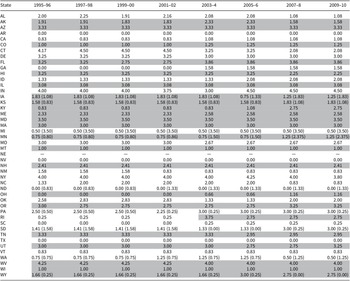
Tables 1 and 2 list the modified power index scores for the top chamber-elected leader in each state senate in the aforementioned 15 year span. Table 1 lists all leaders of even-year elected senates, while Table 2 does so for all odd-year elected senates. Shaded cells apply to senate-elected presidents (i.e., senates in which the lieutenant governor did not serve as president), while nonshaded rows apply to senate-elected presidents pro tem because the lieutenant governor in those states served as senate president. Numbers in parentheses apply to senate majority leaders in states where they were identified by Powell and Kurtz as the most influential.
Formal powers index score, top chamber-elected leader of state senates (states with even-numbered-year elections)

Source: The Book of States (various years), coded by the author using a modified method derived from Mooney (Reference Mooney2013a). Shaded cells are index scores that measure the formal powers of the (senate-elected) president; unshaded scores measure the formal powers of the (senate-elected) president pro tem (since the lieutenant governor serves as president). Numbers in parentheses are the scores of the Senate majority leader, if that officer was identified most influential by Powell and Kurtz (Reference Powell and Kurtz2014). Nebraska’s unicameral legislature is excluded.
Formal powers index score, top chamber-elected leader of state senates (states with odd-numbered-year elections)

Source: see prior table. Shaded cells are scores that measure the formal powers of the (senate-elected) president; unshaded scores measure the formal powers of the (senate-elected) president pro tem (since the lieutenant governor serves as president). Numbers in parentheses are the scores of the Senate majority leader, if that officer was identified most influential by Powell and Kurtz (Reference Powell and Kurtz2014).
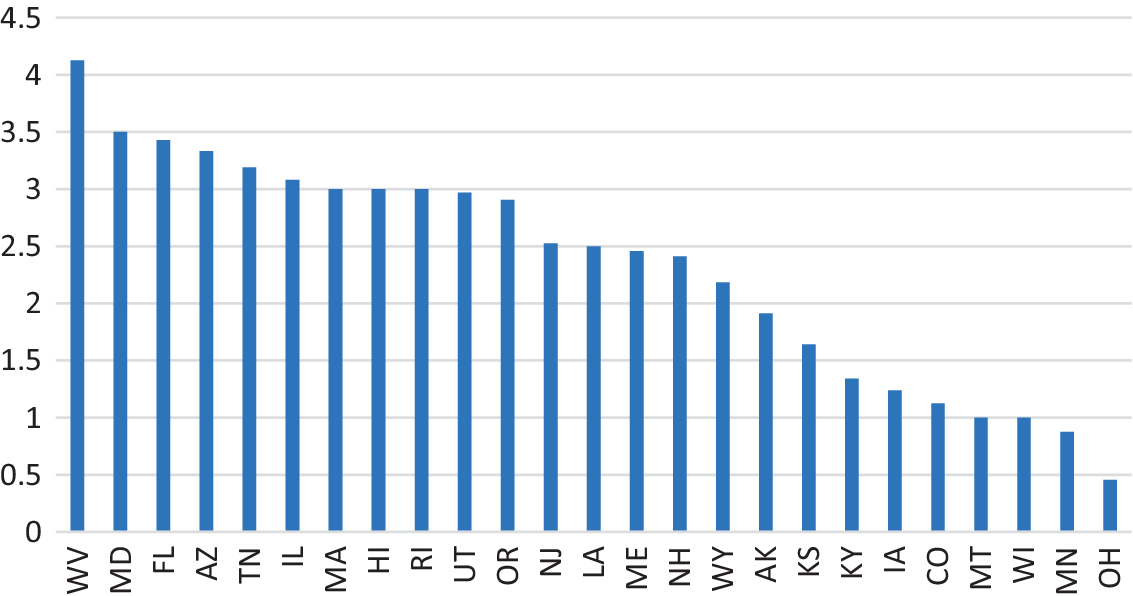
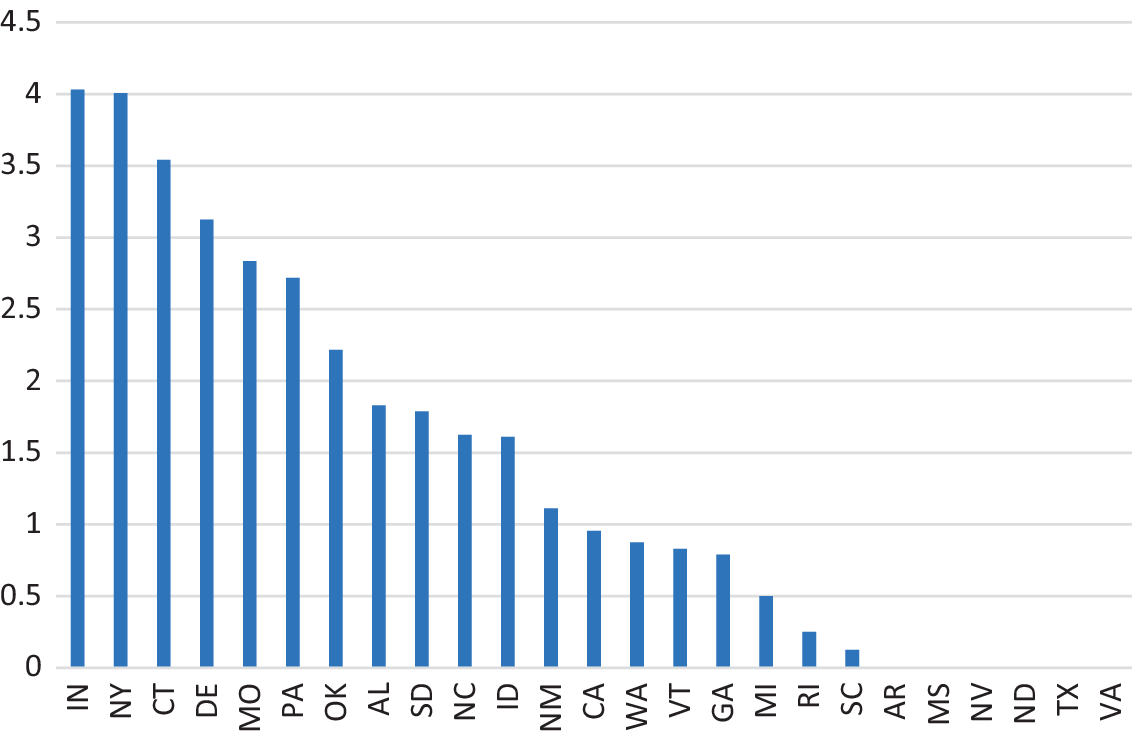
A brief review of the data reveals several patterns worth noting. First, the data generally support the second identification method for determining a chamber’s top leader: that is, the BOS scores of leaders identified as influential (in parentheses) are, in a majority of states, equal to or greater than the scores of leaders who ranked highest on the leadership ladder for at least part of the time under examination.Footnote 7 Second, top party leaders in state senates tend to be less powerful than their equivalents (i.e., speakers) in state houses. In 2009–10, for example, the average score of house speakers as measured by Mooney’s index was 2.67, versus 1.91 for senate leaders when using the first identification strategy (i.e., presidents or presidents pro tem) and 1.97 when using the second strategy (i.e., presidents, presidents pro tem, or majority leaders, and excluding the four states that identified the lieutenant governor as the most influential leader). Over half of states (57% when using the first identification strategy, 56% when using the second) had legislatures in which the house speaker held greater formal power than the top chamber-elected senate leader. Third, the top chamber-elected senate leader has even less power when that officer is not the president because the lieutenant governor serves in that capacity. In those chambers, the top chamber-elected leader in 2009–10 had an average corrected power index score of 1.40 when using the first identification strategy and 1.49 when using the second. By contrast, senate-elected presidents in that time period had an average corrected power score of 2.40. Finally, despite these differences in averages, there is considerable variation across states. This can be seen in Figures 1 and 2, which display the sorted average scores of the highest ranked senate-elected leader between 1995 and 2010, separated by whether that leader was the president (Figure 1) or the president pro tem (Figure 2).
Average power index scores (modified), senate president (if selected by senators), 1995–2010. Note. Rhode Island scores are calculated for 2003–2010; prior to 2003, the senate’s highest ranked internally elected leader was the president pro tempore.

Average power index scores (modified), senate president pro tempore (in states where lieutenant governor is senate president), 1995–2010. Note. Rhode Island scores are calculated for 1995–2002; after 2002, the senate’s highest ranked internally elected leader was the senate president.

Explaining the Power of the Top Chamber-Elected Senate Leader
Why might a state senate grant its top chamber-elected leader more or less power? Prior studies of party leadership in the US Congress and in state legislative chambers suggest a number of hypotheses, each rooted in central elements of legislative politics like lawmakers’ ideological preferences, the electoral environment, the degree of chamber professionalism, and policy challenges facing the legislature. In addition, state senates are hardly identical to state houses, and at least one factor unique to upper chambers—the role of some lieutenant governors as senate president—may matter for leadership power as well.
First, the distribution of ideological preferences in the majority party could determine the power of party leaders. The most prominent ideology-based leadership model is conditional party government (CPG) theory, which holds that governing parties which are more polarized—that is, internally more homogeneous and more distant from the minority party—will grant their legislative leaders more formal authority to help them carry out their shared policy goals (Aldrich and Rohde Reference Aldrich and Rohde2000; Rohde Reference Rohde1991). Evidence for CPG has been found in the US House of Representatives,Footnote 8 though less so in the US Senate (Smith Reference Smith2007) or in state legislatures (Battista and Richman Reference Battista and Richman2011; Clucas Reference Clucas2009; Fouirnaies and Hall Reference Fouirnaies and Hall2015; Mooney Reference Mooney2013b; but see Atkins Reference Atkins2019). The theoretical foundations for partisan distance are also weaker than they are for party homogeneity, since it could be that parties that are closer together ideologically are no less motivated to strengthen their leadership, especially if it means more of their members are likely to defect on floor votes (Smith Reference Smith2007).Footnote 9
H1: Polarization hypothesis. The more ideologically homogeneous a senate majority party is, and the more distant it is from the minority party, the more formal power will be delegated to the senate’s top chamber-elected leader.
A second hypothesis follows from the central objective of lawmakers to be reelected (Mayhew Reference Mayhew1974) and from the fact that lawmakers may have electoral incentives to strengthen or weaken their top leaders. Specifically, under conditions of greater electoral competition, lawmakers may allocate more power to party leaders to provide them with electoral assistance and help them enact legislation, which in turn burnishes their reputation with voters and thereby indirectly helps them win reelection (Clucas Reference Clucas2001; Cox and McCubbins Reference Cox and McCubbins1993). It should be noted, however, that there is mixed support for this claim (see, e.g., Clucas Reference Clucas2001, Reference Clucas2009; Mooney Reference Mooney2013a), and at least one study has found that electoral competition leads to the expansion of only certain kinds of leadership powers (Richman Reference Richman2010).
H2: Electoral competition hypothesis. If members of the state senate majority party face a more competitive electoral environment, they will delegate their top chamber-elected leader greater formal power.
Another hypothesis is related to the degree of professionalism of a chamber. Some state chambers compensate their members well and give them sufficient resources to succeed, while others are less professionalized. Though not all scholars agree that professionalism leads to stronger leaders or has any effect on leadership at all (see, e.g., Fouirnaies and Hall Reference Fouirnaies and Hall2015; Moncrief, Thompson, and Kurtz Reference Moncrief, Thompson and Kurtz1996), Maddox (Reference Maddox2005) argues that in professionalized chambers, incumbents are more focused on their legislative careers and so delegate more power to party leaders to help them carry out their duties (see also Clucas Reference Clucas2007).
H3: More professionalized chamber hypothesis. If a state senate is more professionalized, its top chamber-elected leader will be delegated greater formal power.
A fourth hypothesis, related to workload, holds that the level of policy-making challenges faced by a state legislature will determine how much power it wishes to grant its leadership. The idea is that a chamber that faces greater policy challenges—or, speaking more generally, must deal with exogenously induced collective action problems (Battista Reference Battista, Jenkins and Volden2017)—will need stronger leadership to help address those challenges. There is some evidence for this. Richman (Reference Richman2010), for instance, finds that different measures of policy challenges, such as state population, the number of lobbyists and legislators, indicators of government intervention, and a composite index of all three factors independently influence the power of state speakers. The same may apply to state senates as well.
H4: Policy-making challenge hypothesis. A state senate that faces more policy challenges will delegate its top chamber-elected leader greater formal power.
That some lieutenant governors serve as senate presidents suggest two additional hypotheses that may influence the degree of power granted to senate leadership. In general, a legislative chamber may opt to expand the power of its elected leadership as a counterweight against the executive branch when the executive is controlled by the opposite party. For state senates that do not elect their own president, the lieutenant governor is especially important in driving this partisan motivation. When the lieutenant governor is the senate president but is not from the governing party of a senate chamber, the senate’s majority party has a strong incentive to strengthen the president pro tem or majority leader. In 1988, for example, Democrats in the North Carolina state senate shifted some powers away from the newly elected Republican lieutenant governor to the president pro tem, and in 2003, the incoming Republican majority in the Georgia State Senate gave its president pro tem the authority to assign bills, rather than allow the Democratic lieutenant governor to do so (Associated Press 2005; DeBlieu Reference DeBlieu2012). Accordingly, in states where the lieutenant governor serves as senate president, we may see senates expand the power of the top chamber-elected leader when the lieutenant governor is of the opposite party, and weaken their power when the lieutenant governor is from the same party as the majority.
H5: Interbranch partisanship hypothesis. If the president of the state senate is an opposite-party lieutenant governor, the senate will delegate its top chamber-elected leader greater formal power.
Finally, and contrary to the previous hypothesis, it may be that, when the lieutenant governor serves as senate president, the senate is constrained in its ability to shape the power of its top chamber-elected leader. The president pro tem may be permitted to preside over the senate only in the absence of the lieutenant governor, for instance, making that officer a less than ideal vehicle for the exercise of party power. In addition, the practices of some states in selecting presidents pro tem—such as Arkansas’s tradition of limiting presidents pro tem to one term—could limit their effectiveness as an agent of the majority party.Footnote 10 Democratic norms may further inhibit senates from altering the power of their president pro tem if it directly or indirectly results in changing the legislative powers of the lieutenant governor, who is, after all, elected directly by voters. Even if the most influential leader is someone whom senators are able to delegate substantial authority, like the majority leader, the history of the US Senate intimates that these senates may also choose not to give full authority to that leader and instead grant power to collective decision-making bodies. If senates are so constrained, the effects of ideology, electoral competitiveness, professionalism, and workload would be conditional on whether the top chamber-elected senate leader is president or not, and only in the former case would those factors influence the power of the chamber’s top chamber-selected leader.
H6: Elected president hypothesis. Only if a state senate’s top chamber-elected leader is a senate president will ideological, electoral, professionalism-related, or workload-related factors influence the leader’s formal power.
To test these hypotheses, I conducted linear regression analyses with the dependent variable equal to the modified power index score of each state Senate’s highest elected leader between 1994 and 2011.Footnote 11 To test the party polarization hypothesis (H1), I used Shor-McCarthy’s NPAT ideological scores calculated for state lawmakers (Shor and McCarty Reference Shor and McCarty2015) to create two independent variables. One variable measured the standard deviation of the majority party’s NPAT scores. To ease interpretation, the variable was inverted, so larger values equal a more homogeneous majority party; the variable should thus have a positive effect on the power of party leadership if the hypothesis is correct. The other variable measured the distance between both the majority and minority parties’ median NPAT scores, and it should have a positive sign if the hypothesis is correct.Footnote 12 Since some studies measure party polarization by multiplying party homogeneity and party distance (e.g., Battista and Richman Reference Battista and Richman2011; Mooney Reference Mooney2013b), I also included an interaction term for both variables. To test the electoral competition hypothesis (H2), I included a variable measuring the (logged) absolute difference in seats held by the majority and minority parties divided by the total number of seats in the chamber, since it captures the most obvious metric lawmakers would use to determine their majority’s electoral security (Clucas Reference Clucas2007; Smith Reference Smith2007).Footnote 13 The variable should have a negative effect on leader power if the hypothesis is correct. The Squire professionalism index (Squire Reference Squire2007) is a valuable measure to assess the validity of the professionalization hypothesis (H3), but because professionalism and leadership strength may be causally interrelated—stronger leaders are better positioned to professionalize a chamber, or lawmakers may professionalize their chamber to counter stronger leaders—I also tested each model separately by following Richman (Reference Richman2010) and conducting two-stage least squares with two instrumental variables, state GDP and the professionalism scores of neighboring states, to address the potential measurement error associated with the Squire index.Footnote 14 The policy-making challenge hypothesis (H4) was tested with one of the variables employed by Richman (Reference Richman2010) to capture such challenges: the natural log of the state population. Larger values of this variable should be positively associated with the power of a senate’s top leader if this hypothesis holds.Footnote 15 To test the interbranch partisanship hypothesis (H5), I included a dichotomous variable equal to 1 if the lieutenant governor is of the opposite party; this variable will be statistically significant and positive for states with a lieutenant governor as president if the hypothesis is true. For the elected president hypothesis (H6), I interacted the model’s explanatory variables with a dichotomous variable equal to 1 if the senate president is a separately elected lieutenant governor, to see if they had an effect for those senates.Footnote 16
I also controlled for several factors that could plausibly shape leader power in state senates. In the event that party control of both the legislative and executive branches affects the power of a senate’s top chamber-elected leader, I included a dichotomous variable equal to 0 if the state house, state senate, and governor are all controlled by the same party, and 1 otherwise. Term limits have been shown to have a significant effect on a variety of state legislative functions, and studies of leadership influence often include a measure of whether a state imposes term limits on its legislators (Fouirnaies and Hall Reference Fouirnaies and Hall2015; Miller, Nicholson-Crotty, and Nicholson-Crotty Reference Miller, Nicholson-Crotty and Nicholson-Crotty2011; Mooney Reference Mooney2013b). In addition, one study finds that state houses with term limits are more likely to have powerful speakers (Shay Reference Shay2021). I thus added a dichotomous variable equal to 1 if a state has adopted term limits for its legislature.Footnote 17 I also included a dummy variable to capture whether the majority party in the state senate is Democratic, which controls for the possibility that political parties differ in their approaches to leadership. Some legislative chambers require supermajorities in order to meet or pass certain legislation, which may increase the demand for strong leadership to create the larger (and usually bipartisan) coalitions necessary to overcome the higher voting threshold (Powell Reference Powell2019). To test for this possibility, I added a control variable equal to 1 if the senate must marshal a supermajority to raise revenue, enact a budget, or make a quorum. Finally, in case leadership power is influenced by other elements unique to each state that do not vary over the time period I examine, such as state culture, the careerist nature of the legislature, or relevant chamber rules (Clucas Reference Clucas2001, Reference Clucas2007; Elazar Reference Elazar1966; Richman Reference Richman2010), I conducted the analysis with fixed effects for each state, using robust standard errors clustered by state.
Results
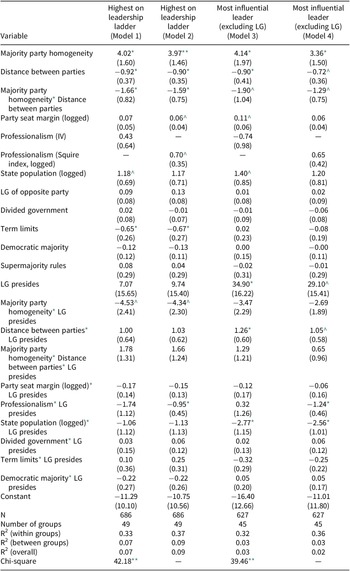
The results of the analyses are provided in Table 3. Models 1 and 2 report the results when the dependent variable measures the power of the chamber-selected officer who is highest on the leadership ladder (i.e., the senate president or president pro tem). Models 3 and 4 show the results when looking instead at the most influential chamber-selected leader as measured by Powell and Kurtz, excluding the four states where a leader who is not selected by the chamber is identified as the most influential (i.e., the lieutenant governor). Note that the only senates with supermajority rules have a lieutenant governor as president, and the interbranch partisanship hypothesis applies only to senates presided over by the lieutenant governor, so the variables Supermajority rules and LG of opposite party are not interacted with the LG presides variable.Footnote 18
Explaining the variation in power of the top chamber-elected leader of state senates (1995–2010)

Note. All models use two-stage least squares with fixed effects by state; robust standard errors clustered by state are reported in parentheses.
^ p < 0.1;
* p < 0.05;
** p < 0.01.
The findings provide strong and robust support for the claim that party homogeneity shapes leadership power. As predicted by CPG theory, in all four models, the majority party homogeneity variable is statistically significant and positive in senate chambers that elect their own president (i.e. the variable that is not interacted with LG presides). However, while the ideological distance variable is also statistically significant for these senates, the coefficient is in a direction contrary to that predicted by CPG theory (and, as a consequence, so is the variable that measures polarization by interacting distance and homogeneity). It would appear that parties closer to each other ideologically are more compelled to empower their leaders, at least in state senates.
There is less evidence for hypotheses 2 through 5. In chambers that select their own president, the variable measuring the size of the majority party, which is used to test the electoral competitiveness hypothesis (H2), is not statistically significant in models 1 or 4 and is only weakly significant (p < 0.1) in models 2 and 3. Regarding the professionalism hypothesis (H3), only in model 2 is the professionalism variable statistically significant for chamber-selected presidents, and only marginally so. Though state population has a positive relationship with leadership power, indicating that state senates that face more policy challenges have a stronger top chamber-elected leader (H4), the variable is not statistically significant in two models and only weakly so in models 1 and 3. None of the regression models support the interbranch partisan conflict hypothesis (H5).
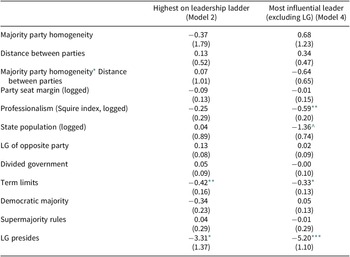
However, the results provide stronger support for H6, the elected president hypothesis. When interacted with the lieutenant governor dichotomous variable, many of the variables of interest are statistically insignificant, and most have a sign that is opposite from the noninteracted coefficient, thus cancelling out its effect. To ease the interpretation of the additive effect of the lieutenant governor interaction term, Table 4 shows the conditional effects of each variable in models 2 and 4 when the lieutenant governor serves as president. The variables used to test H1, H2, and H5 are not statistically significant, and the variable used to test H4 (state population) is only significant at the p < 0.1 level, and only in one model. A noteworthy exception is the professionalism variable, which has a statistically significant and negative conditional effect in Model 4, contrary to prediction. Though this result should be interpreted with caution, since it may be an artifact of using the Squire index measure of professionalism, it supports the claim of some that professionalized legislatures have weaker leaders, not stronger ones, because lawmakers in those chambers receive more resources and thus do not need strong leaders to help them achieve their goals (Jewell and Whicker Reference Jewell and Whicker1994; Moncrief, Thompson, and Kurtz Reference Moncrief, Thompson and Kurtz1996; Richman Reference Richman2010). The negative conditional effect of the LG presides variable in Table 4 further confirms that lieutenant governor-led chambers have less powerful chamber-selected leaders than states where the lieutenant governor is not president. It could be that, in the former type of chambers, state senators follow the lead of the US Senate and delegate leadership responsibilities more widely, whereas in chambers that choose their own president, senators feel more confident in entrusting authority to a single leadership officer.
Conditional marginal effects of explanatory variables when lieutenant governor serves as president (Models 2 and 4)

Note. Robust standard errors clustered by state are reported in parentheses. The coefficient for the LG presides variable is estimated when holding all continuous variables at their means and all dichotomous variables at zero.
^ p < 0.1;
* p < 0.05;
** p < 0.01;
*** p < 0.001.
Finally, most of the control variables in Table 3 are statistically insignificant, with the sole exception being the variable measuring term limits, which has a statistically significant and negative effect on the power of a chamber’s top leader in Models 1 and 2. This stands in contrast to state houses, where term limits contribute to a more powerful speakership (Shay Reference Shay2021), implying that term limits in state senates do not impose the kind of collective action problems that they do in state house chambers. This suggests that senators with shorter legislative careers because of limited terms see little to gain from granting their top chamber-elected leader greater power.
Discussion and Conclusion
This study provides three contributions to our understanding of the party leadership power in state senates. First, it presents a new quantitative measure of the formal power of the top elected leader of all US state senates, following Mooney’s method for coding state house speakers, but with an important modification to account for the disproportionate use of party committees in state senates to determine committee assignments. Second, it analyzes these data to test various theories of leadership influence in state senates. The results serve as further, if partial, confirmation of CPG theory, in that more unified parties in state senates are associated with stronger chamber-elected presidents. However, it also gives reason to be skeptical of the claim that more ideologically distant parties will also strengthen their leaders. Indeed, it indicates that, at least in state senates that elect their presidents, chambers with parties that are closer ideologically are more likely to expand leadership power. This in turn underscores the wisdom of testing the effects of party homogeneity and party distance on party leadership power separately, rather than multiplying them together, as some studies do to test CPG theory.
Third, both the data itself and the statistical analyses of those data underscore crucial differences between senate chambers that elect their own presidents and those that do not. The former type of chamber more closely resembles its house counterpart, and several factors that shape the power of leaders in state houses do so in state senates as well. But in the latter type of chamber, not only do most of those factors not influence leadership power, but the top chamber-selected leader (either president pro tem or majority leader) is likely to be less powerful than a chamber-selected president, all else being equal. Contrary to the conventional wisdom about the relationship between lawmakers and leaders (e.g., Cox and McCubbins Reference Cox and McCubbins1993, 2005; Rohde Reference Rohde1991; Sinclair Reference Sinclair1995), members of these state senates do not perceive their top internally elected leader as an officer able to best carry out their ideological, electoral, or policy objectives. Like members of the US Senate, and akin to the traditional view of state senates as chambers where the distribution of influence in upper state chambers is more diffuse (Jewell and Patterson Reference Jewell and Patterson1986), they may instead grant some of that authority to collective decision-making bodies, such as a committee on committees. It may even be that, as happened occasionally in Senate history, they deliberately trust that power to the lieutenant governor, perhaps because they have adopted mechanisms that ensure he serves their collective interests—a possibility that suggests a future line of research. Regardless, this finding emphasizes the necessity of differentiating between these two types of chambers when analyzing the internal politics of state senates and, more generally, conceptualizing about the relationship between legislators and those chosen to lead them.
Supplementary Materials
To view supplementary material for this article, please visit http://doi.org/10.1017/spq.2022.13.
Data Availability Statement
Replication materials are available on SPPQ Dataverse at https://doi.org/10.15139/S3/LQTWTC (Green Reference Green2022).
Acknowledgments
The author thanks Will Atkins, James Battista, Nathaniel Birkhead, Justin Kirkland, Carl Klarner, Thad Kousser, Nancy Martorano Miller, and attendees at the 2019 State Politics and Policy Conference and the 2019 American Political Science Association Conference for their helpful comments and suggestions, and Todd Makse and Lynda Powell for generously sharing their data.
Funding Statement
The author received no financial support for the research, authorship, and/or publication of this article.
Conflict of Interest
The author declared no potential conflicts of interest with respect to the research, authorship, and/or publication of this article.
Author Biography
Matthew N. Green is Professor of Politics at The Catholic University of America. His research focuses on legislative politics, and his most recent book, coauthored with Jeffrey Crouch, is Newt Gingrich: The Rise and Fall of a Party Entrepreneur (University Press of Kansas, 2022).