Introduction
The network perspective offers a novel way of understanding the dynamics of psychopathology (McNally, Reference McNally2016; Borsboom, Reference Borsboom2017). According to this framework, symptoms do not primarily result as passive consequences of underlying mental disorders. Rather, causally connected symptoms may interact with each other over time, potentially producing mental disorders as emergent phenomena. The new field of network psychometrics has been used in recent years to investigate the complex structure of various psychiatric disorders (Fried et al. Reference Fried, van Borkulo, Cramer, Boschloo, Schoevers and Borsboom2017b), including depression (Fried et al. Reference Fried, Epskamp, Nesse, Tuerlinckx and Borsboom2016), psychosis (Isvoranu et al. Reference Isvoranu, Borsboom, van Os and Guloksuz2016), schizophrenia (Levine & Leucht, Reference Levine and Leucht2016), and anxiety (Beard et al. Reference Beard, Millner, Forgeard, Fried, Hsu and Treadway2016), among others.
Several studies have recently used network analysis to examine the symptom-level structure of posttraumatic stress disorder (PTSD) in cross-sectional data (McNally et al. Reference McNally, Robinaugh, Wu, Wang, Deserno and Borsboom2015; Bryant et al. Reference Bryant, Creamer, O'Donnell, Forbes, McFarlane and Silove2017; Knefel et al. Reference Knefel, Tran and Lueger-Schuster2016; Afzali et al. Reference Afzali, Sunderland, Batterham, Carragher, Calear and Slade2017a, Reference Afzali, Sunderland, Teesson, Carragher, Mills and Slade2017b; Armour et al. Reference Armour, Fried, Deserno, Tsai and Pietrzak2017; Birkeland & Heir, Reference Birkeland and Heir2017; Fried et al. Reference Fried, Eidhof, Palic, Costantini, Huisman-van Dijk and Bockting2017a; Mitchell et al. Reference Mitchell, Wolf, Bovin, Lee, Green and Rosen2017; Spiller et al. Reference Spiller, Schick, Schnyder, Bryant, Nickerson and Morina2017; Sullivan et al. Reference Sullivan, Smith, Lewis and Jones2018). These studies indicate the central roles that various symptoms may play in driving PTSD networks by being highly connected to other PTSD symptoms. For example, these studies suggest the central role of re-experiencing symptoms in the acute phase following traumatic injury (Bryant et al. Reference Bryant, Creamer, O'Donnell, Forbes, McFarlane and Silove2017); of hypervigilance, concentration problems and foreshortened future in Chinese earthquake survivors 5 years after the disaster (McNally et al. Reference McNally, Robinaugh, Wu, Wang, Deserno and Borsboom2015); and of intrusive thoughts, anger, and detachment in survivors of mass violence (Sullivan et al. Reference Sullivan, Smith, Lewis and Jones2018). Two studies in military veterans found that negative trauma-related emotions were among the most central symptoms (Armour et al. Reference Armour, Fried, Deserno, Tsai and Pietrzak2017; Mitchell et al. Reference Mitchell, Wolf, Bovin, Lee, Green and Rosen2017).
Only three studies have previously assessed DSM-5 PTSD network structure (Afzali et al. Reference Afzali, Sunderland, Batterham, Carragher, Calear and Slade2017a; Armour et al. Reference Armour, Fried, Deserno, Tsai and Pietrzak2017; Mitchell et al. Reference Mitchell, Wolf, Bovin, Lee, Green and Rosen2017), and, crucially, as all of these studies were cross-sectional, none of them explored the temporal dynamics of PTSD, which many researchers have described as one of the major shortcomings of the prior literature (Hamaker, Reference Hamaker2012; Fisher, Reference Fisher2015; Fried & Cramer, Reference Fried and Cramer2017; Bos et al. Reference Bos, Snippe, de Vos, Hartmann, Simons and van der Krieke2017; Hamaker & Wichers, Reference Hamaker and Wichers2017; Nelson et al. Reference Nelson, McGorry, Wichers, Wigman and Hartmann2017). Conceptualizing PTSD symptoms as a dynamic interacting network, rather than limiting the focus to cross-sectional associations between symptoms, allows for deeper exploration of potential causal pathways. This could provide valuable insights into the way that PTSD builds or is maintained in individuals who have traumatic experiences.
Intensive longitudinal assessments such as Experience Sampling Methodology (ESM) collect data about the daily lives of participants repeatedly over time, often using handheld computers or smartphones (Bolger et al. Reference Bolger, Davis and Rafaeli2003; Ebner-Priemer & Kubiak, Reference Ebner-Priemer and Kubiak2010; Bolger & Laurenceau, Reference Bolger and Laurenceau2013). ESM has been used to investigate various psychiatric disorders, including PTSD (Chun, Reference Chun2016), anxiety (Walz et al. Reference Walz, Nauta and aan het Rot2014), and depression (Armey et al. Reference Armey, Schatten, Haradhvala and Miller2015), among others. ESM entails multiple methodological advantages (Santangelo et al. Reference Santangelo, Ebner-Priemer and Trull2013; Trull & Ebner-Priemer, Reference Trull and Ebner-Priemer2013), as data are collected in real-life settings, with high ecological validity, increased accuracy, and minimized recall bias. Repeated short-term assessments can detect variations in the presence and severity of variables and reveal dynamic processes between them (Ebner-Priemer & Trull, Reference Ebner-Priemer and Trull2009; Myin-Germeys et al. Reference Myin-Germeys, Oorschot, Collip, Lataster, Delespaul and van Os2009; Bolger & Laurenceau, Reference Bolger and Laurenceau2013).
Network models can be used to investigate such dynamic processes in ESM data from one participant (vector autoregression models; VAR) or data from multiple participants (multilevel VAR; Epskamp et al. Reference Epskamp, Waldorp, Mõttus and Borsboom2016). These models produce temporal networks depicting a directed network of the lagged associations of symptoms from one time point to the next, for which Granger-causal connections between symptoms are inferred (Schuurman et al. Reference Schuurman, Ferrer, de Boer-Sonnenschein and Hamaker2016). Temporal networks can identify symptoms with a high ‘out-strength’, that is symptoms which are most predictive of other symptoms at the next time point, and those with a high ‘in-strength’, that is symptoms which are most predicted by other symptoms at the previous time point. Recent extensions include contemporaneous networks, for which the within-measurement associations are represented, and a between-persons network, modeling relations between the stable means of participants, for both of which ‘cliques’ or sub-networks of closely connected symptoms can be identified.
Using ESM data for network analysis is relatively new; ESM data have previously been used for network studies of psychiatric disorders, but almost exclusively for individual-level (n = 1) studies (Bak et al. Reference Bak, Drukker, Hasmi and van Os2016; David et al. Reference David, Marshall, Evanovich and Mumma2017; Epskamp et al. Reference Epskamp, van Borkulo, van der Veen, Servaas, Isvoranu and Riesse2017), or to investigate idiographic symptom dynamics (Fisher et al. Reference Fisher, Reeves, Lawyer, Medaglia and Rubel2017), although multilevel VAR using ESM data has been applied to investigate various psychological phenomena, such as positive and negative affect (e.g. Epskamp et al. Reference Epskamp, Waldorp, Mõttus and Borsboom2016).
The current study uses ESM data from multiple individuals in a multilevel framework to investigate PTSD symptoms. As multilevel models focus on the dynamics of the relationships between symptoms over time, they could further help us to elucidate the processes by which PTSD symptoms build up and interact with each other, and potentially reinforce themselves. This could have important clinical implications (McNally et al. Reference McNally, Robinaugh, Wu, Wang, Deserno and Borsboom2015; McNally, Reference McNally2016; Borsboom, Reference Borsboom2017); identifying symptoms with high out-strength, and to a lesser extent high in-strength, as well as detecting closely connected groups of symptoms, could eventually help clinicians focus on symptoms that might ‘drive’ PTSD in its early stages.
We present the first study to apply a multilevel network model to investigate the dynamics of symptoms that comprise the DSM-5 PTSD construct (APA, 2013), using data collected during a period of trauma exposure among Israeli civilians exposed to rocket fire. It is important to note that collecting ESM data regarding traumatic stress symptoms during a conflict situation is unparalleled in the literature, and we believe that this study, therefore, has the potential to make unique and important contributions to the understanding of mental health during ongoing trauma exposure. The study aims to produce an exploratory empirical conceptualization of dynamic networks of PTSD symptoms, with the goal to investigate the network structure of PTSD symptoms during an extended period of trauma exposure and identify symptoms that closely cluster together, as well as those with high out-strength and high in-strength.
Method
Participants and study design
The current study is part of a larger study conducted during and after the 50-day July–August 2014 Israel–Gaza armed conflict (Gelkopf et al. Reference Gelkopf, Lapid, Grinapol, Werbeloff, Carlson and Greene2017; Greene et al. Reference Greene, Gelkopf, Grinapol, Werbeloff, Carlson and Lapid2017; Lapid Pickman et al. Reference Lapid Pickman, Greene and Gelkopf2017), during which more than 4500 rockets and mortar shells were fired from Gaza toward Israeli communities, and Israel Defence Forces conducted ground and air attacks on Gaza.
The sample for the current study comprised a general population sample of Israeli adult civilians living in communities exposed to rocket fire (n = 114). Participants were recruited via advertisements in local colleges/universities, local organizations and communities, and social networks, and via snowballing methods. Potential participants contacted the research team directly, and study explanation and oral informed consent were conducted over the telephone.
Participants entered the study gradually, between days 8 and 24 of the conflict. Participants were asked to complete ESM daily diary assessments twice a day, morning and evening at predetermined times, for 30 days, and could reply within 2 h. The questionnaires were administered via a personalized email link to participants’ smartphones and referred to experiences, reactions, and symptoms occurring since the last assessment.
Participants were remunerated for their participation. The design and procedure were approved by the University of Haifa, Faculty of Social Welfare and Health Sciences Ethics Committee.
Measures
Traumatic stress symptoms were measured using the PTSD Checklist for DSM-5 (PCL-5; Weathers et al. Reference Weathers, Litz, Keane, Palmieri, Marx and Schnurr2013). This 20-item self-report tool asks participants to indicate the extent to which they experienced each PTSD symptom, on a four-point Likert scale ranging from 0 = not at all to 3 = very much. The original version was adapted for the current study so that the timeframe for experiencing each symptom was changed from ‘in the past month’ to ‘since the last time you replied’ (a minimum of 8 h gap). This measure has good psychometric properties in its original form (Blevins et al. Reference Blevins, Weathers, Davis, Witte and Domino2015).
Data analysis
We included data from participants providing over 20 valid responses (one-third of potential responses). Of the sample, 84.2% (n = 96) met this inclusion criterion.
Demographic characteristics of the sample are presented in Table 1.
Demographic characteristics of the sample

The mlVAR package (version 0.3.3) in R was used to estimate three networks (Epskamp et al. Reference Epskamp, Waldorp, Mõttus and Borsboom2016): a contemporaneous network, which is a Gaussian graphical model (GGM) that depicts within-time-window edges (associations) between nodes (DSM-5 PTSD symptoms) that remain after controlling for temporal associations, akin to a multilevel partial correlation network; a temporal network, which is a directed network of regression coefficients that depicts the lagged associations between symptoms from one measurement point to the next and a between-persons network which is a GGM that depicts the variance–covariance structure of participants’ means (Epskamp et al. Reference Epskamp, Waldorp, Mõttus and Borsboom2016, Reference Epskamp, van Borkulo, van der Veen, Servaas, Isvoranu and Riesse2017).
Decomposing the variance in these three networks allows for different insight in the covariation and potential dynamics: the temporal network shows if a deviation from a person's mean predicts a deviation from a person's mean in another variable at the next measurement occasion. As a result, temporal networks give insight into Granger causality (Granger, Reference Granger1969). Contemporaneous networks show if deviations from a person's mean in two variables predict one-another in the same measurement occasion (Epskamp et al. Reference Epskamp, van Borkulo, van der Veen, Servaas, Isvoranu and Riesse2017). Finally, the between-subjects network models the covariation between means of participants and is a more stable way of estimating networks that can be obtained from cross-sectional data, while providing a network that can be used for comparison with previous cross-sectional studies (Epskamp et al. Reference Epskamp, Waldorp, Mõttus and Borsboom2016).
In our analysis, to make the model estimable we estimated forced random effects of incoming edges to a single node (temporal) or edges connected to the same node (contemporaneous) to be orthogonal. In the contemporaneous and between-subjects networks, we used an ‘and’ rule in retaining significant edges: an edge was retained if both regressions on which the edge was based were significant (α = 0.05).
In the current analysis, the between-persons network included numerous negative edges, which are likely spurious connections given that the contemporaneous and temporal network had far fewer negative connections (see online Supplementary Material). We, therefore, conducted an alternative between-persons network analysis in the R Bootnet package using graphical LASSO and extended Bayesian information criterion to select the optimal regularization parameter, for which rather than using the mean edge scores from each individual to depict the network, we used the mean symptom scores for each participant.
Results
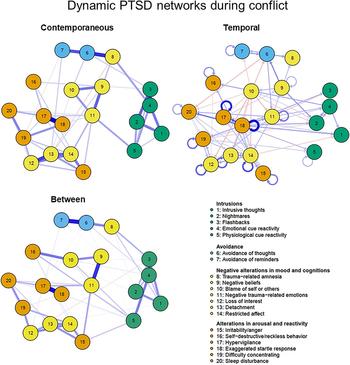
Figure 1 depicts the contemporaneous, temporal and between-person networks.
Dynamic PTSD networks during the conflict. Note: Blue edges denote positive associations between nodes, red edges denote negative associations between nodes. Edge thickness represents the degree of association.

Contemporaneous network
Several important things stand out in the contemporaneous network (Fig. 1 and Table 2). First, contemporaneous connections were nearly all positive in nature, and we identified especially strong associations between hypervigilance and exaggerated startle response (partial correlation edge weight=0.36), avoidance of thoughts and amnesia (0.30), and loss of interest and detachment (0.27).
Contemporaneous network: significant edge weights

Note: ns denotes non-significant edge
Second, the DSM-5 symptom clusters were fairly well recovered, with strong within-cluster associations, and weaker between cluster associations.
Third, in a few cases, the contemporaneous network did not fully correspond to the DSM-5 cluster conceptualization. For example, amnesia had stronger associations to the avoidance cluster than it did to its own cluster of negative mood and cognitions, and anger had stronger associations to the negative mood and cognitions cluster than to the arousal cluster to which it belongs.
Finally, the negative mood and cognitions appear to include two ‘cliques’ – clusters of closely connected symptoms; the first clique comprised negative beliefs, blame, and negative emotions which were all significantly connected to each other, and the second clique was made up of loss of interest, detachment, and restricted affect.
Temporal network
There were several notable aspects of the temporal network (see Fig. 1). First, there were a substantial number of negative edges, specifically from blame, flashbacks, avoidance of thoughts, nightmares, and self-destructive behavior, which differed from the contemporaneous network. All of the lagged associations from blame to other symptoms were negative. Avoidance of thoughts had a negative lagged association with sleep disturbances.
Exaggerated startle response had by far the strongest out-strength (0.83), which is the sum of absolute significant temporal edge weights extending out from each symptom, excluding autocorrelations (see Table 3). In other words, the more startle response an individual had at one measurement, the more likely the individual was to report other symptoms at the next. Other variables with high out-strength included restricted affect (0.54), blame (0.51), negative emotions (0.34), and avoidance of thoughts (0.32).
In-strength and out-strength of symptoms in the temporal network

The variables with the highest in-strength centrality – the extent to which variables are influenced by other variables in the network at the previous measurement – were sleep disturbance (0.37), and loss of interest (0.37).
Consistent with prior temporal studies of psychopathological dynamics, there were a considerable number of autocorrelations, which were stronger than the cross-lagged effects. Exaggerated startle response had the strongest autoregressive coefficient (0.27), meaning that knowing the startle response at a given timepoint has strong predictive power about startle response at the next timepoint. Hypervigilance also had a high autoregressive coefficient (0.22).
Finally, a number of interesting feedback loops emerged. For example, sleep disturbance predicted concentration difficulties, which in turn predicted restricted affect, which predicts sleep disturbance. Negative emotions predicted negative beliefs, which went to avoidance of thoughts, and back again to negative emotions.
Between-persons network
The between-persons network closely resembled the contemporaneous network, albeit more sparsely connected. As with the contemporaneous network, associations between symptoms were mostly positive, with particularly strong associations between the two avoidance symptoms, between negative beliefs and negative emotions, and between hypervigilance and startle. Standardized node strength centrality was calculated (see Fig. 2), representing the sum of all edge weights of a given node. Flashbacks followed by emotional cue reactivity were the two most central symptoms in this network.
Between-persons network standardized node strength centrality.

Discussion
This study assessed dynamic PTSD symptom networks in Israeli civilians during the 2014 Israel–Gaza War. There were strong positive contemporaneous associations between hypervigilance and exaggerated startle response, avoidance of thoughts and avoidance of reminders, and between flashbacks and emotional reactivity. There were some notable differences between the temporal and contemporaneous networks, which underlines the importance of analyzing both separately. These differences included the presence of a number of negative associations, particularly from blame. The temporal network also indicated the central role of startle response as a predictor of PTSD symptomatology at the next timepoint. The between-persons network showed similar patterns of associations to the contemporaneous network.
Contemporaneous associations between symptoms largely reflected the DSM-5 clusters, other than the alterations in negative mood and cognitions cluster. Previous PTSD network studies found that amnesia was only weakly associated with other PTSD symptoms (McNally et al. Reference McNally, Robinaugh, Wu, Wang, Deserno and Borsboom2015; Armour et al. Reference Armour, Fried, Deserno, Tsai and Pietrzak2017; Birkeland & Heir, Reference Birkeland and Heir2017; Fried et al. Reference Fried, Eidhof, Palic, Costantini, Huisman-van Dijk and Bockting2017a; Spiller et al. Reference Spiller, Schick, Schnyder, Bryant, Nickerson and Morina2017). The current findings indicated, however, that this was not the case, but rather that amnesia was more closely related to the avoidance cluster, than to the cognitive symptoms from its own cluster, and had no significant associations with any of the negative mood items. Perhaps amnesia could be better conceptualized as an additional and perhaps involuntary form of avoidance, rather than as a negative cognition and mood symptom, at least in the context of the ongoing threat.
The pattern of connections from the remaining symptoms from the negative cognition and mood cluster supported a model in which numbing of responsiveness items (loss of interest, detachment, and restricted affect) are split from the increased negative mood and cognition items (negative mood, blame, negative cognitions), something that has also been found in previous investigations of the dimensional structure of DSM-5 PTSD (Armour et al. Reference Armour, Tsai, Durham, Charak, Biehn and Elhai2015; Pietrzak et al. Reference Pietrzak, Tsai, Armour, Mota, Harpaz-Rotem and Southwick2015).
It is important to interpret the contemporaneous network in a nuanced manner (Epskamp et al. Reference Epskamp, van Borkulo, van der Veen, Servaas, Isvoranu and Riesse2017). While ‘contemporaneous’ would seem to imply concurrent associations, in the current study there were relatively large time windows between assessments (8–16 h), so contemporaneous networks are not really ‘contemporaneous’. Rather, they depict associations between symptoms, including potentially causal associations that took place over a number of hours, and may therefore also reflect temporal processes. To assess true contemporaneous networks, far more frequent assessments are needed, and participants should be asked how they are feeling ‘right now’, rather than ‘since the last assessment’.
In the temporal network, the blame of self or others surprisingly predicted lower symptoms at the next measurement, in contrast to the positive associations they showed in the contemporaneous network. The blame item, which was added to the PTSD criteria in DSM-5, actually captures two very different phenomena (Greene, Reference Greeneunder review); blame of self, in which the individual gives an internal attribution to the adversity, and blame of others, which gives an external attribution to the adversity. Attributions theory posits that making external attributions for negative events is protective (Kelley & Michela, Reference Kelley and Michela1980). While we cannot ascertain in this study whether the participants were reporting external or internal blame, it could be speculated that in the context of war and conflict, the blame would be more likely to be externally attributed. This may then explain the negative lagged association from blame to avoidance of thoughts, avoidance of reminders, negative emotions, loss of interest, detachment, restricted affect, startle, concentration difficulties and sleep disturbance, suggesting that blaming an external source may be an effective coping mechanism.
Symptoms with strong out-strengths can be seen as those with the highest potential to impact other symptoms within the network, and are therefore likely to be particularly important in the dynamics of PTSD development. Symptoms with strong in-strength, on the other hand, are those that are most affected by other symptoms in the network. For interventions, it has been speculated that targeting symptoms with strong out-strength might provide an effective way of preventing or reducing future PTSD symptomatology (McNally, Reference McNally2016; Armour et al. Reference Armour, Fried, Deserno, Tsai and Pietrzak2017; Bos et al. Reference Bos, Snippe, de Vos, Hartmann, Simons and van der Krieke2017).
In the current study, startle response had a greater out-strength than all other symptoms, which may suggest that targeting startle response could help reduce other symptoms. While arousal symptoms have been generally indicated as key drivers of future psychopathology in longitudinal studies of PTSD clusters (Schell et al. Reference Schell, Marshall and Jaycox2004; Marshall et al. Reference Marshall, Schell, Glynn and Shetty2006; Doron-LaMarca et al. Reference Doron-LaMarca, Niles, King, King, Pless Kaiser and Lyons2015), startle has not specifically been found to be a central symptom in previous PTSD network studies with the exception of Spiller et al. (Reference Spiller, Schick, Schnyder, Bryant, Nickerson and Morina2017). It is likely that startle in the context of an ongoing threat is a different phenomenon compared with a startle when the stressor has ceased. Future studies could investigate whether startle has strong out-strength in other lower-stress environments. Additionally, restricted affect, blame, negative emotions, and avoidance of thoughts, also had high out-strength, all of which should be explored as the potential for interventions. It might also be argued that targeting symptoms that have both high in-strength and out-strength, such as sleep disturbance, could especially disrupt the network, facilitating an overall reduction in symptomatology.
Many symptoms in the temporal network had large autoregressive coefficients, i.e. predicting themselves at the next measurement, such as startle response and hypervigilance. This may indicate that these ‘symptoms’ may be more trait-like than others. It could also be that these strong autocorrelations represent the first signs of a ‘critical slowing down’, whereby pathological responses gradually crystallize (Wichers et al. Reference Wichers, Groot, Psychosystems and Group2016).
The between-persons network largely resembled the contemporaneous network, although with fewer and weaker connections between the symptoms. This network is the one that can be most directly compared to previous cross-sectional network studies, and there are a number of similarities between them and the current between-persons network. Hypervigiliance and startle have been found to be highly connected in a number of studies (e.g., McNally et al. Reference McNally, Robinaugh, Wu, Wang, Deserno and Borsboom2015; Armour et al. Reference Armour, Fried, Deserno, Tsai and Pietrzak2017; Birkeland & Heir, Reference Birkeland and Heir2017; Spiller et al. Reference Spiller, Schick, Schnyder, Bryant, Nickerson and Morina2017). Flashbacks were identified as central symptoms by (Armour et al. Reference Armour, Fried, Deserno, Tsai and Pietrzak2017), while emotional cue reactivity was found to be the most central symptom by Spiller et al. (Reference Spiller, Schick, Schnyder, Bryant, Nickerson and Morina2017). Bryant et al. (Reference Bryant, Creamer, O'Donnell, Forbes, McFarlane and Silove2017) focused on early symptomatology and also noted the centrality of the re-experiencing symptoms (in a DSM-IV acute traumatic stress symptoms network). These findings are in line with our current finding of the centrality of both flashbacks and emotional cue reactivity. Interestingly, we found strong associations between the two DSM-5 avoidance symptoms, however other DSM-5 PTSD network studies do not find this strong association, relative to the associations between others symptoms. Furthermore, amnesia, while not being one of the most central symptoms, did not have especially weak connections, as found previously (Fried et al. Reference Fried, Eidhof, Palic, Costantini, Huisman-van Dijk and Bockting2017a). It is important to investigate whether these differences are because symptoms or reactions that arise during a period of trauma exposure are essentially different from those that emerge at a later stage when exposure has ceased.
There are some limitations of this study. We did not specifically include a sample with a diagnosis of PTSD, thus limiting our ability to generalize as to the associations between symptoms in those meeting DSM-5 PTSD criteria. Data were collected peritraumatically, during a conflict period, and were based on assessments conducted during both the first and second months since the traumatic stressor began, therefore the findings may not necessarily be generalizable to PTSD networks after exposure has ceased. Additionally, there are some methodological limitations with the multilevel network analysis model (Epskamp et al. Reference Epskamp, Waldorp, Mõttus and Borsboom2016): there are no adequate fit statistics to assess the model; it only models linear processes yet there may be non-linear trends to consider; and it assumes stationarity, treating the properties of the network as constant over time, but this may not be the case, given what we know about PTSD resilience and recovery patterns (Bonanno & Mancini, Reference Bonanno and Mancini2012; Bryant et al. Reference Bryant, Nickerson, Creamer, O'Donnell, Forbes and Galatzer-Levy2015), including in this particular sample (Gelkopf et al. Reference Gelkopf, Lapid, Grinapol, Werbeloff, Carlson and Greene2017; Greene et al. Reference Greene, Gelkopf, Grinapol, Werbeloff, Carlson and Lapid2017). Further development of time-varying multilevel network models may better clarify disorder development over time. Finally, there are other key variables that we would have liked to include in the model such as gender, trauma history, and severity of exposure to the conflict; however, power is a key limitation with these models (Fried & Cramer, Reference Fried and Cramer2017), and we did not have a large enough sample size to include these covariates.
This study provides a unique contribution to the PTSD research field through the novel use of ESM methodology to assess DSM-5 PTSD symptoms in individuals during a period of conflict, and through its employment of multilevel network, analyses to explore contemporaneous and temporal network connections. While this study does not depict ‘classic’ PTSD, it is certainly relevant for many people around the world who live in situations of ongoing stress and trauma exposure. This study indicates that multilevel network analyses can provide novel and useful insights into the ways that different symptoms interact with each other, as well as reinforcing themselves. More studies in this vein can elucidate the complex processes by which PTSD symptoms crystallize into disorder and indicate possible causal mechanisms that drive the development of PTSD. This, in turn, could have clinical implications for identifying the relative importance of symptoms as targets for interventions.
Supplementary material
The supplementary material for this article can be found at https://doi.org/10.1017/S0033291718000351.
Acknowledgements
The authors would like to thank Liron Lapid Pickman and Shulamit Grinapol for their contribution to establishing the study. This work was supported by The Brain and Behavior Research Foundation (Narsad Young Investigator Award, T.G., grant number 23524); The Moshe Hess Foundation (T.G. and M.G.); NATAL: Israel Trauma Center for Victims of Terror and War (M.G); and the Israel Science Foundation (T.G. and M.G., grant number 1244/16).
Declaration of interest
None.
Ethical standards
The authors assert that all procedures contributing to this work comply with the ethical standards of the relevant national and institutional committees on human experimentation and with the Helsinki Declaration of 1975, as revised in 2008.