It is well-established that the application of severe plastic deformation (SPD) techniques, such as high-pressure torsion (HPT), may lead to unique microstructural and mechanical properties of materials exhibiting high strength and enhanced ductility.[Reference Zhilyaev and Langdon1, Reference Valiev2] Recently, ultrafine-grained (UFG) Al–Zn alloys processed by HPT have been extensively studied due to their interesting mechanical behaviors obtained by various compositional designs.[Reference Straumal, Sauvage, Baretzky, Mazilkin and Valiev3–Reference Chinh, Jenei, Gubicza, Bobruk and Valiev12] For Zn concentrations up to 10 wt%, the hardness of the HPT-processed samples is higher than that of the annealed samples, indicating a normal strengthening effect of SPD.[Reference Bobruk, Sauvage, Enikeev, Straumal and Valiev7, Reference Sauvage, Murashkin, Straumal, Bobruk and Valiev8, Reference Chinh, Jenei, Gubicza, Bobruk and Valiev12] In the case of higher Zn concentrations, such as Al–30 wt% Zn alloy, however, there is a strong reduction in hardness due to HPT, showing an abnormal softening effect of SPD.[Reference Chinh, Jenei, Gubicza, Bobruk and Valiev12] The abnormal softening was explained by the simultaneous effect of grain refinement and the decomposition of the microstructure during HPT.[Reference Chinh, Valiev, Sauvage, Varga, Havancsák, Kawasaki, Straumal and Langdon6] It was revealed that the Al/Al grain boundaries of the UFG alloys are wetted by Zn-rich layers that enhance the role of grain boundary sliding, leading to the unusual softening of this UFG material.
The superductility of UFG Al–Zn alloys, which may lead to unusually high elongations of 150%,[Reference Valiev, Murashkin, Kilmametov, Straumal, Chinh and Langdon4] is strongly related to their strain-rate sensitivity (SRS) which is a key parameter in the development of superplastic materials. The higher the SRS (conventionally denoted as m) of a material, the more it resists the local reduction of cross-section during tensile tests. Therefore, the measurement of SRS is an important factor in the development of materials with high strength and good ductility. Nanoindentation, which was originally developed for the measurement of hardness and elastic modulus and has become a widely used technique for mechanical characterization of solids,[Reference Jin, Minor, Stach and Morris13–Reference Merle, Maier-Kiener and Pharr23] is an efficient tool also to measure SRS of UFG materials. Despite the numerous works on the determination of SRS by using indentation, its connection with basic viscoelastic properties deriving from dynamic nanoindentation[Reference Hay, Agee and Herbert24] has not been investigated up to now. Considering the experimental results that the plastic deformation of UFG Al–Zn alloys taking place mainly by grain boundary sliding on Zn-rich wetted layers is an intrinsically viscous process, the objective of the current work is to reveal the correlation between the SRS and the viscoelastic response obtained by dynamic nanoindentation for UFG Al–Zn alloys with wetted grain boundaries.
High purity (4N) Al and Al–Zn alloys with Zn contents of 10 and 30 wt% were prepared by vacuum induction melting. Disks with diameters of 20 mm and thicknesses of 0.8 mm were homogenized at 500 °C for 1 h, then quenched to room temperature and processed by HPT as described in Refs. Reference Chinh, Valiev, Sauvage, Varga, Havancsák, Kawasaki, Straumal and Langdon6–Reference Sauvage, Murashkin, Straumal, Bobruk and Valiev8. Samples were cut out from the regions at the half-radius of the HPT-processed disks. The microstructure of these specimens consisted of equiaxed ultrafine grains with sizes between 300 and 700 nm.
Dynamic indentation measurements were carried out by using a nanohardness tester NHT-TTX (CSM-Instruments/Anton Paar) device equipped with a Berkovich indenter. The measurements were performed using dynamic nanoindentation mode in load control. This means that the applied load had two components. The main term F lin(t) increased linearly with time (t) up to a maximum load of 50 mN at a loading rate of v = 0.5 mN s−1. This load was superimposed by an oscillatory force of F sin(t) = F 0sin (ωt) with a maximal amplitude of F 0 = 2 mN and an angular frequency ω corresponding to the frequency of 2 Hz. The penetration depth (h) caused by the applied load was recorded as a function of time during the measurements which was also a harmonic signal on a semi-static depth function possessing a phase shift compared to the load signal in the form of h sin(t) = h 0 sin (ωt − φ). This phase shift (phase difference) caused by the internal friction in a damping medium is essential for the evaluation of the contact stiffness which is necessary for the determination of the hardness and elastic modulus of the sample as a function of the penetration depth.[Reference Hay, Agee and Herbert24] Here, it is important to note that we analyze only the depth and load signals as a function of time, other properties, like hardness or modulus, are not discussed in the current work.
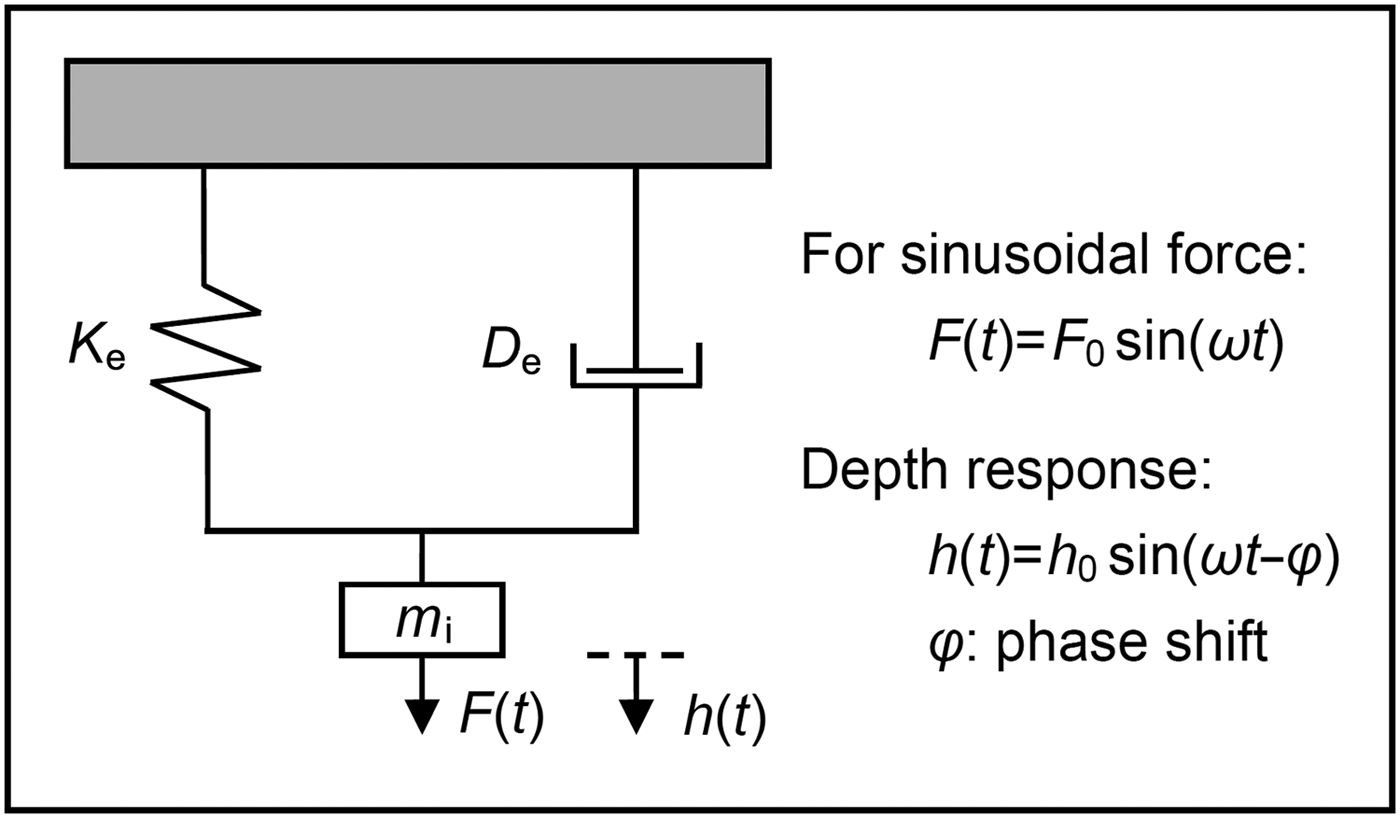
In order to establish a connection for SRS and viscous properties of UFG Al–Zn alloys, we outline the basic concept of a commonly used viscoelastic models of dynamic nanoindentation.[Reference Hay, Agee and Herbert24–Reference Herbert, Oliver and Pharr26] The scheme of this viscoelastic model, as a damped, forced oscillating indenter in contact with a sample, is shown in Fig. 1.
Schematic model describing the collective viscoelastic response of the nanoindenter and the investigated material.

The spring symbolizes the force component raising from the elasticity, while the dashpot describes the damping of the system. The model comprises an effective spring with a stiffness of K e, an effective dashpot with a damping coefficient of D e, and a mass of the indenter as m i.[Reference Hay, Agee and Herbert24] In the current work, the damping term is important for us as it describes the effect of the rate-dependent behavior of the investigated materials. If this system is excited by a sinusoidal force, F sin (t) = F 0 sin (ωt), the motion equation of the indenter is similar to the well-known classical physical case of the constraint motion for a body, which is moving for a sinusoidal force via spring in a damping media. In order to obtain the harmonic depth response of the oscillating system around an equilibrium position corresponding to a given semi-static load, the following second-order differential equation should be solved[Reference Hay, Agee and Herbert24]:
 $$m_{\rm i}\displaystyle{{{\rm d}^2h} \over {{\rm d}t^2}} + D_{\rm e}\displaystyle{{{\rm d}h} \over {{\rm d}t}} + K_{\rm e}h = F_0\,{\sin}(\omega t).$$
The analytical solution of this equation is also a sinusoidal function with the same ω angular frequency:
 $$h(t) = h_{{\rm sin}}\,(t) = h_0\,\sin (\omega t-\varphi ),$$
where the amplitude:
 $$h_0 = \displaystyle{{F_0} \over {\sqrt {{(K_{\rm e}-m_{\rm i}\omega ^2)}^2 + {(D_{\rm e}\omega )}^2}}}, $$
and for the phase shift, φ
 $${\rm tan}\,\varphi = \displaystyle{{D_{\rm e}\omega} \over {K_{\rm e}-m_{\rm i}\omega ^2}}.$$
In the case of very small phase shift (φ ≪ 1) we can use the usual approximation:
 $$\varphi \approx {\rm tan}\,\varphi = \displaystyle{{D_{\rm e}\omega} \over {K_{\rm e}-m_{\rm i}\omega ^2}}.$$
According to Eqs. (3)–(5), the K e and D e values could be evaluated experimentally by measuring the quantities h 0 and φ. Considering the viscoelastic behavior for a given alloy system, for instance, for Al–Zn alloys, where the value of K e can be expected to be a constant, the phase shift φ given by Eq. (5) is proportional to the value of D e, indicating that the rate-dependent (or time-dependent) behaviors of materials can be studied by determining the phase shift, φ. This would be the one of the main points of the current work.
As it has been mentioned, during dynamic indentation the applied load is a combination of a linearly increasing component (F lin (t) = vt) and the superimposed sinusoidal signal (F sin (t) = F 0 sin (ωt)). Considering the indentation process, the sinusoidal signal can be regarded as the local change of the load on the global component, F lin. For a total load, F exp applied on the indenter:
 $$F_{{\exp}} = F_{{\rm lin}} + F_{{\rm sin}} = vt + F_0{\sin}\,(\omega t). $$
The corresponding—experimentally measured—total depth-response (h exp) can be given as follows:
 $$h_{\exp} = h_{\rm global} + h_0\,\sin(\omega t-\varphi ),$$
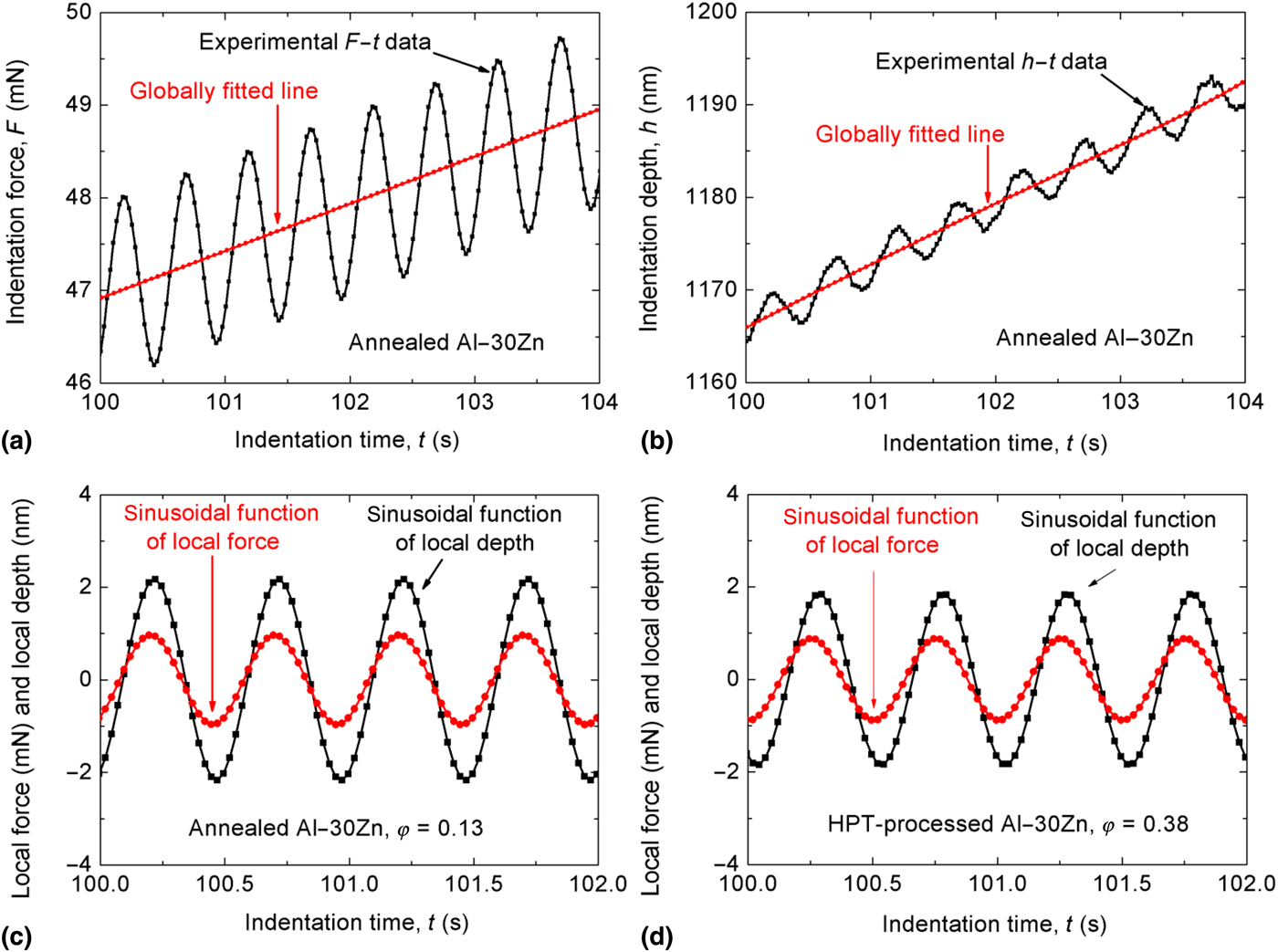
where the term h global(t) describes the global development of the depth in the function of time. Selecting a constant depth region, a couple of nanometers in the present case, the global load and depth functions are determined by fitting simple linear functions to F exp and h exp signals. The local force and depth signals are calculated by subtracting the globally fitted lines from the experimental curves. In order to obtain phase shift (φ), both quantities (F exp − vt) and (h exp − h global) are fitted by the sinusoidal functions F 0sin (ωt − φ 1) and h 0 sin (ωt − φ 2), respectively, in the same time range. Then the phase shift is obtained as a phase difference between the depth and load signals according to φ = φ 2 − φ 1.
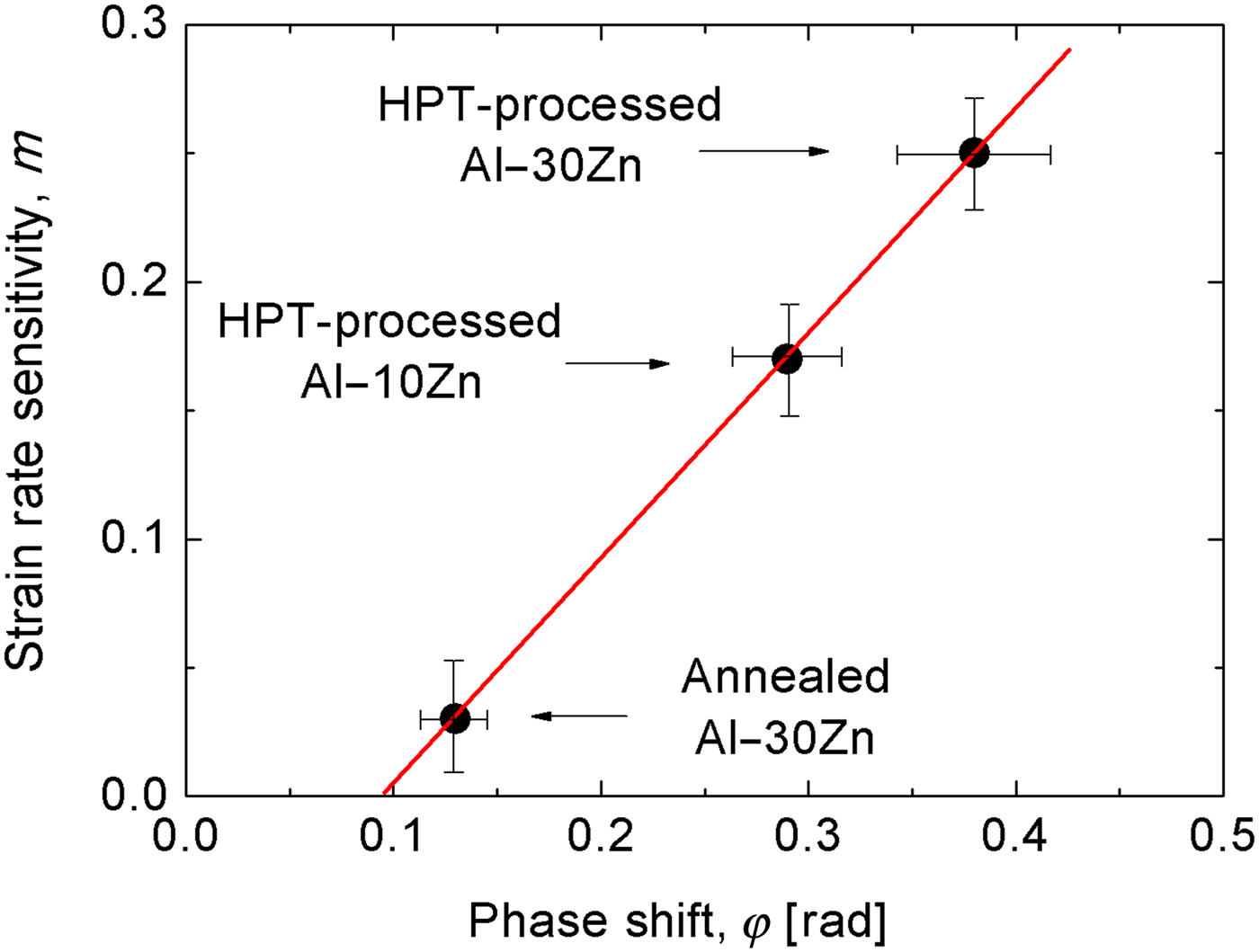
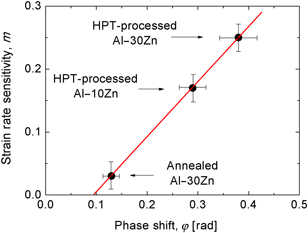
Figure 2 shows some examples demonstrating the determination of φ by applying dynamic indentation tests. It should be emphasized that (i) in all experimental cases the local depth-response (h 0sin (ωt − φ 2)) can be fitted well by a sinusoidal function with the same angular frequency than that works for the local force (F 0sin (ωt − φ 1)). Moreover, (ii) as the current work is a pioneer in this subject, the obtained phase shift values could not be compared with the literary data and could not be discussed on that. The φ values of 0.13, 0.29, and 0.38 were obtained for annealed Al–30Zn, HPT-processed Al–10Zn, and HPT-processed Al–30Zn samples, respectively, which have the strain rate sensitivity (m) of 0.03,[Reference Woodford27] 0.17, and 0.25,[Reference Chinh, Jenei, Gubicza, Bobruk and Valiev12] in the given order.
Examples for the main steps of the determination of phase shift (φ) during dynamic nanoindentation: (a) and (b) calculation of the local force and depth signals from the experimental curves using globally fitted lines; (c) and (d) the remaining sinusoidal signals by eliminating the global functions for the annealed and HPT-processed Al–30Zn, respectively.

For the purpose of comparison and explanation, the parameter m is plotted as a function of φ in Fig. 3, where the errors of 10% in φ and ±0.02[Reference Chinh, Jenei, Gubicza, Bobruk and Valiev12] in m are also added. The present experimental results show that the there is an unambiguous correlation between the phase shift (φ) and the strain rate sensitivity (m). The higher phase shift corresponds to a higher strain rate sensitivity. In the case of the investigated Al–Zn samples, this correlation can be described well by a linear relationship with the function of m = −0.085 + 0.879φ. Although further systematic investigations are needed to clarify the correlation between m and φ in details, qualitatively both parameters express the rate-dependent behavior of the investigated materials.
The connection between the obtained phase shift (φ) and strain rate sensitivity values (m) of the investigated Al–Zn alloys.

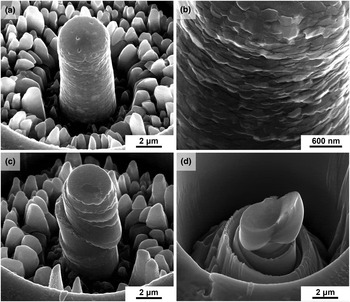
Considering also the well-established fact that the SRS parameter correlates to the ductility,[Reference Woodford27, Reference Chinh, Csanádi, Gubicza, Valiev, Straumal and Langdon28] the preliminary dynamic indentation results may allow us to conclude that the ductility of a material can be studied by investigating its phase shift. In the present case, the relatively high phase shift observed in the HPT-processed Al–30Zn sample correlates well to the super-ductility of this sample at room temperature.[Reference Valiev, Murashkin, Kilmametov, Straumal, Chinh and Langdon4] The relatively high SRS and phase shift of this sample are certainly a consequence of the high fraction of Al/Al grain boundaries wetted by Zn-rich layers, which lead to intensive grain boundary sliding,[Reference Chinh, Valiev, Sauvage, Varga, Havancsák, Kawasaki, Straumal and Langdon6, Reference Chinh, Jenei, Gubicza, Bobruk and Valiev12] as shown in Fig. 4, where the surface morphologies of compressed micro-pillars taken by a scanning electron microscope can be seen.[Reference Chinh, Valiev, Sauvage, Varga, Havancsák, Kawasaki, Straumal and Langdon6, Reference Chinh, Jenei, Gubicza, Bobruk and Valiev12] In the case of the HPT-processed Al–30Zn sample [see Figs. 4(a) and 4(b)] the surface morphologies demonstrate clearly the occurrence of intensive grain boundary sliding, as individual ultrafine grains emerging from the pillar surface are visible on the surface.[Reference Chinh, Jenei, Gubicza, Bobruk and Valiev12] For the HPT-processed Al–10Zn sample having lower SRS and phase shift (φ), only strain localization and individual slip bands are visible [Fig. 4(c)].[Reference Chinh, Jenei, Gubicza, Bobruk and Valiev12] The ductility of coarse-grained, annealed Al–30Zn sample having very low SRS and phase shift seems to be very poor,[Reference Chinh, Valiev, Sauvage, Varga, Havancsák, Kawasaki, Straumal and Langdon6] as only few slip bands are visible in Fig. 4(d).
Surface morphologies of compressed micro-pillars for HPT-processed Al–30Zn in low and high magnifications shown in (a) and (b), respectively, (c) HPT-processed Al–10Zn [reproduced with permission from Ref. Reference Chinh, Jenei, Gubicza, Bobruk and Valiev12 (Elsevier, 2017)] and (d) annealed Al–30Zn samples [reproduced with permission from Ref. Reference Chinh, Valiev, Sauvage, Varga, Havancsák, Kawasaki, Straumal and Langdon6 (John Wiley and Sons, 2014)].

In summary, a new application of depth-sensing indentation is suggested in the current work. Unique microstructures and mechanical properties of UFG Al–Zn alloys were studied by dynamic nanoindentation testing. We have shown that the phase shift between the oscillatory force and depth-response is well correlated to the strain rate sensitivity, which is a key parameter in the characterization of the ductility. Our study revealed a possible new application of dynamic nanoindentation in the investigation of rate-dependent deformation-mechanisms in materials.
Acknowledgments
This research was supported by the Hungarian–Russian bilateral Research program (TÉT) No. 2017-2.3.4-TÉT-RU-2017-00005 (NQC and JG). This work was financed partly by the Ministry of Human Capacities of Hungary within the ELTE University Excellence program (1783-3/2018/FEKUTSRAT), by the Ministry of Education and Science of the Russian Federation under grant agreement No. 14.586.21.0061 (unique project identifier RFMEFI58618X0061) (RZV), as well as by the Slovak Grant Agency for Science under the project APVV-15-0469 (TCs).