The referendum device plays an increasingly prominent role in what arguably constitutes the most fundamental of all political questions: the determination of the territorial contours of a polity. Three of the four newest additions to the international system – East Timor, Montenegro and South Sudan – were legitimized via referendums, while the remaining fourth – Kosovo – had already voted on its sovereignty nearly two decades before it declared independence in 2008. More recently, the referendum held in Crimea in March 2014 paved the way for Russia’s controversial annexation of the (former) Ukrainian territory. Analogous referendums held shortly thereafter in Ukraine’s Donbas region have failed to achieve their aspiration, at least to date. Advanced democracies have not been immune to the phenomenon either. Scotland has just rejected independence in one of the most widely followed sovereignty referendums ever, while Catalonia has recently endorsed secession from Spain, though upon a low turnout. Nor are there any signs of the phenomenon coming to an end. Among others, referendums on sovereignty continue to be on the agenda in the breakaway region of Nagorno-Karabakh (on its relations with Azerbaijan), in New Caledonia (on independence) and in the UK (on continued EU membership).
The increasing prominence of the sovereignty referendum has led to significant scholarly attention. Legal work, for one, has focused on the constitutional regulation of sovereignty referendums and whether a customary norm has emerged requiring a referendum before a territorial change.Footnote 1 Political philosophers, on the other hand, have investigated the implications of democratic theory for the desirability and/or the conduct of referendums on sovereignty, often with a focus on referendums on secession.Footnote 2 The phenomenon has not escaped the more empirically oriented political scientists, either. Often with a focus on a single case or a small set of cases, scholars have investigated the individual-level determinants of vote choice, highlighting factors such as national identity,Footnote 3 risk propensity,Footnote 4 supranationalizationFootnote 5 and campaign effects.Footnote 6 Work with a broader comparative perspective includes research on the circumstances under which sovereignty referendums are held,Footnote 7 on questions related to the design of sovereignty referendums,Footnote 8 on referendums generated by the process of European integrationFootnote 9 and on the consequences of sovereignty referendums, particularly in terms of conflict resolution.Footnote 10
An indispensable prerequisite for research on sovereignty referendums, especially of the comparative kind, is to get the historical record right. However, existing compilations tend to suffer from conceptual vagueness, questionable coding decisions, incomplete coverage and largely ad hoc categorizations of the disparate phenomenon. In this article, we first present a freshly collected dataset that attempts to address these concerns: Contested Sovereignty: A Global Compilation of Sovereignty Referendums, 1776–2012. The Contested Sovereignty dataset is based on an improved conceptualization of the sovereignty referendum. Next, we introduce a two-dimensional typology that allows for a more theory-driven categorization of the widely disparate phenomenon.Footnote 11 Drawing on a much richer set of sources, the Contested Sovereignty dataset then identifies 602 sovereignty referendums between 1776 and 2012, thus significantly extending existing compilations, which feature a maximum of about 230 cases. In an exploratory analysis on the basis of this new dataset, the following section maps the diffusion of the sovereignty referendum over time and space, thus unravelling some of the dynamics in terms of distinct clusters, patterns of usage and outcomes produced. The discussion in the final section wraps up the argument and suggests possible directions for future research.
A Critique of the State of the Art
Over the years there have been repeated attempts at mapping the worldwide experience with the sovereignty referendum. One of the most oft-cited historical examples is the collection by Wambaugh.Footnote 12 Now outdated, Wambaugh’s work served as a useful reference source for later attempts at covering the field.Footnote 13 Another milestone came with the work by Butler and Ranney.Footnote 14 Whether implicitlyFootnote 15 or explicitly,Footnote 16 later work builds heavily on Butler and Ranney’s efforts. The most up-to-date current lists have identified roughly 230 sovereignty referendums, starting with the oft-discussed ‘first’ sovereignty referendum of the modern era in Avignon and Comtat Venaissin held in 1791Footnote 17 (which in reality was not the modern era’s first sovereignty referendum; for more on this see below) and ending with the 2012 referendum on Puerto Rico’s future relations with the United States.Footnote 18
However, existing compilations of sovereignty referendums suffer from at least four major problems. We look at each in turn. First, there is considerable conceptual muddiness around the sovereignty referendum. This starts with the many terms used to refer to what on the practical level largely coincides with our conception of the sovereignty referendum,Footnote 19 including ‘referendums on territorial issues’,Footnote 20 ‘plebiscites’,Footnote 21 ‘ethnonational referendums’Footnote 22 and ‘referendums on the boundary/identity question’.Footnote 23 Of course, the use of alternative labels for the same or similar concepts is not necessarily a problem as long as the core concepts are properly defined. But unfortunately, all too often scholars pay rather scant attention to basic definitional issues.Footnote 24 Sussman,Footnote 25 for instance, defines sovereignty referendums as ‘characterised by the participation of the demos in determining the shape of the polis or the nature of its sovereignty’ – a rather ambiguous statement that arguably is too lofty to generate replicable coding decisions.Footnote 26 Auer, Malinverni and HottelierFootnote 27 may be clearer, but nonetheless seem to avoid the definitional issue when they define sovereignty referendums by enumerating the range of possible cases: popular consultations relating to the independence of states, territorial modifications, self-determination of a decentralized community or the accession of a state to a supranational organization.Footnote 28 Perhaps the most extreme case, however, is Laponce, who in his book-length treatise on sovereignty referendums does not bother defining the concept at all.Footnote 29 Evidently Laponce seems to assume that the concept of the sovereignty referendum is self-evident. It is not, of course, and indeed concepts never are and should always be clearly delimited.Footnote 30
The conceptual muddiness afflicting existing compilations has led to varied coding decisions – the second major issue. SussmanFootnote 31 may be instructive here, since he counts South Africa’s 1992 referendum on ending the apartheid system as a sovereignty referendum. While this referendum undoubtedly affected the nature of the polity, in that it asked whether non-Whites should be given equal political rights, most scholars would not classify South Africa (1992) as a sovereignty referendum. Another example is the case of supranational entities. Scholars have disagreed on whether referendums related to the formation of supranational entities, in particular the EU or NATO, should be considered sovereignty referendums. SomeFootnote 32 have taken a negative view, while othersFootnote 33 argue that at least EU-related referendums should be counted.
Thirdly, existing compilations suffer from incomplete coverage. While conceptual ambiguity could play its part here, too, the most important reason for this is the typical focus on a small selection of seminal worksFootnote 34 and the lack of original research. Thus, omissions replicate over time. For instance, Wambaugh, one of the most oft-cited references for historic cases, explicitly omits all referendums from the US context.Footnote 35 As a result, today’s compilations exclude much of the American experience (see below).
Fourthly, there have been manifold attempts to classify the disparate phenomenon of the sovereignty referendum. One danger with this is that scholars generate proliferating but incompatible typologies. For instance, the extent to which Laponce’sFootnote 36 five types of sovereignty referendums (transfer, union, separation, restricted sovereignty and status quo) overlap with Sussman’sFootnote 37 six categories (independence celebration, border dispute settlement, status, sovereignty transfer, downsizing and upsizing) is not immediately clear. More problematic, however, is that most typologies are largely inductive enterprises and thus rather ad hoc. Among the few notable exceptions is Qvortrup’sFootnote 38 classification scheme. However, his approach can only encompass referendums that involve ethnic conflict and, as Qvortrup himself recognizes, not all sovereignty referendums do. Thus there is a need for a theory-driven typology that allows for the categorization of all sovereignty referendums.
A New Framework for Analysis
The Concept of the Sovereignty Referendum
As argued above, a more precise definition of the concept of the sovereignty referendum is in order. Since the sovereignty referendum is a subset of the more general category of the referendum, we naturally start with a definition of the term ‘referendum’. What constitutes a referendum is not self-evident. The term is sometimes used to refer solely to binding votes on issues, while non-binding votes are sometimes referred to as consultations or polls. In other cases a distinction is made between popular votes on proposals put forward by the government and those resulting from ‘initiatives’ on the part of the citizenry (particularly in the Swiss context or in certain US states). The definition we propose is relatively flexible and encompassing, and thereby follows the practice of leading comparativists on referendums.Footnote 39 Specifically, we use the concept of the referendum to refer to any popular vote on an issue of policy that is organized by the state or at least by a state-like entity, such as the authorities of a de facto state.
The concept of the referendum defined as such includes both binding and consultative votes. It also includes votes on government proposals as well as citizen’s initiatives. It includes both official and unofficial (illegal) votes, such as the independence referendums held in the Baltics in early 1991. Moreover, the way in which a popular vote is expressed is irrelevant. That is to say, it does not matter whether an issue is voted via the ballot box or, for instance, in a town hall meeting (for example, a Landsgemeinde in the Swiss case).Footnote 40 Critically, however, this definition excludes elections to a representative body, even if the sole purpose of this body is to make decisions on sovereignty matters. Thus we do not, for instance, include the 1863 vote on the Ionian Islands’ merger with Greece. Though often counted as a sovereignty referendum,Footnote 41 the Ionian case actually involved an election to appoint delegates to a representative body charged with deciding the matter.Footnote 42 Nor, to give another example, do we include the 1991 presidential elections in Chechnya, even if they clearly served to legitimate the secessionist regime.Footnote 43
Having defined the term referendum, the question remains how to delimit the subject matter of referendums on sovereignty. We define a sovereignty referendum as a direct popular vote on a reallocation of sovereignty between at least two territorial centres. We would argue that most scholars have such an implicit understanding when speaking of a sovereignty referendum,Footnote 44 although the tendency has been to avoid specifying the underlying concept. Following this definition, sovereignty referendums must involve, at a minimum, a dyadic shift in the locus of sovereign rights between two territorial centres. Secession constitutes a typical example of such a dyadic shift, given that it involves the reallocation of sovereignty from a country’s capital to a regional centre. Sovereignty reallocations may implicate more than two territorial centres; for instance, the 1971 referendum on the proposed union of Libya, Egypt and Syria involved three territorial centres and thus a triadic reallocation.
This introduces yet another issue: what do we understand by ‘sovereignty’? Sovereignty is a notoriously muddled concept, and varying definitions abound.Footnote 45 While most scholars would agree that sovereignty entails decision-making power, supremacy and territoriality, there is less agreement on the absolute or non-absolute nature of sovereignty.Footnote 46 A traditional understanding à la Bodin and Hobbes envisions sovereignty as absolute, understood as extending unconditionally to all matters within a given territory. In contrast, many contemporary theorists have argued that absolute sovereignty is an illusion that should be broken with.Footnote 47 Keohane,Footnote 48 for instance, has argued that sovereignty is best conceived as a variable, not a constant. According to the latter view, an authority may be sovereign with regard to some matters but not others. The EU constitutes a good example, as it has ultimate decision-making powers with regards to some matters (for example, trade) but not others (for example, defence). Our approach dovetails that of most existing sovereignty referendum collections, which tend to include referendums on, say, the creation of an autonomous region. More specifically, in line with a non-absolute conception we define sovereignty broadly as the right to make authoritative political decisions within a territorial unit. However, we require that core competencies of the state are at stake, for instance in the economic, cultural or security realms. Therefore referendums on municipal authority, purely administrative decentralization or other small-scale reallocations of authority are not included.Footnote 49
Two additional points are worth emphasizing. First, note that a clear definition of sovereignty helps resolve the above-mentioned controversy over whether EU-related referendums should be counted as sovereignty referendums. Assuming a non-absolute conception of sovereignty (as most scholars, including ourselves, have at least implicitly done), it is hard to think of a good reason not to include them, given that the EU does have supreme authority over certain core competencies of the state, including trade. A similar argument applies to referendums related to NATO in the realm of security.
Secondly, the sovereignty referendum is closely related to what is known as the ‘boundary’ or ‘demos’ problem in political philosophy: the question of ‘who’ constitutes the polity and is hence legitimately entitled to decide.Footnote 50 Indeed, some authors have explicitlyFootnote 51 or at least implicitlyFootnote 52 defined the sovereignty referendum as referendums on the boundary question. However, the boundary terminology can be misleading and lead to coding confusion unless its territorial component is specified. Most scholars would not consider referendums on non-territorial boundaries of the polity as sovereignty referendums. This gives rise to an important analytical distinction based on the minimum dyadic shift criterion. A couple of examples should help illustrate this point. Without any doubt, the 1971 referendum in Switzerland on extending voting rights to women had momentous implications for ‘who’ constitutes the demos and governs. But it did not involve a reallocation of sovereignty between at least two territorial centres. Similarly, South Africa’s 1992 referendum on ending White-only rule – which SussmanFootnote 53 counts as a sovereignty referendum (see above) – clearly affected the boundaries of the polity, but lacked a territorial component. On the other hand, the 1978 referendum in Spain, which also marked a transition to democracy, did incorporate a significant territorial reallocation by setting up an asymmetrical, proto-federal system. This latter case would, therefore, satisfy the minimum dyadic shift criterion. Again, using the minimum dyadic criterion can help resolve controversies about case inclusion that many referendum scholars have followed implicitly.
Typology
The typology we propose flows smoothly from our conceptualization of the sovereignty referendum and classifies the phenomenon according to the type of sovereignty reallocation at stake. To that end, as with most of the literature,Footnote 54 the typology is based on a sub-classification of the subject matter. Specifically, we argue that two dimensions in combination provide a meaningful description of any sovereignty reallocation: (1) the scope of the sovereignty shift and (2) the logic of the sovereignty shift. Each is discussed in turn.
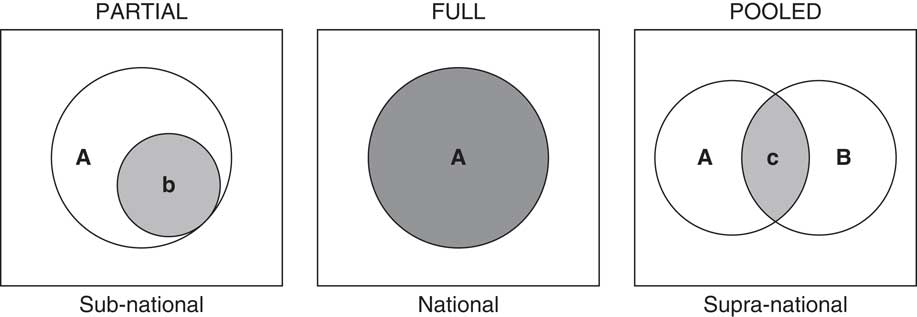
The scope dimension parts from the observation that sovereignty needs to be unbundled rather than treated as an all-or-nothing proposition.Footnote 55 To this end, we build on Keohane’sFootnote 56 concept of the gradations of sovereignty to identify three principles of sovereignty that can be at stake: full, partial and pooled sovereignty. Figure 1 illustrates the scope dimension and the level of territoriality to which the three sovereignty principles pertain.
Scope dimension

Full sovereignty relates to the classic conception of sovereignty underpinning the modern state. It involves what KrasnerFootnote 57 referred to as international legal sovereignty (that is, international recognition). At least in its ideal-type form, it also involves full internal supremacy and external or Westphalian sovereignty (that is, the principle of non-intervention in internal affairs), though in practice both can – and indeed are – often compromised.Footnote 58
Partial sovereignty derives from the gradation logic and the reality that there are alternative configurations of sovereignty that fall short of the classical ideal. As Keohane argues, there is no reason why sovereignty must inhere in a single centre since it can be dispersed among governmental entities as in a federal system.Footnote 59 The partial sovereignty enjoyed by a territory such as the Basque Country in Spain constitutes a good example. Neither international legal nor Westphalian principles of sovereignty are at stake in referendums pertaining to partial sovereignty. Instead, the question is whether the national centre should limit its internal supremacy by granting limited sovereignty to one or more sub-state entities.
Finally, pooled sovereignty involves what Keohane and Krasner refer to as the parcelling out of elements of domestic authority to supranational structures, such as the EU or NATO.Footnote 60 Pooled sovereignty institutions do not affect international legal sovereignty: its members remain internationally recognized states. However, the pooling of sovereignty imposes constraints on member states’ internal and Wesphalian sovereignty: the supranational authorities enjoy the right to intervene in some of the member states’ internal affairs.
Whereas our scope dimension relates to the material notion of the aspects of sovereignty at stake, our second overarching dimension – the logic of a sovereignty referendum – is concerned with the ideational or identitarian dimension of a referendum. It incorporates a directional element and describes the shift in identities, loyalties and expectations implied in any given reallocation of sovereign authority. A sovereignty shift can take two distinct logics – integrative or disintegrative. An integrative logic refers to the dynamic whereby political actors in one or more political (sub-)systems are persuaded to shift their loyalties, expectations and political activities towards a new centre that then acquires overall jurisdiction (for example, unification).Footnote 61 A disintegrative logic, on the other hand, operates in the opposite direction and refers to the dynamic whereby political actors in one or more subsystems withdraw their loyalties, expectations and political activities from a jurisdictional centre and either focus them on a centre of their own (for example, secession) or on an external centre, such as a cultural motherland.Footnote 62
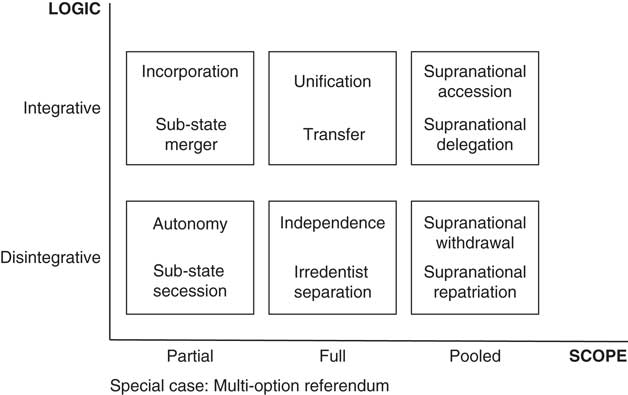
Combining the two dimensions (scope and logic) yields a total of six categories (see Figure 2). It is possible to further disaggregate the typology with two types within each of the six broad categories. Due to space constraints we will not define each type, but will present illustrative examples of the various types in the exploratory analysis that follows.Footnote 63 Before moving on, two further points should be clarified. First, one of the types is a theoretical case. There are no empirical examples of the ‘supranational repatriation’ type – though cases could be forthcoming if for instance a member state voted on leaving the eurozone (for example, Greece). Secondly, in terms of the two overarching dimensions there is a special class of sovereignty referendums that involves multiple options. If a referendum involves more than one option other than the status quo, it may not be possible to classify its scope and/or logic. For instance, the 2012 vote in Puerto Rico involved several options ranging from statehood (partial sovereignty and integrative logic) to full independence (full sovereignty and disintegrative logic). Hence both the referendum’s scope and logic were mixed.Footnote 64
Sovereignty referendum typology

Data Collection and Coding
The coding exercise involved three successive steps. In a first step, we drew up the putative universe of cases. Existing compilations of sovereignty referendums represented a natural starting point.Footnote 65 We complemented them with compilations of referendums more generally.Footnote 66 Coverage of the latter is excellent regarding referendums at the national level; systematic searches revealed a number of cases that were missing from existing lists. However, they remain more limited when it comes to sub-national referendums, in particular unofficial or semi-official referendums and historical cases.
Three main strategies helped us overcome this weakness.Footnote 67 First, we searched encyclopaedias of ethnic separatismFootnote 68 and the Minorities at Risk Project’s online resourcesFootnote 69 to get fuller coverage of sovereignty referendums in the context of ethnic self-determination conflicts. Secondly, we surveyed some of the less well-known older literature on the topic.Footnote 70 Thirdly, noting that we still systematically missed referendums from the US context, we searched seminal historical work on the creation of the American Union.Footnote 71
Having identified the putative universe of sovereignty referendum cases, the next crucial step was to check whether an instance conformed to our operational definition of the sovereignty referendum. This coding exercise was performed independently by the research team. Agreement among coders was generally high, and disagreements were resolved by consensus, usually by gathering more case-specific information. In a smaller number of cases, external experts were consulted for reconciling coding decisions, for example on certain cases from the Soviet Union.
After resolving case inclusion, the final step involved the addition of context information, including the sovereignty referendum type, the regional and political context in which a referendum was held, the ballot question, turnout and ‘yes’ share.Footnote 72 For this we drew on the above-mentioned sources, often in combination with case-specific literature. In addition, we consulted information from the Correlates of War (COW) project for the affiliations of territorial units.Footnote 73 Disagreements were again resolved by consensus.
Exploratory Analysis
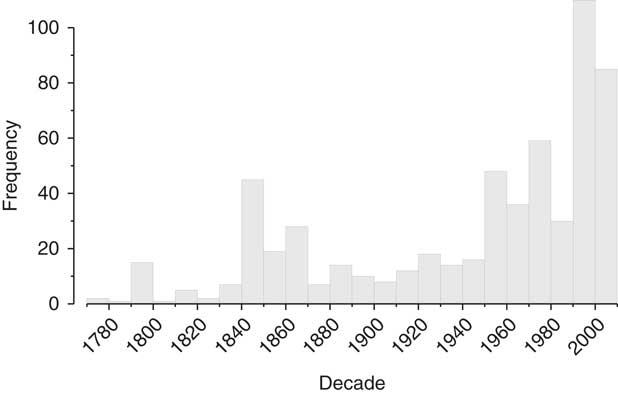
The resulting dataset contains a total of 602 sovereignty referendums from 1776–2012, more than double the number of cases identified in existing collections.Footnote 74 Figure 3 presents a summary of referendum activity over time. An initial observation is that the number of sovereignty referendums has increased tremendously over time. Moreover, the figure reveals a number of distinctive peaks. Previous work has identified five such waves (or high tides) of sovereignty referendums,Footnote 75 which have generally coincided with moments of massive geopolitical upheaval in the international system, such as the collapse of empires or world war. For example, the French Revolution triggered a spate of referendums, as did the Treaty of Versailles in 1919.
Decade-wise referendum frequencies (1776–2009)

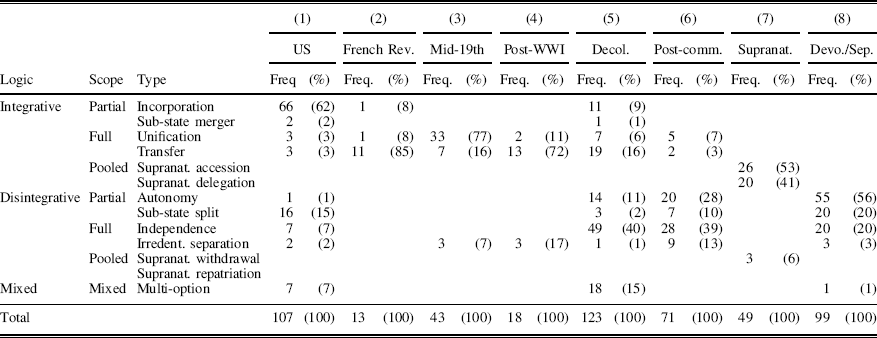
Since it implies a concentration of referendum activity at a particular temporal juncture, the defining feature of a wave relates to its temporality. Many referendum compilations have drawn on the wave concept. However, we prefer to think in terms of clusters of referendum activity, defined as sets of sovereignty referendums related to broad macro-historical processes. Referendum clusters, as defined, may involve a narrow temporal scope, but can also be more drawn out. Moreover, different clusters can also overlap. For instance, our first cluster, which broadly relates to the formation of the United States, overlaps temporally with several other clusters, including our second cluster (the French Revolution). Overall, we have identified a total of eight broad clusters of referendum use, which together account for almost 90 per cent of the referendum activity.Footnote 76 Table 1 presents the clusters and their overall frequencies, drawing on our sovereignty referendum typology. In the section below we discuss each cluster in turn.
Sovereignty Referendum Clusters

Note: percentages may not total 100 due to rounding.
Clusters of Referendum Activity
US polity creation
The first cluster relates to the formation of the United States. With more than 100 referendums, it is the second largest (see Table 1). Most of these referendums were overlooked in existing lists. The US cluster includes what was actually the modern era’s first sovereignty referendum (rather than the oft-mentioned Avignon referendum): Massachusetts’ 1776 referendum on declaring independence.Footnote 77 Somewhat surprisingly, only one ‘unification’ referendum was held to ratify the constitution that gave birth to the modern American union. This contrasts with other classic federations, such as Switzerland or Australia, where multiple referendums were held. The only referendum on the unification of the United States, an integrative-type referendum according to our typology, took place in Rhode Island in 1788. The outcome was actually a ‘no’ vote – though Rhode Island did eventually join the federation via an alternative ratification route that avoided the referendum. In contrast, there were comparatively numerous referendums associated with the most unstable period in the formation of the US polity: the attempted secession of the pro-slavery Southern states that led to the American Civil War (1861–65). A total of five states voted on leaving the American union, including Texas, North Carolina and Virginia. Interestingly, voters rejected independence in both North Carolina and Tennessee.Footnote 78
However, the majority of referendums in the US cluster, accounting for almost two-thirds of the activity, relate to what we term ‘incorporation’. These are referendums on partial sovereignty that involve an integrative logic: they are associated with the expansion of the original thirteen states to incorporate ever more territories into the union. Examples of the most recent, successful statehood referendums occurred in the late 1950s when Hawaii and Alaska attained statehood. Indeed, most of the territories that have acceded to the union after its constitutive moment have held popular votes on their incorporation. In some cases a single vote was sufficient (for example, California in 1849), while in others multiple votes were required because of opposition against statehood within the territory itself (for example, IowaFootnote 79 ) or due to opposition in Washington (for example, Utah).Footnote 80
The second-biggest set of votes in the US cluster constitutes what we call ‘sub-state splits’: referendums on the splitting up of autonomous territories or states. These referendums relate to partial sovereignty and involve a disintegrative logic. Maine makes up for a fair share, having voted seven times on its separation from Massachusetts before attaining separate statehood in 1820. Other cases in this category include the referendums on the split of the two Dakotas and on West Virginia’s separation from Virginia in the context of the Civil War. States can also merge – a ‘sub-state merger’ – although in the US context this type of referendum is relatively rare and we only came across Arizona and New Mexico’s failed attempts in 1906. The difference between the ‘sub-state merger’ type and the ‘sub-state split’ type is that the logic is integrative rather than disintegrative. Lastly, the expansion of the United States has triggered a number of ‘multi-option’ referendums in associated territories as they seek to clarify their status and relationship with the federation, including the series of votes in Puerto Rico.
French Revolution
The prevailing opinion in the literature has been that the practice of the sovereignty referendum begins with the French Revolution, when the principle of self-determination is said to have originated.Footnote 81 As has been shown, the first sovereignty referendums were actually held in the United States. Nevertheless, France’s post-revolutionary governments’ use of the referendum device did much to further its appeal. This is despite the fact that the number of referendums in this cluster is relatively limited (thirteen), and that the tool was mainly used as a means to legitimate territorial expansion. A doctrine of ‘no annexation without the consultation of the inhabitants’ managed to combine the foreign policy goals of the revolutionary movement with the prevailing theories of popular sovereignty.Footnote 82 Post-revolutionary France staged the first such annexation referendum in 1791 in the previously cited Avignon and Comtat Venaissin, then part of the Papal States. In our classification scheme, this is an integrative ‘transfer’ case since it involves (1) a reallocation of full sovereignty from the Papal States to France and (2) a shift of loyalties and expectations towards a new centre (in this case Paris).Footnote 83 The following years saw similar referendums in Savoy, Nice and Monaco, among others. However, with the advent of Napoleon the device was abandoned.
Mid-nineteenth century nation-state formation in Europe
Europe did not see further referendums on sovereignty until the idea was revived by the national movements in Switzerland and Italy between 1848 and 1870. A total of forty-three referendums were held during this period of foundational state creation, with twenty-three related to the Swiss case and twenty associated with the creation of modern Italy. Whereas the foundational moment of the Swiss confederation was a relatively swift affair, which took place after a civil war and was settled by a series of referendums in 1848, Italian unification was a longer drawn-out process that culminated in 1870. The referendums in this cluster invariably relate to full sovereignty, while the dominant logic is integrative since loyalties and expectations are refocused externally towards a new centre. Most of the referendums were ‘unification’ referendums on the merger of states or ‘transfer’ referendums on the merger of a territory with another state.Footnote 84
Post-World War I
Following the Italian Risorgimento, Europe did not witness much activity until the referendum re-emerged as a device for redrawing territorial borders in the aftermath of the First World War.Footnote 85 With only eighteen cases, this cluster is among the smallest. Nonetheless, it includes some of the most widely discussed cases. These occurred in the context of the post-Versailles settlements and the famous enunciation of the Wilsonian doctrine of self-determination,Footnote 86 though it should be noted that the referendum device was used highly selectively by the Allied Powers.Footnote 87 Many of the referendums in the post-World War I cluster were what we call ‘transfer’ referendums on border delimitations between nation-states, often stipulated by the Versailles Treaty. In particular, this includes the celebrated 1920 referendums in Schleswig (on joining Denmark or Germany) and Upper Silesia 1921 (on joining Poland or Germany). Other ‘transfer’ cases were connected to the dismantling of the Austro-Hungarian empire, such as Klagenfurt Basin (1920) or Sopron (1921). It should be mentioned that this cluster also includes cases of ‘irredentist separation’, including Voralberg’s attempt to secede from Austria and join Switzerland in 1919 and Tyrol’s 1921 referendum on joining Germany. Except for one case,Footnote 88 all the referendums were spatially concentrated in Europe and most occurred between 1919 and 1923. However, since they are connected to the ripple effects of the Versailles settlement, this cluster also includes the 1935 referendum in the Saar and the 1938 Anschluss referendum on Germany’s merger with Austria – held after Hitler had already occupied Austria.
Decolonization
The end of the Second World War and the ever-wider consensus that the principle of self-determination extends to non-Whites triggered another wave of referendums related to the decolonization process.Footnote 89 The decolonization cluster contains 123 cases, easily the largest of our clusters. It is also the most diverse in terms of geography, with referendums in almost every world region, as well as the type of referendums. Notably, however, the majority of cases follow the logic of disintegration. Indeed, most referendums were votes on independence held in what now are mostly former European colonies, especially those of France and the UK. Exemplary cases include the 1962 referendums in Algeria and mainland France on the former’s independence, the 1961 ‘independence’ referendum in Jamaica and the 1958 vote on France’s Fifth Republic constitution, which for the overseas territories effectively amounted to a referendum on continued French rule.Footnote 90
Nonetheless, there are also integrative votes in the decolonization cluster. The creation of the Federated States of Micronesia in 1978, for instance, involved ‘unification’ referendums in six island entities. Moreover, there was a series of ‘transfer’ votes in world regions such as the Indian subcontinentFootnote 91 and Africa.Footnote 92 Finally, there were also a number of ‘multi-option’ referendums related to decolonization, many held in PacificFootnote 93 and CaribbeanFootnote 94 islands. Critically, there is ongoing activity in recent years, albeit with much less intensity. For instance, there has been a referendum on independence in the UK colony of Bermuda as recently as 1995,Footnote 95 while France’s New Caledonia is scheduled to hold a referendum on independence between 2014 and 2018.
Post-communism
The fall of communism in the Soviet Union and Yugoslavia unleashed another domino wave of sovereignty referendums. With seventy-one referendums, this constitutes a medium-sized cluster. Apart from being spatially concentrated in the former Yugoslavia and the former Soviet Union, referendums in this cluster are distinctive for at least two reasons. First, they are highly temporally concentrated: almost half of the referendums were held in 1991 (thirty-four) and roughly 85 per cent were held between 1989 and 1995. This peak is responsible for the record number of votes in the 1990s (see Figure 3). Still this cluster is ongoing, as is evidenced by the (out-of-sample) referendums held in 2014 in Ukraine’s Crimea and Donbas regions.
The second distinguishing factor of the post-communist referendums is that they are quite uniform in terms of their logic: 90 per cent of cases followed the logic of disintegration. Admittedly, there were some referendums with an integrative logic, such as Moldova’s 1994 referendum on joining Romania (which was rejected) and Belarus’ 1995 referendum on an economic union with Russia (which was agreed). Yet the bulk of referendums were disintegrative in nature, with most relating to either independence or peripheral irredentism.
One of the most important examples in this cluster includes the all-union referendum staged by Gorbachev in March 1991, a move that was intended to legitimize the preservation of the Soviet Union. While Gorbachev managed to win the union-wide vote comfortably, he severely underestimated the strength of ethnic secessionism in the union’s west, particularly in the Baltics, Georgia, Armenia and Moldova. Not only did these republics boycott the referendum, but Gorbachev’s announcement also opened the floodgate for counter-referendums: by the end of March, independence votes had been passed in Lithuania, Estonia, Latvia, Georgia and the western part of Ukraine. Thus Gorbachev’s referendum tactic ended up amplifying rather than calming an already tense situation that ended with the disintegration of the union only months later – an event that was notably hastened by another referendum, Ukraine’s vote on independence in December 1991.Footnote 96
In the case of Yugoslavia, the referendums on independence in Slovenia (1990) and Croatia (1991) set the stage for the outbreak of the Yugoslav war(s). Moreover, the Yugoslav context includes some of the most notorious cases of ‘irredentist separation’ referendums: those staged by Croatia’s and Bosnia’s Serb minorities on joining the Serbian motherland.
Not all referendums implied a shift in full sovereignty, however. Some critical cases were related to partial sovereignty. This includes the 1995 ‘autonomy’ referendum that helped contain the separatist conflict in Gagauzia (a region in Moldova) as well as the far more divisive and unilaterally staged referendums on increased autonomy in Crimea and Donetsk in 1994, which were both held during Ukraine’s tumultuous post-independence phase of constitutional bargaining.Footnote 97
Supranationalization
The creation of supranational entities, in particular the EU, has given rise to another cluster of referendum activity. Its roots go back to the former European Community’s (EC’s) first enlargement round, and it began with a curiosity: France’s 1972 vote on whether it should allow for EC enlargement – effectively whether the UK should be allowed to enter. Since then a total of forty-nine votes have been held in the context of supranationalization, most related to the EC/EU (forty-three) and some others to NATO (six). In terms of their scope, all referendums in this cluster are related to the pooling of sovereignty. Most pertain to the ‘accession’ or the ‘delegation of powers’ to a supranational entity. As such, they tend to follow an integrative logic. Yet there is a small number of disintegrative referendums, too. Three have taken place thus far, all related to the withdrawal from supranationational organizations: the UK’s continued EC membership referendum in 1975, Greenland’s successful withdrawal from the EC in 1982 and a Spanish referendum on continued NATO membership in 1986. As argued above, no referendum on ‘supranational repatriation’ has yet taken place. Given the increasing political saliency of the EU, referendums related to the pooling of sovereignty are likely to persist for the foreseeable future.
Devolution and separatism
In recent decades, the number of referendums on disintegrative reallocations of sovereignty in the context of self-determination conflicts has increased significantly. A number of these referendums has already been grouped within the decolonization and post-communism clusters. However, there are many referendums that follow this dynamic that are not part of these two clusters and should be grouped together. In fact, with ninety-nine cases, this cluster is the third largest. The first case we list in this cluster is the celebrated referendum on Norway’s secession from Sweden in 1905. A number of referendums followed in the 1930s including an ‘independence’ referendum in Western Australia and, just before the onset of the Spanish Civil War, ‘autonomy’ referendums in Galicia, Catalonia and the Basque Country during the mid-1930s. Yet the bulk of activity in this cluster is distinctly a post-1970s phenomenon.
More than three-quarters of cases involve the question of greater partial sovereignty for a given territory. Most are what we call ‘autonomy’ referendums. In addition to the aforementioned Spanish cases, these include Greenland’s 1979 referendum on home rule or the repeated referendums on devolution in Scotland and Wales first in 1979 and then again, successfully, in 1997. Disintegrative referendums related to partial sovereignty can also take the form of ‘sub-state split’ referendums, as was the case with the series of referendums generated by Jura’s famous separation from Berne in Switzerland or those on the creation of a new, Inuit-dominated state in Canada (Nunavut). This cluster also includes some well-known referendums involving the reallocation of full sovereignty, such as the above-mentioned case of Norway, but also Quebec’s two failed ‘independence’ referendums in 1980 and 1995 and the successful ones in Eritrea (1993), East Timor (1999) and South Sudan (2011).
Patterns of Referendum Activity
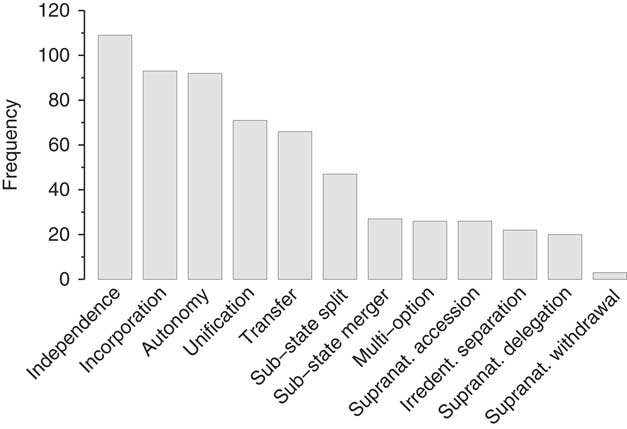
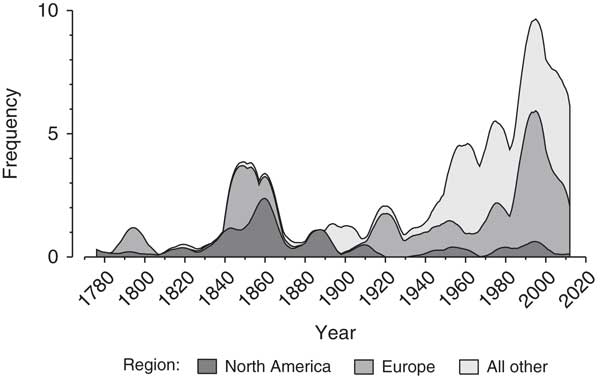
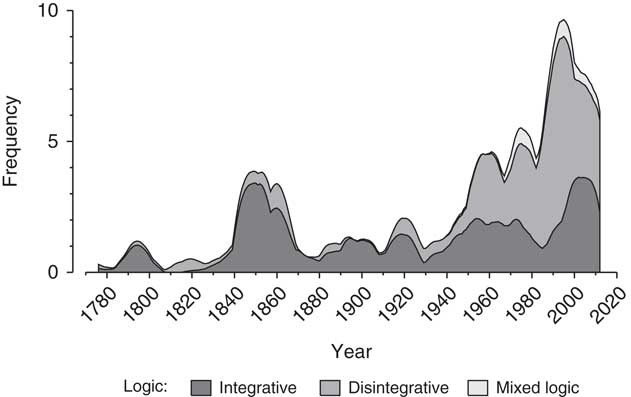
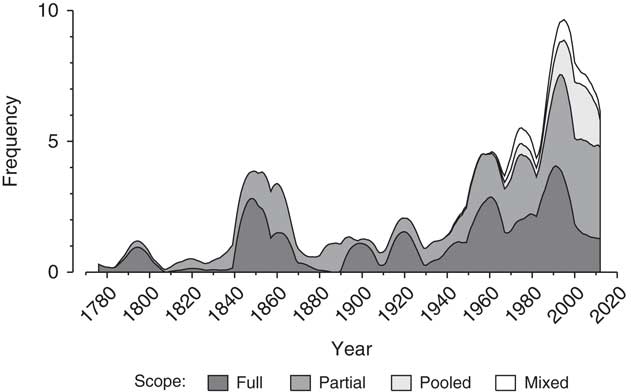
After overviewing the referendum clusters, we are now in a better position to identify some of the broader patterns of referendum activity over the past two-and-a-half centuries. Let us begin by looking at the distribution of types as shown in Figure 4. Among other things, this highlights the relative infrequency of referendums related to pooled sovereignty and in particular to withdrawal from supranational structures. If we take the four categories with the highest frequencies an interesting picture emerges: whereas the incorporation and unification types are predominantly a pre-1950s and US/European affair, the independence and autonomy referendums are more of a global phenomenon of the post-war period. To get a better handle on such dynamics we will look at the distribution of referendums over time by region, the logic of the sovereignty reallocation and the scope of sovereignty at stake, which is shown in Figures 5, 6 and 7, respectively. All three graphs show annual referendum frequencies, smoothed for better interpretation.
Referendum frequencies by type

Region-wise referendum frequencies

Referendum frequencies by sovereignty logic

Referendum frequencies by sovereignty scope Note: all three graphs show smoothed annual referendum frequencies based on kernel-weighted local polynomial regression (bandwidth=4).

Taking geographic dispersion first, Figure 5 nicely illustrates an important finding: for almost two centuries, the sovereignty referendum has largely been a Western phenomenon.Footnote 98 In these initial years, a good deal of activity emanated from North America, where the creation of the US polity generated a fairly constant flow of referendum activity. Most of the remaining referendums were held in Europe, though activity there came more in waves (French Revolution, mid-nineteenth century state formation and post-World War I). In the aftermath of the Second World War, the sovereignty referendum has become truly ‘globalized’, largely due to the referendums held in the decolonization context and their increasing use in non-colonial self-determination conflicts around the world. At the same time, Europe has seen continued or even increased activity in recent years, mostly due to referendums in the context of supranationalization, the disintegration of the Soviet Union and Yugoslavia, and further cases of devolution or separatism. Yet activity in North America has decreased due to the fact that polity formation in the United States is coming to an end.Footnote 99
In a next step we focus on the sovereignty logic. Figure 6 suggests some distinctive patterns. Until the post-war period, sovereignty referendums tended to follow the integrative logic, with notable spikes at the time of France’s post-revolutionary annexations, the unifications of Italy and Switzerland in the middle of the nineteenth century, and the interwar period redrawing of the European map. Much of the baseline integrative activity is due to the drawn-out process of the formation of the American union. However, after 1945 referendums tended to increasingly follow the logic of disintegration. Essentially, this is due to three partly overlapping processes: (1) the wave of referendums related to decolonization after the Second World War, (2) the disintegration of Yugoslavia and the Soviet Union and (3) the spike of self-determination referendums referred to in our eighth cluster. Although disintegrative activity has increased, integrative activity has far from ceased and has indeed even increased in recent years. This is mainly due to the referendums triggered by European integration. Finally, Figure 6 points to another recent development: the emergence of multi-option referendums with mixed logic post-1945, mostly related to decolonization.
Turning to the scope of sovereignty at stake, Figure 7 reveals that referendums involving the reallocation of full sovereignty have a constant ebb and flow over time, with notable peaks during the mid-nineteenth state formation process and especially after the decolonization wave following the Second World War and the disintegration of the Soviet Union and Yugoslavia. Similarly, referendums related to partial sovereignty also exhibit some distinctive trends. Until roughly the 1950s, most of these referendums were associated with territorial changes in the United States. Since then, however, there has been a marked rise in referendums related to territorial reconfigurations within the nation-state. This has especially been the case since the 1970s, a trend that was described in our discussion related to the self-determination referendums in cluster 8. Another distinctive feature is the rise of the pooled sovereignty referendum since the 1970s. Again, this can be easily explained by the referendums generated as a result of the process of European integration.
Referendum Outcomes
Next we will take a look at the outcomes of sovereignty referendums. Specifically, we will provide some tentative answers to two rather broad but interlinked questions: (1) to what extent do sovereignty referendums tend to come out in favour of a sovereignty reallocation? (2) And by what share of the vote?
Answering these general questions requires some data pre-processing. Most referendum questions follow the format: are you in favour of X? For instance, the ballot question in Latvia’s 1991 independence referendum read: ‘Are you in favour of a democratic and independent Republic of Latvia?’ In such instances a ‘yes’ vote entails a change from the status quo to a new sovereignty arrangement. However, in some cases the referendum question is reversed in terms of the sovereignty issue at stake. Here a yes vote entails the status quo rather than a change in sovereignty allocation. The 1975 UK referendum on withdrawal from the EC is a good example. The question was formulated as such: ‘Do you think that the United Kingdom should stay in the European Community?’ Thus in order to get the share of referendums in favour of a sovereignty reallocation and the vote share in favour of a change from the status quo, we re-coded all outcomes accordingly.Footnote 100
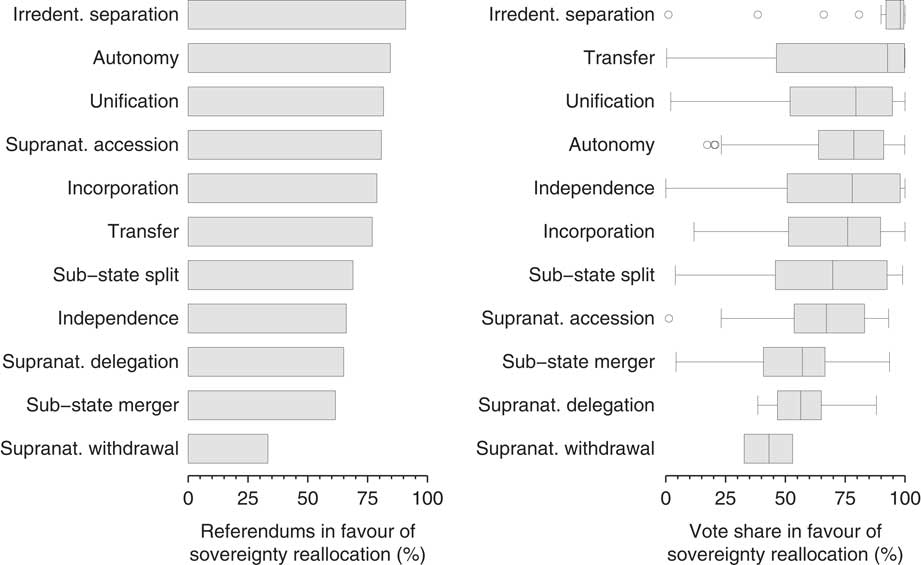
Referendum outcomes Note: the left panel shows the share of sovereignty referendums in favour of the sovereignty reallocation at stake, and the right panel depicts the vote share in favour of the sovereignty reallocation at stake.

Before we turn to some of the descriptive statistics it is necessary to take into account at least three issues. First, sovereignty referendums are frequently held in undemocratic contexts that are far from being free and fair. In quite a few cases referendums are also likely to be outright rigged. Hitler’s Anschluss referendum, the series of referendums triggered in Moldova’s breakaway region of Transnistria and the recent (though out-of-sample) referendum on Russia’s annexation of Crimea are all obvious examples.
Secondly, even when overwhelmingly passed, referendums are evidently not always implemented. This is especially true of referendums that were unilaterally staged by separatists. Despite the approval of independence in a large number of Catalan municipalities between 2009 and 2011 and, more recently, in the regional vote of November 2014, Catalonia is still part of Spain. Similarly, despite referendums to the contrary, both Abkhazia and South Ossetia are still de jure part of Georgia.
Finally, sovereignty referendums seem to involve a good deal of political instrumentality. Critically, they can be staged for different motives and may perform different functions, depending on who controls themFootnote 101 and who initiates them.Footnote 102 In particular, sovereignty referendums can be triggered by actors who want to further a sovereignty reallocation (for example, Tudjman with his 1991 referendum on Croatia’s independence) as well as by actors who wish to avert one (for example, Gorbachev trying to counter secessionist threats with his 1991 all-union referendum). While the latter is less frequent, the outcomes in both our examples were unsurprising (Tudjman’s referendum favoured secession while Gorbachev’s resulted in a pyrrhic victory for the unionists). Initiation is particularly important for sovereignty referendums because it can be pivotal in determining which demos gets to vote. For instance, Gorbachev’s referendum would most likely have had a very different outcome had those who were the primary object of the referendum (the secession-minded Baltics and Georgia) been directly asked rather than staging a union-wide referendum.
With such provisos regarding outcomes in mind, let us start with the most general finding presented in the left panel of Figure 8, which shows the proportion of referendums in favour of a sovereignty reallocation across the categories in descending order.Footnote 103 Most sovereignty referendums clearly pass, and by quite an overwhelming rate. There is one notable exception to this general trend: supranational withdrawal referendums. Yet, as argued above, we should note that there are only three cases in this category. Two of these failed (the UK’s withdrawal from the EC and Spain’s from NATO), which in both cases was in alignment with the initiators’ intentions.
The right panel in Figure 8 provides a more nuanced assessment. The box plots indicate the percent of voters that opted in favour of the sovereignty reallocation, again by categories and in descending order.Footnote 104 Apart from the supranational withdrawal category, the vote share in favour of change is predominantly clustered above the 50 per cent threshold. In particular, the first category on irredentist separation has a very distinctive box plot with an extremely high median vote share –close to 100 per cent. This is because it is a relatively small category of only twenty-two casesFootnote 105 that includes a large share of unilateral votes staged by separatists themselves, such as the Greek Cypriot community’s referendum on a merger with Greece in 1950, the Croatian Krajina’s referendum on merging with Serbia in 1991 and the 1992 referendum in South Ossetia on a merger with Russia. Irredentist separation referendums apart, there is a notable spread in most categories, as can be seen from the width of the boxes representing the first and third quartiles.
The box plots also reveal some significant outliers that are of interest, plotted as circles in the graph. The most extreme case involves the irredentist separation category: Northern Ireland’s 1973 border boll, a popular vote on remaining with the UK that was boycotted by the Catholic minority. Nearly 99 per cent were in favour of maintaining the union, which is exactly what the organizers wanted. A second category with some significant outliers is the autonomy category. Most autonomy referendums are clearly approved, although there are some outliers that failed such as Wales in 1979. Another interesting outlier is in the supranational accession category: the rather unique case of Crimea holding a unilateral referendum against Ukraine joining NATO in 2006. As with the Northern Ireland case, the outcome – approximately 99 per cent against joining – was exactly what the organizers intended.
To conduct a more systematic analysis of referendum outcomes would necessitate much richer contextual information, for instance on the political dynamics surrounding a decision to call a referendum, the motives of the initiator, potential legal constraints (if any) and the role of external actors, to name but a few variables that we unfortunately lack. Acquiring such information, especially for some of the historical cases, was well beyond the scope of the data collection exercise. Insofar as any tentative conclusions can be derived, it is that referendums on sovereignty allocations appear to be generally passed, if not always implemented, and on average by a substantial share of the vote. Furthermore, our vignettes suggest that referendum outcomes tend to be in line with the intentions of their initiators.
Discussion
We have argued that existing compilations of sovereignty referendums tend to suffer from several weaknesses. Many of the problems stem from conceptual vagueness, which led to inconsistent coding decisions regarding what is (and is not) a sovereignty referendum as well as incompatible and typically rather atheoretical typologies. Furthermore, existing compilations tend to have incomplete coverage of the phenomenon. We noted that this is due to the over-reliance on the same historical sources and a lack of original research drawing on alternative data sources; thus, systematic omissions in the historical records have been compounded over time. A case in point is the neglect of most US cases, since they were omitted from one of the most-often-cited historical treatises. This has led to erroneous statements, such as the claim that the 1791 referendum in Avignon and Comtat Venaissin constitutes the first sovereignty referendum in the modern era. It was not the first; indeed it was preceded by Massachusetts’ 1776 referendum on the Declaration of Independence, among others.
Aiming to ameliorate existing compilations, we presented a new dataset of sovereignty referendums that draws on an improved conceptualization, replicable coding criteria and a much richer set of sources. The Contested Sovereignty dataset identifies 602 sovereignty referendums from 1776–2012, more than double the number in existing lists, and introduces a new, theory-driven typology of the phenomenon based on two dimensions. First, we distinguished among three aspects of sovereignty that can be at stake in referendums, what we called the scope dimension. Secondly, we outlined the directional nature of a sovereignty reallocation, what we called its logic. These two overarching dimensions yielded a sovereignty referendum typology of six basic categories (and twelve types) as well as a mixed residual category.
In the exploratory analysis, we highlighted the increasing use of the referendum to decide sovereignty matters. Furthermore, we identified eight relatively coherent referendum clusters – sets of sovereignty referendums related to broad macro-historical processes – which together account for almost 90 per cent of referendum activity. We then looked at aggregate patterns over time and space, which suggested three main conclusions. First, the referendum was essentially a North American and European phenomenon for nearly two centuries. However, since the Second World War the sovereignty referendum has become a truly globalized tool spreading to most world regions. Secondly, in terms of the principles of sovereignty at stake, there has been a sharp increase in the number of referendums on sovereignty reallocations to entities either below or above the nation-state since about the 1950s. Thirdly, in terms of the logic of the sovereignty reallocation, the most important finding is this: whereas the distribution of integrative referendums has remained fairly constant over the entire time period (despite a recent upward trend), disintegrative referendums are predominantly a post-1945 phenomenon. The tremendous spike in the frequency of disintegrative referendums is interesting not least because they also tend to be the most conflictual type of referendum.
Finally, we took a first look at referendum outcomes. Insofar as any conclusion can be drawn from our tentative analysis, it was that most referendums turn out in favour of the sovereignty reallocation at stake, with many cases exhibiting very high approval rates. Referendum outcomes should be interpreted with care, however. In many instances referendums are staged in undemocratic contexts, and even when this is not the case there is often a high degree of political instrumentality in opting for the referendum. Indeed, our vignettes offered examples of how referendum outcomes were in line with the preferences of the political elites who staged the referendums.
Our speculations on this matter, and the extent to which political instrumentality holds across other referendum categories more generally, would necessitate systematic empirical testing. While that analysis is beyond the scope of this article, it points to an exciting line of research that also raises a host of ancillary questions. These include investigating the conditions (democratic or otherwise) under which sovereignty referendums are held. Or, examining under what conditions sovereignty referendums lead to durable outcomes – and when they may be associated with an escalation of conflict. The scholarly community has only begun to address this research agenda, which we hope will be facilitated by our new dataset.