Social Anxiety Disorder
Social anxiety disorder (SAD) is a psychological disorder characterised by an excessive and persistent fear of social or performance situations, in which an individual fears being negatively evaluated by others (American Psychiatric Association [APA], 2013). Feared social situations include social interactions (e.g., a conversation with unfamiliar others), social performances (e.g., a speech), and being observed (e.g., eating in public).When an individual with SAD encounters such a situation, they experience cognitive, affective, behavioural, and physiological symptoms of anxiety, and frequently use avoidance or related safety strategies to manage these symptoms.
A diagnosis of SAD is warranted when anxiety symptoms and avoidance interfere significantly with one's social or occupational functioning and cause significant distress in daily life (APA, 2013). Social anxiety exists on a spectrum and can be experienced by individuals with and without diagnosed SAD (Turner, Beidel, Dancu, & Stanley, Reference Turner, Beidel, Dancu and Stanley1989); however, both SAD and subclinical social anxiety are associated with impaired daily functioning (Crum & Pratt, Reference Crum and Pratt2001).
In recent empirical studies, researchers have commonly used both clinical SAD samples and social anxiety analogue samples (Stopa & Clark, Reference Stopa and Clark2000, Reference Stopa and Clark2001). Thus, for the purpose of this review, SAD will refer only to individuals who meet DSM-IV-TR (APA, 2000) or DSM-V (APA, 2013) criteria for Social Anxiety Disorder, and social anxiety will otherwise refer to non-clinical levels of distress and anxiety associated with social evaluative situations. The main difference between subclinical and clinical social anxiety is the intensity and severity of symptoms, and the distress and interference of those symptoms on everyday functioning (Crum & Pratt, Reference Crum and Pratt2001).
According to epidemiological research, SAD is one of the most prevalent psychological disorders in Western countries (Kessler, Berglund, Demler, Jin, & Walters, Reference Kessler, Berglund, Demler, Jin and Walters2005). SAD is the fourth most common psychiatric disorder in Australia, with a lifetime prevalence of 10.6% (Australian Bureau of Statistics [ABS], 2007). Within Australia, 78.1% of individuals with SAD have at least one other comorbid disorder; 53.4% of which include comorbid Axis I anxiety disorders (Lampe, Slade, Issakidis, & Andrews, Reference Lampe, Slade, Issakidis and Andrews2003). Additionally, 35.8% of individuals with SAD also met criteria for avoidant personality disorder (Lampe et al., Reference Lampe, Slade, Issakidis and Andrews2003). A review of epidemiological research found women were more likely to develop SAD than men, with the female-to-male ratio reported to be approximately 3:2 (Furmark, Reference Furmark2002).
In community settings, SAD is associated with less education, lower salaries, less social support, and being unmarried (Furmark, Reference Furmark2002; Heimberg, Hope, Dodge, & Becker, Reference Heimberg, Hope, Dodge and Becker1990). SAD has an earlier onset than most anxiety disorders, typically beginning in childhood or early adolescence, and often occurring before the development of other psychiatric disorders (Weissman et al., Reference Weissman, Bland, Canino, Greenwald, Lee, Newman, Rubio-Stipec and Wickramaratne1996). The experience of SAD, in association with at least one other comorbid disorder, has been found to significantly increase the risk of attempting suicide (Weissman et al., Reference Weissman, Bland, Canino, Greenwald, Lee, Newman, Rubio-Stipec and Wickramaratne1996).
Efficacious Treatments
The most widely used treatment for SAD is group Cognitive Behavioural Therapy (gCBT; Heimberg & Becker, Reference Heimberg and Becker2002); an adaptation of CBT for anxiety disorders, which includes cognitive restructuring, behavioural experiments, and graded exposure techniques (Beck, Emery, & Greenberg, Reference Beck, Emery and Greenberg1985). Despite being the gold standard, these treatments have received modest results, with one study showing 58% of participants significantly improved after the 12-week gCBT program (Heimberg et al., Reference Heimberg, Hope, Dodge and Becker1998), and another finding that 51.7% of participants no longer met criteria for SAD after gCBT (Davidson et al., Reference Davidson, Foa, Huppert, Keefe, Franklin, Compton and Kishore2004). Additionally, gCBT plus added social skills training has been found to have similar effect sizes from pre- to 12-month follow-up as gCBT treatments alone (Herbert, Rheingold, & Goldstein, Reference Herbert, Rheingold and Goldstein2002).
Treatment for SAD typically includes an exposure component and a cognitive therapy (CT) component; however, the additive therapeutic effect of CT over exposure alone remains controversial. In a meta-analysis of psychological treatments for SAD, Taylor (Reference Taylor1996) found that the effect sizes for CT and exposure were not significantly different than exposure alone, although there was a trend for CT and exposure to show the largest effects. Meta-analyses by Feske and Chambless (Reference Feske and Chambless1995) and Gould, Buckminster, Pollack, Otto, and Yapp (Reference Gould, Buckminstel, Pollack, Otto and Yap1997) found no evidence for the additive effects of CT over exposure alone.
Feske and Chambless (Reference Feske and Chambless1995) propose that their failure to detect differences between CBT and exposure does not necessarily mean that the CBT approach lacks the potential to improve over exposure, as more powerful cognitive-based interventions are developed.
More recent research suggests that CT can enhance efficacy of SAD treatments (Clark et al., Reference Clark, Elhers, Hackmann, McManus, Fennell, Grey, Waddington and Wild2006; Rapee, Gaston, & Abbott, Reference Rapee, Gaston and Abbott2009). Clark et al. (Reference Clark, Elhers, Hackmann, McManus, Fennell, Grey, Waddington and Wild2006) found that CT and exposure were consistently superior to exposure alone on a varied range of SAD measures. Additionally, the CT program used in this study involved fewer total exposure exercises than the exposure program, suggesting that less overall exposure may be needed when embedded within a CT framework. This is hypothesised to be due to some of the therapeutic differences in CT over exposure alone, including framing exposure as a behavioural experiment, elimination of safety behaviours, and the experiential demonstration that self-focused attention and safety and avoidance behaviours can have unhelpful effects (Clark et al., Reference Clark, Elhers, Hackmann, McManus, Fennell, Grey, Waddington and Wild2006).
Extending these findings, Rapee et al. (Reference Rapee, Gaston and Abbott2009) compared a traditional CBT package (similar to that used by Clark et al., Reference Clark, Elhers, Hackmann, McManus, Fennell, Grey, Waddington and Wild2006) to an enhanced CBT package, which included an overlap between the cognitive (i.e., cognitive restructuring) and behavioural (i.e., in vivo exposure) elements through the use of hypothesis testing, evidence gathering and restructuring techniques targeting broader core beliefs and life scripts, and the systematic elimination of safety and avoidance behaviours. The enhanced program showed significantly greater effects over the traditional CBT program in terms of both statistical and clinical significance.
These results support hypotheses of cognitive models of SAD, which suggest that a greater understanding of SAD and key mediating factors (e.g., over-evaluation of the likelihood and cost of negative evaluation and use of safety behaviours) will increase treatment efficacy. Improved understanding of key maintaining factors underlying mechanisms and processes is invaluable in the continuing development of comprehensive theoretical models and efficacious treatments. For instance, there has been limited research examining some of the key cognitive factors in SAD (e.g., pre- and post-event rumination) and their relationship with cognitive biases and perceived expected standards, though the impact on heightening state social anxiety is well founded.
Cognitive Models of Social Anxiety Disorder
Contemporary cognitive models of SAD (Clark & Wells, Reference Clark, Wells, Heimberg, Liebowitz, Hope and Schneier1995; Rapee & Heimberg, Reference Rapee and Heimberg1997; Hofmann, Reference Hofmann2007) have been used to provide theoretical frameworks to understand the key maintaining processes involved in the disorder. These models posit that dysfunctional beliefs, biased processing of social information, safety behaviours, and avoidance of anxiety-provoking situations contribute to the development and maintenance of SAD. The Clark and Wells (Reference Clark, Wells, Heimberg, Liebowitz, Hope and Schneier1995) and Rapee and Heimberg (Reference Rapee and Heimberg1997) models are theoretically similar, with Clark and Wells focusing on the maintaining factors of SAD, and Rapee and Heimberg focusing on the cognitive processes maintaining state anxiety experienced by individuals with SAD. Hofmann (Reference Hofmann2007) also highlights a primary role for high perceived social standards and poorly defined social goals in triggering anticipatory anxiety before a social event.
Clark and Wells (Reference Clark, Wells, Heimberg, Liebowitz, Hope and Schneier1995)
Clark and Wells’ (Reference Clark, Wells, Heimberg, Liebowitz, Hope and Schneier1995) cognitive model suggests that individuals with SAD are more likely to perceive social events as threatening due to cognitive biases that they hold about themselves, others, and the world. For instance, individuals with SAD are hypothesised to hold excessively high standards for social performance, which naturally provoke anxiety, as they are difficult to achieve and thus promote the perception of failure (Clark & Wells, Reference Clark, Wells, Heimberg, Liebowitz, Hope and Schneier1995).
Individuals with SAD also hold conditional beliefs concerning social evaluation, such as, ‘If I make mistakes, then others will reject me’ (Clark & Wells, Reference Clark, Wells, Heimberg, Liebowitz, Hope and Schneier1995). These beliefs are the result of a biased assumption that ‘What (I think) others think of me, must be the truth’. These stringent rules for interactions provoke anxiety and activate the expectation of negative social evaluation and rejection from others. Individuals with SAD are thought to have ‘unstable self-schemata’ (p. 76), meaning that while they have negative beliefs about themselves (e.g., ‘I’m inadequate’), these beliefs are conditional on specific situations and are more marked in social situations, compared to less threatening situations, such as being with close friends (Clark & Wells, Reference Clark, Wells, Heimberg, Liebowitz, Hope and Schneier1995).
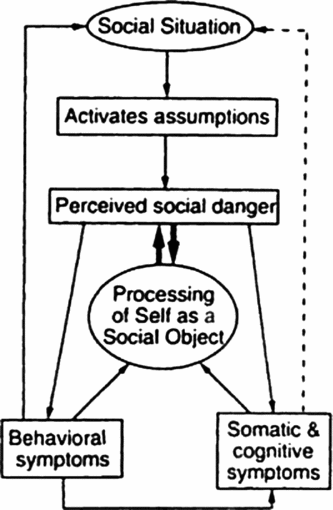
As shown in Figure 1, Clarke and Wells’ (Reference Clark, Wells, Heimberg, Liebowitz, Hope and Schneier1995) model posits several key maintaining processes involved in SAD. Individuals enter a social situation, which activates unhelpful assumptions that the social situation is threatening, resulting in a shift in attention and a detailed monitoring of the self. This self-focused attention further promotes physiological and cognitive symptoms of anxiety, such as blushing and the activation of further dysfunctional beliefs. Individuals with SAD then use this somatic and cognitive information to create a negative mental representation of themselves (as they believe would be viewed by the audience), resulting in the individual not attending to potential positive social cues from others (Clark & Wells, Reference Clark, Wells, Heimberg, Liebowitz, Hope and Schneier1995).
Clark's (2001) cognitive model of social anxiety disorder (adapted from Clark & Wells, Reference Clark, Wells, Heimberg, Liebowitz, Hope and Schneier1995). Printed with permission from the publisher: Guildford Press.

Additionally, individuals with SAD are known to engage in safety behaviours (Kim, Reference Kim2005; Wells et al., Reference Wells, Clark, Salkovskis, Ludgate, Hackmann and Gelder1995), which can either involve overt behaviours (e.g., avoidance) or internal mental processes (e.g., rehearsing what to say next; Clark, Reference Clark, Crozier and Alden2001; Clark & Wells, Reference Clark, Wells, Heimberg, Liebowitz, Hope and Schneier1995). These safety behaviours maintain SAD in four ways: (1) a social success may be attributed to the safety behaviour rather than the inference that the situation was less threatening than originally perceived; (2) the individual's fears may be exacerbated (e.g., holding arms together to hide sweating may produce more sweating); (3) safety behaviours direct attention to the self, which exhausts cognitive capacity that may be used to process objective information; and (4) safety behaviours can produce the feared result (e.g., an individual may rehearse what to say next to avoid appearing foolish, but by doing so may appear slower or preoccupied; Clark, Reference Clark, Crozier and Alden2001; Clark & Wells, Reference Clark, Wells, Heimberg, Liebowitz, Hope and Schneier1995).
Clark and Wells (Reference Clark, Wells, Heimberg, Liebowitz, Hope and Schneier1995) posit that individuals with SAD engage in extensive anticipatory rumination prior to a social or performance event. Such rumination often focuses on past failures and negative predictions of performance in the social situation. Anticipatory social threat places individuals in a self-focused processing mode, where one expects to perform poorly, and engages in cognitive biases, which prevent one from perceiving external signs of acceptance from others.
After the event, individuals are hypothesised to engage in a ‘post-mortem’ (i.e., post-event rumination; Clark & Wells, Reference Clark, Wells, Heimberg, Liebowitz, Hope and Schneier1995, p. 74) of the social event, where the dominant images and thoughts focus on perceived failure and negative images of themselves that were experienced during the event itself. The model predicts a relationship between performance self-appraisal and negative post-event rumination, such that the more negative one's self-appraisal of their performance, the more frequently an individual will engage in post-event rumination (Clark & Wells, Reference Clark, Wells, Heimberg, Liebowitz, Hope and Schneier1995).
Rapee and Heimberg (Reference Rapee and Heimberg1997)
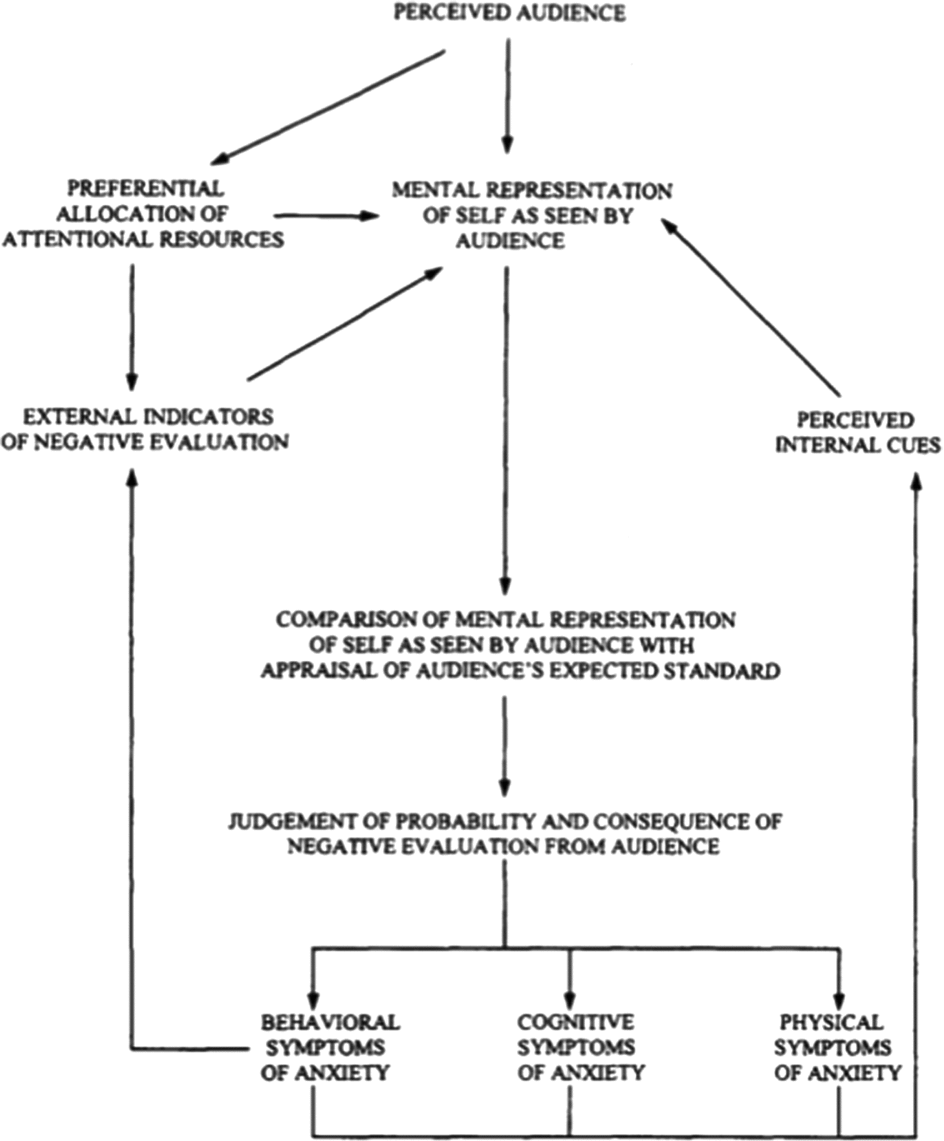
Rapee and Heimberg's (Reference Rapee and Heimberg1997) cognitive-behavioural model (see Figure 2) is similar to the Clark and Wells (Reference Clark, Wells, Heimberg, Liebowitz, Hope and Schneier1995) model, but begins with the premise that socially anxious individuals attach significant importance to being positively evaluated by others, yet they assume that any evaluation will be inherently negative. When a socially anxious event is perceived or experienced, an individual with SAD is argued to create a mental representation of themselves as would be seen by a social other, created by memories of past experiences, internal cues (e.g., physiological anxiety symptoms), and external cues (e.g., perceived indicators of negative evaluation; Rapee & Heimberg, Reference Rapee and Heimberg1997). Although pre- and post-event rumination is not explicitly named in this model, it can be inferred that the content of pre- and post-event rumination is the expectation of a negative outcome and the generation of the negative internal mental representation of the self as seen by an audience in anticipation, during and after a social event.
Rapee & Heimberg's (1997) cognitive-behavioural model of social anxiety disorder. Printed with permission from the publisher: Elsevier.
Unlike the Clark and Wells’ (Reference Clark, Wells, Heimberg, Liebowitz, Hope and Schneier1995) model, which postulates that attentional resources will be allocated to one's internal representation, Rapee and Heimberg (Reference Rapee and Heimberg1997) argue that the individual's attentional resources are split to monitor both the self-image and potential external signs of threat simultaneously (e.g., signs of disinterest). This self-image is then compared to a perceived standard of audience expectation. The higher the discrepancy between the self-image and perceived standard, the greater the likelihood that the individual will anticipate negative social outcomes in terms of probability and cost, which in turn results in behavioural, cognitive, and physical symptoms of anxiety. Anxiety symptoms and any external indictors of threat are perceived and reintegrated into the mental representation of the self, resulting in maintenance of the social anxiety and ruminative cycle (Rapee & Heimberg, Reference Rapee and Heimberg1997).
Hofmann (Reference Hofmann2007)
Hofmann's (Reference Hofmann2007) model (Figure 3) extends the theoretical work of the other models. This model posits that individuals with SAD feel social apprehension due to the perception that social standards are high. Individuals then desire to meet these high social standards, but simultaneously doubt their ability to do so, leading to further social apprehension, anticipatory anxiety, and self-focused attention. In turn, a number of cognitive processes are triggered, resulting in an overestimation of the probability and cost of a poor social outcome (Hofmann, Reference Hofmann2007).
Hofmann's (2007) model of social anxiety disorder. Printed with permission from the publisher: Routledge.
This theory is consistent with Clark and Wells’ (Reference Clark, Wells, Heimberg, Liebowitz, Hope and Schneier1995) model, which posits that individuals with SAD believe they will act in a humiliating way, resulting in perceived negative social costs. Additionally, individuals with SAD hold a poor view of themselves as a social object, and thus believe they have insufficient social skills and low control over their anxiety (Hofmann, Reference Hofmann2007). These cognitive factors result in individuals experiencing further social apprehension and engaging in avoidance or safety behaviours to cope with the experience of excessive anxiety. After a social event, individuals are hypothesised to engage in post-event rumination similar to that described in both Clark and Wells (Reference Clark, Wells, Heimberg, Liebowitz, Hope and Schneier1995) and Rapee and Heimberg (Reference Rapee and Heimberg1997). These processes are thought to play a role in the cycle and maintenance of social anxiety (Hofmann, Reference Hofmann2007).
Rumination in SAD
The three main cognitive models of SAD are theoretical frameworks that emphasise the importance of negative rumination as a maintaining factor in the cycle of social anxiety. The process of negative rumination occurs when an individual engages in an excessive mental review of their performance before or after a social event (Brozovich & Heimberg, Reference Brozovich and Heimberg2008). Researchers have found that excessive and persistent negative rumination is engaged in by individuals with SAD both before and after a social-evaluative event (Rachman, Gruter-Andrew, & Shafran, Reference Rachman, Gruter-Andrew and Shafran2000; Vassilopoulos, Reference Vassilopoulos2004). It is theorised that negative rumination may be one of the key cognitive processes preventing individuals from becoming desensitised to social threat, despite regular exposure to seemingly benign social events (Clark & Wells, Reference Clark, Wells, Heimberg, Liebowitz, Hope and Schneier1995; Hofmann, Reference Hofmann2007; Rapee & Heimberg, Reference Rapee and Heimberg1997).
In a recent review examining rumination and its role in SAD, it was found that negative rumination (related to a social or performance event) leads to excessive worry about one's performance, a belief that the performance was unsatisfactory, and memory retrieval of previous perceived social failures (Brozovich & Heimberg, Reference Brozovich and Heimberg2008). Negative rumination before and after a social event, and interpreting oneself as a social failure, maintains SAD despite exposure to social events with objectively neutral or positive outcomes. Rumination further maintains SAD by perpetuating negative self-impressions and negative predictions for future events (Brozovich & Heimberg, Reference Brozovich and Heimberg2008). Thus, it is important to understand both pre- and post-event rumination processes when investigating SAD.
There is a wealth of literature investigating rumination related to depressive symptoms (e.g., Nolen-Hoeksema, Reference Nolen-Hoeksema1987, Reference Nolen-Hoeksema, Papageorgiou and Wells2004; Nolen-Hoeksema, Parker, & Larson, Reference Nolen-Hoeksema, Parker and Larson1994; Smets, Wessel, Schreurs, & Raes, Reference Smets, Wessel, Schreurs and Raes2012), and it is important to distinguish this cognitive process from rumination in SAD. Rumination related to depressive symptoms has not been found to be predictive of post-event rumination related to social anxiety (Kocovski & Rector, Reference Kocovski and Rector2008), suggesting that the content of rumination has diagnostic specificity. It is important to note that while there is significant comorbidity between SAD and depression (Perugi, Frare, Toni, Mata, & Akiskal, Reference Perugi, Frare, Toni, Mata and Akiskal2001), there are significant conceptual distinctions in the rumination process. Clark and Wells (Reference Clark, Wells, Heimberg, Liebowitz, Hope and Schneier1995) propose that rumination in SAD focuses on perceived social failures, while response styles theory (Nolen-Hoeksema, Reference Nolen-Hoeksema1991) proposes that rumination in depression focuses on depressive symptoms, emotions, and consequences. While social anxiety and depression may share the cognitive process of rumination, the content of the rumination is diagnostically distinct, and must be treated that way in empirical investigations.
Cognitive-based interventions for SAD have been shown to be beneficial in the reduction of cognitive symptoms, such as persistent negative rumination (Abbott & Rapee, Reference Abbott and Rapee2004). Participants with SAD reported significantly lower levels of negative rumination, and significantly more positive appraisals of their speech performances after a 12-week course of gCBT (Abbott & Rapee, Reference Abbott and Rapee2004). Thus, a better understanding of this key cognitive process would aid the development of both theoretical models and applied treatments.
Post-Event Rumination
The association between social anxiety and post-event rumination has been well established in the literature (Fehm, Schneider, & Hoyer, Reference Fehm, Schneider and Hoyer2007; Kocovski & Rector, Reference Kocovski and Rector2007; McEvoy & Kingstep, Reference McEvoy and Kingsep2006; Rachman et al., Reference Rachman, Gruter-Andrew and Shafran2000). A widely used measure of post-event rumination is the Thoughts Questionnaire (TQ) adapted by Abbott and Rapee (Reference Abbott and Rapee2004) from Edwards, Rapee, and Franklin (Reference Edwards, Rapee and Franklin2003). This is a self-report measure that assesses the frequency of post-event rumination during the week following a social performance or interaction, rather than general levels of rumination. The items were designed to reflect the type of content hypothesised by Clark and Wells (Reference Clark, Wells, Heimberg, Liebowitz, Hope and Schneier1995) and found by Rachman et al. (Reference Rachman, Gruter-Andrew and Shafran2000) to be dominant in the ruminative process, including self-perceptions of anxiety, poor performance, and perceived negative evaluations from others. The TQ has been found to have strong psychometric properties, and there is strong empirical evidence for the association between negative rumination (as measured by the TQ) and social anxiety (see Abbott & Rapee, Reference Abbott and Rapee2004; Edwards et al., Reference Edwards, Rapee and Franklin2003; Rapee & Abbott, Reference Rapee and Abbott2007; Zou & Abbott, Reference Zou and Abbott2012).
Individuals higher in social anxiety engage in greater levels of negative rumination after a social event, such as an impromptu speech performance (Edwards et al., Reference Edwards, Rapee and Franklin2003), or social interaction (Mellings & Alden, Reference Mellings and Alden2000). Mellings and Alden (Reference Mellings and Alden2000) asked individuals with high and low social anxiety to participate in a 10-minute conversation with an opposite sex confederate in a laboratory setting. Individuals with higher social anxiety reported significantly more post-event rumination the day after the conversation task. Additionally, increased post-event rumination was associated with increased negative appraisal of one's social performance (Mellings & Alden, Reference Mellings and Alden2000). This is consistent with cognitive models (e.g., Hofmann, Reference Hofmann2007), which state that during the ruminative process an individual generates negative self-images and poor performance appraisals, which increases future social apprehension and maintains the cycle of SAD. One limitation of Mellings and Alden's (Reference Mellings and Alden2000) study was that it utilised a non-clinical social anxiety analogue sample and thus caution is warranted in generalising these findings to individuals with SAD.
More recently, empirical research in this field has emerged, investigating the role of post-event rumination within samples of individuals diagnosed with SAD (Abbott & Rapee, Reference Abbott and Rapee2004; Kocovski & Rector, Reference Kocovski and Rector2008; Perini, Abbott, & Rapee, Reference Perini, Abbott and Rapee2006; Rapee & Abbott, Reference Rapee and Abbott2007). In a study by Abbott and Rapee (Reference Abbott and Rapee2004), participants who met DSM-IV-TR criteria for a principle diagnosis of SAD were more likely than non-anxious controls to engage in negative rumination immediately after an impromptu speech task, as well as in the week following the speech. Moreover, the clinical group continued to perceive the speech task in negative terms over the subsequent week, while the control group viewed their performance on the task more positively, suggesting that negative rumination maintained negative self-appraisals (Abbott & Rapee, Reference Abbott and Rapee2004). Similarly, Kocovski and Rector (Reference Kocovski and Rector2008) found that SAD participants with higher levels of social anxiety reported higher levels of post-event rumination after the first gCBT exposure task, regardless of the social anxiety measure used (i.e., the Social Phobia Scale, Social Interaction Anxiety Scale, Liebowitz Social Anxiety Scale).
Evidence indicates that individuals with higher social anxiety (within both clinical and non-clinical groups) engage in more negative rumination after a socially anxious event. However, this rumination may not be solely accounted for by poorer social performances, as research has found that socially anxious individuals consistently rate their own performance more negatively than both objective raters and comparison control groups, and effects are maintained when variance due to objective performance ratings is partialled out (Abbott & Rapee, Reference Abbott and Rapee2004; Dannahy & Stopa, Reference Dannahy and Stopa2007; Mellings & Alden, Reference Mellings and Alden2000; Rapee & Lim, Reference Rapee and Lim1992).
While there is emerging research linking post-event rumination and SAD, there is limited research in the area of pre-event rumination and SAD. This is a significant limitation of the empirical literature given the importance of this hypothesised cognitive process in maintaining the cycle of SAD (Clark & Wells, Reference Clark, Wells, Heimberg, Liebowitz, Hope and Schneier1995; Hofmann, Reference Hofmann2007; Rapee & Heimberg, Reference Rapee and Heimberg1997).
Pre-Event Rumination
In their cognitive model of SAD, Clark and Wells (Reference Clark, Wells, Heimberg, Liebowitz, Hope and Schneier1995) and Wells and Clark (Reference Wells, Clark and Davey1997) hypothesised that individuals with SAD would engage in a form of cognitive processing prior to entering a social event that involves biased thinking and subsequent anxious affect. Similar to how individuals with SAD are thought to think through a ‘post-mortem’ after an event, so too do individuals go through a ‘pre-mortem’ before the event, ruminating on past failures, negative self-images, and predictions of rejection and negative evaluation from others. Thus, individuals are already in a negative self-focused processing mode and expecting failure before they enter the social situation, and may be less receptive to objective indicators of acceptance (Clark & Wells, Reference Clark, Wells, Heimberg, Liebowitz, Hope and Schneier1995; Wells & Clark, Reference Wells, Clark and Davey1997). Although not explicitly named in their earlier account, Clark and Wells (Reference Clark, Wells, Heimberg, Liebowitz, Hope and Schneier1995) appear to be referring to pre-event rumination.
Vassilopoulos (Reference Vassilopoulos2004) was one of the first researchers to empirically demonstrate the positive relationship between greater social anxiety and greater levels of negative pre-event rumination, even after controlling for the effects of trait anxiety and depression. Highly socially anxious individuals reported that they experienced frequent negative thoughts about a future social event that were intrusive, difficult to control, and interfered with their ability to concentrate. Additionally, it was found that while both high and low socially anxious groups made predictions regarding cost and consequences about future social events, these were significantly more negative in socially anxious participants (Vassilopoulos, Reference Vassilopoulos2004).
In a study by Brown and Stopa (Reference Brown and Stopa2006), undergraduate students who scored low and high in social anxiety were asked to engage in either a distraction task or a pre-event rumination period before giving a brief speech. Socially anxious participants reported more anxiety and greater frequency of negative self-images than non-anxious participants after engaging in pre-event rumination. Despite this, both low and high social anxiety groups rated their speech performance as better after an anticipated (compared to an unanticipated) speech, suggesting that individuals may hold positive meta-beliefs about the function of anticipation and rumination before a social performance (Brown & Stopa, Reference Brown and Stopa2006). This may also be indicative of the role that pre-event rumination (and positive meta-beliefs about rumination) has in maintaining social anxiety.
Limitations of this and similar research (e.g., Vassilopolous, Reference Vassilopoulos2004, Reference Vassilopoulos2005; Wong & Moulds, Reference Wong and Moulds2009, Reference Wong and Moulds2011, Reference Wong and Moulds2012a, Reference Wong and Moulds2012b) are inherent in the use of undergraduate students, and high and low socially anxious groups created using the Fear of Negative Evaluation (FNE) scale (Watson & Friend, Reference Watson and Friend1969), a 30-item self-report measure that assesses apprehension, distress, and expectation of negative evaluation. The FNE assesses cognitions associated with social anxiety rather than specific symptoms of SAD, such as fear and avoidance of social situations, and therefore cannot be considered a diagnostic measure. Additionally, other clinical groups have also demonstrated high fear of negative evaluation, and thus this measure may not be specific to SAD (Rodebaugh et al., Reference Rodebaugh, Woods, Thissen, Heimberg, Chambless and Rapee2004).
Recent studies in the area of negative rumination have included an experimental state anxiety task; for example, a speech or conversation task (e.g., Abbott & Rapee, Reference Abbott and Rapee2004; Kashdan & Roberts, Reference Kashdan and Roberts2007; Perini et al., Reference Perini, Abbott and Rapee2006; Rapee & Abbott, Reference Rapee and Abbott2007). These studies address limitations of previous studies that have relied heavily on self-report measures, by controlling for frequency, content, and intensity of post-event rumination (e.g., Kocovski & Rector, Reference Kocovski and Rector2007; Fehm et al., Reference Fehm, Schneider and Hoyer2007; Wong & Moulds, Reference Wong and Moulds2010). Despite this improvement in study design within this field, relatively few studies have completed experimentally designed research in the area of pre-event rumination, and those few that have (e.g., Brown & Stopa, Reference Brown and Stopa2006), did not use a clinical participant group.
Research into pre-event rumination has been inconsistent and has focused on social anxiety analogue samples, rather than participants with SAD. Further research is needed to specifically investigate the role of pre-event rumination in SAD samples, utilising state anxiety tasks (e.g., a speech) within experimentally-designed research. Future research is needed to extend the literature in this area by not only examining the link between SAD and pre-event rumination, but the cognitive and appraisal processes that might predict this pervasive symptom of SAD.
Predictors of Rumination
While the link between negative rumination and SAD is well supported by empirical research and clinical observation, little is understood about this cognitively important process, which has received relatively little empirical attention. Within the current literature, performance appraisal and fear of negative evaluation have been the most commonly studied predictors of negative rumination.
It has been argued that there are striking similarities between pre-event and post-event processing (Vassilopolous, Reference Vassilopoulos2004). These two processes appear to have similar cognitive processes in terms of frequency, pervasiveness, intrusiveness, and observer-perspective imagery (Vassilopolous, Reference Vassilopoulos2004). Future research should aim to clarify whether pre-event rumination can be predicted by the same symptom, cognitive and appraisal variables found to significantly predict post-event rumination (e.g., performance and threat appraisal, and state and trait anxiety), thereby enhancing the understanding of SAD and contributing to the assessment and extension of cognitive models.
Threat appraisal
Cognitive models of anxiety hypothesise that biases in information processing (e.g., a hypersensitivity to threat or perceived danger) play a significant role in the aetiology and maintenance of anxiety disorders (Beck, Reference Beck1976; Beck et al., Reference Beck, Emery and Greenberg1985). This perceived threat or danger is typically related to subjective cost and probability appraisals (Butler & Mathews, Reference Butler and Mathews1983). Clark and Wells (Reference Clark, Wells, Heimberg, Liebowitz, Hope and Schneier1995) posit that individuals with SAD believe that (1) they have a greater likelihood of behaving in a socially unacceptable way, and (2) that this will lead to disastrous consequences or social costs, in terms of status, worth, and rejection. Similarly, if a situation was ambiguous, anxious individuals are more likely to interpret this situation as more threatening, in terms of cost and probability (Butler & Mathews, Reference Butler and Mathews1983), and experience greater state anxiety (Moscovitch & Hofmann, Reference Moscovitch and Hofmann2007), than non-anxious controls.
Rapee and Heimberg (Reference Rapee and Heimberg1997) posit that individuals determine the threat level of a social situation according to the perceived probability of negative evaluation from others, and perceived consequences or cost of that negative evaluation. This perceived likelihood and cost has been found to be predictive of self-reported anxiety and levels of avoidance (Zane & Williams, Reference Zane and Williams1993). McManus, Clark, and Hackmann (Reference McManus, Clark and Hackmann2000) have found that excessively high estimates of perceived likelihood and cost of poor social outcome and evaluation during social events is specific to SAD, and not due to general high anxiety or depression.
Rapee and Abbott (Reference Rapee and Abbott2007) developed a measure to assess the perceived probability and consequences of negative evaluation in the context of a speech performance. Participants were asked to indicate what they believed an objective rater would think of their performance in terms of (1) the likelihood that the rater would have a certain thought (e.g., ‘the rater will think you look silly’), and (2) the cost of negative evaluation from the rater in terms of how distressing that would be. This measure was found to have good psychometric properties and excellent internal consistency. Greater perceived negative probability and cost estimates were found to be predictive of increased negative rumination post speech (Rapee & Abbott, Reference Rapee and Abbott2007).
As cognitive models posit that expectation of negative social outcomes occur before the social event (Clark & Wells, Reference Clark, Wells, Heimberg, Liebowitz, Hope and Schneier1995; Hofmann, Reference Hofmann2007; Rapee & Heimberg, Reference Rapee and Heimberg1997), it is likely that negative probability and cost is likely to be predictive of both pre- and post-event rumination. Empirical evidence supports this predictive relationship between more negative probability and cost estimates and greater post-event rumination (Rapee & Abbott, Reference Rapee and Abbott2007).While there is evidence of an association between anticipatory anxiety and increased negative expected likelihood and cost (Butler & Mathews, Reference Butler and Mathews1987), there is limited research assessing whether pre-event rumination in SAD is predicted by higher expectation of negative probability and cost. It is reasonable to assume pre- and post-event rumination processes are similar, as hypothesised in cognitive models (Clark & Wells, Reference Clark, Wells, Heimberg, Liebowitz, Hope and Schneier1995; Rapee & Heimberg, Reference Rapee and Heimberg1997; Hofmann, Reference Hofmann2007); nonetheless, empirical research has yet to determine the validity of this prediction.
Performance appraisal
Clark and Wells (Reference Clark, Wells, Heimberg, Liebowitz, Hope and Schneier1995; Clark, Reference Clark, Crozier and Alden2001) hypothesise that a relationship exists between negative rumination and poor self-appraisal of performance. Individuals with SAD are often anxious in social situations as they expect to perform poorly, and many studies support the link between social anxiety and poor self-ratings of performance (Beidel, Turner, & Dancu, Reference Beidel, Turner and Dancu1985; Dannahy & Stopa, Reference Dannahy and Stopa2007; Mellings & Alden, Reference Mellings and Alden2000; Stopa & Clark, Reference Stopa and Clark1993). While individuals with SAD typically rate their performance as poorer than controls, there is evidence that individuals do not objectively perform worse than non-anxious individuals (Beidel et al., Reference Beidel, Turner and Dancu1985; Rapee & Lim, Reference Rapee and Lim1992) or, where any differences exist between SAD and non-anxious samples in terms of objective performance, they are relatively small. Instead, individuals with SAD typically rate their performance as of a poorer standard than an objective blind rater of their performance (Chen, Rapee, & Abbott, Reference Chen, Rapee and Abbott2013; Heimberg, Hope, Dodge, & Becker, Reference Heimberg, Hope, Dodge and Becker1990; Rapee & Lim, Reference Rapee and Lim1992).
One frequently used measure of performance appraisal is the Performance Questionnaire (PQ), developed by Rapee and Lim (Reference Rapee and Lim1992). This measure has been used to measure a participant's self-ratings, as well as an observer's rating of the participant's performance, allowing for a direct comparison between self-appraisal of performance and objective appraisal of performance. This measure was found to have good internal consistency and reliability (Rapee & Lim, Reference Rapee and Lim1992).
Rapee and Lim (Reference Rapee and Lim1992) found a significant discrepancy between self-ratings and observer-ratings of performance on global features (e.g., overall impression on audience), such that individuals with SAD rated their own performance much more poorly than did an observer. A strength of this study is that it used a clinical population of individuals with diagnosed SAD as well as a non-anxious comparison group (Rapee & Lim, Reference Rapee and Lim1992). The finding that individuals with SAD rated their performance as poorer than an objective observer is consistent with cognitive models, which posit that individuals with SAD believe their own abilities are less than the expected standard and that, as such, their performance will ‘fall short’ of expected audience standards (Rapee & Heimberg, Reference Rapee and Heimberg1997). This discrepancy helps maintain anxiety and prevents individuals with SAD learning from exposure that social situations are less threatening than originally thought.
More recently there is evidence that performance appraisal is not only linked to social anxiety, but is predictive of negative rumination. Research indicates that performance appraisal is the most likely unique predictor of post-event rumination within a clinical sample of SAD participants (Abbott & Rapee, Reference Abbott and Rapee2004; Chen et al., Reference Chen, Rapee and Abbott2013; Perini et al., Reference Perini, Abbott and Rapee2006; Zou & Abbott, Reference Zou and Abbott2012). Abbott and Rapee (Reference Abbott and Rapee2004) investigated performance appraisal and negative rumination in a treatment-seeking sample of individuals with SAD. Participants completed a brief 3-minute speech on a topic of their choice and then completed the PQ (Rapee & Lim, Reference Rapee and Lim1992). One week later, participants were asked to complete a measure of rumination (the TQ) and the PQ again. This study found that within individuals with SAD, poorer performance appraisal uniquely predicted greater levels of post-event rumination one week after the speech.
Using a similar methodology to Abbott and Rapee (Reference Abbott and Rapee2004), Perini et al. (Reference Perini, Abbott and Rapee2006) found performance appraisal fully mediated the relationship between social anxiety and post-event rumination, such that when performance appraisal was statistically controlled, the relationship between social anxiety and post-event rumination was no longer significant, suggesting that one's perception of performance may be a key factor in understanding the rumination process.
Similarly, Chen et al. (Reference Chen, Rapee and Abbott2013) conducted structural equation modelling of two primary pathways: (1) showing that trait social anxiety is directly related to negative post-event rumination, and (2) showing a second pathway whereby negative self-appraisals and self-focused attention mediated the relationship between trait social anxiety and negative rumination, again indicating the importance of performance self-appraisal in understanding the rumination process (Chen et al., Reference Chen, Rapee and Abbott2013).
Research by Rapee and Abbott (Reference Rapee and Abbott2007) suggests that this relationship is bidirectional and may go some way to explaining the vicious cycle in which SAD is maintained. Rapee and Abbott (Reference Rapee and Abbott2007) found that negative self-appraisal mediated the relationship between trait social anxiety and negative post-event rumination; however, they also found that negative rumination explained additional variance in negative self-appraisals one week after a speech, above what was explained by the self-appraisals at the time of the speech. This may help to explain the vicious cycle of SAD, whereby cognitive biases in perception of one's performance increase the tendency to ruminate negatively on the performance, which further maintains one's negative self-representations of oneself as a social object (Rapee & Abbott, Reference Rapee and Abbott2007).
There is also emerging evidence that performance appraisal may be associated with pre-event rumination (Brown & Stopa, Reference Brown and Stopa2006; Vassilopolous, Reference Vassilopoulos2005). However, caution is warranted in this area as this research has typically used non-clinical samples, and moreover, Brown and Stopa (Reference Brown and Stopa2006) and Vassilopolous (Reference Vassilopoulos2005) experimentally induced participants to engage in pre-event rumination or distraction, and thus the exact nature of the relationship between SAD, performance appraisal, and pre-event rumination is unclear. It is still to be determined if the relationship between performance appraisal and post-event rumination will be mirrored in pre-event rumination.
Fear of negative evaluation
The link between social anxiety and fear of negative evaluation is well established in both the literature and cognitive models. Rapee and Heimberg (Reference Rapee and Heimberg1997) postulate that it is the likelihood and cost associated with fear of negative evaluation that plays a causal role in cognitive symptoms of SAD, such as negative rumination.
Fear of negative evaluation has been found to be associated with increased levels of negative rumination (Brozovich & Heimberg, Reference Brozovich and Heimberg2011; Dannahy & Stopa, Reference Dannahy and Stopa2007; Edwards et al., Reference Edwards, Rapee and Franklin2003; Fehm et al., Reference Fehm, Schneider and Hoyer2007; Zou & Abbott, Reference Zou and Abbott2012). Dannahy and Stopa (Reference Dannahy and Stopa2007) investigated the link between fear of negative evaluation and post-event rumination. Participants were categorised based on their Fear of Negative Evaluation (FNE) scale scores. In a sample of 50 undergraduate students, the high FNE group engaged in more post-event rumination overall than the low FNE group. High FNE participants were also found to be more likely to rate their performance as poor. Unfortunately, fear of negative evaluation was not used in hierarchical regression analysis controlling for other variables, and social anxiety analogue samples were used, limiting the generalisability of findings.
Additionally, rather than use the FNE to measure the cognitive symptom of fear of negative evaluation, many studies (e.g., Dannahy & Stopa, Reference Dannahy and Stopa2007) have used the FNE (Watson & Friend, Reference Watson and Friend1969), and the Brief Fear of Negative Evaluation (BFNE) scale (Leary, Reference Leary1983; e.g., Brown & Stopa, Reference Brown and Stopa2006; Makkar & Grisham, Reference Makkar and Grisham2011) ‘diagnostically’ to create their high and low socially anxious groups. As the FNE is not designed to assess broader symptoms of SAD, this is an inappropriate use of these measures. The FNE is less widely used than the BFNE (Leary, Reference Leary1983), which is considered a more valid measure of fear of negative evaluation (Leary, Reference Leary1983; Rodebaugh et al., Reference Rodebaugh, Woods, Thissen, Heimberg, Chambless and Rapee2004).
At present, Zou and Abbott's (2012) is one of the only published studies using a clinical population to investigate whether fear of negative evaluation is predictive of post-event rumination. In a study comprising 80 undergraduate students (40 with diagnosed SAD), fear of negative evaluation was not found to be a unique predictor of post-event rumination over and above other variables, including performance appraisal, trait social anxiety, state anxiety, state mood, or depression (Zou & Abbott, Reference Zou and Abbott2012). Thus, it is unclear at this stage whether this cognitive variable exerts direct effects on negative rumination or whether it may indirectly impact negative rumination through the process of performance appraisal or other variables.
Self-concept
Self-concept refers to one's perception of oneself, including a cognitive schemata that processes and stores self-relevant information about the ‘self’, such as concrete and abstract memories, beliefs, feelings, and self-evaluations (Campbell, 1990; Campbell & Lavallee, Reference Campbell, Lavallee and Baumeister1993). The self can have both an evaluative component (linked to trait self-esteem and global self-reflection) and a knowledge component (i.e., beliefs about one's attributes; Campbell, 1990).
Self-concept is dynamic in that it is the collection of self-representations that are active at any one time, and plays a role in regulating behaviour (Stopa, Reference Stopa2009). Self-concept can be subject to change in response to life-events or therapy (Showers, Limke, & Zeigler-Hilln, 2004), and is associated with self-esteem, such that individuals with low self-esteem often have a less clear concept of who they are (Campbell, 1990; Campbell & Lavallee, Reference Campbell, Lavallee and Baumeister1993).
Within SAD, it may be important to differentiate different aspects of the self-concept; for example, content of the ‘self’ versus other process characteristics, such as stability and clarity. Self-concept stability refers to the constancy of one's self-concept over time (Rosenberg, Reference Rosenberg1965), whereas self-concept clarity refers to whether one's self-concept is clearly defined, internally consistent, and temporally stable (Campbell et al., 1996).
Campbell et al. (1996) developed the Self-Concept Clarity (SCC) scale using a sample of 471 undergraduate students. Participants were first administered a 40-item questionnaire designed to measure clarity of self-concept. The final measure was created using 12 items that had good internal consistency and temporal stability, and the scale has been found to be a reliable measure of the relatively stable individual trait of self-concept clarity (Campbell et al., 1996).
Zeigler-Hill and Showers (Reference Zeigler-Hill and Showers2007) found that the self-concept of compartmentalised individuals (i.e., individuals with a different view of themselves across different situations) is less stable than the self-concept of integrated individuals. This is particularly relevant for social anxiety due to Clark and Wells’ (Reference Clark, Wells, Heimberg, Liebowitz, Hope and Schneier1995) assertion that individuals with SAD are characterised by ‘unstable self-schemata’ (p. 76). Thus, those with low self-concept clarity or highly compartmentalised self-concepts are believed to possess unstable self-esteem, which causes them to be hypersensitive to external cues to determine their self-worth (Zeigler-Hill & Showers, Reference Zeigler-Hill and Showers2007).
While cognitive models of SAD hypothesise the importance of negative self-beliefs in maintaining SAD, most research has focused on the negative content of self-beliefs (e.g., Schulz, Alpers, & Hofmann, Reference Schulz, Alpers and Hofmann2008; Stopa & Clark, Reference Stopa and Clark1993; Tanner, Stopa, & De Houwer, Reference Tanner, Stopa and Houwer2006; Turner, Johnson, Beidel, Heiser, & Lydiard, Reference Turner, Johnson, Beidel, Heiser and Lydiard2003), rather than the clarity or structure of self-beliefs. Stopa, Brown, Luke, and Hirsch (Reference Stopa, Brown, Luke and Hirsch2010) examined structure of the self (e.g., self-organisation, self-complexity, and self-concept clarity) in social anxiety. Socially anxious participants demonstrated less self-concept clarity than non-anxious participants on both self-report and computerised measures of self-consistency and confidence in self-related judgments. This indicates that socially anxious individuals are less certain about who they are and have more difficulty maintaining a consistent and coherent sense of self over time. Self-concept clarity was found to correlate with social anxiety, even after controlling for the effects of depression and self-esteem. Self-concept clarity uniquely predicted social anxiety and accounted for 7% of the unique variance in social anxiety scores (Stopa et al., Reference Stopa, Brown, Luke and Hirsch2010).
Similarly, Wilson and Rapee (Reference Wilson and Rapee2006) found that individuals high in social anxiety not only demonstrate more negative self-descriptions, but they also demonstrate less certainty in their self-descriptions, than individuals low in social anxiety. This certainty in self-concept was not associated with other forms of psychopathology (e.g., depression, general anxiety, or stress) after controlling for the effects of social anxiety, suggesting that there may be something about social anxiety that uniquely influences the self-concept clarity of individuals (Wilson & Rapee, Reference Wilson and Rapee2006).
This research is consistent with the Clark and Wells’ (Reference Clark, Wells, Heimberg, Liebowitz, Hope and Schneier1995) model, which suggests SAD is associated with ‘unstable self-schemata’ (p. 76), whereby an individual's self-concept can change based on their environment. For example, individuals with SAD typically have a more negative self-concept in social and performance situations, and a more positive self-concept when alone, indicating that the clarity of their self-concept is less certain and less stable than for those with social anxiety.
Campbell et al. (1996) found that lower levels of self-concept clarity were associated with higher levels of negative rumination, including affectively negative, intrusive self-related thoughts. However, while there is evidence of the link between social anxiety and self-concept clarity (Stop et al., Reference Stopa, Brown, Luke and Hirsch2010), and self-concept clarity and negative rumination (Campbell et al., 1996), there is limited research on the role of self-concept clarity in negative rumination within a SAD sample. Additionally, methodological limitations in this area have included the use of social anxiety analogue samples and correlational designs, indicating a need for experimentally designed research investigating the role of self-concept clarity in predicting levels of pre- and post-event rumination, in individuals with clinically diagnosed SAD.
A better understanding of the structure and clarity of one's self-concept may aid the understanding of the cycle of social anxiety. It is necessary for theoretical models and empirical research to determine whether self-concept clarity in individuals with SAD provides additional explanatory power in understanding the relationship between perceived standards and self-appraisal, state social anxiety, and pre- and post-event negative rumination.
Perceived Standards
According to Hofmann's (Reference Hofmann2007) cognitive model of SAD, individuals are anxious in social evaluative situations because they perceive that the audience or social other has a high expected standard for their social performance. Rapee and Heimberg's (Reference Rapee and Heimberg1997) cognitive model suggests that individuals with SAD form negative self-representations of themselves based on how they believe the social audience is evaluating them. This suggests that negative self-appraisals that make up the self-representation are malleable responses, which are created based on the perceived external feedback that a social peer or audience may give about the expected standard.
Consistent with Hofmann (Reference Hofmann2007), individuals with SAD have been found to demonstrate a greater discrepancy than non-anxious controls between their perceived expected standards and their perceived abilities and skills, which is particularly pronounced when an individual is under social threat (Wallace & Alden, Reference Wallace and Alden1991, Reference Wallace and Alden1995). In a study by Wallace and Alden (Reference Wallace and Alden1995), socially anxious participants who had a successful social interaction and received positive feedback about their performance were more likely than non-anxious controls to experience increased anxiety in anticipation of a second interaction. Although one might expect that positive social experiences would raise an individual's belief in their own social skills, instead individuals with SAD believe that their initial success has led to a higher expected standard in subsequent tasks (Wallace & Alden, Reference Wallace and Alden1995). Thus, it can be concluded that perceived social standards are associated with self-appraisal of performance, perceived social abilities, and state anxiety.
Moscovitch and Hofmann (Reference Moscovitch and Hofmann2007) investigated the link between SAD and perceived standards. They aimed to examine whether subjective and objective performance appraisal was moderated by type of standard. Prior to giving a speech, participants were shown a video of an exemplar speech and either informed that this was the expected standard (high standard), or that it was higher than the expected standard (low standard), or given no feedback (ambiguous standard; Moscovitch & Hofmann, Reference Moscovitch and Hofmann2007).
Within a clinical sample of SAD participants, performance appraisal was poorer in the high and ambiguous standard conditions, compared to non-anxious controls and individuals with SAD in the low standard condition (Moscovitch & Hofmann, Reference Moscovitch and Hofmann2007). Performance appraisal for individuals with SAD in the low standard condition was indistinguishable from non-anxious controls. However, individuals with SAD reported significantly higher levels of state anxiety than controls across all conditions (Moscovitch & Hofmann, Reference Moscovitch and Hofmann2007). This study supports hypotheses from the cognitive models that when individuals with SAD perceive the expected social standard to be high, they experience more state anxiety and poorer self-appraisals of performance. However, it can be questioned whether the ambiguous standard condition was well designed, as it may have been that in the absence of any instructions, the participants assumed that they were expected to perform to the standard of the exemplar video. Thus, assessing perceived audience standards as well as one's perceived ability to meet such standards is necessary in future replications.
Given the evidence that performance appraisal is predictive of negative rumination, it seems reasonable to assume that perceived standards will exert influence on negative rumination, possibly via self-appraisals. Further research is needed to extend the work of Moscovitch and Hofmann (Reference Moscovitch and Hofmann2007) to investigate not only the role of performance standard on performance appraisal, threat appraisal, and state anxiety, but also its impact on pre- and post-event rumination for groups of SAD participants and non-clinical control participants.
Treatments Targeting Negative Rumination in SAD
SAD can be a debilitating disorder, and when it is untreated it will typically run a chronic course (Dewit, Ogborne, Offord, & MacDonald, Reference Dewit, Ogborne, Offord and MacDonald1999). Cognitive models of SAD label pre- and post-event rumination as key maintaining factors of the disorder, and thus targeting these cognitive variables may be essential in alleviating the symptoms of SAD. Clark and Wells (Reference Clark, Wells, Heimberg, Liebowitz, Hope and Schneier1995) suggest that CBT should target cognitive self-appraisals and encourage less negative self-appraisals after performance and evaluative situations. This in turn may result in reduced negative rumination and help to break the vicious cycle that maintains both negative self-appraisals and negative rumination (Clark & Wells, Reference Clark, Wells, Heimberg, Liebowitz, Hope and Schneier1995). Emerging empirical research has also supported the importance of targeting negative rumination during treatment, as increased rumination may be associated with an increased severity of the disorder (Abbott & Rapee, Reference Abbott and Rapee2004; Trew & Alden, Reference Trew and Alden2009).
Makkar and Grisham (Reference Makkar and Grisham2013) conducted a study where both high and low socially anxious participants were exposed to false physiological feedback indicating that the participant was experiencing an increase or decrease in their heart rate prior to a speech task. Participants who believed their heart rate was increasing reported higher levels of post-event rumination and poorer appraisals of their performance, relative to participants who believed their heart rate had decreased. In line with cognitive models, these effects were mediated by self-focused attention (Makkar & Grisham, Reference Makkar and Grisham2013). This suggests that the negative attention and appraisal given to somatic symptoms contributes to the maintenance of SAD and negative rumination, and thus challenging catastrophic interpretations of somatic symptoms may help to reduce post-event rumination and the cycle of SAD.
Few studies have evaluated whether CBT for SAD reduces the frequency and negativity of pre- and post-event rumination. Evaluating the efficacy of current treatments in the reduction of this cognitive symptom is important due to the theoretical importance of this factor in the maintenance of the disorder. Abbott and Rapee (Reference Abbott and Rapee2004) found that individuals with SAD engaged in significantly less negative post-event rumination after a CBT intervention. Additionally, individuals with SAD had significantly fewer negative self-appraisals of their performance post-treatment compared to pre-treatment. That both negative self-appraisals and negative rumination reduced after this CBT intervention is significant, given the empirical and theoretical link between these two variables and their role in SAD.
More research is needed to evaluate the specific processes that are linked with a reduction in negative rumination. For instance, it is yet to be determined if perhaps cognitive restructuring reduces perceived standards and negative self-appraisal, which in turn reduces rumination; or if behavioural and exposure exercises demonstrate the lower likelihood and cost of negative consequences in an evaluative situation, thereby reducing the frequency of rumination and the negativity of self- appraisals.
Methodological Limitations of Past Research
While there is a growing amount of research investigating negative rumination in social anxiety, there are significant methodological limitations within the literature and a paucity of experimental studies. Many of the earlier studies of negative rumination have used self-report methods of inducing social anxiety, by asking participants to recall a time they felt socially anxious (Fehm et al., Reference Fehm, Schneider and Hoyer2007; Kocovski & Rector, Reference Kocovski and Rector2007; Rachman et al., Reference Rachman, Gruter-Andrew and Shafran2000), and some have used experimental manipulations using state tasks and measures, such as a speech task (Abbott & Rapee, Reference Abbott and Rapee2004; Cody & Teachman, Reference Cody and Teachman2012; Perini et al., Reference Perini, Abbott and Rapee2012) or an interaction task (Brozovich & Heimberg, Reference Brozovich and Heimberg2011; Dannahy & Stopa, Reference Dannahy and Stopa2007). Despite the growing literature examining post-event rumination in social anxiety, there is a lack of experimentally designed research in the area of pre-event rumination.
An additional limitation is that many studies have used social anxiety analogue samples rather than participants with diagnosed SAD. Some studies have used the Social Interaction Anxiety Scale (SIAS; e.g., Brozovich & Heimberg, Reference Brozovich and Heimberg2011; Cody & Teachman, Reference Cody and Teachman2012) or the Social Avoidance and Distress Scale (SADS; e.g., Mellings & Alden, Reference Mellings and Alden2000) to create their high and low socially anxious participant groups. While these measures of social anxiety symptoms do correlate highly with diagnoses of SAD (Mattick & Clark, Reference Mattick and Clarke1998; Watson & Friend, Reference Watson and Friend1969), they are not sufficient on their own to diagnose SAD. Of more concern are studies which have used the FNE (e.g., Dannahy & Stopa, Reference Dannahy and Stopa2007; Vassilopoulos, Reference Vassilopoulos2005; Wong & Moulds, Reference Wong and Moulds2009) or BFNE (e.g., Brown & Stopa, Reference Brown and Stopa2006; Makkar & Grisham, Reference Makkar and Grisham2011) to create their high and low socially anxious groups, as the FNE is not a diagnostic measure of SAD and high scores are also obtained from other Axis I samples, such as depressed participants.
While there is experimentally designed research in the area of post-event rumination utilising clinical samples with diagnosed SAD (Abbott & Rapee, Reference Abbott and Rapee2004; Chen et al., Reference Chen, Rapee and Abbott2012; Kocovski & Rector, Reference Kocovski and Rector2008; Laposa & Rector, Reference Laposa and Rector2011; Perini et al., Reference Perini, Abbott and Rapee2012; Rapee & Abbott Reference Rapee and Abbott2007; Zou & Abbott, Reference Zou and Abbott2012), the current authors are not aware of any studies that have employed an experimental design in the area of pre-event rumination utilising a clinical sample.
Additionally, the preliminary stage of the research in this field necessarily means there is limited research that has empirically examined processes associated with pre- and post-event rumination in SAD. The exact nature of the relationship between processes, such as inflated perceived standards, performance and threat appraisal, state anxiety, and the ruminative processes, particularly with respect to pre-event rumination is as yet unclear, warranting future research.
Summary and Future Research Implications
This review has provided empirical support for the role of post-event processing in maintaining SAD, as hypothesised by contemporary cognitive models. There is evidence to suggest that performance and threat appraisal are predictive of post-event rumination in SAD; however, whether this pattern is mirrored for pre-event rumination remains to be empirically evaluated. There is also evidence that self-concept clarity and perceived standards may impact state social anxiety, appraisal processes, and negative rumination. Further research is warranted to examine the impact of performance standards, threat and performance appraisals, and self-concept variables on models of pre- and post-event rumination. Cognitive models suggest that significant predictors should show comparable effects across pre- and post-event processing periods, irrespective of the social task.
Future research is needed to address the methodological limitations of past research, and examine the key hypotheses posited by the cognitive models of SAD by experimentally manipulating perceived social standards in order to examine the impact of high and low perceived social standards on appraisal processes (i.e., both threat appraisal and performance appraisal), state social anxiety, and pre-event and post-event rumination. Research is needed to clarify whether pre-event rumination can be predicted by the same symptom, cognitive, and appraisal variables that are predictive of post-event rumination. This will allow for a better understanding of SAD and will contribute to cognitive models and treatment protocols for SAD by clarifying the interconnectiveness of pre-event and post-event rumination, and their role in maintaining state social anxiety and SAD.