Section 1: Introduction to the Problem
Two Views in Literature on the Character of Indian Big Business
For over a century and a half now, economic historians have been attempting to categorise the character of the Indian big business class that emerged in colonial India. These scholars have captured the complexities in the formations of the big business class, and the courses it followed temporally, according to the specificities of community, industry, location and political, social and economic associations, among others. Early scholarship on the economic history of India attributes the sluggish economic activity in India during British rule to caste restrictions, other-worldly values of Hindu culture and the aversion to ‘risk taking’ of the commercial class. The prominent works of this genre are by Daniel H. Buchanan,Footnote 3 Vera Anstey,Footnote 4 Kingsley DavisFootnote 5 and Max Weber.Footnote 6 Serious economic historians today largely ignore these explanations as significant reasons for economic backwardness of India in colonial times. D. R. Gadgil'sFootnote 7 work The Industrial Evolution of India in Recent Times, which was first published in 1924, emphasises the economic factors impeding industrialisation in India. Important works like those of BagchiFootnote 8 and RayFootnote 9 have convincingly pointed out the advantages cornered by the Europeans through racially discriminating government policies and cartel formations to ‘systematically’ keep out Indian competition:
The European businessmen very consciously set themselves apart from ‘native’ businessmen; they claimed a cultural and racial affinity with the British rulers of India which was denied to the Indians who might compete with them . . . However this social discrimination was complemented and separated by political, economic, administrative and financial arrangements, which afforded European businessmen a substantial and systematic advantage over their Indian rivals.Footnote 10
The Indians were confined to a subsidiary position in the dominant industries and to those industries which the Europeans were not keen to invest in themselves. Contradicting the hypothesis of racial discrimination MorrisFootnote 11 argues that there was no racial barrier to entry for Indians. He explains the disparity of investment between the two groups as due to their difference in perceptions about an ‘identical’ situation:
Different groups had different kinds and amounts of knowledge. Each would sum the elements of an apparently identical opportunity—costs, prices, demand and expectations of probable rewards—quite differently and behave accordingly. This is why the British and other foreigners tended to invest in activities oriented to international markets (particularly their own) while Indians generally developed enterprises that catered primarily to domestic demand.Footnote 12
Pressing this argument further, Morris elaborates that there were two rates of profit operating in India, and Europeans were satisfied with lower rates (in keeping with those existing in the North Atlantic markets), whereas Indians sought a higher rate of return. Morris argues that this could be the reason for Indians not investing in jute.Footnote 13 Though it is difficult to comprehend from Morris's argument why the reverse did not happen—Europeans investing in Indian-dominated industry like cotton particularly if it was more ‘profitable.’ Contradicting the above argument, several scholars argue that jute manufacturers maintained a monopoly on the jute industry, and the rate of dividend in the boom years was in the range of 20% to 25% annually.Footnote 14 Ray suggests that there were two markets instead—first was of the elite which was export-oriented and dominated by the Europeans and second was the domestic mass market on which Indians generally concentrated.Footnote 15 Though this was not strictly true, the Bombay cotton textile industry got its initial impetus largely from supplying coarse cotton yarn to the Chinese market at the turn of the twentieth century.
Several full-length studies and papers have brought out the social characteristics of prominent business communities in India. Gadgil in Business Communities in India Footnote 16 and Origins of the Modern Indian Business Class: An interim Report Footnote 17 points out the pioneering role played by several hereditary communities in commerce and industry in India. Dwijendra TripathiFootnote 18 in his edited volume traces the genesis and growth of several important ‘socio-economic’ formations in India's industrial history. TimbergFootnote 19 studies the historical development of the Marwari community and systematically contends with the Western notion of entrepreneurial development. PavlovFootnote 20 lays out the historical progress of the Indian big bourgeoisie from feudal times to the capitalistic development in the colonial period. He also brings out the process of formation of the national bourgeoisie, which had increasing contradictions with the colonial state and British capital, particularly in the post–First World War period. MarkovitsFootnote 21 examines the nature of relationship of Indian big business with the colonial state and the Indian National Congress. Ray,Footnote 22 in his detailed introduction to a collection of articles explores the nature of entrepreneurship and industry in colonial India. There are also some interesting and detailed accounts on individual entrepreneurs of colonial India. Harris'sFootnote 23 book on J. N. Tata, Khanolkar'sFootnote 24 work on Walchand Hirachand, Joshi'sFootnote 25 work on Shri Ram and Tripathi'sFootnote 26 historical account of the founder of Arvind Mills, Kasturbhai Lalbhai, are some of the prominent writings in this category. But these accounts are largely personality-oriented and tend to be fairly eulogistic in nature.
A large section of available literature on the Indian business class has been occupied with studies of business communities. Commercial ventures have been categorised and analysed by positing the existence of tightly organised socio-economic formations, like the Marwaris, the Parsis and the Chettiyars, which apparently not only defined their business conduct but also helped in consolidating the group positions vis-à-vis the contending groups. And yet, most of these writings have denied any inherent superiority of certain communities, owing to their religious affiliation or liberal social outlook. Thus Desai'sFootnote 27 paper on the Parsis and Guha'sFootnote 28, Footnote 29 writings on the same community attribute the success of the Parsis to their strategic collaboration with the European business community in the trade with China. Further, as pointed out by Bagchi,Footnote 30 KlingFootnote 31 and Sinha,Footnote 32 while the educated, liberal-minded Bengalis after their initial venture in the first half of nineteenth century had virtually faded out till the nationalist movement in the twentieth century, the conservative Marwaris proved to be the most successful businessmen after the First World War.Footnote 33
In spite of these inter-community differences, Indian big businesses have also been defined by some racial characteristics unifying them, especially vis-à-vis the Europeans. Scholarship of this genre can be broadly classified into two divergent views on the character of Indian big business in colonial India, particularly during the interwar period to the Second World War. One school of thought led by Chandra,Footnote 34 Mukherjee,Footnote 35 PavlovFootnote 36 and Ray,Footnote 37 amongst others propounds that a section of Indian big business class was guided by nationalist feelings, which made them sacrifice their personal interests in favour of the larger cause of development of the nation:
Let there be no lack of clarity about this: only savage, single-minded determination and will-power, that brooked no obstacle or resistance, that did not quail at any sight of privation and suffering, could have carried the Indian economy forward at a pace comparable to that of Japan or Russia during the interwar period. Such a procedure needed, above all, a national will, an aggressive appetite for transformation that had characterised Japanese and Russian society from the late nineteenth century . . . The urban intelligentsia, which had largely led the nationalist struggle since the late 19th century, had exhibited a yearning for economic transformation that had found expression in the writings of Dadabhai Naoroji, Romesh Dutt and a host of other writers. What was more important, during the interwar period important business groups in India were seized by the aggressive nationalistic desire for achieving an economic miracle and eradicating the ills of backwardness.Footnote 38
On the other hand, Leadbeater,Footnote 39 MarkovitsFootnote 40 and Sarkar,Footnote 41 amongst others, use economic logic to explain the behaviour of Indian big business class. They claim that this business group, like the business class in general, sought the maximum possible advantage for itself and towards that end aligned with the forces (social, economic and political) which offered it this desired objective at a particular juncture in history. These contradictory assertions are based on the collective and not on specific businessmen who may have had personal reasons for their individual decisions:
This fact [dominance of British in Indian industry] basically defined the situation of Indian capitalists and clearly set the limits of the influence they could hope to exercise over the colonial state. Indian businessmen were no match for British lobbies, whose access to the Government was made easier by racial affinities, kept alive by day-to-day rubbing of shoulders in the clubs patronised by both bureaucrats and British businessmen [while Indian businessmen were barred entry to most of them] . . . The unity of the Indian business class was thus negatively defined by its being denied access to levers of power and channels of influence, which remained the preserve of Britisher.Footnote 42
The assessment of the Indian big business class in colonial India in such contradictory categories has been based on the conduct of the business class on issues of economic, political and social significance in the period. One important feature of the Indian big business class, especially during the interwar years, had been its growing antagonism with the European big business class in India. Indian big business as a collective held conflicting positions vis-à-vis the dominant Europeans on most issues concerning business, including the government policies. Indian big business increasingly pushed for policies which can be broadly classified as ‘economically nationalistic.’ For example they opposed the earlier governmental policy of free trade and pushed for tariff protection for domestic industries. Further, they campaigned for a higher exchange rate for the rupee, so that it made imports dearer, provided further immunity to local ventures and the like. This period was significant because of the increasing presence of the Indian business class in the manufacturing sector. The majority of the new investments in existing industries were by Indian businessmen and several new import-substituting industries also came up during the period including sugar, paper, matches and cement. Economic historians like Ray attribute extra-economic considerations like ‘nationalism’ and the ‘swadeshi spirit’ as the motive force behind investments in the interwar period:
There is enough evidence to show that during this period emerged big Indian houses Birla and Walchand, which were impelled by the driving force of economic nationalism to go beyond normal business considerations in the initiation of new industries . . . No European house would have taken these risks.Footnote 43
And a further and perhaps more generalised comment on the class:
A strong sense of nationalism and Swadeshi spirit increasingly came to mould the political behaviour and economic thinking of big Indian business from the outbreak of the First World War to the advent of independence.Footnote 44
The interwar period also witnessed hectic anti-colonial political activity, and the Congress Party gradually emerged as the most formidable political alternative to the colonial government. Indian big business class sometimes wholly and sometimes partially supported the Congress—mainly through financial contributions. Ray analyses the growing closeness between the Congress and Indian big business as primarily a religious, social and cultural affiliation.Footnote 45
This group of scholars propounded a nationalist agenda to describe the association of Indian big business with the Congress. Though it also occasionally accepted that Indian capital had had a collaborationist attitude towards the Raj, it explained it as a necessary strategy for survival.Footnote 46
The other strand of scholarship mentioned above offered a more economically plausible explanation for the association of Indian big business with the Congress. Historians like Markovits propose that the rise of nationalist agitation offered opportunities for putting increased pressure on the colonial government.Footnote 47 According to this school of thought this is corroborated by the fact that Indian business withheld a complete support to the Congress until the party tailored its political as well as economic agenda to suit this influential class.
As long as the British Raj appeared as the main guarantor of maintenance of the social order, while the Congress struggle harboured some revolutionary potentialities, even in a limited sense, capitalists did not give the Congress more than limited and conditional support—mainly aimed at keeping the pressure on the colonial government.Footnote 48
Thus according to this school the Indian business class rallied to the Congress only after the political agenda of the latter moved away from mass agitation and towards electoral aspirations and eventually ministerial participation. ‘This realignment enabled Indian capitalists to overcome the fairly sharp split between near loyalists and nationalists within their own ranks, which had become quite marked during the early 1930s.’Footnote 49
It has been well established in the existing literature that the big business class in colonial India was sharply divided along racial lines. European big business in India dominated the commercial scene primarily because of its racial affinity with the rulers. The members of this class were the major players in the international trade of exports and imports and also dominated the major industries like jute and tea. In the colonial period the Indian business class played a subsidiary role to the Europeans, and only during the interwar years it was able to establish itself to any significant extent. The European commercial class was largely dependent on trade and hence thrived on the colonial policy of free trade, and given the intertwined interests of Indian big business it also benefited from those interests.Footnote 50 But during the interwar years the Indian big business class asserted itself through import-substituting industries and took advantage of the partial protection provided initially by the World War and subsequently by the state. During this phase the interests of the business communities in India got sharply divided along racial lines. Thus the debate, as has been put earlier, is whether the division between Indian big business and European business was because of differing business interests or because of the social ethos of these two business classes.
Amartya SenFootnote 51 in a pioneering paper suggested that the business activities of Europeans in colonial India were primarily guided by their racial loyalty—a kind of social ethos, which led the community from refraining from any commercial venture which did not align with the larger interests or the race, including the colonial state and its fellow business collective back in England. This view has been supported by several subsequent scholars. As we noted earlier, original works by RayFootnote 52 and BagchiFootnote 53 have brought out the advantages cornered by the European big business community through racially discriminating policies and cartel formations. But the overall view of existing literature is that the larger interests of the collective (European commercial class as a whole both in the metropolitan centre and in the colony) took precedence over individual economic interests. This of course has to be viewed in conjunction with the fact that the European business class enjoyed massive advantages by supporting the imperial policies of the government and adhering to the norms of a racial collective. In an earlier paperFootnote 54 I have attempted to contradict the theory of ‘social ethos’ of the European commercial class in colonial India. By analysing the business conduct of a collective of European businessmen in Kanpur I have tried to argue that the economic interests took precedence over other considerations.Footnote 55
To summarise, there exist two diametrically opposing views regarding the character of Indian big business during the colonial regime. The first discerns a decidedly nationalist shift in the attitude of this class, especially during the interwar years, when the collective is said to have risen above the individual and class interests and led the nationalist movement for political independence from the colonisers. The other view provides an economic logic for the conduct of the Indian big business class, and it did not ascribe any extra-economic reasons for its behaviour even during the interwar years. This view asserts that the peculiar behaviour of the class, during this specific period, is in keeping with the changed political context, and the class merely realigned its position to adjust to the change. Paradoxically both these schools of thought tend to use the same illustrations to substantiate their positions—the difference being only the frame for analysing these specific examples. Thus the debate hinges on the specific understanding of the conduct of the Indian big business class—whether its position was primarily dictated by economic considerations or, whether during this special period of the nation's history, it consciously rose above it economic interest and rallied its forces for the national struggle, often at the cost of its immediate business interests.
Proposal for an Alternate Approach to Understand the Character of Indian Big Business
In this paper I propose a different window to analyse the character of Indian big business during the late colonial period. Most scholarship on this issue analyses the same set of facts from different vantage points and comes up with diametrically opposite conclusions. But if similar behaviour is exhibited, consistently over a period and on several issues, by a business collective that has a different social context, then it would provide us an opportunity to explore the reasons of that behaviour from an alternate vantage point and subsequently make a comment on the group under discussion (Indian big business in this case). History rarely provides the luxury of an ‘experimental set’ which can be studied to analyse any phenomenon—something akin to studying another species exhibiting similar characteristics to make a comment on humans. But in this paper I provide a detailed account of the business conduct of a group of European businessmen in Kanpur over a quarter of a century,Footnote 56 which matches almost without exception with the positions taken by Indian big business during the same period. The paper would focus on the interwar years, as this period saw increasing participation of the commercial class with the political interests along racial lines—wherein the Europeans as a group aligned with the colonial state, and Indian big businessmen gradually put their support to the nationalist movement spearheaded by the Indian National Congress. This further deepened the antagonism within the commercial class in colonial India along racial lines. Significantly the European businessmen in Kanpur as a collective took contradictory stands from the European business class not only on economic issues but even on politically sensitive issues during this period. Their positions were similar to that of Indian big business during the period. In this paper I am going to compare the conduct of Indian big business, European big business and the European business class in Kanpur on several economic, social and political issues of importance and base my analysis of Indian big business on it. By exploring the reasons for the conduct of the European businessmen in Kanpur during the period under study I would attempt to inform the analysis of the behaviour of Indian big business during the same period.
Research Methodology and Data Sources
Given the unusual nature of methodology applied in this paper I would like to dwell on some methodological issues and also the sources of data used for this work in the next section. Scholarship on the European business community in colonial India has focussed primarily on the presidencies of Calcutta, Bombay and Madras. This is probably because data are most easily available for these centres, as they feature prominently in all official and semi-official records, government communications, private papers, prominent newspapers, etc. and are also comparatively simple to access. Another feature signifying scholarship of the European business class in colonial India is that the class has been generally treated as a monolithic entity—glorified or vilified as a whole based again primarily on the data of Calcutta and Bombay. Thus though there are voluminous primary data on the Europeans in the form of financial reports, stock exchange data, official records, private publications, newspaper reports, etc., there are not many detailed studies on the community, which bring out their peculiarities and the heterogeneity of their interests, as has been attempted for the Indian business class. When I started working on Kanpur, I realised that there were hardly any secondary literature available on the industries of Kanpur. There are some notable exceptions like Zoe Yalland's helpful contribution of the early period of British settlement in Kanpur, Traders and Nabobs: The British in Cawnpore Footnote 57 and The Boxwallahs: The British in Cawnpore 1857–1901. Footnote 58 A. C. Chatterjee'sFootnote 59 detailed account of the Industries of the United Provinces gives a good analysis of the industrial possibilities of Kanpur at the turn of the twentieth century, but the studies on the industrial development of the subcontinent mention Kanpur only in passing and do not provide any comprehensive understanding of its industrialisation. The admirable effort, Kanpur Ka Itihaas Footnote 60 provides us a snapshot overview of the industries of Kanpur in the 1950s but does not provide many facts or analysis of either the industries or the individual players. There are some accounts of the 75- year glorious labour history of the city by JoshiFootnote 61 and Pandey,Footnote 62 among others, but they do not deal with other aspects of the industries and its context.
The primary source of data for the present study are the annual reports of the Upper India Chamber of Commerce (ARUICC)—the most important mouthpiece of European commercial community in northern India. The annual reports of the Upper India Chamber are available since the year of its inception. These annual volumes are on an average of 300–400 pages each and record all important issues handled by the ChamberFootnote 63 during the year, including important correspondences related to it. They also contain the annual presidential address which summarises the important events and happenings of the year pertaining to the general economy, the main industries of interest to the Chamber, labour and the political climate—both local and national. These documents give a comprehensive coverage of all the events, legislations, decisions, etc. affecting the businesses affiliated to this Chamber. Almost all scholarships of the period covered mention these reports as one of their archival sources, and yet none of them seem to have done any detailed analysis of these reports. An in-depth study of the reports during the course of this study has thrown up new and hitherto unexplored facets about several issues of the period, which have been largely missed by earlier works.Footnote 64 This also indicates the need for re-looking at the existing data sources for fresh understanding. For the present paper I have done a detailed study of these documents from 1914 to 1939 to get a year-to-year understanding of the development of industries in north India, primarily located in Kanpur. (See Appendix A for a note on the significance of the annual reports of the Upper India Chamber of Commerce as the primary data source.)
Outline of the Paper
The paper is divided into three broad sections. The first section, which has been already covered, poses the problem to be studied, situates it in the current literature and then outlines the method this paper proposes to use to contribute to the debate. This section also touches upon the main data source for the present study and its relevance.
The second section basically lays out a series of data on the positions taken by the European business group in Kanpur on several issues of importance, especially during the interwar years. The primary data on Kanpur are simultaneously compared with the positions taken by Indian big business and the European business on the same issues over the period under study. Through this comparative exercise I would attempt to demonstrate that the behaviour of Europeans in Kanpur was in contradiction with the rest of the European commercial community and further was actually similar to that exhibited by Indian big business. This section starts with a brief background of the industrial relevance of Kanpur during the colonial period, which is followed by a short overview of the positions taken by European business in Kanpur during the pre–World War I period. This is to indicate that the positions of this collective had been in contradiction with that of the larger European business class even earlier than the interwar period. Subsequently the paper moves on to its main focus, the comparative analysis of the behaviour of the three business formations—Indian big business, European business and the European commercial interests of Kanpur during the interwar period. The paper picks up some of the most important and contentious issues of the period including the government's fiscal policies, the monetary policies, repatriation and investment decisions of the business class and finally the participation of the class in the political issues of the period. Through this analysis I would hope to prove my assertion that not only did the European business class of Kanpur display a stand contradictory to that of the rest of the European commercial community but its position was also akin to that of Indian big business during the period.
The final section of the paper is primarily an analysis of the data presented in the paper and the conclusion of the study with a contribution to the existing debate on the character of Indian big business. The section starts with an analysis of the reasons for the peculiar behaviour (diametrically different from European commercial community) of the Europeans in Kanpur. On the basis of the above examination and its outcome an attempt is made to contribute to the existing understanding of Indian big business which displayed almost identical behaviour. I conclude with some observations on the nature of the business class in general on the basis of the understanding of the present study.
Section 2: Comparative Data on the Behaviour of the Three Business Formations
Kanpur: A Historical Background
The industrial city of Kanpur was created primarily because of colonial intervention and British enterprise. Unlike other industrial centres, Kanpur does not have any industrial history prior to the colonial rule. The city was founded in 1778 as an army camp, and by the 1940s it had became the fourth largest industrial centre of India. It had been able to attract private investments in various sectors and reached the peak of industrial activity in textile and leather—two important industries of the colonial economy. The European business community dominated the industries of Kanpur for the period under study. Though Indians were always present, they did not have any significant big business till the 1930s. (See Appendix B for a brief sketch of the Industrial history of Kanpur.) BagchiFootnote 65 actually cites the case of Kanpur's industrialisation to explain the typical pattern of European dominance in Indian industries in the colonial period: ‘No other industrial city displays these factors [of European dominance] supporting the maintenance of European control better than Kanpur.’
The European business collective of Kanpur was unique on several counts:Footnote 66
• Kanpur was the first significant non-port city to gain industrial prominence in colonial India.
• The European business collective in Kanpur was primarily into manufacturing industries catering to the domestic demand unlike those in the presidencies which were dominated by trading interests and manufacturing mostly for exports.
• The European business group in Kanpur was into industries which had direct conflict of interests with the metropolitan centre—cotton textile industry.
The European commercial group of Kanpur opposed the imperial policies, which, though beneficial for the class as a whole, were detrimental to this specific group's economic interests. Thus through illustrations of the behaviour of the European businessmen in Kanpur contradictory to that of European big business in general on several significant issues over the period, I have tried to put forth the argument that the economic interests are the primary considerations for business conduct of a collective.
Comparative Analysis of the Behaviour of the European Business Collective in Kanpur, Indian Big Business and European Business Class in the Pre–World War I Period: A Brief Overview
The period till 1914 is marked by a professed free trade policy by the government of India, when except for the United Kingdom, all other countries with industrial aspirations were providing tariff protection to their industries.Footnote 67 Even the self-governing colonies like Canada and New Zealand had protectionist policies. MorrisFootnote 68 chooses to conclude that ‘British India was one of the great social experiments in letting self interest and market forces do virtually everything.’ While another school of historians asserts that the free trade policy in India served a multi-fold imperial need of Britain by exploiting trade in its favour.Footnote 69
Besides the colossal drain of resources to Britain under home charges,Footnote 70 this policy distinctly promoted trade over manufacturing. It also favoured export-oriented industries like jute and tea. Thus the Europeans supported free trade policy. In contrast, the fledgeling cotton textile industry owned largely by Indians, which could have gained by modest tariff protection on cotton and yarn, suffered competition not only in the overseas market but also in the domestic market. This was because India was the most crucial market for the primary exports from the U.K.—cotton textiles.Footnote 71
Apparently the government, purely for revenue purposes had introduced a modest tariff of 5% in 1894 but because of the pressure from the textile interests of England had to introduce a countervailing duty in 1896 on domestic manufacture of cotton textiles. This measure adversely affected the infant cotton textile industry in India and has been largely viewed as a symbol of subservience of the local government to that of Great Britain and specifically to the Lancashire lobbies.Footnote 72 Evidently the Europeans based in the port centres and largely engaged in importation of cotton textile of England supported the government as it benefited their trade. The European business community in Kanpur on the other hand, being in manufacturing of cotton textiles themselves, held views similar to that of Indian big business.
[T]here can be no two opinions that this is an unjust duty an inequitable levy imposed on the country by the jealousy and selfishness of Lancashire.Footnote 73, Footnote 74
[B]ut as you know, the worship of Free Trade in the United Kingdom is devout, and accordingly the British Government interposes and says you really must not have these import duties unless you put on countervailing duties . . . A wag in one of our legislative councils once said that there always sixty reasons for observing the Free Trade fetish in regard to cotton cloth, those being the 60 votes in parliament possessed by Lancashire.Footnote 75
As has been argued by several scholars, the imperial government had no systematic industrial policy till the First World War, and the industrialisation that took place in the country happened largely in spite of the indifference of the government. Only those industries got some fillip which fitted in the imperial scheme of things, and these were mostly owned by the Europeans. Thus Indian business, which was attempting to enter the domain of organised manufacturing, had to bear the brunt of the colonial government and its Britain-oriented policies. Much of the early nationalist stirrings among Indian big business class rallied around this point.Footnote 76
The Chamber continued to oppose the policy of imperial preference and protectionism throughout the First World War. The chamber feared that the imperial character of the state would compel it to promote the interests of the ‘home’ industries and trade over Indian efforts. Thus this Chamber, in spite of the fact that it represented mostly British industrialists, was clear that the most beneficial course of industrial development for India would probably not come through increased trade with Great Britain or with the countries within the empire; instead it would most likely come through improved trade and trade relations with countries outside the empire. Hence when a few months before the First World War the Indian government made a proposal for unification of weights and measures practices within the country and strongly advocated the adoption of English yards and pounds to align it with the rest of the British colonies, the Chamber firmly opposed the move. They instead pressed for the adoption of the more widely used metric system.
It is argued that the foreigner [non-English] would benefit by this [adoption of the metric system] to which I reply that India as a trading nation would be equally as glad to do business with Germany and Italy as with England or Scotland. In my opinion India should be free to develop in whatever way may seem best, her own trade first, wherever that trade may be, the interests of Great Britain being only secondary considerations. . . . [A]nd after all India as a country wants trade, profitable trade first of all, and inter-empire trade only as secondary considerations [emphasis added].Footnote 77
Further the Chamber opposed policies advocating discriminatory duties for Indian products sold outside the empire, even after the war started. The quote below also explicitly states the reason for the behaviour of the members of this Chamber contradictory to the rest of the European commercial community:
It is necessary in this connection to point out that from its very composition, as representing the main manufacturers rather than importers, this Chamber's interest and therefore recommendations lie more in the direction of improving the self-supporting position of Indian manufacturers and Indian industry than in devoting its energies to diverting German trade and industry to the United Kingdom, and it is realised that, this being the case, the proposals of this Chamber must in some respect differ from those of the Presidency Chambers, the members of which are very largely interested in fostering imports into and exports from this country [emphasis added].Footnote 78
It held this stance even during the war as is evident from its opinion of the discriminatory fiscal policy proposed for post-war trade:
[T]he sub-committee by a majority consider that it would be inadvisable to make any radical change in the fiscal policy of India; they recognised however that in certain cases it may be beneficial to depart, for a term of years, from the general principle of free trade with a view to fostering such industries and trades as can be carried on economically (1) in India (2) in the British Empire. Any protection thus afforded should, however, not be discriminatory or preferential, as between present allies, enemies or neutrals [emphasis added].Footnote 79
Thus, as is evident, till the First World War, European commercial interests of Kanpur, which were primarily into manufacturing of products meant for the domestic market, held positions in the economic domain which were diametrically in opposition to those held by European interests in the rest of the country (especially those represented by the presidency chambers), which were primarily into international trade and manufacturing meant for the export market. Another interesting deduction which can be drawn from an analysis of the stance taken by the Chamber is that it largely coincided with that of Indian big business. This paper would build further on this peculiarity of the behaviour of Kanpur's European business group, especially during the interwar years, but before that it is necessary to appreciate the political, economic and social significance of the 20-year period between the two world wars and its influence on the commercial community of the country.
The Positions Taken by Indian Big Business, European Business and the European Business Collective in Kanpur on Issues of Significance in the Interwar Years: A Comparison
The 25-year period starting from the First World War witnessed important political and economic developments, which finally led to the transfer of power in 1947. During the war there was reduced international trade, and large capital accumulated in the hands of Indian speculators and traders. Subsequent growth in industry, unlike the earlier period, was primarily oriented towards the domestic mass market and was led by Indians—particularly the Marwaris. Besides the established cotton textile industry, other light manufacturing industries like sugar and paper emerged and grew, protected from international competition owing to the war, depression and tariffs.
As has been mentioned earlier the interwar years were marked with increasing divergence and antagonism between the interests of the European business community and the Indian business class. In earlier periods too there had been conflict of interests which manifested along the racial affiliations, but largely their interests were complementary in nature, with the Europeans in a dominant position. But the beginning of the twentieth century witnessed a rise in nationalist politics almost all over the country, which became even more intense during the interwar period. It is during this period that the European and Indian business interests consolidated their positions through national level business associations like The Associated Chamber of Commerce and Industry of India (ASSOCHAM) and the Federation of Indian Chamber of Commerce and Industry (FICCI). The ASSOCHAM was formed precisely with the objective of containing the growing strength of Indian big business through representation in the central legislature.Footnote 80 The Europeans, because of their racial affiliations remained bound to the imperial order, while a section of Indian big business increasingly associated with the nationalist movement (which was challenging the imperial rule) led by the Congress Party.Footnote 81 The Congress had become a formidable contender for political power in this period. Gradually the party started to depend largely on the contributions of the Indian business class, and in return the Congress came to accept the economic agenda of the capitalist class, particularly on the excise, tariff and exchange questions.Footnote 82 I would demonstrate that the Chamber, with predominantly European members, because of the peculiar nature of its business, found its economic interests in congruence with those of Indian big business and consequently also with those rallied for by the Congress. I propose to look at some of the most important issues of the period in the economic domain like the fiscal policies and the monetary policies of the government. Subsequently I would also examine issues of social and political significance and analyse the stance of European and Indian big business and that of the Upper India Chamber of Commerce (the mouthpiece of the European commercial interest in Kanpur).
Positions Taken by Indian Big Business and European Business on the Fiscal Policy of the Imperial Government in Interwar Years
After the period of enforced protection owing to the First World War, the colonial government adopted a system of discriminating protection in 1923. Britain's hegemony in the world economy had suffered serious reverses during the war, and the strategic need to develop India as an industrial nation was brought home because of it. The severe strain on Indian economy left the Indian government with a massive debt, a large proportion of which was due to the Indian businessmen. In addition the Reform Act of 1919 passed on the land revenues of the provinces, which amounted to 26% of the centre's tax revenues in 1920–21.Footnote 83 Personal taxes had already been raised from 4% to 12% of total tax revenues during the war. Thus the Fiscal Autonomy Convention and ‘discriminating protection’ were introduced to address both the orthodox budgetary concerns of the government and a ‘concession’ to the Indian business community. But owing to the lack of a clear industrial policy the attempt did not have any profound impact.Footnote 84 Several authorsFootnote 85 hold the ‘sound’ finance policy and strong deflationary policy of the government in the face of acute depression largely responsible for arresting the possibility of higher industrial growth. On the other hand, Dewey,Footnote 86 KumarFootnote 87 and Tomlinson,Footnote 88 though conceding that the government's overall assistance to industry was limited, do not subscribe to the analysis that British influence significantly decided the levels of tariffs in India. Gupta, through a thorough search of archival data, concludes in support of Bagchi's assertions:
To conclude: right up to 1940 the British government in India had not developed any long-term operational plan for the development of industry, not even for creating an industrial base for strategic purposes. Its choices were influenced by alternative types of political bargains between the claims of British exporters, British expatriates, British bureaucrats and Indian Businessmen.Footnote 89
British businessmen in India with their primary interests in international trade and export-oriented industries like tea and jute did not foresee any advantage in the protectionist policy of the government and generally opposed it. BagchiFootnote 90 summarises it as follows:
But on the whole, they were quite happy with the existing arrangements under which they had the major share of external trade, organised banking and finance, industries catering for the export markets, and industries depending primarily on government patronage. Protectionist policies might after all encourage the growth of indigenous Indian entrepreneurship and force the Europeans to compete with the Indians on somewhat more equal terms with home market. The interests of Indian business or of Indian economic development inevitably received a low priority in the imperial scheme, and could be sacrificed in order to safeguard the other interest involved in the preservation and smooth working of the system.
Indian capitalists on the other hand had consistently campaigned for protection and welcomed government's tariff policies.Footnote 91 The cotton textile industry, particularly in Bombay, got a respite from Japanese competition by this policy.Footnote 92 Indians also entered newer industries aimed towards import substitution. The interwar period, in contrast (to the earlier period) saw sharpened conflict between foreign capital and indigenous enterprise. This conflict arose from the resistance of European interests to the increase in import substitution industries predominantly under Indian initiative, catering to the domestic market for goods of mass consumption.Footnote 93
The Chamber's Position on Various Aspects of the Government's Fiscal Policy
Campaign for Protectionist Policy
The Upper India Chamber of Commerce like its Indian counterparts was strongly in favour of a protective policy. In 1921, commenting on the report by the Indian Fiscal Commission, the Chamber urged the government not to exempt even government imports from duty. But on the other hand it did not approve of export duties as a source of revenue, ‘except if applied cautiously for very special purposes, like to inhibit exports of raw material, which could be used by domestic manufacturing sector, or essential food grains, whose exports might lead to increase in domestic prices.’Footnote 94
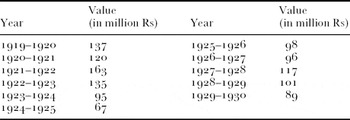
Imports of Government Stores from 1919–1920 to 1929–1930

Source: Statistical abstract for British India, numbers 61 and 63, quoted from Buchanan, 1934, p 472.
Campaign for Sourcing of Government Stores from Domestic Manufacturers
An important point of contention of the Chamber and other manufacturing interests based in India with the colonial government was the purchase of government stores, which included purchases of equipment for the massive army; materials for modernising a large number of cities like water, gas and electric and sewage systems; hospital and medical equipment, steel hardware, cement for building docks, bridges and buildings, telegraph, telephone and wireless material; and the most significant items, railway tracks, bridges, rolling stock and buildings. Table 1 shows the value of stores imported in the period from 1919–1920 to 1929–1930. Practically all of these manufactured stores came from England. The Indian industrial community, especially during the war, claimed that it was discriminated against in favour of manufacturers from the United Kingdom. It complained against this practice to the Indian Industrial Commission in 1917–1918.Footnote 95 The Upper India Chamber of Commerce, with almost exclusive European members, also voiced a very similar opinion regarding the government policy:
Government may and actually does pass business out of India when the difference in price between the Indian and foreign product is comparatively small on the grounds of so-called economy. But is this economy? India is capable of meeting all the present and potential requirements of Government in most commodities and, when orders go abroad, machinery lies idle and unemployment results . . . In particular, I think we are entitled to claim that all purchases for the military and public services should be made in India, the funds to meet the expenses of these services are raised in India and that money, as far as it relates to products and services should be retained in India . . . Apart from the financial aspect of the question there is also a tendency to lay down specifications for Government requirements which do not suit Indian conditions . . . [S]pecifications should be recast, so as to make it practicable for goods to be produced in India.Footnote 96
Opposition to the Policy of Channelising All Intra-Empire Trade through Crown Agents
The industries in Britain had an obvious advantage over manufacturers in India, and their monopoly over the markets of other British colonies was further ensured through the institution of Crown Agents. These Crown Agents in London acted as middlemen between the suppliers and the buyers to apparently facilitate business through their mediations in the Crown Colonies, and all contracts within the Empire had to be processed through these Agents. Before 1905, the year this system was introduced, the industries of Kanpur had business links with other colonies in the empire. Apparently one of its members (which the Chamber did not identify) had business with colonies of South and East Africa, Ceylon, Straits Settlements, Hong Kong, Singapore and other territories. But since 1905, when it was made mandatory for all tenders to be processed by the Crown Agents, the branch had not bagged even a single contract. The matter was strongly taken up in the Colonial Office, but apparently nothing came of it. Another branch of the British India Corporation (BIC), which used to supply goods to the police in Mombasa, Kenya, was informed in 1908 that further supplies were not required, as they had received instructions that all requirements had to be obtained through the Crown Agents at home. The Chamber was particularly upset because of the following reasons:
In no case have the rates quoted by successful tenders been made public and requests for information have methodically been refused . . ., and it has been alleged that the Crown Agents did not, for reasons best known to themselves distinguish between rates for London delivery quoted [by] manufactures at Home and the c.i.f. Colonial port price quoted from Cawnpore.Footnote 97
The Chamber mobilized opinion within the European business interest in India against the all-encompassing mandate of the Crown Agents.Footnote 98 The ASSOCHAM passed a resolution to this effect unanimously. The Upper India Chamber of Commerce campaigned against Crown Agents not only within the country but outside the country too; a significant case was that of Iraq. Iraq was not a Crown Colony but a mandated territory of Britain. Around 1924 the Iraq government received orders from the United Kingdom, instructing all purchasing units of the government to process all indents through the Crown Agent. The Chamber went out of its way to mobilise an agitation against these ‘intensely objectionable’ orders. It must be added though, that another reason for this special interest of the Chamber was because it was itself keen to supply requirements to the Iraq defence force:
We have always looked upon this department as being a drag on Colonial local trading but recent developments here to my mind justify its being described as a deliberate stand by the Imperial Government to establish a ‘shop’ supported by Government where goods must be purchased under what amounts practically to compulsion. Orders have been received by the purchasing units of Iraq that all indents should go through the Crown Agents. Such an order is sufficiently ruinous in effect to pioneers of commerce and industry in legitimate Crown Colonies but when applied to an independent kingdom like Iraq it seems to me to be worse still and seems to me to indicate that there exists a concealed element of coercion in the administrative methods of those in authority. It is true that Iraq is at present a mandated kingdom but the mandate expires in 1928 or earlier, subjected to certain conditions, and they have no right to subject the new king to petty tyranny from an obscure Government department [emphasis added].Footnote 99
Opposition to the Policy of Maintaining Positive Balance of Trade
At the time of the Depression India required a favourable visible balance of trade of about Rs 70 crores to meet her external obligations for debts and services rendered to London or ‘home charges.’ The depression had greatly reduced India's exports, which were mostly in primary products, and the shortfall was made good by exporting bullion to London. Exports of treasure, which stood at Rs 243 crores as against imports of Rs 2691 crores in 1930–1931, reached Rs 6291 crores in 1931–1932 as against imports of only Rs 741 crores for the same year.Footnote 100 From 1931 onwards India turned into a net exporter of bullion, and from 1931 through to 1939 India exported bullion worth Rs 349.41 crores. During the Depression years gold accounted for one-third of merchandise exports.Footnote 101 There is a controversy amongst economic historians regarding the nature of this gold transfer, which came almost wholly from private disinvestments of the agrarian population. Tomlinson asserts that there was a speculative interest too for the sale of gold and substantial profits were made from this trade,Footnote 102 while most others regard it as a coercive measure of the government, which further impoverished the rural masses.Footnote 103 The Chamber opposed this policy of the government, as it felt that most of the gold exported was ‘distress’ gold. It felt that the government of India, which had done practically nothing to alleviate the condition of the population of the country, should in the very least not distress the Chamber further through such coercions:
This continued drain in India's stock of gold to balance her trade is very unsatisfactory, and cannot continue indefinitely . . . [B]ulk of gold exported is “distress gold” originating from the hoards of the agricultural population, which is rural. India's method of adjusting her losses on production and maintaining her purchasing power in tines of depression . . . [is] a remarkable tribute to the capacity of the people of India to adjust themselves to economic circumstances, which they have achieved during the last 4 years without any assistance from Government beyond the remissions of land revenue. If the metallic reserves had been with the Banks, and if agricultural indebtedness had been financed by the Banking system of the country, India would have experienced a financial crisis as severe, if not more than, in America. If exports of merchandise do not rapidly increase, or imports decrease, and the gold reserves of the people are exhausted, then no amount of artificial props can permanently maintain the external exchange value of the rupee.Footnote 104
The positive balance of trade supported by the coercive gold exports bolstered the credit worthiness of the country, when the whole world was reeling under the trade Depression. The plight of the common people could have been mitigated to an extent if the government had used this opportunity to raise debt at the prevailing low interest rates and invested in productive projects. But the government did no significant investments in infrastructural development like the railways, irrigation and the roads; on the contrary investments in these sectors actually declined.Footnote 105
Support for Promotion of Internal Trade over External Trade
In the early 1930s several significant commercial, financial and political interests in India attributed the crisis of the Indian economy to the government's policies, which aimed to maintain India's external obligation at the expense of the internal economy.Footnote 106 The protection offered to several industries boosted domestic trade and industry. But the external trade lobby dominated by the Europeans subscribed to the idea that lower tariffs would increase imports, which in turn would boost exports and thus set course for the balance of trade deficit. The Chamber also dominated by Europeans opposed this position because its business interests were in direct conflict with those of the exporters:
An increase in exports and imports denotes a general revival in trade, provided that exports and imports have not been stimulated at the expense of internal trade. The idea is prevalent in some quarters that if India lowers her tariffs the increase in imports will increase exports and thereby balance her foreign trade. This is a fallacy. No country can import without exporting to pay . . . So increase in imports and exports . . . will not necessarily create balance of trade in favour of India . . . Except as a healthy expansion of internal trade an expansion of foreign trade is of no value. If foreign trade is developed merely at the expense of internal trade it is a loss to India. The internal trade of any country is its most valuable asset, is far preferable to external trade, and should be fostered by Government provided that it is on a sound basis which will assist to raise the general standard of living. The United States of America with the highest standard of living in the world, exports only 1/9th of her production. Great Britain's internal trade has gone ahead . . . since she adopted protective policy.Footnote 107
Positions Taken by Indian Big Business and European Business on the Monetary Policy of the Colonial Government
The overriding concern of the government of India for monetary policy was the same as for its fiscal policies—a balanced budget at all costs. The most significant manifestation was the fixation of the rupee–sterling ratio, which was fixed at 1s 6d in 1925. Indian capitalists had rallied for a lower ratio—1s 4d. Officially, the government had reasoned that a higher ratio would reduce its commitments abroad and would also help improve the country's image as a borrower. But, the ratio was probably artificially maintained by a conscious deflationary policy pursued by the government.Footnote 108
The Europeans in general, including the capitalists, supported the government's decision for a higher ratio. Ray asserts that this was because repatriation was higher up in English businessmen's agenda than reinvestment during the period:
It is curious to note that European businessmen wanted a higher exchange rate of the rupee even though this would produce an adverse impact on exports of jute, tea and other export products controlled mainly by European interests in India. Nothing more clearly underlined the fact of their preference for remittance as against reinvestment of their war profits.Footnote 109
Besides repatriation considerations, attractive investment possibilities in the Far East seem to have also withheld British investments in India.Footnote 110
Indian manufacturers opposed the higher value of the rupee, as it made imports cheaper, thereby increasing competition for the domestic market. They kept agitating for a lower ratio all throughout the interwar period.Footnote 111 Indians also opposed the deflationary policy of the government, which they felt was responsible for the Depression in the Indian industry: ‘Great Depression in India was not a result of the Wall Street crash, but a consequence of the government's currency policy.’Footnote 112
The Chamber's Position on the Rupee–Sterling Ratio
The issue of fixing the value of rupee vis-à-vis the sterling dominated the economic scene all throughout the interwar years and came up in a big way just before the Second World War. The Indian business class as a body resented the economic policy of the government, particularly the policy's effect on the balance of payment of the country. A deficit in the current account in 1937–1938 and 1938–1939, because of a fall in commodity transactions and poor export performance, was blamed squarely on the higher exchange rate, and the Indian capitalists campaigned for devaluation of the rupee. They also actively rallied for the support of the Congress for the move. Initially the Congress refused to endorse the proposal, but by the end of 1938 the Working Committee of the Congress passed a resolution in favour of the lower ratio. MarkovitsFootnote 113 cites this as an illustration of the growing collusion between Indian big business and the Congress. The Chamber, with predominantly European members, also took a similar position, primarily because its business interests closely matched those of the Indian manufacturers.
With the provincial autonomy implemented in 1937, and the Congress' ascendance to power in eight provinces, the British commercial interests were anxious not to concede any further power to the provinces. In July 1938, the Bengal Chamber of Commerce sent a letter to the entire constituency of the ASSOCHAM, seeking a concerted view on the rupee–sterling ratio, which was expected to be brought up by the Congress in the forthcoming session of the central assembly. The Bengal Chamber felt that the present attempt to revive the ratio controversy was primarily ‘political and constitutional’ and had the primary objective of undermining the special powers accorded to the governor general under the Government of India Act. It wanted a concerted opposition by the European group in the assembly to foil this move by the Congress:
If the Governor-General disallows discussion in the Indian Legislature, the charge will be that the special powers are so great that India is not even free to discuss a question that closely concerns her finance and commerce. If, on the other hand, discussion in the legislature is allowed and the vote is against the GOI, the decision will inevitably be ignored—rightly so having regard to the provision of RBI Act—with that another ‘grievance’ will be added to those of Congress and the demand for removal of the Governor-Generals special powers will to that extent be strengthened. Experience during the last 18 months has shown how difficult is to maintain the special powers of the Provincial Governors . . . [It is] desirable that the European Commercial Community . . . . stand solidly behind Govt. in opposing any attack of this kind.Footnote 114
The Bombay Chamber of Commerce supported the motion of Bengal Chamber and further added that as the Reserve Bank had come into existence since the last time the ratio controversy took place, the issue should be removed from the sphere of public discussion. The chambers in Calicut, Chittagong, Coconada, Cochin, Karachi, Madras, Narayanganj, Tuticorin and Burma fully supported the Bengal Chamber's views. The Northern India Chamber of Commerce in Lahore and Punjab Chamber of Commerce in New Delhi refrained from making any view because of difference in opinion between Indian and European Members.'Footnote 115 Only the Upper India Chamber of Commerce strongly opposed the move. It expressed its resentment of the economic dependence of India on the United Kingdom on issues internal to the country. The issue (rupee–sterling ratio) and the positions taken on it by various European commercial interests aptly captures the basis for contradiction; hence, the rejoinder letter of the Upper India Chamber of Commerce is quoted at length:
My Committee in the first place, do not agree with the opinion expressed by the Bengal Chamber, . . . that the issue, when the fixation of the exchange value of the rupee was under discussion [in 1925–1926], was one primarily between the GOI and a certain section of the Indian Commercial Community. This Chamber was then strongly of opinion that the exchange value of rupee should have been fixed at its then gold exchange value i.e. 1s4d, and not at its then sterling-exchange value of 1s6d, which had the effect of placing 12/2% above the gold standard when other countries were having difficulty in even attaining the gold standard. My Committee do not, furthermore, agree that this question then “formed part of the general political and constitutional problem” and strongly deprecate the suggestion that the question should now be viewed from the constitutional and political aspects only. That the question has assumed, to a certain extent, a political aspect cannot be denied but my Committee considers that it should be first and foremost viewed from the economic aspect.
It is understood that this question will be raised in a motion for adjournment in the Central Assembly. Apparently Bengal Chamber considers that the European Group should oppose the motion, not on its merits but because in some manner it may develop into an attack on the Governor-Generals special powers. This appears to my Committee to be an inadequate reason for attempting to prevent the discussion of a subject of such transcendent importance to the economic life of India.
As my Committee views this problem, the issue is not between 1s4d and 1s6d. Each of these figures is merely an arbitrary unit; neither is sacrosanct. My committee is entirely unable to understand the contention that, when Great Britain has depreciated the exchange value of her currency by 40%, India should not be permitted to depreciate the exchange value of her currency to the same extent. The subject is admittedly one of great complexity and my Committee considers that not harm but good may come from a full and frank discussion for this reason, my Committee are unable to agree that the European Group should join in an attempt to stifle discussion [emphasis added].Footnote 116
Investment versus Repatriation in the Interwar Years: The Position of Indian Big Business, European Business and the Chamber
Relatively speaking, Europeans took less initiative in the industrialisation process in India in the interwar period. As has been mentioned earlier, Bagchi put it down largely to the ‘social ethos’ of the businessmen:
Perhaps some kind of group solidarity transcending individual profit calculations prevented British businessmen from taking as much advantage of the protectionist policies in India as they might have otherwise done because of the (mistaken) belief that tariff protection was mainly directed against imports from Britain.Footnote 117
Markovits attributes the relative ‘passivity’ of British capital to the decline of the British colonial grip on India: ‘Once the Raj was reduced to a strategy for survival, British enterprise in India also lost much of its dynamism and hung on to its position but lost its major incentive to expansion.’Footnote 118 Ray on the other hand denies the influence of extra-economic considerations on business decisions by Europeans and concludes that profitability of the enterprise was the only guiding factor for investments:
Profitability being the guiding motive, capital was not withheld by them when the returns promised to be favourable. No social ethic, political motivation or tie-up with concerns at Home was strong enough to counteract the pull of profitable investment in the colony, however harmful that might be to the firms in Britain supplying India.Footnote 119
He argues that European businesses pushed for a higher ratio, in spite of its adverse effect on exports, because they were keen on repatriation of wealth to Britain:
It is curious to note that European businessmen wanted a higher exchange rate of the rupee even though this would produce an adverse impact on exports of jute tea and other export products controlled mainly by European interests in India. Nothing more clearly underlined the fact of their preference for remittance as against reinvestment of their war profits.Footnote 120
Curiously on the other hand, for Indian capitalists, Ray attributes lofty extra-economic considerations like ‘nationalism’ and ‘swadeshi spirit’ as the motive force behind investments in the interwar period.Footnote 121, Footnote 122
MukherjeeFootnote 123 makes an elaborate case for the rise in ‘nationalist spirit’ amongst a section of the Indian capitalist class during the interwar years on the basis of its opposition to the higher ratio of rupee. He argues that the class advocated a lower ratio primarily to promote the cause of agriculturists to ensure the ‘prosperity of the masses,’ even at some cost to their own interests. MarkovitsFootnote 124 sharply denies this hypothesis and instead asserts that there were sound economic judgements behind investments by the Indian business class.
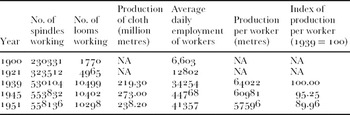
The contradictory stands taken by Indian and European big business groups on the rupee–sterling ratio have also been broadly attributed to their differing interests. The stance taken by the European business community of supporting a higher value of rupee has been interpreted as an indication that the group was primarily interested in cheap imports from, and repatriation of revenues to, England. The Indian industrialists strongly opposed the move as being detrimental to the Indian economy. The Indian business interests accused the government of purposely adopting a deflationary economic policy to maintain the higher exchange ratio.Footnote 125 This stance of Indian big business has been interpreted as the rise in nationalist spirit of the collective, evident from its growing share in the investment in the Indian industry. The Chamber, in spite of being a European chamber, kept making fresh investments in existing industries like cotton textile and leather and also new ones like the sugar industry. The growth in cotton textile industry is captured in Table 2.
Growth of Cotton Textile Industry in Kanpur

Source: Pandey, As Labour Organises, 1970, p 16.
This brings us to a very important feature of the period—the rise of nationalist politics and the Congress and its influence on business classes in India.
The Position of the Business class (Indian, European and the Chamber) in the Nationalist Politics: Interwar Years
This period witnessed hectic anti-colonial political activity, and the Congress emerged as the most formidable political alternative to the colonial government. Indian big business class sometimes wholly and sometimes factionally supported the Congress—mainly through financial contributions. Increasingly the economic agenda of the Congress coincided with those of Indian big business, and consequently the party bargained for economic and industrial concessions with the colonial government, which benefited primarily the Indian capitalists.
Ray chooses to analyse the growing closeness between the Congress and big business as primarily a religious, social and cultural affiliation:
Gandhi did not merely provide the merchant communities in their consciousness a rationale for their material wealth in their own eyes. The aura of his saintliness appealed to much deeper spiritual and religious needs of salvation. The Gujaratis and Marwari merchant communities were attracted to the charismatic role of Gandhi as Saint and Saviour, and as such their large financial contributions to the Congress constructive programmes are to be seen, not as insurance policies, but as charities. Gandhi in their eyes stood in the long succession of India's Saints, Seers and Saviour; and they responded to him as generation upon generation of their forefathers had responded to such persons.Footnote 126
MarkovitsFootnote 127 on the other hand offers a more economically plausible explanation for the association of Indian big business with the Congress. He proposes that the rise of nationalist agitation offered opportunities for putting increased pressure on the colonial government. This is corroborated by the fact that Indian business withheld a complete support till the Congress tailored its political and economic agenda to suit it as a class.Footnote 128
Thus Indian business class almost unanimously supported the Civil Disobedience Movement in the initial period to get economic concessions from the imperial government.Footnote 129 It wanted to influence the currency policy of the government which it held as the primary reason for Depression in the national economy. Another compelling factor was to repel the ‘full-scale counter-offensive by British business interests with Lancashire in particular closely aligning with the ultra-Tory opposition led by Churchill to any constitutional concession going beyond the Simon framework.’Footnote 130 But by 1932, the Congress in almost all provinces, particularly in Calcutta (where Marwaris had largely withdrawn their initial support because of their apprehension of the rising worker's militancy and social upheaval caused by the boycott), seemed to be running short of funds to sustain the movement.Footnote 131
Indian business class again rallied unitedly for the Congress only after the political agenda of the latter moved away from mass agitation and towards electoral aspirations and eventually ministerial participation. ‘This realignment enabled Indian capitalists to overcome the fairly sharp split between near loyalists and nationalists within their own ranks which had become quite marked during the early 1930s.’Footnote 132 Probably in a move towards overall coherency the Congress shifted its rural base from the masses of peasants to the landlords.Footnote 133 Indian business class seemed keen to get the most possible political and economic advantage with the least disturbance to the existing social order:
There is no reason to think that they [Indian business class] developed a split personality, between their economic aspirations and their political fears. The maintenance of the existing agrarian order, in spite of its many imperfections, suited them both politically and economically.Footnote 134
On the eve of the Congress taking office in 1937 Indian businessmen had already staked their support for it, as they analysed that the colonial government had reached the limits of concessions it could extend towards Indian business ‘without jeopardising powerful British interests.’ The Indians therefore placed their hopes on a more ‘sympathetic government.’Footnote 135 Ray sums up the two-year Congress rule as a phase of growing mutual dependence between Indian business and the Congress:
Indian businessmen generally, including those who had been consistently loyalist, came to have a greater appreciation of the commercial and industrial benefits of national rule from their experience of the Congress tenure in office from 1937 to 1939.Footnote 136
Indian business benefited from the swadeshi-oriented stores purchase policy of the Congress. The Congress also directly helped the Indian capitalists to fulfil their economic aspirations: Patel's intervention in the acquisition of Bombay Steam Navigation Company by Walchand is an example of the alliance.Footnote 137 By 1937 another phase of industrial stagnation had set in India. There was over production in sugar and stagnation in cotton textile and cement, amongst other things. Sarkar summarises it in the following manner:
The limits of growth through import substitution in consumer goods industries were being reached, given the fact that a big expansion in the rural home market required structural changes like thorough going land reforms which the Congress as well as the Indian big bourgeoisie considered socially unacceptable . . . Thus there were signs in 1938–39 of a novel and a very significant realignment. Indian capitalists, while retaining close ties with elements in the Gandhian ‘Right’ like Patel and Rajaji, had also started cultivating sections of the Congress ‘Left’ Nehru's vision of a modern industrialised India, after all, fitted in much better with bourgeois aspirations than the Gandhian evocation of rural simplicity and handicrafts, and there were enough indications already, that the former's socialist flourishes were eminently manageable.Footnote 138
In spite of an overall alignment of the Congress and Indian big business, there were two important sources of difference between the ruling Congress and the capitalists. One was on the issue of labour, which is discussed at length later, and the other was on the issue of finance.
By the end of 1938 the Congress provincial ministries faced a financial crisis owing to the loss of revenue due to prohibition and also the increased expenditure on rural uplift. This forced them to resort to unpopular tax measures. In United Provinces they introduced employment tax, which affected the professionals. This was deeply resented by the local commercial community, both Indians and Europeans. In Bombay the business opposition centred around urban property tax and sales tax on cloth. By September 1939, on the eve of the war, relationship between business and the Congress had deteriorated in most provinces:Footnote 139
The financial difficulties, which the Congress ministries faced, made an adjustment between the overall compulsions of governmental action and the sectional interests of Indian business more and more difficult . . . [W]hen its immediate interests were at stake, as during the textile crisis of mid 1939, even the most staunchly pro-Congress section of the capitalist class, the Ahmedabad Mill owners, did not hesitate to attack the ministry violently and tried to take unpopular measures.Footnote 140
Thus, to summarise, the commercial community of India drifted apart largely along racial lines, with the European group remaining firmly entrenched in the imperial scheme of affairs and Indian big business steadily aligning with the emergent nationalist political force of the Congress Party.Footnote 141
The members of the Chamber, because of the nature of their business, realised that their economic interests were more in line with Indian big business and hence decided it prudent to dissociate from the rest of the European community in overtly opposing the nationalist forces. The cotton textile interests of India, including those in Kanpur, benefited from the Swadeshi Movement (the boycott of foreign goods), which started in the 1920s. The Chamber welcomed with enthusiasm the removal of the ‘offensive’ excise duty, which was brought about primarily by the efforts of the mill owners in Bombay. The Bombay Mill Owners Association cleverly manipulated the government to concede this measure by proposing wage cuts as a counteraction to the excise duty, which further fuelled the rising labour discontent in the industry.Footnote 142 Leather and sugar industries thrived under the policy of protection and import substitution. The Chamber stood to gain from the nationalist demand for a lower rupee–sterling ratio, and therefore it chose to be the only dissenting voice in the European group in the assembly. The Chamber along with the Congress and the Indian business interest opposed the Indo-British trade pact of 1939 because of its clause on cotton textiles. The Chamber, impelled by its own economic interests, supported the political and economic opposition of Lancashire by the Congress, as did a section of the Indian business class.Footnote 143 The Chamber, probably in keeping with the strategy of its Indian counterparts, also took political positions, which were in alignment with its own; though on overtly contentious issues it kept a neutral stance by dissociating itself from direct participation. The economic interests represented by the Chamber, which catered mostly to the domestic market, seemed more closely in touch with popular sentiments and ground reality than the European business concentrated in the presidency chambers. All through the interwar years the Chamber observed and acknowledged the popular upsurge in the country—particularly the anti-colonial movements. The Chamber seemed to be keen for an environment conducive to industrial operations and took care to avoid racially determined antagonistic positions. The Chamber seemed to have consciously tried to avoid being identified comprehensively with the British interests—both economic and political. Thus, while the rest of the members of the ASSOCHAM hailed the Ottawa Agreement and opposed the move for its abolition in 1936, the Chamber proposed for more India-favouring terms:
No agreement can be satisfactory, or permanent, that is not of mutual benefit. There is no denying the fact that the present agreement has not been entirely satisfactory to India; since 1931–32 India's exports to the U.K. have increased by 10 points whereas the United Kingdom's share in Indian imports has increased by 34 points.Footnote 144
Indian big business largely withdrew from the Second Roundtable Conference when London refused to discuss the issue of devaluation of rupee, as suggested by Schuster.Footnote 145 The Chamber too refrained from sending its representative to the European business delegation of the conference.Footnote 146 The Chamber opposed the proposal of the Bengal Chamber to raise salt tax for revenue purposes, as salt had become a politically sensitive issue since Gandhi's use of it for mass mobilisation in 1927.Footnote 147 The Indian industrialists had also supported the salt campaign of the Congress.Footnote 148 The Chamber formally dissociated itself from political mobilisation of the European group, which was mainly to oppose Indian business interests in the legislature.Footnote 149 The Chamber, along with the majority of Indian big business, opposed the communist influence on the working-class movement in India. The Chamber also collaborated with Indian big business at both the local and the national levels to oppose pro-labour legislations of Congress.Footnote 150
Section 3: Analysis and Conclusion
Analysis of Contradictory Behaviour of the European Business of Kanpur
In the preceding sections, I have tried to argue that European business community of Kanpur consistently took position in contradiction with the expected behaviour of European business class in India. No amount of racial compulsion could make it sway under the combined pressure of European business community locally and in Britain, when it conflicted with its own economic interests. No feeling of loyalty and patriotism for its home country could make it shy away from opposing the government policies even during the uncertain times like the war and the gradual transfer of power. But what could induce this collective to stick to such a consistently ‘anomalous’ behaviour? It needs to be emphasised that one is not talking about a few whimsical individuals but a collective, which was not confined to a peculiar industry but represented an array of industries, and its ‘contradictory’ view is not on a specific issue but actually over a host of issues spread over half a century. Finally, and probably most importantly, these were not its private musings but formally documented official positions.
In an earlier paperFootnote 151 I have examined the reasons for this ‘anomalous’ behaviour of the European business community of Kanpur. The explanations can be summarised under the following points:
Kanpur's European Business Community Was Primarily Involved in Manufacturing
Historically, by a peculiar combination of economic, locational, social and political factors, the European business community in Kanpur entered and flourished in an industry which was not patronised by Europeans in India in general—cotton textiles. Thus, from the very inception of large enterprises in the city, Europeans chose to enter an industry which had as a rival politically the most powerful industry of Britain, in spite of the risk of inviting adverse social pressure in Britain ‘as well as in India,’ as argued by Sen.Footnote 152 Subsequently too, Kanpur's European business interests were largely confined to manufacturing industries, catering primarily to domestic markets. Whereas the European businesses in India, particularly those based in the presidencies, were primarily interested in trade—especially in external trade.Footnote 153 Though these chambers had significant manufacturing interests, the stronger trading community outnumbered them by many. Kanpur was also an important centre for internal trade. But, being situated in the hinterland with no port in proximity, it had no significant linkages with the external trade of the country. This peculiarity of the Chamber of having homogenous manufacturing interest often led them to take positions in contradiction with the other European chambers dominated by trading interests.
Kanpur's Factories and Manufactures Catered Primarily to the Domestic Market Including the Army and the Government
European commercial community in India had a significant interest in export-oriented manufacturing industries like jute, tea (a commercial crop), coal and others. The Chamber on the other hand was into industries like cotton textiles, sugar and leather, which catered to the domestic market. The fledgeling domestic industries of India including those in Kanpur had to face a stiff competition from the industrialised countries of Europe and Japan. Therefore Indian big business campaigned for protection of domestic industries and welcomed the government's tariff policies during the interwar period.Footnote 154 On the other hand Europeans who dominated export-oriented industries, which would benefit from free trade, opposed it.Footnote 155 The chamber representing European business interests of Kanpur campaigned for tariff protection to promote its industries.
During the Depression years the Chamber was quite concerned about the very large exports of bullion, which originated primarily from the rural population and, according to the Chamber, was predominantly ‘distress’ gold. The Chamber criticised the government for not only doing nothing to alleviate the condition of the agriculturists but also for actually pushing them to part with their meagre savings. The nationalist section of the Indian business class had taken similar stands on the issue,Footnote 156 but the Chamber's position definitely cannot be attributed to ‘nationalist’ feelings towards India. A possible backlash against industry due to an impoverished agricultural population must have been an important consideration for the stand of the Chamber.
Increasingly the Economic Agenda of the Chamber Matched with Those of the Nationalist Movement (Represented by the Congress)
The interwar years were marked with increasing divergence and antagonism between the interests of European business community and Indian business class. The Europeans, because of their racial affiliations remained bound to the imperial order, while a section of Indian big business increasingly associated with the nationalist movement (which was challenging the imperial rule) led by the Congress Party.Footnote 157 The Congress, which became a formidable contender for political power in this period, gradually started to depend largely on the contributions of the Indian business class, and in return the Congress came to accept the economic agenda of the business class particularly on issues like excise, tariff and exchange rate.Footnote 158 Markovits and SarkarFootnote 159 argue that Indian big business did not openly antagonise the colonial masters and basically used its association with the Congress as leverage to gain economic concessions from the government. It often left the movement in a lurch when the movement strayed too uncomfortably towards harming its own financial or other business-related interests, like on the issue of the rights of labour. The Congress on the other hand by the late 1930s became so dependent on support by the big business that it kept modifying its agenda to woo Indian big business class including the loyalist even at the cost of undermining the causes of its popular base in the peasantry and the working class.Footnote 160 As is apparent from the preceding discussion, the economic interests of the Chamber matched with Indian big business; therefore, probably in keeping with the strategy of its Indian counterparts, the Chamber also took political positions, which were in alignment with those of the former, though on overtly contentious issues it kept a neutral stance by dissociating itself from direct participation. Thus the members of the Chamber were attempting a fine balancing act between retaining the economic, social and political advantages of being European in the existing colonial context without alienating themselves from the rising counter-political force, particularly in the eventuality of a change in political power.
Existence of Racial Bias in the European Commercial Community of Kanpur: A Rider
The above discourse on the contradictory behaviour of the Europeans in Kanpur is not to imply that there was no racial bias of the collective. On the contrary the data suggest that the members of the Chamber believed in racial superiority of the Europeans on all issues except for those in which such a bias took a backseat ostensibly because of overriding business considerations. This is evident from the attitude of the European employers of Kanpur towards their workers. To quote:
[F]rom the time a worker comes in the mills, until he leaves, he is stupid, unskilled, untidy workman, caring nothing for his employers' interests and taking none in his own work.Footnote 161
They derided the native workers and their culture, often to justify their callous attitude towards the working and living conditions of the labour. Thus they opposed the move to reduce the workday to 12 hours because:
while shorter hours are suited to highly civilised and vigorous European nations, they are utterly unsuited to the lethargic oriental who is incapable of continuous work.Footnote 162
They opposed the introduction of legislation related to compensation of injuries received at work site because they thought that it would induce the workers to voluntarily inflict injuries on themselves to avail the provision:
As soon as the Indian worker would know that compensation for injuries is to be enforced by law minor accidents will . . . be of exceedingly frequent occurrence. Half pay without work, even at the cost of some immediate suffering, would appeal to a large percentage of workers in India.Footnote 163
The European employers seemed insensitive to the economic and social context of the workers and even exploited to their advantage the ensuing conditions of large-scale calamities like the influenza epidemic of 1917–1918: ‘[T]he failure of the rains has left agriculture with surplus labour which is finding its way back to the towns and to the mills.’Footnote 164
The attitude of these European employers towards women and child workers blatantly displayed their racial bias. For example the enforcement of regulations, like those recommended by the Washington Convention regarding labour, was opposed on the pretext of cultural differences between the Indians and the Europeans: ‘[A]n Indian boy of nine is far more precocious than a boy of the same age in the Western countries . . ., [as] Indian children are not regarded psychologically unfit for marriage at an early age.’Footnote 165 Further it was even suggested that working in factories from a very tender age would keep them off the streets and ‘other objectionable employment’ and thereby ensure that they ‘gain at the most receptive and important period of their lives a knowledge of the work which is to be expected of them during life.’Footnote 166 Thus the mere act of employing children, sometimes as young as six years of age, was made out to be an act of charity to them and to the working class in general.
Only with the gradual organisation of the working class could the native labour force wrench some rights regarding its working conditions. Thus the Europeans of Kanpur probably had as much racial bias against the natives as any average European in the colonial era,Footnote 167 but because of the peculiar nature of their business, on several macroeconomic issues, they had to take the positions which contradicted with the interests of the European in general in India and in Britain. Though, besides a racial explanation to the behaviour of European mill owners towards the Indian labour force, there was also a class dimension that they shared with their Indian counterparts, which would be analysed later.
Thus, to conclude this section, one may say that the Upper India Chamber of Commerce represented a collective which displayed all the advantages of a small group as theorised by Olson.Footnote 168 Constituting a relatively smaller collective, compared to the presidency chambers, and having fairly homogenous and non-clashing, intra-group economic interests, it was ‘successful’ in pursuing its common ‘good’ with an exceptionally effective singularity of purpose. European business community of Kanpur through a complex period in history pursued its economic interests even when these interests seriously clashed with the interests of the larger collective of Europeans. And yet this ‘special interest group’ took all the advantage which accrued to it—socially, politically and economically—because of belonging to a race which dominated the country colonially. Or in other words the members of the Chamber actively pursued the interests of their specific ‘sub-group’ and hoped to gain a ‘free rider's’ advantage of belonging to the dominant race, even though the sub-group's specific interests clashed with that of the larger collective.
Analysis of Indian Big Business through a Comparative Understanding with the European Business Group in Kanpur
I have systematically tried to argue in this paper that data indicate that there were sound economic considerations for most of the positions taken by the Upper India Chamber of Commerce not only in the economic domain but also in the social and political domains during the interwar years. Though, some of the positions are not explainable by the immediate ‘logic of profit’ as suggested by Ray,Footnote 169 they are appreciable when viewed from the long-term interest of the business. Of course the nature of business—manufacturing—has a time frame and other related considerations very different from those of trading, as has been argued above. What is remarkable is that the Chamber's positions were very similar to those taken by Indian big business during the period, and the similarity was much more marked in the interwar period when European and Indian big businesses in general took largely antagonistic stands against each other.Footnote 170 Thus the European business community of Kanpur, instead of ‘consciously’ setting itself apart from the ‘native businessmen and claiming cultural and racial affinity with the British rulers in India,’ as suggested by BagchiFootnote 171 about European business class in India in general, consciously aligned with Indian big business on several contentious issues.
The positions of the European business collective in Kanpur in the political and social domain too were similar to those of Indian big business, particularly in the post–World War I period. The Chamber as a body displayed an equally ‘morbid preoccupation with the development of the industrial resources of India in order to remove the poverty and social misery in the subcontinent’Footnote 172 as did Indian big business, but, in the case of Europeans in Kanpur, it does not seem to emanate from their ‘deeply religious’ and ‘piestic’ qualities,Footnote 173 as suggested for Indian big business. On the other hand, as has been argued earlier, there were serious economic and political implications of the prosperity of the masses, or the lack of it, for the business community of India. Probably the reason for which powerful businessmen, of diverse racial origin and engaged in very different businesses, were forced to act similarly did not lie within the business class but with the masses of ordinary individuals from various walks of life, including the peasants and the workers and their aspirations for a better economy and a better society. Probably the phenomenon can be understood only if one takes into account the phenomenal anti-imperialist groundswell during the period covered in the present study.
On the basis of the above argument I would like to make an observation on Indian big business. As I discussed in the beginning of this paper there are two divergent views on the nature of Indian big business particularly in the period from the First World War to the independence. One school of thoughtFootnote 174 feels that a section of Indian big business was guided by ‘nationalist feelings’ which made it sacrifice its personal interests in favour of the larger cause of development of the nation. But since a similar ‘aggressive nationalistic desire’ cannot be attributed to be the reason for the behaviour of Europeans in Kanpur, one tends to agree with the other view,Footnote 175 which puts forth an economic logic to the behaviour of Indian big business. They claim that this business group, like the business class in general, sought the maximum possible advantage for itself and towards that end aligned with political forces, which offered it the desired objective. Indian capitalist class opposed any fundamental change in the existing arrangement—economic, social or political—which would have been detrimental to its interests.
MukherjeeFootnote 176 makes an elaborate case for the development of the Indian capitalist class as a ‘mature self-conscious class’ not because of the colonial context but in spite of it. The two major arguments built by him in support of this above assertion are based on the process of development of this class in the interwar years:
• Indian business class emerged because of its struggle against colonial domination, particularly against the metropolitan bourgeoisie.
• The class developed the ability to subordinate various intra-class conflicts as well as make concessions to other classes—taking it ahead of any other class in the anti-imperialist movement in India.
The present study suggests that with a similar yardstick the European business class in Kanpur displayed as much ‘struggle’ (if not more) against the metropolitan bourgeoisie as Indian big business not only in the interwar years but also from much earlier. For some peculiar reason Kanpur's business collective went for industries which could not be fully supported by the government because of its imperial linkages. And after that, for a long and complex period of history, the behaviour of businessmen of Kanpur was not solely determined by the norms of the race but also by the context of the industry. It is often indistinguishable from those of Indian big businessmen, not just the ‘loyalists’ but actually even the ‘nationalists.’
MukherjeeFootnote 177 asserts that the concept of the Indian capitalist class and its nationalism is inextricably linked with the formation of the Indian nation state. But since on those same issues the Europeans in Kanpur displayed as ardent a ‘spirit’ of nationalism as their Indian counterparts there is probably a more general explanation for the behaviour of business class in India. I would like to argue that the primary objective of the capitalist class in any context is to further its economic interests by exploiting and manipulating and if required by adjusting to the larger socio-political context. Thus the European business group in Kanpur took all advantages accrued to it because of its racial affiliations and yet aligned with the Indians on issues of common interest. It could not openly support the Congress but took neutral political positions while coming out clearly in support of the economic agenda favoured by the Congress. It dissociated itself from the patently antagonistic stand taken by the majority of the European community. Though it did not invest extensively during the 1930s and the 1940s, they did not repatriate wealth either. One gets the feeling that it wanted to remain on the correct side of the Congress, in case of the imminent transfer of power, to be able to continue business even after a political change at the centre. And, of course, much of the economic social and political agenda of the Congress would have been more advantageous for its industries, which were domestic-oriented, than the imperial policies of the British Empire. It even came out in support of the national interests and aspirations of the common people.
There seems to be an analogy between the behaviour of the European businessmen of Kanpur in the face of a declining empire's control and that of the Indian business class in the high noon of empire. Indian capitalists maintained an intermediary and subordinate role to the Europeans during the peak of the colonial reign. They got into the so-called risky industries not because they were nationalists but because the easier ones were denied to them in the earlier stages. But with the emergence of a viable alternative political force because of the strong nationalist movement, they associated with it to expropriate economic concessions from the colonial government. The Congress was able to get only a partial backing of Indian big business till the early 1930s, and only when the party moved away from the mass movement strategy to compete and form stable parliamentary government did it get a fuller support. The so-called rapprochement with the Left in the party is also explainable from the analysis of SarkarFootnote 178 and from the data collected in this study. The rural swaraj system of Gandhi did not gel with the aspirations of the big business, but the socialist group within the Congress without a revolutionary agenda and mass agitation had a definite place for big industries, which the big business wanted to capitalise. Thus it was not the formation of nation state that moulded the national big bourgeoisie, but instead in the possibility of its formation this class saw an opportunity for furthering its own interest.
RayFootnote 179 contends Bagchi'sFootnote 180 assertion that native businessmen were only marginally ahead of the government policy. He cautions that if that were so, then it would imply that even if racial discrimination were removed there would not be much difference in the behaviour of private sector. The experience of Kanpur proves that eminently. The present study indicates that the behaviour of capitalists was not determined by race but by the nature of business. Thus a domestic mass market–oriented manufacturing sector would inevitably have contradictions with the trading sector, particularly international trade, and also with the export-oriented industries. A concern for overall development of the economy and population is also a business requirement for industries catering to the mass market—and not just an extra-economic emotion like nationalism and charity, amongst others. And probably more importantly, correctly judging the popular political sentiments and even campaigning for policy level concessions, without jeopardising business interests to any great extent, to maintain a stable socio-political environment indicate an eminently shrewd business policy on the part of the Europeans of Kanpur as well as Indian big business.
The second inference of going beyond class interest is even more tenuous as would be evident from the attitude of the business class towards labour.
Attitude of the Business Class towards Labour
Attitude towards labour is a useful indicator in support of the proposed thesis. Europeans, as has been seen through several writings, considered themselves racially superior and kept to their exclusive society in their day-to-day interaction through clubs, dress, customs, etc. as well as social relationship like marriages. That European business class with its racial affiliations with the rulers would exploit the native workers and have scant regard for them as humans is not surprising. But literature, and even the current study, shows that Indian business class was as callous to the conditions of the workers.
The large mass of workers in the organised sector was generally not unionised till the 1920s. But throughout the 1920s and 1930s workers unions came up in all important industrial centres of the country. Many of these unions had strong linkages with the nationalist struggle led by the communists as well as the Congress. Thus the interwar period was very significant in the history of labour movements and organisation. The workers were able to wrench several legislations in their favour from both the colonial government and the Congress ministries in its two-year reign from 1937to 1939. The strength of the labour movement was enhanced by their participation in the nationalist movement. Interestingly, in spite of the growing antagonism between the Europeans and Indian employers, they remained united against the aspirations of the workers. DasguptaFootnote 181 contends that workers in large-scale enterprises in colonial India, not only in the initial phases but also in the closing decades, lived and worked virtually in captivity. The business class had to keep good relations with the authorities to check the adverse economic effects of an organised workforce:
The development of an organised labour movement in India in the 1920s therefore posed a growing threat to the major Indian (as well as the British) business interests and gave the colonial state some supplementary leverage in its dealings with Indian businessmen. The help of the colonial repression apparatus was necessary to prevent the labour movement from endangering business profits.Footnote 182
The class solidarity amongst businessmen is particularly evident during the provincial rule of the Congress. The working class as well as the bourgeoisie in India welcomed the ascendancy of the Congress to the office.Footnote 183 But, early pro-labour policies came under severe criticism from the Indian capitalists.Footnote 184 The workers' increasing militancy and rise in trade union activities sharpened the differences between the employers and the workers. The strikes affected both Indian and British capitalists of United Provinces and other provinces like Madras.Footnote 185
Most of the factories operated for very long hours under inhuman working conditions. Any move towards improving the conditions of the working class was collectively resisted by the business class. At the turn of the twentieth century the Chamber joined the Indian cotton interests to protest against legislation to restrict the working day to 12 hours from the then existing norm of working up to 16 hours. An Ahmedabad mill owner voiced a similar sentiment when he advocated long hours as a remedy to drinking problems among labour, ‘as there would be no time to drink.’Footnote 186
The Chamber continuously opposed any move to raise the minimum age for child labour, claiming that it would be ‘harmful both to children themselves and to industry.’Footnote 187 As mentioned earlier, they even claimed that children of the Orient were more precocious than the children in the West, as they married at a much earlier age than their counterparts in the Western countries. On these grounds they opposed the adoption of Washington Convention requiring the minimum age of child workers to be raised to 14.Footnote 188 Similarly, factories in Bombay (largely owned by the Indians) evaded the shortened workday (six hours) for children awarded by the Indian Factories Act by employing them in two consecutive shifts often at two different factories, so that neither could be held responsible for the violation.Footnote 189
All through the interwar years the Chamber voiced its growing alarm towards the unionisation of the working class in Kanpur as well as other industrial centres. In Kanpur, European business interests associated with Indian big business to stave off the increasing strength and demands of labour. Both Indian and European businesses of Kanpur viewed the formation of the Congress government in seven provinces and its initial pro-labour policy with anxiety. In 1937 they jointly formed the Employer's Association of Northern India (EANI) to safeguard the interests of the business class against the growing labour movement and the ruling Congress government that had to concede some pro-labour legislation after its assumption of office in the province. Significantly the office of EANI was in the premises of Upper India Chamber of Commerce, and the noted Congress supporting industrialist Padampat Singhania was one of its founding members and also its president during the war years.Footnote 190
Thus, in spite of the growing closeness of Indian big business with the Congress, it unitedly opposed any steps taken by the movement for the uplift of labourers and their unionisation. It was not ready to accept any measures which would have been detrimental to its immediate economic interest in spite of the possibility of weakening a long-term united front against the imperial powers. To safeguard its economic interests it even financed extremist parties like the Mahasabha and the Muslim League to counter the Congress during its period in office:
[J.P.] Srivastava [a U.P. magnate who was then a minister in the Viceroy's Council] . . . today told me that after the Congress's success at polls and assumption of office in U.P. in 1937 the leading industrialists—all, I think Hindus—got together and decided to finance Jinnah and the Muslim League and also the Mahasabha, as the extreme communal parties to oppose Congress who they feared might threaten their financial profits.Footnote 191
In spite of ‘being seized by the aggressive nationalistic desire for achieving an economic miracle and eradicating the ills of backwardness,’Footnote 192 nothing could induce Indian big business to share a fraction of its profits with the working class. Far from making concessions to the basic classes as suggested by Mukherjee,Footnote 193 it was opposed to any fundamental changes in the social relationship not only in the urban setting but also in the vast rural areas primarily under agriculture. Therefore it withheld a complete support to the Congress till the party realigned its interests with those of the feudal landlords and the capitalist class, moving away from the masses.Footnote 194 The unanimity of the business class on issues regarding labour and labour rights, and the consistent class solidarity displayed by both the Indian and the European employers, indicates that economic considerations were the primary criteria determining business decisions of this class irrespective of its racial affinity. As a class it was opposed to any move that fundamentally challenged the social hierarchy and its financial interests whether in agriculture or industry. The business class was keen to gain the maximum advantage for itself and therefore was as ready to use imperial connections as its association with the nationalist movement towards this primary objective. To summarise, as Bagchi argues, capitalist enterprises under the colonial regime, irrespective of ownership (whether merchants from metropolitan countries or indigenous investor), functioned in a phenomenally wasteful and inefficient manner to the detriment of the technological advancement of not only the colony but also the metropolitan centre:
Thus colonialism almost inevitably results in the retardation of the forces of production by inhibiting technological change, routinising coercive and brutalising (and not just dehumanising) labour processes, and sustaining a social process that requires the regular waste of a considerable amount of human and non-human resources.Footnote 195
Conclusion
To conclude, the existing scholarship on the colonial period is largely in agreement that Indian big business actively campaigned for economically patriotic policies during the interwar period. And yet there is a sharp divide in literature regarding the reasons for the same: One group believes that this was because of a rise in nationalism in Indian big business wherein the collective rose above its own class interests, often sacrificing individual gains, to contribute to the ongoing nationalist struggle in the country. The other group of scholars assess that Indian business class had adequate economic reasons to seek protectionist policies and support the nationalist movement led by the Congress. An important reason cited by the group proposing that nationalism guided Indian big business is its growing antagonism against European business class during the interwar years. Almost up to the First World War the commercial scene of colonial India was dominated by the Europeans, with the Indians largely relegated to a subordinate role. This often led to an accusation levelled against Indian business class of being collaborationist in nature vis-à-vis the imperial order or, in other words, of compromising national interests in the interest of its class. Thus when Indian big business took positions which were in contradiction with European business class, European community and sometimes even the colonial government, it was interpreted as emanating from nationalistic spirit.
The present study brings forth the case of a European business collective in colonial India which had business interests similar to that of Indian big business—the European commercial interests of Kanpur. And I have systematically tried to demonstrate that its positions on diverse issues were similar to that of Indian big business not only during the relatively politically neutral period before the First World War but also during the politically sensitive interwar years. An in-depth analysis of the positions of the Upper India Chamber of Commerce on economic, political and social issues indicates that it was influenced by its commercial interests. This leads me to conclude that the behaviour of Indian big business, as a collective, was also guided primarily by its economic considerations.
The assertions made in this paper are not to claim that big business class in colonial India was a homogenous entity irrespective of the diverse races, communities, castes, regions, political affiliations, etc. it represented. In fact as I have tried to illustrate here and in an earlier workFootnote 196 even the apparently homogenous European commercial community had heterogeneous interests due to various social, political and, most importantly, economic reasons. What I have tried to argue in this paper is that the interests of diverse groups may converge unexpectedly when there are overriding economic reasons for it. And under such compelling circumstances, as in this case, big business group in colonial India seemed to display an apparently homogenous class consciousness because of a complex interplay of its divergent contexts. And finally, the factor which most comprehensively influenced the class consciousness of big business class in colonial India was its converging economic interests. This is probably similar to the process of development of working-class consciousness in the same period. In a path-breaking work on the social organisation and political action of the working class in colonial India based on the study of the textile mill workers of Bombay, ChandavarkarFootnote 197 brings out the complex interplay of the role of the state, the employers and the workers. The work details their multi-layered interactions and examines the nature of the social formation of working class ‘both as it was influenced by and as it shaped the nature of development of industrial capitalism in colonial India.’Footnote 198 Chandavarkar skilfully presents the complex process of formation of working-class consciousness not as exclusive of or rising above the various divergent social identities constituting it but actually as a combination of a wide range of identities. And further, working class' association with nationalist politics did not obliterate class differences but actually contributed to enhance its class consciousness.Footnote 199
To summarise, the data on the European business community in Kanpur suggest that unlike what is seen in the literature, extra-economic considerations like racial affiliations, ‘social ethos,’ ‘nationalist’ feelings and ‘patriotism’ do not necessarily determine economic behaviour of the business class. On the contrary the business class often used them to assuage and manipulate popular sentiments to promote its business interests. Or in other words social contexts do not necessarily govern the economic behaviour, but on the contrary economic activity often defines the social context and therefore the political behaviour of the business class, irrespective of the initial social distinctions like race. My data also indicate that even economic compulsions cannot be fully appreciated by confining one's enquiry to the economic domain, and a much richer picture emerges if one explores the political and social role of the economic entity. As Ray astutely observes:
the exact significance of non-economic motivations can never be appreciated until the possibility of explanation of investment decisions in terms of profit incentives has been thoroughly explored. This is something which propagandists and scholars, who emphasised cultural attitudes and political motives, did not always care to explore in the past.Footnote 200
While broadly agreeing with Ray's assertion that ‘economic motives’ ought to be exhausted before appealing to ‘cultural and political’ motives, I would like to add that a fuller understanding of economic motives is possible only by analysing their sociological and political manifestations and thereby appreciating the deeper economic objective behind them.
Acknowledgement
The present paper is based on a larger work which was the basis of the PhD degree awarded to the author by Jadavpur University, Kolkata, India.
I have gathered innumerable debt to several individuals and institutions during the course of data collection, and though it would be impossible to thank them separately I would like to put on record my gratitude for all the help. I am greatly indebted to Professor Amiya Kumar Bagchi and Professor Biswajit Chatterjee, my thesis advisors, whose guidance made this work possible. To Rahul Varman I owe so much—intellectually and otherwise—that I would not attempt to thank him in words. The paper has also benefited from the inputs of the anonymous reviewers of Modern Asian Studies. The usual disclaimers regarding the faults in the paper apply here too.
Appendix A: The Annual Reports of Upper India Chamber of Commerce: Significance as a Data Source
The Upper India Chamber of Commerce, which is situated in Kanpur, was formed in 1888, and only the presidency chambers of Bengal, Bombay and Madras preceded it in importance during the colonial period. The Chamber played a crucial role in shaping the industrial and fiscal policies of the region. It took active interest in the provincial and central legislature and played a key role in important constitutional subjects like the Morley Chelmsford Report, Simon Commission, Franchise and Delimitation Committees, the Roundtable Conferences and the Joint Select Committees.Footnote 201 The Chamber was entitled to send two nominated representatives to the legislative councils of the province. The member in charge for finance in the United Provinces discussed all important finance-related issues including the budget with the president of the Chamber before presenting it in the legislature.Footnote 202 The Chamber was the most important mouthpiece of the European business of Kanpur on all issues affecting it, including government policies, industrial disputes, political positions and labour. The central committee of the Chamber, which included the president and other important members, coordinated all interfaces with the government, bureaucracies, other chambers of commerce and commercial bodies and associations. The Chamber also had dedicated committees for important industries like cotton textiles, leather and sugar to look over the interests of the members associated with it. Further, there was a committee to mediate on labour issues in the region. The role of the Chamber was central to European businesses in Kanpur because their interests were fundamentally different from those of the presidency chambers. The importance of the Chamber in the words of its representative in a speech given at the Montreal conference in 1903:
My chamber is the commercial mouthpiece of large and important tract of the Indian Empire with 12 times the population of Canada. I have travelled 12000 miles to attend these meetings. My Chamber draws its members from a territory having population of 70,000,000. I am here to represent the commercial interests of a population of citizens of the British Empire nearly twice as large as the combined total of the Great Britain and the self-governing colonies, and larger than the total population of your neighbours to the South—the United States of America.Footnote 203
An important criticism of this work could be its overwhelming reliance on documents which many feel are merely the public positions of a business group—probably a public relations exercise in keeping with the politically correct positions of the period. What is basically implied is that this may not be the actual sentiment of the group but some kind of a doctored position to gain the most possible advantage from the prevailing social, political and economic contexts. And such an accusation is primarily based on the observation that the documents are not from an ‘objective third party source’—and are actually from the official mouthpiece of the group being studied. I find this argument for discounting the importance of the documents not very convincing for the following reasons:
• Firstly, most historical sources have the aforesaid disadvantage of being subjective to a particular vantage point, and the skill of any historian, I think, lies in unravelling the vantage point(s), contextualising it, and then analysing the document in the specific context of the study undertaken. No historical document can claim to provide an unfiltered truth; the primary task of the historian is to discover the filter used to understand the partial truth presented in the document.
• Secondly, the very limitation that is being levelled at the annual reports of the Upper India Chamber of Commerce, of being the official mouthpiece of the Chamber, according to me contribute to its importance the most. While sifting through the reports what struck me as most noteworthy, was the fact that the members of this collective of European businessmen chose to denounce the policies of the colonial government, take public positions against the majority of fellow European businessmen and also support several measures and demands mooted by Indian big business during a period of extreme antagonism from the business class along racial lines, not in their private papers, individual noting, private musings or in the evening discussions in the club or race course (as they may have done it there too, but those most likely have not been recorded) but in their most important public platform—the annual reports. This was the stand taken by the collective which it could not deny even if it wanted to, and it would have known, astute businessmen that its members were, that the stand would have repercussions too from some of the most powerful constituencies of the country at the time. And this was no isolated incident, as one president of the Chamber may have bullied his way through the other members, but this was its stand for a long period (and I have data for 50 years)—consistent and increasingly becoming more antagonistic to the European collective (government, other businessmen in India and Britain) as a whole.
• And finally, the whole of the evidence cited for the positions taken by Indian big business regarding its disposition towards the colonial government, rising nationalist politics and fellow businessmen both Indian and European is based on documentary evidence which would be subject to similar criticism. The private papers, the letters, the reports, the oral evidence, the newspaper reports all have a particular purpose and a particular context wherein they are situated. I feel a pursuit to search the elusive ‘true position’ is meaningless, unless one specifies the interpretative tool that is being used for the purpose. And anyway one is not attempting a psychological analysis of individual(s) or group of businessmen (which undoubtedly may throw up interesting and contradictory narratives); one is trying instead to compare the public positions taken by two different socio-economic groups for a particular period, analyse the same and come up with better understanding of the group(s) under study.
Appendix B: A Brief Outline of the Industrial History of Kanpur
Kanpur's economic history has undergone dramatic swings in the last two centuries. From its inception in 1778 as an up-country army camp of the East India Company, Kanpur rapidly grew as an industrial and trading centre. The important industries of the city were textile, leather, ordnance and engineering. But, in the last three decades of the twentieth century the industrial activity has rapidly declined and, at present, almost all the large-scale factories of the city have either closed down or stopped functioning. Cotton and indigo plantations flourished in the early nineteenth century. Leather was the most important industry during this period. The central location of the city also helped in the movement of merchandise, and Kanpur emerged as a leading trading centre. The start of large-scale industrial activity can be dated to 1861, when the first integrated textile mill came up in Kanpur—The Elgin Mills. By the end of the century there were four large textile mills running in the city. Leather industry also expanded during this period. Among other industries that came up during this period were wool and heavy chemicals. The development of these industries was primarily due to captive demand provided by the army. By the beginning of the twentieth century, Kanpur was already an important industrial centre of north India. But, the most hectic industrial activity in the city has been during the two world wars and the period between them—basically from 1914 to 1945. The boom created by the First World War benefited the traders of both European and Indian origins, who made huge profits (largely by hoarding and speculation) during the period. This strengthened their position in trade and finance. Many new industries also came up during the period. This period also saw the emergence of Indian-owned enterprises, the most important of them being the House of Juggilal Kamlapat (the JK Group). Three cotton mills, a jute mill, an oil mill and a steel rolling mill of the JK Group came up during this period. All this industrial activity created a large employment base. In 1920, there were 44 factories employing around 28,000 people; by 1939 it had gone up to 90 factories employing around 56,000 people. The onset of World War II propelled the local industries to an unprecedented and exponential growth. In the six war years the number of factories doubled to 176 and the employment rose to 1,16,252 workers.