INTRODUCTION
Ethical standards generally require termination of animal experiments before obvious suffering of experimental animals. This precludes survival studies from using actual death as the readout. The definition of appropriate and objective humane endpoints has thus become a pervasive problem for improving the ethical standard in animal experimentation. In particular, defining objective and robust endpoints for infectious disease research has proven difficult. However, since infectious disease in humans can often be acute, aggressive and deadly, survival is a valuable readout for testing of e.g. potential drug candidates. Objectivity can be considered a golden standard in humane endpoint measurement; however, many animal models still lack unbiased and reliable objective endpoints. This complicates the use and comparison of survival studies. Additionally, with the progression of technology and ‘out-of-animal’ research techniques, animal inspectorates and the public at large are increasing the demand for objective and humane measures. In our research on experimental cerebral malaria (ECM), we proposed the use of a core body temperature (BT) below 32 °C as an objective predictor of morbidity and death in the classical Plasmodium berghei ANKA/C57Bl/6j ECM model (Wiese et al. Reference Wiese, Hempel, Penkowa, Kirkby and Kurtzhals2008). Furthermore, BT has been proposed as an objective humane endpoint in models of sepsis, viral and fungal infections in the past (Soothill et al. Reference Soothill, Morton and Ahmad1992; Wong et al. Reference Wong, Saravolac, Clement and Nagata1997; Stiles et al. Reference Stiles, Campbell, Castle and Grove1999; Warn et al. Reference Warn, Brampton, Sharp, Morrissey, Steel, Denning and Priest2003; Nemzek et al. Reference Nemzek, Xiao, Minard, Bolgos and Remick2004). In our efforts to establish a lethal model of severe malarial anaemia (SMA), we opted to use the Plasmodium chabaudi AS-infected A/J mice model as described earlier by Yap and Stevenson (Reference Yap and Stevenson1992) in order to evaluate hypotheses concerning erythropoeitic suppression in future studies. In order to assess lethality we wished to implement BT as an objective humane endpoint for this model that has – to our knowledge – not been previously described.
Furthermore, repeated endpoint assessments are required to adhere to humane endpoints in a timely manner. We have recently been concerned with the invasive nature of repeated rectal probe measurement in our assessment of animal well-being, as it carries a risk of intestinal perforation. We therefore wished to assess the feasibility of minimally invasive BT measurements through use of non-contact infrared emission thermometers. This would allow us to take more frequent measurements of our endpoint without increasing distress and complications associated with acquiring this measurement. However, this method must be able to robustly reproduce core BT measurements from rectal thermometers, especially in compromised animals with vascular and neurological distress.
In this study we present analysis of the implementation of BT <30 °C as a potential objective endpoint for the study of SMA with a lethal Plasmodium chaubaudi AS infection. Additionally, we study if the minimally invasive infrared-emission measurement can reliably measure BT in mice in comparison with the rectal probe.
MATERIALS AND METHODS
Animals and ethics
All animals were kept under standard conditions in a closed, ventilated rack system with food/water access ad libitum. All studies were conducted to minimize suffering and in accordance with the Danish Animal Experiments Inspectorate according to licence 2012-15-2934-00449.
Infrared-emission measurement
In the initial testing, an infrared thermometer (845, Testo, DE) was tested against rectal probe (DM852, Ellab, DK) measurement to determine, calibrate and standardize the emission index and the method of handling. Animals were restrained by the neck skin and tail. Measurements were obtained by tracing the epigastral region and the maximum registered temperature was reported. This region was chosen based on pilot experiments in other regions of the mouse body (head, back, abdominal) where temperatures did not report similar to core body temperature. An emission index of 0·75 was determined to be ideal and adopted throughout the study. Emissivity is a measure of efficiency of an object to emit thermal energy relative to a theoretical ‘perfect’ black-body emitter (emissivity = 1·0).
Cervical dislocation
Investigator #1 determined the BT of C57Bl/6 mice (N = 5) with infrared thermometer. Blinded to the infrared measurement, investigator #2 inserted the rectal probe to a pre-defined depth. Thereafter, anaesthesia was induced with i.p. hypnorm/dormicum and animals were killed by cervical dislocation. Infrared and rectal probe measurements were repeated every 5 min until BT dropped below 29 °C.
Plasmodium berghei cerebral malaria
Throughout a previously reported study (DellaValle et al. Reference DellaValle, Staalsoe, Kurtzhals and Hempel2013) we tested the use of the infrared thermometer in comparison with the rectal probe. In brief, P. berghei ANKA parasites were thawed from a previously characterized batch of infected red blood cells and injected i.p. into a pilot C57Bl/6 mouse (Taconic, DK). After 3 days’ incubation in the host, 104 parasites were transferred to female C57Bl/6 mice age 6–10 weeks (N = 14) that received 100 μl 0·9% saline (placebo) as part of the study. Animals were monitored for temperature first with infrared thermometer and subsequently with rectal probe to a pre-defined depth from day 4 of infection until they dropped below the predetermined humane endpoint of 32 °C. ECM was diagnosed based on increasing parasitaemia, neurological signs, reduced BT and post-mortem observation of cerebral haemorrhaging as described (DellaValle et al. Reference DellaValle, Staalsoe, Kurtzhals and Hempel2013). Two animals did not develop ECM and were thus excluded.
Plasmodium chabaudi malarial anaemia infection
In order to establish a partially lethal model of P. chabaudi AS infection in A/J mice (Harlan, NL) discussions were held with the Danish Animal Inspectorate. Based on these discussions a pilot study was conducted comparing increasing parasite loads (104–106, N = 5 per inoculum). A composite humane endpoint would be applied with observation of clinical presentation (fur appearance, home cage locomotion, grooming behaviour, urine colouration), weight loss and rectal BT measurement with an agreed lower limit of 30 °C. Mice with a BT below 34 °C were monitored three times daily. Thus, animals with a sharp decline in clinical health and/or measured below 30 °C were considered terminal. SMA was verified with increasing parasitaemia and decreasing haemoglobin. Animals given 104 parasites had 100% survival, 105 parasites had a 40% survival whereas 106 had a 0% survival (Kirchhoff et al. unpublished data). Additionally, at 105 no spontaneous deaths occurred. Based on these observations, the parasite load of 105 was adopted as a partially lethal inoculum and the lower limit of 30 °C was implemented as a humane predictor of lethality.
Infrared thermometer testing
To test the applicability of the infrared thermometer in SMA of A/J mice, in an independent study, animals were monitored for BT first with the infrared thermometer and thereafter with the rectal probe inserted to a pre-defined depth at baseline before infection and again once the animals showed signs of distress and BT temperature reduction (N = 96 measurements). SMA was confirmed with increasing parasitaemia and decreasing haemoglobin (Kirchhoff et al. unpublished data).
Implementation of 30 °C humane endpoint
Forty A/J mice were infected i.p. with 105P. chabaudi parasites after passage in a pilot mouse in an independent study. Animals were monitored with the infrared thermometer throughout the experiment and were observed for clinical symptoms and distress throughout the experiment (once daily until clinical presentation, three times daily thereafter). Animals with an infrared reading below 30 °C were only deemed terminal when BT was verified with the rectal thermometer. SMA was confirmed with increasing parasitaemia and decreasing haemoglobin. ‘Moribund’ was used to describe animals with ruffled fur, little to no motion, slow or no avoidance to touch and clear cold sensation to touch.
Determination of parasitaemia and haemoglobin in blood
Methods are described in detail in (Hein-Kristensen et al. Reference Hein-Kristensen, Wiese, Kurtzhals and Staalsoe2009; Maretty et al. Reference Maretty, Sharp, Andersson and Kurtzhals2012; DellaValle et al. Reference DellaValle, Staalsoe, Kurtzhals and Hempel2013). Briefly, for estimation of parasitaemia 2 μL of tail-vein blood was suspended in heparinized PBS, diluted further in PBS and 0·5 μg mL−1 acridine orange (Sigma-Aldrich, Germany), incubated in the dark for 30 min and counted on a BD FACSCanto (BD Biosciences, USA). Data were analysed with FlowJo (TreeStar INc., OR, USA) through gating of erythrocytes, and infected erythrocytes based on DNA/RNA content. Monomeric haemoglobin concentration was determined using AHD-575 Spectrophotometry on 2 μL of tail-vein blood mixed with 248 μL of 0·1 m NaOH with 2·5% Triton X-100 (Sigma-Aldrich, DE) in doublet. Absorbance measured at 595 nm on a Thermo Labsystems Multiscan EX photometer (ThermoScientific, DK) and haemoglobin was calculated using a standard curve.
Statistical analysis
Data were tested for normality (Shapiro–Wilk). Linear regression analysis was performed with rectal probe as independent and infrared as dependent variables, respectively. Pearson R (95% confidence interval) and R2 values are reported for parametric data (BT) along with the slope and y-intercept. For non-parametric data (haemoglobin concentration and parasitaemia) Spearman's R is provided. Parametric data are presented as mean+s.e.m. and non-parametric as median+75% percentile.
RESULTS
Performance of minimally invasive infrared thermometer
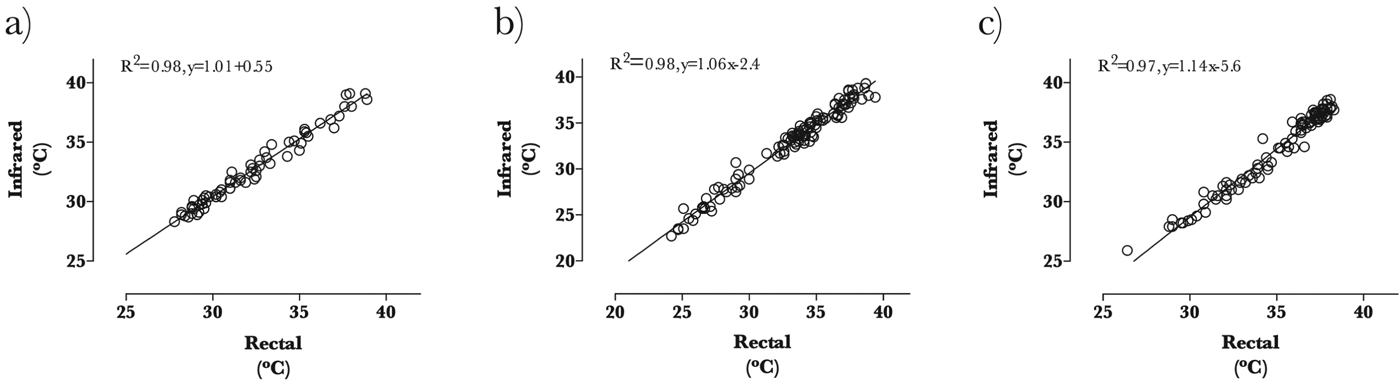
In our first set of experiments we compared the proposed infrared device in repeated measurements against rectal probe in animals as BT dropped after cervical dislocation. The performance of the infrared thermometer strongly correlated to the rectal readings (Pearson R = 0·99 [0·98–0·99], R 2 = 0·98, slope = 1·01, y-intercept = 0·55; N = 67 measurements; Fig. 1a).
Linear regression analysis comparing infrared and rectal thermometers in mice. A non-contact infrared thermometer recorded body temperature in the epigastral region of restrained mice. Thereafter a rectal probe measurement was taken at a pre-defined depth. Body temperature measurements for each instrument are presented in a scatter plot after (a) cervical dislocation, (b) infection with Plasmodium berghei ANKA and (c) infection with P. chabaudi AS. Pearson R 2 coefficient and slope are presented for each condition. (a) N = 4 animals, 69 measurements; (b) N = 12 animals, 114 measurements; (c) N = 48 animals, 96 measurements.

We were thereafter interested in implementing the use of infrared measurement in our ECM experiments as a substitute for rectal probe measurement. Thus, the performance of the infrared thermometer was tested against rectal measurements in ECM study with a pre-defined humane endpoint of 32 °C. Similarly to the cervical dislocation experiment, the infrared performance corresponded strongly to the rectal measurements (Pearson R = 0·99 [0·98–0·99], R 2 = 0·98, slope = 1·06, y.intercept = −2·4, Fig. 1b; N = 112 measurements).
Similarly to previous experiments with cervical dislocation and ECM, the minimally invasive infrared thermometer performed strongly in SMA, correlating well with rectal probe measurements (Pearson R = 0·98 [0·98–0·99], R 2 = 0·97, slope = 1·14, y-intercept = −5·6; Fig. 1c; N = 96 measurements).
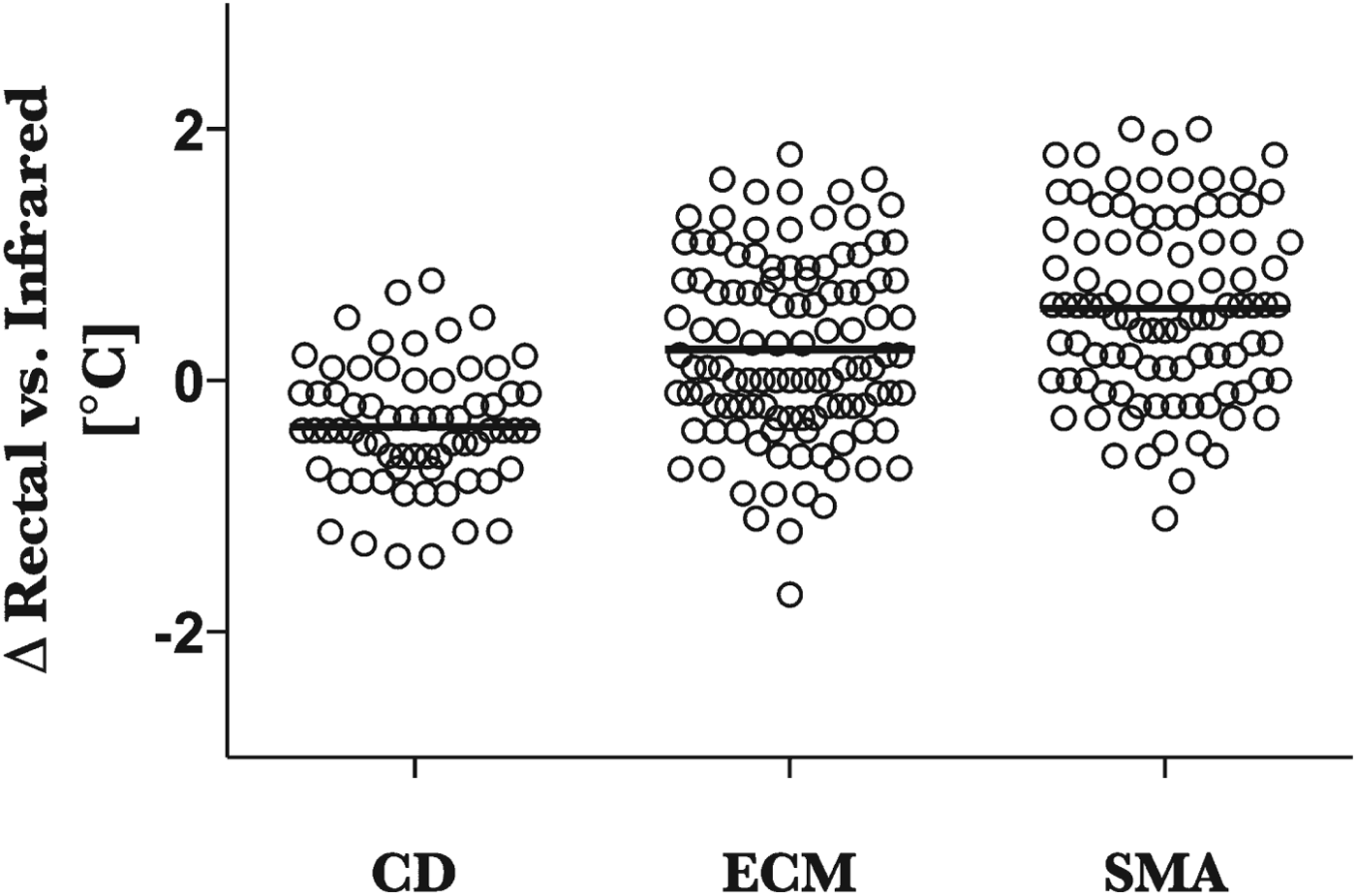
The differences between rectal and infrared BT measurements were −0·4±0·06 °C; 0·2±0·07 °C; 0·6±0·07 °C for cervical dislocation, ECM and SMA animals, respectively (Appendix: Fig. A1). In all conditions BT measurements varied above and below the zero-difference value.
Applying an objective humane endpoint in P. chabaudi infection
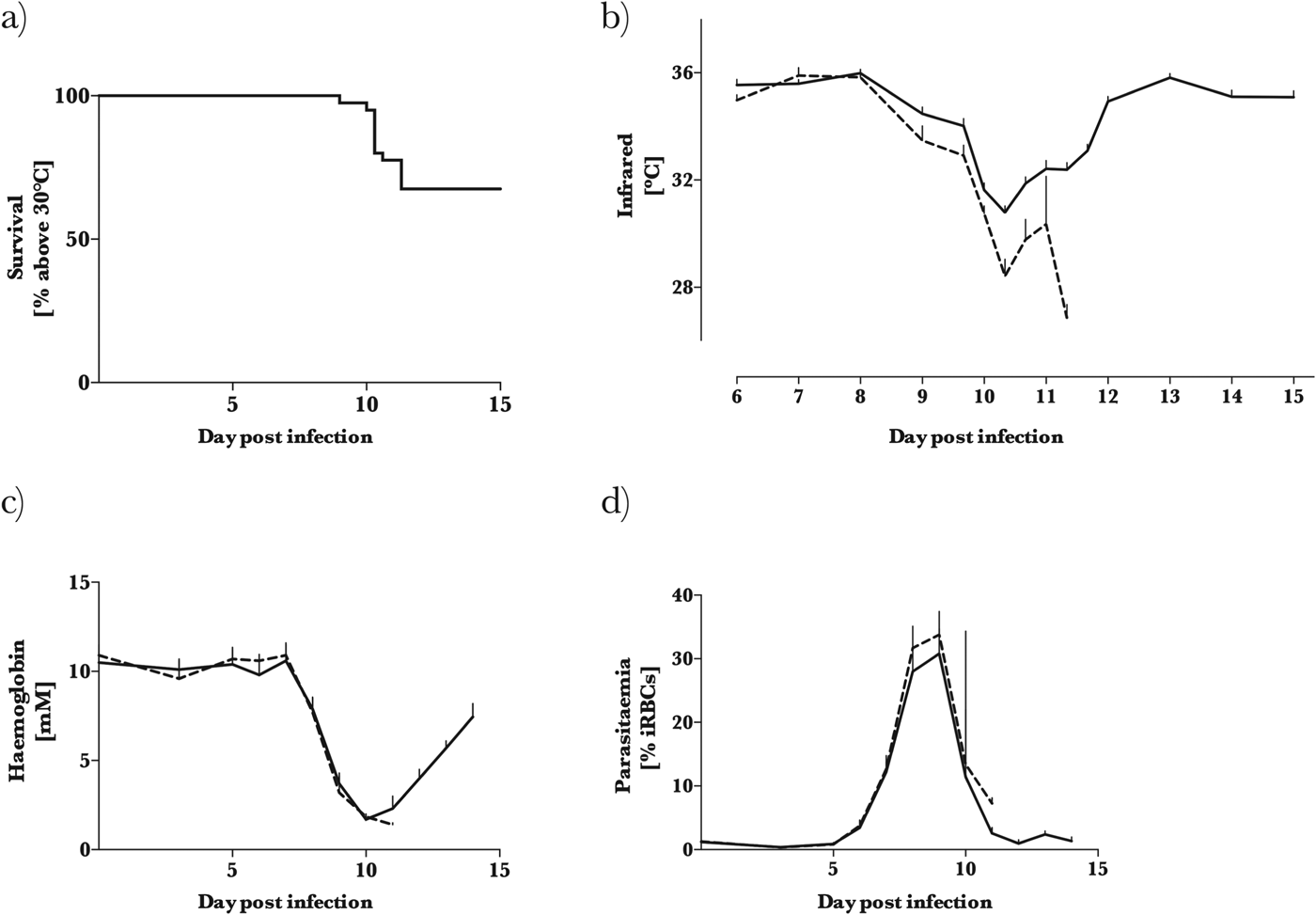
A suitable endpoint applicable for acute disease models is, ideally, directly available to the researcher in the animal facility. Once we established a partially lethal parasite inoculum and confirmed the feasibility of infrared BT measurement, we wished to evaluate the applicability of BT as a readily accessible and simple objective humane endpoint to predict lethal infections. Application of the 30 °C endpoint in a SMA survival study resulted in a ∼30% mortality rate (Fig. 2a). Importantly, no unexpected fatalities occurred above the 30 °C threshold. This suggests that the endpoint was completely sensitive in capturing lethal SMA infections. However, not all animals deemed terminal by the threshold were deemed moribund by the researcher.
Infrared body temperature and survival in P. chabaudi infection of A/J mice. A/J mice (N = 40) were injected i.p. with 105P. chabaudi AS parasites in a murine model of malarial anaemia. Animals were measured for body temperature with a non-contact infrared thermometer in the epigastral region once daily until clinical symptoms were present. Thereafter, mice were recorded three times daily to monitor for reduced body temperature. Animals that dropped below the pre-defined humane endpoint of 30 °C were measured for rectal body temperature. Confirmed measurements below 30 °C were deemed terminal. Animals were measured for haemoglobin and parasitaemia throughout the experiment. (a) Survival curve is based on body temperature drops 30 °C presented as a Kaplan–Meier plot. No unexpected deaths occurred and all mice developed malarial anaemia. (b) Body temperature data were normal and thus reported as mean+s.e.m. for surviving mice (bold line) and terminal mice (dotted line) based on whether any given mouse dropped below 30 °C (c). Haemoglobin (c) and parasitaemia (d) data were not normally distributed and are presented as median+75% percentile and are separated into surviving mice (bold line) and terminal mice (dotted line) based on whether any given mouse dropped below 30 °C. (N = surviving: 27, terminal: 13). (Total N = 40).
As measured by the infrared thermometer, the BT of all surviving animals dropped below 32 °C before recovering, reaching a low point of 30·8±0·2 °C (Fig. 2b). Six surviving animals were recorded below 30 °C with the infrared thermometer but were ⩾30 °C with the rectal probe and proceeded to remain above 30 °C and recover. These measurements were all within a reasonable range of error between devices in all 6 animals (mean: 29·0±0·3 °C). These data emphasize the importance of a rectal measurement for verification in this SMA model where a recovery phase is prevalent. These animals were not deemed terminally moribund.
Importantly, mice that reached a temperature below 30 °C were not all evaluated as terminally moribund based on the above-described clinical criteria. Due to ethical requirements, none of the mice were allowed to continue below 30 °C. Thus, the specificity of this endpoint could not be estimated.
Correlation analysis detected a weak correlation between BT and haemoglobin with a Spearman r-value of 0·62 [0·54–0·69]. When we separated animals into surviving and terminal groups based on BT <30 °C (Fig. 2c), haemoglobin concentration did not provide additional support for predicting lethality. For example, at day 10, when most animals became terminal, there was no difference in haemoglobin concentration (surviving: 1·7 (1·4, 1·9) mmvs. terminal: 1·4 (1·3, 1·5) mm). The correlation between BT and parasitaemia was low: Spearman R = −0·33 [(−0·43)–(−0·22)], and did not provide additional support for predicting lethality (Fig. 2d).
DISCUSSION
Objectivity in the application of humane endpoints reduces user-bias and thus improves study designs in pre-clinical therapeutic trials, reliability in results and standardization between laboratories. Ultimately, the implementation of appropriate, objective humane endpoints reduces the number of animals required to test a given phenomenon.
Defining such an endpoint can be a challenge. It should be associated with disease progression and be predictive of lethality for use in survival investigations. Additionally, since survival is determined by a complex array of pathological dysfunction, it is difficult to define with a single measurement in a living animal. We have implemented BT measurements with success in the evaluation of ECM pathology. Our cut-off of 32 °C was determined based on a threshold past which erythropoietin-treated mice could not be saved (Wiese et al. Reference Wiese, Hempel, Penkowa, Kirkby and Kurtzhals2008). In the years since implementation we have found this endpoint to be satisfactory for survival experiments. We have also benefitted from the simplicity of the measurement in training staff researchers compared with scoring of clinical symptoms (Lackner et al. Reference Lackner, Beer, Heussler, Goebel, Rudzki, Helbok, Tannich and Schmutzhard2006). Furthermore, BT has been used to follow disease progression in other infectious diseases in research of Staphylococcus and Pseudomonas (Soothill et al. Reference Soothill, Morton and Ahmad1992; Stiles et al. Reference Stiles, Campbell, Castle and Grove1999), influenza (Wong et al. Reference Wong, Saravolac, Clement and Nagata1997) and fungal infections (Warn et al. Reference Warn, Brampton, Sharp, Morrissey, Steel, Denning and Priest2003). Although weight loss is often used successfully as an objective humane endpoint in slow progressing disease research (Nemzek et al. Reference Nemzek, Xiao, Minard, Bolgos and Remick2004), we suggest that BT may be a better predictor of death in acute and progressive infectious disease research in rodents as it rapidly detects a dysfunction in maintenance of core BT: a complex and essential bodily function. Nevertheless, our experience with SMA infection as presented here is slightly more complicated due to the spontaneous recovery seen in this mouse model. It is intriguing that the SMA-mice sustain a BT approaching 30 °C (∼15% reduction in resting BT) and proceed to recover to a largely asymptomatic state. This recovery phase is a challenge for determining the specificity of the endpoint in this model. No unexpected deaths occurred with frequent surveillance (three times daily) and a BT limit of 30 °C; thus, the sensitivity for detecting lethality seems to be close to 100%. However, without pursuing a BT threshold below 30 °C, this endpoint may result in an over-estimation of the lethality. Indeed, in this study mice with an infrared and rectal BT below 30 °C were not all necessarily deemed terminally moribund. For the purposes of survival studies involving therapeutics, this over-estimation may be relevant. Thus, it seems that a composite endpoint involving a standardized clinical evaluation or investigation into a lower BT threshold may be appropriate in this model involving spontaneous recovery. Moreover, when surviving and terminal animals were defined with this endpoint haemoglobin levels were similar. Thus, lethality in this study may not be linked strictly to anaemia but be a complex result of malaria infection.
This predicament poses an ethical challenge when defining humane endpoints. It is of utmost importance to minimize the extent and duration of suffering in animal experimentation. This requires regular assessment of procedures and informed and well-functioning animal inspectorates/in-house veterinarians. In determining a robust predictor of lethality, a study involving potential predictors and utilizing death as the endpoint would be the most efficient. Moreover, the consequence of over-estimation of lethality may be an increase in false-negative hits concerning therapeutic efficacy, resulting in increased animal sample sizes and/or abandonment of the therapeutic (thus rendering the animal use redundant). However, as death is an unacceptable endpoint and ethical animal use requires that a study be powered to generate statistically useful data, a balance must be achieved based on the three Rs of animal research (replacement, reduction and refinement) (Russell and Burch, Reference Russell and Burch1959).
The major challenge with implementation of rectal BT measurements as a humane endpoint is the invasive nature of repeated rectal sampling. In disease models that progress rapidly from mild to severe presentation such as ECM, it is important to implement regular monitoring of pre-determined endpoints to capture terminal animals and reduce distress. Repeated rectal measuring is accompanied with an increased risk of intestinal perforation. This can lead to detrimental complications and distress, and confound the results generated.
In order to improve this measurement and ensure repeated monitoring of our endpoint, we considered substituting the rectal probe with a minimally invasive, non-contact infrared thermometer. This method is non-invasive but does require handling. In this study, we tested the performance of an infrared thermometer from one manufacturer. We suggest that pilot testing for optimization should be conducted for each thermometer and the emissivity index be determined for each strain of mouse.
As an alternative to infrared thermometry, temperature microchips that limit the handling of the animal are available but do require an invasive insertion of a foreign object, and may induce undesired inflammatory processes (Warn et al. Reference Warn, Brampton, Sharp, Morrissey, Steel, Denning and Priest2003). The chip method may be more attractive for long-term investigations. A previous study with a similar infrared thermometry method in mice compared infrared and rectal thermometers and reported similar findings (Ochiai et al. Reference Ochiai, Yamamoto, Kataoka, Toyoizumi, Arakawa and Horiuchi2007). A similar comparison was made between infrared and temperature microchips in mice with fungal infections where the mean difference between measurements techniques was negligible (Warn et al. Reference Warn, Brampton, Sharp, Morrissey, Steel, Denning and Priest2003). However, in larger laboratory animals such as the rabbit and monkey it seems that dermal infrared thermometry does not strongly correlate with rectal measurements (Chen and White, Reference Chen and White2006; Brunell, Reference Brunell2012). This may be due to reduced surface area to volume ratios in larger animals. In our study, despite high linear regression y-intercept values in malaria-infected mice, the difference between measurements varies about the zero value. This variation suggests that the rectal probe should be consulted when infrared measurement is±1·0 °C of the pre-determined endpoint. Our results support the replacement of the rectal probe for the implementation of BT as an objective humane endpoint in murine ECM and SMA pathology, where repeated measurements are required.
In conclusion we provide evidence that use of simple and affordable non-contact infrared emission technology can reliably improve surveillance frequency, reduce invasive monitoring and thus improve animal welfare in murine studies with acute neurovascular distress. In SMA, a temperature cut-off of 30 °C is successful in capturing all fatal infections and may be suitable as a humane endpoint for SMA although it may overestimate fatality. Investigation of a slightly lower BT cut-off may improve the specificity of the endpoint for SMA in mice.
ACKNOWLEDGEMENTS
We would like to acknowledge veterinarians Helle Nordahl Hansen, Grete Østergaard and Stefania Embla Arnorsdottir, and Casper Hempel and Flemming Fryd Johansen for productive discussions and/or observational assistance. We would also like to acknowledge the veterinarians at the Biocenter animal facility for expertise and continual care for animals.
FINANCIAL SUPPORT
This work was supported by the University of Copenhagen (BDV, JK, LM, FCC, JALK), Rigshospitalet (BDV, JK, LM, FCC, JALK), Novo Nordisk Fonden (BDV), Novo Nordisk (BDV) and Vifor Pharma (JK, LM, FCC).
APPENDIX
Measurements of body temperature by rectal probe and infrared thermometers from Fig. 1 are plotted as the difference between rectal probe and thermometer in matched measurements. Measurements were taken after cervical dislocation (CD), cerebral malaria (ECM) and severe malarial anaemia (SMA).
Difference in rectal probe versus infrared in measuring body temperature in C57Bl/6J and A/J mice.