Introduction
Approximately 30 percent of total animal protein consumed by human on the planet originates from poultry (Permin and Pedersen, Reference Permin and Pedersen2000). In 2010, poultry meat ranked the second after pork meat, contributing to 33.4 percent of the world's meat production, mostly from commercial broiler chicken industry (USDA database and FAO database, cited in Trostle et al., Reference Trostle, Marti, Rosen and Wasrcott2011). Modern poultry farming worldwide is based on the use of a limited number of chicken breeds and lines. White Leghorn and Rhode Island Red are the leading breeds among commercial egg layers while Cornish and White Plymouth Rock are the major broiler breeds (Fulton, Reference Fulton2006). However, under intensive systems of rearing for high productivity, the hybrid chickens suffer from several problems, such as feather pecking, high mortality, cracked and stained eggs as well as diseases such as ascites syndrome, Cellulitis, sudden death syndrome, tibial dyshondroplasia, osteoporosis, etc. (Julian, Reference Julian2005; Sørensen, Reference Sørensen2005). In consequence of these negative repercussions, the welfare movements and organizations have great concern on modern poultry farming, especially with respect to the well being of birds under commercial farming conditions (Lukanov and Aleksieva, Reference Lukanov and Aleksieva2013). Intensification of poultry with the use of high-performance hybrids has led to the displacement of less competitive breeds and circumscription of genetic diversity (Gandini and Villa, Reference Gandini and Villa2003; Hillel et al., Reference Hillel, Groenen, Boichard, Korol, David, Kirzhner, Burke, Dirie, Crooijmans, Elo, Feldman, Freidlin, Maki- Tanila, Oortwijn, Thomson, Vignal, Kuhnlein, Aggrey, Zadworny, Muir and Aggrey2003; Beaumont, Bihan-Le Duval and Magdelain, Reference Beaumont, Bihan-Le Duval and Magdelain2004). Over the past half-century, a considerable portion of avian genetic stocks has disappeared (Pisenti et al., Reference Pisenti, Delany, Taylor, Abbott, Abplanalp, Arthur, Bakst, Baxter-Jones, Bitgood, Bradley, Cheng, Dietert, Dodgson, Donoghue, Emsley, Etches, Frahm, Gerrits, Goetinck, Grunder, Harry, Lamont, Martin, McGuire, Moberg, Pierro, Qualset, Qureshi, Schultz and Wilson1999; Fulton and Delany, Reference Fulton and Delany2003). The assessment of local breeds and lines is important for maintaining genetic variation. Many local breeds could be used in poultry breeding industry as carriers of valuable genes that determine important traits such as resistance to diseases, adaptation to ecological conditions, eggshell colour and hardness, body constitution, meat and egg traits. The characterization of animal genetic resources (AnGR) for food and agriculture requires three types of information of their phenotype, genetics and history (FAO, 2012a). Phenotypic characterization of AnGR is the process of identifying distinct populations/breeds and describing their external and production characteristics in a fixed environment and management, taking into consideration of the factors that influence them. Phenotypic and molecular genetic characterizations of AnGR are complementary to each other to measure genetic diversity for better understanding and sustainable utilization. The information provided by this characterization is essential for planning the management of AnGR at local, national, regional and global levels (FAO, 2012a).
In this context, the phenotypic characterization is fundamental and the first step for the evaluation of AnGR.
Poultry genetic diversity in Europe
The significance of AnGR and especially poultry genetic resources has been discussed in many forums (FAO, 1998, Reference Rischkowsky and Pilling2007, 2012b; Delany, Reference Delany, Muir and Aggrey2003; Fulton and Delany, Reference Fulton and Delany2003). About 30 percent of all poultry breeds have been classified as at risk. Among avian species, chickens have by far the highest number of breeds at risk on a global scale (FAO, 2012a, 2012b).
Europe has the highest number of local avian breeds (851), followed by Asia (408), Africa (146) and Latin America regions (138). Near Middle East, North America and Southwest Pacific regions have the lowest number of reported local breeds (FAO, Reference Fulton2012b). Compared with other regions, Europe has also the highest number of transboundary chicken breeds, defined as breeds that occur in more than one country. A major role in preservation of the poultry breeds reared in Europe, North America and Australia is due to the long tradition in exhibition and ornamental poultry breeding dating back to middle nineteenth century. The existence of a significant number of regional transboundary breeds has implication for management and conservation of AnGR, and highlights the need for cooperation at regional or subregional levels (FAO, Reference Fulton2012b).
For local breeds or lines of chickens, there is paucity of knowledge at the production, pedigree and population structure at molecular levels (Blackburn, Reference Blackburn2006).
Recently, an information system was installed in Bulgaria to monitor the diversity of farm animals – EFABIS (http://efabis-bg.iasrj.eu) which is part of the global network FABISnet. The information system will collect data on AnGR in the country, which will be shared with other members of the network and the global database – DAD-IS of the FAO.
This paper focuses on the status, phenotypic characterization and some productive traits of the Bulgarian local chicken breeds, which represent both a heritage and a reservoir of variability but under threat of extinction presently.
Bulgarian poultry genetic resources
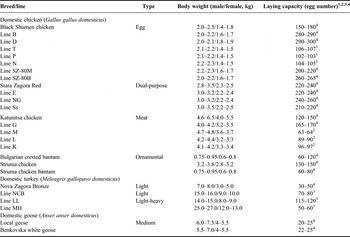
The list of Bulgarian poultry breeds, old productive lines and their primary productive performances are summarized in Table 1.
Productive performances of Bulgarian avian breeds/lines.

1 Laying capacity per 120 days.
2 Laying capacity per 160 days.
3 Laying capacity per 6 months.
4 Laing capacity per year.
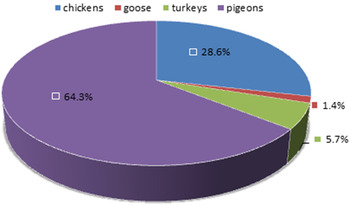
The shares of Bulgarian domestic poultry breeds by species are shown in Figure 1.
Shares of Bulgarian avian breeds by species.

Present status, morphology and production performance of Bulgarian chicken breeds
Local Bulgarian chickens include five breeds – Black Shumen chicken, Stara Zagora Red chicken, Katunitsa chicken, Bregovska dzhinka chicken (Bulgarian crested bantam) and Struma chicken (including bantam form). A total of 14 productive lines were developed for the first three breeds (Table 1). Currently all breeds are at risk and threatened with extinction, demonstrated by their drastic decline in number and their low consistency (Lalev et al., Reference Lalev, Oblakova, Mincheva, Hristakieva and Ivanova2011). In spite of their endangered status, these chicken breeds are well appreciated for their ability to adapt to extensive and organic rearing systems.
Black Shumen chicken was developed in Shumen region in Northeastern Bulgaria in the late 19th and early 20th centuries by folk breeding. The breed is distinguished by its black plumage, red earlobes, red iris and production of white-shelled eggs with slightly creamy tinge. This breed thrives despite unfavourable conditions like poor feeding and breeding as well as presence of predators and disease outbreaks. The breed has the following characteristics: high vitality and stamina, excellent reproductive abilities, relatively good egg production and egg weight. Improvement of chicken in Shumen region began in the middle of the twentieth century through crossing local black hens with Black Minorca cocks for improved body weight, egg production and egg size. In the 1980s, the second stage of genetic improvement of this breed crossing with Rhode Island Red was carried out for consolidation of its body shape, leading the development of a new, large body-sized dual-purpose breed, called Black Large.
By the end of the twentieth century, Black Shumen chicken was fairly well distributed, although not numerous. Presently, small flocks are reared in experimental stations, agricultural colleges and institutes, as well as in private yards. A conservation flock with 170 birds (150 ♀ and 20 ♂), which are insufficient for a sustainable conservation program of this breed, was established in 2010 and is managed by the Agricultural Institute, Stara Zagora (Lalev et al., Reference Lalev, Oblakova, Mincheva, Hristakieva and Ivanova2011). Agricultural University – Plovdiv supported another small flock (20–30 birds) for educational purpose (Petrov, Lukanov and Gerzilov, Reference Petrov, Lukanov and Gerzilov2011). Approximately 200 breeding birds of this breed in black and blue plumage colours are kept by hobbyist breeders in the country. Birds of this breed are also kept by several breeders in Serbia, Turkey, Romania, Russia, Netherland, France and Germany.
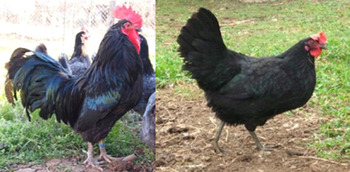
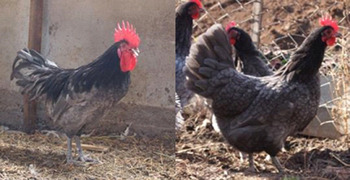
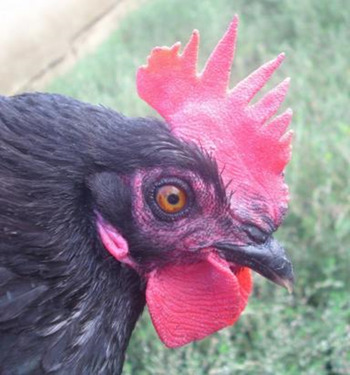
The Black Shumen breed has black plumage with green tinge (Petrov, Lukanov and Gerzilov, Reference Petrov, Lukanov and Gerzilov2011) (Figure 2). In recent years, blue colour plumage has been introduced from blue Australorps (Figure 3). The breed is characterized by moderately wide head (Lukanov, Reference Lukanov2013) and medium size beak which is black and slightly curved. The eyes are large, bright and orange-red. The face is red and covered with some short black feathers. In some females (Figure 4), a facial fibromelanosis can be seen, a condition of dermal hyperpigmentation (melanization) due to a mutation in domestic chicken that is supposed to have originated in South East Asia (Lukanov and Genchev, Reference Lukanov and Genchev2013). The comb is straight, single and relatively large with 5–7 points in males. In the hens, the comb is a straight or slightly slumped to one side. Wattles are relatively large, rounded. The neck is of medium length and well feathered. The body is elegant, harmonious, robust, cylindrical and slightly upright. Shoulders are relatively broad, rounded, partly covered by the hackle plumage. The back of the rooster is moderately wide and long, slightly sloping back towards the tail while it is horizontal for the hens. Saddle area is well feathered, medium length with a sharp transition to the tail. In the roosters, breasts are round with relatively high position. The abdomen is moderately wide and well developedin hens, while in the roosters it is retracted. The tail is relatively large, open, carried on about 40–45° to the horizontal line in both sexes, while the roosters has well-developed, broad sickle feathers. The wings are relatively long, close fitting to the body, parallel to the topline, without departing from the outline of the body. Thighs are well feathered and medium in length. Shanks are grey-black coloured, in medium length, strong and unfeathered. The body weight of the cock is about 2.0–2.5 and 1.4–1.8 kg for hens. Egg production is 150–180 eggs per year depending on the use of illumination. The eggs have white shell with a creamy shade and weigh about 50–55 g.
Black Shumen chicken breed: cockerel (left) and hen (right) (orig.).

Blue Shumen cockerel (left) and hen (right) (orig.).

Head of Black Shumen hen with facial fibromelanosis (orig.).

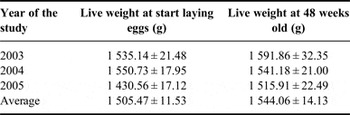
Wide variations in body size exist while the colours of the plumage varied in white or red feathers or strong violet hue. Targeted and in-depth studies on the productivity of the Black Shumen chicken and its crossbreds with dw barred hens in Bulgaria were carried out by Mincheva (Reference Mincheva2006). The author found that the birds from the Black Shumen breed reached sexual maturity at 184 days of age, with an average egg production of 58.29 and 60.59 percent in the first and second productive years, respectively. The mean egg weight was 47.58 g. The averaged live weights of pullets at sexual maturity and of hens at 48 weeks of age were 1 505 and 1 544 g, respectively (Table 2).
Study in three consecutive years of live weight in Black Shumen chicken breed (Mincheva, Reference Mincheva2006).

Petrov, Lukanov and Gerzilov (Reference Petrov, Lukanov and Gerzilov2011) studied the production performance of Black Shumen chicken under extensive rearing system. The average egg production for the 23-week period from the onset of lay was 45.4 percent. The egg weight increased with increasing age of birds and ranged from 40.40 to 53.60 g.
Stara Zagora Red chicken is native to Stara Zagora region and distributed mainly in Central Southern Bulgaria. Establishment of the breed was started in the middle of the twentieth century through crossing local red hens with Rhode Island Red roosters for the improvement of growth rate, body weight, egg production and egg mass. The breed has very good adaptatability to local conditions and good egg production. The colour of the plumage is red-brown with mahogany tint and the tail is black with a green sheen.
The breed was developed with the objective of producing highly productive birds with good body weight and laying capacity suitable for extensive and semi-intensive poultry farming. However, the breed began declining in the late 1980s to be ultimately replaced by commercial hybrids. The breed is currently critical. The only flock in Bulgaria is maintained by the Agricultural Institute in Stara Zagora with a population of about 300 hens and 60 roosters. These birds are considered as part of national gene pool with the name StR line maintained under controlled breeding conditions.
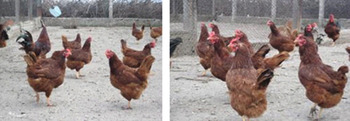
Stara Zagora Red chicken has a medium body size, wide head, single-comb and well-developed wattles (Figure 5). The comb and earlobes are red and eyes are in orange-red colour. The beak is short, strong, well curved and in slight yellowish colour. The neck is in medium length and good feathered. The back is broad and relatively long. The breasts are round, long and well muscled. The shanks are not very long, vertically placed and yellow coloured. The tail is in medium size, well spread, and carried at a relatively high position above the horizontal line. The plumage colour is red-brown and the tail is black (Nozhchev and Tsonkov, Reference Nozhchev and Tsonkov1969). Hens are characterized by calm temperament, tolerant to various weather conditions and unpretentiousness to the feed and rearing. These birds are one of the good dual-purpose breeds with intensive growth in males and good laying capacity in hens. The live weights are 2.3–2.5 and 2.8–3.5 kg for hens and cocks, respectively (Lalev et al., Reference Lalev, Oblakova, Mincheva, Hristakieva and Ivanova2011; Lukanov, Reference Lukanov2011). The egg production is 220–240 eggs per year with an egg weight about 58 g.
Stara Zagora Red chicken (orig.).

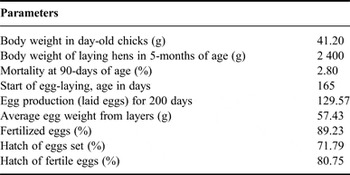
The main reproductive and egg productive performances in this breed are shown in Table 3.
Reproductive performance and egg production in Stara Zagora Red chicken.

Ornamental chickens
Three ornamental breed groups of chickens are commonly reared in Bulgaria: Bregovska dzhinka chicken, Struma chicken and Struma bantam chicken.
Bregovska dzhinka chicken (Bulgarian crested bantam)
This is a breed group of true bantams in Northwestern Bulgaria, especially in the region of Vidin and Bregovo. “Dzhinka” is the Bulgarian folk word for true bantams. Due to unintentional selection and different vision of each breeder, these birds still have a great variability in their morphological characteristics.
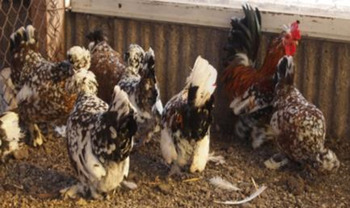
Bregovska dzhinka breed group is characterized by the presence of well-developed crest (small in roosters and well developed in hens), single or rose comb, white or red earlobes and well-manifested feathered legs with vulture hocks (Figure 6). The colour of the plumage varied in three major colours (black–red–white) and black–white mottled variations. The pullets start laying at about 5.5–6 months of age and the egg production is low, in a range of 60–120 eggs per year and weighing 30–35 g each. These birds are suitable for ornamental purpose, resistant to some parasite and infectious diseases, unpretentious and excellent brooders. The body weight is 0.75–0.95 kg for the roosters and 0.6–0.8 kg for the hens.
Bregovska dzhinka breed group (orig.).

Struma chicken standard and bantam
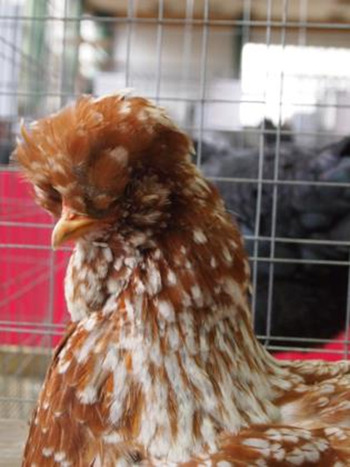
There was report for the presence of hens with a beard, crest and feathered legs at the end of the nineteenth century in Bulgaria (Figure 7). This breed group was established in the region around the Struma River by local breeders. The creation of miniature version of the Struma chicken (Struma bantam) began in the last decade by introducing the Bregovska dzhinka chicken. It is difficult to determine the actual number of breeding birds on the ground because these birds are bred from amateur poultry breeders, mainly in Western Bulgaria.
Struma hen at the Bulgarian National show 2013 (orig.).

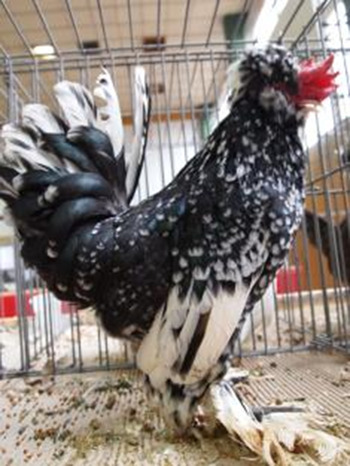
The plumage colour varies widely, the most stable ones are black–white mottled, red–white mottled, barred and white. These birds were part of several major exhibitions in Bulgaria and their popularity has grown steadily because of their extravagant appearance. They are excellent brooders. The roosters weigh about 3.2–3.8 kg and the hens 2.8–3.2 kg. The laying capacity is not very good – one hen can lay 130–150 eggs per year with an averaged egg weight about 50 g. The bantam version has appearance of the Bregovska dzhinka chicken, but they do have a well-developed beard (Figure 8).
Struma bantam hen at the Bulgarian National exhibition 2013 (orig.).

Katunitsa chicken (line AN)
This breed group is of meat type and developed by Alexandar Nikolov in his poultry farm in the village of Katunitsa near Plovdiv in the late 1990s in collaboration with Agricultural University of Plovdiv (Nikolov and Gerzilov, Reference Nikolov and Gerzilov2011).
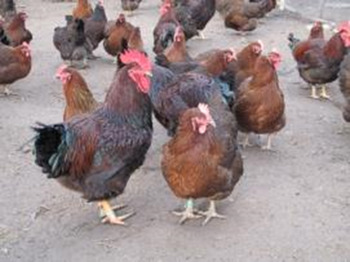
Katunitsa chicken (line AN) was developed by a strict selection by mass and plumage colour in a population of dual-purpose chickens in the area of Katunitca village. The nucleus flock of Katunitsa chicken is about 400 breeding birds and they are extremely popular in the Plovdiv region and gaining greater popularity in Bulgaria. The body is large, massive, deep, wide and well muscled. The plumage is soft with greyish-copper red colour in the hens and black–red in the roosters. The legs are pale yellow and the beak is dark with a yellow tip. The comb is medium sized and single. The earlobes are red (Figure 9).
A flock of Katunitsa chicken (line AN) at Alexandar Nikolov poultry farm (orig.).

Both males and females are characterized by rapid growth performance and excellent meat-qualities. The live weight at 12 weeks of age is 1.75–1.85 kg for females and 2.45–2.55 kg for males, at the beginning of egg laying (20–21 weeks old) above 3.00 kg for pullets and 4.40 kg for cockerels, and at 52 weeks old 4.0–4.2 kg for hens and 4.6–4.7 kg for cocks (Gerzilov et al., Reference Gerzilov, Nikolov, Petrov, Bozakova, Penchev and Bochukov2013). Egg production is 120–150 eggs with weight of 60–62 g. These breeds are suitable for organic production of chicken meat.
Present status of other Bulgarian poultry breeds
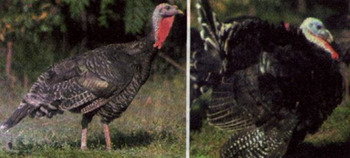
Local turkey (Nova Zagora Bronze turkey)
These are small local turkeys, spread in the area around Nova Zagora, Stara Zagora, Yambol, Pazardzhik, Pavlikeni and Gorna Oryahovitsa (Figure 10). During the second half of the twentieth century, many high productive breeds were imported and there was a sporadically cross-breeding with local birds. During this period, the Ministry of Agriculture of Bulgaria approved local bronze turkeys from Nova Zagora region as a breed named as Nova Zagora Bronze turkey (Lukanov, Reference Lukanov2011).
Bulgarian local turkeys (Donchev et al., Reference Donchev, Kaytazov, Kabakchiev and Aleksieva1997).

This turkey breed is characterized by low body weight, low egg production, highly resistant to some parasite diseases (like Histomonosis) and undemanding with excellent adaptability and good reproductive capabilities. These turkeys have a strong brooding instinct. Local people use them to brood chicken eggs. Plumage is mainly bronze coloured but there are also white, blue, bourbon, etc. (Ivanov and Shishkov, Reference Ivanov and Shishkov1968). The body weight of the males is 7–8 kg and of the females 3–5 kg. Laying capacity is about 30–50 eggs per year with weight around 80 g (Donchev et al., 1997).
Nova Zagora bronze turkeys use pastures very well and are easy to breed, but are not convenient for industrial production of meat due to their low productive capacity. The birds can be used for organic turkey meat production.
Local geese
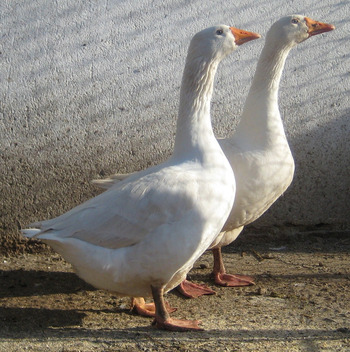
Different geese are widespread in the areas around the river valleys in Bulgaria and they have a predominantly grey–white plumage (wild). They were created by the folk selection. Birds with small crests and also curly feathered geese could be seen in different parts in Bulgaria. Local geese are characterized with quick maturity, relatively good meat productivity and adaptive capabilities. During the second half of the twentieth century, breeding for improvement of the liver size was conducted by crossing local geese with Emden goose, Toulouse goose and Hungary goose and the new birds were called Benkovska White goose (Rangelov and Ivanov, Reference Rangelov and Ivanov1987). Due to the global trend to reduce the production of foie gras from geese at the expense of those from mule ducks, pure Benkovska White geese have become limited in number.
The body of this breed goose breed is relatively large and deep. Its neck is of medium length and in black colour. Its back is wide, long and in grey to grey-white. These geese have a broad and deep chest. Their heads are medium-sized. Their peaks are orange and there are orange circles around their eyes. Their abdomen and tail are white. Benkovska White goose has one or two abdominal skin folds. The legs are of medium length, well muscled, wide set and orange (Figure 11). The body weight of females is 4.0–5.5 kg and of males 6–7.5 kg. Egg production is low, about 20–25 eggs per year. Eggs weigh about 180–190 g. Benkovska White goose achieves a mass of 4.2–5 kg at 70 days old and 9–11 kg for fatten mature birds. Their livers reach 450–500 g and a maximum of 1 100 g can be achieved after overfeeding (Lukanov, Reference Lukanov2011).
Benkovska White goose (orig.).

Conclusions
The information on the genetic and phenotypic characteristics of Bulgarian local poultry breeds and lines is very limited. Today, the main Bulgarian poultry breeds and old productive lines are only kept in closed flocks in Agricultural Institute in Stara Zagora and Agricultural University in Plovdiv. This type of conservation is very risky since the whole flocks can be lost if there is an epidemic. This implies the need for segmentation of breeds into small flocks in different regions. The hobby poultry breeders could play a major role to preserve some of the breeds and lines. Through the encouragement of organic poultry production or special products, these breeds can find their place in modern poultry farming.
There is an urgent need to document the genetic diversity of local poultry resources and design strategies for their sustainable conservation. Molecular characterization of local poultry breeds in the near future will aid considerably in the maintenance of existing genetic stocks in Bulgaria.