

Introduction
Even though the recent resurgence of authoritarianism in Egypt has attracted considerable attention, its appraisal remains a disputed topic both in terms of explanandum and explanans.
One issue pertains to how to interpret the case. For proponents of authoritarian resilience, Egypt's political evolution from the ousting of Mubarak of 2011 to the military coup of 2013 instantiates a case of regime survival. For subscribers of democratization studies, it is an example of a failed transition. This article treats the Egyptian experience as a case of failed democratic transition. The suspension of the previous constitution, the holding of free, fair and democratic elections and the rise of a Parliament with constituent prerogatives at a time when the Supreme Council of the Armed Forces (SCAF) had stepped aside (Albrecht and Bishara, Reference Albrecht and Bishara2011) clearly mark a sharp rupture with the previous regime and speak to a genuine process of transition from authoritarian rule.
A second dispute pertains to the determinants of such a failure. The scholarly production of democratization studies has accounted for this issue through structural and agency-based explanations. In particular, emphasis on the role of political parties is opening venues of research that are shedding new light on the causes and dynamics beneath the undemocratic outcome of the Egyptian transition. Building on insights from both democratization studies and regime survival, the present contribution aims to assess how the previous authoritarianism has shaped transitional party politics in Egypt.
The type of previous regime is said to influence the format and mechanics of transitional party politics with significant repercussions for the emergence of democracy and its consolidation. In the case of Egypt, the effects of previous electoral authoritarianism on the format of the transitional party system are quite evident, but this is not true of the impacts on its workings, rendering accounts of Egypt's failed transition incomplete. Thus, it is possible to appeal to the heterogeneity of and imbalance in parties’ organizational resources as the outcome of the controlled pluralism exerted by the previous electoral autocracy (Lust and Waldner, Reference Lust, Waldner, Bermeo and Yashar2016). Yet, there are cases of successful democratic transition even when one faction dominates due to the existence of a consensual attitude among the actors involved. However, such common ground did not exist in Egypt and the reasons for its absence must be addressed. Some scholars contend that this situation owes to the high degree of polarization established by the previous regime's formal structures of competition (Lust and Waldner, Reference Lust, Waldner, Bermeo and Yashar2016); for others it is due to the identity cleavage the Mubarak regime cultivated (Brumberg, Reference Brumberg2013). Hence, beyond its effects on the format of the party system, did the authoritarian legacy jeopardize the transition because it triggered political polarization or because of the identity cleavages it drew?
This question will be answered through quantitative text analyses of the party manifestos of the relevant transitional parties. In spite of recent developments (Harmel, Reference Harmel2018), quantitative techniques have rarely been applied to the analysis of Arabic texts (Al-Moslmi et al., Reference Al-moslmi2017). Moreover, and quite surprisingly, even though the content analysis of Middle East and North African (MENA) parties’ electoral programmes has provided invaluable insights, it remains scarce and only qualitative (Kurzman and Türkoğlu, Reference Kurzman and Türkoğlu2015). Hence, this article offers a degree of methodological and empirical innovation in the study of Arab politics.
The article is organized as follow. The following section elucidates the merits of focusing on political parties. The third section attempts to make sense of the political parties’ behaviour during the transition and spells out the working hypotheses regarding the absence of a consensual attitude among them. The fourth section illustrates the data while the fifth tests the hypotheses. Section 6 concludes.
Accounting for the failure: the saliency of transitional parties in Egypt
The failure of the Egyptian transition has been connected with different factors: the socio-economic underdevelopment of the country (Brownlee et al., Reference Brownlee, Masoud and Reynolds2015), the fuzziness of the transition process (Brown, Reference Brown2013), the electoral formula used for the founding elections (Carey and Reynolds, Reference Carey and Reynolds2016) and ultimately the ‘bad behaviour’ and ‘poor choices’ of the transitional actors (Szmolka, Reference Szmolka2015).
Explanations based on socio-economic indicators are not on their own entirely convincing because successful cases of democratization in India, Benin, Costa Rica and Indonesia (among others) invalidate the argument that ‘mere reference to gross developmental indicators (such as per capita income) would probably have been sufficient’ (Brownlee et al., Reference Brownlee, Masoud and Reynolds2015: 210) to predict Egypt's failure.
Although it is evident that the Egyptian transition was badly designed, explanations that focus on the messiness of the transition are also unconvincing because uncertainty and volatility are inherent traits of all transition processes (O'Donnell and Schmitter, Reference O'Donnell and Schmitter1986). In addition, blaming the electoral system – and particularly its formula, timing and the design of districts for the ensuing ‘Islamist domination’, which allowed the Freedom and Justice Party (FJP) and al-Nour to hold the majority of the seats – disregards the fact that together they would have controlled Parliament regardless of the electoral system employed (Carey and Reynolds, Reference Carey and Reynolds2016). In fact, the strength of Islamists’ electoral appeal is not new in Egypt, where they had obtained impressive results even when ‘victory was not an option’ (Brown, Reference Brown2012). In contrast, attention to the agency of transitional parties seems to be more useful in order to account for its failure.
Indeed, the Egyptian transition entered into a fatal crisis as soon as parties assumed control following the first free and fair elections. Rather than being the locus for an agreed compromise to give the country a democratic constitution, the first democratically elected Parliament soon became an arena of conflict among the different political currents. The harshest disagreement revolved around the composition of the Constituent Assembly that Parliament had to appoint. To Islamists, it had to reflect the balance of power within the elected Parliament. To non-Islamists, it had to be the expression of the diverse political and ideological persuasions present in the country. Incapable of solving this political conflict through dialogue and compromise, the Islamists imposed their view thanks to their parliamentary majority, while opposition parties continuously resorted to judicial adjudication until the Supreme Constitutional Court (SCC) eventually disbanded Parliament due to the unconstitutionality of the electoral law. Such a decision came at an extremely delicate moment in the Egyptian transition, namely during the presidential elections that took place between 23–24 May (first round) and 16–17 June (runoff) 2012, and had the effect of paving the way for the return of the SCAF, thereby triggering an institutional conflict between the latter and the Presidency. Under the pretext of fulfilling the legal void created by the SCC ruling, the SCAF assumed legislative and constituent powers. Therefore, when Mohamed Mursi was democratically elected as President, he found himself struggling against the SCAF for control of the transition. The struggle culminated in the military coup of 3 July 2013, which extinguished any hope for a transition to democracy.
Egypt's type of transition led scholars to follow Capoccia and Ziblatt's (Reference Capoccia and Ziblatt2010) invitation to ‘start rethinking the autonomous role played by political parties, as key strategic actors […] in shaping democracy's emergence in crucial episodes’ (2010: 43:941). To be clear, parties were not absent from democratization studies. On the contrary, they have always been considered crucial to the process of democratic consolidation (Gunther et al., Reference Gunther, Diamandouros and Puhle1995; Morlino, Reference Morlino, Gunther, Diamandouros and Puhle1995). Yet, new here was the acknowledgement that political parties also play an active role within the phase of actual transition and the sub-phase of democratic installation (Bermeo and Yashar, Reference Bermeo and Yashar2016; Enyedi, Reference Enyedi2005).
In this vein, political parties are no longer considered empty vessels of the pre-defined socio-economic interests of certain classes that might favour the emergence of democracy, such as for the working class (Allinson, Reference Allinson2015) or bourgeoisie (Moore, Reference Moore1965). Rather, they are now entrusted with an autonomous role in structuring disparate interests (often independent from class) in the wake of political learning and institutional incentives (Bermeo and Yashar, Reference Bermeo and Yashar2016; Enyedi, Reference Enyedi2005). In so doing, during the transition they are crucial in generating support for democracy prior to the founding elections as well as in coordinating, negotiating and designing the subsequent regime change by directly shaping the selection of democratic institutions (Elster, Reference Elster1995; Kitschelt et al., Reference Kitschelt1999; Lust and Waldner, Reference Lust, Waldner, Bermeo and Yashar2016).
Although doubts have been raised about Islamists’ democratic credentials, very few would surmise that the Egyptian transition failed because they opposed the democratic project (Blaydes and Lo, Reference Blaydes and Lo2012). Rather, for a growing number of scholars, the failure of the transition was due to parties’ inability to coordinate and negotiate. Focusing on this constitutive moment, Szmolka (Reference Szmolka2015) describes the Egyptian transition as exclusionary and non-consensual, thus pinpointing two crucial aspects behind its failure that other studies consider only separately. The first is the parliamentary predominance of one faction (namely the Islamists, including its Salafi component) over the others (namely the so-called secular parties), which facilitated the latter's exclusion from the decision-making process, thus jeopardizing the legitimacy of the transition (Brownlee et al., Reference Brownlee, Masoud and Reynolds2015). The second is the lack of common ground wherein transitional parties could debate their views regardless of their power relations (Stepan, Reference Stepan2012).
The failure of Egypt's democratization should thus be understood as the result of the format and mechanics of the transitional party system. However, given that political parties in Egypt are not the outcome of political liberalization inaugurated with the transition (Hinnebusch, Reference Hinnebusch2017), the determinants of the format and mechanics of the transitional party system are to be found in the previous electoral autocracy.
Making sense of the failure: how the previous electoral autocracy shaped the transitional party system
Before the 2011 uprising, Egypt was a case of electoral authoritarianism. The key feature of this kind of regime is incumbents’ recourse to multi-party elections to resist the perceived threat of democratization (Schedler, Reference Schedler2006; Heydemann, Reference Heydemann2007; Gandhi and Lust-Okar Reference Gandhi and Lust-Okar2009). Elections thus serve to convey a façade of democracy – gaining internal and international legitimation – to co-opt oppositions and political elites alike, as well as to attain information about individuals’ political orientations, in turn informing incumbents’ strategies. Nonetheless, elections are a double-edged sword: they can secure authoritarianism or open the door to democratization (Lindberg, Reference Lindberg2009). As Brownlee (Reference Brownlee2007) notes, it is only the presence of a strong ruling party that defuses elections’ democratic potential. Ruling parties regulate the competition in power and for power by mixing co-optative and repressive strategies (Kraetzschmar and Cavatorta, Reference Kraetzschmar and Cavatorta2010). They constitute the arena for adjudicating the spoils of power among the ruling elite and regulate access to state institutions for opposition groups (Albrecht, Reference Albrecht2010).
Until the 2011 uprising, the Egyptian ruling party was the pivot of a divide et impera ruling strategy aimed at permitting an illusory pluralism while guaranteeing regime survival. On the one hand, divided structures of competition to discriminate between legal and illegal oppositions were put in place in order to control access to the political arena, thereby preventing the unification of different opposition groups and preserving incumbents’ centrality. On the other hand, these lines of division mainly revolved around identity and religion to allow the incumbent to play one group against the other depending on the circumstances.
As a result, some groups were excluded from the political system and were subjected to the regime's repression due to the threat they posed to the secular state (as was the case of Islamists) or to national unity and the Muslim values of Egypt (as was the fate of the Left). For the latter, for instance, such repression was fatal in that all of its channels of mobilization, like trade unions and professional associations, were suppressed or infiltrated (Bianchi, Reference Bianchi1989). Other opposition groups – the more innocuous ones – were legalized and allowed to compete in elections, thus sharing in the spoils of political power, but at the considerable cost of becoming the regime's loyalists (Resta, Reference Resta, Cavatorta and Storm2018).
The only remarkable exception to this dichotomous structure of competition was the Muslim Brotherhood (MB). Contrary to all other opposition groups, the MB was never confronted with an in-or-out option. Like many other opposition groups, the MB never received formal recognition. Yet, unlike all other illegal opposition groups, which were systematically repressed, the MB was fully repressed only sporadically and fielded its candidates as independents at elections, thus alternating periods of ‘honeymoon’ with the regime (Albrecht and Wegner, Reference Albrecht and Wegner2006) to periods of friction. This has enabled the MB to develop a strong organizational network (Wickham, Reference Wickham2002), to capitalize on popular support by means of its oppositional stance (Brown, Reference Brown2012), as well as in the meantime to be at ease inside the state's control room (Albrecht and Wegner, Reference Albrecht and Wegner2006).
This uneven structure of opportunity influenced the transitional party system with regard to the types of parties, the type of competition, the cleavages around which parties mobilized voters and the degree of the party system's polarization (Kitschelt et al., Reference Kitschelt1999; Lust and Waldner, Reference Lust, Waldner, Bermeo and Yashar2016).
Coming to the types of transitional parties, the survival strategies of the authoritarian regime determined the presence of different types of parties in terms of their organizational or penetrative capacities. In this regard, distinctions have been made between relic, novice and movement parties. The first are descendants of the old ruling party or those loyal to it, and have weak ties to their constituencies. The second are new parties born following the collapse of the dictatorship and possess varying degrees of organizational capacity. The third are previously formally excluded political parties, which thanks to their widespread social networks enjoy considerable representative capacities (Lust and Waldner, Reference Lust, Waldner, Bermeo and Yashar2016).
Differences in parties’ organizational resources are the key to interpreting the electoral results of the founding elections and the exclusionary character of the transition that followed. While, as explained above, some groups (leftists in particular) were efficiently expelled from their natural channels of mobilization, others, namely Islamists, could expand them during the authoritarian period. Contrary to the received wisdom according to which Islamists’ domination was the expression of voters’ concern for more religion in politics (Wegner and Cavatorta, Reference Wegner and Cavatorta2018), their strength was rather the result of their complex and widespread organizational networks, which allowed them to speak to potential voters in ways implausible for others (Masoud, Reference Masoud2014). In further support of this hypothesis is the fact that before the 2012 elections, Egyptian voters displayed political preferences more in line with a leftist political agenda than with an Islamist one (Masoud, Reference Masoud2014). This imbalance undermined the transition in two respects. First, the presence of an overwhelming Islamist majority in Parliament disincentivized negotiations with the opposition to find a compromise on their most basic disagreements, crucial to establishing democratic institutions (Higley and Burton, Reference Higley and Burton1989). Second, such an imbalance of forces undermined opposition parties’ constitutive role in favour of democracy. Their willingness to create and sustain democratic institutions has been deemed directly proportional to their probability of winning an election in the foreseeable future (something unlikely for small parties) and the inverse of the cost of ‘tolerating [their] opponent implementing its preferred policies’ (Lust and Waldner, Reference Lust, Waldner, Bermeo and Yashar2016: 176), which are high in the case of ideological polarization. In light of their envisaged electoral irrelevance, it was more rational for secular parties to abort the democratic project than to sustain it. From this perspective, secularists’ resorting to ‘deep-state’ judges and fuelling street protests appears intelligible.
Nonetheless, this reading, as others (Szmolka, Reference Szmolka2015; Cross and Sorens, Reference Cross and Sorens2016), takes for granted a situation of intense polarization, which is understood as the by-product of the formal structures of competition in force under previous authoritarianism (Lust-Okar, Reference Lust-Okar2005). The division of the opposition into legalized and illegal groups was intended as a means of augmenting political polarization between them in order to rule out any possibility of cooperation among the diverse opposition groups against the status quo. The rationale of this argument relied on acknowledgement that illegal groups, excluded from formal politics, had no other option but to call for regime change. At the same time, legalized opposition groups included in the political system were incentivized to stick with the regime in order to maintain the privileges deriving from such inclusion even when they potentially shared issues with the excluded parties. Hence, the greater the pressure from illegal opposition groups that capitalize on popular discontent by strengthening their opposition to the status quo, the more legalized groups adhere to the regime by moderating their oppositional stances. Like Lust, other authors agree that growing polarization between Islamists and secularists is not the result of Islamist parties’ religious worldviews, but rather their exclusion from political competition (Schwedler, Reference Schwedler2011; Tepe, Reference Tepe2013). From all this it follows that the previous regime is accountable for the failed transition due to the polarization it engineered between Islamists and secular parties, which hampered the emergence of common ground.
Departing from such a formalistic reading, Brumberg (Reference Brumberg2013) argues that the failure of the transition owes to the effects of the previous regime on the cleavages and the type of competition that emerged following its collapse. This argument assumes that all political parties were subjected to political learning regardless of their legal (or illegal) status in the political arena, and addresses the effects of the identity cleavages created and manipulated by the regime to play one group against the other with the ultimate goal of offering them a ‘Godfather-style protection’ in return for political support (Brumberg, Reference Brumberg2013).
In light of this, the lack of common ground is not due to political polarization, but to the fact that during the transition the parties structured political competition based on the familiar question of identity issues. This contribution echoes the warnings regarding the lack of programmatic competition for the sake of democratization (Storm, Reference Storm2014). For instance, in his seminal works, Kitschelt posited that programmatic parties were better-suited to favouring democratic stability and consolidation because ‘programmatic party competition provides a rational motivation for citizens’ participation in elections and thus a rational justification of the democratic rules of the game’ (1995: 450). Nonetheless, he also noticed that this kind of party-voter linkage has little chance of emerging when the prior regime relies ‘on hierarchical chains of personal dependence between leaders in the apparatus and their entourage, buttressed by extensive patronage and clientelistic networks’ (ibid. 451), such as those characterising party-voter relations under Egypt's electoral authoritarianism (de Miguel et al., Reference de Miguel, Jamal and Tessler2015).
Although previous electoral authoritarianism appears to pave the way for a highly heterogeneous and unbalanced transitional party system, it is not clear how it has affected transitional parties’ patterns of interactions. This aspect is particularly relevant in that democratization has occurred even in situations of unbalanced power relations among parties thanks to the presence of common ground (Driessen, Reference Driessen2014), which was absent in the Egyptian transition. The following sections will assess whether in Egypt this absence was due to regime-led polarization or identity-based politics by testing the following hypotheses:
Hypothesis 1:
Given transitional parties’ unbalanced power relations, the Egyptian transition lacked a common ground due to the polarization of the party system.
Hypothesis 2:
Given transitional parties’ unbalanced power relations, the Egyptian transition lacked a common ground due to the identity cleavages characterizing the party system.
The political programmes of Egyptian transitional parties
The texts used as data to test the aforementioned hypotheses are the party manifestos – in Arabic – for the founding elections. These documents are considered parties’ written profiles (Harmel et al., Reference Harmel2018). They can reveal information about the overall ideology of the party along with its major political concerns. Although it may be questioned whether party manifestos in transitional countries or less institutionalized democracies account for party elites and voters’ behaviour as they do in advanced democracies, they are still relevant inasmuch as they account for parties’ portrayals (real or prospective) at the time of editing (Harmel et al., Reference Harmel2018).
Given the impossibility of finding the party manifestos of all parties in the Egyptian Parliament, this study employs only those of parties that gained more than 10 seats. Therefore, it includes the Muslims Brotherhood's FJP, the Salafi parties al-Nour and Building and Development Party (BD), the centrist/right Wafd, the Free Egyptians Party and the leftist Social Democratic Party (SPD). This subset of the entire transitional party system includes parties with different organizational capacities due to the various positions they occupied in the previous political system. Following Lust and Waldner's (Reference Lust, Waldner, Bermeo and Yashar2016) classification, the FJP (which led the Democratic Alliance electoral coalition) and the Salafis (running under the Islamic alliance electoral list) are movement parties in that they capitalized on their opposition, expressed through political engagement (see the FJP) or quietism (see the Salafists) to authoritarian rule, and relied on strong organizational capacities. The New Wafd party can be considered a relic party: it is a legacy of the constitutional monarchy period and one of the few parties that survived throughout the authoritarian era as a minor partner of the ruling coalition. Offshoots of the National Democratic Party (NDP) – the remnants of the previous ruling party banned in 2011 – are excluded from this analysis due to their electoral irrelevance. Finally, SPD and the Free Egyptians Party are novice parties. They ran together as part of the Egyptian Bloc coalition in the 2012 elections. Despite their shared vision of a secular Egypt, the SPD and the Free Egyptians have ideological differences: the former is a centre-left party while the latter is a centre-right party.
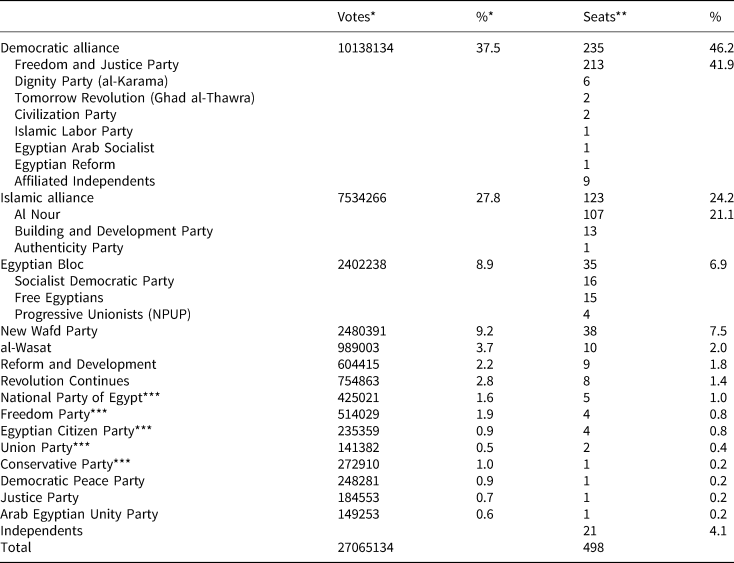
Together, the parties in this study cover almost 80% of the parliamentary seats allocated in the first free and fair legislative elections, even though stark differences emerge in how these seats were distributed among them. As Table 1 shows, the FJP and al-Nour won 213 and 107 seats, respectively, while the SDP and the Free Egyptians only won 16 and 15. With 38 MPs, the Wafd was the third largest parliamentary group.
Results of Egyptian Parliamentary Elections, 28 November 2011–11 January 2012

*PR votes.
**Only elective seats were considered. Ten more seats are reserved for non-elected MPs.
***NDP offshoots.
Source: Brownlee et al., Reference Brownlee, Masoud and Reynolds2015, al.waatan.org.
The structure and length of the party manifestos are highly varied. The FJP's political programme is a 94-page document divided into five main sections (urgent issues, political reforms and freedoms, social justice, integrated development and regional leadership) plus a reminder about FJP's previous engagement in opposing the authoritarian regime. Al-Nour's manifesto is 32 pages long and is particularly concerned with culture and identity, the economy, healthcare and education, with relatively little attention paid to institutional issues. Considerable emphasis on identity issues and the role of religion in the new political system also characterizes the BD's 20-page programme, in which institutional concerns are prioritized over economic ones. The SDP's party manifesto is a 52-page document and is clearly structured around three ‘axes’: political, economic and social. The programme of the Free Egyptians has a length of 25 pages and is articulated into five main chapters (rights and freedoms, the economy, the social sphere, culture and information, national security and foreign policy). Lastly, the New Wafd presented a programme drawing attention to 20 points ranging from the economy and social justice to poultry production in only seven pages.
These documents have been pre-processed to retain only the necessary information. This has implied the removal, for instance, of numbers, punctuation, stop words (like articles) and the reduction of words to their lemmas through the stemming process. While this latter process is ‘not a solved problem’ for the Arabic language (Nielsen, Reference Nielsen2013) and some opt against stemming words (Ceron et al., Reference Ceron, Curini and Iacus2018), here words have been stemmed with the ‘arabicStemR’ programme (Nielsen, Reference Nielsen2013).
The burden of the previous regime: did parties pool apart or play the same game?
From the review of the extant literature, it emerges that the failure of the Egyptian transition has to do with the lack of common ground among transitional political parties, but the causes of this absence are not clear. From the way in which political competition was structured under the previous regime, it is possible that this is the result either of the high degree of political polarization or of the kind of cleavages dividing the transitional party system. Alternatively, it could be both: indeed, in principle the two case-scenarios are not antithetical.
To test the two different hypotheses, we will make use of two different techniques of quantitative text analysis: scaling methods and topic modelling. Presented as innovative instruments of analysis in comparative political science, they have found surprisingly little application in the Arab world even though they can assist the empirical and theoretical body of scholarship of Arab politics.
Counting polarization
Drawing on Sartori's (Reference Sartori1976) definition of polarization as the political distance between parties in a given party system, the test of the first hypothesis regarding the presence of considerable polarization in the transitional party system is conducted here through a quantitative scaling method using the Wordfish algorithm.
When applied to party system studies, this represents a frequently used, unsupervised technique that enables parties’ positions on a political space from texts (speeches and party manifestos) to be inferred even in cases where there is no prior information about the party system and where the commonly used left/right categories are largely inapplicable, as in Egypt. It does so by assuming that the relative use and frequency of some words denote the major topics and concerns of political parties’ elites, and are therefore reflective of parties’ overall ideological orientations (Slapin and Proksch, Reference Slapin and Proksch2008).
In its original formulation, Wordfish is used to trace changes in the party system over the years (Slapin and Proksch, Reference Slapin and Proksch2008). However, given that our interest is directed at understanding the causes of the failure of the Egyptian transition, the analysis will be conducted only for the founding elections of 2012. Hence, in the Wordfish function here, estimated time parameters are held as constant.
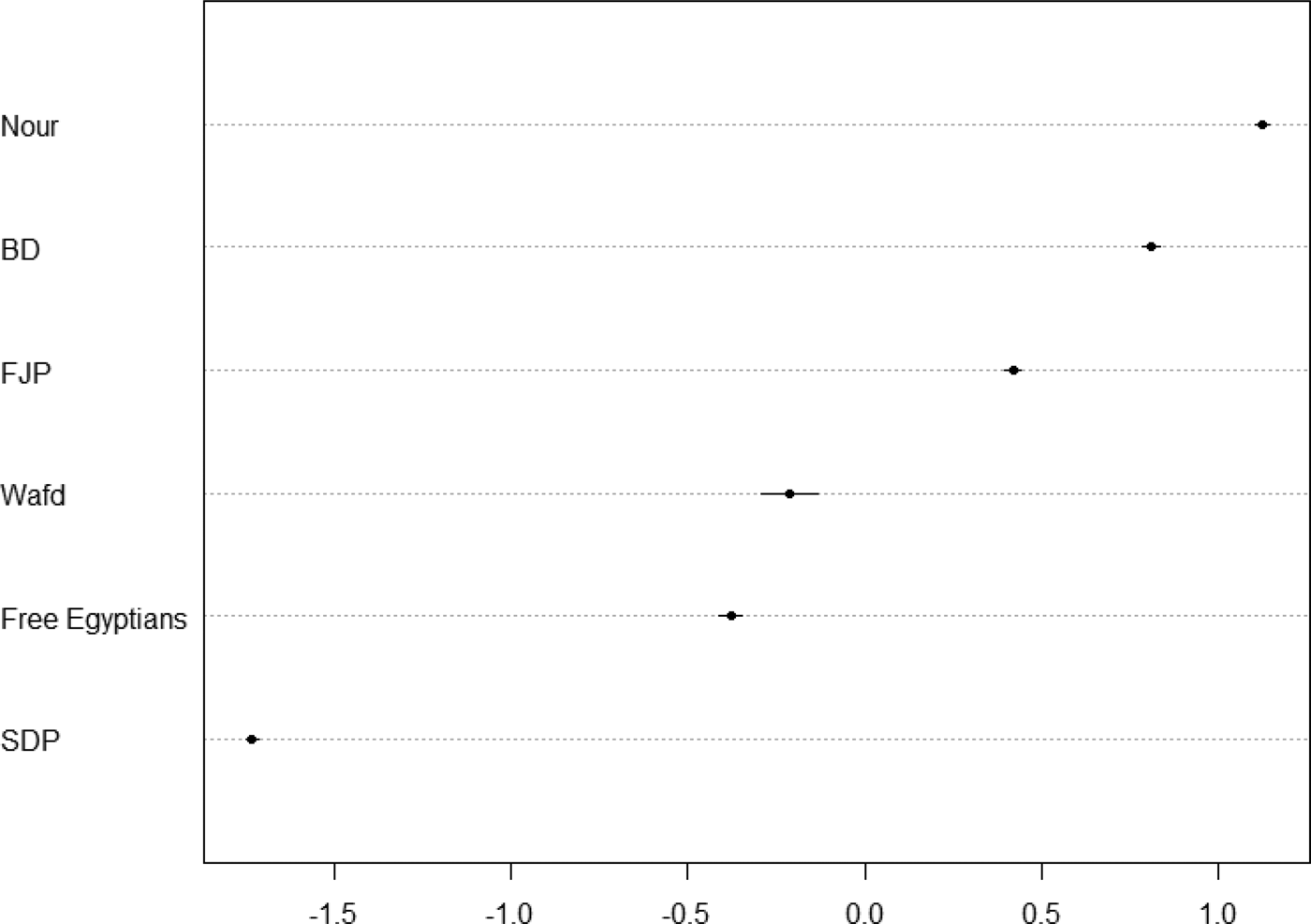
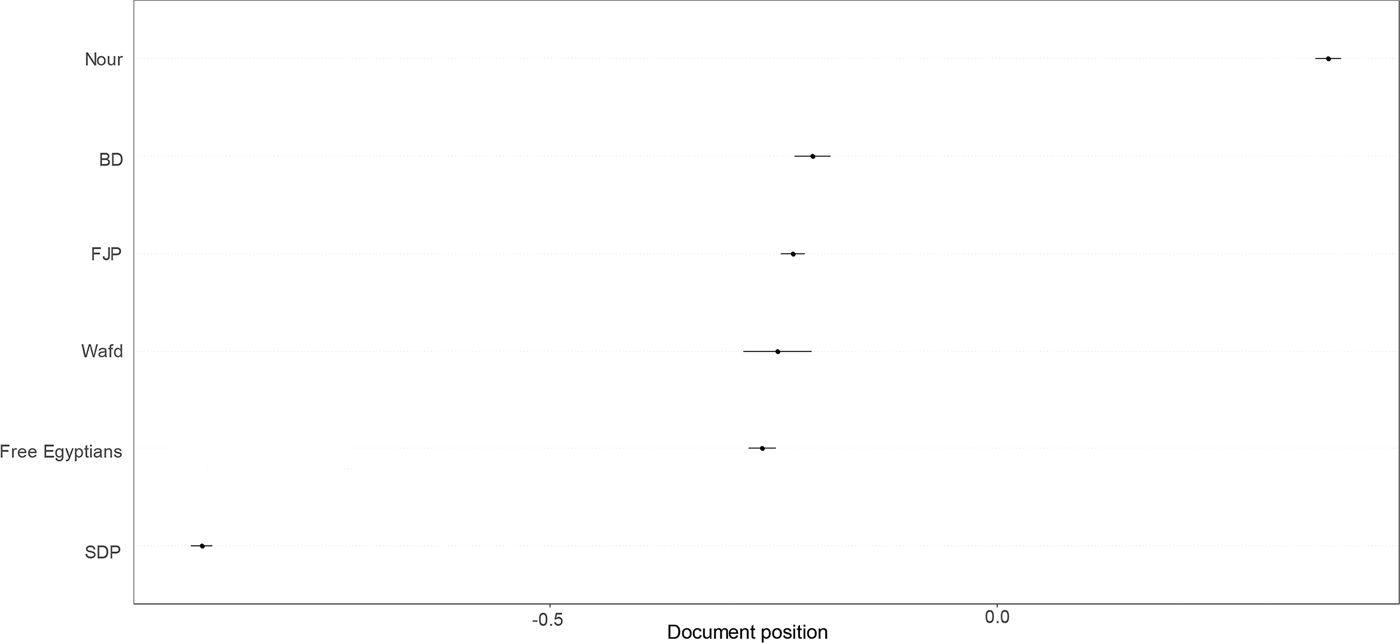
Once the party manifestos have been ‘cleaned’, the Wordfish algorithm is applied and parties’ position estimates on a hypothetical political space are produced. While it is not within the scope of the article to investigate the nature of the political space, we can say that parties’ distribution seems to revolve around the religious-conservative/secular-progressive divide.Footnote 1 As Figure 1 shows, the right side of the political spectrum hosts the more conservative Islamist parties, with al-Nour located on the far end, and moving from the right to the centre, we encounter more reformist religious parties. Wafd and the Free Egyptians, both considered secular liberal parties, occupy the centre of the political space. Finally, on the opposite end there is the SDP, which is a secular leftist party.Footnote 2
Estimated party position in Egypt.

From our working definition of polarization, the hypothesis that the transition has failed because of the ideological distance separating the Islamists from the seculars is not corroborated. As a matter of fact, the FJP, which had the relative majority of seats in Parliament, was as distant from al-Nour as it was from the Wafd and the Free Egyptians party. From a strategic perspective, this means that the FJP's decision to unite with other secular forces was as feasible as that of coalescing, as it eventually did, with al-Nour. The FJP's inability to act as a pivot between the Salafis and the Secularists might be better explained through a different approach that, departing from the formal structures of competition, focuses on the content of the political competition under the previous regime.
Counting identity-based politics
Our second hypothesis posited that parties’ unwillingness to work on a common project during the transition owed to the political salience of identity issues. This claim is tested here through Latent Dietrich Allocation (LDA) topic modelling. Moving from the assumption that the documents observed are a mixture of a given number of latent topics, this technique serves precisely to discover such latent topics by inferring them from words’ co-occurrence within and across documents (Blei et al., Reference Blei, Ng and Jordan2003). The objective of conducting an LDA on the party manifestos is to ascertain whether an identitarian dimension exists and its possible spread across different party manifestos.
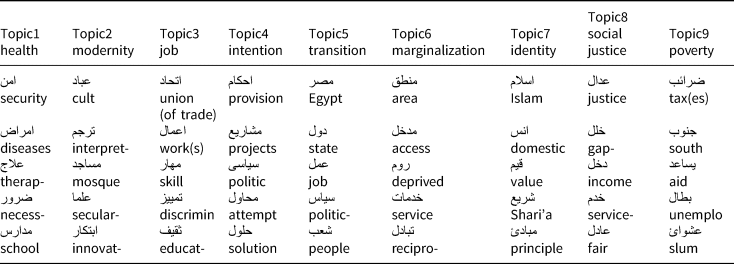
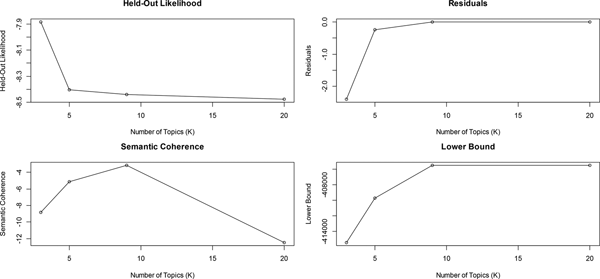
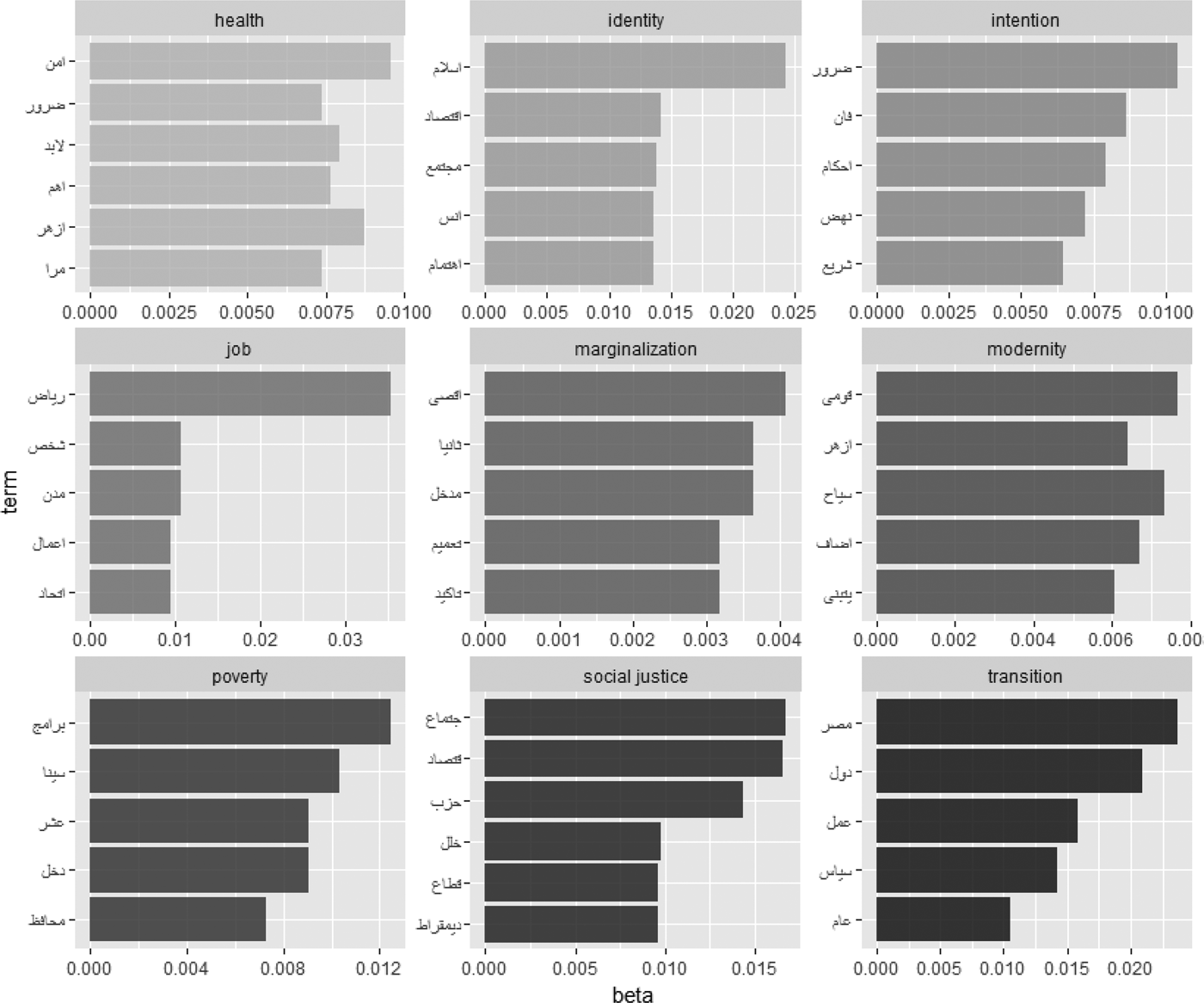
The LDA model returns a set of estimates, including the probability distribution of words to topics and of topics to documents once the number of topics (k) has been imputed a priori. In the absence of any prior information about the ‘real’ number of topics in the whole corpus of texts, the choice of k has been made after reviewing the performance of the estimated models with different values of k (Roberts et al., Reference Roberts2013; see the diagnostic values in Figure A2 in the Appendix). In so doing, nine latent dimensions emerge. These are reported in Table 2 alongside some of the more frequently used words associated with them.
LDA topics

Note: words reported in column are some among the top 30 words associated with a given topic. Topic names are reported in parentheses to denote the inferential process underneath the labelling of discovered latent dimensions.
As can be seen, Topic 1 is constituted of words related to basic social rights like health and to a lesser extent education, and will therefore be referred to as health and education. Interestingly, the words in the second column revolve around a highly disputed issue within Islamist circles, namely the need to adapt through interpretation the observance of sacred law to the challenges of modern times, first and foremost secularization. Indeed, this topic does not deal with religion tout-court, but only with its theological reflections dealing with the application of religious pillars in modern times (عباد). Paying tribute to this scholarly production from Muslim thinkers (Bahlul, Reference Bahlul2003), we will refer to this topic as modernity. The third topic is that of job. Subsequently, there emerges a topic denoting the semantic field of intention. The fifth column reports a mixture of words having to do with both the specificity of the Egyptian state as well as the key words of the uprisings, namely ‘the people’ and especially ‘job’. This topic is referred to as transition. The sixth column unveils the concern over the issue of regional disparities and the need to guarantee citizens in deprived areas access to basic services (including medical care, houses and schools, which are not reported in the Table but are among the most frequently used words associated with this topic); this goes under marginalization. The following column has to do with the dimension that our hypothesis posited as present in the 2011 political competition and as a determinant of the failure of the Egyptian transition, namely the issue of identity. Although at this point nothing can be said about its impact, the seventh column reveals the existence of a dimension concurring to 2011 electoral propaganda specifically dealing with a vision of a society that goes hand in hand (as far as we know, in one sense or another) with issues of religion, Shari'a and ethics. The eighth column comprises of words associated with economy, justice and fairness, and the topic associated with it is here labelled social justice. Finally, the last column deals with poverty.
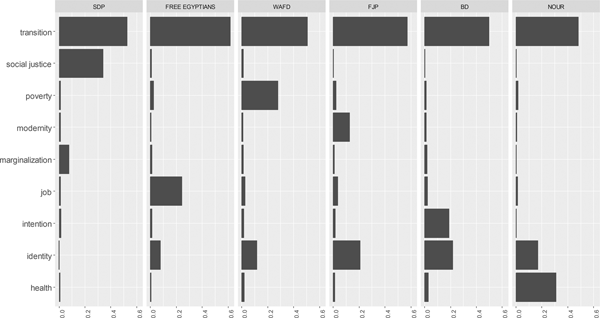
To assess the spread of these topics over parties’ electoral programmes, Figure 2 reports the estimated probabilities of finding a given topic within a given party manifesto. As can be seen, the rhetoric related to the transition is the one that probabilistically accounts for the largest part of all the manifestos. The first row of the graph shows that around 50% of words present in all party manifestos belong to the topic of transition. This is unsurprising given the salience of the historical moment and the need for parties to speak the jargon of protesters in order to maximize consensus.
Topic distributions over 2011 Egyptian party manifestos.

In contrast, other topics seem to be largely the prerogative of just one party. In this sense, the topic of social justice accounts for 34% of the entire political programme of the SDP, but is barely present if not totally absent in the others. The same applies to the topics of poverty, job and health and education. Even though these are present in the programmes of all of the political parties, with ratios rarely reaching a 10% share of the entire document, they are the second-most preferred topics of Wafd (where the theme of poverty accounts for 27% of the political programme), Free Egyptians (where job accounts for 24%) and Nour (where health accounts for 30% of the electoral manifesto). Indeed, it is rather surprisingly that such topics do not find greater space in the remaining party manifestos. A possible explanation is that these are very similar topics (as the words-topic distribution in the Appendix shows) in that they all deal with the need to provide Egyptians with a better life, but they do so by emphasizing slightly different aspects that are discriminated by only a few words captured in the model. As expected from the labelling process, the spread of the modernity topic emerges as somewhat meaningful within the political programme of the FJP, but traces of the semantic field attributable to it (i.e. those not necessarily having religious implications, like ‘innovation’) are present in all of the other party manifestos.
The topic of identity follows a different trend. In contrast to all other topics, its presence is somewhat sizeable in all of the party manifestos, but follows a distribution that appears consistent with the transitional parties’ ideological orientations. Islamist parties’ manifestos display the largest share of words attributable to identity issues. The manifestos of the BD, the FJP and Nour reach peaks of 22, 21 and 17%, respectively. For the centrist secular parties Wafd and Free Egyptians, the topic of identity amounts, respectively, to 12 and 7% of their entire programmes. Finally, for the leftist party SDP, identity issues appear almost irrelevant, accounting for only 0.02% of its entire political programme.
However, the immediate impression that the spread of identity issues within the party manifestos stems from their ideological positioning should not obscure the gap between the parties that existed before the transition (all the Islamists, i.e. FJP, Building and Development and Nour, plus the Wafd), where the ratio of identity issue per manifesto is never below 12%, and those constituted only in 2011, where this ratio is never above 7% (as is the case of the Free Egyptians party) when not virtually equal to zero (for the SDP).
In this regard, the hypothesis that the transition in Egypt failed due to pre-existent parties’ re-proposition of authoritarian identity-based politics by means of political learning seems to hold.
However, we must still explain why the newly constituted Free Egyptian party, founded by an Egyptian Copt, paid so much attention to such themes. Referencing some eloquent passages of the Free Egyptians party manifesto in which the word ‘Islam’ appears,Footnote 3 it can be seen that this party felt both the need to reaffirm a separation between the religious and the political sphere, as well as to acknowledge Islam (together with Christianity) as the hallmark of the Egyptian character. In this regard, the newborn Free Egyptians party might have expressed its commitment to Islamic values to reassure pious voters controlling important businesses in key economic sectors given the party's adherence to economic liberalism.
This analysis corroborates our second hypothesis and uncovers another possible mechanism behind the prevalence of identity issues in transitional Egypt. Identity politics moved into the transitional setting through the political learning of pre-existent parties: FJP, Nour, BD and Wafd. In turn, this dynamic makes identity an issue worth addressing for newcomers as well, as they compete with established parties for the same electorate.
Conclusion
As numerous authors have noted (Brumberg, Reference Brumberg2013; Szmolka, Reference Szmolka2015; Lust and Waldner, Reference Lust, Waldner, Bermeo and Yashar2016), democratization's failure in Egypt was largely attributable to party politics given the burden of previous electoral authoritarianism. This article has examined the effects of the authoritarian legacy on the mechanics of the transitional party system for the sake of completeness and clarity.
On the one hand, claiming as some scholars do (Masoud, Reference Masoud2014; Lust and Waldner, Reference Lust, Waldner, Bermeo and Yashar2016) that the transition failed because the previous regime paved the way for a heterogeneous and unbalanced transitional party system underestimates the fact that in Egypt no party had the absolute parliamentary majority, and leaves unexplained similar cases where the transition was successful due to actors’ commitment to finding a consensual solution, which was entirely absent in Egypt. On the other hand, extant accounts focusing on the reasons for this absence advance different explanations. For some scholars (Lust, Reference Lust-Okar2005; Lust and Wladner, Reference Lust, Waldner, Bermeo and Yashar2016), parties’ unwillingness to cooperate around a shared project was due to a considerable degree of political polarization, understood as the by-product of the previous formal structures of competition. For others (Brumberg, Reference Brumberg2013), this originated in the prevalence of identity cleavages inherited from the previous ‘protection-racket’ politics.
The results of this work have demonstrated that while polarization cannot account for the absence of common ground, identity-based politics does. This manner of structuring politics survived its master – namely the ruling party – because it was internalized through political learning by the political parties born before January 2011, which resorted to it even in an environment of free competition. In turn, this has triggered path-dependencies for newcomers who, in order to compete with established parties, had to engage in one way or another in identity issues. Such a form of competition is particularly unsuitable for the emergency of democracy because it fosters an understanding of the constituent phase as the settlement of mutually exclusive goods, rendering parties averse to dialogue and compromise.
From a comparative perspective, these findings are also useful as a means of explaining the success of the Tunisian transition. In contrast to the Egyptian case, under the Ben Ali regime, Islamists and secularists were both on the same level in terms of political exclusion and the regime's repression (Cavatorta and Merone, Reference Cavatorta and Merone2013). During the transition, two intertwined positive implications resulted. First, the party system format was quite balanced and stimulated the creation of a large governmental coalition. Second, as Cavatorta and Merone note, this ‘common destiny of repression […] between all genuine opposition players […] permitted the creation of a united front against the regime’ (2013: 870), which allowed Islamists and secularists to construct a common ground between them even before the collapse of the Tunisian regime.
Finally, this paper shows how identity-based electoral autocracies, which are very common in the MENA region, are able to explain the ‘modest harvest’ (Brownlee et al., Reference Brownlee, Masoud and Reynolds2013) of the Arab uprisings. Engineered to hamper the development of genuine representative institutions and the unification of opposition actors, these types of regimes taint the very structure of opportunity available to nascent political formations and structure politics in a way that entails a spiral of extreme bids around identity issues. This is unsuitable for the emergence of any sort of compromise around a new set of government-constraining rules. Hence, even if identity-based electoral autocracies collapse, as was the case of some countries in the aftermath of the Arab uprisings, the format and mechanics of the resulting party systems are likely to suffer from a lack of pluralism and programmatic competition, rendering democratic politics very difficult to achieve.
Data
The replication dataset is available at http://thedata.harvard.edu/dvn/dv/ipsr-risp
Author ORCIDs
Valeria Resta, 0000-0002-0440-7946.
Acknowledgments
The author wishes to thank Andrea Cassani and Luca Tomini for their invitation in this special issue and for the care with which they followed the entire project. A special thanks goes also to the two anonymous reviewers for their precious comments.
Financial support
The research received no grants from public, commercial or non-profit funding agency.
Appendix
See Figures A1–A3.
Wordscores estimates.

Measures of model diagnostic.

Word to topic probability.