The process of translating a word often does not result in a simple one-to-one mapping between a word in the first language (L1) and a corresponding translation in the second language (L2). In fact, previous research on English and Spanish, English and Dutch, and English and German has demonstrated that many words have a one-to-many mapping (Eddington, Degani & Tokowicz, Reference Eddington, Degani and Tokowicz2012a; Prior, MacWhinney & Kroll, Reference Prior, MacWhinney and Kroll2007; Tokowicz, Kroll, de Groot & van Hell, Reference Tokowicz, Kroll, de Groot and van Hell2002). This one-to-many mapping between a source language and target language is referred to as translation ambiguity.
One cause of translation ambiguity is near-synonymy in the target language, as in the case of the word shy, which has two equivalents in German: schüchtern and scheu. Both of these correspond to the same meaning. Translation ambiguity is also sometimes due to semantic ambiguity within the source language. For example, the English word odd means an uneven number and strange, and each of these meanings can be translated into a distinct German word (ungerade for the number sense and merkwürdig for the strange sense). We refer to the former as synonym translation-ambiguous words and to the latter as meaning translation-ambiguous words.
Unlike translation-unambiguous words for which there is only one possible translation, a speaker translating a translation-ambiguous word could activate multiple translations. This parallels within-language semantic ambiguity, which occurs when a single word has multiple meanings. Previous research on semantic ambiguity has demonstrated that context is important in resolving the meanings of ambiguous words (e.g., Duffy, Morris & Rayner, Reference Duffy, Morris and Rayner1988; Hogaboam & Perfetti, Reference Hogaboam and Perfetti1975; Onifer & Swinney, Reference Onifer and Swinney198l; Simpson, Reference Simpson1981). Additionally, other factors such as the dominance of the meanings play a significant role in meaning activation (e.g., Duffy et al., Reference Duffy, Morris and Rayner1988; Hogaboam & Perfetti, Reference Hogaboam and Perfetti1975). Further, meaning dominance and context interact in lexical ambiguity resolution such that the more dominant meaning may be primed by either the dominant or subordinate context, whereas the subordinate meaning typically is primed only by the subordinate biasing context (Duffy et al., Reference Duffy, Morris and Rayner1998; Hogaboam & Perfetti, Reference Hogaboam and Perfetti1975).
More recently it has also been noted that the semantic similarity between the various meanings of an ambiguous word may influence lexical ambiguity resolution and processing (Armstrong & Plaut, Reference Armstrong and Plaut2008; Azuma & Van Orden, Reference Azuma and Van Orden1997; Klepousniotou, Titone & Romero, Reference Klepousniotou, Titone and Romero2008; Rodd, Gaskell & Marslen-Wilson, Reference Rodd, Gaskell and Marslen-Wilson2002). For example, polysemous words, which have highly related senses (e.g., paper), are responded to more quickly in a lexical decision task than unambiguous words and homonymous words (e.g., bank), which are words with unrelated senses or meanings (Armstrong & Plaut, Reference Armstrong and Plaut2008; Azuma & Van Orden, Reference Azuma and Van Orden1997; Rodd et al., Reference Rodd, Gaskell and Marslen-Wilson2002).
Because context, meaning frequency, and semantic similarity all play a role in processing ambiguous words within a language, these factors may also influence processing translation-ambiguous words across two languages (e.g., Degani & Tokowicz, Reference Degani and Tokowicz2010b). Research to date has shown that out of context, translation-ambiguous words are translated more slowly and less accurately than translation-unambiguous words (Degani & Tokowicz, Reference Degani and Tokowicz2010a; Tokowicz & Kroll, Reference Tokowicz and Kroll2007). Degani and Tokowicz (Reference Degani and Tokowicz2010a) further demonstrated that the translation-ambiguity disadvantage is not simply due to ambiguous words being experienced less frequently because the disadvantage persisted even though they matched the token frequency of ambiguous and unambiguous words precisely in a learning paradigm.
This research has provided important insights into how these words affect processing by individuals at varying levels of proficiency ranging from beginning adult L2 learners (e.g., Degani & Tokowicz, Reference Degani and Tokowicz2010a) to highly-proficient bilinguals (e.g., Boada, Sánchez-Casas, Gavilán, García-Albea & Tokowicz, in press; see Tokowicz & Degani, Reference Tokowicz, Degani, VanPatten and Jegerski2010, for discussion of the potential changes in translation ambiguity effects that may occur with increased proficiency).Footnote 1 However, examining how other factors such as dominance and context influence the processing of these words is critical to gaining a more complete understanding of the lexical and semantic representations of these words in the bilingual mind. Yet, to date, only a limited number of research studies have examined these factors directly (Elston-Güttler & Friederici, Reference Elston-Güttler and Friederici2005; Elston-Güttler, Paulmann & Kotz, Reference Elston-Güttler, Paulmann and Kotz2005; Elston-Güttler & Williams, Reference Elston-Güttler and Williams2008; Frenck-Mestre & Prince, Reference Frenck-Mestre and Prince1997; Laxén & Lavaur, Reference Laxén and Lavaur2010).
Laxén and Lavaur (Reference Laxén and Lavaur2010, Experiment 3) used a translation recognition task to examine how translation dominance and the semantic similarity between the translations of translation-ambiguous words affect translation recognition. The translation-ambiguous words that had less semantically similar translations (meaning translation-ambiguous words) were responded to more slowly overall compared to words with more semantically similar translations (synonym translation-ambiguous words) and to unambiguous words. Additionally, dominant translations were responded to more quickly than subordinate translations, and the dominance effect was greater for words with less semantically similar translations than for words with more semantically similar translations. The authors suggested that this was due to greater shared representations at the semantic level of representation in memory for the more semantically similar translation-ambiguous words. Nevertheless, this study examined only bilinguals’ decisions on translation-ambiguous words out of context, where ambiguity effects may be exaggerated in comparison to effects in context.
A study by Elston-Güttler et al. (Reference Elston-Güttler, Paulmann and Kotz2005, Experiment 2) compared how less and more proficient German–English bilinguals processed homonyms in a sentence context. They also examined the effects of dominance of the homonyms’ meanings captured by the English translations (e.g., the German word Kiefer means both jaw and pine in German). In the experiment, a sentence biased one meaning of the homonymous word (e.g., jaw), which served as the prime. The prime appeared in the final position of the sentence. After a delay, the target word, which corresponded to the other sense of the homonym (e.g., pine), was presented. Then, participants made a lexical decision to the target word. There were two conditions: (i) a sentence that biased the dominant meaning of the word (e.g., “The sticky candy stuck together his jaw”) with a target that represented the subordinate meaning (e.g., pine), and (ii) a sentence that biased the subordinate meaning (e.g., “The beautiful table was made of solid pine”), with a target that represented the dominant meaning (e.g., jaw). Dominant targets were responded to more quickly than the subordinate targets, demonstrating dominance effects across translated senses of semantically-related words.
A study by Elston-Güttler and Williams (Reference Elston-Güttler and Williams2008) examined how German learners of English process translation-ambiguous words within sentential context. They used polysemous German words such as Blase, which translates to both blister and bubble. Participants read a sentence and decided whether the final word made sense in the context. The German learners of English responded more slowly to the polysemous translations that biased the alternative sense (e.g., “His shoes were uncomfortable due to a bubble”) than to the same words in control sentences (e.g., “She was very hungry because of a bubble”). These findings suggest that all meanings of the ambiguous word were activated, thereby leading to the interference effect. Because this interference effect appeared even though only one translated sense was presented, it suggests that on viewing the English word form (bubble) the bilinguals activated the German word form (Blasen), which in turn activated both meanings and corresponding translations (bubble and blister) (but see Degani, Prior & Tokowicz, Reference Degani and Tokowicz2010, for an alternative explanation).
Although Elston-Güttler and Williams (Reference Elston-Güttler and Williams2008) showed that both meanings of a polysemous word are activated even in biasing context, they did not directly examine the role of translation dominance, which may also influence these effects. Dominance influences ambiguous word processing (Elston-Güttler et al., Reference Elston-Güttler, Paulmann and Kotz2005; Laxén & Lavaur, Reference Laxén and Lavaur2010) as does semantic similarity between the translations (Laxén & Lavaur, Reference Laxén and Lavaur2010), and these factors may interact with each other. The current study examines these three factors: word context, semantic similarity/source of translation ambiguity, and translation dominance/frequency.Footnote 2 Thus, this study provides an investigation of how each of these elements affects processing of translation-ambiguous words, and how these factors interact with one another, within a word translation recognition task.
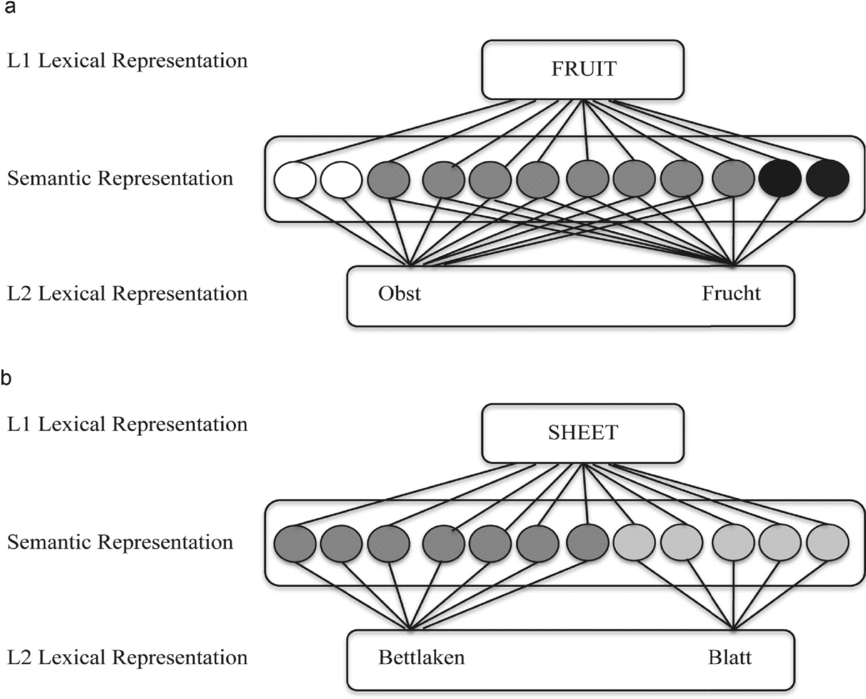
Despite the fact that translation ambiguity consistently affects processing, the majority of bilingual models (e.g., Dijkstra & van Heuven, Reference Dijkstra and van Heuven2002; Jacquet & French, Reference Jacquet and French2002) have not been adapted to take translation ambiguity effects into consideration. One such adaptation was presented by Laxén and Lavaur (Reference Laxén and Lavaur2010), who described a modified version of the Distributed Conceptual Feature Model (DCFM; de Groot, Reference de Groot1992; van Hell & de Groot, Reference van Hell and de Groot1998) to explain their findings. According to the original DCFM, a word's semantic information is distributed across nodes in a shared (L1/L2) semantic level of representation. The speed and accuracy of translating a word is influenced by how many shared nodes there are between a word in L1 and its corresponding translation in L2. Concrete words and cognate translations are thought to share more nodes at the semantic level across languages than abstract words and noncognate translations, respectively. Specifically, the DCFM predicts that the greater the number of shared nodes between the L1 and L2, the faster and more accurate processing will be. The model therefore provides an explanation of why concrete words and cognates are translated more quickly and accurately than abstract words and noncognates, respectively (e.g., de Groot, Reference de Groot1992; van Hell & de Groot, Reference van Hell and de Groot1998; see also Schoonbaert, Duyck, Brysbaert & Hartsuiker, Reference Schoonbaert, Duyck, Brysbaert and Hartsuiker2009, for a similar explanation within the context of translation priming). Laxén and Lavaur's (Reference Laxén and Lavaur2010) extension of the DCFM included translation-ambiguous words so that more than one translation could be selected at the lexical level of representation. According to this model, the more semantically similar the possible translations are (as for synonym translation-ambiguous words), the greater the number of shared nodes will be active, leading to faster processing (see Figure 1a). When translations are less semantically similar (as for meaning translation-ambiguous words) there will be less shared activation at the semantic level and therefore processing will be slower (see Figure 1b).
Laxén and Lavaur's (Reference Laxén and Lavaur2010) extension of the Distributed Conceptual Feature Model (de Groot, Reference de Groot1992; van Hell & de Groot, Reference van Hell and de Groot1998). Panel (a) depicts synonym translation-ambiguous words, and panel (b) depicts meaning translation-ambiguous words.

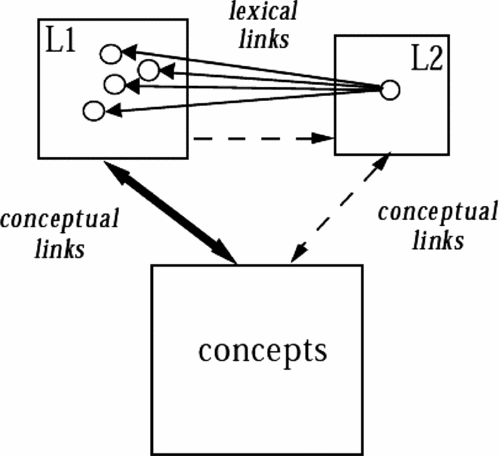
The Revised Hierarchal Model (RHM; Kroll & Stewart, Reference Kroll and Stewart1994) has also been extended to include translation ambiguity (Kroll & Tokowicz, Reference Kroll, Tokowicz and Nicol2001; see Figure 2). The original RHM makes two key assumptions. First, bilinguals have stronger lexical links from L2 words to their translations in L1 than the reverse. Second, there are stronger bidirectional links between concepts and corresponding words in L1 than between concepts and corresponding words in L2. As a result of these asymmetries, translation from L2 to L1 is thought to be mediated via lexical associations. By contrast, translation from L1 to L2 is conceptually mediated, such that access to the translation is through concepts or meanings (from the L1 word, to the concept, to the L2 word).
The Revised Hierarchical Model adapted to account for translation-ambiguous words (Kroll & Tokowicz, Reference Kroll, Tokowicz and Nicol2001).

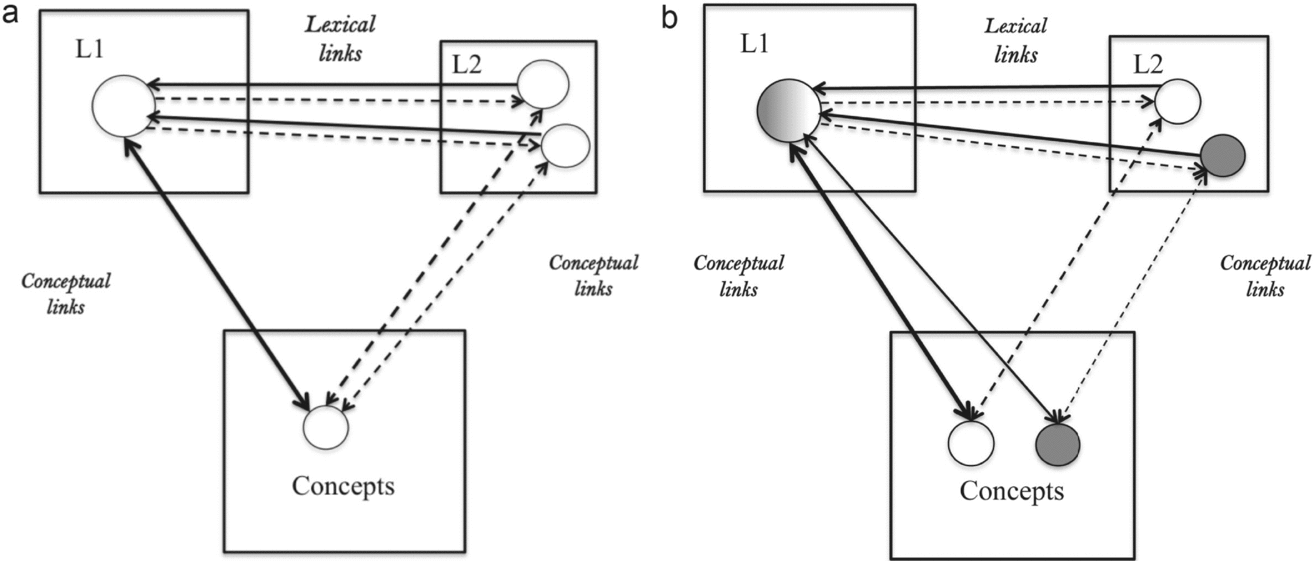
Kroll and Tokowicz (Reference Kroll, Tokowicz and Nicol2001) modified the RHM to include translation-ambiguous words, but did not distinguish synonym and meaning translation-ambiguous words. Here, we incorporate these two elements into the RHM and refer to the adapted model as the Revised Hierarchical Model of Translation Ambiguity (RHM-TA). The RHM-TA predicts different outcomes for translation-ambiguous words derived from different sources (synonym vs. meaning). In Figure 3, we portray this model indicating translation ambiguity in the L1 to L2 direction. For synonym translation-ambiguous words, there is a single L1 lexical representation and a single conceptual representation, but this conceptual representation is connected to multiple L2 lexical representations (see Figure 3a). For meaning translation-ambiguous words, there is again a single L1 lexical representation, but more than one conceptual representation; each conceptual representation is connected to a different L2 lexical representation (see Figure 3b). Additionally, for meaning translation-ambiguous words with one highly dominant translation, there would be a stronger connections to the concept for the dominant meaning and to the L2 lexicon for the dominant translation; here, we make the simplifying assumption that the dominant translation across languages corresponds to the dominant meaning within a language, although this may not necessarily be the case because the meaning distribution experienced in L1 will not precisely mirror that in L2.
The Revised Hierarchical Model of Translation Ambiguity. Panel (a) depicts synonym translation-ambiguous words, and panel (b) depicts meaning translation-ambiguous words.

Based on prior research (e.g. Elston-Güttler et al., Reference Elston-Güttler, Paulmann and Kotz2005; Frenck-Mestre & Prince, Reference Frenck-Mestre and Prince1997; Laxén & Lavaur, Reference Laxén and Lavaur2010) and the RHM-TA framework, we predict that dominant translations will be processed more quickly than subordinate translations. Furthermore, once the meaning is established for meaning translation-ambiguous words, there will be a more one-to-one connection from the L1 word to the L2 word via concepts. This is because the ambiguity for meaning translation-ambiguous words is due to the multiple connections from the L1 lexical level to the conceptual level, but there is a direct mapping from a single concept to a single word from the conceptual level to the L2 lexical level. For example, if the context biased the strange sense of the word odd then the only possible translation would be merkwürdig. In contrast, a context for the word fruit would not limit the possible translations available to a single translation in German; Obst and Frucht would both remain options. Therefore, meaning translation-ambiguous words may have an advantage over synonym translation-ambiguous words in tasks that establish some form of context because the latter will maintain a one-to-many mapping regardless of context. Consistent with this idea, Degani and Tokowicz (Reference Degani and Tokowicz2010a) found that when teaching monolinguals translation-unambiguous and ambiguous Dutch words, the meaning translation-ambiguous words were learned more easily than synonym translation-ambiguous words.
Because in this experiment we directly compare two sources of translation ambiguity in a categorical rather than continuous manner, we chose to demonstrate these two types of ambiguity in the RHM-TA in a more localized fashion. However, this representation may be oversimplified. Instead, this model could be adapted to have a more distributed representation as in the DCFM. For example, polysemous translation-ambiguous words in which the translations are more highly related, the meanings at the conceptual level would overlap to a higher degree.
The goals of the current study are: (i) to better understand how L2 learners process translation-ambiguous words; (ii) to understand how word context, semantic relatedness, and dominance of the translations interact with processing of these words; and (iii) to examine whether word context can disambiguate translation-ambiguous words. We therefore examined differences between the processing of the synonym vs. meaning types of translation-ambiguous words compared to translation-unambiguous words, as well as the differences in processing for dominant and subordinate translations. Because the semantic similarity between different senses of ambiguous words influences processing within a language (Armstrong & Plaut, Reference Armstrong and Plaut2008; Azuma & Van Orden, Reference Azuma and Van Orden1997; Rodd et al., Reference Rodd, Gaskell and Marslen-Wilson2002), in a post-hoc analysis we also examined how the perceived semantic similarity between the multiple translations of the translation-ambiguous words correlates with processing speed.
To examine these issues, we developed a modification of the translation recognition task (e.g. de Groot & Comijs, Reference de Groot and Comijs1995), which we have termed the primed translation recognition task. In this task, bilinguals decide if pairs of words are correct translations; the word pairs are preceded by an unrelated or related prime word. We focused our analyses on the correct translation pairs that were preceded by unrelated vs. related primes; faster reaction times on related than unrelated trials was taken to indicate priming. Initially, we were additionally interested in how the matching of the related prime to the meaning of the translation, for the meaning translation-ambiguous items (e.g., a prime that matched the dominant translation paired with that dominant translation vs. paired with the subordinate translation) may affect processing. However, the manipulation of prime match (match RT: 1259 ms vs. mismatch RT: 1248 ms) did not yield any significant effects, F < 1. Therefore, we examine only the effects of primes that matched the translation meaning and excluded data from trials on which mismatched primes were presented.
Based on the findings of previous studies (e.g., Tokowicz & Kroll, Reference Tokowicz and Kroll2007) and the RHM-TA, we predicted an overall ambiguity disadvantage such that translation-ambiguous words (e.g., trunk) would be responded to more slowly and less accurately than unambiguous words (e.g., art). Based on previous semantic priming studies (see Neely, Reference Neely, Besner and Humphreys1991, for a review), we expected target-translation pairs preceded by related primes (e.g., prime: design; target–translation: ART–Kunst) to result in faster response times than target–translation pairs preceded by unrelated primes (e.g., prime: fiscal; target–translation: ART–Kunst). In line with the RHM-TA, we also predicted that related primes would disambiguate meaning translation-ambiguous words (e.g., prime: paper; target–translation: SHEET–Blatt) and make them easier to process, such that response times for semantically primed meaning translation-ambiguous words would be similar to primed translation-unambiguous words. Based on previous studies within a language (Duffy et al., Reference Duffy, Morris and Rayner1998; Hogaboam & Perfetti, Reference Hogaboam and Perfetti1975) and across languages (Laxén & Lavaur, Reference Laxén and Lavaur2010) we predicted further that dominant translations (e.g., SHY–schüchtern) would result in faster response times than subordinate translations (e.g., SHY–scheu) for both synonym and meaning translation-ambiguous words. We expected that synonym translation-ambiguous words would be responded to more quickly overall than meaning-translation ambiguous words based on the predictions of the modified DCFM and previous research (Laxén & Lavaur, Reference Laxén and Lavaur2010). Lastly, based on the RHM-TA, we expected a translation ambiguity type by relatedness interaction such that related primes would facilitate translation-recognition speed more for meaning translation-ambiguous words than for synonym translation-ambiguous words. This is because a related prime could disambiguate the meaning-translation ambiguous word by restricting the selection to one translation but should not disambiguate a synonym translation-ambiguous word.
Method
Design
This study used a 3 word type (unambiguous, synonym translation-ambiguous, meaning translation-ambiguous) by 2 prime relatedness (related, unrelated) by 2 translation dominance (dominant, subordinate) within-subjects design.
Task order
Following two tasks that did not yield interesting findings, participants completed the primed translation recognition task.Footnote 3 Lastly, participants completed a language history questionnaire (Tokowicz, Michael & Kroll, Reference Tokowicz, Michael and Kroll2004) that details their demographic information, previous language exposure, and self-reported ratings of L1 and L2 proficiency. Additionally, a subset of participants completed form (spelling and sound) and meaning similarity ratings for the German translations of the translation-ambiguous English words.
Participants
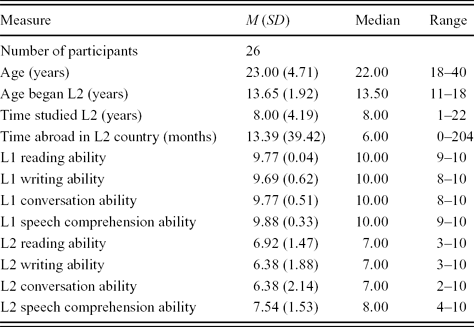
Data were analyzed from 26 native English-speaking participants from the University of Pittsburgh and The Pennsylvania State University. An additional 17 participants took part in the study but did not contribute data to the final analyses because they failed to reach 50% accuracy on all three word types in the translation recognition task (unambiguous, meaning translation-ambiguous, and synonym translation-ambiguous words; n = 7) or had exposure to a language other than English before age 10 (n = 10). Participants included in the final analyses had an overall mean accuracy of 85%. All but one of the participants were right handed. Language history questionnaire data are shown in Table 1.
Language history questionnaire data.

Note: The L1 and L2 reading, writing, conversation ability and speech comprehension ability are based on a 1–10 scale, on which 1 indicates the lowest ability level and 10 indicates the highest ability level.
Stimuli
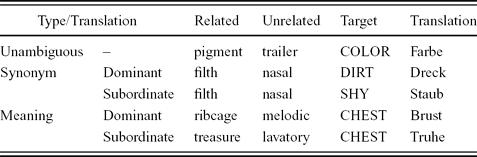
The critical word stimuli consisted of 448 prime–target–translation triplets (see Table 2 for example stimuli; for the complete list of items see Supplementary Materials accompanying this article online, via the journal's webpage at http://journals.cambridge.org/BIL). The critical target words consisted of 32 translation-unambiguous words, 32 meaning translation-ambiguous words, 32 synonym translation-ambiguous words, and 92 filler targets. Translations and their dominance were obtained from English–German/German–English number-of-translations norms obtained by Eddington et al. (Reference Eddington, Degani and Tokowicz2012a), who used the same method to elicit and code translations as Tokowicz et al. (Reference Tokowicz, Kroll, de Groot and van Hell2002). Specifically, individuals provided the first translation they thought of for each word, and the number of correct translations across individuals was used to determine translation ambiguity. Words were considered translation ambiguous if they elicited two or more German translations and translation unambiguous if they elicited a single German translation. The most frequently provided translation was considered the dominant translation. Using dictionaries (Biographisches Institut GmbH, 2012; LEO GmbH, 2012), we classified words as synonym translation ambiguous if they had German translations with similar senses; we classified words as meaning translation ambiguous if they had German translations with dissimilar meanings.Footnote 4
Example stimuli.

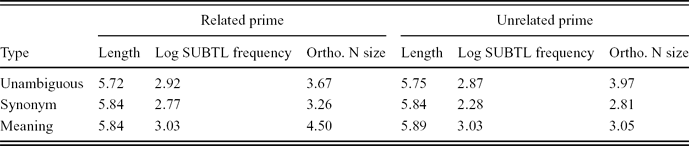
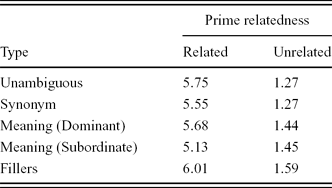
For each critical target, there was a corresponding related and unrelated prime. All translation-ambiguous targets (meaning and synonym types) had two corresponding translations. For the meaning-ambiguous targets, there were related and unrelated primes that corresponded to each distinct meaning/translation. However, because the synonym translation-ambiguous targets essentially only have one meaning (although there may be slight differences in usage of the words) there was only one related and unrelated prime for each target. Translation-unambiguous targets were paired with a single translation and also had one related and unrelated prime. Prime and target pairs had been normed previously for relatedness by a group of native English speakers (Eddington, Reference Eddington2009). Stimulus characteristics by condition are given in Table 3, prime characteristics are given in Table 4, and relatedness ratings are given in Table 5.
Characteristics of targets and translations.

Note: English word frequencies are the log of the SUBTL frequency norms per million (Brysbaert & New, Reference Brysbaert and New2009) downloaded from the English Lexicon Project (Balota et al., Reference Balota, Yap, Cortese, Hutchison, Kessler, Loftis, Neely, Nelson, Simpson and Treiman2007). English orthographic neighborhood (ortho. N) size values were obtained from the English Lexicon Project (Balota et al., Reference Balota, Yap, Cortese, Hutchison, Kessler, Loftis, Neely, Nelson, Simpson and Treiman2007). German word frequencies are the log of the SUBTLEX-DE word frequency norms per million (Brysbaert et al., Reference Brysbaert, Buchmeier, Conrad, Jacobs, Bölte and Böhl2011). Form similarity ratings between the English and German word pairs were computed using the normalized for word length Levenshtein metric as described in Schepens et al. (Reference Schepens, Dijkstra and Grootjen2012).
Characteristics of related and unrelated primes by type.

Note: English word frequencies are the log of the SUBTL frequency norms (Brysbaert & New, Reference Brysbaert and New2009) downloaded from the English Lexicon Project (Balota et al., Reference Balota, Yap, Cortese, Hutchison, Kessler, Loftis, Neely, Nelson, Simpson and Treiman2007). English orthographic neighborhood (ortho. N) size values were obtained from the English Lexicon Project (Balota et al., Reference Balota, Yap, Cortese, Hutchison, Kessler, Loftis, Neely, Nelson, Simpson and Treiman2007). German word frequencies are the log of the SUBTLEX-DE word frequency norms (Brysbaert et al., Reference Brysbaert, Buchmeier, Conrad, Jacobs, Bölte and Böhl2011). Form similarity ratings between the English and German word pairs were computed using the normalized for word length Levenshtein metric as described in Schepens et al. (Reference Schepens, Dijkstra and Grootjen2012).
Mean semantic similarity ratings for prime–target pairs.

Note: Semantic similarity ratings were based on a scale from 1–7 on which 1 indicates that the two words are highly unrelated and 7 indicates that the words are highly related. These ratings were obtained from Eddington (Reference Eddington2009). Twenty-four participants rated prime–target pairs for relatedness. There were two related and unrelated primes that correspond to each distinct meaning for the meaning translation-ambiguous target words. Only one related and unrelated pair was presented for the filler, unambiguous, and synonym translation-ambiguous targets.
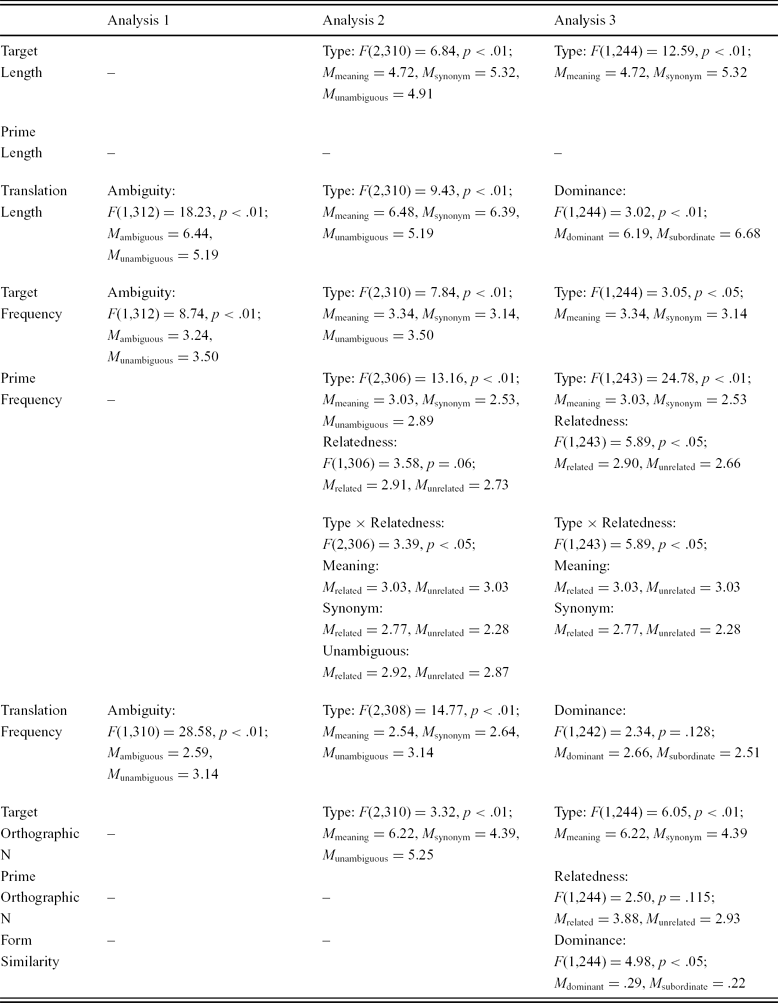
However, because of the limited selection of items there were some differences in word characteristics of the prime–target–translation triplets across conditions. Item characteristic differences were regressed out of the analyses by items. We address these differences further in the results section.
The conditions were counterbalanced across list versions such that each target word was presented only once to each participant. All the critical targets were paired with their corresponding correct translation and therefore constituted “yes” trials. The filler targets consisted of targets paired with incorrect translations and therefore constituted “no” trials. There were equal numbers of related and unrelated primes paired with the filler and critical targets within each list. Data from only the “yes” trials were analyzed.
Procedure
In the primed translation recognition task, participants were asked to decide if English–German word pairs were translation equivalents. Each English–German pair was preceded by a related or unrelated prime. Participants first saw a fixation cross for 1000 ms, then a prime for 250 ms, followed immediately by a target–translation pair. Participants had up to 3500 ms to respond using a button box (leftmost key for “no” and rightmost key for “yes”). Participants had four breaks during the task to rest their eyes. The E-prime software package (Schneider, Eschman & Zuccolotto, Reference Schneider, Eschman and Zuccolotto2010) was used to present the stimuli and to record reaction time (RT) and accuracy.
Results
Data trimming
One word was removed from the data analysis because it was mislabeled as being a synonym type rather than meaning type ambiguous word.Footnote 5 Following this, response latencies that were shorter than 300 ms or longer than 3000 ms, and all response latencies 2.5 standard deviations above or below each participant's mean were excluded from analyses. These procedures led to the removal of 3.32% of the data.
Analysis approach
We conducted three sets of analyses to examine different aspects of our results. We first explored overall ambiguity effects with 2 word type (ambiguous vs. unambiguous) by 2 prime relatedness (related vs. unrelated) ANOVAs. We then investigated word type effects using 3 word type (synonym, meaning, unambiguous) by 2 prime relatedness (related vs. unrelated) ANOVAs. Finally, we investigated translation dominance effects using 2 ambiguity type (synonym vs. meaning) by 2 translation dominance (dominant vs. subordinate) by 2 prime relatedness (related vs. unrelated) ANOVAs. Mean RT and accuracy data are analyzed by participants (F 1) and by items (F 2).
To assess the matching of prime, target, and translation characteristics across conditions, we examined: word length; log SUBTL English word frequency (per million words; Brysbaert & New, Reference Brysbaert and New2009) for primes and targets; log SUBTLEX-DE German word frequency (per million words; Brysbaert, Buchmeier, Conrad, Jacobs, Bölte & Böhl, 2011) for translations; prime and target orthographic neighborhood sizes; and target–translation form similarity (Schepens, Dijkstra & Grootjen, Reference Schepens, Dijkstra and Grootjen2012) in three analyses. These three analyses are congruent with our three sets of primary participant and items analyses. Any factor that differed across conditions in main effects or interactions using a conservative alpha level of .15 was regressed out of the item RT and accuracy data; the saved residual values were treated as the dependent measures in the analyses by items (see Table 6).Footnote 6
Analyses of item characteristics.

Note: F and p values and means are reported for all effects significant at the p < .15 level. All other ps ≥ .224.
Analyses
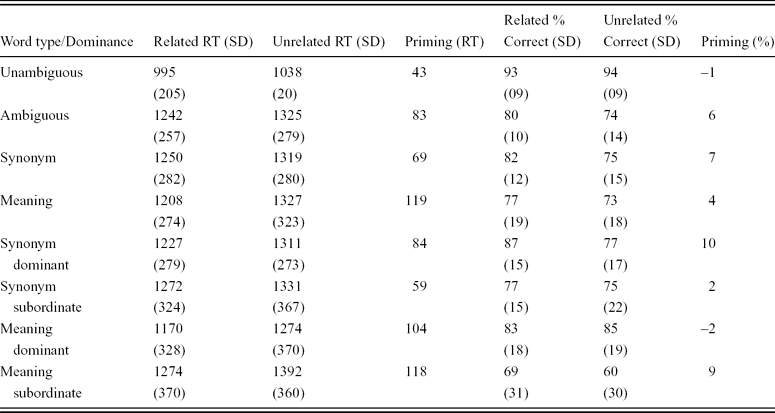
To examine overall ambiguity effects, both meaning and synonym type translation-ambiguous words were collapsed in 2 word type (ambiguous vs. unambiguous) by 2 prime relatedness (related vs. unrelated) repeated measures ANOVAs (see means in Table 7).
Means and Standard Deviations (SDs) for the reaction time (RT) and accuracy analyses.

Note: Negative priming values indicate reverse priming.
Overall, translation-ambiguous words were recognized more slowly (1284 vs. 1017 ms) (F 1(1,25) = 173.93, MSE = 10645.95, p < .001; F 2(1,298) = 21.46, MSE = 69781.10, p < .001) and less accurately (77 vs. 94%) (F 1(1,25) = 156.21, MSE = 0.004, p < .001; F 2(1,310) = 16.89, MSE = 0.061, p < .001) than translation-unambiguous words.Footnote 7 Target–translation pairs that were preceded by related primes were responded to more quickly than target–translation pairs preceded by unrelated primes (1119 vs. 1182 ms), F 1(1,25) = 11.88, MSE = 8714.16, p < .01; F 2(1,298) = 5.85, MSE = 69781.10, p < .016. No main effects of relatedness were found in the accuracy analyses, F 1(1,25) = 2.01, MSE = 0.009, p = .169; F 2 < 1. The ambiguity by relatedness interaction was not significant for the analyses of RT (Fs < 1) or accuracy, F 1(1,25) = 2.88, MSE = 0.008, p = .102; F 2 < 1.
To examine word type effects, we further analyzed the three word types in 3 word type (synonym, meaning, unambiguous) by 2 prime relatedness (related vs. unrelated) ANOVAs on RT and accuracy. Again, translation-ambiguous words were recognized more slowly (M synonym = 1284 ms, M meaning = 1268 ms, M unambiguous = 1017 ms) (F 1(2,50) = 54.45, MSE = 21902.58, p < .001; F 2(1,292) = 9.90, MSE = 69052.70, p < .001) and less accurately than translation-unambiguous words (M synonym = 79%, M meaning = 75%, M unambiguous = 94%), F 1(2,50) = 41.21, MSE = 0.012, p < .001; F 2(1,304) = 9.34, MSE = 0.061, p < .001. Examination of the 95% confidence intervals for RT and accuracy revealed that the means for the form and meaning ambiguous words were similar, and were both different than those for the translation-unambiguous words. Also, processing was faster following related than unrelated primes (1151 vs. 1228 ms) (F 1(1,25) = 12.23, MSE = 18920.18, p = .002; F 2(1,292) = 8.85, MSE = 69052.70, p < .01), however this priming effect was not significant in the accuracy analyses, F 1(1,25) = 1.83, MSE = 0.024, p = .189; F 2(1,304) = 1.15, MSE = 0.061, p = .29. Word type and relatedness did not interact in either analysis, for RT: F 1(2,50) = 1.18, MSE = 16162.06, p = . 316; F 2 < 1; for accuracy: Fs < 1.
In the following analyses, we directly compare the ambiguous word types and the differing effects of priming and dominance on synonym and meaning translation-ambiguous words. To accomplish this, we tested only the translation-ambiguous words, and used 2 ambiguity type (synonym vs. meaning) by 2 translation dominance (dominant vs. subordinate) by 2 prime relatedness (related vs. unrelated) repeated measures ANOVAs on the RT and accuracy data. Missing cells (n = 3) were replaced with the mean.
We observed no RT differences between the meaning translation-ambiguous words and the synonym translation-ambiguous words (1285 vs. 1274 ms), F 1 < 1; F2(1,231) = 1.14, MSE = 78548.17, p = .286. However, synonym translation-ambiguous words were responded to marginally more accurately than the meaning translation-ambiguous words (79 vs. 74%), F 1(1,25) = 3.21, MSE = 0.035, p = .085; F 2(1,243) = 3.35, MSE = 0.069, p = .069. Dominant translations were responded to more quickly than subordinate translations in the analysis by participants (1246 vs. 1314 ms) (F 1(1,25) = 9.19, MSE = 26325.51, p < .01), but not in the analysis by items, F 2(1,231) = 1.13, MSE = 78548.17, p = .288. Dominant translations were also responded to more accurately than subordinate translations (83 vs. 70%), F 1(1,25) = 34.56, MSE = 0.024, p < .001; F 2(1,243) = 14.23, MSE = 0.069, p < .001. Target–translation pairs preceded by related primes were responded to more quickly than target–translation pairs preceded by unrelated primes (1232 vs. 1327 ms), F 1(1,25) = 8.21, MSE = 56754.05, p = .008; F 2(1,231) = 7.41, MSE = 78548.17, p = .007. There was no significant relatedness effect in the accuracy analyses, F 1(1,25) = 1.70, MSE = 0.072, p = .204; F 2(1,243) = 1.67, MSE = 0.069, p = .197. The interaction between type and dominance was not significant by participants or items in the reaction time analyses, F 1 < 1; F 2(1,231) = 2.64, MSE = 78548.17, p = .106. We did observe a significant type by dominance interaction in the accuracy analysis by participants, F 1(1,25) = 6.23, MSE = 0.033, p = .02, which was marginally significant by items, F 2(1,243) = 3.19, MSE = 0.069, p = .075. To gain a better understanding of the significant interaction for the accuracy analysis, we conducted Bonferroni-corrected post-hoc t-tests (value to reach significance = .0125), which revealed that the effect of translation dominance was greater for meaning translation-ambiguous words (M dominant = 84%, M subordinate = 64%), t(25) = 5.23, p < .001, d = 1.35, than for the synonym translation-ambiguous words (M dominant = 82%, M subordinate = 76%), t(25) = 2.39, p = .025, d = 0.44. Additionally, there was no significant difference between dominant translations for the meaning and synonym translation-ambiguous words, t(25) = 0.602, p = .55, d = 0.08, but there was a significant difference between the subordinate translations for the synonym and meaning translation-ambiguous words such that subordinate synonym translation-ambiguous words had a higher accuracy than subordinate meaning translation-ambiguous words (76 vs. 64 %), t(25) = 2.86, p = .009, d = 0.84.
No ambiguity type by relatedness interaction was observed in the RT and accuracy analyses, Fs < 1. Although only significant interactions are typically probed further, the RHM-TA makes specific predictions regarding differences in priming for the two types of ambiguous words. Therefore, we conducted planned t-tests (using the Bonferroni correction for multiple comparisons; critical value to reach significance = .025) examining the RT priming effects for synonym and meaning translation-ambiguous words. These revealed significant priming for meaning translation-ambiguous words (M related = 1215 ms, M unrelated = 1333 ms), t(25) = 2.67, p = .013, d = 0.42, but not for synonym translation-ambiguous words (M related = 1250 ms, M unrelated = 1321 ms), t(25) = 1.91, p = .068, d = 0.24. Again, because the interaction between ambiguity type and relatedness was not statistically significant, these findings must be interpreted with caution. No dominance by relatedness interaction or three way interactions were observed.
Discussion
The focus of this experiment was to explore how the processing of translation-ambiguous words is influenced by word context, translation dominance, and translation ambiguity type in a primed translation recognition task. Consistent with our hypotheses and previous research (e.g., Boada et al., in press; Degani & Tokowicz, Reference Degani and Tokowicz2010a; Laxén & Lavaur, Reference Laxén and Lavaur2010; Tokowicz & Kroll, Reference Tokowicz and Kroll2007) we found an overall ambiguity disadvantage. Participants were slower and less accurate to respond to words that had more than one translation compared to unambiguous words. Our hypothesis that dominant translations would be recognized more quickly than subordinate translations was confirmed only in our analyses by participants. After accounting for potential confounding factors in the analysis by items, this hypothesis was not upheld, and the results were only marginally significant. However, we did observe that dominant translations were responded to more accurately than subordinate translations. Additionally, we did not observe any overall differences between the synonym and meaning translation-ambiguous words. Consistent with previous research (Laxén & Lavaur, Reference Laxén and Lavaur2010), we found a marginally-significant interaction between ambiguity type and translation dominance in accuracy, such that there was a greater benefit for the dominant translation compared to the subordinate translation for meaning translation-ambiguous words but not for synonym translation-ambiguous words.
To our knowledge, this is the first study to employ the primed translation recognition methodology. We demonstrated that a related prime can facilitate translation recognition speed compared to an unrelated prime, thus validating the primed translation recognition task. In the following sections first we will discuss the theoretical implications of the overall ambiguity effects, and then how bilingual models could account for the influence of context, dominance, and semantic similarity on processing of translation-ambiguous words.
Translation ambiguity effects
The source of translation ambiguity effects has yet to be determined, although there are theoretical accounts that provide some insights. The fan effect (Anderson, Reference Anderson1974) is the notion that the more ideas associated with a concept, the greater the processing time will be on the concept. For example, a word with many associates would have smaller association strengths between the concept and each association, whereas a word with only one associate would have strong association strength between the concept and the associate. Applying this account to translation ambiguity generally, as the number of translations increases, the associative strength between a source word and each of its translations would decrease (e.g., Degani & Tokowicz, Reference Degani and Tokowicz2010a). Translation-unambiguous word pairs would therefore have the strongest associative strength, leading to facilitation in processing, whereas translation ambiguous words would have weaker associations between a source word and each translation, resulting in longer, more difficult processing (e.g., Degani & Tokowicz, Reference Degani and Tokowicz2010a).
The difficulty found with translation-ambiguous words can also be explained by Interactive Activation (IA) models (e.g., Jacquet & French, Reference Jacquet and French2002; McClelland & Rumelhart, Reference McClelland and Rumelhart1981) in which the effects would be due to competition between the translations that correspond to one word (Degani & Tokowicz, Reference Degani and Tokowicz2010a). For translation-ambiguous words, more than one alternative translation is available for selection, which may lead to active competition between the possible translations. Selecting one translation over another would require the inhibition of the unselected translation alternatives, leading to slower and less accurate responses, particularly in translation production tasks. Moreover, Elston-Güttler et al. (Reference Elston-Güttler, Paulmann and Kotz2005) found evidence consistent with inhibition of the unintended translation in the ERP record and RT data for low proficiency native German-speaking learners of English. Additionally, within the framework of an IA model, one could explain dominance effects by adjusting inhibitory connections such that there would be greater inhibition for subordinate than dominant translations. Although both theories can explain translation-ambiguity effects, the underlying mechanisms driving the effects are different. Furthermore, it is not clear how other factors such as concreteness, cognate status, and source of ambiguity would be incorporated in these two accounts and therefore we are not able to distinguish which theory may best capture our translation-ambiguity effects. It must also be noted that these models may not accurately reflect more complex translation situations such as discourse translation. When a bilingual translates ambiguous words out of context, they may be more influenced by the level of ambiguity than when processing in a richer semantic context. For example, a bilingual translating words embedded in a discourse context may be less influenced by ambiguity (but see Prior, Wintner, MacWhinney & Lavie, Reference Prior, Wintner, MacWhinney and Lavie2011).
Word context
One goal of the present study was to examine if word context would reduce the translation-ambiguity disadvantage in processing. We observed an overall priming effect suggesting that translation recognition can indeed be facilitated with a simple word context. However, priming was not equivalent across word types. Although the interaction between word type and relatedness did not reach statistical significance, results from planned t-tests revealed significant priming for meaning translation-ambiguous words, but no significant priming for the synonym translation-ambiguous words; because the interaction was not statistically significant, this finding must be interpreted cautiously. Further, despite an overall priming effect for translation-ambiguous words, this effect was not strong enough to completely eliminate the translation-ambiguity disadvantage. This is made evident by the fact that the mean RTs for primed translation-ambiguous words were still slower than those for translation-unambiguous words. It may be that a simple word context is insufficient to aid in the processing difficulties of translation-ambiguous words. Future work should evaluate how richer contexts affect processing of translation-ambiguous words. Perhaps sentential and discourse contexts may provide greater information to allow the bilingual or L2 learner to narrow the selection of the appropriate target word. Studies on simultaneous translators/interpreters have noted that the rich context provided during simultaneous interpreting (e.g., at conferences) benefit the translator greatly; not only does the source language guide the translator's output in the target language, but the overall context of the environment does as well (Setton, Reference Setton2006).
Dominance
The dominance effect we observed in the analysis by participants is consistent with several within-language (e.g., Duffy et al., Reference Duffy, Morris and Rayner1988; Hogaboam & Perfetti, Reference Hogaboam and Perfetti1975) and cross-language studies (e.g., Elston-Güttler et al., Reference Elston-Güttler, Paulmann and Kotz2005; Frenck-Mestre & Prince, Reference Frenck-Mestre and Prince1997; Laxén & Lavaur, Reference Laxén and Lavaur2010). These results are also in line with the modified DCFM (Laxén & Lavaur, Reference Laxén and Lavaur2010) in which dominant translations share more semantic nodes between the L1 and L2 compared to subordinate translations, thus facilitating translation recognition. In this framework, the number of shared nodes is taken to indicate the relative amount of semantic similarity. However, we did not observe a significant dominance effect in RT after regressing out potential confounding factors. However, the dominance effect in the accuracy analyses remained even after accounting for potentially confounding factors. Thus, dominance effects here may reflect greater knowledge of the dominant translation as can been seen in the accuracy results.
Translation ambiguity type
We did not observe any differences between the two types of ambiguous words on mean translation recognition latency, but did observe differences in accuracy such that meaning translation-ambiguous words were responded to marginally less accurately than synonym translation-ambiguous words. We also found an interaction between dominance and ambiguity type in accuracy suggesting that translation dominance affected meaning translation-ambiguous words to a greater extent than synonym translation-ambiguous words. The interaction of ambiguity type and dominance is predicted by the modified DCFM (Laxén & Lavaur, Reference Laxén and Lavaur2010). For synonym translation-ambiguous words, the subordinate translation is semantically similar to the dominant translation. Thus, the set of features that becomes activated will not help to disambiguate the translation because both the dominant and subordinate translations will become active. This would reduce the effects of dominance on translation recognition for these words. For the meaning translation-ambiguous words, the translations are less semantically similar, so fewer shared semantic features would be active, and different features would be active for the dominant vs. subordinate translation. The dominant translation would have a greater number of representations shared between the L1 and L2 and thus dominant translations would be responded to more quickly and accurately than subordinate translations.
Following the same logic, the adapted DCFM would predict faster response times for synonym than meaning translation-ambiguous words because there are more shared semantic features for the former. However, we found no differences between the two types. The lack of a modulation by type of ambiguity in the presence of an overall translation-ambiguity effect in the reaction time analyses suggests that translation ambiguity slows processing regardless of the source of ambiguity. It is also possible that we observed different results from Laxén and Lavaur (Reference Laxén and Lavaur2010) because of the differences between our tasks. In Laxén and Lavaur's study, participants made responses to the translation, and the target word served as the prime. In the current study, the participants’ responses were made to the target–translation pair with a preceding word context. The addition of word context and simultaneous presentation of the target–translation pair may have slowed the responses, potentially influencing the pattern of findings.
However, within words of each type of ambiguity there is likely to be a range of similarity between the two translations. To perform a post-hoc examination using a more continuous measure of semantic similarity, we asked a subset of the participants (n = 12) to complete form (spelling and sound) and semantic similarity ratings of the German translations that corresponded to the English translation-ambiguous words (e.g., Tokowicz et al., Reference Tokowicz, Kroll, de Groot and van Hell2002).Footnote 8 There were no significant differences between the form similarity ratings of meaning translation-ambiguous words (M = 1.89, SD = 1.17) and synonym translation-ambiguous words (M = 2.35, SD = 1.17), t(61) = 1.55, p < .13. However, on average, the meaning translation-ambiguous words were rated as less semantically similar (M = 3.07, SD = 1.21) than the synonym translation-ambiguous words (M = 4.19, SD = 0.94), t(61) = 4.10, p < .001. This range in perceived semantic similarity may play a role in how bilinguals process these words in a translation recognition task. Therefore, we correlated the semantic similarity ratings and the mean related and unrelated RTs; these were significantly negatively correlated (related: r = –.255, p = .046; unrelated: r = –.356, p < .004). It is possible that the related RTs show a weaker correlation because facilitation from the related prime made semantic similarity less influential for primed target–translation pairs. These correlations support the prediction of the DCFM. The dichotomous categorization of words as meaning vs. synonym translation ambiguous therefore may not best capture the full range of semantic similarity between the multiple translations (see Eddington, Degani & Tokowicz, Reference Eddington, Degani and Tokowicz2012b, for the related Translation Semantic Variability measure). It is also possible that some words that were initially categorized as meaning or synonym translation-ambiguous words may be perceived as more or less semantically similar than we expected. This correlation should not be taken cautiously, however, because these ratings were obtained by a small number of participants who had just completed the translation recognition task, and therefore their ratings may have been biased. Additionally, the perceived semantic similarity between the two words in one language may change as a function of them sharing a translation in another language (e.g., Degani, Prior & Tokowicz, Reference Degani, Prior and Tokowicz2011). It is also important to note the distinction between the semantic similarity between the shared translations and the type of translation ambiguity. The semantic similarity ratings capture only the similarity between the multiple translations, which is suggestive but not diagnostic of the source of translation ambiguity (within-language synonymy, polysemy, or semantic ambiguity) in the target language. Therefore, perceived semantic similarity in addition to the source of ambiguity may influence processing uniquely, but this has yet to be determined. Nonetheless, future researchers should consider a more continuous measure when examining the effects of ambiguity in processing (Eddington et al., Reference Eddington, Degani and Tokowicz2012b).
Examining the type of ambiguity allowed us to partially disentangle within-language semantic ambiguity effects from translation ambiguity effects. We predicted that there would be differential priming effects on the various word types such that priming would facilitate translation recognition more for the meaning translation-ambiguous words than the synonym translation-ambiguous words. We expected this effect because a related prime for a meaning translation-ambiguous word could restrict the selection to one possible translation but would not restrict selection to one possible translation for the synonym translation-ambiguous words. We did not observe this interaction. It is possible that the interaction was not significant because of the large range in proficiency of the participants. We did not collect information on their knowledge of all the possible multiple translations for the translation-ambiguous words and therefore some of the less-proficient participants may have been less aware of the alternative translations than the more-proficient participants. Future research would need to address this issue by examining how proficiency plays a role in these ambiguity effects. Nonetheless, planned t-tests revealed that priming was significant only for the meaning translation-ambiguous words. Furthermore, the priming effect size for the meaning translation-ambiguous words was nearly double that of the synonym translation-ambiguous words, suggesting that perhaps the variability across individuals was responsible for the lack of a significant interaction. The slowing in processing for the meaning translation-ambiguous words relative to translation-unambiguous words in part could be due to the competition or increased number of associations (i.e., a fan effect) between the multiple translations, and/or it could be due to competing meanings of the word. For example, the word trunk in English is both semantically ambiguous and translation ambiguous from English to German. An English-German bilingual may have difficulty processing this word because there are multiple meanings (e.g., tree sense, car sense) activated and they may activate the corresponding translation for those meanings (e.g., Baumstamm, Kofferraum).
Slowing in processing for synonym translation-ambiguous words could be influenced in part by the potential competition of the multiple translations, but not by semantic ambiguity because the words essentially capture only one sense. In a production task, both translations could compete for selection, but it appears that even in a recognition task such as ours, in which only one possible translation is presented to the bilinguals, the alternative translation is still active, which may be the source of the reduced priming for the synonym translation-ambiguous words. Thus, as the bilinguals made decisions on the target–translation pairs, the prime related to the meaning of the word could not fully restrict the activation and selection of one translation over the other. Priming for the meaning translation-ambiguous words suggests that the prime may have narrowed the selection of the potential translation. Alternatively, this narrowing of translation possibilities may also have reduced the number of associations leading also to a speedup in translation recognition.
These effects are consistent with the RHM-TA, which predicts that a cue to one sense of a meaning translation-ambiguous word would help to disambiguate the word. The corresponding connection from the conceptual level to the L2 lexical representation would then be more direct. A semantic cue for synonym translation-ambiguous words would still result in multiple connections from the conceptual level to the L2 lexical level. However, we must interpret these results with caution because they are based on post-hoc analyses and the interaction between word type and relatedness failed to reach significance. Additionally, because there are often meaning nuances between near-synonyms, a cue provided for one use of the word may in fact also disambiguate a synonym translation-ambiguous word. Furthermore, the associative strength of a prime could modulate ambiguity effects (Nievas, Justicia, Cañas & Bajo, Reference Nievas, Justicia, Cañas and Bajo2005). Consequently, translation ambiguity due to multiple sources (near-synonymy vs. within-language semantic ambiguity) may be represented and processed differently. Future research on translation ambiguity would benefit from examining not only the underlying source of the translation ambiguity but also the semantic similarity between the shared translations.
Conclusion
Translation ambiguity is an influential phenomenon in bilingual processing and L2 learning and processing. Exactly how translation ambiguity is resolved has yet to be elucidated. However, the current study reveals that translation dominance, word context, and the source of ambiguity affect processing of translation-ambiguous words. Future research on translation ambiguity would also benefit from examining how other factors such as proficiency, direction of ambiguity, and semantic similarity between translations influence processing. We also provide a new methodology for use in examining bilingual processing, the primed translation recognition task, and provide a modified account of the RHM, the RHM-TA, which makes predictions regarding translation ambiguity.