INTRODUCTION
The loggerhead sea turtle (Caretta caretta Linnaeus, Reference Linnaeus1758) is the most widespread sea turtle in the world, displaying a remarkable and complex migratory pattern (Musick & Limpus, Reference Musick, Limpus, Lutz and Musick1997). In Brazil, around 80% of nests belong to this species and its reproductive area extends from the states of Sergipe (10°–11°S) to Rio de Janeiro (21°–22°S), being particularly concentrated in Bahia State (12°–14°S) (Baptistotte et al., Reference Baptistotte, Thomé and Bjorndal2003; Marcovaldi & Chaloupka, Reference Marcovaldi and Chaloupka2007). In general, C. caretta exhibits ontogenetic changes in its habitat and diet throughout its life cycle. Small juveniles spend more than a decade in the pelagic zone, feeding on organisms associated with drifting algae, such as crustaceans, jellyfish and ctenophores (Frick et al., Reference Frick, Williams, Bolten, Bjorndal and Martins2009), while large juveniles return to neritic waters and feed opportunistically on benthic invertebrates (Bolten, Reference Bolten, Bolten and Witherington2003).
The olive ridley sea turtle (Lepidochelys olivacea Eschscholtz, Reference Eschscholtz1829) is the most abundant sea turtle in the world (Polovina et al., Reference Polovina, Balazs, Howell, Parker, Seki and Dutton2004). Along the Brazilian coast, the nesting area comprises the north-eastern coast, with a great concentration in Sergipe State (Silva et al., Reference Silva, Castilhos, Lopez and Barata2007). Adult specimens use a wide variety of foraging sites, including pelagic and benthic habitats, where they display a carnivorous and generalist feeding behaviour (Plotkin, Reference Plotkin2010; Silva et al., Reference Silva, Santos, Oliveira, Weber, Batista, Serafini and Castilhos2011; Wildermann & Barrios-Garrido, Reference Wildermann and Barrios-Garrido2012; Colman et al., Reference Colman, Sampaio, Weber and Castilhos2014). In the western Atlantic Ocean, they feed in shallow waters and seem to prefer areas with high primary productivity (Reichart, Reference Reichart1993).
Caretta caretta is listed as an ‘Endangered’ species in the Red List of Threatened Species, organized by the International Union for Conservation of Nature, and its population trend is currently imprecise and demanding extensive review (IUCN, 2015). Lepidochelys olivacea is currently classified as ‘Vulnerable’, with a decreasing population trend (IUCN, 2015), although in Brazil its nesting population has grown rapidly each year (Silva et al., Reference Silva, Castilhos, Lopez and Barata2007). The knowledge of sea turtle ecology is essential for making effective conservation plans. In this sense, diet studies are important for identifying feeding grounds and preferred prey, which can aid management decisions regarding habitat protection (Hamann et al., Reference Hamann, Godfrey, Seminoff, Arthur, Barata, Bjorndal, Bolten, Broderick, Campbell, Carreras, Casale, Chaloupka, Chan, Coyne, Crowder, Diez, Dutton, Epperly, Fitzsimmons, Formia, Girondot, Hays, Cheng, Kaska, Lewinson, Mortimer, Nichols, Reina, Shanker, Spotila, Tomás, Wallace, Work, Zbinden and Godley2010).
This study describes, for the first time, the feeding habits of the sea turtles C. caretta and L. olivacea in Rio de Janeiro State, south-eastern Brazil, and discusses the use of this area as feeding ground and the overlap between fisheries and these turtle species.
MATERIALS AND METHODS
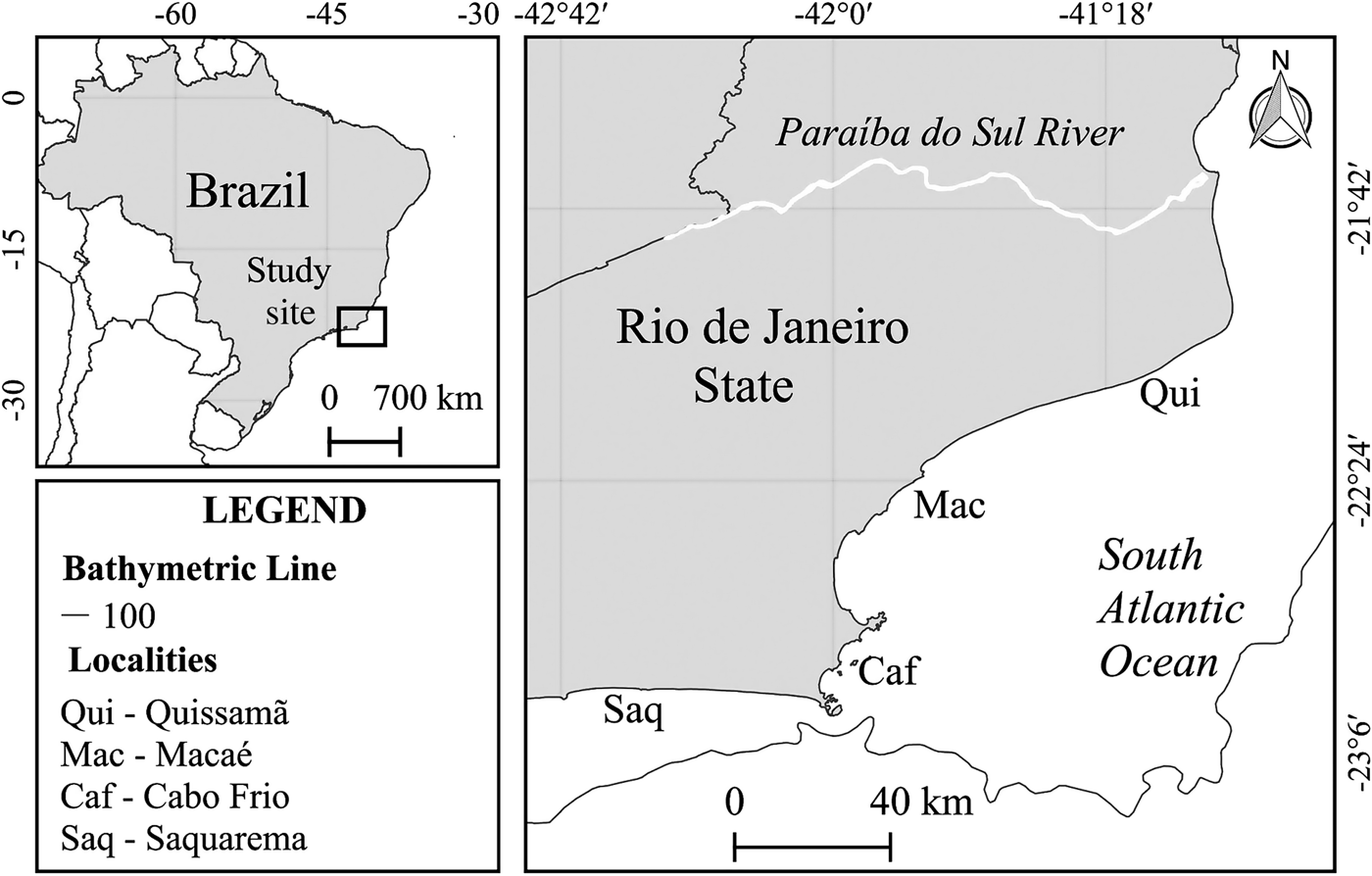
The beaches along the central-northern coast of Rio de Janeiro State, between Quissamã (22°06′S) and Saquarema (22°55′S), were regularly patrolled during 2009 and 2010 to recover washed up marine megafauna carcasses (sharks, turtles, mammals and seabirds) (Figure 1). Sea turtle carcasses were taxonomically identified based on their morphological characteristics. The turtles’ size was considered as the curved carapace length (CCL, in cm), from the anterior point at the midline (nuchal scute) to the posterior notch at the midline between the supracaudals. Only individuals with a complete carapace were measured. Whenever possible, the specimens were classified according to sex and maturity stage (juvenile or adult) based on CCL measurements (Márquez, Reference Márquez, Fischer and Scialabba1990). The stomach of each turtle was removed from the abdominal cavity during the dissection procedure for further examination, but the total volume of its content was not measured. The stomach contents were then washed in running water with a 1 mm mesh sieve. Prey remains were preserved in 70% ethanol, identified to the lowest taxonomic level and counted. The length of partially digested prey and estimates of prey's original size were taken whenever possible.
Study site where the sea turtles were recovered in Rio de Janeiro State, south-eastern Brazil.

RESULTS AND DISCUSSION
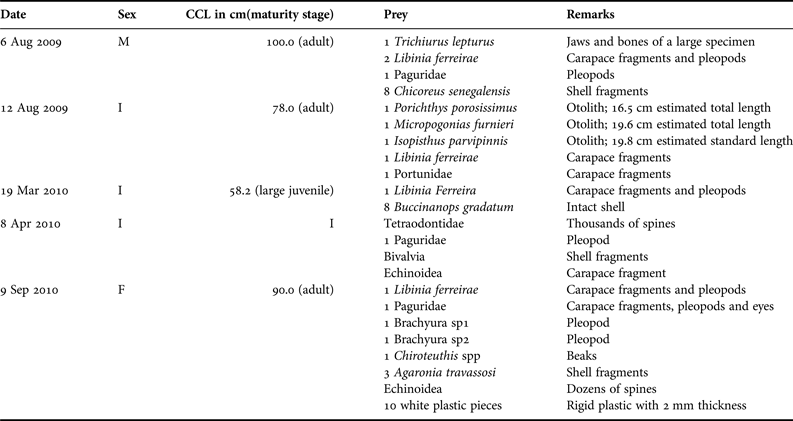
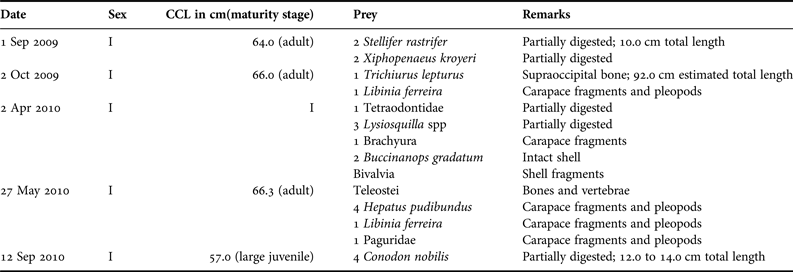
The stomach contents of five Caretta caretta and five Lepidochelys olivacea were analysed, but the cause of death was not determined. Specimens were large juveniles or adults, but the sexual classification was not determined for most turtles (Tables 1 and 2). The study area is an important nesting site for C. caretta (Marcovaldi & Chaloupka, Reference Marcovaldi and Chaloupka2007). Reis et al. (Reference Reis, Silveira and Siciliano2009) indicated that the strandings of L. olivacea along this area from 1994 to 2004 was unexpectedly high (higher than C. caretta) since its abundance in south-eastern Brazil is low. Sales et al. (Reference Sales, Giffoni and Barata2008) suggested that pelagic waters around northern Brazil (5°N–5°S) are the preferential habitat for L. olivacea in the western Atlantic Ocean. The area is adjacent to the main Brazilian nesting area for this species (Sergipe State, 10°–11°S), whose population has consistently increased (Silva et al., Reference Silva, Castilhos, Lopez and Barata2007). Thus, during the non-reproductive period, the specimens could reach new feeding grounds to minimize intraspecific competition, increasing the records of L. olivacea in the southernmost part of their distribution. In the study area, Reis et al. (Reference Reis, Moura, Lima, Rennó and Siciliano2010) recorded a tagged L. olivacea specimen whose origin was Sergipe State, confirming the wide movement of this species along the Brazilian coast.
Prey recovered from the stomach contents of Caretta caretta in Rio de Janeiro State, south-eastern Brazil. I: indeterminate or not measured; M: male; F: female.
Prey recovered from the stomach contents of Lepidochelys olivacea in Rio de Janeiro State, south-eastern Brazil. I: indeterminate or not measured.
Despite the small sample size, a common feeding pattern was noted for C. caretta and L. olivacea: bottom-dwelling prey organisms were the main food items. This pattern was expected and already recorded for both species in previous studies (e.g. Bolten, Reference Bolten, Bolten and Witherington2003; Seney & Musick, Reference Seney and Musick2007; Wildermann & Barrios-Garrido, Reference Wildermann and Barrios-Garrido2012; Colman et al., Reference Colman, Sampaio, Weber and Castilhos2014). The diversity of prey organisms, based on many taxa (fish, crustaceans, molluscs and echinoderms), showed a generalist feeding behaviour. Most prey species are common in Brazilian coastal waters, suggesting an opportunistic feeding behaviour in shallow environments.
Oceanic prey organisms were represented only by the cephalopod mollusc (Chiroteuthis spp.), whose beaks were found in the stomach content of one specimen of C. caretta (Table 1). Cephalopod beaks are chitinous structures very resistant to stomach acids that may accumulate for months (or even years) in the predators’ stomach (Hernández-Garcia, Reference Hernández-Garcia1995). Therefore, the beaks might have accumulated in the turtle's stomach long before stranding.
Cephalopods from the family Chiroteuthidae are pelagic organisms associated with medium-deep to deep water and found in the diet of pelagic predators, including turtles (Salman & Karakulak, Reference Salman and Karakulak2009; Young & Roper, Reference Young and Roper2011; Morais et al., Reference Morais, Longo, Santos, Yoshida, Stahelin and Horta2012). The Chiroteuthis spp. is a slow-swimmer with fragile muscles and bioluminescence, which facilitates its location, capture and ingestion by the predator. Despite inhabiting deep waters during the day, at night Chiroteuthis spp. may reach shallow waters (Young & Roper, Reference Young and Roper2011). In this sense, the area (oceanic vs coastal) where this prey was ingested by the C. caretta specimen could not be precisely described.
Most of the prey (all fish and brachyuran crustacean species) identified in the stomach contents of both sea turtles was by-catch from small-scale shrimp fisheries that operate in the shallow and near-shore waters along the study area (Di Beneditto & Lima, Reference Di Beneditto and Lima2003; Costa & Di Beneditto, Reference Costa and Di Beneditto2009; Di Beneditto et al., Reference Di Beneditto, Souza, Tudesco and Kloh2010). These fisheries produce a great amount of by-catch that may be an important food resource for both species, as previously described in other regions (Tomás et al., Reference Tomás, Aznar and Raga2001; Colman et al., Reference Colman, Sampaio, Weber and Castilhos2014). The high frequency of prey species being by-caught in fishing gears could indicate a spatial overlap between feeding and fishery grounds. The by-catch disposals can serve as surplus food resources to the sea turtles, facilitating their feeding activities; however, the overlap with fisheries can create a negative interaction, as turtles can also become by-catch (Wallace et al., Reference Wallace, Kot, Dimatteo, Lee, Crowder and Lewison2013).
The prey remains (otoliths, bones, carapace fragments and shell fragments) recovered in the stomach contents of C. caretta indicated a non-recent ingestion. Thus, it is not possible to conclude if the prey ingestion was close to the stranding area. On the other hand, in three stomachs (60%) of L. olivacea the partially digested prey did reveal a recent ingestion (Table 2), which probably took place in the coastal waters of Rio de Janeiro State.
The feeding interaction between sea turtles and their prey may occur when prey are dead (scavenging) or alive (active predation). In the present study, the scavenging behaviour of C. caretta and L. olivacea is inferred by the discovery of large hairtail fish (Trichiurus lepturus) remains in the turtles’ stomach contents (Tables 1 and 2). This fish is a voracious and fast-swimming predator, usually found along continental shelf areas in tropical and subtropical regions worldwide (Froese & Pauly, Reference Froese and Pauly2015), and it is unlikely that the turtles could prey upon it easily while alive. For C. caretta, already known as a scavenger, dead fishes are important food sources (Limpus et al., Reference Limpus, Limpus, Horton and Ferris2008). For L. olivacea, its scavenging behaviour could also be a feeding strategy (Reichart, Reference Reichart1993), but active predation seems to be more common (Colman et al., Reference Colman, Sampaio, Weber and Castilhos2014).
In conclusion, the coastal waters of Rio de Janeiro State, south-eastern Brazil, are important to the sea turtle species C. caretta and L. olivacea. For C. caretta, this area is known as a nesting site, where mature females migrate seasonally. For L. olivacea, this area represents a new feeding ground, expanding its preferential habitat and distribution during the non-reproductive period. As pointed out in a previous study in the same area (Reis et al., Reference Reis, Silveira and Siciliano2009), fishery interaction was the main cause of death for some sea turtle specimens. Indeed, our results provide strong evidence for the notion that sea turtles are interacting with fisheries due to an overlapping between feeding and fishery grounds. As such, a factual evaluation of the carcasses of sea turtles washed up on beaches is required for a better understanding of the effects on their population dynamics.
ACKNOWLEDGEMENTS
We thank the team of Grupo de Estudos de Mamíferos Marinhos da Região dos Lagos (GEMM-Lagos), who provided us with the marine turtle stomach contents used in this study, Dr Roberta Aguiar dos Santos, who identified the cephalopod species, and Dr Ronaldo Novelli, who identified the gastropods species. This study was supported by Conselho Nacional de Desenvolvimento Científico e Tecnológico – CNPq (grant no. 301.405/2013-1) and Fundação Carlos Chagas Filho de Amparo a Pesquisa do Estado do Rio de Janeiro – FAPERJ (grant no. E-26/201.161/2014).