With regard to English common law, medieval women were able to participate in the curial process in only a limited way. This is not true of women as defendants: women could be sued for almost any civil or criminal plaint, but their privileges as plaintiffs were broadly curtailed by marital status and cultural expectation. The legal fiction of unity of person saw a wife's legal personality merge into her husband's; he assumed the responsibility for representing them both at law. A married woman was a lawful dependent; the only time she appeared as plaintiff in a civil suit was when she stood in as attorney for her husband. The single woman (a category that includes also the feme sole, a married woman whom the law treated as single for business purposes) was the exception to the rule: the courts acceded to her full legal personhood. She was capable of representing herself at law, although that concession existed more in theory than in practice. Success at law for a woman usually entailed suing jointly with a man.Footnote 1 In terms of putting forward a criminal accusation, a woman's agency was not tied as closely to her marital status. All women were prohibited from enjoying independent legal personhood. Common law formally endorsed what is known as “the limiting rule,” authorizing a woman to accuse only when her suit involved personal injury (such as rape, or assault causing a miscarriage), or the murder of her husband, with some provision that he perished in her arms, which meant that she was in fact an eyewitness.Footnote 2
A woman had the cards stacked against her in more ways than one. The judicial system itself was all male. A woman could not hold office of the king (bailiff, coroner, sheriff), or of the court (clerk, justice, pleader); she was barred from acting as oath-helper in compurgation,Footnote 3 and from sitting on juries, a serious disadvantage in an administration best characterized as “government-by-jury.”Footnote 4 Derek Neal has emphasized the deep-rooted masculinity of the experience by remarking that the law courts “loom the largest among the institutions available for the negotiation and reinforcement of masculinity … and they did so because they spoke a masculine language.”Footnote 5 Women's marginal relationship with the law is represented best in the practice of outlawry, in which a felon turned fugitive was ousted from the protections of the law. Women could not be outlawed because in effect they were never “inlawed.” Tithing groups were a man's entrance into the law: all males over the age of 14 belonged to these local groups dedicated to communal policing. Without any means to participate in the law, women were “waived” instead of outlawed. The difference was purely rhetorical and had no real impact on the experience of outlawry, but the language itself marked women's inability to engage fully in the English system of law enforcement.
Nonetheless, women were zealous participants in those elements of law enforcement from which they were not blocked because of their sex. In cases of homicide in fourteenth-century England, 32% of the first findersFootnote 6 responsible for raising the hue and cry were women.Footnote 7 Coroners also occasionally cited a woman as the nearest neighbor in death investigations, and women at times acted as pledges (sureties) for those neighbors.Footnote 8 Women surpassed men in initiating homicide appeals (private accusations), introducing roughly two thirds of the total number in the thirteenth century, prompting John Bellamy to write that the appeal “was perhaps more of a woman's action than a man's.”Footnote 9 What is more, they paid no heed to the limiting rule, bringing appeals for homicides of family members other than their husbands, for a wide variety of crimes other than homicide, and the king's justices typically allowed those appeals to proceed, putting the needs of the law first.Footnote 10 We even discover the rare instance of a woman as sheriff, although that was certainly the exception not the rule.Footnote 11
In this context, the jury of matrons takes on pronounced significance. This little-studied institution was the sole channel for a woman to participate in the adjudication of the law as a woman, and in which she could be appreciated for the kind of expertise only a woman might bring.Footnote 12 Matrons lent their proficiency to both common law and ecclesiastical courts in a variety of situations. Especially when: a widow professed to be pregnant with her recently deceased husband's heir; a woman claimed to have been raped; the body of a newborn was unearthed and the community hoped to identify its mother; or a wife pled a suit of nullity (that is, an annulment) on the basis of her husband's sexual dysfunction. This article will focus on the work that occupied the majority of the jury's time: when a convicted felon petitioned for a stay of execution on the grounds of pregnancy, justices assigned a group of matrons to conduct a physical inspection to ascertain whether she was in fact pregnant.
Matrons are central to a fuller appreciation of women's participation in the medieval criminal justice system, yet little is known about who they were or what qualified them to act on behalf of the court. There are a number of reasonable possibilities. If England adhered to the Continental model, then we can surmise that midwives filled the role. In fifteenth-century Parisian parishes, the terms sworn matron (matrone juree) and midwife (obstetrix) appear interchangeably in the written record.Footnote 13 The same is true of fifteenth-century Manosque.Footnote 14 Continental midwives sometimes worked alongside honorable women on juries of matrons when medical expertise was necessary, for example, when the victim of an assault was underage and the examination was therefore more medically challenging.Footnote 15 Case studies for both fourteenth-century Catalonia and fifteenth-century Dijon and Lyon provide examples.Footnote 16
That the nature of the job necessitated some degree of familiarity with the basics of gynecology and obstetrics also points to the appropriateness of midwives. As the early modern evidence makes clear, the “quickening” was integral to the matrons’ assessment. Postponement was granted only if the woman was “quick with quick child,” referring to canonists’ theories of late human ensoulment, sometimes called “delayed hominization,” in which the fetus is considered both human and living only once graced with a human soul.Footnote 17 The process in which this takes place is referred to as the quickening; it transpires after the body is fully formed in the womb and is signaled by the first fetal movements. Executing a woman with quick child condemned not one but two to death. Given the formidable consequences of delivering an erroneous verdict, it does not seem far-fetched to suppose that royal justices saw appointing midwives as running the smallest risk.
Yet, to date, historians have dismissed midwives as possible candidates for English matrons for a number of reasons. The Continent's adoption of Roman law created a need for medical expertise that simply did not exist in the English context. The courts of both the church and the ius commune bestowed on judges a much more expansive role than that to which we are accustomed with the Anglo-American legal tradition. Judges presided over each stage of the process. Not only were they instrumental in soliciting indictments, they headed the investigation, creating the articles of inquiry employed by the court's officials to extract testimony from relevant witnesses, and eventually also produced the final verdict and sentence. Rome's evidentiary rules set high standards: a full proof required a confession or two eyewitnesses, or a multiplicity of half-proofs. Judges sought expert testimony from medical practitioners, such as midwives, in their resolve to equip themselves with the necessary information to establish the truth and produce a just verdict. England, on the other hand, had no defined expectations about evidence, and because they failed to document the process of evidence collection, what it took to persuade a jury of the defendant's guilt remains somewhat of a mystery. The prevailing assumption is that it did not include expert testimony proffered by medical professionals, traditionally understood to be an innovation dating to the seventeenth century.Footnote 18 Indeed, as James Oldham contends, the medieval jury system mitigated the need for expert witnesses: “jury members themselves were regarded as experts,” and as such “the use of expert witnesses would have been anomalous before the jury attained some semblance of its modern character.”Footnote 19
Evidence from the records of the English church, which first instituted the practice of summoning matrons to testify in legal matters and likely inspired the king's courts to follow suit, also chips away at the likelihood of midwives as matrons. The church regularly sought matrons’ expertise when a wife pled a suit of divorce because of her husband's impotence and the court hoped to verify the credibility of the allegation.Footnote 20 In his guidance on how to choose a suitable matron, Gratian, author of a widely popular textbook of canon law (c.1140), declares emphatically that matrons should not be midwives. He writes that because “the hand and the eye of midwives are often deceived,” judges should instead “depute upright, discerning and prudent matrons to inquire whether the girl is still a virgin” (saepe manus fallitur et oculus obstetricum … honesta matronas provides et prudentes deputare curetis ad inquirendum, utrum dicta puella virginitatis privilegio sit munita).Footnote 21 Documentation from suits of nullity, however, have guided historians in a different direction altogether, concluding that matrons were “clinicians expert in the sexual aspects of marriage.”Footnote 22 Somewhat more candidly, Jeremy Goldberg writes that matrons were women engaged in prostitution, hired by the church.Footnote 23 In a close analysis of Russell c. Skathelok (1432), Goldberg calls attention to two factors: first, as the subsequent excerpt depicts, the matrons’ work was highly sexualized in nature.
The same witness exposed her naked breasts, and with her hands warmed at the said fire, she held and rubbed the penis and testicles of the said John. And she embraced and frequently kissed the same John, and stirred him up in so far as she could to show his virility and potency, admonishing him that for shame he should then and there prove and render himself a man. And she says, examined and diligently questioned, that the whole time aforesaid, the said penis was scarcely three inches long … remaining without any increase or decrease.Footnote 24
Second, Goldberg identifies two of the seven matrons deposed in this case as known sex workers and proposes the likelihood of a third.Footnote 25 However, Bronach Kane disputes the passage's characterization of matrons by stressing the distinctiveness of this particular case as well as historians’ over-reliance on it.Footnote 26 Putting Russell c. Skathelok in context of other relevant cases reveals a distinct strategy in the pattern of matrons’ appointments. The court endeavored to assign matrons with the expertise appropriate to the needs of the suit.Footnote 27 In Russell c. Skathelok, proficiency in sexual matters dominated the selection, presumably to identify whether the problem was tied to his wife, or to all women. In Greyford c. Fonte (1293), trustworthiness was the chief criterion: the matrons were drawn equally from the parishes of the two litigants, and were branded as “worthy of faith, of good reputation and of honest life.”Footnote 28 When the allegations centered on physical impairment, the court would seem to have sought matrons with medical knowledge. Lamhird c. Sanderson (1370) includes the deposition of Joan of Wighton, one of three “wise matrons,” who reports submerging Sanderson's penis in a bowl of semen in order to cure his sexual dysfunction.Footnote 29 The medical reasoning behind the act is that “by joining the non-functional penis to the effluent of one that did work, she expected to see John Sanderson improve in ‘virile work.’”Footnote 30 Anthropologists describe such a procedure as an example of sympathetic magic, which lay at the base of much of medieval Europe's medical practice. In John's case, the technique met with no success: his penis was an “empty intestine of dead skin, not having any flesh in it or veins in the skin and the middle of its front is totally black.”Footnote 31
The ecclesiastical material is pertinent to this study. First, it clarifies that even in the ecclesiastical context, not all or even most matrons worked in prostitution. This assumption has done much to debase medievalists’ perceptions of the critical function of matrons in the medieval judicial system. To put it mildly, as prostitutes (especially as they are presented in the previous selection from Russell c. Skathelok), matrons become the punchline of a bad joke. Second, given that juries of matrons were a borrowing from the church courts, it is not hard to imagine that royal justices adopted similar strategies of appointment. The church courts’ surviving documentation does not rule out the possibility that midwives were natural candidates for the role of matrons; however, it does not build a strong argument in favor of regular appointment of midwives either.
Of course, this prompts us to ask: was medical expertise actually necessary to declare a woman was quick with child, or was personal experience with childbirth sufficient? In the absence of modern advances in contraceptive technology, being married in the Middle Ages meant being subjected to a protracted cycle of pregnancy and lactation.Footnote 32 A woman who had experienced multiple pregnancies and was perpetually surrounded by other women in various states of pregnancy and lactation surely felt qualified as an “expert” of sorts on the subject. How far can we take this general knowledge and experience to argue that all women were, in fact, quasi-medical practitioners? This is the vantage point endorsed by Monica Green. Midwives are absent from the sources, she explains, because midwifery skills belonged to the toolbox of the average woman. Self-identifying as a midwife was therefore pointless until the advent of licensing procedures in the late Middle Ages.Footnote 33 In this light, it is not unreasonable to suppose that medieval men and women might have construed motherhood as a gateway to obstetrical expertise.
James Oldham's 1985 pathbreaking study of matrons during the long eighteenth century has also provided an influential argument for seeing motherhood as the key component.Footnote 34 Drawing on a number of nineteenth-century examples, he notes that when a convicted felon pled pregnancy, matrons were selected de circumstantibus, that is, through a “slapdash impaneling process” in which women present at the trial were pressed into service.Footnote 35 Trial reports describe hard-nosed judges who ordered courtrooms locked, preventing anxious women from fleeing to avoid being impaneled.Footnote 36 Given the process, the term “matron” could not have held much meaning. If any of these women had an obstetrical background, it was sheer coincidence that they were impaneled. At best, Oldham contends that judges probably excluded unmarried women.Footnote 37
More generally, historians have sided with the author(s) of Bracton (c. 1220), the English legal treatise, which emphasizes the respectability of matrons above all. It describes matrons simply as “lawful and discreet women” (legales et discretas mulieres).Footnote 38 The focus on law-worthiness, usually defined as reputability and belonging to the propertied class, aligns also with commentaries on the office. The Decretals of Pope Gregory IX (1234) speak of “matrons of good opinions, trustworthy, and expert in the arts of marriage” (a matronis bonae opinionis, fide dignis ac expertis in opere nuptiali).Footnote 39 Thomas Chobham (d. c. 1236) writes of “wise matrons” (sagaces matrone).Footnote 40 This process mirrors men's approach to jury service. For men, jury service tended to be the preserve of the upper middle class: according to statute, jurors were required to have an annual income of 40 s. (£2) in order to participate, and jury service was often viewed as a stepping stone to office holding.Footnote 41 Jury service was founded on the ideal that the “the better men … know better the truth.”Footnote 42 Should we assume a similar strategy also with a jury of women?
Whether a matron was a woman of status, a mother, or a midwife matters. How can we evaluate the legitimacy of the process if we do not even know who these women were? If matrons were in fact midwives, it is logical to expect greater accuracy in terms of their assessments than if they were mothers, or honorable women. Here, it is important to recognize that the reliability of matrons’ verdicts has been under fire since the early modern era. In his Historia Placitorum Coronae (1736), Matthew Hale describes matrons as softhearted women working hard to inject some civility into a highly masculinized and inflexible judicial system. He writes: “If she be priviment enseint and not quick with child, and only so found by the jury of women, that is no cause of respite; but I have rarely found but the compassion of their sex is gentle to them in their verdict, if there be any colour to support a sparing verdict.”Footnote 43 Hale's perception lays the foundation for a scholarly tradition emphasizing the lenience of matrons, as well as judges and even the king, toward pregnant women. This convention gave rise to the concept of “benefit of the belly,” which sees pleas of pregnancy paralleling benefit of clergy. Benefit of clergy is the privilege of having one's trial removed to an ecclesiastical court. Although initially it was restricted to men of clerical status, the late medieval crown effectively expanded eligibility to include any literate (or pseudo-literate) man when it introduced a reading test to prove one's clergy.Footnote 44 Benefit of clergy saved a man's neck. In the king's court, a convicted homicide merited capital punishment; those condemned by the bishop instead received a life sentence of imprisonment.Footnote 45 James Cockburn saw pleas of the belly as the female equivalent, noticing that judges commonly took pity on pregnant women, commuting sentences of execution into time in prison or transportation to the colonies.Footnote 46 John Beattie has taken it a step further by arguing that “a successful plea of pregnancy” was “tantamount to a pardon.”Footnote 47 Oldham disagrees with this conclusion; nonetheless, he, too, cautions his readers about the reliability of matrons’ verdicts. Although “many juries went about their task conscientiously,” in the last two decades of the seventeenth century and the first decades of the eighteenth, abuse of the legal process by defendants was rife: they regularly submitted false pleas of pregnancy, hoping either to get pregnant in prison or to fake their way through the inspection process. Accusations of jury packing, in which matrons were thought to be “cronies of the prisoner,” were not only widespread; Oldham also sees they were “likely true.” However, as Oldham points out, the more realistic concern, given the role played by jurors more generally in mitigating the rigors of the law, is that matrons in fact participated in “pious perjury” for humanitarian purposes. He asks, “[i]f the prisoner's claim of being with quick child had any plausibility, what was the harm in allowing a respite?”Footnote 48 Did medieval matrons also engage in “pious perjury”?
Drawing on trial records recorded in the jail delivery rollsFootnote 49 from fourteenth- and fifteenth-century England, as well as jury lists, petitions for pardon, statute law, and legal textbooks and treatises, this article strives to offer a more precise understanding of the position of the medieval matron. In doing so, it hopes to answer a number of questions. Did the king's justices consider juries of matrons to be real juries? That is, did matrons wield the same clout as trial jurors? When a sheriff summoned matrons to court, how did he decide whom to summon? What were a matron's credentials? How much medical training (if any) did a matron need to examine pregnant felons? This final question, in particular, will lead to delving into the history of the quickening to ascertain at what point it became central to legal determinations of when life begins, and how that transition might have influenced a woman's eligibility to be a matron. The overarching argument of this article is that motherhood alone did not prepare women amply to fulfil the role of matron.
I. Matrons in the King's Court of Medieval England
Our hazy understanding of matrons and their role as jurors is reflected in the Oxford English Dictionary (OED)’s efforts to pin down the term. The Middle English “matron” has multiple meanings: “[a] married woman, esp. one of mature years (usually with connotation of dignity, propriety, and moral or social rank)” (1393); a married female saint (c.1450); and also “[a] married woman regarded as having expert knowledge in matters of childbirth, pregnancy, etc., and who therefore may be called upon … to act as a midwife” (c. 1425).Footnote 50 With respect to the latter, OED draws upon an English translation of Guy de Chauliac's Grande Chirurgie (1363), from a passage in which he speaks of participating in a suit of nullity on the grounds of impotence. He explains that a physician's inspection should be purely academic: he must scrutinize the man's complexion and genitals, then arrange for a matron, glossed in the Middle English as “a housewife used in such things” (a huswife vsed in sich þingez) to watch them lie together, presumably so that she could stand as witness to the truth of their claim.Footnote 51 Caxton's 1492 translation of Vitas Patrum is also instructive: in recounting the story of a girl who falsely accused Saint Macarius of fathering her unborn child, the narrator remarks that she was prompted to reveal the truth by “the matrons or midwives that were come to her for to receive the child” ([t]he matrones or myddewyfes yt were come to her for to receyue the childe). Waiting until she was “long in great martyrdom with throws without comparison” (longe in grete martyrdom with thrawes without comparison) the matrons asked if anything might be preventing her from giving birth, at which point, she made a tearful confession, and God facilitated the birth.Footnote 52 These two illustrations indicate that a matron might well be expected to have familiarity with the basics of female anatomy and childbirth; however, with such a broad scope of definition, OED provides little to assist us in determining whether royal justices valued medical training over respectability when it came to appointing juries of matrons, or whether both criteria were equally acceptable.
Documentation concerning matrons in the king's courts is invariably spare. To offer an example: the January 1383 trial of William Martyn of Anstey of Ockham and his wife Agnes for robbery occupies a mere twenty-two lines on a folio taken from the records of a Lincolnshire jail delivery. The indictment narrative provides a distinctly unfavorable account of their actions. The two were arrested the previous August with the stolen goods on their person (cum manuopere), after the victim had raised the hue and cry and pursued them from vill to vill by night. Escorted to court by the jailer, and under the watchful eye of their appealer whose presence in court practically guaranteed their conviction, the two denied all criminal activity, each asserting his or her innocence. They placed their fates in the hands of the jury, who proceeded to find them guilty. The husband was sentenced to hang, and a marginal notation implies that this sentence was indeed carried out: “hanged; no chattels” (s[uspensus] cat[allus] null[us]). We are told that Agnes “immediately claimed to be pregnant. And on this [matter] an inquisition was held without delay by twelve matrons who, on these premises sworn, say on oath, that the said Agnes is pregnant. Therefore she is to be remitted to prison into the custody of John Wutlysbury, sheriff, etc. for safe keeping, until [childbirth], etc.” The marginalia provides a summary of the court's actions: “returned to prison by the matrons” (r[e]pr[isonata] per matrones).Footnote 53
The matrons appear unnamed in this enrolment, as is true of the majority of trial records in which matrons are mentioned. In rare circumstances, we find also jury lists. Customarily, sheriffs drafted a panel of twenty-four names for a jury, in the expectation that at least twelve of those might respond to the summons then issued by the hundred-bailiff, and appear in court for the trial. Lists were enrolled on files (bits of parchment from offcuts) and sewn into the jail delivery rolls, often alongside the accompanying trial record. The names of those empaneled are marked with the word “sworn” (jurata); the names of those not chosen for jury service are sometimes crossed out, sometimes not. Surviving lists for juries of matrons are rare, and when they do exist they do not necessarily conform to the abovedescribed model. Often they list only those empaneled; more often than not, the number of potential matrons is less than twenty-four. A file from York castle, 1433–34, contains this list: Cecilia Scirtannt, Katherine Cattall, Agnes Yerersey, Agnes Ffysshe, Margery Sawer, Agnes Barley, Agnes Ferrour, Joan White, Agnes Hewetson, Joan Fflecher, Agnes Bownes, and Joan Waller, beside which is written “the matrons said that she was not pregnant,” although the file does not identify the defendant by name.Footnote 54 The sparsity of detail presents challenges to the historian, but they are not insurmountable. In concert with written law and the king's correspondence, they can help us to construct a rudimentary history of matrons and pleas of the belly.
The practice of delaying execution for pregnant convicts extends as far back as the twelfth century with the Old French Leis Willelme, which decree, “[i]f a woman who is pregnant is sentenced to death or to mutilation, the sentence shall not be carried out until she is delivered.”Footnote 55 Nowhere do the leis mention a jury of matrons. By the early thirteenth century, we see women acting in this capacity, although not in connection with pregnant felons. In 1220, four women (iiii feminabus) were brought in to inspect alleged rape victim Christina daughter of Henry and Alditha Peche. After some deliberation, they confirmed that she had indeed been violated (quod violata fuit), clarifying for the reader that even if the legal record did not label them as matrons, they fulfilled a matron's responsibilities.Footnote 56
The conviction of Alice la Dorys in July 1303 is the first clear instance in which the court instructed a group of matrons to examine a pregnant felon. Alice was convicted on appeal of stealing goods worth half a mark from Geoffrey Blome. When she claimed to be pregnant, the record remarks that “on the testimony of the lawful matrons” (fidedignas matronas) her pregnancy was affirmed and the court ordered her returned to prison until the birth of her child.Footnote 57 The question, of course, is whether Alice's trial marks the implementation of a new procedure, or instead evidence of more meticulous record keeping. The crown's initial stance on pregnant felons seems to have been simply to pardon them. The king awarded a pardon to Clarice of Waltham in 1228: she was sentenced to hang for participating in the homicide of a pilgrim woman and her daughter, although the sentence was delayed because of pregnancy. Pregnant felons Alice widow of Richard de Langwath and Maud of Chobham (Chabbenham) also received pardons in 1248 and 1253 respectively.Footnote 58
Over the course of the fourteenth century, notations regarding juries of matrons gradually standardized and formalized. The number of matrons on early juries varied; from the four women in Christina Peche's examination, to eight or nine on other juries.Footnote 59 By the later fourteenth century, mirroring the usual composition of trial juries, twelve came to be the norm. Circa 1390, court scribes began also applying the formulaic language normally reserved for trial juries also to juries of matrons, describing them as “chosen, tried, and sworn” and giving testimony under oath.Footnote 60
Trial records show matrons in a position of unlimited authority. Their verdicts were conclusive: if they affirmed a woman's pregnancy, the court ordered the felon sent back to prison to await labor and delivery, after which she would be called down to her former sentence. Nor do the jail delivery rolls divulge evidence of the kind of abuse Oldham detected in his study of early modern England, when felons resorted to false pleas of pregnancy and bribed matrons for a positive verdict. An examination of two jail delivery rolls highlights this best: one roll (TNA: JUST 3/117) records deliveries, which were usually done twice yearly, for the counties of Norfolk and Suffolk from 1324 to 1326.Footnote 61 Out of 471 individuals indicted of felony, fifty-two (or 11%) were women, of which four of those fifty-two women were convicted (7.7%). Three of the four convicts pled the belly (75%); none of them were pardoned. Another (TNA: JUST 3/213) includes deliveries for Cumberland, Northumberland, Westmorland, and Yorkshire for the period 1454–60. Of the 396 individuals indicted of felony, eighteen (4.5%) were women. Four of those eighteen women (22%) were convicted. Two of the four women (50%) pled the belly, none of whom received pardons. On their own, the percentages of those who pled the belly seem high; yet, given the low numbers of women indicted, let alone convicted, it is clear that pleas of the belly were rare. This impression is reinforced by the fact that a search of jail delivery rolls across England for the fourteenth century yielded a mere forty-one cases, with an additional twenty-one petitions for pardon drawn from the calendar of patent rolls (therefore, a total of sixty-two pleas of the belly).Footnote 62 Second, there is no reason to believe that those who pled the belly received lenient treatment. Of those forty-one pleas, only four (9.8%) received pardons from the king; matrons also found five (12.2%) to be not pregnant.Footnote 63 All of this indicates that we should not assume that matrons saw their job as pro forma and just rubber-stamped their approval. Women rarely pled the belly. What is more, a plea was no guarantee of success. Juries of matrons sometimes rejected their claims, and even for those whose claims were corroborated by matrons, only occasionally were they spared execution by the king's pardon.
II. Matrons and their Medical Qualifications
With regard to the English setting, Maryanne Kowaleski is the only scholar to refer comfortably to matrons as midwives.Footnote 64 Her decision to do so likely is based on the fact that the work performed by matrons seemed to call for an added level of medical expertise. In his work on the criminalization of abortion, Wolfgang Müller exemplifies the more typical approach espoused by medieval historians. He characterizes juries of matrons as “teams of female consultants,” and renders obstetrices as simply “women.”Footnote 65 Monica Green similarly refuses to accord matrons medical status: she sees matrons as “women who had no particular expertise beyond being mothers and neighbors.”Footnote 66 Müller's and Green's rejection of matrons as childbirth experts springs from the fact that historians know little definitively about midwives in medieval Europe. To offer a brief summary: arguing chiefly from the absence of evidence, the scholarly consensus is that the fate of the profession was tied to the city, and as such, midwifery vanished altogether in a post-Roman setting as urban life dwindled.Footnote 67 Urban renewal of the twelfth century revived the profession, although midwifery had to wait until the fourteenth or fifteenth centuries to attain any degree of institutionalization, and many areas in northwestern Europe (England among them) did not see professionalization of midwives until well after the Middle Ages drew to a close.Footnote 68 Most of what we know about midwives relates to their regulation: the Catholic church entrusted midwives with the procedure for emergency baptism, but was not especially happy to do so.Footnote 69 Elsewhere in Europe, the implementation of licensing procedures in the late Middle Ages brought midwives into greater contact with the larger medical profession, although the nature of that interaction is still broadly contested.Footnote 70 As Kathryn Taglia summarizes the debate, some adopt the “thesis of (male) medical and regulatory practices triumphing over the (female) irrational, unscientific midwives,” whereas others see instead “a time of utopian medical freedom for both midwives and their female patients,” brought to a grinding halt with the first attempts at regulation.Footnote 71 Regrettably, the extant evidence reveals almost nothing about a midwife's background, training, and knowledge base. We know that they did not attend universities, nor were there midwife guilds; therefore, knowledge of midwifery was probably passed on through informal apprenticeships. As a result, Fiona Harris-Stoertz observes, “one cannot be sure what qualities, if any, separated the midwife from other experienced women.”Footnote 72
Greater still is the problem that in most regions, court officials would have been hard pressed to find enough midwives to empanel an entire jury. In Nuremberg, where the numbers of late medieval midwives are exceptionally well documented because of their status as public officials with a municipal salary, the city had sixteen registered midwives to serve a population of 23,000.Footnote 73 Granted, in England where midwifery was not a licensed or even a regulated profession, expertise in childbirth may have been more loosely defined, extending beyond full-time professionals to include also midwives’ apprentices or assistants, as well as a category of women that we might describe as “birth attendants”; that is, those who frequently attended the all-women gatherings devoted to labor and delivery. As Harris-Stoertz remarks, “[w]hat is particularly striking to a modern reader is just how many people might attend a high medieval birth.”Footnote 74 Whereas some women used childbirth as an opportunity to socialize and provide emotional support, others may have acted as informal assistants in the birth process and achieved some degree of notoriety as a result.
At least one English trial record provides credible evidence that matrons sometimes had a background in midwifery. The 1332 Newgate trial of Agnes of Kent and Isabel of Saint Botolph for counterfeiting remarks that the two were caught in possession of incriminating evidence, that is, both false money and metal pieces (presumably, dies) for forging it. The two women were recipients of swift justice: they were convicted and sentenced to hang. Isabel's judgment was carried out forthwith, but Agnes chose instead to plead her belly, at which point the court summoned “six lawful and wise midwives” (sex mulieres obstetrices legales et sapientes) to authenticate her claim. The record lists the midwives’ names as Goditha de Oreng, Agnes Blakebrok, Joan Dormad, Maud Slegh, Alice Bery, and Margaret of Waltham. They upheld Agnes's plea, and the king's justices ordered her returned to prison.Footnote 75
Agnes of Kent's plea raises a critical question: why describe her matrons as obstetrices when matrones was the normal designation? Did the scribe simply forget the appropriate terminology? Or, did he depict them as midwives because in this instance the sheriff actually summoned midwives to do the job? The Newgate scribe's narrative draws to mind the legal treatise Britton, a late thirteenth-century update and abridgement of Bracton. When he speaks of matrons, the author employs the phrase sages femmes et leales, which the treatise's editor, Francis Nichols, has translated as “discreet and lawful women.”Footnote 76 Yet, it impossible to ignore the fact that in French, the phrase for “midwife” is sage femme.Footnote 77 Taken together, a tentative argument can be made for seeing matrons and midwives as related terms.
Surviving jury lists include some additional insight into matrons’ credentials. Jury lists for matrons seldom survive. A search of files among the fourteenth- and fifteenth-century jail delivery rolls has uncovered a total of eleven matron lists, representing a tiny fraction of the actual numbers of juries of matrons assembled over the course of the period. What can these records tell us about matrons? A perusal of the names of matrons listed in Appendix 1 reveals that marital status was rarely recorded in jury lists. This is not a surprise. Jury lists were not formal documents: they were disposable, and meant to be expedient. There was no need to meet the requirements of the 1413 Statute of Additions that led to the fuller identifications typical of felony indictments, including also the individual's status as a guild-member, and place of residence.Footnote 78 Of the thirty-one matrons identified by a spousal relationship, twenty-four are described as wives and seven are described as widows. Admittedly, an additional eighty-four are not described in relation to any man (either husband or father), and, therefore, it is difficult to draw any solid conclusion about the necessity of marriage or motherhood from the lists themselves.
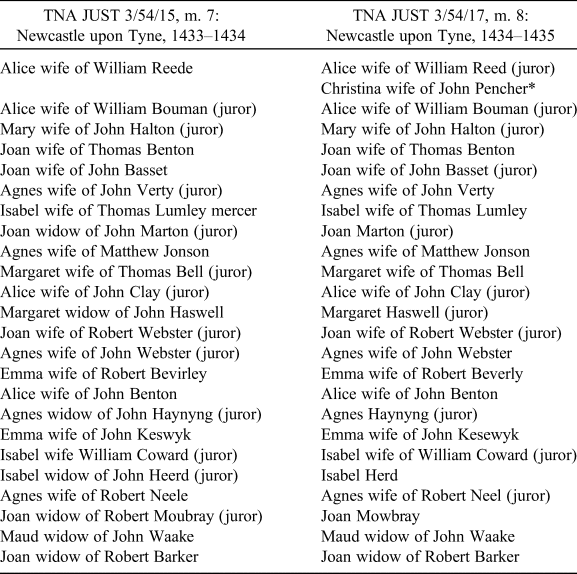
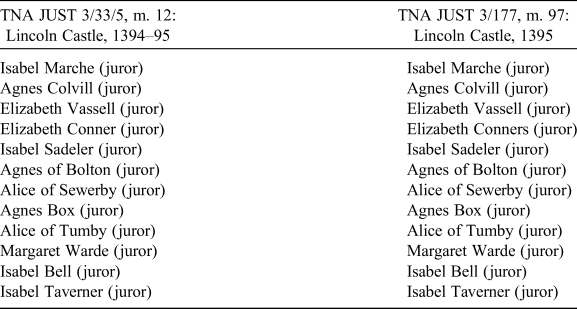
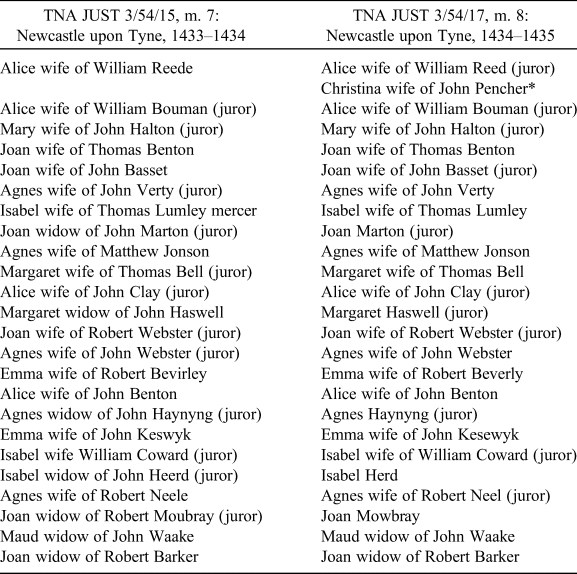
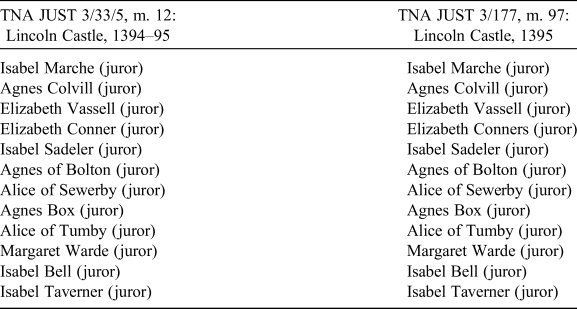
What is most remarkable, however, is among those few matron lists that do exist there are repeat appearances (see Table 1). As you can see from Table 1, the two matron lists are practically identical—the names even appear in the same order—with the exception that the list on the right also includes Christina wife of John Pencher (indicated within the table with an asterisk). We can easily rule out the possibility that these are duplicate jury lists drawn from the same trial: the fact that different women from among each group were chosen as jurors negates this possibility. Something similar is apparent also in the two lists in Table 2.
Jury of Matrons, Newcastle upon Tyne.
Jury of Matrons, Lincoln Castle.
Jury lists such as these imply that sheriffs relied on the same pool of women to act as matrons time and again. This finding helps us to explain why so few matron lists exist at all. If the same women in the town or city regularly filled the post, there was no need to create a new list each time. This process was likely assisted by the formalization of the position. Descriptors in the legal record hint that the position had become an appointed one by the late fourteenth century, as trial records speak in more official terms of a “jury of matrons of the city,” “matrons of the vill of Guildford,” and “matrons of the city of Lincoln.”Footnote 79 If matrons were simply mothers, or even honorable women, why narrow the choice to such a select group of women? Jury service in medieval England was generally considered a privilege: it offered an individual the opportunity to be counted among the village notables.Footnote 80 For men, it provided them “an edge in village and estate affairs.”Footnote 81 In a town the size of Newcastle upon Tyne (population of approximately 3,970 in 1377), or Lincoln (population of approximately 5,354 in 1377), there were surely more than twenty-four mothers or honorable wives eligible and eager to serve on a jury.Footnote 82 Winnowing the number of eligible matrons to such a select few implies that these were not the guiding criteria. If not motherhood, or respectability, was expertise in childbirth the key qualification for eligibility as a matron?
The language used previously also implies that matrons were residents of the urban centers where prisons were located and delivered (such as Carlisle, Exeter, Guildford, Lincoln, London, Newcastle upon Tyne, Norwich, Nottingham, and York), rather than the hundred where the crime was committed. This factor further distinguishes the function of a jury of matrons from the trial jury. Common law expected juries to be self-informing: as such, trial jurors purported to be witnesses to the crime, or at the very least, representatives from the hundred where it was committed (often also the defendant's home village), and accordingly appearing in court bearing local knowledge about how the crime was perpetrated. As mere residents of the cities that housed prisons, the matrons likely had no prior relationship with the condemned, and vice versa. Matrons were therefore not making their decisions based on local knowledge, or on gossip about the convict's ostensibly maternal state. Of course, it is possible, even logical, that trial jurors who were better informed about the condemned's pregnancy communicated their knowledge to the jury of matrons; the records provide no evidence either way. Medieval England's laconic trial reports include almost nothing of the courtroom experience, masking a broad array of questions asked and information exchanged. However, judges may also have appreciated that severing the link between matrons and defendant had it uses in guaranteeing an impartial response.
III. The Physical Examination: Before 1348
The degree of medical expertise needed by a jury of matrons turns on the expectations of the courts. What charge guided matrons in their search for physical signs of pregnancy? Although the quickening ultimately became the focal point for matrons, legal treatises and records confirm that until the mid-fourteenth century, matrons spoke only to a woman's pregnant state, ignoring altogether the formation of the child in utero. This finding separates medieval history into two distinct phases, with the year 1348 acting as the dividing line.
Beyond question, matrons in the earlier phase had the more demanding assignment. They had to discern whether a woman had in fact conceived, and they seem to have done so without internal examinations or urine samples. The writ de ventre inspiciendo, issued out of chancery when a widow purported to be pregnant with her deceased husband's heir, provides one of the few extant descriptions of the inspection process in a legal setting. The writ depicts it as a rather superficial assessment in which the matrons “carefully [examine] her by feeling her breasts and abdomen and in every way whereby they may best ascertain whether she is pregnant or not” (diligenter tractari a prædictis mulieribus per ubera et per ventrem, modis omnibus quibus inde melius possint certiorari utrum prægnans sit necne).Footnote 83 Britton’s account is similar. It states that the matrons’ examination is performed “by handling her belly and her breasts, and using all other means whereby they may be certified whether she is with child or not” (par tast de soen ventre et de ses mameles et en totes autres maneres dount eles porrount estre certefiez, lequel ele enceynte, ou noun).Footnote 84 The phrase “using all other means” leaves room for interpretation and may mask more invasive procedures. However, there is little reason to assume that any sort of internal examination was deemed necessary. Today, gynecologists perform pelvic examinations in early pregnancy in order to assess uterine enlargement, but on their own they are not a useful test for pregnancy.
Given the centrality of uroscopy to medieval medicine, such that a urine flask was widely understood to be the symbol of the medical profession, it is striking that it is not singled out in the writ's procedural description.Footnote 85 Uroscopy was a tool of immeasurable value in the medieval context, seen as a reliable guide to the body's inner workings. Textbooks on the subject exist in abundance, in both Latin and Middle English, many of which dispense sound advice on spotting clues of conception. For example, motes (atthomi) in the urine were thought to be a sure sign.Footnote 86 De urinis mulierum (“On Women's Urines”), present in England by the twelfth century, demonstrates how a woman's urine can indicate whether she is a virgin, non-virgin, menstruating woman, or a woman in the first, second, third, or fourth months of pregnancy.Footnote 87 The utility of urine as a diagnostic for pregnancy does not stop there. Urine in which the “troubliness”Footnote 88 floats “thickest above,” signifies that she is carrying a boy. If the troubliness “draws downward,” it is a girl. Urine can even forewarn of complications. If it has “clear stripes, the most part troubly and the troubliness reddish like tanwose (‘tanning liquor’),” she is pregnant, but the child will not live much beyond birth.Footnote 89 The proliferation of these “self-help guides” in Middle English, rather than the academic Latin, means that some women would have been able to read them.Footnote 90 Nonetheless, because Bracton makes no mention of uroscopy, we cannot presuppose that analysis of a urine sample was part of the inspection process.
As one might suspect, weight gain was considered a potential sign of conception. The 1305 trial of Agnes Crok, described in the plea rolls as a harlot (meretrix), demonstrates that added weight was a consideration. Indicted on charges of being a common receiver of ill-gotten gains without the consent of her husband, a jury found her guilty. However, the trial report notes that “because she is somewhat fat and she says that she is pregnant she is remitted to prison until we know more” (quia eadem Agnes aliqualiter grossa est et se dicit eam pregnantem remittatur gaolem quousque sciatur, etc.). When a jury of mulieres had been assembled, they declared that she was not pregnant.Footnote 91 Presumably, the matrons were better able than royal justices to distinguish between corpulence and a swelling uterus expanding beyond the pelvis to press against the belly.
In Agnes's case, her trial was held on June 30 but it was not until July 6 that matrons gathered before the justices at the guildhall to offer their verdict. Other trial records offer no evidence to determine whether this time frame was typical. Nor are the legal treatises helpful in this respect: neither Bracton nor Britton gives any indication of just how much time a jury of matrons had to come to a decision. Presumably, as long as they produced a decision before justices of jail delivery left town it was sufficient. If the matrons were permitted time to administer an overnight test, Gilbertus Anglicus's “The Sickness of Women” (c. 1240), far and away the most common gynecological text in late medieval England, also written in Middle English, affords a useful guide. In the chapter entitled, “If thou will know well and truly whether a woman be with child without looking of her water (urine)” (If thow wilt knowe wele and triewly whether a womman be with chield other nat withouten lookyng at hir water), Gilbertus writes that if a woman drinks mead (meth) before bed, and has “much woe in her womb, it is a sign that she is with child” (moche woo in hir wombe, it is a signe that she is with chield).Footnote 92
After a physical inspection, Britton tells us: “Then they shall take her privately into a house, and inquire into the truth” (Et puis la prengent en une mesoun privément et enquergent la verité).Footnote 93 An oral examination had much to offer a jury of matrons. As far back as the ancient world, the link between absent menstruation and pregnancy was recognized; therefore, inquiring about the date of a woman's last menstrual cycle surely would have been one of the first questions broached by matrons. This is substantiated also by a story about a female felon narrated in anatomist Andrea Vesalius’ De humani corporis fabrica (1543), a somewhat later text but close enough in time to be relevant. Vesalius explains how the midwives sent in to inspect the woman under orders from the podestà griped about the convict being uncooperative because she refused to tell them how long she had gone without menstruating. Presumably, the midwives had other means by which to draw their conclusion: they proffered a verdict of “not pregnant,” which Vesalius then corroborated with a follow-up dissection.Footnote 94 Admittedly, high rates of anemia among women in medieval Europe means that a “missed period” was a much less precise gauge of conception then than it is now.Footnote 95 Even today, it has its limits: excessive exercise and anxiety are known to induce amenorrhea, and menstrual irregularity is a common byproduct of hormonal disorders. Yet, it was a useful starting point for ascertaining whether a woman had in fact conceived.
An oral interview might also touch upon stomach upset and appetite.Footnote 96 The Liber pantegni, one of the most influential books for medieval European medicine, cites nausea, vomiting, and pain in the cardia as sure signs a woman had conceived.Footnote 97 One might also expect a discussion of bizarre dietary cravings. The medical treatises have much to say on the subject of pica, the clinical term for a pregnant woman's unusual hungers, named after the Latin for magpie, a bird that supposedly will eat anything. According to Galen, these cravings typically begin in the second month of pregnancy.Footnote 98 Pseudo-Albertus, a thirteenth-century disciple of Albertus Magnus who penned the Latin treatise Secrets of Women, explains, “if the woman asks first for earth, then for charcoal, then apples, then mulberries, then cherries; this is a sign that she has conceived.”Footnote 99 Although the first two of these items might seem curious, pregnancy cravings for soil and charcoal are characteristically associated with iron deficiency and are common practices in some Third World countries today.Footnote 100 Battling anemia, medieval women also turned to soil, clay, and charcoal, described by the Italian surgeon William of Saliceto (d.1277) as appetitus mendosus (a faulty appetite).Footnote 101 The Trotula, the most influential compendium of women's medicine in medieval Europe, also available in Middle English, makes a useful recommendation in this respect: the text suggests that “if she desires clay or chalk or coals, let beans cooked with sugar be given instead.”Footnote 102 Beans, of course, are rich in iron. At the very least, matrons wishing to settle their suspicions might have seen morning sickness and cravings as suitable cues to signal pregnancy.
Medical treatises of the time stress many of the classic signs of conception touted by pseudo-medical websites today. Soranus’ Gynecology, the foundational text on conception, comments that a pregnant woman's breasts will be swollen and painful to the touch, and the blood vessels on the breast will appear “prominent and livid.”Footnote 103 He also addresses what we today call a “pregnancy mask” (in medical parlance, melasma or chloasma), “darkish splotches spread over the region above the eyes,” a greenish tinge below the eyes, and increased prominence of freckles.Footnote 104 (For the curious layman: hyperpigmentation of this nature affects close to half of all pregnant women and is a corollary of elevated hormone production.Footnote 105) Pseudo-Albertus draws attention also to what normally is described today as a “pregnancy glow.” He writes that the color of a woman's face will change in appearance “for women are normally flushed after conception.”Footnote 106 The author points to a woman's retained menses as the culprit, elevating the womb's temperature and causing the woman's face to flush from the heat.Footnote 107 Today we know that it is a result of a pregnant body's increased production and circulation of blood, which causes her face to brighten.Footnote 108 The text also advances a number of less reliable recommendations, such as, how to determine the sex of the baby from breast size: an enlarged right breast indicates a boy, an enlarged left breast a girl.Footnote 109 If a woman's nipples are exceptionally warm, she is pregnant with a boy; if her left breast blackens, she is pregnant with a girl.Footnote 110 Although these final few suggestions are not in fact useful determinants of sex, they do correspond to common physical changes in pregnant bodies when it comes to the size and coloring of the breast, and may have been used by diligent matrons as signs of conception.
The point of this discussion is to underline that the medieval world had recourse to a wide variety of pregnancy diagnostics. Yet, as these indicators imply, the process presents its own challenges. Knowing that a woman's face had brightened, or her breasts swollen, was not an easy task if someone was meeting her for the first time in court. And as Vesalius’ story above reveals, a contrary defendant who evaded the matrons’ questions, or outright lied, only made their job more difficult. In addition, despite the broad expanse of learned knowledge about the signs of conception, it is not at all clear whether midwives had access to it. Monica Green writes of “women's tenuous association with literate medicine.”Footnote 111 Many of the texts mentioned were available chiefly at universities for the use of male academics. Nonetheless, it is hard to imagine that there was little crossover between learned medicine and that of midwives, hinted at by the number of surviving thirteenth- to fifteenth-century gynecological and obstetric treatises available not only in Middle English, but also in French and Dutch, that are addressed to a female audience, implying that their authors expected women to access them somehow.Footnote 112 Lisa Bitel highlights the role played by learned men relating their knowledge of the procreative process to women, including “developing a vocabulary of symbols for childbirth, and deciding what days were best for conception, who should procreate with whom, and even whether or not sexual partners should enjoy themselves during fruitful coitus.”Footnote 113 Although Bitel is drawing from Irish literature, there is no reason to believe something similar did not transpire in England, where priests regularly intervened in family life, teaching midwives how to baptize infants in an emergency, and warning mothers not to overlay their children. Signs of conception also occasionally appear in literature as a plot point, indicating a general familiarity. For example, May's unusual craving for pears in Chaucer's “The Merchant's Tale” is intended to signal her pregnant state to an audience of readers.Footnote 114 Hali Meiðhad, a thirteenth-century anti-marriage essay addressed to anchorites, also includes a passage on conception, intended to drive its readers directly into the arms of the church: “…Your rosy face will grow thin, and turn green as grass; your eyes will grow dull, and shadowed underneath, and because of your dizziness your head will ache cruelly… Heaviness in every limb; the dragging weight of your two breasts… Your beauty is all destroyed by pallor.”Footnote 115
Once again, the framing of this text implies that these symptoms would have been immediately recognizable to its audience. All of this suggests that if midwives did not learn the signs of conception from the learned texts discussed, it seems likely that they developed their own.
We also need to acknowledge that matrons worked at the behest of the court; they were not running the show. Sheriffs summoned matrons to court only at conviction. Successive claims by condemned felons to be still pregnant although as of yet undelivered were not corroborated by matrons unless justices of jail delivery ordered them to perform a follow-up inspection.Footnote 116 Knowing this helps us to appreciate those instances in which women hoodwinked the courts. To offer some examples: Muriel widow of William of Melton, who insisted she was pregnant with her husband's heir in 1221—a story that was corroborated by a jury of fourteen London matrons—managed to string the court along for 4 years before finally admitting that she was mistaken. Apparently, she felt “so heavy with disease” that she had believed herself pregnant.Footnote 117 Maud Hereward of Braunston extended her life by a year and 3 months with a fabricated claim of pregnancy.Footnote 118 Agnes Kent had even greater success. She was convicted and pled her belly on May 8, 1332; despite many successive appearances, the court reported that she was still pregnant on August 27, 1334, over 2 years later.Footnote 119
The experiences of Muriel, Maud, and Agnes showcase the remarkable patience of English justices. One would think there was no need to wait the full 40 weeks (or more!) to determine whether a woman had falsified a pregnancy. The French magistrate Pierre de Fontaine endorsed a waiting period of 4 and a half months, to be on the safe side.Footnote 120 It is also reasonable to assume that justices simply forgot that these women were waiting in prison. However, one cannot help but wonder whether the male personnel of the court knew enough about pregnancy to realize when it was time to call the matrons back in. A statement made by Thomas Rolf, a sergeant in the court of Common Pleas in a case of bastardy recorded in a 1422 Year BookFootnote 121 delivers a dim view of general male expertise on women's bodies. On the difficulties of proving paternity, Rolf instructed, “if pregnancy is an issue, it will be tried by the writ de ventre inspiciendo, by women by certain private signs: … but they will deliver an issue that we cannot try… because no one knows by whom she is pregnant, but God alone.” Accordingly, if a woman is pregnant before a marriage is contracted, no one will know who the father is. This is complicated, he argued, by the fact that some women “can be pregnant for seven years,” an offhand comment that provoked no discernable reaction from his peers.Footnote 122 Of course, such seeming ignorance of women's bodies contrasts with the legal treatises. Britton and the Mirror of Justices both state that a pregnancy lasts 40 weeks.Footnote 123 Bracton is less explicit, but the authors comment that the projected date of birth can easily be calculated by counting the weeks from conception.Footnote 124
IV: The Physical Examination: After 1348
What it meant to be pregnant was not consistent throughout the medieval period. Before Gratian's Decretum (c.1140), the church did not authorize any one exclusive stance on the process of conception and ensoulment. Debate within the church focused on the question of when life begins. Unlike the Catholic church today, medieval canonists and theologians unequivocally rejected the notion that life is present at conception.Footnote 125 Building on the work of the Stoic philosophers, some scholars maintained that the soul enters the body when the fetus takes its first breath; prior to that moment, the fetus is neither human, nor alive.Footnote 126 The more common view was that supported by Saint Augustine and founded on an Aristotelian notion of conception in which the fetus gradually evolves into humanity. The embryo emerges first in a vegetative state; over time, as it develops into a fetus it acquires animal-like qualities. Vivification, also known as animation, transpires only once the fetus takes on a fully human form and is infused with a rational soul by the hand of God.Footnote 127 Only at that point can the child be considered human. The mother experiences ensoulment as the first fetal movements. Gratian's twelfth-century Decretum brought an end to the dispute by siding definitively with Augustine and Aristotle. Not long after Gratian, civilian Azo of Porticus (d. 1202) helped to refine further our knowledge of this process by promoting Aristotle's belief that vivification is gender specific: a boy quickens in 40 days, a girl in 80.Footnote 128
Knowledge of theories of conception was not the preserve of the elite. Quickening was understood well enough to make its way into popular literature. One of the many tales included in Boccaccio's Decameron (c. 1353) involves a character named Madam Catalina who is thought to have died while pregnant. Dying pregnant might have dire consequences for a woman. The church forbid burial in consecrated ground to pregnant women once the infant in the womb was ensouled; doing so polluted the graveyard, as the child had died unbaptized. Accordingly, the church instructed authorities to perform a caesarean section to remove the child prior to burial.Footnote 129 Thankfully for Catalina, while officials waffled over whether to perform the surgery, her kinswomen declared it unnecessary. Not long before her “death,” Catalina remarked that “she had not been so long pregnant that the child could be fully formed.” Given that Catalina was not truly dead, it is fortunate that her kinswomen recollected such a critical statement! Footnote 130
The relevance of ensoulment to secular legal dicta is highlighted in the section of Gratian's text entitled “Are those who procure an abortion homicides or not?” Following Aristotle and Augustine, for Gratian, the benchmark for legal personhood occurred only after the fetus was fully formed and animated. Destruction of the fetus prior to vivification was not abortion but contraception: still sinful, but a matter resolved by confession and penance, not criminal prosecution. Regarding abortion, surprisingly, English emphasis on quickening predates Gratian. The Leges Henrici Primi (c. 1115) called for compensation of a full wergild for the loss of a quickened child and a half for one not yet quickened, here defined as less than 40 days old.Footnote 131 Canon law's influence, however, is most visible in Bracton, which copies the canonist Raymond de Penyafort “almost word for word.”Footnote 132 The treatise notes: “If one strikes a pregnant woman or gives her poison in order to procure an abortion, if the foetus is already formed or quickened, especially if it is quickened, he commits homicide.”Footnote 133 In practice, quickening appears in abortion suits as early as 1203, when Sybil daughter of Engelard appealed Ralph of Sandford for having “so shamefully treated her that he killed the living child in her womb.”Footnote 134 This appeal was not exceptional: similar language appears in suits from 1238 and 1292.Footnote 135
With pleas of the belly, however, we see something entirely different. Concern for detecting quickening does not materialize until much later. A coroner's note recorded in a Year Book from 1348 is the first indication that royal justices shared Gratian's views on the significance of animation in the womb. A woman arraigned for homicide alongside a male accomplice petitioned to circumvent the trial altogether because she was pregnant. Chief Justice of the King's Bench, William of Thorp, instructed her in the error of her ways, explaining that such a plea came after the trial, not before. Accordingly, she denied the allegations and placed herself upon the country. The jury found the two guilty. Thorp sentenced the man to hang, but commanded the marshals “to put the woman in a chamber, and make women come to prove and examine if she was pregnant with a living infant or not” (de mett[re] la feme en un chamber et faire ven[ir] femes a prover & examiner si el fuit enseint oue viie enfant qel nient). Matrons pronounced her not pregnant, and the woman was hanged.Footnote 136
Still, it is questionable just how firm a turning point this represents. Even after 1348, only the occasional record hints that royal justices were looking for something more than conception. In 1352, when Elena Smart was convicted of counterfeiting, a treasonable offense, she described herself as not only “pregnant but also big with child” (se esse pregnante et puero grossam, etc.), plausibly a reference to quickening.Footnote 137 Emma wife of John Handed in 1406 also employed conjunctive vocabulary to emphasize the advanced state of her pregnancy. She alleged that, “she had conceived and was pregnant” (ipsa puerpera et pregnans est). The matrons upheld her plea and declared that they came to this conclusion through “a palpation and inspection of her belly” (pro ut palpationem et inspectionem ventris ipsius Emma).Footnote 138 More definitively, the 1366 trial of Emma Baxtere of Thrapston, convicted of harboring a thief, records the matrons’ verdict as “pregnant and with a living infant” (pregnans et cum infant vivo), plainly adhering to Gratian's views.Footnote 139 References to vivification were more common after this point, and by the sixteenth century, they became standard.Footnote 140
Why did it take so long for royal justices to adopt the standard of quickening in pleas of the belly, but not in instances of abortion? After all, the same personnel acted as judge in both kinds of cases. Additionally, if life did not begin at conception, it is hard to appreciate why the king's justices were so keen to identify its signs: doing so, was not, in fact, saving a life. At that stage, the fetus held only the potential for life. None of these questions are easy to answer. Here, James Whitman's latest research on reasonable doubt may offer some guidance. Whitman explains that today, the reasonable doubt clause is understood as concern for the welfare of the defendant, but modern practice has no bearing on the clause's origin. In the medieval world, when the condemned were regularly executed, judges and juries worried that God might equate their participation in capital punishment with homicide. In England, such a concern is voiced in both the twelfth-century Leges Henrici Primi and the thirteenth-century Mirror of Justices.Footnote 141 Theologians eager to see justice done sought to comfort anxious judges and jurors by developing the reasonable doubt clause, which legally sanctioned erring on the side of uncertainty, protecting their souls, and allowing them to hide in the fact that God knew they were just doing their jobs.Footnote 142
How does this apply to pregnancy and English law? When it comes to abortion caused by assault, focusing on quickening as the key moment clarified intent (mens rea). Jurors and justices could be certain that the defendant actually knew that the woman was pregnant, presumably because by then she looked pregnant, and he struck her anyway. This strategy presumably led to fewer executions of assailants who knowingly committed assault, but unknowingly committed homicide. It also created a situation in which there was less doubt, and fewer guilty consciences for jurors who submitted a verdict, and for justices of jail delivery who pronounced the sentence. Pleas of the belly, however, put jurors, justices, and also matrons in the distressing predicament of potentially participating in the execution of a woman pregnant with a live child. What if the child was sleepy or sluggish in its movements at the time of inspection? In the interests of protecting the souls of everyone involved, surely justices took comfort in casting the broadest net, including all 40 weeks of pregnancy, at least in the early stages of theological transition.
The year 1348, then, marks a slow, even hesitant transition away from a focus on conception to a focus on quickening. For female felons, the experience meant a drastic reduction in merciful treatment by the courts. That it coincides also with a sharp limitation in the practice of granting reprieves to only one per sentence seems appropriate. A 1349 Year Book presents the case of two convicted felons, both of whom had received stays of execution on the grounds of pregnancy, but had since been delivered. Nonetheless, after childbirth, the women had somehow both become pregnant a second time while in prison. Royal justices decreed that the women could not obtain a second reprieve for the same sentence. Their executions were to be carried out and the jailer was not to be punished for doing so. Given latent fears of executing a potentially live child, it is striking that the record makes no reference to the formation of the second child in utero or the need for a physical examination.Footnote 143 In fact, it was not until late in the early modern period that jurists evinced the slightest concern about the development of the second pregnancy. Edward Coke's Institutes (1628) writes that she will be executed, “though she be gaine quick with childe.”Footnote 144 A century later, Matthew Hale explains that she cannot ask for a second reprieve, but that the jailer “shall be punished for not looking better to her.”Footnote 145 It is only in Blackstone's Commentaries (1765) that we finally see this concern articulated. He writes that the execution should take place “before the child is quick in the womb.”Footnote 146
After quickening became the focal point, it is hard to imagine that medical training was needed for a matron to complete her work: the swollen breasts and distended abdomen of a midterm pregnancy are much more easily identifiable. So, too, is the presence of fetal movement. Modern physicians advise ten kicks in a two-hour period as a sign of a healthy baby, implying that matrons would not have needed to wait long for confirmation in most instances.
Conclusion
Analysis of the medieval evidence helps us to move beyond stereotypes of matrons as teary-eyed compassionate mothers, honorable wives, or sex workers chosen for their expertise in anatomy. This article draws a number of key conclusions. First and foremost, the king's justices acknowledged juries of matrons as legitimate juries. This is reflected in the language of the record, in which matrons are styled as having been “chosen, tried, and sworn,” as if they were a typical trial jury. That the number of jurors eventually standardized at twelve, mimicking our “twelve good men and true,” merely reinforces that conclusion. This finding is noteworthy. As early as the eighteenth century, the reliability of matrons’ verdicts was viewed with suspicion. The medieval evidence, however, gives us no reason to believe that justices suspected that matrons did not take their job seriously, or accorded them a lesser degree of respect than trial jurors. Indeed, what is perhaps most striking is the recognition by justices of the matrons’ absolute authority. When they declared a woman pregnant, requesting that she be sent back to prison to await delivery, justices accepted the matrons’ decision. Justices sought no second opinions; nor are there instances in which they overturned the matrons’ verdicts. The same cannot be said for the judgments of male physicians of the era, working in tandem with the Continental courts where physicians appeared regularly as expert witnesses in homicide cases. Study of this early foray into expert testimony reveals that their consilia were treated only as “belief in what must have happened,” with “ambiguous” standing in the court.Footnote 147 In practice, judges sometimes concluded that the experts were wrong, or ignored the medical opinion when it did not correspond to their own perceptions of what happened.Footnote 148 Even more telling, Continental physicians shared their position of authority in medical competence also with lay witnesses, often women who traditionally washed and prepared the dead for burial.Footnote 149
Second, medieval matrons most likely possessed some degree of informal medical training. They may have been midwives, as one scribe labeled them; they may also have been midwives’ apprentices or assistants, or even birth attendants. The select group of women from which matrons were drawn points tentatively to this conclusion. If motherhood and respectability were all that was needed to be a matron, the pool would not have been so shallow. The language of the later records especially suggests that a matron may have come to be an appointed position in some communities. The difficulty of the task to which matrons were assigned also supports a need for some familiarity with the fundamentals of gynecology and obstetrics. For the majority of the period, matrons were asked to detect signs of conception, a commission that required a trained eye and experience with pregnancy and childbirth. Although the evidence is tentative, this finding indicates that we may need to revise our timeline of England's history of forensic medicine. If matrons were not laywomen, but in fact experts in childbirth, then the introduction of expert testimony to the common law was not a seventeenth-century invention, but a regular facet of late medieval law. This conclusion parallels my own research on the coroner's inquest. Although historians have roundly criticized the medieval English for failing to employ medical practitioners in determining cause of death as did their Continental counterparts, jury lists for coroners’ inquests in medieval London and York spotlight the regularity with which medical practitioners, specifically barbers, were appointed to inquest juries. For example, London coroners’ rolls for the years 1325–39 demonstrate that medical practitioners of various backgrounds served as jurors 33% of the time. Surely, sheriffs appointed those men to assist in the difficult process of assigning cause of death when the source was not obvious. Significantly, some few late medieval lawsuits also held medical practitioners responsible for failing to participate in inquests when they possessed relevant information.Footnote 150 The conclusions of this article taken together with the evidence of the coroners' inquest emphasize that an argument can be made that England's use of expert testimony parallels the Continent's more closely than is usually recognized. The records themselves, which prioritize felony forfeiture above all, simply make this advance harder to detect.
Finally, the years 1348 and 1349 witnessed the beginning of an unsteady transition in which royal justices applied new ideas about when life begins, and questioned whether a convict might extend her time in prison through a perpetual state of pregnancy. Once quickening gained acceptance in the common law courts as the defining moment, the scope of a matron's responsibility diminished markedly. So, too, did her need for medical training. Confirming fetal movement was a much less onerous task than spotting early signs of conception. Therefore, it is possible that medical expertise over time became less central to the appointment of matrons, helping us to appreciate how modern judges, such as those described by Oldham, came to be satisfied with matrons whose sole experience derived from motherhood.
Granted, for women in English history, pleas of the belly launched their careers as the common law's medical experts. English recognition of the value of the average woman's medical expertise increased appreciably over time. In early modern England, the scope of a matron's work expanded considerably. In terms of plague management, parishes typically appointed two “sober, discreet women” to act as searchers of the dead, charged with determining cause of death, and two more to be viewers of the sick, assigned to evaluate whether the afflicted needed quarantining.Footnote 151 By the seventeenth century, matrons also performed virginity/chastity searches on women suspected of loose behavior, and they played a vital part in the epoch's infanticide panic.Footnote 152
What we should perhaps be most impressed with is the continued English appreciation that pregnancy and childbirth were a woman's realm. Monica Green, among others, has argued that the thirteenth century served as a decisive moment for women's medicine, when writers of obstetrical manuals directed their work primarily to a male audience eager to unveil “the secrets of women.”Footnote 153 By the fourteenth century, male physicians were sometimes acknowledged as experts on obstetrics and gynecology: women consulted male physicians in obstetrical emergencies and when faced with sterility; male physicians also played a critical role performing caesarean sections, and by 1400 they were performing them even on live women.Footnote 154 Any of these moments presented opportunities for the English courts to discontinue the practice of relying on women as matrons, expressly if they believed the process was ineffective. The logical reason for not doing so is that the medieval courts trusted that matrons were doing their jobs.
Names of Matrons, Listed Alphabetically.