

1. Introduction
Lithuanian and Latvian are two extant Baltic languages; Lithuanian is credited with having retained a more archaic grammatical system, close to that of Indo-European (Geniušienė Reference Geniušienė and Nedjalkov2007).Footnote 1 The two languages have similar morphological and grammatical systems and, consequently, similar means of verb formation (see Arkadiev et al. Reference Arkadiev, Holvoet, Wiemer, Arkadiev, Holvoet and Wiemer2015 for a recent overview). Both languages – with Lithuanian showing a greater diversity –, can form verbs with the marker si, Footnote 2 which has traditionally been referred to as the reflexive marker or a reflexive-middle marker (Geniušienė Reference Geniušienė and Nedjalkov2007: 637, Arkadiev et al. Reference Arkadiev2015: 35; see also Ambrazas Reference Ambrazas2006, Vaišnienė Reference Vaišnienė2013).Footnote 3 As in other languages, si contributes a broad range of meanings and is used to form reflexive, reciprocal, Subject-experiencer, unaccusative, middle and impersonal predicates (the latter means being available only for impersonal passives in Lithuanian), following the classification of Reinhart and Siloni (Reference Reinhart and Siloni2005), functioning as an arity operator which reduces the valency of the verb. In addition, si is used to form verbs which do not change their valency, and is usually perceived as conveying an intensifying meaning, similarly to Polish (Goledzinowska Reference Goledzinowska and Frigeni2004); this is productive in Lithuanian, but very rare in Latvian (Geniušienė Reference Geniušienė and Nedjalkov2007). Since this article will focus on the formal properties of si , and given the diversity of constructions in which it can appear, I will refer to it simply as si , assuming, like Reinhart and Siloni (Reference Reinhart and Siloni2005), that it is a formal marker licensing a range of lexical operations which usually involve a change in verb valency.
Across the Baltic continuum, si -verbs exhibit an interesting derivational pattern: in standard Lithuanian and in dialectal Latvian (e.g., Latgalian), prefixless verbs have si word-finally, whereas prefixed verbs have si following the prefix; in standard Latvian, si is verb-final in both prefixless and prefixed verbs, as is the case in Russian and Icelandic. Verb-final si in prefixed forms is also attested in dialectal Lithuanian (Endzelīns Reference Endzelīns1971).
The present article seeks to account for the placement of si . While the analysis is driven primarily by Lithuanian data, I also consider facts from standard and dialectical Latvian (Latgalian), and Russian, in an attempt to provide a uniform account for si placement in Balto-Slavic languages.Footnote 4 I chose to incorporate evidence from dialectal Latvian to show the continuum with respect to si placement, in which Lithuanian and Russian take two polar positions (with Latvian manifesting the features of both), and also to avoid excluding Latgalian from research in Baltic linguistics, a caveat that has been voiced in recent literature (e.g., Lazdiņa and Marten Reference Lazdiņa and Marten2012, Arkadiev et al. Reference Arkadiev, Holvoet, Wiemer, Arkadiev, Holvoet and Wiemer2015).
The issue of si placement is explored within a larger issue of morpheme linearization, and in particular, relative to aspectual morphemes. I employ the Minimalist Syntactic and the Distributed Morphology frameworks for general issues, and refer to Condition A of the Binding Theory (Chomsky Reference Chomsky1981). I argue that the position of si depends on the type of the argument and, in light of its changing position within the verb, the need to maintain proper binding with the sentence subject. The inherent relation to the subject accounts for the range of lexical operations si can license; si itself is believed to have only one lexical entry, a preferred approach cross-linguistically (Marelj and Reuland Reference Marelj, Reuland and Chahine2013). Having shown that the analysis of prefixes is indispensable in determining the position of si, I examine the status and place of adjunction of Baltic prefixes. I show that Baltic prefixes, like Slavic ones, can be grouped into two classes: lexical and superlexical prefixes, the former originating below the verb and the latter having adjunct-type features and originating above the verb, which influences their meaning as well as their stacking properties. Building on Svenonius (Reference Svenonius, Ramchand and Reiss2007) and Embick and Noyer (Reference Embick, Noyer, Ramchand and Reiss2007), I show that the presence of aspectual material on both sides of the verb root points to roll-up and remnant movement mechanisms at the AspP/(v/VP) level. I argue that in Lithuanian and in dialectal Latvian, lexical prefixes form a phase at AspLP, and, reformulating binding domains as phases, show that si is a regular second position clitic to a phase. In contrast, in standard Latvian and Russian, where the marker si is always verb-final, lexical prefixes do not form a phase of their own, and si functions as a second position clitic to the v/VP phase, maintaining coreference with rather than being bound by, the subject antecedent.
The article is structured as follows. In section 2, I present the problem: the lineup of aspectual morphemes relative to si in Balto-Slavic languages. Section 3 is a brief overview of previous approaches to the marker si . In section 4, on the basis of si -constructions in Lithuanian, I outline the properties of the marker relevant for the discussion. In section 5, analysis of Lithuanian verbal prefixes is conducted and their landing site is determined. In section 6, a more fine-grained analysis of the placement of si as well as its status in Baltic languages and in Russian is proposed. Section 7 puts the findings in the context of the Lexicalist Hypothesis. Section 8 summarizes the results. For clarity of exposition and because it is the most stable manifestation of the phenomena to be discussed, I will refer mainly to Lithuanian data, but will include examples from Latvian, Latgalian and Russian where relevant.
2. Aspect And si
In this section, I present the lineup of aspectual morphemes that interact with the position of si in Balto-Slavic, and identify the questions that must be answered.
2.1 Where is aspect?
As is known, aspectual information on the verb in Baltic and Slavic languages may appear through either derivational or inflectional means, the former being “the least widespread typologically” (Dahl Reference Dahl1985, Holvoet and Čižik Reference Holvoet, Čižik-Prokaševa, Holvoet and Semėnienė2004: 141). Though not a grammatical category in the strict sense,Footnote 5 aspect in Russian is more grammaticalized than in Lithuanian or Latvian, leading to the debate as to whether aspect in Baltic should be seen as a grammatical or a lexical category, or a mixture of both (for Lithuanian: Galnaitytė Reference Galnaitytė1962; Zinkevičius Reference Zinkevičius1981; Paulauskienė Reference Paulauskienė1994; Holvoet and Čižik Reference Holvoet, Čižik-Prokaševa, Holvoet and Semėnienė2004; Arkadiev Reference Arkadiev2009, Reference Arkadiev, Petit, Feuvre and Menantaud2011a, Reference Arkadiev, Holvoet, Wiemer, Arkadiev, Holvoet and Wiemer2015; and Vaičiulytė-Semėnienė Reference Vaičiulytė-Semėnienė2012; for Latvian: Kabelka Reference Kabelka1987; Mathiassen Reference Mathiassen1997; Holvoet Reference Holvoet, Čižik-Prokaševa, Holvoet and Semėnienė2004, Reference Holvoet2001; Kalnača Reference Kalnača2005; and Andronov Reference Andronov2010; see also Dahl Reference Dahl1985, for the difficulties in distinguishing the notions of aspect and Aktionsart). Dahl, in particular, argues that in certain languages without as clear a grammaticalised category of aspect as that which exists in Slavic languages (the same being true of Lithuanian), relevant morphemes nevertheless have “a natural connection to aspectual categories” (Dahl Reference Dahl1985: 86). These considerations suggest that aspectual relations have to be formally encoded on the tree with a dedicated functional projection which would give credit to their role and effect on the verb. The projection that contributes the resultative meanings is AspP located above the verb. But postulating an aspectual projection brings up one more question to be considered, dealing specifically with Lithuanian: the status of perfectivisation. While in Slavic languages а prefix like s- is able to turn the imperfective stem into a perfective stem (e.g., delat' – s-delat’ ‘to do’, chitat' – pro-chitat’ ‘to read’), with the distinction largely preserved throughout verbal conjugation, in Lithuanian, the change from imperfective to perfective is identifiable only in the infinitive (e.g., skaityti – per-skaityti ‘to read’); when conjugated, the verb often does not preserve formal aspectual differences and can be interpreted as either perfective or imperfective.Footnote 6
In Balto-Slavic languages, derivational aspectual relations can appear in prefixed form, as a resultative prefix (e.g., Lith. su-, Latv. uz-, Rus. po-), or in suffixed form, as, for instance, a secondary imperfective suffix (Lith. -inė-, Rus. -yva-), with Lithuanian having a number of suffixes contributing Aktionsarten meanings (Ambrazas Reference Ambrazas2006). Latvian has several iterative suffixes which, in addition, contribute a slightly pejorative meaning to the verb, e.g. -elē- (Horiguchi Reference Horiguchi, Arkadiev, Holvoet and Wiemer2015: 241). However, more commonly Latvian is cited as having developed a different means of expressing aspectual relations, involving the opposition of a prefixed verb forming the perfective, and a combination of unprefixed verb and adverb forming the imperfective. The latter is viewed as a “periphrastic contruction which can be included in morphology” (Mathiassen Reference Mathiassen1997: 117, Kalnača Reference Kalnača2005, but see Holvoet Reference Holvoet2001).Footnote 7 For current purposes, I will assume that Latvian follows the same pattern as Lithuanian and Russian, following Chomsky's (Reference Chomsky and Kenstowicz2001) Uniformity Principle, given in (1).
-
(1) In the absence of compelling evidence to the contrary, assume language to be uniform, with variety restricted to easily detectable properties of utterances (Chomsky Reference Chomsky and Kenstowicz2001: 2).
Following the Uniformity Principle, I assume that in all relevant languages, verbs without an overt suffix have a phonologically null aspectual suffix. This stance will be further justified in section 6.
Given the above stipulation, Baltic and Russian verbs would seem to have very similar composition, as illustrated below for the past verb form ‘sent’, expressing a resultative state:
-
(2)
-
a. iš-siunt-ė / iš-siunt-inėj-o Lithuanian
pref-send-3.pst / pref-send-freq-3.pst
‘(he/she) sent’
-
b. vy-pisa-l / po-vy-pis-yva-l Russian
pref-write-sg.pst / pref-write-freq-sg.pst
‘(he) wrote out’
-
c. uz-rаkstīj-a Latvian
pref-write-3sg. pst (Mathiassen Reference Mathiassen1997, glosses adjusted)
‘(he/she) wrote down’
-
d. iz-syutej-a Latgalian
pref-send-3sg.pst (Nau Reference Nau2011: 61, glosses adjusted)
‘(he/she) sent’
-
e. skraidī-t / skraid-elē-t Latvian
fly-inf / fly-freq-inf (Horiguchi Reference Horiguchi, Arkadiev, Holvoet and Wiemer2015: 241, glosses adjusted)
‘to fly’
-
Consequently the basic verbal morphemes in Baltic and Russian verbs have the order shown in (3).
-
(3) Asp>v>V>Asp>T>Agr
This is still an oversimplified structure, and we will elaborate it in the discussion that follows.
2.2 Where is si?
The order in (3) suggests that there are two aspectual positions: one realized by prefixes to the left of the verb stem, and the other, by aspectual suffixes to its right. Economy considerations would require that there should be a single aspectual projection, and this issue has been tackled in the relevant literature (see also discussion below). But the picture is complicated by the placement of the formal marker si , which participates in a number of arity operations and, in parts of the Baltic area, depends on the morphemic composition of the verb. With no exception in standard Lithuanian and some Latvian dialects, for instance Curonian subdialects and Latgalian, an East Latvian dialect (Nau Reference Nau2011, Kalnača Reference Kalnača2014), si appears verb-finally in prefixless verbs and between the prefix and the root in prefixed verbs.Footnote 8 In contrast, in standard Latvian and Russian no such change takes place and si is always verb-final.
-
(4)
-
a. at-si-kel-ė Lithuanian
pref-si-lift-3.pst
‘(he) got up’
-
b. sa-runāt-ies standard Latvian
pref-talk.inf-si (Kalnača Reference Kalnača2014: 159, glosses adjusted)
‘to talk’
-
c. sa-sa-runāt dialectal Latvian
pref-si-talk.inf (Kalnača Reference Kalnača2014: 159, glosses adjusted)
‘to talk’
-
d. pī-sa-cēl-e Latgalian
pref-si-rise-3sg.pst (Nau Reference Nau2011: 43, glosses adjusted)
‘he/she got up’
-
e. podnial-sja Footnote 9 Russian
lift-3sg.pst-si
‘(he) got up’
-
The doubling of si and its simultaneous use post-prefixally and verb-finally is also attested in the history of Lithuanian (Jakulienė Reference Jakulienė1969; Zinkevičius Reference Zinkevičius1981, Reference Zinkevičius1996) and present-day sub-dialectal Latvian (Kalnača and Lokmane Reference Kalnača, Lokmane, Usonienė, Nau and Dabašinskienė2012: 233–234). Considering standard use, Lithuanian and Russian can then be regarded as located at the two poles of si placement, with Latvian in the middle. Standard Latvian verbs behave like Russian, while dialectal Latvian follows the same paradigm as Lithuanian. In all these languages, si is regarded historically as a reflexive pronoun which has lexicalised onto the verb. Notably, in Latvian, Russian and prefixless Lithuanian forms, verbal tense and agreement morphology precedes si , a phenomenon shared beyond the the Balto-Slavic domain, (e.g., in Icelandic: see Anderson 1989: 302).
Incorporating si into the verbal morpheme order in Baltic and Slavic, we arrive at the following layout:
-
(5)
-
a. v>V>Asp>T>Agr>si: Russian, standard Latvian, prefixless standard Lithuanian, dialectal Latvian;
-
b. Asp>si>v>V>Asp>T>Agr: prefixed standard Lithuanian, dialectal Latvian.
-
The formula presented in (5b) is not complete, due to the range of material that can figure as prefixes in Baltic languages.
While the stacking properties of prefixes in Slavic are well-known, the fact that certain present-day prefixes can stack in Baltic is mentioned only in passing in traditional grammatical accounts (e.g., Andronov Reference Andronov2010 for Latvian), or indirectly, specifying that si appears between the prefix and the stem (e.g., Kalnača Reference Kalnača2014, Naua Reference Naua2014). Yet the prefixal inventory is heterogeneous in Baltic languages. The Lithuanian prefixes te-, ne-, be-, and complexes formed from them tebe-, nebe-, and the Latvian prefixes j ā- (Latg. juo-) and ne- (Latg. na-) constitute what are referred to as “outer prefixes” (see also the discussion below). Following the analysis and notation proposed by Arkadiev (Reference Arkadiev2010, Reference Arkadiev2011b), the Lithuanian prefix te- will be referred to as permissive (prm) or restrictive (rstr),Footnote 10 and the prefix be- will be marked as continuative (cnt), though two main uses are distinguished: continuative, when be- is used in constructions tebe-/nebe-, and avertive, when be- is used in present active participle forms (Arkadiev Reference Arkadiev2011b: 42). In addition, be- is also widely used in subjunctive constructions.Footnote 11 Consequently, the marker si can be preceded by several prefixes:
-
(6) Lithuanian
a. te-be-pa-si-keli-aFootnote 12 b. ne-si-kel-k
rstr/prm-cnt-pref-si-rise-3.prs neg-si-rise-2.imp
‘still keeps rising / may it rise’ ‘don't rise’
-
(7) Latgalian (Nau Reference Nau2011: 43)
a. na-pī-sa-cēļ-s-im b. juo-pī-sa-cēļ c. na-sa-cel-it
neg-pref-si-rise-fut-1pl deb-pref-si-rise neg-si-rise-2sg-imp
‘we will not get up’ ‘must get up’ ‘don't rise’
-
(8) Latvian (Lokmane and Kalnača Reference Lazdiņa and Marten2012: 244(a), 233(b), glosses adjusted)
a. aiz-gulēj-ā-s b. sa-runā-tie-s
pref-lie-3sg. pst -si pref-speak-inf-si
‘to oversleep’ ‘to speak’
-
(9) Russian
po-na-za-khazh-yva-l-sja
pref-pref-pref-go-freq-3sg.pst-si
‘stopped by (at a certain place) to a great degree (to the effect that something has happened)’
Obviously, formulating the placement of si in prefixed verbs as a pref-si-verb pattern does not fully reflect the case at hand.
2.3 Questions to be resolved
The question of si placement in Baltic languages has remained unresolved. Given the prefixal and suffixal aspectual means and the changing position of si , and before taking a closer look at si itself, let us formulate the questions to be answered:
-
a) Why are there two or more overt aspectual positions in Lithuanian and Russian, one for prefixes and one for suffixes?
-
b) Why is the marker si placed in one dedicated position in Russian and standard Latvian, but in two different positions, one of which is verb-internal, in Lithuanian and dialectal Latvian?
-
c) Speaking of the verb-internal position of si , why is it not placed in any other position except immediately before the verb root in prefixed verbs?
These are the questions the present article seeks to answer. As mentioned above, for convenience and clarity of exposition, we focus on standard Lithuanian, which manifests stability in having non-final si in prefixed verbs, but provide examples from Latvian and its Latgalian dialect where needed. For the same reasons, language data and the analysis itself will be based on agentive verbs; but with some minor formal adjustments to be mentioned below, the proposed analysis accounts for the entire class of si -verbs. The reasoning and conclusions are taken to hold for the placement of si in Baltic languages and Russian.
3. Previous Approaches to si
This section provides an overview of previous approaches to si.
3.1 Traditional approaches
Traditional grammatical approaches to the grammars of Lithuanian and Latvian do not provide an explanation for the placement of si , and examine si -verbs from either a typological or a historical perspective. The term particle (Lith. dalelytė) is still widely used in Lithuanian terminology, deriving from the historical perspective on the formation of reflexive/ reciprocal verbs in general and pointing to its originally non-verbal non-affixal status (Zinkevičius Reference Zinkevičius1981; Stolz Reference Stolz1989; Paulauskienė Reference Paulauskienė1994, Reference Paulauskienė2001, Reference Paulauskienė2006; Ambrazas Reference Ambrazas2006; Geniušienė Reference Geniušienė and Nedjalkov2007; and Paulauskienė and Miliūnaitė Reference Paulauskienė and Miliūnaitė2009; for Lithuanian, see Stolz Reference Stolz1989, Rosinas Reference Rosinas1995, Zinkevičius Reference Zinkevičius1996, and Razanovaitė Reference Razanovaitė2010; and for Latvian, see Bukšs and Placinskis Reference Bukšs and Placinskis1973, Kabelka Reference Kabelka1987, Andronov Reference Andronov2010, Kalnača and Lokmane Reference Kalnača, Lokmane, Corbett, Baerman and Brown2010, Nau Reference Nau2011, and Kalnača Reference Kalnača2014).
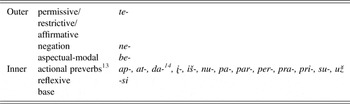
In a recent account, Lithuanian prefixes have been classified as “inner” or “outer” on the basis of their stacking properties, with si found in the latter group. Table 1 summarizes the Lithuanian pre-verbal morphological and morphosyntactic inventory as well as the meanings contributed (Arkadiev Reference Arkadiev2014: 16):
Arkadiev's (Reference Arkadiev2014) taxonomy of Lithuanian verbal prefixes.

Under this approach, not only the outer, but also the inner prefixes are a heterogeneous class and the entire range of meanings si may contribute is placed alongside modality or aspectuality/resultativity.
I argue against this approach for several reasons. First, it overlooks an important distinction between si and prefixes per se: their relation to the verb base. Any lexical verb can combine with at least one or several actional preverbs, taking one preverb at a time,Footnote 15 and there is not a single verb that would not be able to take an outer prefix, including modal verbs, as in (10).
-
(10) te-reiki-a
rstr-need-prs
‘One needs but (something)’
But si apparently has a defective status: first, it never appears prefixed to the verb in the absence of another, “real” prefix; second, it would perhaps be too strong a claim that si -verbs can be formed on the basis of any verb, even though verbs with intensifying si , middles and derived unaccusatives seem to be formed very easily (see Geniušienė Reference Geniušienė and Nedjalkov2007). Next, the relation between si and the verb goes beyond the verb proper: si always involves some “external” (nominal) material, which is not all contained within the theta-grid of the verb, as the discussion below will show. Viewed as such, si in Table 1 is the only element whose use depends partly on the verb, and partly on non-verbal material; hence it is not exact to interpret si as an inner prefix, albeit with a defective status. Moreover, si is of neither adverbial nor prepositional origin, nor is it attributable to the terminological distinction between the prefix and the preverb: its meaning is not grammatical – as with prefixes – nor necessarily lexico-aspectual – as with preverbs. If the reason for grouping actional preverbs and si together is solely their ability to supply aspectual and metaphorical meanings to the verb, again there is a generalizability problem, since si never contributes the directional component. Finally, such an analysis eliminates the possibility of a unified approach to si in Baltic languages and, ultimately, in Baltic languages and Russian. Therefore, although it provides a convenient view of the pre-verbal material, the analysis illustrated in Table 1 oversimplifies the general picture and is incapable of either motivating the position of si within the Lithuanian verb, or drawing conclusions for the Balto-Slavic paradigm of si placement in general.
We can now formulate the possible combinations of si -placement in prefixed Lithuanian verbs as in (11),Footnote 16 referring to the “outer” prefixes as modal (Lith. te-, Latg. juo-), negative (Lith. ne-, Latg. na-), aspectual (Lith. be-) and actional (derivational prefixes; see a more detailed discussion in section 4.6 below):
-
(11)
-
a. verb- si
-
b. actional- si -verb (including Latgalian/dialectal Latvian)
-
c. aspectual-actional- si -verb
-
d. negative-aspectual- si -verb
-
e. negative- si -verb (including Latgalian/dialectal Latvian)
-
f. negative-actional- si -verb (including Latgalian/dialectal Latvian)
-
g. modal- si -verb
-
h. modal-actional- si -verb
-
i. modal-aspectual- si -verb
-
j. modal-negative-aspectual-actional- si -verb
-
k. modal-aspectual-negative-aspectual-actional- si -verb (this is a marginal instance, restricted to colloquial register; see section 4.6. for an example).
-
3.2 Generative approaches
Within the generative domain, an account of the morphosyntax of Lithuanian reflexives within the Distributed Morphology framework has been proposed (Embick and Noyer Reference Embick and Noyer2001). They consider si to be a “dissociated morpheme” with the status of a Subword which left-adjoins to the leftmost subword within the Morphosyntactic Word – in the present case, the verb and accompanying morphology. Si then undergoes Local Dislocation (LD) from its initial position to become right-adjoined to the leftmost material – the prefix in prefixed verbs, or verb-finally in prefixless cases. To make the latter case possible, Embick and Noyer add a stipulation: they argue that the verb and the tense and agreement morphology constitute an indivisible string, given that Indo-European suffixes are more closely attached to the verb than prefixes, to prevent si from appearing between V and T, which are both subwords. Their analysis is criticized by Williams (Reference Williams, Ramchand and Reiss2007), who questions the properties of Subwords before and after LD, namely, why Subwords before LD should be prioritized over those formed after LD has taken place and consequently, why configurational parameters, initially stipulating Subwords, do not apply after LD. But there is another problem with Embick and Noyer's approach, having to do with their analysis of prefixal material: they allow si to appear “between a prefix and a following stem or prefix” (2000: 579), even though they state earlier that the prefix, which si attaches to “as a suffix”, must be “of a certain type” (2001: 579). First, si never appears between any two prefixes.Footnote 17 Second, the status of the prefix “of a certain type” is vague. Embick and Noyer state that LD explains the placement of si “whenever the verb has a prefix or is negated” (ibid.). The problem is, the verb can be both prefixed and negated, and then different stipulations for the negative component, sometimes prompting LD of si and sometimes not, are unclear, just like its status as a subword. Finally, Embick and Noyer do not give due credit to the outer prefixes te-, be-, which, when used alone, cause si replacement, but when used with another prefix, including the compound tebe- and combinations of each with the negative and/or actional prefixes, do not.
4. Identifying si
This section investigates the nature of si and the relations it bears to other elements in the sentence.
4.1 s i-constructions: a brief overview
In Baltic, the marker si licenses a number of lexical operations and is used, following the classificatory approach of Reinhart and Siloni (Reference Reinhart and Siloni2005), to form reflexives, reciprocals, middles, derived unaccusatives,Footnote 18 and Experiencer-subject constructions; it may also contribute an intensifying meaning. The most characteristic uses are illustrated below with examples from Lithuanian, which, at least numerically, shows a greater prevalence than Latvian (Geniušienė Reference Geniušienė and Nedjalkov2007; see also Kalnača and Lokmane Reference Kalnača, Lokmane, Usonienė, Nau and Dabašinskienė2012, Arkadiev et al. Reference Arkadiev, Holvoet, Wiemer, Arkadiev, Holvoet and Wiemer2015).Footnote 19 Whenever the meaning permits, the examples are given with a prefixed and an unprefixed form.
-
(12) With valency reduction
-
a. Tom-asi slepi-a-si i / pa-si i-slep-ė.
Tomas-sg.nom hide-3.prs-si / pref-si -hide-3.pst
‘Tom is hiding/has hidden (himself).’ reflexives
-
b. Tom-asi ir Marij-aj buč-iuoj-a-si i,j / pa-si i,j-buči-av-o.
Tomas-sg.nom and Marija-sg.nom kiss-3.prs-si / pref-si-kiss-pst-3
‘Tomas and Marija are kissing / (have) kissed.’ reciprocals
-
c. Durysi at-si i-dar-ė.
Door-pl.nom pref-si-do-3.pst
‘The doors opened.’ derived unaccusatives
-
d. Mergin-ai lauki-a-si i.
Girl wait-3.prs-si
‘The girl is expecting (a baby).’ experiencer subjects
-
e. Knyg-ai lengvai skait-o-si i.
Book-sg.nom easily read-3.prs-si
‘The book reads easily.’ middles
-
f. Pirma yra bučiuoj-a-ma-si, o paskui tuoki-a-ma-si.
First be-3.prs kiss-3.prs-pas-si and then marry-3.prs-pas-si
‘First one kisses and then one marries.’Footnote 20 impersonal passive
-
-
(13) Without valency reduction: si adds the meaning of the subject performing an action for their own benefit.
Mokytoj-a liep-ė vaik-amsi pa-(si i)-skaity-ti straipsn-į.
Teacher-sg.nom tell-3. pst children-pl.dat pref-si-read-inf article-sg.acc
‘The teacher told the children to read the article.’
Instances like (13) above illustrate the frequently optional nature of si-verbs. Native speakers perceive si -verbs as more personalized and intensifying the ultimate beneficiary of the action. Commenting on the difference between with and without si , a native speaker said that, when read appears without si , the idea is that one must obey the instructions; but when read-si is used, the idea is that ‘you are expected, but do not actually have to, conduct the reading’. To paraphrase, the interpretation of (13) in Lithuanian would be ‘The teacher told the children to read the article because she believes it will be useful for them’. In general, the use of reflexive forms where they are not required by context is quite widespread crosslinguistically, including in English, where the reflexive form may be used for emphasis, for instance, you must read it for yourself (Ronnie Wilbur, p.c.).Footnote 21
Importantly, in all constructions, si seems to be related to the subject of the sentence, regardless of the function of si , or what the subject is, bearing in mind example (12f) and adopting the analysis of impersonal passive constructions proposed for Russian by Bowers (Reference Bowers2002), to which I now turn.
4.2 A digression: Bowers (Reference Bowers2002) on Russian impersonal passive constructions
On the basis of adversity impersonal constructions in Russian, Bowers (Reference Bowers2002) argues that all impersonal passive constructions have a null expletive merged late during the derivation to satisfy the agreement requirements of the probe T. According to Bowers, since there is no overt subject bearing Nominative case, the noun in the Accusative should be able to bear ϕ-features and satisfy the EPP condition, hence the Transitivity Phrase (TrP), located between the light verb and the VP, and a null expletive bearing the Nominative case.
Adversity impersonal constructions are also available in Lithuanian, as shown in (14) (see also Holvoet and Judžentis Reference Holvoet, Judžentis, Holvoet and Mikulskas2005).
-
(14) Vaik-ą pykin-a nuo šokolad-o.
Child-sg.acc nauseate-3.prs from chocolate-m.gen
‘Chocolate makes the child nauseous.’
Applying Bowers’ analysis, (14) may be interpreted as follows: while the argument ‘vaiką’ is generated at VP, with Accusative case assigned at TrP, to fulfill the EPP condition, Nominative case is assigned to the silent 3rd person neuter expletive, indicated in (15) by it, merged in the specifier of vP.Footnote 22
-
(15) [TP T [vP it v [TrPTr[VPvaiką [v′ pykina [PPnuo šokolado]]]]]]
This serves as evidence that Lithuanian has null expletives.
4.3 si and coreferentiality considerations
Since Lithuanian is a pro-drop language, obligatory coreference is not so apparent in complement clauses like the one in (16) when the subject of the complement clause is omitted, especially given the fact that the Lithuanian verb in the third person is differentiated for neither gender nor number:
-
(16) Monik-ai tik-i, kad [pro i/j] ap-si i/j−reng-s šiltai.
Monika-sg.nom believe-3.prs that pref-si-dress-3.fut warmly
‘Monikai believes that shei/someonej will dress warmly.’
In (16), si in ap-si-rengs and the covert subject both have two candidates they can refer to: Monika, the subject of the matrix clause, and a different person who is not overtly mentioned in the sentence. In this situation, si on the verb may refer to either, showing obligatory coreference with the subject of the complement clause.
Constructions with multiple si -verbs are possible with si markers referring to their respective antecedents. In (17) it can be seen how the presence of a matrix si -verb can permit both subject control and object control constructions.
-
(17)
-
a. Direktor-iusi kvieči-a darbuotoj-ąj pa-si *i/j -aišk-in-ti.
Director-sg.nom invite-3.prs employee-sg.acc pref-si-clear-caus-inf
[TP Direktoriusi t [VP kviečia darbuotojąj [TP pro *i/j pasi*i/jaiškinti]]].
‘The director summons the employee to explain him/herself.’
-
b. Direktor-iusi kvieči-a-si i darbuotoj-ąj pa-si i/j-aišk-in-ti.
Director-sg.nom invite-3.prs-si employee-sg.acc pref-si-clear-caus-inf
[TP Direktoriusi t [VP kviečiasii darbuotojąj [TP pro i/j pasii/jaiškinti]]].
‘The director summons the employee to explain him/herself.’
-
In (17) above, the form of the first verb with or without si ultimately determines the interpretation of the infinitival form in the embedded clause. In (17a), the non- si matrix verb functions as an object control predicate allowing only one interpretation. When si is added, as in (17b), two interpretations become available, reminiscent of strict vs. sloppy identity: either the director or the employee may have to explain themselves, and consequently, the matrix predicate can function either as a subject control or as an object control predicate. In the object control construction, si on the matrix verb is coreferential with the matrix subject, and si on the verb of the embedded clause is coreferential with the embedded subject, which has checked case as the matrix object. When the matrix verb functions as a subject control predicate, si on both verbs is coreferential with the matrix subject. It appears that in both cases, si correlates with the subject. Following the VP-Internal Subject Hypothesis, and considering the “longer”, “strict” reading with both verbs bearing si, si can be interpreted as marking the intermediate positions of the subject antecedent on its way from the subject position in the embedded clause to that of the matrix clause (cf. Hornstein Reference Hornstein1999, Reference Hornstein2001, Reference Hornstein and Hendrick2003). In addition, the functions of si on the verbs in (17b) are clearly different: in the lower predicate, si functions as a valency reducing morpheme, while in the matrix verb it does not. But besides conveying an intensifying meaning, si on the matrix verb kviečia-si ‘invites-si’ in the subject control construction serves to connect the matrix subject with the rest of the sentence, thereby giving the “strict” reading, which is otherwise ruled out.
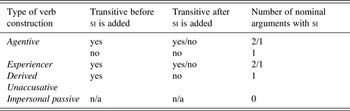
The possible constructions and the number of arguments taken in si -verbs are summarized in Table 2, where n/a stands for non-applicable.
Possible constructions and arguments taken by si-verbs

4.4 Relations and the status of si
Let us now look specifically at the characteristics of si with reference to the arguments it refers to and the verbs in which it appears.
4.4.1. Si with reference to sentence arguments
Following Reinhart and Siloni (Reference Reinhart and Siloni2005), I have shown that si is best interpreted as an operator, licensing a number of lexical operations. However, given its stable morphophonological form and the flexible syntactic property of subsuming one of the theta roles of the verb, I would like to supplement its syntactic characteristics with one more stable property, lest the behavior of si as an arity operator should seem either chaotic or due to chance. In all cases, si must corefer with the grammatical subject of its clause.
-
(18)
-
a. [Aš]i pa-si i -dari-au kav-os.
[1sg.nom] pref-si-do-1.pst coffee-sg.part
‘I cooked- si coffee’. / ‘I made myself coffee.’
-
b. *[Aš]i pa-si i -dari-au Jon-uij kav-os.
[1sg.nom] pref-si-do-1.pst Jonas-sg.dat coffee-sg.part
‘I cooked- si coffee for John.’
-
Thus, as an operator, si is obligatorily coreferential with the subject of the sentence.
4.4.2 Si relative to the verb
As regards its appearance on the verb, the mechanism is regular in standard Lithuanian: si is added verb-finally in prefixless verbs, and between the prefix and before the root in prefixed verbs. Put simply, si takes one of the two positions listed in (19).
-
(19)
-
a. V-Af-si - si functions as enclitic (Kalnača and Lokmane Reference Kalnača, Lokmane, Corbett, Baerman and Brown2010 for Latvian)
-
b. pref-si-V-Af - si functions as a mesoclitic, or as just another affix (Haspelmath Reference Haspelmath2002: 164; Bukšs and Placinskis Reference Bukšs and Placinskis1973: 153 for Latgalian)
-
The fact that si can appear both verb-finally and toward the left boundary of the verb in Lithuanian and dialectal Latvian makes si -“hopping” very reminiscent of clitic climbing in Romance languages. “Climbing” is in general a characteristic of null-subject languages (Sola Reference Sola2002), a group to which Lithuanian belongs. Crucially, however, in Balto-Slavic languages si never leaves the verb. Whether positioned low or high, it occupies a position within the immediate proximity of the v/VP domain.
Let us take stock of what we have discussed so far. In all instances, si obligatorily refers to the subject, which is a manifestation of coreference between the antecedent expressed through a free form, an independent variable, and a morphologically expressed anaphor, whose meaning depends on that of the antecedent. But the placement of si within the verb is different: in Slavic languages and in standard Latvian si does not move, whereas in Lithuanian and dialectal Latvian it does. Since si is not a free form and its meaning depends entirely on the subject of the sentence, it seems reasonable to suggest that the changing position of si is due to its need to be placed within a certain distance of the antecedent. What is special about Lithuanian and dialectal Latvian is that si seems to be bound by the noun in subject position and consequently acts as a nominative anaphor (Carnie Reference Carnie2013). If so, it appears that Lithuanian, along with Latvian dialects, obeys Condition A of the Binding Theory, stated in (20).
-
(20) An anaphor is bound in its Governing Category (Chomsky Reference Chomsky1981).
Thus in prefixless verbs, regardless of their type, the subject of the sentence c-commands and is coindexed with the anaphoric si marker on the verb. The fact that si has an anaphor-like relation with the nominal antecedent entails one more important attribute: appearing in the position following the prefix, si , as we have shown, is intrinsically related to the EPP properties of its antecedent. We therefore find the following bundle of properties. First, si stands in an anaphoric relation to the antecedent, hence it must be properly bound by the antecedent within its local domain; and second, si is dependent on the EPP features of its antecedent, which is a necessary condition to account for instances where the antecedent is not an agent, but a theme (see, for example, Marelj and Reuland Reference Marelj, Reuland and Chahine2013). In other words, si is a subject anaphor and an overt trace left by the subject argument on its way to check Case and, crucially, check the EPP feature, hence a manifestation of A-movement. If so, the locus of si is where the subject of any given sentence is merged, namely spec-vP for agentive and experiencer verbs and spec-VP for thematic verbs. On this view, when si takes different positions in the verb, it does so in order to maintain the binding domain with the subject.
4.5 Extensions to the Classical Binding Theory
In this section, we digress briefly to place the discussion in the context of approaches to binding within the generative tradition.
4.5.1 Behaviour of copies
The status of the anaphor as a copy of its antecedent, and the relation between the two, is not a new idea in generative approaches and has been explored in a number of works. Below I will mention some of them and will look for possible correlation with the present data.
Let us first consider the idea of the antecedent and its anaphor merging in the same position. Hornstein (Reference Hornstein2000) argues for this analysis of reflexive forms in English, whereby the antecedent is first merged in the position of its anaphor and then moves to check Case. The copy/trace of the antecedent is deleted in its merge position, whereas the anaphor is pronounced. Since it has the status of a bound morpheme, but no overt realization in English, it is filled with the pronoun self.
The consequences of a copy being overt have also been explored, with the copy having to be “masked” in order for the derivation to converge at PF and LF (Nunes Reference Nunes1995, Reference Nunes, Epstein and Hornstein1999, Reference Nunes2004). Boeckx, Hornstein and Nunes (Reference Boeckx, Hornstein, Nunes, Conroy, Jing, Nakao and Takahashi2005) assume a) that movement leaves a copy in the original position (following Hornstein Reference Hornstein1999, Reference Hornstein2001) and b) that reflexivizing and control constructions are manifestations of movement. They seek to account in this way for the differences between languages that do not have overt copies (like English), and those that have copies manifest in either reflexive or control constructions. They agree with Nunes (Reference Nunes1995, Reference Nunes, Epstein and Hornstein1999, Reference Nunes2004) that the crucial factor for the generally problematic status of overt copies is Kayne's (Reference Kayne1994) Linear Correspondence Axiom (LCA) and further explore Nunes’ (Reference Nunes2004) proposal that the presence of overt copies is due to language-specific morphological operations, whereby two forms can fuse, and consequently become “masked” and invisible to the LCA, and that the complexity of the candidates for fusing is one of the criteria. From this it follows that multiple copies will be blocked, since they will not find matching candidates for fusion.
4.5.2 Binding as a phase
The binding domains of anaphors have also been analyzed in light of phases. Hicks (Reference Hicks2009) argues that Condition A should be eliminated altogether, in favour of a phase-internal Agree-based interpretation of binding of anaphors, which provides an account of the cases challenging Condition A. Consequently, anaphors are distinguished from DPs and pronouns in that the latter have a valued [Var] feature on entering the derivation, while the former do not. They therefore must have it valued through an Agree operation in the course of derivation. Despić (Reference Despić2011) also pursues an account of binding domains through phases, under which CPs, vPs, and DPs constitute appropriate phases, and examines binding relations in light of a larger issue of whether the DP is a universal category. Despić argues that languages such as Serbo-Croatian and Russian are NP rather than DP languages, which affects their syntax and derives the “subject-orientedness” of their anaphors. While I will not be exploring the issue in depth from the perspective of the DP/NP issue, our data already suggests that si placement is indicative of a particular kind of phase in Baltic.
4.5.3 A digression: why and when si?
One might wonder why, in general, the trace position is filled with an overt morpheme in some languages (e.g., Lithuanian), while in others it is not (e.g., English and Dutch).Footnote 23 I will propose two possible explanations. The first is along the lines of Hornstein (Reference Hornstein2000) with the addition that the reason there are no relevant bound morphemes in English and Dutch would derive from the fact that these languages have poorer agreement systems than do Balto-Slavic languages, or Icelandic, among the Germanic languages. Dutch and Icelandic both inflect verbs, but Dutch does so to a significantly lesser degree than Icelandic. Thus Dutch Present Indicative forms make no distinction between second and third person forms in the singular, or among any persons in the plural; in addition there is no person-number distinction made in the Past Indicative forms; whereas Icelandic verbs are inflected for both person and number.Footnote 24 In English, in the Present Indicative forms, the only distinction made is between singular 3rd person and plural 3rd person. Given the weak status of the category of person in Dutch and English, contrasted with the greater diversity in Icelandic and in Balto-Slavic languages, I suggest that the agreement system is a precondition for the absence of a bound si morpheme. The view of the antecedent-anaphor relation as an Agree operation is pursued in some approaches (e.g., Reuland Reference Reuland, Broekhuis, Corver, Huybregts, Kleinhenz and Koster2006, Reference Reuland2007); hence the proposed answer may fall largely within the same domain.
Alternatively, we could follow Despić (Reference Despić2011); the part of his analysis relevant here comes from Bošković’s (Reference Bošković2010) criteria delimiting DPs (vs NPs) and from Reuland‘s (Reference Reuland2007, Reference Reuland2011) criterion of definiteness marking. Under this approach, we can build the opposition between English and Dutch on the one hand, and Baltic languages, Icelandic and Russian on the other, on the basis of the presence or absence of DP. Thus English and Dutch have a DP (both have definite and indefinite articles). In contrast, Icelandic has only one article, which is attached postnominally, and Baltic languages and Russian have no overt articles. Rather, words that could be categorized as determiners behave like adjectives. Essentially, then, the distinction between the two groups is made according to whether definiteness is marked pre- or post-nominally. For example, Lithuanian has pronominal adjectival forms where definiteness is marked word-finally. Another specific example that illustrates this opposition is the fact that English does not allow Left Branch Extraction, but Russian does (Despić Reference Despić2011: 5). Consequently, Despić argues, Russian is an NP language. Given their similar features, we can tentatively speculate that Icelandic and Baltic are also NP languages. One property of NP languages is that they have “subject-oriented” reflexive affixes attached word-finally. Therefore the DP/NP distinction may be responsible for the fact that si -forms can appear on the verbs in Icelandic, in Baltic languages and in Russian, but not in English or Dutch.Footnote 25
4.5.4 Anaphor types
Charnavel and Sportiche (Reference Charnavel and Sportiche2016) argue that the computation of plain anaphors is confined to the domain where they get their interpretation. Plain anaphors roughly correspond to inanimate anaphors, which all obey Condition A, unlike the so-called exempt anaphors, comprising animate anaphors, which show variation. Charnavel and Sportiche take subjects to be markers of phase boundaries and classify phases into Tolerant and Intolerant phases, that is to say those allowing and those disallowing multiple extraction. While we will not go into detail, it may be relevant, given the uses of si in Baltic languages, to reassess its manifestations in light of two categories. Reflexive, Experiencer-as-subject and intensifying uses of si as well as impersonal passive constructions would constitute the animate- si domain, while the middle and derived unaccusative constructions would form the inanimate- si domain, given that si is a copy of the subject.
4.5.5 Proxy readings as Xo
Marelj and Reuland (Reference Marelj, Reuland and Chahine2013) consider reflexive and middle constructions and also argue that the range of meanings of se cl follows from its merge position. Building on Chomsky (Reference Chomsky1995) and Bošković (Reference Bošković1997), they argue that the underspecification of phi-features on se cl should not be taken as a criterion of se cl functioning as an anaphor, but rather points to its ability to function both as a head and a phrase. Consequently, the distinctive property of se cl is that it enters “an Agree relation with the first available source of phi-features (finite AGR)”, which explains their matching features (Marelj and Reuland Reference Marelj, Reuland and Chahine2013: 78). They state further that the availability of proxy, or “near reflexive” readings reveals whether se cl has the status of Xo or XP. Thus Russian reflexive -sja does not allow proxy readings and is an affix with the status Xo.
As in Russian, proxy readings are not available in Lithuanian si -verb forms, but are quite frequent with the pronominal form save, for example,
-
(21)
-
a. Saul-ius už-si-deng-ė.
Saulius-sg.nom pref-si-cover-3.pst
‘Saulius covered himself.
≠
-
b. Saul-ius už-deng-ė save nuotrauk-oje.
Saulius-sg.nom pref-cover-3. pst self photo-sg.loc
Saulius covered himself [his image] on the photo.’
-
The fact that si moves in Lithuanian, at least within the limits of the present discussion, prevents me from following Marelj and Reuland's (Reference Marelj, Reuland and Chahine2013) concept of se cl-affixation, on two principles: a) the non-anaphoric analysis of si ; b) application of an affixal approach on the basis of the availability of proxy readings. The analysis proposed here will also offer an alternative interpretation for the Russian marker -sja.
4.5.6 Binding as Move or Agree
Drummond et al. (Reference Drummond, Kush and Norstein2011/Reference Drummond, Kush and Norstein2012) view binding as a grammatical process which can be accounted for with the two major minimalist concepts: Move and Agree. In the Move-based approach, the anaphor is viewed as a “morphological offspring of a copy of the antecedent” (p. 399), and hence is directly linked to the antecedent. In the Agree-based approach, the relation between the anaphor and the antecedent is maintained via the Agree operation, mediated by a functional head directly connected to both the antecedent and the anaphor, which themselves have no direct connection with each other. Due to space constraints and because the proposed analysis will also rely heavily on movement within a single morphosyntactic form, we will consider only the Move-based approach. One immediate consequence of the Move-based approach is that it helps resolve the issue of the referent of si in animate si -constructions, which we can further subdivide into reflexive and non-reflexive constructions. According to this approach, movement can occur into two case-bearing positions. Drummond et al. provide the example of reflexivizing and A-movement constructions presented in (22) below (2011/2012: 402).
-
(22)
-
a. John washes himself.
-
b. John washes t.
-
Drummond et al. argue that in reflexivization, movement takes place into two θ positions, whereby John in (22a) is both the subject and the object; whereas in (22b) John has only one θ-role.
Let us consider the similar Lithuanian examples in (23).
-
(23)
-
a. Jon-as bar-a save.
Jonas-sg.nom scold-3.prs self-acc
‘Jonas scolds himself.’
-
b. Jon-as bar-a-si.
Jonas-sg.nom scold-3.prs-si
‘Jonas is swearing/swears.’
-
c. Jon-as neš-a-si kompiuter-į į darb-ą.
Jonas-sg.nom carry-3.prs-si computer-sg.acc in work-sg.acc
‘Jonas carries/is carrying the computer to work (for himself).’
-
In (23a), the anaphoric pronoun save ‘self’ takes the object position; in (23b), the object theta-role is subsumed by si ; in (23c), si may be perceived as subsuming an indirect object θ-role. Both save in (23a) and si in (23b-c) stand in an anaphoric relation to the antecedent, Jonas. On the basis of these examples, I would like to suggest that, in animate constructions, the anaphoric si acts as the morphological offspring of a copy of A-movement that has taken place from one locus into two θ-positions. This can further be subdivided into si -reflexivisation, if the relevant positions are subject and direct object, or si -intensification, as in (23c), if the relevant positions are subject and indirect object, or into one θ-position – the subject – to give the undirected meaning, as in (23b) (see Korostenskienė Reference Korostenskienė2014). For si-reflexivization to take place, crucially, there has to be complete semantic identity between the subject and the object, which distinguishes it from constructions with the reflexive pronoun, as in (23a). In (23a) there is only partial overlap of identities, but no full identity, as there is not in well-known examples like The Morning Star is the Evening Star. When scolding, apparently Jonas scolds only some part, however big it is claimed to be, of his own identity, and never its entirety, which is impossible for logical reasons. I would argue that full identity between the subject and the object is, however, present in verbs like in (24).
-
(24) a. su-si-žeis-ti b. slėp-ti-s
pref-si-injure-infhide-inf-si
‘to injure oneself’Footnote 26 ‘to hide’
In these examples the subject is fully affected by the action, whether it is manifest through metonymy in the former or si -reflexivization in the latter case. In all other cases of si being an animate anaphor, si obligatorily shares full identity with one θ-role only, the subject. Hence in (23b), si shares full identity with the subject, and consequently the beneficiary of the action is never specified and the sentence has a non-directed meaning.
4.6 The proposed approach to si
Let us now return to our discussion in which si appears to behave like a subject anaphor.
Since subject position is in spec-TP, its binding domain has to be formed between T and some (functional) projection where both the prefix and the verb can appear, supposing that in prefixless verbs, the verb moves up to occupy a certain position to maintain the binding domain, while in prefixed verbs the binding domain is overtly marked by the prefix. But the problem is that the right boundary of the binding domain is not at all clear: saying that si appears between the prefix and the verb root somehow obscures the fact that there may be several prefixes before the verb root. The combinability of “grammatical” prefixes in general invites a further study of its own, but it will be illustrated here briefly in order to demonstrate how long prefixed verbs can be and, in light of the present discussion, how far si can occur from the left boundary of the verb complex. Below is an illustration for the verb šnek-ė-ti ‘to talk’ in the third person Present tense. For simplicity of exposition, I provide the translation and give the formula for the prefixal material of the verb:
-
(25)
-
a. actional- si:
nu-si-šnek-a
‘talk(s) nonsense’
-
b. negative- si:
ne-si-šnek-a
‘doesn't talk’
-
c. modal- si:
te-si-šnek-a
‘mayIMP talk’
-
d. negative-actional- si:
ne-nu-si-šnek-a
‘don't/doesn't talk nonsense’
-
e. modal-negative-actional- si:
te-ne-nu-si-šnek-a
‘mayIMP not talk nonsense’
-
f. modal-aspectual-negative-actional- si:
[te-be]-ne-nu-si-šnek-a
‘does not talk nonsense anymore’
-
g. modal-aspectual-negative-aspectual-actional- si:
[te-be]-[ne-be]-nu-si-šnek-aFootnote 27
‘mayIMP not talk nonsense anymore’
-
What about Latvian? Experts in Latvian do not have a unanimous opinion on forms with multiple grammatical prefixes. Thus, Ilya Seržant (p.c.) argues against deb-neg-verb combinations emphasizing the grammaticalization of the debitive in Latvian. Nicole Nau (p.c.) finds such forms unexpected, but, commenting on their presence on the Internet, says that contexts in which they appear (she provides examples j ā-ne-iet ‘to be obliged not to go’, jā-ne-dara ‘to be obliged not to do’, jā-ne-but ‘to be obliged not to be’) suggest that these forms cannot be merely attributed to non-native speakers’ (in)competence and might consequently be viewed as marginally possible.
The combinability of modality and negative morphemes is not critical for the analysis at hand, but has interesting implications considering the fact that modality expressions (in our case, morphemes) pertain to the category C on the syntactic tree (Felser Reference Felser and Janβen2000). I will return to them in the discussion below.
The examples in (25) above pose a problem for both the traditional and generative accounts of the position of si . From the traditional perspective, hence ignoring binding, it is unclear why in prefixed verbs si should move to the position between the verb and the innermost prefix. From the generative perspective, under which binding-related phenomena are relevant, it is not clear why, given the same antecedent (the subject) and the anaphor ( si ), the binding domain, which is located somewhere in the left periphery of the verb, should be extendable. It is also mysterious why, if we assume that there is one functional operator where prefixes go while the binding domain should be stable, Lithuanian does not have forms like, for example, *ne-si-nu-šnek-a (cf. 25d), *te-si-be-ne-nu-šnek-a (cf. 25f), with si being placed immediately after the topmost prefix. The fact that we treat si as a manifest trace overtly representing A-movement helps us to identify the merging position of the subject/ si as spec-v/VP, but says nothing about the stage at which si is finally “dropped off” by the subject on its way to check EPP features in spec-TP. In this respect, the following questions arise: a) what is the location of the verbal prefixes relative to the v/VP, and b) what explains the interaction between si and verbal prefixes, depending on whether there is one or several of them? We must therefore consider Baltic prefixes.
5. Incorporating PrefixesFootnote 28
Baltic prefixes are traditionally divided into prefixes of prepositional and non-prepositional origin. For Lithuanian, the latter class includes prefixes of particle origin (Ulvydas Reference Ulvydas1971, Ambrazas Reference Ambrazas2006, Paulauskienė Reference Paulauskienė2006; see also Šepetytė Reference Šepetytė2006): the negative ne-, the continuative be-, the restrictive te-, and two complex prefixes nebe-, tebe-, formed by two particle prefixes put together. In Latvian, non-prepositional prefixes, also referred to as grammatical prefixes (Andronov Reference Andronov2010: 68) include the negative ne- and debitive jā- (Latgalian na- and juo- respectively: Nau Reference Nau2011).Footnote 29 The meanings contributed by Baltic (i.e., Lithuanian and Latvian combined) non-prepositional prefixes are always compositional and predictable, albeit allowing polysemy.
In Lithuanian, three particle prefixes (ne-, nebe-, and tebe-) are separable and can figure as free-standing words in coordinate structures, as shown in the examples in (26), from the Corpus of the Contemporary Lithuanian Language.
-
(26)
-
a. …ne-be-mylėj-o, seniai ne-be-mylėj-o Gvidon-o,
neg-cnt-love-3.pst long-ago neg-cnt-love-3.pst Gvidon-sg.gen
ir jis jos ne.
and he-sg.nom her-sg.gen ne
‘loved no longer, did not long love Gvidon, and he did not love her.’
-
b. Ar aš dar gali-u ką nors rink-ti-s? Matyt, ne-be.
q+ I yet can-1.prs what-acc else choose-inf-si See-inf neg-cnt
‘Can I still choose anything? Obviously, not anymore.’
-
c. … lyg norė-dam-as pa-tikrin-ti, ar te-be-sėd-i
as if want-ptcp-sg.nom pref-check-inf q+ rstr-cnt-sit-3.prs
girinink-as. Te-be.
forester-sg.nom rstr-cnt
‘..as if willing to check whether the forester is still sitting. He still is.’
-
Notably, when detached from the verb, complex clitic prefixes must have the continuative be- as their second element. In this combination, the idea of continuity of an action is very palpable and the meaning contributed by the prefixed complex is that an action is either still ongoing (tebe-, in which case te- seems to undergo semantic bleaching, as mentioned early in the article), or is no longer ongoing (nebe-). When used on the verb without be-, te- and ne- “resume” their primary meaning(s) as the restrictive/permissive and negative respectively.
Except for the separability issue, all Baltic particle prefixes share a number of properties: the meaning they contribute is compositional; they do not affect the arguments of the verb; only the negative prefix ne- obligatorily induces Genitive case on the object;Footnote 30 and they allow stacking in that they can attach freely to an already-prefixed verb. Unlike Lithuanian, the particle prefixes in Latgalian (negative na- and debitive juo-) cannot co-occur in standard forms, but each can attach to a verb with a lexical prefix (Nau Reference Nau2011; see also section 4.6).
The Baltic inventory of prepositional prefixes is rich; there are 14 in Lithuanian: ap-(api-), at(ati-), į-, iš-, nu-, pa-, par-, per-, pra-, pri-, pra-, pri-, su-, už- (Paulauskienė Reference Paulauskienė2006) and 11 in Latvian: aiz-, ap, at-, ie-, iz-, nuo-, pa-, pār-, pie-, sa-, uz- (Andronov Reference Andronov2010: 68–72). While all verbs can combine with particle prefixes, the degree of compatibility of the verb with lexical prefixes ranges from being able to combine with all prefixes, each time forming a certain shade of meaning, to combining with only a few prefixes. The meanings contributed by the prefix may have associations with the original prepositions, or be metaphorically extended, as illustrated in (27) and (28).
-
(27) LithuanianFootnote 31 (Paulauskienė Reference Paulauskienė2006: 58)
-
a. api-bėg-ti (aplink ką)vs.ap-valg-y-ti
about-run-inf (around what/who-acc) about-eat-Ɵ-inf
‘to run about’ ‘to eat out of house and home’
-
b. į-bėg-ti (į kur)vs.į-valg-y-ti
in-run-inf (in where) in-eat-Ɵ-inf
‘to run into’ ‘to eat into something’
-
c. nu-bėg-ti (nuo kur) vs.nu-valg-y-ti
from-run-inf (from where) from-at-Ɵ-inf
‘to run down from (a hill)’ ‘to eat a little from’
-
-
(28) Latvian (Ilze and Nešpore Reference Ilze and Nešpore2014, glosses adapted)
-
a. aiz-ietvs.aiz-mirs-t
away-go.infaway-die.inf
‘to go away’‘to forget’
-
b. sa-stāv-ē-tvs.sa-smalcin-ā-t
with-put-Ɵ-inf with-cut-Ɵ-inf
‘to put together’ ‘to cut up, chop’
-
Prefixes are perceived as a means to convey aspectual or Aktionsart-related information (hence the term preverb), sometimes specifying that the information is more “semantic” or “lexical”, rather than purely morphological (Sawicki Reference Sawicki2000: 134). Thus the terminative reading contributed by Baltic prepositional prefixes may optionally be supplemented with a directionality component.
Given the apparent similarities between Slavic and Baltic aspectual systems, with prefixation being a productive means of forming resultative constructions as well as the possibility of stacking prefixes, albeit contributing different meanings to the verb, an analysis within the framework proposed by Svenonius (Reference Svenonius and Svenonius2004, Reference Svenonius, Zybatow, Szucsich, Junghanns and Meyer2008b) for Slavic prefixes seems reasonable.
5.1 The lexical / superlexical distinction
Svenonius' approach to Russian prefixes has largely been stipulated by inquiries into Germanic particle constructions (e.g., Svenonius Reference Svenonius1996, Reference Svenonius2003). The general ability of certain Slavic prefixes to stack has been shown to have crucial consequences for the understanding of the prefixation mechanism in Russian, resulting in the distinction of two kinds of prefixes: lexical and superlexical (Svenonius Reference Svenonius and Svenonius2004).Footnote 32 The issue has been widely discussed for Russian in particular and Slavic languages in general, sometimes with terminological variation (e.g., Babko-Malaya Reference Babko-Malaya1999; Ramchand Reference Ramchand2004; Rojina Reference Rojina2004; Romanova Reference Romanova2004, Reference Romanova2007; Svenonius Reference Svenonius and Svenonius2004, Reference Svenonius, Zybatow, Szucsich, Junghanns and Meyer2008b; Slabakova Reference Slabakova, Franks, Gladney and Tasseva-Kurktchieva2005; Tatevosov Reference Tatevosov, Kisseleva, Plungian, Rakhilina and Tatevosov2009a, Reference Tatevosov2013; Žaucer Reference Žaucer2009, Tolskaya Reference Tolskaya2015). Lexical prefixes contribute “directional or idiosyncratic lexical meanings” (Svenonius Reference Svenonius, Zybatow, Szucsich, Junghanns and Meyer2008b: 527), the latter sometimes argued to be metaphorical extensions of their primary spatial meaning. Superlexical prefixes “are like adverbs or auxiliary verbs” and contribute “aspectual or quantificational meanings” (Svenonius Reference Svenonius and Svenonius2004: 205). Thus, when scalarity of meaning is emphasized (e.g., Kagan Reference Kagan2012 and references there; Tolskaya Reference Tolskaya2015),Footnote 33 the need to distinguish between lexical and superlexical prefixes is called into question, given their phonological equivalence. Since in Baltic languages the structural distinctions between prefixes are much clearer and since, if relevant, scalarity will remain the property holding within either class of prefixes, but never both classes at the same time, I will not pursue this issue further.Footnote 34
For clarity and in order to highlight the generative perspective, I will retain the terminological distinction into lexical vs superlexical.
Once the properties of lexical and superlexical prefixes have been established, we should be able to answer the following questions: a) why can certain prefixes (Lith. ne- be-, te-, nebe-, tebe-; Latv. ne-, jā) stack on “derivational” prefixes? b) why does this former group of prefixes trigger movement of the marker si in the verb with one prefix or without a prefix, but not in stacking constructions?
5.2 Lexical prefixes through the Figure/Ground relation
To account for the different properties of Slavic prefixes, Svenonius (Reference Svenonius and Svenonius2004) employs his earlier analysis of Germanic particle constructions in light of Talmy‘s (Reference Talmy and Greenberg1978, Reference Talmy2000) distinction of the notions Figure and Ground,Footnote 35 the former denoting the variable which is located or moved, and the latter the reference point against which this event is measured, expressed, for instance, by a prepositional phrase. Talmy argues that, underlyingly, the relationship between FIGURE and GROUND is unidirectional and Svenonius (Reference Svenonius and Svenonius2004) attributes this relation to syntactic c-command, in which the Figure c-commands the relevant expression – the Ground – identifying its location or movement. To capture spatial relations, Svenonius (Reference Svenonius and Svenonius2004, Reference Svenonius, Asbury, Dotlacil, Gehrke and Nouwen2008a, Reference Svenonius, Cinque and Rizzi2010) introduces a functional category P, whose members can have both literal and metaphorical meanings and are regularly followed by a complement. He argues that “when spatial relations are lexicalized as adpositions, the complement of the adposition is always the Ground” (Svenonius Reference Svenonius and Svenonius2004: 208). The structure in (29) depicts the Figure-Ground relation (Svenonius Reference Svenonius and Svenonius2004: 208; see also Svenonius Reference Svenonius, Cinque and Rizzi2010).
-
(29)


Consequently, the preposition introduces the Ground while Figure is always merged in PP, regardless of the type of the argument. Svenonius (Reference Svenonius, Cinque and Rizzi2010) proposes a cartographic approach to expressing spatial relations, and consequently places the PP under pP, the projection handling the internal argument within the verb group, dominated by the projection PathP, which in its turn is dominated by DirectionalP, designating/capturing the directional context of the entire phrase.
Svenonius argues, for example, that to render directed motion, languages employ essentially the same structure, with the particle left-adjacent to the verb. He observes that in Slavic languages, the verbal prefix is frequently doubled by the respective preposition.Footnote 36 The same is true of Baltic languages. Compare the examples in (30).
-
(30)
-
a. On za-shel za ugol. Russian
He behind-go-3.pst behind corner-sg.acc
‘He went round the corner.’
-
b. Jis už-ėj-o už kampo. Lithuanian
He behind-go-3.pst behind corner-sg.gen
‘He went round the corner.’
-
c. Ciko at-iet vilciens uz Liepāju? Latvian
at-what-time away-go-3sg.prs train-sg.nom for/to Liepaja
‘At what time does the train leave for Liepaja?’ (Prauliņš and Moseley Reference Prauliņš and Moseley2015: 47, 49)
-
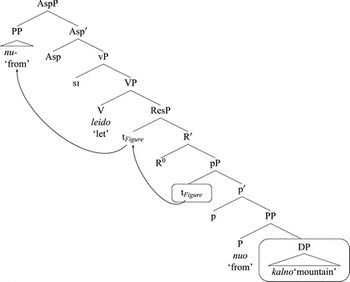
Svenonius argues that, appearing as part of the prepositional phrase in the verbal complement, the preposition thus points to its relation to the Ground. He proposes that lexical prefixes originate in an extended projection pP below the Result Phrase (ResP) and then move out to the aspectual projection above the verb to express the resultative state.Footnote 37 Given their nominal status, they can only occupy the specifier position of the aspectual phrase.Footnote 38 Svenonius (Reference Svenonius and Svenonius2004) develops his analysis of Slavic complex prepositions, proposing a PP projection split into PathP and PlaceP,Footnote 39 but since they are of no immediate relevance for the discussion, we will not be concerned with this distinction here. Below I apply Svenonius’ analysis to Lithuanian. For illustrative purposes, in the tree diagram I use a prefixed si -verb to reflect the interaction between the prefix, both in its merge and final position, and the marker si . The structure is also somewhat simplified: rather than use PathP and PlaceP for the reasons just mentioned, I opt for the standard Prepositional Phrase, but retain the ResP and pP projections to demonstrate the relation between the preposition and the prefix. The aspectual head AspP is an ad hoc solution to capture resultativity and is tentative. Its position will be reassessed later.
The boxes around t Figure and the DP kalno show the merge positions of Figure and Ground respectively. The arrow shows the merge position of the prefix and its subsequent movement to the aspectual projection above the verb.
-
(31) Jis nu-si-leid-o nuo kaln-o.
He-sg.nom from-si-let-3.pst from mountain-sg.gen
‘He descended from the hill.’
-
(32)
The discussion of lexical prefixes suggests that, as stated before, si cannot be included into the paradigm for definitional reasons: it cannot be doubled by a respective prepositional counterpart, unlike inner/lexical prefixes; its movement to the position preceding the verb cannot be stipulated by aktionsarten reasons only; and finally, if included in the class, it would immediately compromise it by appearing pre-verbally in a stacking construction with a true lexical prefix, bearing in mind that inner/lexical prefixes cannot stack. Building on Katz's (Reference Katz, Lang, Maienborn and Fabricius-Hansen2003) analysis of the placement of manner adverbs relative to the verb, we can also define the highest point of attachment of manner adverbs in Baltic languages: they seem to be able to adjoin to modal superlexical prefixes, as in (33).Footnote 40 , Footnote 41
-
(33) a. noriaite-duod-ab. nuoširdžiaite-myl-i
willinglyprm-give-prssincerely prm-love-3.prs
‘should give willingly’‘should love sincerely’.
5.3 Superlexical prefixes
Unlike lexical prefixes, which are merged low, superlexical prefixes, given their optional status, are argued to merge above the verb and attach to it in an adjunct-like manner. The merge positions of the lexical and superlexical prefixes are given in (34), based on Svenonius (Reference Svenonius and Svenonius2004: 206).
-
(34)

Unlike lexical prefixes, superlexical prefixes have the properties listed in (35) (Svenonius Reference Svenonius and Svenonius2004: 229; see also Svenonius Reference Svenonius, Zybatow, Szucsich, Junghanns and Meyer2008b).
-
(35)
-
a) Temporal rather than spatial meanings
-
b) Absence of idiomatic collocations
-
c) Argument structure: failure to license unselected arguments
-
d) Secondary Imperfective scopes over lexical, not over superlexical
-
e) Stacking: appear outside lexical prefixes
-
Baltic superlexical prefixes are more heterogeneous than their Slavic counterparts and include modal meanings, inviting the distinction of a modality phrase ModP. Indeed, since they describe the situation rather than the verb alone, the meanings conveyed by superlexical prefixes seem to be closer to the properties of T or C rather than to the properties of V. This is supported by the fact that superlexical prefixes go beyond the scope of secondary imperfective and habitual past in Lithuanian, expressed by the affixes -inė- and -dav- respectively, and because the use of the permissive/restrictive te- in the modal use may essentially form an entire clause, as in (36).
-
(36) te-ne-be-[[iš-si-dirb]-inėj-a]
rstr-neg-cnt-pref-si-work-freq-3.prs
‘May he/she/they not behave arrogantly anymore.’ (colloquial)
5.4 The proposed inventory of Baltic prefixes
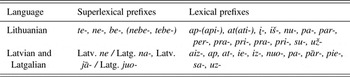
The proposed analysis divides the Baltic prefix inventory as in Table 3.
Proposed division of Baltic prefixes

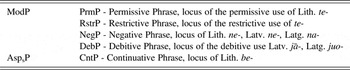
Taking into consideration, as far as possible, the fine-grained distinctions within the class of superlexical prefixes and leaving their detailed analysis for further study, superlexicals can now be tentatively defined as stored under the two functional domains ModP and AspSP, which include the functional projections given in Table 4.
Tentative taxonomy of projections of Baltic superlexical prefixes

Returning to the earlier question on the placement of si within the verb, the proposed analysis explains why Lithuanian (and dialectal Latvian, by extension) has forms like those in (37a), but none like those in (37b).
-
(37)
-
a. ne-be-nu-si-suk-o
neg-cnt-from-si-turn-3.pst
‘no longer turned away’
-
b. *ne-be-si-nu-suk-o
*ne-si-be-nu-suk-o
-
In other words, we can now explain why si is sensitive to whether or not the verb form is prefixed, but never moves past the superlexical prefixes to show up higher in the structure. As an overt copy of the subject of the sentence, si never leaves the material originating within the verbal complex.
The interim structure in (38) illustrates the Lithuanian verb with prefixal positions filled with both superlexical and lexical prefixes. The square frame in the tree diagram marks the region with material produced/merged within the verbal complex, while NegP and CntP form the superlexical domain.
-
(38)

6. A More Fine-Grained Approach to si Placement
Let us now identify the possible positions of si . They are as listed in (39).
-
(39)
-
a. Verb- si
-
b. PrefL- si -verb
-
c. PrefS- si -verb
-
d. PrefS-PrefL- si -verb
-
We now have to consider more closely what happens specifically at the left boundary of the vP region, in other words, what motivates the placement of si in verb forms with patterns like Verb- si vs Pref s - si-verb and Pref s -Prefl- si-verb, but not Pref s - si-Pref l -verb. Let us first consider unprefixed si -verbs.
6.1 Unprefixed reflexive verbs
So what about the verb-final position of si in unprefixed verbs? On the one hand, it seems that si has maintained strong ties with its historical pronominal roots. While verb-final position is perceived as its historical location, si appears to be preserving its anaphoric status and incorporates into the verb structure by closely following the morphological structure of the verb on the one hand and the generation of the subject at the syntactic level on the other. Since it always appears as a copy of the noun checking EPP features, si forms what Carnie refers to as a “nominative anaphor” (Carnie Reference Carnie2013: 484). With respect to Lithuanian subjecthood, this notion does not seem to be completely homogenous and merits a study of its own; I will therefore use the more general term subject anaphor, thereby relating it transparently to the noun checking EPP features. Therefore, the binding domain of si is determined by the TP region, and is necessarily above the VP domain of the internal argument. As it combines the features of the anaphor and an overt nominal copy, si in its specifier position cannot form the left word boundary of the unprefixed verb. How can this issue be resolved?
Let us now consider several examples. As is well known, valency reduction is a common feature of se/si cross-linguistically. Lithuanian si -verbs are also known to sometimes change their meaning dramatically. In addition, as (40) suggests, Lithuanian si is capable of changing the verb from static to dynamic:
-
(40)
-
a. Tom-as (*greitai) myl-i Monik-ą.
Tomas-sg.nom (quickly) love-3.prs Monika-sg.acc
‘Tomas (*quickly) loves Monika.’
-
b. Tom-as ir Monik-a (greitai) myl-i-si.
Tomas-sg.nom and Monika-sg.f.nom (quickly) love-3.prs-si
‘Tomas and Monika are (quickly) making love.’
-
In these sentences, two things happen. First, the argument structure changes depending on whether or not si appears.Footnote 42 Second, the verb changes its status from stative to dynamic only with si , disallowing a low manner adverb in the stative (40a), but not in the dynamic (40b). Let us consider a few more pairs of examples in which the argument structure changes when si is added.
-
(41)
-
a. Vaik-as tik-i tėv-ams.
Child-sg.nom believe-3.prs parents-pl.dat
‘The child believes her parents.’
-
b. Vaik-as tik-i-si gau-ti dova-nų.
child-sg.nom believe-3.prs-si get-inf presents-pl.gen
‘The child hopes to get presents.’
-
-
(42)
-
a. Jam gail-a vaikų.
he-sg.dat pity-3.prs child-pl.gen
‘He feels sorry for (the) children.’
-
b. Jis gail-i-si vaik-ų.
he-sg.nom pity-3.prs-si child-pl.gen
‘He feels sorry for (the) children.’
-
-
(43)
-
a. Jis nor-i mieg-o.
he-sg.nom want-3.prs sleep-sg.gen
‘He wants to sleep.’
-
b. Jam nor-i-si mieg-o.
he-sg.dat want-3.prs-si sleep-sg.gen
‘He wants to sleep.’
-
-
(44)
-
a. Jie (pa-)naudoj-o virykl-ę.
They (pref-)use-3.pst stove-sg.acc
‘They used the stove.’
-
b. Jie naudoj-o-si / pa-si-naudoj-o virykl-e.
They use-3.past-si / pref-si-use-3.past stove-sg.acc
‘They (have) used the stove.’
-
In (41), the meaning of the verb is made idiomatic by adding si ; in (42), the presence of si changes a sentence with a non-Nominative subject (traditionally referred to as impersonal) into a sentence with a Nominative subject. In (43), the process is reversed: when si is added to the experiencer verb, the case of the subject changes from Nominative to Dative. In (44), there is no change in the argument structure. As can be seen, in all these pairs, the only morphosyntactic change that takes place within the verb is the addition of si . It is known that changes involving argument structure and idomaticity are characteristic of the verb-complement relation. With respect to the examples just seen, si must appear as a verbal complement in order to bring about the relevant changes. Since it has been shown that si is merged in the vP with agentive and experiencer verbs, it is significant that in unprefixed forms, the verb appears above si . This is possible only if the verb has raised to an aspectual position above si . The motivation for verb movement to the aspectual domain is in line with Kempchinsky (Reference Kempchinsky, Auger, Clancy, Clements and Vance2004): the verb, having interpretable temporal features, moves up to check and delete the uninterpretable temporal features of the aspectual head. In Lithuanian, there is one more plausible reason for the verb to move: it does so in order to maintain the binding relation between the subject and the si -anaphor.
Let us now examine what happens when superlexical prefixes come into play.
6.2 Does si have aspectual properties?
Let us first summarise what we have so far. There are lexical and superlexical prefixes in Lithuanian. Lexical prefixes derive from prepositions and are merged within the verbal complex. Superlexical prefixes can be of various origins; but none of them induces movement of si to any position between two superlexical prefixes. Si can appear either between a lexical prefix and the verb, if such a prefix is present; or between the lowest superlexical prefix and the verb, if there is no lexical prefix. Lexical prefixes cannot stack. Superlexical prefixes can stack, albeit in a strictly defined order, and si invariably follows all superlexical prefixes. Therefore, keeping all superlexical prefixes in one domain would be helpful in defining the binding domain for the anaphoric si . Recall that with the lexical prefixes only, the binding domain is formed between the T and AspP. Let us now consider the case where there are one or more superlexical prefixes, but no lexical prefix, as in (45).
-
(45) ne-be-si-tik-i
neg-cnt-si-believe-3.prs
‘does not expect/hope any more’.
Three things can be seen in (45). First, the domain of superlexical prefixes is filled. Second, there are no lexical prefixes to form the AspLP; finally, si appears above the verb. This is possible under two scenarios. Either si has remained in its spec-vP position and there is a null AspLP; or si has moved to spec-AspL. Crosslinguistic parallels favor the latter option. For instance, reflexivity has already been shown to have aspectual properties for Romance languages (Kempchinsky Reference Kempchinsky, Auger, Clancy, Clements and Vance2004). Given that superlexical prefixes always precede si , we can claim that si is forced to raise to the aspectual position either by the Minimal Link Condition, or in order to maintain its binding domain, which is now formed between T and AspSP. Since si is of nominal origin, its only possible position is in Spec-AspL, while the verb itself apparently raises to Asp and thus follows si . When there are no superlexical prefixes, si cannot raise, but a binding domain must nonetheless be formed. This is accomplished when the verb raises to Asp.
The question to be answered now is, why doesn't the number of superlexical prefixes matter? I hypothesize that the answer lies in the locus of the phase and in the Phase Impenetrability Condition.
6.3 Enter phase
Given the fact that si can change the argument structure of the verb, the node responsible for this sort of permutation falls within the same domain as the verb. Disregarding for a moment the distribution of si , the existence of resultative prefixes and their ability to modify verbal argument structure in Lithuanian suggests that the phase containing the verb should extend beyond the vP, and I argue here that it is precisely AspLP.Footnote 43 When there is a lexical prefix, the phase becomes complete and, even if the verb is marked with si , neither the phase nor si itself is affected by further addition of one or more superlexical prefixes. When there is no lexical prefix, but at least one superlexical prefix, si raises, due to the Minimal Link Condition, to spec-Asp, and the phase is complete again, becoming impenetrable to further operations. The number of superlexical prefixes is thus of no importance: si will always remain in spec-Asp while the binding domain is formed between T and the “upper” aspectual projection of the superlexical prefix be-, if it is present, or the respective modality-type prefixes te- and/or ne-. Returning to the properties of si , since it is a copy of the subject of the sentence, it cannot check any features at spec-Asp. If it could, verbal forms with the order si-verb should be possible, contrary to fact. If we disregard the phase for a moment and consider only the lexical/superlexical and Figure/Ground distinctions, the proposed analysis seems just as logical. The aspectual projection is still formed within the verb (recall that lexical prefixes are of prepositional origin and appear as Ground in the structure); so si essentially is quite at home, as it is located within the material originally c-commanded by the verb. Meanwhile Baltic superlexical prefixes are adjuncts; in Lithuanian they can form clitic compounds, and from this standpoint are quite independent in their behaviour. In addition, they also mark an area to which si , being an overt copy of the moved subject of the sentence, cannot move. If it could, this would be movement of a full-fledged element, not a copy. In the present analysis, si is regarded as but a copy of the subject; and therefore, first, it never appears independently, and second, it is always found within the verbаl complex, and never outside it.
Understandably, the position of si following only superlexical prefixes, in the absence of a lexical prefix, is somewhat weaker. This is felt by native speakers when they occasionally use the ungrammatical form with the misplaced marker, responding to the question in a jocular manner:
-
(46)
-
a. Question: Kaiptausek-a-si?
howyou-sg.datfollow-3.prs-si
‘How are you?’
-
b. Response:*Ne-sek-a-si.intended: Ne-si-sek-a
neg-follow-3.prs-si neg-si-follow-3.prs
‘Not well.’
-
The incorrect form as used in the response in (46b) is arguably confined to the context of the negative clitic prefix; neither the continuative be- nor the restrictive/modal te- have been encountered in verbs with this morpheme order, though this may also be due to their far less frequent use relative to verbal negations. This incorrect order is not possible if the verb has a lexical prefix, either. But what the presence of such forms suggests is that the verb and si are not sensitive to the presence of a superlexical prefix and, in the absence of the lexical prefix, retain their ordering v- si as if there were no prefix at all. In the latter case, the phase would be closed by the verb raising to Aspo.
It is also interesting that moving to the aspectual projection also determines the type of the verb: only dynamic verbs can move to the aspectual head. In order for a stative verb like mylėti ‘to love’ to appear at AspP, it must be interpreted as a dynamic verb. As the discussion above has shown, this can be achieved by prefixation, by adding si , or both.
Another reason the phase should include the aspectual projection is that this is where argument composition is ultimately determined. Consequently, si appears to share several properties with Lithuanian prefixes: both influence argument composition and both can convert a stative verb into a dynamic one. Since both lexical prefixes and si are merged inside the verbal group, but affect the argument structure outside the verb, it is plausible to treat the aspectual phrase as part of the extended projection of the verb. Given that arguments as well as their cases are determined at the aspectual level, the phase should include the lower AspLP, but not the domain of superlexical prefixes, which, as I have suggested, range over at least two categories, AspSP for be-, and a covert modality phrase ModP for te- and ne-(Latv jā-, ne-/Latg juo-, na-).Footnote 44 Since Lith. be- is a superlexical prefix and is optional, let us exclude it from the discussion and focus only on the meaning-forming material, that is to say, lexical prefixes and what comes below them.
6.4 Handling aspect: movement considerations
The template for the morpheme order in Lithuanian and dialectal Latvian agentive and experiencer verbs was given in (5b), repeated here as (47).
-
(47) Asp>si>v>V>Asp>T>Agr
In (47), there are two aspectual positions: one for resultative prefixes, to the left of the verb, and one for aspectual suffixes, to its right. Economy considerations of the generative approach would require that there be only one aspectual projection distinguished. Consequently, the appearance of two aspectual positions must be formally explained. I have suggested that in unprefixed verbs, the verb moves to AspP and thus forms a binding domain for si . Notably, the process takes place in any verb that can combine with a frequentative (secondary imperfective) affix, which I assume is possible only with dynamic verbs. Considering the fact that aspect is a clausal, rather than verbal, property, and remembering the phasal (and phrasal) status of the upper aspectual projection, we are now ready to tackle this issue.
Building on the classical DM model (Embick and Noyer Reference Embick, Noyer, Ramchand and Reiss2007), according to which complex heads are formed by movement and relevant functional projections can be linearized both as prefixes and as suffixes, we would expect that, when clausal properties (such as tense and aspect) are expressed elsewhere, this is due to movement. Given the unavailability of rightward movement, it is the verb that moves. According to the minimalist perspective on movement, the placement of two elements next to each other is not accidental, but rather is driven by a certain functional projection with strong features that need to be checked (Svenonius Reference Svenonius, Ramchand and Reiss2007). Consequently, if there are two elements X and Y, such that X is (universally and underlyingly) higher on the syntactic tree than Y, but in a given language Y moves over X and ultimately appears higher than X, this suggests that Y is attracted to a certain functional head F with which it needs to check features. Svenonius (Reference Svenonius, Ramchand and Reiss2007) summarises as in (48) the possible linear combinations of three items standing in hierarchical relation to each other, all of which are attested in various languages, with ‘1’ being the highest and ‘3’ the lowest.
-
(48)
-
a. 1-2-3 Straight
-
b. 1-3-2 Curl
-
c. 3-2-1 Roll-up
-
d. 3-1-2 Skipping
-
e. 2-3-1 Constituent Fronting or Sinking
-
f. 2-1-3 Hopping(Svenonius Reference Svenonius, Ramchand and Reiss2007: 241)
-
So if the primary order T > Asp > V corresponds to 1 > 2 > 3 in (48), the order Asp-V-T, the aspectual projection distinguished for lexical prefixes, is suggestive of roll-up, which Svenonius, on the same grounds, postulates for Russian (p. 17, note 13). But we also have the secondary imperfective suffix to account for, and hence the aspectual phrase is split by the verb. Enter remnant movement: “Remnant movement is movement of an XP from which extraction has taken place earlier in the derivation” (Müller Reference Müller, Alexiadou, Anagnostopoulou, Barbiers and Gärtner2002: 209). Therefore, in both Baltic and Russian, there are two types of movement that manifest overtly. When there is no overt aspectual suffix, as stated in section 2, nothing prevents us from postulating a phonologically null aspectual suffix in the relevant morphological system. Going back to our discussion, it has been shown that prefixes occupy the specifier position of the aspectual phrase, and now, arguing that there can be only one aspectual phrase, we are ready to locate the verb as left-adjoining to the aspectual suffix as a result of remnant movement.
There is only one more element to be added: si . Let us now consider how it moves. The trees in (50) show all the processes we have so far been able to identify. Example (50a) shows the structure deriving the unprefixed verb važ-inėj-a-si from (49a), and (50b) shows the structure deriving the prefixed counterpart shown in (49b).
-
(49) a. Unprefixed form:b. Prefixed form:
važ-inėj-a-sipa-si-važ-inėj-a
go-freq-3.prs-si pref-si-go-freq-3.prs
‘frequently goes (by a certain kind‘goes by transport occasionally,
of transport)’from time to time’
-
(50)
-
a. Structure for unprefixed form
-
b. Structure for prefixed form
-


In (50a), the verb undergoes head movement from V0, through v0 and AspL 0 to T0, creating a complex head spelled out as važ-inėj-a. Si remains within vP and thus surfaces after the verb. In the prefixed form in (50b), the prefix pa- moves to the specifier position of AspPL, taking on an aspectual role and activating the specifier position. Si then moves to the specifier of AspPL, tucking in below pa-, and vP rolls up and tucks in below si . Finally, AspPL rolls up to the specifier of TP, tucking in below the subject. This derives pa-si-važ-inėj-a, the form in (49b).
The difference between the two structures is that the unprefixed form is derived by head movement, while the prefixed form is derived by phrasal movement to specifier positions. Phrasal movement is made possible when the lexical prefix moves from a position below V to the aspectual specifier position, giving the resultative meaning.
I am now ready to explain why I argue for a zero aspectual marker in Latvian: otherwise, prefixes have no motivation to exist. I have shown that prefixes occupy the specifier position of the aspectual phrase, and now I argue that there can be only one aspectual phrase. Consequently, both Lithuanian and Latvian have a single aspectual head below T, which is always zero in Latvian and may be filled with the secondary imperfective suffix in Lithuanian (as in Russian). To get a resultative reading, the preposition/prefix moves to the specifier of the aspectual head. In standard Lithuanian and dialectal Latvian, this leads to the movement of the si to the Aspectual specifier position immediately following the lexical prefix. But we do not know yet whether si is moved for binding considerations or, perhaps, for some other reason.
6.5 The mechanism of si placement
There are three possible motivations for the movement of si in the prefixed form.
Alternative 1: Si is attracted by the aspectual head, once that head is activated by the movement of the prefix to its specifier. This is why the order is reversed at spellout: prefix> si . Prosodically it seems plausible, since si can occur in a stressed position. When this happens, it is indicative of the historically stressed prefix (Kazlauskas Reference Kazlauskas1968).
The problem with this approach arises with superlexical prefixes. As said before, these merge not below the v/VP, but above it, and do not occupy the specifier of AspPL. In forms with one or more superlexical prefixes, it is thus unexplained why si raises to a position before the verbal root, as illustrated in (45), repeated here as (51).
-
(51) ne-be-si-tik-i
neg-cnt-si-believe-3.prs
‘Does not expect/hope any more’
Since we cannot explain how si appears before the verb root in such cases, the alternative of si being attracted by the lexical prefix illustrated in (50b) has to be abandoned.
Alternative 2: Si moves up not on its own, but as part of the v/VP. This alternative has two further options, depending on whether or not si is regarded as an anaphor. Let us first clarify the relationship between the verb and si and, more specifically, consider whether the two can move as a complex, disregarding anaphoric relations and binding. Suppose that v/VP moves to the specifier of AspPL in roll-up fashion. The v/VP therefore moves up in its entirety, together with si , which thus remains preverbal, as in (51). This also rules out forms like (52a), which, as was shown earlier, caused problems for the analysis of Embick and Noyer (Reference Embick and Noyer2001):
-
(52) a. *važ-inė-si-jaFootnote 45 intended:b. važ-inėj-a-si
go-freq-si-3.prsgo-freq-3.prs-si
‘frequently goes (by a certain kind of transport)’
Movement of si together with the verb, as an instance of phrasal movement, seems plausible. But we saw in (50a) that in unprefixed cases, where the correct form is (52b), the verb root appears above the aspectual head (the latter filled with -inė-), while si remains below T. We accounted for this by head movement of the verb, rather than by phrasal movement. The essential difference between the movement of the verb and that of si is that the verb always moves, but the whole vP, including si , moves only in the presence of a prefix, and only in Lithuanian and dialectal Latvian. Crucially, si stays in its merge position in unprefixed verbs in the entire Baltic group and in Russian, and in prefixed standard Latvian and Russian forms. This is where Baltic languages and Russian part ways, and Aspect has more (grammatical) strength in Russian, but not in Baltic languages, the latter due to the further movement of si . Given the conditions when the marker si does move (that is, prefixed dialectal Latvian and standard Lithuanian forms), two results follow. First, si has to move up independently from the verb, and second, it is independent even before the first roll-up initiated by Asp.
Alternative 3: Si is a subject anaphor which must maintain its binding domain with its antecedent. According to this analysis, as a bound subject anaphor, si moves in order to maintain the binding domain with its antecedent. I argued earlier that a binding domain is formed between the T and AspP. When moved, what position will si take in the structure? I suggest that there is a second specifier position in the AspP, following Rizzi and Roberts (Reference Rizzi, Roberts and Wetzels1989) and Roberts (Reference Roberts1993), who argue that, when a complex head is formed via simple head movement, each of the conjoining heads contributes a specifier position. As for the relation of specifiers to their heads and the timing of the incorporation of the prepositional head Po on Vo relative to Vo on Aspo, it seems to be precisely because the verb has moved into the aspectual phrase that the preposition can now acquire the resultative reading as a prefix. For convenience, I will follow this line.Footnote 46 We thus end up with the aspectual phrase in (53).
-
(53)

After head movement, two specifier positions are available.Footnote 47 One specifier position is for Po and is taken by the operator: enter the resultative prefix. The other specifier position is a nominal position reserved for A-movement and is taken by si . The suffixal aspectual head Aspo does not morphologically select for either the prepositional or the verbal head. Rather, the prepositional and the verbal heads freely incorporate to it. The outcome is a complex head licensing (at least) two specifiers, each “typical” for its relevant head (Roberts Reference Roberts1993: 45).
The refined view of the processes in verb pairs as in (49), repeated here as (54), is presented in the trees in (55). The tree in (55a) corresponds to the unprefixed form in (54a), and (55b) gives the structure of the prefixed form in (54b).
-
(54)
-
a. važ-inėj-a-sib. pa-si-važ-inėj-a
go-freq-3.prs-si pref- si-go-freq-3.prs
‘frequently goes (by a certain kind ‘goes by transport occasionally, from
of transport)’time to time’
-
-
(55)
-
a. Unprefixed form, derived by head movement of the verb:
-
b. Prefixed form, derived by phrasal movement of P and si and head movement of the verb, followed by movement of AspPL to spec-TP.
-


The requirement that si appear within a certain distance of the subject helps explain a number of other factors and we can now refine the definition of the binding domain, which we placed earlier between the spec-TP and the AspP. Now knowing the mechanism and the intra-verbal dependences, we can further develop this idea.
As has been shown before, in Lithuanian and dialectal Latvian, si appears above the verb, and I argue that this position is the second specifier of Asp; recall that the verb always surfaces within the aspectual domain. In this view, it is clear why superlexical prefixes have no effect on binding in the presence of a lexical prefix: as material attached to the verb via adjunction, they are “external” by definition and consequently have no influence on the process of the subject merged within the v/VP getting to its position in spec-TP. In unprefixed forms, the verb has moved and is within the aspectual projection, too, but this time the first specifier position taken by the resultative prefix is empty. Si appears below the verb, after tense and agreement morphology, hence in its original position.
Let us now examine a situation where there is a superlexical prefix, but no lexical prefix. In this situation, as we know, si raises and appears between the rightmost superlexical prefix and the verb root. Under this approach, the superlexical prefix essentially makes the left boundary of the aspectual domain of lexical prefixes visible to si . As an overt copy of the subject antecedent and hence “defective” material, si cannot form the left boundary of the verb. But crucially, the presence of a superlexical prefix activates the specifier region of the lower (“lexical”) aspectual domain. Then perhaps it is not the prefix itself, but rather the activation of the specifier position of the AspLP, that forces si to move. Hence the binding domain is formed, once again, between the spec-TP and AspLP. In this way, although the superlexical prefix is not directly involved in the derivation, it activates the intermediate landing site of the subject in AspLP, which is then filled by si . This is the process that separates standard Lithuanian and dialectal Latvian from the other languages. What does the binding domain consist of, exactly? In all prefixed forms, regardless of prefixal composition, as we have seen, it is formed between the spec-TP and the AspLP, with si taking the second specifier position. In unprefixed forms, the spec- AspLP position remains unactivated and hence the binding domain is formed between the spec-TP and the remnant verb in the aspectual projection. But apparently the roll-up of Asp and V have no effect on the subject since specifier projections, reserved for nominal material, remain unaffected. Consequently, the subject antecedent does not participate in the process, with the result that binding is naturally derived and si remains in its base position, exactly where the subject was merged.
Interestingly, si obligatorily raises in prefixed Lithuanian verbs, optionally in prefixed Latvian verbs, and never in prefixed Russian verbs. This suggests that si has retained the strongest bond with its pronominal ancestor in Lithuanian, less so in Latvian, dialectal forms being an older relic (cf. Stolz Reference Stolz2012), and figures overtly, as if having lost its properties as a bindee, in Russian.
6.6 The status of si
However, the question of the morphological status of si is still to be answered. Essentially, three perspectives are available: si is either an affix, a particle (Lith. dalelyt ė, a term used in Lithuanian traditional approaches), or a clitic. I have argued against the first view, but what supporting evidence can be found to favour its status as a clitic? Mobility seems to be a suggestive reason, but not a conclusive one.
In line with Wackernagel's Law, attributing clitics to the second position, Klavans (Reference Klavans1985) establishes three parameters distinguishing a clitic within the cliticization domain based on dominance, precedence, and phonological liaison: 1) whether the clitic appears after the initial element or the final element, dominated by the relevant phrase; 2) whether the clitic occurs before, or after its host; 3) whether it is phonologically attached to the preceding element or to the following one.
Let us now describe the placement of si relative to the verb, in line with Klavans’ parameters. Si is associated with a verb, and hence its cliticization domain is always the verb, v/VP. But relative to the verb, si can appear either after the verb (taken roughly, with tense and agreement morphology on it), or before it; hence the second parameter allows, as Klavans puts it, “dual citizenship” (Reference Klavans1985: 104). Notably, si need not be phonologically attached to the verb, as in the position following lexical prefixes, and hence can act as a phonological enclitic while being syntactically proclitic to the verb. A common Baltic feature is that si occurring in the stressed position is indicative of the original stress borne by the prefix (Kazlauskas Reference Kazlauskas1968). Following the earlier proposal that lexical prefixes determine a phase, si has exactly the propoerties of a clitic: it is faithful to Wackernagel's Law, and it appears in the second position. The picture is entirely uniform if we postulate that si , the clitic, appears in second position in the phase – usually AspLP, or v/VP. This is interesting: we see how the notion of the word is becoming less clear, in that while (lexical) prefixes are perceived as parts of the orthographic word, we already have to recognize their independence from the verb. They constitute a phase of their own, hence formally are not obligatory to the verb, since their presence is, first of all, driven by considerations of meaning. On the other hand, semantics is a strong argument for lexical prefixes to be interpreted as located within the same word rather than constituting a word of their own. This is also what explains why prefixes are “less attached” to the verb than are suffixes.
Now si is characterized by the following properties: it is bound by the subject antecedent, and it appears as a second-position clitic in a phase. This allows us to define the binding domain of si : it is separated by one phase boundary from its antecedent. Now what about instances when superlexical prefixes come into play? It seems that the superlexicals tebe-, nebe- in Lithuanian have their own phasal status, as their free-standing positions suggest, but more generally, all grammatical/superlexical prefixes are phases of their own in Lithuanian and Latgalian. Apparently, when si relocates in the presence non-clitic superlexical prefixes, this can be interpreted as a “last resort” operation. Superlexical prefixes should not affect processes taking place in the TP-v/VP region, and they do not, given their high position, as long as they are not the only players involved in the game. If they are, then since superlexical prefixes form an orthographic and phonological word with the verb, they affect the morphological structure of the verb “from above”, causing si to relocate to second position, but now in the phonologically null phase formed by AspLP. When there are two superlexical prefixes in Lithuanian, si seems to be sensitive only to the lowest phase-forming prefix. As I have suggested above, it may just need the first position to be activated, and there might not be a direct link between the lowest superlexical prefix and si , assuming that si takes the second specifier position.
Meanwhile, the seemingly affixal si in standard Latvian and Russian is very much a clitic, as well. Recall the earlier observation that in Latvian and Russian, the relation between si and the argument seemed to be one of coreference rather than binding. We can now apply minimum corrective action: si is a clitic if we state that lexical prefixes in these languages do not form a phase of their own and are subsumed under one phase with the v/VP, unlike Lithuanian and Latgalian/dialectal Latvian LPs. This derives the clitic status of Latvian -s and Russian -sja. Meanwhile, the difference in phasal composition may be taken as an explanation for the differences in aspect strength in the respective languages.
7. A Final Note: on the Lexicalist Debate
Let us now consider how Baltic data contribute to the Lexicalist debate. I will first present the lexicalist viewpoint as articulated by Williams (Reference Williams, Ramchand and Reiss2007). The question is whether processes holding at the word level and those at the phrase level constitute two modular units with the phrasal level starting to operate after all relations at the word level have been established. Under this view, word processes are internal and not accessible to the phrasal system. The fact that the phrasal anaphor, unlike the lexical anaphor, is separated by a number of other phrases from the antecedent leads Williams to argue for delayed resolution holding at the phrase, but not at the word level. A contrasting view is presented in Haspelmath (Reference Haspelmath2011), who argues for the indeterminacy of the notion of the word itself, as it is largely influenced by the orthographic tradition (see also Borer Reference Borer, Spencer and Zwicky1998, Harley Reference Harley2010). According to Haspelmath, words and phrases should be seen as forming a single kind of morphosyntactic unit following the same logic and principles. With respect to si , Haspelmath argues against affixal analyses. Constructing a theory of word status, in which mobility is one of the criteria pointing to the fuzziness of the category, Haspelmath suggests that si should be viewed as a clitic, like its free-standing counterpart in Polish, which is in line with the analysis of si proposed here.
Returning to the Lexicalist debate, the Baltic facts explicitly support the non-Lexicalist perspective. We have seen that si moves above the stem as soon as a prefix is added, whether it be lexical or superlexical. Consequently, superlexical prefixes change their morphemic order and si will be placed immediately preceding the root, as in (56).
-
(56) SLP + V-si → SLP-si-V
The morpheme order thus depends on material which is optional, that is, not required by verbal morphology, and therefore has clausal properties. The position of si in the verb is determined after the clause-level information has been added. This leads to the conclusion that if word boundaries are those indicated by orthography and phonology, then the word level is subject to delayed resolution. The Lexicalist perspective therefore does not hold.
8. Conclusion
The present article has provided an account for the placement of si in Lithuanian prefixed and unprefixed verbs, a long-standing unresolved issue of Lithuanian morphosyntax, and more generally, the placement of si in Baltic and Russian. It has been shown that si acts as a nominal anaphor, obeying Binding Condition A. Given its status, si is merged within the v/VP, depending on the type of the subject argument serving as the antecedent, while its position relative to the verb depends on the morphological composition of the verb.
Having first shown the phrasal status of all verbal prefixes in Lithuanian, we divided verbal prefixes into two main groups: lexical and superlexical prefixes. Lexical prefixes derive from prepositions and can contribute both literal and idiosyncratic meanings. They can also change the event structure of the verb as well as affect its argument composition. Superlexical prefixes contribute regular temporal or modal meanings and can stack above lexical prefixes. On the basis of these properties, previous research on Germanic particles and Slavic prefixes, and the idiom construction principle outlined in Marantz (Reference Marantz, Hammond and Noonan1988), the conclusion was drawn that Lithuanian lexical and superlexical prefixes have different merge positions. Lexical prefixes are first merged below the verb and then move out to the aspectual phrase AspLP to acquire the resultative properties. The domain of superlexical prefixes is heterogeneous, including modal and negative prefixes in Lithuanian and Latvian, as well as the aspectual be- in Lithuanian. Consequently, Baltic superlexical prefixes form a broader category than do Slavic superlexical prefixes, which are aspectual. The different merge positions of prefixes help explain why the reflexive/reciprocal marker never raises beyond the lexical prefix: as an overt trace of the subject argument, it stays within the material originating within the verbal complex. In addition, the position of si is subject to the principle of the phase: for Lithuanian, the phase is argued to be constituted by AspLP; consequently, as soon as it is closed, whether by the lexical prefix in verbs with a single (lexical) prefix, or by the verb itself in unprefixed reflexive verbs, or by si in prefixed verbs with a superlexical (in the absence of a lexical) prefix, it becomes impenetrable to further operations; therefore, in the case of multiple stacking prefixes, no further movements of si take place. The status of si has also been specified: it is a second-position clitic in a phase, both in Baltic languages and in Russian. Finally, the data presented in the article provide evidence against the Lexicalist Hypothesis.