Introduction
During studies of the triseptate species of the genus Buellia s. lat. in the Iberian Peninsula (Giralt & Nordin Reference Giralt and Nordin2002), we examined a small specimen of an interesting but inconspicuous corticolous species, previously identified as Buellia triphragmia (Nyl.) Arnold. Pending additional material, the species was not described at that time. Since then, two additional collections have been made in the Algarve by one of us (PvdB) (van den Boom & Giralt Reference van den Boom and Giralt2012), and are described here as a new species. Further infertile Iberian specimens could be stored in herbaria under names of species with a similar habit (brown blastidiate crust) such as Placynthiella icmalea (Ach.) Coppins & P. James.
Materials and Methods
The specimens were examined by standard techniques using stereoscopic and compound microscopes. Only free ascospores lying outside the asci were measured. Measurements were made in material mounted in water at ×1000 magnification. Mean value (M) and standard deviation (SD) were calculated and the results in the diagnosis and species description are given as (minimum value observed) (M − SD)–(M + SD) (maximum value observed); M, SD and n (the total number of ascospores measured) are given in parentheses. The terminology used follows Rambold et al. (Reference Rambold, Mayrhofer and Matzer1994) for the asci, Giralt (Reference Giralt2001) for the ascospore-types and their ontogeny, and Nordin (Reference Nordin1996) for the ascospore septum-types.
Chemical constituents were identified by standardized thin-layer chromatography (TLC) (Orange et al. Reference Orange, James and White2001).
The Species
Buellia subericola Giralt & van den Boom sp. nov.
MycoBank No.: MB803840
Thallus brown, entirely blastidiate, lacking secondary metabolites. Apothecia lecideine, very small, 0·1–0·3 mm diam. Proper exciple paraplectenchymatous. Hymenium without oil droplets. Ascospores (1–2–)3-septate, rarely submuriform with a longitudinal septum in each middle cell, (14·0–)15·0–17·5(–18·0)×(5·0–)5·5–7·5(–8·5) µm; inner wall thickenings very pronounced at septa, absent at apices; walls smooth. Ontogeny of type A.
Type: Portugal, Algarve, S of Barranco do Velho, NW of São Brás de Alportel, 1 km N of Alportel, W side of Road 2, SW slope, shaded by shrubs and Quercus suber, on Q. suber, 360 m, 7°55·1′W, 37°10·8′N, 2 March 2006, P. & B. v.d. Boom 36108 (BR—holotype).
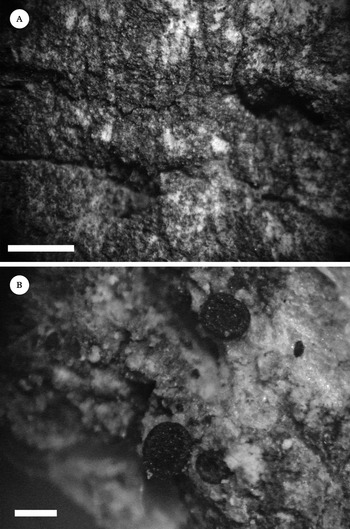
(Figs 1A & B, 2)
Buellia subericola (holotype). A, minutely blastidiate thallus; B, scattered, minute apothecia. Scales: A=2 mm; B=0·2 mm.

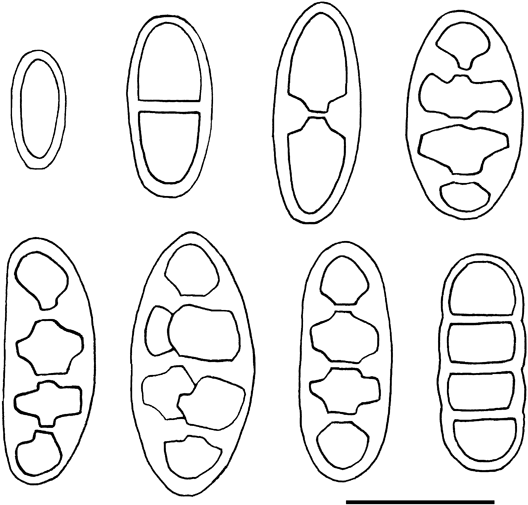
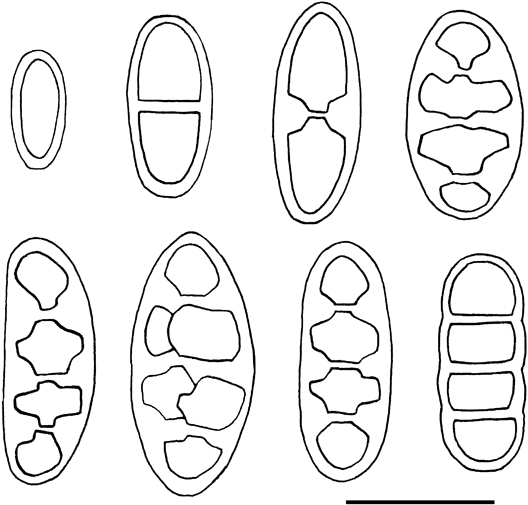
Buellia subericola, ascospore ontogeny and variability (holotype). Scale=10 µm.
Thallus corticolous, episubstratal, crustose, brown, thin, composed of discrete to usually contiguous areoles, ochraceous to brown; areoles becoming completely blastidiate, forming a ±continuous leprose crust (Fig. 1A); blastidia brown, up to 20–35 µm diam. Prothallus absent. All thallus structures non-amyloid. Photobiont chlorococcoid, inside the thallus 12–15 µm diam. and inside the blastidia of 5–8 µm.
Apothecia rare, lecideine, brownish to black, very small, (0·1–)0·2–0·3 mm diam., scattered, discrete, sessile. Proper margin thin, entire and prominent in young apothecia, becoming thinner, persistent, reddish brown to dark brown or black. Disc urceolate at first, then flat, epruinose, often darker than the proper margin (Fig. 1B). Proper exciple paraplectenchymatous, laterally 10–35 µm thick, expanded to 40(–50) µm below, inner part pale reddish brown composed of cells of 5–6 µm diam., outermost part darker, cells with dark brown caps up to 8 µm diam. Hymenium colourless, (50–)60–70 µm high, not inspersed with oil droplets. Epihymenium reddish brown to brown. Hypothecium 60–80(–100) µm deep, upper part dark brown, lower part reddish brown. Paraphyses slender, c. 1 µm wide, the apical cells slightly enlarged, 2–3 µm wide, dark brown. Asci Bacidia-type, 8-spored but very often immature and without ascospores. Ascospores with (1–2–)3-proper septa, rarely submuriform with a longitudinal proper-septum in each middle cell, (14·0–)15·0–17·5(–18·0)×(5·0–)5·5–7·5(–8·5) µm (M=16·5×6·5 µm; SD=1·2×0·9 µm; n=36), not constricted at septa, straight or rarely slightly curved; inner wall thickenings very pronounced at septa, absent at apices; walls smooth (×1000). Ontogeny of type A (Fig. 2).
Pycnidia and conidia not seen.
Chemistry
K−, C−, KC−, Pd−, UV−. The thallus does not contain secondary lichen substances by TLC.
Etymology
The name reflects the substratum on which this species grows.
Ecology and distribution
The new species is known only from two localities in the south-western Iberian Peninsula, growing always on the bark of Quercus suber. Both localities are cork-oak forests, more or less influenced by forestry practices, which belong biogeographically and bioclimatologically to the mesomediterranean subhumid-humid vegetation series (Rivas-Martínez Reference Rivas-Martínez1987; Rivas-Martínez et al. Reference Rivas-Martínez, Lousa, Díaz, Fernández González and Costa1990; Fos & Clerc Reference Fos and Clerc2000). The type locality is poor in lichen growth. The new species was found with fragments of Candelariella reflexa (Nyl.) Lettau, Lecidella elaeochroma (Ach.) M. Choisy, Parmelia s. lat. and Rinodina sp. On soil, near the Quercus tree with B. subericola, only Cladonia subturgida Samp. and Micarea subviridescens (Nyl.) Hedl. were observed.
The species was erroneously reported in Fos (Reference Fos1998) as B. triphragmia, a taxonomic synonym of Tetramelas geophilus (Sommerf.) Norman (cf. Nordin Reference Nordin1996; Giralt & Nordin Reference Giralt and Nordin2002).
Observations
Buellia subericola is characterized by the brown, areolate to leprose thallus, a lack of secondary metabolites, and the relatively small, mostly 3-septate to rarely submuriform ascospores (Table 1) with pronounced septal wall thickenings which remain thickened for a long time (Fig. 2). Additional diagnostic characters are the minute apothecia, the paraplectenchymatous proper exciple and the ascospore ontogeny of type A.
Main differences between Buellia subericola and other related Buellia s. lat. taxa discussed in this paper.

M = mean value; –, absent
Although Buellia s. lat. species with submuriform to muriform ascospores will be combined into several of the generic segregates of this genus (cf. Marbach Reference Marbach2000; Elix Reference Elix2011) [e.g. B. capitis-regum W. A. Weber, B. oidalea (Tuck.) Tuck. and B. oidalella A. Nordin within Buellia s. str. (=Hafellia)], up to now, the genus Diplotomma Flot. and Buellia auct. non De Not. are the only ones which involve species with submuriform or muriform ascospores. However, Diplotomma s. str. (=Diplotomma-group, Nordin Reference Nordin2000) as currently accepted (Helms et al. Reference Helms, Friedl and Rambold2003; Nordin & Tibell Reference Nordin and Tibell2005; Elix Reference Elix2011), is also characterized by pruinose apothecia, a thallus rich in calcium oxalates and a thick perispore, features which are all absent in B. subericola. Thus, for the time being, the new species is included in Buellia auct. non De Not. which accommodates a great range of variation in several characters, among them the number of cells per ascospore (from 1-septate to pluriseptate, submuriform or muriform).
Other known Buellia s. lat. species with 3-septate or submuriform ascospores which, like B. subericola, are corticolous and develop vegetative propagules, are B. griseovirens (Sm.) Almb., widespread in the Northern Hemisphere, and the tropical B. nordinii Giralt, Kalb & Elix and B. sorediata (Tuck.) H. Magn. All three taxa are clearly distinguished from the new species. Buellia griseovirens develops discrete soralia, contains atranorin and norstictic acid, and has larger ascospores, which are typically submuriform (with 8–12 cells) and uniformly thin-walled (Nordin Reference Nordin2000). The blastidiate B. nordinii has larger, never submuriform ascospores (Giralt et al. Reference Giralt, Kalb and Elix2010a ). Buellia sorediata has a whitish sorediate thallus with atranorin, larger apothecia (up to 1·2 mm diam.) and ascospores without septal wall thickenings. An additional taxon with soralia and 3-septate ascospores is Tetramelas graminicola (Øvstedal) Kalb. This species, however, contains xanthones (6-O-methylarthothelin) and has larger ascospores, (Giralt & Clerc Reference Giralt and Clerc2011) (Table 1).
According to the literature B. subericola, together with B. sorediata, B. subdispersa Mig. (=Diplotomma lutosum Arnold) and B. vernicoma (Tuck.) Tuck. [=Gassicurtia vernicoma (Tuck.) Marbach], are the Buellia s. lat. taxa with the smallest 3-septate or submuriform ascospores (Table 1).
In the Iberian Peninsula, B. subericola could be mistaken only for B. triseptata A. Nordin. This species, however, lacks vegetative propagules, contains atranorin and has significantly larger apothecia (up to 0·7 mm) and ascospores of ±Callispora-type, with slight subapical wall thickenings (Giralt & Nordin Reference Giralt and Nordin2002; Giralt et al. Reference Giralt, Nordin and Elix2010b ) (Table 1).
When sterile, B. subericola looks like a poorly developed Placynthiella dasaea (Stirt.) Tønsberg or P. icmalea. However, these species contain the gyrophoric acid chemosyndrome and therefore give a C+ red reaction (Coppins & James Reference Coppins and James1984; Tønsberg Reference Tønsberg1992).
Additional specimens examined. Portugal: Algarve: S of Barranco do Velho, NW of São Brás de Alportel, 1 km N of Alportel, W side of Road 2, SW slope, shaded by shrubs and Quercus suber, on Q. suber, 360 m, 7°55·1′W, 37°10·8′N, 2006, P. & B. van den Boom 36103 (hb. van den Boom).—Spain: Extremadura: Badajoz, San Vicente de Alcántara, Puerto de Elice, 540 m, on Q. suber, 28 ix 1993, S. Fos & E. Barreno (VAB-Lich 9692).
The authors wish to thank the herbarium VAB-Lich (Universitat de València, Spain) for the loan of specimens used in this study, and Anders Nordin (Sweden) for checking part of the material and for his helpful comments on it.