INTRODUCTION
The demand for animal products, such as milk and meat, is increasing continuously (Barreveld Reference Barreveld1993); therefore, there is a need to feed ruminants with lignocellulosic biomass, but also to improve its quality. Date palm leaves (DPL) are an abundant by-product of pruning in southern Iran, but the lignocellulosic matrix greatly limits the degradation of palm leaves in the rumen (Rajaee Rad et al. Reference Rajaee Rad, Ahmadi, Mohammadabadi, Ziaee and Polikarpov2015). However, with an efficient pre-treatment, they have the potential to be used as a ruminant feed.
Lime is considered a promising chemical for the pre-treatment of DPL, because it is less costly compared with other alkalis (Tao et al. Reference Tao, Aden, Elander, Pallapolu, Lee, Garlock, Balan, Dale, Kim, Mosier, Ladisch, Falls, Holtzapple, Sierra, Shi, Ebrik, Redmond, Yang, Wyman, Hames, Thomas and Warner2011). It is also safe to handle, easily recoverable, selectively delignifies the lignocellulosic materials, while leaving the carbohydrate architecture largely intact, and most importantly it is environmentally less problematic (Holtzapple et al. Reference Holtzapple, Davison, Ross, Aldrett-Lee, Nagwani, Lee, Lee, Adelson, Kaar, Gaskin, Shirage, Chang, Chang and Loescher1999).
Use of air as a source of oxygen in long-term lime pre-treatments has increased delignification extensively and the enzymatic digestibility of poplar wood and maize stover at moderate temperature ranges (25–75 °C) (Kim & Holtzapple Reference Kim and Holtzapple2005; Sierra et al. Reference Sierra, Holtzapple and Granda2011), which is preferable to minimize carbohydrate degradation by the pre-treatment. At an extremely alkaline pH, oxygen can be reduced to oxidizing radicals including the superoxide ion (O2 −), hydroperoxide anion (HOO−) and hydroxyl (HO) groups, which attack the electron-rich sites in lignin and increase its solubility (McDonough Reference McDonough, Dence and Reeve1996).
A neutralization step, usually using expensive acids, and subsequent extensive washing are required to remove the unreacted alkali and lower the pH of the slurry (Kim Reference Kim2004), making the cost of the pre-treatment process prohibitive. Thus, the calcium-capturing-by-carbonation (CaCCO) process (Park et al. Reference Park, Shiroma, Al-Haq, Zhang, Ike, Arai-Sanoh, Ida, Kondo and Tokuyasu2010) was adopted to neutralize the pre-treated slurry with an inexpensive agent, carbon dioxide (CO2), thus decreasing the associated costs of the pre-treatment process.
The primary objective of the current study was to investigate the effectiveness of long-term lime pre-treatments under aerated or non-aerated conditions on lignin degradation and subsequently on in vitro rumen degradability of DPL, using the gas production technique.
MATERIALS AND METHODS
Preparation of date palm leaf samples
Whole DPL (rachis + leaflet) were obtained from three different date palm plantations in Jam County (Bushehr Province, Southern Iran); DPLs were obtained from 10- to 12-year-old date palm trees in June 2014. Each batch was cut into pieces 10–15 cm long, washed and subsequently dried at 45 °C in a forced-air convection oven and ground through a 2-mm sieve (Wiley mill, Arthur H. Thomas Co., Philadelphia, PA).
Lime pre-treatment
Packed-bed polyvinyl chloride (PVC) columns (internal diameter × length = 2·5 × 43 cm2), constructed according to Kim & Holtzapple (Reference Kim and Holtzapple2005) with some modifications, were used as reactors for long-term lime pre-treatment (aerated and non-aerated). To maintain a desired pre-treatment temperature, Kim & Holtzapple (Reference Kim and Holtzapple2005) used a thermostat and a water circulator; in the current work the reactors were fixed inside an oven providing the desired temperature instead. To provide the aerated condition during the pre-treatment, carbon dioxide-free air was injected through an inlet located at the bottom of each tube and exited at the top at a flow rate of 4·0 ml/min, adjusted by a flow meter (ParsCenter, Tehran, Iran). Carbon dioxide in air can react with lime and form calcium carbonate deposits; a reaction, which decreases the alkalinity and ultimately the efficiency of lime pre-treatment. Therefore, before blowing air into the reactors, CO2 was removed by passing air through a lime-water slurry. Periodically, the pH of the lime solution was measured, and more lime was added into the bottle if pH dropped below 9. No-aeration mode was provided by injecting N2 gas into the reactors. Once the desired pre-treatment temperature was reached, a homogeneous mixture of distilled water (120 ml), biomass (15 g dry matter (DM)), and calcium hydroxide (Ca(OH)2) (3 g) was placed into each reactor. The average initial pH of the lime-slurry was 12·0 ± 0·12. To take advantage of daily high temperatures in the regions where DPL was collected, an average pre-treatment temperature of 40 °C was provided via a day-night cycle of 12 h : 12 h (50 °C for first 12 h and 30 °C for another 12 h) to simulate a typical summer day in that region.
Neutralization of lime-treated slurry with carbon dioxide
Neutralization of the Ca(OH)2-treated slurry via the CaCCO process was conducted according to a modified version of the procedure proposed by Park et al. (Reference Park, Shiroma, Al-Haq, Zhang, Ike, Arai-Sanoh, Ida, Kondo and Tokuyasu2010). Briefly, at the end of each pre-treatment run, the contents of the reactor were thoroughly discharged into a 500-ml pressure-resistant stainless steel container, specifically modified for this application. The pH of the pre-treated slurry was determined immediately (HI 8314 membrane pH meter, Hanna Instruments, Villafranca, Italy) and the air in the headspace of the container was replaced with CO2 gas for 1 min at a flow rate of 1 l/min. The outlet line was then closed and CO2 pressure kept at 0·15 MPa for 1 h under continuous agitation through the inlet line. After neutralization, the pre-treated slurry was filtered to separate the non-solubilized solids. The remaining solid residue, dried in an aluminium pan at 45 °C for 72 h, was used as the substrate for the in vitro gas production test and chemical analyses. The post-pre-treatment conditioning procedure to determine the pre-treatment yield of the solids (non-solubilized solids) was based on pH neutralization and subsequently a washing-filtration process (Kim Reference Kim2004). Briefly, the initial pH of the slurry was lowered to around 4·0 (using 5-N hydrochloric acid (HCl)) to solubilize the residual lime, after which the slurry was washed several times until its final pH was around pH 6·0.
When the lime pre-treatment process is adopted to improve the enzymatic hydrolysis of lignocellulosic materials, it is a common practice to first lower the pH to around 4 (usually using dilute acetic or hydrochloric acid, which solubilizes the adsorbed alkalis attached to lignocelluloses; therefore, the pH of the slurry might increase to about 9, and thus may interfere with the enzymatic hydrolysis) and then to wash the lime-pre-treated slurry with copious volumes of water to remove unreacted lime and to achieve complete neutralization (Sierra et al. Reference Sierra, Granda, Holtzapple and Mielenz2009). Because in the present experiment the DPL were pre-treated as feed for ruminants, the samples were not washed to remove the unreacted lime, assuming that the CaCCO process would neutralize and convert the residual lime into an insoluble form of CaCO3 that would be beneficial for the ruminant animal. To compensate for the high ash content of the pre-treated solids, calculations were reported on an ash-free basis (organic matter).
In vitro gas production
Rumen fluid from two non-lactating fistulated Holstein cows fed a diet containing concentrate (400 g/kg diet DM), alfalfa hay (300 g/kg diet DM), wheat straw (300 g/kg diet DM) and a mineral/vitamin supplement at maintenance level, was mixed and strained through four layers of cheesecloth (Ahmadi et al. Reference Ahmadi, Rajaee Rad, Holtzapple and Zamiri2013). The rumen fluid was mixed with an anaerobic buffer/mineral solution (1 : 2 v/v) and bubbled for at least 15 min with oxygen-free CO2 at 39 °C. The buffer-mineral solution (Menke et al. Reference Menke, Raab, Salewski, Steingass, Fritz and Schneider1979, as modified by Steingass Reference Steingass1983) consisted of a micro-mineral solution containing (g per litre of deionized water (H2O)) calcium chloride (CaCl2)·2H2O (13·2), manganese chloride (MnCl2)·4H2O (10), cobalt chloride (CoCl2)·6H2O (1·0), iron chloride (FeCl2)·6H2O (8·0); a macro-mineral solution containing (g per litre of deionized water) disodium phosphate (Na2HPO4)·12H2O (5·7), monopotassium phosphate (KH2PO4) (6·2), magnesium sulphate (MgSO4)·7H2O (0·60); a buffer solution containing (g per litre of distilled water) ammonium bicarbonate (NH4HCO3) (4) and sodium bicarbonate (NaHCO3) (35); a reducing solution containing 1 N sodium hydroxide (NaOH) (4 ml), 95 ml H2O and sodium sulphide (Na2S)·9H2O (625 mg), and deionized water (1000 ml). Rumen fluid–buffer mixture (60 ml) was dispensed into a gas-tight volume-calibrated serum vial, flushed with CO2 for 10 s, and immediately sealed and incubated at 39 °C. Gas pressure was measured by inserting a 0·6 mm-gauge needle attached to a digital pressure sensor (model PSA-01; Autonics Co., South Korea). Gas pressure data were first corrected for the average amount of gas released from four blank bottles (only buffered rumen fluid).
Analysis of chemical composition
The contents of neutral- (NDF) and acid-detergent fibre (ADF) (exclusive of ash) were determined according to Van Soest et al. (Reference Van Soest, Robertson and Lewis1991), followed by the determination of lignin (sa), using 72% (w/w) sulphuric acid (H2SO4) to solubilize the cellulose. Hemicellulose and cellulose were calculated from the difference between NDF and ADF and ADF and acid detergent lignin (ADL), respectively. Calcium was determined using atomic absorption spectrophotometry.
Description of data used for statistical analysis
A representative sample from each of three batches of DPL was pre-treated separately for each run, with each pre-treatment being run in triplicate. A 3 × 2 × 2 full factorial experimental design with the following factors and levels was used: pre-treatment residence time (1, 2 and 3 weeks), pre-treatment temperature (25 and 40 °C), and oxidation mode (air v. nitrogen). Then the samples were subjected to the analysis of chemical composition and GP test in duplicate (n = 6). For example, the total number of observations for GP test was 13 treatments × six replications, plus four blank bottles = 82. The average of the six bottles of each treatment was considered to be an experimental unit. Data were analysed using the generalized linear model (GLM) procedure (SAS 2003). The level of significance was set at P < 0·05. Mean comparisons were performed using Tukey's test. The statistical model for analysis of data was:
 $$\eqalign{Y\, & = \,\mu + R_i + T_j + O_k + \,(R\, \times \,T)_{ij} \, + \,(R\, \times \,O)_{ik} \, \cr & \quad + \,(T\, \times \,O)_{\,jk} \, + \,(R\, \times \,T\, \times \,O)_{ijk} \, + \varepsilon _{ijk}}$$
where Y = dependent variable, μ = mean, R i = effect of residence time i, T j = effect of temperature j, O k = effect of oxidation k, (R × T) ij = interaction effect of residence time × temperature, (R × O) ik = interaction effect of residence time × oxidation, (T × O) jk = interaction effect of temperature × oxidation, (R × T × O) ijk = 3-way interaction effect of residence time × temperature × oxidation mode and ε ijk = error term.
RESULTS
Chemical composition of raw and pre-treated biomass
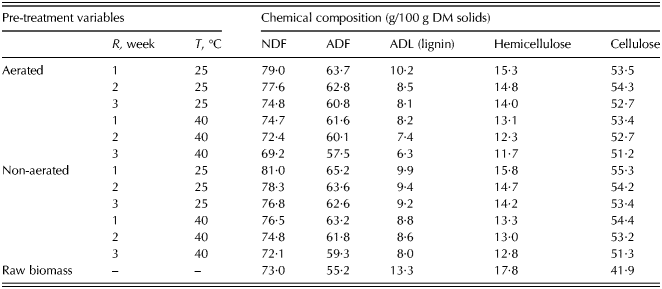
Chemical analysis (g/100 g organic matter) of raw DPL revealed that the material was composed of 17·8 hemicellulose, 41·9 cellulose, 13·3 lignin, 5·6 ash and 21·4 other fractions. Considering the initial concentration of hemicellulose, cellulose and lignin in the solids, obtained after both oxidative and non-oxidative lime pre-treatments, cellulose was the most resistant component to pre-treatment, ranging from 51·2 to 55·3 g/100 g solids. However, as the duration and temperature increased in air-lime pre-treatment, hemicellulose concentration consistently decreased from 15·4 to 11·7 g/100 g solids. The same trend was also observed in the non-oxidative lime pre-treatment (Table 1).
Chemical composition of date palm leaf solids retained following the neutralization procedure under aerated and non-aerated pre-treatment conditions

DM, dry matter; R, residence reaction time (1, 2 or 3 weeks); T, pre-treatment temperature (25 or 40 °C); NDF, neutral detergent fibre; ADF, acid detergent fibre; ADL, acid detergent lignin. Hemicellulose and cellulose were calculated from the difference as ‘NDF − ADF’ and ‘ADF – ADL’, respectively.
Each value is the mean of six observations.
Lignin degradation increased with increasing reaction temperature and residence time but compared with non-oxidative conditions, oxidative conditions at 40 °C were more favourable for delignification of the biomass. Longer reaction time (P = 0·001), higher temperatures (P < 0·001) and oxidative condition (P < 0·001) promoted lignin solubilization. The interaction effect between time × oxidative condition (P = 0·042) indicated that lignin degradation was affected by a longer residence time under oxidative conditions. The three-way interaction effect was not significant.
Gas production
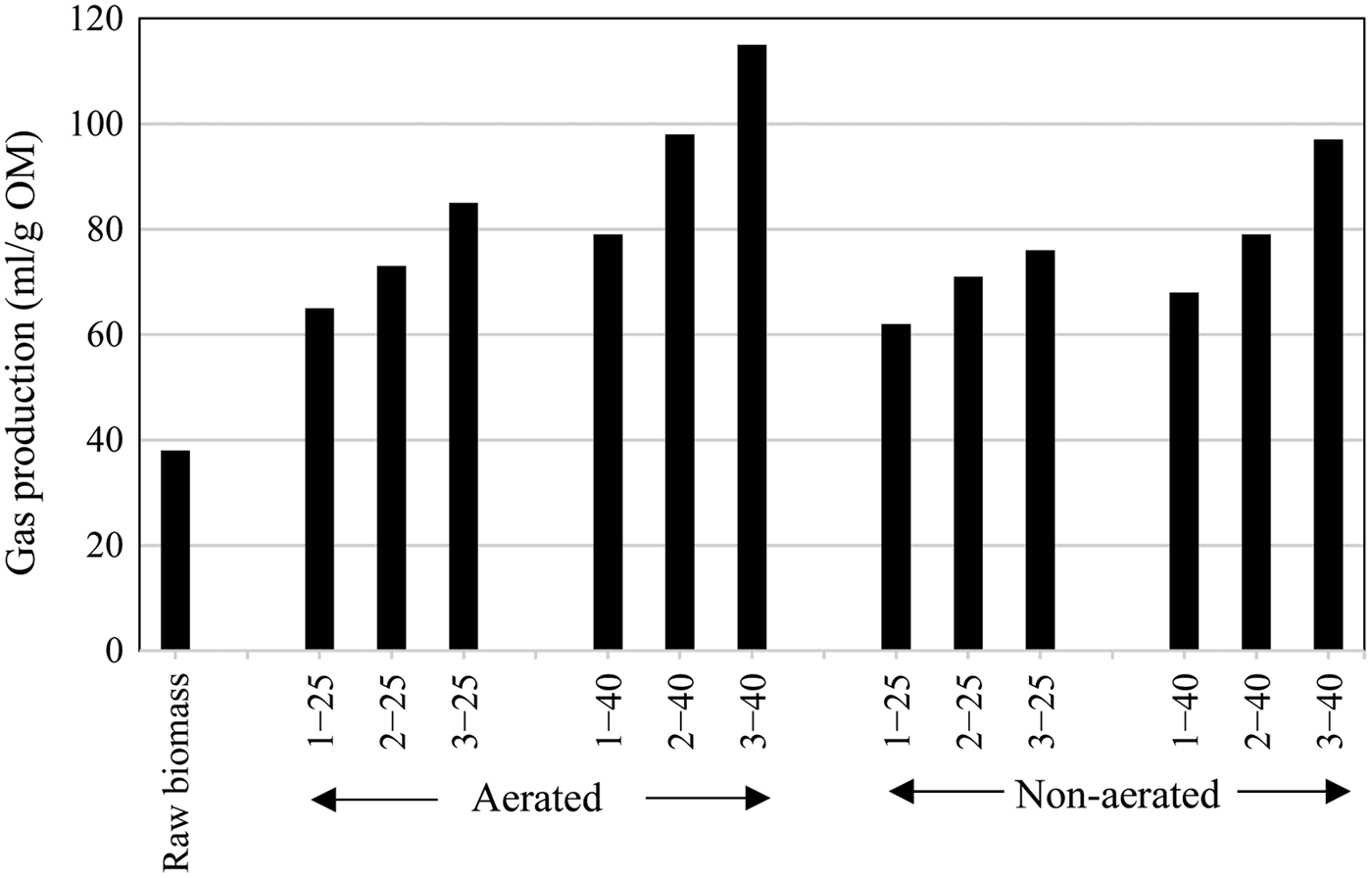
The in vitro gas production after 24 h of incubation (GP24) of pre-treated solids is illustrated in Fig. 1. Solids obtained after a pre-treatment at 40 °C and under oxidative conditions produced more gas, indicating increased in vitro rumen degradability, which is probably due to the fact that they contained less lignin.
Effect of different pre-treatment variables of date palm leaves on gas production after 24 h of incubation in rumen fluid. The X-axis label contains two numbers indicating the pre-treatment residence time and temperature. For example: 1−25 denotes pre-treatment for 1 week and temperature of 25 °C. Treatment effect: temperature (T) < 0·001; residence time (R) < 0·001; oxidation condition (O) < 0·001; R × T = 0·007; T × O = 0·005; O × R = 0·243; T × O × R = 0·523. Standard error of mean = 5·9. Each value is the mean of six observations.

As shown in Fig. 1, the main effects of pre-treatment variables were statistically significant (P < 0·001) at GP24, indicating that a longer residence reaction time and a higher pre-treatment temperature under oxidative conditions increased the in vivo rumen degradability. The interaction effects of time × temperature (P = 0·007) and temperature × oxidation condition (P = 0·005) at GP24 were significant, indicating sensitivity to all three pre-treatment variables. The three-way interaction effect was not significant.
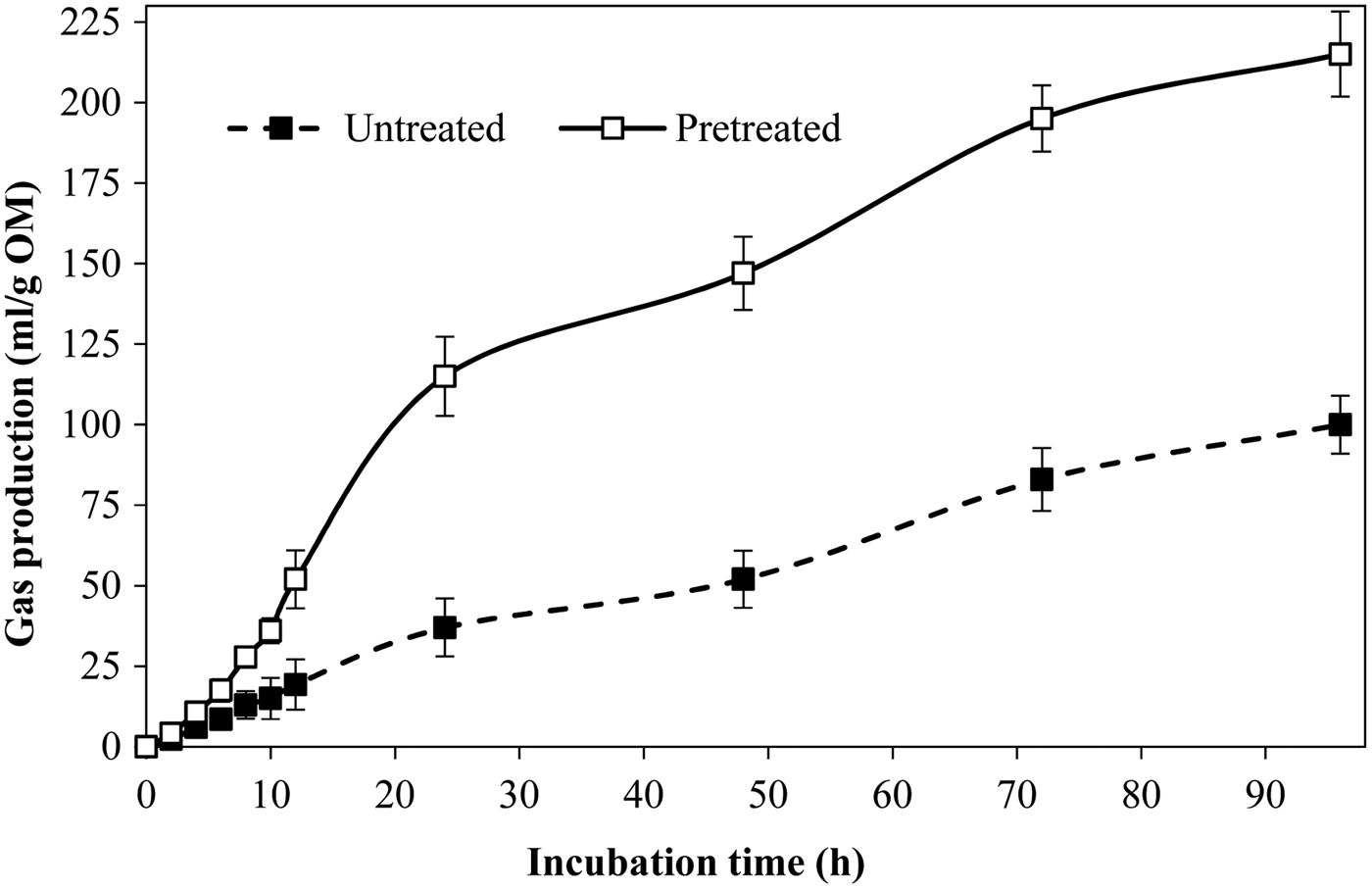
Figure 2 illustrates the time-course of gas production from untreated biomass and from the solids recovered after 3 weeks of pre-treatment at 40 °C and under aeration. The GP24 of the pre-treated biomass was 115 ml/g organic matter, an improvement of approximately 3-fold compared with untreated biomass (38 ml/g organic matter).
The gas production profiles of untreated date palm leaves and lime pre-treated for 3 weeks at 40 °C with aeration. Each value is the mean of six observations.

Weight loss during pre-treatment and recovery of components
The total recovery (g/100 g untreated solid) after oxidative-lime pre-treatment at 40 °C for 3 weeks was 69·8 g dry treated solid/100 g dry untreated solid. For similar pre-treatment under non-oxidative conditions, the total recovery was 73·8 g dry treated solid/100 g dry untreated solid. Calcium concentration was 0·56 g Ca/100 g unwashed dry raw DPL. Washing tended to decrease the calcium concentration, whereas lime pre-treatment (at 40 °C for 3 weeks with aeration) increased it to 6·1 g Ca/100 g dry treated DPL.
DISCUSSION
It appears that at least some criteria for an ideal pre-treatment were met, because a maximum removal of lignin, and at the same time, a maximum retention of carbohydrates (cellulose and hemicellulose) in the recovered solids are the main aims set for an ideal pre-treatment (Ding et al. Reference Ding, Liu, Zeng, Himmel, Baker and Bayer2012). In other words, lignin is the most recalcitrant component of the lignocellulosic biomass (Himmel et al. Reference Himmel, Ding, Johnson, Adney, Nimlos, Brady and Foust2007), playing an important role in hindering the rate and extent of enzymatic degradation of plant cell walls, mainly through limiting the binding of carbohydrate-active enzymes to their target sites (Buanafina et al. Reference Buanafina, Langdon, Hauck, Dalton and Morris2008; Tsuchida et al. Reference Tsuchida, Rezende, de Oliveira-Silva, Lima, d'Eurydice, Polikarpov and Bonagamba2014). Therefore, lignin removal during the pre-treatment process plays a pivotal role in making cell wall polysaccharides more amenable to degradation by rumen microbial enzymes (Meale et al. Reference Meale, Beauchemin, Hristov, Chaves and McAllister2014).
Hemicellulose solubilization behaved much more like lignin solubilization, which is possibly due to its covalent bonds with lignin (Kim Reference Kim2004). Additionally, its amorphous structure also makes it more reactive to alkali (Chen et al. Reference Chen, Stevens, Zhu, Holmes and Xu2013). In agreement, lime pre-treatment of lignocellulosic biomass (bagasse, bajra, jowar and tobacco stalks) led to 0·21–0·61 hemicellulose solubilization compared with untreated biomass (Gandi et al. Reference Gandi, Holtzapple, Ferrer, Byers, Turner, Nagwani and Chang1997).
The trends observed for cellulose recovery rate agree well with previous studies reporting high cellulose recovery even after severe (elevated temperature and pressure) reaction conditions (Kim & Holtzapple Reference Kim and Holtzapple2005; Rezende et al. Reference Rezende, De Lima, Maziero, de Azevedo, Garcia and Polikarpov2011; Ahmadi et al. Reference Ahmadi, Rajaee Rad, Holtzapple and Zamiri2013). High crystallinity and a high degree of polymerization make cellulose highly resistant to alkaline pre-treatment (Chen et al. Reference Chen, Stevens, Zhu, Holmes and Xu2013). Moreover, calcium carbonate generation during lime pre-treatment forms a protective layer over cellulose and prevents its significant degradation (Lopez et al. Reference Lopez, Poblano, Licea-Claverie, Avalos, Alvarez-Castillo and Castano2000; Kim Reference Kim2004), thus contributing to high cellulose recovery (cellulose enrichment) after lime pre-treatment.
More lignin was solubilized in the presence of air (0·48 v. 0·41 under the same conditions (3 weeks, 40 °C) but without aeration). At 40 °C, the difference in delignification between aerated and non-aerated conditions increased. An alkaline pH may increase the conversion of oxygen to oxidizing radicals, which can attack the biomass and introduce hydrophilic groups into the lignin structure, and consequently enhance lignin solubility (McDonough Reference McDonough, Dence and Reeve1996). Kim & Holtzapple (Reference Kim and Holtzapple2005) pre-treated maize stover with excess lime (0·5 g Ca(OH)2/g raw biomass) under oxidative conditions at mild temperatures (55 °C) for 4 weeks, resulting in 0·88 lignin removal. It was demonstrated that temperature and oxidative mode are the most dominant factors affecting the degree of delignification, and efficiency of enzymatic hydrolysis. More recently, long-term air-lime pre-treatment (65 °C, 4 weeks) was used for pre-treating poplar wood, resulting in a 7·5-fold increase in digestibility compared with untreated biomass (Sierra et al. Reference Sierra, Holtzapple and Granda2011).
The increase in calcium concentration of lime-treated biomass might be due to the formation and incorporation of calcium carbonate deposits onto the biomass surface and un-reacted lime (Kim Reference Kim2004). Calcium is a strong cation and its presence in the diet above the recommended level (NRC 1984) may positively influence the animal performance, owing to its powerful alkalinizing potential in the rumen, especially in cows feeding maize silage-based diets. The increase in calcium content of lime-treated solids may also be beneficial to animals receiving calcium-deficient diets, such as grains and mature forages. However, when feed with a high concentration of calcium are fed, such as alfalfa hay or citrus pulp, the level of lime-treated DPL should be carefully formulated to avoid excess calcium level in the diet (Gandi et al. Reference Gandi, Holtzapple, Ferrer, Byers, Turner, Nagwani and Chang1997).
During the pre-treatment process, carbon dioxide generated from degradation of lignin, cellulose or hemicellulose, reacts readily with lime, resulting in the formation of calcium carbonate deposits on the biomass surface (Kim Reference Kim2004), as shown by increases in the ash and calcium content in the pre-treated solids.
Because GP24 provides a good indication of the in vivo rumen degradability (Menke & Steingass Reference Menke and Steingass1988), it was considered as the pre-treatment response on which the best pre-treatment conditions were chosen. Previous work (Ahmadi et al. Reference Ahmadi, Rajaee Rad, Holtzapple and Zamiri2013) on lime pre-treatment of two different fractions of DPL (rachis and petiole) confirmed the effectiveness of short-term lime oxidative pre-treatment, although at more severe conditions in improving the in vitro gas production efficiency. Gas production after 24 h increased by about 7·3- and 5·1-fold for the pre-treated rachis (250 min, 120 °C and 10·0 bar pure O2) and petiole (280 min, 120 °C and 10·0 bar pure O2), respectively.
The positive correlation (r = 91·9) between delignification and gas production after 24 h of incubation demonstrated the effectiveness of delignification in improving the rumen degradability of the materials.
CONCLUSION
Although long-term aerated-lime pre-treatments were more effective in delignifying DPL and subsequently improving the ruminal degradability of DPL than the non-aerated treatment, a comprehensive cost-benefit analysis is still required to trade-off between the pre-treatment under aerated or non-aerated conditions. The pre-treatment methods applied in the current experiment can be used for other lignocellulosic materials as animal feed. Further optimization of the pre-treatment conditions in future studies is also required for generation of a digestible ruminant feed. In vivo evaluation of the pre-treated materials is recommended.
The authors are thankful to the R&D division of Ehyagaran-e-Sanate Asia Co. for technical assistance and financial support in constructing and assembling the equipment needed for the experiment. The authors thank the laboratory staff of Isfahan Science & Technology Town (ISTT) for providing the research facilities required for conducting some analytical analyses. Appreciation is also extended to Dr. Ken Tokuyasu of the National Agriculture and Food Research Organization (NARO), Food Research Institute, Tsukuba, Japan, for the careful review and constructive feedback on the manuscript.