




1. Introduction
Coalitions of transnational corporations, investors, international organizations, and philanthropies are increasingly mobilizing to support transformations toward sustainable futures (Andonova et al., Reference Andonova, Faul, Piselli, Andonova, Faul and Piselli2022a; Higham et al., Reference Higham, Bäckstrand, Fritzsche and Koliev2024, e.g. Andonova Reference Andonova, Faul, Andonova, Faul and Piselli2017 for sub- and non-state actors’ climate initiatives, Westerwinter Reference Weber2021 for transnational public–private initiatives, Negacz et al. Reference Olsson, Bohlin and Moberg2020 for biodiversity initiatives, and UNFCCC https://climateaction.unfccc.int/Initiatives for increased number of climate action initiatives). For example, they might jointly lobby for pro-environmental actions, establish voluntary standards, and build capacity for new forms of financing to meet sustainability objectives. Although the roles and legitimacy of such actors in transnational environmental governance are highly contested (see for example, Barkemeyer et al., Reference Barkemeyer, Preuss and Lee2015; Biermann et al., Reference Biermann, Chan, Mert and Pattberg2007; Scherer et al., Reference Scherer, Baumann-Pauly and Schneider2013), it is note-worthy that a growing number of coalitions consisting of influential actors are engaging with the challenge of changing how their sectors impact various sustainability issues (see e.g., the joint initiative by the Business for Nature coalition, the World Business Council for Sustainable Development, and the World Economic Forum, which developed actions for businesses to transform their practices spanning across 12 economic sectors https://www.businessfornature.org/news/sector-actions-launch). Yet, there is little data-driven empirical research on how their aggregate efforts may – or may not –support the creation of an enabling context for transformative changes toward sustainable and just futures.
Sustainability transformations are defined as ‘fundamental shifts in the way authority, power, and resources are structured and flow in a particular social system, the practices and processes that reflect and reproduce those structures, the norms, values, and beliefs that underpin those structures and processes, and the way that all of these are connected to ecological systems across multiple scales’ (Moore & Milkoreit, Reference Moore and Milkoreit2020, p. 4). The cross-scale element of the definition implies that a fundamental change in the relationships between humans and ecosystems is key to realizing sustainable and just transformations (Moore & Milkoreit, Reference Moore and Milkoreit2020). With this conceptual backdrop, this study presents an empirically derived analytical framework designed to rapidly identify features of sustainability-themed coalitions that align with transformations toward just and sustainable futures.
Collaborative efforts to address sustainability issues can take several forms and shapes. In the broader literature, scholars refer to these groups as coalitions, partnerships, alliances, consortia, industry-interest groups, clubs, networks, voluntary environmental programs, pre-competitive collaborations, and related initiatives (for an overview, see Grayson & Nelsson, Reference Grayson and Nelson2013; Sobkowiak et al., Reference Sobkowiak, Bebbington, Blasiak, Folke and Österblom2025, and for specific examples, see Andonova et al., Reference Andonova, Faul and Piselli2022b; Arts, Reference Arts2002; Brockmyer, Reference Brockmyer2016; Bäckstrand, Reference Bäckstrand, Pattberg, Biermann, Chan and Mert2012; Grabs & Garrett, Reference Grabs and Garrett2023; Prakash & Potoski, Reference Prakash and Potoski2007; Vurro et al., Reference Vurro, Romito, Costanzo, Ghobadian and Russo2024). Albeit these definitions often overlap, different disciplines tend to use their own definitions as they wish to define the analytic boundaries of the studied object and add nuance to specific aspects of these collaborations.
We use ‘large-scale actor coalitions’ (LSACs) as an all-inclusive term to refer to groups of large-scale actors that come together to change how their sector impacts sustainability issues. Four main criteria need to be fulfilled for a collaborative approach to be considered an LSAC in the context of global sustainability (see Table S1). First, at least two members of the coalition need to be ‘large’. Large-scale actors (LSAs) refer to those actors that are globally influential in regard to their concentration of power, monetary and natural resources they control, and access to influence both policies and cultural norms (Avelino, Reference Avelino2017; M. L. Moore et al., Reference Moore, Tjornbo, Enfors, Knapp, Hodbod, Baggio and Biggs2014; Österblom et al., Reference Österblom, Jouffray, Folke, Crona, Troell, Merrie and Rockström2015, Reference Österblom, Bebbington, Blasiak, Sobkowiak and Folke2022). LSAs, in the context of this study, are also actors of the dominant, incumbent regime (Fischer & Newig, Reference Fischer and Newig2016; Geels, Reference Geels2011, Reference Geels2014; Loorbach, Reference Loorbach2010). The incumbent regime refers to the established configuration of practices, rules, institutions, networks, infrastructures, and routines, as well as actors and processes that reproduce these structures (Geels, Reference Geels2014; Loorbach, Reference Loorbach2010). LSAs can be non-state, sub-state, or state actors, including transnational corporations, investors, foundations, non-governmental organizations (NGOs), intergovernmental organizations (IGOs), and various forms of state actors. Second, at least two LSAs need to come together for an initiative to be considered an LSAC. This excludes all initiatives where, for example, a single LSA engages with local partners for sustainability, often for-profit, projects. Third, LSACs need to respond to a social-ecological sustainability challenge by proposing one or more solution(s) to address this challenge. This implies that coalitions working on issues not linked to environmental sustainability are excluded. Fourth, LSACs should aspire to achieve change that goes beyond their own member organizations and impacts their sector at large. Therefore, our LSAC definition emphasizes the “large-scale” aspect of the actors and the intention to join forces to contribute to systemic sustainability changes. Throughout this paper, we use the coalition-level, i.e., the group of actors that form each initiative (LSAC), as our unit of analysis. Moreover, although these collaborations between actors can be conceptualized both as actors and as mechanisms of environmental governance (B. Bull & McNeill, Reference Bull and McNeill2019; Mert, Reference Mert2012), in this paper we conceptualize them as actors (change agents) who mainly operate within the incumbent regime level, yet seek to influence both micro and macro institutional levels (sensu Geels, Reference Geels2002). Their position within or linkage to the dominant regime implies that they occupy a unique role in the systems they aim to affect.
Numerous theoretical approaches can – and have – been used to study how sustainability-themed partnerships impact practices and norms within specific sectors. Most studies have focused on issues of governance efficiency, legitimacy, and accountability (Andonova & Faul, Reference Andonova, Faul, Andonova, Faul and Piselli2022; Bäckstrand, Reference Bäckstrand2006; Higham et al., Reference Higham, Bäckstrand, Fritzsche and Koliev2024; Mert, Reference Mert2012; Pattberg & Widerberg, Reference Pattberg and Widerberg2016; Sobkowiak et al., Reference Sobkowiak, Bebbington, Blasiak, Folke and Österblom2025). In this paper, we explore whether a systems approach to sustainability transformations can contribute new insights into our understanding of how a specific type of partnership (namely, LSAC) may shape transformation dynamics. The 2024 Intergovernmental Science-Policy Platform on Biodiversity and Ecosystem Services (IPBES) Transformative Change Assessment identified systems approaches to transformative change as a cluster of theories and schools of thought that share commonalities in the mechanisms and processes underlying sustainability transformations, the root causes of nature’s decline, and the roles of various actors and their actions (E. Bennett et al., Reference Bennett, Biggs, Calderón Contreras, Golden Kroner, Vianna Mansur, Woroniecki, Acar, Aksoy, Alpizar, Lam, Horcea-Milcu, Linnér, Mehta, Campos, Nishi, Rahiri, Richardson, Sabinot, Simão Seixas, Garibaldi, O'Brien, Garibaldi and Agrawal2024). Systems approaches mainly draw on scholarship such as phases of deliberate social-ecological transformations (M. L. Moore et al., Reference Moore, Tjornbo, Enfors, Knapp, Hodbod, Baggio and Biggs2014; Olsson et al., Reference Olsson, Folke and Hahn2004), panarchy (Gunderson & Holling, Reference Gunderson and Holling2003), human agency (Westley et al., Reference Westley, Tjornbo, Schultz, Olsson, Folke, Crona and Bodin2013), socio-technical transitions (Geels, Reference Geels2002; Loorbach, Reference Loorbach2014), leverage points (Abson et al., Reference Abson, Fischer, Leventon, Newig, Schomerus, Vilsmaier, Von Wehrden, Abernethy, Ives, Jager and Lang2017; Meadows, Reference Meadows2008), and collective action (Bodin, Reference Bodin2017; Ostrom, Reference Ostrom1990).
The main distinctive characteristics of systems approaches are their focus on system components (e.g., structures, rules, actor networks) and their interactions, which might reinforce or disrupt certain path-dependencies and their outcomes. Social and ecological systems are conceptualized as interconnected and complex, and although a range of actors can shape system dynamics through exerting their agency, a complex system's behavior cannot be fully predicted or controlled. Instead, its behavior is often characterized by features of emergence and non-linearity. Systems approaches to transformative change often involve understanding change as multi-level, multi-phase processes (Herrfahrdt-Pähle et al., Reference Herrfahrdt-Pähle, Schlüter, Olsson, Folke, Gelcich and Pahl-Wostl2020) that (1) interact across niche (micro), regime (meso), and landscape (macro) levels (Geels, Reference Geels2002), and (2) evolve through phases where the system becomes ready for change, goes through a navigation process, and stabilizes into a configuration of practices, rules, and values (Olsson et al., Reference Olsson, Folke and Hahn2004, Reference Olsson, Gunderson, Carpenter, Ryan, Lebel, Folke and Holling2006). Studying LSACs through a systems transformative change approach offers a valuable and complementary perspective to other disciplinary lenses that have been used to study partnerships for sustainability, by adding nuance to two specific dimensions of this phenomenon.
First, our approach does not focus merely on the social system but examines the research inquiry through the lens of a coupled social–ecological system (Biggs et al., Reference Biggs, Preiser, De Vos, Schlüter, Maciejewski and Clements2021). This perspective emphasizes the interconnectedness of LSACs with material dimensions – such as flows of energy, materials, and capital – recognizing that fundamental changes in a system are typically reflected in the reconfiguration of these material flows. As mentioned earlier, LSACs are composed of ‘large’ actors that concentrate power and possess the capacity to influence resource flows and exert significant impact on the biosphere, directly or indirectly (Folke et al., Reference Folke, Österblom, Jouffray, Lambin, Adger, Scheffer and de Zeeuw2019). For example, more than 70% of the world's greenhouse gas emissions can be traced back to just 100 companies (Griffin & Heede, Reference Griffin and Heede2023). Additionally, due to the high market concentration of various economic sectors among a few dominant actors, the associated impacts of these sectors on the environment can be linked to these same actors (Folke et al., Reference Folke, Österblom, Jouffray, Lambin, Adger, Scheffer and de Zeeuw2019). While individual LSAs rarely have the capacity to transform an entire system on their own, they can collectively influence industry-wide shifts – both through their global supply chains and by presenting a unified voice to regulators via collaborative initiatives (Henrik Österblom et al., Reference Österblom, Jouffray, Folke and Rockström2017; Marti et al., Reference Marti, Fuchs, DesJardine, Slager and Gond2023). Recent efforts to identify influential non-state actors across global industries such as seafood, fashion, finance, and food – and to engage them in enabling large-scale, systemic sectoral transformations – represent a growing frontier within sustainability science (Galaz et al., Reference Galaz, Crona, Dauriach, Scholtens and Steffen2018; Hileman et al., Reference Hileman, Kallstenius, Häyhä, Palm and Cornell2020; Österblom et al., Reference Österblom, Bebbington, Blasiak, Sobkowiak and Folke2022). These efforts also raise critical concerns about the risks of entrusting transformation processes to large-scale actors (see e.g. Béné, Reference Béné2022; Clapp, Reference Clapp2021; Dauvergne & Lister, Reference Dauvergne and Lister2012; Folke et al., Reference Folke, Österblom, Jouffray, Lambin, Adger, Scheffer and de Zeeuw2019, Reference Folke, Österblom, Jouffray, Lambin, Adger, Scheffer and de Zeeuw2020; Schneider et al., Reference Schneider, Hinton, Collste, González, Cortes-Calderon and Aguiar2019).
Second, the systems transformations literature offers an appropriate analytical lens for studying complex adaptive systems and their features (Reyers et al., Reference Reyers, Moore, Haider and Schlüter2022). LSACs operate in a complex system, where various actors and processes shape system dynamics, and causality is hard to assume. As Andonova and Faul (Reference Andonova, Faul, Andonova, Faul and Piselli2022) describe, ‘partnerships for sustainable development thus influence existing complex systems at the same time as they are affected by them’ (p. 31). We therefore refrain from focusing on whether LSACs achieve or do not achieve their stated goals, which is often the focus of studies that look at partnership efficiency, but instead focus on how LSACs shape system dynamics through their actions, roles, and capacities. Studying the research inquiry through systems approaches to transformative change can benefit from the recent scholarship on transformative capacities and the development of conceptual tools and frameworks to evaluate past or ongoing potentially transformative change processes (e.g. features that have, or potentially can, enable social–ecological transformations – see Herrfahrdt-Pähle et al., Reference Herrfahrdt-Pähle, Schlüter, Olsson, Folke, Gelcich and Pahl-Wostl2020; Tuckey et al., Reference Tuckey, Harmáčková, Peterson, Norström, Moore, Olsson, Lam and Jiménez-Aceituno2023, respectively).
A careful navigation of sustainability transformations requires an understanding of the capacities that are mobilized by different actors in the transformation processes. By ‘transformative capacities’, we refer to the knowledge, skills, attitudes, and resources necessary to realize transformative change (IPBES, Reference O'Brien, Garibaldi and Agrawal2024). Resilience capacities can be transformative, non-transformative (e.g. adaptive capacities, Berkes et al., Reference Berkes, Colding and Folke2003) or both (Moore et al., Reference Moore, Olsson, Nilsson, Rose and Westley2018), and their importance depends on the transformation phase in focus (Herrfahrdt-Pähle et al., Reference Herrfahrdt-Pähle, Schlüter, Olsson, Folke, Gelcich and Pahl-Wostl2020; Westley et al., Reference Westley, Tjornbo, Schultz, Olsson, Folke, Crona and Bodin2013). This means that capacities are context-specific, and they might be expressed or remain latent under certain conditions. Capacities can be conceptualized both from a system’s or change-maker’s perspective – but the system capacities are not just the sum of the actors’ capacities (Reyers et al., Reference Reyers, Moore, Haider and Schlüter2022). This is because capacities are dynamic and emerge through interactions (Reyers et al., Reference Reyers, Moore, Haider and Schlüter2022) – i.e. they can act in a synergistic or antagonistic way with other change-makers’ capacities. Building on our earlier research on transformative capacities (Olsson et al., Reference Olsson, Gunderson, Carpenter, Ryan, Lebel, Folke and Holling2006, Reference Olsson, Bodin, Folke, Armitage and Plummer2010), a body of literature is forming around exploring such capacities (Brodnik & Brown, Reference Brodnik and Brown2018; Haider & Cleaver, Reference Haider and Cleaver2023; Hölscher, Reference Hölscher, Hölscher and Frantzeskaki2020; Moore & Milkoreit, Reference Moore and Milkoreit2020; Olsson et al., Reference Olsson, Folke, Moore, Gunderson, Allen and Garmestani2022; Strasser et al., Reference Strasser, De Kraker and Kemp2019; Søgaard Jørgensen et al., Reference Søgaard Jørgensen, Delannoy, Maniatakou, Folke, Moore and Olsson2024a; Ziervogel et al. Reference Ziervogel, Cowen and Ziniades2016; Wolfram, Reference Wolfram2016). However, many of these studies are local in scope, for example, exploring the community-level capacity for transformative adaptation in South Africa (Ziervogel et al., Reference Ziervogel, Enqvist, Metelerkamp and van Breda2021), focusing on ‘seed’ niche initiatives (L. M. Pereira et al., Reference Pereira, Hichert, Hamann, Preiser and Biggs2018; Raudsepp-Hearne et al., Reference Raudsepp-Hearne, Peterson, Bennett, Biggs, Norström, Pereira and Aceituno2020, https://goodanthropocenes.net/) or urban governance contexts (Hölscher, Reference Hölscher, Hölscher and Frantzeskaki2020; Wolfram, Reference Wolfram2016). There is, therefore, a knowledge gap related to transformative capacities enacted by large-scale actor partnerships with ambitions to create change within the sectors they operate in (Søgaard Jørgensen et al., Reference Søgaard Jørgensen, Jansen, Avila Ortega, Wang-Erlandsson, Donges, Österblom, Olsson, Nyström, Lade, Hahn, Folke, Peterson and Crépin2024b).
In this paper, we use the communication material uploaded on the websites of five LSACs that aim to change current agricultural or investing practices, rules, and norms. We try to understand what capacities present in these LSACs can support sectoral sustainability transformations. While transformations research has often relied on long-term, in-depth case studies to map out transformative capacities (e.g. Baird et al., Reference Baird, Quinlan, Plummer, Moore, Krievins, Baird and Plummer2021; Herrfahrdt-Pähle et al., Reference Herrfahrdt-Pähle, Schlüter, Olsson, Folke, Gelcich and Pahl-Wostl2020), there is a need to develop scalable methodologies that can match the diversity of LSACs and their rapid pace of action. We, therefore, design a framework that allows us to rapidly assess the potential transformative capacities of LSACs and use our five cases from the food (3) and finance (2) sectors. The framework is designed to be adaptable and sector-agnostic and can be utilized by using publicly available data. Through analyzing the set-up of each coalition, the framework can support the identification of LSACs' capacities (and gaps thereof) that can contribute to large-scale sectoral transformations.
The paper proceeds as follows: the next section outlines a mixed-methods approach underlying the framework and the gathering of empirical data from the five LSACs. We then present results from the analysis of the empirical data, before proceeding to a discussion of the results. In this way, we hope to advance the theoretical understanding of ongoing, potentially transformative change processes, as well as the methodological approaches for exploring these.
2. Methodology
2.1. Research design
This study employs social science mixed-methods to develop and operationalize an analytical framework. We draw upon pragmatism (Johnson & Onwuegbuzie, Reference Johnson and Onwuegbuzie2004), meaning that our research is designed in response to the data types, frameworks, and methods that are available to answer our research inquiry (Creswell, Reference Creswell and Creswell2018; Moon & Blackman, Reference Moon and Blackman2014). Another feature of our research design aligns with the exploratory case study approach, which means that our initial selection of cases was driven by curiosity, and the research design was not decided in advance but emerged as the study developed (Tracy, Reference Tracy2013). A small case study approach was preferred over a large-N study because the focus was to develop and pilot test a new framework and verify the validity of a Rapid Assessment Framework (RAF) against a detailed understanding of a small but diverse set of LSACs.
Our abductive research design, as illustrated in Figure 1, is characterized by two parallel iterative processes: (1) framework development, and (2) data collection and analysis, and two sequential phases: (A) using a diverse set of eight partnerships from five sectors (Table 1), and (B) using a subset of five partnerships from two sectors (Box 1). The framework was developed through an iterative process of observing the data, refining the framework, and then using the refined versions of the framework as a coding structure for the data collection and analysis. For final framework development and testing in phase B, we chose to focus on five coalitions within the food and finance sectors for three reasons. First, these sectors both require fundamental changes to support sustainability objectives and serve as key levers for transformations toward sustainability (Crona et al., Reference Crona, Folke and Galaz2021; Willett et al., Reference Willett, Rockström and Loken2019). The food sector directly impacts most Sustainable Development Goals – from poverty reduction to health and environmental goals (DeClerck, Reference DeClerck2016; FAO 2016; Willett et al., Reference Willett, Rockström and Loken2019). For example, greenhouse gas emissions, deforestation, water use and contamination, land use changes, and biodiversity decline driven by pesticide use are just a few of the environmental challenges the sector contributes to (see Willett et al., Reference Willett, Rockström and Loken2019 and references therein). The financial sector, with its ability to channel capital into economic activities that harm or contribute to a green and just transition, is also identified as having the potential to impact global sustainability goals (Crona et al., Reference Crona, Folke and Galaz2021; Galaz et al., Reference Galaz, Crona, Dauriach, Scholtens and Steffen2018; Maniatakou et al., Reference Maniatakou, Crona, Jean-Charles, Ohlsson, Lillepold and Causevic2024a; Weber, Reference Weber2014). Both sectors are historically and increasingly concentrated in the hands of a few powerful actors (Béné, Reference Béné2022; Clapp Reference Clapp2025; Loorbach et al., Reference Loorbach, Schoenmaker and Schramade2020), thereby perpetuating growing income inequalities. Second, our initial data selection already included at least two LSACs from the finance and food sectors, allowing for some initial comparisons. Third, our previous engagement and prior knowledge of these two systems (Maniatakou et al., Reference Maniatakou, Crona, Jean-Charles, Ohlsson, Lillepold and Causevic2024a; Søgaard Jørgensen et al., Reference Jørgensen, Avila Ortega, Blasiak, Cornell, Gordon, Nyström and Olsson2022) provided additional motivation for choosing this sectoral focus.
Case study summaries: the five large-scale actor coalitions
Global Investors for Sustainable Development
The GISD alliance consists of 30 CEOs from financial institutions and corporations, who were invited and convened by the UN in 2019. GISD is well-connected to the United Nations governance system and other international organizations (e.g. the World Bank, WB). GISD members are geographically diverse but relatively homogeneous in terms of economic status. In 2020, GISD members were worth a total value of US$16 trillion. GISD is set up with a 2-year action plan (2019–2021) and aims to shape the global investment landscape to contribute to the 2030 Agenda for Sustainable Development, more specifically to ‘scale-up and speed-up our efforts to align business with the SDGs’ (Global Investors for Sustainable Development 2019). GISD focuses on removing the barriers in SDG investing, such as the inconsistency in metrics and taxonomies, improving the regulatory framework, and transforming the investment landscape. The latter focus is illustrated by the following quote: ‘we are committed to transform the finance and investment ecosystem’ (Global Investors for Sustainable Development2019). GISD argues that regulatory processes are essential for allowing the sustainable finance transition to take place.
2. Climate Action 100 +
CA100 + consists of 545 institutional investor signatories who collectively represented USD $47 trillion in assets under management in 2020. This coalition's aim is to engage with carbon-intensive investee companies and pressure them to decarbonize, which will, in turn, reduce the ecological footprint of CA100 + members’ investment portfolios. The focus is strongly on the climate change challenge and meeting the Paris Agreement climate goal. CA100 + was initiated in 2017 by investor groups and has a 5-year timeline. It is funded by grants from its partner organizations and other interested parties and has an extended network of research and scientific partners. Similarly to GISD, CA100 + also pushes for legislation and rapid implementation of policies, exemplified in the following quote: ‘[…]delayed implementation of climate policies or the absence of effective climate policy impacts on investor confidence and risks increasing the levels of long–term economic damage from climate change’ (Climate Action 100+ 2019).
3. Global Alliance for the Future of Food
GA is an alliance consisting of 27 philanthropic private organizations. It convenes a relatively homogenous group of actors, which are either general philanthropic foundations or civic foundations related to food companies. The challenges GA responds to are related to food system reform, and their work aspires to contribute to the transformation of the food system, while at the same time addressing the current systemic inequities within it. The partnership acts both on the global and local scale, where, depending on the project, they partner with other actors such as local public authorities. Moreover, GA has a monitoring and evaluation process aimed at improving the initiative’s learning about its impact. Since 2020, GA has formally adopted a theory of transformational change, as illustrated below: ‘Genuine food systems transformation takes place when diverse actions, networks, and individuals intersect across sector and issue silos, the global and local, the macro and the micro. These intersections facilitate convergence around shared visions and values and, ultimately, build critical mass and momentum behind tipping points that lead to healthy, equitable, renewable, resilient, inclusive, and culturally diverse food systems that dynamically endure over time.’ [source: https://futureoffood.org/insights/theory-of-transformation/]
4. Sustainable Food Lab
SFL consists of 17 members, which include private companies and other actor types from civil society. SFL aims to improve sustainability in the food sector by helping organizations experiment with innovations within the mainstream food system. Membership is open, and members pay fees (with different rates according to each actor’s revenue) to support SFL. SFL works on both the international and local levels and partners with several actors depending on the project. Learning objectives are central to SFL’s work, and a lot of emphasis is placed on this topic. Moreover, there is a strong focus on the individual level, e.g., providing support to the sustainability managers of member companies. SFL’s scaling strategy is primarily to impact a greater number of organizations and multiply successful approaches. Lastly, complexity is mentioned as an attribute that should be embraced: ‘The cornerstones of our approach are: Harnessing a long-view and embracing the complexity of the whole system to foster unlikely partnerships.’ [source: https://sustainablefoodlab.org/the-food-lab/about/]
5. One Planet Business for Biodiversity
OP2B consists of 21 CEOs from private companies in the food, textile, cosmetics, and medicinal sectors, as well as an EU fund. The group is quite homogenous in terms of member characteristics, as it includes well-established, popular companies (e.g. Nestlé, Danone). The coalition is hosted by the WBCSD and was launched in 2019 by President Macron's ‘One Planet Lab framework’ at the UN Climate Action Summit in New York. Their aim is to transform agriculture, with a focus on biodiversity loss, climate change, small-scale farmer livelihoods, and inclusive supply chains. OP2B acts throughout the supply chain, both on global and local levels. At the global level, they aim to provide policy recommendations to the 2021 CBD COP15, while at the local level, each member is involved in community projects where they might partner with diverse actors (e.g. local public authorities). OP2B supports the view that collaboration with public authorities is essential for the success of the transformation they work toward, as exemplified in the following text: ‘A strong regulatory framework is essential for preserving biodiversity’ (One Planet Business for Biodiversity 2020).
Methodological process (in chronological order) for the development of the rapid assessment framework.

Selected coalitions and associated background information. Phases a and b relate to the framework development; see the text above and figure 1 for explanation
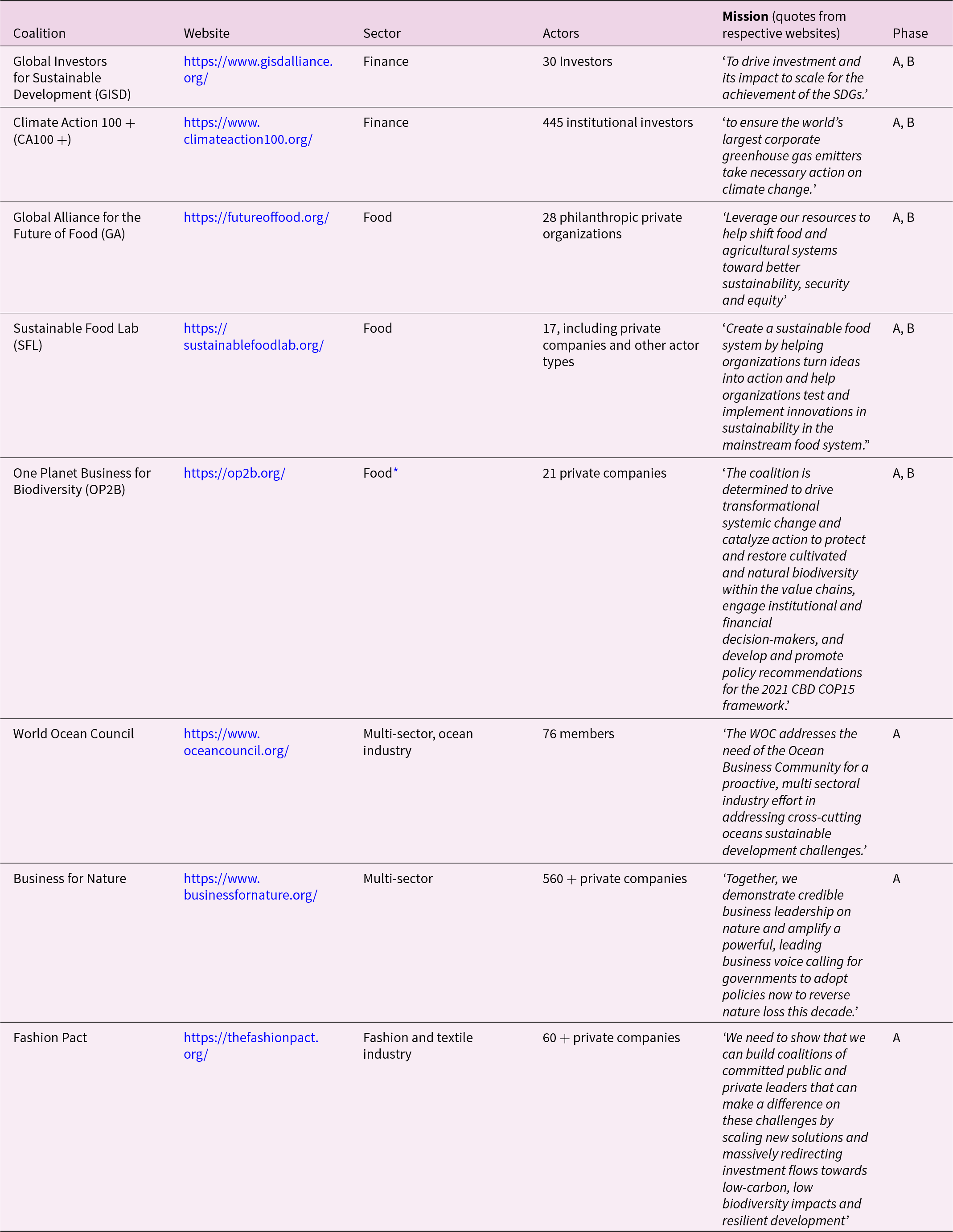
* OP2B members focus on agriculture and come mainly from the food sector, but also from the textile, cosmetics, and medicinal sectors.
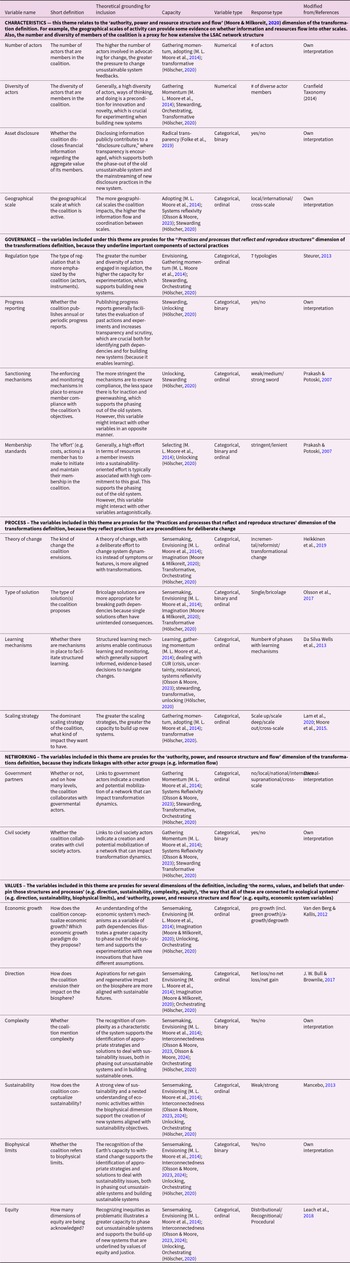
The data used in this study is publicly available from the coalitions' websites and was collected between April 2020 and May 2021 (Maniatakou et al., Reference Maniatakou, Olsson and Søgaard Jørgensen2024b). The framework designed for this study includes 20 variables relevant to understanding how LSACs relate to transformative processes (Table 2). For all these 20 variables, we either used established frameworks or our own interpretation to categorize the data into a scoring system. This categorization process allowed us to operationalize the framework for rapid assessment, and two datasets were created (see Supplementary Material, section 1.3). Following a pragmatist approach, we brought together different frameworks into the RAF on the basis of categorizing different elements of the research inquiry, thereby deepening our understanding of LSACs and yielding more comprehensive results than would be possible with a singular-framework approach. The RAF was linked at a later stage with existing scholarship on transformative capacities from systemic approaches to transformative change (Table 3). The conceptual links between the set-up of a coalition, their undertaken actions, and capacities are outlined in section 1.6 of the Supplementary Material.
Rapid assessment framework. Variables are sorted under each of the five themes that are key to transformation processes. See supplementary material table S3 for the extended version
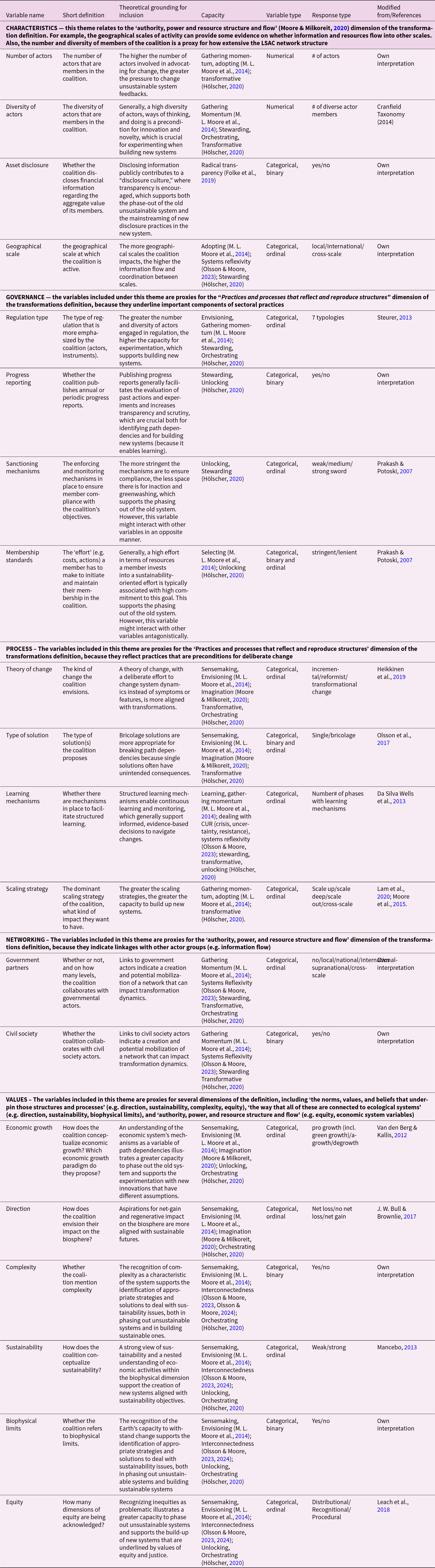
All variables are ordinal, ranked in order of proximity to the transformation definition (from more distant to more proximal).
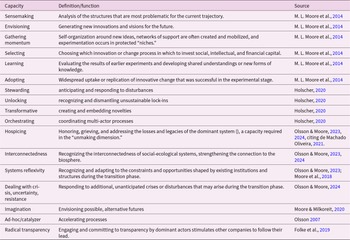
Attempting a one-on-one mapping of variables to capacities is neither feasible nor desirable because it is the combination of variables, at a specific phase of a process, in a specific context, that can give rise to certain capacities. For this reason, we developed a framework focused on variables that can be indicative of potential capacities.
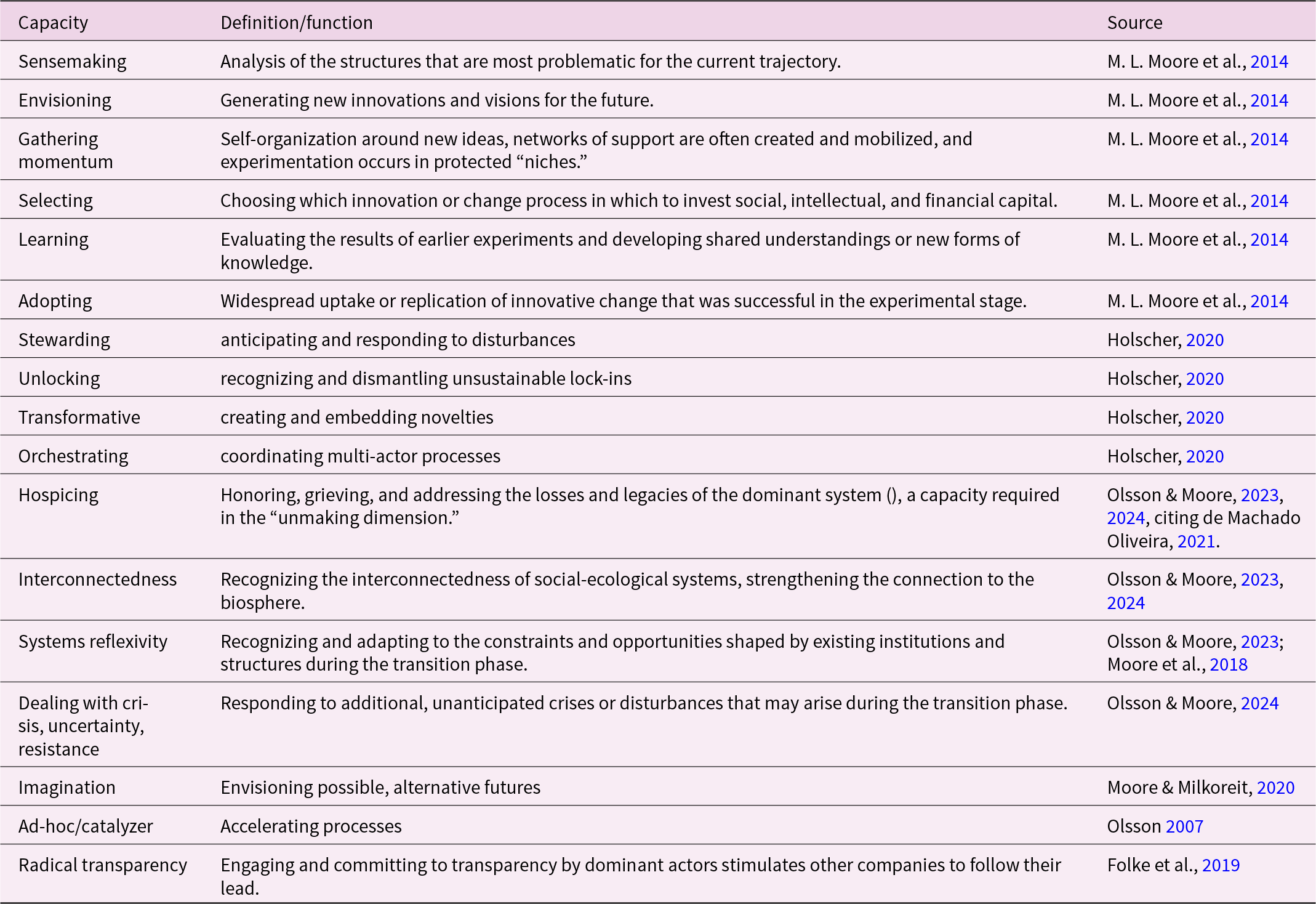
Capacities for sustainability transformations
The RAF variables were grouped into five themes that are key to transformation processes, as explained in Table 2. The five themes were derived inductively during Phase B, based on commonalities among the 20 variables (see Supplementary Material Section 1.2). The themes are:
1) Characteristics: descriptive characteristics of the coalition (e.g. size),
2) Governance: processes to ensure accountability (e.g. monitoring).
3) Process: impact strategies (e.g. theory of change)
4) Networking: collaboration between the coalition and other actors (e.g. collaborations with the public sector).
5) Values: the underlying assumptions, principles, and value systems the coalition stands for (e.g. conceptualization of sustainability).
For comprehensive details on the methodological process (selection criteria for inclusion of LSACs, data categorization, datasets, and methodological limitations), see Supplementary Material Section 1.
3. Findings
3.1. Qualitative comparison
Here, we describe some overall commonalities and differences among the five coalitions (referring to the coalitions summarized in Box 1).
Sectoral differences: Differences between the two sectors became evident through the analysis. Specifically, food sector coalitions are unique when it comes to scales of engagement, as they are the only coalitions that engage in local projects that are quite similar in terms of aims and collaborations (e.g., OP2B’s program on sourcing sustainable spices in India [https://op2b.org/sustainable-sourcing-program-for-spices-india/] and SFL’s program on sustainable production of vanilla [https://www.idhsustainabletrade.com/sustainable-vanilla-initiative-svi/]. Both programs aim at improving farmers’ livelihoods, eliminating child labor, and ensuring environmental sustainability of crop production). In their local projects, food LSACs usually partner with multiple actors, including public authorities and civil society groups. The finance partnerships, on the other hand, aim for a strong regulatory framework and policies and argue that ‘governments must act now’ (Global Investors for Sustainable Development Alliance). However, the finance coalitions focus on the transformation of other companies or systems (GISD, CA100 +), not much on the transformation of how their own members operate (which is very central for one of the food coalitions, e.g. SFL). This is expected due to the different nature of the sector. Another difference between finance and food partnerships is that the food coalitions GA and SFL emphasize their role as conveners and their capacity to act as learning platforms for their members. Two of the food coalitions (GA and SFL) have been set-up with a strong focus on the process – e.g. they incorporate learning mechanisms to adapt and evolve according to new situations. Those same partnerships also show a broad understanding of sustainability, encompassing several dimensions of it, such as social equity. The finance coalitions are more specific, time-bound, and mainly connected to actors and processes of the investment community. The finance coalitions, through their websites, emphasize more the ‘governance’ variables and engage with international processes and other meta-networks such as the UN SDG and TCFD frameworks, Science Based Targets Initiative (SBTi), and IPCC Paris Agreement target. This focus is likely due to the sector’s higher level of familiarity with following reporting guidelines.
Set-up: With regard to time horizons for achieving their goals, the most recently-initiated coalitions (GISD, CA100 +, OP2B) have a specific end-date, whereas two of the food coalitions (GA and SFL) have longer processes without a specific end-date. More specifically, CA100 +, OP2B, and GISD have 2–5 year timelines. As far as their funding and membership set-up is concerned, for GISD and OP2B we found neither information regarding their coalition’s funding scheme nor information on why (or on what basis) the members were invited to participate. In addition, few partnerships have developed monitoring processes, and none of the studied coalitions enforces sanctioning mechanisms on their members.
Role in transformations: We found some differences in how coalitions communicate their aspirations for contributing to transformations. While some say they want to ‘drive’ transformation, others state that they want to ‘support’ or ‘contribute to’ transformation. These choices of wording serve as an indication of how they perceive themselves within the system they strive to change. For example, GA argues that their aim is to ‘Leverage our resources to help shift food and agricultural systems toward better sustainability, security, and equity’ [source:, whereas OP2B states that “The coalition is determined to drive transformational systemic change and catalyze action” [source: https://op2b.org/] (our emphasis). Another example that illustrates the same point is that GISD refers to their member-CEOs as ‘business giants’, ‘recognized leaders’, and ‘leaders of the world's investment and business community’. This choice of wording indicates how the coalition perceives their members’ status in the finance sector, as well as their potential to be role-models for other companies regarding sustainable practices. Several coalitions emphasize the large-scale potential of their initiatives; for example, OP2B aims to impact their entire supply chain, while SFL explains that impact at scale is more promising if initiated from the top-down.
Multiple engagements: We also found that some large-scale actors are members of more than one coalition among the ones we assessed. Specifically, transnational companies ‘Mars’ and ‘Unilever’ are part of both SFL and OP2B partnerships, but they engage in different projects with the two partnerships. Moreover, the ‘Rockefeller Foundation’ is a member of GA and is involved in one of SFL’s projects named Food Loss & Waste in Smallholder Value Chains.
Degrees of specificity: LSACs provide different levels of detail in relation to what they consider a challenge and how they aim to achieve their goals. All coalitions in both groups mention that they want to affect policy, but only two (GISD and OP2B) specify which policy processes they aim to influence. Although most of the studied LSACs focus on improving their sectors' impact on the ecological sphere, few of the assessed coalitions included evidence of acknowledgment of biophysical thresholds beyond GHG emissions. Moreover, the majority of LSACs did not define the terms they use, while others (e.g., GA) provided precise definitions for most of the terms they use.
3.2. Quantitative comparison between sectors
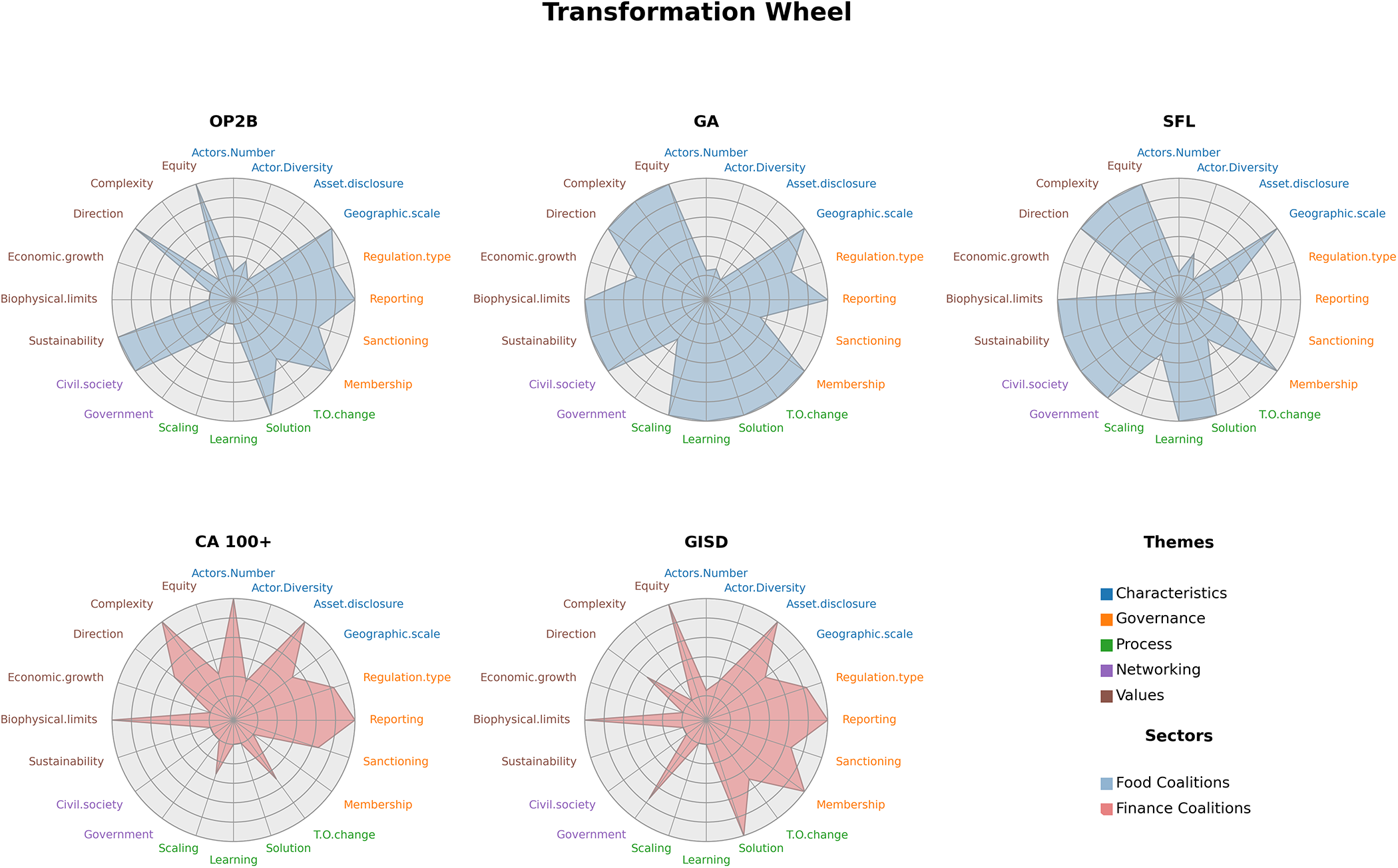
A quantitative comparative analysis revealed how each of the five coalitions is associated with the variables of the framework (Figures 2 and 3).
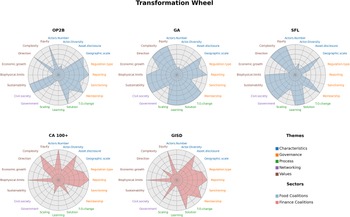
Transformation wheels illustrating the five coalitions evaluated across the 20 variables of the rapid assessment framework. The variables are grouped into thematic categories (blue for characteristics, orange for governance, green for process, purple for, and brown for values). The first row illustrates the coalitions from the food sector (light blue radar, and the second row illustrates the coalitions from the financial sector (red radar plots). The data for this figure comes from the normalized dataset (see Supplementary Material Section 1.3). The figure aims to facilitate a visual ‘rapid assessment’ because it allows for a, high-level comparison and consideration of multiple variables at once for each coalition, and provides a detailed overview of the information.
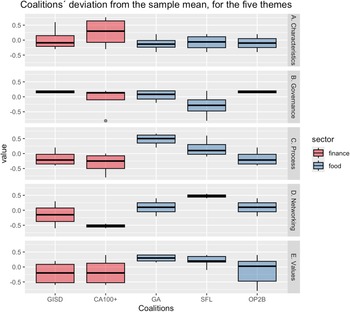
Boxplots illustrating the coalitions' deviation of each theme from the sample mean. The five panels correspond to the five themes of the rapid assessment framework. The red boxplots represent the financial coalitions, and the light blue boxplots represent the food sector ones. The position of each boxplot on the y-axis indicates whether the score is higher or lower relative to the other coalitions for that specific theme. The data for this figure comes from the deviation-adjusted dataset (see Supplementary Material Section 1.3). The line within each boxplot indicates the median score, and the height of the box indicates variation among variables within each-theme. This visualization facilitates identifying nuances among the coalitions by comparing relative, not absolute, scores.

In terms of overall patterns between the two sectors, we see that food sector coalitions place more emphasis on aspects that relate to the ‘Value’, ‘Process’, and ‘Networking’ themes, whereas finance sector coalitions emphasize ‘Governance’ and score higher in the ‘Characteristics’ theme, which refers to how the coalition operates (Figure 3). However, there are also similarities between coalitions from different sectors, where the two financial and OP2B coalitions score similarly across several variables (e.g. ‘regulation type,’ ‘sanctioning,’ ‘learning,’ and ‘scaling’). Finally, some partnerships have rather unique scoring profiles across multiple indicators, including CA100 + (‘size’, ‘membership’, ‘solutions’), GA (‘theory of change,’ ‘scaling,’ ‘economic growth’), and SFL (‘regulating type,’ ‘reporting’ variables).
Characteristics: The majority of coalitions show similar patterns in the descriptive characteristics indicators (Figure 3A). The exception is CA100 +, which has significantly larger membership. The other coalitions have approximately 30 members, and each coalition's member composition is relatively homogeneous. The most diverse members are convened by the SFL, whereas GA is the least diverse in terms of representation by different kinds of organizations. The food coalitions show similar patterns in this theme, and compared to the finance ones, they score lower (i.e. less information/emphasis on each variable of the ‘Characteristics’ theme). For example, the finance coalitions disclose the sum of each member's assets under management, whereas food coalitions do not.
Governance: Overall, we observe low levels of variation in relative performance on governance variables within each coalition (Figure 3B). Finance coalitions score higher on reporting and sanctioning than the food coalitions (Figure 2). Although evidence of sanctioning was generally low across all coalitions, investor-led coalitions (GISD and CA100 +) and OP2B place more emphasis on certain elements that enable sanctioning, such as audits and public disclosure. All coalitions claim that they report on their progress, except the SFL, but this is expected given the type of coalition (see Box 1). Moreover, all coalitions, except CA100 +, have stringent membership standards, which means that the process of joining the coalition requires members to have already invested resources in this domain. The CA100 +, GISD, and OP2B show similar regulation patterns (Figure 2), characterized by ‘soft regulation’ (Steurer, Reference Steurer2013), i.e. the encouragement of certain behaviors without legal sanction-based enforcement.
Process: The general pattern here is that the food LSACs score higher than the finance LSACs (Figure 3C). For example, SFL and GA place a lot of emphasis on learning and the theory of change (Figure 2). With the exception of CA100 +, all other coalitions propose a combination (‘bricolage’) of solutions to the challenges they have identified.
Networking: On the topic of engagement with civil society, the food coalitions collaborate with civil society, whereas the finance coalitions do not (Figure 2). This drives variation among food and finance coalitions in this indicator category (Figure 3D). Here, CA100 + scores the lowest because it does not engage with civil society or state actors. However, CA100 + is very well-networked with other private sector-led initiatives. GISD and OP2B score high on networking with public authorities (Figure 2).
Values: We observe relatively high levels of variation between coalitions in the values indicator category (Figure 3E). Here, GA scores high in most of the variables, while OP2B, GISD, and CA100 + exhibit a lot of variation. More specifically, there is a difference in the definition of ‘sustainability’ between food and finance coalitions. The framing of sustainability in finance indicates a more positive attitude toward substitutability (an indication of weak sustainability approaches). Most coalitions do mention ‘inclusive equitable growth’ and ‘opportunities created by the SDGs’, so it is likely that they are aligned with inclusive growth trajectories. However, GA appears less focused on business opportunities. In the ‘limits’ variable, most coalitions mention climate change and the Paris Agreement 1.5°C target, but strikingly, none explicitly emphasize thresholds of other environmental boundaries. GA and OP2B score relatively high in the variable ‘direction’ because they emphasize that they aim for a net-positive, regenerative food system.
3.3. Potential capacities for change
The operationalization of the RAF provided some indications of which capacities are likely to be enacted by the studied LSACs (Table 2). More specifically, the capacities reflected through the analysis of the finance coalitions are mainly those of gathering momentum, adopting, stewarding, unlocking, and transformative (see Table 3 for descriptions). These have greater potential to alter the first two dimensions of the transformation definition employed in this paper, specifically the ‘fundamental shifts in the way authority, power, and resources are structured and flow in a particular social system’and ‘the practices and processes that reflect and reproduce those structures’ (Moore & Milkoreit, Reference Moore and Milkoreit2020, p. 4).
The food coalitions also work on changing resource flows and practices, but due to their relatively higher scores in the ‘values’ theme, they also signal aspirations to alter all four dimensions of the definition, including the ‘norms, values, and beliefs that underpin those structures and processes, and the way that all of these are connected to ecological systems across multiple scales’ (Moore & Milkoreit, p. 4). Their potential capacities that can support fundamental changes in both impacting current unsustainable pathways and building new dynamics are those of sensemaking, envisioning, imagination, transformative, gathering momentum, systems reflexivity, interconnectedness, unlocking, and orchestrating. Our small sample of LSACs revealed a general lack of hospicing capacities (except SFL’s work; this blogpost by SFL discusses the losses from transitioning away from corn farming and the pork industry: https://sustainablefoodlab.org/hospice-in-the-time-of-covid/), which are key for phasing out outdated systems and enabling the emergence of new, transformative states.
4. Discussion
In this section, we discuss the features and actions undertaken by the studied LSACs during 2020-21. We apply the multi-phase, multi-level (MPML) framework (Herrfahrdt-Pähle et al., Reference Herrfahrdt-Pähle, Schlüter, Olsson, Folke, Gelcich and Pahl-Wostl2020) to map the actions LSACs pursued in advancing their stated missions (Figure 4). The MPML framework builds on Geels' (Reference Geels2002) multi-level perspective, which emphasizes interactions across niche (micro), regime (meso), and landscape (macro) levels, as well as the ball-in-cup heuristic (Olsson et al., Reference Olsson, Bodin, Folke, Armitage and Plummer2010), which highlights different phases of a transformation process: preparation, navigation, and stabilization. Using this framework enables a visual representation of the multiple and diverse phases and levels in which the coalitions are embedded and operate.
Mapping of various actions undertaken by LSACs on the multi-level and multi-phase (MLMP) framework (Herrfahrdt-Pähle et al., Reference Herrfahrdt-Pähle, Schlüter, Olsson, Folke, Gelcich and Pahl-Wostl2020). Colors indicate different categories of actions. The x-axis of the framework draws upon Geels (Reference Geels2002) multi-level perspective which emphasizes interactions between levels (niche/micro – regime/meso – landscape/macro). The y-axis draws upon the ball-in-cup heuristic (Olsson et al., Reference Olsson, Bodin, Folke, Armitage and Plummer2010), which highlights the multiple phases of a transformation process (preparation – navigation – stabilization). Here, the focus is on the preparation phase. During this phase, LSACs are responding to a social-ecological crisis (loss of biodiversity, climate change, food system failures, underinvestment in the SDGs) that constitutes challenges for LSACs. LSACs engage in different actions aligned with their stated objectives. These actions contribute to the overall capacity for preparation. The transition from the preparation to the navigation phase typically occurs in response to a shock that disrupts the status quo and creates an opening for transformative change. During the navigation phase, solutions, ideas, and approaches developed in the preparation phase become institutionalized. The stabilization phase is reached when a pattern of relatively stable configuration of practices, rules, and values emerges into a new regime, embedded in the macro level (illustrated as stability domains A, B, or C). Illustration by J. Lokrantz/Azote.

4.1. Mapping LSACs' actions onto the multi-level and multi-phase framework
4.1.1. Actions for preparing for change
All of the studied LSACs were set up with the mission to respond to certain sustainability challenges (see Table 1). Figure 4 maps the actions linked to the activities undertaken by LSACs onto the MLMP framework. Notably, some of the studied coalitions:
(1) catalyzed action by raising awareness and engaging actors not already interested in sustainability. An example is CA100+, where investors work with the world's most polluting companies to influence them to reduce emissions.
(2) Utilized high-level connections and engaged in policy-shaping processes. For instance, GISD, closely linked to the UN (as it was initiated by the UN), was invited by the EU Commission to provide input during the Sustainable Finance Strategy consultation. Similarly, OP2B prepared for engagement in the CBD COP15 framework development.
(3) Envisioned alternatives to the current system and supported the introduction of novelty into the systems they aim to transform, such as the SFL's focus on innovation and experimentation, and GA's promotion of niche initiatives. OP2B also supported local-level solutions.
Previous research has shown that the actions mentioned above can contribute to the overall capacity for readiness in transformative change (L. Pereira et al., Reference Pereira, Frantzeskaki, Hebinck, Charli-Joseph, Drimie, Dyer, Eakin, Galafassi, Karpouzoglou, Marshall, Moore, Olsson, Siqueiros-García, Van Zwanenberg and Vervoort2020). A system with high capacity for readiness is more likely to undergo change when the dominant system begins to fail and the status quo becomes vulnerable to alteration due to the existence of alternative solutions and niche initiatives that can seize the opportunity to drive change (Gelcich et al., Reference Gelcich, Hughes, Olsson, Folke, Defeo, Fernández and Castilla2010; Herrfahrdt-Pähle et al., Reference Herrfahrdt-Pähle, Schlüter, Olsson, Folke, Gelcich and Pahl-Wostl2020; Olsson et al., Reference Olsson, Bodin, Folke, Armitage and Plummer2010). Furthermore, having a variety of innovations ready in the preparation phase provides a wide array of ideas that can be selected, combined, and invested in during the subsequent navigation phase, creating opportunities for upscaling (M. L. Moore et al., Reference Moore, Tjornbo, Enfors, Knapp, Hodbod, Baggio and Biggs2014).
4.2. Complementary roles
Achieving transformative change requires ‘ecosystems of interacting changemakers’, and we find that LSACs possess capacities that can complement the work of other changemakers to achieve such change. Here, we highlight two key ways in which LSACs complement each other and support the broader work of other changemakers.
The first way relates to regime-level interactions, and specifically to the initial set-up of a coalition. As mentioned earlier, some LSACs are designed ‘for process’, while others have specific goals and clear mandates to be achieved within a defined timeline. The process-focused set-up, which centers on learning, may enable LSACs to be more adept at adapting and navigating change due to the mechanisms they have already established – ultimately preparing them for an ‘infinite game’ by fostering capacities critical for transformative change (e.g. learning, evaluating, selecting niche-level solutions). In contrast, LSACs with timelines and goals are set up for a solution-oriented process. Past research has identified challenges with solution-oriented approaches, as they often create new problems (Olsson et al., Reference Olsson, Bohlin and Moberg2020). In the context of multi-stakeholder partnerships (MSPs), Higham et al. (Reference Higham, Bäckstrand, Fritzsche and Koliev2024) find that MSPs are often ill-suited to effectively manage trade-offs between sustainability objectives, which often occur if partnerships focus on single solutions.
However, previous research applying a systems lens to transformative change has shown that solution-oriented actors can complement process-oriented ones by acting as accelerators or catalysts. For instance, niche actors developing ecosystem-based fishery management interacted with a shadow network of the national confederation of artisanal fisher associations, helping to drive a governance transformation in the Chilean coastal fishery (Gelcich et al., Reference Gelcich, Hughes, Olsson, Folke, Defeo, Fernández and Castilla2010). Similarly, in the case of Kristianstads Vattenrike – a wetland social-ecological system in southern Sweden that transformed into an adaptive co-management governance system – shadow networks and ‘adhocracy’ organizations (initiatives that appear and dissolve dynamically) played a key role in bridging the preparation and early navigation phases. These temporary structures supported the institutionalization of new processes, and their ability to appear at the right moment, when conditions were conducive for their mission, was crucial in transferring ideas and innovations into the navigation phase (Olsson et al., Reference Olsson, Folke, Galaz, Hahn and Schultz2007).
Our analysis of LSACs aligns with findings from the literature that show partnership durability, adaptability, and the existence of clearly defined goals are all important aspects for addressing the challenges they target (Andonova et al., Reference Andonova, Faul, Piselli, Andonova, Faul and Piselli2022c; Pattberg & Widerberg, Reference Pattberg and Widerberg2016). Our results suggest that, from a systems perspective, these features can be present in LSACs with distinct organizational set-ups, as they each play different but complementary roles. Furthermore, LSACs complement each other at the regime-level by linking with similar initiatives and collaborating to pursue shared goals – referred to as ‘field-making’ in the financial sector (sensu Marti et al., Reference Marti, Fuchs, DesJardine, Slager and Gond2023). This process further supports alignment and mutual reinforcement of goals across coalitions.
The second way LSACs complement the efforts of other change-makers is through their ability to engage with actors who are not initially aligned with their mission. Our analysis shows that all coalitions emphasize scaling out and up – extending their influence to new actors and higher institutional levels. Unlike ‘seed’ initiatives (E. M. Bennett et al., Reference Bennett, Solan, Biggs, McPhearson, Norström, Olsson and Xu2016; L. M. Pereira et al., Reference Pereira, Hichert, Hamann, Preiser and Biggs2018), which often focus on already engaged stakeholders, LSACs are positioned to reach those not already invested in sustainability transformations. If LSACs can cultivate agency within the broader system and inspire others to participate in transformative change, they may help overcome some of the limitations seed initiatives face in contributing to systemic transformations. This aligns with Andonova et al. (Reference Andonova, Faul, Piselli, Andonova, Faul and Piselli2022c), who emphasize that the catalytic potential of partnerships is central to their overall effectiveness.
4.3. Risks of derailing transformations
The work of LSACs may also hinder the sustainability efforts of other changemakers. Our examination of five LSACs revealed that some large-scale actors, such as Unilever, Danone, Mars, and the Rockefeller Foundation, participate in multiple coalitions. While this could signal a strong commitment to sustainability, it may also indicate that these large actors exert disproportionate influence over these processes, particularly compared to smaller actors who face access barriers due to limited resources and capacities, such as time, funds, and expertise. For example, some coalitions are invitation-only (e.g. GISD, OP2B), while others involve membership fees (SFL) or demand significant resources (CA100 +). This raises concerns whether LSAs are optimizing their engagement in multiple initiatives or unintentionally steering these processes toward outcomes that diverge from socially just values. Previous research on partnerships and multi-stakeholder initiatives for sustainable development has identified a lack of inclusivity as a recurring issue, although it remains unclear whether these partnerships are primarily driven by non-state actors, state actors or IGOs, or their respective interests (Higham et al., Reference Higham, Bäckstrand, Fritzsche and Koliev2024; Pattberg & Widerberg, Reference Pattberg and Widerberg2016).
Our findings suggest that LSACs often prioritize raising awareness of the ecological aspects of the sustainability polycrisis, potentially overlooking the social dimension and the structural issues that underpin them. Higham et al. (Reference Higham, Bäckstrand, Fritzsche and Koliev2024) similarly find that MSPs tend to focus on isolated rather than interconnected dimensions of sustainability challenges. This narrow framing may constrain LSACs' capacity for sensemaking and systems reflexivity (Moon & Blackman, Reference Moon and Blackman2014; Moore et al., Reference Moore, Olsson, Nilsson, Rose and Westley2018). A growing concern is the observable trend of large-scale actors reshaping systems toward environmental sustainability in ways that disproportionately benefit themselves. This risks driving market consolidation, as smaller businesses struggle to meet the demands of high environmental performance. Therefore, it becomes crucial to strengthen the capacities of other changemakers to anticipate and navigate these transitions, while simultaneously advocating for large-scale and rapid transformation that addresses power imbalances, and social and environmental injustices.
Consequently, if the concept of transformation is applied without considering the power dimension – central in how transformations are defined in this paper and in the recent consensus of transformation scholarship – we risk enabling greenwashing or ‘transformation-washing’. These actions fail to contribute to just and sustainable transformations, instead reinforcing current system dynamics. Greenwashing can cement and perpetuate the very structures transformation aims to disrupt. While some scholars worry that the term “transformation” has become a buzzword, others argue that maintaining a plurality of conceptualizations is essential, alongside strategies for enabling transformative processes (Feola, Reference Feola2015; IPBES, Reference O'Brien, Garibaldi and Agrawal2024; Scoones et al., Reference Scoones, Stirling, Abrol, Atela, Charli-Joseph, Eakin and Yang2020). Preserving this plurality, while ensuring that the concepts of ‘transformation’ and ‘systems change’ are not diluted by actors unwilling to make fundamental changes, is critical. This requires strengthening the capacities of a diversity of changemakers who have invested significant energy in building their ability to reflect on and address the root causes of sustainability and equitability challenges.
While a wide range of actors shape transformation dynamics in various directions, our focus is to assess the potentially transformative capacities of LSACs and use our five cases to test this framework. The framework is designed to be adaptable and sector-agnostic and can be utilized with publicly available data. Through analyzing the set-up of each coalition, the framework can support the identification of potential LSAC capacities (and gaps thereof) that can enable large-scale sectoral transformations. The contribution of this framework is that it captures features relevant for sectoral and systemic sustainability transformations without requiring access to, collection of and analysis of interview data. In addition, it can be used to identify which dimensions, important from a sustainability perspective, LSACs are omitting. Moreover, it is sector-agnostic and thus adaptable for other sectors. However, the framework refers to potential capacities – whether these are expressed and whether they prove to be relevant depends on other contextual factors beyond the individual LSACs.
5. Conclusion
LSACs vary in several aspects of how they work on transforming their sector toward sustainability. To explore these nuances, we designed and applied the Rapid Assessment Framework outlined in this paper, focusing on five coalitions from the food and finance sectors. The assessment centered on features relevant to sustainability transformations, including general coalition characteristics, governance, networking, processes, and values emphasized in the communication materials on LSACs' websites during April 2020–May 2021. By identifying these features, we aimed to understand how individual and collective capacities within these systems could influence and shape broader system dynamics.
Our analysis revealed differences in the initial set-up of LSACs. Some have been established with specific timeframes and goals, while others follow more continuous, open-ended processes. We argue that both approaches play crucial roles in transformation processes. Regarding their actions, most LSACs focus on raising awareness, leveraging networks, and experimenting with solutions. Some act as frontrunners due to their capacities to scale up solutions and access high institutional levels. The abovementioned actions can complement the work done by niche-level actors. LSACs are uniquely positioned in the regime, and their access to regime-level processes can provide opportunities to niche-level actors. However, it is concerning that certain coalitions fail to comprehensively address the multidimensional nature of the sustainability crisis in their communication materials, and their actions are limited to regime-level peer interactions, potentially restricting their capacity to drive transformative change across scales and institutional levels.
Despite data limitations, our examination suggests that the aggregate effect of LSAC-led efforts reveals critical capacities for shaping the practices, rules, and norms of the food and finance sectors. However, to guide these efforts toward socially and ecologically just pathways, it is essential to strengthen both the capacities of non-large-scale system actors and LSAC's self-reflexive capacities. This would create space for diverse sustainability visions and enable deep scaling of transformative processes. For instance, our small sample of LSACs revealed a general lack of hospicing capacities, which are key for phasing out outdated systems and enabling the emergence of new, transformative states. Overall, our analysis reveals that there are indications that LSACs have a range of latent capacities and take on actions that can contribute to transformative change. However, the expression and relevance of these capacities, as well as the limitations of the undertaken actions, depend on other context-specific factors, such as the system state (Westley et al., Reference Westley, Tjornbo, Schultz, Olsson, Folke, Crona and Bodin2013).
Returning to our question of whether coalitions of large-scale actors have the capacity to contribute to the fast, broad, and deep transformations needed or merely perpetuate the same system dynamics that created the problems in the first place, our analysis suggests that LSACs have the potential to influence multiple scales quickly. However, the depth of change remains critical. We conclude that a nuanced understanding of the differences among LSACs can clarify their role in transformative processes, identify in which phases they are likely to support just and sustainable transformations, and determine how they can complement the efforts of other changemakers.
Future studies can operationalize the framework with a large, representative, and diverse group of LSACs from a range of sectors. Investigations into how LSACs’ capacities combine to enable dynamics critical for the navigation and stabilization phases of transformative processes can also be undertaken. These processes include consolidating new values and norms, scaling deep, strengthening cross-scale relationships, creating legal frameworks, and enabling the routinization and embedding of new practices (M. L. Moore et al., Reference Moore, Tjornbo, Enfors, Knapp, Hodbod, Baggio and Biggs2014). Additionally, employing diverse methodologies – from in-depth interviews and focus groups with organization representatives to tracking LSACs’ regulatory impact through policy document analysis or process-tracing – can shed light on changes in behavior, practices, norms, rules, and values. Moreover, a deeper, empirical understanding of the role of agency throughout the transformation process (Westley et al., Reference Westley, Tjornbo, Schultz, Olsson, Folke, Crona and Bodin2013) is essential to assess how it contributes to destabilizing the status quo (Geels, Reference Geels2020), fostering niche formation, and building readiness (L. Pereira et al., Reference Pereira, Frantzeskaki, Hebinck, Charli-Joseph, Drimie, Dyer, Eakin, Galafassi, Karpouzoglou, Marshall, Moore, Olsson, Siqueiros-García, Van Zwanenberg and Vervoort2020) in the preparation phase. Agency also plays a pivotal role in scaling, systems innovation, and institutionalization during the navigation phase, as well as in consolidating values and establishing new routines in the stabilization phase. Research could offer insights into human agency, examining whether change agents of the regime wish to – and are able to – transform the expectations of the roles they occupy (Archer, Reference Archer1995). Finally, network analysis could complement this endeavor by exploring human agency versus ‘systems’ agency.
Supplementary material
The supplementary material for this article can be found at https://doi.org/10.1017/sus.2025.10010.
Acknowledgements
We thank Nadja Najjar, Stephen Mejia, and Garry Peterson for their contributions during the early phases of this project. We also wish to thank the reviewers, whose comments substantially improved this manuscript. We are grateful to colleagues at the Stockholm Resilience Center and the Global Economic Dynamics and the Biosphere program for their insightful discussions. We acknowledge the work of Jerker Lokrantz for developing Figure 4 and the use of AI-assisted technologies in supporting the development of the code that generated Figure 2. AI-assisted technologies were also used as inspiration for rewording individual sentences. The authors take full responsibility for the content of this publication.
Author Contributions
S.M.: Conceptualization, Data curation, Formal analysis, Methodology, Project administration, Visualization, Writing – original draft, Writing – review and editing. P.O.: Conceptualization, Formal analysis, Writing – original draft, Writing – review and editing, Supervision, Funding acquisition. P.S.J.: Conceptualization, Formal analysis, Writing – original draft, Writing – review and editing, Supervision, Funding acquisition.
Funding statement
This work was supported by the Swedish Research Council Formas (P.O., P.S.J., and S.M., grant number 2021-00825; P.S.J., grant number 2020-00371). P.S.J. acknowledges funding from the IKEA Foundation, Marianne and Marcus Wallenberg Foundation, the Marcus and Amalia Wallenberg Foundation, the European Union (ERC, INFLUX, 101039376), and the Swedish Research Council (grant number 2020-04586). P.S.J. and S.M. acknowledge funding from the Erling-Persson Foundation. Views and opinions expressed are, however, those of the author(s) only and do not necessarily reflect those of the European Union or the European Research Council. Neither the European Union nor the granting authorities can be held responsible for them.
Competing interests
The authors declare that they have no known competing financial interests or personal relationships that could have appeared to influence the work reported in this paper.
Data availability
Data are available in the Supplementary Material associated with this article. Additional information about the data can be requested via e-mail to the corresponding author.




 Open access

