Over the past few decades, farmers have increasingly integrated cover crops into their cropping systems. Soil conservation initiatives, depletion of soil productivity and social pressures to decrease agricultural externalities can all be attributed with an increase in adoption. A cover crop—also known as green manure, living mulch, catch crops or forage crops (Sullivan, Reference Sullivan2003)—is a small grain, grass, legume, Brassica or a mixture of these grown in rotation between regular cash crop production periods to provide soil protection and improvement (Singer et al., Reference Singer, Kohler and McDonald2007a, Reference Singer, Nusser and Alfb). Cover crops can help alleviate drought stress by potentially increasing infiltration rates and soil moisture content. They can also improve soil quality by increasing soil organic matter (SOM) and reducing soil compaction and erosion (Reeves, Reference Reeves, Hartfield and Stewart1994; Sustainable Agriculture Network, 1998). Other benefits can include weed suppression, protecting water quality, increasing nutrient cycling efficiency and improving cash crop productivity.
Economic considerations related to the decision to adopt or use cover crops are multi-faceted. A producer must consider direct benefits (e.g., yield boost and impacts on crop revenue), direct production costs, indirect benefits (e.g., possible cash crop cost savings), indirect and opportunity costs, risk and agricultural policy considerations. Changes in crop-system production management and externalities, such as social and environmental benefits of reduced soil erosion and chemical runoff, may also factor into the decision-making process. Reducing these externalities will be important for farmers with objectives such as farm survivability, environmental stewardship and social welfare. However, the opportunity to increase profit, decrease yield variability or both, will likely be the strongest incentive to adopt cover crops (Pannell, Reference Pannell1999a, Reference Pannellb).
This paper reviews economic considerations of cover crops and provides valuable information to two key audiences: producers contemplating adoption and policy makers seeking a better understanding of the incentives for (and against) adoption. Benefits and costs of production, as well as risk and policy are covered from an economic perspective. For specific examples, the paper focuses primarily on the use of cover crops in Kansas, where the authors reside, but examples are provided for other areas within the USA, as well. The paper provides a novel contribution to the literature through a comprehensive review of the economic considerations of cover-crop adoption and usage, which has not been holistically addressed in the conservation literature to the authors’ knowledge.
A Brief History of Cover-Crop Use and Adoption
In the 1930s, environmental impacts from the Dust Bowl emphasized the need for re-evaluating farming practices. Conventional tillage practices left the soil exposed and highly vulnerable to wind and water erosion (Kell and McKee, Reference Kell and McKee1936). Kell and McKee (Reference Kell and McKee1936) of the US Department of Agriculture (USDA) recognized several advantages and disadvantages of cover crops, still discussed today. They state ‘…any system of cover which will reduce the number of days the soil is exposed to washing will result in a great national saving of soil and fertility’ (Kell and McKee, Reference Kell and McKee1936; p. 1). However, they also note cover cropping is not a cure all (Kell and McKee, Reference Kell and McKee1936). This has been expressed by other cover-crop proponents who emphasize that cover crops are just one part of a well-rounded conservation plan or system (Dabney et al., Reference Dabney, Delgado and Reeves2001; Snapp et al., Reference Snapp, Swinton, Labarta, Mutch, Black, Leep, Nyiraneza and O'Neil2005).
Ironically, a reason for recent interest in cover crops was a key factor in decreasing their usage during the 1940s and 1950s. Synthetic fertilizers and herbicides became readily available and affordable on a commercial level in the mid-1900s (Ingels and Klonsky, Reference Ingels, Klonsky, Ingels, Bugg, McGourty and Christensen1998). Synthetics were low cost, easy to apply and required less management than planting and terminating a green manure cover crop. Thus, using cover crops as green manure—a cover crop terminated by incorporation into the soil without harvesting—was no longer seen as a profitable approach to fertilizing. Additionally, the long-term effects of continued intensive tillage—as required under a green manure approach—were having a greater environmental impact, reducing soil productivity and health (Kell and McKee, Reference Kell and McKee1936).
Recently, public attitudes toward use of synthetic fertilizers have become more negative due to potential environmental impacts from its use. As a result, some producers are now looking to supplement or replace synthetic chemical applications with leguminous cover crops, which may also prove to be less costly than synthetic fertilizer applications (Lu et al., Reference Lu, Watkins, Teasdale and Abdul-Baki2000; Snapp et al., Reference Snapp, Swinton, Labarta, Mutch, Black, Leep, Nyiraneza and O'Neil2005).
Despite motivating forces and increased adoption rates, cover crops are still not prominent across the agricultural landscape. Wade et al. (Reference Wade, Claassen and Wallander2015) found that during 2010–2011, approximately 4% of farmers adopted cover crops on some portion of their fields, and only 1.7% did so, on cropland. Cover-crop adoption was found to be lowest in the Heartland region (‘the ‘Heartland’ region contains all of Kansas and parts of Colorado, Nebraska, New Mexico, Oklahoma and Texas’), where the adoption rate was only 0.6%. Dunn et al. (Reference Dunn, Ulrich-Schad, Prokopy, Myers, Watts and Scanlon2016) indicate that <5% of total cropland planted to row crops had cover crops planted on them. Reimer et al. (Reference Reimer, Weinkauf and Prokpy2012) found improvements in soil fertility and structure to be the primary reasons producers were using cover crops. They also state that ‘potential yield increases associated with increased soil fertility were also mentioned as an economic motivation for cover-crop adoption’ (Reimer et al., Reference Reimer, Weinkauf and Prokpy2012, p. 126). Conversely, compatibility with a producer's current farming system and other limiting factors (e.g., water) are barriers to cover-crop adoption (Reimer et al., Reference Reimer, Weinkauf and Prokpy2012). Ultimately, concerns such as moisture loss, increased management requirements, equipment purchases, inconsistent results and lack of policy support can all discourage adoption.
Mallory et al. (Reference Mallory, Posner and Baldock1998) found that for farmers participating in on-farm trials using cover crops, the primary motivation for adoption was the need to provide ground cover. Profitability as a nitrogen (N) source was secondary. However, barriers to adoption must still be overcome. Cover crops, like any investment may not provide immediate net returns. A number of growing seasons may be required to maximize the benefits received from heavy residue covers and increased SOM (Derpsch, Reference Derpsch2008). With short-term land leasing a common practice, long-term producer investments are less likely (Lu et al., Reference Lu, Watkins, Teasdale and Abdul-Baki2000). Bergtold et al. (Reference Bergtold, Duffy, Hite and Raper2012), found that Alabama producers were approximately 20% less likely to incorporate cover crops on rented land. Dunn et al. (Reference Dunn, Ulrich-Schad, Prokopy, Myers, Watts and Scanlon2016) indicate that in some areas, larger farms have discontinued the use of cover crops due to perceived limited adoption potential, high costs and difficulties with farm management. Studies such as Pannell (Reference Pannell1999a, Reference Pannellb) and Lu et al. (Reference Lu, Watkins, Teasdale and Abdul-Baki2000) show that evidence of stabilized yields through cover-crop use (i.e., lowered risk) must be more widely accepted by producers before large-scale adoption will occur. Ultimately, producers will need to be well informed and feel comfortable in their economic expectations regarding cover-crop adoption if it is to see widespread adoption.
Cover-Crop Economics
This section of the paper provides a review of cover-crop economics. The section examines (i) direct production costs, (ii) indirect and opportunity costs, (iii) direct benefits, (iv) indirect benefits, (v) risk and crop insurance, (vi) policy incentives and (vii) economic examination of cover-crop adoption and usage. The objective is to provide a thorough review of the economic considerations when considering the usage and adoption of cover crops in agricultural operations.
Direct Costs
As with many innovative practices, cover crops come with costs of adoption, both direct and indirect. Direct costs include planting and managing the cover crop. A winter cover crop incurs costs for establishment and possibly N fertilization (Larson et al., Reference Larson, Roberts, Jaenicke and Tyler2001). In addition, to establish a cover crop, no-till drills or planters with row cleaners, extra down-pressure springs and disk openers may be needed to move and penetrate high-residue cover without dragging or hair pinning it in the seed trench (Reeder, Reference Reeder2002).
Given the varying cover-crop management regimes, producers must consider the different production costs when adopting them (Bergtold and Goodman, Reference Bergtold and Goodman2007). Table 1 provides production costs for four cover-crop options either trialed with reported success or used on-farm in Kansas (Watson, Reference Watson1999; Blanco-Canqui et al., Reference Blanco-Canqui, Claassen and Presley2012). Hairy vetch (Vicia villosa) and crimson clover (Trifolium icarnatum) are N-fixing legumes, while rye (Secale cereale) and oats (Avena sativa) are cereals that produce comparatively large amounts of aboveground biomass (Watson, Reference Watson1999). The remaining sub-sections below outline the primary direct costs in growing and managing a cover crop.
Variable costs (US$ ac−1) of managing and planting cover crops in Kansas.

1 Seeding rate of 20 lbs ac−1. Seed cost at US$1.70–2.50 lb−1 (SARE, 2013).
2 Seeding rate of 20 lbs ac−1. Seed cost at US$1.25–2.00 lb−1 (SARE, 2013).
3 Seeding rate of 90 lbs ac−1. Seed cost at US$0.23 lb−1 (SARE, 2013).
4 Seeding rate of 90 lbs ac−1. Seed cost at US$0.15 lb−1 (SARE, 2013).
5 Kansas Custom Rates Projections, 2014—planting—no-till small grains.
6 Assume 0 lbs applied fertilizer to legumes to allow N fixation to begin as early as possible. Lower cost assumes single-liquid application of 15 lbs N ac−1. Higher cost assumes two liquid applications of 15 lbs N ac−1 utilizing 28-0-0 liquid fertilizer (Personal communication, Jeris McMullen, Ag Valley Co-op, Norton, KS. July 18, 2008).
7 Assuming producer is already no-till, chemical termination of cover crop is done with the same pass that would be done pre-plant. Therefore, no additional cost is assumed. Lower cost (US$7) is a combination of mechanical termination (roller crimper) and ½ rate of burn-down herbicide pass. Roller-crimper costs and savings are taken from Mississippi State University (2007) and adjusted for inflation and energy costs. Herbicide treatment was assumed to be 22 oz glyphosate, 10 oz 2-4D, + surfactant (Chris O'Hare, Ag Valley Co-Op Agronomist, Norton, KS, July 18, 2008).
Seed
Seed is a significant cost of establishing a cover crop. In a 2012–2013 survey conducted by the Conservation Technology Information Center (CTIC) and the North Central Sustainable Agriculture Research and Education (SARE), 33% of respondents indicated seed cost as one of the most significant barriers in using cover crops. In the same survey, the median seed cost farmers were willing to pay was US$61 ha−1 (US$25 ac−1) (CTIC and SARE, 2013). Seed costs can be highly variable depending on variety, seeding rate and uncontrollable factors, such as availability. For example, crop failures in seed-producing regions of sunn hemp (Crotalaria juncea), a tropical legume, have caused unavailability and drastic price increases over time (Blanco-Canqui et al., Reference Blanco-Canqui, Claassen and Presley2012; Clayman, personal communication, 2008). Annual variation in seed costs necessitates careful evaluation of cover-crop selection. While a cover crop may be appealing in terms of biomass, N fixation or erosion control, if seed prices are too high or volatile, a farmer may not see it as a viable practice.
Planting
Planting cover crops requires the same basic equipment as a no-till cropping system, with minor additions. If a producer already owns a no-till drill or planter, machinery purchase is not necessary (Bergtold and Goodman, Reference Bergtold and Goodman2007). However, high-residue planting environments may require some combination of row cleaners, additional down-pressure springs and spoke-closing wheels. These add-ons penetrate thick residue, ensure proper seed–soil contact and minimize hair pinning (Watson, Reference Watson1999; Bergtold and Goodman, Reference Bergtold and Goodman2007). Add-on investment costs can range from US$350 to 700 per row, based on southeastern US equipment costs (Bergtold and Goodman, Reference Bergtold and Goodman2007). Inter-row seeders are another option. These implements allow cover-crop seeding between standing cash-crop rows. This could be done to provide in-season protection or to allow for earlier cover-crop seeding toward the end of the cash-crop season.
Broadcast seeding is a second planting option that can be done with whirl-type seeders, air seeders and high-clearance sprayers. Using high-clearance sprayers, cover crops could be seeded into standing cash crops and thus allow some of the same benefits as an inter-row seeder. Historically, broadcast seeding has been cheaper than a no-till drill or planter in terms of custom rates (Twete et al., Reference Twete, Habets, Stock, Smith, Thiessen and Wells2008). However, germination and stands are grossly inferior to those achieved by planting or drilling (Singer and Kaspar, Reference Singer and Kaspar2006). A whirl-type seeder requires a 25–50% increase in seeding rates to obtain the same stand counts as a planter. Germination rates may be improved by harrowing to increase seed–soil contact, but this disturbs the soil and so conflicts with the idea of cover crops and soil conservation (Sullivan, Reference Sullivan2003). Harrowing also requires an additional pass across the field, adding to labor and fuel costs.
Aerial seeding is a third option. While low germination rates and stand counts accompany aerial seeding, it allows inter-seeding cover crops into a standing cash crop without damage (Mannering et al., Reference Mannering, Griffith and Johnson2000). Inter-seeding is a non-intrusive operation relative to drilling or planting and can be accomplished with a spinner-spreader or airplane. As with other broadcast seeding approaches, aerial-seeding germination rates are lower and depend heavily on late-season rains (Mannering et al., Reference Mannering, Griffith and Johnson2000). Application rates are higher as well. For example, rye in Indiana is aerial seeded at 156–188 kg ha−1 (2.5–3.0 bu ac−1), compared with 84 kg ha−1 (1.5 bu ac−1) when drilled (Mannering et al., Reference Mannering, Griffith and Johnson2000). Aerial seeding costs vary greatly and there is no established custom rate for this operation in Kansas (Twete et al., Reference Twete, Habets, Stock, Smith, Thiessen and Wells2008; Clayman, personal communication, 2008).
In lieu of outfitting an owned planter with additional equipment, hiring an operator to custom plant is an option. Beaton et al. (Reference Beaton, Dhuyvetter, Kastens and Williams2005) found custom rates to be 24.4% lower than costs to own and operate a planter. Twete et al. (Reference Twete, Habets, Stock, Smith, Thiessen and Wells2008), however, assume custom rates to be higher, treating prior machinery ownership as a sunk cost not to be used in decision-making. After review of different cost-calculators, it was decided that custom rates are the most straight-forward method of estimating the cost for this application. Kansas custom rates in 2014 for no-till planting were US$43.74 ha−1 (US$17.70 ac−1) for small grains (Table 1). This number is used to establish a base cost; it is implied that individual costs can display significant variation.
While planting a cover crop may not require a large capital outlay, time requirements may interfere with other activities if hiring custom work is not an option (Bergtold and Goodman, Reference Bergtold and Goodman2007). Fall cover crops are often seeded at the same time as winter wheat (Triticum aestivum L.), and careful planning is required to avoid encroachment on cash-crop responsibilities (Mannering et al., Reference Mannering, Griffith and Johnson2000; Bergtold and Goodman, Reference Bergtold and Goodman2007). Another consideration when planting a cover crop is the potential issue of herbicide carryover injury. That is, herbicides used to terminate weeds in cash crops may carryover to planting of cover crops, potentially hindering cover-crop establishment. Thus, weed management for cash crops should take cover-crop management into consideration (Curran and Lingenfelter, Reference Curran and Lingenfelter2017). Another consideration that may impact timing of planting for a cover crop that is used for forage or grazing is herbicide-label plant-back restrictions. Under federal law, producers must take into account the time interval required between planting a subsequent cover crop after the application of a pre- or post-emergence herbicide on the cash crop (Jhala et al., Reference Jhala, Redfearn, Anderson, Drewnoski and Proctor2016).
In a survey of 3500 farmers in Illinois, Indiana, Iowa and Minnesota by Singer et al. (Reference Singer, Kohler and McDonald2007a, Reference Singer, Nusser and Alfb), time and cost requirements of cover crops were cited by 34.8 and 27.4% of farmers as reasons for not adopting. Allowing an established cover crop to self-seed may reduce the input cost and time requirements if a producer is in an area where this is feasible (McDonald et al., Reference McDonald, Singer and Wiedenhoeft2008). Varieties such as winter rye, wheat, triticale (Triticosecale rimpaui C.), hairy vetch, clovers and alfalfa (Medicago sativa) create self-seeding cover-crop systems, which may alleviate some producer concerns. With seed and planting outlays accounting for 33–100% of cover-crop production costs, savings from a self-seeding variety may provide a strong economic incentive for producers to adopt (see Table 1 for comparisons). Allowing the cover crop to mature and self-seed can also provide erosion protection during the spring when heavy rains can wash a field and greatly affect cash-crop stands (Uri, Reference Uri2001).
Fertilization
Fertilizer applications are a potential cost of using cover crops. While not necessary for all cover crops, applying N to maximize grain and small-grain cover-crop biomass may add further benefits to following cash crops (Singer and Meek, Reference Singer and Meek2004). In these circumstances, it may be prudent to do a one-time or split application of fertilizer to establish the cover crop, thereby improving the chance that the cover crop suppresses weeds in the field (Bergtold et al., Reference Bergtold, Anand and Molnar2007). This becomes necessary when a cover crop, such as cereal rye, is being managed for high biomass (Singer and Meek, Reference Singer and Meek2004; Bergtold et al., Reference Bergtold, Anand and Molnar2007).
Termination
Cover crops generally are not harvested because many of their benefits are gained from decomposing biomass left in the field. Thus, cover crops must be efficiently terminated to prevent competition with cash crops. Inadequate termination of a cover crop or allowing a cover crop to go to seed may result in unwanted cover-crop growth during cash-crop production.
Herbicide spraying, known as chemical ‘burn down’, is one method of termination (Lu et al., Reference Lu, Watkins, Teasdale and Abdul-Baki2000). A burn-down pass to terminate a cover crop is unlikely to be an ‘additional’ pass for a no-till operator, as it is common to spray a non-selective herbicide prior to planting to terminate winter weeds (Bergtold et al., Reference Bergtold, Anand and Molnar2007). Personal ownership of a sprayer is convenient due to the required timeliness of this type of operation.
While herbicide applications are common and effective, increases in herbicide and fuel costs can make the practice unattractive (Lu et al., Reference Lu, Watkins, Teasdale and Abdul-Baki2000). Mechanical termination with a roller crimper provides an alternative approach. This approach does not disturb the soil and can be used alone or in conjunction with reduced rates of non-selective herbicides (Ashford and Reeves, Reference Ashford and Reeves2003; Kornecki et al., Reference Kornecki, Price and Raper2006). Roller crimpers terminate cover with blunt blades attached to a rolling drum and produce a residue mat on the soil surface (Ashford and Reeves, Reference Ashford and Reeves2003). The blades cause injury to the cover crop as they roll, accelerating the process of termination (Kornecki et al., Reference Kornecki, Price and Raper2006). The purchase of a roller crimper is much less than that of a sprayer and requires less energy than termination by tillage, lowering fuel costs (Goddard et al., Reference Goddard, Zoebisch, Gan, Ellis, Watson and Sombatpanit2008). Mechanical termination can be less costly than burn down or tillage, but is the most labor and time intensive, as roller crimpers are narrower and slower to operate than sprayers (Kornecki et al., Reference Kornecki, Price and Raper2006).
Timing roller-crimper use affects termination efficacy (Ashford and Reeves, Reference Ashford and Reeves2003). A producer who attempts to terminate a wheat, oat or rye cover crop at the flag-leaf stage will have limited success (<25%) and need an additional herbicide pass to complete termination. If rolled at soft-dough stage or later, kill rates equal to that of a full rate non-selective herbicide application can be achieved (Ashford and Reeves, Reference Ashford and Reeves2003). Slower decomposition of rolled residue also results in a longer period of weed suppression (Lu et al., Reference Lu, Watkins, Teasdale and Abdul-Baki2000). Duiker and Curran (Reference Duiker and Curran2005) provide a final consideration: increased slug activity under a thick rye mat in the northern Mid-Atlantic. In other words, the residue mat may introduce or increase pest issues. As with all management decisions, the benefits and costs of using roller-crimper termination methods should be considered.
Cover crops can also be terminated through integration into the soil as green manure (Bouldin, Reference Bouldin1988; Biederbeck et al., Reference Biederbeck, Bouman, Looman, Slinkard, Bailey, Rice and Janzen1993; Biederbeck and Bourman, Reference Biederbeck and Bourman1994). Tillage termination is the oldest and perhaps most well-known form of cover-crop termination, but has many drawbacks (Lu et al., Reference Lu, Watkins, Teasdale and Abdul-Baki2000). Specifically, producers do not receive the benefits of no-till, and so this method is discouraged on the basis of long-term profitability and sustainability (Goddard et al., Reference Goddard, Zoebisch, Gan, Ellis, Watson and Sombatpanit2008). Tillage accelerates N availability, but hampers the soil tilth, percolation and infiltration benefits of cover crops and leaves soil vulnerable to wind and water erosion (Biederbeck et al., Reference Biederbeck, Bouman, Looman, Slinkard, Bailey, Rice and Janzen1993; Lu et al., Reference Lu, Watkins, Teasdale and Abdul-Baki2000). Weed-suppression benefits of biomass residue on the soil surface are also lost with tillage (Lu et al., Reference Lu, Watkins, Teasdale and Abdul-Baki2000).
Winter-kill may be possible for less-hardy cover crops in harsher environments, e.g., delayed-planting soybeans (Glycine max L.) in parts of Kansas (Mannering et al., Reference Mannering, Griffith and Johnson2000). Planting late enough to allow winter-kill provides a smaller growth window for N fixation (with legumes) and biomass creation, but eliminates the cost of termination. Because winter-killed cover crops result in lower levels of biomass and thus shorter periods of weed control, most producers incorporate burn-down herbicide prior to cash-crop planting (Mannering et al., Reference Mannering, Griffith and Johnson2000).
Regardless of the termination method, precedence must be given to the timing of cash-crop planting. Allowing a legume cover-crop additional time to fix N can potentially decrease applied N requirements. For example, waiting an extra 2 weeks for spring termination of hairy vetch can produce significant increases in N accumulation (Sainju and Singh, Reference Sainju and Singh2001). Janke et al. (Reference Janke, Claassen, Heer, Jost, Freyenerger and Norman2002) found delaying winter pea termination by just 18 days nearly doubled N contribution from 6.4 to 12.2 kg (14–27 lbs). Delaying termination also allows for maximum biomass creation and extended weed suppression benefits for the next cash crop (Ashford and Reeves, Reference Ashford and Reeves2003). However, if cash-crop planting is done too soon after termination, dying—but not dead—cover crops will compete for soil nutrients and water. Delayed termination also delays residue breakdown and thus reduces late-season nutrient availability (Sainju and Singh, Reference Sainju and Singh2001). Many producers terminate cover crops at different times in different years based on accumulated and expected precipitation. In a dry year, it may be beneficial to terminate early, while in a wet year a producer may let the cover crop grow as long as possible (Sainju and Singh, Reference Sainju and Singh2001).
Indirect and Opportunity Costs
Indirect costs include effects on cash-crop management and foregone opportunities. Increased water infiltration, e.g., may speed leaching of chemicals and nutrients beyond the root zone (Lu et al., Reference Lu, Watkins, Teasdale and Abdul-Baki2000). Residue-covered soils may be slow to warm and delay the emergence of planted crops (Snapp et al., Reference Snapp, Swinton, Labarta, Mutch, Black, Leep, Nyiraneza and O'Neil2005). Decreased soil water for the following cash crop may be a cost of adoption, especially in arid regions such as western Kansas where water is the limiting factor for cash-crop yields (Biederbeck and Bourman, Reference Biederbeck and Bourman1994; Lu et al., Reference Lu, Watkins, Teasdale and Abdul-Baki2000). In these types of regions, farmers will often use a fallow period with the intent of storing moisture for a subsequent cash crop (Robinson and Nielsen, Reference Robinson and Nielsen2015). Using test plots and legume cover crops in northeastern Colorado, Nielsen and Vigil (Reference Nielsen and Vigil2005) found soil water at wheat planting was reduced by 55–104 mm depending on when legumes were terminated. In a similar study, Nielsen et al. (Reference Nielsen, Lyon, Hergert, Higgins, Calderón and Vigil2015) found water reductions (compared with fallow) from cover crops to be robust across cover-crop species and whether only a single or multiple species were used. The potential for negative impacts on cash-crop yields following a cover crop is well documented (e.g., Nielsen et al., Reference Nielsen, Lyon, Higgins, Hergert, Holman and Vigil2016). If cover crops are to be used in these environments, termination timing is critical to maintaining adequate soil water content for the following cash crop (Lu et al., Reference Lu, Watkins, Teasdale and Abdul-Baki2000).
Opportunity costs of time and money are important indirect costs of cover cropping. A foregone cash crop is the most glaring opportunity cost. Most producers find the idea of planting, fertilizing and paying to terminate a crop, while potential revenue is left in the field counterintuitive. However, the net income from a cash-crop harvest may not represent the income foregone from producing a cover crop. For example, wheat may be used as either a cash crop or a cover crop. Produced as a cash crop, wheat requires intensive management, pesticide use and fertilization to produce economically optimal yields. Managing wheat as a cover crop can significantly reduce these production costs. In general, foregone income is equal to the change in total revenue minus the change in variable costs.
Many agricultural producers will only have anecdotal evidence of the successful management of cover crops within cash-crop systems from other agricultural producers. Thus, additional education may be a prerequisite to cover-crop adoption. Time spent at conferences, on the phone with other producers, or reading to learn about new practices could possibly be used toward other ends. Utilizing cover crops require the producer to actively manage cropping systems on a year-round basis. While cover crops are not managed as intensively as cash crops, there is a marked difference in chemical and conventional fallow versus cover-crop management. The producer must decide the cover-crop species, when to plant and terminate, and termination methods (Lu et al., Reference Lu, Watkins, Teasdale and Abdul-Baki2000). Another important consideration is the potential for cover crops to serve as hosts for diseases or pests. Decisions regarding cover-crop species and planting and termination timing are critical in managing this risk. Whether or not this is an easy management transition will vary across producers.
Grazing and forage opportunities
Some producers may forego grazing opportunities. Grazing land for cattle is a valuable asset, and forage needs lead some producers to graze their herds on winter wheat. Many cover crops are highly palatable to livestock, and the opportunity to graze or bale the cover crop can be tempting (Kell and McKee, Reference Kell and McKee1936). While grazing does not eliminate cover-crop benefits, repeatedly removing biomass has been shown to substantially decrease cash-crop yield benefits (Singer and Meek, Reference Singer and Meek2004). One innovative and successful high-residue producer in Alberta, Canada bales residue for sale only if the price is twice the nutrient value, citing that the worth to his operation is greater in the field otherwise (Hagny, Reference Hagny2008). Other advantages of grazing over baling include leaving existing nutrients in the field and adding nutrients through manure from grazing livestock.
Compaction is another drawback of grazing cover crops. The force exerted per square centimeter by a mature cow is equivalent to that of a heavy-wheeled tractor (Bezkorowajnyj et al., Reference Bezkorowajnyj, Gordon and McBride1993). Compaction breaks down soil structure, limiting water infiltration and N uptake while slowing the growth rate of subsequent crops (Bezkorowajnyj et al., Reference Bezkorowajnyj, Gordon and McBride1993). These factors must be considered when determining whether or not to use a cover crop as a source of grazing.
Dabney et al. (Reference Dabney, Delgado and Reeves2001) indicate that an advantage of cover crops is a potential harvestable forage. It may be the case that producers may prefer to utilize cover crops as a harvestable forage rather than leaving all cover-crop residue in the field. For example, in dairy areas, cover crops could provide a potential source of forage for cow herds. As discussed below, removal of cover-crop residues may reduce direct and indirect benefits.
Direct Benefits
Incentives to include cover crops in rotations vary across producers, but many benefits can be gained from their use. The magnitude and range of these benefits are geographically specific, depending on cropping system, management, soil type and weather. Cover crops may increase production costs over a fallow period, but cost reductions are possible if fallow periods entail multiple tillage runs or herbicide treatments. Cover crops can also reduce input costs for the following cash crop. These savings are primarily due to reduced levels of fertilizer, herbicide and pesticide applications. Cost-savings depend on the management and level of risk aversion of the producer.
Yield benefits
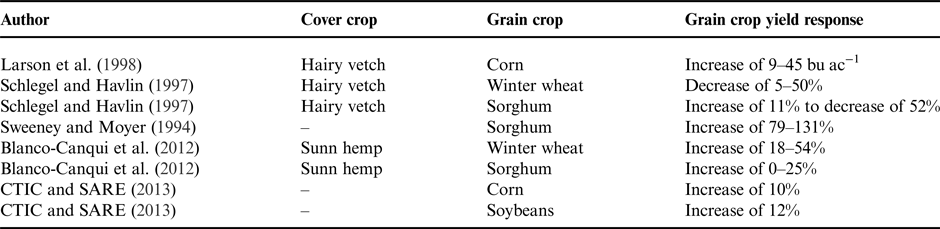
Higher cash-crop yields may be possible for some cover crops. Hairy vetch has been found to be consistently profitable in small-grain rotations (Lu et al., Reference Lu, Watkins, Teasdale and Abdul-Baki2000; Snapp et al., Reference Snapp, Swinton, Labarta, Mutch, Black, Leep, Nyiraneza and O'Neil2005). Using experiment-station test plots, Larson et al. (Reference Larson, Roberts, Tyler, Duck and Slinksy1998) found Tennessee no-till corn yields across five N rates [0–224 kg ha−1 (0–200 lbs ac−1)] favored a hairy-vetch cover crop opposed to no cover crop at each application level. Average yield increases were as much as 2.82 Mg ha−1 (45 bu ac−1) at 0 kg of N and as small as 0.50 Mg ha−1 (9 bu ac−1) at 168 kg (150 lbs) (Larson et al., Reference Larson, Roberts, Tyler, Duck and Slinksy1998). These results support the idea that N exhibits decreasing marginal benefits.
Each producer's situation is unique and so too will be the experience with cover crops. Schlegel and Havlin (Reference Schlegel and Havlin1997) found substantial declines in wheat yield following hairy vetch as a summer cover crop in the Central Great Plains. Their study focused on green manure crops, which invariably draws more water from the soil, causing the following cash crop to be deficient in an area that receives minimal rainfall (Schlegel and Havlin, Reference Schlegel and Havlin1997). Declines in soil health also result from green manure practices due to the use of soil inversion for termination.
Sweeney and Moyer (Reference Sweeney and Moyer1994) found sorghum yields following a winter-legume cover crop on Eastern Great Plains soils were 79–131% higher than on fields with no cover crop. Blanco-Canqui et al. (Reference Blanco-Canqui, Claassen and Presley2012) found that at 0 kg N ha−1, grain sorghum (Sorghum bicolor) yields following sunn hemp were 1.18–1.54 times that for grain sorghum in no-cover-crop plots. At the same location and N application rate, Blanco-Canqui et al. (Reference Blanco-Canqui, Claassen and Presley2012) found wheat yields following sunn hemp to be 1–1.25 that of no-cover-crop plots. These results are primarily from the use of legume cover crops, which have been indicated in other research as a more profitable cover-crop option (Lu et al., Reference Lu, Watkins, Teasdale and Abdul-Baki2000; Snapp et al., Reference Snapp, Swinton, Labarta, Mutch, Black, Leep, Nyiraneza and O'Neil2005). Many of these studies included small plot research, which may be different than actual on-farm performance.
During the winter of 2012–2013, the CTIC and the SARE collected more than 750 responses to a cover-crop survey. Respondents reported an average corn yield of 7.91 Mg ha−1 (126 bu ac−1) on fields where cover crops were used, compared with 7.22 Mg ha−1 (115 bu ac−1) without cover crops. For soybeans, yields averaged 3.16 Mg ha−1 (47 bu ac−1) after cover crops and 2.82 Mg ha−1 (42 bu ac−1) without. The study also found that producers using cover crops in the worst drought areas saw 0.69 Mg ha−1 (11 bu ac−1) higher corn yields and 0.38 Mg ha−1 (5.7 bu ac−1) higher soybean yields (CTIC and SARE, 2013). While these statistics are promising, it should be noted that they do not necessarily indicate a positive causal impact of cover crops on cash-crop yields. Rather, it may be that farmers with higher yields may be more likely to adopt cover crops, potentially because they have higher incomes. Arbuckle and Roesch-McNally (Reference Arbuckle and Roesch-McNally2015) provide some evidence that higher gross farm sales increase the likelihood of cover-crop adoption. However, cover crops have been shown to stabilize yields over time, a benefit to risk-averse producers (Bergtold et al., Reference Bergtold, Terra, Reeves, Shaw, Balkcom and Raper2005; Snapp et al., Reference Snapp, Swinton, Labarta, Mutch, Black, Leep, Nyiraneza and O'Neil2005), especially during periods of extreme weather.
Soil protection
Continual erosion of topsoil on bare lands by wind and water results in reduced long-term productivity of agricultural land (Lu et al., Reference Lu, Watkins, Teasdale and Abdul-Baki2000; Uri, Reference Uri2001; Goddard et al., Reference Goddard, Zoebisch, Gan, Ellis, Watson and Sombatpanit2008). Erosion also leads to public concern regarding social costs caused by chemical and sediment runoff, natural resource depletion and pesticide residues in food supplies (Lu et al., Reference Lu, Watkins, Teasdale and Abdul-Baki2000). Thus, eliminating bare ground from agricultural production—a benefit provided by cover cropping—is essential to successful conservation farming (Goddard et al., Reference Goddard, Zoebisch, Gan, Ellis, Watson and Sombatpanit2008). Cover crops slow erosion by providing physical cover that protects soil from rain and wind (Lu et al., Reference Lu, Watkins, Teasdale and Abdul-Baki2000).
Year-round ground cover provided by cover-crop residue on crop-producing fields can also increase SOM (Larson et al., Reference Larson, Roberts, Jaenicke and Tyler2001; Sainju and Singh, Reference Sainju and Singh2001). This in turn increases soil aggregation (binding of soil particles into large aggregates), which contributes to soil tilth by improving aeration, rainwater infiltration and water-holding capacity (Lu et al., Reference Lu, Watkins, Teasdale and Abdul-Baki2000; Sullivan, Reference Sullivan2003). Improved soil health leads to increased soil productivity and improved cash-crop performance.
Nutrient cycling and fertilizer cost savings
Cover crops can lead to substantial input cost savings for the following cash crop by adding or recovering nutrients. It is important to note that cover crops may not always provide nutrients in forms usable to following cash crops, but certain species have been shown to provide supplemental nutrients. Legume cover crops such as hairy vetch, soybeans, sunn hemp and winter peas (Pisum sativum L.) can provide 45–224 kg ha−1 (40–200 lbs ac−1) of available N for cash crop production, depending on availability of nutrients in the soil (Lu et al., Reference Lu, Watkins, Teasdale and Abdul-Baki2000). A producer looking to optimize cash-crop fertilization rates should ‘credit’ some percentage of the fixed N provided by the cover crop and reduce applied N by the same amount (Bergtold et al., Reference Bergtold, Duffy, Hite and Raper2012).
Legume cover crops have the potential to fix atmospheric N into the soil for future crop uptake, but the range of available N in the soil varies greatly (Lu et al., Reference Lu, Watkins, Teasdale and Abdul-Baki2000). Sunn hemp has shown the ability to fix more than 112 kg ha−1 (100 lbs ac−1) in Kansas climates, with up to 50% readily available to the following cash crop (Mansoer et al., Reference Mansoer, Reeves and Wood1997). Hairy-vetch N fixation has been measured between 101 and 224 kg ha−1 (90–200 lbs ac−1), while soybeans are routinely assumed to give producers a 1.1 kg ha−1 (1 lb ac−1) of credit for each 27.2 kg (60 lbs or 1 bu) produced (SARE, 2013; NRCS, 2002). In a West Tennessee study, Roberts et al. (Reference Roberts, Larson, Tyler, Duck and Dillivan1998) found that no-till corn yields following hairy vetch could be maintained with up to 20% [40 kg ha−1 (36 lbs ac−1)] less applied N compared with following a wheat cover crop and 12% [24 kg ha−1 (21 lbs ac−1)] less than following a no-cover chemical-fallow system. The amount of N available can be increased by incorporating residue into the soil, but tillage can also place the N too deep and out of the cash-crop's root zone (SARE, 2013).
Producers who do not reduce their N application rate in accordance with available legume-fixed N may be failing to gain the fertilizer benefit of raising the legume altogether (Larson et al., Reference Larson, Roberts, Tyler, Duck and Slinksy1998; Johnson and Raun, Reference Johnson and Raun2003). However, multiple studies have shown that with a corn cash crop, even cover crops that fix large amounts of N cannot replace all applied fertilizer (Power et al., Reference Power, Doran and Koerner1991; Lu et al., Reference Lu, Watkins, Teasdale and Abdul-Baki2000; Snapp et al., Reference Snapp, Swinton, Labarta, Mutch, Black, Leep, Nyiraneza and O'Neil2005). Cost savings are highly dependent on fertilizer prices; and N prices would have to greatly increase in order for legume cover crops to become a viable economic substitute for applied N (Power et al., Reference Power, Doran and Koerner1991; Snapp et al., Reference Snapp, Swinton, Labarta, Mutch, Black, Leep, Nyiraneza and O'Neil2005). Mallory et al. (Reference Mallory, Posner and Baldock1998), conducting on-farm trials in Wisconsin, found that while legume cover crops could provide a significant amount of N, they may not be an economical alternative to N fertilizer. Lichtenberg et al. (Reference Lichtenberg, Hanson, Decker and Clark1994) found that a hairy-vetch/corn rotation provided small savings in N relative to other cover crop/corn and fallow/corn rotations, potentially due to improved N uptake and increases in the marginal productivity of N use.
In a study using hairy vetch, Larson et al. (Reference Larson, Roberts, Tyler, Duck and Slinksy1998) found the highest expected net return came from using the cover crop and an application of 168 kg N ha−1 (150 lbs N ac−1). This combination was found to be more profitable than any practice using 224 kg N ha−1 (200 lbs N ac−1) of applied N, implying decreasing marginal returns of N fertilizer (Larson et al., Reference Larson, Roberts, Tyler, Duck and Slinksy1998). These results point to the importance of accurately estimating N fixation amounts to avoid excessive fertilizer applications (Larson et al., Reference Larson, Roberts, Jaenicke and Tyler2001; Bergtold et al., Reference Bergtold, Duffy, Hite and Raper2012). Simply stated, if producers do not credit fixed N to the total desired amount for the cash crop, then no fertilizer savings may be realized (Bergtold et al., Reference Bergtold, Duffy, Hite and Raper2012).
Legume cover crops also decompose more rapidly due to their low C to N ratio, increasing the speed of nutrient availability (Lu et al., Reference Lu, Watkins, Teasdale and Abdul-Baki2000). Non-legume cover crops, such as cereal rye, can ‘scavenge’ for nutrients that have leached to the lower part of the root zone, rescuing potentially lost nutrients (Snapp et al., Reference Snapp, Swinton, Labarta, Mutch, Black, Leep, Nyiraneza and O'Neil2005). In essence, non-legumes can act as a recycling mechanism for nutrients by taking up nutrients, which remain in the residue following termination. As residues break down, the scavenged nutrients become available for uptake by later cash crops (Lu et al., Reference Lu, Watkins, Teasdale and Abdul-Baki2000; Snapp et al., Reference Snapp, Swinton, Labarta, Mutch, Black, Leep, Nyiraneza and O'Neil2005). The gradual breakdown process extends the period of active nutrient uptake, meaning cash crops have steady access to vital nutrients for a longer period (Singer and Kasper, Reference Singer and Kaspar2006). While it is important to note that these benefits depend upon nutrient release timing coinciding with the timing of crop nutrient needs, these processes may improve soil and cash-crop productivity over time and thus increase cash-crop yields and revenues.
Despite knowledge of N from cover crops, many producers are not willing to alter fertilizer-application rates. This risk-averse behavior is common among producers and stems partly from uncertainty in predicting N mineralization and availability from a cover crop (Bergtold et al., Reference Bergtold, Duffy, Hite and Raper2012). Some producers view the fixed N as a type of insurance against under-application, rather than optimizing the combined N rates (Snapp et al., Reference Snapp, Swinton, Labarta, Mutch, Black, Leep, Nyiraneza and O'Neil2005; Bergtold et al., Reference Bergtold, Duffy, Hite and Raper2012). In this instance, cover-crop profitability is solely dependent upon increasing cash-crop revenues via higher yields (Lu et al., Reference Lu, Watkins, Teasdale and Abdul-Baki2000; Snapp et al., Reference Snapp, Swinton, Labarta, Mutch, Black, Leep, Nyiraneza and O'Neil2005).
Weed control and herbicide savings
Weed control is another benefit of adding cover crops to a rotation. Cover crops compete with weeds for water, nutrients and sunlight; and some release natural (allelopathic) chemicals harmful to weeds (Liebl et al., Reference Liebl, Simmons, Wax and Stoller1992; Lu et al., Reference Lu, Watkins, Teasdale and Abdul-Baki2000). Rye and other high-biomass crops are good options for creating an environment that steals growth requirements from weeds (Lu et al., Reference Lu, Watkins, Teasdale and Abdul-Baki2000). Weed control can possibly allow a producer to forego one to two herbicide treatments on the following cash crop (Morton et al., Reference Morton, Bergtold and Price2006), but effects likely will not last the entire cash-crop growing season (Lu et al., Reference Lu, Watkins, Teasdale and Abdul-Baki2000). Even so, weed control has the potential for cash-crop production savings (Lu et al., Reference Lu, Watkins, Teasdale and Abdul-Baki2000).
When properly terminated with a roller crimper, high-residue cover crops add another dimension to no-till production, the ‘residue mat’. Residue mats minimize rainfall erosion, help maintain a constant soil temperature and decrease weed emergence (Morton et al., Reference Morton, Bergtold and Price2006). Teasdale and Mohler (Reference Teasdale and Mohler2000) found that increasing levels of biomass (residue mats achieve nearly complete light extinction) resulted in exponentially decreasing rates of weed emergence.
Reddy (Reference Reddy2003) found that a rye cover crop in Mississippi reduced total weed density 9–27%, and total weed biomass 19–38% across different tillage systems. This decrease may not fully eliminate the need for an herbicide pass, but could lower costs by reducing herbicide rates. Morton et al. (Reference Morton, Bergtold and Price2006), assuming that a pre-emergent herbicide was not applied to the cash crop, found break-even biomass levels for Alabama producers to be 5.57 Mg ha−1 (2.48 tons ac−1) for rye and 3 Mg ha−1 (1.34 tons ac−1) for crimson clover. Both biomass levels mentioned are well within the capability of either crop (SARE, 2013). Crimson clover has dry-matter biomass levels of 3.92–6.17 Mg ha−1 (1.75–2.75 tons ac−1); rye produces 3.36–11.21 Mg ha−1 (1.5–5 tons ac−1) (SARE, 2013). Herbicide savings will depend on the cash crop being planted, the type of cover crop selected and management of cover-crop biomass production.
Reduced tillage operations
Cover-crop benefits can also be mechanical. Root systems of certain cover crops, especially those that create significant below-ground biomass, act as a form of natural tillage (Lu et al., Reference Lu, Watkins, Teasdale and Abdul-Baki2000). Brassicas provide natural tillage with roots that can break through soil hardpans, creating pathways for water and nutrients (Raper and Kirby, Reference Raper and Kirby2006). By reducing compaction through deep rooting, cover crops can help to reduce or eliminate the need for deep tilling (Pratt et al., Reference Pratt, Tyner, Muth and Kladivko2014). Brassicas can also improve soil structure, which may help prevent compaction from occurring in the first place.
Biofuel feedstock potential
In addition to agronomic and environmental benefits, cover-crop residues can generate revenue when sold as biofuel feedstocks (Anand, Reference Anand2010). Demand for these biofuel feedstocks is primarily driven by the Renewable Fuel Standard, which mandates that 136.27 billion L (36 billion gal) of renewable fuel be blended into transportation fuel by 2022, of which 60.57 billion L (16 billion gal) are to come from cellulosic biofuels (U.S. Congress, 2007). The incorporation of cover crops may allow producers to generate biofuel revenue by (1) allowing for the harvest of residue from a cash crop such as corn or (2) harvesting cover-crop residue for biofuel feedstock.
Corn stover is expected to be a primary source of biofuel feedstocks because it is readily available and has a high cellulosic content (Pratt et al., Reference Pratt, Tyner, Muth and Kladivko2014). However, these residues aid in soil health and thus their removal raises concerns (Pratt et al., Reference Pratt, Tyner, Muth and Kladivko2014). Pratt et al. (Reference Pratt, Tyner, Muth and Kladivko2014, p. 67), conducted an analysis to examine the extent to which ‘cover crop costs could be compensated by additional stover removal and additional agronomic benefits from the use of cover crops’. The authors found that at a stover price of US$66.14 tonne−1 (US$60 ton−1), net benefits ranged from a loss of US$3.78 ha−1 (US$1.52 ac−1) for hairy vetch to a benefit of US$80.28 ha−1 (US$32.49 ac−1) for annual ryegrass (Pratt et al., Reference Pratt, Tyner, Muth and Kladivko2014). The study also found the probability of negative net benefits to be approximately zero at a stover price of US$66.14 except for hairy vetch for which the probability was 58.2% (Pratt et al., Reference Pratt, Tyner, Muth and Kladivko2014). In another study, Bonner et al. (Reference Bonner, Muth and Koch2014) estimated that the cover crops could increase by 51% the amount of corn stover that could be sustainably harvested in states such as Nebraska, Iowa, Illinois, Indiana and Minnesota.
Anand (Reference Anand2010) suggests cover crops themselves could be harvested as biofuel feedstock and still provide conservation benefits. Harvesting some of the cover crop as a biofuel feedstock would also allow for the cash-crop residue to remain in the field. This would retain residue benefits and may also be important for producers receiving cost-share payments for no-till practices, which often entail certain requirements on the amount of residue left in the field (Anand, Reference Anand2010). Conversely, the removal of cover-crop residues as biofuel feedstocks by many definitions would no longer be considered cover cropping. In this case, producers may not meet requirements for cover-crop payments through cost-share programs.
Indirect Benefits
The incorporation of cover crops also has the potential to provide indirect services (and benefits), which are difficult to place a monetary value on. Such services include increased SOM and reduced erosion. Valuing these services is difficult, largely because they provide benefits to landowners and society at large. As with most positive externalities, there are not established markets for cover-crop benefits that accrue to society. Current literature on the valuation of cover crops benefits is scarce. Additionally, benefits provided to landowners are often indirect, adding to the difficulty of valuing these services and in helping landowners to see these values.
Increases in SOM—a product of decomposed cover-crop dry matter—can be used as a proxy for soil health, soil carbon and nutrient content (Pratt et al., Reference Pratt, Tyner, Muth and Kladivko2014). Improved SOM can benefit the famer through increased productivity or sustainability, but also society as a whole through mechanisms such as C sequestration (Schipanski et al., Reference Schipanski, Barbercheck, Douglas, Finney, Haider, Kaye, Kemanian, Mortensen, Ryan, Tooker and White2014). Pratt et al. (Reference Pratt, Tyner, Muth and Kladivko2014) estimate cover-crop SOM benefits of US$50.59 ha−1 (US$20.47 ac−1) for oilseed radish (Raphanus sativus L.) to US$108.42 ha−1 (US$43.88 ac−1) for crimson clover. These values do not include benefits from stored carbon.
Soil erosion—the loss of topsoil as the result of wind or water processes—can lead to degradation of aquatic ecosystems and agricultural land (Schipanski et al., Reference Schipanski, Barbercheck, Douglas, Finney, Haider, Kaye, Kemanian, Mortensen, Ryan, Tooker and White2014). This is one of the primary resource concerns of harvesting crop residue (Bonner et al., Reference Bonner, Muth and Koch2014) and may be a concern during fallow periods or for producers not practicing no till. Soil erosion costs farmers indirectly through declines in future productivity and can cost society at large due to the siltation of reservoirs, enhanced flooding risks and loss of wildlife habitat, among others (Colombo et al., Reference Colombo, Hanley and Calatrava-Requena2005). Cover crops have the potential to reduce erosion by lessening the impacts of rain and wind while alive and after termination if residue is left in the field.
Schipanski et al. (Reference Schipanski, Barbercheck, Douglas, Finney, Haider, Kaye, Kemanian, Mortensen, Ryan, Tooker and White2014) estimate that cover crops provide a broad suite of services including biomass production, N supply, soil-carbon storage, NO3 retention, erosion control, weed suppression, arbuscular mycorrhizal fungi colonization and beneficial-insect conservation. Each of these may provide a benefit to either landowners or society, but the benefits are often indirect and inter-related and thus are difficult to value monetarily. However, producers should be aware of and consider all impacts of cover-crop adoption, which go beyond a here-and-now perspective.
Risk and Crop Insurance
Chavas (Reference Chavas2004; p. 5) defines risk as ‘representing any situation where some events are not known with certainty’. For cover-crop adoption, risk is predominantly encountered within the context of economic performance and may be transmitted through several channels. Direct impacts, such as establishment costs, cash-crop yields and impacts from unrelated events such as weather, will determine whether cover-crop adoption results in a positive or negative economic outcome. Cover crops are also complex in the sense that there is much to learn before they can be competently managed (Pannell, Reference Pannell1999a, Reference Pannellb), which can be another source of risk for producers.
Prior to adoption, producers cannot know with certainty whether cash-crop yields will increase or decrease, or whether input savings (e.g., reduced herbicide or N costs) will be realized. Both positive and negative impacts on cash-crop yields can be found in the literature (see Table 2), and the outcome for a particular producer is likely to be dependent upon management and farm characteristics, among other factors. Moreover, economic gains or losses will be dependent on the cash-crop price and input prices for cash and cover crops. These factors can be viewed as increasing short-run risk, or current growing-season risk, for producers and can be an obstacle to adoption.
Cover-crop impacts on following grain crop yields.

Conversely, cover crops may be able to provide a reduction in long-term risks if continual use results in a stabilization of cash-crop yields. Increased yield stability in the long run would help with farm planning and may become more important as concerns mount over climate change. Due to these dynamics, producers may therefore be faced with a trade-off between short- and long-term risks when deciding whether or not to adopt cover crops.
The primary tool for producers to alleviate concerns of risk is the Federal Crop Insurance Program (FCIP). Through FCIP, producers are able to obtain protection from certain levels of declines in either revenue or production. Cover crops can be incorporated without unduly impacting crop-insurance eligibility, so this program could ease producer fears regarding cover-crop risks. This was not always the case, and so the change to current eligibility rules represents the removal of one barrier to cover-crop adoption. The use of cover crops may in turn impact the level of insurance coverage desired by producers. For example, following the 2012 drought, farmers using cover crops with corn experienced yields of about 79% of typical yields, while those not using cover crops experienced yields of about 68% of typical yields (O'Connor, Reference O'Connor2013). In this situation, the average producer using cover crops insured at the 75% yield level would not have received indemnity payments. Thus, for producers where this result is typical, the use of cover crops may induce the selection of higher coverage levels.
In recent years, there has been public and thus political pushback to lump sum transfers, such as direct payments, to farmers. As a result, agricultural support is moving away from income transfers toward policies that target risk and volatility in production. The 2014 Farm Bill eliminated direct payments while retaining federal crop insurance. Even prior to the 2014 Farm Bill, the importance of crop insurance subsidies was on the rise. For example, premium subsidies to Kansas producers grew from US$10.7 million in 1989 to US$403.7 million in 2014, while insured land in Kansas over the same time period had increased from 2.59 to 7.61 million hectares (6.4–18.8 million acres) (RMA, 2016).
As crop insurance and associated subsidies become more important for producers, they need to understand how their eligibility may be impacted if they decide to use cover crops. Specifically, producers need to understand cover-crop termination requirements. According to the Risk Management Agency, ‘Insurance shall attach to a crop following a cover crop when the cover crop meets the definition provided in the Basic Provisions, was planted within the last 12 months, and is managed and terminated according to NRCS guidelines…(RMA, 2015; para. 4)’.
The Natural Resources Conservation Service (NRCS) termination guidelines vary based on the management zone location of a producers’ land. For example, four types of management zones exist in Kansas. Termination dates range from at least 35 days prior to planting the crop for southwest Kansas counties in zone 1 to within 5 days after planting but prior to crop emergence for eastern Kansas counties in zone 4. If the cover crop is part of a no-till system, termination can be delayed for up to 7 days from baseline dates, but must be terminated prior to crop emergence. Additional considerations may apply, so producers should consult the guidelines or their local NRCS representative (NRCS, 2014).
Additionally, a Special Provisions statement ensures that haying or grazing a cover crop within or prior to the late planting period will not impact prevented-planting coverage for the following crop. To maintain eligibility for a prevented-planting payment, haying or grazing must not contribute to planting prevention (RMA, 2015).
Policy Incentives
Conservation programs are offered at many levels, e.g., federal, state or county. Through many of these programs, farmers may be able to receive cost-share or subsidy payments to implement various conservation practices. A common goal of these programs is the provision of environmental protection or enhanced ecosystem services for public benefit, which may be lost without these programs. Subsidy programs may be very important for promoting cover-crop adoption. Lichtenberg (Reference Lichtenberg2004) estimated that a 1% increase in the cost of using a cover crop would decrease the probability of adoption by 14% for Maryland farmers. In 2005, 56% of Corn Belt farmers said they would plant cover crops if a government cost share of at least US$56 ha−1 (US$23 ac−1) was available (Singer et al., Reference Singer, Kohler and McDonald2007a, Reference Singer, Nusser and Alfb). Marshall (Reference Marshall2012) estimated subsidies of US$37–74 ha−1 (US$15–30 ac−1) would significantly increase adoption, dependent upon how much N is credited from legumes. As a final example, Ramirez et al. (Reference Ramirez, King and Arbuckle2015) found a cost-share program would increase both the likelihood of farmers adopting and the proportion of total land on which cover crops are used (Ramirez et al., Reference Ramirez, King and Arbuckle2015).
Studies like the ones above underscore the cost sensitivity shared by many producers. To combat this, cost-share incentives have been offered by state and federal agencies. For example, in recent years, the Maryland Department of Agriculture paid an average of US$61.78 ha−1 (US$25 ac−1) for harvested cover crops and US$111.20–185.25 ha−1 (US$45–75 ac−1) for traditional cover crops on an annual basis (Maryland Department of Agriculture, 2017). At the national level, cost-share payments are available from USDA's NRCS through programs such as the Environmental Quality Incentives Program (EQIP) or the Conservation Stewardship Program (CSP). For example, in fiscal year 2017, EQIP financial assistance in Kansas ranges from US$123.87 to 205.76 ha−1 (US$61.50–222.03 ac−1) depending on whether one or multiple species are planted and whether the system is organic. These payments are only intended to cover a portion of the total cost to farmers, but they often include indirect costs such as foregone income as well. When cover crops are used between cash crops in rotation, producers are able to receive up to five payments during a contract term, which is typically 3 yr (i.e., cover crops must used on the farm for 3 consecutive yr). Under CSP, payment rates vary according to whether the practice is new or already in place, as well as other ranking factors. Program specifics and incentive payment levels for both EQIP and CSP vary by state and county (NRCS, 2015). We refer the reader to the USDA-NRCS website for specifics (https://www.nrcs.usda.gov/wps/portal/nrcs/site/national/home/).
Cover-crop profitability may require policy support such as EQIP to lessen production costs even when taking into account cost savings for cash-crop production (Lu et al., Reference Lu, Watkins, Teasdale and Abdul-Baki2000; Bergtold et al., Reference Bergtold, Duffy, Hite and Raper2012). Using average yearly spot prices for crops in Alabama from 2001 to 2003, Bergtold et al. (Reference Bergtold, Terra, Reeves, Shaw, Balkcom and Raper2005) found net returns for cotton production to be US$111.20–172.97 ha−1 (US$45–70 ac−1) higher using a high-residue cover crop and conservation tillage compared with systems using tillage and no cover crop. Under the same regime, net returns for corn exceeded those from a conventional system during a drought year (2002). Bergtold et al. (Reference Bergtold, Terra, Reeves, Shaw, Balkcom and Raper2005) take into account a US$90 ha−1 (US$40 ac−1) cost share for maintaining 50% or greater soil coverage for a 3-yr period, which was obtainable through EQIP. Without the EQIP payment, even the 2002 results would have favored the conventional cropping system by nearly US$54.36 ha−1 (US$22 ac−1).
Trialing of new practices on the farm is the most important phase when considering the adoption of agricultural innovations or practices (Pannel, Reference Pannell1999a, Reference Pannellb). Conservation programs create a reduced-risk environment in which to trial cover crops on-farm, allowing producers to adjust management skills to achieve profitability (Pannel, Reference Pannell1999a, Reference Pannellb). Furthermore, use of other conservation practices is a significant factor of adoption. Farmers already practicing conservation tillage are more likely to trial and see the benefits of cover crops due to past experience (Bergtold et al., Reference Bergtold, Duffy, Hite and Raper2012). Reimer et al. (Reference Reimer, Weinkauf and Prokpy2012) found that annual ryegrass (Lolium perenne) was seen as beneficial by producers practicing no-till due to its deep-root system.
Economic Performance
The potential for profitable application of cover crops in Kansas and other areas is promising. While results are contingent upon many variables, Table 3 provides an estimate of the profitability of a hairy-vetch cover crop prior to dryland and irrigated corn, using relatively conservative cost estimates and returns for Kansas. These results can differ substantially by location, management and weather. Fixed costs and opportunity costs are not accounted for in Table 3. Opportunity costs would possibly include the cost of a foregone cash crop, fixed costs of cover-crop production and the potential for winter-annual grazing. The estimates show a return to cover crops in irrigated corn of US$17.40 ha−1 (US$7.04 ac−1). While the dryland scenario does not show a positive return, only 10% of the available N from the cover crop is being credited to the cash crop. This is a conservative estimate based on the research of Johnson and Raun (Reference Johnson and Raun2003) who found that 33% is commonly used for uptake of applied N, while organic N has a higher percentage. Assuming 20% of the available fixed N is actually used by the dryland cash crop raises the net return from − US$69.21 ha−1 (−US$28.01 ac−1) to −US$49.50 ha−1 (−US$20.03 ac−1). In addition, there is the possibility of receiving EQIP or CSP payments, which would further increase returns to cover-crop use.
Net returns to hairy vetch cover crop in dryland and irrigated corn production systems.

Planting costs are based on Kansas custom rate projections (Dhuyvetter, Reference Dhuyvetter2014). This should be taken as a base cost subject to change based on an individual farmer's situation and preferences. Planting and seeding costs could be reduced in subsequent years if a farmer opts for a self-seeding cover-crop system. Termination costs are based on either a roller-crimper or burn-down scenario. These costs could potentially be reduced under a winter-kill scenario. Other considerations include the potential of reduced herbicide costs due to smothering, allelopathic and light-interception effects that cover crops may provide. In fact, as time progresses, weed activity overall may decrease. Weed seed-bank density due to rye and clover cover crops decreased 25% and 22%, respectively, over control plots in a 7-yr study by Moonen and Barberi (Reference Moonen and Barberi2004). Benefits beyond the fixed N are consistent and proven with cover-crop use.
Each producer will weigh the trade-offs differently, but there is evidence that cover crops can be managed profitably. Thus, cover crops should be viewed as a cash-crop investment in the same manner that producers currently view fungicide applications, a second N application late in the season or the use of precision-application equipment. With an investment perspective in mind, producers should realize that there may be a trade-off between negative short-term outcomes and positive long-term outcomes.
Summary and Conclusions
The profitability of cover crops is affected by several factors such as establishment, management and productivity of the following cash crop. Each of these on its own has the potential to push returns from crop production toward the red or black. However, a positive return to cover crops for producers seems to be a definite possibility, especially if the cover crop replaces a fallow period as opposed to a cash crop. In addition, the inclusion of cover crops should help to promote the long-term sustainability of the farm, even if immediate net returns are not positive. Each producer's situation will be unique due to style of management, aversion to risk and characteristics specific to the producer and the farm. Ultimately, each producer will need to weigh the benefits, costs and other economic considerations. In doing so, they should seek knowledge from experts or producers who have already adopted and trialed with cover crops.
The economic outcome from cover-crop adoption is going to vary based on factors under the farmer's control—cover-crop species, management decisions, etc.—as well as factors not under the farmer's control—soil types, weather, etc. In addition, there is likely to be an important time component to cover-crop profitability and viability. This component will be a function of gradual changes in the physical and biological cropping environment, as well as a farmer's knowledge and abilities with respect to managing cover crops. While positive outcomes are not uncommon in the literature, the complex nature of this outcome leads to a high degree of uncertainty for each farmer's unique situation. While much small-plot research has been conducted with cover crops in a wide variety of cropping systems, it is important that farmers conduct their own on-farm research to address the issues of interest and pertinence regarding cover crops to them and their cropping system.
Cost-share, subsidy or other conservation programs provide a means of easing farmers’ financial concerns about cover crops. Specifically, incentives and cost-share mechanisms can provide a buffer or protection against negative profit scenarios, helping to remove a major barrier to adoption. Keeping in mind the uniqueness of each farmer's situation, policy makers may also want to build programs with as much flexibility as possible, keeping in mind the myriad of unique circumstances farmers face across the USA. Programs that would allow farmers to tailor cover-cropping plans to their operations, goals and preferences (e.g., regarding risk) may help make conservation practices, such as cover crops, a more attractive option.
Many opportunities still exists to conduct research on cover crops across the USA, regarding how they fit into crop rotations, the level of returns that can be expected and what the preferred strategies are under varying levels of risk. The agricultural landscape has a wide variety of local climates and environmental conditions, which will undoubtedly result in differing levels of success when cover crops are applied. By furthering the research in these areas, producers will have access to additional resources and be better equipped to decide whether or not to use cover crops on their farms.
Acknowledgements
Funding and graduate student support for this review was partially provided by CNH: Coupled Climate, Cultivation and Culture in the Great Plains: Understanding Water Supply and Water Quality in a Fragile Landscape, NSF, CNH Award #1313815.