Despite clinical and scientific interest in the developmental morbidity of children with CHD who undergo neonatal or infant surgery, few prospective, standardised reports of motor outcomes have been reported beyond the infant years.Reference Bellinger, Wypij and Rivkin 1 – Reference Goldberg, Schwartz and Brunberg 5 The prevalence of severe motor problems in children with CHD – for example, cerebral palsy – is low. In the pre-school years, children with CHD generally learn to walk, run, and jump, although at a slower rate than their peers;Reference Snookes, Gunn and Eldridge 6 however, previous studies suggest that a portion of these children will have minor motor problems such as balance difficulties and coordination impairments. Such impairments have been described in specific cardiac populations – for example, children with transposition of the great arteries,Reference Bellinger, Wypij and Kuban 7 single ventricle lesions,Reference Hovels-Gurich, Seghaye, Dabritz, Messmer and von Bernuth 4 and other select mixed cohorts.Reference Majnemer, Limperopoulos, Shevell, Rosenblatt, Rohlicek and Tchervenkov 3 These impairments are concerning because of the potential risk for reduced participation in recreational activities leading to later risks of a more sedentary lifestyle, as well as isolation from same-age peers.
The aim of this study was to further describe motor outcomes for children with CHD who – rather than having a specific cardiac diagnosis – were homogeneous in having undergone early infant cardiac surgery. We describe 5-year motor outcomes for this group, having previously assessed them throughout infancy; results from these longitudinal infant studies have been reported previously.Reference Long, Harris, Eldridge and Galea 8 We hypothesised that children who were categorised as having atypical or suspicious motor development in infancyReference Long, Harris, Eldridge and Galea 8 would have ongoing motor problems at age of school entry. A secondary analysis was performed to identify potentially modifiable risk factors or confounders for gross motor impairment at 5 years of age.
Materials and methods
A prospective cohort of 50 children with CHD, who underwent cardiac surgery in the first 2 months of life (median age 9 days, interquartile range from 4 to 21 days) between July, 2006 and January, 2008, was recruited for the initial infant studies. Infants with known chromosomal abnormalities or congenital syndromes, such as the 22q deletion spectrum or Down syndrome, were excluded from participation, as were families in which the primary caregiver did not speak English, and families who lived >100 km outside the Melbourne metropolitan area. Gross motor assessments with the Alberta Infant Motor Scale were performed at 4, 8, 12, and 16 months of age, and a neurodevelopmental assessment using the Bayley Scales of Infant and Toddler Development, third edition, was conducted at 2 years of age. The methods used and the results have been reported previously.Reference Long, Harris, Eldridge and Galea 8 , Reference Long, Galea, Eldridge and Harris 9 The present study reports the follow-up at 5 years of age of this same cohort, which was approved by the Human Research and Ethics Committee of the Royal Children’s Hospital, Melbourne, Australia (approval # 32035). A total of 47 children from the initial cohort were eligible to participate in this study; two study patients died – one at 7 months and one at 4.5 years of age – and one other study patient was recruited to, but did not participate in, the infant study.
Families were invited to participate in a battery of hospital-based motor assessments when their children were 5 years of age; assessments were spaced over a 60- to 90-minute period with rest-breaks based on individual needs. A paediatric physiotherapist (S.L.) conducted recruitment; the primary caregiver gave his or her signed informed consent to participate. A physiotherapist blinded to the medical and surgical history of the children, as well as to gross motor development results throughout infancy, evaluated the patients. A second physiotherapist attended and documented test outcomes in real-time.
Outcome measures
Motor proficiency was evaluated using the Bruininks–Oseretsky Test of Motor Proficiency Brief Form, second edition. This norm-referenced screening tool measures gross and fine motor skills of children (ages 4 to 21) with mild-to-moderate motor control problems, in as little as 20 minutes, making it ideal for children with endurance or attention limitations.Reference Bruininks and Bruininks 10
Secondary outcome measures were chosen to identify impairments that may impact overall motor proficiency, including more detailed assessments of balance, range of movement, and endurance. Further details of these assessments are shown below:
-
∙ The Bruininks–Oseretsky Test of Motor Proficiency, second edition, Balance Subtest to evaluate motor control skills integral for maintaining static and dynamic posture.Reference Bruininks and Bruininks 11
-
∙ The Pediatric Clinical Test of Sensory Interaction for Balance to examine visual, proprioceptive, and vestibular inputs and their specific role in maintaining balance.Reference Gagnon, Swaine and Forget 12 Outcome were assessed in both tandem (heel-toe) and single-leg stance (preferred leg).
-
∙ Range of movement and leg length were measured to identify musculoskeletal impairments that may affect postural control, and to identify any imbalances between right and left sides in those infants who were seen to crawl asymmetrically in infancy. Asymmetrical crawling was defined as one-leg weight-bearing at the knee, the other leg in an externally rotated, abducted, and flexed position during the propulsion phase of the crawl – that is, weight bearing at the foot. Passive range measures were carried out using a goniometer and standardised bony landmarks.Reference Clarkson and Gilewich 13
Data collection
Selected surgical, medical, and neurodevelopmental risk factors that may be associated with adverse outcomes were obtained from prospective hospital databases and existing study data. Continuous variables included the following: gestational age; birth weight; infant gross motor outcomes from Alberta Infant Motor Scale total raw scores at 4, 8, 12, and 16 months of age; gross motor scaled score and motor composite score of the Bayley Scales of Infant and Toddler Development, third edition, at 2 years of age; cardiopulmonary bypass time; respiratory support time; and ICU length of stay. Binary variables included the following: gender; cyanotic CHD at birth; cyanotic CHD at 5 years of age; single or biventricular circulation; arch repair at primary surgery; reciprocal or asymmetrical crawl pattern in infancy; low or high social risk according to the Social Risk Index; and achievement of specific gross motor milestones – hands-to-knees at 4 months of age, chin tuck in prone at 4 months of age, sitting at 8 months of age, rolling at 8 months of age, standing at 12 months of age, and walking at 16 months of age. The primary caregiver was asked to complete a questionnaire to obtain socio-demographic information. Social risk was assessed using the Social Risk Index, a composite measure comprising the following six aspects of social status: family structure, education of the primary caregiver, occupation of the primary income earner, employment status of the primary income earner, language spoken at home, and maternal age at birth.Reference Roberts, Howard, Spittle, Brown, Anderson and Doyle 14
Statistical analyses
Data analysis was carried out in STATA IC 13. Descriptive statistics were used to describe binary, categorical, and continuous variables collected throughout the peri-operative, infant, and 5-year periods, as well as primary and secondary outcome measures. Sample size, median, interquartile ranges, and/or ranges are reported.
Hypothesis tests (two sample t-tests, equal variance not assumed) were performed to examine differences in the primary outcome measure (Bruininks–Oseretsky Test of Motor Proficiency Brief Form, second edition) with respect to classification of gross motor development in infancy – atypical or suspicious gross motor development versus typical gross motor development. Study patients were classified as having an overall outcome of atypical, suspicious, or typical gross motor development, based on their serial Alberta Infant Motor Scale results throughout infancy; these methods have been described previously.Reference Long, Harris, Eldridge and Galea 8
Bivariate linear regression was used to describe the association between primary outcome standard scores and each individual continuous risk factor variable. Hypothesis tests (two sample t-tests, equal variance not assumed) were performed to examine primary outcome standard scores and each independent binary variable. Associations were considered statistically significant if p<0.05.
Results
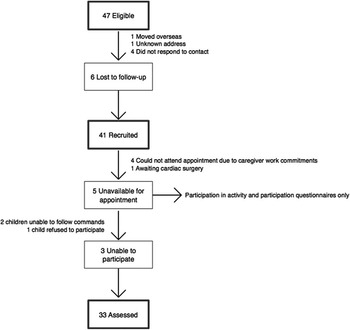
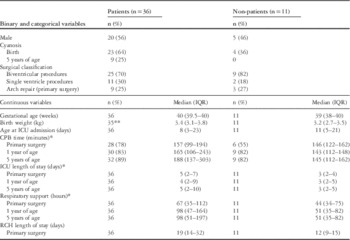
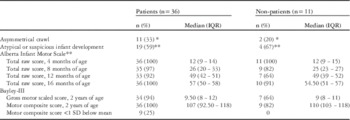
Figure 1 shows the eligibility, recruitment, and participation in this study. A total of 33 children both returned and participated in an assessment for motor proficiency (Fig 1). Characteristics of the study patients differed from those of non-patients in areas of gender, cardiac diagnoses, surgical variables, post-operative respiratory support, and admission lengths – that is, study patients had a relatively more complex medical and surgical history than non-patients (Table 1). Study patients were also more likely to have participated in all five infant assessment sessions compared with non-patients (Table 2).
Eligibility, recruitment and participation.

Study patient characteristics.

CPB=cardiopulmonary bypass; IQR=interquartile range; RCH=Royal Children’s Hospital
* 1 year of age and 5 years of age variables include cumulative data
** Missing data
Study patient versus non-patient infant motor outcomes.

Bayley-III=Bayley Scales of Infant and Toddler Development, third edition; IQR=interquartile range; LE=lower extremity
* Missing data due to some infants not crawling – that is, they used alternate methods of mobility such as a bottom shuffle; 33 patients and 10 non-patients were seen to crawl either symmetrically or asymmetrically
** Due to non-attendance for some Alberta Infant Motor Scale assessments, classification of atypical or suspicious infant development was only possible for 32 patients and six non-patients. Detailed Alberta Infant Motor Scale and Bayley-III methods and results have been reported previouslyReference Long, Harris, Eldridge and Galea 8 , Reference Long, Galea, Eldridge and Harris 9
The assessments were conducted by three senior physiotherapists; two were present during each assessment. The majority of cohort patients (n=22, 67%) was assessed by one physiotherapist and another consistently attended for documentation purposes (n=29, 88%). At assessment, study patients were a mean age of 5 years and 8 months (±3 months).
The Bruininks–Oseretsky Test of Motor Proficiency Brief Form, second edition
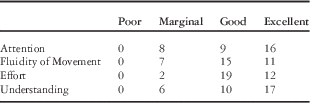
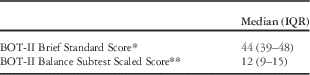
Assessors’ ratings of study patients’ behaviours are presented in Table 3. The median standard score for study patients was within one standard deviation below the normative mean (Table 4). Totally, 11 study patients were categorised as having standard scores more than one standard deviation below the normative mean (below average, 32%), and three had standard scores more than two standard deviations below the normative mean (well below average, 9%). The remaining study patients had average or above-average scores (53 and 6%, respectively).
Assessors’ ratings of behavioural observations: Bruininks–Oseretsky Test of Motor Proficiency Brief Form, second edition (n=33).

Summary outcome data (n=33).

BOT-II=Bruininks–Oseretsky Test of Motor Proficiency, second edition; IQR=interquartile range
* BOT-II Brief Standard Score normative mean±SD=50±10
** BOT-II Balance Subtest normative mean±SD=15±5
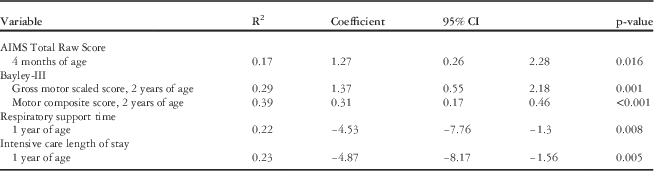
Continuous variables significantly associated with the Bruininks–Oseretsky Test of Motor Proficiency Brief Form, second edition, standard scores included the following: the Alberta Infant Motor Scale total raw scores at 4 months of age, the Bayley scales gross motor scaled scores and motor composite scores at 2 years of age, cumulative respiratory support time, and intensive care length of stay at 1 year of age (Table 5). Cyanotic CHD at 5 years of age was associated with lower scores (p=0.008), as was asymmetrical crawling in infancy (p=0.03). None of the socio-economic or demographic variables were associated with primary outcome standard scores.
Bivariate linear regression, BOT-II brief standard scores (n=33).

AIMS=Alberta Infant Motor Scale; Bayley-III=Bayley Scales of Infant and Toddler Development, third edition; BOT-II Brief=Bruininks–Oseretsky Test of Motor Proficiency Brief Form, second edition
The Bruininks–Oseretsky Test of Motor Proficiency, second edition, Balance Subtest
The median balance sub-test scaled score for study patients was within one standard deviation below the normative mean (Table 4); 10 (30%) study patients were categorised as below average or well below average.
Pediatric Clinical Test of Sensory Interaction for Balance
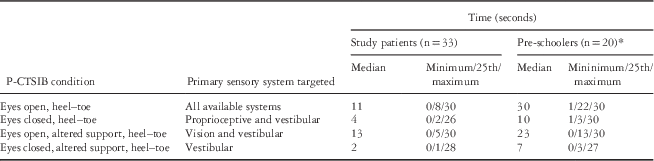
Table 6 shows performance on the tandem-stance aspect of the Pediatric Clinical Test of Sensory Interaction for Balance versus previously published data for children of the same age.Reference Richardson, Atwater, Crowe and Deitz 15
Pediatric Clinical Test of Sensory Interaction for Balance (P-CTSIB).

* Richardson et alReference Richardson, Atwater, Crowe and Deitz 15
Patients could balance for a median time of 9 seconds (interquartile range from 4 to 14 seconds) in single-leg stance with their eyes open, and 3 seconds (interquartile range from 2 to 8 seconds) when the standing support was altered. With eyes closed, study patients could balance in these conditions for a median time of 2 seconds (interquartile range from 2 to 5 seconds) and 2 seconds (interquartile range from 1 to 2 seconds), respectively. The more challenging single-leg stance position highlights reliance on visual sensory information of the study patients to maintain balance at this age.
Range of movement
Median and interquartile range values for all passive range of movement measurements were within normal limits. Differences between median measurements for children who crawled asymmetrically in infancy and those who did not were not significant (<5°), nor were the differences between median measurements taken on the right and left sides.
Discussion
This study has shown that 41% of children who had undergone early cardiac surgery had below-average motor proficiency at 5 years of age. These results are unique in that all patients in our study required cardiac surgery in the early infant period for a range of cardiac diagnoses, with some going on to have further planned cardiac surgical procedures before the time of final assessment. Previous longitudinal studies have focussed on specific cardiac defects – for example, single ventricle lesions – and/or included children who underwent their first surgical procedure after the early infant period.
Despite such differences in cohort characteristics, the rate of motor dysfunction in all studies to date is much higher than rates expected in typical children. Gross and fine motor delays were described in 49.4 and 39%, respectively, of a school-age cohort who had undergone early cardiac surgery.Reference Majnemer, Limperopoulos, Shevell, Rosenblatt, Rohlicek and Tchervenkov 3 These outcomes resulted from an in-depth, norm-referenced motor assessment that was theoretically more sensitive in diagnosing motor skill impairments than the screening tool we used, which may explain the higher proportion of children with motor dysfunction. A comparative study described gross and fine motor delays in 23.4 and 22.1% of their pre-school-age cohort who underwent arterial switch procedures as neonates.Reference Hovels-Gurich, Seghaye, Dabritz, Messmer and von Bernuth 4 These studies highlight that, although outcomes vary, motor dysfunction is present in a large proportion of children with CHD.
In infancy, our cohort acquired gross motor skills several months later than typically developing peers, with 59% categorised as having atypical or suspicious motor development based on serial assessments during the first 12 months of life. On hypothesis testing, however, this subgroup did not have worse performance on motor assessment at 5 years of age. Alberta Infant Motor Scale raw scores at 4 months of age were associated with primary outcome scaled scores at 5 years of age (p=0.016); however, these data cannot be used to predict later outcomes.
Gross motor scaled scores and motor composite scores of the Bayley Scales of Infant and Toddler Development, third edition, at 2 years of age were also associated with motor proficiency at 5 years of age (p=0.001, <0.001, respectively). The strong association between the motor composite scores and Bruininks–Oseretsky Test of Motor Proficiency Brief Form scores is somewhat expected, given the extremely similar testing styles and constructs of the two outcome measures. These results support the validity of the third edition of the Bayley scale, which has been reported to underestimate motor delay.Reference Anderson, De Luca, Hutchinson, Roberts and Doyle 16 , Reference Acton, Biggs and Creighton 17 In contrast, our results suggest that earlier versions of the Bayley scale may have overestimated motor delay.
Our study investigated impairments that may contribute to motor proficiency outcomes. On standardised assessment, approximately one-third of children had below-average balance skills (Bruininks-Oseretsky Test of Motor Proficiency, second edition, Balance Subtest), with both static balance – for example, single-leg stance – and dynamic coordination – for example, walking heel–toe along a line – being affected. Results from the Pediatric Clinical Test of Sensory Interaction for Balance suggest that our cohort did not have mature postural response strategies, instead relying on visual information to maintain static balance.
Balance is maintained through integration of the sensory system – visual, vestibular, and proprioceptive inputs – motor system, and biomechanical system.Reference Westcott, Lowes and Richardson 18 Damage to any of these systems, or an abnormality of the central nervous system, can contribute to balance deficits. Our results may in part be explained by the increased incidence of both congenital and acquired brain injury in children with CHD, and a direct effect on these systems.Reference Donofrio, Duplessis and Limperopoulos 19 Postural responses also go through a transition stage between 4 and 6 years of age, likely related to a growth spurt and resulting in less coordinated motor patterns in terms of timing and selection strategy.Reference Westcott, Lowes and Richardson 18 Further assessment will, therefore, be necessary in later childhood to determine the significance of balance dysfunction at 5 years of age.
In some cases, symptoms of balance dysfunction may be confused with a behavioural disorder,Reference Casselbrant and Mandel 20 relevant because children with CHD have been shown to have high rates of behavioural problems.Reference Amianto, Bergui, Abbate-Daga, Bellicanta, Munno and Fassino 21 As balance testing became more difficult through each test session, due to the progression of test item difficulty, some children became less attentive and/or less cooperative – often to the point that further performance on standardised testing was affected. It seemed that reaching the ceiling of the child’s balance ability invoked a behavioural response that then masked whether the child’s true abilities were being demonstrated. In line with this, examiners classified 24% of the study patients as having marginal attention and 18% as having difficulty understanding test requirements, both associated with motor proficiency outcome. In the clinical setting, we recommend that a detailed assessment, including use of standardised assessment tools, be performed to determine the likely cause of balance dysfunction in each individual, thereby guiding the most appropriate treatment approach.
Cyanotic CHD at 5 years of age was associated with motor proficiency outcomes. These patients had undergone multiple cardiac operations and procedures and included a number of children with single ventricle physiology. This finding should encourage clinicians to prioritise services to this subgroup of children. Respiratory support time and intensive care length of stay in the 1st year of life – both interrelated – were also associated with motor proficiency; however, we know that a number of risk factors exist and change over time, and therefore that these risk factors may be of little relevance later in childhood.
An unexpected finding of this study was the association between asymmetrical crawling in infancy and motor proficiency at age 5; one-third of our cohort crawled asymmetrically in infancy. This atypical form of mobility has previously been described in smaller subgroups of children (1–19%), spanning diagnoses that include healthy term infants,Reference Bottos, Dalla Barba, Stefani, Pettena, Tonin and D’Este 22 , Reference Adolph, Vereijken and Denny 23 pre-term infants,Reference Bottos, Dalla Barba, Stefani, Pettena, Tonin and D’Este 22 , Reference de Groot, Hopkins and Touwen 24 and infants with Asperger syndrome.Reference Teitelbaum, Benton, Shah, Prince, Kelly and Teitelbaum 25 , Reference Teitelbaum, Teitelbaum, Nye, Fryman and Maurer 26 It has been postulated that long-lasting asymmetry may alter the growth or function of the muscles involved and contribute to more subtle asymmetrical feedback and asymmetrical motor functions at older ages. To our knowledge, however, long-term associated outcomes have not been reported thus far.
Limitations of our study include the small sample size and our inability to randomly select patients, both threats to external validity of the findings; however, the fact that our sample was heterogeneous as far as types of cardiac deficits included helps in enhancing generalisability. Use of a motor screening test with only one overall score precluded our ability to examine fine motor and gross motor proficiency independently. We did not collect any data to determine the possible effect of parental overprotection – and resultant decreased participation in physical activity – on motor performance.
Conclusion
This study was designed to further describe motor outcomes for a cohort of children with CHD, who, as a group, had shown atypical gross motor development throughout infancy. Our results show that problems with motor proficiency are still evident at 5 years of age in a significant proportion of these children. These findings suggest the need for regular neurodevelopmental assessment and the availability of neurodevelopmental services for those children who require support. Services should be prioritised for children with ongoing cyanotic CHD. Further research is required to determine the most appropriate and feasible developmental treatment approach for this complex group of patients, who have differing needs across the developmental spectrum. Further assessment will also be necessary to determine the significance of early motor problems in later childhood and adolescence.
Acknowledgements
The authors thank physical therapists, Katy DeValle and Lucy Lorefice, for their assistance with gross motor assessments, and A/Prof Susan Donath for statistical consultancy.
Financial Support
This study was funded by the 2012 HeartKids Australia Grants-in-Aid program, which was supported by the Wilson HTM Foundation. The Murdoch Children’s Research Institute is supported through a Federal Government infrastructure grant. The Heart Research Group is supported by RCH 1000, Royal Children’s Hospital Foundation and Big W.
Conflicts of Interest
None.