On 29 December 1581, the Medicean agent Stefano Degli Alli wrote from Rome to the Grand Duke Francesco I:
I have been searching for some medallions or some other thing worthy of your highness, but there are some people that deal with these medals and other antiquities that have mutual agreements, so that it is difficult to get anything, unless from their hands, and they operate together with rummagers (‘frugatori’). This is how I call those who spend their day in the squares in order to buy from the peasants that find these things. And as soon as they have them, they bring them to their correspondents, who form companies, one of which is that of Targone and Stampa, another one is of Ercole Basso and Domenico de’ Cammei and a third one is that of Cesare, equally called de’ Cammei, and of another person whose name I do not remember.Footnote 1
Degli Alli's letter provides us with an entry point for an investigation of the role played by antiquarians in Rome during the second half of the sixteenth century, when collecting antiques was a status symbol activity, and a way of asserting one's position as a cardinal, a prince or an aristocrat. Most studies of the history of collecting have concentrated on reconstructing the contents of these collections and on the owners’ profile, yet the figure of agents, who operated in the market on behalf of a high-status third party, as antiquarians did, have been largely overlooked by art historians.Footnote 2 They have been treated mostly as marginal characters, who intervened at the orders of refined Renaissance patrons endowed with quite precise taste, and have rarely been considered as instrumental shapers and builders of the collections themselves.Footnote 3
However, primary sources make it evident that most of these men did not simply execute the will of their lords. Agents often acted as advisors, suggesting one purchase rather than another, and performing a preliminary – and sometimes the only – screening of what the market offered. This was especially true for antiquarians, who traded objects that, on account of their particular nature, were ill-suited to being transported from one place to another in order to be viewed by prospective buyers. Only in the last few years has scholarship given more critical attention to the role of agents and intermediaries, who have finally become the protagonists of articles, books, conferences and even successful novels.Footnote 4
In line with these scholarly interests, this article discusses those elements that made individual Roman antiquarians part of a restricted but lively community, deeply entrenched in the urban fabric and closely intertwined through conflicting bonds of solidarity and competition. Members of this group were men who relied mostly on the buying and selling of works of art for their livelihood, who possessed specific knowledge of materials, techniques and iconography, and often aspired to raise their social standing by means of their interactions within the antiquarian market. By acting as advisors for illustrious collectors, as well as by establishing relationships with peasants and rummagers, antiquarians played the important role of mediators between urban spaces and social groups in sixteenth-century Rome, as the case-study of the brothers Vincenzo and Giovanni Antonio Stampa, two of the foremost Roman antiquarians of their day, will demonstrate below.Footnote 5
From the countryside to the squares of Rome: people in the market for antiquities
During the second half of the sixteenth century, the trade in antiquities in Rome was relatively widespread as indicated by the Farnese librarian, scholar and collector Fulvio Orsini's inventory of gems.Footnote 6 Here, Orsini gives details of every piece's provenance, providing a varied picture of the kind of people involved in that business. This consists of highly experienced agents, such as the Stampa brothers and Alessandro Grandi, the Ferrarese ambassador in Rome;Footnote 7 of a long list of artisans, above all goldsmiths (e.g. ‘da Luca orefice’, ‘da un orefice al Pellegrino’, ‘per mano di messer Francesco Banchi orefice’) and precious-stone cutters (e.g. ‘dal concia pietre’, ‘da Francesco conciatore di pietre’); and of a line up of common people, such as a soldier and an otherwise unidentified woman.
This last group is not particularly remarkable: in this period, occasional sellers were made up above all by peasants who arrived in the city to sell items they had found in the countryside. In a trial of 1569, they were defined as ‘field workers who find medals, busts, and other antiquities’.Footnote 8 There were, moreover, those individuals who Degli Alli calls rummagers (‘frugatori’), working for themselves or for merchants, who collected information on objects available and plundered everything that arrived in the city, in particular in Campo de’ Fiori and in piazza Madonna dei Monti, which were the two major market places.Footnote 9 For them too, it seems that this was a secondary profession. The main occupation of one Stefano, who in 1569 looked for coins, for instance, was as a grain merchant and this was his principal reason for frequenting the Roman markets.Footnote 10
There were also a good number of thieves involved in the business, who conducted their activities in a more discreet manner, inside the houses of merchants, second-hand dealers and sculptors, as well as in the collectors’ palaces. In 1573, for example, Vincenzo Stampa denounced Bernardino de’ Quadris, a sculptor by profession, having found him hidden in his home, under a bed. As investigations revealed, de’ Quadris had taken a mantel, various rings and some medals from the antiquarian.Footnote 11 Similarly, a servant called Giacomo, being short of cash, had previously stolen two antique marble heads – a Cupid and a Julius Caesar – from Stampa.Footnote 12 The words of Jean-Jacques Boissard, who complained of how thefts resulted in collectors being more reluctant to display their collections, demonstrate that this phenomenon was a serious problem: ‘moreover today, on account of the deceit of many bad people, who secretly have removed many things, in an execrable crime, few people are allowed entry to the less-well-known places of this type [collections]’.Footnote 13
Alongside the occasional vendors, there existed an army of artisans who engaged in the antiquities trade with greater competence and business skills, although for them too it was a complementary activity to their main jobs. Those whom Stefano Degli Alli cites as market leaders of Campo de’ Fiori include Cesare Targone, a goldsmith and antiquarian to Francesco de’ Medici,Footnote 14 and Domenico and Cesare de’ Cammei, who, as their surname suggests, were cameo carvers.Footnote 15 It is easy to imagine that the specific competence connected to their profession helped them to succeed in the market for gems and antiquities.
But we also know of others who come from very different backgrounds, like, for instance, the hat maker Giuseppe della Porta. He had a shop in via del Pellegrino – conveniently close to the lively market of Campo de’ Fiori – and around 1560 bought sculptures on several occasions in partnership with his neighbour, the Mantuan goldsmith Vincenzo, who then worked on their restoration.Footnote 16 These enterprises, undertaken for the most part in partnership to share the investment and any eventual losses, were not always crowned with success. Significant in this regard is the case of the blacksmith Bernardino Acciari. Around 1560, the latter was convinced by the Stampa to buy busts, coins and various other antiquities from the peasants who came from the countryside to piazza della Madonna dei Monti, where he had a shop. Taking advantage of his incompetence, the two brothers had set up fake peasants to sell him shoddy pieces of theirs, peddled as precious, and bought objects of great value from him cheaply.Footnote 17
The antiquarian community
This last example provides a useful illustration of the differences between those who risked entering the antiquities market without the necessary expertise and the professional antiquarians. In the second half of the sixteenth century the term antiquarian was used to indicate apparently distinct categories, that is those who dealt in antiquities skilfully, important humanist figures, and people in charge of the collections of important patrons.Footnote 18 In the eyes of their contemporaries, what was the common characteristic of these individuals that led to such an indiscriminate definition of them in the sources as antiquarians? Above all it was the possession of a specific set of skills that allowed them to value objects according to quality and price, to carry out any restoration required, but also to place the antiquities in a cultural and historical context, to interpret iconography and to decipher epigraphs. Such specific knowledge was acquired over many years of familiarity with antique objects, the reading of erudite texts and association with the community of scholars.
Certainly the motivations that drove antiquarians towards the study of the ancient world could vary. Some of them were more interested in acquiring the tools to be able to interpret and value finds in order to make money. As Giuseppe Orologi wrote in 1562, those ‘called antiquarians by everyone in Rome . . . say the most thieving and roguish things in the world’.Footnote 19 Others could recognize themselves in the words of the well-known antiquarian Lelio Pasqualini, who wrote in 1608: ‘I began to collect some ancient things for the pure amusement of my studies, without any other object; but . . . I found myself in brief having put together so many things it occurred to me that I could make a systematic study of them, and this done, my own pleasure still did not satisfy me unless it was communicated.’Footnote 20 Nevertheless, easy categorizations can be misleading. A learned gentleman such as Fulvio Orsini more or less openly sought recompense when, on various occasions, he acted as an agent on behalf of important collectors in the acquisition of antiquities.Footnote 21 Likewise, while he was the antiquarian of the Emperor Maximillian II, Jacopo Strada was also very active on the art market for other patrons.Footnote 22
The main peculiarity that characterized antiquarians and distinguished them from occasional vendors was, thus, their ability to evaluate aesthetically finds and understand their significance. Nevertheless, this competence was not sufficient if it was not accompanied by considerable versatility and an ability to move between very different places, acting with equal ease amongst people who belonged to different social groups. In this way, they enabled interchanges between contexts normally separated from one another and fostered the permeability of otherwise closed social and cultural environments.Footnote 23 On the one hand, antiquarians frequented the squares where peasants and scavengers used to take what they found in the countryside, and regularly visited the shops of sculptors and second-hand merchants, in particular those concentrated around the market places. On the other hand, they had access to the palaces and villas of popes, cardinals and princes, and among erudite circles, that is to say to those places where, as William Stenhouse has pointed out, antiquities ‘were the catalysts for debate, analysis, and learned conversation’.Footnote 24 In each of these situations they had to adopt appropriate language, clothes and behaviour. Precisely this ability to move deftly between vastly different worlds transformed antiquarians into mediators between urban spaces and social groups, creating a virtual arena in which demand and supply met. It also constituted the true key to their economic and social success, as demonstrated by Giovanni Antonio's and Vincenzo Stampa's glittering career.
Giovanni Antonio and Vincenzo Stampa
The Stampa brothers represent a remarkable example of how this antiquarian community operated within Rome during the second half of the sixteenth century. Giovanni Antonio and Vincenzo were sons of a Milanese tailor, Pietro, who emigrated to Rome before 1550.Footnote 25 Work must have begun to go well for him as soon as he arrived in the city, because in a short time he was able to invest some of his profits in a substantial number of antique sculptures.Footnote 26 It should be pointed out, however, that Pietro regarded this purely as an occasional investment. In surviving documents, he proudly declares himself to be a tailor, considering himself to be the repository of a wealth of artisanal knowledge well appreciated at the time.Footnote 27 It was his sons who decided to abandon their father's shop. For them, the antiquities trade represented an opportunity to free themselves from the bonds of manual work and to improve their social status thanks to the relationships they developed with cardinals and princes.
From as soon as they began their new activity, around 1554, the two brothers showed themselves to be in possession of a hearty dose of that adaptability discussed above. Giovanni Antonio immediately abandoned the sober dress typical of artisans, provoking indignation from his father, and he began to dress with ostentatious elegance, well aware of how much the successful outcome of business could depend on the manner in which he presented himself.Footnote 28 Giovanni Antonio also knew the conventions of gift etiquette and, to win the trust of potential clients and protectors at the court of Julius III del Monte, ‘all day he gave antiquities’, as we read in the proceedings of a 1554 trial that saw him as the only suspect for the fatal assault on the architect Bartolomeo Baronino.Footnote 29
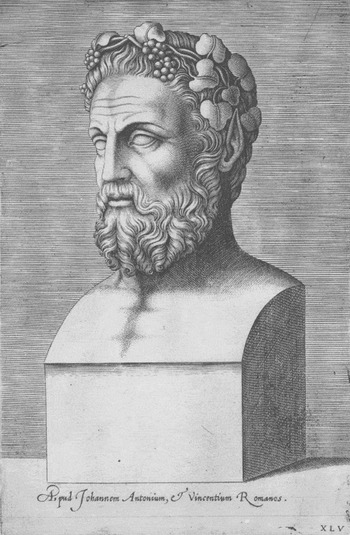
Vincenzo, the more talented brother, gained a degree in lawFootnote 30 and acquired such expertise in the field of antiquarian studies as to be recognized by distinguished individuals such as Pirro Ligorio and Fulvio Orsini.Footnote 31 He had such knowledge of the ancient world and of Latin that in 1589 he was able to publish a cultivated libello on the Felice aqueduct, which had just been constructed on order of Pope Sixtus V Peretti.Footnote 32 He also wrote a complex Latin description of the virtues of the stones making up a table given by Cardinal Michele Bonelli to Philip II of Spain.Footnote 33 In the 1570s, the Stampa collection was renowned in Rome by insiders, as is demonstrated by the presence of some pieces in engravings by Achille StazioFootnote 34 and drawings by Alonso Chacòn, who described the two brothers as ‘antiquitatis studiosi’ (Figures 1–4).Footnote 35
Anonymous, Herma of Chiron, in Achilles Statius, Inlustrium virorum ut exstant in urbe expressi vultus (Rome, Formis Antonii Lafreri, 1569), Los Angeles, The Getty Research Institute, Research Library, 89-B1188, pl. 23. Photo courtesy of The Getty Research Institute, Research Library.

Anonymous, Unidentified Herma, in Achilles Statius, Inlustrium virorum ut exstant in urbe expressi vultus (Rome: Formis Antonii Lafreri, 1569), Los Angeles, The Getty Research Institute, Research Library, 89-B1188, pl. 45. Photo courtesy of The Getty Research Institute, Research Library.

Anonymous, Head of Archimedes, in Alonso Chacón, ‘Collezioni di antichità che erano del cardinale Gasparo Carpegna’, Pesaro, Biblioteca Oliveriana, MS 59, fol. 204r, 1570–80. Photo by the author, reproduced with permission of Biblioteca Oliveriana.

Anonymous, Head of Euripides, in Alonso Chacón, ‘Collezioni di antichità che erano del cardinale Gasparo Carpegna’, Pesaro, Biblioteca Oliveriana, MS 59, fol. 145r, 1570–80. Photo by the author, reproduced with permission of Biblioteca Oliveriana.

Nevertheless, in their attempt to adapt to a cultivated model and to interact with the cultural and social elites, the brothers never lost sight of the other side of the coin, that world of antiquities trafficking that was their fundamental hunting ground. Thus, we discover that in 1554 it was rumoured that several busts purloined from Cardinal Cesi's garden had been found in Giovanni Antonio's house.Footnote 36 In 1565, Vincenzo asked one Cesare to steal a statue from the garden of the former bargello of Rome and a slab from the church of San Lorenzo fuori le mura.Footnote 37 It is evident that the two brothers were able to shift from one context to another and to show different faces as the situation required.
In the span of their thirty-year career, the Stampa accumulated a remarkable patrimony, which they also invested in property and soap production. In spite of this, Giovanni Antonio and, above all, Vincenzo never appeared to be satisfied. Their true aspiration was to obtain fixed positions at the court of a powerful lord. Giovanni Antonio initially tried to become the pope's antiquarian at villa Giulia, but without success; he then became antiquarian to Cesare Gonzaga and later, along with his brother, to Ippolito d'Este.Footnote 38 For Vincenzo, equipped with a superior education, the antiquarian business represented a springboard from which to launch a brilliant career within the papal administration. After being named magistrate of the port of Ripa (1579),Footnote 39 he was promoted to the prestigious office of governor, first of Foligno (1585), then of Ravenna (1587).Footnote 40 Thus, from humble beginnings as a tailor's son, Vincenzo had become a papal governor, a friend of scholars and a merchant patronized by Italian and foreign princes.
The two brothers’ knowledge, versatility and strategy of connection with some of the most influential collectors of their time, within and without the Roman curia,Footnote 41 allowed them to be recognized as members of the antiquarians’ community and to distinguish themselves from the mass of artisans and shopkeepers occasionally involved in the market for antiquities. This sense of belonging allowed them to accomplish a project of social advancement unimaginable for their father, transitioning, so to speak, from the artisan community occasionally engaged in the antiquities trade, to the erudite elite community of the antiquarians.
Following what has been said, it would be misleading to confine the activity and influence exercised by the antiquarians’ community to the public piazza, loosely understood as the market place, or to any one specific place in Rome. Thanks to their ability in acting in different contexts and places, these antiquarian intermediaries crafted instead a very peculiar space within the city. This cannot be defined exclusively by architectural categories, but should rather be understood as a mobile and mutable space produced by the staging of social phenomena in the urban arena, or, to borrow Henri Lefebvre's words, it was a space ‘fashioned, shaped and invested by social activities’.Footnote 42 A flexible locus that is impossible to locate exactly on a map, but which nevertheless enabled commercial exchange and favoured interchanges and permeability among communities which were normally distinct from one another – second-hand dealers and cardinals, peasants and intellectuals – to the mutual benefit of all parties.