Introduction
Countries that rely heavily on private pensions for the provision of retirement income have long been associated with creating a dualism, between those with access to private occupational insurance and those without (Esping-Andersen, 1990; Korpi and Palme, Reference Korpi and Palme1998). This dualism implies not merely unequal access to private savings accounts, but also to employer contributions, and to the generous tax subsidies with which governments incentivise private schemes.
Patterns of access are well documented. Since they began to develop in the late nineteenth century, private pensions have rarely covered more than half of the working population. Today, the manufacturing sector displays among the best coverage rates and low-skilled service sectors the worst. Coverage increases with income, and atypical workers are less likely to be enrolled (OECD, 2012: 105; Seeleib-Kaiser et al., Reference Seeleib-Kaiser, Saunders, Naczyk, Emmenegger, Hausermann, Palier and Seeleib-Kaiser2012; Wiss, Reference Wiss2015).
Private-heavy pension systems, defined here as those with a ratio of private to public expenditure consistently higher than the OECD average, are not all equally dualising however. By departing from employer voluntarism, it is possible to achieve encompassing occupational coverage. The Netherlands is an oft-cited example; supplementary private pensions based on collective agreements have long been quasi-mandatory, the result of regulation from the 1950s extending all benefits negotiated at the bargaining table to non-union workers (Myles and Pierson, Reference Myles, Pierson and Pierson2001:315). As a result over ninety per cent of workers are covered, a proportion comparable to the coverage rates of contributory state pensions (Scruggs, Reference Scruggs2004).
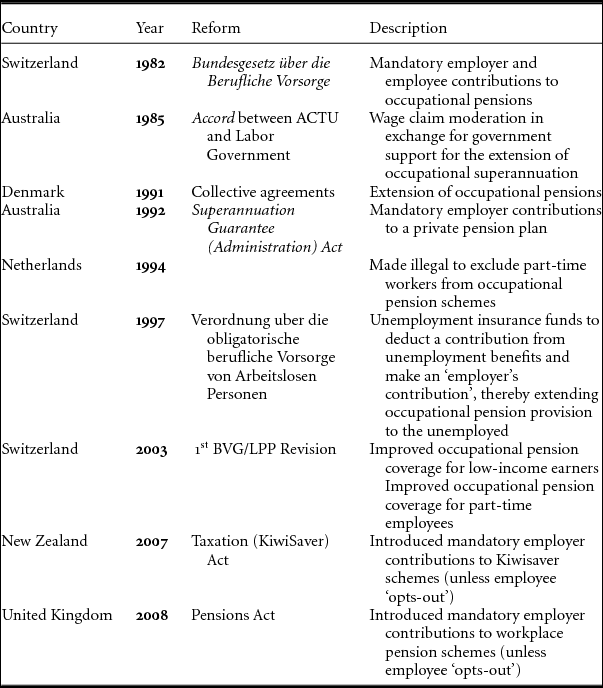
While for three decades the Netherlands stood alone among private-heavy pension systems in its departure from dualising employer voluntarism, this is no longer the case. Since the 1980s there has been a clear trend towards more encompassing private pensions. Of the nine mature welfare states where the ratio of private to public pension expenditure is higher than the OECD averageFootnote 1, only Ireland, Canada and the US now rely on employer voluntarism in private pension contributions. The rest have either introduced or extended mandatory employer contributions to private schemes. The trend is summarized in Table 1 below.
Regulatory changes extending private pension coverage in private-heavy pension systems

This trend towards more encompassing private pensions is surprising, since it goes against well-established institutionalist expectations. Dualism between those with access to private occupational pensions and those without is expected to persist over time in ‘liberal’ welfare regimes (Esping-Andersen, 1990), in ‘basic social security’ and ‘targeted’ pension systems (Korpi and Palme, Reference Korpi and Palme1998), and in most of the so-called ‘latecomer’ countries (Myles and Pierson, Reference Myles, Pierson and Pierson2001: 315–318) that failed to develop significant earnings-related pensions in the immediate post-war years.
Moreover, the trend has taken place at a time when employers have been increasingly reluctant providers of retirement income (Bridgen and Meyer, Reference Bridgen and Meyer2005; Seeleib-Kaiser et al., Reference Seeleib-Kaiser, Saunders, Naczyk, Emmenegger, Hausermann, Palier and Seeleib-Kaiser2012: 170), divides between insiders and outsiders in terms of social protection have been growing, and the political representation of outsiders has been weak (Emmenegger et al., Reference Emmenegger, Häusermann, Palier and Seeleib-Kaiser2012; Rueda, Reference Rueda2007).
In this paper, I offer an explanation for the trend towards more encompassing private-heavy pension systems based on the preferences of organised labour. In doing so, I build on research that identifies unions as key proponents of the regulatory extension of private pension coverage (Hacker, Reference Hacker2002; Meyer and Bridgen, Reference Meyer and Bridgen2012; Naczyk and Seeleib-Kaiser, Reference Naczyk and Seeleib-Kaiser2015; Trampusch, Reference Trampusch2009). While this research has richly theorised interest group preferences, it remains unclear how unions succeed in bringing about more encompassing private pensions in the face of employer opposition.
Using Qualitative Comparative Analysis (QCA), I show that union demands for more encompassing private pensions are met in different ways in different institutional contexts. In addition to being negotiated in the familiar way through collective agreements (where the institutional capacity allows), mandatory employer contributions to private schemes are introduced through top-down regulation by right-of-centre governments in Continental European countries, and by left-of-centre governments in Anglophone countries.
In a second step I focus on the Anglophone ‘path’ to top-down regulation, which remains the least well understood. Through an exploratory case study of the UK, I show how unions can play a central role in bringing about more encompassing private pensions even where their formal influence in the policymaking process is weak: where there is little institutional capacity either for the extension of coverage through collective agreements or for the engineering of reform coalitions, and where employer opposition is strong. First, I develop theoretical expectations that form the starting point for my empirical analysis, and link these expectations to the paper's research design.
The politics of more encompassing private pensions
The development of private pensions is closely linked with that of state pensions. Private pensions can be crowded-in or out by state provision, and visa-versa (Ebbinghaus, Reference Ebbinghaus2011b; Esping-Andersen, 1990; Myles and Pierson, Reference Myles, Pierson and Pierson2001). This reflects public concern for the overall ‘pensions package’, and makes past policy choices crucial to explaining the politics of private pensions (Overbye, Reference Overbye1997). In this vein, government attention to extending the coverage of private pensions can be seen as an attempt to make private pensions functionally equivalent to state pensions, following retrenchment of the latter (Mabbett, Reference Mabbett and Leisering2011).
Of course, past policy choices do not determine the development of private pensions, but rather shape the policy preferences and influence of relevant political actors. In the politics of private welfare, as in those of state benefits, political parties are key actors (Mabbett, Reference Mabbett and Leisering2011; Myles and Pierson, Reference Myles, Pierson and Pierson2001; Overbye, Reference Overbye1997). Yet electoral politics are likely to be less important than interest group politics. This is because the politics of private welfare are often less salient and less visible to the public than the politics of state-provided benefits (Hacker, Reference Hacker2002: 42). Exceptions (see Hacker, Reference Hacker2002: 145–153; Mabbett, Reference Mabbett and Leisering2011) tend to concern the security of existing private savings rather than the extension of private pensions to new social groups.
This section therefore starts with a discussion of the preferences of the organised interests expected to be central to the politics of private pensions, namely unions, employers, and third-party providers. For these groups, the regulation of private pension coverage is likely to be an issue of strong-enough concern to justify the costs of information gathering and mobilisation (Hacker, Reference Hacker2002: 43). The discussion then moves from interest group preferences to politics, bringing in political parties and labour market institutions to derive expectations about the development of more encompassing private pensions.
Employers
For employers, private occupational pensions are associated with monetary costs on the one hand, and benefits in terms of human resource management on the other (McCarthy, Reference McCarthy2006; Sass, Reference Sass1997: 18–37). While the costs associated with occupational pensions vary with the size of the firm and the risk profile of its employees, the benefits depend on the skills profile of the firm's employees, and the ‘control’ that the employer has over the scheme (Mares, Reference Mares, Hall and Soskice2001: 195–203).
Thus, employers tend to favour private sector voluntarism and resist top-down regulatory measures that increase their costs and reduce their control (Meyer and Bridgen, Reference Meyer and Bridgen2012: 391). Opposition to compulsory employer contributions is expected to be particularly strong in small firms where the costs are relatively large, and for firms employing predominantly low-skilled labour where the benefits of ‘tying’ the worker to the firm are relatively small (Clark, Reference Clark, Clark and Whiteside2003; Sass, Reference Sass1997).
The pensions industry
Representatives of the pension industry are usually considered to be primary drivers of the extension of private pensions (Leimgruber, Reference Leimgruber2012; Naczyk, Reference Naczyk2013). Indeed, pension insurers have promoted limited state pensions as a platform for the expansion of private schemes (Hacker, Reference Hacker2002; Schulze and Moran, Reference Schulze, Moran, Immergut, Anderson and Schulze2006), lobbied for favorable tax subsidies (Schulze and Moran, Reference Schulze, Moran, Immergut, Anderson and Schulze2006), and fought to remove disincentives to save (Meyer and Bridgen, Reference Meyer and Bridgen2012).
Regulation to mandate employer contributions can increase business for pension insurers. By guaranteeing a bigger risk pool and reliable contributions, it can also reduce the risk of providing for those on below-average incomes (Meyer and Bridgen, Reference Meyer and Bridgen2012: 392). Yet commercial insurers tend to share employer concerns about the costs of regulation and have historically strongly resisted regulatory incursions into their affairs (Hacker, Reference Hacker2002; Immergut et al., Reference Immergut, Anderson and Schulze2006; Meyer and Bridgen, Reference Meyer and Bridgen2012). While extending private pensions is important for pension industry representatives, top-down compulsion is unlikely to be a preferred policy tool. Pension industry representatives are likely to be ‘consenters’ (Korpi, Reference Korpi2006) rather than drivers of the regulatory extension of private pensions.
Unions
While organised labour has typically been associated with the development of earnings-related state pensions (Esping-Andersen, 1990), it is now clear that unions have often driven the development and expansion of private pensions. In the early stages of pension system development, unions representing high-skilled employees fought hard to protect their occupational benefits and resisted the development of more encompassing state earnings-related provision (Oude-Nijhuis, Reference Oude-Nijhuis2009; Pemberton, Reference Pemberton2012).
More recently, unions representing sectors with poor access to occupational schemes have pursued the regulatory extension of private occupational benefits as a ‘second best’ option to introducing or strengthening an earnings-related state pension, which they consider to be politically infeasible (Hacker, Reference Hacker2002; Meyer and Bridgen, Reference Meyer and Bridgen2012: 390). They have found allies in unions representing sectors with good access to occupational schemes, who pursued the extension of private pensions because they feared the decline of their own schemes or because they hoped this would give them control of substantial capital resources. Together, unions representing both insiders and outsiders to occupational benefits have pushed for more encompassing coverage, through industry-level collective agreements (Commonwealth Treasury of Australia, 2001; Green-Pedersen, Reference Green-Pedersen, Immergut, Anderson and Schulze2006; Naczyk and Seeleib-Kaiser, Reference Naczyk and Seeleib-Kaiser2015), or through top-down regulation (Bonoli, Reference Bonoli, Immergut, Anderson and Schulze2006; Naczyk and Seeleib-Kaiser, Reference Naczyk and Seeleib-Kaiser2015).
In sum, employers have a clear interest in opposing regulation to make private pensions more encompassing, although the strength of their opposition may vary according to their size or employee skills profile. Although pension industry representatives have an interest in the expansion of private pensions, they are likely to have reservations about top-down regulatory intervention. Unions have reason to unite in favour of the regulatory extension of private pensions as a second-best alternative to a state earnings-related pension, and as such are the most likely drivers of the trend towards more encompassing private arrangements.
From preferences to politics
While we have a substantial set of expectations about the preferences of the three key groups with a stake in the regulatory reform of private pensions, the question of how these groups affect the regulatory process has received less attention. In fact, the upshot of historical accounts of the extension of private pension coverage through collective agreements (Anderson, Reference Anderson, Anderson and Schulze2006; Green-Pedersen, Reference Green-Pedersen, Immergut, Anderson and Schulze2006), as well as of comparative work on the subject (Ebbinghaus, Reference Ebbinghaus2011b: 381; Myles and Pierson, Reference Myles, Pierson and Pierson2001; Trampusch, Reference Trampusch2009; Wiss, Reference Wiss2015), has been a consensus that more encompassing private pensions are almost as inevitable for those countries with the institutional capacity for ‘self-regulation’ – i.e. for the collective negotiation of occupational pensions (Ebbinghaus, Reference Ebbinghaus2011a: 317) – as they are unattainable for those without. That is, encompassing private pensions are expected only where there is widespread union membership, or else where collective agreements can be extended to non-organised employees and to firms that did not participate in the original agreements (Keune, Reference Keune2017: 7).
In seeking to understand how demands for more encompassing private pensions play out in the absence of any institutional capacity for collective self-regulation, I start from the assumption that similar reform pressures may fare differently in different institutional contexts (Hall and Soskice, Reference Hall and Soskice2001; Myles and Pierson, Reference Myles, Pierson and Pierson2001; Streeck and Thelen, Reference Streeck and Thelen2005). In particular, the success of unions in the face of employer opposition will depend greatly on how existing institutions structure interest group influence in the reform process.
Institutional contexts characterised by corporatist interest representation and fragmentation of political parties and the executive – prevalent in much of Continental Europe – facilitate consensus (Lijphart, Reference Lijphart2012)Footnote 2. These systems require compromise and negotiation between affected interests in government policymaking. In recent years, reforms extending social rights to politically weak outsider groups have been introduced in such countries, primarily by right-of-centre governments, as part of cost-cutting reform packages engineered to generate support from cross-class coalitions (Häusermann, Reference Häusermann2010).
By contrast, in institutional contexts characterised by pluralist representation of economic interests and the concentration of political parties and executive power, negotiation and compromise to achieve consensus among affected interests is more rare (Lijphart, Reference Lijphart2012). In such contexts – which overwhelmingly characterise the Anglophone countriesFootnote 3 - the top-down extension of private pensions should depend heavily on support from governing parties. Since left-of-centre parties are most closely associated with union interests (Esping-Andersen, 1990; Korpi, Reference Korpi2006; Rueda, Reference Rueda2007), I expect that in the absence either of institutions associated with consensus democracy or of an institutional capacity for collective self-regulation, union demands are more likely to come to fruition when a strong left government is in power.
Nevertheless, a substantial body of work indicates that the alliance between unions and left-of-centre parties cannot be taken for granted in the post-industrial context, and that gaining the support of business is increasingly important to left-of-centre parties who feel the need to prove their fiscal rectitude to the electorate (Ludlam and Taylor, Reference Ludlam and Taylor2003; Piazza, Reference Piazza2001; Simoni, Reference Simoni2007). For this reason, exploratory work is needed in order to understand how unions are able to bring about the development of more encompassing private pensions in Anglophone countries.
In sum then, the empirical analysis starts from the idea that the trend towards more encompassing private pensions is likely to have been driven by union demands for the extension of private pension coverage as an alternative to significant earnings-related state provision. Where there is no institutional capacity for collective self-regulation, union demands for the regulatory extension of private pensions may be met when right-of-centre governments seek to pass cost-cutting reforms in ‘consensus’ systems. In the absence however of both the institutional capacity for collective self-regulation and institutions that facilitate the engineering of reform coalitions, the regulatory extension of private pensions is likely to depend on the ability of unions to influence left-of-centre governments.
Research design
Since the development of more encompassing private pensions is expected to be met in different ways in different institutional contexts, I model the reforms using Qualitative Comparative Analysis (QCA), a set-theoretic approach that can capture equifinality, where alternative causal logics produce the same causal outcome (Schneider and Wagemann, Reference Schneider and Wagemann2012). I use the QCA procedure to identify three combinations of conditions associated with the introduction of more encompassing private pensions. I select conditions on the basis of the theoretical expectations developed above, focusing on the institutional and political conditions that are relevant to shaping union preferences and influence. I draw on case knowledge gained during the iterative QCA research process to calibrate the conditions and to interpret the results of the QCA (Ragin, Reference Ragin2000; Schneider and Wagemann, Reference Schneider and Wagemann2012: 305–312). I then present a case study of the UK, a representative case of the Anglophone ‘path’ that remains the most poorly understood. This exploratory case links the institutional conditions identified in the QCA with the reform outcome by explicitly tracing the ways that unions were able to shape the reform process in a least likely case of their influence.
Three paths to more encompassing private pensions
The fsQCA covers reforms in nine private-heavy pension systems between 1980 and 2009. The data is split into three decades 1980–1989, 1990–1999, and 2000–2009, and the analysis is run not with nine country cases, but with twenty-seven country-decade cases. This offers analytical leverage by introducing variation in causal conditions over time.
The outcome of interest is the development of more encompassing private pensions, understood as the extension of occupational pension coverage either through collective self-regulation or through top-down government regulation.Footnote 4 Although top-down regulation to increase occupational pension coverage may take many forms, including mandating that employers simply provide access to an occupational pension, or that they enrol employees into an occupational pension scheme by default, I count as ‘encompassing’ only those reforms which also mandate that employers make contributions to the occupational pension scheme that their employees are compulsorily or by default enrolled in. For each country-decade, I calibrate membership in the fuzzy-set ‘cases where private pensions have become significantly more encompassing’ (encomp) drawing on a range of government reports and secondary sources. The calibration is explained in detail for each country-decade in Box 1 of the online appendix.
The five conditions included in the model reflect the expectations developed in the previous section. I include a measure of the absence of a significant earnings-related pension (lo_erel) to reflect the expectation that unions are likely to work together to push for mandatory employer contributions where there is no significant earnings-related state pension. To do this, I construct a four-value fuzzy set based on the statutory replacement rate that accrues at average earnings from the earnings-related state pension, using OECD data (OECD, 2011).
To capture the expectation that union demands may be met through collective self-regulation where such institutional capacity exists, I include the condition of high union density (hi_ud) using a measure of union density from the Comparative Political Data Set (CPDS) (Armingeon et al., Reference Armingeon, Weisstanner, Potolidis, Gerber and Leimgruber2011).
To capture the possibility that in the absence of such institutional capacity union demands may be met by strong left-of-centre governments, I include a measure of left-party control of government (hi_left), using data from the CPDS on the percentage of total cabinet posts held by left-of-centre parties.
Finally, to capture the expectation that union demands may be met as part of a cost-cutting reform package in a context of corporatist interest representation and political fragmentation, I include conditions to capture the presence of institutions associated with ‘consensus’ democracy (hi_cons) and the presence of cost cutting reforms (cuts). Closely following Lijphart (Reference Lijphart2012), I proxy the former using a composite indicator made up of the Hicks-Kenworthy indicator of corporatism (Kenworthy, Reference Kenworthy2003), and the ‘effective number of parties’ from the CPDS (Armingeon et al., Reference Armingeon, Weisstanner, Potolidis, Gerber and Leimgruber2011). The composite indicator closely proxies the ‘executive-parties’ dimension of Lijphart's explanatory framework, since the effective number of parties in a political system is expected to be causally linked to all aspects of this dimension except for the level of corporatism (Lijphart, Reference Lijphart2012: 170).
The measurement and calibration of both outcome and causal conditions are presented in detail in the online appendix. Fuzzy-set conditions contain more information than crisp-set conditions and are used wherever possible. The resulting analysis is therefore fuzzy-set, conducted using the specialist software fsQCA2.5. Since an analysis of necessary conditions found no causally relevant necessary conditions for the development of more encompassing private pensionsFootnote 5, the discussion focuses on sufficient conditions.
Analysis of sufficient conditions for the development of more encompassing private pensions
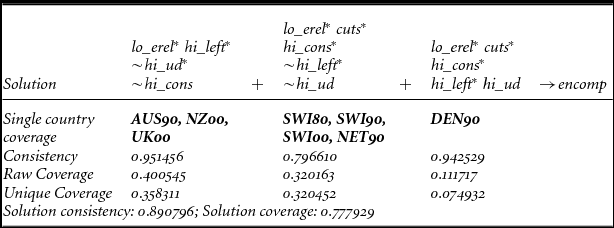
The results of the analysis of sufficient conditions are summarised in Table 2Footnote 6. The Boolean algebraic solution term at the top of Table 2 reveals three paths to more encompassing private pension coverage in private-heavy pension systems. The first path uniquely covers reforms that have occurred in the Anglophone countries – the Australian Superannuation Guarantee Act of 1992, the New Zealand KiwiSaver Act of 2007 and the UK Pensions Act of 2008. No cases logically contradict the statement of sufficiency, so the consistency score of 0.95 for this path provides strong support for the claim that the combination of a low earnings-related state pension, a left government, the absence of high union density and the absence of high political fragmentation is sufficient for the extension of private pension coverage in private-heavy systems. In light of the theoretical discussion in section two, I interpret this as evidence that, in the absence of high union density, coherent demands for the extension of private pension coverage as the best alternative to an earnings-related state pension can be met by a strong left government. I substantiate this interpretation in the next section with a narrative of the UK reform process.
Analysis of sufficient conditions for the outcome ‘extension of private pension coverage’, intermediate solution

Frequency cut-off: 1.000000; Consistency cut-off: 0.796610.
Assumptions: lo_erel (present)
Cases in bold are uniquely covered by the relevant solution term
The second path to more encompassing private pensions uniquely covers the reforms that occurred in Continental private-heavy pension systems – the three Swiss reforms of 1982, 1997 and 2003, and the Dutch reform of 1994. Again, no cases logically contradict the statement of sufficiency, so the consistency score of 0.80 provides strong empirical support for the claim that the combination of a low earnings-related pension, institutions facilitating political consensus, cost-cutting reforms, a non-left government and the absence of high union density is sufficient for the extension of private pension coverage. In light of the theoretical discussion, I interpret this as support for the proposition that, in the absence of high union density and a strong left government, demands for the extension of private pension coverage as the best alternative to an earnings-related state pension can be met as part of a cost-cutting reform package in a context of corporatist interest representation and political fragmentation.
The Danish extension of occupational pensions through collective agreements in 1991 is uniquely covered by a third path, where union density is high. In this case, although conditions did not rule out the top-down introduction of mandatory employer contributions by the left government, both the government and employers insisted that union demands for the extension of coverage must be met voluntarily through collective self-regulation, because it was feared that otherwise contributions would not be viewed by wage earners as part of normal wage increases and wage moderation would be compromised (Nielsen, Reference Nielsen and Shalev1996: 251).
The extension of private pension coverage through the Australian Accord of 1985 is the only case to remain uncovered by the solution formula. In this case too, union density was high and the extension of private pension coverage was therefore approached through collective self-regulation. The exclusion of this Australian case from the Danish path is due to the absence of political fragmentation, which meant that collective self-regulation proceeded via an Accord between Unions and the Labor party rather than via decentralised collective bargaining, a fact which does not alter the substantive argument of this paper.
So the fsQCA reveals three paths to more encompassing private pension coverage. The classic path to more encompassing coverage – familiar from historical accounts of pension politics – of collective self-regulation, is joined by two ‘top-down’ paths. The first of these covers the reforms that occurred in continental Europe, where there is corporatist interest representation and fragmentation of political parties and the executive. Here, as expected, reforms to extend the coverage of private pensions were introduced by right-of-centre governments, alongside cost-cutting reforms. The second of the ‘top-down’ paths covers the reforms that occurred in Anglophone countries, which in the absence of either political fragmentation or an institutional capacity for collective self-regulation, were passed – as expected – by left-of-centre governments.
The UK case
In the previous section, the country-decade UK00 emerges as a ‘typical’ case of the Anglophone reform path. The case of the UK is therefore well suited to explore how, in the absence of political fragmentation or an institutional capacity for collective self-regulation, union demands for more encompassing private pensions can influence left-of-centre governments and bring about reform.
Although the UK is not the most typical case of the reform path (fuzzy-set membership scores in the causal conditions are higher in the other countries), it is chosen because it constitutes a ‘least likely’ case for the argument that unions drive policy. Policy proposals are shaped within the executive through extensive consultation with affected interests but whilst some interests are incorporated into policymaking others are marginalised (Schulze and Moran, Reference Schulze, Moran, Immergut, Anderson and Schulze2006: 56). Since the 1980s, this has been the case for unions, and even the electoral victory of New Labour in 1997 did not restore their influence in policy making (Ludlam and Taylor, Reference Ludlam and Taylor2003; Simoni, Reference Simoni2007)Footnote 7. Meanwhile the political influence of other organised interests has increased. Employers have been empowered by an increased emphasis on economic competitiveness, and the pensions industry has been strengthened by a series of policies encouraging the growth of private pensions (Schulze and Moran, Reference Schulze, Moran, Immergut, Anderson and Schulze2006: 59). The narrative over the following pages shows how it is that, even in this least likely context, union preferences were crucial in shaping New Labour's policy agenda, and made possible the development of more encompassing private pensions.
Old Labour's battle for a state earnings-related pension
In the mid-1950s the British Labour Party and a small number of affiliated unions developed a commitment to the idea of a state earnings-related pension that was to characterise pension politics for the next forty years. The flat-rate Basic State Pension (BSP) set up in 1946 did not secure accustomed standards of living in old age, and fuelled a rapid expansion of occupational schemes. The Labour Party made repeated attempts to bridge the divide between those with access to these schemes and those dependent on the BSP (Labour Party, 1957; Pemberton, Reference Pemberton2010). These attempts culminated in 1974 with the introduction of the State Earnings Related Pension Scheme (SERPS), which supplemented the BSP with inflation-linked benefits calculated on the basis of the best twenty years of earnings.
Reforms passed by Thatcher's Conservative government in the 1980s, that eroded the SERPS by allowing for ‘contracting-out’ into occupational pensions and creating further incentives for the growth of private pensions, were fiercely resisted by the Labour party (Labour Party, 1985: 111). The Labour party stance had strong union backing. According to the TUC, private pension schemes were ‘inferior’ to a state solution. They ‘would undermine the concept of collective insurance’ and dependence on the rate of return from investment was insecure (Labour Party, 1985: 108; Schulze and Moran, Reference Schulze, Moran, Immergut, Anderson and Schulze2006; TUC, 1985, 1986).
Although Labour Manifestos for the 1979, 1983, 1987 and 1992 elections show a gradual shift towards more centrist positions (Simoni, Reference Simoni2007) at the 1992 general election Labour was still firmly committed to reversing the decline of the SERPS (Harrison, Reference Harrison1992).
New Labour's new policy stance
However, after a fourth consecutive electoral defeat, the Labour party faced an internal rift. The party was ‘struggling to find social policies which please its traditional wing and are fiscally responsible’ (Blitz and Smith, Reference Blitz and Smith1996; Suzman, Reference Suzman1996).
Pension policy was to prove particularly contentious. 1994 saw a formal ‘re-launch’ of the union movement. As part of this re-launch, union leaders reassessed their insistence that the state should provide replacement of accustomed earnings on retirement. They now believed that there was little chance of restoring the SERPS, and occupational schemes were the best alternative way to provide for supplementary pensions (Pemberton, Reference Pemberton2010; Schulze and Moran, Reference Schulze, Moran, Immergut, Anderson and Schulze2006; Taylor, Reference Taylor1997). Unions were aware this was a radical break from the past, dubbing their new policy stance ‘a revolution in welfare provision and modern trade union thinking’ (Halligan and Martinson, Reference Halligan and Martinson1998; Ludlam and Taylor, Reference Ludlam and Taylor2003).
The new union policy stance was key in securing support for the ideas of party modernisers who had begun to emphasise private saving in lieu of the SERPS. In 1996, the Labour Party's National Executive Committee (NEC) – which was still dominated by union votes (Ludlam and Taylor, Reference Ludlam and Taylor2003) – drafted a statement on pensions. The statement deemed the restoration of the SERPS unaffordable and set out a commitment to developing an alternative approach.
This did not go down well with traditionalists within the party (Castle and Townsend, Reference Castle and Townsend1996). At the 1996 Labour party conference they moved against the NEC statement on pensions, insisting that the restoration of SERPS was affordable (Labour Party, 1996: 143). But the traditionalists were defeated at the vote. The biggest unions – from both high- and low-skilled sectors – were united in turning their backs on the SERPS and moved to support the NEC statement on pensions (Labour Party, 1996: 145).
Speaking on behalf of the modernisers, Harriet Harman, shadow Secretary of State for social security, summed up the rationale behind the NEC statement on pensions:
‘As we found out, and as the country found out to its cost in 1983, 1987 and 1992, all the promises in the world will be worth nothing if we threaten our own chances at the election’ (Labour Party, 1996: 152).
In this way, the idea of a compulsory state earnings-related pension was decisively defeated at the 1996 Labour Party Conference (Taylor-Gooby and Larsen, Reference Taylor-Gooby, Larsen and Taylor-Gooby2004). By the time Labour came to power in the next general election, it had completely abandoned its commitment to restoring the SERPS and reversed its categorical rejection of private schemes. A Green Paper issued in December 1998 stated the party's intention to replace the SERPS with a flat-rate benefit built up through earnings-related contributions. This would increase benefits for low-income earners while the majority of people would be motivated to contract-out into private pension schemes.
The issue of compulsion
The TUC believed that if occupational pensions were to take on the role of the SERPS, they would have to involve compulsory employer contributions (TUC, 1998). The issue of compulsion was also raised by other organisations during the same period, including the National Association of Pension Funds (NAPF), the Institute of Directors, and the Conservative Party (Timmins, Reference Timmins1997). In calling for compulsory savings, however, these organisations in one way or another called for the privatisation of existing contributions to the state pension. In this way they differed crucially from the type of compulsion desired by the TUC, which involved additional contributions (Cohen, Reference Cohen1996; Timmins, Reference Timmins1997). The TUC proposal was a call to increase employer responsibility in pension provision rather than increasing only individual savings.
Determined to shake off its image as the party of ‘tax and spend’, the Labour Party was reluctant to pursue the TUC's proposals. It was keen not to alienate employers, who were vocal defenders of the voluntarist status quo and likened compulsion to conscription and punishment (Timmins, Reference Timmins2002). It feared that a compulsory levy imposed on top of National Insurance contributions could be presented as an additional tax (Blitz and Smith, Reference Blitz and Smith1996). Although the party accepted the need for alternative second tier pensions, it had taken the ‘firm decision’ not to make such schemes compulsory (Suzman, Reference Suzman1996).
In 1999, the Labour government passed the Welfare Reform and Pensions Act, which compelled employers to offer a workplace pension but not to contribute. As levels of private saving remained stagnant and the government prepared to reform occupational pensions with no mention of compulsory employer contributions, TUC pressure for compulsory contributions mounted (Guha, Reference Guha2002; Timmins, Reference Timmins2002).
It was in this context that the government set up an independent Commission to make recommendations on ‘whether there is a case for moving beyond the current voluntarist approach’ (Pensions Commission, 2004: ix). The Commission included a union voice in the form of TUC President Jeannie Drake. The Commission's first report identified a national problem of under-saving (Pensions Commission, 2004) and this was used by the TUC to bolster its campaign (Barber, Reference Barber2004). Labour too used the report to legitimise softening its anti-compulsion stance (Adams and Turner, Reference Adams and Turner2005), announcing that employers would be ‘forced to contribute to occupational pension schemes unless many more companies start making voluntary payments on employee's behalf' (Brown, Reference Brown2004).
The government's announcement received support neither from the opposition nor from other interest groups (Timmins, Reference Timmins2005) Although some businesses who already provided occupational pensions welcomed compulsion (Naczyk and Seeleib-Kaiser, Reference Naczyk and Seeleib-Kaiser2015; Timmins, Reference Timmins2005), on the whole employer representatives remained publicly united in insisting that companies ‘should contribute only if they could afford it’ (Brown, Reference Brown2004). The press reported that compulsion was ‘fiercely resisted by employers’ (Brown, Reference Brown2004).
Similarly, although pension industry representatives were concerned about levels of private saving, they supported the reduction of tax disincentives, the simplification of regulation, raising financial awareness and reform of the state pension – not increased compulsion. Despite having briefly announced the ‘last chance for voluntarism’ in 2003 (ABI, 2003), the ABI quickly became ‘cool on the idea’ (Timmins, Reference Timmins2005). It joined the NAPF – whose opposition to compulsion had been firmer because its membership consisted not only of pension insurers but also of employer providers of occupational schemes – in promoting alternative solutions (ABI, 2005a: 3; 2005b).
But the idea of compulsion was further legitimised when the Pensions Commission reported its findings in 2005. It recommended auto-enrolment combined with a modest level of compulsory matching employer contributions as ‘an essential part of the reform package’ (Pensions Commission, 2005). The Government seized the opportunity to publish reform proposals in the form of two White Papers which closely followed the recommendations of the Pensions Commission (DWP, 2006a, 2006b).
Most employers remained strongly against compulsion until the end (DWP, 2006c: 37). But after the Pension Commission's report, pension industry representatives accepted mandatory employer contributions (DWP, 2007: 8). This endorsement was enough to allow the opposition to support the ‘consensus’ in favour of mandatory employer contributions when the government's reform proposals were brought before parliament in the form of the 2008 Pensions Act (HC Deb, 16 January 2007: c671, c680).
Union influence in a least likely case
The regulatory extension of private pension coverage in the UK emerged from the fsQCA as typical of reforms that have made private pensions more encompassing in Anglophone countries. The preceding narrative shows how a left-of-centre party came to expand the coverage of private pensions through the introduction of mandatory employer contributions. Although union influence in policymaking is usually considered limited in modern British pension politics, the narrative shows that unions shaped the development of more encompassing private pensions at two critical stages.
First, in 1996 unions played a vital role in side-lining traditionalists within the Labour Party still committed to a state solution for earnings-replacement in old age. In this way they helped shape the New Labour consensus that earnings replacement should be provided through private means. Second, as the one big group firmly in favour of mandatory employer contributions, unions singlehandedly put employer compulsion on the political agenda, and this made possible the move towards more encompassing private pensions in 2008.
Conclusion
Over the past decades private-heavy systems, long associated with dualism of access to adequate earnings replacement in retirement, have experienced a trend towards more encompassing coverage. While a diverse literature has richly theorised interest group preferences and identified unions as key proponents of more encompassing coverage, there has been no attempt to develop a systematic account of the politics behind these reforms. It is not clear how union desires for more encompassing coverage have found their political expression in countries as different as Denmark, the UK, and Switzerland.
In this paper, I derived from the literature a set of expectations regarding how union preferences might find political expression in different institutional contexts. Using this to inform a fsQCA, I mapped three paths to the extension of private pension coverage in private heavy systems: a) a ‘Collective self-regulation’ path; b) a ‘Continental’ path characterised by political institutions that facilitate consensus, where the top-down regulatory extension of private pension coverage takes place under right-of-centre governments; and c) an ‘Anglophone’ path of top-down regulation by strong left governments.
While there have been a number of excellent country-level accounts that can substantiate the ‘Collective self-regulation’ and ‘Continental’ paths, the ‘Anglophone’ path was in need of some unpacking. The UK, New Zealand, and Australia are some of the most unlikely contexts for reforms that move away from employer voluntarism, and these countries have also received the least academic attention from scholars of comparative pension politics. Despite Naczyk and Seeleib-Kaiser's compelling account of union alliance-building and preference formation in the UK (2015), it remained unclear how union calls for more encompassing private pensions could bring about change. There was no institutional capacity for either collective self-regulation or the development of cross-class alliances, employer opposition was strong, formal union influence in the policymaking process was weak, and the political left was keen to display fiscal rectitude.
An exploratory case of the UK, which is a typical case of the ‘Anglophone’ path as well as a least likely case for union influence, shows that although ‘hard’ union influence in policymaking was low, employer opposition to compulsion succeeded only in keeping mandatory contributions low and delaying their introduction (Thurley, Reference Thurley2011). Ultimately, employer calls for continued voluntarism were ignored by a Labour party otherwise keen to gain business group support. Unions achieved this in two stages. First, they side-lined the idea that earnings-replacement in old age needed to be publicly provided, by drawing attention to the strategic importance of proving to the electorate that Labour would exercise fiscal restraint, starting in a very public way with their flagship pensions policy. Second, having helped shape the New Labour consensus that earnings replacement should be privately financed, unions fought to extend access to occupational schemes. As the only notable group firmly in favour of mandatory employer contributions, they singlehandedly put employer compulsion on the political agenda.
As post-industrial societies struggle to contain state spending on what has long been the largest category of social transfer, the private provision of retirement income is likely to become more prevalent. It is therefore important to understand the political dynamics that shape the development of private-heavy pension systems. This paper goes some way towards this end. In so doing, it also contributes to recent work that seeks to understand the politics of solidarity and dualisation in post-industrial societies (Emmenegger et al., Reference Emmenegger, Häusermann, Palier and Seeleib-Kaiser2012). Building on research that shows unions demand more encompassing private pensions in the absence of adequate state provision (Bonoli, Reference Bonoli, Immergut, Anderson and Schulze2006; Hacker, Reference Hacker2002; Meyer and Bridgen, Reference Meyer and Bridgen2012; Naczyk and Seeleib-Kaiser, Reference Naczyk and Seeleib-Kaiser2015), the contribution of this paper lies in showing how these demands are able to come to fruition in very different institutional contexts.
It is important to end on a note of caution. Even where private pensions have become significantly more encompassing, some gaps in coverage remain, particularly among the increasingly large group of ‘atypical’ workers who risk exclusion on the basis of their low earnings or self-employment (OECD, 2012). Moreover, the solidaristic effects of more encompassing coverage may be undermined where minimum mandatory employer contributions are low, administrative costs high, and state pensions means-tested. It is a significant limitation of this study not to have analysed the extent to which more encompassing coverage has benefited those individuals affected. It would therefore be premature to celebrate the end of the dualisms associated with private-heavy pension systems.
Acknowledgements
I would like to thank Traute Meyer, David Soskice, Timo Fleckenstein, Waltraud Schelkle, Bernard Ebbinghaus, Silja Häusermann, Claudius Wagemann, Marco Simoni, Paul Bridgen, Tobias Wiss, and two anonymous reviewers for valuable feedback on this paper and its previous iterations.
Supplementary material
To view supplementary material for this article, please visit https://doi.org/10.1017/S0047279417000770