Tetralogy of Fallot occurs in three of every 10,000 live births and is the most common cause of cyanotic CHD,Reference Perry, Neill and Ferencz 1 which requires open heart corrective surgery. Patients who undergo tetralogy of Fallot repair are at high risk for ischaemia re-perfusion injury caused by the use of the cardiopulmonary bypass machine and sudden blood restoration after a period of aortic clamping-off.Reference Goldhaber and Weiss 2 Our study in 2013 showed that 22% of patients with tetralogy of Fallot who underwent total correction showed an increase in procalcitonin levels (the mean procalcitonin value was 89.55 ng/ml) and clinical signs of systemic inflammatory response syndrome 24 hours after the procedure.Reference Ponisih 3 It has been known that during restoration of blood flow to the ischaemic heart an extra burst of free radicals occurs. Free radicals cause lipid peroxidation, and lipid peroxidation end-products, malondialdehyde, have been used to assess oxygen free radical-mediated injury in re-perfusion injury.Reference Dhalla, Elmoselhi, Hatac and Makino 4 Re-perfusion injury also leads to the depletion of glutathione, the major intra-cellular antioxidant, which is important for the maintenance of cellular proteins and lipids in their functional phases. Pro-inflammatory cytokines are activated after cardiopulmonary bypass. Nuclear factor-kappa B is involved in regulating inflammatory signal transduction. Furthermore, myocardial ischaemia and ischaemia/re-perfusion may also activate several protein kinase families, including c-Jun N-terminal kinase, the primary kinase involved in myocardial ischaemic apoptosis.Reference Armstrong 5
Curcumin, an active component of turmeric, is a well-known antioxidant. It scavenges reactive oxygen species and has anti-inflammatory properties. These properties appear to be mediated by the inhibition of cytokine production and the activation of transcription factors such as nuclear factor-kappa B and several kinases upstream of c-Jun N-terminal kinase.Reference Rafiee, Shi and Kong 6 We assessed the effect of curcumin on decreasing myocardial ischaemia re-perfusion injury during cardiopulmonary bypass and by attenuating the appearance of apoptosis caspase-3 of cardiomyocytes. In addition, we also measured the post-operative clinical outcomes.
Methods
Design
This single-centre, double-blind, randomised placebo-controlled trial was performed to evaluate the effects of curcumin on malondialdehyde and glutathione levels, nuclear factor-kappa B, and c-Jun N-terminal kinase transcription factor activity, as well as on caspase-3 expression, in children aged between 1 and 6 years, who underwent tetralogy of Fallot corrective surgery. This study was approved by the Ethics Research Committee of the University of Indonesia Medical School/Cipto Mangunkusumo Hospital, Jakarta. Written informed consent was obtained from parents. Randomisation was carried out by block permutation. Patients in the placebo group received saccharum lactis, whereas those in the curcumin group received 45 mg oral curcumin daily (containing 98% curcuminoid), both for 14 days before surgery. This dose was considered to be safe and effective based on the study by Alwi, which showed 45 mg of curcumin for 1 month can suppress inflammatory response in the coronary acute syndrome.Reference Alwi 7 The team chose 14 days of treatment for safety reasons, as this is the first study on curcumin to be carried out in children with prolonged hypoxia.
Study criteria
We included patients undergoing elective tetralogy of Fallot repair, and we excluded patients with other major anomalies, McGoon ratio <1.5, patients with previous palliative procedures, or pulmonary atresia with ventricular septal defect. Pre-operative routine blood investigation, liver and renal functions, as well as coagulation profiles were taken before and after drug administration in both groups.
Measurements
Blood specimens for malondialdehyde and glutathione measurements were collected from mixed vein blood (right atrium) for the pre-ischaemia phase and 6 hours after surgery. Specimens for the ischaemia and re-perfusion phases were taken from the coronary sinus. Serum malondialdehyde levels were evaluated by spectrophotometry based on the reaction between malondialdehyde and thiobarbituric acid, as described by WillsReference Wills 8 and Devasagayam et al.Reference Devasagayam, Boloor and Ramasarma 9 Serum glutathione was evaluated by glutathione assay, as described by Ellman;Reference Ellman 10 measurements using this method require total protein concentration, which was determined as described by Peterson.Reference Peterson 11
Cardiomyocyte tissue biopsy sample was taken directly from the infundibulum. These specimens were used for nuclear factor-kappa B and c-Jun N-terminal kinase enzyme-linked immunosorbent assay analysis and for the measurement of caspase-3 expression. Phosphorylated nuclear factor-kappa B and c-Jun N-terminal kinase were analysed from nuclear proteins of the cardiomyocyte tissue biopsy. In order to extract these proteins, we used a Nuclear Extract Kit (Active Motif, Carlsbad, California, United States of America). For enzyme-linked immunosorbent assay analysis, phosphorylated nuclear factor-kappa B was measured using a TransAM NFκB p50 transcription factor assay kit, and for phosphorylated c-Jun N-terminal kinase we used a Face JNK ELISA Kit (Active Motif). These enzyme-linked immunosorbent assay analyses yielded absorbance values for active nuclear factor-kappa B and c-Jun N-terminal kinase proteins, but not the absolute values of these transcription factors. As phosphoproteins are characteristically unstable, it was difficult to prepare a standard phosphoprotein of fixed concentration. To maintain the quality of examinations, all specimens were examined under similar conditions, from the preparation to nuclear protein extraction phases. We also avoided freezing and thawing nuclear protein extracts.
The expression of caspase-3 was measured using a specific, cleaved caspase-3 antibody (Asp175) (Cell Signaling Technology, Beverly, Massachusetts, United States of America). Primary antibodies were stained with the cleaved caspase-3 antibody (diluted 1:2000) and visualised using a Star Trek Universal HRP Detection System Kit (Biocare Medical, Concord, California, United States of America) according to the manufacturer’s instructions.
Primary outcomes
The primary outcomes were serial serum malondialdehyde and glutathione levels taken at the pre-ischaemia, ischaemia, and re-perfusion phases, as well as at 6 hours after aortic clamping-off. Other primary outcomes were serial measurements of active nuclear factor-kappa B and c-Jun N-terminal kinase proteins, as well as caspase-3 expression, as obtained from the right ventricular outflow tract endocardial (infundibular) biopsy during the pre-ischaemia, ischaemia, and re-perfusion phases.
Secondary outcomes
The secondary outcomes were the haemodynamic parameters such as body temperature, lactate levels, oxygen saturation, mixed vein saturation, inotropic score, urine output, creatinine level, cardiac index, and systemic vascular resistance index taken at 6, 24, and 48 hours after ICU admission, as well as on the 5th day after surgery. Time to extubation and length of stay in the ICU and hospital were also recorded.
Statistical analysis
Statistical analysis was performed with SPSS 20.0 software. We used the independent t-test for normally distributed numerical data; otherwise, we used the Mann–Whitney test. A general linear model test was used for variables measured more than once. A p value <0.05 was considered to be statistically significant.
Results
Study patients
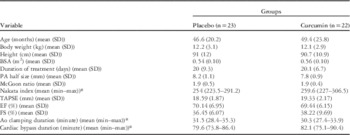
This study was carried out from July, 2012 to July, 2013. Of the 50 recruited patients, five were excluded because of incomplete data. The age range of the patients was from 46 months to 6 years and 11 months. There were 22 patients in the curcumin group and 23 in the placebo group. Some patients did not have surgery immediately following the 14 days of treatment due to illness or lack of ICU beds. Both groups, however, had similar means of treatment times – that is, 20 days. They also had similar tetralogy of Fallot anatomical indicators for corrective surgery (Nakata index and McGoon ratio), aortic clamping duration, and cardiac bypass duration. Characteristics data of the patients are shown in Table 1.
Characteristics of the patients (n=45).

Ao=aortic; BSA=body surface area; CI=confidence interval; EF=ejection fraction; FS=fractional shortening; max=maximal; min=minimal; PA half size=pulmonary artery half size; TAPSE=tricuspid annular plane systolic excursion
* t-test after data transformation, presented as geometrical means (95%CI, minimal–maximal)
We examined complete blood counts, liver and kidney functions, and coagulation profiles before and 14 days after treatment to assess the effects of curcumin. There were no significant differences between laboratory results before and after the treatment (data not shown).
Primary outcomes
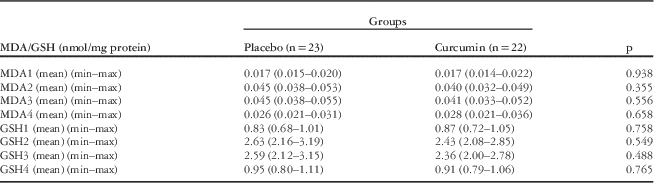
Malondialdehyde and glutathione serum concentrations. Both groups showed increased malondialdehyde concentrations at the ischaemia and re-perfusion phases; however, the geometric means were not significantly different between groups among the four observation phases. Glutathione concentrations in the four observation phases were also not significantly different between groups. The glutathione concentration increased in the ischaemia and re-perfusion phases of both the groups, and then decreased to baseline levels in the 6 hours after aortic clamping-off phase (Table 2).
Mean MDA and GSH serum concentrations in the 4 phases of observation.

MDA=malondialdehyde; GSH=glutathione; min=minimal; max=maximal; CI=confidence interval
Analysis with GLM after data transformation, mean of 95%CI. MDA 1/GSH 1: MDA/GSH in pre-ischaemia phase; MDA 2/GSH 2: MDA/GSH in ischaemia phase; MDA 3/GSH 3: MDA/GSH in re-perfusion phase; MDA 4/GSH 4: MDA/GSH in 6 hours after aortic clamping-off (in the ICU)
Nuclear factor-kappa B and c-Jun N-terminal kinase protein activities in the nuclei of cardiomyocytes
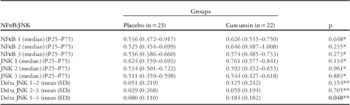
The median values of nuclear factor-kappa B of the curcumin group in the pre-ischaemia and ischaemia phases were higher than that of the placebo group; however, median values were similar between groups in the re-perfusion phase. Mean delta nuclear factor-kappa B differences in all observation phases were not significantly different (delta nuclear factor-kappa B data not shown). The median active c-Jun N-terminal kinase protein was similar in both the groups; however, the mean delta c-Jun N-terminal kinase was significantly different in the two groups, from the pre-ischaemia to the re-perfusion phases –0.184 decrease in the curcumin group and 0.080 in the placebo group (p=0.048) (Table 3).
Active NFκB and JNK protein in cardiomyocyte nuclei in the three phases of observation.

NFκB=nuclear factor-kappa B; JNK=c-Jun N-terminal kinase P25; P75=25th percentile and 75th percentile
NFκB 1/JNK 1: NFκB/JNK in the nucleus of cardiomyocytes at the pre-ischaemia phase; NFκB 2/JNK 2: NFκB/JNK in the nucleus of cardiomyocytes at the ischaemia phase; NFκB 3/JNK 3: NFκB/JNK in the nucleus of cardiomyocytes at the re-perfusion phase
* Mann–Whitney test
** Unpaired t-test
Caspase-3 expression in cardiomyocytes
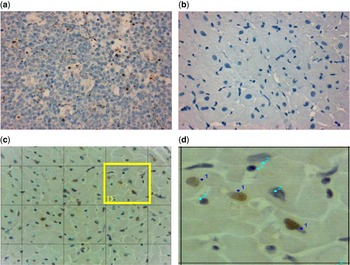
The percentage of caspase-3 expression was measured from the mean number of cells with caspase-3 expression divided by the total number of cardiomyocytes observed in a specimen of myocardial tissue. The examination of caspase-3 with immunohistochemistry showed optimal result. Immunohistochemical analysis of caspase-3 yielded the following: cardiomyocyte nuclei with caspase-3 expression were stained brown, whereas nuclei without caspase-3 expression were stained blue (Fig 1). Caspase-3 expression in the ischaemia phase was significantly lower in the curcumin group than in the placebo group (p=0.035). There was no significant difference between the pre-ischaemia and re-perfusion phases between groups (Table 4).
Expression of caspase-3 by immunohistochemistry (original magnification 400×). The brown staining in cardiomyocytes indicates the presence of caspase-3, and the blue staining indicates the absence of caspase-3. ( a ) Positive control reaction in human tonsils, ( b ) negative control reaction in the myocardium, ( c ) caspase-3 expression during the ischaemia phase in the myocardium, ( d ) magnified area with cell colour difference as a result of reaction with caspase-3 antibody. Numbers 1 and 2 are nuclei with and without caspase-3 expression, respectively.

Caspase-3 in cardiomyocytes in the three observation phases.

Mann–Whitney test
Caspase-3 expression is presented in 10−3
Data are presented as median (1st–3rd quartile)
Secondary outcomes
Post-surgery haemodynamics
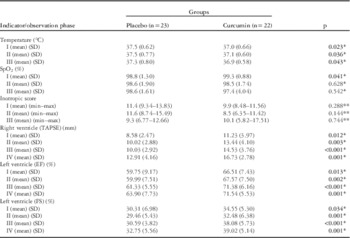
The mean body temperatures in the curcumin group were significantly lower compared with the placebo group in the three observation phases (6, 24, and 48 hours after ICU admission). Mean arterial blood oxygen saturation at 6 hours after aortic clamping-off in the curcumin group was significantly higher, although the difference was not clinically significant. The haemodynamic data are shown in Table 5.
Post-surgery haemodynamic data.

I=examination 6 hours after aortic clamping-off (in ICU); II=examination 24 hours after surgery; III=examination 48 hours after surgery; IV=examination 5 days after surgery; CI=confidence interval; EF=ejection fraction; FS=fractional shortening; GLM=general linear model; SpO2=arterial oxygen saturation; TAPSE=tricuspid annular plane systolic excursion
* Analysis with GLM
** Analysis with GLM after data transformation. Data are presented as geometric means (95%CI)
Dopamine and milrinone were administered as a continuous intravenous drip. Inotropic scores were not significantly different between the two groups. Serial echocardiographic examinations for right and left ventricular functions were performed before surgery until 5 days after surgery. Ventricular functions were similar between groups before surgery (data not shown). Right ventricular function – tricuspid annular plane systolic excursion – decreased after surgery in both the groups; however, the curcumin group had significantly better tricuspid annular plane systolic excursion. The tricuspid annular plane systolic excursion in both the groups remained under baseline values at 5 days after surgery. The systolic left ventricular function – ejection fraction and fractional shortening – in the placebo group decreased from baseline values until 5 days after surgery, although the mean values were in the normal range. The mean ejection fraction and fractional shortening differed significantly between the two groups at 6, 24, and 48 hours as well as at 5 days after surgery.
Discussion
To the best of our knowledge, this is the first study to use curcumin treatment in an effort to reduce the injurious effect of ischaemia and re-perfusion in children with tetralogy of Fallot undergoing corrective surgery. The threshold of tolerance to curcumin is high, according to a study of titrated doses given to children with ulcerative colitis aged between 8 and 18 years.Reference Suskind, Wahbeh, Burpee, Cohen, Christie and Weber 12 During the pre-surgery observation, no clinical symptoms were caused by the treatment and all the patients received their complete doses. The dosage used in this study was 45 mg of curcumin/day for 14 days before surgery, the lowest dose ever given to adults.Reference Alwi, Santoso and Suyono 13
A study in children with congenital heart defects found that their malondialdehyde levels were higher compared with the normal population; furthermore, their total antioxidant capacity was significantly decreased.Reference Pirinccioglu, Alyan, Kizil, Kangin and Beyazit 14 In cyanotic patients who underwent corrective surgery, malondialdehyde levels further increased and glutathione levels depleted.Reference Ozer, Parlakpinar, Cigremis, Ucar, Vardi and Acet 15 , Reference Namratha, Shenai, Chatra, Rao, Veena and Prabhu 16 – Reference Reddy, Osorio and Deque 19
In a rat study, curcumin treatment with a dosage of 100 mg/kg intra-peritoneally 1 hour before re-perfusion significantly increased antioxidant activity and lowered malondialdehyde concentrations.Reference Avci, Kadioglu and Sehirli 20 Other animal studies using intravenous curcumin doses of 20 mg/kg body weight or 40 mg/kg before the ischaemia episode also reported lower malondialdehyde concentrations.Reference Cheng, Liu and Ai 21 Curcumin was found to decrease lipid peroxidation by maintaining antioxidant activity.Reference Namratha, Shenai, Chatra, Rao, Veena and Prabhu 16 Our differing results may have been caused by our low dose of curcumin, the timing of curcumin administration before the re-perfusion phase, or the difference in malondialdehyde concentrations, because the ischaemia re-perfusion injury did not disrupt cardiomyocyte cell membranes. As such, sub-cellular malondialdehyde and its precursors were not released, and therefore were undetected by the assay.Reference Ambrosio, Flaherty and Duilio 22
Ischaemia re-perfusion myocardial injury activates the transduction pathways of nuclear factor-kappa B and c-Jun N-terminal kinase phosphorylation,Reference Oeckinghaus and Ghosh 23 – Reference Gerits, Kostenko and Moens 25 and can cause apoptosis or cellular necrosis.Reference Krijnen, Nijmeijer, CJLM, Visser, Hack and Niessen 26 , Reference Haunstetter and Izumo 27 A study in mouse hearts found that c-Jun N-terminal kinase phosphorylation doubled after an ischaemic period of 20 and 15 minutes after re-perfusion.Reference Milano, Morel and Bonny 28 Another study showed elevated c-Jun N-terminal kinase activation during the ischaemia and re-perfusion phases,Reference Yue, Wang and Gu 29 whereas a study by Shao et alReference Shao, Bhattacharya and Hsich 30 found that increased c-Jun N-terminal kinase activation only occurred during re-perfusion. A study in animal cardiac cells with 10 μM curcumin, administered before the ischaemia phase, showed it to be the most effective time for lowering nuclear factor-kappa B and c-Jun N-terminal kinase expressions, as well as for lowering cell death.Reference Fiorillo, Becatti and Pensalini 31
In our study, expression of active nuclear factor-kappa B in every phase of observation was similar between groups, perhaps due to the low dose of curcumin; however, the effects of curcumin on c-Jun N-terminal kinase suppression and caspase-3 expression were seen from the pre-ischaemia to the re-perfusion phases and the ischaemia phase, respectively.
The curcumin group had significantly lower temperature than the placebo group. This may be caused by the effect of curcumin in inhibiting cytokine production pathways such as tumor necrosis factor α, interleukin-1β, and interleukin-8 from inflamed cells.Reference Literat, Su and Norwicki 32 , Reference Mukhopadhyay, Basu and Ghatak 33 Increased temperature in children after heart surgery is usually a response to systemic inflammation caused by various processes including blood contact with a cardiac pulmonary bypass machine,Reference Hindman 34 , Reference Mitchell, Grocott, Phillips-Bute, Mathew, Newman and Bar-Yosef 35 ischaemia re-perfusion injury secondary to aortic clamping-off, and endotoxaemia.
Inotropic scores are widely used for early post-surgical result parameters. Maximal inotropic score is a superior indicator compared with low cardiac output for predicting early post-heart surgery results.Reference Butts, Scheurer and Atz 36 Arterial oxygen saturation may also provide haemodynamic status information.Reference Top, Tasker and Ince 37 In our study, curcumin did not appear to affect inotropic scores in our patients.
During ischaemia re-perfusion, a heart may undergo changes such as depressed contraction function, arrhythmia, and gene expression.Reference Temsah, Netticadan, Chapman, Takeda, Mochizuki and Dhalla 38 A few studies reported that curcumin protected heart performance from ischaemia re-perfusion injury.Reference Fiorillo, Becatti and Pensalini 31 , Reference Kim, Park and Joo 39 A curcumin dose of 150 mg/kg orally at the re-perfusion phase in animals, with a 45-minute ischaemia period, repaired ventricular function by lowering malondialdehyde levels, protecting the extracellular matrix from degradation by lowering the activity of matrix metalloproteinase, and inhibiting fibroblast accumulation caused by expression of α-smooth muscle actin.Reference Wang, Wang, Tootle, Philip and Zhao 40
The left and right ventricular contractility functions were better in the curcumin group than in the placebo group, which may have been due to a curcumin effect on apoptosis suppression.
Study limitations and strengths
A limitation of our study was that we did not obtain data for malondialdehyde and glutathione levels before treatment with curcumin or placebo, due to the difficulty of obtaining blood specimens from children susceptible to severe hypoxaemic shock. As such, we used the pre-ischaemia data as the “initial” assessment. Another limitation was the use of a single curcumin dosage for all patients, who had a wide range of body weights.
Nevertheless, the advantages of this study were that the specimens for oxidative stress levels were collected from the right atrium and coronary sinus, and the tissue specimens for transcription factor examinations were taken from the myocardium, reflecting actual myocardial conditions. In addition, the method of evaluating transcription factors allowed us to obtain quantitative measurements.
Clinical outcome assessments, especially using left and right ventricular function up to 5 days after surgery, may be a good way to follow-up ventricular functions in post-ischaemia re-perfusion.
Conclusions
In children undergoing tetralogy of Fallot surgery, oral curcumin supplementation at a dose of 45 mg/day for 14 days pre-operatively greatly reduced active c-Jun N-terminal kinase protein from the pre-ischaemia to the re-perfusion phases, suppressed caspase-3 expression in the ischaemia phase, and improved myocardial performance, body temperature, and oxygen saturation at the 6-hour stage. Curcumin administration might be considered as a standard protocol before tetralogy of Fallot correction to suppress apoptosis responses due to ischaemia re-perfusion injury. Further studies are warranted to evaluate the potential of curcumin to improve antioxidant levels in children requiring this surgical procedure.
Acknowledgement
Financial Support
This research received no spesific grant from any funding agency, commercial, or not-for-profit sectors.