Kawasaki disease is a well-known, acute, self-limiting vasculitis with unknown aetiology that predominantly affects infants and young children.Reference Newburger, Takahashi and Gerber1 Among many complications, coronary artery aneurysm or ectasia develops in 15–25% of untreated patients and may result in ischaemic cardiac disease, myocardial infarction, or sudden death.Reference Kato, Sugimura and Akagi2 Since the introduction of high-dose intravenous immunoglobulin within the first 10 days of illness, coronary artery complication decreased to 5% of transient coronary artery dilation and 1% of giant aneurysm.Reference Terai and Shulman3 Despite various medications, including intravenous immunoglobulin for Kawasaki disease, a small number of children have been undergoing catheter interventions such as balloon angioplasty, rotablation, or stent implantation for severe coronary artery complications.Reference Newburger, Takahashi and Gerber1 Here, we report successful recanalisation for chronic totally occluded left anterior descending artery because of previously implanted stent fracture in a young girl suffering from Kawasaki disease.
Case report
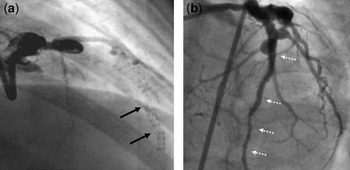
An 11-year-old girl was referred for the treatment of chronic total occlusion in the left anterior descending artery. She had been suffering from Kawasaki disease with severe coronary artery complications since 4.5 years before admission. During a regular check-up for coronary lesions 2 years before admission, she had undergone stent implantation with two Cypher stents (2.5 × 18 and 3.0 × 23 millimetres; Cordis Corporation, Johnson & Johnson Company, Miami Lakes, Florida, United States of America) for the total occlusion of the mid-left anterior descending artery accompanying positive exercise test – ST depression at lead II, III, and aVF. She was being administered aspirin and clopidogrel, and had undergone coronary angiography every year since the stent implantation. A routine coronary angiogram obtained 1 month before admission (Fig 1a) showed chronic total occlusion from the proximal left anterior descending artery to the second broken piece of the previous distal Cypher stent – 2.5 × 18 millimetres – in the left anterior descending artery, collateral communication from the first diagonal branch to distal left anterior descending artery, and multiple fractures of the previous stent.
(a) Pre-procedural left coronary angiogram. Pre-procedural left coronary angiogram showed chronic total occlusion from the proximal left anterior descending artery to the second broken piece of the previous distal stent (solid black arrows). (b) Post-procedural left coronary angiogram. Final left coronary angiogram confirmed successful recanalisation (white dotted arrows) after deploying TAXUS-Liberte stents in the fractured Cypher stents.

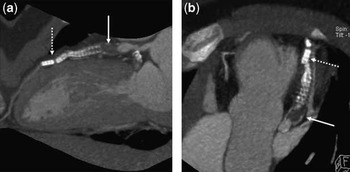
The patient was hospitalised for percutaneous coronary intervention, and we performed electrocardiogram-gated cardiac computed tomography to observe the structures surrounding the affected left anterior descending artery. We found a thrombus without calcification at the proximal part of the occluded left anterior descending artery and previously fractured stents in the mid- to distal left anterior descending artery (Fig 2). After successful wiring into the chronic total occlusion lesions by the anterograde approach using Conquest Pro (Asahi Intecc, Aichi, Japan), we performed multiple pre-dilations of occluded lesions with a 1.25 × 10-millimetre Maverick OTW balloon (Boston Scientific, Natick, Massachusetts, United States of America), 1.3 × 10- and 2.0 × 15-millimetre Lacrosse balloons (Goodman, Aichi, Japan), and a 3.0 × 12-millimetre Sprinter balloon (Medtronic, Minnesota, United States of America). We overlapped the previously fractured stents with a 3.0 × 38-millimetre TAXUS-Liberte stent (Boston Scientific) from the proximal portion of the mid-left anterior descending artery stent to the distal portion of the distal left anterior descending artery stent after massive thrombosuction in the proximal left anterior descending artery. Another 4.5 × 24-millimetre TAXUS-Liberte stent was inserted at the proximal left anterior descending artery after pre-dilation using a 4.0 × 12-millimetre Sprinter balloon. The final left anterior descending angiogram showed good patency (Fig 1b) and intravascular ultrasound imaging after stenting showed good apposition. She was discharged with clopidogrel, aspirin, and cilostazol. On follow-up coronary angiography after 7 months of stent re-insertion, we observed good patency in left anterior descending artery.
Electrocardiogram-gated cardiac computed tomography. Cardiac computed tomography revealed thrombus without calcification at the proximal portion of the occluded left anterior descending artery (solid arrows) and the previously fractured stent (dotted arrows).

Discussion
Since stent implantation was shown to be successful for coronary artery stenosis after Kawasaki disease in the late 1990s,Reference Hijazi, Smith and Fulton4 this procedure was suggested as another option for older children – above 13 years of age – with mild calcification in the coronary artery instead of coronary artery bypass grafting.Reference Akagi5 In spite of the good results obtained by the various recently developed coronary stents, there is a possibility of restenosis in the stent or intrinsic fracture. These pathologies may cause chronic total occlusion lesions as in this patient. The suggested pre-disposing factors for stent fracture in this patient may be vessel tortuosity, the use of overlapping long stents, and sirolimus-eluting stent (Cypher stent) itself.Reference Lee, Jurewitz, Aragon, Forrester, Makkar and Kar6
In the chronic total occlusion lesion from stent fracture, especially in a patient with Kawasaki disease, decision making for further treatment is troublesome. Considering the patency rates of graft for damaged coronary artery – the patency rates of internal thoracic artery grafts at 5, 10, and 15 years were 79%, 76%, and 73%, respectively, after Kawasaki disease in a Japanese national surveyReference Tsuda and Kitamura7 – coronary artery bypass grafting itself is not a permanent solution in this patient.
In conclusion, percutaneous transcatheter intervention is a feasible alternative to coronary artery bypass grafting so that patients with chronic total occlusion lesion after Kawasaki disease, even by stent fracture, can live with their native coronary artery as long as possible.