INTRODUCTION
Chronic Kidney Disease (CKD) is an increasingly common illness of mid to late adulthood, with an estimated 11% of adults in the United States affected (Coresh et al., 2003). The term CKD is used to describe a decrease in renal function caused by kidney damage, and this illness is typically managed on an outpatient basis with strict dietary and medication regimens (Levey et al., 2003). Left untreated, CKD results in the gradual development of renal failure and uremia secondary to the accumulation of neurotoxins and reductions in metabolic rates (Burn & Bates, 1998). Estimated glomerular filtration rate (GFR) is considered the best overall indicator of level of kidney function, with lower GFR levels indicating a decrease in the overall number and/or filtration rate of the kidney nephrons (Levey et al., 2003). Renal failure eventually results when GFR drops consistently below 15 mL/min per 1.73 m2 and requires replacement therapy such as dialysis. It is well-documented that persons with end stage renal disease (ESRD) undergoing hemodialysis are at considerably higher risk for cognitive impairment than their age peers, and this has been linked to metabolic derangements and cerebrovascular diseases associated with renal failure (Burn & Bates, 1998; Fazekas et al., 1996; Fazekas et al., 1995; Kurella et al., 2004; Lass et al., 1999; Pereira et al., 2005). Those studies that have not reported cognitive declines in ESRD have likely been limited by reliance on cognitive screening instruments (Maugeri et al., 1999), and small samples (Pliskin et al., 1996; Umans & Pliskin, 1998).
Despite the fact that the prevalence of the earlier stage of CKD is more than 100 times greater then that of ESRD (Collins et al., 2003; Levey et al., 2003), neuropsychological functioning in CKD has been virtually ignored to date. In fact, several factors lead to the prediction that CKD may be associated with exceptionally high risk for cognitive impairment even before the development of renal failure. Diabetes mellitus (Type II adult onset) and hypertension are the leading causes of CKD (Coresh et al., 2003; Levey et al., 2003). Both of these illnesses have been independently associated with development of cerebrovascular disease (Carmelli et al., 1999; Novak et al., 2006; Raz et al., 2003), reductions in memory and executive functioning (Knopman et al., 2001; MacKnight et al., 2002; Perlmuter et al., 1984; Raz et al., 2003; Saxby et al., 2001), and accelerated cognitive decline in late middle-age and older adulthood (Hassing et al., 2004; MacKnight et al., 2002; Ott et al., 1999; Posner et al., 2002). Thus, whereas underlying cerebrovascular disease is recognized as contributing to the cognitive presentation of ESRD (Pereira et al., 2005), it is likely that these effects may emerge earlier in the disease course as well. Other potential risks for cognitive dysfunction associated with CKD include elevated levels of homocysteine (Reutens & Sachdev, 2002), and anemia caused by decreased production of erythropoietin (Pliskin et al., 2001).
To date, only a few studies have attempted to characterize cognitive functioning in persons with CKD. In a cross-sectional comparison of persons with CKD and persons with ESRD on hemodialysis, findings suggested a graded relation between cognitive function and severity of renal disease, with ESRD participants performing worse than those with CKD, and persons with CKD performing worse than published neuropsychological norms on measures of verbal memory and executive functioning (Trails B; Kurella et al., 2004). Nonetheless, the inclusion of participants with overt CNS pathologies confounds the etiology and significance of the findings. For example, 28% of the CKD sample had a history of stroke, which may be independently associated with significant and lasting neuropsychological impairments (Desmond et al., 1999). Similarly, a recent study of cognition in menopausal women with coronary artery disease and co-morbid CKD reported reductions in neuropsychological performance associated with worsening renal functioning (Kurella et al., 2005). Whereas these findings may suggest that specific subgroups of persons with CKD may be at risk for cognitive impairments, the significance for the larger CKD population without overt neurological co-morbidities remains unknown. Furthermore, the restricted age ranges employed has limited the strength of the conclusions that can be drawn to date. If cerebrovascular disease contributes toward the cognitive presentation of this illness, one may expect that the reported reductions in memory and executive function in CKD may be differentially exacerbated with increasing age (Hassing et al., 2004; MacKnight et al., 2002).
To address these issues, we assessed cognitive functioning in a consecutive outpatient sample of persons with CKD, and compared their performance with that of healthy controls drawn from the same community. Given previous associations between memory/executive functioning and renal disease, we examined these functions in a CKD sample that did not have overt CNS pathologies, such as stroke, that may confound the cognitive presentation. Secondly, we examined the roles of three potential variables predicted to have a negative effect on cognitive performance in CKD, increasing age, a higher number of depressive symptoms, and increased metabolic derangement (i.e., estimated GFR and hemoglobin). Toward these ends, we examined (a) the bivariate associations between age, metabolic derangement, and depressive symptoms in CKD participants, and (b), the utility of age, health status, and their interaction in predicting individual differences in verbal memory and executive functioning before and after controlling for depressive symptoms.
METHODS
Subjects
We tested 51 consecutive outpatients (age 38–89), with a current diagnosis of CKD who were referred to the Renal Clinic at Vancouver General Hospital for treatment. Potential participants were considered to meet criteria for CKD if they had an average estimated GFR <60 mL/min/1.73 m2 and were not receiving renal replacement therapy (i.e., hemodialysis, peritoneal dialysis). Testing of CKD participants was completed at the Renal Clinic between August 2003 and December 2005. Participants were considered eligible for inclusion if they met the following criteria: (a) they were fluent in the English language, (b) had completed a minimum grade 6 education; and (c) had been followed by the renal clinic for at least six months to ensure medical stabilization of acute illness parameters. Participants were ineligible if they had a history of other major illnesses with known direct CNS effects (e.g., stroke, head injury, CNS malignancies, and Parkinson's disease), or had previously identified cognitive impairments (e.g., diagnosis of dementia). Additional exclusion criteria included diagnosis of concurrent terminal illness, major psychiatric illness, or other major organ failure (e.g., end stage liver disease). Because of the visual nature of some tasks, we screened participants' visual acuity, with the lower limit of corrected vision set at 20/50. Consecutive patients who met these criteria were invited to participate during their regularly scheduled clinic visit by a research coordinator. Recruitment success was approximately 70%. Control participants were recruited through local community centers and through university staff union email lists, and were subject to the same exclusion criteria. The study protocol was approved by both the University of British Columbia and Simon Fraser University research ethics boards, and all participants signed informed consents.
Measures
Measures were individually administered and scored by trained research assistants according to standardized procedures. Healthy controls were tested at community testing sites (i.e., local libraries or community centers) or at the Simon Fraser University Human Neuropsychology Laboratory. Participants received monetary compensation for their time and travel expenses. Measures included:
- Vocabulary: An untimed multiple choice vocabulary test was created by combining Vocabulary (V2) and Extended Vocabulary (V3) from the ETS kit (Ekstrom et al., 1976).
- Verbal Learning and memory functioning were measured with the California Verbal Learning Test-2 (CVLT-II). The CVLT-II assesses learning over repeated trials, susceptibility to memory interference, and delayed verbal memory. The sum of performance across Trials 1–5 represents the total number of items learned across five repetitions. Delayed recall on the CVLT-II provides an estimate of information retained after a 20-minute delay (Delis et al., 2000).
- Executive functions were assessed with the Trailmaking and Color-Word Interference subtests of the Delis-Kaplan Executive Functioning System (DKEFS; Delis et al., 2001). For the Trailmaking test, Trails Test B (letter-number sequencing) was used as an index of mental set shifting. In addition to the commonly used versions of this task, we also utilized the Motor Speed Trails task (Delis et al., 2001), which requires participants to trace a dotted line over the Trails path without the numbers or letters present. We computed a “mental set shifting” variable by subtracting an individual's difference in psychomotor speed from the Trails B total score. For the Color-Word Interference test, we used the difference between the Inhibition trial and the Color Naming trial (aka “Stroop effect”) to assess cognitive inhibition abilities while controlling for differences in reading speed.
- Depressive symptoms were assessed with the Centre for Epidemiological Studies-Depression Scale (CES-D; Radloff, 1977).
- A measure of Instrumental Activities of Daily Living (IADL's) was included (Lawton & Brody, 1969) to assess to what extent participants could complete various tasks (i.e. financial, housekeeping) autonomously, or with assistance. A maximum score of eight reflects autonomy on all items.
- All CKD and healthy control participants completed a health questionnaire to evaluate general medical history. In persons with CKD, information confirming specific medical diagnoses, medication regimens, and duration of illness was obtained from their medical records. Medical diagnoses (e.g., hypertension, diabetes) were made by the treating nephrologists. For controls we followed published recommendations for obtaining valid and reliable prevalence estimates of target illnesses (Campbell et al., 2005) (i.e., to be considered hypertensive, participants must report a diagnosis of “high blood pressure” and currently be prescribed anti-hypertensive medication).
The state of metabolic compensation was determined by examining blood test results obtained during the most recent clinic visit, and testing was scheduled to ensure that blood work was obtained within two weeks of neuropsychological testing. The following parameters were considered: hemoglobin concentration to assess the degree of anemia and estimated glomerular filtration rate (GFR) to assess clearance capacity of nitrogenous wastes. Estimated GFR was calculated with the widely used 4-variable equation (Levey et al., 1999).
Statistical Analysis
Sample differences across the demographic, affective, and cognitive variables were examined with independent sample t-tests or nonparametric tests (Pearson χ2) where appropriate. For purposes of sample description and presentation, age 60 was determined as a cut-off for middle-aged (30–60), and older (61–89) age groups. To assess learning and memory abilities, two measures were selected from the CVLT-II, the total number of words remembered across the 5 trials, and the number of words correctly recalled after a 20-minute delay. The mean performances on these measures are presented in Table 2. Because these two measures were highly correlated within the full sample (r = .78), a composite “verbal memory” T-score combining these measures was generated based on the control sample means, and used in all subsequent analyses to reduce the number of dependent variables. The two measures of executive functioning (inhibition and mental set shifting) were treated independently for the following reasons. First, because executive functioning has received little previous attention in CKD, we wished to expand our assessment to include two aspects of executive functions, mental set shifting and inhibition (Miyake et al., 2000). Secondly, these measures exhibited only a modest relationship (r = .55), and were thus not considered redundant.
For the regression analyses, results of evaluation of assumptions led to logarithmic transformation of the CES-D variable to reduce skewness and improve the normality of the distribution. For all participants, distributions were examined for extreme values and departures from normality. Data from 2 participants (1 CKD and 1 control) were identified as extreme values for the Mental Set Shifting variable, and two (both CKD) were identified as extreme values for the Inhibition variable. Consequently, the data was evaluated after adjusting these extreme values to make them contiguous with the next closest value while maintaining the rank ordering of the distribution (see Tabachnick & Fidell, 2007). As this adjustment did not significantly impact the regression findings, the results are presented on the non-adjusted values. The continuous independent variable (Age) was centered to reduce multicollinearity in examination of the interaction term. To facilitate presentation of the relevant findings in the Figures, T-scores (mean of 50, SD of 10) were calculated for the dependent variables to place these scores on a consistent metric. Analyses were conducted using SPSS 14 software (SPSS Inc. Chicago, Il).
RESULTS
Subject Characteristics
Information regarding demographic and illness characteristics is presented in Table 1. The 51 CKD and 55 control participants were well matched on age and education, and they did not significantly differ in their gender composition, or on a measure of verbal knowledge (Vocabulary). As expected, persons with CKD had significantly higher rates of diabetes, hypertension, and hypercholesterolemia than controls (see Table 1). All CKD participants scored 7 or 8 on a measure of IADL's (Lawton & Brody, 1969; mean 7.89, SD = .37), and all controls obtained a maximal score of 8 on this measure. Thus, all participants can be considered functionally independent for daily living skills.
Demographic and clinical variables

Severity and Moderators of Cognitive Impairment in CKD
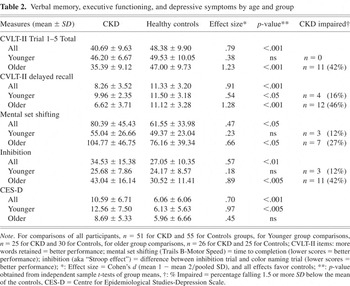
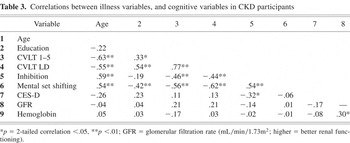
The percentage of CKD participants considered to meet criteria for cognitive impairment was calculated using the recommended cut-off score of performance at least 1.5 SD's below matched controls (Tuokko et al., 2001). As can be seen in Table 2, the estimates of cognitive impairment in CKD varied with age. In younger CKD participants (ages 38–60), estimates of cognitive impairments ranged from 0% to 16%, with the largest performance differences noted on the delayed recall measure. In older CKD participants (ages 61–89), estimates of cognitive impairment ranged from 27% to 46%, with largest performance differences again noted on the delayed recall measure. Overall, CKD participants reported a higher number of depressive symptoms than healthy controls, although when stratified by age group, these differences only reached significance in younger participants (see Table 2). As can be seen in Table 3, increasing age was associated with worse performance on all of the cognitive tasks in CKD participants. Importantly, age was not significantly associated with increased severity of illness as indexed by either estimated GFR (Pearson r = −.04) or hemoglobin (Pearson r = .05). Furthermore, neither hemoglobin nor estimated GFR were significantly correlated with cognitive performance.
Verbal memory, executive functioning, and depressive symptoms by age and group

Correlations between illness variables, and cognitive variables in CKD participants

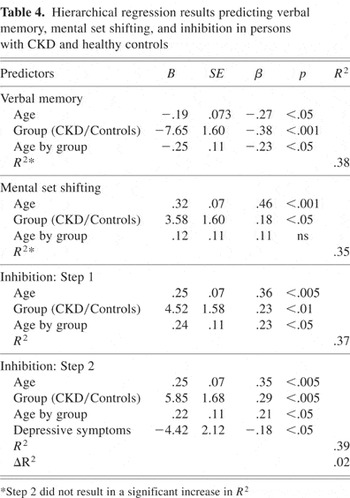
To examine the predictive utility of age, health status, and their interaction in accounting for individual differences in verbal memory and executive functioning, we conducted a series of two-step hierarchical regression analyses, the results of which are presented in Table 4. The first step of the model included participant's age (centered), group (CKD vs. controls) and the interaction of these variables. In addition, because persons with CKD reported a higher level of depressive symptoms than controls, we wanted to determine whether this variable improved prediction of performance on the cognitive measures. Therefore, scores on the CES-D (log) were entered into the second step of the model.
Hierarchical regression results predicting verbal memory, mental set shifting, and inhibition in persons with CKD and healthy controls

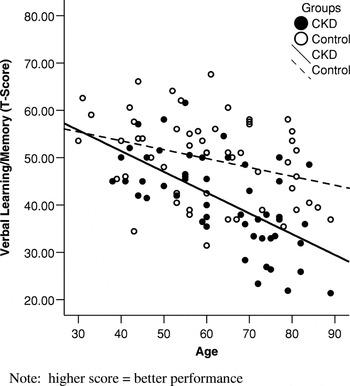
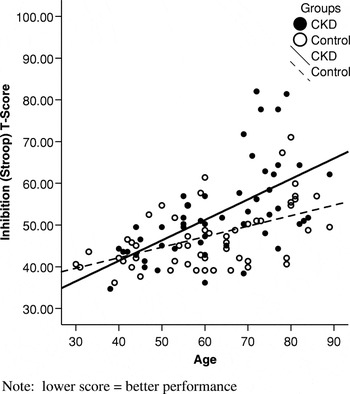
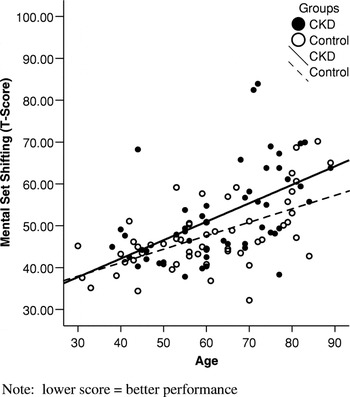
As can be seen in Table 4, increasing age, CKD, and their interaction were each significant predictors of poorer performance on measures of verbal memory and inhibition. Together, these variables explained 38% of the variance in verbal memory performance with 95% confidence limits from .21 to .51 (Steiger & Fouladi, 1992), and 37% of the variance in Stroop (inhibition) performance (95% confidence limits from .20 to .50; Steiger & Fouladi, 1992). Both older age and CKD were associated with worse performance on these measures. Furthermore, examination of the regression slopes revealed that age-related performance decrements were differentially exacerbated in CKD participants. These relationships can be observed in Figures 1 and 2. Whereas older age and diagnosis of CKD were predictive of worse performance on the mental set shifting task (R2 = .35; confidence limits from .18 to .48; Steiger & Fouladi, 1992), the interaction of these variables was non-contributory (see Fig. 3).

Regression slopes and scatter plot showing the effects of Age, Group (CKD and Controls), and their interaction on the verbal memory measure.

Regression slopes and scatter plot showing the effects of Age, Group (CKD and Controls), and their interaction on the Inhibition measure.

Regression slopes and scatter plot showing the effects of Age and Group (CKD and Controls) on the Mental Set Shifting task.
Depressive symptoms were not a significant predictor of either verbal memory or mental set shifting performance (R2 change = .000, and .001, respectively). However, depressive symptoms were a significant predictor of Stroop performance, resulting in an additional 3% of variance explained. Interestingly, the direction of this relationship was negative, as a lesser number of depressive symptoms predicted greater interference on the Stroop task. To elucidate this relationship, the “age by depressive symptoms” and “group by depressive symptoms” interaction terms were entered into two hierarchical regression models along with the appropriate main effects, and were non-contributory. Examination of the intercorrelations revealed that in CKD participants, a higher number of depressive symptoms were significantly associated with better performance on the Inhibition task (Pearson r = −.32; see Table 3). Furthermore, it was noted that this might reflect the fact that increasing age was marginally associated with a reduction in depression symptoms (Pearson r = −.26, p = .07). In fact, after controlling for the effects of age through partial correlation, the relationship between depressive symptoms and inhibition was reduced to non-significance (pr = −.22).
Finally, in CKD participants only, we conducted a series of hierarchical regression analyses to determine the predictive utility of metabolic factors (estimated GFR and hemoglobin) after adjusting for the effects of age, which is embedded in the MDRD GFR estimate. As expected, increasing age emerged as a significant predictor of worse performance on each of the cognitive dependent measures, whereas the inclusion of the metabolic factors added no further prediction over and above the effects of age.
DISCUSSION
Little attention to date has been directed toward cognitive functioning in persons with CKD in the years prior to the initiation of dialysis. We examined the pattern of cognitive performance in a Canadian CKD sample with a broad range of age and illness severity. In addition, we examined the roles of three potential variables predicted to have a negative effect on cognitive performance in CKD, increasing age, a higher number of depressive symptoms, and increased illness severity (as indexed by estimated GFR and hemoglobin). The current evidence extends previous findings (Kurella et al., 2004) by demonstrating that even persons with CKD who do not present with overt evidence of cerebrovascular pathology (e.g., stroke) are at high risk for cognitive impairments in comparison with age peers. In addition, our findings suggest that age is an important moderator of the cognitive presentation in CKD. Whereas certain aspects of executive functioning and learning may be relatively preserved in younger CKD participants, older CKD participants exhibited worse performance than matched controls on all aspects of memory and executive functioning assessed in the current study. Furthermore, examination of the effect size estimates indicates that the magnitude of the cognitive differences observed is moderate to large (see Table 2) with very large differences noted in verbal memory in older CKD participants (Cohen, 1992).
An important question remains, what may be underlying these significant cognitive impairments in persons with CKD? The current findings allow us to first approach this question by ruling out some potentially important variables. Whereas CKD participants exhibited more self-reported depressive symptoms than controls, these were only weakly associated with cognitive performance after controlling for the effects of age. Furthermore, we could find no evidence for an association between cognitive performance and illness progression in persons with CKD. Regarding the effects of age, it is important to note that there was no indication in the current sample of a direct association between increasing age and our indices of severity of renal disease. Specifically, whereas increasing age was associated with greater extent and severity of impairments in verbal memory and inhibition, age was not significantly associated with either estimated GFR (Pearson r = −.04) or hemoglobin (Pearson r = .05). Furthermore, age was evenly distributed across the stages of renal disease represented in the current sample (see Table 1).
To understand the age effects in this study, it is important to note that we excluded participants with a previous diagnosis of dementia, and all participants were considered independent for activities of daily living based on their IADL performance. Nonetheless, the fact that older CKD participants exhibited such high rates of cognitive impairments suggests that these results may reflect emergent cerebrovascular disease that may exert a negative effect on cognition even in the absence of overt symptoms such as stroke. As reported previously and observed in the current sample, hypertension is nearly ubiquitous in CKD (Levey et al., 2003). Furthermore, hypertension and diabetes together form the leading causes of renal disease (Collins et al., 2003; Coresh et al., 2003), and both have been associated with accelerated cognitive decline in late mid-age and late-life (Abate et al., 2001; Gunning-Dixon & Raz, 2000; Hassing et al., 2004; Knopman et al., 2001; MacKnight et al., 2002). Whereas there has been little direct neuroradiological examination to date in persons with CKD, it has recently been argued that cerebrovascular disease may be an important cause of cognitive impairment in persons with the more severe form of renal failure known as ESRD (Pereira et al., 2005). Recent brain imaging studies have reported high rates of cerebrovascular disease in persons with ESRD, with 50% to 80% exhibiting white matter hyperintensities (WMH) and other evidence of ischemic brain lesions (Fazekas et al., 1996; Fazekas et al., 1995; Lass et al., 1999). The presence of WMH's has been associated with cerebrovascular disease (Stewart, 1999) and with impairments in executive functioning and memory in elderly populations (Gunning-Dixon & Raz, 2000). In addition, CKD is associated with several other cerebrovascular risk factors, such as atherosclerosis, hyperhomocysteinemia, and oxidative stress (Leoncini et al., 2003; Pereira et al., 2005). Thus, the pattern of memory and executive functioning impairments we observe in older CKD participants may in part reflect what has previously been deemed “vascular cognitive impairment” (Hachinski, 1994), in patient populations with known cerebrovascular risks. Such an explanation may underlie previously reported associations between moderate renal impairment and vascular dementia in older samples (Seliger et al., 2004). An important direction for future research will be to further elucidate the relative contributions of these and other potential cognitive risk factors in CKD. Furthermore, it will be important to track cognitive performance longitudinally in persons with CKD to determine how declining cognitive status may influence treatment decisions and outcomes.
Limitations
These findings should be considered in light of certain limitations. It is possible that our decision to exclude individuals with other illnesses with CNS effects (i.e., stroke and dementia) may reduce the generalizability of our findings to the broader CKD population. In fact, it is likely that more liberal inclusion would have led to even higher rates of significant impairment observed. Nonetheless, we felt our criteria allowed more precise elucidation of the cognitive presentation of CKD. In addition, because we did not have access to laboratory blood work on our control participants, it is it possible that some of our “healthy controls” may have had undetected renal disease (i.e., reduced GFR). In any case, the inclusion of such individuals in the control group would be expected to reduce the magnitude of the differences observed and would not serve to confound interpretation of the current results.
Regarding the dependent measures employed, we elected to specifically examine verbal memory and aspects of executive functioning. The reasons for this were threefold. First, a decline in these functions has previously been reported in CKD samples with a large percentage of participants with a history of stroke. We wished to extend these findings to CKD participants without a history of stroke to better characterize the pervasiveness and nature of the impairments. Secondly, it is important to note that our measures of executive functioning were derived after controlling for the effects of both psychomotor speed and reading speed. Thus, we believe we have reported a more accurate and nuanced picture of the true nature of the deficits associated with CKD. Thirdly, these functions have been shown to be particularly sensitive to cerebrovascular risks that are highly prevalent in this population. We acknowledge that postulating that cerebrovascular disease may underlie at least some of the deficits observed is speculative, but consistent with previous findings indicating high rates of cerebrovascular pathology in renal disease (for a review, see Pereira et al., 2005). Developing a direct link between cerebral integrity and function in CKD remains an important question for future research.
Summary and Conclusions
In summary, our findings suggest that community-dwelling adults with CKD display high rates of cognitive impairments relative to matched controls. Furthermore, these impairments are most pronounced in persons aged 61 and older and are not associated with metabolic illness parameters such as estimated GFR or hemoglobin. The differences observed were not accounted for by depressive symptoms, which were only weakly associated with cognitive performance, and negatively associated with age. With more than half of persons with renal disease over age 60 (Coresh et al., 2003), the current findings have important implications for medical management of CKD, and highlight the need for further neuropsychological investigation of this highly prevalent and costly illness. Developing a better understanding of the factors underlying neuropsychological performance in CKD is crucial to detect persons that may be at risk for cognitive compromise years before the initiation of dialysis, to assist in treatment planning, to identify and treat potentially reversible causes of cognitive impairment, and to provide essential support to patients required to manage increasingly complex medication and dietary regimens.
ACKNOWLEDGMENTS
The authors thank Heike Dumke, Stacey Kesten, and Sarah Meachen for their help in data collection, Teri Pentland for her efforts in subject recruitment and study coordination, Dr. Ray Koopman for statistical consultation, and Dr. Allen E. Thornton for his helpful comments on an earlier version of this manuscript. The authors also address special thanks to those who agreed to participate in this study. This work was supported in part by a Simon Fraser University/Social Sciences and Humanities Research Council (SFU/SSHRC) Institutional Grant and an SFU/Institute of Health Research and Education (SFU/IHRE) Seed Grant awarded to Dr. Wendy Loken Thornton, and by a University of British Columbia (UBC) Division of Geriatric Medicine Grant awarded to Dr.'s Thornton and Hill. Sirad Deria was supported by the Formation de Chercheurs et l'Aide a la Recherche - Fonds de la recherche en santé du Québec Master's Scholarship (FCAR-FRSQ), and by a Canadian Institute of Health Research (CIHR) Professional Student Research Award. Shannon Gelb was supported by a SSHRC Canada Graduate Master's Scholarship and by a CIHR/Michael Smith Foundation for Health Research (MSFRH) Transplant Research Training Award. Portions of this work were presented in abstract form at the 2nd Annual Congress of the International Society for Vascular, Cognitive, and Behavioural Disorders, and at the Gerontological Society of America's 56th Annual Scientific Meeting.