

Introduction
The current state of the labour market in Europe is an issue of great concern in public debate. The media have been discussing the growing presence of precarious working conditions while scholarly studies have examined the rise of segmented labour markets. Labour-related protests and mobilizations have also received considerable attention. The Indignados and Mileuristas in Spain, and Movimenti Precari in Italy are among the most well-known Southern European examples (Castañeda, Reference Castañeda2012; Murgia and Armano, Reference Murgia and Armano2012; Lima and Artiles, Reference Lima and Artiles2013), but similar movements are spreading all across Europe (Lahusen, Reference Lahusen2013). The rise of the ‘gig economy’ and digital labour platforms suggests that these trends are likely to continue into the near future (Milkman and Ott, Reference Milkman and Ott2014; Harvey et al., Reference Harvey, Rhodes, Vachhani and Williams2016; Malin and Chandler, Reference Malin and Chandler2016; Webster, Reference Webster2016). Nonetheless, the overwhelming attention given to collective mobilizations that seek to tackle precariousness and related issues such as austerity and cuts to benefits risks overlooking how individual workers are participating.
This article examines the effect of job precariousness on different forms of political participation among young precarious workers vis-à-vis regularly employed ones. In doing so, it seeks to identify and explain patterns and traits in how young people engage with and within the political arena. The well-known nexus between individual socio-demographic characteristics and political participation is taken into account by including all relevant socio-demographic characteristics and individual variables such as economic resources, time availability, civic skills (Brady et al., Reference Brady, Verba and Schlozman1995), household burden (Schlozman et al., Reference Schlozman, Burns and Verba1994, Reference Schlozman, Burns and Verba1999; Coffé and Bolzendahl, Reference Coffé and Bolzendahl2010; Marien et al., Reference Marien, Hooghe and Quintelier2010), and social capital (La Due Lake and Huckfeldt, Reference La Due Lake and Huckfeldt1998; Putnam, Reference Putnam2000; McFarland and Thomas, Reference McFarland and Thomas2006; Van Der Meer and Van Ingen, Reference Van Der Meer and Van Ingen2009).
Geographically, the article focuses on people living in the city of Turin (Italy). This city is located in the Piedmont region, which was once the heartland of Italian manufacturing. However, since the 1980s it has been subject to a large and continuous process of de-industrialization increasing precarious working conditions in the labour market (Monticelli and Bassoli, Reference Monticelli and Bassoli2016; Bassoli and Monticelli, Reference Bassoli and Monticelli2017). The survey is based upon an original sample of people between 18 and 34 years of age, divided into two major groups: temporary workers and permanently employed workers. The survey includes both institutional and non-institutional types of political behaviour (Stolle and Hooghe, Reference Stolle and Hooghe2011; Tarrow, Reference Tarrow2013).
The article is organized as follows: the first section presents the theoretical framework, emphasizing the crucial interplay between individual variables – socio-economic characteristics, social capital, and occupational status – with the local context; the second section presents the data set and the methods and explains how factor analysis was used to identify youth-specific forms of participation; in the third section, hypotheses are tested through a set of logit regressions that show the decreasing relevance of the socio-economic status model (among youth) and confirm some well-known hypotheses in the literature about political participation (the role of social capital and political interest); the final part of the article outlines the main empirical findings and discusses the potential of bridging political participation studies with sociology of work and industrial relations.
Occupational status and political involvement: the state of the art
Most people would agree that a properly functioning democracy requires citizens to actively participate in the political arena. They should have the opportunity to engage in the political system through the typical range of tools provided by representative democracies. Two of the most important tools are voting and involvement in party politics. But when it comes to challenging the status quo, citizens have historically deployed a different repertoire of actions, ranging from protests to violent actions and, more recently, shifting their focus from the state to markets with individual or collective forms of political consumerism aimed at positively or negatively discriminating between products for ethical, environmental, and political reasons (Micheletti, Reference Micheletti2003; Forno and Graziano, Reference Forno and Graziano2014).
Nonetheless, one of the most striking and enduring findings in the field of political participation studies is the unequal distribution, across the population, of the propensity towards political activism (Stolle and Hooghe, Reference Stolle and Hooghe2011). Among the factors influencing these discrepancies identified by the traditional literature on political participation, we find economic resources, age, educational attainment, social capital, familial background, and occupational status (Schlozman et al., Reference Schlozman, Burns and Verba1994, Reference Schlozman, Burns and Verba1999; Brady et al., Reference Brady, Verba and Schlozman1995; La Due Lake and Huckfeldt, Reference La Due Lake and Huckfeldt1998; McFarland and Thomas, Reference McFarland and Thomas2006; Solt, Reference Solt2008; Van Der Meer and Van Ingen, Reference Van Der Meer and Van Ingen2009; Coffé and Bolzendahl, Reference Coffé and Bolzendahl2010; Marien et al., Reference Marien, Hooghe and Quintelier2010; Lorenzini and Giugni, Reference Lorenzini and Bassoli2012).
More specifically, two broad strands of literature have tackled the relationship between employment and political participation. On the one hand, there are scholars who consider unemployment as a trigger for collective action and increased interest in socio-political issues (Gamson, Reference Gamson1968; Piven and Cloward, Reference Piven and Cloward1977; Demazière and Pignoni, Reference Demazière and Pignoni1998; Maurer and Mayer, Reference Maurer and Mayer2001; Wilkes, Reference Wilkes2004; Stolle and Hooghe, Reference Stolle and Hooghe2011). On the other hand, there are scholars who describe unemployment as a hindering factor for political activism (Verba et al., Reference Verba, Nie and Kim1978, Reference Verba, Schlozman, Brady and Nie1993; Brady et al., Reference Brady, Verba and Schlozman1995; Schlozman et al., Reference Schlozman, Burns and Verba1999). The first strand, often referred to as the ‘grievance model’ (Kern et al., Reference Kern, Marien and Hooghe2015), considers any sort of resentment, once it is translated explicitly into political demands, as representing a strong incentive for political activism at the individual level (Gamson, Reference Gamson1968; Wilkes, Reference Wilkes2004; Stolle and Hooghe, Reference Stolle and Hooghe2011). Similarly, others interpret unemployment as a boost for collective action and mobilization (Piven and Cloward, Reference Piven and Cloward1977; Demazière and Pignoni, Reference Demazière and Pignoni1998; Maurer and Mayer, Reference Maurer and Mayer2001; Baglioni et al., Reference Baglioni, Baumgarten, Chabanet and Lahusen2008). In other words, political participation is considered a viable way for marginalized social classes to escape from social isolation, express their discontent, make political claims and fight the social stigma attached to unemployment.
As for the second strand of literature, often referred to as the civic voluntarism model (Verba et al., Reference Verba, Schlozman, Brady and Nie1993), scholars have demonstrated that political participation is supported and fostered by the availability of individual resources: money, time, civic skills, and social capital (Verba et al., Reference Verba, Nie and Kim1978, Reference Verba, Schlozman, Brady and Nie1993; Brady et al., Reference Brady, Verba and Schlozman1995; Schlozman et al., Reference Schlozman, Burns and Verba1999). Research on the impact of labour conditions has consistently shown that unemployed people tend to be less politically active than regular workers (Brady et al., Reference Brady, Verba and Schlozman1995; Schlozman et al., Reference Schlozman, Burns and Verba1999; Anderson, Reference Anderson2001; Driskell et al., Reference Driskell, Embry and Lyon2008; Van Der Meer and Van Ingen, Reference Van Der Meer and Van Ingen2009; Coffé and Bolzendahl, Reference Coffé and Bolzendahl2010).
Job precariousness: the missing piece of the puzzle
A rich body of literature has been produced in last decade with the goal of shedding light on the nuanced concept of precariousness. Scholars within the field of sociology of work believe that precariousness can be better defined by looking at the context and at the consequences of job conditions in terms of citizenship rights and social guarantees rather than by focusing on the type of contract (Murgia and Armano, Reference Murgia and Armano2012; Mattoni and Vogiatzoglou, Reference Mattoni and Doerr2014). In fact, temporary contracts’ conditions and related social guarantees may vary consistently across and within European countries, pointing out the necessity of going beyond mere contractual features to assess job-related degree of precariousness. In other words, workers with open-ended contracts might experience precariousness as much as, if not more than, workers with temporary contracts. In spite, and probably exactly because of this complexity, it is difficult to find a readymade definition of precariousness in the literature.
Rather than a static condition, precariousness is often referred to as a multi-dimensional, complex process shaped by the dynamics of contemporary capitalism, the actions (and reactions) of the people involved and the institutional mediation between the two (Della Porta et al., Reference Della Porta, Silvasti, Hänninen and Siisiäinen2016). As stated above, precariousness is not – or not only – the consequence of the contractual status, but it also constitutes a subjectively perceived condition. Given its broad scope, the concept of precariousness has been deployed to describe workers in disparate sectors ranging from university to the sharing and gig economy. As stated in a recent publication ‘the precariat remains a contestable and polyvalent term, giving rise to and reason for endless definitional debates and classificatory clashes’ (Silvasti and Hänninen, 2016: 159).
Returning to the role of occupational status in triggering political participation and, in particular, collective mobilizations, precariousness has been rarely analyzed within the framework of the grievance model. Classical studies on the diffusion of unemployed people’s collective movements (Piven and Cloward, Reference Piven and Cloward1977; Maurer and Mayer, Reference Maurer and Mayer2001) overshadow other occupational conditions, not to mention the difficulties that precarious youth face in self-organizing (Mattoni, Reference Mattoni and Vogiatzoglou2016) and accessing existing trade unions (Alberti et al., Reference Alberti, Holgate and Tapia2013; Keune, Reference Keune2015).
More recent studies on precarious collective movements in Europe point towards the emergence of some kind of group-consciousness (Mattoni and Doerr, Reference Mattoni2007) even though this dynamic is difficult to assess given the simultaneous presence and the interplay with anti-austerity movements. Only few studies examine the political attitudes and voting preferences of precarious workers based on single or cross-national case studies (Bay and Blekesaune, Reference Bay and Blekesaune2002; Corbetta and Colloca, Reference Corbetta and Colloca2013).
As regards the civic voluntarism model, occupational status is usually treated as an unproblematic individual variable (Brady et al., Reference Brady, Verba and Schlozman1995; Schlozman et al., Reference Schlozman, Burns and Verba1999; Anderson, Reference Anderson2001; Schur, Reference Schur2003; Driskell et al., Reference Driskell, Embry and Lyon2008; Van Der Meer and Van Ingen, Reference Van Der Meer and Van Ingen2009; Coffé and Bolzendahl, Reference Coffé and Bolzendahl2010).
Broadly speaking, the literature has dealt with the issue of occupational status and political participation by drawing a sharp distinction between full-time employment and unemployment, without identifying ‘intermediate’ situations (such as part-time jobs, self-employment, or fixed-term contracts) or without differentiating between workers’ individual characteristics. Indeed, employment for a young person today has a different meaning and significance compared with an older person, just as having a job has a differential effect on the individual life trajectory of a man or a woman (Schlozman et al., Reference Schlozman, Burns and Verba1999). Analogously, part-time or temporary jobs might have different impacts on the repertoire of political actions compared with permanent full-time employment, as is the case for political attitudes (Corbetta and Colloca, Reference Corbetta and Colloca2013; Marx and Picot, Reference Marx2013; Marx, Reference Marx and Picot2014; Eichhorst and Marx, Reference Eichhorst and Marx2015).
In light of this, this article aims at tackling the following research questions: Are precarious workers more prone to political activism than their counterparts holding open-ended jobs? Do they tend to choose representative channels of political participation or do they prefer to engage directly in grassroots and contentious political actions?
To begin answering these questions one should contextualize precariousness in the Italian case.
The Italian socio-economic and political context
The labour market of temporary jobs in Italy is two-tiered, with a primary segment offering well-paid job positions and a secondary segment offering short-term, low-paid work with no career and stabilization prospects. Therefore, temporary positions may be used as probationary periods serving as ‘stepping stones’ towards more rewarding positions (Scherer, Reference Scherer2001, Reference Scherer2004), while others – such as seasonal or casual jobs – are de facto potential traps that promise dead-end precarious careers (Picchio, Reference Picchio2012; Pavlopoulos, Reference Pavlopoulos2013; Bruno et al., Reference Bruno, Caroleo and Dessy2014). Moreover, a strong internal divide exists between precariously employed young people holding a university degree and those who do not (Barbieri, Reference Barbieri2011; Lodovici and Semenza, Reference Lodovici and Semenza2012). Scholars hypothesize that tertiary-educated young people tend to have more stable and better-remunerated job trajectories than those who are less educated, since they possess a relatively higher bargaining and signalling power than their lower educated peers (Gebel and Giesecke, Reference Gebel and Giesecke2011). This dynamic is quite common across Southern European countries. What is more specific to each country is the impact of job precariousness on political participation patterns.
The political attitudes of Italian citizens have been widely studied in comparative terms. Italy often appears as an outlier, together with Portugal and Spain. Undoubtedly, welfare regimes, institutional incentives, and cultural characteristics do affect social inclusion and specific forms of political participation (Monticelli and Bassoli, Reference Monticelli and Bassoli2016). According to the existent literature, four aspects are unique to the Italian context.
First, Bay and Blekesaune (Reference Bay and Blekesaune2002) showed that Italy is the only country in the EU where unemployed young people trust the democratic system more than their employed counterpart. However, the overall level of satisfaction among Italian young people is impressively low: ‘political distrust is a majority attitude in Italy. […]. Bluntly stated, it can be maintained that it is those who are satisfied who form the deviant group in Italy’ (Bay and Blekesaune, Reference Bay and Blekesaune2002: 138). Second, extreme political positions on the left–right scale persist among Italian young people, who are also significantly influenced by the political positioning of their parents and relatives (Ogris and Westphal, Reference Ogris and Westphal2005). Third, there is a general agreement about the salience of the precariousness issue. ‘The traditional “lenses” focusing on the insiders/outsiders divide are inadequate to grasp the ongoing changes in the Italian labour market: at least a third category of workers, the “mid-siders” (Jessoula et al., Reference Jessoula, Graziano and Madama2010: 561–562), – or precarious, is needed. Fourth, Italy is characterized by deeply rooted political subcultures. A political subculture is composed of a group of people that fit into the larger culture, but have specific political beliefs that set them apart from the larger group to varying degrees. This means that while they may share some ideas and objectives with the dominant group (such as trust in representative democracy), they oppose the status quo, hoping to change certain aspects of the system to align it with their beliefs. This is specifically true for Italy.
Since the end of WWII, Italians strongly identified either in the Communist Party (Partito Comunista Italiano), in the Christian Democratic Party (Democrazia Cristiana), or in the post-Fascist Party (Movimento Sociale Italiano). The first two parties were either in the majority or in the minority depending on the geographic area considered. The affiliation to a specific political subculture boosted political participation in various ways among different groups of the population (Corbetta and Colloca, Reference Corbetta and Colloca2013). Indeed, regional and local political subcultures seem to still help predict the behaviour of civil society organizations (Bassoli, Reference Bassoli, Monticelli and Pincella2017) and that of the general population (Diamanti, Reference Diamanti2009; Bassoli et al., Reference Bassoli2011; Monticelli et al., Reference Monticelli and Bassoli2016).
Concerning the role played by occupational status in fostering political participation, Baglioni et al. (Reference Baglioni, della Porta and Graziano2008: 846) show that, at least in Italy, unemployment translates into claims-making under two conditions: the presence of political entrepreneurs and their visibility in the public sphere. The activation of precarious youth might depend on similar conditions. Precariousness, in fact, represents nowadays an oft-invoked discursive framework in the media and in the political debate (Doerr et al., Reference Doerr, Mattoni and Teune2015). Focussing on Italian precarious workers’ political attitudes, Corbetta and Colloca (Reference Corbetta and Colloca2013) found that precarious workers are different from their counterparts holding open-ended contracts or being unemployed: ‘They did not share with unemployed people this feeling of political disillusion; in addition, they appeared ideologically to be the most leftist group (slightly more leftist than regular workers)’ (Corbetta and Colloca, Reference Corbetta and Colloca2013: 16).
Findings for other continental countries are similar to a certain extent (Marx, Reference Marx and Picot2014; Eichhorst and Marx, Reference Eichhorst and Marx2015; Emmenegger et al., Reference Emmenegger, Marx and Schraff2015). Marx and Picot (Reference Marx2013) show that a growing number of atypical workers in Germany exhibit a propensity to vote for New Left and Green parties rather than traditional Social-Democratic ones – the former being much better at representing these voters’ preferences for redistributive policies and claims against the status quo. However, to the best of our knowledge, no empirical evidence exists on the range of political actions performed by precarious individuals other than their voting preferences.
As briefly described in a previous article (Monticelli and Bassoli, Reference Monticelli and Bassoli2016), all the above-mentioned strands of research suggest that, in Italy, some systemic variables are creating the preconditions for a new political cleavage to emerge along the dimension of job precariousness. If one accepts the definition of political cleavage as linking ‘the social reality of openness/closure of individual life chances to the likelihood of collective and organized action through the mediation of socially shared systems of beliefs’ (Kriesi, Reference Kriesi, Grande, Lachat, Dolezal, Bornschier and Frey2010: 674), it appears clear how the impossibility to exit a condition of precariousness might trigger certain forms of political participation. The overarching theoretical background of this article is that, given the characteristics of contemporary capitalism and its consequences on labour market structures, precariousness might constitute an emerging political cleavage, especially amongst the most affected groups, including young people. In the following section, the main research hypotheses are described along with the main variables used in the analysis.
Conceptual framework and research hypotheses
Many individual variables must be controlled for in order to test the relative impact of occupational status. We therefore use a conceptual framework built using insights from three strands of political participation studies. We build on the idea that political participation may be explained by individual characteristics (gender, age, and education – the so-called socio-economic status, SES model) and economic resources (the availability of time and civic skills) (Brady et al., Reference Brady, Verba and Schlozman1995).
The first layer, based upon the resource-based model, convincingly explains individual differences in political participation and departs from the SES model (age, class, education) while also considering other resources developed during an individual’s lifetime, such as spare time, skills, and income (Schlozman et al., Reference Schlozman, Burns and Verba1994, Reference Schlozman, Burns and Verba1999).
As a second theoretical pillar, the literature has stressed the importance of gender in helping to explain differential gaps in political activism between men and women. According to these studies (Coffé and Bolzendahl, Reference Coffé and Bolzendahl2010; Marien et al., Reference Marien, Hooghe and Quintelier2010; Lorenzini and Bassoli, Reference Lorenzini and Giugni2015), the registered political participation gap is not related to gender itself, but to the specific resources that women and men have at their disposal within the household. Therefore, in a country like Italy, with a weak welfare regime and a strong imbalance in the division of domestic responsibility between men and women, abstention from politics may be stronger for women who provide more household care than men.
Finally, scholars have also stressed the importance of social capital. They distinguish between structural social capital created by actual networks of friendship and acquaintances (La Due Lake and Huckfeldt, Reference La Due Lake and Huckfeldt1998) and civic engagement created through participation in voluntary associations,Footnote 1 either in the past (McFarland and Thomas, Reference McFarland and Thomas2006) or in the present (Stolle et al., Reference Stolle, Hooghe and Micheletti2005; Van Der Meer and Van Ingen, Reference Van Der Meer and Van Ingen2009; Eggert and Giugni, Reference Eggert and Giugni2010). Both conceptualizations consider social capital to have a positive impact on all forms of participation and are therefore included as part of the model.
As regards the role played by the political, institutional, and geographical context, it is important to consider the existing polarization of the Italian political arena (Pizzorno, Reference Pizzorno1966), as the left–right positioning can explain certain political activism (Van Der Meer et al., Reference Van Der Meer, van Deth and Scheepers2009). Given the specificity of political subculture in the city of Turin, the left-wing youth in Turin should be more active than their right-wing counterpart because they are ‘more central’ relative to the city’s leftist political and social tradition (Diamanti, Reference Diamanti2009). More extreme positions (on the extreme left or extreme right of the political spectrum) are expected to trigger more contentious forms of political behaviour (Van Der Meer et al., Reference Van Der Meer, van Deth and Scheepers2009). From this, we derive the following hypotheses:
Hypothesis 1.1: Young individuals with extreme political positions are more likely to engage in more contentious forms of political participation (strikes, blockades, etc.) than their moderate counterparts;
Hypothesis 1.2: Leftist young individuals of Turin are more likely to engage in all forms of political participation than their right-wing counterparts.
Concerning occupational status, as described in the second section, two competing hypotheses have been debated among scholars. According to many studies in this area, and coherent with the social marginalization strand (Brady et al., Reference Brady, Verba and Schlozman1995), the unemployed should be less engaged in all forms of participation, while precariously employed youth should behave similarly to the ‘fully’ employed youth (Polavieja, Reference Polavieja1999; Schur, Reference Schur2003). As mentioned earlier, the reason for this can be traced back to the role of social stigma. Unemployed people may feel that a stigma is attached to them which produces marginalization and isolation in the contemporary context (Monticelli et al., Reference Monticelli and Bassoli2016) just as they did in the 1930s (Lazarsfeld et al., Reference Lazarsfeld, Jahoda and Zeisel1981). This phenomenon affects the political dimension.
However, considering the contentious politics of unemployment and precariousness in Italy (Baglioni et al., Reference Baglioni, Baumgarten, Chabanet and Lahusen2008) and the fact that precarious workers and unemployed people are often found to be less stigmatized in Italy than in other countries (Bay and Blekesaune, Reference Bay and Blekesaune2002; Murgia and Armano, Reference Murgia and Armano2012), we expect that the level of political participation among precarious workers will actually be higher than their counterparts holding open-ended contracts (Hypothesis 2). This hypothesis must be controlled for by educational attainments because tertiary-educated young people tend to display more stable and better-remunerated job trajectories than less educated young people. At the same time, tertiary education is usually associated with higher levels of political participation. Thus the interaction between these two variables (education and precariousness) has to be assessed.
Hypothesis 2: Precarious workers are more likely to participate than workers with open-ended contracts.
In testing these hypotheses, a control for the interaction between occupational status and political positioning is included, given the importance of local contextual political subcultures, especially the leftist one in the case of Turin.
Beyond voting: the multifaceted nature of political participation
The data set contains 949 individuals aged 18–34 who live in the city of Turin, interviewed using the CATIFootnote 2 method between June 2009 and October 2010. This data set is part of the EU-funded research project YOUNEX.3 The sample is equally divided into two groups of individuals – temporary workers and a reference group comprising workers with open-ended contracts who have worked for the last 12 months in the same workplace.
Aware of the debate about precariousness and its subjective side (De Witte and Näswall, Reference De Witte and Näswall2003), but limited by the quantitative nature of the data available, we constructed the category of ‘precarious workers’ by deploying temporary contracts as a proxy (Corbetta and Colloca, Reference Corbetta and Colloca2013; Marx and Picot, Reference Marx2013; Marx, Reference Marx and Picot2014; Eichhorst and Marx, Reference Eichhorst and Marx2015). In the survey, the category of temporary workers was built through a series of ‘filter’ questions asked at the beginning of the interview. The resulting category includes a wide array of contracts: projects, on call, seasonal, self-employed with only one contractor, temporary, and fixed-term. In order to test the reliability of temporary workers as a proxy of precarious workers, we ran a series of parametric and non-parametric statistical tests (Kendall’s τ, Spearman’s ρ, and Student’s t-distribution) crossing the variable on the type of contract with other relevant variables within the data set. We found that temporary workers display significantly lower levels of income and unionization than workers with open-ended contracts. The survey also shows how their main source of monthly income is not just dependent on their salary, but also on someone else salary. However, this fragility in income is similar to their permanently employed counterparts: descriptive statistics run on the data set show that there is no statistical difference between the two groups in the perception of financial difficulty that living with their present income generates (see variable ‘financial difficulty’ in online Appendix 2 and 4).
Turning to the impact of contextual variables, the impact of political subcultures was considered using leftist political stance while controlling for extreme political positioning. Political positioning is measured using a 0–10 self-positioning scale, while extreme political positioning is a dichotomous variable coded as one for those placing themselves below one or above nine. This modification allows us to test Hypotheses 1.1 and 1.2 simultaneously. With regard to the other independent variables, we deployed standard operationalizations (see online Appendix 2).
Concerning the independent variables, we followed the approach developed by Verba et al. (Reference Verba, Nie and Kim1978: 51–56; 310–339) that involves the identification of patterns of coherent behaviours called ‘modes of political participation’ (Verba et al. Reference Verba, Nie and Kim1978).Footnote 3 In this article, we use a more recent typology developed by Teorell et al. (Reference Teorell, Torcal and Montero2007: 345) which identifies four modes: voting, party activity, collective action, and consumer participation. The typology is built along two dimensions: channel of expression and mechanism of influence.
The first dimension, channel of expression, is broken down into two broad types: behaviours taking place within the framework of representative democracy and behaviours taking place through extra-representational channels of expression. For the second dimension, mechanism of influence, Teorell et al. rely on Hirschman’s popular distinction between ‘exit’ and ‘voice’ as distinct political strategies (Hirschman, Reference Hirschman1970). More specifically, they identify two representational modes of political participation: ‘voting’ is the exit-based mode, while ‘party activity’, by contrast, is the voice-based mode. Voters, in fact, may change party once they are not satisfied (exit strategy), while party members can ‘voice’ their dissatisfaction in congresses and assemblies (voice strategy). The same dual structure can be applied to extra-representational forms of participation: the exit-based mode is political consumerism (i.e., the choice of boycotting or ‘buycotting’ specific products), while the voice-based mode is collective action. While political consumerism works according to market-like dynamics, collective action is based upon the flow of information towards (and often, against) political and institutional elites (Table 1).
Modes of political participation

Source: Adaptation from Teorell et al. (Reference Teorell, Torcal and Montero2007: 340).
Even though Teorell et al. (Reference Teorell, Torcal and Montero2007) illustrated quite robust results on 13 European countries, Italy was not included in the sample. The typology was therefore tested on the sample under investigation using a confirmatory factor analysis based on the four items described above and imposing a varimax rotation given the orthogonal nature of the factors (online Appendix 1).Footnote 4 Teorell’s typology was found to hold valid in the sample and similar labels were given to the factors: voting, party activity, consumer participation and collective action (see online Appendix 1 for further details). In the following analysis, though, the factor ‘party activity’ was dropped from the analysis because all young people actively engaged in that form were precarious, making it impossible to conduct a comparative analysis (see online Appendix 3).
Thereafter a set of logistic regressions was launched to test Hypotheses 1.1, 1.2, and 2. The baseline model (online Appendix 4) assesses the impact of occupational status on different forms of participation that emerged from the factor analysis.Footnote 5 The baseline model includes variables for gender, age, education, nationality, as well as economic resources, time availability, civic skills, familial burden, social capital and political resources (see online Appendix 4 for further details). The baseline model was extended by adding and testing the effect on political participation of four different types of variables. The first model tests the role of extremism (Hypothesis 1.1) by considering extreme political positioning only (Partial model A). The following model tests the importance of leftist political positioning on participation (Hypothesis 1.2) by considering political positioning only (Partial model B). Finally, the third model is testing the two hypothesis simultaneously, leaving in the fourth model the interaction terms between political positioning and occupational status (Hypothesis 2). All models were tested running binary logistic regressions. Logistic regressions were chosen instead of ordinal logistic regressions since forms of participation – operationalized as ordinal scales – could not fit the mandatory proportional odds assumption (or parallel regression assumption).
In a second step of the analysis, we run some robustness checks: one concerning the role of extremism using a quadratic relationship with the political positioning (see online Appendix 5) and the other on the role of education. The effect of precariousness at different educational levels was assessed using interaction terms allowing to control for the divide between low educated and highly educated flexible workers (online Appendix 6).
The following section illustrates and discusses the results of the empirical analysis by presenting average marginal effects (AME)Footnote 6 and predictive margins at representative values to facilitate the interpretation of results.
Engaged precariat in Turin: young, educated, and left wing
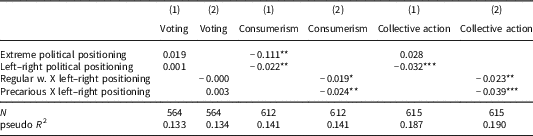
Table 2 presents an overview of the impact of political positioning on the different modes of political participation, controlling for the different sets of identified predictors with a specific focus on the complete models (models 1 and 2, online Appendix 4). The first finding concerns the limited impact of extreme political positions: the variable is almost never significant, except for ‘political consumerism’. Young people with an extreme political position are 11% less likely to be active in this form of political participation vis-à-vis those declaring a more moderate position on the political scale. This finding does not support Hypothesis 1.1, collective action (a typical extra-representational form of political participation) is not positively influenced by an extreme political positioning, probably because of the limited contentiousness of this form of political participation in the city of Turin. We also controlled for a quadratic relationship with the political positioning (see online Appendix 5), but results are similar to those found by running the model with the variable ‘extreme political positioning’, which was thus preferred given the lack of collinearity.
Effect of precarious job condition in predicting non-institutionalised participation

We present average marginal effects calculated when moving from fully employment to precarious job condition.
Model 1 – Controls included: gender, age, citizenship, educational level, financial situation, children, associational involvement, political interest, internal political efficacy, and political knowledge.
Model 2 – Controls included: model 1 and interaction term between employment status and political self-positioning.
Source: Annex 4, models 1–2, for each dependent variable.
*P<0.05, **P<0.01, ***P<0.001.
Turning to Hypothesis 1.2, concerning the role of a left-wing political positioning on political participation, the findings lead to more nuanced conclusions than expected. While leftist youth were expected to be more active in all modes of political participation, this is not true for voting. In the full model without interaction (model 1 in online Appendix 4), political positioning plays a role in both political consumerism and collective action: those with a right-wing political positioning participate less in both forms of political participation (−2.2% and −3.2%, respectively). The same trend (also in magnitude) holds valid when precarious workers and workers with open-ended contracts are analyzed separately, using interaction terms. The impact of political positioning is stronger on precarious young people compared to their permanently employed counterparts. For political consumerism, the impact of right-wing political positioning decreases the rate of political participation among regular workers by 1.9% compared with 2.4% for precarious workers. Whereas for collective action, the expected rate of political participation diminishes by 2.3% for right-wing regular workers compared with −3.9% for precarious young people with the same political positioning. Overall, political positioning seems to influence youth activation in extra-representational modes of political engagement, especially in the case of precarious youth.
These findings do not mean that right-wing precarious youth are the least active group. The interaction term, presented in Table 2, assesses the impact of political positioning on precariousness, not the rate of participation in absolute terms. In order to better understand the role of a left-wing political positioning on the Turinese precariat, we deploy figures to highlight the patterns and the rates of political engagement. Considering model 2, the following figures illustrate the predicted probabilities of participating in different forms of political activities (voting, consumerism, and collective action) by employment status for different political positioning.
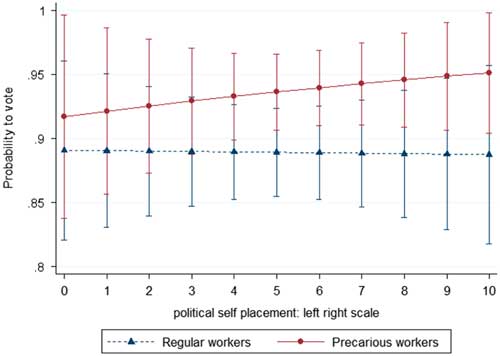
In Figure 1, the flat line, comprising regular workers, suggests that the probability of participating (around 89%) is not depending on political positioning. At the same time, the upper line, positively inclined from left to right, depicts the predicted probabilities of voting for precarious young people. It also highlights that the previous positive effects of being precarious on the probability of voting (between 6 and 9%) is now statistically non-significant. The loss of explanatory power is represented by the lack of distance between the two lines. In model 2, the effect is thus ‘absorbed’ by the interaction term, showing that precarious workers are similar to their counterparts with open-ended contracts once political positioning in taken into consideration. Moreover, the importance of declaring a left-wing political positioning (Hypothesis 1.2) does not hold when the effect of job precariousness is taken into consideration.
Predicted probabilities of voting by political self-positioning. Source: Average marginal effects are calculated based on Annex 4, model 2 (with all controls and interaction terms).

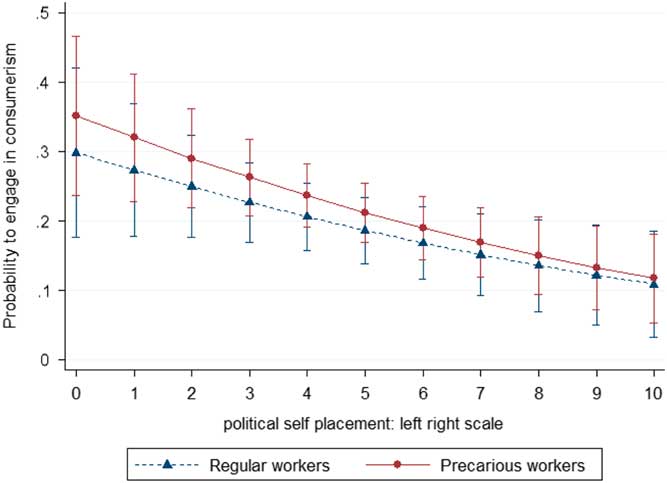
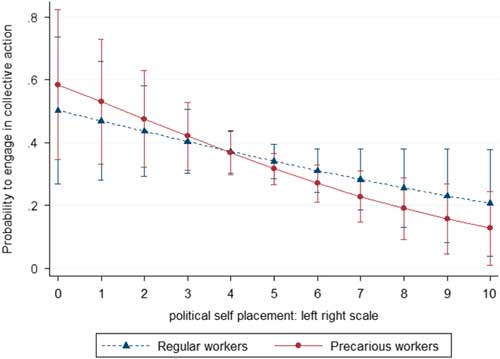
Focussing on non-representational modes of participation, the results reveal a slightly different picture. Looking at Figures 2 and 3, it is clear that precarious youth and regular workers show similar patterns, strongly influenced by political positioning. The two lines present similar decreasing trends as one moves from left-wing to right-wing political positions. In both job conditions, predicted probabilities are influenced by political positioning. Left-wing young people show higher chances of engaging in political consumerism compared to right-wing young people. At the extremes, the difference reaches 20% for consumerism and 40% for collective action. However, the interaction term between political positioning and occupational status is not significant since the difference between the two groups is not affected by political positioning, that is the distance between the two lines is not statistically affected.
Predicted probabilities of engaging in consumerism by political self-positioning. Source: Average marginal effects are calculated based on Annex 4, model 2 (with all controls and interaction terms).

Predicted probabilities of engaging in collective action by political self-positioning. Average marginal effects are calculated based on Annex 4, model 2 (with all controls and interaction terms).

To conclude, the role of education was specifically analyzed because – according to the literature presented above – it is usually considered a strong predictor of political participation. Moreover, since some scholars suggest that educational levels might play a major role in the process of occupational stabilization or ‘precarisation’ of career trajectories, a specific control for the mediator effect of education was introduced in the analysis. Results show that educational attainment is not a particularly strong predictor of political participation (online Appendix 4). On the other hand, the interaction with job condition is rarely significant. More precisely, in the main model there is no evidence of educational attainment influencing the probability of voting and enacting consumerism, nor a moderating effect while considering the interaction term (online Appendix 6). In sum, tertiary education only positively influences the level of mobilization in collective action (online Appendix 4) for both precarious and permanently employed youth (online Appendix 6).
Job precariousness: an emerging political cleavage
The aim of this article is to disentangle the relationship between occupational status and political participation by analyzing a sample of young Italian workers and their patterns of individual and collective political engagement. While the extant literature has demonstrated an increasing interest in the preconditions that foster or hinder political participation, this article demonstrates the fruitfulness of adopting an approach that considers the interplay between job precariousness and the range of actions that individuals engage in, both inside and outside the political arena of representative democracy. In the case of Turin, this article shows how precariousness affects the political participation of young people, while also drawing attention to the importance of political positioning and political subcultures.
In short, the findings suggest that precarious young workers tend to participate more in representational forms of political participation (voting) than their counterparts with open-ended contracts. On the other hand, precarious workers do not show any difference when focussing on non-representational forms of political participation: political consumerism and collective action. Another finding concerns the role played by the interaction between occupational status and left-wing political positioning. While a left-wing political positioning is connected to a higher level of non-representational political activity, the impact is more pronounced for precarious young people than for permanent contract workers.
In addition, left-wing young people participate more in two forms of political participation due to an interaction between political positioning and occupational status rather than the left-wing subculture of Turin. While a leftist political positioning is often a trigger for high levels of political participation among young people, when it interacts with occupational status, the triggering effect is present for both regular and precarious workers. This sheds lights on the hypothesis put forward at the beginning of the article, that is the centrality in Turin is not only a matter of leftist political position, but also a matter of more nuanced characteristics at the individual level such as the level of educational attainment, civic skills, and occupational status.
To conclude, the article suggests, as highlighted by recent research (Monticelli and Bassoli, Reference Monticelli and Bassoli2016), that an insecure occupational status does constitute a contemporary political cleavage able to trigger the political activation of precarious workers both at the individual and collective level (Kriesi et al., Reference Kriesi2006; Kriesi, Reference Kriesi, Grande, Lachat, Dolezal, Bornschier and Frey2010). In other words, the distinction between precarious workers and workers with open-ended contracts is relevant and should be carefully considered when analyzing individual employment trajectories as well as patterns of civic, political, and social engagement. More broadly, this article demonstrates how the debate on the struggles of precarious workers in the sociology of work and industrial relations could benefit from a deeper dialogue with interpretive frameworks typical of social movement and political participation studies.
Supplementary material
To view supplementary material for this article, please visit https://doi.org/10.1017/ipo.2018.11
Acknowledgements
Results presented in this article have been obtained within the project ‘Youth, Unemployment, and Exclusion in Europe: A Multidimensional Approach to Understanding the Conditions and Prospects for Social and Political Integration of Young Unemployed’ (YOUNEX). The authors wish to thank all the members of the research consortium and, in particular, the other members of the Italian research team, Simone Baglioni and Paolo R. Graziano. The authors are also grateful to the two anonymous reviewers for their comments that helped improving the initial draft of this article. The authors declare that they have no conflicts of interest.
Financial Support
The research has been funded by European Commission under the 7th Framework Programme (grant agreement no. 216122).