Introduction
Rice is one of the most amenable crop species for the application of molecular markers, as DNA sequences of many accessions have become available now. At the same time, understanding the genetic diversity of wild relatives of rice is important, because they represent a valuable gene pool for agronomic improvement, including beneficial alleles for yield and biotic and abiotic stress resistance. The International Rice Research Institute (IRRI) has collected and conserved 3736 accessions of wild rice relatives globally; similarly, the International Oryza Map Alignment Project (OMAP) has pursued whole-genome sequencing of reference wild accessions, completing generation of high-quality sequences of four species with drafts and currently sequencing ten more accessions (Jacquemin et al., Reference Jacquemin, Bhatia, Singh and Wing2013). Diverse types of molecular markers have been utilized to understand the genetic diversity and population structure of rice and its wild relatives. In this study, single-nucleotide polymorphism (SNP) markers distinguishing rice subspecies were used to characterize wild accessions with a high-throughput genotyping technology (McCouch et al., Reference McCouch, Zhao, Wright, Tung, Ebana, Thomson, Reynold, Wang, DeClerck, Ali, McClung, Eizenga and Bustamante2010; Thomson et al., Reference Thomson, Zhao, Wright, McNally, Rey, Tung, Reynolds, Scheffler, Eizenga, McClung, Kim, Ismail, de Ocampo, Mojica, Reveche, Dilla, Mauleon, Leung, Bustamante and McCouch2012). The main objective of this study was to evaluate the usefulness of indica–japonica SNP markers developed from cultivated rice to further characterize the relationships between cultivated rice and AA genome wild relatives of rice.
Materials and methods
A total of 93 accessions of AA genome wild rice relatives originating from 29 countries were used in this study (Table S1, available online). The AA genome accession collection comprises Oryza nivara (24 accessions), Oryza rufipogon (23), Oryza barthii (5), Oryza glumaepatula (6), Oryza glaberrima (24), Oryza longistaminata (4) and Oryza meridionalis (7). A total of 96 SNP markers were used for genotyping using the SNP chipset RiceOPA1.0 of the Illumina BeadXpress system in the Genotyping Services Lab at IRRI (Thomson et al., Reference Thomson, Zhao, Wright, McNally, Rey, Tung, Reynolds, Scheffler, Eizenga, McClung, Kim, Ismail, de Ocampo, Mojica, Reveche, Dilla, Mauleon, Leung, Bustamante and McCouch2012). In this study, 72 of the 96 markers were used to carry out a combined analysis with the SNP data of 134 cultivated rice accessions extracted from the SNP data set from the rice diversity panel in NSF-TV (Rice Diversity Project which studies transgressive variation in rice funded by National Science Foundation of United States) (Zhao et al., Reference Zhao, Tung, Eizenga, Wright, Ali, Price, Norton, Islam, Reynolds, Mezey, McClung, Bustamante and McCouch2011). The collected seeds were propagated in an IRRI screenhouse to obtain selfed seeds and conduct phenotypic observations. Fresh leaves from single plants of each accession were sampled for analysis. DNA extraction, the GoldenGate SNP genotyping using the BeadXpress Reader and SNP allele-calling methods were applied as described in Thomson et al. (Reference Thomson, Zhao, Wright, McNally, Rey, Tung, Reynolds, Scheffler, Eizenga, McClung, Kim, Ismail, de Ocampo, Mojica, Reveche, Dilla, Mauleon, Leung, Bustamante and McCouch2012). The allele frequency of the 72 SNP markers was calculated based on the allele-calling success rate and SNP allele types. Nipponbare standard DNA was used as the quality control check. Marker allele frequency, polymorphism information content, genotype frequency and genetic similarity were calculated using PowerMarker version 3.25 (Liu and Muse, Reference Liu and Muse2005). Genetic similarity was calculated using Nei's method (Nei, Reference Nei1973), and phylogenetic trees were drawn using MEGA 4 (Tamura et al., Reference Tamura, Dudley, Nei and Kumar2007).
Results and discussion
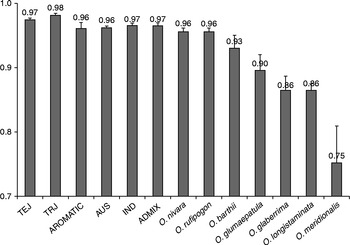
In Oryza sativa varietal groups, more than 96% of the SNPs were successfully called across the 96 SNP loci. On the other hand, accessions of wild relatives exhibited allele presence variation based on calling rates ranging from 0.75 to 0.96 (Fig. 1). The evolutionarily closest wild relatives O. nivara and O. rufipogon exhibited the same level of SNP calls, but O. meridionalis, O. longistaminata and O. glaberrima accessions performed at < 0.90 calling rate (Table S2; available online). Some markers were not specifically amplified in certain species (Table S3; available online). The average amplification frequency ranged from 0.53 to 1.00 (Fig. S1; available online). A total of 18 markers amplified less than half the accessions in at least one AA wild relative species through all the chromosomes except chromosome 3. The lower calling rates in more distantly related species are probably due to polymorphisms in the flanking regions preventing hybridization and extension of the GoldenGate SNP assay, as well as potential null alleles due to presence/absence variation at these loci. These markers may not be useful for the diversity study of wild relatives, but can help characterize genomic variations differentiating O. sativa and the other Oryza species. For example, to distinguish O. sativa and O. glaberrima, id2000835, id2016584, id40003888, id5014934, id6003050, id7000337, id8002554 and id11007840 can be used, as they amplify in O. sativa but not in O. glaberrima (Table S2; available online).
Successful calling rates of 96 single-nucleotide polymorphism markers of the RiceOPA 1.0 panel using the Illumina BeadXpress system. TEJ, temperate japonica; TRJ, tropical japonica; IND, indica; ADMIX, admixture.

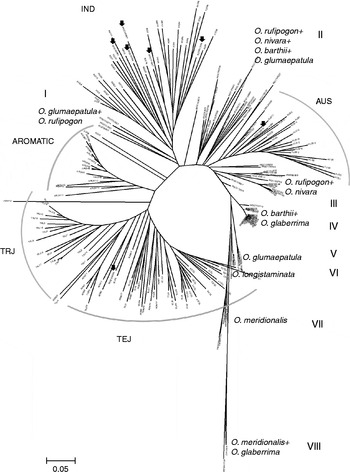
In a phylogenetic tree constructed using the 72 SNPs, all the accessions evaluated in this study (93 AA genome accessions and 134 cultivated rice accessions from Zhao et al., Reference Zhao, Tung, Eizenga, Wright, Ali, Price, Norton, Islam, Reynolds, Mezey, McClung, Bustamante and McCouch2011) clustered clearly into four varietal groups: japonica, aromatic, indica and aus (Fig. 2). Regardless of the marker types used, whether simple sequence repeats (SSRs), insertions/deletions or SNPs, whole-genome markers show similar subgroup clusters across the studies (Garris et al., Reference Garris, Tai, Coburn, Kresovich and McCouch2005; Zhu et al. Reference Zhu and Ge2005). There were eight clusters of wild species accessions: cluster I between indica and aromatic groups; cluster II between indica and aus groups; and clusters III–VIII that appeared distinct from the O. sativa accessions. Clusters I–III consist of almost all the O. rufipogon and O. nivara accessions as well as a few O. barthii and O. glumaepatula accessions. These accessions originated from Asian countries and a few African/South American countries. Cluster IV consists of O. barthii and O. glaberrima accessions, which exhibit very close genetic similarity. Clusters V–VIII consist of O. glumaepatula, O. longistaminata, O. meridionalis and some unclear types. In this study, O. meridionalis accessions originating from Australia and Indonesia clusters farthest from O. sativa (Fig. S2; available online).
Phylogenetic tree of 93 accessions of the AA genome Oryza genus and 134 rice varieties constructed using 72 single-nucleotide polymorphism markers. Black arrows indicate the accessions clustered within the indica and japonica groups. TEJ, temperate japonica; TRJ, tropical japonica; IND, indica; ADMIX, admixture. The code number of each accession is given in online supplementary Table S1.

Most of the wild rice accessions were closely related to the indica subspecies, as also shown previously using SSR markers (Garris et al., Reference Garris, Tai, Coburn, Kresovich and McCouch2005). Especially six of the O. rufipogon and O. nivara accessions clustered together with the indica and japonica varieties (see arrows in Fig. 2). Five accessions that clustered with the indica variety were IRGC 80 543, IRGC 89 054, IRGC 103821, IRGC 113651 and IRGC 106279. On the other hand, only one accession (IRGC 10 059) clustered with the japonica variety. Only one accession, IRGC 106276 (Papua New Guinea), clustered with the aus variety. It is notable that the indica-type accessions originated from various regions around the world covering South Asia, Southeast Asia, and Pacific Islands as well as China. However, the japonica-type accessions originated from Taiwan, possibly due to the intermediate type of climate and photosensitivity of crops between the indica and japonica regions in the country.
The high-throughput SNP marker system is a useful tool for increasing genotyping efficiency and accelerating genetic diversity studies. In rice, several SNP discovery and genotyping projects have led to the development of 1536 and 44K SNP chips, with even more SNP markers to be available soon (McNally et al., Reference McNally, Childs, Bohnert, Davidson, Zhao, Ulat, Zeller, Clark, Hoen, Bureau, Stokowski, Ballinger, Frazer, Cox, Padhukasahasram, Bustamante, Weigel, Mackill, Bruskiewich, Rätsch, Buell and Leung2009; McCouch et al., Reference McCouch, Zhao, Wright, Tung, Ebana, Thomson, Reynold, Wang, DeClerck, Ali, McClung, Eizenga and Bustamante2010; Tung et al., Reference Tung, Zhao, Wright, Ali, Jung, Kimball, Tyagi, Thomson, McNally, Leung, Kim, Ahm, Reynold, Scheffler, Eizenga, McClung, Bustamante and McCouch2010; Zhao et al., Reference Zhao, Wright, Kimball, Eizenga, McClung, Kovach, Tyagi, Ali, Tung, Reynolds, Bustamante and McCouch2010, Zhao et al., Reference Zhao, Tung, Eizenga, Wright, Ali, Price, Norton, Islam, Reynolds, Mezey, McClung, Bustamante and McCouch2011). This study demonstrated that a set of 96 O. sativa-derived SNP markers, which are subsets of the 1536 and 44K SNP sets (Thomson et al., Reference Thomson, Zhao, Wright, McNally, Rey, Tung, Reynolds, Scheffler, Eizenga, McClung, Kim, Ismail, de Ocampo, Mojica, Reveche, Dilla, Mauleon, Leung, Bustamante and McCouch2012), could be used to further characterize the genetic relationships between cultivated rice and AA genome wild rice species. Looking forward, it will be interesting to compare data from SNP loci selected to be informative across specific germplasm sets with sequence data. Sequencing of several partial and complete whole-genome sequences of wild relatives has now been completed by the OMAP (Jacquemin et al., Reference Jacquemin, Bhatia, Singh and Wing2013). Next-generation sequencing technology can provide efficient and high-throughput SNP information. Thus, utilization of wild relatives of rice through novel gene identification, marker development and breeding application for rice development will be facilitated through advanced molecular marker technologies.
Supplementary material
To view supplementary material for this article, please visit http://dx.doi.org/10.1017/S1479262114000215
Acknowledgements
This study was supported by a grant from the Next-Generation BioGreen 21 Program (Plant Molecular Breeding Center, no. PJ009076), Rural Development Administration, Republic of Korea, and the Plant Breeding Project at IRRI supported by the Government of Japan. The authors thank Christine Jade Dilla-Ermita, Joie Ramos and Boyet (Eleazar Manalaysay) for providing technical support.