1. Introduction
The Wenlock Series (Silurian) of the Midland Platform and Welsh Basin contains in excess of 150 bentonites, representing a record of sporadic subduction-related volcanism (Butler, Reference Butler1937; Trewin, Reference Trewin1971; Teale & Spears, Reference Teale and Spears1986; Huff, Morgan & Rundle, Reference Huff, Morgan and Rundle1996; Ray, Reference Ray2007; Ray & Butcher, Reference Ray and Butcher2010). These bentonites are easily identifiable as thin (1 to 200 mm), white, blue-grey or rusty-orange clay layers forming prominent notches in many rock faces. The presence of bentonites within the Wenlock has proven useful in addressing a number of stratigraphic problems. In particular, bentonites have been instrumental in establishing radiometric ages (Ross et al. Reference Ross, Naeser, Izett, Obradovich, Bassett, Hughes, Cocks, Dean, Ingham, Jenkins, Rickards, Sheldon, Toghill, Whittington and Zalasiewicz1982), determining tectonomagmatic settings (Cave & Loydell, Reference Cave and Loydell1998) and as a means of correlation in the absence of appropriate biostratigraphic evidence (Ray, Reference Ray2007).
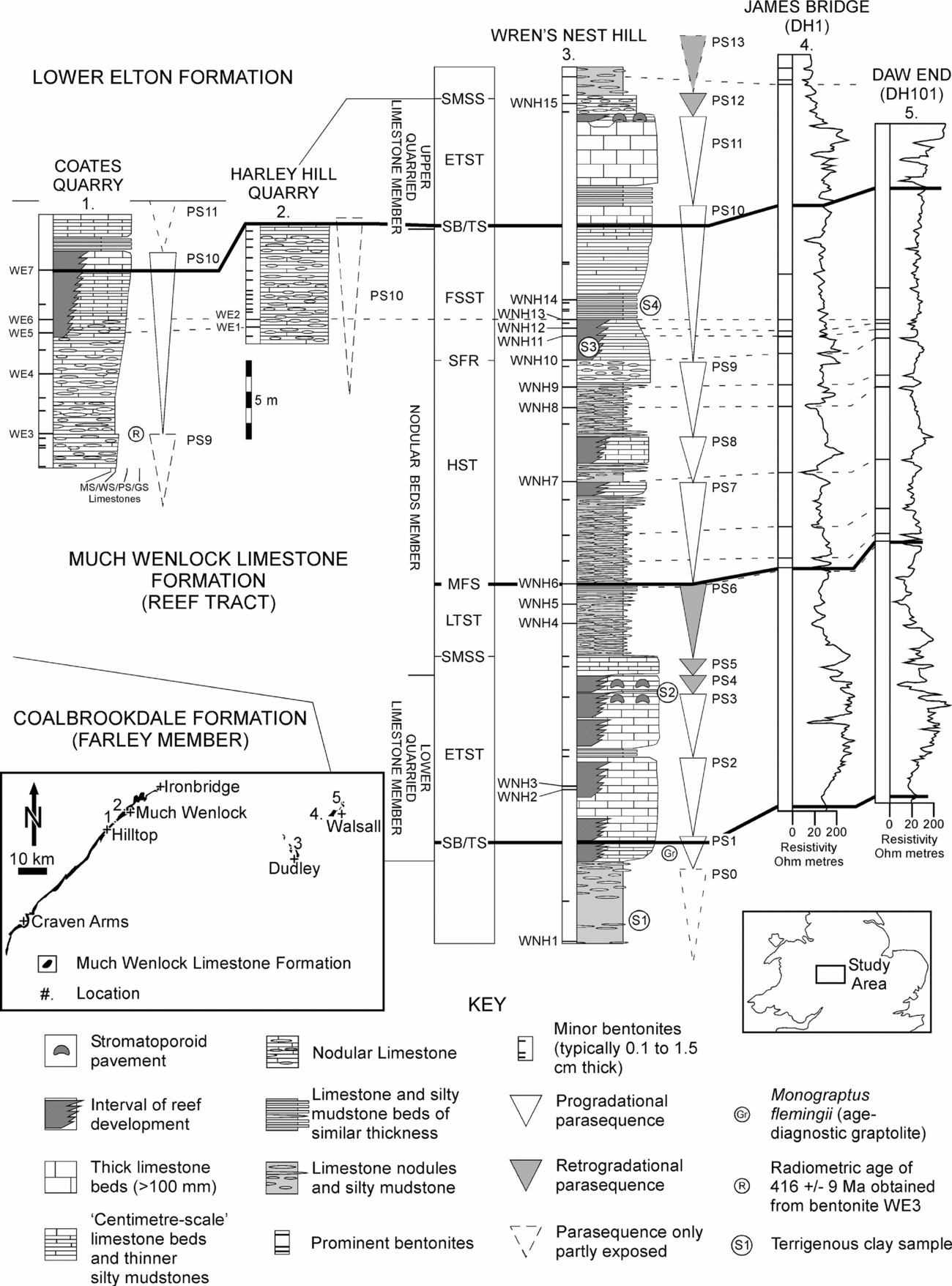
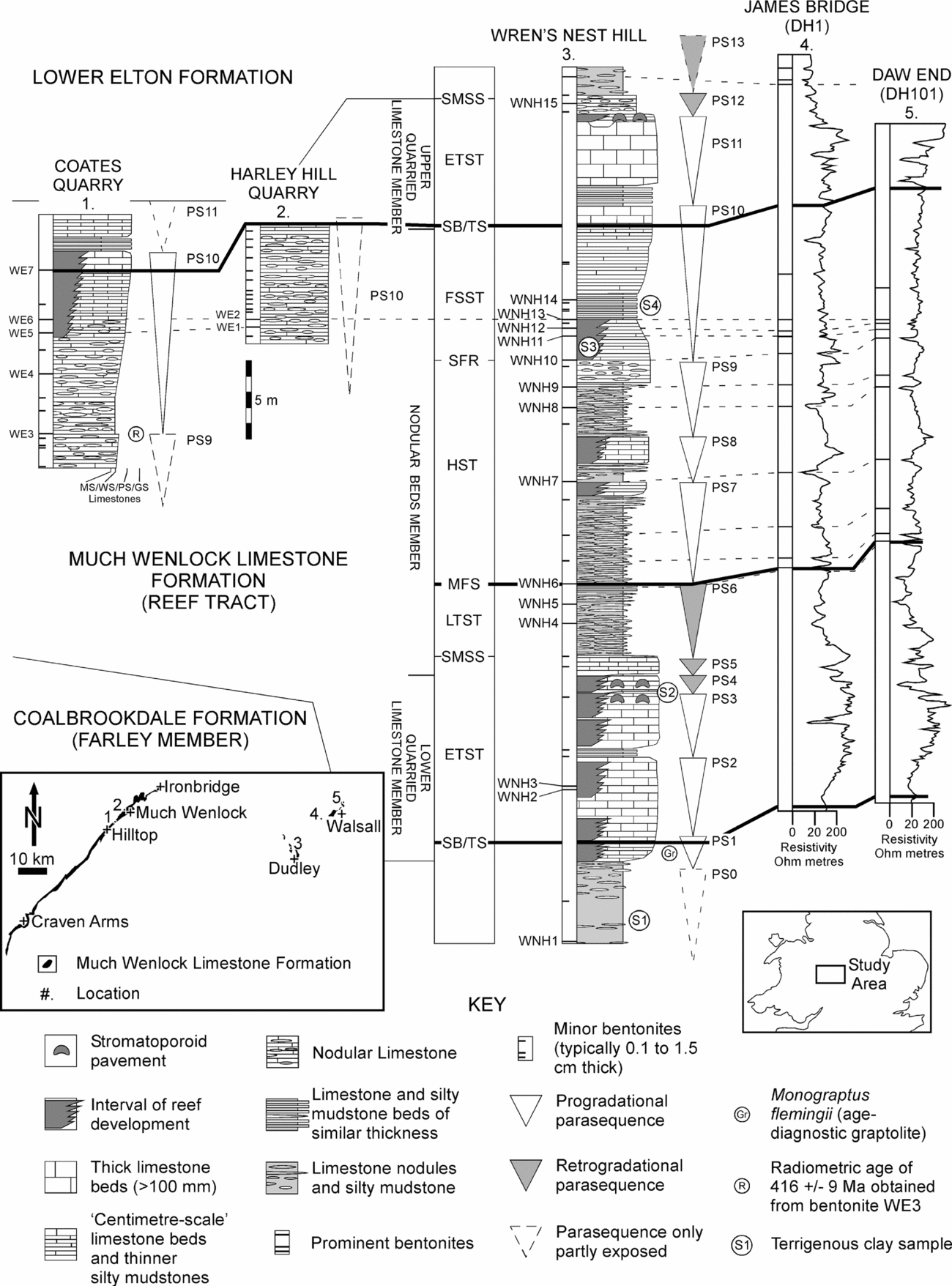
This paper focuses on 22 bentonite horizons contained within the upper Wenlock Series (Homerian Stage) of the northern Midland Platform, England. In these sections biostratigraphical markers (particularly graptolites) are rare or absent, making correlation very challenging. At the Wren's Nest Hill inlier, Dudley, West Midlands, a combination of excellent exposure and unusually high numbers of prominent bentonites have allowed a reference section encompassing the uppermost Coalbrookdale and Much Wenlock Limestone formations to be established. From this reference section comparisons have been made with coeval strata across the West Midlands and with key bentonites along Wenlock Edge, Shropshire (Scoffin, Reference Scoffin1971; Trewin, Reference Trewin1971; Teale & Spears, Reference Teale and Spears1986; Huff, Morgan & Rundle, Reference Huff, Morgan and Rundle1996) (Fig. 1). Each bentonite investigated has been characterized by the mineralogy of its constituent clay and sand-grade fractions. Furthermore, geochemical fingerprinting based upon the relative abundances of rare earth elements (REE) and yttrium contained within primary volcanic apatite microphenocrysts has been undertaken where apatite concentrations allowed. The resulting geochemical data from ten bentonites has established geochemical correlation between sections in the West Midlands and Shropshire, thereby improving regional stratigraphy. In addition, published apatite REE and yttrium geochemical signatures obtained from 36 bentonites within the Llandovery and Wenlock series of Scotland, Norway, Sweden and the Midland Platform (Batchelor & Clarkson, Reference Batchelor and Clarkson1993; Batchelor & Jeppsson, Reference Batchelor and Jeppsson1994, Reference Batchelor and Jeppsson1999; Batchelor, Weir & Spjeldnæs, Reference Batchelor, Weir and Spjeldnæs1995; Ray, Reference Ray2007) have been compared allowing tectonomagmatic trends and potential traceable volcanic episodes to be identified.
Bentonite distribution and correlation within the Much Wenlock Limestone Formation of the northern Midland Platform. The location map shows outcrop and borehole positions within the West Midlands and along Wenlock Edge. West Midlands: Wren's Nest Hill [SO 937 920], James Bridge [SO 992 975] and Daw End [SK 034 009]. Wenlock Edge: Harley Hill Quarry [SJ 609 004] and Coates Quarry [SO 604 993]. Within the upper Homerian are the following systems tracts and their bounding surfaces: SB/TS – sequence boundary and combined transgressive surface; ETST – early transgressive systems tract; SMSS – surface of maximum sediment starvation; LTST – late transgressive systems tract; MFS – maximum flooding surface; HST – highstand systems tract; SFR – surface of forced regression; FSST – falling stage systems tract. PS0 to PS13 represent the parasequences established by Ray et al. (Reference Ray, Brett, Thomas and Collings2010).
1.a. Localities and sampling
The Much Wenlock Limestone Formation of the West Midlands is contained within the Cyrtograptus lundgreni to Colonograptus ludensis graptolite zones and is made up of the Lower Quarried Limestone, Nodular Beds and Upper Quarried Limestone members (Dorning, Reference Dorning1983). Of the late Wenlock inliers of the West Midlands, Wren's Nest Hill, near Dudley, represents the best exposure and can be regarded as one of the most important successions within the UK (Siveter Reference Siveter, Aldridge, Siveter, Siveter, Lane, Palmer and Woodcock2000, pp. 191–8). Notably, a double-peaked positive δ13C isotopic excursion has been documented here (Corfield et al. Reference Corfield, Siveter, Cartlidge and McKerrow1992; Marshall et al. Reference Marshall, Thomas, Boomer and Ray2009), as has a detailed record of relative sea level change allowing for correlation with the type Wenlock area, along Wenlock Edge, and beyond (Ray et al. Reference Ray, Brett, Thomas and Collings2010).
The formation consists chiefly of impure limestones and represents a variety of depositional environments ranging from below storm wave base and the euphotic zone to within the fair-weather wave base (Ratcliffe & Thomas, Reference Ratcliffe and Thomas1999; Ray & Thomas, Reference Ray and Thomas2007). Owing to the mid-platform position of the West Midlands, sheltered from the open-ocean setting developed to the west of Wenlock Edge and proximal to sources of terrigenous sediment, conditions were ideal for the development and preservation of a diverse range of lithofacies, their associated faunas and numerous bentonites. In particular, exposures of the Much Wenlock Limestone at Wren's Nest Hill contain at least 32 individual bentonites, with an additional 2 bentonites contained within the immediately underlying Coalbrookdale Formation (Fig. 1). Many of these bentonites are extremely thin (1 to 10 mm), discontinuous at exposure and are unable to yield the amount of sample needed for analysis (approximately 1 kg). Nevertheless there remain 15 bentonites that are locally traceable around the Wren's Nest Hill inlier and are sufficiently thick for sampling. Furthermore, of these 15 bentonites (WNH1 to WNH15; Table 1) it has been shown that 10, contained within the Nodular Beds Member, are traceable via resistivity responses within wire-line logs and core records northeast to the town of Walsall (Ray et al. Reference Ray, Brett, Thomas and Collings2010, fig. 2); a distance of approximately 13 km (Fig. 1). Similarly three closely spaced bentonites within the basal 4 m of the Lower Elton Formation (Ludlow Series) can also be correlated across the West Midlands, but are beyond the scope of the current study (Collings, Reference Collings1989; Ray et al. Reference Ray, Brett, Thomas and Collings2010, fig. 4).
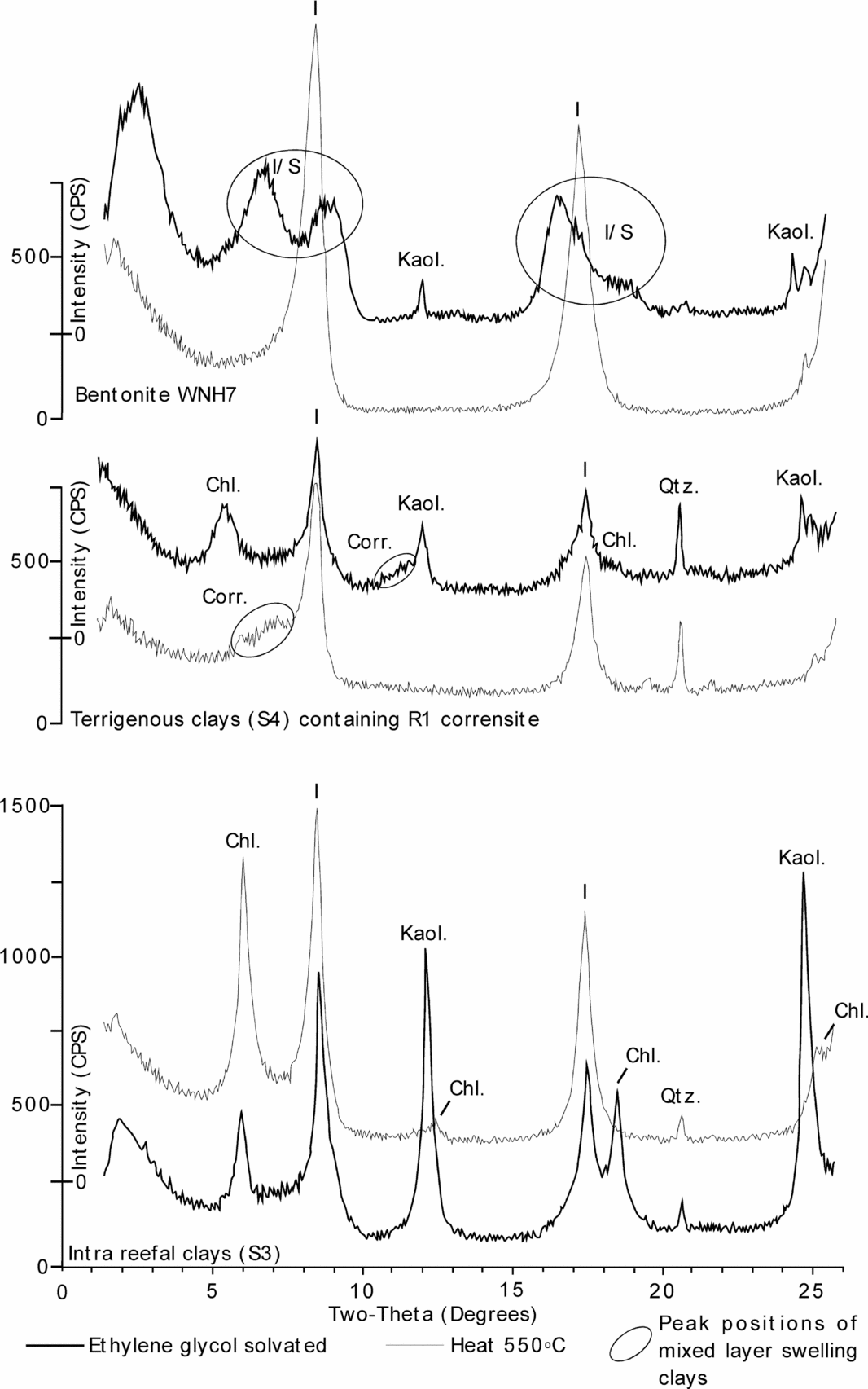
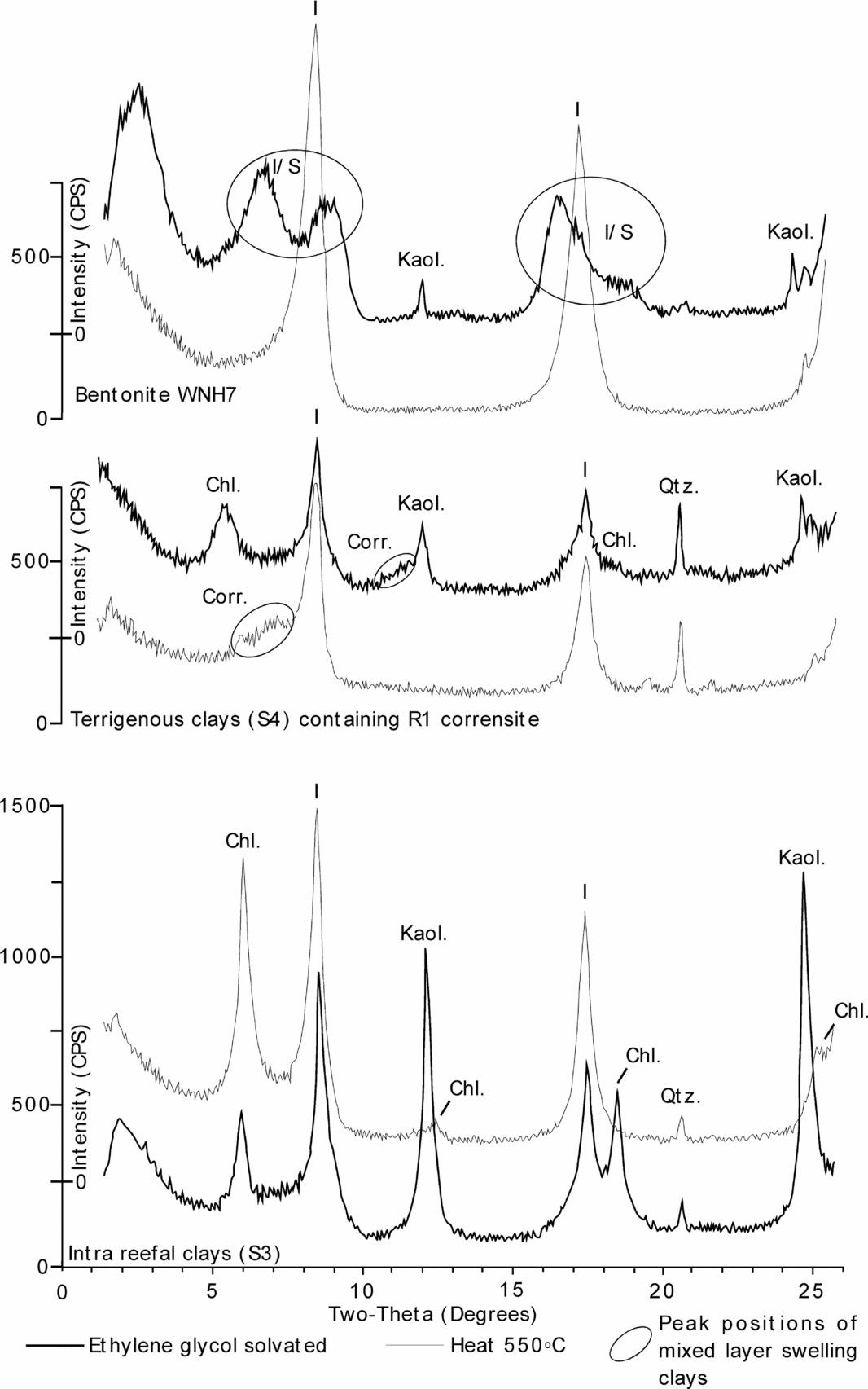
A comparison of XRD traces from a typical bentonite (WNH7), a silty mudstone bed (S4) and an intra-reefal silty mudstone (S3), all collected within the Nodular Beds Member at Wren's Nest Hill, Dudley. Note that for each sample the intensity scale is off-set by 250 CPS between upper and lower traces. See Figure 1 for the stratigraphic positions of the samples. Corr. – corrensite; Chl. – chlorite; I – illite; I/S – mixed-layer illite/smectite; Kaol. – kaolinite; Qtz. – quartz.
Mineral assemblages and clay mineralogy of selected bentonites
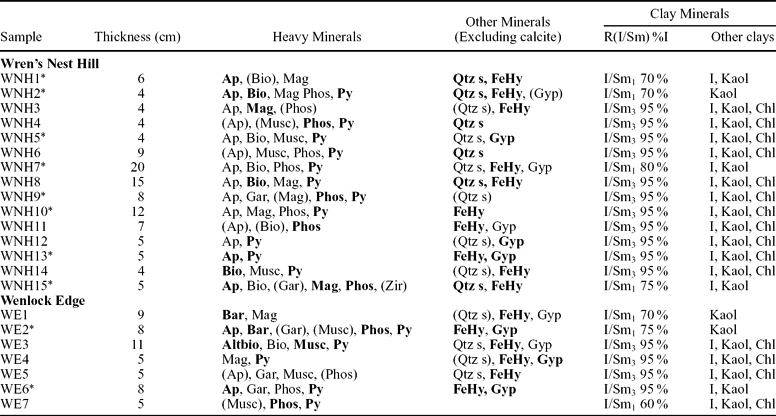
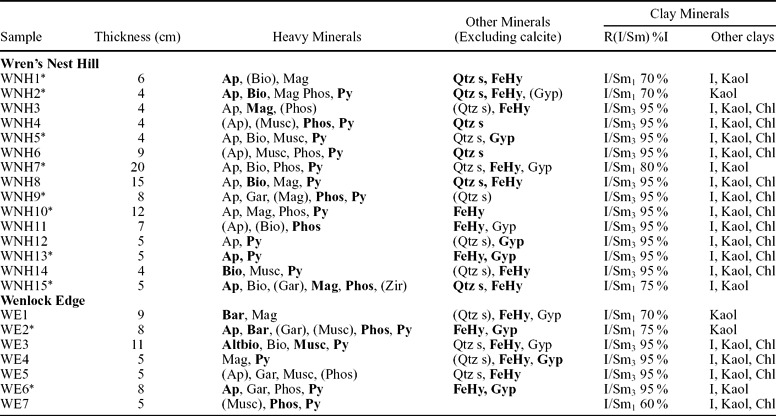
Altbio – Altered biotite; Ap – Apatite; Bar – Barite; Bio – Biotite; FeHy – Fe hydroxides; Gar – Garnet; Gyp – Gypsum; Mag – Magnetite; Musc – Muscovite; Py – Pyrite; Phos – Phosphatic ooids; Qtz – Quartz; Qtz s – Quartz shards; Zir – Zircon; I/Sm(0–3) %I – R0 to R3 ordered illite/smectite & percentage illite; Chl – Chlorite; I – Illite; Kaol – Kaolinite; * – ICP-MS apatite analysis; ( ) – rare; plain type – present; bold type – common.
The presence of numerous traceable bentonites within the West Midlands is in marked contrast to the main exposures of the Much Wenlock Limestone cropping out in large quarries along Wenlock Edge, Shropshire. This situation can, in part, be explained by the close proximity of Wenlock Edge to the platform margin and the open-ocean setting of the Welsh Basin, resulting in increased reworking and erosion of bentonites during storm events. In addition, quarrying activity along Wenlock Edge has tended to focus upon the most pure limestone interval formed during the latest Wenlock marine regression (C. ludensis graptolite Zone). This resulted in an increasingly shallow high-energy depositional environment that is generally not conducive to bentonite preservation: the falling stage systems tract and PS10 parasequence of Ray et al. (Reference Ray, Brett, Thomas and Collings2010) (Fig. 1). Surprisingly, the majority of prominent bentonites investigated in previous works (Weaver & Bates, Reference Weaver and Bates1952; Trewin Reference Trewin1971; Teale & Spears, Reference Teale and Spears1986; Huff, Morgan & Rundle, Reference Huff, Morgan and Rundle1996) are contained within this interval, but are restricted to two key locations: Coates Quarry and Harley Hill Quarry. Both of these quarries are established within the reef tract of the Much Wenlock Limestone (Bassett, Reference Bassett, Holland and Bassett1989) and within an area where reefs make up 20 to 40% of the upper 16 m of the formation (Scoffin, Reference Scoffin1971). As a consequence of these reefs and the large ‘fringing’ reefs developed at Hilltop (Scoffin, Reference Scoffin1971), the erosive influence of storms appears to have been significantly reduced, particularly within sheltered hollows on the leeward-side of large reefs, as is inferred for both these quarries. In total, 28 potential bentonites have been identified within the Coates and Harley Hill quarries (13 and 15, respectively), of which only 7 bentonites (WE1 to 7) were sufficiently thick to allow sampling. Furthermore, it is likely that the two prominent bentonites sampled at Harley Hill Quarry (WE1 and 2) are also present approximately 1 km to the southwest within the five bentonites (WE3 to 7) sampled at Coates Quarry, thereby allowing for the potential of correlation along strike to be tested.
2. Bentonite mineralogy
2.a. Clay fraction mineralogy analytical methods
Twenty-two bentonite clay layers and four background mudstone samples were analysed by X-ray diffraction (XRD) using gravity separation of the < 2 μm size fraction and the pipette method onto glass slides to allow orientation of the clay aggregates. Air-dried, heated (550 °C) and ethylene glycol solvated slides were then scanned from 2° to 32° 2θ with Cu Kα radiation at a scan rate of 2.4° 2θ/minute. The identification of the clay mineralogy and a semi-quantitative estimation of the illite and smectite in mixed-layer illite/smectite (I/S) was then determined using the method of Moore & Reynolds (Reference Moore and Reynolds1997, pp. 270–6) (Table 1).
2.b. Clay mineralogy findings and discussion
All samples contained mixed-layer illite/smectite (I/S) with ordering ranging from R1 to R3 (short to long-range interstratification), though R3 I/S dominates with illite making up approximately 95%. In addition, the majority of samples contained chlorite, discrete illite and kaolinite, with microcrystalline quartz and calcite also present within the clay-sized fraction. The composition of these samples, particularly the presence of I/S, is typical of bentonites and results from the breakdown of volcanic ash in a marine environment (Ross & Shannon, Reference Ross and Shannon1926). However, composition does not merely reflect the character of the ash; the host sediment type, the presence of organic matter and late diagenetic alteration are also extremely important (Hints et al. Reference Hints, Kirsimäe, Somelar, Kallaste and Kiipli2008) and may result in laterally heterogeneous bentonites.
Based upon the work of Hints et al. (Reference Hints, Kirsimäe, Somelar, Kallaste and Kiipli2008) it is clear that the composition of the clay fraction is of potentially little use as a means of correlation, but it may reveal something about the interaction of the bentonites with their depositional environment. As a means of establishing the composition of the background terrigenous clay fraction, four silty-mudstone beds, not associated with bentonites, have been analysed from Wren's Nest Hill. These clays were sampled from within the upper Coalbrookdale Formation, the Lower Quarried Limestone and Nodular Beds members of the Much Wenlock Limestone Formation and a mudstone pocket with a reef mass also within the Nodular Beds Member (Figs 1, 2). These samples represent a range of depositional environments and are intended as an approximate guide to the range of terrigenous clay types present within the host Wenlock Series.
Chlorite, discrete illite and kaolinite are present in all terrigenous samples and the majority of bentonites, suggesting mixing by reworking or bioturbation. However, the presence of these clays in bentonites may also reflect the diagenetic alteration of primary mineral grains, such as feldspars, which are notably absent from the sand-grade fraction of the bentonites. Furthermore, I/S, which is characteristic of bentonites, is absent from the terrigenous clays, indicating that within these samples ash fall was not a major contributor to background sedimentation. Excluding the intra-reefal mudstone, the remaining three terrigenous clay samples contained the mixed-layer chlorite/smectite clay corrensite (R1 ordering, 50:50 chlorite/smectite). The presence of corrensite is notable as it is not present within the clay fraction of any of the bentonites sampled, despite being known from bentonites elsewhere (Hints et al. Reference Hints, Kirsimäe, Somelar, Kallaste and Kiipli2006). Consequently, a terrigenous supply of corrensite such as the hypothesized ancient Ordovician igneous centres to the east of Birmingham (Pharaoh, Brewer & Webb, Reference Pharaoh, Brewer and Webb1993) seem a likely source, in that corrensite can result from the low temperature hydrothermal alteration of mafic igneous rocks (Hiller, Reference Hiller1993). Microcrystalline quartz and calcite are present in a number of bentonites, while only microcrystalline quartz occurs within the terrigenous clay fraction. The presence of both microcrystalline quartz and calcite within some bentonites, along with the common occurrence of well-cemented limestone beds below prominent bentonites, may in part reflect the exchange of SiO2 during devitrification of volcanic ash and/or the additional release of SiO2 and Ca2+ during the illitization of smectite.
2.c. Bentonite sand-grade mineralogy analytical methods
Approximately 1 kg of each clay layer was wet sieved (0.06 mm mesh size) free of clay and treated with weak hydrochloric acid to remove the commonly abundant calcite fraction. These samples were then washed, dried and suspended in the heavy liquid bromoform (sp. gr. 2.85). The separated heavy and light mineral fractions were then identified using a combination of petrographic and stereo-zoom microscopic methods, XRD random orientation mounts, magnetic separation and a further separation of the heavy minerals using methylene iodide (sp. gr. 3.32). A classification of minerals as common, present or rare has been used for the bromoform separates as identified using a stereo-zoom microscope. Here, minerals that are immediately apparent are termed ‘common’, those that are apparent after 1–2 minutes ‘present’, and those that require a more detailed search are termed ‘rare’ (Table 1).
2.d. Bentonite sand-grade mineralogy findings and discussion
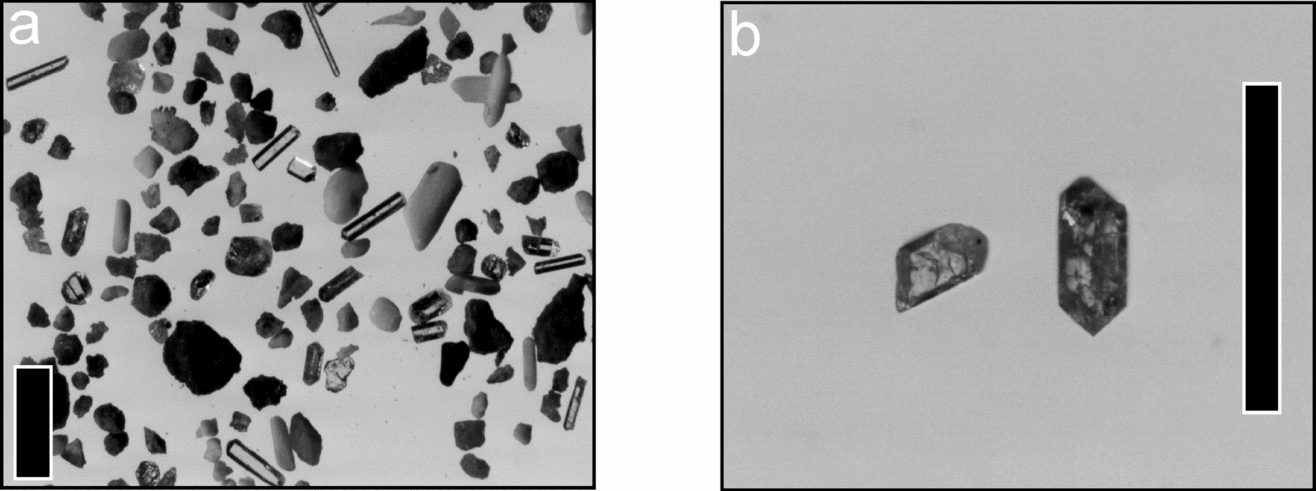
Primary quartz grains that display a high-temperature beta-form habit are particularly diagnostic of a volcanic origin (Huff, Morgan & Rundle, Reference Huff, Morgan and Rundle1996) and are present in 16 of the bentonites. These quartz shards can be distinguished from detrital quartz in that they are angular (commonly fractured), colourless, clear and commonly contain melt inclusions. With the exception of WNH14, apatite occurs in all of the Wren's Nest Hill bentonites, while it is far less common in the Wenlock Edge bentonites (three out of seven) (Fig. 3). The majority of apatites are clear, colourless, stumpy euhedral prisms, often with etched crystal faces. Other features less commonly exhibited include yellow colouration, an acicular habit and melt inclusions. Euhedral flakes of biotite commonly containing inclusions of apatite and zircon occur in nine of the bentonites, while sub-rounded biotite grains with cleavage typically identifiable as bands of dark and light, suggestive of alteration to chlorite (Huff, Morgan & Rundle, Reference Huff, Morgan and Rundle1996) are only present in WE3. Of the remaining minerals, weakly zoned euhedral zircon crystals ranging from pale pink to champagne in colour (Fig. 3), sub-angular magnetite grains and garnet xenocrysts are of potential volcanic origin, while Fe-hydroxides, gypsum (Fig. 3), pyrite, barite and phosphatic ooids are of a likely detrital or diagenetic origin. Of particular note among the non-volcanic grains are the phosphatic ooids; such grains are commonly associated with episodes of sediment starvation typically resulting from transgression (Brett et al. Reference Brett, Baarli, Chowns, Cotter, Driese, Goodman, Johnson and Landing1998). The frequent occurrence of phosphatic ooids within the Much Wenlock Limestone suggests a close link between bentonite preservation and sediment starvation; a relationship which is not unsurprising within a shallow-water carbonate setting where bentonite preservation should otherwise be low.
Stereo-zoom microscope images of selected grains (black scale bar represents 1 mm). (a) Euhedral apatite, Fe-hydroxide and gypsum grains from WE6, Coates Quarry, Wenlock Edge. (b) Euhedral zircon grains from WNH15, Lion's Mouth Quarry, Wren's Nest Hill, Dudley.

3. Apatite REE geochemistry
3.a. Analytical methods
Apatites are the most commonly occurring mineral that offer the possibility of obtaining uniquely diagnostic chemical fingerprints from the bentonites sampled. When associated with unaltered primary microphenocrysts, the REEs and yttrium contained within apatites are considered immobile under most upper crustal conditions and are unaffected by weathering (Shaw, Reference Shaw2003). Furthermore, the REE composition typically reflects magmatic processes as there is no preferential concentration of light REEs (LREEs) relative to heavy REEs (HREEs) within the apatite structure (Watson & Green, Reference Watson and Green1981). Finally, while the apatite composition of the same bentonite along strike (Batchelor & Jeppsson, Reference Batchelor and Jeppsson1994; Batchelor, Weir & Spjeldnæs, Reference Batchelor, Weir and Spjeldnæs1995) and individual apatites within the same bed (Samson, Kyle & Alexander, Reference Samson, Kyle and Alexander1988) demonstrate a small spread in composition (approximately 2%), variations between individual beds can exceed 20%, thereby increasing the likelihood of identifying a uniquely diagnostic chemical fingerprint for any given bentonite.
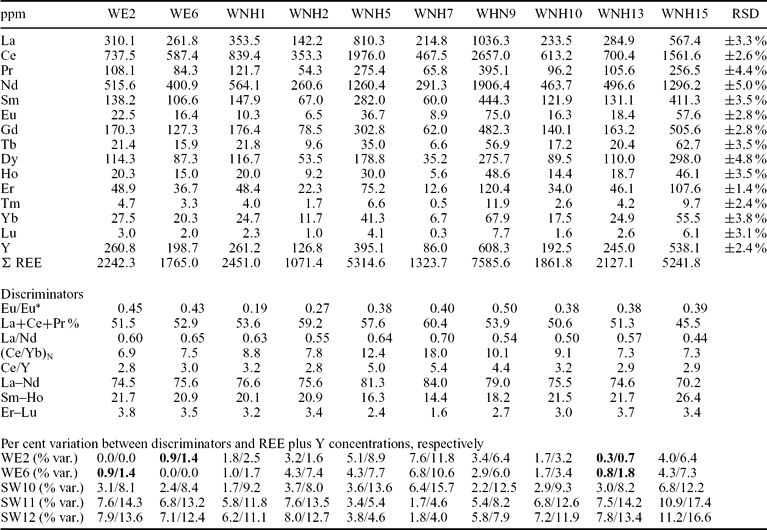
In the selection of suitable apatite grains for analysis, care was taken to avoid crystals that contained inclusions, displayed dissolution features or showed evidence of reworking. For each sample (WNH1, 2, 5, 7, 9, 10, 13, 15, and WE2, 6) approximately 200 μg or 50 apatite grains were weighed on a microbalance accurate to 1.0 μg. As approximately 20 apatite grains are considered sufficient to reflect the range of chemical variability within an individual bentonite (Shaw, Reference Shaw2003), it is hoped that the larger sample size herein should allow for bentonites of similar composition, as reported for Silurian bentonites from Wales and the Welsh borders (Pearce et al. Reference Pearce, Thorogood, Mathews, Cave, Loydell, Evans and Williams2003), to be distinguished from each other. Having been hand-picked, the apatite samples were then dissolved in 1 ml of ‘Optima’ nitric acid, diluted to 10 ml with deionized distilled water (18 M Ohm distillate resistivity) and spiked with an internal calibrating standard of indium. The solutions were then analysed using inductively coupled plasma mass spectrometry (ICP-MS) for their REE and yttrium concentrations (Table 2). A further discussion of ICP-MS analysis of apatite is presented in Batchelor & Clarkson (Reference Batchelor and Clarkson1993), Batchelor & Jeppsson (Reference Batchelor and Jeppsson1994) and Shaw (Reference Shaw2003).
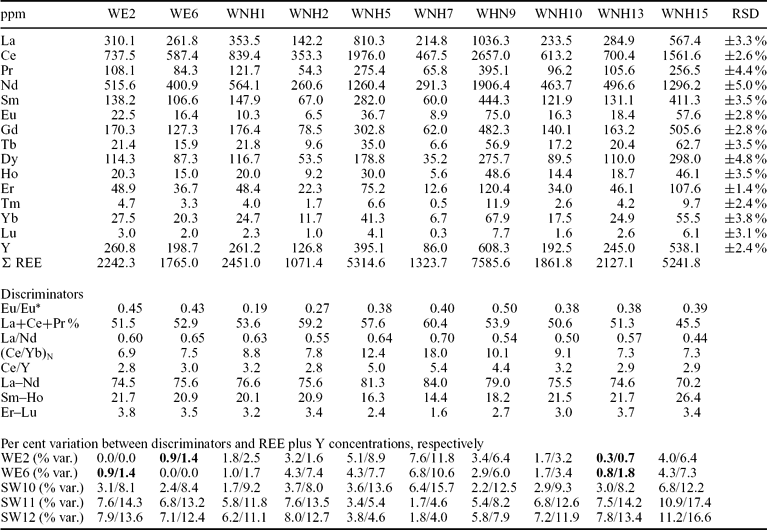
Rare earth element and yttrium concentrations, chemical discriminators and percentage variation between apatite crystals
3.b. Findings and discussion
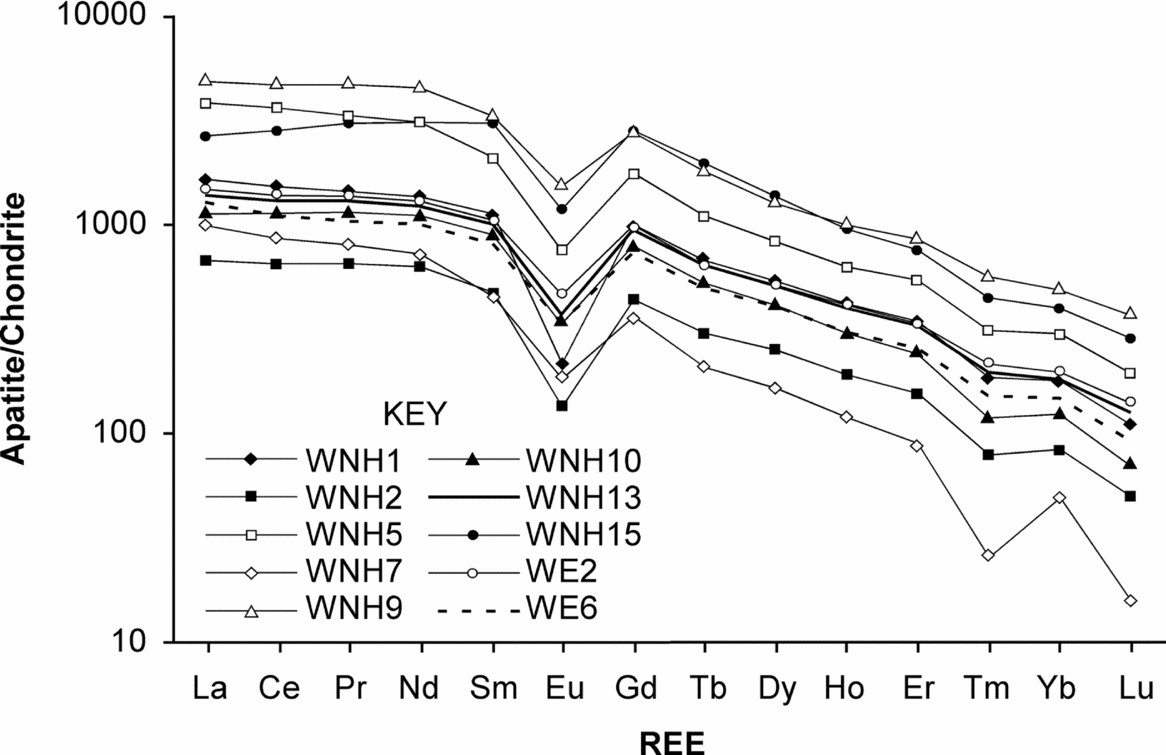
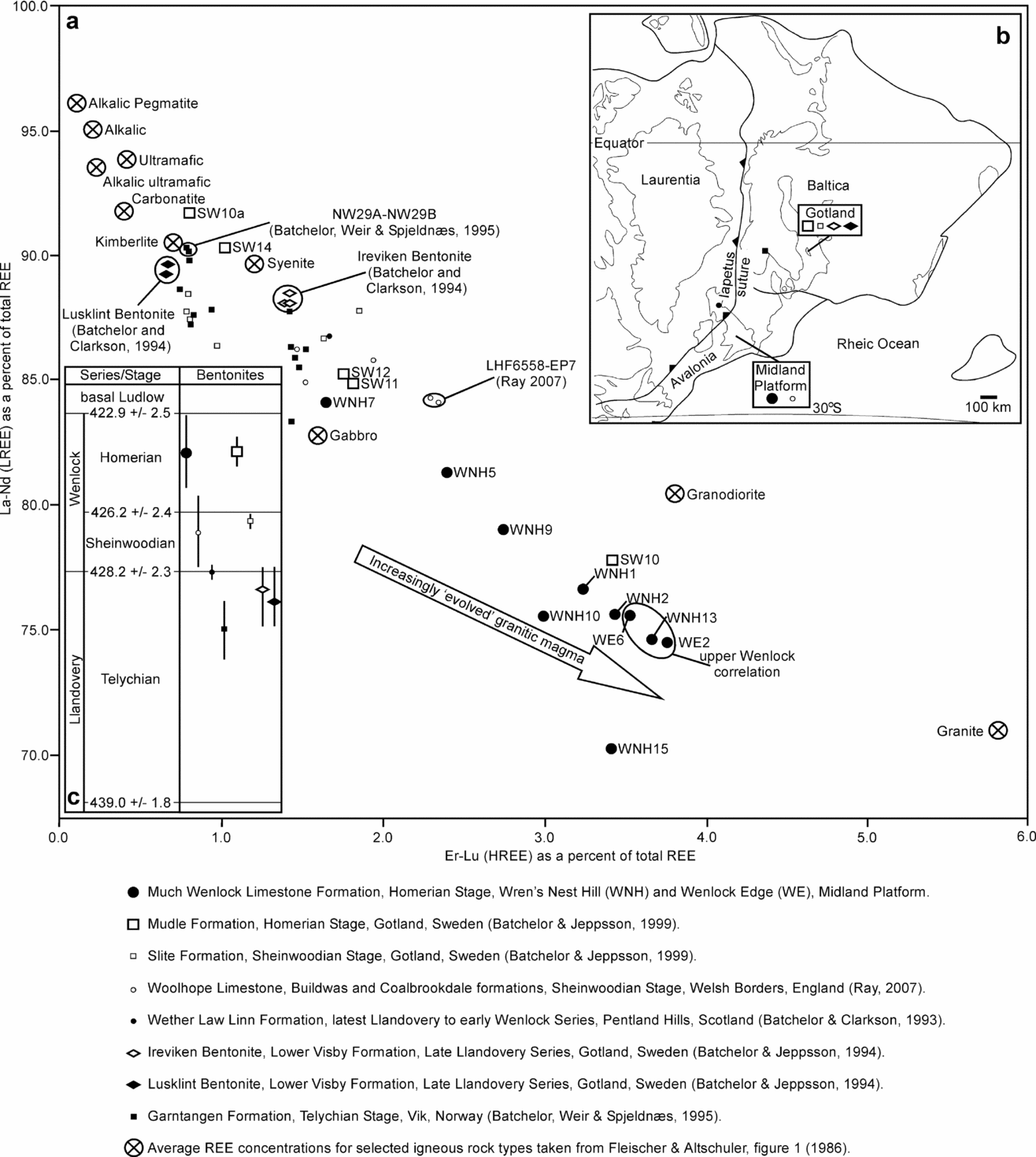
An assessment of chondrite-normalized REE curves indicates that the apatites were derived from a volcanic source, in that they lack a negative Ce anomaly and also lack enrichment in HREEs relative to LREEs that is typically characteristic of sedimentary apatite (Fleischer & Altschuler, Reference Fleischer and Altschuler1986). The concentration of LREEs relative to HREEs can be determined by the overall slope of the chondrite-normalized REE plot (Fig. 4) and is reflected in the (Ce/Yb)N values (Table 2) where higher values indicate relative LREE enrichment or HREE depletion. Furthermore, the proportions of LREEs (La–Nd) to HREEs (Er–Lu) can be compared with apatites of a known igneous affinity (Fleischer & Altschuler, Reference Fleischer and Altschuler1986, table 1) allowing an assessment of the likely source magma (Fig. 4). Based upon the proportions of LREEs to HREEs as a percentage of total REE concentration, the majority of bentonites were derived from magmas whose composition most closely reflects that of granodiorite, with outlying samples (WNH5, 7) trending towards the composition of gabbro. Ce/Y ratio values (2.8 to 5.4) further support this conclusion in that they exclude association with alkaline magmas, which typically record values for this ratio above 7.7 (Roeder et al. Reference Roeder, MacArthur, Ma, Palmer and Mariano1987). In addition, the presence of Eu anomalies (Eu/Eu*) broadly reflect magmatic composition such that divalent Eu ions within a reducing magma can act as a proxy for calcium in plagioclase feldspar. Consequently, apatites derived from a magma in which calcic plagioclase has already crystallized should be reflected by a strong negative Eu anomaly. The bentonites described herein have Eu/Eu* values between 0.19 and 0.5, which is indicative of significant plagioclase feldspar fractionation from an evolved magmatic source.
Chondrite-normalized rare earth element data for apatites extracted from the Wren's Nest Hill, Coates Quarry and Harley Hill bentonites. Normalizing data taken from Evensen, Hamilton & O'Nions (Reference Evensen, Hamilton and O'Nions1978).

4. Bentonite correlation
In order for correlation to be achieved between bentonite samples they must be stratigraphically coeval, chemically similar and distinct from all other bentonites within the same stratigraphic interval. Based upon an assessment of LREEs versus HREEs as a percentage of total REEs within volcanogenic apatites, the Wren's Nest Hill and Wenlock Edge bentonites can be partly distinguished from one another. Furthermore, these geochemical signatures can be compared with the existing published geochemical signatures obtained from 36 bentonites from within the Llandovery and Wenlock series of England, Norway, Scotland, Sweden (Batchelor & Clarkson, Reference Batchelor and Clarkson1993; Batchelor & Jeppsson, Reference Batchelor and Jeppsson1994; Batchelor, Weir & Spjeldnæs, Reference Batchelor, Weir and Spjeldnæs1995; Ray, Reference Ray2007), and with the age equivalent (Gothograptus nassa–Pristiograptus dubius graptolite Zone) bentonites from the Mulde Formation on the Island of Gotland, Sweden (Batchelor & Jeppsson, Reference Batchelor and Jeppsson1999) (Fig. 5).
LREE versus HREE discrimination diagram for apatite. (a) Average values for selected igneous rock types are based on rare earth element data after Fleischer & Altschuler (Reference Fleischer and Altschuler1986). Apatite data from Wren's Nest Hill, Coates Quarry and Harley Hill are superimposed alongside Llandovery and Wenlock Series apatite data from England, Norway, Scotland and Sweden (Batchelor & Clarkson, Reference Batchelor and Clarkson1993; Batchelor & Jeppsson, Reference Batchelor and Jeppsson1994, Reference Batchelor and Jeppsson1999; Batchelor, Weir & Spjeldnæs, Reference Batchelor, Weir and Spjeldnæs1995; Ray, Reference Ray2007). (b) Location of selected Llandovery and Wenlock Series bentonites. Palaeogeography after Cocks & Torsvik (Reference Cocks and Torsvik2005). (c) Stratigraphic distribution of selected bentonites. Chronostratigraphy is taken from Ogg, Ogg & Gradstein (Reference Ogg, Ogg and Gradstein2008).
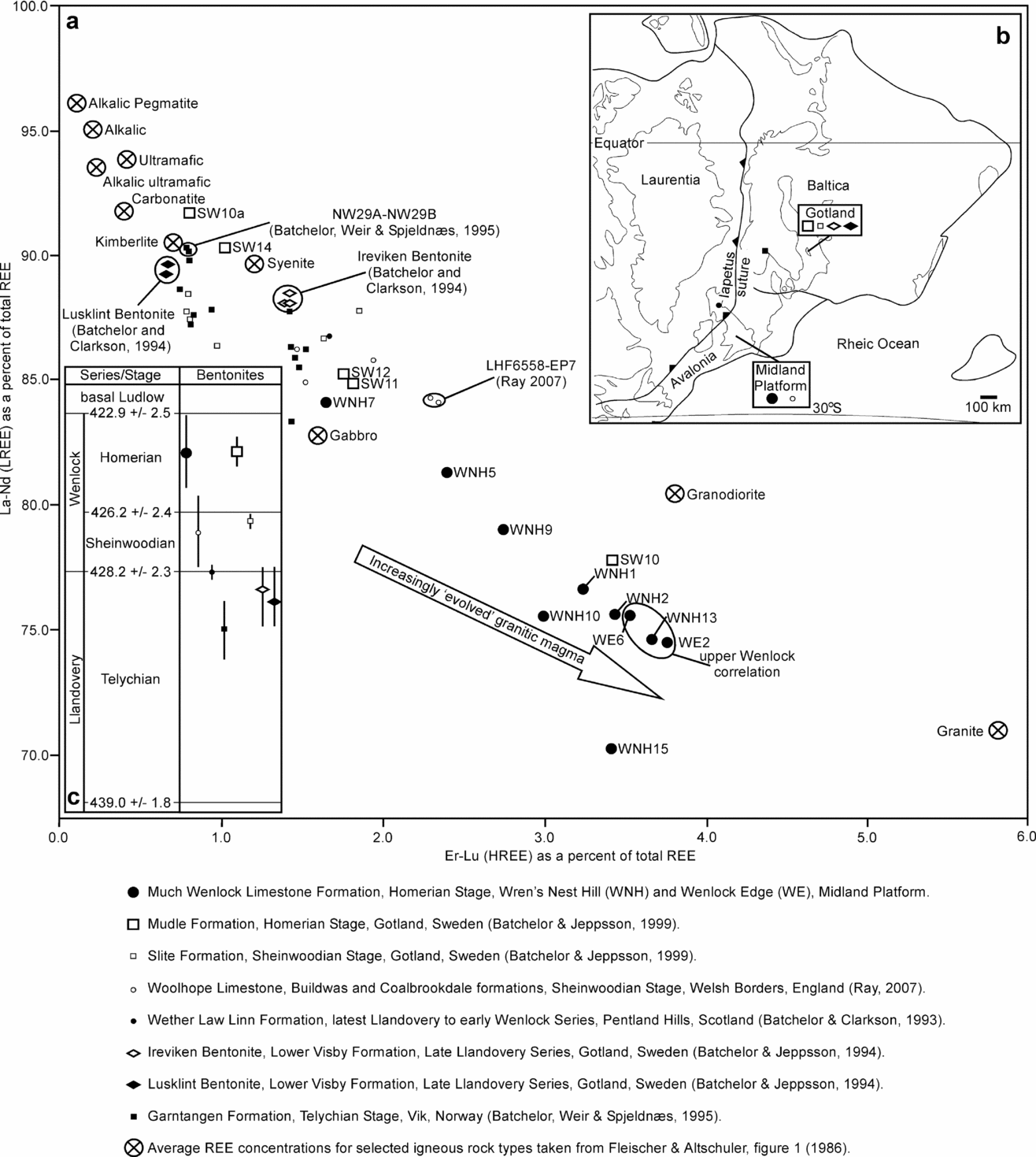
Initial comparisons illustrate a generalized bimodal clustering of apatite compositions, reflecting higher LREE values within Telychian and Sheinwoodian bentonites when compared with younger Homerian bentonites, as well as some notable Homerian exceptions. Such a relationship is indicative of evolving magmatic sources, possibly resulting from the changes occurring as subduction gave way to continental collision during the final stages of closure of the Iapetus Ocean and or the Tornquist Sea (Trench & Torsvik, Reference Trench and Torsvik1992; Williams, O'Connor & Menuge, Reference Williams, O'connor and Menuge1992; Niocaill, Reference Niocaill2000; Cocks & Torsvik, Reference Cocks and Torsvik2005).
The clustering of Homerian apatite compositions (WNH1, 2, 9, 10, 13; WE2, 6) offers the possibility of correlation between bentonites on the Midland Platform, as well as with SW10 (Batchelor & Jeppsson, Reference Batchelor and Jeppsson1999) from the Mulde Formation. Furthermore, while outliers WHN7 and WNH5 appear chemically distinct from each other, they also show similarities with bentonites SW11 and SW12 (Batchelor & Jeppsson, Reference Batchelor and Jeppsson1999) from the Mulde Formation, though they are still relatively depleted in LREEs when compared with the majority of Telychian and Sheinwoodian bentonites. The remaining outlying sample (WHN15) currently has no known equivalent, being unique in its relativity low LREEs and high middle REE composition. However, WHN15 is the youngest (?uppermost C. ludensis graptolite Zone) of the bentonites studied, being within 0.5 m of the top of the Much Wenlock Limestone Formation at Wren's Nest Hill, and as such may become an important Wenlock–Ludlow Series geochemical marker in future studies.
As a further means of assessing the similarity between apatite compositions, eight chemical discriminators have been calculated from the REE and yttrium values (Table 2). Each discriminator has then been per cent normalized and the sum of the total variation between bentonites has been calculated. The same approach has been adopted for REE and yttrium values, thereby removing the effect of slight variations in apatite sample weight on absolute REE values. As the bentonites at Wren's Nest Hill are all clearly stratigraphically separate events, comparison has been made between these bentonites and chemically similar and potentially coeval bentonites along Wenlock Edge (WE2, 6) and within the Mulde Formation on Gotland (SW10, 11, 12).
As established within the sequence stratigraphic interpretation of Ray et al. (Reference Ray, Brett, Thomas and Collings2010), the bentonites sampled at Harley Hill (WE2) and Coates Quarry (WE6) fall within parasequence PS10 (C. ludensis graptolite Zone) of the Much Wenlock Limestone and may therefore correlate with each other and bentonites WNH10 and/or WNH13 at Wren's Nest Hill. A measure of the potential for the correlation of these bentonites is present in the percentage variations between chemical discriminators and REE and yttrium values. WNH13 and WE2 are the most chemically similar (0.3/0.7% variation), while WNH13 and WE6 (0.8/1.8% variation) and WE2 and WE6 (0.9/1.4% variation) are also chemically very alike. As the differences between REE and yttrium values between these samples is less than 2%, it seems likely that such differences may reflect the chemical variability of apatite grains within a single bentonite horizon. Comparisons of clay and sand-grade mineralogies between these samples also demonstrate strong similarities, as well as minor differences. Apatite forms the only common constituent of all the samples (excluding detrital and diagenetic components), and along Wenlock Edge this is a key discriminating factor with only WE5 additionally containing rare apatite grains. Differences occur within the remaining sand-grade (garnet and muscovite) and clay minerals fractions. However, these differences, particularly clay mineralogy, do not exclude the correlation as they may reflect variations in the depositional environment and reworking (Hints et al. Reference Hints, Kirsimäe, Somelar, Kallaste and Kiipli2008). It is therefore concluded that, based upon apatite chemistry and stratigraphic position, WE2, WE6 and WNH13 can be considered to be the same bentonite horizon and an important upper Wenlock stratigraphic marker/time line.
Apatite chemistry also shows WE6 and WNH1 as similar (1.0/1.7% variation). However, WHN1 occurs within the Coalbrookdale Formation (upper C. lundgreni graptolite Zone), while WE6 is within the Much Wenlock Limestone Formation (C. ludensis graptolite Zone), thereby precluding correlation on biostratigraphic grounds. The close chemical similarity between Wenlock bentonites has been previously described by Pearce et al. (Reference Pearce, Thorogood, Mathews, Cave, Loydell, Evans and Williams2003) and illustrates potential problems in attempting to correlate bentonites in an absence of additional stratigraphic control.
A detailed comparison with bentonites SW10, 11 and 12 from the Mulde Formation (Batchelor & Jeppsson, Reference Batchelor and Jeppsson1999) indicates the closest chemical similarities between WNH7 and SW11 and SW12, while the apparent similarity between SW10 and the majority of the bentonites described herein is not actually as strong as is implied by the simple comparison of LREEs versus HREEs (Fig. 5). Based upon the comparison of apatite chemistry, WNH7, SW11 and SW12 cannot be considered as indistinguishable from each other (1.7/4.6% and 1.8/4.0% variation, respectively). However, it is unclear as to the amount of additional variability gained when comparing values obtained under slightly different experimental procedures and instrumentation. Furthermore, WNH7 is the thickest bentonite (20 cm) described from Wren's Nest Hill and is preserved upon a prominent flooding surface; features that could indicate that WNH7 represents the preservation of two or more bentonites that potentially include the equivalents of the closely spaced (0.16 m apart) SW11 and SW12 bentonites. In spite of the current uncertainties in the correlation of these bentonites, their relative LREE enrichment, when compared with other bentonites of a similar age, identifies them as potentially important distinguishable upper Homerian chemostratigraphic markers that merit further investigation.
5. Identification of magmatic sources
Based upon the age, location and composition of the bentonites analysed it seems likely that they originated in response to final stages of closure of the Iapetus Ocean and or the Tornquist Sea (Trench & Torsvik, Reference Trench and Torsvik1992; Williams, O'Connor & Menuge, Reference Williams, O'connor and Menuge1992; Niocaill, Reference Niocaill2000; Cocks & Torsvik, Reference Cocks and Torsvik2005). There are numerous potential Wenlock magmatic sources associated with the margins of Avalonia (Cave & Loydell, Reference Cave and Loydell1998); however, few are likely candidates to have sourced the bentonites described herein.
Based on the close chemical similarities between WNH7 from the Midland Platform, and SW11 and SW12 on the Island of Gotland, a shared source region for these bentonites may be inferred, though they may not necessarily result from the same eruption. If such a shared source region was indeed present, its most favourable location to allow for bentonite deposition over a present-day distance of 1300 km is to the northeast of the Midland Platform, as inferred for Wenlock bentonites described from Estonia, Sweden and Norway (Kiipli et al. Reference Kiipli, Orlova, Kiipli and Kallaste2008b). However, the grain size of phenocrysts associated with the bentonites from Gotland and the Midland Platform allows for an additional assessment of the likelihood of a shared source region and its probable location. Batchelor & Jeppsson (Reference Batchelor and Jeppsson1999) described the apatite grains from the Gotland bentonites as ranging between 0.02 and 0.2 mm in length and photographs of associated biotite grains (Batchelor & Jeppsson, Reference Batchelor and Jeppsson1999, fig. 3) confirm a similar size range. Based upon comparisons with modern tephra deposits, an average transportation distance of between 500 and 2000 km seems likely for such grain sizes (Fisher & Schmincke, Reference Fisher and Schmincke1984, fig. 6–36) and would indicate an extremely distal source region. This is in marked contrast to phenocrysts obtained from the Midland Platform which, ranging from 0.5 mm to 1.0 mm in length, indicate a much more proximal source with an average transportation distance of between 25 and 50 km, though an upper limit of 300 km is possible (Fisher & Schmincke, Reference Fisher and Schmincke1984, fig. 6–36). Based upon this assessment, it seems likely that should a shared source region exist for these two sets of bentonites it is most likely to be sourced from an area immediate to the Midland Platform.
Isopach mapping of bentonite thickness (Kallaste & Kiipli, Reference Kallaste and Kiipli2006; Kiipli et al. Reference Kiipli, Radzevičius, Kallaste, Motuza, Jeppsson and Wickström2008a,b) and comparisons with the thickness of tephra deposits of a known origin (Williams & Goles, Reference Williams, Goles and Dole1968; Fisher & Schmincke, Reference Fisher and Schmincke1984) can additionally be used to estimate the location and proximity of volcanic centres. However, in the case of the Wenlock bentonites described here, post-depositional compaction, upward reworking by bioturbation (Watkins et al. Reference Watkins, Sparks, Sigurdsson, Huang, Federman, Carey and Ninkovich1978) and variations in depositional energy are likely to have had a significant impact on both bentonite preservation and their final thickness; consequently such proxies should be treated with caution and then only based upon multiple records of the same bentonite over a geographically significant area. There is, however, a notable difference between the thickness of WNH7 (20 cm) and SW11 and SW12 (2.5 and 2.0 cm, respectively), which like the grain-size data suggests a source region proximal to the Midland Platform.
6. Conclusions
This study of Wenlock bentonites and their apatite REE chemistry has enabled WNH13 from the Wren's Nest Hill, Dudley, to be correlated with confidence to WE2 and WE6 along Wenlock Edge, a distance of approximately 40 km. Furthermore, geochemical similarities and apatite crystal sizes within WNH7 and bentonites described from the Island of Gotland indicate the possibility of a potentially shared source region and an important regional mid-Homerian marker interval that is chemically distinguishable from other bentonites of a similar age. These data imply that the source region for some bentonites from the Midland Platform and Gotland are the same and from an area immediate to the Midland Platform.
Acknowledgements
The authors acknowledge J. Day for assistance with ICP-MS analysis, and the University of Cincinnati for access to analytical equipment. Geophysical logs for the West Midlands were obtained from Dudley, Sandwell and Walsall Metropolitan Borough Councils as part of the Department of the Environment Derelict Land Grant scheme. We are grateful to referees Tarmo Kiipli and Lennart Jeppsson for numerous helpful suggestions.