

Introduction
When combining with guanosine, G protein may hydrolyse GTP to generate GDP, which means it has GTPase activity. Research in recent years has confirmed that G protein and its intracellular effector mediate signal transduction not only on the plasma membrane but also in plasma (Slessareva et al., Reference Slessareva, Routt, Temple, Bankaitis and Dohlman2006). It is believed that the amino-acid structures of all α subunits of G protein are predominantly α helixes (Wallet et al., Reference Wallet, Coleman and Lee1995; Lambright et al., Reference Lambright, Sondek, Bohm, Skiba, Hamm and Sigler1996), and the G protein can be divided into six sub-families according to the different structures of the α subunits: Gs, Gi/o, Gq, Gt, Gg and G12 (Hill, Reference Hill2006).
Cloning and gene location of the olfaction-related G protein gene in Drosophila and several G-protein-coupled scent receptor genes (Clyne et al., Reference Clyne, Warr and Freeman1999; Gao and Chess, Reference Gao and Chess1999; Vosshall et al., Reference Vosshall, Amrein, Morozov, Rzhetsky and Axel1999) have confirmed that the G-protein-coupled signal transduction pathway participates in the olfaction process of invertebrates. A few studies have reported that Gqα protein in arthropoda has the function of mediating the transduction of olfactory signals (Talluri et al., Reference Talluri, Bhatt and Smith1995; Fadool et al., Reference Fadool, Estey and Ache1995; Munger et al., Reference Munger, Gleeson, Aldrich, Rust, Aches and Greenberg2000; Jacquin-Joly et al., Reference Jacquin-Joly, François, Burnet, Lucas, Bourrat and Maida2002). Currently, the olfaction-related G-protein-coupled signal transduction pathway is a focus for research in the fields of molecular biology and cytology (Chen et al., Reference Chen, Weng and Ni2001). As a model insect for which genome sequencing has been completed, various functional genes of Drosophila melanogaster, including olfaction-related genes and their regulating pathways, have attracted a lot of attention. Pheromone identification in Lepidoptera has also become a model for olfaction receptor and transduction mechanism research (Nault et al., Reference Nault, Edwards and Styer1973). Following completion of the genome sequencing of Anopheles gambiae (Holt et al., Reference Holt, Subramanian and Halpern2002), progress in research on olfactory detection molecular mechanisms with the aim of controlling the disease transmission function of the mosquito will provide another model for research on insect olfactory mechanisms (Li, Reference Li2004). However, there are few studies to date on G protein and its signal transduction pathway in major pests.
We cloned the olfaction-related Gqα gene of alate adult aphids (Sitobion avenae) using TOPO and Gateway systems to construct the eukaryotic expression system of the insect baculovirus Autographa californica nuclear polyhedrosis virus (AcMNPV) for the expression of the Gqα gene encoding protein.
Materials and methods
Materials
S. avenae was reared and maintained as clonal individuals on wheat seedlings planted in pots. The breeding conditions were set with a temperature of 22°C, L:D (light:dark) illumination of 16:8 and humidity of ~40–60%. Beijing 837, the Triticum aestivum used to feed the aphids, was aphid-susceptible. We preserved the living alate adult aphids of S. avenae in liquid nitrogen using a quick-freezing technique for future use.
T-easy vector was acquired from Promega Company (USA), the plasma extraction reagent kit from Omega Company (USA), Ex Taq DNA polymerase and 3′-rapid amplification of cDNA ends (3′-RACE full set) from TaKaRa Company (Japan), the RNA extraction reagent (Trizol), entry vector (pENTR Directional TOPO Cloning Kits), 5′-RACE reagent kit (5′-RACE System), eukaryotic expression system (BaculoDirect Baculovirus Expression System) and reverse transcription (Super Script III), primary antibody (anti-V5 antibody) and secondary antibody (Rabbit anti-Goat IgG-HRP) from Invitrogen (USA).
The cell culture media and related chemical reagents comprised complete insect cell culture media (Graces insect medium) and liposomal transaction reagent (cellfectin reagent), and were all self-contained in the eukaryotic expression system.
The acrylamide/bis-acrylamide and standard protein Marker Ladder used in sodium dodecyl sulphate polyacrylamide gel electrophoresis (SDS-PAGE) were the products of Shanghai Sangon Biological Engineering Technology and Services Co., Ltd. The nitrocellulose blotting membranes (Hybond-C Extra) and testing reagents (ECL Chemiluminescence system) for western blotting were sourced from the British Amersham Company.
Design and synthesis of the primers
By comparing the amino-acid sequences of several olfaction-related Gqα proteins in Helicoverpa armigera and Drosophila melanogaster already recorded in GenBank, we were able to identify highly conserved sequences. We designed a pair of degenerate primers (GqA1 and GqA2), with the calculated length of specific cDNA amplification products being ~810 bp. According to the sequence characteristics of specific polymerase chain reaction (PCR) products, we designed 3′-RACE specific primers (3′pest1 and 3′pest2) and 5′-RACE specific primers (5′pest1 and 5′pest2) to amplify the 3′ and 5′ ends of the open reading-frame of the gene, respectively. According to the results of sequence assembly, we designed a pair of specific primers (Gqα1 and Gqα2) to amplify the full-length cDNA sequence of the Gqα gene in S. avenae. We then designed a pair of specific primers (entry-1 and entry-2) to directionally clone the full-length cDNA of the gene that contained reading-frames into the AcMNPV expression vector by various techniques including directional cloning and in vitro recombination.
The primers described were synthesized by Beijing Sun Biotech Co., Ltd., with the following sequences:
GqA1: 5′-CGACAACTGCGTCGAGACAARCGNGAYGC-3′
GqA2: 5′-TGTGGACCGTCGTATTCTGGRAARTARTC-3′
3′pest1: 5′-TCATATTCTTGGTGGCACTT-3′
3′pest2: 5′-ATCCTTGGTTCCAACACTCA-3′
5′pest1: 5′-TTCGCGCCTGCGATCATAAC-3′
5′pest2: 5′-TGAGCTCTCGCCGGGCATCT-3′
Gqα1: 5′-GCCCACTGTCCTCCGTC-3′
Gqα2: 5′-TGAGCTCTCGCCGGGCATCT-3′
entry-1: 5′-CACCGCGTGTTGCCTATCTGAGGAG-3′
entry-2: 5′-TTACACAAGGTTGTATTCTTTGAGATTG-3′
Total RNA isolated from S. avenae
We extracted the total RNA from the alate adult aphids of S. avenae using Trizol reagent (Wang et al., Reference Wang, Wu and Guo2003) and total RNA mass detection by electrophoresis and spectrophotometer.
Synthesis and PCR amplification of first strand cDNA
Taking the overall RNA as a template and OligdT20 as primer, we obtained first strand cDNA by reverse transcription and used it as the PCR template.
The reaction system of PCR amplification was as follows: 2 μl dNTP (10 mol/l), forward primer and reverse primer, 2 μl (10 μM) each, 1 U Ex Taq DNA polymerase, 1 μl cDNA template and added water to a total volume of 50 μl.
Reaction conditions were as follows: 94°C denaturation for 3 min, 94°C for 1 min, 48°C for 1 min, 72°C for 1 min, 5 cycles; 94°C for 1 min, 53°C for 1 min, 72°C for 1 min, 25 cycles; ending with a 72°C extension step for 10 min.
The amplification products were examined by 1.5% agarose gel electrophoresis and the objective bands recovered.
Amplification of the full-length gene by RACE
The key reaction conditions of 3′-RACE were as follows. Both of the two reaction steps involved in nested PCR used the double-temperature-gradient technique. Reaction 1: 94°C denaturation for 3 min, 45°C annealing, for 5 cycles, 50°C annealing for 25 cycles. Reaction 2: 94°C denaturation for 3 min, 53°C annealing for 5 cycles, 48°C annealing for 25 cycles.
The key reaction conditions of 5′-RACE were as follows. Both of the two reaction steps involved in nested PCR used touchdown PCR. Reaction 1 and Reaction 2: initial annealing temperature of 70°C and touchdown gradient of −1°C per cycle for 20 cycles, then annealing temperature of 50°C for 20 cycles.
The key reaction conditions of full-length sequence amplification were an annealing temperature of 70°C and touchdown gradient of −0.5°C per cycle for 20 cycles, then an annealing temperature of 56°C for 20 cycles.
Amplification of the directional cloned fragment was achieved with an annealing temperature of 52°C for 35 cycles.
Cloning, identification and sequencing of PCR and RACE products
When recovered and purified by electrophoresis, the products were linked to T-easy vectors and transformed into Escherichia coli Top 10. White colonies were selected and grew in Luria Bertani containing 100 μg/μl ompillin shake flask culture overnight. We identified the positive colonies by colony PCR and sent them to Beijing Sun Biotech Co., Ltd. for sequencing.
Construction of eukaryotic expression vector for olfaction-related protein Gq cDNA in S. avenae
For the expression of recombination proteins in the eukaryotic expression system, we reconstructed the Gqα cDNA sequence by deleting the initiation codon of the open reading-frame and destroying the Kozak sequence when constructing the expression vector. Using topoisomerase, we directionally cloned the objective sequence into the entry vector with the recombination site using the TOPO clone technique. With LR Clonase II Enzyme mix, the attL-site of the TOPO entry vector recombined in vitro with the attR-site of BaculoDirect linear DNA from (AcMNPV) using the Gateway technique, producing recombined bacilliform virus with independent transfecting activity. Meanwhile, the Gqα sequence was integrated into the recombined bacilliform virus genome.
Cell culture and the expression and identification of Gq recombination protein
First, 8×10⁵ Tn cells of Trichoplusia ni were inoculated in a 35-mm cell culture dish, cultured in complete cell culture media and incubated at 27°C until the cells became adherent. We transfected the cells with liposome-embedded bacilliform virus, which had recombined with the Gqα cDNA sequence. The cells were then transfected and subcultured for two or three generations and subcultured for 96 to 108 h. Cytolymphs were collected when a microscopy examination showed that most cells were transfected but had not ruptured, and were centrifuged at 1000 rpm for 15 min, after which the supernatant was removed to leave the cell sediment.
On detection of Gqα we added pre-chilled insect cell lysis solution to the cell sediment then left it in an ice bath for lysis to occur. The cells were ruptured by an ultrasonic rotor, then centrifuged at 1000 rpm for 10 min to discard karyon. The supernatant was supercentrifuged at 100 000 rpm for 20 min at 4°C to collect the plasma membrane sediment. This was then dissolved in PBS buffer to make homogenate to prepare the samples for electrophoresis. The samples were then run in two SDS-PAGE gels, one of which was stained by Coomassie blue and the other examined by western blot for the expression of Gqα protein.
Results and analysis
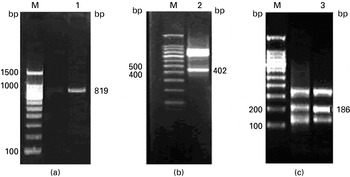
Taking the overall RNA of S. avenae alate adult aphid as a template, PCR amplification was conducted with a pair of degenerate primers. A band of ~810 bp was recovered after electrophoresis (see Fig. 1a) and linked with T-easy vector to be transformed into E. coli Top 10. After sequencing, a fragment of 819 bp was obtained. Using a homology search in GenBank BLAST, it was found to be highly conforming to Gq protein α subunits in various species. More specific primers for 5′-RACE and 3′-RACE reactions were designed, resulting in specific bands of 402 bp and 186 bp, respectively (Fig. 1b and c). They were linked with T-easy vector and transformed by E. coli Top 10 sequencing. By assembling the sequencing results of PCR, 3′-RACE and 5′-RACE, one complete cDNA sequence was obtained that encoded S. avenae Gq protein α subunit gene.
Sequence amplification of Gqα gene. Lanes: M, 100 bp marker ladder, 1, product of RT-PCR; 2, product of 3′-RACE; 3, product of 5′-RACE.

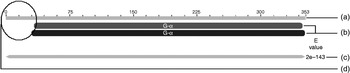
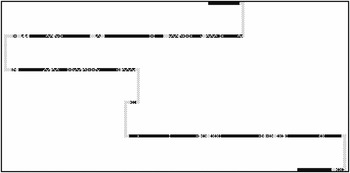
According to the results of sequence assembly, specific primers (Gqα1 and Gqα2) were designed for amplification and the full-length cDNA sequence of the S. avenae Gqα gene obtained, for which the protein encoding region was 1062 bp long. The protein encoded comprised 352 amino-acid subunits (GenBank accession no. EF638906). Searching for the primary structure of the amino-acid sequence of the objective gene showed that the sequence characteristics were highly analogous to Gα protein (Fig. 2a) with an E-value of 2e−143 (Fig. 2b, c). The nearer the E-value to zero, the lower the possibility that the result could occur at random during the search process, thus indicating the dependability of the current result. By comparing the objective protein and others of the same kind (Gα), we could locate the larger mutation sequences concentrated in the first 40 amino-acid subunits (Fig. 2d), which conformed to Gqα sequence characteristics (Hubbard and Hepler, Reference Hubbard and Hepler2006). By a comparison of the homology of the amino-acid sequence with Gqα proteins reported for other species, we obtained the conformity of these sequences:Anopheles gambiae, 94.9%; Aedes aegypti, 94.33%; Bombyx mori, 93.2%; Helicoverpa assulta (Guenee), 92.92%; Helicoverpa armigera, 92.63%; Mamestra brassicae (L.), 90.37%; Panulirus argus, 86.97%; Bos taurus, 83.29%; Homo sapiens, 82.17%. DNASIS software analysis results for its secondary structure showed that the main secondary structures of Gqα are α helixes (Fig. 3).
Conserved domains search for Gqα subunit in NCBI. (a) Gqα amino sequences (353 amino acids). (b) Result of search in NCBI. (c) E-value. (d) Result of the first 40 sequences.

Predicted secondary structure of the deduced amino acids of Gqα. Black, α helix. Alternating black and grey, β sheet. Grey, β turn.

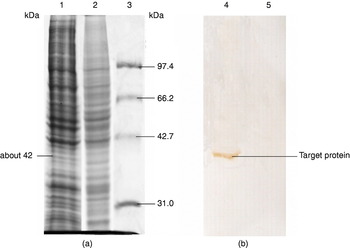
We directionally cloned the cDNA fragment of the open reading-frame of the Gqα gene into the intermediate plasmid vector using the TOPO technique to construct a recombination plasmid containing the Gqα sequence. The plasmid entered the Gateway system and recombined in vitro with the baculovirus linear DNA from AcMNPV in this system to form the recombination baculovirus with independent transfection activity. The Tn cells were transfected, leading to secondarily infected Tn cells. After lysis, we conducted SDS-PAGE and western blot examinations. We ran two parallel SDS-PAGE gels, one of which was examined using Coomassie blue staining, obtaining a specific protein band with a calculated molecular weight of about 41.8 kDa (see Fig. 4a). The other gel was examined by western blotting (Fig. 4b) and the expression products found (Fig. 4b) when the corresponding negative control had no positive reaction.
(a,b) SDS-PAGE (a) and western blot analysis (b) of expressed product for BEVS. Lanes: 1, SDS-PAGE of Tn infected by recombinant virus; 2, SDS-PAGE of Tn normal cell; 3, protein marker; 4, western blot for lane 1 (blotting with V5 antibody); 5, western blot for lane 2. (See online for a colour version of this figure.)

Discussion
The specific fragments cloned in our experiment had consensus sequences completely conforming to the results of 3′ end sequence cloning (3′-RACE) and 5′ end sequence cloning (5′-RACE). The assembly result of these three sequences conformed to the full-length sequence obtained by RT-PCR amplification in S. avenae. The results of BLAST research, conserved sequence research and secondary structure prediction of the protein amino-acid sequence showed that its sequence was typical Gqα. The results also showed that we could amplify a Gqα encoding cDNA sequence in S. avenae using the RACE technique.
The results of SDS-PAGE and western blotting showed that the Gqα recombination protein V5-His6Gqα, which contained six histidine labels and V5 antibody combination sites, could be expressed successfully in the insect in vitro cell line Tn. The cDNA sequence of this gene has been submitted to GenBank with GenBank no. EF638906.
Internationally, there are many studies investigating the structure and function of G protein with the model insect Drosophila as their objective, and which confirm the participation of G protein in the transduction process of various signals including olfactory, visual and incretion signals in the insect. Research on the utilization of aphid warning pheromones has been in progress for over 20 years. Research on the physiological and behavioural reactions of aphids triggered by the scent of plants as well as the electrophysiology reaction of antennae have also made progress. Compared to such studies and related studies on Drosophila, mosquito and Lepidoptera, study of the G protein of S. avenae started relatively recently. Latterly, there have been studies on the cloning of the Goα gene encoding the G protein α subunit for signal transduction of S. avenae (AY603976, Chen et al., Reference Chen, Ni, Sun and Weng2003), gene cloning of the G protein β subunit and γ subunit (AY205294 and AY339875) and tissue distribution (Jiang et al., Reference Jiang, Chen, Ni and Cheng2005, Reference Jiang, Chen, Ni and Cheng2006). However, there have been no reported studies on S. avenae olfaction-related G protein. Owing to a lack of a basic studies on the genome of mini insects such as S. avenae, it is more difficult to study its olfactory behaviour and regulating mechanism. However, studies on S. avenae olfaction-related G protein have important theoretical application value in identifying the mechanisms of host-finding and host-identification behaviours, repellent reaction, and reaction to warning pheromones.
The TOPO and Gateway techniques are advanced in the construction of protein eukaryotic expression systems, which study platforms constructing objective genes and any DNA fragment clones and expression vectors by multiple vectors. Based on the site-specific recombination system of the λ bacteriophage, it is easy to recombine a DNA fragment or objective gene with recombination sites on both ends into a vector with homology recombination sites. With this technique, it is possible to recombine the virus in vitro and produce a recombinant virus with independent transfection activity to avoid the low transfection efficiency resulting from the co-transfection of wild-type baculovirus as in traditional transfection methods. This technique is widely applied to in vitro gene expression and function analysis in the field of molecular biology.
This study has clearly provided preliminary verification of the expression of objective proteins, but has not yet confirmed the optimal harvesting time of cells when transfected by recombinant virus. Thus, the key next step is to examine the differential expression of recombinant protein using different transfection times to decide the optimal harvesting time to produce the most recombinant protein. The in vitro recombinant protein obtained in this study, after purification and the preparation of Gqα protein antibody, is expected to produce the isoenzyme type of upstream coupling receptor protein and downstream effector PLCβ that interacts with Gqα using the co-immunoprecipitation technique. Therefore, it is possible to identify the signal pathway mediated by Gqα to build up the necessary basis for future research on specific combinations of odorant-binding proteins and signal materials, the specific identification of odorant protein by signal receptor, and the mechanism by which aphids identify different odorants in their living environment through signal transduction. Meanwhile, we hope that this study may substantiate the theory behind the mechanism with which a pest finds and chooses a host plant.
Acknowledgements
Sincere gratitude is given to Zhang Chuanxi (a researcher of Zhejiang University) and Dr Yang Zhangnv for their generous support in the study on eukaryotic expression of the Gqα protein. The Fund Project of Major State Basic Research Development Program (973 Plan) (2006CB102004) funded research into pest prevention and control techniques for the three major crops in the main grain production area (2006BAD02A16).