Introduction
Pediatric-onset bipolar disorder (BPD) is a disabling, understudied condition characterized by extreme affective and behavioral dysregulation (Biederman, Reference Biederman2003). Understanding its etiology is a public health priority, given that it impacts up to 20% of child psychiatric referrals in some settings (Biederman & James, Reference Biederman and James2004) and is associated with increased risk for suicide attempts (Goldstein et al. Reference Goldstein, Birmaher, Axelson, Ryan, Strober, Gill, Valeri, Chiappetta, Leonard, Hunt, Bridge, Brent and Keller2005) and hospitalization (Meyer et al. Reference Meyer, Carlson, Wiggs, Martinez, Ronsaville, Klimes-Dougan, Gold and Radke-Yarrow2004).
Although neurobiological studies of this condition are limited, a growing body of literature has documented neurocognitive weaknesses in youth with BPD on measures that tap prefrontal–subcortical circuits. Consistent with adult BPD studies, impairments in affected youth have been observed on measures of attention, verbal and visuospatial memory, processing speed and ‘executive’ functions (e.g. Dickstein et al. Reference Dickstein, Treland, Snow, McClure, Mehta, Towbin, Pine and Leibenluft2004; Doyle et al. Reference Doyle, Wilens, Kwon, Seidman, Faraone, Fried, Swezey, Snyder and Biederman2005c; Glahn et al. Reference Glahn, Bearden, Caetano, Fonseca, Najt, Hunter, Pliszka, Olvera and Soares2005; McClure et al. 2005 a, b;Pavuluri et al. Reference Pavuluri, Schenkel, Aryal, Harral, Hill, Herbener and Sweeney2006; Bearden et al. Reference Bearden, Glahn, Caetano, Olvera, Fonseca, Najt, Hunter, Pliszka and Soares2007). A meta-analysis by Torres et al. (Reference Torres, Boudreau and Yatham2007) confirmed neurocognitive weaknesses in euthymic adult samples, suggesting that they reflect trait-like rather than state-related impairments. Although fewer studies have addressed this issue in young samples, Henin et al. (Reference Henin, Mick, Biederman, Fried, Wozniak, Faraone, Harrington, Davis and Doyle2007) have shown that impairments in unmedicated BPD youth were not generally associated with BPD symptomatology. Others have also shown that neurocognitive impairments in juvenile samples are independent of the severity of manic symptomatology (Glahn et al. Reference Glahn, Bearden, Caetano, Fonseca, Najt, Hunter, Pliszka, Olvera and Soares2005; McClure et al. 2005 a, b;Pavuluri et al. Reference Pavuluri, Schenkel, Aryal, Harral, Hill, Herbener and Sweeney2006; Bearden et al. Reference Bearden, Glahn, Caetano, Olvera, Fonseca, Najt, Hunter, Pliszka and Soares2007), co-morbidity with other disorders (Glahn et al. Reference Glahn, Bearden, Caetano, Fonseca, Najt, Hunter, Pliszka, Olvera and Soares2005; Bearden et al. Reference Bearden, Glahn, Caetano, Olvera, Fonseca, Najt, Hunter, Pliszka and Soares2007) and medication status (Pavuluri et al. Reference Pavuluri, Schenkel, Aryal, Harral, Hill, Herbener and Sweeney2006).
Given that the neurocognitive functions found to be impaired in BPD youth are crucial for self-regulation, such decrements may index the etiological risk mechanisms underlying the behavioral symptoms of the disorder. If so, because the condition itself has been shown to be familial (Faraone et al. Reference Faraone, Glatt and Tsuang2003), neurocognitive impairments should be observed in unaffected relatives of affected individuals. In the few such studies of adults with BPD, unaffected relatives have shown compromised processing speed (Sobczak et al. Reference Sobczak, Riedel, Booij, Aan Het Rot, Deutz and Honig2002), executive functions (Zalla et al. Reference Zalla, Joyce, Szoke, Schurhoff, Pillon, Komano, Perez-Diaz, Bellivier, Alter, Dubois, Rouillon, Houde and Leboyer2004; Clark et al. Reference Clark, Sarna and Goodwin2005), verbal memory (Gourovitch et al. Reference Gourovitch, Torrey, Gold, Randolph, Weinberger and Goldberg1999; Keri et al. Reference Keri, Kelemen, Benedek and Janka2001) and divided attention (Sobczak et al. Reference Sobczak, Honig, Schmitt and Riedel2003), although inconsistencies exist as to impaired domains and measures across studies (Savitz et al. Reference Savitz, Solms and Ramesar2005). To date, no studies have examined neurocognition in unaffected relatives of youth with BPD. Confirmation of a familial link between pediatric BPD and neurocognitive impairments has theoretical and practical implications. For example, distinguishing the impairments that are related to familial risk from those that are sequelae of the disorder could shed light on the pathophysiology of the condition. Such data could also reveal intermediate ‘endophenotypes’ to serve as targets in molecular genetic studies that, in turn, could reveal the origins of the condition and etiologic overlap with the adult-onset disorder.
The current study investigated these issues using youth ascertained through family studies of pediatric-onset BPD. We compared affected probands, their non-mood-disordered relatives and unrelated non-mood-disordered controls on a large battery of measures that have been shown to be impaired in BPD in the literature. Because a substantial proportion of BPD youth meet criteria for co-morbid attention deficit hyperactivity disorder (ADHD) (Borchardt & Bernstein, Reference Borchardt and Bernstein1995), which itself is associated with neurocognitive deficits (Pennington & Ozonoff, Reference Pennington and Ozonoff1996) and the familial transmission of BPD (Faraone et al. Reference Faraone, Biederman, Mennin and Russell1998; Geller et al. Reference Geller, Tillman, Bolhofner, Zimerman, Strauss and Kaufmann2006), all analyses controlled for ADHD. Our primary hypothesis was that impairments in ‘executive’ functioning and verbal learning index a latent trait (or traits) that shares familial etiology with the disorder. Thus, we predicted that unaffected siblings of youth with BPD would show significantly greater impairments than controls after controlling for ADHD.
Method
Subjects
Subjects came from two ongoing family studies of pediatric BPD conducted at the Massachusetts General Hospital (MGH) (Wilens et al. Reference Wilens, Biederman, Kwon, Ditterline, Forkner, Chase, Moore, Swezey, Snyder, Morris, Henin, Wozniak and Faraone2004; Wozniak et al. Reference Wozniak, Biederman, Kwon, Mick, Faraone, Orlovsky, Schnare, Cargol and Van Grondelle2005). Cases were unrelated youth who met full DSM-IV criteria for BPD I or II at some point in their lifetime. In accordance with our case-control family study design, controls were unrelated youth who had no history of BPD, major depression or dysthymia. Cases were 4 to 18 years old, although only youth ⩾7 years were included in the current analyses because of age constraints for completing the full neurocognitive battery. Cases were referred by local clinicians or self-referred through internal hospital postings and internet/community advertisements. Control probands were drawn from comparable advertisements and hospital postings. Potential subjects were screened over the telephone. Probands were excluded if they had major sensorimotor handicaps, a suspected IQ <70 or first-degree biological family relatives unavailable for study. Subjects passing these screens were invited to enroll in the project along with their first-degree biological relatives. Probands and relatives were told the aims, procedures, risks or discomforts, and benefits of the study. For children, information was conveyed using developmentally appropriate language. Written informed consent was obtained from individuals ⩾18 years old and from parents for minor children. Written assent was obtained from minors. Families whose proband diagnostic status was confirmed by interview and blind clinician review were maintained in the study. Procedures were approved by the MGH Human Research Committee.
Structured diagnostic interviews
Raters had undergraduate degrees in psychology or a related field and were blind to subjects' ascertainment status. Interviews were conducted using the Schedule for Affective Disorders in Children – Epidemiologic Version (KSADS-E; Orvaschel, Reference Orvaschel1994) for youth aged ⩽17 years and the Structured Clinical Interview for DSM-IV (SCID; First et al. Reference First, Spitzer, Gibbon and Williams1997) and KSADS-E childhood disorders for individuals aged ⩾18 years. Information was obtained from independent interviews with the primary caregiver as well as youth ⩾12 years old. Diagnoses were scored positive if all DSM-IV criteria were met in either interview and were confirmed by board-certified child psychiatrists and psychologists who were unaware of the subject's ascertainment group, neuropsychological data and family history. Interviewers/clinicians did not depart from or modify DSM-IV criteria when diagnosing a manic episode.
Interviews were audiotaped with permission. To assess reliability, we randomly selected 20 interviews to be re-rated by an expert in the field of pediatric and adult BPD (J.W.) who was blind to all subject information. The results showed good agreement between the interviewer and expert for ratings of mania (κ=0.95).
Neuropsychological testing
We estimated Full-Scale IQ (FSIQ; Sattler, Reference Sattler1988) from the Vocabulary and Block Design subtests of the Wechsler Intelligence Scale for Children – Third Edition (WISC-III; Wechsler, Reference Wechsler1991) for individuals aged <17 years and the Wechsler Adult Intelligence Scale – Third Edition (WAIS-III; Wechsler, Reference Wechsler1997) for individuals aged ⩾17 years. The remaining tests were selected to represent measures and constructs found to be impaired in adult and youth with BPD in the literature, many of which are thought to be indirect indices of the frontal system and pathways. These include components of executive functions (i.e. working memory, interference control, abstract problem solving/set shifting and planning/visuospatial organization) as well as attention, processing speed and verbal learning. Subtests from well-studied clinical instruments were used including: the Arithmetic, Digit Span, Digit Symbol/Coding and Symbol Search subtests from the WISC-III/WAIS-III; the color naming and interference scores from the Stroop Color Word Test (Golden, Reference Golden1978); perseverative and non-perseverative errors on the computerized Wisconsin Card Sorting Test (WCST; Heaton et al. Reference Heaton, Chelune, Talley, Kay and Curtiss1993); copy organization from Bernstein & Waber's (Reference Bernstein and Waber1996) scoring of the Rey–Osterrieth Complex Figure (ROCF; Osterrieth, Reference Osterrieth1944), the trials 1–5 score on the California Verbal Learning Test – Children's Version (CVLT-C; Delis et al. Reference Delis, Kramer, Kaplan and Ober1994) and Second Edition (CVLT-II) for subjects ⩾17 years old (Delis et al. Reference Delis, Kramer, Kaplan and Ober2000); and the ‘vigilance’, ‘working memory’ and ‘working memory plus interference control’ measures from the Seidman auditory CPT (Seidman et al. Reference Seidman, Breiter, Goodman, Goldstein, Woodruff, O'Craven, Savoy, Tsuang and Rosen1998). All scores reflect age-based standard scores from published manuals, with the exception of the Seidman CPT and the ROCF, which were translated into age-based T scores using data on 1142 individuals from control families assessed through studies at MGH (normative data available from the first author).
Tests were administered and, except for the ROCF, scored by psychometricians trained and supervised by licensed neuropsychologists (A.E.D., R.F., L.J.S.). The ROCF was scored by individuals with a master's degree in psychology who were blind to subject characteristics.
Statistical analysis
Three groups were created based on proband and relative diagnostic status for families and individuals whose data had been collected, cleaned and scored at the time of analysis; specifically, the unrelated affected probands, the biological siblings of the affected youth and the unrelated control probands. The first group included index cases with full DSM-IV BPD I or II diagnoses. The second group included the ‘unaffected’ full biological siblings of these individuals with no history of BPD I or II, major depressive disorder or dysthymia. The third group included the non-BPD, non-mood-disordered control probands. This stratification resulted in 170 BPD probands, 118 unaffected relatives of BPD probands and 79 controls. Among the BPD families, 68 had one unaffected sibling and 25 included two unaffected siblings.
We conducted two sets of analyses. First, for data reduction purposes, we conducted a principal components factor analysis of neurocognitive measures. We used a promax rotation to allow for correlation among factors, given potentially overlapping neurocognitive domains. This strategy aimed to reduce Type I errors and to capitalize on increased validity derived from the shared variance among measures. Support for combining measures comes from twin studies (e.g. Kuntsi et al. Reference Kuntsi, Rijsdijk, Ronald, Asherson and Plomin2005) in which composite scores have been shown to yield greater familial aggregation with behavioral symptoms than scores on individual tests. The Seidman CPT working memory measure with interference filtering demands (WM INT) was analyzed separately because it was administered to subjects aged ⩾12 years (n=189) and thus would have excluded younger subjects from the factor analysis.
Second, we used logistic regression to assess the association between group status and performance on the three factor scores and the Seidman WM INT. Specifically, we used generalized estimating equation (GEE) models with the appropriate link and family specification. To account for correlation within families, we used robust estimates of variance so that p values would not be underestimated (Zeger & Liang, Reference Zeger and Liang1986). Models were fit with the statistical software package Stata (Stata Corporation, College Station, TX, USA). The statistical significance of each covariate was determined by Wald's χ2 test. α was set at 0.05; all tests were two-tailed.
Results
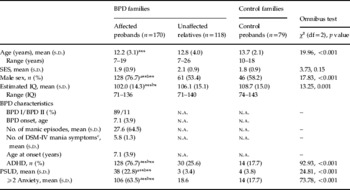
Table 1 shows descriptive features of the sample. No significant group differences emerged on socio-economic status (SES). Differences were found for age and sex, and thus all GEE models included these variables as covariates. BPD I and II cases were analyzed together because only 11% of cases met criteria for BPD II. The mean age of onset of BPD was in early childhood. All cases onset at age 16 or earlier, with 94% of the BPD probands reporting an onset of 14 or earlier. Youth with BPD had significantly lower estimated FSIQ compared to unaffected relatives and controls, although all groups scored within the average range. Because correcting for IQ may remove a portion of the variance directly attributable to our outcomes, primary analyses did not covary for IQ; however, we report results after correction for IQ for purposes of discussion. Rates of co-morbid disorders differed across groups. Although we made an a priori decision to include ADHD as a covariate in GEE models to identify impairments specifically relevant to BPD, given the possibility of shared familial risk factors between ADHD and BPD, we also comment on how the results differ when ADHD is not controlled.
Demographic and descriptive characteristics of sample stratified by relative group and diagnoses

BPD, Bipolar disorder; SES, socio-economic status; ADHD, attention deficit hyperactivity disorder; PSUD, psychoactive substance use disorders (alcohol/drug abuse/dependence); s.d., standard deviation; df, degrees of freedom; n.a., not applicable.
a versus controls; bversus unaffected relatives; c symptoms refer to most severe manic episode by interviewee report.
* p⩽0.05, ** p⩽0.01.
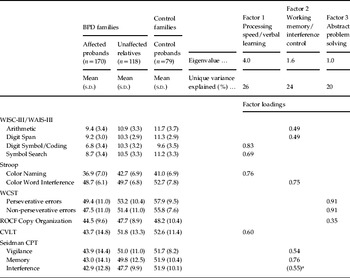
Table 2 shows the mean scores of the three groups on each neurocognitive measure, and also primary loadings in the factor analysis. Three factors were retained (based on eigenvalues >1.0 and the scree plot change in slope), which together accounted for 70% of the total variance. Measures of processing speed from the Wechsler and the Stroop and the single measure of verbal learning loaded on Factor 1. Measures of working memory from the Wechsler tests and the CPT loaded on Factor 2, along with the Stroop Interference subtest and the Vigilance subtest. Measures of abstract problem solving/planning from the WCST and the ROCF loaded on Factor 3.
Neurocognitive measures: mean scores and factor loadings

BPD, Bipolar disorder; WISC-III, Wechsler Intelligence Scale for Children – Third Edition; WAIS-III, Wechsler Adult Intelligence Scale – Third Edition; WCST, Wisconsin Card Sorting Test; ROCF, Rey–Osterrieth Complex Figure; CVLT, California Verbal Learning Test; CPT, Continuous Performance Test.
All data reflect T scores except for WISC-III/WAIS-III measures, which are scale scores.
a Seidman CPT interference score not included in primary factor analysis because only administered to individuals aged ⩾12 years; secondary analysis using only youth aged ⩾12 years showed loading on Factor 2.
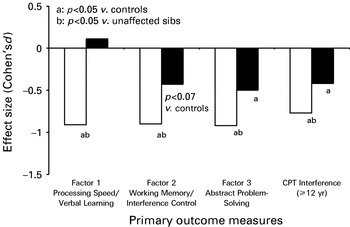
Fig. 1 illustrates effect sizes (Cohen's d) reflecting the performance of BPD probands and unaffected relatives versus controls on the four primary measures. The omnibus tests for the GEE models showed group differences on each [Factor 1 processing speed/verbal learning χ2(2)=56.40, p<0.001; Factor 2 working memory/interference control χ2(2)=16.64, p<0.001; Factor 3 abstract problem solving χ2(2)=23.59, p<0.001; Seidman WM INT measure χ2(2)=14.39, p<0.001]. Pairwise comparisons revealed that BPD probands performed more poorly than controls on all four [Factor 1 χ2(1)=30.69, p<0.001; Factor 2 χ2(1)=15.92, p<0.001; Factor 3 χ2(1)=22.75, p<0.001; WM INT χ2(1)=13.99, p<0.001]. Unaffected relatives showed significantly worse performance versus controls on the abstract problem solving factor [χ2(1)=4.88, p=0.03] and the Seidman WM INT measure [χ2(1)=4.20, p=0.04]. Although the performance of unaffected relatives was also worse than that of controls on the working memory/interference control factor, this comparison fell short of statistical significance [χ2(1)=3.20, p=0.07]. Affected siblings also showed more impairments than unaffected siblings on each measure [Factor 1 χ2(1)=47.48, p<0.001; Factor 2 χ2(1)=7.29, p<0.01; Factor 3 χ2(1)=9.21, p=0.002; WM INT χ2(1)=4.42, p=0.04].
Performance of bipolar disorder probands (□) and unaffected siblings (▪) versus controls. CPT, Continuous Performance Test.

It is noteworthy that the overall pattern of results would have been the same had ADHD not been included as a covariate, except that the performance of unaffected relatives on the working memory/interference control factor would have differed significantly from controls [χ2(1)=4.12, p=0.04] instead of emerging as a statistical trend. Had we controlled for IQ, the majority of significant findings would have remained, including the difference between unaffected relatives and controls on the abstract problem solving/organization factor [χ2(1)=4.49, p=0.03]; however, the difference between unaffected relatives and controls on the WM INT would have fallen just short of statistical significance [χ2(1)=3.02, p=0.08], possibly because of the smaller sample size of the group.
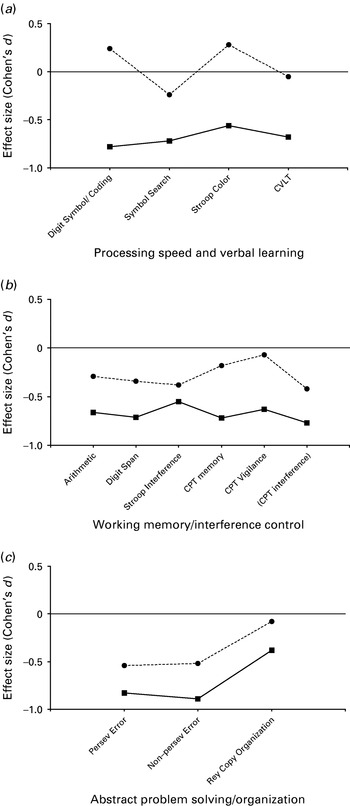
Although comparisons were not made on individual subtests, effect sizes for the subtests that loaded on each factor are shown in Fig. 2 for discussion purposes.
Neuropsychological performance of bipolar disorder probands ( ) unaffected siblings (- - • - -) and Controls (––––). Measures loading on (a) Factor 1, (b) Factor 2 and (c) Factor 3. CPT, Continuous Performance Test; CVLT, California Verbal Learning Test.

Because source studies were naturalistic, we could not assess the impact of medication on test performance. Among the BPD youth, 79% reported medication use at the time of testing. Of these, 19% were taking more than one medication. Medications taken by this group were: 8% lithium, 31% anti-epileptics, 17% atypical neuroleptics, 13.5% selective serotonin reuptake inhibitors (SSRIs), 1% antipsychotics, 19% psychostimulants, 5% buproprion, 4% alpha-adrenoreceptor agonists and 5.5% other. Six per cent of unaffected relatives and 8% of controls were taking at least one psychotropic medication; exclusion of these individuals did not change the results.
Discussion
The current study examined whether neurocognitive performance in youth with BPD is linked to the familial risk for the disorder. Consistent with the growing literature on pediatric BPD samples, the diagnosis itself was associated with relative weaknesses in processing speed/verbal learning, working memory/interference control and abstract problem solving. Unaffected siblings of youth with BPD showed impairments on measures of abstract problem solving and working memory/interference control. These findings suggest that executive dysfunction may index the familially transmitted pathophysiology underlying the condition. To our knowledge, this is the first study to evaluate and identify candidate endophenotypes in youth with BPD.
The neurocognitive functions that we examined, including abstract problem solving/set shifting, working memory, attention, verbal learning and processing speed, have previously been shown to be impaired in pediatric (Pavuluri et al. Reference Pavuluri, Schenkel, Aryal, Harral, Hill, Herbener and Sweeney2006; Rucklidge, Reference Rucklidge2006; Bearden et al. Reference Bearden, Glahn, Caetano, Olvera, Fonseca, Najt, Hunter, Pliszka and Soares2007; Dickstein et al. Reference Dickstein, Nelson, McClure, Grimley, Knopf, Brotman, Rich, Pine and Leibenluft2007) and adult (Quraishi & Frangou, Reference Quraishi and Frangou2002) patients with BPD. The fact that these functions are crucial to cognitive and behavioral self-control compels the question of whether impaired performance reflects the underlying risk for the disorder. Yet, in affected youth, compromised performance could represent sequelae of symptoms, a degenerative process related to the illness or even a consequence of treatment. Although neurocognitive weaknesses in euthymic samples (McClure et al. 2005 a, b;Pavuluri et al. Reference Pavuluri, Schenkel, Aryal, Harral, Hill, Herbener and Sweeney2006; Torres et al. Reference Torres, Boudreau and Yatham2007) suggest that compromised functions are not purely due to acute disorganization, impairments in unaffected relatives provide more direct support for the link between test performance and familial etiological mechanisms.
In the current study, only some of the measures that were impaired in affected youth were impaired in unaffected relatives. Measures of abstract problem solving showed the most definitive familial link to the disorder, with unaffected relatives showing impairment on the factor reflecting this construct, and the two subscales of the WCST that loaded on this factor showing the largest decrements of the battery. For measures reflecting working memory and interference control, the pattern of findings was more complex but indicated a familial link between these domains and the disorder as well. Specifically, the working memory CPT with interference (WM INT) was impaired in individuals aged ⩾12 years, who were old enough to be expected to accomplish the task. Additionally, although impairments on the working memory/interference factor itself fell short of statistical significance (p=0.07), the majority of working memory and interference control measures (i.e. Digit Span, Arithmetic, Stroop Interference) that loaded on it showed decrements of similar magnitude to the WM INT (Cohen's d: 0.3–0.4; Fig. 2a). The exception was the working memory CPT subtest with no interference (Cohen's d=0.2), possibly because of ceiling effects. By contrast, the unaffected relatives' performance on the vigilance subtest, which also loaded on Factor 2, was similar to that of controls, as was their performance on measures of processing speed and verbal learning that loaded on Factor 1.
The current data are consistent with several studies of unaffected relatives of BPD adults that show impairments in interference control (Zalla et al. Reference Zalla, Joyce, Szoke, Schurhoff, Pillon, Komano, Perez-Diaz, Bellivier, Alter, Dubois, Rouillon, Houde and Leboyer2004) and abstract problem solving (Meyer et al. Reference Meyer, Carlson, Wiggs, Martinez, Ronsaville, Klimes-Dougan, Gold and Radke-Yarrow2004; Clark et al. Reference Clark, Sarna and Goodwin2005). However, other studies of BPD adults have failed to find abstract problem solving (Keri et al. Reference Keri, Kelemen, Benedek and Janka2001; Zalla et al. Reference Zalla, Joyce, Szoke, Schurhoff, Pillon, Komano, Perez-Diaz, Bellivier, Alter, Dubois, Rouillon, Houde and Leboyer2004; Frangou et al. Reference Frangou, Haldane, Roddy and Kumari2005) and working memory (Keri et al. Reference Keri, Kelemen, Benedek and Janka2001) impairments in unaffected relatives. It is not clear whether such discrepancies are due to small sample sizes or true neurocognitive heterogeneity in adult samples. However, data suggest that there is a range of neurocognitive impairments in adult samples, with the presence of more severe deficits associated with worse functional outcome (Barnett et al. Reference Barnett, Salmond, Jones and Sahakian2006; Jaeger et al. Reference Jaeger, Tatsuoka, Berns, Varadi, Czobor and Uzelac2006). Our findings raise the possibility that executive dysfunction may be etiologically relevant to the behavioral symptoms of BPD that onsets in youth, whereas weaknesses in vigilance, processing speed and verbal learning may be sequelae of the condition.
Because pediatric-onset BPD is familially linked to ADHD (Faraone et al. Reference Faraone, Biederman, Mennin and Russell1998; Gellar et al. 1996), it is likely that the disorders share at least some risk factors. Measures of working memory/interference control have been found to be impaired in relatives of ADHD youth (Doyle et al. Reference Doyle, Biederman, Seidman, Reske-Nielsen and Faraone2005a), and measures of these constructs in our sample were significantly impaired in unaffected relatives prior to as well as after controlling for ADHD. It is notable that a familial link between abstract problem solving and pediatric-onset BPD emerged even after controlling for ADHD and that impairments in this domain have not previously been found in unaffected relatives of ADHD probands (Doyle et al. Reference Doyle, Faraone, Seidman, Willcutt, Nigg, Waldman, Pennington, Peart and Biederman2005b). Moreover, Meyer et al. (Reference Meyer, Carlson, Wiggs, Martinez, Ronsaville, Klimes-Dougan, Gold and Radke-Yarrow2004) found that impairments on the WCST in adolescents who eventually developed BPD were not associated with early attentional problems. These data suggest the possibility that abstract problem solving taps risk factors for pediatric BPD that do not overlap with ADHD, whereas working memory/interference control measures tap familial risk that may be shared between ADHD and pediatric BPD. More work is needed to test these hypotheses in other samples.
Conceptually, the possibility that the executive system is linked to the extreme behavioral dyscontrol of BPD youth is compelling. Deficits in abstract problem solving, working memory and interference control may interfere with the ability to process information from the environment in conjunction with known rules and expectations, identify pro-social options for behavior and disregard provocative or distracting stimuli. Support for this latter issue is found in the neuroimaging literature; for example, with manic patients showing excessive ventral and medial prefrontal response to distractors with emotional valence (Elliott et al. Reference Elliott, Ogilvie, Rubinsztein, Calderon, Dolan and Sahakian2004).
It is well documented that prefrontal–subcortical networks govern performance on abstract problem solving and working memory/interference control tasks. For example, the processing of negative feedback that leads to set shifting on the WCST has been associated with a loop involving the mid-ventrolateral prefrontal cortex (PFC), the basal ganglia and dorsal thalamus, as well as with the anterior cingulate cortex (Monchi et al. Reference Monchi, Petrides, Petre, Worsley and Dagher2001). In this study, the processing of task feedback in general, which is necessary for rule acquisition and successful problem solving, activated regions (i.e. the mid-dorsolateral PFC and the posterior parietal cortex) implicated in working memory tasks, including the WM INT (Seidman et al. Reference Seidman, Breiter, Goodman, Goldstein, Woodruff, O'Craven, Savoy, Tsuang and Rosen1998). Together, these findings implicate dysfunctional prefrontal–subcortical circuits in the putative familial risk mechanism that mediates the expression of BPD. Such data are consistent with a functional neuroimaging study of pediatric BPD (Leibenluft et al. Reference Leibenluft, Rich, Vinton, Nelson, Fromm, Berghorst, Joshi, Robb, Schachar, Dickstein, McClure and Pine2007) illustrating anomalies in prefrontal–striatal activation during an executive task. Neuroimaging studies with unaffected relatives are needed to pinpoint which aspects of these pathways show a familial relationship to the disorder.
Presuming that our findings are confirmed in other samples, measures such as the WCST and WM INT represent potential targets for molecular genetic studies of pediatric BPD and more precisely reveal its pathophysiology. Although twin studies of pediatric BPD are lacking, high rates of BPD in relatives of affected youth (Strober et al. Reference Strober, Morrell, Burroughs, Lampert, Danforth and Freeman1988; Neuman et al. Reference Neuman, Geller, Rice and Todd1997) and the heritability of BPD in adults suggest that the etiology of pediatric BPD is complex but includes genetic origins (Faraone et al. Reference Faraone, Glatt and Tsuang2003). Endophenotypes, such as familially linked neurocognitive measures, may theoretically increase statistical power to detect the effects of individual susceptibility genes in such conditions due to their reduced complexity compared to the disorder as a whole, given their (1) greater proximity to gene products and (2) potential to parse heterogeneous processes (Gottesman & Gould, Reference Gottesman and Gould2003). Although it is likely that neurocognitive measures such as the WCST are themselves complex conditions, associations between the WCST and the gene for catechol-O-methyltransferase (Flint & Munafo, Reference Flint and Munafo2007), plus data from our recent study showing suggestive linkage of a WCST subscale to a region on chromosome 22q11 (Doyle et al., in press), indicate that it is reasonable to expect to be able to identify genes that influence this phenotype. Indeed, even if neurocognitive phenotypes are not drastically less complex than pediatric BPD itself, their familial (and potentially heritable) covariance with the disorder underscores their potential for increasing power by inclusion in multivariate genetic analyses.
A few issues are noteworthy when considering our results. Although we discuss our findings based on constructs that our tests purport to measure, future studies are needed to determine whether other measures of working memory/interference control (e.g. N-back tests) and abstract problem solving/set shifting (e.g. Tower of London/Hanoi tests) will show impairments in unaffected relatives and/or whether other constructs (e.g. executive attention; Sheese et al. Reference Sheese, Rothbart, Posner, White and Fraundorf2008) better reflect the underlying impairments that our measures are tapping in relatives. In addition, some researchers have argued that IQ should be controlled in neuropsychological studies to insure that deficits are not attributable to low ability (Werry et al. Reference Werry, Reeves and Elkind1987; Lahey et al. Reference Lahey, Pelham, Stein, Loney, Trapini, Nugent, Kipp, Schmidt, Lee, Cale, Gold, Hartung, Willcutt and Baumann1998); however, it is conceivable that neuropsychological deficits contribute to poor performance on measures of IQ (Barkley, Reference Barkley1997). Moreover, data from twin (Polderman et al. Reference Polderman, Gosso, Posthuma, Van Beijsterveldt, Heutink, Verhulst and Boomsma2006) and molecular genetic studies (Doyle et al., in press) suggest a partially shared genetic etiology between measures of IQ and measures of executive functions. Thus, we did not control for IQ so as not to remove potentially relevant genetic variance from our outcomes. Nonetheless, including IQ as a covariate would not have reduced the statistical significance of the differential performance of unaffected relatives and controls on the abstract problem solving/organization factor. Regarding diagnostic issues, although our current diagnostic approach did not depart from or modify DSM-IV criteria for mania, both broad and narrow definitions of pediatric BPD have been proposed. Understanding the cognitive correlates of varied diagnostic criteria would be of interest to the field.
Finally, our data should be considered in light of their limitations. First, because the majority of affected youth in our sample were medicated, we could not determine neurocognitive impairments in BPD youth that were present in the absence of medication. Similarly, approximately half of our BPD probands met criteria for mania at the time of assessment. Thus, it is possible that current mood state influenced impairments in this group. However, because medication status and current rates of mania did not differ between unaffected relatives and controls, these variables do not impact our main focus on impairments in unaffected relatives compared to controls. Second, given the worse performance of the BPD youth and their siblings, it is logical to attribute the familiality of neurocognitive impairments to BPD. Yet the inclusion of at-risk youth unrelated to the BPD probands or of relatives of the control probands would have provided an even stronger test of this hypothesis and helped to rule out the possibility that a factor other than BPD was accounting for the familiality. Third, as part of the case-control design of the source studies, controls were selected based on the absence of mood disorders. However, because they had not yet passed through the age of risk, it is possible that a small number of controls may go on to develop a mood disorder. As there is no doubt that the familial loading for BPD risk factors is greater in the BPD youth than in controls, this issue does not undermine our main findings of greater impairments in unaffected relatives versus controls and, if anything, would have served to reduce the differences between these groups. Fourth, although our analyses included a wide variety of neurocognitive measures that are relevant to pediatric BPD, several interesting candidate endophenotypes were not assessed, including biased processing of emotionally charged stimuli (Murphy & Sahakian, Reference Murphy and Sahakian2001), social cognition/face processing (McClure et al. 2005 a, b;Pavuluri et al. Reference Pavuluri, Schenkel, Aryal, Harral, Hill, Herbener and Sweeney2006) and visual–spatial memory (Dickstein et al. Reference Dickstein, Treland, Snow, McClure, Mehta, Towbin, Pine and Leibenluft2004). Thus, the candidate endophenotypes that we have identified are not exhaustive and probably reflect only a piece of the etiological puzzle that underlies the extreme emotional dysregulation of youth with BPD. Fifth, it is important to note that youth under age 12 were not interviewed directly. Nonetheless, our recent investigation in the current sample (Biederman et al., Reference Biederman, Petty, Wilens, Spencer, Henin, Faraone, Mick, Monuteaux, Kenealey, Mirto and Wozniakin press) suggests that diagnoses based only on parental reports represent a highly morbid condition with comparable clinical correlates to diagnoses resulting from concordant reports. Even so, direct data from younger children would have been preferable.
Despite these considerations, we found clear neurocognitive deficits in the unaffected siblings of youth with BPD. These data suggest that measures of abstract problem solving, working memory and interference control may be linked to the familial risk for the disorder and thus useful targets in molecular genetic studies of the condition. These findings add to a growing body of work documenting the validity and neurobiological underpinnings of pediatric BPD.
Acknowledgments
This work was supported in part by a Harvard Medical School 50th Anniversary Scholars Fellowship in Honor of Joseph B. Martin M.D. Ph.D. and NIMH K08-MH66072 to Dr Doyle, K08-MH01503 to Dr Wozniak, and NIH RO1 DA12945 and K24 DA016264 to Dr Wilens. Support also came in part from the Neal/Kimmerly Fund for the Study of Cognition in Psychiatric Illness at the Massachusetts General Hospital.
Declaration of Interest
Dr Doyle has, in the past year, received consultation fees from Pfizer Pharmaceuticals. Dr Wilens receives grant support, speaker or consultant fees from: Abbott, McNeil, Lilly, NIH (NIDA), Merck, Novartis and Shire. Dr Wozniak receives income from her book Is Your Child Bipolar? (published May 2008, Bantam Books). Her spouse, John Winkelman M.D., Ph.D., receives research support, consultation fees or speaker's fees from Axon Labs Boehringer-Ingelheim, GlaxoSmithKline, Jazz Pharmaceuticals, Novartis, Neurogen, Pfizer, Sanofi-Aventis, Sepracor, Takeda, and UCB (Schwarz) Pharma. Dr Faraone reports having received lecture fees and research funding from Pfizer, and consulting and research funding from Shire. Dr Biederman receives research support, consultation fees or speaker's fees from: Alza, AstraZeneca, Bristol–Myers Squibb, Eli Lilly and Co., Janssen Pharmaceuticals Inc., McNeil, Merck, Novartis, Organon, Otsuka, Shire, NIMH, NICHD and UCB Pharma, Inc.