1 Introduction
Since the early 1960s, advances in technologies have opened up new possibilities for learning in several ways beyond sitting in a traditional classroom. These new methods include computer-assisted, open, distance, and e-learning, in which formal and informal learning opportunities are supported (Chen & Chung, Reference Chen and Chung2008). During the last decade, the widespread ownership of mobile technologies has encouraged a new surge of evolution in technology-enhanced learning. With improvements in processing power, storage capacities, graphics, high-speed wireless connectivity, GPRS, bluetooth, and 3G, the capabilities of mobile devices have been extended beyond their primary function as simple communication and entertainment tools. Researchers have therefore begun to investigate new uses for various mobile technologies to facilitate learning (Stockwell, Reference Stockwell2007).
Although mobile learning (m-learning) is not a stable concept and needs to be made more explicit through m-learning studies and practices (Kukulska-Hulme, Reference Kukulska-Hulme2009), in essence, it refers to teaching and learning with the use of mobile technologies such as mobile phones, media players, PDAs, smart phones, and tablet computers, which are potentially available anytime and anywhere. The characteristics of these devices are that they have ever increasing processing and storage capabilities (Cheung & Hew, Reference Cheung and Hew2009; Saran, Seferoglu & Cagiltay, Reference Saran, Seferoglu and Cagiltay2009), and their use can be spontaneous, informal, contextual, portable, ubiquitous, pervasive, and personal (Sharples, Milrad, Arnedillo-Sánchez & Vavoula, Reference Sharples, Milrad, Arnedillo-Sánchez, Milrad and Vavoula2009; Traxler, Reference Traxler2005). This makes them very useful tools to help achieve educational goals such as improving student retention and achievement, supporting different types of learning needs, and reaching learners who would not otherwise have the opportunity to participate in education (Kukulska-Hulme, Reference Kukulska-Hulme2005, Reference Kukulska-Hulme2009).
As m-learning has become widespread and its impact in education has grown, language learning has been enhanced by the widespread ownership of mobile devices such as phones and media players (Kukulska-Hulme, Reference Kukulska-Hulme2006). In general, Mobile Assisted Language Learning (MALL), which is a specialization within m-learning, has been distinguished from computer-assisted language learning in its use of personal, portable devices such as mobile phones, MP3/MP4 players, PDAs, smart phones, and tablet computers (Kukulska-Hulme & Shield, Reference Kukulska-Hulme and Shield2008) and defined as the use of “mobile technologies in language learning, especially in situations where device portability offers specific advantages” (Kukulska-Hulme, Reference Kukulska-Hulme2013: 3701). These devices enable new ways of learning, which emphasize continuity or spontaneity of access, and interaction across different contexts of use (Chinnery, Reference Chinnery2006; Kukulska-Hulme & Shield, Reference Kukulska-Hulme and Shield2008; Traxler, Reference Traxler2007).
MALL is an emerging research field undergoing rapid evolution. Research suggests that it may provide language learners with rich, real-time, collaborative, and conversational experiences, both inside and outside the classroom. This is because mobile devices can be effective tools for delivering language learning materials to learners (Thornton & Houser, Reference Thornton and Houser2005). MALL enables mobile learners to take part in activities that relate directly to their changing locations (Chen & Li, Reference Chen and Li2010; Kukulska-Hulme, Reference Kukulska-Hulme2009). It also encourages spontaneous interactions, facilitates deeper integration of language learning with everyday communication needs and cultural experiences (Lu, Reference Lu2008), and aids in the utilization and retention of newly acquired language skills. In addition, MALL allows language students to acquire one or more new languages simultaneously (Begum, Reference Begum2011).
The growing body of literature on the effectiveness of m-learning and the development of m-learning systems to assist student learning has been documented in several literature review-based studies (e.g. Cheung & Hew, Reference Cheung and Hew2009; Hung & Zhang, Reference Hung and Zhang2012; Hwang & Tsai, Reference Hwang and Tsai2011; Wu, Jim Wu, Chen, Kao, Lin & Huang, 2012). These literature reviews provide a valuable synthesis of m-learning in general and demonstrate that m-learning has often been used in language courses (Hwang & Tsai, Reference Hwang and Tsai2011; Wu et al., Reference Wu, Wu, Chen, Kao, Lin and Huang2012). A number of literature reviews have also identified research trends specifically in MALL (Burston, Reference Burston2013, Reference Burston2014a; Chinnery, Reference Chinnery2006; Kukulska-Hulme & Shield, Reference Kukulska-Hulme and Shield2008; Viberg & Grönlund, Reference Viberg and Grönlund2012; Ya, Ching & Chih-Kai, 2013). These studies offer significant syntheses and annotated bibliographies related to MALL and examine the field from different perspectives, including the distribution of research topics, the variety of mobile devices, and methodological aspects of the MALL studies. However, considering the popularity and support capabilities of emerging mobile devices and the potential of m-learning applications in a language learning system, continuous investigations of the MALL literature to identify the types and tendencies of recent studies are vital to understand current practices and to direct future research in the field. To this end, the current review also provides a more comprehensive analysis of MALL by systematically examining the distribution of research topics, the variety of mobile devices that are supported by the many mobile platforms and functions, theoretical bases, or the methodological aspects of MALL studies.
The overall goal of the present study is to analyse published MALL studies from the years 2000–2012 in order to examine the characteristics and general research trends, and to show to what extent mobile devices are being used to support language learning. The following research questions guided this study:
1. What are the trends regarding the uses of MALL in language learning/teaching?
1.1. What language learning topics have been commonly investigated in MALL studies?
1.2. What theoretical frameworks have been commonly addressed in MALL studies?
1.3. What learning environments have been commonly used in MALL studies?
2. How is technology/media used in MALL studies?
2.1. What mobile devices have been commonly used in MALL studies?
2.2. What content transport and delivery technologies have been commonly used in MALL studies?
2.3. What multimedia components have been commonly used in MALL studies?
3. What methodologies are employed in MALL studies?
3.1. What types of research have been commonly utilized in MALL studies?
3.2. What research designs have appeared in MALL studies?
2 Methodology
A literature review was conducted to investigate the research trends in MALL from 2000 to 2012. This method facilitates the compilation of a critical report, and provides a current and more comprehensive research database, which also indicates areas that may require future study (Aitchison, Reference Aitchison1998; Creswell, Reference Creswell2008; Johnson & Christensen, Reference Johnson and Christensen2004). In a recent annotated bibliography and literature review, Burston (Reference Burston2013, Reference Burston2014b) has provided a comprehensive overview of MALL. Viberg and Grönland (2012) have also given a systematic review of MALL research during the period 2007–2012 in terms of research content, approaches, methods, and theories. Intended to go beyond existing studies, the current study presents a more extensive coverage of MALL research with a focus on learning environments, content transport and delivery technologies, and multimedia use in the MALL studies.
2.1 Data collection
A systematic review of MALL-related literature published between the years 2000 and 2012 in international journals indexed in Social Sciences Citation Index (SSCI) was carried out. SSCI journals adopt stringent criteria in reviewing articles. These articles are generally regarded as having higher impacts in the field. The review of journal articles began with the year 2000, the year in which one of the first projects using mobile phones in language learning was developed by the Stanford Learning Lab (Regan, Mabogunje, Nash & Licata, Reference Regan, Mabogunje, Nash and Licata2000).
In the data collection process, a first list was compiled of international SSCI journals with relevant information concerning technologies, educational technologies, language learning technologies, mobile technologies, and social sciences. Then, journal websites were searched to find the articles. Databases, digital libraries, and search engines were also queried to search for literature in this field. Search terms used in the main literature search included “mobile” and/or “mobile learning” and/or “language learning” and/or “mobile language learning” and/or “mobile assisted language learning” and/or “MALL” and/or “mobile/cell phones” and/or “tablet computers” and/or “emerging technologies” and/or “computer assisted language learning” and/or “CALL”.
2.2 Selection criteria for the inclusion of papers
To narrow down the selection of papers for inclusion in the current review, this set of publications was screened further through several criteria to guide the selection. These criteria were as follows: (1) studies that were written in English and published as full-text in refereed academic SSCI journals; (2) studies that were published between 2000 and 2012; and (3) studies with a focus on using mobile devices in language learning. Publications such as book reviews, letters, responses, commentaries, and editorial materials were all excluded from this study. Moreover, pure infrastructure projects to provide learners with devices and wireless networks, as well as learning management systems, technical platforms, or unspecific collections of tools, were not considered. After filtering the papers for the aforementioned criteria, 69 international MALL papers in 21 journals were selected and reviewed. Of the reviewed papers, the highest number of articles (n=13) was published in ReCALL, the journal of the European Association for Computer Assisted Language Learning. The next two most prolific sources were Computer Assisted Language Learning (CALL) (n=9) and the Journal of Computer Assisted Learning (JCAL) (n=8). A list of the journals and the number of papers selected from each journal is provided in Appendix A.
2.3 The Data collection instrument
An initial examination of the papers suggested that it was useful to organize them into categories, since they are very diverse in scope, address a wide range of aspects of mobile use in language learning, and feature a variety of methodological approaches. Hence, the papers were coded to extract information about the selected studies via a classification form. A draft of this form was created by the researchers based on the scope of this study, related literature (Attewell, Reference Attewell2005; Woodill, Reference Woodill2011), and sample classification forms (Göktaş, Küçük, Aydemir, Telli, Arpacık, Yıldırım & Reisoğlu, Reference Göktaş, Küçük, Aydemir, Telli, Arpacık, Yıldırım and Reisoğlu2012; Sözbilir & Kutu, Reference Sözbilir and Kutu2008). The draft form was first examined by three experts who have a background in MALL or in literature review studies, and then by a language expert. It was also reshaped during the data analysis process.
2.4 Data analysis
Content analysis, also known as textual analysis, in a quantitative research framework was employed in the present study to describe recent patterns followed in the MALL studies. It is generally used “to refer to any qualitative data reduction and sense-making effort that takes a volume of qualitative material and attempts to identify core consistencies and meanings” (Patton, Reference Patton2002: 453). In the process of coding the MALL articles, initially, randomly selected papers were coded independently by the researchers. The intercoder reliability was computed using Huberman and Miles’ (Reference Huberman and Miles2002) formula, and was found to be above 0.95 for coded or rated papers. Disagreements in coding were resolved through discussion, and some modifications to the form were made. The papers were classified via the form, and the results were reported using descriptive statistics. These are presented in the following section.
3 Results and discussion
Following the analysis of the papers using the form, the collected data were analysed according to the research questions. The results for each research question are presented in order, and in the tables and figures below. It is important here to note that percentages come to more than a hundred in some of the tables below since there is overlap in the use of items listed among the MALL studies.
3.1 Trends in using MALL for language teaching
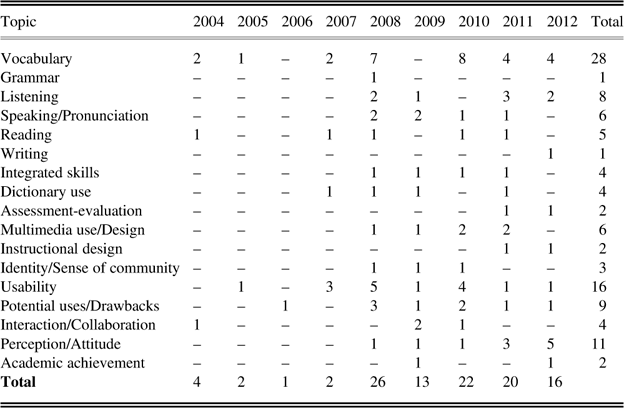
No published studies that met the criteria of this study were found for 2000 to 2003, and only a limited number of studies (n=9) were published between 2004 and 2007 (see Table 1), which actually means that the MALL studies appear outside of SSCI journals, in conference proceedings, project reports, academic dissertations, and so forth (Burston, Reference Burston2013, Reference Burston2014b). However, an increase in publications occurred in the year 2008 (n=13), and the trend reached a peak in 2012 (n=14). This significant change coincided with a special issue of ReCALL in 2008, which provided an orientation for the developing field of MALL (Kukulska-Hulme, Reference Kukulska-Hulme2009; Stockwell, Reference Stockwell2010). The increasing number of papers after 2008 confirms that interest in this area has been growing over the past ten years. This is similar to an observed trend in the field of mobile and ubiquitous learning (Hung & Zhang, Reference Hung and Zhang2012; Hwang & Tsai, Reference Hwang and Tsai2011; Wu et al., Reference Wu, Wu, Chen, Kao, Lin and Huang2012).
Distribution of commonly investigated topics in the MALL studies from 2004 to 2012

3.1.1 Commonly investigated topics in the MALL studies
The findings demonstrate that the topics covered are varied among the MALL studies, though teaching vocabulary was the most commonly addressed topic with 28 studies. This topic’s popularity was followed by the topics of the usability of developed systems for MALL (sixteen studies), and perceptions and attitudes towards MALL (eleven studies). There was only one study which dealt with grammar and writing. These findings support those from m-learning review studies. For example, most studies of m-learning focused on the topic of effectiveness as the primary research purpose; the next most popular topic was m-learning system designs – in other words, project implementations (Burston, Reference Burston2013, 2014; Wu et al., Reference Wu, Wu, Chen, Kao, Lin and Huang2012). Our review revealed a similar tendency among researchers to examine the effectiveness of MALL systems on specific language learning topics such as language skills and areas, as well as learners’ perceptions and attitudes towards MALL (Cheung & Hew, Reference Cheung and Hew2009; Viberg & Grönlund, Reference Viberg and Grönlund2012). Another striking parallel of our review with other reviews in the field is the popularity of the topic “the need to generate instructional design strategies and pedagogical frameworks for curriculum integration” (Burston, 2014; Cheung & Hew, Reference Cheung and Hew2009; Hung & Zhang, Reference Hung and Zhang2012; Kukulska-Hulme & Shield, Reference Kukulska-Hulme and Shield2008; Viberg & Grönlund, Reference Viberg and Grönlund2012). Last but not least, our review pointed out that grammar and writing skills tended to be neglected in the MALL studies, which mirrors the distribution of language learning topics selected in the reviews of Ya et al. (Reference Ya, Ching and Chih2013) and Burston (Reference Burston2014a).
Concerning changes in the most frequently studied subjects across these years, Table 1 shows that teaching vocabulary remained a popular research focus throughout this period. Vocabulary acquisition is the most frequent target (Burston, Reference Burston2014b), indicating that using mobile devices to learn vocabulary seems a successful application (Ya et al., Reference Ya, Ching and Chih2013). Apart from vocabulary, earlier studies that discussed the use of mobile devices in learning environments generally focused on investigations of mobile system usability and reading skills. Starting in 2008, several new subjects emerged in MALL studies. Listening, speaking and pronunciation, multimedia use, and learners’ perceptions and attitudes became prominent areas of focus. For instance, using MALL for speaking skills has become a potential research focus because voice/speech recognition has recently entered the realm of mature technologies (Ya et al., Reference Ya, Ching and Chih2013). Mobile device use in language learning which emphasizes continuity or spontaneity of access, the generation of a strong sense of learning community, and interactions across different contexts of use were also addressed more frequently after 2008, as was also noted by Kukulska-Hulme and Shield (Reference Kukulska-Hulme and Shield2008) in their overview of MALL. They mentioned that there were very few studies on learner collaboration or communication, and stated that interest in the use of m-learning for language learning purposes caused several researchers to attempt to describe the potential of mobile devices to create language learning communities whose members were separated by distance for some time when they visited a target culture. Table 1 also shows that researchers appear to have considered the topics of writing, assessment and evaluation, and instructional design in recent years.
3.1.2 Commonly addressed theoretical frameworks in the MALL studies
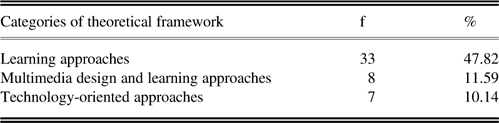
A wide range of theoretical frameworks were addressed, but most of them appeared only in a limited number of papers. The studies that did not specify any theoretical framework constituted 37% (n=26) of the MALL studies. The remaining 63% were classified into three categories: (i) learning approaches, (ii) multimedia design and learning approaches, and (iii) technology-oriented approaches (Table 2). The theories and models addressed in the MALL studies often originated from grand theories of learning, including constructivism, social constructivism, socio-cultural theory, and situated learning theory. Among the MALL studies, 33 (47%) based their research on learning approaches that included collaborative learning, interactive learning, ubiquitous learning, informal learning, task-based learning, and peer-assisted learning. In eight studies (11%), multimedia design and learning approaches were employed, including dual-coding theory, cognitive theory of multimedia learning, cognitive load multimedia design principles, and learning memory cycle. To investigate diverse roles of mobile technology and various user reactions including user perceptions, resistance to change, or attitudes, the technology acceptance model (TAM) and the unified theory of acceptance and use of technology (UTAUT) were applied in seven studies (10%).
Distribution of commonly addressed theoretical frameworks in the MALL studies
Most of the MALL studies were based on a theoretical framework which was consistent with the topic addressed. However, a significant number did not specify any particular theoretical framework to support the research. This implies that these studies lacked a connection to theory and suggests possible methodological weaknesses in the studies. This has been referred to as “lack of linkage to theoretical foundations” and is regarded as a major problem in research studies which focus on instructional technology (Reeves, Reference Reeves2000: 4). One reason why researchers may have neglected the theoretical bases for their studies may be the newness of the field (i.e. its recent emergence) (Webster & Watson, Reference Webster and Watson2002). Also, the absence of conceptual frameworks for mobile learning and theoretical models specific to the field, which clearly distinguish the theory of mobile learning from other learning theories and approaches, indicates that MALL is an emerging research field undergoing a rapid evolution (Viberg & Grönlund, Reference Viberg and Grönlund2012).
3.1.3 Preferred learning environments in the MALL studies
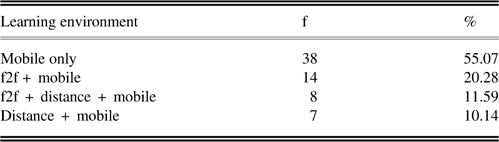
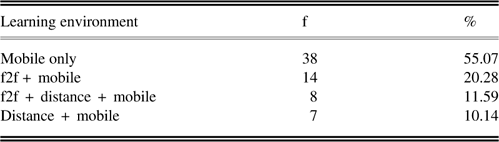
Two of the studies (3%) did not specify any learning environments. In some studies, more than one learning environment was used. Table 3 shows that 38 studies (55%) established “mobile learning environments” and used mobile devices for online access to learning. Both mobile learning environments and traditional face-to-face (f2f) learning environments appeared in fourteen studies (20%). Eight studies (12%) employed a combination of mobile, f2f, and distant learning environments. Seven studies (10%) used mobile learning environments together with a distant learning environment that required the use of devices other than mobile devices (e.g. a desktop PC) to access learning from a distance (online learning, e-learning, etc.). These findings indicate a general inclination to use mobile only or distance plus mobile learning settings, and can be attributed to a desire to make use of the distance facilities of mobile devices for language learning. In other words, due to the “anywhere, anytime” appeal of mobile device usage, MALL implementations designed for out-of-class applications have been dominant among MALL studies (Burston, Reference Burston2014a: 105).
Distribution of learning environments in the MALL studies
3.2 Technology/Media uses in the MALL studies
3.2.1 Commonly used mobile devices in the MALL studies
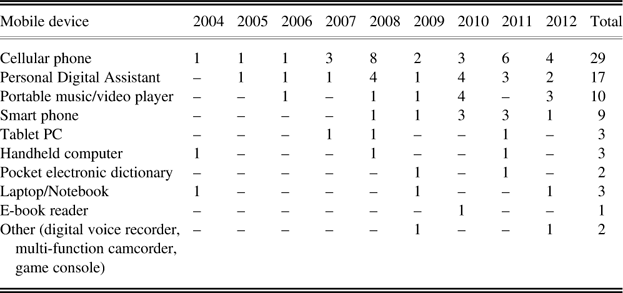
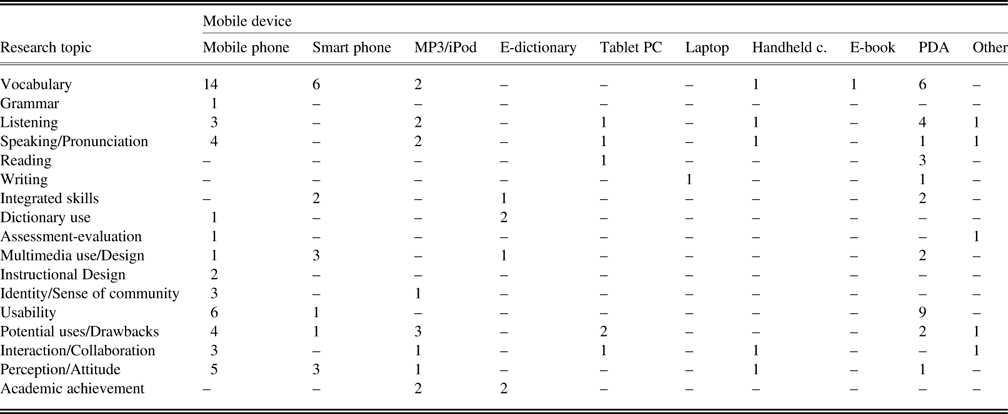
Two of the MALL studies (3%) did not specify any mobile devices; the others are shown in Table 4 along with their distribution by research topic. Twenty-nine studies (41%) employed cell phones, and seventeen (24%) used PDAs. The least used mobile devices were electronic pocket dictionaries (two studies, 3%) and e-book readers (one study, 1%). Digital voice recorders, multi-function mini-camcorders, and handheld game consoles were categorized as “other” and appeared in two studies (3%).
Distribution of commonly used mobile devices in the MALL studies
The frequent use of cell phones in MALL studies is similar to Burston’s (Reference Burston2014b) findings as well as Pęcherzewska and Knot’s (Reference Pęcherzewska and Knot2007) and Wu et al.’s (2012) findings concerning m-learning in general. Aside from mobile phones, PDAs and portable music/video players were also very common. But the frequency of their use across the years is lower than for cell phones, which is again similar to the m-learning projects funded by the European Union since 2001 (Pęcherzewska & Knot, Reference Pęcherzewska and Knot2007). In those projects, mobile phones are the most prevalent m-learning technology, followed by PDAs, personal listening devices (e.g. iPods), and other handheld devices (Kukulska-Hulme & Shield, Reference Kukulska-Hulme and Shield2008). In addition, the choice of device has changed over time with the evolution of technology. For instance, the usage of PDAs has decreased as the technological sophistication of mobile phones has increased and smart phones have now replaced PDAs completely in MALL studies (Burston, Reference Burston2014a). Similarly, tablets, pocket electronic dictionaries, and e-book readers have recently been used more frequently, indicating that researchers have begun to expand their definition of mobile devices and varied the types of mobile devices used as teaching tools. As in the Horizon Report of 2013 (Johnson, Adams Becker, Cummins, Estrada, Freeman & Ludgate, Reference Johnson, Adams Becker, Cummins, Estrada, Freeman and Ludgate2013) which mentions sample applications in K-12 education studies of emerging technologies such as smart phones, tablets, mobile apps, and electronic books, these emerging technologies also appeared in MALL studies.
Regarding the distribution of mobile devices by research topic (Table 5), it is clear that many of the MALL studies employed cell phones to teach vocabulary and to test the usability of mobile devices. Although cell phones were originally developed for oral communication, the MALL studies failed to make significant use of this capability (Kukulska-Hulme & Shield, Reference Kukulska-Hulme and Shield2008). Table 5 also shows that reading skills were taught with Tablet PCs and PDAs, and writing skills with laptops and PDAs. This implies that increased screen size became a significant issue in these studies. Additionally, cell phones and portable music/video players were utilized in MALL studies to promote identity, and a sense of community and connectedness, and also to reveal the potential uses and drawbacks of mobile devices, now that they are readily available for communication and entertainment.
Distribution of mobile devices used in the MALL studies by research topic
3.2.2 Commonly used content transport and delivery technologies in the MALL studies
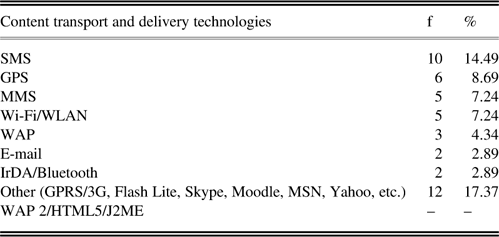
Almost half of the studies (n=34, 49%) did not specify specific content transport and delivery technologies. As seen in Table 6, among the remaining studies, SMS was the preferred content transport and delivery technology (ten studies, 14%). GPS was used in six studies (9%); and MMS and Wi-Fi/WLAN in five studies (7%) to transport and deliver the content. The twelve technologies that featured in only a single study were grouped together as ‘other’, and represented 17% of all studies. WAP 2, HTML5, and J2ME were not seen in any of the studies.
Distribution of commonly used content transport and delivery technologies in the MALL studies
3.2.3 Multimedia use in the MALL studies
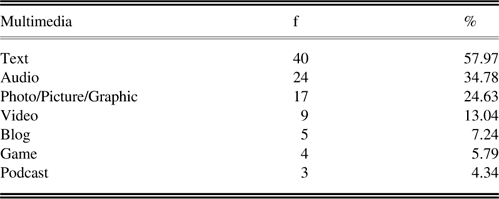
Among the MALL studies, there is overlap in the use of multimedia since some studies used more than one type. Whereas 11 studies (16%) did not specify any multimedia to exhibit the content, 40 (58%) used text, 24 (35%) employed audio, and 17 (25%) presented content through pictures/graphics. These types of multimedia were followed by video in nine studies (13%) and blogs in five studies (7%). Games (n=4, 6%) and podcasts (n=3, 4%) were the least preferred multimedia types in the MALL studies (Table 7).
Distribution of multimedia use in the MALL studies
3.3 Methodologies in the MALL studies
3.3.1 Types of research in the MALL studies
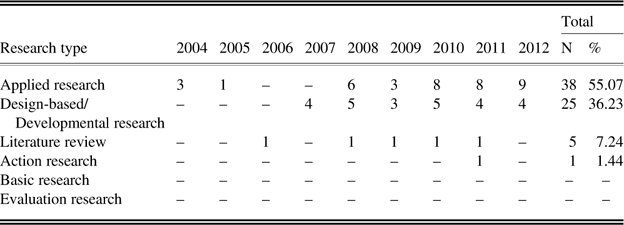
The findings show that applied research that is undertaken to provide a solution to specific social phenomena (Miller & Salkind, Reference Miller and Salkind2002) and to lead to the development of interventions (Johnson & Christensen, Reference Johnson and Christensen2004) was used in 38 studies (55%). As Table 8 shows, applied research was the preferred type throughout this period. The next most popular type was design-based research (DBR)/developmental research (25 studies, 36%), starting in 2007. The popularity of DBR or developmental research in MALL studies is understandable, since DBR or developmental research helps to create and extend knowledge about designing and testing innovative learning environments (Design-Based Research Collective, 2003). This has been a growing area in the educational technology field as well as in education in general for two decades (Oh & Reeves, Reference Oh and Reeves2010). Especially in researching and designing technology-enhanced learning environments, DBR has demonstrated its potential as a methodology (Wang & Hannafin, Reference Wang and Hannafin2005). Thus DBR has been increasingly used in technology-mediated studies because it facilitates the “integration of known and hypothetical design principles with technological affordances” (Reeves, Herrington & Oliver, Reference Reeves, Herrington and Oliver2005: 103). In contrast to the frequent use of applied research and DBR/developmental research, there were very few literature review studies (n=5, 7%) which examined language learning issues using certain mobile devices or overview MALL studies designed to reveal the potential of specific mobile devices for language learning. Action-research was the least preferred research type in the MALL studies with only one study. Basic research that is concerned with seeking new knowledge about social phenomena, hoping to establish general principles and theories with which to explain them and evaluation research assessing outcome of prevailing practices applied to social phenomena (Miller & Salkind, Reference Miller and Salkind2002) did not feature at all in the MALL studies reviewed. This may be attributed to the lack of investigation into different pedagogical approaches and into the evaluation of language educational programs delivered via mobile devices. This finding is corroborated by the study of Wingkvist and Ericsson (Reference Wingkvist and Ericsson2011); in a survey of published research on m-learning, they investigated 114 mLearn conference proceedings and found that there were few papers that used basic or evaluation research. This indicates the lack of maturity of this research field.
Distribution of research types in the MALL studies
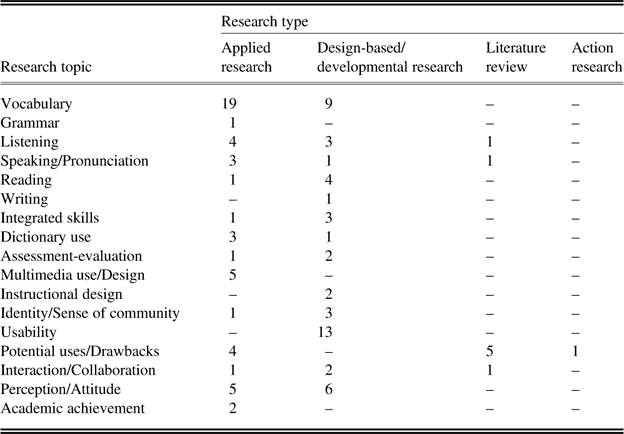
Regarding the distribution of research types by research topics addressed in the MALL studies, Table 9 shows that topics such as vocabulary, listening, speaking/pronunciation, integrated skills, dictionary use, assessment and evaluation, identity/sense of community, interaction/collaboration, and perception/attitude were investigated in both applied and design-based/developmental research studies. Several studies featured design-based/developmental research methods to examine topics of writing, instructional design, or usability, while others conducted design-based/developmental research methods to work on grammar, multimedia use, potential uses and drawbacks of mobile devices, and academic achievement. In literature reviews, potential uses and drawbacks of mobile devices, listening, speaking/pronunciation, and interaction/collaboration were frequently discussed. Potential uses and drawbacks of mobile devices were also addressed in one action-research study.
Distribution of research types by research topic
3.3.2 Preferred research designs in the MALL studies
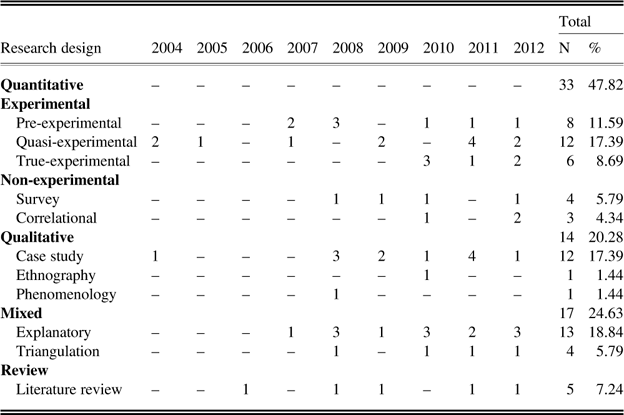
Among the research designs/methods presented in Table 10, quantitative research designs were prominent in the MALL studies (33 studies, 48%), followed by qualitative research designs (14 studies, 20.28%). This corresponds with findings in other m-learning studies (Cheung & Hew, Reference Cheung and Hew2009; Viberg & Grönlund, Reference Viberg and Grönlund2012; Wu et al., Reference Wu, Wu, Chen, Kao, Lin and Huang2012) and in other technology-assisted learning contexts (Bozkaya, Aydın & Göztepe, 2012; Göktaş et al., Reference Göktaş, Küçük, Aydemir, Telli, Arpacık, Yıldırım and Reisoğlu2012; Zawacki-Richter, Bäcker & Vogt, Reference Zawacki-Richter, Bäcker and Vogt2009). The next most popular was mixed-method studies (seventeen studies, 25%), which are particularly important as they combine quantitative and qualitative methods to produce solutions for educational problems and issues. There has been a recent tendency toward the use of mixed studies in the field of educational technology (Johnson & Onwuegbuzie, Reference Johnson and Onwuegbuzie2004; Sözbilir & Kutu, Reference Sözbilir and Kutu2008), which is also evident in the MALL studies. There were fourteen qualitative studies (20%), confirming that in international publications, though quantitative methods tend to be preferred (Hannafin & Young, Reference Hannafin and Young2008; Ross & Morrison, Reference Ross and Morrison2008; Ross, Morrison & Lowther, Reference Ross, Morrison and Lowther2005) and the challenges of producing high quality qualitative studies may be a deterrent (Harry, Sturges & Klinger, Reference Harry, Sturges and Klinger2005), qualitative methods are growing in popularity (Kelly & Lesh, Reference Kelly and Lesh2000; Masood, Reference Masood2004). Literature reviews (five studies, 7%) were few in number, indicating that MALL is still a very new field, which is composed mainly of empirical studies that attempt to create its field-specific theoretical background. Regarding research designs, most of the studies with an experimental research design were carried out using pre- or quasi-experimental methods. This was expected, since MALL studies are mainly performed by researchers who teach one or more classes. Also, restrictions due to available populations and limitations imposed by the type of study often eliminate the possibility of using randomly assigned treatment and control groups. Accordingly, the small number of true-experimental research studies is understandable. However, the frequent use of pre- or quasi-experimental methods may not adequately reveal the full impact of mobile devices on learning outcomes. Burston (Reference Burston2014b) draws attention to inadequate research designs such as a host of unacknowledged and uncontrolled variables, and technocentricity that is largely responsible for the failure of even the most recent MALL projects to exploit communicative affordances of mobile devices. According to Tallent-Runnels, Thomas, Lan, Cooper, Ahern, Shaw and Liu (Reference Tallent-Runnels, Thomas, Lan, Cooper, Ahern, Shaw and Liu2006), without a control group, differences found between the pre- and post-test results may not necessarily be attributable to the use of mobile devices. The existence of a control group and the use of random assignment might strengthen such studies considerably. There were also a few non-experimental research studies, which used survey and correlational methods. Although surveys were the primary research method in m-learning studies, followed by experimental research methods (Cheung & Hew, Reference Cheung and Hew2009; Wu et al., Reference Wu, Wu, Chen, Kao, Lin and Huang2012), the use of surveys in MALL studies is very limited. This implies that researchers give priority to determining the possible causes of the relationships among the variables rather than to defining them. Concerning qualitative research, it seems that no methods in this category were used apart from case studies, ethnography, and phenomenology methods. Regarding mixed research designs, it appears that the explanatory method was the most common. It is also important to note that researchers preferred the literature review method over meta-analyses.
Distribution of research designs by year
Table 10 and Figure 1 also show trends in the research designs/methods employed in the MALL studies. It is clear that quantitative studies continued to be published throughout the period 2004 to 2012, while mixed-methods studies appeared only more recently, starting from 2007. This finding is similar to the tendency toward the use of mixed methods in other educational technologies studies (Bozkaya et al., Reference Bozkaya, Aydın and Kumtepe2012; Johnson & Onwuegbuzie, Reference Johnson and Onwuegbuzie2004; Zawacki-Richter et al., Reference Zawacki-Richter, Bäcker and Vogt2009).
Trends in research methods used in the MALL studies from 2004 to 2012
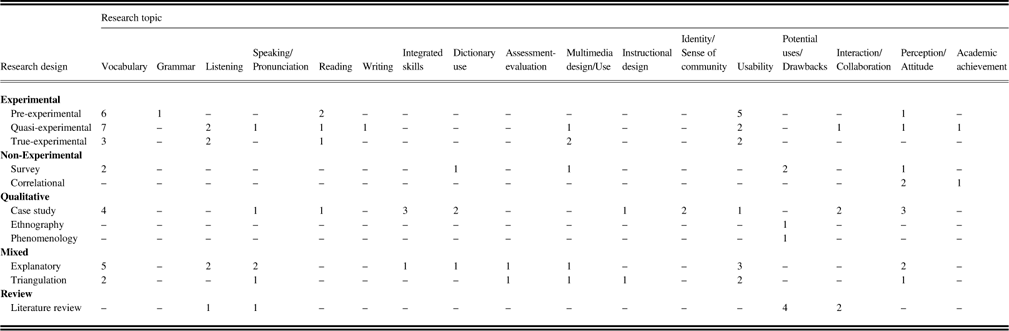
Table 11 shows that the most studied topics were related to language learning in the pre- and quasi-experimental studies, case studies, and explanatory studies. The topics of vocabulary, speaking/pronunciation, dictionary use, usability, and perceptions/attitudes were investigated via quantitative, qualitative, and mixed-methods research. Similarly, studies focusing on listening and multimedia use/design tended to feature quantitative and mixed research designs. The topics of integrated skills and instructional design were coupled with qualitative and mixed research designs, whereas the topics of reading, potential uses and drawbacks of mobile devices, and interaction/collaboration were investigated in both quantitative and qualitative studies. It is also important to note that the potential uses and drawbacks of mobile devices and interaction/collaboration topics also were covered in literature review studies.
Distribution of research topics by research design patterns
4 Conclusion
Prior literature review-based studies on m-learning provided valuable insights for this new field of study, by preparing a base which is currently being established for m-learning research methodology. This study also aims to present a comprehensive analysis of the m-learning studies in language learning, revealing the trends and gaps in research topics, theories and methodologies as well as in learning environments, technology and multimedia use, and help to direct its future.
The results here revealed that the major topics in MALL were teaching vocabulary and the usability of the MALL delivery environment. The writing process and grammar acquisition were addressed only in a limited number of publications. Also, the topics of pedagogical frameworks, changes in individuals’ learning strategies and styles when employing mobile devices in language learning, exploration of individuals’ cognitive processes through problem solving, investigations and other inquiry-based approaches involving mobile devices, in-service training, special education, and professional development have not been examined. The need for solid theoretical bases that will help to establish a link between theory and practice has emerged from analysis of these MALL studies. There is also a need for the foundation of the pedagogical and theoretical orientations of MALL practices, leading to the development of mobile learning theory. The diverse range of mobile devices, content transport and delivery platforms, and multimedia presentations that are available has been continually expanding, giving way to the exploitation of their potential educational benefits with the intention of determining how they can facilitate deep reflection, interaction, communication, and cooperation anywhere and anytime.
MALL research has remained limited by its methodological approaches. Thus, in line with the tendency to use DBR as a tool to study the use of educational technologies in authentic settings, the methodological affordances of DBR in MALL could promise future successful investigations in the area. Correlational and comparative studies that enable the exploration of the relationship between categorical (demographic) variables and MALL components as well as qualitative and mixed-method studies have yet to be realized. Undertaking methodologically sound, statistically reliable studies that account for more than just technology usage will realize the pedagogical potential of recent and innovative MALL implementations. Lastly, other analysis studies, including document analysis, citation analysis, and meta analysis conducted on a regular basis could be of great significance in reporting future trends and patterns in the field.
5 Limitations and suggestions for future research
Ultimately, this study provides an important reference base for future research in the field of MALL with the identification of the most widely examined areas and issues. Like all studies, the present paper has some limitations, each of which provides a solid basis for future studies. First of all, the current review is limited by the journals included. The increasing number of publications in MALL poses a major challenge to ensuring an extensive and detailed search. For this reason, well-defined criteria were adopted for the selection of journal articles. Considering the range of quality, the study opted to refer only to articles in journals listed in SSCI due to their higher impact in the field. But this preference also acknowledges the limitations of excluding valuable contributions in other prestigious journals such as the CALICO Journal, which has been the focus of a number of recent m-learning studies and other related conference proceedings such as mLearn etc. Thus, future research may examine MALL studies in other journals, conference proceedings, project reports, and academic dissertations to provide additional information on background and the current status of MALL. The study is also limited by the search terms, research questions and the date range of the papers published. Although the focus on 2000–2012 and diverse research questions did ensure that the review covered almost the entire corpus of recent research in detail, an examination of articles produced within a larger date range, or of articles with different areas of research focus would reflect even wider trends of development and changes in MALL studies over time. In that sense, future studies may contribute to a deeper understanding of MALL by providing more information on whether it is commonly a standalone modality or part of established courses/programs with sound pedagogy.
Appendix A
Titles of the journals covered